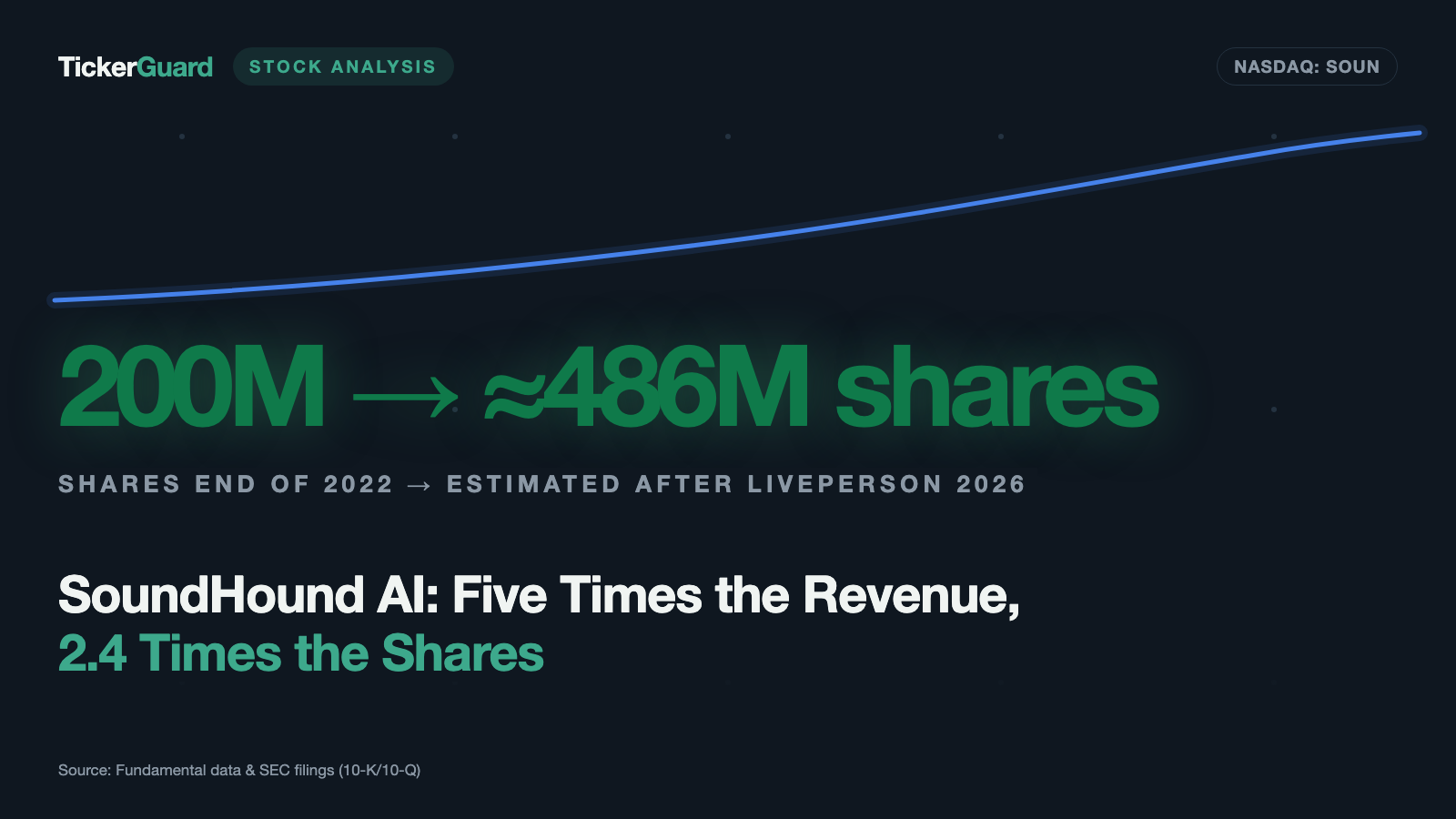
SoundHound AI: Five Times the Revenue, 2.4 Times the Shares
Since its record close of $24.23 in December 2024, SoundHound AI stock has lost about 80 percent. Revenue grew more than fivefold from 2022 to 2025, while the share count rose about 2.4-fold by our estimate — most recently through the LivePerson acquisition, paid for in stock. Whether $4.89 (closing price on October 15, 2026) is cheap also depends on how many shares are sharing the cake today.
 Thomas Mücke
Founder & Publisher
Thomas Mücke
Founder & Publisher
As of Today
As of: October 16, 2026
- Closing price
- 4.70 $ -3.50%
- Market Capitalisation
- 2.1 $B
- Growth Score
- 3/10
- AAQS
- 5/10
Price change since October 15, 2026: -3.9%
This analysis has a cut-off date. The Stock Guard tells you when something material changes in the numbers. Reserve your free spot
Chart
Interactive price chart (TradingView).
52-week range: 4.50 $ to 21.40 $ · Last price: 4.70 $ (As of: October 16, 2026)
Note: pure fact-based analysis, not investment advice and not a solicitation to buy or sell. All figures without guarantee.
There is one number many SoundHound AI investors carry around in their heads: $24.23. That is where the stock closed on December 26, 2024, at the peak of the excitement for anything that sounded like artificial intelligence. On October 15, 2026, it closed at $4.89, about 80 percent lower. If you know the old number, the new one almost automatically feels cheap. Psychologists call this the anchoring effect: in a famous 1974 experiment, Amos Tversky and Daniel Kahneman showed that people let a number they happened to see beforehand steer their estimates, even when that number came from a wheel of fortune. The old high is exactly such a wheel. It tells you what other people were once willing to pay, not what the business is worth.
So let's make a deal: before you compare today's price with the 2024 peak, let's read together what SoundHound AI (NASDAQ: SOUN) has filed with the U.S. securities regulator, the SEC — the annual reports on Form 10-K for 2025 and 2024, the quarterly report on Form 10-Q for June 30, 2026, and every current report (8-K) through mid-October 2026, including the acquisition of LivePerson on September 4, 2026.
The central tension of this analysis: SoundHound really is growing fast; revenue doubled in 2025. But much of that growth was bought, often paid for with its own stock, and the business still burns cash. Whether this turns into a profitable company is one question. Whether you need an anchor to judge it is another.
What SoundHound AI actually does
SoundHound was founded in Silicon Valley in 2005, and many people know it for an app that identifies songs when you hum them. The app still exists but hardly matters anymore: in the first half of 2026 it generated $0.1 million in ad revenue. The real business is voice AI for companies. Put simply, SoundHound builds the ears and the language understanding that a car, a TV, a drive-thru lane or a customer service line needs to talk with people — under the customer's own brand, not as someone else's assistant. The annual report puts it this way:
“We are a global leader in conversational intelligence, offering independent Voice AI solutions that enable businesses to deliver high-quality conversational experiences to their customers.”
— SoundHound AI, Inc., annual report on Form 10-K for 2025, Item 1 (Overview)
The money comes from three sources. Product royalties are paid by automakers and device makers per unit sold or per use; in the first half of 2026 they came to $23.2 million. Service subscriptions — phone ordering for restaurants, drive-thru order taking, AI agents for banks, insurers and hospitals — brought in $82.8 million. Since May 2026, SoundHound has bundled everything into a platform called OASYS, where customers build their own AI agents that handle orders, appointments and requests on their own. Named customers include Stellantis, Hyundai, Five Guys, IHOP and Jersey Mike's.
A large part of this business was acquired: SYNQ3 (restaurant phone ordering, January 2024), Amelia (enterprise AI agents, August 2024), Interactions (customer service, September 2025) and most recently LivePerson (chat and messaging customer service, September 2026). LivePerson makes the company considerably bigger again: on its own it generated $243.7 million of revenue in 2025, more than SoundHound itself with $168.9 million.
How tough the market is, SoundHound spells out in its own risk factors:
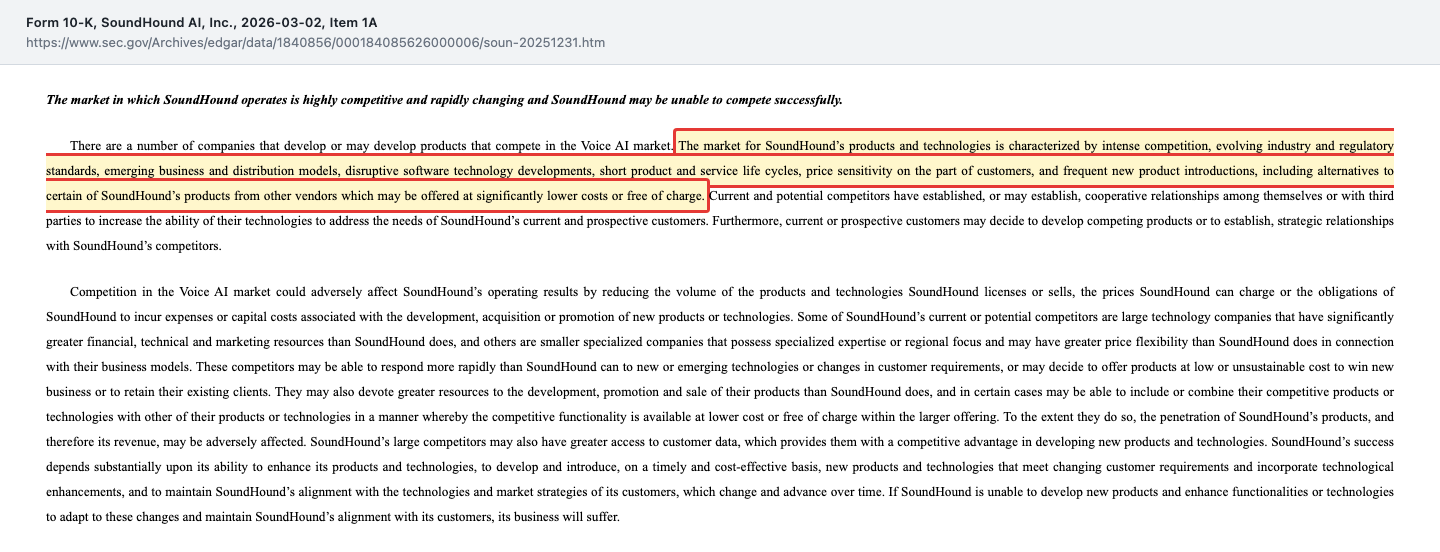
“The market for SoundHound’s products and technologies is characterized by intense competition, evolving industry and regulatory standards, emerging business and distribution models, disruptive software technology developments, short product and service life cycles, price sensitivity on the part of customers, and frequent new product introductions, including alternatives to certain of SoundHound’s products from other vendors which may be offered at significantly lower costs or free of charge.”
— SoundHound AI, Inc., annual report on Form 10-K for 2025, Item 1A (Risk Factors)
We looked at how an established customer service software company copes with AI pressure in our analysis of Five9 — a useful comparison, because with LivePerson SoundHound is moving right into that field.
The road to Nasdaq: an almost empty SPAC
The listing is part of the story. SoundHound did not go public through a classic IPO but through a shell company, a so-called SPAC — an empty listed vehicle that raises money in order to buy a company later. This shell was called Archimedes Tech SPAC Partners Co.; on April 26, 2022 it merged with SoundHound, and since April 28, 2022 the stock has traded on Nasdaq as SOUN and the warrants as SOUNW. The SEC database still lists “Archimedes Tech Spac Partners Co” as a former name under the same identifier. How much money the shell actually brought along is spelled out in the annual report for 2022:
“Cash proceeds of the Business Combination were funded through a combination of $5.4 million in cash held in trust by ATSP (following satisfaction of redemptions by public stockholders) with 532,050 shares of SoundHound AI Class A common stock remaining outstanding, and $113.0 million in aggregate gross proceeds from PIPE investors in exchange for 11,300,000 shares of SoundHound Class A common stock that closed substantially contemporaneously with the Closing of the Business Combination.”
— SoundHound AI, Inc., annual report on Form 10-K for 2022, Item 7 (Business Combination)
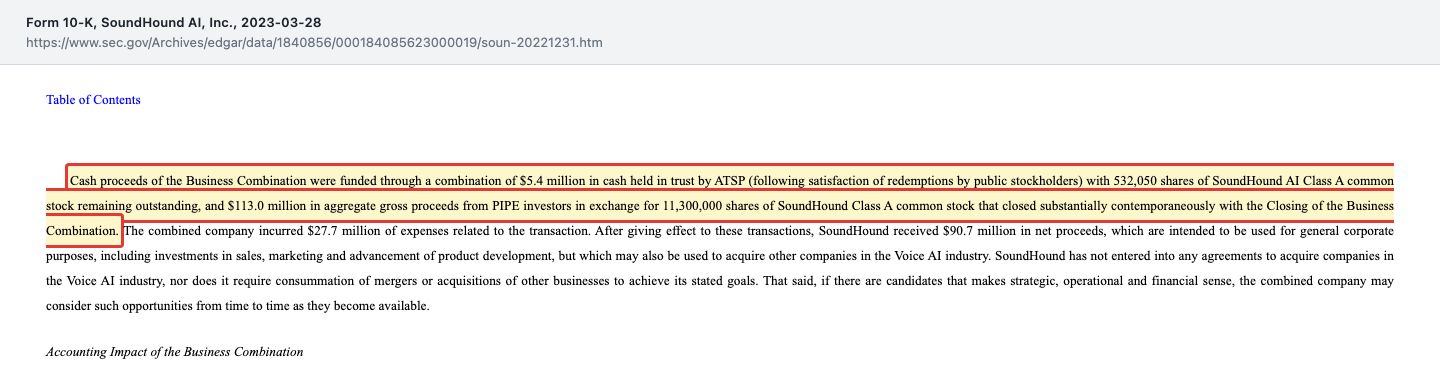
Most of the shell's investors, in other words, preferred to take their money back rather than become SoundHound shareholders. The actual capital of $113.0 million came from large investors in an accompanying private placement (PIPE); transaction costs were $27.7 million, according to the annual report. Such a start was common for SPAC listings of that era; we described similar patterns in our analysis of BigBear.ai. On the share structure: each Class B share carries ten votes. The 32.5 million Class B shares represented about 8 percent of the voting shares on the record date of the 2026 annual meeting, but about 45 percent of the votes. The annual report flags this itself as a risk: the structure concentrates voting control with the Class B holders and limits other shareholders' influence, for example on director elections or a sale of the company.
Company history for investors
-
2005
Founded in Silicon Valley
SoundHound starts out with music and speech recognition; its co-founders include Keyvan Mohajer (now CEO) and James Hom. For shareholders, the origin of its in-house voice AI.
-
2022
Listing through a SPAC
Merger with Archimedes Tech SPAC on April 26, trading on Nasdaq from April 28. After redemptions only $5.4M arrives from the trust; institutional investors bring $113.0M.
-
2024
SYNQ3 and Amelia acquired
Two acquisitions for cash and stock with earn-out promises. The rising stock makes remeasurement expensive: net loss of $350.7M.
-
2025
Revenue doubles, Interactions bought
Revenue of $168.9M (+99%), Interactions acquired. The small $14.0M net loss rests on a $163.1M book gain.
-
2026
LivePerson paid in stock
Deal closes on September 4; noteholders receive 36.9M shares, plus an ATM program of up to $300M. Close on 10/15: $4.89.
How the stock landed on our desk
The trigger was a small uptick in Reddit mentions in our in-house stock scanner (snapshot of October 16, 2026, based on ApeWisdom), but the real reason to take a closer look is a number from the short-interest data: according to fundamental data (retrieved October 16, 2026), about 159 million shares were recently sold short, meaning borrowed and sold by investors betting on falling prices. That equals about 39 percent of the freely tradable Class A shares — almost four out of every ten shares that trade freely at all. At the previous reporting date, the figure was even slightly higher at about 165 million. To buy back all of these positions, short sellers would need almost eight trading days on paper, if they bought up the entire average daily volume each day. Average here means all daily volumes added up and spread evenly across the days; a few very busy days pull it up. Anyone selling short is putting money on the idea that expectations for SoundHound are overblown.
Since trading began in April 2022, the stock has swung wildly: its lowest close was $0.97 on December 22, 2022, its highest $24.23 two years later. Lately the direction has been down: on August 31, 2026 it closed at $7.16, according to the prospectus supplement, and on October 15 at $4.89. Remember this line: when this many shares are sold short, a lot of money is betting that the story you are reading will not work out.
The numbers over the years — a fair look
First, what genuinely impresses. Revenue grew more than fivefold in three years: from $31.1 million (2022) through $45.9 million and $84.7 million to $168.9 million in 2025, up 99 percent in a single year. In the second quarter of 2026, revenue reached $61.9 million, 45 percent more than a year earlier and a record. On August 5, 2026, SoundHound raised its 2026 revenue outlook to $230 million to $260 million — still excluding LivePerson; a new outlook for the combined company has been announced. The June 30, 2026 balance sheet shows $202.8 million in cash and no debt. And the customer base is broad: in the first half of 2026, no single customer accounted for more than 10 percent of revenue.
Now the other side. The business burns cash year after year, and growth has changed little about that so far:
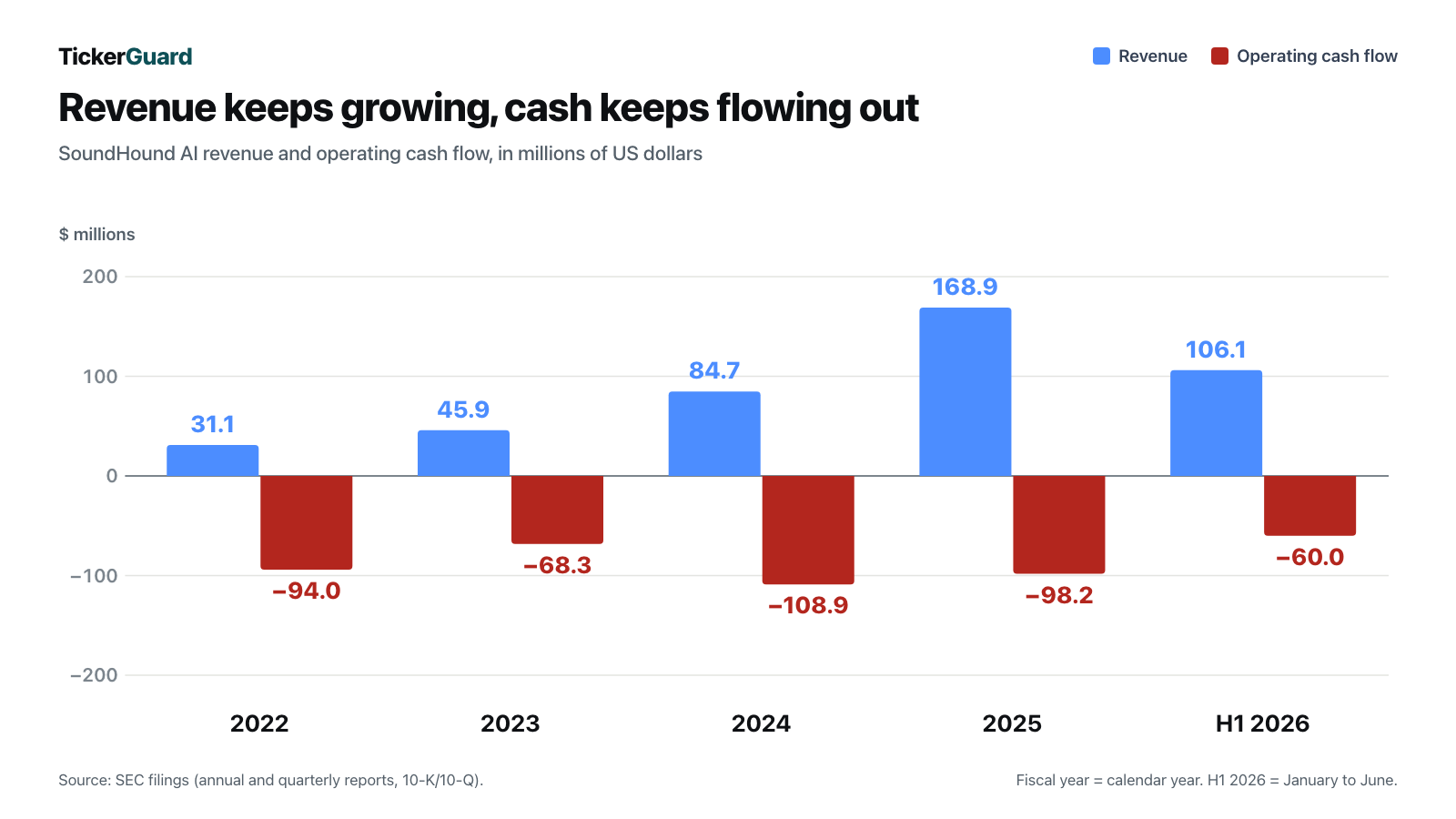
Operating cash flow — the cash that actually comes in or goes out through day-to-day business — was minus $94.0 million in 2022, minus $68.3 million in 2023, minus $108.9 million in 2024 and minus $98.2 million in 2025. Revenue more than quintupled over that period; the cash outflow stayed. In the first half of 2026, $106.1 million of revenue came with an outflow of $60.0 million; in the second quarter alone, about $33.7 million flowed out. One large cost item does not even show up in that cash drain, because it is not paid in cash: in 2025, SoundHound booked $80.6 million of compensation paid in stock, according to the annual report, almost half of its revenue. Stock-based compensation costs no cash, but it costs you, the shareholder, a slice of ownership: spread across the 422.6 million shares at the end of 2025, that is about 19 cents per share in a single year ($80.6 million divided by 422.6 million). Measured against our estimated market value of about $2.4 billion as of October 15, 2026 (already including LivePerson), SoundHound's 2025 stock-based compensation alone, before LivePerson, equals about 3.4 percent of the whole company. And gross margin — what is left of revenue after direct costs — has fallen: from 75 percent (2023) to 49 percent (2024) and 42 percent (2025). According to the annual report for 2024, the drop from 75 to 49 percent was mainly due to the acquisitions of Amelia and SYNQ3, including SYNQ3's lower-margin call center business, and the amortization of the intangible assets that came with them. Keep this picture in mind: fast growth is not yet a business that pays for itself.
What the filings say — the uncomfortable truths
What follows is in the filings themselves. You just have to keep reading into the notes and the current reports.
Uncomfortable truth No. 1: most of the growth was bought
Revenue growth of 99 percent sounds like a product that sells itself. The annual report explains the jump more soberly:
“The increase of $77.2 million in service subscription revenue, primarily based in the Americas, was driven by the contribution of revenue from acquisitions.”
— SoundHound AI, Inc., annual report on Form 10-K for 2025, Item 7 (Results of Operations)
Of the $84.2 million revenue increase in 2025, $77.2 million came from the subscription segment, and there, according to the report, acquisitions were the driver. Product royalties grew organically by $6.9 million. The quarterly report for June 30, 2026 leaves a second trail: Interactions, acquired in September 2025, accounted for about 26 percent of revenue in the first half of 2026. Without it, first-half revenue would have grown by only about 9 percent instead of 48 percent (our rough calculation based on that figure). That is no deception; acquisitions are a legitimate path. But it is a different path from the one the headline “revenue doubled” suggests — and it has a price that is paid in stock.
Uncomfortable truth No. 2: the small 2025 loss is an accounting effect
In 2025, SoundHound reported a net loss of just $14.0 million, compared with $350.7 million in 2024. That looks like a turnaround. The reason lies in a quirk of the acquisitions: the sellers were promised additional payments if certain revenue targets were met (an “earn-out”). These promises sit on the balance sheet as a liability and are remeasured every quarter. The part tied to the share price is mainly the one for Amelia: it is payable only in stock, up to 16.8 million shares. If the stock rises, that liability and the loss grow; if it falls, the company books a gain. The other promises are small or paid in cash: for SYNQ3, up to $0.8 million in cash and 1,434,936 shares; for Interactions, cash only, up to $25.0 million, depending on revenue targets for 2026 and 2027 and on the renewal of a contract with a specific customer by March 31, 2026 — that part does not move with the stock. In 2024 the stock soared, and remeasurement cost $222.7 million, $211.9 million of it for Amelia. In 2025 it fell, and SoundHound booked a gain of $163.1 million; according to the annual report, $157.6 million of that came from Amelia and $6.9 million from SYNQ3, while the Interactions promise caused a $1.3 million expense.
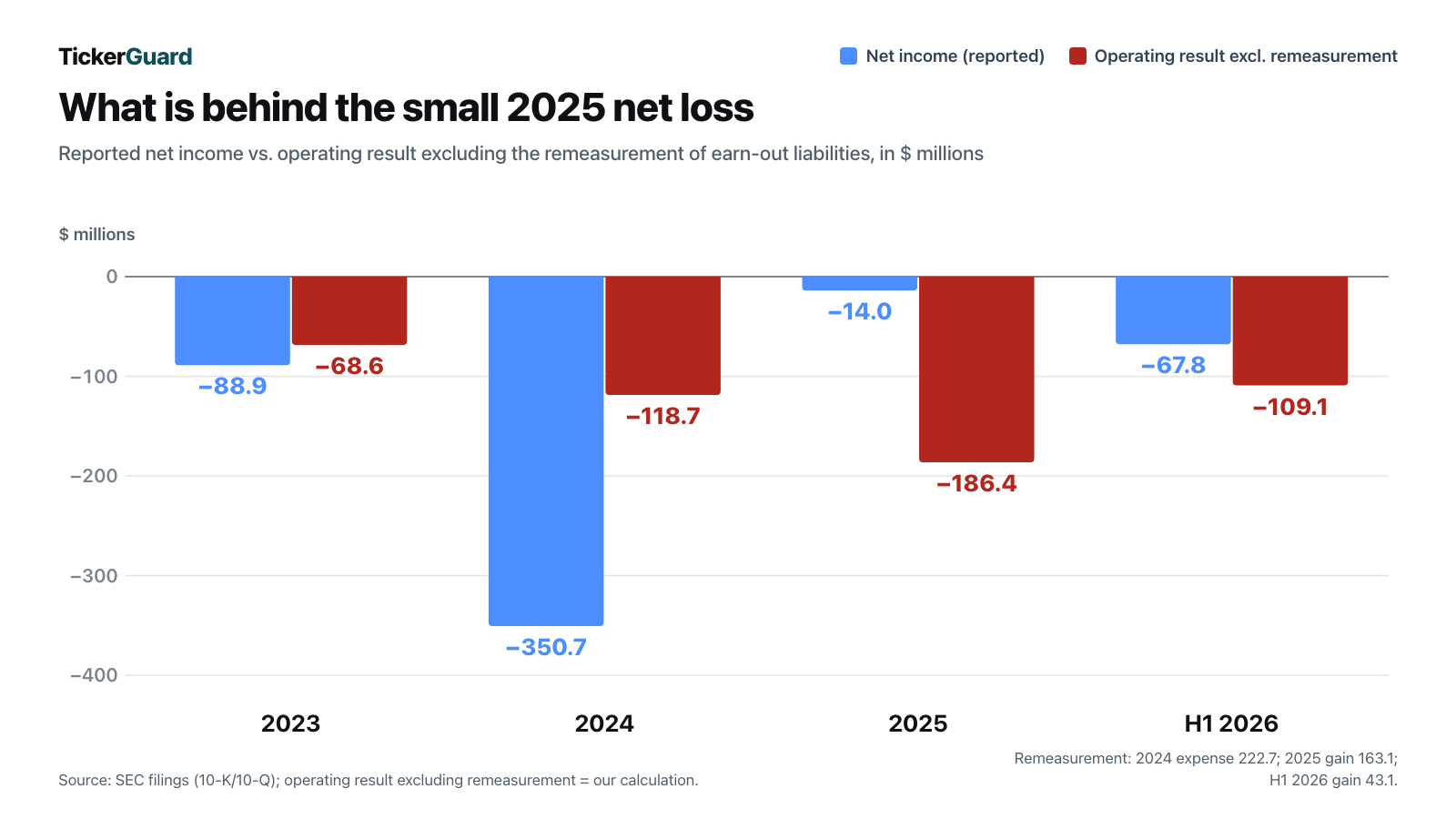
Take this effect out and the picture flips: the operating result excluding remeasurement was minus $68.6 million in 2023, minus $118.7 million in 2024 and minus $186.4 million in 2025; in the first half of 2026 it was minus $109.1 million, while the net loss came to only $67.8 million thanks to a $43.1 million remeasurement gain. For comparison: in 2023, before the big acquisitions, the net loss was $88.9 million. Losses have grown along with revenue, not shrunk. On June 30, 2026, $83.6 million of such liabilities were still on the balance sheet. In July 2026, Amelia's former owners received 8.1 million new shares for 2025; according to the quarterly report, more shares are possible for 2026, up to a total of 16.8 million.
Uncomfortable truth No. 3: LivePerson was paid for in stock — and the lenders are now shareholders
On September 4, 2026, SoundHound closed its acquisition of LivePerson. LivePerson generated more revenue than SoundHound in 2025, but it is shrinking: in the first quarter of 2026, its revenue fell to $57.0 million from $64.7 million a year earlier, a drop of 12 percent. On March 31, 2026, LivePerson had negative stockholders' equity of $51.5 million and about $394 million of notes on its balance sheet. According to the pro forma filing of July 13, 2026, the purchase price consisted essentially of SoundHound stock: face values of about $178.0 million for the first lien noteholders, $83.2 million for the second lien noteholders and $42.8 million for LivePerson's shareholders, the latter partly in cash (LivePerson shares traded in Tel Aviv were paid out in cash) — a face value of about $304 million in total, overwhelmingly in stock. Valued at the June 25, 2026 share price ($6.21 per share), the same filing puts the estimated purchase price at $271.8 million. On paper, SoundHound thus handed over about $1.25 of face value for every dollar of LivePerson's 2025 revenue ($243.7 million; $304 million divided by $243.7 million), or about $1.12 based on the estimated purchase price. What actually changed hands at closing is in the current report:
“Pursuant to the Notes Restructuring Agreement, (a) the holder of First Lien Secured Notes accepted, in full and complete satisfaction of all obligations of LivePerson to such holder under the First Lien Secured Notes, 25,142,335 shares of Company Common Stock and an aggregate amount of cash equal to $2,499,450 […] and (b) the holders of the Second Lien Secured Notes accepted, in full and complete satisfaction of all obligations of LivePerson to such holders under the Second Lien Secured Notes, an aggregate amount of 11,752,504 shares of Company Common Stock and an aggregate amount of cash equal to $3,348,550 […].”
— SoundHound AI, Inc., current report on Form 8-K of September 4, 2026, Item 8.01
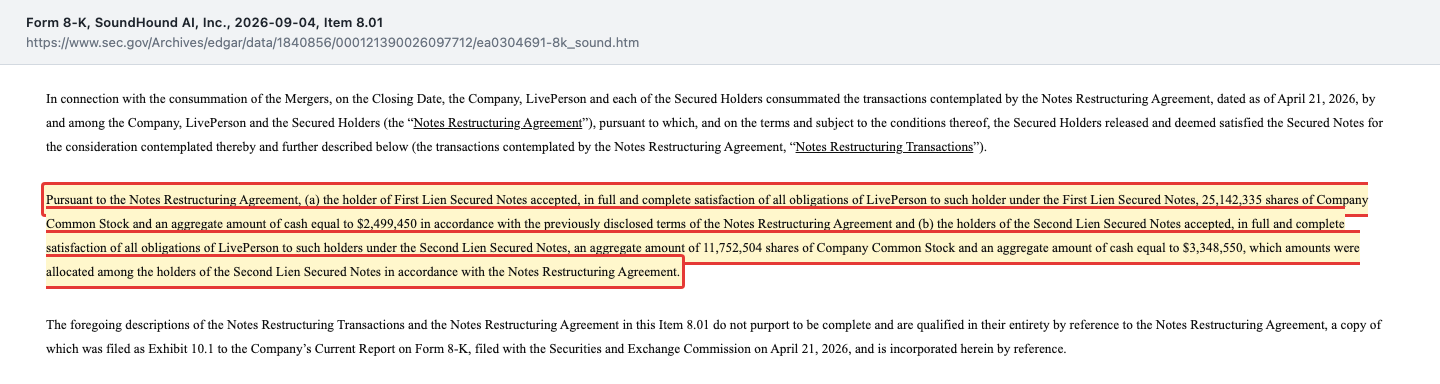
Put simply: SoundHound bought a house with a mortgage and paid off the mortgage not with money but by handing the lenders a stake in its own house. That is why the combined company has no financial debt from the LivePerson notes after closing. The bill went to existing shareholders, whose stake shrinks. On the same day, SoundHound registered all 36.9 million shares for resale; the largest new shareholder, the fund Lynrock Lake, holds about 5.6 percent of Class A (our calculation after the noteholder shares were issued; the prospectus supplement cites 6.1 percent, based on the share count of August 31, 2026). On top of that come shares for LivePerson's stockholders: 0.4673 SoundHound shares per LivePerson share; with about 12.3 million LivePerson shares (as of July 6, 2026), that is roughly another 4 million to 6 million; the pro forma filing of July 13, 2026 estimates 5,086,246 shares, because LivePerson shares traded in Tel Aviv were paid out in cash. The exact number will appear in the next quarterly report.
Since 2022, the share count (Class A and B combined) has grown like this: 200.0 million at the end of 2022, 254.4 million at the end of 2023, 393.6 million at the end of 2024, 422.6 million at the end of 2025 and 444.1 million on August 31, 2026. After the LivePerson deal, it comes to roughly 486 million by our estimate, almost two and a half times the end-2022 level. A shareholder from the end of 2022 who has not bought more since now holds, by this math, only about 41 percent of their former stake in the company (200 divided by 486). And the tap stays open: since May 11, 2026, SoundHound has been allowed to sell up to $300 million of additional stock through a so-called at-the-market (ATM) program, a standing order to sell new shares directly into the market. Picture a cake while more and more guests sit down at the table: your slice gets smaller even if you sold nothing.
Uncomfortable truth No. 4: the record quarter had a tailwind from revenue recognized up front
The record revenue of $61.9 million in the second quarter of 2026 has a composition worth knowing. According to the quarterly report, $20.5 million of it was recognized at a point in time rather than spread over the contract term; the report does not break down which contracts these were. This is typical of licenses, for example, where revenue is booked immediately even though the cash often arrives over years (our interpretation). Without this up-front revenue, quarterly revenue came to $41.4 million; that is the amount recognized over the contract term, according to the quarterly report. In the first quarter of 2026, only about $7.2 million had been recognized up front: of the $17.7 million by which the second quarter exceeded the first ($44.2 million), $13.3 million came from this item. To be fair: in the second quarter of 2025, the figure was already $17.9 million. Such revenue swings sharply from quarter to quarter at SoundHound. Two regional items stand out: customers billed in Colombia accounted for $7.6 million (prior-year quarter: $0.1 million), customers in China for $9.0 million. For the quarter, the August 5, 2026 earnings release mentions, among other things, a partnership in Latin America with an initial eight-figure value and a seven-figure deal with a Chinese automotive infotainment software company. Two customers accounted for 13 and 12 percent of revenue in the quarter. Whether these two customers are behind the revenue from Colombia and China, the quarterly report does not say: it names customers only anonymously and assigns countries by billing location, which may differ from where the end customer sits. All that is certain: Colombia, negligible a year earlier, and China together made up just over a quarter of the record quarter.
The flip side is on the balance sheet: revenue that has been recognized but not yet invoiced (contract assets and unbilled receivables) rose from $68.1 million on December 31, 2025 to $82.9 million on June 30, 2026; the portion due in more than twelve months grew from $29.9 million to $48.1 million. That is not unusual for multi-year license deals, but it contributes to the cash drain not shrinking as fast as revenue grows: in the first half of 2026, the increase in contract assets tied up $16.9 million, according to the cash flow statement. A quarter packed with license deals is therefore no yardstick for the next one.
Uncomfortable truth No. 5: internal controls have not been effective since the end of 2023
SoundHound first disclosed material weaknesses in its internal control over financial reporting — the checks meant to keep errors out of the numbers — in its quarterly report for September 30, 2023. Since then, management has rated these controls as not effective in every annual report, as of December 31, 2023, 2024 and 2025. Two of the previously reported weaknesses, in IT general controls and in the accounting for acquisitions, are considered remediated according to the annual report for 2025. The others, including the control environment as a whole and segregation of duties, still existed as of June 30, 2026:
“Based on this evaluation, our Chief Executive Officer and Chief Financial Officer have concluded that our disclosure controls and procedures were not effective as of June 30, 2026 due to the material weaknesses in the Company’s internal control over financial reporting described below.”
— SoundHound AI, Inc., quarterly report on Form 10-Q for June 30, 2026, Item 4 (Controls and Procedures)
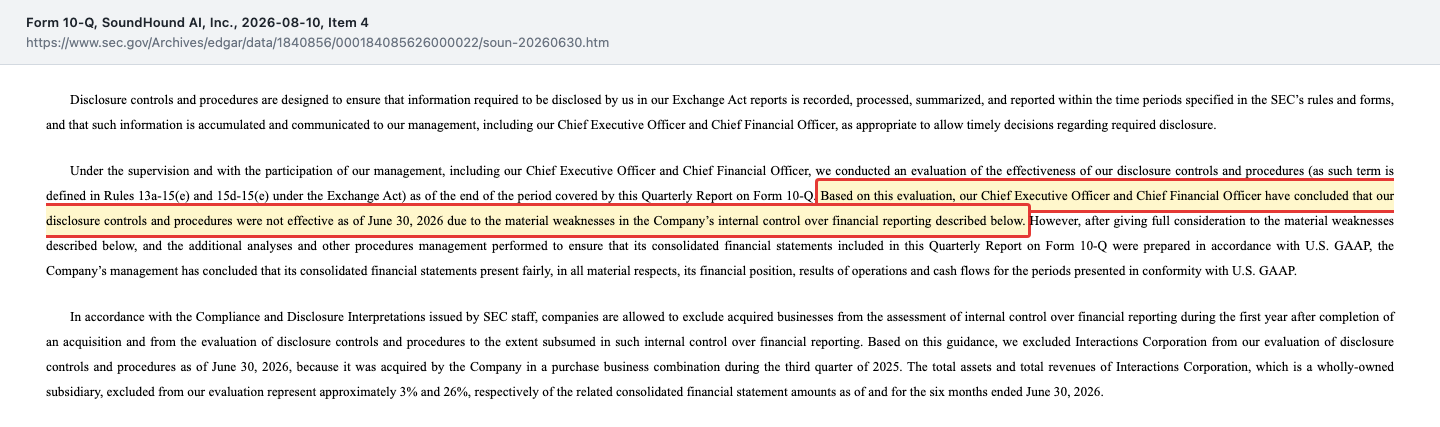
Management stresses that the financial statements are nevertheless fairly presented in all material respects. The weaknesses have not been without consequences, though: according to the annual report for 2025, they resulted in the revision of earlier financial statements for periods from September 2022 to June 2023 and in immaterial errors in various accounts in 2023 through 2025. In addition, Interactions, which generated about 26 percent of first-half revenue, was not yet included in the controls assessment, which is permitted in the first year after an acquisition, and LivePerson adds a business that generated more revenue in 2025 than SoundHound itself. On top of that, a shareholder lawsuit filed as a putative class action has been pending since March 2025 (Liles v. SoundHound AI) on behalf of buyers between March 1, 2024 and March 11, 2025. On May 19, 2026, the court denied the motion to dismiss in part: it dismissed some of the claims, while claims over certain statements about internal controls may proceed. That is not class certification, and nothing has been established by it. According to its quarterly report for June 30, 2026 (Note 7), SoundHound believes the complaint lacks merit and will continue to vigorously defend the claims. The CFO seat has also changed hands since April 2026: Nitesh Sharan left, co-founder James Hom stepped in on an interim basis, and since September 4, 2026 John Collins, previously LivePerson's CFO, has been the new CFO.
Valuation: what the market pays for the voice AI specialist
There is no price-to-earnings ratio because there are no earnings from operations. That leaves the ratio of market value to revenue. At the October 15, 2026 close of $4.89 and roughly 486 million shares after the LivePerson deal, SoundHound is worth about $2.4 billion (our estimate). Other figures, including the automatically populated metrics on this page, may be lower because they only count the 411.6 million Class A shares from the end of August.
The yardstick is the pro forma filing of July 13, 2026, the calculation “as if the acquisitions had been in place all year”: SoundHound, Interactions and LivePerson together came to $455.4 million of revenue in 2025. Market value is therefore about five times combined revenue. For a fast-growing software company that would not be strikingly high. The combined company's pro forma gross margin for 2025 was about 57 percent ($195.2 million cost of revenues on $455.4 million of revenue, our calculation), well above the 42 percent SoundHound reached on its own, because LivePerson (about 69 percent) and Interactions bring higher margins; for the first quarter of 2026, however, the same calculation comes to only about 52 percent ($49.0 million cost of revenues on $101.2 million of revenue). At the same time, the larger part (LivePerson) is shrinking, and operations burn cash. The price-to-sales ratio alone therefore says little; what matters is whether SoundHound can cut the combined company's costs fast enough. No filing has demonstrated that so far.
According to fundamental data (as of October 15, 2026, retrieved October 16), there are eight analyst ratings, six “strong buy” and two “hold”; the average price target is $12.57. Average here means all price targets added up and spread evenly — a single very high target pulls it up noticeably. These are third-party targets that we do not adopt. What stands out is the gap: the target is more than twice the October 15 close. Price targets are estimates, not promises.
Upside and risks at a glance
What speaks for SoundHound:
- Fast growth: 2025 revenue of $168.9 million (+99 percent), second quarter of 2026 at $61.9 million (+45 percent), 2026 outlook of $230 million to $260 million excluding LivePerson.
- Solid cash position without debt: $202.8 million on June 30, 2026; LivePerson's debt was retired at closing on September 4, 2026 with stock and about $5.8 million in cash.
- Broad customer base across cars, devices, restaurants, banks and healthcare; no customer above 10 percent of revenue in the first half of 2026.
- With LivePerson, combined pro forma 2025 revenue of $455.4 million and access to large enterprise customers for chat and messaging; with the OASYS platform, an offering for AI agents across all channels.
What speaks against it:
- Growth mostly bought; without Interactions, first-half 2026 revenue grew only about 9 percent by our calculation.
- Rising operating losses excluding the earn-out effect (minus $186.4 million in 2025), operating cash outflow of $60.0 million in the first half of 2026, stock-based compensation of $80.6 million in 2025.
- Heavy dilution: from 200.0 million shares at the end of 2022 to roughly 486 million after LivePerson by our estimate; 36.9 million of them immediately registered for resale, plus an ATM program of up to $300 million.
- LivePerson is shrinking (first-quarter 2026 revenue down 12 percent) and had negative equity on March 31, 2026; the integration is the largest so far.
- Ineffective internal controls, a shareholder suit whose dismissal the court partly denied, and a market in which competitors may offer products at significantly lower cost or free of charge, according to the annual report.
- Many bets against the stock: almost four in ten freely tradable Class A shares are sold short (figures in the section on how the stock landed on our desk). For you, that means violent swings. Because of the heavy short selling, good and bad news alike can move the price sharply in either direction in the short term — and that has little to do with the business itself.
A human conclusion
Back to the anchor from the beginning, the $24.23 from December 2024. A lot has changed at SoundHound since then: revenue has doubled, Interactions and LivePerson have joined, and the share count rose by about 13 percent through the end of August 2026, and by almost a quarter including LivePerson by our estimate. If the old number is still in your head, you are comparing today's price with a company that no longer exists in that form. Today's SoundHound is bigger, more diversified and free of financial debt from the LivePerson notes, but also more diluted, more shaped by acquisitions and has internal control over financial reporting that the company itself has rated as not effective since the end of 2023.
The next milestones are the quarterly report for September 30, 2026, the first to include almost a month of LivePerson, and the announced new outlook for the combined company. That is when we will see whether the acquired revenue turns into a business that earns its own money. With so much short interest, the price can swing sharply along the way. The next time an old high smiles at you, ask yourself first: is this still the same company — and how many shares are sharing the cake today? What you make of it is your decision. And that is a good thing.
Sources
All original documents used in this analysis — so you can read them yourself:
- SoundHound AI, Inc. — quarterly report on Form 10-Q for June 30, 2026 (filed August 10, 2026) — latest periodic report
- SoundHound AI, Inc. — quarterly report on Form 10-Q for March 31, 2026 (May 11, 2026)
- SoundHound AI, Inc. — annual report on Form 10-K for 2025 (filed March 2, 2026), 10-K for 2024 (March 11, 2025), 10-K for 2023 (March 1, 2024) and 10-K for 2022 (March 28, 2023)
- Current reports (8-K): September 4, 2026 (LivePerson closing, notes retirement, new CFO), September 2, 2026 (exchange ratio), August 5, 2026 (Q2 2026 results and outlook, Item 2.02), July 13, 2026 (pro forma financial information), May 27, 2026 (ATM program, annual meeting, LivePerson Q1 2026 financials), April 21, 2026 (merger agreement), March 18, 2026 (CFO change)
- SoundHound AI, Inc. — prospectus supplement 424B7 of September 4, 2026 (resale of the 36.9 million shares, share count as of August 31, 2026, closing price of August 31, 2026) and prospectus 424B3 of July 9, 2026 (LivePerson share count)
- SoundHound AI, Inc. — quarterly report on Form 10-Q for September 30, 2023 (November 15, 2023) — first disclosure of ineffective controls
- Full SEC filing history: EDGAR overview (sec.gov)
- Fundamental data (prices through October 15, 2026; analyst estimates and short interest retrieved October 16, 2026), cross-checked against the SEC filings.
- Reddit mentions: snapshot from our in-house stock scanner based on ApeWisdom (retrieved October 16, 2026); not an SEC or price source.
- Study on the anchoring effect: Amos Tversky, Daniel Kahneman, “Judgment under Uncertainty: Heuristics and Biases,” Science, vol. 185, 1974.
Data as of: company figures as of December 31, 2025 and June 30, 2026 (latest periodic report filed August 10, 2026); all SEC filings through October 17, 2026 reviewed. The quarterly report for September 30, 2026 had not been filed at the time of writing. Market value, share count after LivePerson, operating result excluding earn-out remeasurement and growth excluding Interactions are our own back-of-the-envelope calculations and labeled as such. The metric tiles on this page show the current database values and may differ from the figures used here.
Transparency & disclaimer: This analysis is a journalistic assessment of publicly available information. It is not investment advice, not financial research in the regulatory sense and not a solicitation to buy or sell securities. Investing in stocks involves substantial risk, up to and including the total loss of capital. All information without guarantee; the data date is noted in the text. Positions held by the operator are disclosed daily; where one exists, it appears as a notice at the top of this deep dive.
Key figures at a glance
All monetary figures in millions of $; earnings per share as reported.
| Metric | 2021 | 2022 | 2023 | 2024 | 2025 |
|---|---|---|---|---|---|
| Revenue | 21.2 | 31.1 | 45.9 | 84.7 | 168.9 |
| Operating Income (EBIT) | -65.3 | -105.7 | -68.6 | -341.4 | -23.3 |
| Net Income | -79.5 | -116.7 | -88.9 | -350.7 | -14.0 |
| Net Margin | -375.2% | -374.9% | -193.9% | -414.1% | -8.3% |
| Earnings Per Share | -0.40 $ | -0.74 $ | -0.39 $ | -1.04 $ | -0.03 $ |
Source: fundamental data & SEC filings (annual and quarterly reports, 10-K/10-Q)
Our Bottom Line at a Glance
- Growth positive
- 2025 revenue $168.9M (+99%), Q2 2026 $61.9M (+45%); 2026 outlook excl. LivePerson $230–260M (08/05/2026).
- Source of growth negative
- According to the 2025 10-K, acquisitions drove the $77.2M increase in subscription revenue; Interactions accounted for about 26% of H1 2026 revenue.
- Profitability negative
- Operating result excl. earn-out remeasurement 2025 −$186.4M (our calculation); operating cash flow 2025 −$98.2M, H1 2026 −$60.0M.
- Balance sheet positive
- Cash of $202.8M and no debt (06/30/2026); LivePerson's notes were retired mainly with stock at closing on 09/04/2026.
- Dilution negative
- Class A+B shares from 200.0M (12/31/2022) to 444.1M (08/31/2026), roughly 486M after LivePerson by our estimate; ATM program up to $300M since 05/11/2026.
- Reporting quality negative
- Internal controls rated not effective since 12/31/2023, disclosure controls also as of 06/30/2026; shareholder suit pending since March 2025, motion to dismiss partly denied on 05/19/2026 (no class certification).
SoundHound AI is growing fast and, as of June 30, 2026, before LivePerson, had just over $200 million in cash and no financial debt. But the growth is mostly acquired and paid for in stock, operating losses keep rising once accounting effects are stripped out, and LivePerson adds a shrinking business that generated more revenue in 2025 than SoundHound itself. Not investment advice.
What Our Rating Means
Open questions
The business works in principle, but one material question is open. As long as it stays open, our findings do not carry a quality verdict.
Yellow, because the business basically works but the decisive operating question is open: whether the acquired revenue turns into a company that earns its own money. Excluding accounting effects, operating losses are growing with revenue, operations burn cash, and the LivePerson integration is the largest yet. There is no substance risk in the sense of red: with $202.8 million in cash and no debt (June 30, 2026, SoundHound alone before LivePerson), the money lasts roughly six quarters at the second-quarter 2026 burn rate; how much cash the combined company uses will only show in the next quarterly report. There is no going-concern warning.Ineffective controls and heavy dilution are serious points, but not a breakdown of the balance sheet.
A journalistic assessment by our editorial team at the time of the deep dive, based on public sources — not investment advice and not a solicitation to buy or sell. Your personal circumstances (investment goals, risk capacity, taxes) cannot be taken into account. What our levels mean, how verdicts are formed, and what conflicts of interest exist →
Worth Noting
- Name history: Archimedes Tech SPAC Partners Co. (SPAC, under that name at the SEC until 05/02/2022) → SoundHound AI, Inc. after the merger with SoundHound Inc. on 04/26/2022; same CIK 0001840856.
- Other market value figures sometimes count only the 411.6M Class A shares of 08/31/2026. Our estimate (roughly 486M shares) adds the 36.9M shares for LivePerson's noteholders, roughly 4M to 6M shares for LivePerson's stockholders and 32.5M Class B shares.
- Reviewed: 10-K for 2025, 2024, 2023 and 2022, 10-Q for 06/30/2026, 03/31/2026 and 09/30/2023, all filings through 10/17/2026. The quarterly report for 09/30/2026 had not been filed at the time of writing.
Stock Watch
This analysis is as of October 17, 2026. Stock Watch will tell you what's changed at SOUN since then.
Later $1 a month per stock — signing up is free, and you'll be the first to know when it launches.
The full analysis as a PDF for later
We will send you this analysis as a PDF — to print, file away, and read at your own pace. And we will add you to the free Stock Watch list for SoundHound AI Inc (SOUN), so you hear about it when something material in this analysis changes.
Frequently Asked Questions
SoundHound AI (NASDAQ: SOUN), based in Santa Clara, California, develops voice AI for businesses: voice control for cars and devices, automated phone and order taking for restaurants, and AI agents for customer service. Revenue was $168.9 million in 2025. Since September 4, 2026, chat customer service provider LivePerson has also been part of the company.
Through a SPAC: Archimedes Tech SPAC Partners Co. merged with SoundHound on April 26, 2022, and the stock has traded on Nasdaq as SOUN since April 28, 2022. After SPAC shareholders redeemed their shares, only $5.4 million arrived from the trust account; $113.0 million came from institutional investors in an accompanying private placement.
Mostly stock. On September 4, 2026, LivePerson's noteholders received a combined 36.9 million SoundHound shares and about $5.8 million in cash, and LivePerson's stockholders 0.4673 SoundHound shares per share. According to the pro forma filing of July 13, 2026, that amounted to a face value of about $304 million, overwhelmingly in stock; the $42.8 million for LivePerson's stockholders was partly paid in cash. The same filing puts the estimated purchase price at $271.8 million, based on the June 25, 2026 share price of $6.21. LivePerson generated $243.7 million of revenue in 2025, so SoundHound paid about $1.25 of face value per dollar of revenue.
No. The 2025 net loss was only $14.0 million, but it includes a $163.1 million book gain from remeasuring earn-out liabilities. Without it, the operating result was roughly minus $186 million. Operations consumed $98.2 million of cash in 2025 and $60.0 million in the first half of 2026.
On June 30, 2026, SoundHound had $202.8 million in cash and no debt. In the second quarter of 2026, about $33.7 million flowed out of operations. In addition, since May 11, 2026, SoundHound may sell up to $300 million of new stock into the market through an at-the-market (ATM) program.
The number of Class A and B shares rose from 200.0 million at the end of 2022 to 444.1 million on August 31, 2026. Including the shares for LivePerson's noteholders and stockholders, it comes to roughly 486 million by our estimate, almost two and a half times as many. Possible earn-out shares and the ATM program of up to $300 million come on top.
Found an error?
Did you spot a factual error, an outdated number, or a typo in this deep dive? Let us know briefly — your report goes straight to the editorial team.