PagerDuty: The Stock Pinged, Revenue Didn’t — and the Record Profit Is Mostly Tax
From a closing low of $5.73 in April 2026 to $17.25 in mid-October: shares of incident-alerting company PagerDuty have tripled. Yet revenue is barely growing, and of the record fiscal 2026 profit of $174 million, $169 million came from a tax benefit.
 Thomas Mücke
Founder & Publisher
Thomas Mücke
Founder & Publisher
As of Today
As of: October 16, 2026
- Closing price
- 16.20 $ -6.40%
- Market Capitalisation
- 1.2 $B
- P/E
- 8.0
- Growth Score
- 6/10
- AAQS
- 4/10
Price change since October 15, 2026: -6.1%
This analysis has a cut-off date. The Stock Guard tells you when something material changes in the numbers. Reserve your free spot
Chart
Interactive price chart (TradingView).
52-week range: 5.70 $ to 16.70 $ · Last price: 16.20 $ (As of: October 16, 2026)
Note: pure fact-based analysis, not investment advice and not a solicitation to buy or sell. All figures without guarantee.
The all-clear trap: when the share price says everything is fine
There is an investor trap that feels like relief: the all-clear trap. A stock crashes, everyone talks about its problems — and then the price turns and climbs and keeps climbing. Your brain hears a siren falling silent: danger over, problems solved. What you miss is that a share price is not a gauge of a business. It shows how investors feel right now, not what is in the books. The siren may have gone quiet while the fire is still burning — or it may really be out. The only way to know is to go and look.
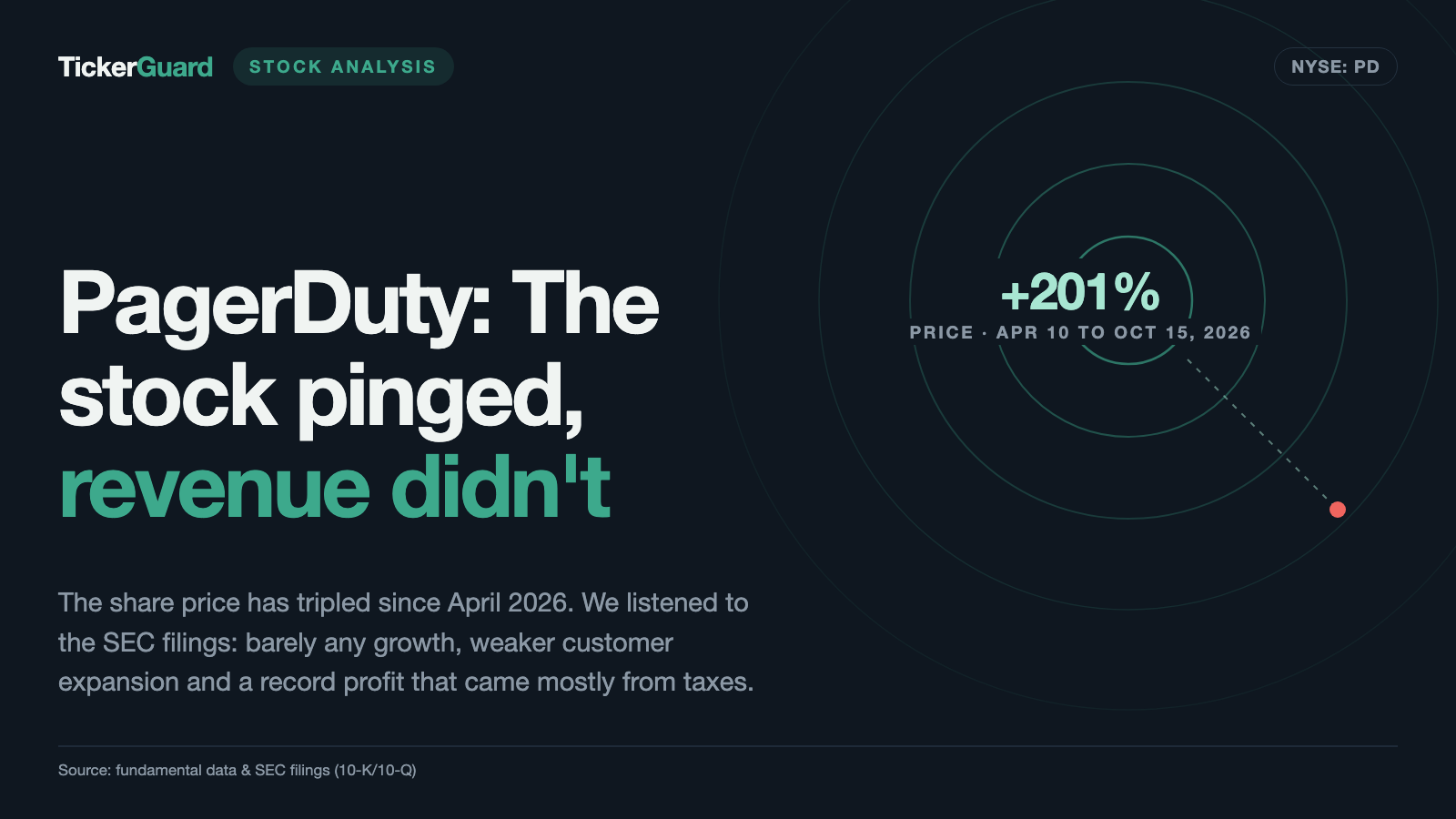
PagerDuty is a fitting case, because alarms are exactly what the company sells. On April 10, 2026, the stock fell to $5.70 intraday, its low for the twelve months to mid-October 2026, and closed at $5.73 (fundamental data). Then it turned: on October 15, 2026, it closed at $17.25, about 201 percent above the low. That names the central tension of this analysis: the share price has tripled — while revenue has barely grown and existing customers are spending less. What has genuinely improved is costs, cash and the share count. Let’s read together what the filings with the U.S. securities regulator, the SEC, actually say. No recommendation, no forecast — just the documents.
Company history for investors
-
2019
IPO on the NYSE
PagerDuty lists on the New York Stock Exchange in April 2019. Years of strong revenue growth follow, but with operating losses — still $129.4 million in fiscal 2023.
-
2023
$402.5 million convertible notes
In October 2023, PagerDuty issues 1.5 percent convertible notes due Oct. 15, 2028. They remain its only major debt and are covered by its cash.
-
2025
First operating profit and tax benefit
In the quarter to Oct. 31, 2025, PagerDuty books a $149.7 million tax benefit; fiscal 2026 closes with +$5.8 million of operating income. Net retention is still 100 percent as of Oct. 31, 2025, and 98 percent as of Jan. 31, 2026.
-
2026
New CEO, job cuts, the stock triples
Buybacks mostly at $7.40, a new CEO in May, a new CFO in June, 15 percent job cuts in August. The stock climbs from $5.73 to $17.25 between Apr. 10 and Oct. 15, 2026.
What PagerDuty actually does
San Francisco-based PagerDuty, Inc. was founded in 2009 and sells software that wakes companies up when their IT breaks. If an online retailer’s checkout fails or an app stops responding, PagerDuty collects the warning signals from more than 750 connected monitoring and development tools, sorts them, alerts the on-call team — via app, phone call or message — and guides the team through the fix. The name comes from the pager, the beeper once used to wake doctors and technicians on call. Put simply: PagerDuty is the fire-alarm control room for the digital infrastructure of large companies.
PagerDuty earns its money from subscriptions that typically run for a year and are billed in advance; pricing has mostly been per user, increasingly also by usage. As of July 31, 2026, it had 15,506 paying customers, 884 of them paying more than $100,000 a year. According to the company, about two-thirds of the Fortune 100 use the platform. The larger figure of “more than 35,000” that PagerDuty cites in press releases counts paying and free customers together. The fourth-quarter fiscal 2026 earnings release says so: “Free and paid customers totaled more than 35,000 as of January 31, 2026” (Exhibit 99.1 to the 8-K of March 12, 2026). At the end of January 2026, PagerDuty had 1,155 employees, about half of them outside the United States.
One thing matters for every number in this analysis: PagerDuty’s fiscal year ends on January 31. “Fiscal 2026” ran from February 1, 2025, to January 31, 2026, and therefore largely covers calendar 2025. The current fiscal 2027 ends on January 31, 2027; its second quarter ended on July 31, 2026.
And artificial intelligence? It sits at the center of the sales pitch. Under the name “PagerDuty Advance,” the company sells AI features and several so-called agents — programs meant to summarize incidents, narrow down causes and, where authorized, carry out remediation steps themselves. The annual report puts it plainly:
“PagerDuty sells an operations management platform powered by AI and automation.”
— PagerDuty, Inc., SEC annual report 10-K for fiscal 2026, Item 1 (Business)
The filings do not break out how much revenue the AI features bring in. And AI has a second side at PagerDuty, which we will get to among the uncomfortable truths.
How the stock landed on our desk
PagerDuty made our research list in October 2026 because of a share price chart that stands out. The biggest one-day jump since the April low followed a reporting day: on May 28, 2026, PagerDuty reported its first quarter of fiscal 2027; the stock closed at $7.44 that day and at $9.95 the next, about 34 percent higher. The next-largest jumps came without a report: about 16 percent on April 24, 2026 (from $6.16 to $7.13) and about 11 percent on May 1, 2026 (from $6.65 to $7.35). After second-quarter results and the job cuts on August 27, 2026, the stock gained about 9.5 percent the next day, from $12.63 to $13.83 (all closing prices, fundamental data). The filings do not explain share price moves — in time, the rally coincides with the CEO change in May, better margins and the share buyback.
The sentence to keep in mind for the rest of this analysis: at PagerDuty, the all-clear has already sounded in the share price — not yet in the revenue line.
The numbers over the years — given their due
First, what is genuinely impressive. Within three fiscal years, PagerDuty turned a deeply loss-making operation into a profitable one. Operating income under U.S. GAAP was a loss of $129.4 million in fiscal 2023 and a profit of $5.8 million in fiscal 2026, the first ever. In the second quarter of fiscal 2027 it rose to $10.2 million (prior-year quarter: $3.6 million). The lever was costs: sales and marketing cost $77.9 million in the first half of fiscal 2027, down from $94.5 million a year earlier. Gross margin — what is left of revenue after the direct costs of data centers and customer support — was 84.9 percent in fiscal 2026: of every revenue dollar, about 85 cents remained after direct costs.
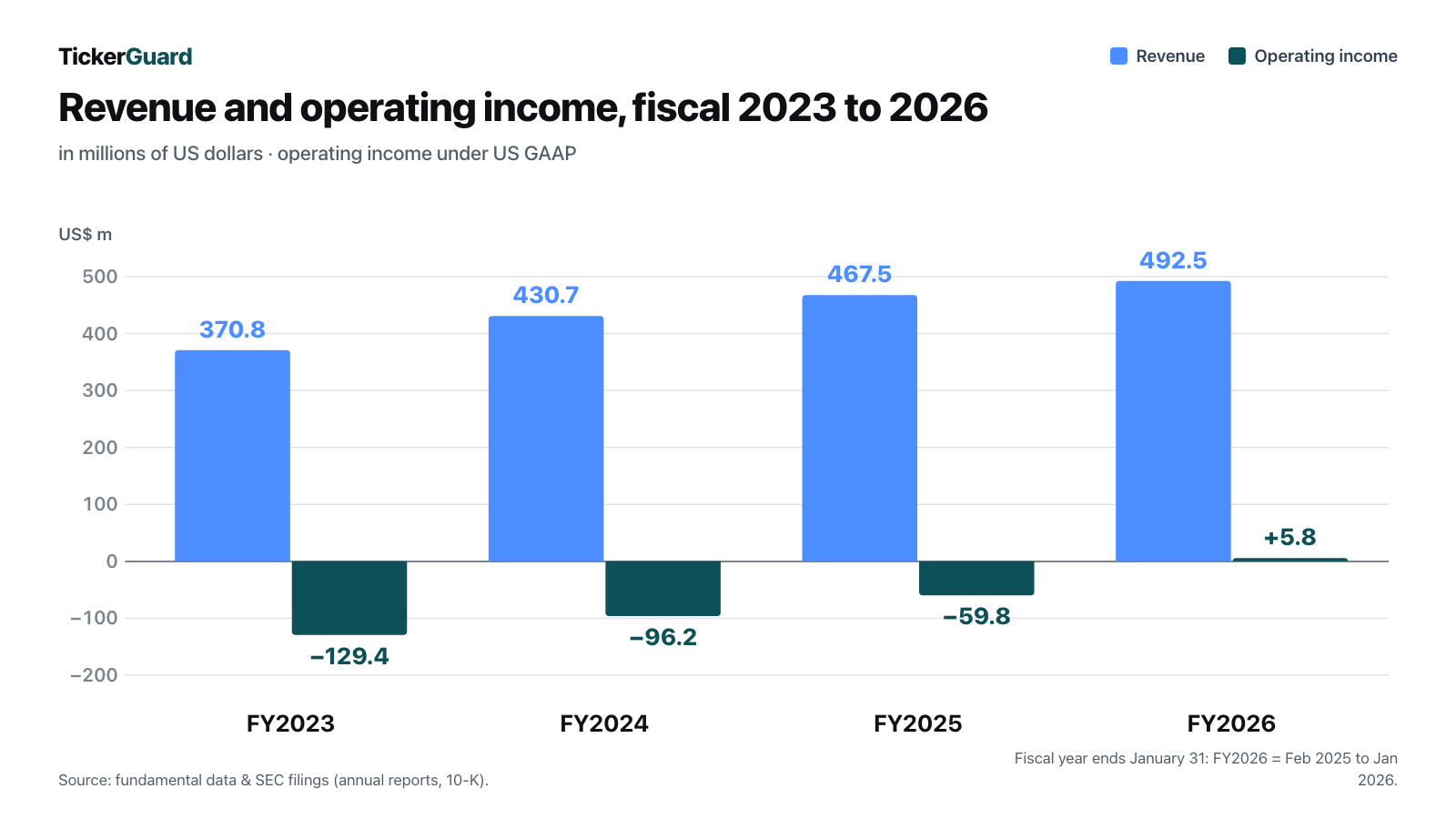
Cash has turned too. Free cash flow — the money left after capital spending — rose from $64.4 million in fiscal 2024 to $108.4 million in fiscal 2025, slipped about 5 percent to $102.7 million in fiscal 2026 and came to $117.5 million in the twelve months to July 31, 2026 (twelve-month figure: our calculation from the filings). Presenting the quarter, the CEO wrote:
“We delivered revenue above the high end of our guidance range, crossed $500 million in ARR, and generated $33 million in free cash flow this quarter, providing encouraging signals that our strategy is gaining traction.”
— John DiLullo, CEO, second-quarter fiscal 2027 earnings release, Exhibit 99.1 to the 8-K of August 27, 2026
The same chart shows the flip side: growth has slowed every year. Revenue grew 31.8 percent in fiscal 2023, then 16.2, 8.5 and 5.4 percent in fiscal 2026. In the second quarter of fiscal 2027 it was just 0.8 percent ($124.4 million after $123.4 million). For the full fiscal 2027, PagerDuty expects $491.5 million to $496.5 million — at the midpoint, growth of 0.3 percent. Keep this picture in mind: PagerDuty became profitable by cutting costs — not by growing.
What the filings say — the uncomfortable truths
Uncomfortable truth No. 1: Existing customers are spending less
For a subscription business, few numbers matter more than the dollar-based net retention rate. It measures how much all customers from twelve months ago pay in total today — expansions included, churn and downgrades deducted. Think of a gym that counts only last year’s members: if they pay more in total today because many booked extra classes, the number is above 100. If they pay less, it is below — and the gym has to win new members just to stand still.
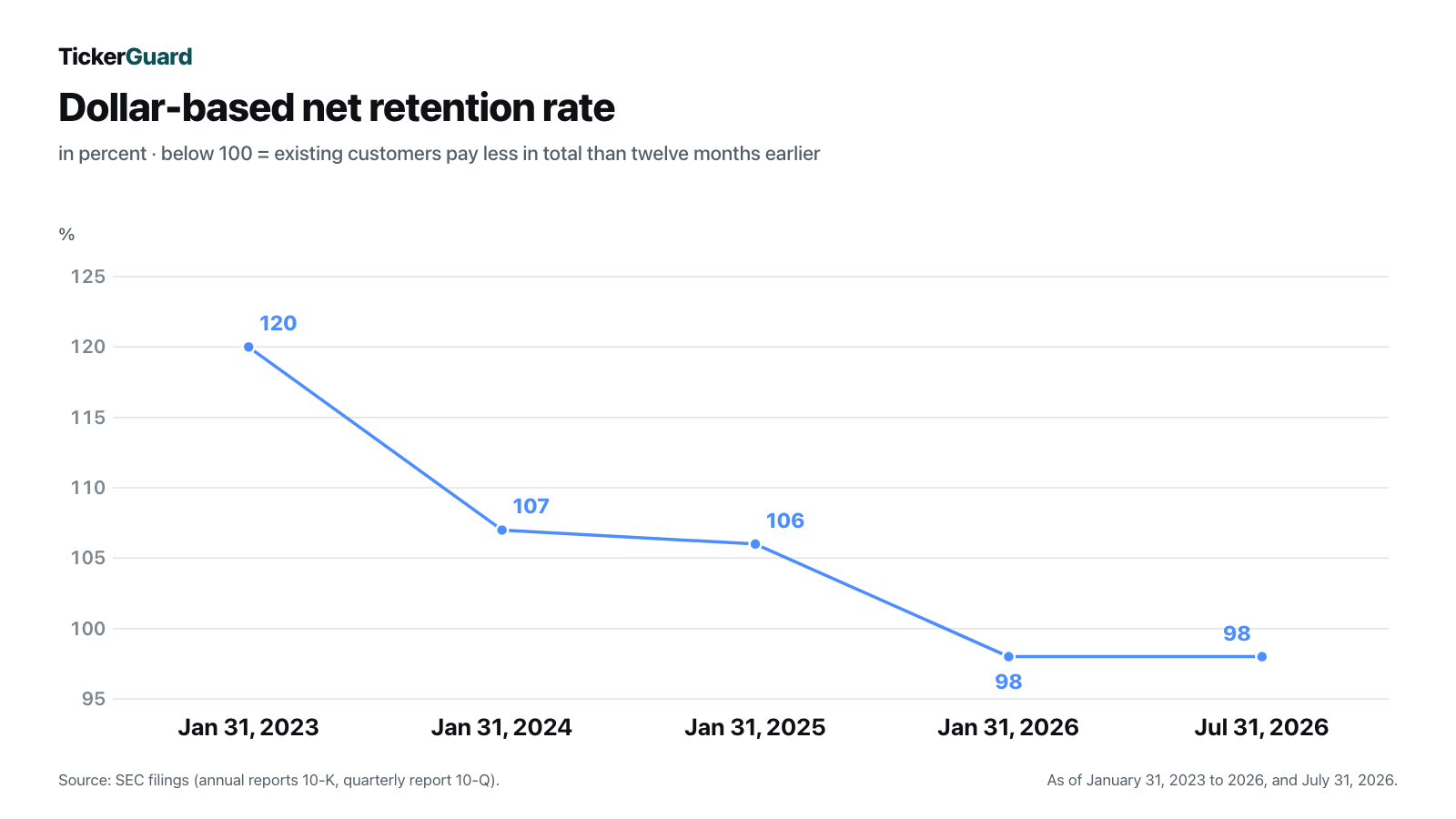
At PagerDuty, the metric fell from 120 percent (January 31, 2023) to 98 percent (January 31, 2026); as of October 31, 2025, it had still been 100 percent. It dipped to 97 percent as of April 30, 2026, and stood at 98 percent on July 31, 2026 — a year earlier it had been 102. Annual recurring revenue across all active contracts (ARR) rose only from $498.9 million to $501.4 million over those twelve months. That is the real explanation for the stalled growth: new customers are just making up for what existing customers no longer pay. For the third quarter, PagerDuty expects revenue of $123 million to $125 million — after $124.5 million in the prior-year quarter, so somewhere between minus 1.2 and plus 0.4 percent.
Why are existing customers paying less? The annual report names one reason itself, and it involves exactly the AI that PagerDuty sells. If companies need fewer people on call thanks to AI, they also need fewer user licenses:
“Our ability to retain our customers and increase the amount of their subscriptions could be impaired for a variety of reasons, including customer reaction to changes in the pricing of our products or the other risks described herein, such as competitive factors, the macroeconomic environment, and advances in artificial intelligence that may reduce demand for our solutions or require us to adapt our platform.”
— PagerDuty, Inc., SEC annual report 10-K for fiscal 2026, Item 1A (Risk Factors)
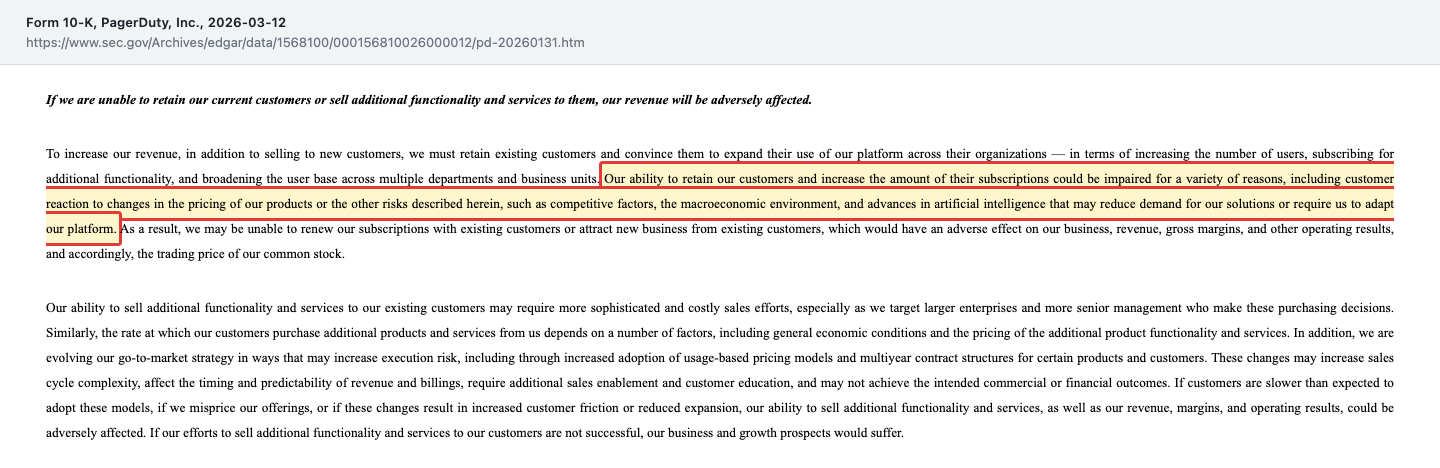
PagerDuty is responding with a new pricing model: according to the quarterly report, it is moving from one-year, per-user contracts toward multiyear agreements with usage credits that bill humans and AI agents alike. Whether that lifts the metric back above 100 is an open question. Remember: a subscription business whose existing customers pay less is running on a treadmill that turns backwards.
Uncomfortable truth No. 2: The record profit is mostly a tax effect
Pull up PagerDuty in a screener and you see a price-to-earnings ratio of about 8.5 (fundamental data as of October 16, 2026) — a strikingly low figure for a software company. The explanation is in the annual report. In fiscal 2026, PagerDuty reported net income attributable to common stockholders of $173.9 million, on operating income of just $5.8 million. The difference is a tax benefit — more precisely, a gain from recognizing deferred tax assets built on past losses. It is a bookkeeping entry, not a payment; no money came from the tax authorities:
“Based on all available positive and negative evidence, including the amount of our taxable income in recent years which is objective and verifiable, and taking into account anticipated future taxable earnings, we concluded that it is more likely than not that our U.S. federal and certain state deferred tax assets will be realizable which resulted in an income tax benefit of $169.2 million.”
— PagerDuty, Inc., SEC annual report 10-K for fiscal 2026, Item 7 (Income taxes)
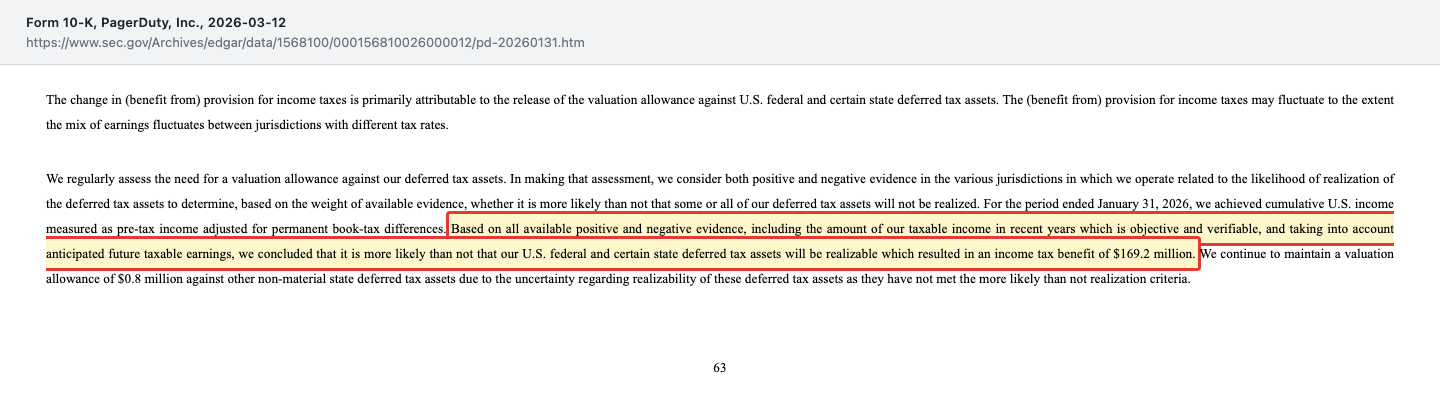
In plain English: over its loss-making years, PagerDuty accumulated tax assets — losses it can later offset against profits. As long as it was unclear whether profits would ever come, they were carried at zero. Now that PagerDuty is profitable, they sit on the balance sheet as an asset, and the write-up ran through the income statement as profit. That is correct accounting and has real value: future profits will carry a lower tax bill for years. But it is a one-time item. Most of the benefit, $149.7 million, landed in the quarter ended October 31, 2025. In the twelve months to July 31, 2026, about 81 percent of earnings attributable to common stockholders came from this single item (our calculation). And the balance sheet as of July 31, 2026, shows something else: deferred tax assets of $153.7 million make up about two-thirds of stockholders’ equity of $232.0 million. In short: the low P/E is an echo of the past, not a picture of the current business.
Uncomfortable truth No. 3: The buyback came at low prices — and partly just offsets stock pay
What PagerDuty did with its cash while the stock was low is in the quarterly report: in the first half of fiscal 2027, the company bought back its own shares in size.
“During the six months ended July 31, 2026, we repurchased 8,532,838 shares of common stock through open market purchases at an average per share price of $7.40, completing the 2025 Share Repurchase Program, and retired 8,896,106 shares, which includes 363,268 which remained on the consolidated balance sheet as of January 31, 2026.”
— PagerDuty, Inc., SEC quarterly report 10-Q for July 31, 2026, Item 2 (Liquidity, share repurchases)
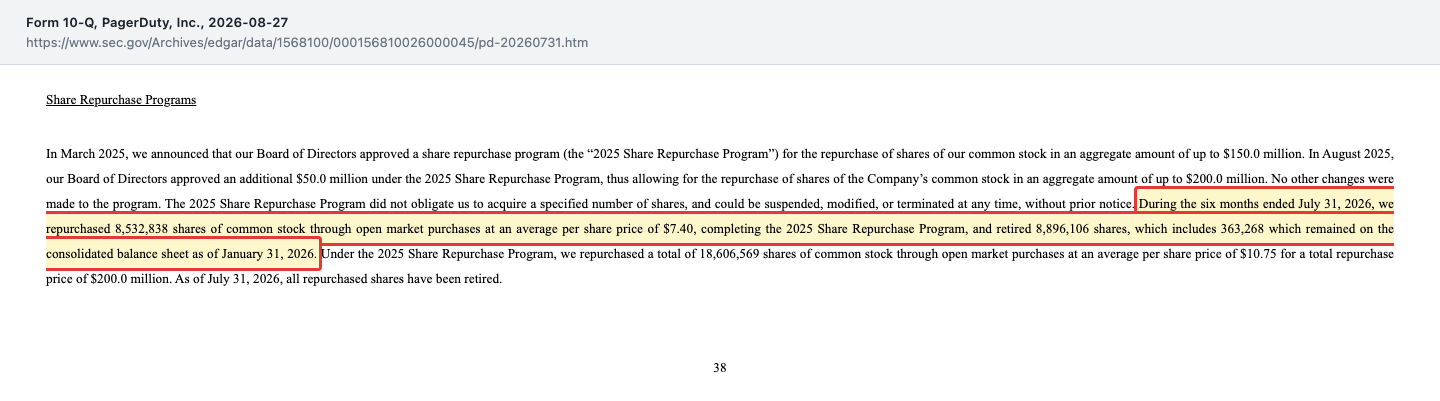
That is a little over $63 million for shares worth 2.3 times as much on October 15, 2026. Across the whole 2025 program, PagerDuty bought 18.6 million shares for $200.0 million, at an average of $10.75. In May 2026, the board authorized a new $100 million program; under it, PagerDuty bought another 799,112 shares at an average of $9.51 in the same half-year (about $7.6 million), and $92.4 million remained available on July 31, 2026. In total, PagerDuty repurchased about 9.33 million shares for about $70.8 million in the first half of fiscal 2027 (total: our calculation from the quarterly report). Shares outstanding fell from 92.7 million (January 31, 2024) to 78.6 million (August 25, 2026) — about 15 percent fewer. Your slice of the pie has grown.
The uncomfortable half: PagerDuty pays its employees to a large extent in stock. Stock-based compensation was $127.2 million in fiscal 2024 — more than total free cash flow of $64.4 million. It has since come down, to $80.5 million in the twelve months to July 31, 2026. Picture it this way: handing new shares to employees with one hand and buying old ones back with the other partly means bailing water back into the same bucket. Subtract stock-based compensation from free cash flow and about $37 million remains for the twelve months to July 2026 (our calculation). And buybacks are getting pricier: at $17.25, the same money buys PagerDuty less than half as many shares as at $7.40.
Uncomfortable truth No. 4: New leadership, fewer people
In 2026, PagerDuty replaced its top team. On May 11, 2026, John DiLullo, previously CEO of security services provider Deepwatch, became CEO; Jennifer Tejada, CEO since 2016, moved to the board as executive chair. On June 22, 2026, Eric Prengel succeeded Howard Wilson as CFO; Wilson, too, had held the post since 2016. Back on April 28, 2025, PagerDuty had signed a cooperation agreement with Scalar Gauge, an investment fund that was a stockholder at the time, which brought Donald J. Carty onto the board; in return, Scalar Gauge agreed, among other things, to standstill and voting commitments that, according to the 8-K of April 28, 2025, ran until 15 days before the deadline for stockholder nominations for the 2026 annual meeting. In the proxy statement of May 4, 2026, PagerDuty calls Scalar Gauge a “former stockholder”; Carty was nominated for the board again there. At the annual meeting on June 18, 2026, about 29 percent of votes cast were withheld from Jennifer Tejada, about 29 percent from Sarah Franklin and about 30 percent from William Losch (broker non-votes excluded); all three were elected.
On August 26, 2026, PagerDuty announced job cuts:
“The immediate impact is a reduction in the Company's current headcount of approximately 15%.”
— PagerDuty, Inc., SEC current report 8-K of August 27, 2026, Item 2.05 (Restructuring)
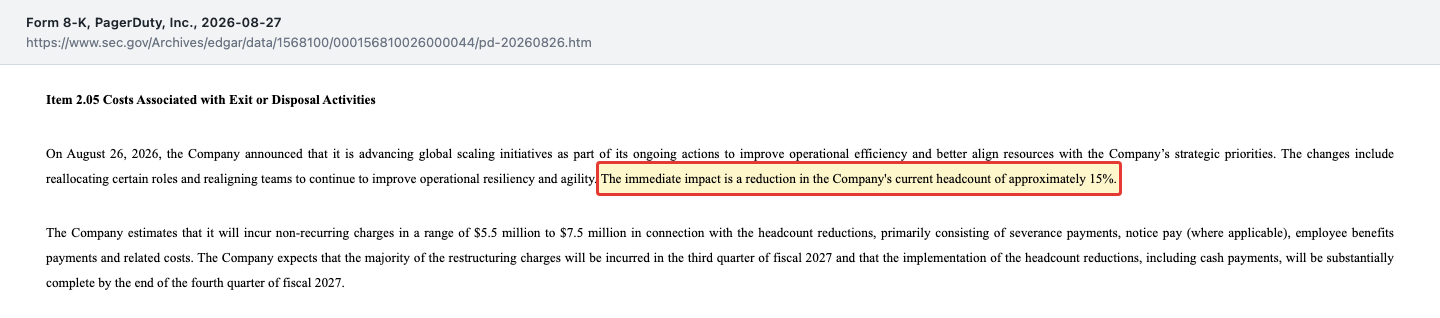
For margins, that is good news: PagerDuty expects a non-GAAP operating margin (excluding stock-based compensation and special items) of 26.5 to 27.5 percent for the third quarter, after 23.7 percent in the second. What the cuts mean for growth is open: the filing does not say which areas are affected; it speaks of reallocating roles and realigning teams. And one detail from the insider filings (Form 4): Jennifer Tejada sold a total of 115,000 shares at about $15 in September 2026 — 8,000 shares on September 24 and 107,000 shares on September 30 (Form 4, sec.gov), both under a trading plan she adopted on September 10, 2025, according to the filings (Rule 10b5-1 plan). A pre-arranged trading plan means the selling rules were set before the trades took place. The filings alone allow no conclusion about the state of the business.
A second trail in the insider filings leads to the new CEO. When he started, PagerDuty promised John DiLullo, among other things, two stock awards with a target value of $2.5 million each, to be granted only once the average stock price over 60 trading days reaches $10.00 and $13.00, respectively (8-K of May 11, 2026). Both thresholds have been met: on August 26, 2026, and on October 14, 2026, he received 294,464 restricted stock units each, a quarter vesting immediately and the rest quarterly over three years (Form 4, sec.gov; the second filing came in on October 16, 2026). Together that is 588,928 units, about 0.75 percent of shares outstanding (our calculation). This was agreed by contract and disclosed. But it means the rally feeds directly into the CEO’s pay — and into the number of new shares that the buybacks partly offset.
Valuation: three lenses, three very different numbers
At the October 15, 2026, close ($17.25), PagerDuty’s market value was about $1.36 billion, based on 78.6 million shares (as of August 25, 2026). Cash and investments of $470.0 million exceed the $402.5 million of convertible notes; enterprise value is therefore about $1.29 billion. Measured against revenue for the last twelve months ($494.7 million), market value comes to about 2.7 times sales; on an enterprise-value basis it would be about 2.6 times. The “As of Today” box at the top of the page updates automatically with the current price and shows rounded figures; the numbers in the text, by contrast, are fixed to the October 15, 2026, close.
Depending on the lens, the stock looks very different. Through the screener lens, which counts the tax benefit, it trades at 8.5 times earnings. Excluding the benefit, our rough calculation puts the P/E near 38. For that, we take trailing earnings for the twelve months to July 31, 2026 (about $185.5 million) and subtract the $149.7 million PagerDuty reported as a tax benefit in the quarter of the release (ended October 31, 2025). The $169.2 million in the annual report is the gross effect of the release; net of ongoing tax expense, PagerDuty booked a tax benefit of $152.5 million for fiscal 2026, $150.7 million of it in the first nine months. That leaves a net benefit of only about $1.8 million in the quarter ended January 31, 2026 (our calculation). Because that small remainder stays in trailing earnings, 38 is more of a floor; stripping it out as well gives about 40. Through the cash lens, measured by market value, it costs 11.5 times trailing free cash flow ($117.5 million). Subtract stock-based compensation and that becomes about 37 times. Which of these numbers describes the business better hinges on a single question: will PagerDuty grow again, or will it remain a company that holds its revenue and cuts its costs?
How hard a return to growth will be also depends on competition. The annual report names no individual companies, but it does describe three groups of competitors:
“For example, our competitors include: “Multi-product ITSM” vendors that seek to consolidate onto a single, monolithic platform; “Pure-play” incident management vendors that utilize basic incident management capabilities coupled with an updated UI; and “Adjacencies” that seek to expand their own addressable markets by venturing into incident management via their origin, such as observability or other telemetry.”
— PagerDuty, Inc., SEC annual report 10-K for fiscal 2026, Item 1A (risk factors)
On top of that come customers’ homegrown solutions. And the report names price as a battleground: “Some of our competitors offer their solutions at a lower price than our solutions, which has resulted in pricing pressures.” According to the same section, larger competitors can also bundle competing features with other products, including at a lower price or at no additional cost. What that means for you: PagerDuty has to win new customers against platforms that can throw in incident management on the side — while its existing customers are already paying less.
The professionals are split: of 9 analysts whose ratings the fundamental data lists, 3 rate the stock a strong buy, 4 a hold, 1 a sell and 1 a strong sell (as of October 16, 2026). This is third-party information for context, not our own assessment. How a large player from the same world of IT operations software stacks up is something we looked at in our ServiceNow analysis.
Opportunities and risks at a glance
What speaks for PagerDuty:
- Profitable and cash-generative: operating income of $10.2 million in the second quarter of fiscal 2027, free cash flow of $117.5 million in the twelve months to July 31, 2026.
- Solid balance sheet: $470.0 million of cash and investments against $402.5 million of 1.5 percent convertible notes not due until October 15, 2028.
- Deeply embedded product: 15,506 paying customers, 884 of them above $100,000 in annual spend, more than 750 integrations, 84.9 percent gross margin in fiscal 2026.
- Buybacks at low prices: about 9.33 million shares in the first half of fiscal 2027, 8.53 million of them at an average of $7.40; the share count is down about 15 percent since January 2024, and a new $100 million program is running.
- AI as a selling point: AI agents and usage-based pricing are meant to free PagerDuty from counting users.
What speaks against it:
- Growth near zero: +0.8 percent in the second quarter of fiscal 2027, full-year guidance of $491.5 million to $496.5 million after $492.5 million the year before.
- Existing customers pay less: net retention of 98 percent as of July 31, 2026 (97 percent as of April 30, 2026), down from 120 percent in early 2023.
- AI as a threat: the annual report itself names advances in artificial intelligence as a risk to demand.
- Profit lifted by a one-time item: a $169.2 million tax benefit in fiscal 2026 makes the P/E of about 8.5 of little use.
- Competition and pricing pressure: according to the annual report, some competitors charge less, and larger ones can bundle incident management with other products.
- Turnaround with an open ending: new CEO and new CFO in 2026, a 15 percent headcount reduction, about 29 to 30 percent of votes withheld from three directors at the annual meeting.
A human conclusion
Back to the all-clear trap from the beginning. Its core is not that the rally is baseless — it has real reasons: PagerDuty has become profitable, the cash pile is full, and the company repurchased shares at prices far below the October 15, 2026, close: in the first half of fiscal 2027 alone (February to July 2026), about a tenth of the shares outstanding at the end of January 2026; since January 2024, the share count is down about 15 percent in total. Its core is that a rising share price tricks you into believing the real problem is solved. But PagerDuty’s problem was never just costs. It is the question of whether, in a world of AI agents, customers will pay more or less for software that wakes people up. And so far, the most important metric answers with 98 percent.
So the honest question for you is not “Will the stock keep rising?” but: would you still hold PagerDuty if the next quarterly report again shows net retention below 100 and earnings without the tax effect? If you can justify a yes, you have a thesis. If all you have in mind is the tripling, you may have heard an all-clear that isn’t one yet. What you make of it is your decision. And that is how it should be.
Sources
All original documents used in this analysis — to read for yourself:
- PagerDuty, Inc. — SEC quarterly report 10-Q for July 31, 2026 (filed August 27, 2026)
- PagerDuty, Inc. — Second-quarter fiscal 2027 earnings release, Exhibit 99.1 to the 8-K of August 27, 2026 and 8-K of August 27, 2026 (Item 2.05, headcount reduction)
- PagerDuty, Inc. — SEC quarterly report 10-Q for April 30, 2026 (filed May 28, 2026)
- PagerDuty, Inc. — SEC annual report 10-K for fiscal 2026, to January 31, 2026 (filed March 12, 2026) and fourth-quarter fiscal 2026 earnings release, Exhibit 99.1 to the 8-K of March 12, 2026
- PagerDuty, Inc. — SEC annual report 10-K for fiscal 2025, to January 31, 2025 (filed March 17, 2025)
- PagerDuty, Inc. — SEC quarterly report 10-Q for October 31, 2025 (filed November 26, 2025, tax benefit)
- PagerDuty, Inc. — Current report 8-K of May 11, 2026 (new CEO), 8-K of June 22, 2026 (new CFO), 8-K of June 22, 2026 (annual meeting voting results) and 8-K of July 14, 2026 (board)
- PagerDuty, Inc. — Proxy statement DEF 14A for the 2026 annual meeting (filed May 4, 2026)
- PagerDuty, Inc. — current report 8-K of April 28, 2025 (cooperation agreement with Scalar Gauge)
- Insider filings (Form 4) by John DiLullo: stock units of August 26, 2026 and stock units of October 14, 2026 (filed October 16, 2026)
- Insider filings (Form 4) by Jennifer Tejada: sale of September 24, 2026 and sale of September 30, 2026
- Complete SEC filing history including all insider filings (Form 4): EDGAR overview (sec.gov)
- Fundamental data (prices, analyst ratings; as of October 16, 2026), cross-checked against the SEC filings. Another subscription software company with slowing growth in our archive: our Five9 analysis.
Transparency & disclaimer: This analysis is a journalistic assessment of publicly available information. It is not investment advice, not a financial analysis in the regulatory sense and not a solicitation to buy or sell securities. Investing in stocks involves substantial risk, up to and including the total loss of capital. All information without guarantee; data dates are noted in the text. Positions held by the operator are disclosed daily; where one exists, it appears as a notice at the top of this deep dive.
Key figures at a glance
All monetary figures in millions of $; earnings per share as reported.
| Metric | 2022 | 2023 | 2024 | 2025 | 2026 |
|---|---|---|---|---|---|
| Revenue | 281.4 | 370.8 | 430.7 | 467.5 | 492.5 |
| Operating Income (EBIT) | -101.7 | -129.4 | -96.2 | -59.8 | 5.8 |
| Net Income | -107.5 | -128.4 | -81.8 | -42.7 | 173.9 |
| Net Margin | -38.2% | -34.6% | -19.0% | -9.1% | 35.3% |
| Earnings Per Share | -1.27 $ | -1.45 $ | -0.89 $ | -0.46 $ | 1.87 $ |
Source: fundamental data & SEC filings (annual and quarterly reports, 10-K/10-Q)
Our Bottom Line at a Glance
- Business model & market position positive
- Deeply embedded subscription software for IT incidents: 15,506 paying customers and 884 large customers above $100,000 (July 31, 2026), more than 750 integrations, 84.9 percent gross margin in fiscal 2026.
- Growth & customer expansion negative
- Revenue growth fell from 31.8 percent (FY2023) to 5.4 percent (FY2026) and 0.8 percent (Q2 FY2027); FY2027 guidance of $491.5 million to $496.5 million. Net retention of 98 percent as of July 31, 2026, after 120 percent in early 2023.
- Earnings power neutral
- Operating income swung from -$129.4 million (FY2023) to +$5.8 million (FY2026), and $10.2 million in Q2 FY2027. But $169.2 million of the $173.9 million FY2026 net income came from a one-time tax benefit.
- Cash & balance sheet positive
- Free cash flow of $117.5 million in the twelve months to July 31, 2026; $470.0 million of cash and investments against $402.5 million of convertible notes (1.5 percent, due Oct. 15, 2028). Share count down about 15 percent since January 2024.
- Leadership & restructuring neutral
- New CEO (May 11, 2026) and new CFO (June 22, 2026), a reduction of about 15 percent of headcount (Aug. 26, 2026, cost $5.5 million to $7.5 million); about 29 to 30 percent of votes withheld from three directors at the June 18, 2026 annual meeting.
PagerDuty illustrates the all-clear trap: the stock rose from a closing low of $5.73 (Apr. 10, 2026) to $17.25 (Oct. 15, 2026). What improved is costs, cash and the share count — operating profit, $117.5 million of free cash flow over twelve months and buybacks mostly at $7.40. What did not improve is growth: +0.8 percent in the second quarter, net retention of 98 percent, and the record fiscal 2026 profit came almost entirely from a tax benefit. Not investment advice.
What Our Rating Means
Open questions
The business works in principle, but one material question is open. As long as it stays open, our findings do not carry a quality verdict.
The substance is there: PagerDuty makes money from operations, generates more than $100 million of free cash flow a year, holds more cash than debt and has no maturity before October 2028. The filings show no threat to the company itself. But the key operating question is open: revenue is barely growing, existing customers pay less in total than a year ago, and the new leadership is cutting 15 percent of staff at the same time — the turnaround from cutting to growing is unproven. Nobody should read the P/E of about 8.5 as proof of quality; it rests on a tax benefit. If you are waiting, check the quarterly report for Oct. 31, 2026: does net retention move back toward 100 percent, does revenue land within the $123 million to $125 million guidance, and what is left of earnings without the tax effect? The decision is yours.
A journalistic assessment by our editorial team at the time of the deep dive, based on public sources — not investment advice and not a solicitation to buy or sell. Your personal circumstances (investment goals, risk capacity, taxes) cannot be taken into account. What our levels mean, how verdicts are formed, and what conflicts of interest exist →
Worth Noting
- PagerDuty made our research list in October 2026 because of its share price move (closing low of $5.73 on Apr. 10, 2026; $17.25 on Oct. 15, 2026). The latest periodic report is the 10-Q for July 31, 2026 (filed Aug. 27, 2026); the earnings release and the 8-K on the job cuts from the same day and all insider filings through Oct. 16, 2026 have been reviewed. The quarterly report for Oct. 31, 2026 was not yet available on Oct. 17, 2026.
- Fiscal year ends January 31: “FY2026” = Feb. 1, 2025, to Jan. 31, 2026; “Q2 FY2027” = May to July 2026. Free cash flow per the company definition (operating cash flow minus capital expenditures minus capitalized software); twelve-month figures are our calculation from FY2026 minus H1 FY2026 plus H1 FY2027.
- Market value (about $1.36 billion) calculated from 78,649,873 shares (10-Q cover page, as of Aug. 25, 2026) and the Oct. 15, 2026 close; cross-check with the price in the insider filings for Oct. 2, 2026 ($15.34): about $1.21 billion. The P/E excluding the tax benefit (about 38) is a rough calculation of ours: net income attributable to common stockholders for the twelve months to July 31, 2026 (about $185.5 million) minus the $149.7 million tax benefit from the quarter ended Oct. 31, 2025, divided by about 79.1 million diluted shares. The remaining net tax benefit inside the twelve-month window (about $1.8 million in the quarter ended Jan. 31, 2026: $152.5 million for fiscal 2026 minus $150.7 million for the first nine months) is not stripped out; 38 is therefore more of a floor, and without it the figure is about 40. The $169.2 million is the gross effect of the release and cannot be netted against these figures.
- Analyst ratings (9 ratings: 3 strong buy, 4 hold, 1 sell, 1 strong sell) come from the fundamental data (as of Oct. 16, 2026) and are third-party information, not our own assessment. This analysis deliberately names no price target.
Stock Watch
This analysis is as of October 17, 2026. Stock Watch will tell you what's changed at PD since then.
Later $1 a month per stock — signing up is free, and you'll be the first to know when it launches.
The full analysis as a PDF for later
We will send you this analysis as a PDF — to print, file away, and read at your own pace. And we will add you to the free Stock Watch list for Pagerduty Inc (PD), so you hear about it when something material in this analysis changes.
Frequently Asked Questions
PagerDuty, Inc. (NYSE: PD), based in San Francisco, sells a software platform that collects warning signals from more than 750 tools when IT breaks, alerts the on-call team and helps resolve incidents with AI agents. It is sold by subscription. As of July 31, 2026, PagerDuty had 15,506 paying customers; at the end of January 2026 it had 1,155 employees.
The stock rose from a closing low of $5.73 (Apr. 10, 2026) to $17.25 (Oct. 15, 2026). The filings do not explain share price moves. In time, the rally coincided with the CEO change in May 2026, higher margins, share buybacks mostly at an average of $7.40 and two quarterly reports above the company's own revenue guidance. Revenue grew just 0.8 percent in the second quarter.
Barely, on an operating basis: GAAP operating income was $5.8 million in fiscal 2026 (to Jan. 31, 2026) and $10.2 million in the second quarter of fiscal 2027. Of fiscal 2026 net income of $173.9 million, $169.2 million came from a one-time tax benefit. Free cash flow was $117.5 million in the twelve months to July 31, 2026.
Hardly. Revenue grew 5.4 percent to $492.5 million in fiscal 2026 and only 0.8 percent in the second quarter of fiscal 2027. For full fiscal 2027, PagerDuty expects $491.5 million to $496.5 million. The dollar-based net retention rate was 98 percent as of July 31, 2026 (Apr. 30, 2026: 97 percent) — existing customers paid less in total than a year earlier.
On January 31. Fiscal 2026 ran from February 1, 2025, to January 31, 2026, and therefore largely covers calendar 2025. Fiscal 2027 ends on January 31, 2027; its second quarter ended on July 31, 2026, and the third ends on October 31, 2026. When comparing with other companies, keep this one-month shift in mind.
PagerDuty has $402.5 million of 1.5 percent convertible senior notes due Oct. 15, 2028; the initial conversion price is about $27.35 per share. Against that, it held $470.0 million of cash and investments as of July 31, 2026. On balance, PagerDuty had net cash of about $67.5 million.
Found an error?
Did you spot a factual error, an outdated number, or a typo in this deep dive? Let us know briefly — your report goes straight to the editorial team.