Six Flags: More Visitors, but Interest Eats More Than the Business Earns — and a $367 Million Bill Comes Due in January
The stock traded near $27 in October 2025. Why that old price is no yardstick today — and how much of the enterprise value now falls to the lenders.
 Thomas Mücke
Founder & Publisher
Thomas Mücke
Founder & Publisher
As of Today
As of: October 16, 2026
- Closing price
- 8.10 $ -5.20%
- Market Capitalisation
- 0.8 $B
- Growth Score
- 3/10
- AAQS
- 1/10
Price change since October 16, 2026: -0.1%
This analysis has a cut-off date. The Stock Guard tells you when something material changes in the numbers. Reserve your free spot
Chart
Interactive price chart (TradingView).
52-week range: 8.90 $ to 26.70 $ · Last price: 8.10 $ (As of: October 16, 2026)
Note: pure fact-based analysis, not investment advice and not a solicitation to buy or sell. All figures without guarantee.
The Anchor Trap: When an Old Price Looks Like a Price Tag
There is an investor trap that feels like experience: the anchor trap. You see a stock that traded at $27 a year ago and trades at $8 today. Immediately, part of your brain does the math: “This was worth more than three times as much not long ago.” The old price becomes an anchor, a secret yardstick. What gets lost: the old price promised nothing. It was the price of a company that may no longer exist in that form.
Six Flags is a textbook case. Almost everyone knows the roller coasters, the colorful parks, Bugs Bunny at the gate. On Oct. 27, 2025, the stock closed at $26.74; on Oct. 16, 2026, it closed at $8.11 — about 70 percent lower. Most recently, on Oct. 13, 2026, the trading day after a fatal accident at one of its parks, it fell from $11.92 to $10.20 on roughly six times normal volume. That names the central tension of this analysis: Six Flags has the parks, the visitors and a brand everyone knows — but the merger that created today's company has nearly wiped out its equity, and interest on $5 billion of debt eats more than the business earns before one-time items. Let's read together what the filings with the U.S. securities regulator, the SEC, actually say. No recommendation, no forecast — just the documents.
Company history for investors
-
2023
Merger agreement with Six Flags
On Nov. 2, 2023, Cedar Fair and Six Flags agree on a merger of equals. Cedar Fair closes the year with $124.6 million of net income.
-
2024
Merger closes
On July 1, 2024, the new Six Flags is born under the ticker FUN. Equity rises to $2,041.9 million by year-end — mainly through the new shares issued to legacy Six Flags shareholders.
-
2025
$1.5 billion of impairments
In the third quarter, Six Flags writes off $1,518.1 million of goodwill and trade names. The year ends with a $1,599.1 million loss; in December, John Reilly takes over as CEO.
-
2026
Seven parks sold
In April and May, seven parks go to EPR Properties for $331.4 million. At mid-year, $114.7 million of equity remains against roughly $5.0 billion of debt.
What Six Flags Actually Does
Six Flags Entertainment Corporation, headquartered in Charlotte, North Carolina, describes itself as the largest regional amusement park operator in North America. As of August 2026, according to its earnings release, it operated 20 amusement parks, 14 water parks and nine resort properties across 13 U.S. states, Canada and Mexico, and it manages a park in Saudi Arabia. Well-known names include Cedar Point in Ohio, Kings Island, Knott's Berry Farm in California, Six Flags Magic Mountain and Six Flags Great Adventure. At the end of 2025 it had about 4,225 full-time employees, plus roughly 91,000 seasonal and part-time workers during 2025.
The business model is easy to explain: admission plus everything sold inside the park — food, drinks, games, extra-charge attractions, hotel nights. In 2025 the parks counted 47.4 million visits, which works out to about $65 of revenue per visit ($3,100.3 million divided by visits, our calculation). Think of a theme park as a hotel that is only open in summer: staff, maintenance and insurance costs run all year, while the money comes in over a few months. According to the annual report (10-K), about 70 percent of 2025 attendance and revenue came in the second and third quarters.
Important for anyone comparing old charts: today's Six Flags is not the Six Flags of old. On July 1, 2024, park operator Cedar Fair, L.P. and the former Six Flags Entertainment Corporation completed a “merger of equals.” Legally, a new company emerged (formerly “CopperSteel HoldCo, Inc.,” SEC identifier CIK 0001999001) that took the Six Flags name and trades on the New York Stock Exchange under Cedar Fair's old ticker, FUN. For accounting purposes Cedar Fair is the acquirer. That is why figures through mid-2024 show Cedar Fair alone, figures from July 2024 show the combined company, and 2025 is the first full combined year. The fiscal year is the calendar year; quarters end on a Sunday — the second quarter of 2026, for example, ended on June 28.
How the Stock Landed on Our Desk
Six Flags made our research list through the Reddit hype scan of Oct. 17, 2026, that is, through the volume of discussion in investor forums. The trigger is a sad one: on Oct. 12, 2026, according to consistent media reports, a guest died on the Goliath roller coaster at Six Flags Over Georgia. The park offered condolences to the family and said it was cooperating with investigators. The cause had not been officially established as of Oct. 17, 2026, and Six Flags had not filed a current report (8-K) about it by then.
On Oct. 13, 2026, the stock fell from $11.92 to $10.20, with 14.6 million shares changing hands. Over the 50 trading days before (Aug. 3 to Oct. 12, 2026), the daily average was about 2.44 million. The average means all daily volumes added up and spread evenly — a few hectic days, such as the one after the August earnings report, pull it up. The median, the typical trading day with half the days above and half below, was about 2.04 million; that it sits below the average reflects exactly those upward outliers. Oct. 13 came in at roughly six times the average. By Oct. 16, the closing price had slipped further to $8.11.
Even before that, our in-house stock scanner showed little to flatter the company (data as of late July 2026): a Piotroski score of 4 out of 9 and an Altman Z-score of 0.92. In plain terms, the Piotroski score is a checklist of nine health questions about the balance sheet — 4 out of 9 is mediocre; a very healthy company scores 8 or 9. The Altman Z-score estimates the strain from debt; below 1.8 counts as the danger zone. The sentence for the rest of this analysis: the accident moved the price — but the reasons the stock had already lost more than half of its value are on the balance sheet.
The Numbers Over the Years — Given Their Due
First, what impresses. Six Flags is a large, real business with millions of paying guests. Cedar Fair alone grew revenue from $1,338.2 million (2021) to $1,817.4 million (2022) and held it at $1,798.7 million in 2023. With the merger, revenue rose to $2,708.9 million (2024, legacy Six Flags included only from July) and $3,100.3 million (2025). The chart shows revenue and net income attributable to shareholders since 2021:
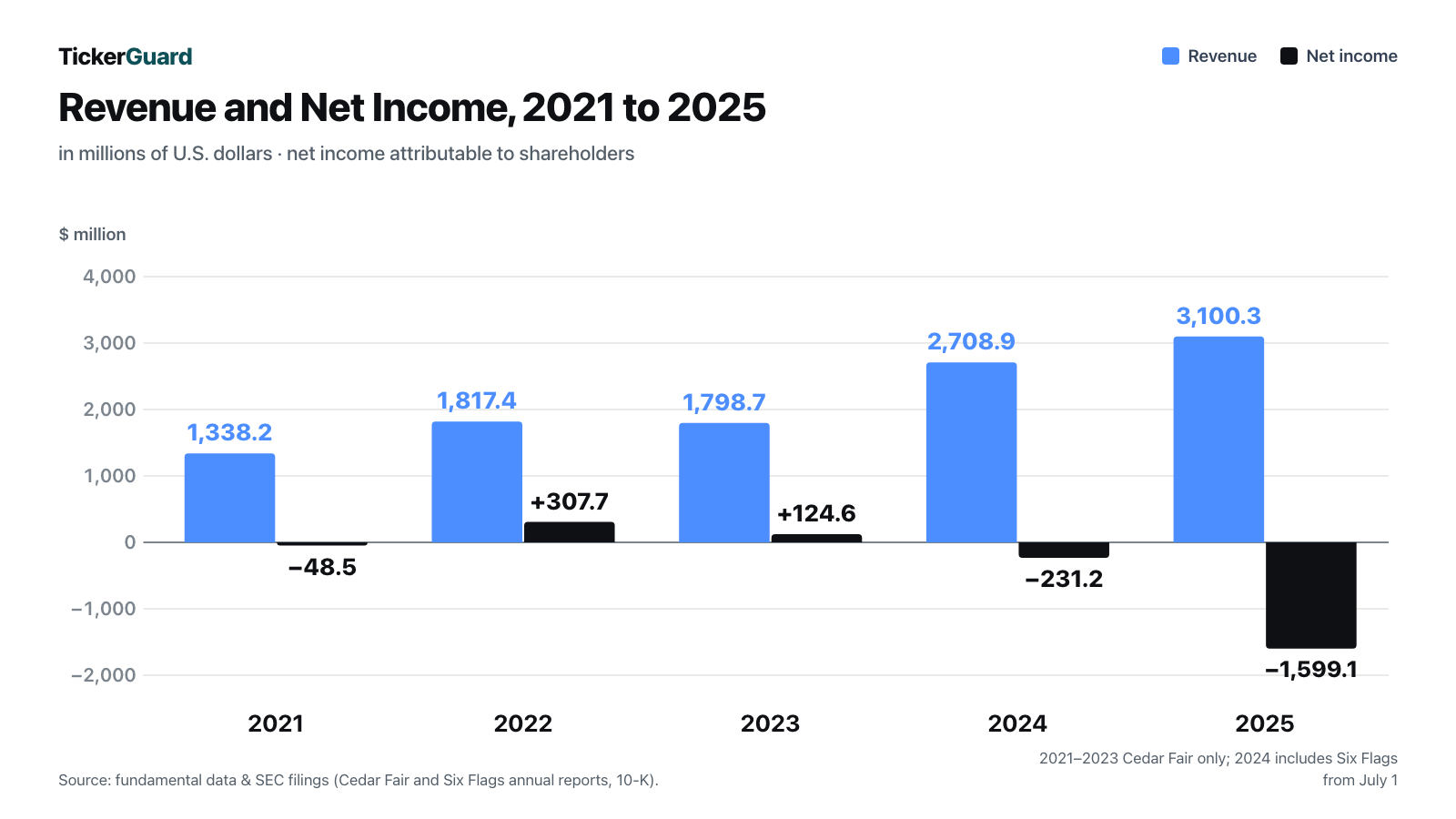
The chart shows the problem: the company got bigger, not more profitable. 2025 ended with a loss of $1,599.1 million, including $1,518.1 million of impairments on goodwill and trade names. Even without that one-time hit, the trend is sobering: Adjusted EBITDA — the measure Six Flags itself manages by and that its credit agreements use — fell from $875.3 million (2024) to $792.0 million (2025), even though 2025 included legacy Six Flags for a full year instead of half a year. According to the annual report, the decline was entirely due to lower revenue from lower attendance; as one reason, the report cites significantly worse than expected weather.
And then the bright spot. In 2026 the new management sold seven parks; another park (Bowie, Maryland) had already closed after the 2025 season. The parks Six Flags still operates did better in the second quarter of 2026 than a year earlier: 4 percent more visits, 2.4 percent more revenue, 7 percent more Adjusted EBITDA ($248.9 million versus $233.0 million). Season pass sales were up 7 percent year to date and the active pass base up 6 percent, according to the earnings release of Aug. 6, 2026. Keep this picture in mind: the park is filling up a little again — but the bill for the merger is still on the table.
What the Filings Say — The Uncomfortable Truths
Uncomfortable Truth No. 1: About $1.46 Billion of Legacy Six Flags Goodwill and Trade Names Written Off
In an acquisition, the buyer books the part of the purchase price that exceeds the value of land, rides and buildings as “goodwill.” Think of it as the premium paid for the hope that the acquired business will earn more than its parts are worth. In the third quarter of 2025, Six Flags had to write off a large part of that hope — a total of $1,518.1 million. Of that, $1,461.0 million related to legacy Six Flags: $1,291.7 million on the goodwill of seven parks (Fiesta Texas, Great Adventure, Great America, Magic Mountain, Mexico, Over Georgia and Over Texas) and $169.3 million on the Six Flags trade name. The remaining $57.1 million concerned the Schlitterbahn water parks (reporting unit $50.7 million, trade name $6.4 million). Six Flags Magic Mountain alone accounted for $533.7 million. The annual report gives the reason:
“These reporting units and trade names were tested for impairment due to a decline in estimated future cash flows as a result of revenue and earnings not meeting expectations through the more seasonally significant third quarter, as well as due to a more significant, sustained decline in the Company's share price through the third quarter when compared to industry peers.”
— Six Flags Entertainment Corporation, SEC annual report 10-K for 2025, Note 5 “Goodwill and Other Intangible Assets”
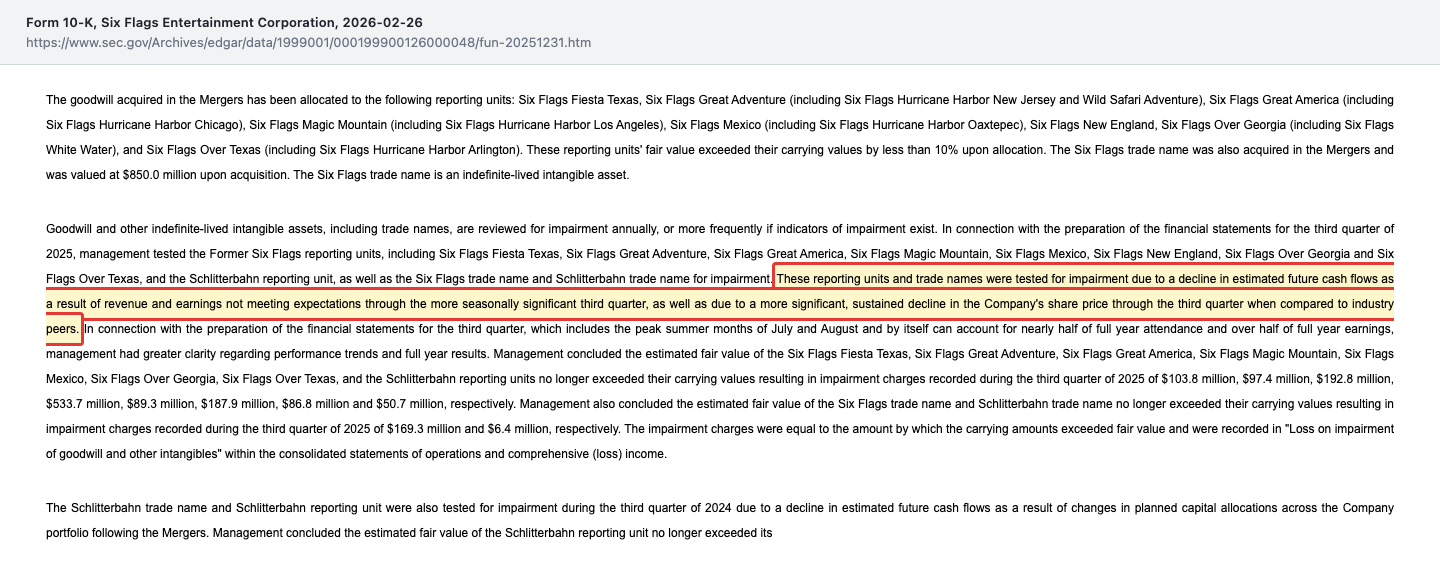
An impairment costs no cash — the money changed hands at closing, in the form of new shares issued to legacy Six Flags shareholders. But it shows that, by the company's own estimate, the merger is worth less than expected. And it has visible consequences for the shareholders' cushion:
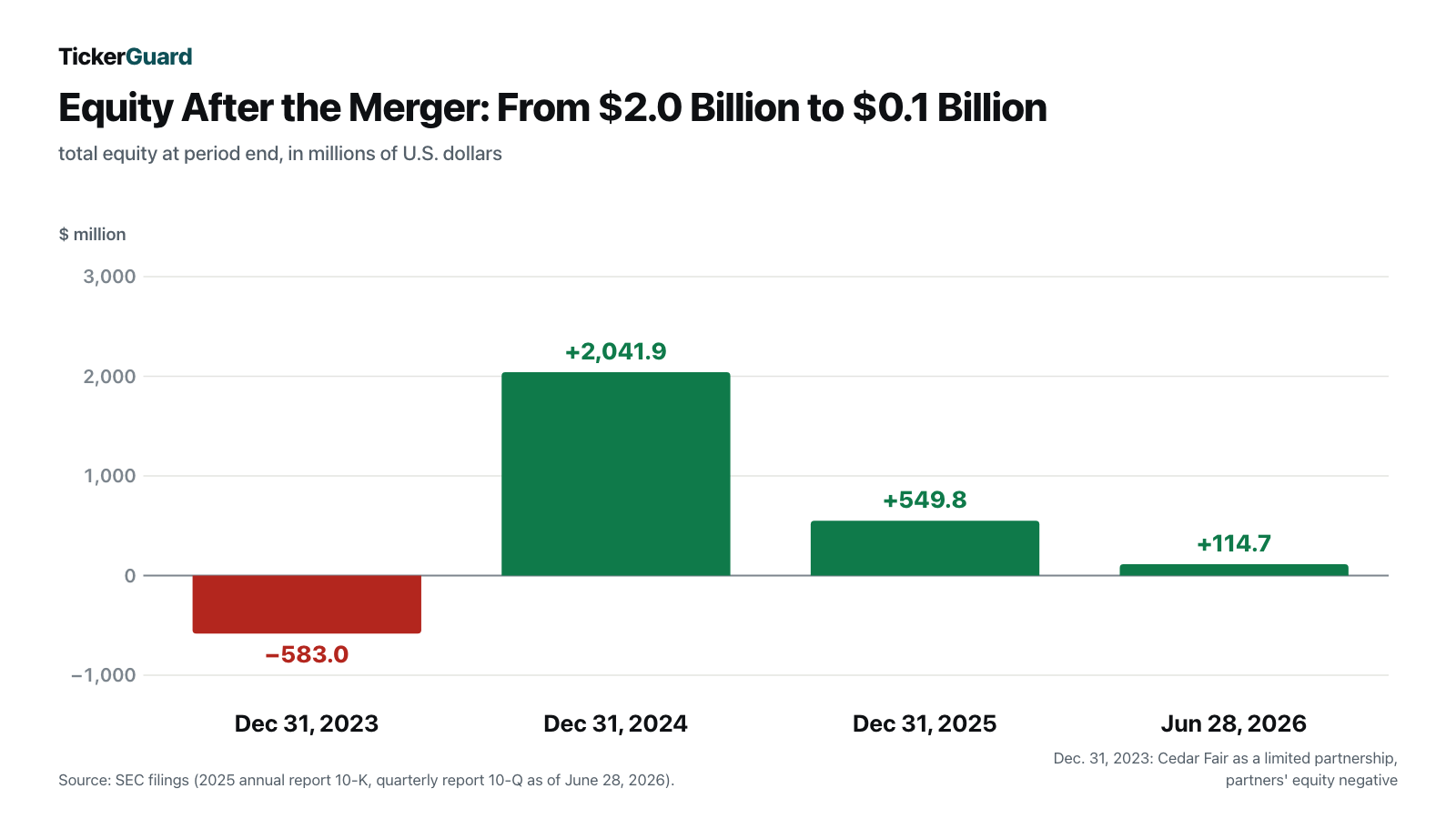
As of June 28, 2026, only $114.7 million of equity remained against $7,435.3 million of total assets — about 1.5 percent. Picture a house worth $100,000 with a $98,500 mortgage: the owner still owns the doormat. In fairness, equity swings with the seasons, because Six Flags loses money in winter and spring and earns it in summer. A mid-year figure is therefore closer to a low point than to a final tally. Still, equity also fell from year-end to year-end, from $2,041.9 million to $549.8 million.
Uncomfortable Truth No. 2: Interest Eats More Than the Business Earns
According to the 10-Q for the quarter ended June 28, 2026, Six Flags owes roughly $5.0 billion before debt issuance costs: a $1.48 billion term loan (due May 2031), five note issues totaling $3.45 billion with coupons between 5.25 and 8.625 percent (due between October 2028 and May 2032), and $90 million drawn on the revolver. After $134.5 million of cash, the company reports $4.88 billion of net debt — 5.8 times trailing twelve-month Adjusted EBITDA ($840.2 million). In January 2026, Six Flags replaced two $500 million note issues carrying 5.375 and 5.5 percent and maturing in 2027 with a new $1.0 billion issue at 8.625 percent. The maturity moved out to 2032; the coupon rose by more than three percentage points.
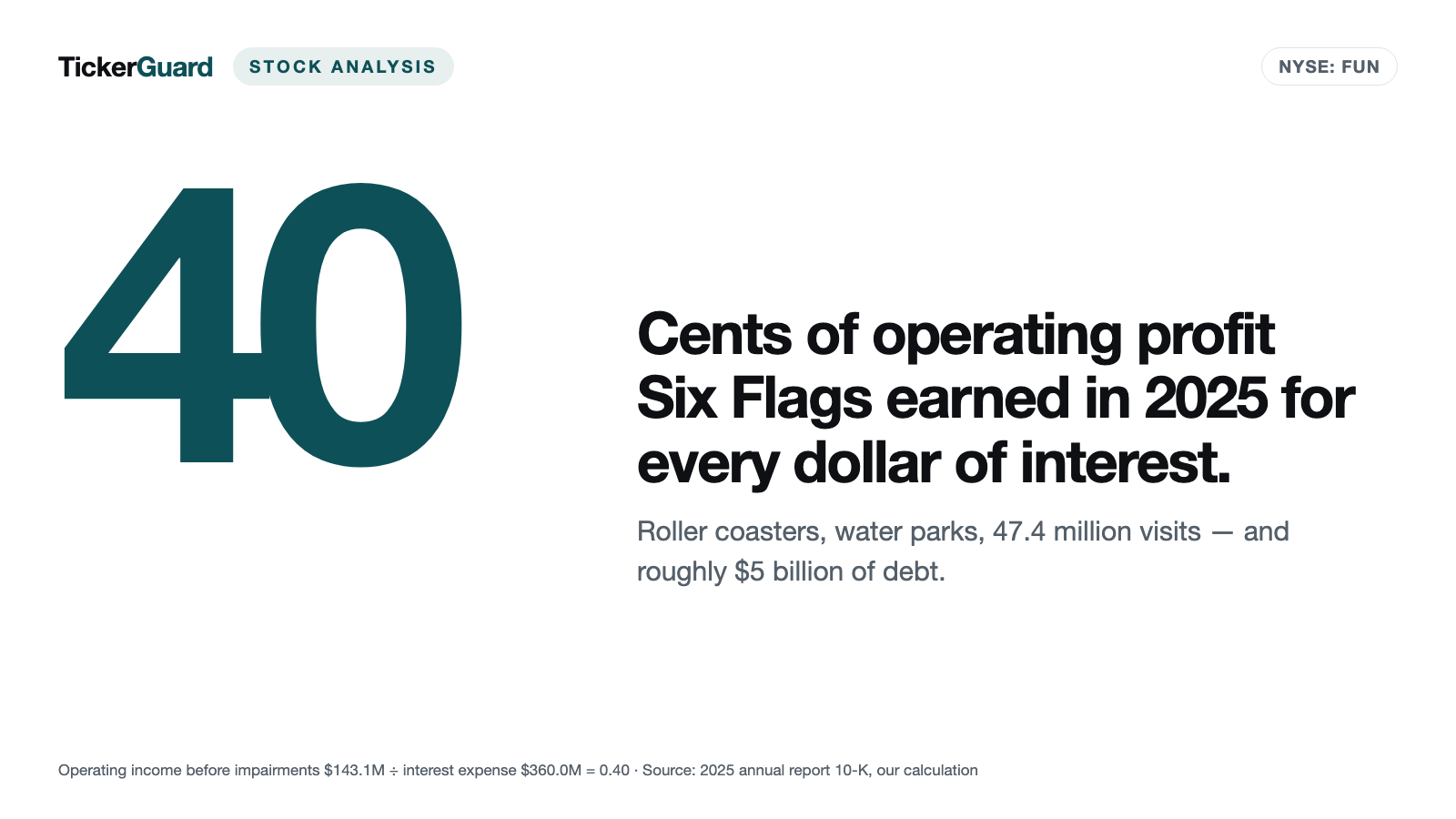
How heavy that load is shows in a simple comparison (our calculation from the 2025 annual report): operating income was −$1,375.0 million in 2025. Add back the impairments on goodwill and trade names and $143.1 million remains. Interest expense was $360.0 million. The business covered only about 40 percent of its interest — coverage of roughly 0.4. Measured against Adjusted EBITDA ($792.0 million) things look friendlier — coverage would be about 2.2 — but even then nearly half goes to lenders before a single dollar reaches roller coasters or maintenance. Free cash flow (operating cash flow of $327.5 million minus capital expenditures of $479.7 million) was −$152.2 million in 2025. Six Flags itself describes the risk in its annual report:
“In the absence of sufficient operating results and resources, the Company could face substantial liquidity problems and might be required to dispose of material assets or operations to meet its debt service and other obligations.”
— Six Flags Entertainment Corporation, SEC annual report 10-K for 2025, Item 1A “Risk Factors”
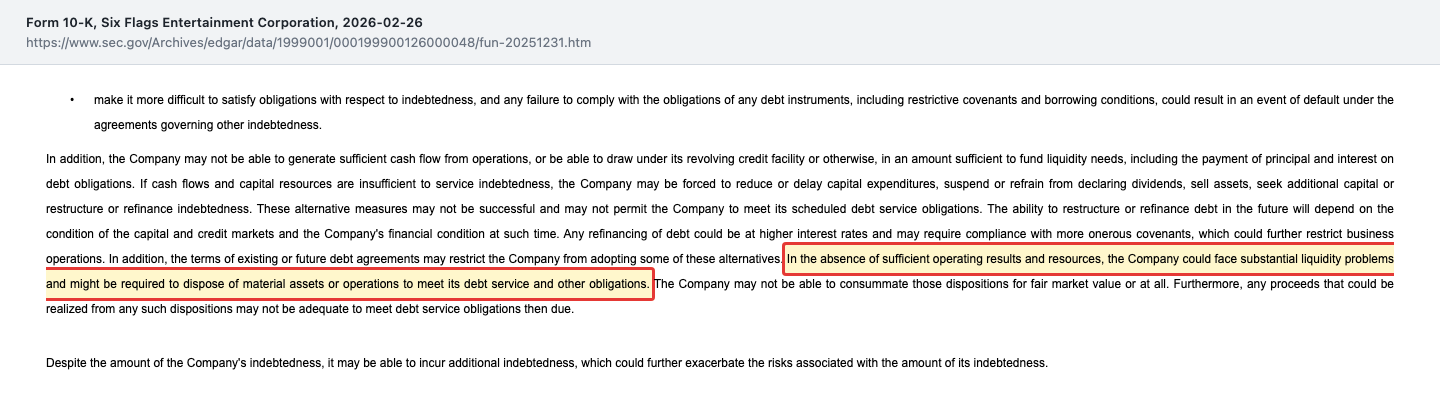
In fairness: this is a risk factor, not a finding. According to the 10-Q for June 28, 2026, the revolver and cash on hand are sufficient for at least twelve months; the only covenant the banks test each quarter (net first lien leverage, maximum 5.0 times) was met. The next note maturity is not until October 2028 ($300 million). And the company is doing what the risk factor describes: it is selling. In April and May 2026, seven parks went to real estate company EPR Properties for $331.4 million, including Worlds of Fun, Valleyfair and La Ronde in Montreal — at a book loss of $37.8 million. For the land of the park in Bowie, Maryland, closed after the 2025 season, there has been a purchase agreement since April 8, 2026, which had not closed as of June 28, 2026. How a capital-intensive leisure company can work its way out from under a mountain of debt — and how long that takes — is the subject of our analysis of Carnival.
Uncomfortable Truth No. 3: A $367 Million Bill in January 2027
Six Flags does not fully own two of its biggest parks: since the 1990s, Six Flags Over Georgia and Six Flags Over Texas have sat in limited partnerships with outside investors. Six Flags runs the parks, pays the partners minimum annual distributions (about $93.5 million in total in 2026, about $43.3 million of it to itself) and holds a purchase right at the end of the term. For Georgia, Six Flags exercised that right in December 2024:
“The agreed-upon value, if determined as of June 28, 2026, multiplied by the 68.5% of units held by the limited partner for SFOG represent $367.2 million that would be required to be paid to the limited partner of SFOG at the End-of-Term Option.”
— Six Flags Entertainment Corporation, SEC quarterly report 10-Q for June 28, 2026, Note 7 “Non-Controlling Interests”
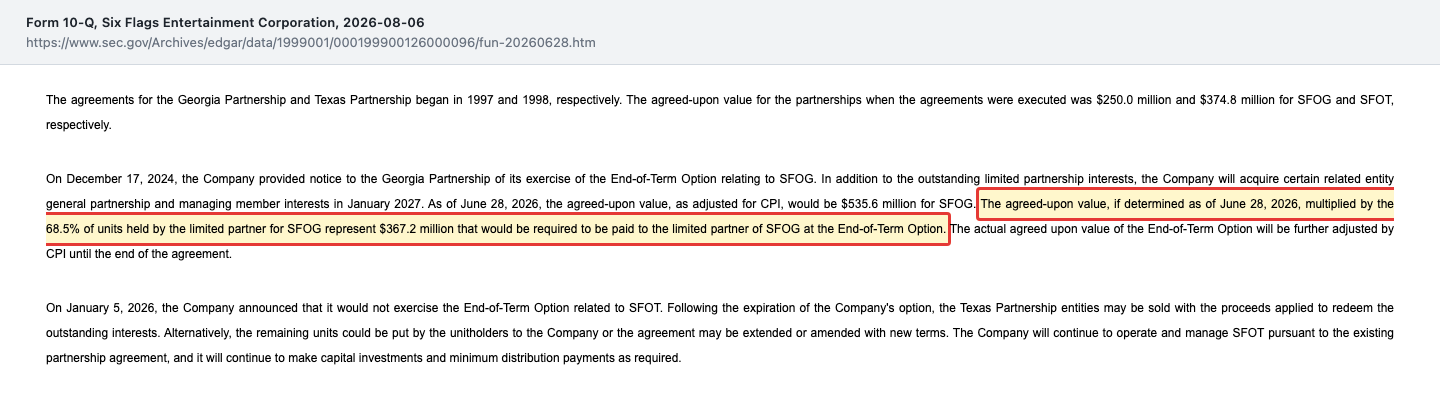
Since 2026 the balance sheet has carried the obligation as a current liability of $350.7 million — less than the $367.2 million in the quote because, according to the 10-Q, it is recorded at the present value of the call price and accreted to the final purchase price over the remaining term. For comparison: cash stood at $134.5 million on June 28, 2026, and $702.8 million was available under the revolver. The filing does not say how the payment will be funded. A rough calculation of our own shows how tight it is: trailing twelve-month Adjusted EBITDA ($840.2 million) minus the capital expenditures guided for 2026 ($400 million to $425 million), cash interest ($300 million to $320 million) and cash taxes ($25 million to $30 million) leaves roughly $65 million to $115 million — before distributions to the park partners. That is not enough for $367 million. Our rough calculation suggests that Six Flags will fund the payment at least partly with borrowed money. For Six Flags Over Texas, the company said on Jan. 5, 2026, that it would not exercise its purchase right. The annual report describes the consequences: after the option expires in January 2028, the park may be sold with the proceeds used to redeem the outstanding interests; alternatively, the partners can put their remaining units to Six Flags, or the agreement may be extended or amended. Until then Six Flags keeps running the park, investing in it and paying the minimum distributions. Which path it will be is open.
Uncomfortable Truth No. 4: Leadership Is Almost Entirely New Within a Year
John Reilly has run the company since December 2025; he previously led Palace Entertainment and spent many years at SeaWorld. His predecessor, Richard Zimmerman, had signed a release agreement in October 2025. In 2026 came more changes: CFO Brian Witherow left on May 8, and Ash Walia joined on June 17 (8-Ks of May 7 and May 27, 2026). Marketing and legal got new chiefs on June 3, and chief operating officer Tim Fisher handed his role to Mark Pauls on July 15 (8-Ks of July 1 and July 2, 2026). The board changed too: investor H Partners, which the company says has been a significant shareholder for more than 15 years, had been represented there by Arik Ruchim since 2020. Under a cooperation agreement of May 19, 2026, H Partners founder Rehan Jaffer replaced him after the annual meeting of May 26 and also joined the audit and finance committee.
A new team can be a fresh start — but it also means that the CEO, CFO and COO all took office after the merger and their strategy has not yet completed a full fiscal year. There is one signal: according to a Form 4 insider filing, CEO Reilly bought 15,713 shares at $15.80 each on Aug. 12, 2026, six days after the quarterly results, for a total of about $248,000. At the closing price of Oct. 16, 2026, that purchase had lost about 49 percent of its value.
Uncomfortable Truth No. 5: Fall Counts Double
A theme park has only a few months to earn its year. The annual report describes what that means for unexpected events:
“Consequently, when adverse conditions or events occur during the operating season, particularly during the peak vacation months of July and August or the important fall season, there is only a limited period of time during which the impact of those conditions or events can be mitigated.”
— Six Flags Entertainment Corporation, SEC annual report 10-K for 2025, Item 1A “Risk Factors”
The fatal accident of Oct. 12, 2026, fell right into that fall season with its Halloween events. What it means for attendance, insurance or liability cannot be read from the filings as of Oct. 17, 2026 — the third-quarter report will show it at the earliest. What matters for you as a shareholder: at a company with an equity ratio of 1.5 percent, every weak fall weighs more than at a competitor with little debt.
Valuation: $0.8 Billion of Equity on $4.9 Billion of Net Debt
At the closing price of Oct. 16, 2026 ($8.11), Six Flags had a market value of about $830 million, based on 102,316,312 shares (as of July 31, 2026, cover page of the 10-Q). Cross-check: at the CEO's purchase price of Aug. 12, 2026 ($15.80), it would have been about $1.62 billion. That is roughly 0.27 times trailing twelve-month revenue ($3,058.4 million, our calculation) and about 7 times equity as of June 28, 2026. There is no price-to-earnings ratio because Six Flags is losing money. Six Flags pays no dividend and, according to the 10-Q, has no immediate plans to do so.
A quarter of a year's revenue looks low. But at Six Flags, most of the company belongs not to the shareholders but to the lenders. Add market value and net debt and you get an enterprise value of about $5.7 billion — roughly 6.8 times trailing twelve-month Adjusted EBITDA. Of every dollar of that enterprise value, only about 15 cents belong to shareholders. Picture the stock as a thin layer of frosting on a big cake made of debt. If the cake gains 10 percent in value, the frosting grows by about two-thirds — if it loses 10 percent, two-thirds of the frosting is gone. That leverage explains both the crash and why investor forums are discovering the stock right now. What such leverage feels like when an online crowd piles in is the subject of our analysis of AMC Entertainment.
Upside and Risks at a Glance
What speaks for Six Flags:
- Market position: by its own account the largest regional amusement park operator in North America, 47.4 million visits in 2025, well-known parks such as Cedar Point, Knott's Berry Farm and Magic Mountain.
- Early signs of an operating turnaround: at the parks it still runs, attendance (+4 percent), revenue (+2.4 percent) and Adjusted EBITDA (+7 percent) rose in the second quarter of 2026; season pass sales +7 percent.
- No note maturity before October 2028 (the term loan amortizes $15.0 million a year), liquidity of $837 million (June 28, 2026), covenant met.
- Portfolio cleanup: seven parks sold for $331.4 million, Bowie land under contract; the company says proceeds will go toward paying down debt.
- Management's own money: the CEO bought about $248,000 of stock in August 2026, and a long-standing major shareholder sits on the board.
What speaks against it:
- Debt load: roughly $5.0 billion of debt, $4.88 billion net, 5.8 times Adjusted EBITDA.
- Interest coverage below 1: in 2025, operating income before impairments ($143.1 million) covered interest expense ($360.0 million) only about 40 percent; expensive new debt at 8.625 percent.
- Barely any equity: $114.7 million as of June 28, 2026, about 1.5 percent of total assets, after $1,518.1 million of impairments in 2025.
- Payment due: about $367.2 million for Six Flags Over Georgia in January 2027 against $134.5 million of cash.
- Negative free cash flow in 2025 (−$152.2 million) and heavy required spending: at least $125 million to $150 million a year for maintenance and infrastructure alone, according to the annual report.
- Seasonal and event risk: about 70 percent of the business falls in two quarters; the consequences of the fatal accident of Oct. 12, 2026, are open.
A Human Conclusion
Back to the anchor trap from the beginning. Its core is not that the old price of $26.74 was wrong. It was the price for a merger that was supposed to make the company bigger, stronger and more profitable. The filings show what came of it: about $1.5 billion of impairments, mostly on legacy Six Flags, $114.7 million of equity, interest above operating profit and a large payment in January 2027. At the same time, the second quarter of 2026 shows that the slimmed-down park portfolio is drawing more guests again and that a new team has put its own money in.
So the honest question for you is not “How far is the stock below its old high?” but: Would you buy this company if you had never seen the old price — with $5 billion of debt, leverage of almost seven to one and a fall season whose consequences nobody knows yet? If yes, you have a thesis built on the numbers. If the number 27 is what mostly convinced you, you have bought an anchor. What you do with this is your decision. And that is how it should be.
Sources
All original documents used in this analysis — for your own reading:
- Six Flags Entertainment Corporation — SEC quarterly report 10-Q for June 28, 2026 (filed Aug. 6, 2026)
- Six Flags Entertainment Corporation — SEC quarterly report 10-Q for March 29, 2026 (filed May 7, 2026)
- Six Flags Entertainment Corporation — SEC annual report 10-K for 2025 (filed Feb. 26, 2026)
- Six Flags Entertainment Corporation — SEC annual report 10-K for 2024 (filed March 3, 2025)
- Cedar Fair, L.P. — SEC annual report 10-K for 2023 (filed Feb. 16, 2024)
- Six Flags Entertainment Corporation — Second-quarter 2026 earnings release, Exhibit 99.1 to the 8-K of Aug. 6, 2026
- Six Flags Entertainment Corporation — 8-K of April 6, 2026 (sale of six U.S. parks to EPR Properties) and 8-K of April 9, 2026 (purchase agreement for the Bowie, Maryland, land)
- Six Flags Entertainment Corporation — 8-K of May 7, 2026 (leadership changes), 8-K of May 20, 2026 (cooperation agreement with H Partners) and 8-K of May 27, 2026 (new CFO)
- Six Flags Entertainment Corporation — 8-K of July 1, 2026 and 8-K of July 2, 2026 (change of chief operating officer)
- John Reilly — Form 4 insider filing of Aug. 12, 2026 (share purchase)
- Complete SEC filing history: EDGAR overview (sec.gov)
- Media reports on the accident at Six Flags Over Georgia of Oct. 12, 2026, for example ABC News 4 and WRDW
- NYSE closing prices and trading volume (through Oct. 16, 2026); scanner metrics from fundamental data (data as of late July 2026).
Transparency & disclaimer: This analysis is a journalistic assessment of publicly available information. It is not investment advice, not a financial analysis in the regulatory sense and not a solicitation to buy or sell securities. Investing in stocks involves substantial risk, up to and including total loss. All information without guarantee; the data date is noted in the text. Positions held by the operator are disclosed daily; where one exists, it appears as a notice at the top of this deep dive.
Key figures at a glance
All monetary figures in millions of $; earnings per share as reported.
| Metric | 2021 | 2022 | 2023 | 2024 | 2025 |
|---|---|---|---|---|---|
| Revenue | 1,338.2 | 1,817.4 | 1,798.7 | 2,708.9 | 3,100.3 |
| Operating Income (EBIT) | 148.3 | 519.9 | 306.2 | 310.5 | 278.0 |
| Net Income | -48.5 | 307.7 | 124.6 | -231.2 | -1,599.1 |
| Net Margin | -3.6% | 16.9% | 6.9% | -8.5% | -51.6% |
| Earnings Per Share | -0.86 $ | 5.45 $ | 2.42 $ | -2.30 $ | -15.76 $ |
Source: fundamental data & SEC filings (annual and quarterly reports, 10-K/10-Q)
Our Bottom Line at a Glance
- Market position positive
- By its own account the largest regional amusement park operator in North America, with 47.4 million visits in 2025 and well-known parks such as Cedar Point, Knott's Berry Farm and Six Flags Magic Mountain.
- Operating trend 2026 neutral
- In the second quarter of 2026, attendance at the parks still operated rose 4 percent, revenue 2.4 percent and Adjusted EBITDA 7 percent. For full-year 2025, by contrast, Adjusted EBITDA had fallen from $875.3 million to $792.0 million.
- Earnings power & interest negative
- In 2025, operating income before impairments ($143.1 million) covered interest expense ($360.0 million) only about 40 percent. Free cash flow was −$152.2 million.
- Balance sheet negative
- Equity of $114.7 million as of June 28, 2026, about 1.5 percent of total assets; net debt of $4.88 billion, 5.8 times Adjusted EBITDA.
- Leadership & shareholders neutral
- CEO, CFO, COO, marketing and legal chiefs all new within a year; the CEO bought about $248,000 of stock on Aug. 12, 2026, and major shareholder H Partners has had its founder on the board since May 2026.
Six Flags is the anchor trap in its purest form: down about 70 percent in a year, the decline looks like an opportunity, but after the Cedar Fair merger about $1.46 billion of legacy Six Flags goodwill and trade names were written off, equity stood at $114.7 million on June 28, 2026, and interest expense exceeds operating profit before one-time items. The slimmed-down park portfolio is doing better in 2026. Not investment advice.
What Our Rating Means
Substance risk
We found at least one documented issue that threatens the company itself — regardless of how the stock is currently valued.
The parks are real, the brands are well known, and the second quarter of 2026 shows operating improvement. The rating, however, is decided by the financing: in 2025, operating income before impairments covered interest expense only about 40 percent, equity has shrunk to 1.5 percent of total assets, and a payment of about $367 million comes due in January 2027. The 10-Q contains no going-concern warning; the company says liquidity and covenants are secure, and the next note does not mature until 2028. Open checkpoints: how Six Flags funds the Georgia buyout and how the fall season went. The decision is yours.
A journalistic assessment by our editorial team at the time of the deep dive, based on public sources — not investment advice and not a solicitation to buy or sell. Your personal circumstances (investment goals, risk capacity, taxes) cannot be taken into account. What our levels mean, how verdicts are formed, and what conflicts of interest exist →
Worth Noting
- Six Flags made our research list through the Reddit hype scan of Oct. 17, 2026; on Oct. 13, 2026, the trading day after the fatal accident at Six Flags Over Georgia, 14.6 million shares changed hands, about six times the average of the previous 50 trading days (2.44 million). The latest periodic report is the 10-Q for June 28, 2026 (filed Aug. 6, 2026); all filings through Oct. 17, 2026, were reviewed (most recently the Form 4 of Aug. 12, 2026, and the Schedule 13G/A of Aug. 14, 2026). The third-quarter 2026 report was not yet available on Oct. 17, 2026.
- Risk of confusion: today's Six Flags Entertainment Corporation (CIK 0001999001) is not the former Six Flags that was listed until June 2024; it is the successor company from the merger with Cedar Fair, L.P. (CIK 0000811532). For accounting purposes Cedar Fair is the acquirer; figures through June 2024 show Cedar Fair only.
- Market value (about $830 million) from 102,316,312 shares (10-Q cover page, as of July 31, 2026) and the Oct. 16, 2026, closing price ($8.11). Cross-check with the CEO's purchase price per the Form 4 of Aug. 12, 2026 ($15.80): about $1.62 billion; the share count implied by fundamental data at the end of July 2026 (about 100.2 million) differs by about 2 percent. Prices and trading volume: NYSE closing prices.
- Interest coverage is our calculation: 2025 operating income (−$1,375.0 million) plus impairments on goodwill and trade names ($1,518.1 million) = $143.1 million, divided by interest expense ($360.0 million). The residual calculation for the Georgia payment ($65 million to $115 million) is an order of magnitude based on trailing twelve-month Adjusted EBITDA and the company's 2026 guidance for capital expenditures, cash interest and cash taxes, excluding distributions to park partners and working-capital changes. Adjusted EBITDA is a company measure not defined under U.S. GAAP.
Stock Watch
This analysis is as of October 17, 2026. Stock Watch will tell you what's changed at FUN since then.
Later $1 a month per stock — signing up is free, and you'll be the first to know when it launches.
The full analysis as a PDF for later
We will send you this analysis as a PDF — to print, file away, and read at your own pace. And we will add you to the free Stock Watch list for Six Flags Entertainment Corporation (FUN), so you hear about it when something material in this analysis changes.
Frequently Asked Questions
Six Flags Entertainment Corporation (NYSE: FUN), based in Charlotte, North Carolina, describes itself as North America's largest regional amusement park operator. As of August 2026 it ran 20 amusement parks, 14 water parks and nine resorts in the U.S., Canada and Mexico, including Cedar Point and Six Flags Magic Mountain. In 2025 it counted 47.4 million visits and $3,100.3 million of revenue.
Cedar Fair, L.P. and the former Six Flags merged on July 1, 2024. The result was a new company (SEC identifier CIK 0001999001) that carries the Six Flags name and trades on the NYSE under Cedar Fair's old ticker, FUN. For accounting purposes Cedar Fair is the acquirer, so figures through June 2024 show Cedar Fair only.
As of June 28, 2026, Six Flags owed roughly $5.0 billion before debt issuance costs: a $1.48 billion term loan, five note issues totaling $3.45 billion and $90 million on the revolver. After $134.5 million of cash, net debt was $4.88 billion, or 5.8 times trailing twelve-month Adjusted EBITDA.
From a close of $26.74 on Oct. 27, 2025, the stock fell to $8.11 by Oct. 16, 2026. In the third quarter of 2025, Six Flags wrote off $1,518.1 million of goodwill and trade names, and 2025 ended with a $1,599.1 million loss. On Oct. 13, 2026, the price dropped about 14 percent after a fatal accident at Six Flags Over Georgia.
Six Flags exercised its option to buy the remaining 68.5 percent of the units in Six Flags Over Georgia. According to the 10-Q for June 28, 2026, $367.2 million would have been payable to the limited partner at that date; the purchase closes in January 2027. Cash stood at $134.5 million on the same date, with $702.8 million available under the revolver.
No. According to the 10-Q for June 28, 2026, Six Flags has not declared a dividend and has no immediate plans to do so, because paying down debt and reinvesting in the parks take priority. Its credit agreements also restrict payouts while leverage is high. Before the merger, Cedar Fair paid distributions as a limited partnership, a combined $0.90 per unit after Nov. 2, 2023.
At the Oct. 16, 2026, close of $8.11, the market value was about $830 million on 102.3 million shares — roughly 0.27 times trailing twelve-month revenue. With $4.88 billion of net debt, enterprise value comes to about $5.7 billion, or roughly 6.8 times Adjusted EBITDA. There is no P/E ratio because of the losses.
Found an error?
Did you spot a factual error, an outdated number, or a typo in this deep dive? Let us know briefly — your report goes straight to the editorial team.