Lufthansa: The Group No Longer Makes Its Money By Flying People
The Lufthansa Group generated around 19.9 billion euros of revenue in the first half of 2026, eight per cent more than a year earlier — and still reported an operating result of minus 229 million euros. The two passenger segments lost 720 million euros between them, while cargo and MRO earned 514 million. The price of jet fuel rose by 60 per cent, strikes added to the bill, and on 4 August 2026 the full-year guidance was cut to a range of 1.7 to 2.2 billion euros. This analysis reads the interim report line by line — and shows which single number the year hangs on.
 Thomas Mücke
Founder & Publisher
Thomas Mücke
Founder & Publisher
Chart
Interactive price chart (TradingView).
Note: pure fact-based analysis, not investment advice and not a solicitation to buy or sell. All figures without guarantee.
There is an investor trap that hits precisely those stocks you believe you know best: the familiarity trap. You have flown with the crane logo, you know the boarding gates, the brand has hung over German airports since your childhood. Familiarity feels like knowledge — but it is not. That explains why Lufthansa shares sit permanently near the top of the most-discussed lists in German retail investor forums: not because so many people have run the numbers, but because so many people know the name. So let us do it the other way round. We put the crane feeling aside and read the second interim report January-June 2026, published on 4 August 2026. And it delivers the tension this whole analysis turns on: the Lufthansa Group has long stopped making its money with the thing everybody knows it for.
What the Lufthansa Group actually does — four businesses in one group
Deutsche Lufthansa AG, headquartered in Cologne, is not an airline but a group of four rather different businesses. As at 30 June 2026 it employed 103,305 people (prior-year reporting date 102,974) and operated 740 aircraft (31 December 2025: 737).
Since the beginning of the 2026 financial year the group has reported under a new segmentation. The former "Passenger Airlines" segment was split into Network Airlines — Lufthansa Airlines including Discover Airlines, plus the regional carriers Lufthansa CityLine, Lufthansa City Airlines and Air Dolomiti as well as SWISS with Edelweiss, Austrian Airlines, Brussels Airlines and the stake in ITA Airways — and Point-to-Point Airlines, essentially Eurowings. On top of that sit two businesses that have nothing to do with selling tickets: Logistics (Lufthansa Cargo) and MRO (Lufthansa Technik, maintenance, repair and overhaul — also for third-party airlines). A fifth block, "Other companies and Group functions", bundles service businesses such as Lufthansa Aviation Training, Lufthansa Systems and Lufthansa Industry Solutions.
Put in everyday terms: picture a family firm that runs a taxi company, a freight forwarder and a large vehicle workshop under one roof. All three deal with vehicles, but they make money in completely different ways — and only one of them is in the company name.
Why there is no SEC filing here — and where the numbers come from instead
One point up front, because it shapes the whole evidence base: there is no 10-K and no 10-Q from Deutsche Lufthansa AG. The group is not a US reporting company; in the United States only an unsponsored depositary receipt trades, not a regular listing. Its mandatory reporting runs through the regulated market of the Frankfurt Stock Exchange: an audited IFRS annual report, a half-year report subject to review, and interim reports for the first and third quarters. Every figure in this analysis therefore carries the note "Source: fundamental data & company reports (interim and annual reports, Frankfurt Stock Exchange)".
The underlying logic is unchanged: a report an executive board signs and an auditor reviews is more honest than any press release. Lufthansa shares this constellation — a large index constituent without SEC registration — with many of the companies we cover here; in our analysis of TUI, Germany's other big travel group, the evidence chain likewise ran entirely through the company's own reports rather than through sec.gov.
How this stock landed on our desk
Honesty first: the trigger here is not an analyst call and not a recommendation, but plain attention. Lufthansa is among the most frequently discussed stocks in German retail investor forums — it appears near the top of the most-mentioned rankings again and again. That is not a quality signal and not a price signal. It is a hint that a lot of people hold money in a company that is talked about a great deal and calculated very little. Those are exactly the ones we take apart.
The first half of 2026 — credit where it is due
First what works. Revenue rose eight per cent in the first half of 2026 to 19,887 million euros (prior-year period 18,449 million). The seat load factor — the share of seats sold — climbed 1.9 percentage points to 82.4 per cent, even though capacity was cut by two per cent. More than 60 million passengers were carried. Freight grew: revenue cargo tonne-kilometres up four per cent.
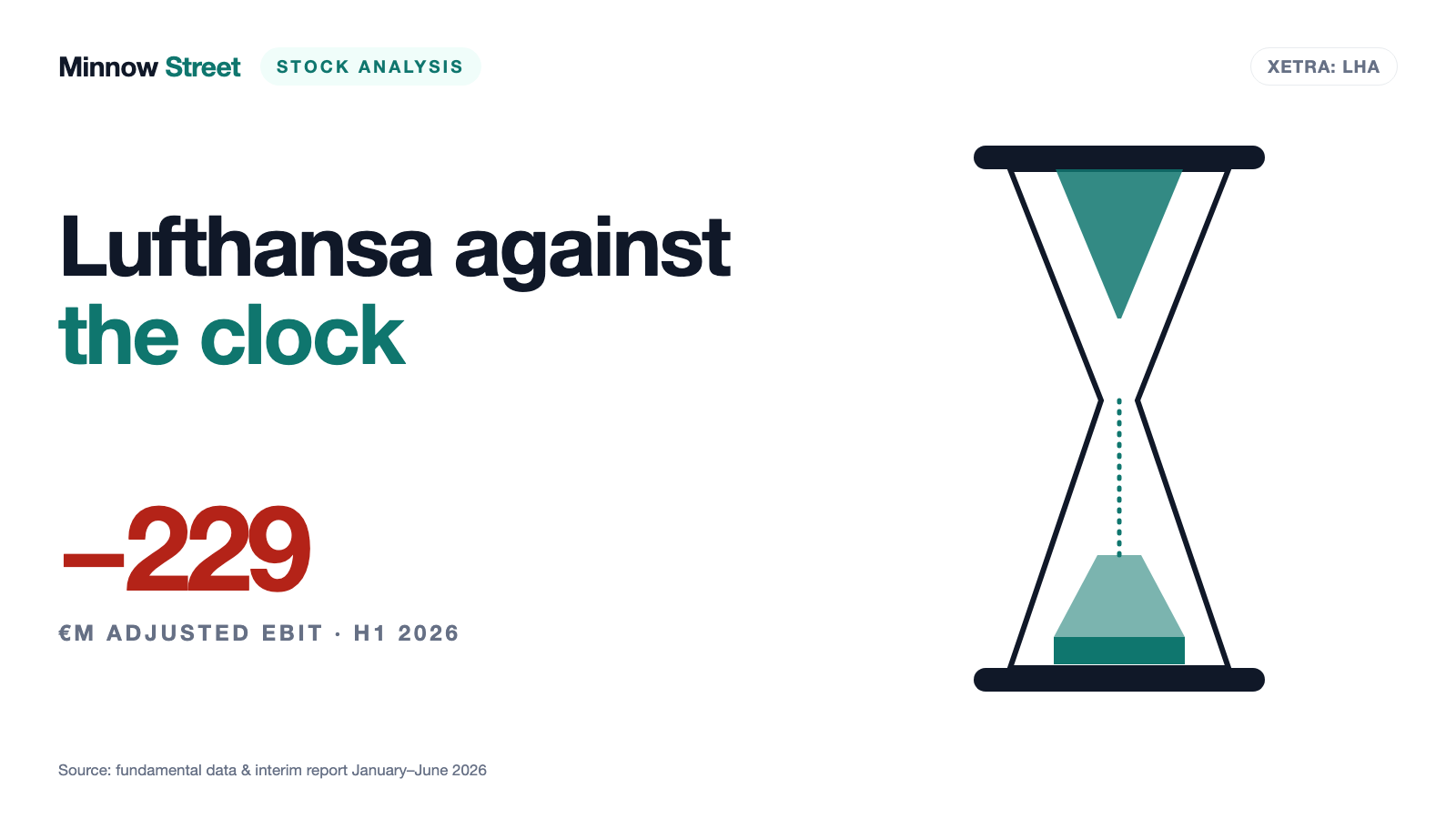
And then comes the line below. Adjusted EBIT — the operating result adjusted for one-off effects and the group's central steering metric — came in at minus 229 million euros, after plus 149 million in the prior-year period. A swing of 378 million euros. The adjusted EBIT margin fell from plus 0.8 to minus 1.1 per cent. The bottom line was a net loss attributable to shareholders of 542 million euros (prior-year period a profit of 127 million) and earnings per share of minus 0.45 euros.
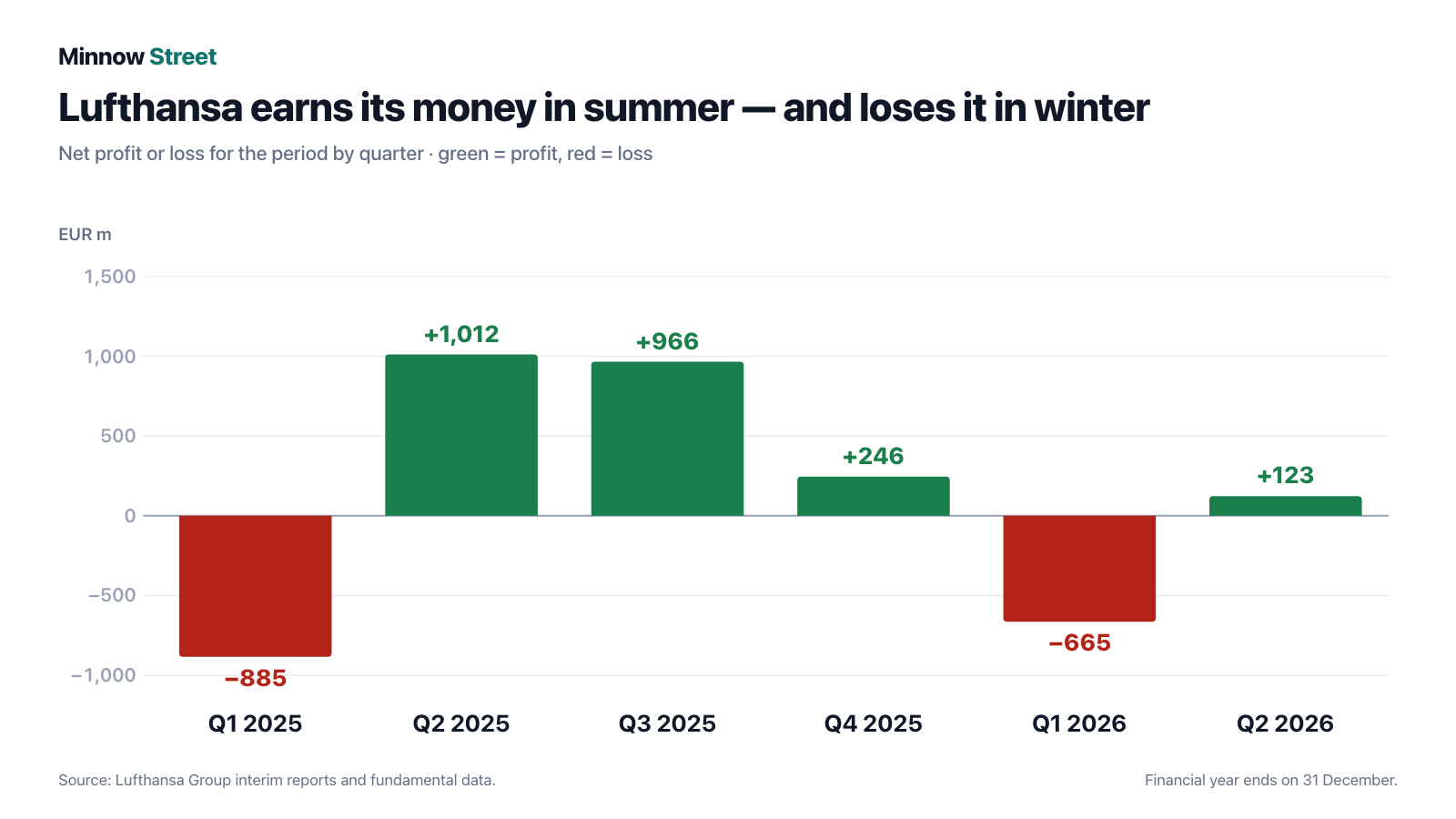
The second quarter on its own was positive — 383 million euros of adjusted EBIT — but even that was only around half the prior-year figure of 870 million. Second-quarter net profit fell from 1,012 to 123 million euros, down 88 per cent.
What the reports say — the uncomfortable truths
Uncomfortable truth no. 1: flying loses money, cargo and the workshop earn it
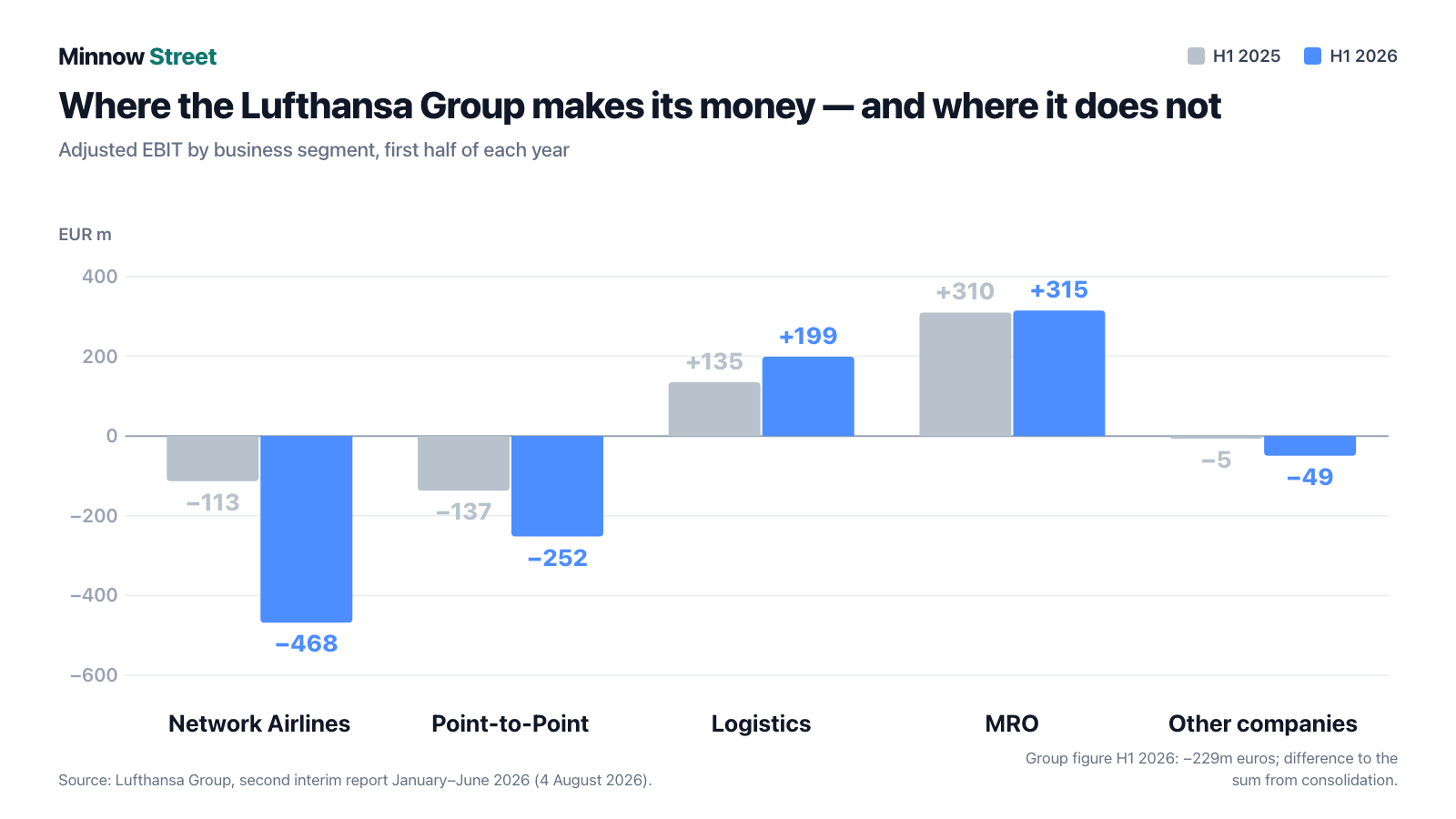
This is the core of the analysis. Take the segments for the first half of 2026 one by one:
- Network Airlines (Lufthansa Airlines, SWISS, Austrian, Brussels, Discover, the ITA stake): adjusted EBIT minus 468 million euros — after minus 113 million a year earlier. Revenue 13,380 million euros, margin minus 3.5 per cent.
- Point-to-Point Airlines (Eurowings): adjusted EBIT minus 252 million euros after minus 137 million. Revenue 1,413 million euros, margin minus 17.8 per cent.
- Logistics (Lufthansa Cargo): adjusted EBIT plus 199 million euros, up 47 per cent from 135 million. Revenue 1,916 million euros, margin 10.4 per cent.
- MRO (Lufthansa Technik): adjusted EBIT plus 315 million euros after 310 million. Revenue 4,428 million euros, margin 7.1 per cent.
- Other companies and Group functions: minus 49 million euros after minus 5 million.
The passenger business — those 14.8 billion euros of revenue the group is famous for — therefore lost 720 million euros in six months. The two side businesses, together 6.3 billion euros of revenue, earned 514 million euros. Put differently: on every euro of revenue, flying lost around five cents while cargo and the workshop made around eight.
Even within Network Airlines the distribution is lopsided. SWISS generated adjusted EBIT of 213 million euros in the first half of 2026 (prior-year period 205 million), while Austrian Airlines came in at minus 93 million (prior-year period minus 43 million) and Brussels Airlines at minus 70 million (minus 46 million). Remember: when a group runs four airlines and only one of them earns money, the group brand is not a promise of quality but a collective label.
Uncomfortable truth no. 2: a single price decides the year
Why did the half-year tip over? The report leaves no doubt. The conflict in the Middle East drove the price of jet fuel up:
“Der durchschnittliche Kerosinpreis erhöhte sich dementsprechend ebenfalls deutlich um 60 % auf 1.133,90 USD/t gegenüber Vorjahr (Vorjahr: 707,86 USD/t).”
— Deutsche Lufthansa AG, second interim report January-June 2026, interim management report "Macroeconomic situation", page 4 (average jet fuel price up 60 per cent to 1,133.90 US dollars per tonne, from 707.86 a year earlier)

What that means in euros is in the segment chapter: at Network Airlines alone, fuel expenses rose 16 per cent on price effects, plus 488 million euros in six months. For comparison: the group's entire adjusted EBIT in the strong year 2025 was 1,960 million euros. A commodity price that moves 60 per cent in half a year can therefore consume roughly a quarter of the annual result before anyone has done anything wrong.
Lufthansa hedges part of its fuel requirement with forward contracts, but only part — and the report itself states that the risk remains: an elevated fuel cost level may be offset by higher revenue only partially or with a delay. Because kerosene is bought mainly in US dollars, a high fuel price additionally amplifies the currency sensitivity of earnings.
The board's response on 16 April 2026 is correspondingly hard: the Lufthansa CityLine flight operation is being taken out of the offering, the entire sub-fleet of 23 Canadair CR-9 aircraft retired, fuel-hungry long-haul types such as the Airbus A340-600 phased out early, and two Boeing 747-400s temporarily parked from the winter schedule. This is not fine-tuning. This is a group scrapping aircraft because a price moved.
Uncomfortable truth no. 3: guidance was not confirmed, it was cut
Coverage often reads that Lufthansa "guided to 1.7 to 2.2 billion euros". True — but it leaves out what stood there before. The report puts both halves of the sentence in the same paragraph:
“Des Weiteren erwartet sie ein Adjusted EBIT zwischen 1,7 und 2,2 Mrd. EUR.”
— Deutsche Lufthansa AG, second interim report January-June 2026, forecast report, page 30 (the group expects adjusted EBIT of between 1.7 and 2.2 billion euros)

Do the arithmetic: adjusted EBIT in 2025 was 1,960 million euros. The lower end of the new range, 1.7 billion, is therefore below the prior year; only the upper end represents, as the report itself puts it, a result significantly above the prior year. A firm statement became a range whose lower end describes a decline. That is a downgrade, not a confirmation.
It runs through every level. At Network Airlines, "significantly above prior year" became a range of 750 to 1,150 million euros. At Point-to-Point Airlines the expectation slipped from 0 to 20 million to minus 50 to plus 20 million euros. Planned capacity fell from plus zero to two per cent to roughly the prior-year level, and net capital expenditure from 2.9 to around 2.5 billion euros — the latter, however, because fewer aircraft are being delivered than planned. Adjusted free cash flow is now expected at around 0.9 billion euros for 2026, after 1,188 million euros in 2025.
Uncomfortable truth no. 4: the debt is bigger than the headline says
The most-quoted debt figure is net debt. It stood at 6,697 million euros as at 30 June 2026:
“Die Nettokreditverschuldung lag trotz positivem Free Cashflow aufgrund gestiegener Leasingverpflichtungen und negativer Währungseffekte mit 6.697 Mio. EUR um 290 Mio. EUR über dem Niveau vom Jahresende 2025 (31. Dezember 2025: 6.407 Mio. EUR).”
— Deutsche Lufthansa AG, second interim report January-June 2026, "Net assets", page 14 (net debt of 6,697m euros, 290m above the level at the end of 2025 despite positive free cash flow, driven by higher lease liabilities and negative currency effects)

The figure is correct — but it is a net number. Gross, the balance sheet carries 14,825 million euros of financial debt (31 December 2025: 14,527 million), including 6,003 million euros of bonds, 3,985 million euros of lease liabilities, 3,590 million euros of aircraft financing and 1,136 million euros of promissory note loans. Deducted from that are bank balances of 1,799 million euros and interest-bearing securities of 6,345 million euros.
Then there are the pensions. Pension provisions stood at 2,148 million euros, net of plan asset surpluses at 1,585 million euros. Together with net debt that comes to 8,281 million euros. And one detail worth knowing: the group's own steering metric "adjusted net debt" sits below that at 8,031 million euros, because it deducts 50 per cent of the hybrid bond issued in 2025 — a bond is therefore treated half like equity. That is standard practice at rating agencies and by no means dubious; it is simply a convention that makes the number smaller than the balance sheet.
In fairness, the other side belongs here, and it is solid. Balance sheet liquidity stood at 8,144 million euros as at 30 June 2026, of which 7,598 million was centrally available at Deutsche Lufthansa AG. Adding undrawn credit lines of 2,583 million euros, the group had 10,727 million euros of liquidity available. Adjusted net debt to adjusted EBITDA of the last twelve months stood at 2.0 (year-end 2025: 1.8). And the risk report closes with the statement that no risks are currently identified that, individually or in aggregate, endanger the continued existence of the Lufthansa Group. This is not a crisis picture — it is the picture of a group that needs a lot of capital to produce very little margin.
Uncomfortable truth no. 5: strikes are not an exception here, they are a cost line
In the first half of 2026 the pilots' union Vereinigung Cockpit and the cabin crew union UFO called strikes in February, March and April — at Lufthansa Classic, Lufthansa Cargo, Lufthansa CityLine and Eurowings, partly simultaneously. The disputes concern the company pension scheme for pilots and a new framework collective agreement for cabin crew. The report notes soberly that the strikes led to considerable disruption to flight operations at times.
The cost shows up in the segment figures. At Network Airlines, expenses for passenger care during irregular operations together with compensation payments for delays and cancellations rose 35 per cent to 254 million euros (prior-year period 188 million). At Eurowings those items nearly tripled, from 16 to 43 million euros. And the risk report contains the decisive sentence for the future:
“Aufgrund offener Tarifverträge mit verschiedenen Beschäftigtengruppen innerhalb der Lufthansa Group besteht weiterhin das Risiko von Arbeitskämpfen.”
— Deutsche Lufthansa AG, second interim report January-June 2026, opportunity and risk report, page 27 (because collective agreements with various employee groups remain open, the risk of industrial action persists)

There is some progress: on 10 April 2026 Lufthansa City Airlines and the ver.di union agreed in principle on a collective framework for flying staff with a minimum term of three years. A start — but only for one of the companies.
Uncomfortable truth no. 6: a capital mandate covering more than half the share count
The last point is not in the numbers section but in the notes — and it is why we read notes. Issued capital stands at 3,077,332,211.20 euros, spread over 1,202,082,895 registered shares with restricted transferability. In parallel, the annual general meeting of 12 May 2026 granted the Executive Board the following:
“das Grundkapital der Gesellschaft um bis zu 920.000.000 EUR durch ein- oder mehrmalige Ausgabe von neuen, auf den Namen lautenden Stückaktien gegen Bar- und Sacheinlagen zu erhöhen (Genehmigtes Kapital A 2026)”
— Deutsche Lufthansa AG, second interim report January-June 2026, notes section 8 "Issued capital", page 43 (authorisation to increase the issued capital by up to 920,000,000 euros through one or more issues of new registered shares against cash or non-cash contributions, Authorised Capital A 2026)

920 million euros divided by the 2.56 euro notional amount is 359,375,000 potential new shares — just under 30 per cent of today's count. Add the remainder of the employee capital (83,111,037.44 euros, around 32.5 million shares) and two contingent capitals for convertible and option bonds of 306,044,326.40 euros and 306,944,000.00 euros (around 239.4 million shares together). In total: around 631 million potential new shares, more than half of the current count. On top of that, section 4 (3) of the German Aviation Security of Ownership Act permits a further increase of up to 10 per cent with pre-emption rights excluded — an instrument meant to ensure that the majority of shares stays in German hands, because traffic rights would otherwise be at risk.
Important for context: an authorisation is not an announcement. All that was used in the first half of 2026 was 7.168 million euros of employee capital. Remember: authorised capital says nothing about what a board will do — only about what it could do without asking you again. For a group whose result hangs on a commodity price, that is worth knowing. How quickly a mandate turns into reality was on display in our analysis of thyssenkrupp, another German industrial group in restructuring.
Valuation: a stock below book value
On 10 August 2026 Lufthansa shares closed at 8.30 euros on Xetra. The interim report still cites a closing price of 10.01 euros as at 30 June 2026 — the discount after the half-year figures were published is therefore substantial. At 1,202,082,895 shares that gives a market capitalisation of around 9.98 billion euros. We cross-checked this against the fundamental data; both agree.
The resulting valuation picture is one you rarely see at a large index constituent:
- Price-to-book of around 0.82. Equity stood at 12,171 million euros as at 30 June 2026, arithmetically 10.12 euros per share. The market values the group at roughly four fifths of its book equity.
- Price-to-sales of around 0.24 on trailing twelve-month revenue of roughly 41.1 billion euros. For four euros of revenue, the market pays one.
- Price-to-earnings of around 15 on the result of the last twelve months (roughly 670 million euros, or about 0.56 euros per share). Not cheap — but that trailing figure already contains two weak quarters.
- Enterprise value of around 18.3 billion euros (market capitalisation plus net debt plus net pension obligations), measured against trailing twelve-month adjusted EBITDA of roughly 4.0 billion euros — around 4.6 times.
- Dividend yield of around 4.0 per cent. For 2025 the annual general meeting on 12 May 2026 resolved a dividend of 0.33 euros per share; 396 million euros were paid out in total.
The obvious question: why does an index heavyweight trade below book value? The answer sits in the balance sheet structure. 19,755 million euros of the assets are aircraft and reserve engines — assets whose value depends on demand and fuel efficiency and which cannot be sold without a discount. The equity ratio is 23.9 per cent; for every euro of equity there are more than three euros of liabilities. Buying below book value here does not buy a bargain, it buys the question of whether that fleet will earn enough in future.
Opportunities and risks
What speaks for Lufthansa: cargo and MRO are independently profitable businesses with a double-digit and a mid single-digit margin respectively, and both are growing — Lufthansa Cargo benefits from geopolitical shifts redrawing freight routes while competitors pull capacity. Liquidity of 10.7 billion euros is comfortable, adjusted net debt to adjusted EBITDA of 2.0 unremarkable. The seat load factor rose despite capacity cuts and average yields improved — demand is there. The fleet measures cut fuel consumption and work disproportionately on the unhedged part of the requirement. And the stock trades below its book equity.
What speaks against it: the core business lost 720 million euros at the operating level in the first half of 2026. The annual result hangs on a commodity price nobody in the group controls and on a geopolitical conflict. Guidance was cut, not confirmed. Open collective agreements keep the strike risk alive. The purchase of control of ITA for 325 million euros falls into a half-year in which ITA flipped from profit to loss. The income tax expense of 165 million euros on a pre-tax loss shows that a weak result at group level does not produce tax relief. And over all of it sits a capital authorisation covering, arithmetically, more than half of today's share count.
One legacy case is also still open: Ryanair has challenged the state aid decision on the pandemic-era stabilisation. On 23 April 2026 the European Court of Justice dismissed Lufthansa's appeal in its outcome, but followed the group's arguments on material points and overturned large parts of the first-instance judgment. The six billion euros of stabilisation funds have been repaid in full and, according to the report, there is no immediate repayment risk — indirectly, recovery interest or conditions from a new European Commission state aid decision remain possible.
Conclusion: what familiarity hides
Back to the beginning. The familiarity trap works particularly well here, because the part of Lufthansa you know — the flying — is precisely the part that made no money in the first half of 2026. What did make money you never see: a cargo airline and one of the largest aircraft workshops in the world. Anyone buying the stock because they like the brand is buying a bet on a fuel price and on a corporate restructuring — not on an in-flight experience.
This is explicitly not a hatchet job. The Lufthansa Group is financially sound: 10.7 billion euros of liquidity, 12.2 billion euros of equity, a moderate leverage ratio, a risk report without any going-concern language, and a dividend that was paid even for a loss-making half-year. Nor is it a hymn. A group that turns over 19.9 billion euros in six months and produces an operating result of minus 229 million euros does not have a demand problem but a cost and structure problem — and the answer to it so far consists mainly of retiring aircraft earlier than planned.
The next verifiable checkpoint is the third interim report January-September 2026, scheduled for 3 November 2026. Until then one thing holds: the third quarter is the strongest of the year for airlines. If the range of 1.7 to 2.2 billion euros is to hold, that is where it has to be earned. No buy recommendation, no sell recommendation — just the suggestion that with this stock you set your own familiarity aside for a moment and read the segment table.
Sources
- Deutsche Lufthansa AG: second interim report January-June 2026, published 4 August 2026 (key figures, interim management report, business segments, opportunity and risk report, forecast report, interim financial statements and notes) — the company's most recent periodic report
- Deutsche Lufthansa AG: shareholder structure, as of 25 June 2026
- Deutsche Lufthansa AG: shareholder information 2/2026
- Fundamental data (price, market capitalisation and valuation figures), as of 10/11 August 2026
Data origin: source: fundamental data & company reports (interim and annual reports, Frankfurt Stock Exchange). All company figures come from the second interim report January-June 2026; every figure carries the date as of which it was reported. Quotations are reproduced in the German original because the report is published in German; an English rendering follows in brackets.
Disclaimer: This article is journalistic analysis and not investment advice, not a recommendation to buy or sell, and not an offer to acquire or dispose of securities. Shares can lead to substantial losses up to a total loss. Check every decision yourself and seek independent advice if in doubt.
Our Bottom Line at a Glance
- Core passenger business negative
- Network Airlines reported adjusted EBIT of minus 468 million euros in the first half of 2026 (prior-year period minus 113 million) and Point-to-Point Airlines minus 252 million (minus 137 million). Together the passenger business lost 720 million euros. Within Network Airlines only SWISS earned money, at plus 213 million euros; Austrian came in at minus 93 million and Brussels at minus 70 million.
- Cargo and MRO positive
- Lufthansa Cargo lifted adjusted EBIT by 47 per cent to 199 million euros in the first half of 2026 at a 10.4 per cent margin, and Lufthansa Technik by 2 per cent to 315 million euros at a 7.1 per cent margin on revenue up 11 per cent. Together the two segments contributed 514 million euros and carried the group through a weak passenger half-year.
- Cost exposure negative
- The average price of jet fuel rose 60 per cent to 1,133.90 US dollars per tonne in the first half of 2026, and the jet fuel crack by 201 per cent. At Network Airlines alone fuel cost 488 million euros more. On 16 April 2026 the group responded by taking the CityLine flight operation out of the offering, retiring 23 Canadair CR-9 aircraft and phasing out fuel-hungry long-haul types early.
- Guidance negative
- On 4 August 2026 the 2026 expectation was cut from "adjusted EBIT significantly above the prior year" to a range of 1.7 to 2.2 billion euros; 2025 came in at 1,960 million euros, so the lower end of the range sits below it. Capacity expectations and net capital expenditure were also reduced, and adjusted free cash flow to around 0.9 billion euros after 1,188 million a year earlier.
- Balance sheet and liquidity neutral
- As at 30 June 2026, equity of 12,171 million euros (ratio 23.9 per cent) stood against net debt of 6,697 million euros and net pension obligations of 1,585 million. Available liquidity was 10,727 million euros and adjusted net debt to adjusted EBITDA 2.0 after 1.8. The risk report explicitly names no risks that endanger the continued existence of the group.
- Capital structure and governance neutral
- The annual general meeting of 12 May 2026 granted authorised and contingent capital covering around 631 million potential new shares — more than half of the 1,202,082,895 shares outstanding; only 7.168 million euros of employee capital was used in the first half. The largest single shareholder is Kuehne Aviation GmbH with 20.00 per cent (as of 25 June 2026).
The Lufthansa Group lifted revenue by eight per cent to 19,887 million euros in the first half of 2026 and still reported adjusted EBIT of minus 229 million euros. The cause was a 60 per cent rise in the price of jet fuel, strikes and route cancellations: the passenger business lost 720 million euros while cargo and MRO earned 514 million. Full-year guidance was cut to 1.7 to 2.2 billion euros, the lower end of which sits below the 1,960 million euros of the prior year. The balance sheet remains sound, with 10.7 billion euros of available liquidity and adjusted net debt to adjusted EBITDA of 2.0. Not investment advice.
What Our Rating Means
Open questions
The business works in principle, but one material question is open. As long as it stays open, our findings do not carry a quality verdict.
Yellow here is not about an existential question. The balance sheet as at 30 June 2026 holds up: 12,171 million euros of equity at a ratio of 23.9 per cent, 8,144 million euros of balance sheet liquidity plus 2,583 million euros of undrawn credit lines, adjusted net debt to adjusted EBITDA of 2.0, and an opportunity and risk report that explicitly states no risks are currently identified that endanger the continued existence of the Lufthansa Group. Demand is intact too: the seat load factor rose 1.9 percentage points to 82.4 per cent despite capacity cuts, average yields improved, and Logistics and MRO grew revenue at double-digit and double-digit rates respectively. Yellow stands because one material operating question is open — and it sits in the core business. The two passenger segments lost 720 million euros at the operating level in the first half of 2026, after 250 million a year earlier; the group was carried by cargo and MRO. The annual result therefore hangs on a commodity price the group does not control and which moved 60 per cent in six months, and on a geopolitical conflict. On 4 August 2026 guidance was not confirmed but cut to a range whose lower end sits below the prior year. Add open collective agreements with a persistent strike risk and an income tax expense of 165 million euros on a pre-tax loss. None of this threatens the substance — all of it is unproven until the seasonally strong third quarter is on the table. The next verifiable checkpoint is the third interim report on 3 November 2026. The decision is yours.
A journalistic assessment by our editorial team at the time of the deep dive, based on public sources — not investment advice and not a solicitation to buy or sell. Your personal circumstances (investment goals, risk capacity, taxes) cannot be taken into account. What our levels mean, how verdicts are formed, and what conflicts of interest exist →
Worth Noting
- The trigger for this analysis is the persistently high presence of Lufthansa shares in the most-discussed rankings of German retail investor forums — not an analyst call, not a newsletter, not a recommendation. All company figures come from the second interim report January-June 2026, published on 4 August 2026.
- There is no 10-K and no 10-Q from Deutsche Lufthansa AG: the group is not a US reporting company but is listed on the regulated market of the Frankfurt Stock Exchange. In the United States only an unsponsored depositary receipt trades. The data origin is therefore "source: fundamental data & company reports (interim and annual reports, Frankfurt Stock Exchange)".
- Adjusted EBIT and adjusted EBITDA are company metrics, not IFRS measures: they adjust for book gains on disposals, restructuring expenses and pension one-offs, among other items. In the first half of 2026 reported EBIT was minus 138 million euros and adjusted EBIT minus 229 million — the reconciliation amounted to plus 90 million euros and includes in particular 177 million euros of book gains on aircraft disposals.
- The market capitalisation of around 9.98 billion euros was cross-checked: 1,202,082,895 shares outstanding per the notes to the interim report, multiplied by the Xetra closing price of 8.30 euros on 10 August 2026, gives the same figure as the fundamental data. The closing price cited in the interim report as at 30 June 2026 was still 10.01 euros.
- Risk of confusion: the ticker LHA.DE used here is shorthand for "Lufthansa, listed in Germany" — not an official exchange code. The shares trade as Xetra: LHA and in Frankfurt, Stuttgart, Munich, Duesseldorf and Hamburg. Not to be confused with the US depositary receipt DLAKY or with the second line LHAB.
The full analysis as a PDF for later
We will send you this analysis as a PDF — to print, file away, and read at your own pace.
Frequently Asked Questions
Revenue rose eight per cent to 19,887 million euros in the first half of 2026. Adjusted EBIT was nevertheless minus 229 million euros, after plus 149 million in the prior-year period, and net profit attributable to shareholders came in at minus 542 million euros (prior-year period plus 127 million). Earnings per share were minus 0.45 euros. In the second quarter alone adjusted EBIT was positive at 383 million euros, but 56 per cent lower than a year earlier.
In the first half of 2026 only Logistics and MRO did: Lufthansa Cargo generated adjusted EBIT of 199 million euros (up 47 per cent) and Lufthansa Technik 315 million euros (up 2 per cent). Network Airlines by contrast lost 468 million euros and Point-to-Point Airlines around Eurowings 252 million. The passenger business therefore lost 720 million euros in total, while the two side businesses earned 514 million euros.
The main driver was the price of jet fuel. It rose 60 per cent in the first half of 2026 to 1,133.90 US dollars per tonne (prior-year period 707.86 US dollars), and the jet fuel crack by 201 per cent. At Network Airlines alone fuel cost 488 million euros more. On top came strikes by the Vereinigung Cockpit and UFO unions in February, March and April 2026, as well as route cancellations because of the conflict in the Middle East.
On 4 August 2026 the group named a range of 1.7 to 2.2 billion euros of adjusted EBIT. Previously it had expected adjusted EBIT significantly above the prior year — 2025 came in at 1,960 million euros. The lower end of the new range is therefore below the prior year. Capacity expectations were also cut from plus zero to two per cent to roughly the prior-year level, and net capital expenditure from 2.9 to around 2.5 billion euros. Adjusted free cash flow is expected at around 0.9 billion euros.
As at 30 June 2026 net debt stood at 6,697 million euros (31 December 2025: 6,407 million) and gross financial debt at 14,825 million euros. Together with net pension obligations of 1,585 million euros that comes to 8,281 million euros. Against it stand balance sheet liquidity of 8,144 million euros and undrawn credit lines of 2,583 million euros — 10,727 million euros in total. Adjusted net debt to adjusted EBITDA stood at 2.0.
Yes. The annual general meeting on 12 May 2026 resolved a dividend of 0.33 euros per share for the 2025 financial year; 396 million euros were paid out in total. At the closing price of 10 August 2026 (8.30 euros on Xetra) that is a yield of around 4.0 per cent. It was paid in a half-year that ended with a net loss of 542 million euros.
Deutsche Lufthansa AG exercised its option to acquire a majority in ITA Airways in June 2026; the stake rises from 41 to 90 per cent and the price for the 49 per cent tranche is firmly agreed at 325 million euros. Completion is expected in the first quarter of 2027 and is subject to regulatory approvals, above all from the European Commission and the US Department of Justice. In the first half of 2026 ITA contributed minus 58 million euros to earnings, after plus 84 million a year earlier.
Deutsche Lufthansa AG is not a US reporting company. It is listed on the regulated market of the Frankfurt Stock Exchange and is a DAX constituent; in the United States only an unsponsored depositary receipt trades. Its mandatory reporting consists of an audited IFRS annual report, a half-year report subject to review and interim reports. This analysis is based on the second interim report January-June 2026 of 4 August 2026.
Found an error?
Did you spot a factual error, an outdated number, or a typo in this deep dive? Let us know briefly — your report goes straight to the editorial team.