TUI Stock: A Record Year on the Front, Accumulated Losses on the Back
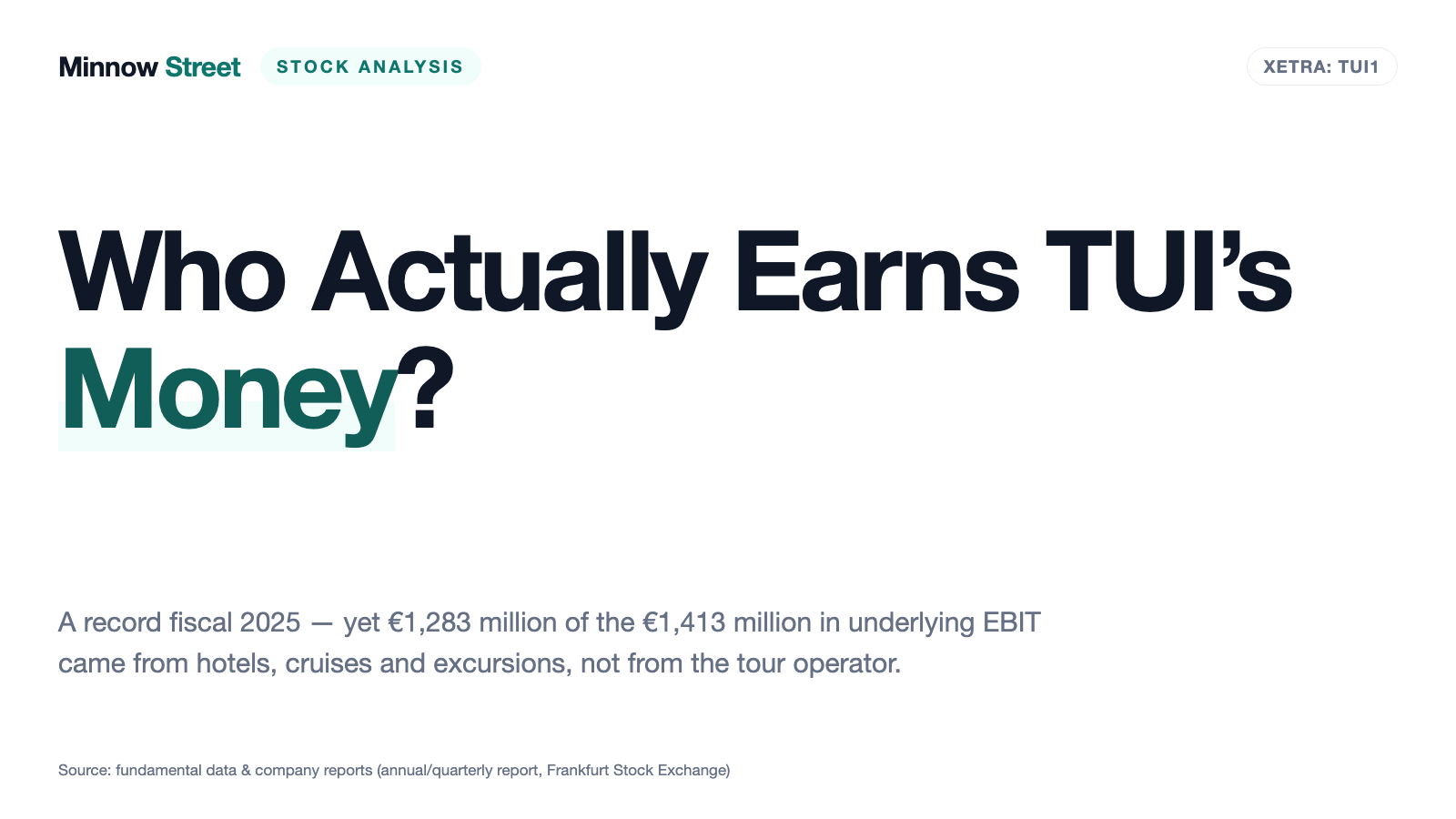
In fiscal 2025 TUI delivered the best underlying result in the group's history: €1,413.1 million on revenue of €24,178.7 million. But €1,283.2 million of it came from hotels, cruises and excursions — the tour operator and its airlines contributed just €199.9 million, a third less than a year earlier. And the balance sheet sets €7,980.4 million of paid-in capital against €6,725.4 million of accumulated losses. If you know a stock because you once flew somewhere on it, read both sides of the card.
 Thomas Mücke
Founder & Publisher
Thomas Mücke
Founder & Publisher
Chart
Interactive price chart (TradingView).
Note: pure fact-based analysis, not investment advice and not a solicitation to buy or sell. All figures without guarantee.
A postcard has two sides. The bay, the blue, the sunset on the front — the address, the stamp and the sentence that actually says something on the back. The same thing happens to us with stocks. We know a company from its front side. We flew on the plane, had breakfast in the hotel, saw the logo at the gate. And because that picture is pleasant, we quietly mistake it for a verdict on the business. Call it the postcard trap. Few European names trigger it as reliably as TUI. So let us make a deal: first we look at the front, and it really is strong — fiscal 2025 was the best year in more than a decade. Then we turn the card over and read what is written on the back. Both belong together.
What TUI actually does — four businesses under one blue roof
TUI stopped being a travel agency a long time ago. The Hanover-based group covers the entire value chain of a holiday and reports it in two large areas. Holiday Experiences is everything TUI owns and runs itself: more than 460 hotels and resorts under brands such as RIU, TUI Blue and Robinson; 19 cruise ships ranging from the luxury MS Europa through the expedition vessels to the Mein Schiff fleet and Britain's Marella Cruises (as of August 2026; there were 18 at the September 30, 2025 balance sheet date, with Mein Schiff Flow added in June 2026); and TUI Musement with excursions, transfers and local experiences. Markets + Airline is what most people associate with the name: the tour operators in Germany, the United Kingdom, the Netherlands, Scandinavia and other countries, roughly 1,200 travel agencies and five airlines with 125 aircraft. In fiscal 2025 34.7 million guests travelled with TUI, and the group employed 66,854 people as at September 30, 2025.
Translated into everyday terms: TUI is a hotelier, a shipping line, an airline and a travel agency at the same time. That is the difference from a pure booking platform — TUI earns its money on its own bed and its own cabin, not on a referral fee. Why exactly that difference mattered so much in fiscal 2025 shows up in the numbers.
Why there is no 10-K here — and what a fiscal year ending in September means
Two things up front, because they shape the whole chain of evidence in this analysis. First: TUI files no 10-K and no 10-Q. Those are the mandatory reports U.S. companies file with the U.S. securities regulator, the SEC — TUI is not a U.S. reporting issuer, and a search of the SEC ticker registry for TUI and TUI1 returns nothing. TUI's mandatory reporting runs through the Prime Standard of the Frankfurt Stock Exchange: audited IFRS consolidated accounts, a half-year financial report and short quarterly statements. The London secondary listing ended on June 21, 2024, and the shares have been in the MDAX since June 24, 2024. Every figure here therefore carries the line "Source: fundamental data & company reports (annual/quarterly report, Frankfurt Stock Exchange)" rather than "SEC filings". You know the same setup from our analysis of adidas — another German index constituent where the entire chain of evidence runs through the company's own reports instead of sec.gov.
Second: TUI's fiscal year does not end on December 31 but on September 30. Fiscal 2025 therefore ran from October 1, 2024 to September 30, 2025. That is not an administrative detail — it follows the season. The summer in which TUI earns most of its money falls entirely into the fourth fiscal quarter, and the report appears once the travellers are home. For you that means: when you read "Q1" in a table, TUI means October to December, the weakest quarter of the year. And the most recent published report at the time of writing is the half-year financial report as at March 31, 2026, released on May 13, 2026. The quarterly statement for the third fiscal quarter is scheduled for August 12, 2026.
How the stock landed on our desk
Honesty first: the hook for this analysis is not a screening hit from our in-house stock scanner but a popularity reading. On August 7, 2026 TUI sits high in the forum rankings of wallstreet-online, among the stocks German retail investors discuss most. That says exactly nothing about the quality of the business — it says something about the postcard trap. Few other European stocks are personally familiar to so many people. That familiarity is precisely why we look at the reports especially carefully here: where our gut already holds an opinion, we need the numbers most. Keep it as the running theme of this piece: being well known is not a metric.
The numbers across the years — given their due
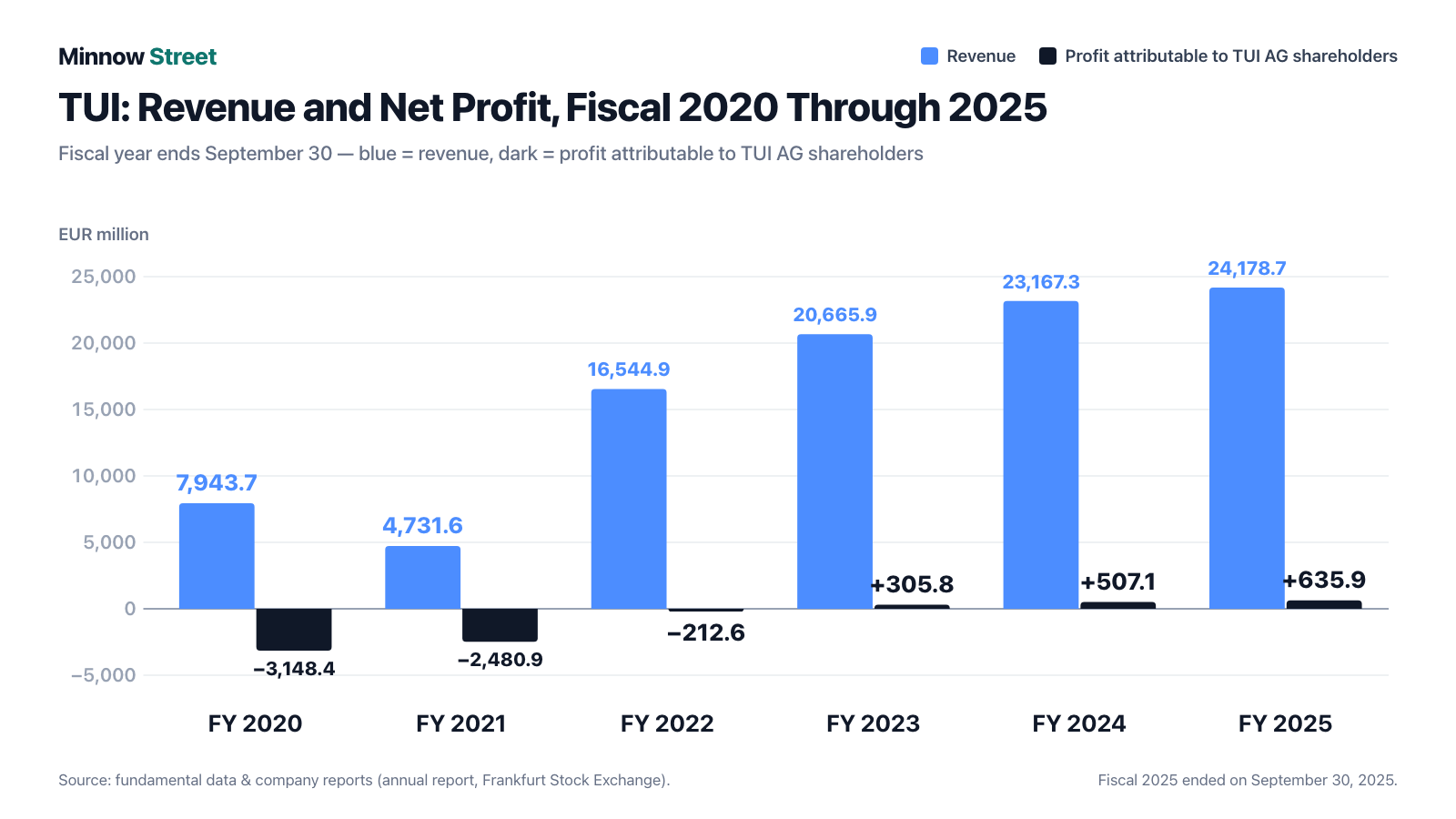
First the part that genuinely impresses. TUI is one of the few companies you have watched collapse completely and then get back up. In fiscal 2020 revenue crashed to €7,943.7 million and in fiscal 2021 to €4,731.6 million — alongside losses of €3,148.4 million and €2,480.9 million attributable to TUI AG shareholders. Since then it has improved every single year: €16,544.9 million of revenue (2022), €20,665.9 million (2023), €23,167.3 million (2024) and finally €24,178.7 million in fiscal 2025, up 4.4 percent. Earnings followed: from minus €212.6 million (2022) through plus €305.8 million (2023) and plus €507.1 million (2024) to plus €635.9 million in fiscal 2025.
The financial position has been put in order as well. Net debt fell 20.5 percent in fiscal 2025 to €1,304.9 million and leverage relative to underlying earnings before depreciation dropped from 0.8 to 0.6. The rating agencies followed: Standard & Poor's raised TUI to "BB-" (stable outlook) in fiscal 2025, Moody's to "Ba3" (stable), and Fitch assigned a rating for the first time ever in February 2025 — "BB" (stable). A year later came half a step more: in February 2026 Moody's affirmed the Ba3 rating and lifted the outlook from stable to positive, while Fitch affirmed "BB" with a stable outlook in the same month. That is still how TUI's own ratings overview reads (retrieved August 7, 2026), and Standard & Poor's no longer appears on it. For context: these are all grades below investment quality, but far above the "CCC+" and "Caa1" pandemic lows of 2020. And for the first time since the pandemic there is money for shareholders again: a dividend of €0.10 per share for fiscal 2025, with 10 to 20 percent of underlying earnings per share to be paid out from fiscal 2026 onwards.
That is the front of the postcard, and it is real. Now we turn it over.
What the reports say — the uncomfortable truths
Uncomfortable truth no. 1: the record result comes almost entirely from hotels and ships
TUI's key-figures table in the Annual Report 2025 breaks underlying EBIT down by area — and that split is the real core of this analysis. Of the group's €1,413.1 million of underlying EBIT, €1,283.2 million came from Holiday Experiences, that is from its own hotels (€735.0 million), cruises (€481.1 million) and TUI Musement (€67.2 million). Markets + Airline — tour operators, travel agencies, airlines — contributed €199.9 million. The prior-year figure was €303.9 million: a decline of 34.2 percent. Within that area the Western Region (the Netherlands, Belgium, France) slipped from plus €10.3 million to minus €21.6 million.
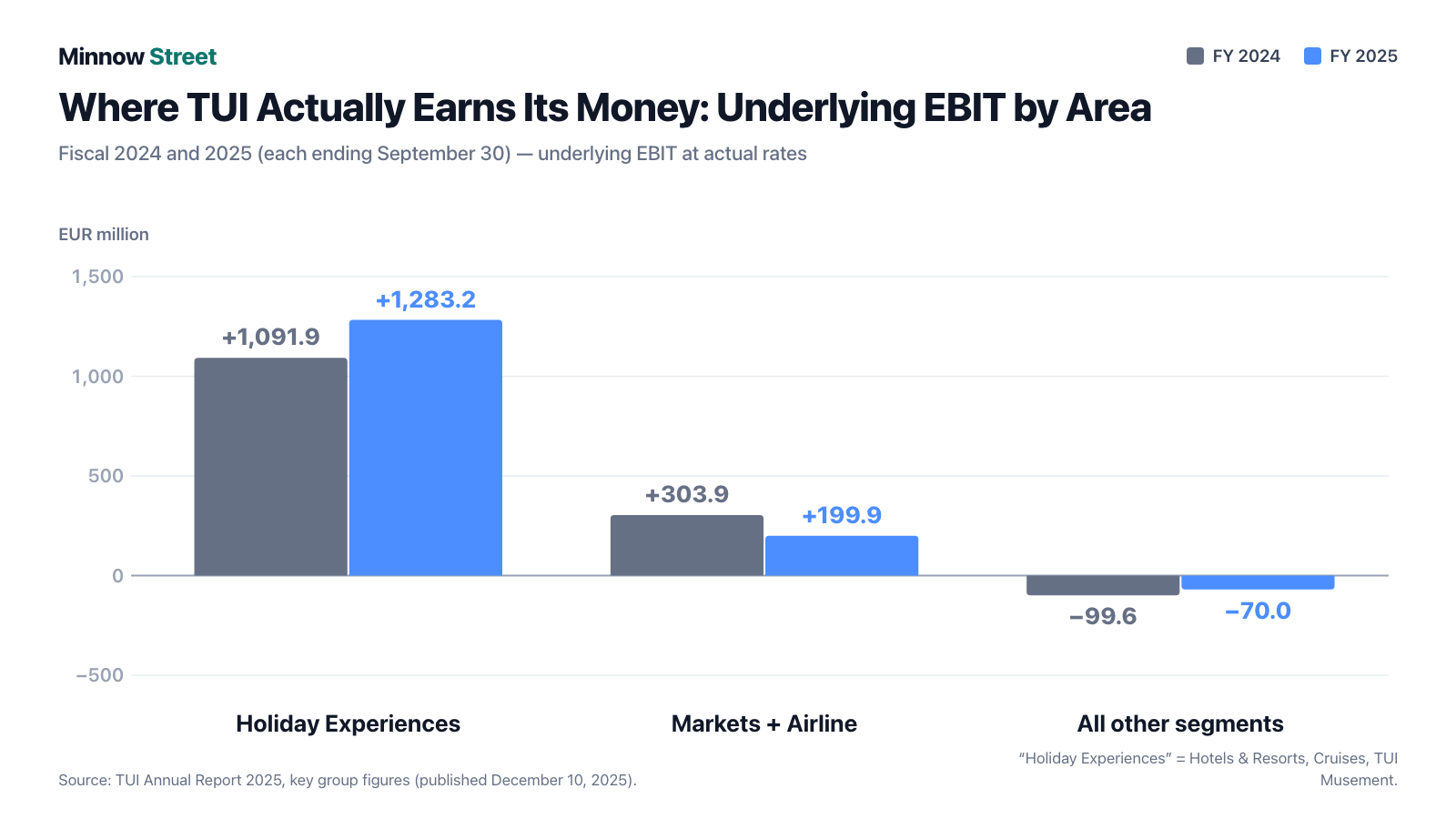
Why is that uncomfortable? Because it turns the postcard over. The part of the group you know — the shop on the high street, the flight with the smiley on the tail — now contributes roughly 14 percent of operating earnings and delivers less than it did a year ago. The part you usually do not associate with TUI — the hotel you own without knowing it, and the cruise ship running at 93 percent occupancy — carries the other 86 percent. TUI calls this the "transformation" and sees Markets + Airline above all as a channel that funnels demand into its own products. That is a plausible strategy. But for you as an investor the question changes: you are no longer buying a tour operator, you are buying a hotel and cruise group with a distribution network attached.
Uncomfortable truth no. 2: of €8.5 billion of paid-in capital, €2.7 billion is left
The equity ratio is one of the few metrics you understand without training: how much of what the company owns actually belongs to it, and how much is borrowed? TUI states the number itself:
"The equity ratio was 14.8% (previous year 10.2%). Equity and non-current financial liabilities accounted for 23.4% (previous year 19.1%) of the balance sheet total."
— TUI AG, Annual Report 2025, combined management report / Business Review

14.8 percent on a balance sheet total of €18,148.9 million is better than the prior year's 10.2 percent, but it stays thin. More interesting than the ratio is what this equity consists of. As at September 30, 2025 the group reports subscribed capital of €507.4 million, capital reserves of €7,980.4 million, revenue reserves of minus €6,725.4 million and minority interests of €924.2 million. Total: €2,686.7 million.
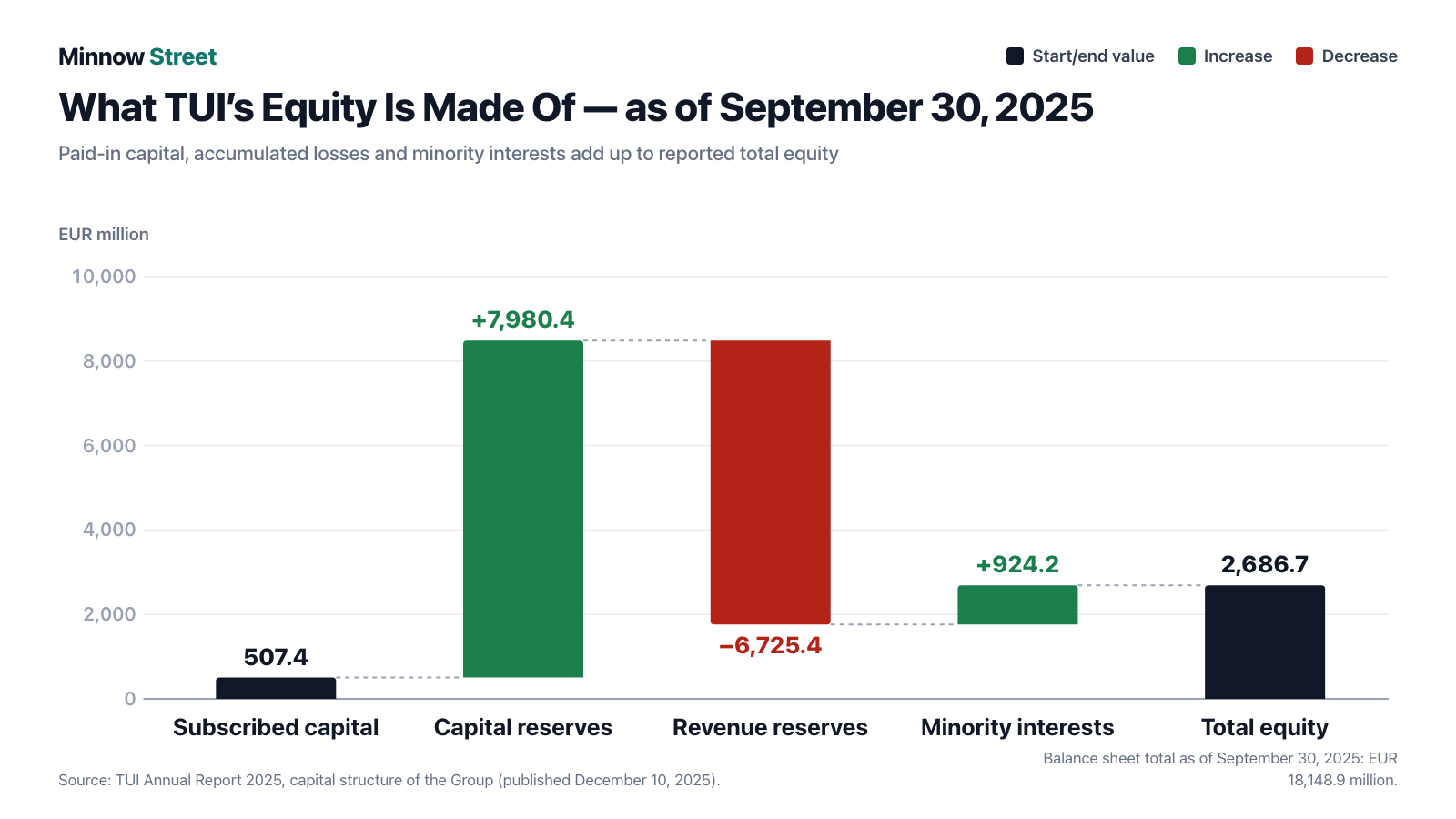
Translated into everyday terms: over the years shareholders have paid roughly €8.5 billion into this company — subscribed capital plus capital reserves. Of that, after all the profits and losses of the past, €6.7 billion has been used up. Most of the gap comes from the pandemic years we saw in the chart above. This is not accounting trickery; it is simply the company's history expressed in numbers. But it explains why TUI has such a thin cushion despite a record result.
And a second figure belongs with it:
"Goodwill amounted to €2,933.6m. a slight decline of 2.2 % compared with the previous year's level of €2,998.7m."
— TUI AG, Annual Report 2025, combined management report / Business Review
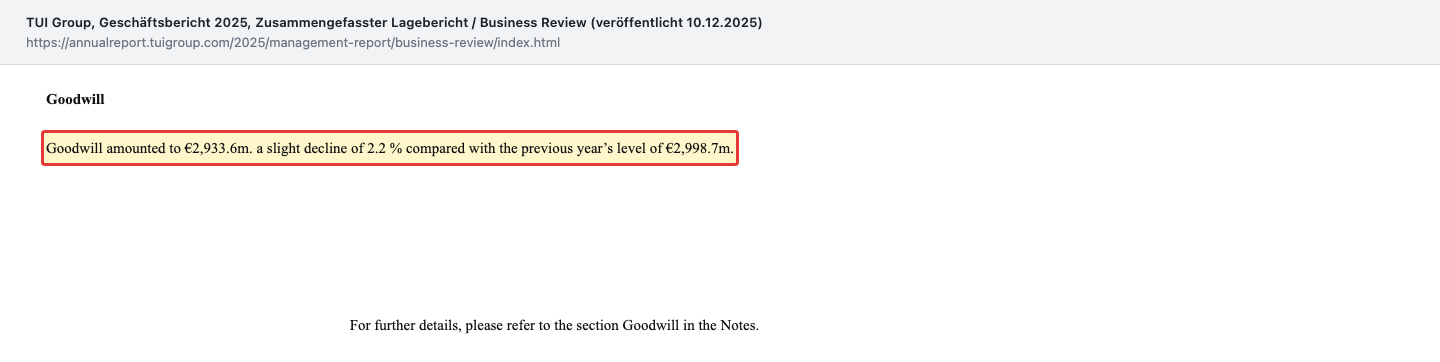
Goodwill is the premium a company paid in past acquisitions beyond the value of the assets it bought. You cannot touch it, sell it or rent it out. And at TUI, at €2,933.6 million, it is roughly two thirds larger than the equity attributable to TUI AG shareholders (507.4 plus 7,980.4 minus 6,725.4 = €1,762.4 million). Add the €596.8 million of other intangible assets and shareholders' tangible equity is arithmetically negative. As long as the hotels and the ships deliver, that is a question for accountants. But if goodwill ever had to be written down, the write-down would hit a cushion smaller than the item itself.
Uncomfortable truth no. 3: two blocks are sitting on your stake
The first block is frozen. In the chapter on takeover-law disclosures, the Annual Report 2025 puts it as plainly as an exceptional situation can be put:
"The Executive Board assumes that it is currently impossible to transfer the shares it considers attributable to Alexey Mordashov or to exercise the voting rights from these shares."
— TUI AG, Annual Report 2025, takeover-law disclosures (page 169)
Before the April 2023 rights issue the sanctioned Russian businessman held roughly 30.9 percent of TUI. Because EU sanctions meant he was granted no subscription rights, he could not take part in the issue: TUI placed 328,890,829 new shares at €5.55 and raised about €1.8 billion, which repaid the German state aid in full. The share count rose from roughly 178.5 million to 507,431,033, and his stake fell to about 10.9 percent. For the other shareholders that was an advantage at the time: whoever subscribed picked up the portion the blocked major shareholder was not allowed to take.
The second block is still waiting. In July 2024 TUI issued a convertible bond of €487.0 million, carrying just 1.95 percent interest and due in July 2031. The price of that cheap coupon sits in the small print: the conversion price is €9.60 per share, and full exercise would create up to 50,729,166 new shares — exactly 10.0 percent of the shares outstanding today. That is why TUI reports two earnings-per-share figures for fiscal 2025: €1.25 basic and €1.17 diluted. Translated into everyday terms: your slice of the cake gets smaller as soon as the share price climbs above €9.60 — precisely at the moment you are enjoying the rising price. On August 7, 2026 the shares stood at €7.74, 19 percent below that mark.
Uncomfortable truth no. 4: winter eats the cash — every single year
As at September 30, 2025 TUI held €3,120.2 million of cash and cash equivalents against net debt of €1,304.9 million. Six months later, on March 31, 2026, cash was down to €1,448.6 million with net debt of roughly €3.0 billion. That is not an alarm signal, it is the business model — and TUI names it in its own risk report:
"Tourism is inherently seasonal with the majority of business undertaken and profits earned in the European summer months. Cash flows are similarly seasonal, peaking in early summer as advance payments and final balances are received from customers, and dipping in winter as liabilities are settled with many suppliers after the summer season. (“The touristic swing”)."
— TUI AG, Annual Report 2025, risk report, risk (3) Seasonal cash flow

Behind that swing sits a number that explains this business model better than any balance-sheet ratio: as at September 30, 2025 TUI's books carried €4,094.3 million of touristic advance payments received (prior year €4,017.1 million). That is money holidaymakers have paid for trips that have not yet happened. TUI works with it — interest-free. It is a genuine advantage over companies that invoice only after delivery. It is also the reason why current liabilities (€10,275.4 million) exceed current assets (€5,681.1 million) so clearly — and why classic balance-sheet warning lights such as the Altman Z-score regularly flash red at tour operators when nothing is actually wrong. Those measures were built for industrial companies, not for businesses pre-financed by their customers. The flip side matters: if booking demand ever collapses, that interest-free credit disappears immediately — which is exactly what happened in 2020. TUI counters with syndicated credit lines of roughly €2.0 billion running to March 2030, which were not drawn in cash as at September 30, 2025, and it states that it met all financial covenants at that date — the most important of them being that net debt must not exceed three times earnings before depreciation.
Where TUI stands on artificial intelligence
Few industries are written off as an AI loser as often as travel distribution: if a language model assembles your trip and books it directly, what is a tour operator for? TUI answers the question itself in the Annual Report 2025 — with an argument that connects straight back to uncomfortable truth no. 1:
"This makes AI an opportunity for us– as we are protected on distribution with differentiated products. To take advantage of this opportunity, we are incorporating the use of AI into our business to drive value."
— TUI AG, Annual Report 2025, TUI Group Strategy
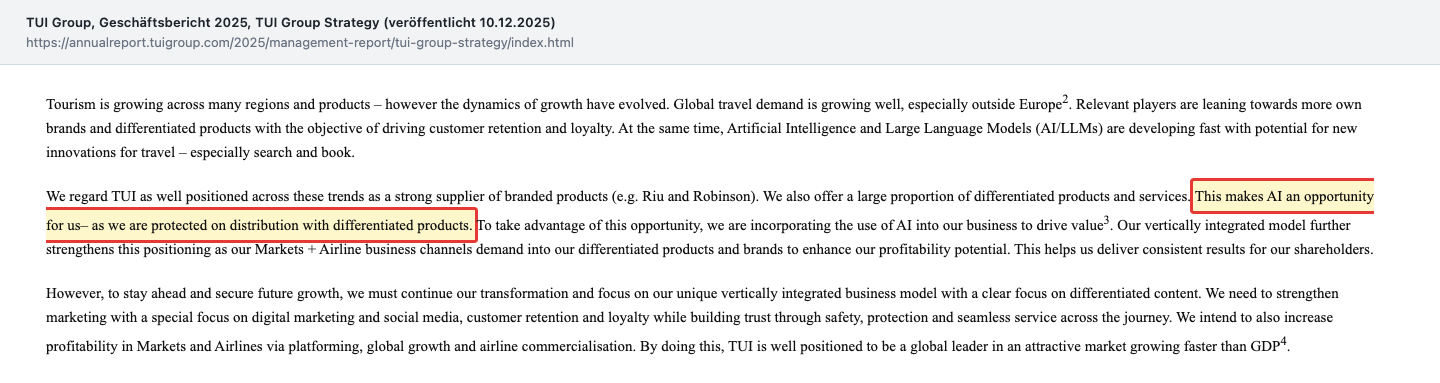
The argument runs like this: a language model cannot sell you a room in a Robinson Club if TUI is the only supplier of that room. Whoever merely brokers other people's beds is exposed; whoever owns the beds is less so. In practice, according to chief executive Sebastian Ebel in the half-year press release of May 13, 2026, TUI works with Google and ChatGPT and offers AI dialogue features in its own app; the stated goal is to make its own content "AI-visible" and "AI-bookable". At the same time AI appears in the risk report as an execution risk: the Executive Board explicitly names the difficulty of integrating new technologies such as AI "at scale". For our classification that means TUI is an AI user, not an AI vendor — and the benefit is not yet a reported number but a statement of intent with early examples. The share of revenue generated through its own app stood at 11.4 percent in the second fiscal quarter of 2026, up 20 percent year over year.
Valuation: cheap at first glance, thin at second
On August 7, 2026 TUI shares traded at €7.74, which on 507,431,033 shares gives a market value of about €3.93 billion. That is less than a sixth of annual revenue (a price-to-sales ratio of roughly 0.16) and about six times the earnings of the past twelve months. Enterprise value — market value plus net debt — comes to roughly €4.8 billion, about twice underlying earnings before depreciation. On paper that is cheap. Over the past 52 weeks the price moved between €6.08 and €9.45.
The second glance qualifies it. First, the book value per share behind a price-to-book ratio of about 1.96 consists — as shown above — largely of goodwill. Second, diluted earnings per share come to only €1.17 rather than €1.25. Third, guidance for the current fiscal year has already been cut. On April 22, 2026 TUI announced by ad-hoc release that the Iran war in March alone had cost roughly €40 million: about 10,000 guests had to be repatriated, among them some 5,000 passengers of the ships Mein Schiff 4 and Mein Schiff 5, whose voyages were cancelled through mid-May 2026. The group guidance:
"Subject to the recovery in the respective markets, the Group has adjusted its guidance (at constant currency) and now expects underlying EBIT for FY 2026 to be in the range of €1.1bn to €1.4bn (prior guidance +7-10%; FY 2025: €1,413m). At the same time, TUI is suspending revenue guidance until conditions stabilize."
— TUI AG, ad-hoc release of April 22, 2026
Operationally the first half of fiscal 2026 was nevertheless better than the year before: underlying EBIT improved by €45 million to minus €111 million (prior year minus €155.9 million), with 12.8 million guests travelling. The minus is normal — winter is the loss-making season, see uncomfortable truth no. 4. For the summer, TUI reported on May 13, 2026 that more than half of capacity had been sold and that demand was shifting from the eastern to the western Mediterranean. Anyone taking the numbers seriously waits for the quarterly statement of August 12, 2026 — the first look at how the summer of 2026 actually went. We took a similarly cautious line in another German restructuring case, our analysis of thyssenkrupp: there too one division carries the rest, and the question is whether the rebuild works faster than the drag.
Opportunities and risks at a glance
What speaks for TUI:
- Best underlying EBIT since the 2014 merger: €1,413.1 million in fiscal 2025 (up 9.0 percent at actual rates, up 12.6 percent at constant rates) on revenue of €24,178.7 million.
- The owned assets carry the group: Hotels & Resorts €735.0 million and Cruises €481.1 million of underlying EBIT — the cruise business grew 28.5 percent in fiscal 2025.
- Net debt cut 20.5 percent to €1,304.9 million and leverage down from 0.8 to 0.6; rating upgrades to BB- (Standard & Poor's), Ba3 (Moody's) and a first-ever BB (Fitch) — and in February 2026 Moody's additionally lifted the Ba3 outlook from stable to positive.
- First dividend since the pandemic: €0.10 per share for fiscal 2025, with a payout ratio of 10 to 20 percent of underlying earnings per share from fiscal 2026.
- Roughly €4,094.3 million of customer advance payments finance the business interest-free; syndicated credit lines of about €2.0 billion running to March 2030 were not drawn in cash as at September 30, 2025.
What speaks against it:
- Markets + Airline — tour operators, travel agencies, airlines — earned only €199.9 million in fiscal 2025, 34.2 percent less than the year before; the Western Region slipped from plus €10.3 million to minus €21.6 million.
- Accumulated losses of €6,725.4 million stand against €7,980.4 million of capital reserves; the equity ratio is 14.8 percent, and shareholders' tangible equity is arithmetically negative once goodwill and other intangibles are deducted.
- Up to 50,729,166 new shares (plus 10.0 percent) can be created from the 2024 convertible bond once the price durably exceeds the €9.60 conversion price.
- Around 10.9 percent of the shares are attributed to a sanctioned major shareholder and are, in the Executive Board's assessment, currently neither transferable nor entitled to vote.
- Guidance for fiscal 2026 was cut to €1.1 billion to €1.4 billion on April 22, 2026 and revenue guidance was suspended; geopolitical events hit TUI's earnings directly (the Iran war €40 million, Hurricane Melissa in Jamaica €5 million in the second fiscal quarter of 2026 alone).
A human conclusion
Back to the postcard trap. The front of this card really is beautiful: a group that lost more than €5.6 billion across 2020 and 2021 is making money again five years later, cutting debt, being upgraded by the rating agencies and paying its first dividend since the pandemic. Anyone who plays that down has not been looking.
But the back is there too. It says that the money is not earned where the logo is, but in the hotels and on the ships. It says that of €8.5 billion of paid-in capital, €2.7 billion remains, and that the largest single item behind equity is a goodwill balance you cannot touch. It says that a tenth of the shares is frozen and another tenth is waiting at €9.60 to be created. And it says that a war in March was enough to cut the full-year guidance in April.
None of these numbers refutes the others. They all sit on the same card. Whoever buys TUI because they enjoyed the holiday is buying the front. Whoever reads both sides at least knows what they are getting into — and can ask the right questions on August 12, 2026, when the next quarterly statement arrives. What you make of it is your decision. And that is exactly as it should be.
Sources
Every original document used in this analysis, so you can read it yourself:
- TUI AG — Annual Report 2025 (published December 10, 2025, reporting period October 1, 2024 to September 30, 2025)
- TUI AG — Annual Report 2025, combined management report / Business Review (capital structure, equity ratio, goodwill, ratings)
- TUI AG — Annual Report 2025, risk report (seasonal cash flow, execution risks)
- TUI AG — Annual Report 2025, TUI Group Strategy (how the group frames artificial intelligence)
- TUI AG — ratings overview on the investor relations pages (retrieved August 7, 2026)
- TUI AG — ad-hoc release of April 22, 2026 (guidance cut caused by the Iran war)
- TUI AG — press release on the first half of fiscal 2026 (May 13, 2026)
- TUI AG — ad-hoc release of November 12, 2025 (preliminary figures for fiscal 2025)
- TUI AG — press release of April 18, 2023 (completion of the rights issue at €5.55 per share)
- Fundamental data (price, market value, valuation metrics, quarterly figures; data as of August 7, 2026), reconciled against the annual and half-year reports.
Transparency & disclaimer: this article is journalistic analysis of publicly available information. It is not investment advice, not a recommendation to buy or sell, and not a solicitation to buy or sell securities. Equity investments carry substantial risk up to total loss. All figures carry the reporting date stated in the text; the overall cut-off for this version is August 7, 2026. The latest period report evaluated is the half-year financial report as at March 31, 2026, published May 13, 2026; the quarterly statement of August 12, 2026 may update or correct the numbers shown here. Positions held by the operator are disclosed daily; where one exists, it appears as a notice at the top of this deep dive.
Our Bottom Line at a Glance
- Recovery and earnings positive
- Fiscal 2025 (to September 30, 2025) delivered revenue of €24,178.7 million and, at €1,413.1 million of underlying EBIT, by the company's own account the best figure since the 2014 merger. Five years earlier the books showed a loss of €3,148.4 million.
- Where the earnings come from negative
- Of the €1,413.1 million of underlying EBIT, €1,283.2 million came from hotels, cruises and excursions. Markets & Airline earned only €199.9 million — 34.2 percent less than a year earlier; the Western Region slipped from plus €10.3 million to minus €21.6 million.
- Balance sheet substance negative
- Equity ratio of 14.8 percent as at September 30, 2025 (prior year 10.2 percent). Capital reserves of €7,980.4 million stand against accumulated losses of €6,725.4 million; goodwill of €2,933.6 million exceeds the €1,762.4 million of shareholders' equity by roughly two thirds.
- Debt and financing positive
- Net debt cut 20.5 percent to €1,304.9 million in fiscal 2025, leverage down from 0.8 to 0.6. Rating upgrades to BB− (Standard & Poor's), Ba3 (Moody's) and a first-ever BB (Fitch); in February 2026 Moody's additionally lifted the Ba3 outlook to positive while Fitch affirmed BB (stable). Syndicated credit lines of about €2.0 billion to March 2030 were undrawn in cash at the reporting date, and all financial covenants were met.
- Share register and dilution negative
- About 10.9 percent of the 507,431,033 shares are attributed to a sanctioned major shareholder and are, in the Executive Board's assessment, neither transferable nor entitled to vote. The 2024 convertible bond can create up to 50,729,166 new shares (plus 10.0 percent) above a price of €9.60.
- Guidance and sensitivity neutral
- On April 22, 2026 TUI cut guidance to underlying EBIT of €1.1 billion to €1.4 billion and suspended revenue guidance. The Iran war cost roughly €40 million in the second fiscal quarter of 2026 alone and Hurricane Melissa in Jamaica a further €5 million — yet the half-year result still improved by €45 million to minus €111 million.
TUI has come through the pandemic and is delivering operationally: a record underlying result, falling debt, three rating upgrades and the first dividend in years. But the money comes almost entirely from hotels and cruise ships, while the tour operator that carries the group's name lost a third of its earnings. The balance sheet visibly carries the past: €6,725.4 million of accumulated losses, goodwill larger than shareholders' equity, a frozen block of shares and a convertible bond that can create ten percent of new stock at €9.60. Not investment advice.
What Our Rating Means
Open questions
The business works in principle, but one material question is open. As long as it stays open, our findings do not carry a quality verdict.
The amber light here is not about survival. TUI generated an operating cash inflow of €1,728.5 million in fiscal 2025, cut net debt to €1,304.9 million, met all financial covenants as at September 30, 2025, left roughly €2.0 billion of credit lines untouched and was upgraded by all three rating agencies. No substance risk in the sense of a going-concern question is evidenced. Amber stands because two material operating questions are open. First, the source of earnings: Markets & Airline, the area that carries the group's name, earned only €199.9 million in fiscal 2025 instead of €303.9 million, and the Western Region slipped into the red — the group depends on its own hotels and ships while the rebuild of distribution is still under way. Second, balance sheet substance: goodwill of €2,933.6 million sitting above €1,762.4 million of shareholders' equity means an impairment of that item would overwhelm the cushion; tangible equity is arithmetically negative. Add two special situations in the shares themselves: about 10.9 percent frozen, up to 10.0 percent potentially new from a convertible bond. The guidance cut of April 22, 2026 also shows how directly geopolitical events feed through to this business. Whether the rebuild works faster than the drag will be visible at the earliest in the quarterly statement of August 12, 2026. The decision is yours.
A journalistic assessment by our editorial team at the time of the deep dive, based on public sources — not investment advice and not a solicitation to buy or sell. Your personal circumstances (investment goals, risk capacity, taxes) cannot be taken into account. What our levels mean, how verdicts are formed, and what conflicts of interest exist →
Worth Noting
- The hook for this analysis is the forum ranking of wallstreet-online (the stocks German retail investors discuss most) as of August 7, 2026 — a popularity measure, not a quality measure. All company figures come from the Annual Report 2025 (published December 10, 2025), the half-year press release of May 13, 2026, the ad-hoc release of April 22, 2026 and the press release of April 18, 2023.
- TUI is not a U.S. reporting issuer: there is no 10-K and no 10-Q, and a search of the SEC ticker registry for TUI and TUI1 returns nothing (checked August 7, 2026). The evidence base is exclusively the mandatory publications under German law. The fiscal year ends on September 30; the quarterly statement for the third fiscal quarter of 2026 is scheduled for August 12, 2026 per the financial calendar and was not yet available at the cut-off for this version (August 7, 2026).
- Easy to confuse: "underlying EBIT" is TUI's own steering metric and came to €1,413.1 million in fiscal 2025, above the reported EBIT of €1,368.9 million. TUI also regularly quotes a figure "at constant currency" (€1,458.9 million) — headlines usually carry the highest of the three.
The full analysis as a PDF for later
We will send you this analysis as a PDF — to print, file away, and read at your own pace.
Frequently Asked Questions
Overwhelmingly in its own hotels and cruise ships. Of €1,413.1 million of underlying EBIT in fiscal 2025, €1,283.2 million came from Holiday Experiences (Hotels & Resorts €735.0 million, Cruises €481.1 million, TUI Musement €67.2 million). Markets & Airline, with tour operators, travel agencies and airlines, contributed just €199.9 million.
Because it follows the travel season. Fiscal 2025 ran from October 1, 2024 to September 30, 2025, so the entire summer season falls into one fiscal year. When TUI says "Q1" it means October to December — the seasonally weakest quarter, which regularly produces a loss.
No. TUI is listed in the Prime Standard of the Frankfurt Stock Exchange and in the MDAX, not in the United States. There is no annual report (10-K) and no quarterly report (10-Q) with the U.S. securities regulator, the SEC. What is mandatory is an audited IFRS annual report, a half-year financial report and quarterly statements. The London secondary listing ended on June 21, 2024.
The equity ratio stood at 14.8 percent on September 30, 2025, after 10.2 percent a year earlier. Behind it sit €7,980.4 million of capital reserves against €6,725.4 million of accumulated losses. Goodwill of €2,933.6 million exceeds the €1,762.4 million of equity attributable to TUI AG shareholders by roughly two thirds.
In July 2024 TUI issued a convertible bond of €487.0 million at a 1.95 percent coupon, due in July 2031. The conversion price is €9.60 per share. Full conversion would create up to 50,729,166 new shares, an increase of 10.0 percent. That is why TUI reports diluted earnings per share of €1.17 for fiscal 2025 rather than €1.25.
The Annual Report 2025 states that the Executive Board considers the shares attributed to Alexey Mordashov currently neither transferable nor entitled to vote — a consequence of the EU sanctions of 2022. Before the April 2023 rights issue the stake was around 30.9 percent; because no subscription rights were granted, it fell to roughly 10.9 percent.
Yes. For fiscal 2025 it paid a dividend of €0.10 per share, the first since the pandemic; the ex-dividend date was February 11, 2026. From fiscal 2026 onwards the plan is to pay out 10 to 20 percent of underlying earnings per share.
Since April 22, 2026 TUI expects underlying EBIT of €1.1 billion to €1.4 billion at constant currency instead of growth of 7 to 10 percent, and revenue guidance has been suspended. The reasons were the Iran war (roughly €40 million of costs, about 10,000 guests repatriated) and the resulting booking hesitancy.
Found an error?
Did you spot a factual error, an outdated number, or a typo in this deep dive? Let us know briefly — your report goes straight to the editorial team.