Metaplanet: 43,000 Bitcoin, a 182.8 Billion Yen Half-Year Loss — and a Buyback That Never Happened
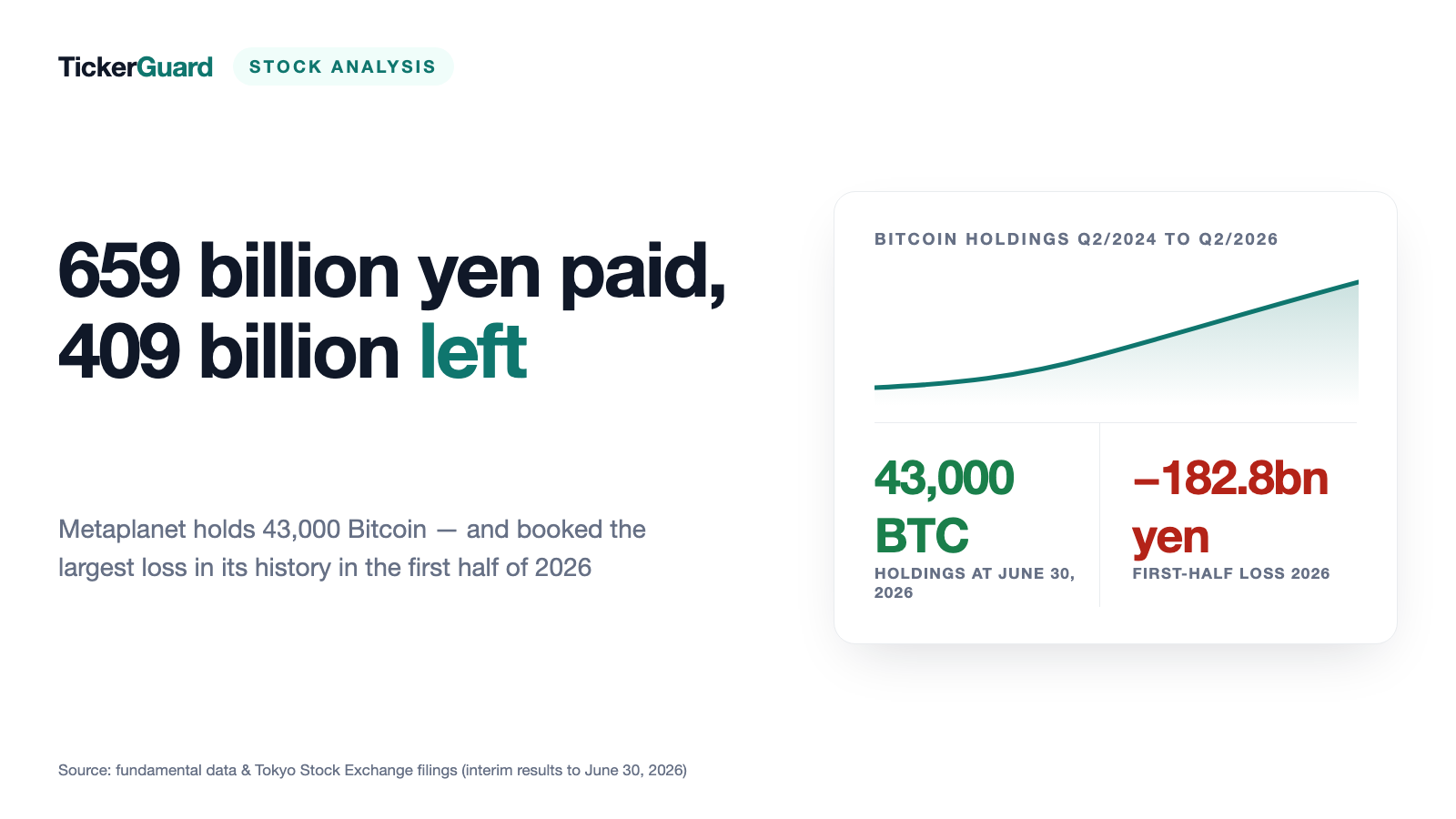
Metaplanet Inc. (Tokyo, securities code 3350; MTPLF over the counter in the United States) held exactly 43,000 Bitcoin at June 30, 2026 — bought for 659.3 billion yen and carried at 409.5 billion. Operating profit rose 136 percent in the first half of 2026, and the bottom line still showed a 182.8 billion yen loss. At the same time the company's own capital rule has stalled the growth engine, and a 75 billion yen buyback has stood at zero shares purchased since October 2025. We read the interim report, the quarterly deck and every timely disclosure through August 18, 2026 — so you know what actually sits between you and those 43,000 Bitcoin.
 Thomas Mücke
Founder & Publisher
Thomas Mücke
Founder & Publisher
As of Today
As of: October 2, 2026
- Closing price
- 1.80 $ -4.70%
- Market Capitalisation
- 2.3 $B
- Growth Score
- 7/10
- AAQS
- 5/10
Price change since August 19, 2026: +19.2%
This analysis has a cut-off date. The Stock Guard tells you when something material changes in the numbers. Reserve your free spot
Chart
Interactive price chart (TradingView).
52-week range: 1.20 $ to 4.30 $ · Last price: 1.80 $ (As of: October 2, 2026)
Note: pure fact-based analysis, not investment advice and not a solicitation to buy or sell. All figures without guarantee.
There is a thought that shows up almost automatically when you look at a Bitcoin company, and it sounds perfectly sensible: "I believe in Bitcoin, but I do not want to deal with wallets, keys and crypto exchanges — so I will just buy shares in a company that holds Bitcoin." Call it the proxy trap. It is dangerous precisely because it is not wrong. It is just that what now sits between you and the Bitcoin is no longer a wallet but a balance sheet: with debt, with preferred stock, with a share count that can change, and with a management team deciding when to buy more.
At Metaplanet Inc. that trap can be measured unusually precisely, because the company discloses unusually much. At June 30, 2026 the Tokyo-based company held 43,000 Bitcoin. It paid 659.256 billion yen for them. The same 43,000 units are carried on the balance sheet at 409.493 billion yen. And in the same half-year in which operating profit rose 136 percent, the bottom line showed a loss of 182.774 billion yen. So here is the deal: we read the interim report of August 13, 2026, the quarterly deck, the capital allocation policy and every timely disclosure through August 18, 2026 — and by the end you will know what actually sits between you and those 43,000 Bitcoin. The decision after that is yours.
What Metaplanet actually does — a hotel, a Bitcoin vault and, since July, a brokerage
Metaplanet Inc. is based in the Minato ward of Tokyo, was incorporated in 1999 and is listed on the Tokyo Stock Exchange Standard Market under securities code 3350. Simon Gerovich is chief executive officer. In the United States the same share trades over the counter under the ticker MTPLF — a secondary quotation, not a separate company and not a separate security. Buying MTPLF means buying the same Japanese common share through a different venue, settled in dollars.
How an investor outside Japan actually gets in. The home market is Tokyo, which trades during Japanese hours. There are three routes from abroad and they are not equivalent. In the United States two lines exist: MTPLF, the plain foreign quotation of the ordinary share, and MPJPY, a sponsored Level 1 American Depositary Receipt representing one ordinary share on a 1:1 basis, launched December 19, 2025 with Deutsche Bank Trust Company Americas as depositary. The ADR carries an annual service fee the company puts at $0.01 per receipt for 2026 and 2027 (disclosure of April 13, 2026). In Frankfurt the same share trades in euros under the ticker DN3 (ISIN JP3481200008).
Two consequences follow that appear on no balance sheet. First, a double currency exposure: the asset is Bitcoin, the books are kept in yen, and you trade in dollars or euros. Two exchange rates sit between you and the Bitcoin, and both can move against you while the Bitcoin price stands still. Second, volumes away from Tokyo are a fraction of the home market, and over-the-counter lines typically carry wider spreads. Anyone using a market order in these secondary lines learns the price only after the fact.
The operating business consists of two segments that the interim report reports separately, and the relative sizes are worth noting:
- Bitcoin-related business. First-half 2026 revenue: 4,742 million yen, segment profit 4,279 million yen. Of that, 4,583 million yen came from option premiums received on Bitcoin derivatives. Metaplanet essentially sells insurance on the Bitcoin price and collects the premium. Internally the line is called "Bitcoin Income Generation".
- Hotel business. First-half 2026 revenue: 201 million yen, segment profit 71 million yen. This is what remains of the original business and contributes about four percent of group revenue.
A third leg was added on July 13, 2026, when the acquisition of Siiibo Securities closed for 2,100 million yen. The firm has since been renamed Metaplanet Securities and is a registered Type I Financial Instruments Business Operator running an online platform for corporate bonds. By the company's account it has supported more than 100 bond issuances by over 40 issuers.
None of those three is the real core, though. The core is the balance sheet. Since April 2024 Metaplanet has run what it calls the "Bitcoin Standard": Bitcoin is the company's primary reserve asset. The stated order of priorities in the interim report is: first, raise Bitcoin holdings per share over the medium to long term; second, fund those purchases not by selling Bitcoin but with yen-denominated equity or debt; third, build businesses that turn the resulting balance sheet into earnings. Since April 2024 the company has raised roughly 580 billion yen in total. One detail worth pausing on: all of it is run by 35 full-time employees, according to fundamental data as of August 20, 2026.
Company history for investors
-
2024
April: Bitcoin becomes the reserve asset
Metaplanet is the first listed Japanese company to name Bitcoin its primary reserve asset. It ends the quarter with 141 coins — the start of a model investors would measure by a single number.
-
2025
April 1: ten-for-one share split
The split puts the stock within reach of retail investors. Over the same year holdings grow from 1,762 to 35,102 Bitcoin, funded mostly by new shares and warrants.
-
2025
October 28: capital rules and a buyback authorization
The board adopts the capital allocation policy and an authorization for 150 million own shares worth up to 75bn yen. Shareholders are handed a rule they can check the company against.
-
2026
March 16: the mNAV clause is armed
The revised policy bars new common shares below an mNAV of 1.0x. The 27th warrant series issued to EVO FUND the same day may only be exercised from 1.01x — tying dilution to the share price.
-
2026
July 13: brokerage Siiibo is acquired
For 2,100m yen Metaplanet buys a licensed securities firm, now Metaplanet Securities. It is meant to sell the company's own bonds straight to investors and so replace share issuance.
-
2026
August 13: half-year loss and the first BitBonds
The Bitcoin markdown produces a 182,774m yen loss for the half. Alongside it the BitBonds program launches — at roughly 200m yen, in homeopathic size for now.
-
2026
August 18: 2,100 Bitcoin head to Nasdaq
Metaplanet contributes 2,100 Bitcoin to Nasdaq-listed Super League and ends up with about 95.7 percent. For shareholders it is an attempt to raise capital where the home-market rule forbids it.
Why there is no SEC filing here — and where the numbers come from instead
One point up front, because it shapes the entire evidence base: Metaplanet files no 10-K and no 10-Q. Those forms are filed only by companies registered with the U.S. securities regulator, the SEC. Metaplanet is a Japanese company with its primary listing in Tokyo; MTPLF is merely an over-the-counter secondary quotation and creates no SEC reporting duty. Searching the SEC database returns nothing — which is not a red flag, just the wrong database.
Mandatory disclosure runs instead through TDnet, the Tokyo Stock Exchange filing system, and the full archive sits on the company's investor relations page, in many cases in both Japanese and English. The documents that matter for this analysis are:
- the interim report to June 30, 2026 ("Consolidated Financial Results for the Six Months Ended June 30, 2026, Under Japanese GAAP", filed August 13, 2026) — the most recent periodic report, fully reviewed here,
- the Q2 2026 Earnings Presentation of the same date,
- the annual report to December 31, 2025, filed February 16, 2026,
- and the running timely disclosures through August 18, 2026, including the monthly reports on buybacks and warrant exercises.
One important difference from U.S. accounting: Metaplanet reports under Japanese GAAP and measures its Bitcoin holdings at fair value. Every move in the Bitcoin price therefore flows straight into the income statement, up and down alike. That single fact explains most of what follows. The fiscal year ends December 31, so the first half runs from January 1 to June 30. And the interim report is expressly not audited or reviewed by an accounting firm — the document says so itself.
How this stock reached our desk
Metaplanet did not come out of a screen. The ticker MTPLF turned up on the hot list of a German stock forum — the list that simply measures what people are writing about most. That is an attention signal, not a quality signal, and we treat it as such. Our in-house stock scanner did not flag the stock; most of our criteria filters have little to say about a company whose bottom line is set by the price of a single asset.
So the case came in on the strength of its documents, not its ratios. Two things made it interesting. First, sheer scale: 43,000 Bitcoin is, by the company's account, the third-largest position of any listed company worldwide, the largest in Asia, and roughly 87 percent of all Bitcoin held by listed Japanese firms (Metaplanet cites bitcointreasuries.net; interim report and presentation of August 13, 2026). Second, openness: few companies of this size spell out so precisely the rule by which they raise capital — and thereby hand you the tools to hold them to it. That is exactly what this article does.
For context before we start: we have already taken apart two other companies whose earnings hang on Bitcoin, the miners Hut 8 and Bitdeer. Metaplanet is a different animal. Nothing is mined here; it is bought. That makes the arithmetic simpler and the dependency purer.
The numbers over the years — what genuinely impresses
Start with what is genuinely impressive, because there is plenty. The build-up since April 2024 has few parallels in corporate history: from 141 Bitcoin at the end of the second quarter of 2024 to 43,000 two years later.
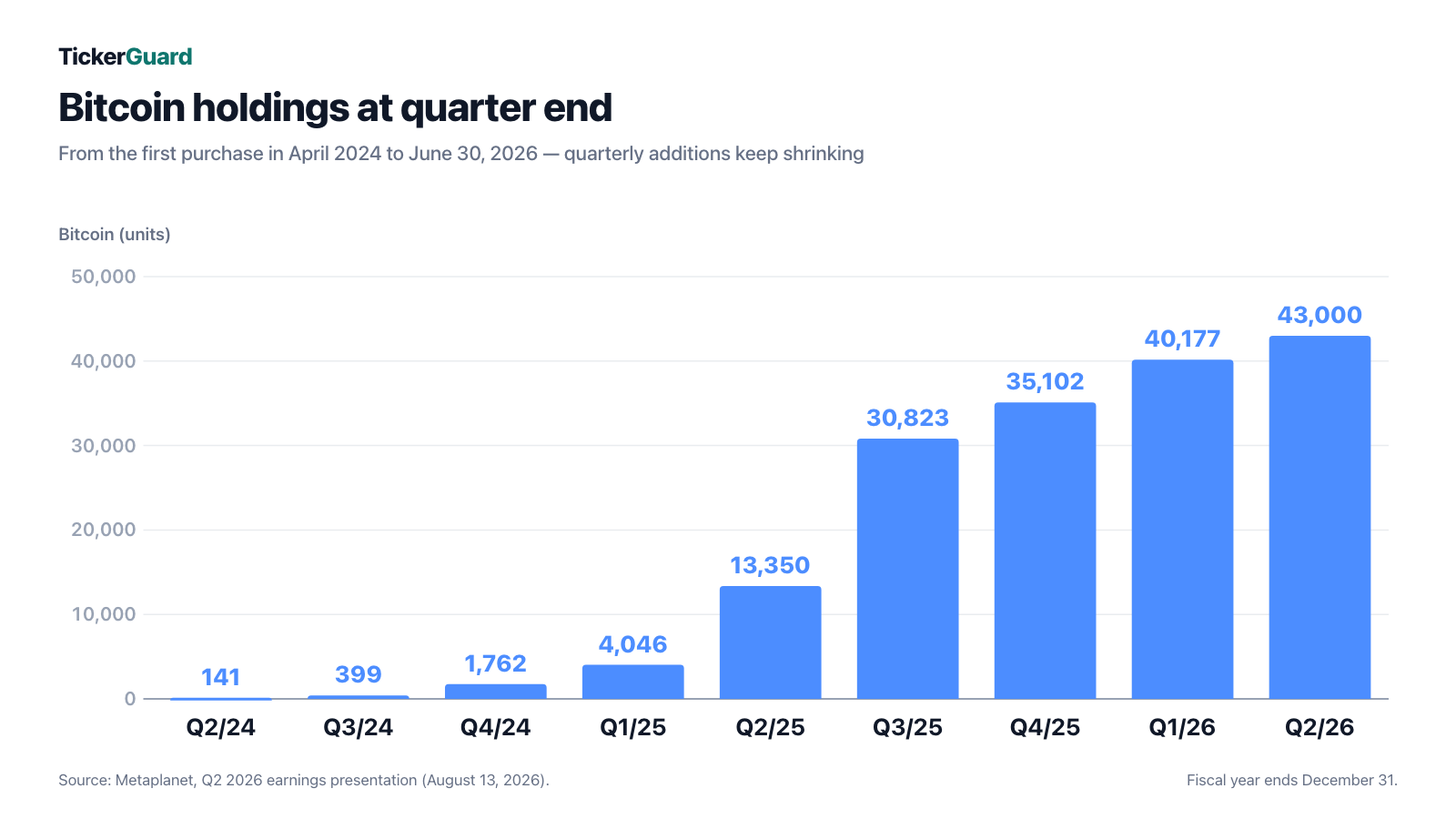
The income statement above the Bitcoin line also reads well. Revenue rose from 1,062 million yen in fiscal 2024 to 8,905 million yen in fiscal 2025, up 738.3 percent. Operating profit climbed from 350 to 6,287 million yen over the same period, for an operating margin of 70.6 percent in 2025. The first half of 2026 continued that: 4,944 million yen of revenue, up 133.7 percent, and 3,331 million yen of operating profit, up 136.3 percent.
Holdings per share have risen too, not fallen. Metaplanet reports the figure as "Bitcoin per 1,000 effective diluted shares": from 0.024049 at the end of 2025 to 0.026355 at June 30, 2026, up 9.6 percent in six months. Anyone who held from the start of 2026 owns more Bitcoin per share than before, despite all the new stock. That is precisely the proof this model owes its shareholders, and it has been delivered.
The pace, however, has changed. The same metric grew 309.8 percent in the fourth quarter of 2024, 2.8 percent in the first quarter of 2026 and 6.6 percent in the second. The engine is running, but at idle.
Uncomfortable truth No. 1: 659 billion paid, 409 billion carried
The disclosure of July 2, 2026 states both numbers openly. For its 43,000 Bitcoin, Metaplanet has spent 659.256 billion yen, an average of 15,331,542 yen per coin. On the June 30, 2026 balance sheet the same 43,000 units appear under "Bitcoin assets" at 409,493 million yen — equal to 9,523,104 yen per coin, exactly the reference price the quarterly deck quotes for that date. The gap between cost and carrying value is therefore roughly 250 billion yen — just under 38 percent of cost.
That gap is not an accounting quirk. It is the main reason for the second number of the half-year.

"These losses were primarily attributable to a Bitcoin valuation loss of JPY 184,297 million. Because the Group measures its Bitcoin holdings at fair value, the decline in the yen-denominated price of Bitcoin through June 30, 2026 was reflected in profit or loss for the interim consolidated accounting period. This valuation loss is a non-cash item, and the Group did not sell any Bitcoin in connection with it."
— Metaplanet Inc., interim report to June 30, 2026, section 1(1)
The "non-cash" label is accurate and still only half the story. Non-cash means no money left the building. It does not mean nothing happened. The asset against which Metaplanet has borrowed really did become less valuable, by exactly that amount. Spending 659 billion yen on something worth 409 billion at the reporting date is a real economic setback whether or not you sell. The reverse is equally true: when the price rises, the carrying value comes back. That is in fact what happened after the reporting date — the company itself shows a reference value of 434.3 billion yen for the position as of August 12, 2026.
Here is the full bridge from operating profit to the half-year loss:
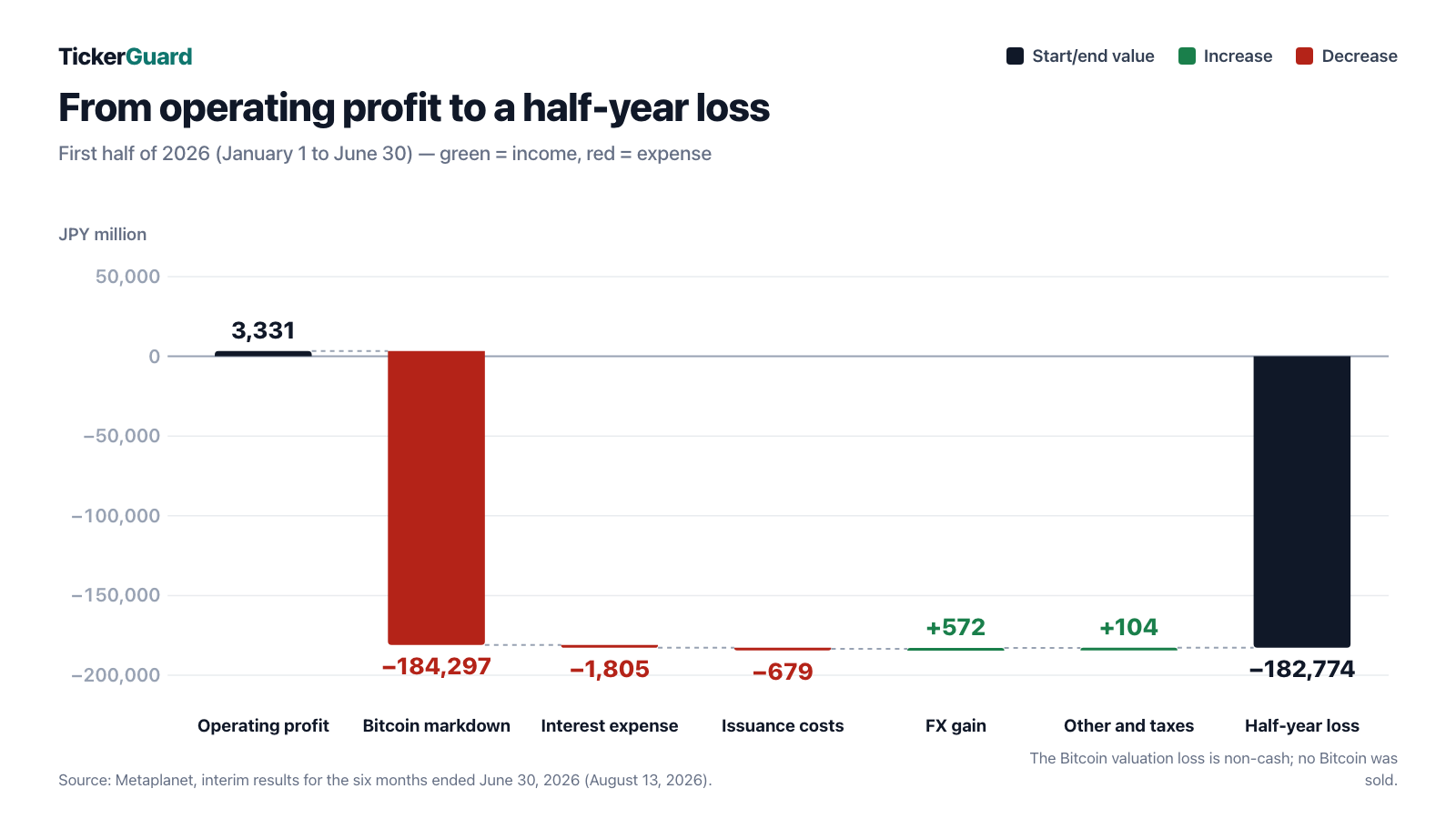
One detail rewards a second look: interest expense of 1,805 million yen disappears next to the markdown, yet it amounts to more than half of the entire operating profit. In the first half of 2025 interest came to 3 million yen. Funding has become expensive.
Uncomfortable truth No. 2: the company's own rule switched off the engine
Now to the central mechanism, and for that we need one metric: mNAV. Metaplanet defines it as enterprise value divided by the market value of its Bitcoin holdings. Enterprise value is market capitalization plus debt plus preferred capital, less cash. In plain language: what does the whole company cost on the exchange compared with what its pile of Bitcoin is worth? Above 1.0x, investors are paying a premium to Bitcoin. Below it, they are getting a discount.
From that metric follows a remarkably disciplined rule, in force since October 28, 2025 and revised on March 16, 2026:

"Under the Company's Capital Allocation Policy, the Company will not, in principle, raise funds through the issuance of common shares when mNAV is below 1.0x. Issuing common shares at that level could reduce existing shareholders' Bitcoin holdings per share."
— Metaplanet Inc., interim report to June 30, 2026, section 1(1)
That is shareholder-friendly thinking and deserves credit. Most companies issue stock when they need money, not when the price justifies it. Metaplanet tied its own hands — and the knot held. After two placements on February 13 and March 31, 2026 that together produced 131,897,000 new shares and 53,039 million yen, there was no further third-party allotment of common stock in the second quarter.
But that restraint has a consequence, and the company names it: without new shares there is no money for new Bitcoin. Only 2,823 Bitcoin were added in the second quarter — funded from a non-interest-bearing 8,000 million yen bond issued on April 24, 2026, from the Bitcoin-collateralized credit facility, from warrant exercises and from the earnings of the options business. And because that options business needs Bitcoin and cash as collateral, it shrinks when the position grows more slowly. Revenue there fell from 4,241.8 million yen in the fourth quarter of 2025 to 2,969.3 in the first quarter and 1,747.3 million yen in the second quarter of 2026 — two consecutive declines.
The result of that chain sits in the outlook section of the interim report, phrased with unusual candor:

Full-year guidance still reads 16,000 million yen of revenue and 11,400 million yen of operating profit. After six of twelve months, 30.9 percent and 29.2 percent of those figures are in the bag — numbers the company itself reports in its deck. Metaplanet nevertheless left guidance untouched on August 13, 2026. That is permissible, since the second half can look different. But an investor should know that the guidance rests on a capital raise that the company's own rule is currently preventing.
Uncomfortable truth No. 3: the 75 billion yen buyback that never happened
The capital allocation policy has an action side as well as a prohibition side. Its third principle says, in substance: when mNAV falls below 1.0x, the company will execute share buybacks in order to maximize Bitcoin per share. The logic is airtight — if your own stock trades below the value of your pile of Bitcoin, buying your own stock is the cheapest way to raise Bitcoin per share.
The authorization has been in place since October 28, 2025: up to 150,000,000 shares, which the company puts at 13.13 percent of shares outstanding, for up to 75 billion yen, running through October 28, 2026. Here is the interim scorecard:
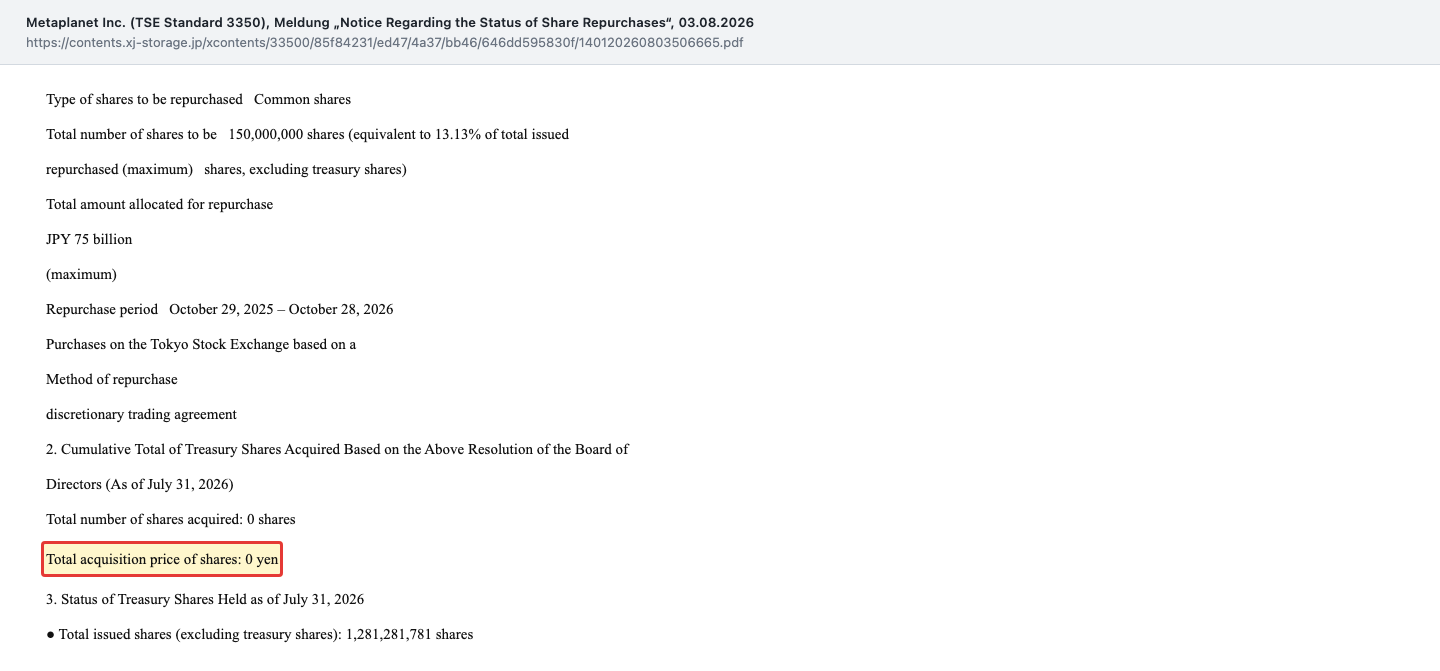
It is only fair to be precise here: a repurchase program is an authorization, not an obligation, in Japan as anywhere else. No contract has been broken. But the asymmetry is striking. Of the company's own rule for the "mNAV below 1.0x" case, the half that prevents new shares was followed to the letter. The half that retires shares went untouched through July 31, 2026. Anyone wondering why will find an obvious hint on the balance sheet — which leads straight to the next truth.
Uncomfortable truth No. 4: 76.9 billion yen of short-term debt against 1.1 billion yen of cash
The June 30, 2026 balance sheet looks rock solid at first glance: 418,177 million yen of total assets, 340,884 million yen of net assets, a capital adequacy ratio of 81.4 percent. Read only those three numbers and you see a company with almost no debt.
The second glance changes the picture. On the asset side essentially everything is one line item: 409,493 million yen of Bitcoin, classified among non-current assets. Current assets total 2,369 million yen, of which 1,087 million yen is cash and deposits. On the liability side sit 76,878 million yen of current liabilities — 67,486 million yen of short-term borrowings and 8,000 million yen of bonds due within a year.
Put differently: what falls due within twelve months exceeds short-term assets by roughly 74.5 billion yen. Interest alone in the first half — 1,805 million yen — was larger than the entire cash balance at the reporting date. The group can service these obligations, no question: it holds 43,000 Bitcoin, one of the most liquid assets in the world. But that is exactly the point. Repayment capacity depends on refinancing or on selling the very position the company exists to hold. Of the $500 million Bitcoin-collateralized credit facility, $414 million was drawn at June 30, 2026, and the lender holds a priority right over the pledged Bitcoin, according to the company.
Metaplanet publishes its own stress test on this, and it is refreshingly honest. The company sets its Bitcoin value against all debt and preferred capital of 100.9 billion yen combined and arrives at coverage of 4.1x at June 30, 2026. A 30 percent fall in the Bitcoin price would take that to 2.8x; a 50 percent fall to 2.0x; and a 75 percent fall to exactly 1.0x — the point at which the Bitcoin position covers debt and preferred capital precisely and, arithmetically, nothing is left for common shareholders. Bitcoin has fallen more than 75 percent from a peak several times in its history. That is not a forecast, just an order of magnitude worth knowing.
One more item is easy to miss: Metaplanet has 23,610,000 Class B preferred shares outstanding and pays 12.25 yen per share each quarter on them — an annualized 4.9 percent on face value by its own account, roughly 289 million yen a quarter. That distribution comes out of capital surplus, not out of retained earnings; the accumulated deficit stood at minus 268,961 million yen on June 30, 2026. And those preferred shares are convertible, so a conversion would dilute common shareholders further. Think of them as lenders on a fixed coupon who get paid before you do and may later turn into fellow shareholders.
What Metaplanet is doing about it — BitBonds, Superplanet and a brokerage of its own
The company is not sitting still, and the countermeasures are the genuinely interesting part of the story. The logic is consistent: if common stock is off the table as a funding source, other sources have to arrive that do not dilute holdings per share.
First, BitBonds. On August 13, 2026 Metaplanet announced a bond issuance program under that name, distributed through its own subsidiary Metaplanet Securities. The idea is straightforward and new in Japan: investors receive a fixed coupon on the credit of a company whose principal asset is priced continuously and traded worldwide, without taking Bitcoin price risk themselves. The inaugural numbers, however, are tiny. In late July 2026 four series totaling roughly 200 million yen were placed, with maturities of about three years and coupons of about 4.0 to 4.3 percent a year, unsecured, unrated, by small-number private placement. For scale: 200 million yen is about 0.05 percent of total assets. The company itself calls it a first step whose purpose is to build the machinery. So the start should be neither dismissed nor mistaken for a funding source that already carries weight.
Second, Superplanet. On August 18, 2026 Metaplanet agreed to contribute 2,100 Bitcoin — about $132.1 million, roughly 4.9 percent of its holdings — together with $2.5 million in cash to Nasdaq-listed Super League Enterprise, Inc. through a U.S. subsidiary. In exchange it receives 44,859,400 common shares at $3.00 apiece plus preferred stock and warrants, leaving it with roughly 95.7 percent of the common stock. The share count was fixed on August 14, 2026 and no longer moves with the Bitcoin price, which is why the stated $132.1 million works out below the Bitcoin price we quote further down for August 20, 2026. Super League is to be renamed "Superplanet, Inc." and to raise capital in the U.S. market as a consolidated subsidiary while Metaplanet does the same in Japan. The Bitcoin does not leave the group and stays consolidated; Metaplanet has also committed to a five-year lock-up. In substance this is an attempt to open a second capital market where the first one is closed. Whether it works will be settled by Superplanet's share price — at a company whose stock will be more than 95 percent owned by Metaplanet after closing, leaving a correspondingly thin float.
Third, the regulatory backdrop. On July 15, 2026 the Japanese Diet passed amendments to the Financial Instruments and Exchange Act and the Payment Services Act, promulgated on July 23, 2026. They bring crypto assets within the scope of financial instruments regulation, including insider trading rules and disclosure obligations. They take effect only by cabinet order within one year — so not yet as of the reporting date. From January 1, 2028, capital gains on crypto held by individuals are expected to be taxed separately at 20.315 percent instead of at progressive rates. For Metaplanet that is the real bet: that institutional money in Japan has stayed away for lack of legal clarity rather than lack of interest.
Valuation — what you pay for a yen of Bitcoin
Conventional valuation metrics are no help here. There is no price-to-earnings ratio because there are no earnings; a price-to-sales ratio would be meaningless because the revenue comes from option premiums and says nothing about substance. The only question that matters is: how much am I paying for a yen of Bitcoin?
Let us work that out in orders of magnitude, with dated inputs. On August 19, 2026 MTPLF closed at $1.51 over the counter, for a market capitalization of about $1.94 billion (fundamental data, as of August 20, 2026). The 43,000 Bitcoin were worth about $3.07 billion on August 20, 2026 at a Bitcoin price of $71,313 (market data, retrieved August 20, 2026). Add the 100.9 billion yen of debt and preferred capital the company reported at June 30, 2026 — about $0.64 billion at the 158 yen per dollar rate Metaplanet uses in its own deck — subtract the small cash balance, and enterprise value lands at roughly $2.6 billion. That is about 84 percent of the Bitcoin value.
In the company's language: an mNAV of roughly 0.84. You are buying the Bitcoin at a discount of about one-sixth, and getting an options business, a hotel, a brokerage and a Nasdaq subsidiary thrown in. Framed that way, the stock is cheap.
Except that is only half the frame. For that discount you also get 76.9 billion yen of short-term debt against 1.1 billion yen of cash, 218 million shares of dilution potential from open warrants, convertible preferred stock, a growth model currently idling under the company's own rule — and not a single share bought back out of a 75 billion yen program. A 16 percent discount is not a gift; it is the price of exactly that list. Whether it is large enough is an opinion, not a calculation. Analyst coverage, incidentally, is thin for this name, so the professionals' view offers no anchor here.
Upside and risks at a glance
Upside:
- Bitcoin per share has risen despite every capital measure — up 9.6 percent in the first half of 2026. The model's core promise has been kept so far.
- By our calculation as of August 20, 2026 the stock trades at a discount of roughly one-sixth to the value of the Bitcoin position. If the Bitcoin price rises and the discount closes, both effects push the same way.
- The operating business earns money: 3,331 million yen of operating profit in the first half of 2026 at a margin above 60 percent. The loss comes entirely from valuation, not from operations.
- Capital discipline is documented: when the share price fell below the Bitcoin value, no further common stock was issued. That is rare and it protects existing holders.
- Japan's regulatory framework is moving in the direction the model bets on: crypto assets brought under financial instruments regulation (promulgated July 23, 2026) and separate taxation of private crypto gains from 2028.
Risks:
- The Bitcoin price determines essentially everything. The 43,000 coins make up the overwhelming share of 418,177 million yen in total assets; a 75 percent price decline would, on the company's own stress test, leave the position covering debt and preferred capital exactly.
- Current liabilities of 76,878 million yen sit against current assets of 2,369 million yen (June 30, 2026). Servicing them depends on refinancing or on selling the position.
- Average cost is roughly 61 percent above carrying value per coin (15,331,542 against 9,523,104 yen at June 30, 2026). Closing that gap requires a substantially higher Bitcoin price.
- Open warrants in the 25th, 26th and 27th series could create 218,042,000 additional shares — 17 percent of the share count at July 31, 2026. Of those, 94,730,000 sit with a single fund, EVO FUND.
- Full-year 2026 guidance is only 30.9 percent achieved on revenue and 29.2 percent on operating profit at the halfway mark, and was not cut. Options-business revenue has fallen for two consecutive quarters.
- Under Japanese law the interim report is neither audited nor reviewed by an accounting firm.
A human conclusion
Back to the proxy trap. At Metaplanet, the thought "I buy the stock and thereby own Bitcoin" is not wrong — it is incomplete. What you buy is a claim on 43,000 Bitcoin that ranks behind 76.9 billion yen of short-term debt, 23.6 million convertible preferred shares and 218 million potential new common shares. In return you get a discount to the Bitcoin price, a profitable options business and a management team that writes its capital rules down with unusual clarity and keeps to the more important half of them.
What stays with me is not the 182.8 billion yen loss — that is non-cash, explainable and part of the model. It is the zero in the buyback notice. A company that writes it will repurchase stock when mNAV is below 1.0x, then stands in exactly that situation for ten months with a 75 billion yen authorization in hand and buys not one share, is telling you something about itself. Perhaps it is only the 1.1 billion yen of cash. Perhaps it is the conviction that every spare yen belongs in Bitcoin rather than in its own stock. Both are legitimate answers. But they are answers the company has not yet given — and the next buyback notice is a good place to look.
Metaplanet is not a company you end up owning by accident. It is a lever on an opinion about Bitcoin, wrapped in a Japanese balance sheet with its own rules, maturities and footnotes. If you hold that opinion and understand the lever, there is a lot here. If all you want is a convenient Bitcoin substitute, you are buying something other than what you think. What you make of that is your call. And that is exactly as it should be.
Sources and disclosures
- Metaplanet Inc., "Consolidated Financial Results for the Six Months Ended June 30, 2026 (Interim), Under Japanese GAAP", TDnet, August 13, 2026 — most recent periodic report
- Metaplanet Inc., "Q2 2026 Earnings Presentation", TDnet, August 13, 2026
- Metaplanet Inc., "Notice Regarding the Recording of Non-Operating Income, Non-Operating Expenses (Including Loss on Valuation of Bitcoin), and Income Tax Adjustments", TDnet, August 13, 2026
- Metaplanet Inc., "Notice Regarding the Establishment of a New Bond Issuance Program, 'BitBonds', and the Completion of the Inaugural Issuance", TDnet, August 13, 2026
- Metaplanet Inc., "Notice Regarding the Status of Share Repurchases", TDnet, August 3, 2026
- Metaplanet Inc., "Notice Regarding Monthly Exercise Status of the 27th Series of Stock Acquisition Rights", TDnet, August 3, 2026
- Metaplanet Inc., "Notice of Additional Purchase of Bitcoin", TDnet, July 2, 2026
- Metaplanet Inc., "Notice Regarding the Q2 FY2026 Results of the Bitcoin Income Generation Business", TDnet, July 2, 2026
- Metaplanet Inc., "Notice Regarding Revision of Capital Allocation Policy", TDnet, March 16, 2026
- Metaplanet Inc., "Consolidated Financial Results for the Fiscal Year Ended December 31, 2025", TDnet, February 16, 2026
- Metaplanet Inc., "Metaplanet to Invest 2,100 Bitcoin in Super League to Launch U.S. Bitcoin Treasury Platform, Superplanet", TDnet, August 18, 2026
- Metaplanet Inc., "Notice Regarding Changes in Major Shareholders and the Largest Major Shareholder", TDnet, July 21, 2026
- Metaplanet Inc., issuance notice for the 25th series of stock acquisition rights, TDnet, January 29, 2026, and issuance notice for the 26th series, TDnet, March 16, 2026 — including the lists of allotted funds
- Metaplanet Inc., issuance notice for the 27th series of stock acquisition rights with mNAV clause, TDnet, March 16, 2026
- Metaplanet Inc., "Notice Regarding the Establishment of an ADR Free Issuance Period for MPJPY", TDnet, April 13, 2026
- Metaplanet Inc., investor relations archive of all mandatory disclosures
- Fundamental data (headcount, market capitalization, share count; as of August 20, 2026) and market data (MTPLF close of August 19, 2026; Bitcoin price of August 20, 2026)
Disclosure: this article is journalistic analysis of publicly available company information. It is not investment advice, not a recommendation to buy or sell, and not a solicitation to buy or sell securities. Share prices can move sharply and a total loss of invested capital is possible. All figures come from the filings linked above and carry the reporting date stated there; price data are dated snapshots and go stale. Where a conversion was needed, yen amounts were translated at the 158 yen per U.S. dollar rate the company itself uses (as of August 10, 2026). Positions held by the operator are disclosed daily; where one exists, it appears as a notice at the top of this deep dive.
Key figures at a glance
All monetary figures in millions of JPY; earnings per share as reported.
| Metric | 2021 | 2022 | 2023 | 2024 | 2025 |
|---|---|---|---|---|---|
| Revenue | 518.5 | 366.1 | 261.6 | 1,062.0 | 8,905.0 |
| Operating Income (EBIT) | -1,425.1 | -858.8 | -468.1 | 351.0 | 6,287.0 |
| Net Income | -737.2 | 977.8 | -683.9 | 4,439.0 | -95,046.0 |
| Net Margin | -142.2% | 267.1% | -261.4% | 418.0% | -1,067.3% |
| Earnings Per Share | -12.89 JPY | 17.10 JPY | -5.96 JPY | 12.27 JPY | -83.21 JPY |
Source: fundamental data & SEC filings (annual and quarterly reports, 10-K/10-Q)
Our Bottom Line at a Glance
- Bitcoin per share positive
- Bitcoin per 1,000 effective diluted shares rose from 0.024049 to 0.026355 in the first half of 2026 — up 9.6 percent despite 139 million new shares. The model's core promise was kept (interim report, August 13, 2026).
- Operating business positive
- Revenue of 4,944m yen and operating profit of 3,331m yen in the first half of 2026, both more than doubled. The loss stems entirely from Bitcoin valuation, not from operations (interim report, August 13, 2026).
- Capital discipline neutral
- The rule against issuing common shares below an mNAV of 1.0x held through the second quarter of 2026. The other half of the same rule — buybacks below 1.0x — produced zero shares by July 31, 2026 out of an authorization for 150 million shares and 75bn yen (disclosure, August 3, 2026).
- Balance sheet structure negative
- Current liabilities of 76,878m yen against current assets of 2,369m yen and cash of 1,087m yen at June 30, 2026. Of the $500m Bitcoin-collateralized facility, $414m was drawn, and the lender holds a priority right over the pledged Bitcoin.
- Dilution overhang negative
- The 25th, 26th and 27th warrant series could create 218,042,000 additional shares — 17 percent of the 1,281,308,624 shares outstanding at July 31, 2026 (monthly disclosure, August 3, 2026). The 27th series over 94,730,000 shares sits with EVO FUND alone; the remaining 123,312,000 are spread across fourteen overseas funds (issuance notices of January 29 and March 16, 2026).
- Guidance progress negative
- Full-year 2026 guidance (16,000m yen revenue, 11,400m yen operating profit) was 30.9 percent and 29.2 percent achieved at the halfway mark, and options-business revenue fell for two consecutive quarters. Guidance was not revised on August 13, 2026.
Metaplanet holds 43,000 Bitcoin, paid 659.3bn yen for them and carries them at 409.5bn yen as of June 30, 2026. The operating business earns money and Bitcoin per share is still rising — but more slowly, because the company's own capital rule bars new common shares below an mNAV of 1.0x and therefore throttles buying. On the liability side, 76.9bn yen of short-term debt sits against 1.1bn yen of cash. Investing here means buying an opinion about the Bitcoin price, levered through a Japanese balance sheet. Not investment advice.
What Our Rating Means
Open questions
The business works in principle, but one material question is open. As long as it stays open, our findings do not carry a quality verdict.
The business model works and the evidence says so: revenue and operating profit both more than doubled in the first half of 2026, Bitcoin per share rose, the capital adequacy ratio stands at 81.4 percent and there is no going-concern note. What is open is a material operating question. The growth engine — raise capital, buy Bitcoin, earn more option premiums — is largely idle under the company's own mNAV rule, full-year guidance is only about 30 percent achieved at the halfway mark and was not cut. On top of that sits a balance sheet in which 76.9 billion yen of current liabilities face 1.1 billion yen of cash: servicing that depends on refinancing or on selling the very position the company exists to hold. Measured against the Bitcoin value the stock is not expensive — by our calculation it trades at a discount. That does not change the fact that a single asset decides profit, loss and debt coverage here. The decision is yours.
A journalistic assessment by our editorial team at the time of the deep dive, based on public sources — not investment advice and not a solicitation to buy or sell. Your personal circumstances (investment goals, risk capacity, taxes) cannot be taken into account. What our levels mean, how verdicts are formed, and what conflicts of interest exist →
Worth Noting
- The starting point was the ticker MTPLF appearing on the hot list of a German stock forum, not a hit in our in-house stock scanner.
- Data as of: interim report to June 30, 2026 (filed August 13, 2026), with every timely disclosure through August 18, 2026 reviewed; fundamental data and prices as of August 19 and 20, 2026.
- Easily confused: MTPLF is the U.S. over-the-counter secondary quotation of Tokyo-listed 3350, not a separate company. There are no 10-K or 10-Q filings; the primary source is TDnet.
- Under Japanese law the interim report is neither audited nor reviewed by an accounting firm, as the document itself notes.
Stock Watch
This analysis is as of August 26, 2026. Stock Watch will tell you what's changed at MTPLF since then.
Later $1 a month per stock — signing up is free, and you'll be the first to know when it launches.
The full analysis as a PDF for later
We will send you this analysis as a PDF — to print, file away, and read at your own pace. And we will add you to the free Stock Watch list for Metaplanet Inc. (MTPLF), so you hear about it when something material in this analysis changes.
Frequently Asked Questions
Metaplanet Inc. is a Japanese company based in Tokyo that has held Bitcoin as its primary reserve asset since April 2024. At June 30, 2026 the position stood at 43,000 coins. Operations consist of selling options on Bitcoin (4,742 million yen of revenue in the first half of 2026), a small hotel business (201 million yen) and, since July 2026, the brokerage Metaplanet Securities.
Metaplanet measures its Bitcoin at fair value under Japanese GAAP. When the Bitcoin price falls, a book loss lands in the income statement immediately. In the first half of 2026 that came to 184,297 million yen. Operating profit of 3,331 million yen could not offset it. No Bitcoin was sold, so no cash left the company.
mNAV is enterprise value divided by the market value of the Bitcoin position. Enterprise value is market capitalization plus debt plus preferred capital, less cash. Above 1.0x the market pays a premium to Bitcoin; below it, a discount. The capital allocation policy bars new common shares in principle while mNAV is below 1.0x — which was the case for most of the first half of 2026.
Shares outstanding rose from 1,142,274,340 at December 31, 2025 to 1,281,283,624 at June 30, 2026, up 12.2 percent in six months. Year over year the jump is larger: average shares were 1,218,167,880 in the first half of 2026 against 483,152,329 a year earlier. Bitcoin per share still rose 9.6 percent over the half.
The primary listing is on the Tokyo Stock Exchange Standard Market under securities code 3350. MTPLF is the over-the-counter quotation of the same common stock in the United States, settled in dollars; alongside it runs MPJPY, a sponsored Level 1 ADR at a 1:1 ratio launched December 19, 2025, and in Frankfurt the euro line DN3 (ISIN JP3481200008). All the same company, all the same share. Because Metaplanet is not a U.S. reporting company, there are no 10-K or 10-Q filings with the SEC.
Metaplanet sells options on Bitcoin and collects the premiums — 4,583 million yen in the first half of 2026. The company's own Bitcoin and cash serve as collateral, which is why the business shrinks when the position grows more slowly. Revenue fell from 4,241.8 million yen in the fourth quarter of 2025 to 1,747.3 million yen in the second quarter of 2026.
The fiscal year ends December 31, so the first half runs January 1 to June 30. Full-year results were filed on February 16, 2026 and the interim report on August 13, 2026, both through TDnet, the Tokyo Stock Exchange disclosure system. Japanese semi-annual reports are exempt from audit or review by an accounting firm, and the interim report states this explicitly.
Not on the common stock: for fiscal 2024, 2025 and 2026 the company reports 0.00 yen per share. On the 23,610,000 Class B preferred shares it pays 12.25 yen per quarter, an annualized 4.9 percent on face value by its own account. That payment comes out of capital surplus, not out of profit.
Found an error?
Did you spot a factual error, an outdated number, or a typo in this deep dive? Let us know briefly — your report goes straight to the editorial team.