Leonardo DRS: Half of the Earnings Jump Is a Recalculation
In the second quarter of 2026, U.S. defense supplier Leonardo DRS grew earnings per share by 60 percent — half of the increase came from a catch-up recalculation of old cost estimates, and after its raised outlook the stock fell harder than its sector. We read the SEC filings and show what you really buy with this stock — including a majority owner in Rome that holds about 71 percent — and a charter under which DRS waives any claim to business opportunities presented to Leonardo.
 Thomas Mücke
Founder & Publisher
Thomas Mücke
Founder & Publisher
As of Today
As of: October 2, 2026
- Closing price
- 36.80 $ +0.10%
- Market Capitalisation
- 9.9 $B
- P/E
- 32.7
- Growth Score
- 5/10
- AAQS
- 6/10
This analysis has a cut-off date. The Stock Guard tells you when something material changes in the numbers. Reserve your free spot
Chart
Interactive price chart (TradingView).
52-week range: 32.60 $ to 49.70 $ · Last price: 36.80 $ (As of: October 2, 2026)
Note: pure fact-based analysis, not investment advice and not a solicitation to buy or sell. All figures without guarantee.
On July 30, 2026, Leonardo DRS reported a 60 percent jump in earnings per share and a record funded backlog, and raised its earnings outlook. By October 2, 2026, the stock had still fallen about 19 percent, from $45.62 to $36.80, more than a quarter below its highest close to date, $49.69 on June 11, 2026. Part of that is sector weather: a broad index fund of U.S. aerospace and defense stocks (iShares U.S. Aerospace & Defense, ticker ITA) fell from $238.13 to $207.79 over the same period, about 13 percent (source: fundamental data, our calculation). The six-point gap is the real puzzle. The company has filed no new current report about it — and companies are not required to comment on share price moves. But the quarterly report itself offers a clue: half of the earnings increase came from a catch-up recalculation. Whether the market is pricing exactly that cannot be proven. You should know it anyway.
If you are now thinking “It was at 49 not long ago — at 37 it’s a steal,” you have fallen for the anchoring effect: a number you have seen once pulls every later judgment toward itself — even when it was purely random, as in the wheel-of-fortune experiment by psychologists Amos Tversky and Daniel Kahneman in 1974. DRS comes with three such anchors. June’s high. The price target of the eleven analysts covering the stock: $53.82 on average (source: fundamental data, as of October 4, 2026). And the name: in the ranking through which the stock landed on our desk, it was simply called “Leonardo.” Behind it is a U.S. company that is about 71 percent owned by an Italian group — and whose majority shares are voted by proxy holders cleared by the U.S. Department of Defense.
So let’s set all three anchors aside and read what Leonardo DRS itself has filed with the U.S. securities regulator, the SEC: the annual report for 2025 (Form 10-K of February 27, 2026), the latest quarterly report (Form 10-Q of July 30, 2026) together with the earnings release of the same day, and every filing through October 1, 2026, the last one before this article. The tension running through this analysis: a steadily growing defense supplier with a record funded backlog — whose profits are booked early in the year, whose cash arrives late in the year, and whose majority owner sits in Rome.
What Leonardo DRS actually does — sensors, computers, submarine propulsion
Leonardo DRS does not build tanks or missiles. It supplies the eyes, nerves and muscles of modern weapon systems: infrared sensors and radars that detect targets, rugged computers and networks that move data between ships, vehicles and command posts, and electric propulsion and power systems for warships. The company is headquartered in Arlington, Virginia, and employed about 7,300 people at the end of 2025. It reached the stock market by a detour: on November 28, 2022, it merged with Israel-based radar maker RADA Electronic Industries; RADA shareholders received about 19 percent of the combined company and Leonardo kept 81 percent (10-K 2024). Since November 29, 2022, the stock has traded on Nasdaq under the ticker DRS.
It reports two segments. Advanced Sensing and Computing generated $2,355 million in 2025 revenue at an operating margin of 10.2 percent. Integrated Mission Systems (propulsion, power, force protection) brought in $1,307 million at 8.8 percent. According to the annual report, one of the Navy’s top priority programs: for the new Columbia Class ballistic missile submarines — according to the annual report, the first modern U.S. electric drive submarine — DRS supplies power conversion, control, distribution and propulsion. On top of that come radars and systems for counter-drone and short-range air defense; according to the earnings release, tactical radars, along with infrared sensing, were the main driver of revenue growth in the Advanced Sensing and Computing segment in the second quarter of 2026.
The customer is almost always the same: in the first half of 2026, about 82 percent of revenue came directly or indirectly from the U.S. government, mainly the Navy (37 percent) and the Army (33 percent). The international share rose to 12 percent from 8 percent a year earlier; the quarterly report cites as one reason global demand for tactical radars used against drones. And the company is betting on software: on July 28, 2026, it agreed to acquire Raft, a maker of mission software for data fusion and artificial intelligence, for $450 million. Closing is expected in the fourth quarter of 2026; through October 4, 2026, the company had not reported completion. In our AI classification, Leonardo DRS is therefore listed as “sells AI”: according to the annual report, AI is already built into the computers and sensors the company sells.
Company history for investors
-
2022
Dividend to the parent, then the listing
In August 2022, $396M from divestitures went to Leonardo; on November 29, 2022, DRS began trading on Nasdaq after its merger with RADA.
-
2025
First dividend and buyback program
On February 20, 2025, DRS announced its first quarterly dividend since the listing (9 cents) and buybacks of up to $75M — most of the dividend goes to Leonardo.
-
2025
Growth year with an estimates dent
Revenue $3,648M, net earnings $278M; revised cost estimates cost $59M of operating earnings, and the fourth quarter brought $425M of operating cash flow.
-
2026
Loan repaid, Raft agreed
In January 2026, DRS repaid a $191M bank loan; on July 28, 2026, it agreed to acquire AI software maker Raft for $450M.
-
2026
Guidance raised, stock down
On July 30, 2026, DRS raised its earnings guidance; by October 2, the stock still fell from $45.62 to $36.80.
How the stock landed on our desk — as “Leonardo” on wallstreet-online
Not through our in-house stock scanner, but through the ranking of the most-discussed stocks on wallstreet-online, one of Germany’s largest retail investor sites (as of early October 2026). There it was listed under the name “Leonardo” with the symbol DRS. That is a mix-up worth knowing about: there are two listed Leonardos. One is Leonardo S.p.A., an Italian aerospace and defense group headquartered in Rome and listed on the Milan Stock Exchange. The other is its U.S. subsidiary Leonardo DRS, Inc., listed on Nasdaq under the ticker DRS since November 29, 2022. Because the ranking carried the symbol DRS, we analyze the U.S. subsidiary. The parent still features prominently — it is the subject of the second uncomfortable truth.
The share price has given people plenty to talk about since July 30, 2026. After that date, the company filed no Form 8-K through October 4, only insider filings. Three executives sold shares, all under trading plans they had adopted in March 2026, including CFO Michael Dippold, who sold 20,317 shares at an average of $37.18 on September 2, 2026 (Form 4 insider filing). Pre-arranged plans say little about what the sellers think. Rule of thumb: a name in a ranking is not yet a security — check the ticker before you talk about the company.
The numbers over the years — credit where it is due
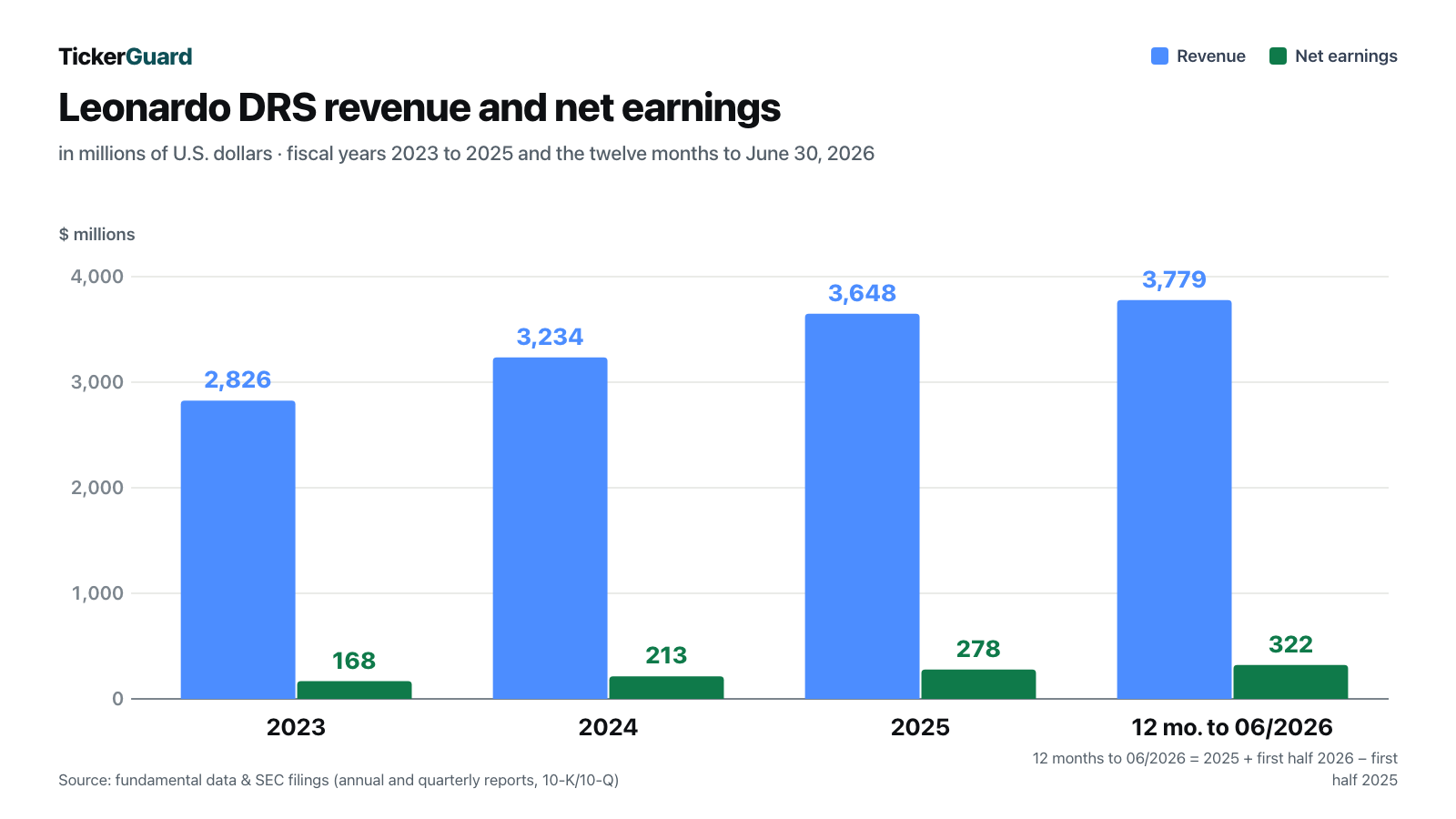
First, what deserves credit. Revenue grew from $2,826 million in 2023 to $3,234 million in 2024 and $3,648 million in 2025, up 12.8 percent in the latest year. Net earnings grew faster, from $168 million to $213 million and $278 million; diluted earnings per share rose from $0.64 to $1.03. In the twelve months to June 30, 2026, revenue came to $3,779 million and net earnings to $322 million (our calculation: full year 2025 plus first half 2026 minus first half 2025).
The second quarter of 2026 was strong too: revenue of $913 million (up 10 percent), net earnings of $86 million (up 59 percent) and new orders of $1,085 million — about $1.20 of new orders for every dollar of revenue. Funded backlog — orders for which Congress has already appropriated the money — reached a record $5,092 million, 17 percent more than a year earlier. For 2026, the company raised its outlook for adjusted EBITDA to $525 million to $540 million and for adjusted diluted EPS to $1.34 to $1.39; the revenue outlook of $3,900 million to $3,975 million was unchanged (earnings release of July 30, 2026).
The balance sheet is healthy. In January 2026, the company prepaid its remaining $191 million bank term loan and entered into a new $500 million revolving credit facility running to January 2031, which was undrawn as of June 30, 2026. At that date, $270 million of cash stood against $149 million of debt, consisting entirely of finance leases and other financing — net cash of about $121 million (our calculation). Operating cash flow was $205 million in 2023, $271 million in 2024 and $366 million in 2025; after capital expenditures of $60 million, $85 million and $139 million, free cash flow came to $145 million, $186 million and $227 million (our calculation). Since March 2025, the company has paid a quarterly dividend of 9 cents per share and buys back its own stock under a program of up to $75 million. Rule of thumb: growing, making money and holding more cash than debt — the rest of this analysis stands on those three things.
Uncomfortable truth No. 1: half of the earnings jump is a recalculation
Net earnings up 59 percent and earnings per share up 60 percent in the second quarter of 2026 — that was the headline of the earnings release. To see where part of it came from, you need to know how DRS accounts for its contracts. On multi-year fixed-price contracts, the company estimates total costs and recognizes revenue and profit based on the share of costs already incurred. When the estimate changes, the effect for the entire contract to date is booked in one go in the current quarter:
“When adjustments in estimated total costs at completion are determined, the related impact on revenue and operating earnings are recognized using the cumulative catch-up method, which recognizes in the current period the cumulative effect of such adjustments for all prior periods.”
— Leonardo DRS, SEC quarterly report 10-Q for the second quarter of 2026, Note 2 (Revenue from Contracts with Customers)

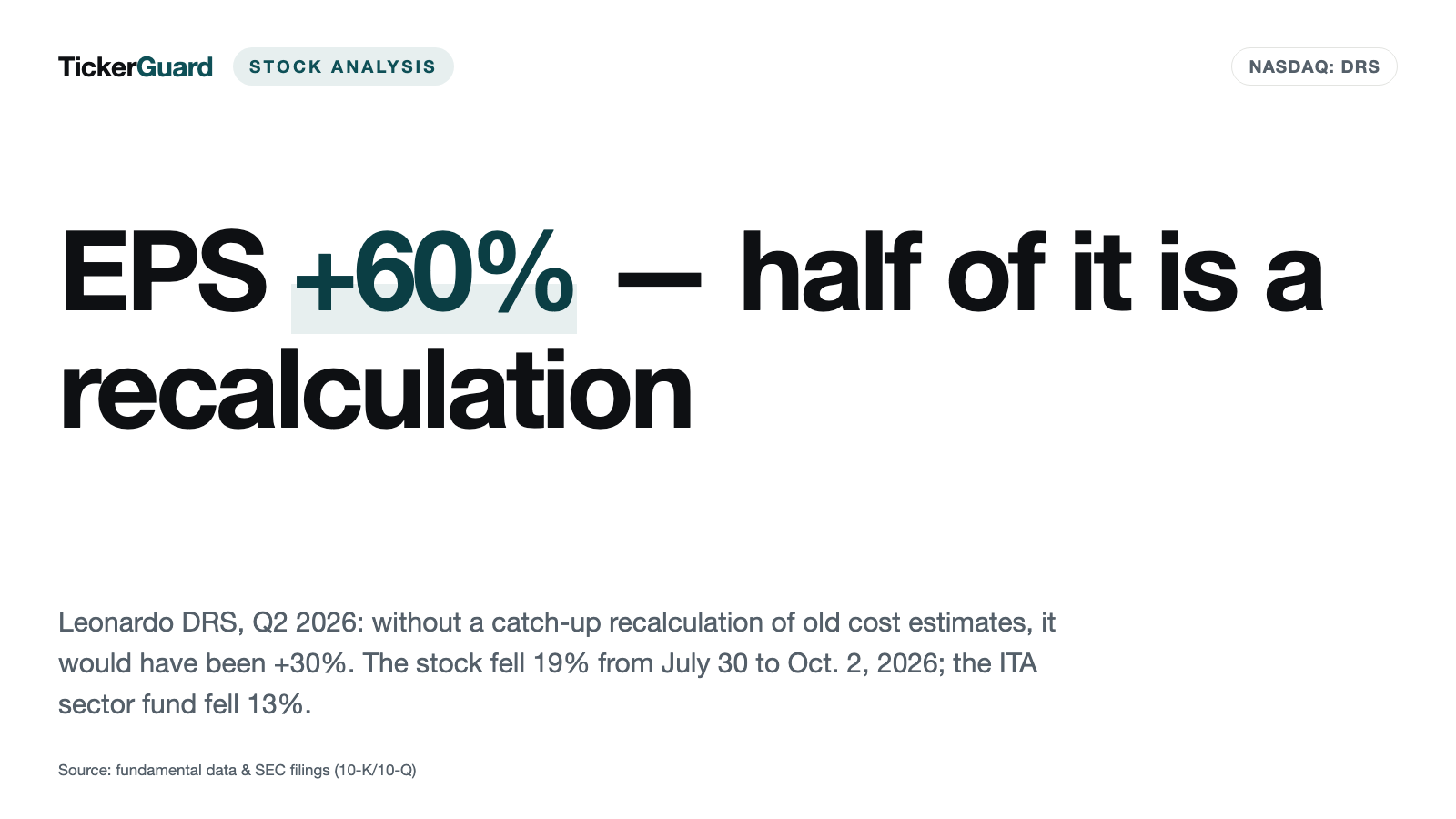
In everyday terms: a contractor who realizes that a fixed-price job will cost less than budgeted books the savings from the past two years in a single month. That is what happened in the second quarter of 2026. According to the notes, revised estimates added $21 million to revenue and operating earnings, $17 million to net earnings and 6 cents to earnings per share; in the prior-year quarter, the effect was zero. $17 million out of $86 million is a fifth of the quarter’s net earnings. And of the 12-cent rise in earnings per share, from $0.20 to $0.32, 6 cents came from the recalculation — exactly half. Without it, diluted EPS would have risen from $0.20 to $0.26 — about 30 percent instead of 60 percent — and operating earnings by about 16 percent instead of 46 percent (our calculation). A lower tax rate, which the company itself cites, helped as well.
To be fair: such catch-ups are required by the accounting rules, not a trick, and even without them operating earnings would have grown about 16 percent. But prior years show they can just as easily run the other way. Revised estimates reduced operating earnings by $23 million in 2023, $25 million in 2024 and $59 million in 2025; at the net earnings level, the hit was $18 million, $20 million and $47 million. In 2025, this was mainly due to the negotiated conclusion of a legacy ground surveillance program and higher raw material prices, for example germanium in infrared optics (10-K 2025, Note 2 and MD&A). Rule of thumb: a revised estimate is not a new order — it shifts profit between quarters, and it can flip its sign.
Uncomfortable truth No. 2: Rome first — even on business opportunities
If you buy a DRS share, you become a minority shareholder. About 71 percent of the stock is held by Leonardo US Holding, which is wholly owned by Italy’s Leonardo S.p.A.; the Italian state, in turn, holds about 30.2 percent of Leonardo’s voting power, according to the annual report. What that means for you, the company spells out in its own risk factors:
“So long as Leonardo S.p.A. continues to indirectly control a significant amount of the outstanding shares of our common stock, Leonardo S.p.A. and the proxy holders will continue to be able to strongly influence or effectively control our decisions, including potential mergers or acquisitions, asset sales and other significant corporate transactions.”
— Leonardo DRS, SEC annual report 10-K for 2025, Item 1A (Risk Factors)

Who are the “proxy holders”? Because a foreign company holds the majority, DRS may perform classified work for the U.S. Department of Defense only under a special arrangement (a proxy agreement, current version dated March 1, 2025). It provides that Leonardo’s shares are voted by independent proxy holders with U.S. security clearances, who sit on the board of directors and must be approved by an agency of the department. In everyday terms: the owner lives in Rome, but the keys to the vault are held by a building manager vetted by the Pentagon. According to the annual report, mergers and consolidations still require the approval of the majority stockholder.
Three consequences are tangible for minority shareholders. First, under its certificate of incorporation, DRS waives any claim to business opportunities presented to Leonardo — even ones DRS could have pursued. Second, most of the money flows to Rome: in the first half of 2026, DRS paid $34 million in dividends to its majority stockholder and $14 million to all other shareholders combined (10-Q, cash flow statement). That simply mirrors the 71 percent stake; more notable is that back in 2022, before the listing, the proceeds of two divestitures went out as a $396 million dividend to what was then the sole shareholder (10-K 2024). Third, the U.S. agency that reviews foreign investment, CFIUS, treats DRS as foreign-government controlled, so acquisitions such as Raft can face tougher scrutiny. To be fair: a majority owner can also mean stability. But its stake has shrunk since the listing, from 81 percent at the merger (10-K 2024) to about 71 percent (10-K 2025), and according to the 2024 annual report it has secured registration rights to sell shares in public offerings. Whether and when it will do so is not in any filing. Rule of thumb: with DRS, you buy into what the majority owner in Rome and its proxy holders decide — and into what the Pentagon agreement forbids Rome to decide. For comparison, see how a European maker of radars and optronics stacks up in our Hensoldt stock analysis.
Uncomfortable truth No. 3: two years running, the fourth quarter brought more cash than the full year
In the first half of 2026, DRS earned $148 million. In the same half-year, operating activities used $31 million of cash; after capital expenditures, the company reports negative free cash flow of $89 million. Cash fell from $647 million to $270 million, partly because the company repaid $191 million of debt. This is not a slip; it is how this company works. The annual report says so openly:
“We do not consider any material portion of our business to be seasonal. However, a significant portion of our revenue, profit and cash flows are generated in the fourth quarter of our fiscal year.”
— Leonardo DRS, SEC annual report 10-K for 2025, Item 1 (Seasonality)

The chart shows how strong the effect is. In the first nine months of 2025, operating cash flow was negative on balance, minus $59 million; then the fourth quarter alone brought $425 million — more than the whole year’s $366 million. 2024 looked the same: minus $172 million through September, plus $443 million in the fourth quarter (our calculation from nine-month and full-year figures). Uneven cash collection over the year is nothing unusual for defense suppliers. What stands out at DRS is the scale: two years in a row, cash flow was negative after nine months, and the fourth quarter alone brought more than the full year.
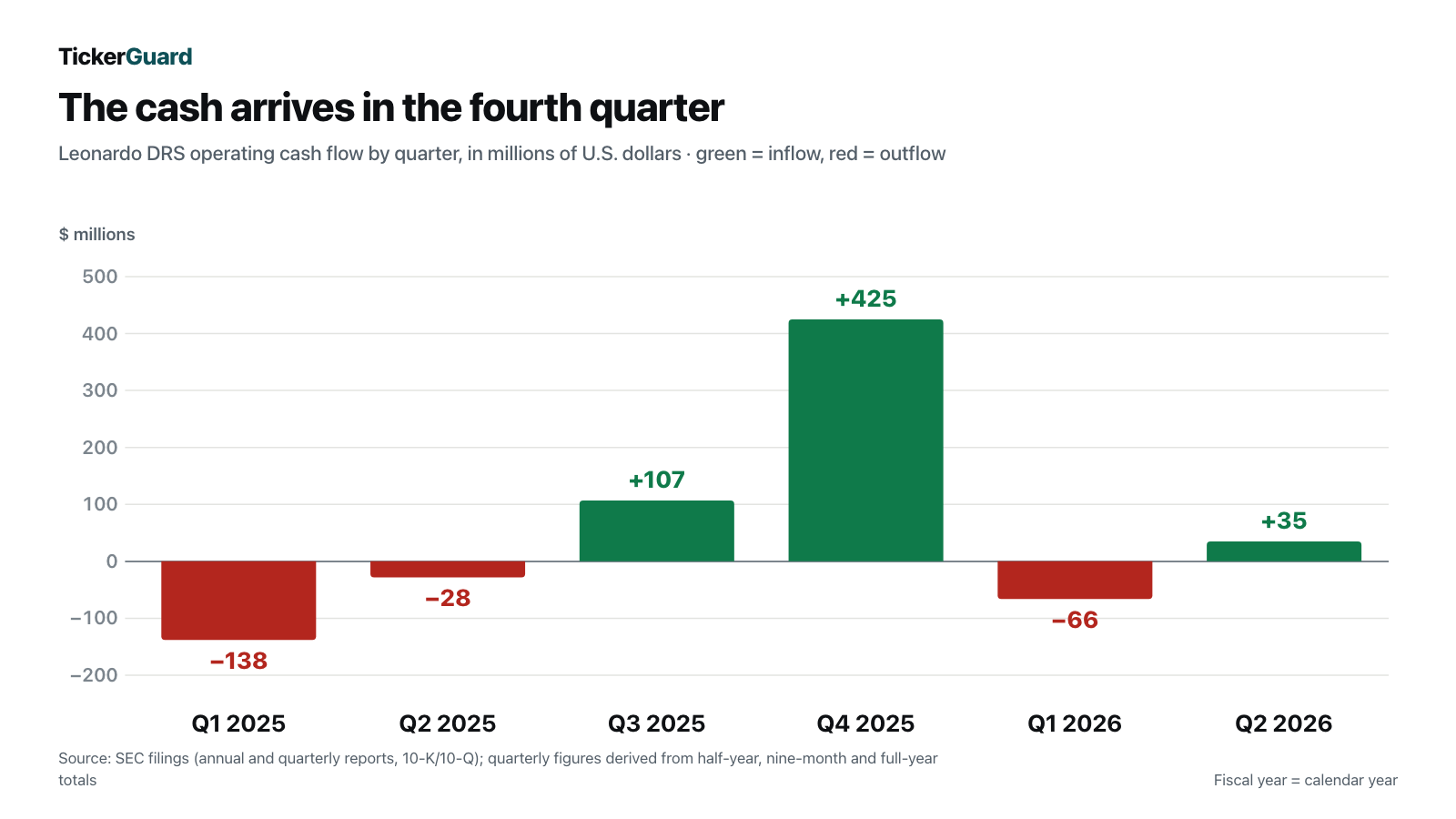
Why? For most contracts, DRS recognizes revenue as work progresses. But it bills later, depending on the contract at periodic intervals or only when agreed milestones are reached. In between, that revenue sits on the balance sheet as a “contract asset” — an IOU from the customer that the company cannot cash yet: $1,002 million as of June 30, 2026, a little over a quarter of annual revenue (our calculation), up from $931 million at the end of 2025. To be fair: the cash outflow in the first half of 2026, at $31 million, was far smaller than the $166 million a year earlier, and the customer is the U.S. government, which pays. But you see the profits long before you see the money. Rule of thumb: judge DRS’s cash flow after year-end, never at mid-year.
Uncomfortable truth No. 4: nearly half of future revenue rests on Navy propulsion
A backlog of nearly $8.8 billion sounds like security, and it is. But it has a particular shape. The quarterly report describes it like this:
“Approximately 45% of our remaining performance obligations relates to long-term contracts on electric power and propulsion programs with the U.S. Navy, which are expected to be recognized as revenue over a span of up to 11 years.”
— Leonardo DRS, SEC quarterly report 10-Q for the second quarter of 2026, Note 2 (Remaining Performance Obligations)

As of June 30, 2026, contractually committed future revenue stood at $8,787 million, nearly half of it for Navy power and propulsion, including the Columbia Class submarine program. Three things make this uncomfortable. First, about 82 percent of revenue depends on the U.S. government (first half of 2026), whose programs must be funded by Congress every year and, according to the annual report, can be terminated for convenience. Second, about 88 percent of 2025 revenue came from fixed-price contracts: if costs rise — for raw materials or wages — DRS bears them itself; the negative estimate revisions in truth No. 1 are exactly that. Third, an eleven-year contract is a long bet on stable cost estimates.
To be fair: U.S. defense budgets are rising; for fiscal 2026, Congress appropriated $839 billion for the Department of Defense, according to the annual report $8 billion more than requested. And according to the annual report, the submarine program is among the Navy’s top priority shipbuilding programs. The concentration is more of a foundation than an abyss. Rule of thumb: a backlog is only as good as the cost estimates behind it — and at DRS, nearly half of it sits in a single program area.
Valuation: about $9.8 billion as of October 2, 2026
At the October 2, 2026, close of $36.80 and 266.9 million shares (as of July 29, 2026), Leonardo DRS had a market value of about $9.8 billion (our calculation; the fundamental data show the same order of magnitude). Subtracting net cash of about $121 million (June 30, 2026), the whole company costs about $9.7 billion. That is about 2.6 times trailing twelve-month revenue and about 18 times the adjusted EBITDA the company expects for 2026 (midpoint of guidance: $532.5 million). On unadjusted trailing twelve-month EPS of $1.19, the market pays about 31 times; on adjusted EPS guidance for 2026 ($1.34 to $1.39), about 27 times (all our calculations). For comparison, each on trailing twelve-month earnings: L3Harris traded at about 24 times, Curtiss-Wright at about 38 times (source: fundamental data, as of October 4, 2026). DRS sits in the middle of the pack of U.S. defense electronics makers. The dividend of 36 cents a year equals about 1 percent of the share price.
Context: about 27 times expected adjusted earnings is the number against which you can judge the price yourself; whether it is reasonable is not something this analysis answers. Two things will shift the math soon. The Raft acquisition for $450 million, about 4.6 percent of the market value, is to be paid from cash and the credit facility; on paper, net cash would turn into net debt of a little over $300 million, before second-half cash inflows (our calculation). And the 2026 guidance explicitly excludes Raft.
The professionals’ view: eleven analysts cover the stock — eight rate it “Strong Buy,” one “Buy” and two “Hold”; their price target averages $53.82 (source: fundamental data, as of October 4, 2026). An average means all targets are added up and spread evenly — so a single very high or very low target moves it considerably. And here the anchor from the beginning returns: a price target is an opinion about the future, not a price anyone is paying.
Opportunities and risks at a glance
What speaks for Leonardo DRS:
- Steady growth: revenue from $2.8 billion to $3.6 billion between 2023 and 2025, net earnings from $168 million to $278 million, 2025 free cash flow of about $227 million.
- Record funded backlog: $5.1 billion as of June 30, 2026, up 17 percent year over year; contractually committed future revenue of $8.8 billion.
- Healthy balance sheet: net cash of about $121 million, bank loan repaid in January 2026, $500 million credit facility undrawn (June 30, 2026).
- In-demand niches: Columbia Class submarine propulsion, counter-drone radars, a growing international share (12 percent in the first half of 2026).
- 2026 outlook raised on July 30, 2026; AI software via the planned acquisition of Raft.
What speaks against it:
- Leonardo S.p.A. holds about 71 percent; minority shareholders have little influence, and most of the dividend flows to Rome.
- The cash comes late: operating cash outflow of $31 million in the first half of 2026, $1.0 billion of contract assets not yet billed.
- A fifth of second-quarter 2026 net earnings came from revised cost estimates; in 2025, they cost $47 million of net earnings.
- Dependence on the U.S. government (82 percent) and on fixed-price contracts (88 percent in 2025); nearly half of the backlog in Navy propulsion.
- About 31 times trailing twelve-month earnings; the Raft acquisition turns net cash into net debt on paper.
A human conclusion
Back to the anchors. At Leonardo DRS, they read $49.69, $53.82 and “Leonardo” — June’s price, the average price target and a name behind which sits a U.S. company under Italian majority control. None of them is a valuation of the company. The company itself is pleasingly solid: it grows, earns money, has more cash than debt and a backlog that reaches years ahead. But you are buying a minority stake in a business whose majority sits in Rome and whose major decisions Leonardo and the proxy holders can effectively control, according to the annual report, whose cash arrives only at year-end and half of whose second-quarter 2026 earnings jump came from a catch-up recalculation. So don’t ask how far the stock sits below its high; ask whether you would pay about 27 times the adjusted earnings the company expects for 2026 if you had never seen June’s high. The next chance to take a closer look is the report for the third quarter of 2026: it will show whether the estimate revisions stay positive, how much cash came in before year-end and whether Raft has closed. What you make of it is your decision. And that is how it should be.
Sources
All original documents used in this analysis — so you can check them yourself:
- Leonardo DRS, Inc. — quarterly report on Form 10-Q for the second quarter of 2026 (July 30, 2026; latest periodic report: balance sheet, cash flow statement, revised estimates, contract assets, backlog, customer shares, debt, Raft agreement, related-party transactions with Leonardo)
- Leonardo DRS, Inc. — current report on Form 8-K of July 30, 2026 with the second-quarter 2026 earnings release (Exhibit 99.1): quarterly results, orders, raised guidance, dividend, share repurchases
- Leonardo DRS, Inc. — annual report on Form 10-K for 2025 (February 27, 2026): business description, employees, seasonality, risk factors (Leonardo, proxy agreement, foreign control), annual figures 2023 to 2025, fixed-price share, Note 2 (revised estimates), defense budget
- Leonardo DRS, Inc. — annual report on Form 10-K for 2024 (March 3, 2025): $396 million dividend to Leonardo US Holding in 2022, registration rights of the majority stockholder, Nasdaq trading since November 29, 2022
- Leonardo DRS, Inc. — quarterly reports on Form 10-Q of October 29, 2025 (nine-month 2025 cash flow) and May 5, 2026 (first quarter 2026)
- Form 4 insider filings of August 5, September 4, September 8, September 10 and October 1, 2026, available via the SEC’s EDGAR database
- Closing prices of June 11, July 30 and October 2, 2026 (price anchor $36.80), analyst ratings and price target: source: fundamental data. Market value, net cash, valuation multiples, quarterly cash flows and free cash flow are our own calculations. Multi-year figures: source: fundamental data & SEC filings (annual and quarterly reports, 10-K/10-Q).
Transparency & disclaimer: This analysis is a journalistic assessment of publicly available information and is not investment advice, not a financial analysis in the regulatory sense and not a solicitation to buy or sell securities. Investing in stocks involves substantial risk, up to and including the total loss of your investment. All information without guarantee; data dates are noted in the text. Positions held by the operator are disclosed daily; where one exists, it appears as a notice at the top of this deep dive.
Key figures at a glance
All monetary figures in millions of $; earnings per share as reported.
| Metric | 2021 | 2022 | 2023 | 2024 | 2025 |
|---|---|---|---|---|---|
| Revenue | 2,879.0 | 2,693.0 | 2,826.0 | 3,234.0 | 3,648.0 |
| Operating Income (EBIT) | 236.0 | 561.0 | 231.0 | 293.0 | 348.0 |
| Net Income | 154.0 | 405.0 | 168.0 | 213.0 | 278.0 |
| Net Margin | 5.3% | 15.0% | 5.9% | 6.6% | 7.6% |
| Earnings Per Share | 1.06 $ | 1.88 $ | 0.64 $ | 0.80 $ | 1.03 $ |
Source: fundamental data & SEC filings (annual and quarterly reports, 10-K/10-Q)
Our Bottom Line at a Glance
- Business model positive
- Defense electronics in in-demand niches (submarine propulsion, counter-drone, sensors); funded backlog $5.1B (6/30/2026, record, +17%).
- Growth and earnings positive
- Revenue from $2,826M to $3,648M and net earnings from $168M to $278M between 2023 and 2025; 2026 guidance raised on 7/30/2026.
- Balance sheet positive
- Net cash of about $121M, bank loan repaid in January 2026, $500M credit facility undrawn (6/30/2026); the Raft acquisition ($450M) turns this into net debt on paper.
- Cash flow quality neutral
- 2025 free cash flow of about $227M, but heavily concentrated in the fourth quarter; operating cash outflow of $31M in the first half of 2026, contract assets of $1,002M.
- Earnings quality neutral
- Revised cost estimates: +$17M net in Q2 2026 (a fifth of quarterly net earnings), −$47M net (operating −$59M) in 2025; 88% fixed-price contracts.
- Ownership structure negative
- Leonardo S.p.A. holds about 71%, the Italian state about 30.2% of Leonardo; under its charter, DRS waives any claim to business opportunities presented to Leonardo; minority shareholders with little influence.
Leonardo DRS is a growing, profitable supplier of defense electronics with a record funded backlog and net cash. The drawbacks lie in its structure: Leonardo in Rome holds about 71 percent, nearly all the cash arrives in the fourth quarter, and a fifth of second-quarter 2026 net earnings came from revised cost estimates. Not investment advice.
What Our Rating Means
Quality confirmed
Business model, numbers and balance sheet hold up to our review. Whether the current price supports an entry is a separate question — it hangs on the price, not on the company.
Green, because the quality of the business is documented: revenue and earnings have grown every year since 2023, operating cash flow was positive in every fiscal year (2025: $366 million), the balance sheet shows net cash, and funded backlog stood at a record as of June 30, 2026. We examined the dependence on the U.S. government and do not count it as an existential dependence on a single counterparty: it is spread across the Navy, the Army and many programs, and the defense budget is rising; the concentration in Navy propulsion (about 45 percent of committed future contract revenue) is spelled out in truth No. 4 — it rests on programs the annual report describes as top priority. Leonardo’s majority, the late cash curve and the swinging estimate revisions temper the picture and are spelled out in the text, but they are not a threat to the company’s substance. Whether the stock at $36.80 (October 2, 2026), about 27 times expected adjusted earnings, is a reasonable price is not something this rating answers. The decision is yours.
A journalistic assessment by our editorial team at the time of the deep dive, based on public sources — not investment advice and not a solicitation to buy or sell. Your personal circumstances (investment goals, risk capacity, taxes) cannot be taken into account. What our levels mean, how verdicts are formed, and what conflicts of interest exist →
Worth Noting
- Version of October 4, 2026, based on the quarterly report on Form 10-Q of July 30, 2026 (latest periodic report), the second-quarter earnings release (8-K of July 30, 2026), the annual reports on Form 10-K for 2025 and 2024, the quarterly reports of October 29, 2025, and May 5, 2026, and Form 4 filings through October 1, 2026. The stock came to our attention through the wallstreet-online ranking in early October 2026, not through our in-house stock scanner.
- The ranking listed the stock as “Leonardo” with the symbol DRS. This analysis covers Leonardo DRS, Inc. (Nasdaq: DRS), not the Italian parent Leonardo S.p.A. (Milan Stock Exchange). Price data before 11/29/2022 belong to the predecessor listing of RADA Electronic Industries and are not used.
- Price anchor is the October 2, 2026, close of $36.80 (source: fundamental data). Market value is our own calculation (266.9 million shares × $36.80), cross-checked against the sale price in the Form 4 filed September 8, 2026 (sale on September 4, 2026, at $37.01). Free cash flow = operating cash flow minus capital expenditures, our own calculation; quarterly cash flows derived from half-year, nine-month and full-year totals.
Stock Watch
This analysis is as of October 4, 2026. Stock Watch will tell you what's changed at DRS since then.
Later $1 a month per stock — signing up is free, and you'll be the first to know when it launches.
The full analysis as a PDF for later
We will send you this analysis as a PDF — to print, file away, and read at your own pace. And we will add you to the free Stock Watch list for Leonardo DRS, Inc. (DRS), so you hear about it when something material in this analysis changes.
Frequently Asked Questions
No. Leonardo S.p.A. is an Italian aerospace and defense group headquartered in Rome and listed on the Milan Stock Exchange. Leonardo DRS, Inc. is its U.S. subsidiary, listed on Nasdaq under the ticker DRS since November 29, 2022. Through Leonardo US Holding, the parent owns about 71 percent of DRS shares.
Leonardo DRS makes defense electronics: infrared sensors, radars, rugged computers and networks for ships and vehicles, counter-drone systems, and electric propulsion and power for warships, including the Columbia Class submarines. Revenue was $3.6 billion in 2025; about 80 percent of it came directly or indirectly from the U.S. government, about 82 percent in the first half of 2026.
DRS recognizes revenue as work progresses but bills later, depending on the contract at periodic intervals or at agreed milestones, and the U.S. government’s fiscal year ends on September 30. So most cash arrives in the fourth quarter: in 2025 it brought $425 million of operating cash flow, more than the full year’s $366 million. In the first half of 2026, operations used $31 million.
According to the 2025 annual report, Leonardo US Holding, a wholly owned subsidiary of Leonardo S.p.A., holds about 71 percent of DRS shares. The Italian state, in turn, holds about 30.2 percent of Leonardo S.p.A.’s voting power. Because of this foreign control, Leonardo’s DRS shares are voted by independent proxy holders with U.S. security clearances.
Yes. Since March 2025, Leonardo DRS has paid a quarterly dividend of 9 cents per share, most recently payable on August 27, 2026. At the October 2, 2026, close of $36.80, that is about 1 percent a year. Because Leonardo owns about 71 percent, $34 million of the $48 million in first-half 2026 dividends went to the majority stockholder.
On July 28, 2026, Leonardo DRS agreed to acquire Raft LLC, a maker of mission software for data fusion and artificial intelligence, for $450 million. It plans to pay with cash on hand and its revolving credit facility; closing is expected in the fourth quarter of 2026. The 2026 guidance excludes Raft.
Found an error?
Did you spot a factual error, an outdated number, or a typo in this deep dive? Let us know briefly — your report goes straight to the editorial team.