Acumen Pharmaceuticals: The Alzheimer’s Trial Failed and the Stock Trades at a Fifth of Its Cash — Here Is the Math Behind It
On October 30, 2026, Acumen Pharmaceuticals reported that its Alzheimer’s antibody sabirnetug missed the primary endpoint of its large Phase 2 trial, ALTITUDE-AD. The stock fell from $2.29 to $0.21 in a single session; the company is discontinuing the drug and exploring “strategic options.” Acumen is now worth about $15 million in the market, yet it held $78.6 million in cash and marketable securities at the end of September. We show which claims stand ahead of shareholders — and why the leftover-value trap snaps shut most quietly right after a crash.
 Thomas Mücke
Founder & Publisher
As of Today
As of: October 30, 2026
- Closing price
- 0.2101 $ -90.80%
- Market Capitalisation
- 15.0 $M
- Growth Score
- 2/10
- AAQS
- 1/10
This analysis has a cut-off date. The Stock Guard tells you when something material changes in the numbers. Reserve your free spot
Chart
Interactive price chart (TradingView).
52-week range: 1.60 $ to 3.40 $ · Last price: 0.2101 $ (As of: October 30, 2026)
Note: pure fact-based analysis, not investment advice and not a solicitation to buy or sell. All figures without guarantee.
There is an investor trap that only snaps shut after the worst has already happened. Let’s call it the leftover-value trap. A stock loses nine tenths of its value in a day, and shortly afterwards someone does the math: “The company has $78 million in the bank and is worth only $15 million on the market — that is free money.” The thought feels like cold arithmetic, not greed. That is exactly what makes it dangerous. Acumen Pharmaceuticals (Nasdaq: ABOS) is such a case right now: on October 30, 2026, the company reported that its Alzheimer’s antibody sabirnetug had failed the decisive trial, and the stock fell from $2.29 to $0.21. Before you call anything free money, we read together what Acumen reported to the U.S. securities regulator, the SEC — under liability: false statements there can carry criminal and civil consequences. And we show which claims stand ahead of you as a shareholder. In the end, you decide.
What Acumen actually does — an antibody against the toxic precursors of plaques
Acumen is based in Newton, near Boston, and was incorporated as far back as 1996. It acquired the exclusive rights to its drug in 2011 from Merck, with which it had collaborated since 2003 and which was then focusing on a different Alzheimer’s candidate; real operations only began with the first institutional financing round in 2018. In the summer of 2021, the company listed its shares on Nasdaq at $16. At the end of March 2026, it had 61 employees, 40 of them in research and development.
The idea is easy to picture. In Alzheimer’s disease, a protein called amyloid beta clumps together in the brain. The large clumps, the plaques, show up on brain scans; the approved drugs Leqembi and Kisunla clear them away. Acumen bet on a different theory: the main problem is not the big clumps but small, soluble precursors called oligomers — just as it is not the trash heap in the yard that pollutes the apartment, but the fine dust that seeps through every crack. The antibody sabirnetug (development code ACU193) was designed to catch precisely that dust. The U.S. Food and Drug Administration granted it Fast Track designation, an expedited review pathway, in October 2022.
Next to it sits a second, much earlier program: Enhanced Brain Delivery (EBD), developed with Japan’s JCR Pharmaceuticals. The antibodies are attached to a “ferry” that carries them across the blood-brain barrier more easily. In June 2026, Acumen selected two candidates, ACU301 and ACU401; the $9.25 million for them went to JCR in July; an application to start human trials was targeted for mid-2027. How companies fare that actually sell an Alzheimer’s antibody is covered in our Biogen analysis.
That sets up the central tension of this analysis: On paper, Acumen stock is cheaper than the cash in its account after the crash. But that cash does not simply belong to shareholders — ahead of them stand a lender, unpaid bills, the cost of the aborted trial and a board that proposes the path — a merger, sale or liquidation would typically also need shareholder approval.
Company history for investors
-
2011
Rights to sabirnetug from Merck
Merck focuses on a different Alzheimer’s candidate, and Acumen acquires the exclusive rights. Real operations only start with the 2018 financing round.
-
2021
IPO at $16
Acumen sells 11.5 million shares at $16 on Nasdaq. From then on, shareholders pay for the trials.
-
2023
Phase 1 success and a loan from K2
July: INTERCEPT-AD meets its objectives. November: a $30 million loan from K2 HealthVentures, secured by substantially all assets.
-
2024
Start of the large ALTITUDE-AD trial
The Phase 2 trial begins in May 2024 and is fully enrolled with 542 patients in March 2025. Cash burn rises to $86.2 million a year.
-
2026
Private placement at $3.30
March 2026: 10.8 million new shares at $3.30, about $35.7 million gross, mainly for the EBD program. In June, Acumen selects two EBD candidates.
-
2026
Trial misses its primary endpoint
On 10/30/2026, Acumen reports the failure of ALTITUDE-AD. The stock falls from $2.29 to $0.21, and sabirnetug is discontinued.
How the stock landed on our desk
Acumen made our research list through the Reddit hype scanner: it recorded the stock on October 31, 2026, one day after the crash, with 2 mentions on Reddit (ApeWisdom) — a murmur, not a hit from a quality or valuation scanner.
On the price, with dates: in early March 2026 the stock cost a little over $3; the highest close of the preceding twelve months was $3.37 on March 11, 2026. It closed at $2.29 on October 29, 2026, and at $0.21 on October 30, with 66.6 million shares changing hands in a single day (closing prices and volume per fundamental data). The six analyst ratings in our fundamental data (“strong buy,” average price target $7.60, data as of November 1, 2026) clearly no longer fit a company without its lead product; we do not adopt them. The average means all price targets added up and spread evenly — a single high target pulls the figure up sharply.
We reviewed the 2025 annual report (10-K), the quarterly reports (10-Q) through September 30, 2026 — filed on October 26, 2026, on the usual schedule and without an amendment — and every current report (8-K) since August through November 1, 2026.
The numbers over the years — honestly appraised
First, what deserves respect. Acumen turned a small research idea into a real, large trial: ALTITUDE-AD started in May 2024, was fully enrolled with 542 patients in March 2025 and ran in the United States, Canada, the European Union and the United Kingdom. The first human study, INTERCEPT-AD with 62 participants, met its objectives in July 2023. Operating expenses in the third quarter of 2026 stayed roughly at the prior-year level at $25.8 million ($26.5 million).
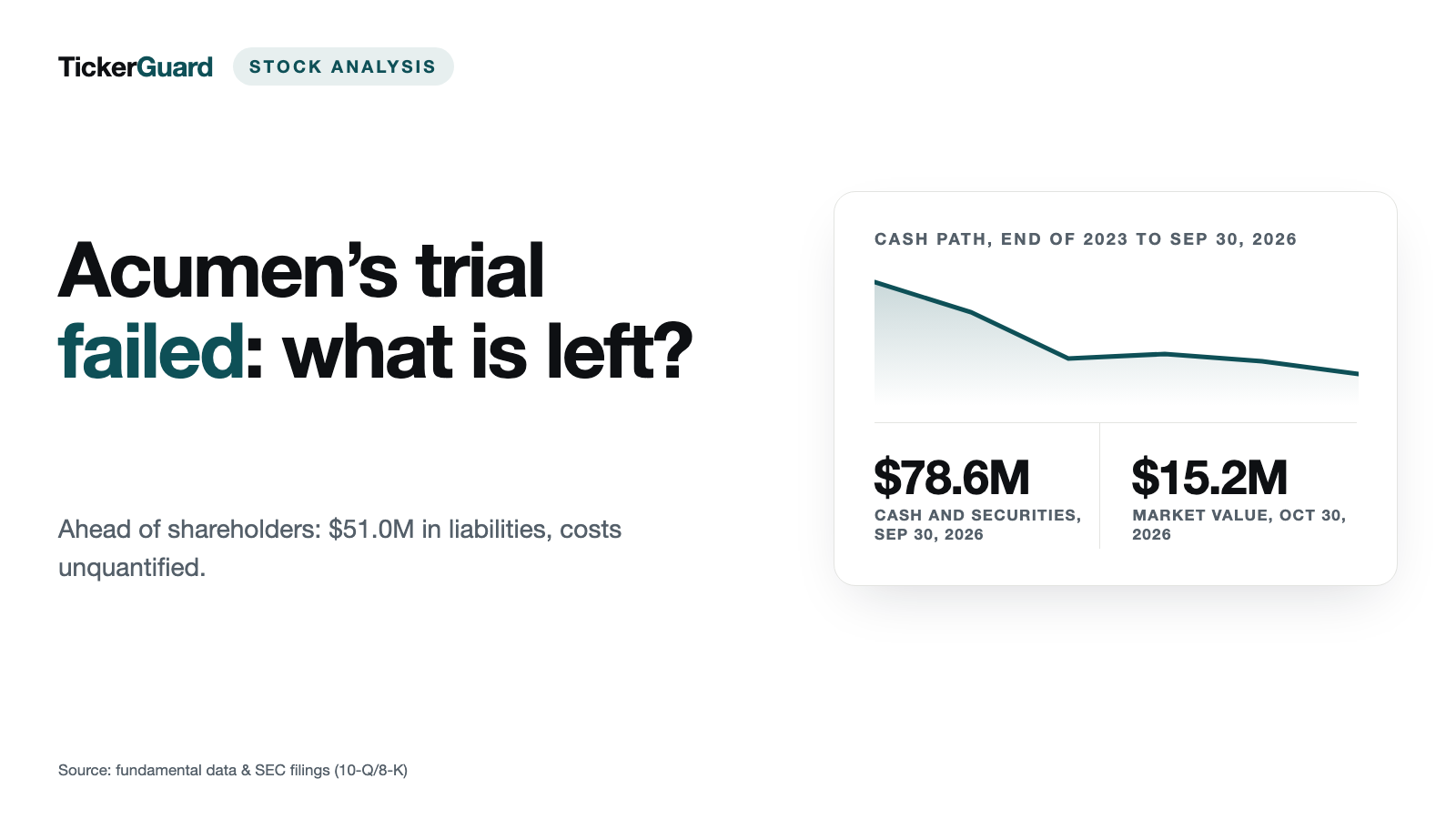
The flip side: all of this cost a great deal of money, and there was never any revenue. Cash used in operating activities rose from $18.0 million (2021) through $35.2 million (2022), $43.1 million (2023) and $86.2 million (2024) to $115.5 million in 2025. In the first nine months of 2026, it was $68.9 million. The 2025 net loss was $121.3 million; through September 30, 2026, Acumen had accumulated losses of $525.3 million. How fast the cash pile shrank is shown in the first chart.
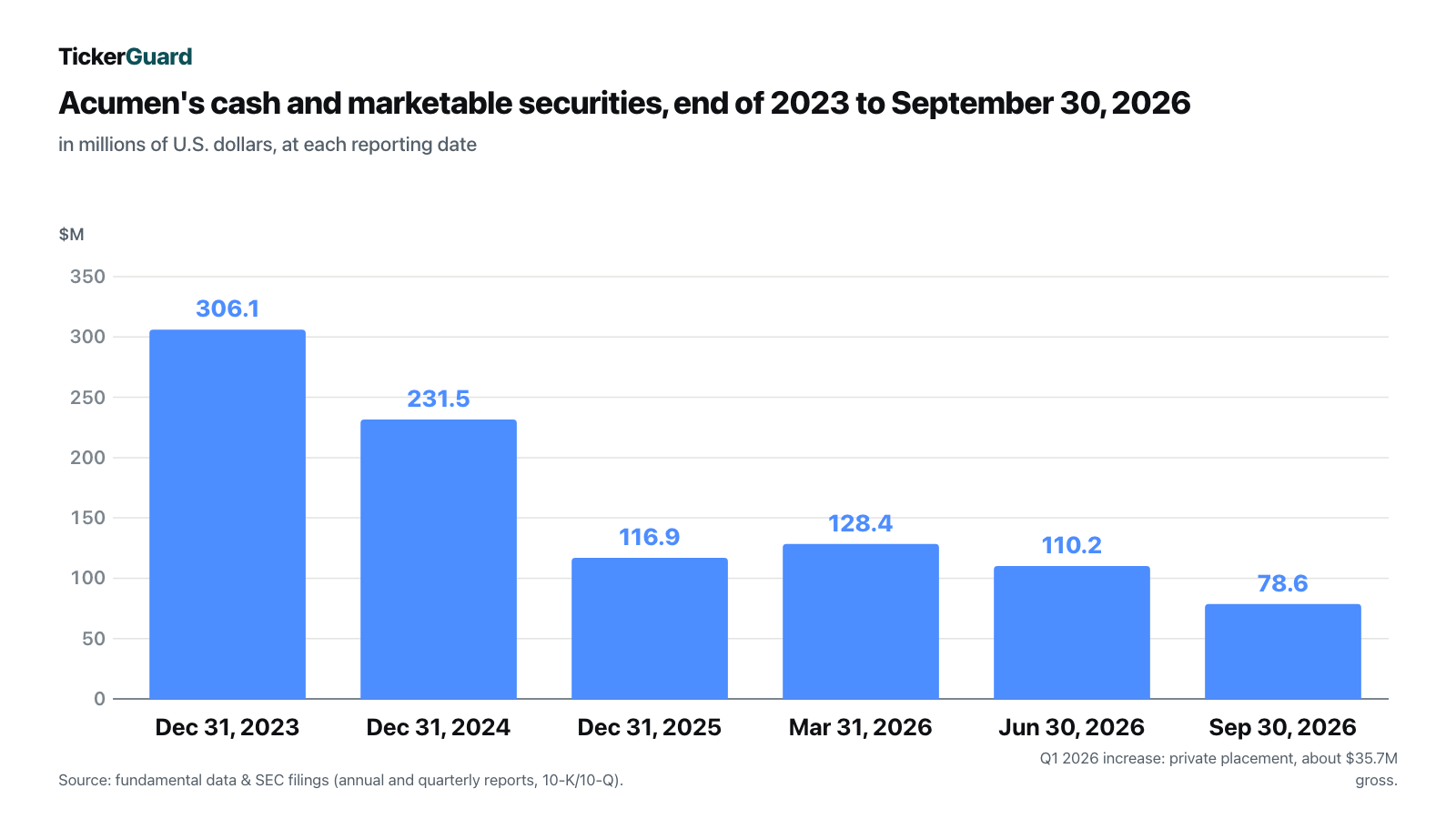
In March 2026, Acumen raised fresh money once more: 10,833,331 new shares at $3.30 sold to institutional investors, about $35.7 million gross. The money was earmarked mainly for the EBD program. Anyone who bought in at $3.30 now holds a stock that closed at $0.21 on October 30, 2026. In the third quarter of 2026 alone, cash fell by $31.6 million — including the $9.25 million paid to JCR and about $5.0 million in loan principal. Remember the image: a biotech cash pile is not a savings account but an hourglass — and at Acumen it was running out toward early 2027 even before the readout.
What the filings say — the uncomfortable truths
Uncomfortable truth no. 1: The trial did not narrowly miss — it showed no difference at all
When a trial fails, investors like to cling to the word “narrowly.” There is no basis for that here. The current report (8-K) of October 30, 2026, is unusually blunt:
“The clinical trial also failed to achieve statistical significance on key secondary efficacy endpoints, including the Clinical Dementia Rating – Sum of Boxes, and did not show any meaningful difference between either sabirnetug treatment arm and the placebo arm.”
— Acumen Pharmaceuticals, Inc., SEC current report 8-K of October 30, 2026, Item 8.01
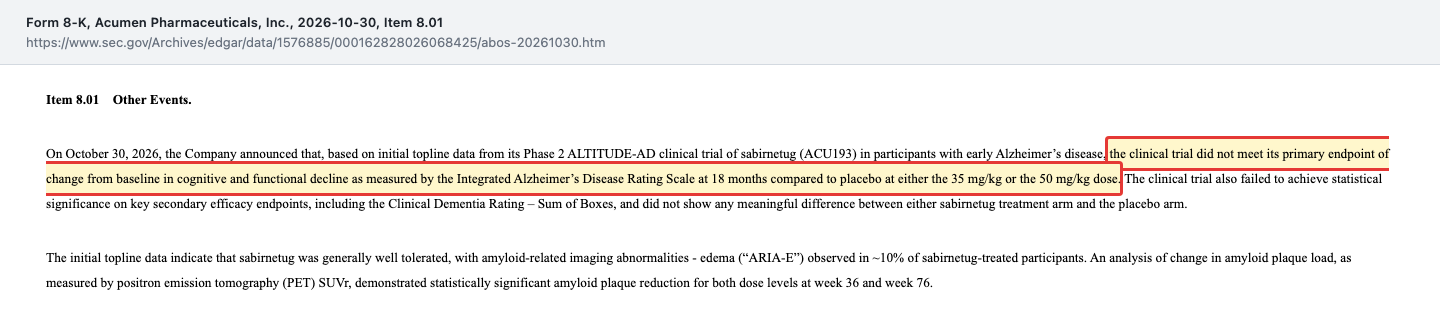
What that means: the trial measured with the iADRS scale, which combines memory, thinking and the ability to manage daily life. After 18 months, patients on sabirnetug were not measurably better off than those on placebo — neither at 35 nor at 50 milligrams per kilogram of body weight. Two things did work: the drug was generally well tolerated (brain swelling, ARIA-E, in about 10 percent of treated patients), and plaques in the brain declined measurably at both doses. But that does not help patients whose memory fades just as fast. Acumen plans to analyze further data in the coming weeks but explicitly expects no turnaround:
“Acumen expects to receive and analyze additional data from ALTITUDE-AD in the coming weeks, including fluid biomarker and additional imaging data, but does not expect these data to change the efficacy conclusions of the trial.”
— Acumen Pharmaceuticals, Inc., press release of October 30, 2026, Exhibit 99.1 to the 8-K
For comparison, the description from the weeks before: on September 16, 2026, management described the trial at its investor day as a “Large, well-powered, registration-quality ALTITUDE-AD Phase 2 study currently ongoing” (presentation, Exhibit 99.1 to the 8-K of September 16, 2026). The description referred to the trial’s design, not its outcome. Six weeks later, the lead product was history.
Uncomfortable truth no. 2: The money did not last a year even before the readout
The crash did not hit a well-funded company. The quarterly report (10-Q) as of September 30, 2026 — filed four days before the readout — already carried what is called a going-concern warning. In plain terms: the company itself doubts it can make it through the next twelve months without fresh money.
“The Company expects that its current balance of cash and cash equivalents and marketable securities will not be sufficient to fund its operations for at least 12 months from the date of issuance of these financial statements.”
— Acumen Pharmaceuticals, Inc., SEC quarterly report 10-Q as of September 30, 2026, Note 1 “Liquidity, Capital Resources and Going Concern”
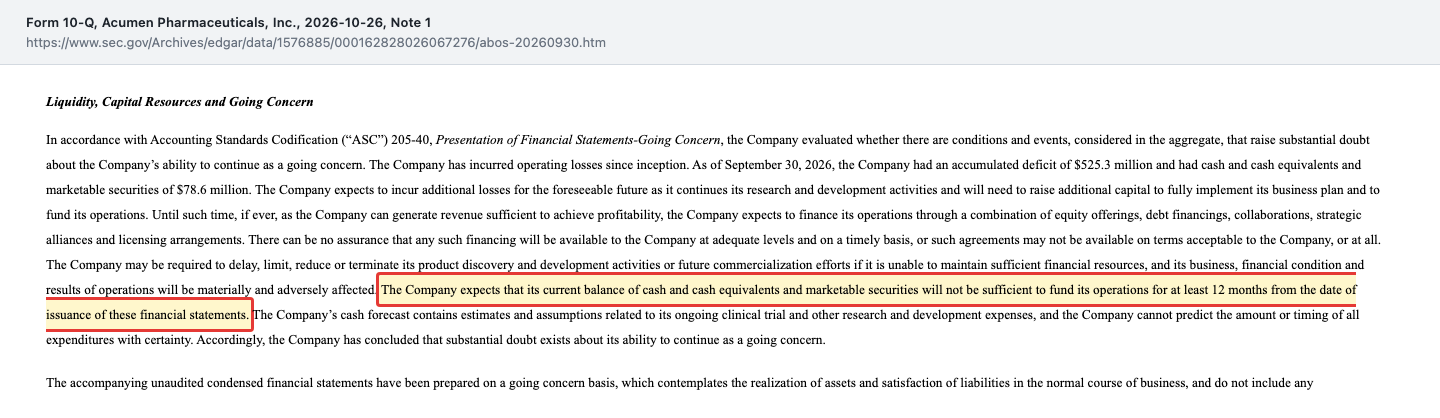
According to the company, the money would last “into early 2027” — a forecast that assumed an ongoing trial and the EBD program. With sabirnetug gone, large costs fall away; at the same time, ending the extension study, closing out contracts with trial sites and possible severance cost money. Acumen had not quantified how that math works out as of November 1, 2026. All we know: a normal quarter recently cost $25.8 million in operating expenses, and the September 30 cash figure was already a month old on the day of the readout.
Uncomfortable truth no. 3: The lender comes first, then nothing for a long while
In November 2023, Acumen borrowed $30 million from K2 HealthVentures. As of September 30, 2026, the quarterly report shows $26.6 million still to be repaid, including a $1.6 million final payment; interest is at least 9.65 percent, and the effective rate was 15.0 percent in the third quarter. The loan matures on November 1, 2027, and has been amortizing in monthly installments since July 2026. It is secured by substantially all assets except the patents. And the 2025 annual report (10-K) contains a clause that gains weight after October 30:
“In addition, K2HV could declare a default upon the occurrence of any event that it interprets could have a material adverse effect, subject to the limitations specified in the Loan Agreement.”
— Acumen Pharmaceuticals, Inc., SEC annual report 10-K for 2025, Item 1A “Risk Factors”
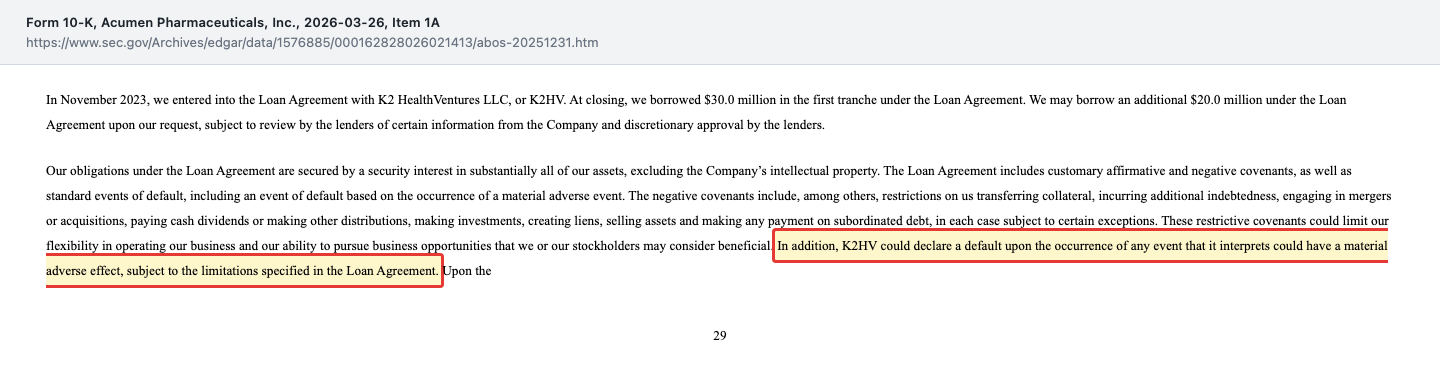
Whether K2 will use it is open; as of November 1, 2026, there is no filing on it. What is clear is the order of payment, and the annual report states it plainly: “If we are liquidated, the rights of our lenders to repayment would be senior to the rights of the holders of our common stock to receive any proceeds from the liquidation.” Picture it like selling a house: whoever distributes the proceeds pays off the bank first. Whatever is left belongs to the owners.
Uncomfortable truth no. 4: The board shapes what happens to the rest first
The most important sentence in the October 30, 2026, filing is not about the trial but about the company’s future:
“Based on the initial topline results, the Company plans to cease development of sabirnetug, including the open-label extension portion of the ALTITUDE-AD trial, and to evaluate its strategic options, including its Enhanced Brain Delivery™ (EBD®) program.”
— Acumen Pharmaceuticals, Inc., SEC current report 8-K of October 30, 2026, Item 8.01
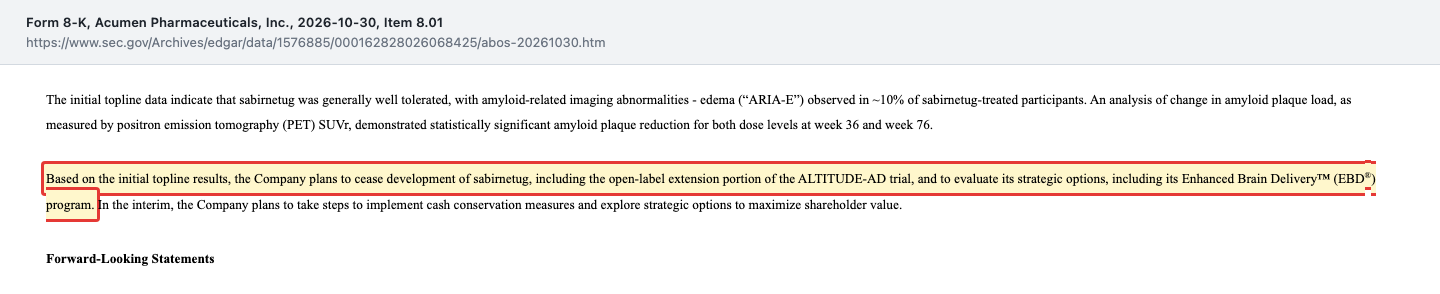
In biotech, “strategic options” is a catch-all. It can mean selling the EBD program, a merger with a private company that wants to go public through Acumen, a liquidation with a payout to shareholders — or carrying on with the early program, which still needs years and a lot of money before human trials. The board proposes the path; major steps such as a merger or dissolution typically go to a shareholder vote. In a merger, today’s shareholders’ stake would depend on how much cash Acumen contributes — and that is open; if the company carries on, the remaining cash keeps being spent.
Two details show that new shares can also play a role. On October 26, 2026, four days before the readout, Acumen filed a new shelf registration (S-3) for up to $500 million, effective since October 28; the trial readout followed on October 30. That is a shelf registration, not a concrete offering. And there are already 15.3 million stock options (weighted average exercise price $3.19), 3.0 million unvested restricted stock units (RSUs) for employees, a warrant for 730,769 shares at $1.95 and a lender conversion right covering 988,142 shares. At the October 30 price, the options are on average deep out of the money. The RSUs are not: they dilute as they vest — your slice of the pie gets smaller every time new slices are cut.
Valuation: what the market pays for the rest
There is no price-to-earnings or price-to-sales ratio for Acumen — there are neither earnings nor sales. The most honest yardstick now is the balance sheet, and the second chart puts it next to the market value.
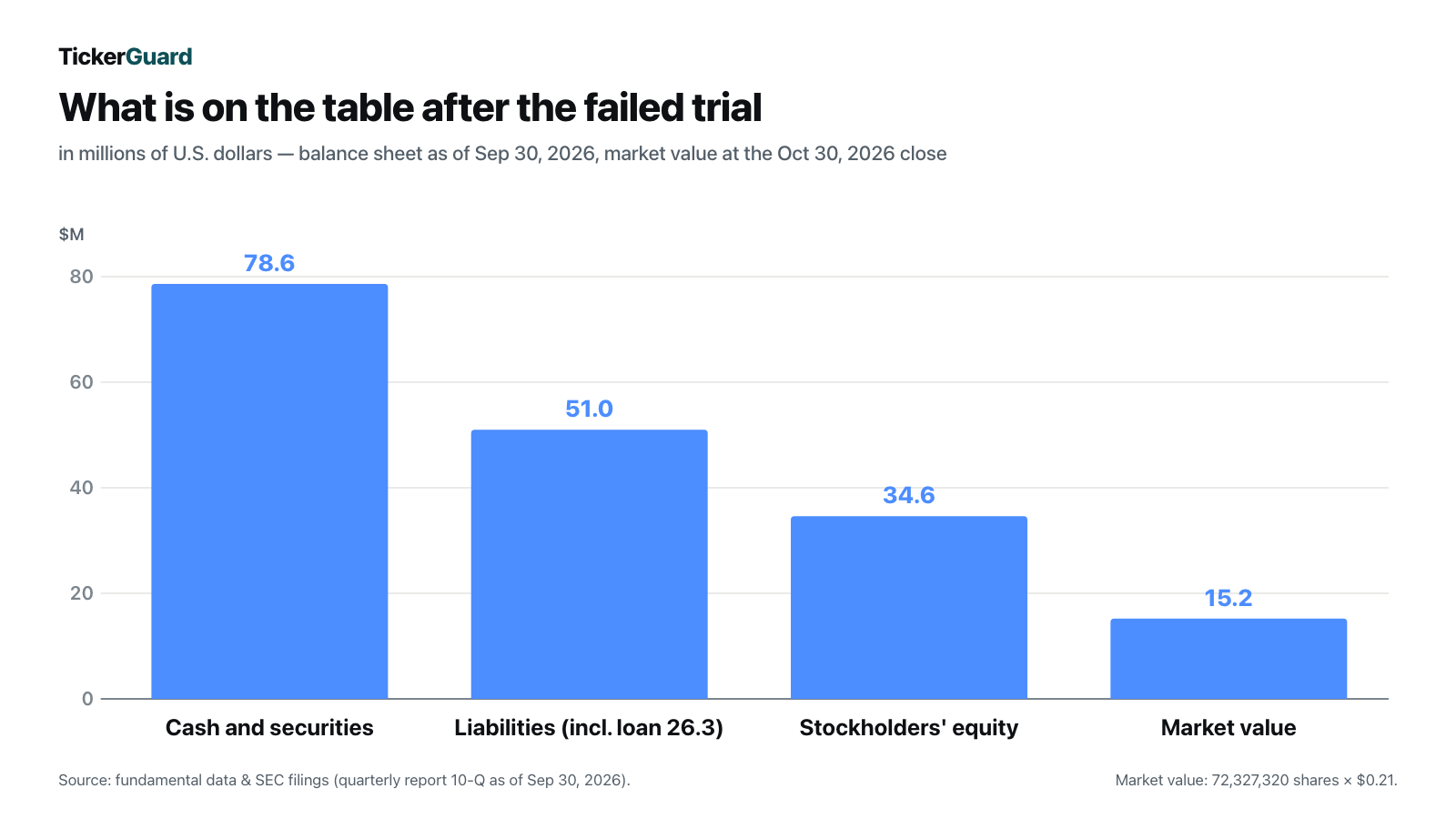
Per share, on 72,327,320 shares (as of October 21, 2026): cash comes to about $1.09, equity to about $0.48, and cash minus all liabilities to about $0.38. The stock closed at $0.21 on October 30, 2026. You can read the gap between $0.38 and $0.21 as a discount for three unknowns: the costs since September 30, the cost of ending the trial, and the path the board proposes. A worked example, explicitly our own assumption and not a company figure: if the fourth quarter cost as much as the third ($25.8 million in operating expenses, of which $2.7 million was non-cash stock-based compensation, so roughly $23.1 million in cash outflow), about $4.5 million of the $27.6 million would remain — about $0.06 per share. Before wind-down costs, the range therefore runs from about $0.06 to $0.38 per share; the cost of winding down would come on top, and Acumen itself has given no figure. For comparison: on October 23, 2026, Acumen still cited a price of $1.98 in its shelf registration (S-3) — a week before the readout, the market was pricing mainly the hope for sabirnetug, not the cash.
One more point that has nothing to do with the balance sheet but everything to do with trading: Nasdaq requires a minimum closing bid price of one dollar for continued listing. Acumen itself names the minimum bid price as a delisting risk (10-K 2025, Item 1A). A price of $0.21 is far below that; if it stays there, a deficiency notice from the exchange and a cure period typically follow, for example via a reverse stock split.
Opportunities and risks at a glance
What speaks for Acumen:
- Plenty of cash relative to market value: $78.6 million in cash and marketable securities as of September 30, 2026, against a market value of about $15.2 million on October 30, 2026; equity of $0.48 per share against a $0.21 stock price.
- Large cost blocks fall away: research and development accounted for $21.1 million of $25.8 million in operating expenses in the third quarter of 2026, including trial and manufacturing costs for ALTITUDE-AD; Acumen does not break costs out by program.
- A second program exists: the EBD candidates ACU301 and ACU401 are selected and licensed ($9.25 million paid to JCR in July 2026) and could be sold or continued.
- A clean trial with clear data: tolerability and plaque reduction were well documented, which may hold value for a buyer of the technology or the antibodies.
What speaks against it:
- The lead product failed: no difference from placebo at 18 months at either dose, development discontinued (8-K of October 30, 2026).
- A going-concern warning even before the readout: cash would not last twelve months, only into early 2027 per the company (10-Q as of September 30, 2026).
- The lender is first in line: $26.6 million owed to K2 HealthVentures, secured, with a default right on a material adverse event.
- Unquantified wind-down costs: ending the extension study, trial-site contracts, staff — none of it quantified as of November 1, 2026.
- Little influence over the path: the board proposes it, and shareholders mostly just approve or reject; a new $500 million shelf is in place, and the stock trades far below Nasdaq’s one-dollar threshold.
A human conclusion
Back to the leftover-value trap from the start. Its core is not that the math is wrong — $78.6 million in cash against a $15.2 million market value is correct. Its core is that the math stops too early. From the cash come $51.0 million in liabilities, including a lender that gets paid first. Then come the costs since September 30, the cost of ending the trial, perhaps severance. And what happens to whatever remains is shaped first by the board — whether it proposes paying the money out, contributing it to a merger or putting it into a program that would reach human testing in 2027 at the earliest; major steps such as a merger or dissolution would typically also need shareholder approval. The honest question for you is therefore not “Is this free money?” but: Do you know the three unknowns (costs since September 30, the cost of ending the trial, the path the board proposes) that stand between $0.38 in cash after debt and the market price — and do you know how the board will resolve them? As long as both are open, the leftover value remains an unknown. What you make of it is your decision. And that is exactly as it should be.
Sources
All original documents used in this analysis — so you can read them yourself:
- Acumen Pharmaceuticals, Inc. — SEC current report 8-K of October 30, 2026 (ALTITUDE-AD topline results) with press release (Exhibit 99.1)
- Acumen Pharmaceuticals, Inc. — SEC quarterly report 10-Q as of September 30, 2026 (filed October 26, 2026)
- Acumen Pharmaceuticals, Inc. — third-quarter release of October 26, 2026 (Exhibit 99.1 to the 8-K, Item 2.02)
- Acumen Pharmaceuticals, Inc. — shelf registration S-3 of October 26, 2026 (up to $500 million)
- Acumen Pharmaceuticals, Inc. — investor day of September 16, 2026 (presentation, Exhibit 99.1 to the 8-K)
- Acumen Pharmaceuticals, Inc. — SEC quarterly report 10-Q as of June 30, 2026 (filed August 12, 2026)
- Acumen Pharmaceuticals, Inc. — SEC current report 8-K of June 2026 (EBD candidates, JCR option)
- Acumen Pharmaceuticals, Inc. — SEC quarterly report 10-Q as of March 31, 2026 (filed May 12, 2026)
- Acumen Pharmaceuticals, Inc. — SEC current report 8-K of March 13, 2026 (private placement at $3.30)
- Acumen Pharmaceuticals, Inc. — SEC annual report 10-K for 2025 (filed March 26, 2026)
- Acumen Pharmaceuticals, Inc. — SEC annual report 10-K for 2024 (filed March 27, 2025)
- Complete SEC filing history of Acumen Pharmaceuticals, Inc.: EDGAR overview (sec.gov)
- Fundamental data (prices through the October 30, 2026 close, analyst ratings; data as of November 1, 2026), reconciled with the SEC filings and the SEC’s XBRL data series.
- Reddit mentions: ApeWisdom (recorded October 31, 2026); accessed via our in-house stock scanner.
Transparency & disclaimer: This analysis is a journalistic contextualization of publicly available information and is not investment advice, not a financial analysis in the regulatory sense and not a solicitation to buy or sell securities. Investing in stocks carries substantial risks, up to and including total loss. All information without guarantee; the data date is noted in the text in each case. Positions held by the operator are disclosed daily; where one exists, it appears as a notice at the top of this deep dive.
Key figures at a glance
All monetary figures in millions of $; earnings per share as reported.
| Metric | 2021 | 2022 | 2023 | 2024 | 2025 |
|---|---|---|---|---|---|
| Revenue | 1.4 | 0.0 | 0.0 | 0.0 | 0.0 |
| Operating Income (EBIT) | -19.6 | -45.2 | -61.1 | -114.0 | -123.8 |
| Net Income | -100.6 | -42.9 | -52.4 | -102.3 | -121.3 |
| Net Margin | -7,006.0% | – | – | – | – |
| Earnings Per Share | -2.63 $ | -1.06 $ | -1.08 $ | -1.71 $ | -2.00 $ |
Source: fundamental data & SEC filings (annual and quarterly reports, 10-K/10-Q)
Our Bottom Line at a Glance
- Pipeline negative
- The only clinical program failed: ALTITUDE-AD (542 patients) showed no meaningful difference from placebo at 18 months at either dose, and sabirnetug is being discontinued (8-K of 10/30/2026). What remains is the preclinical EBD program with JCR, with a filing for first human trials previously targeted for mid-2027.
- Liquidity negative
- $78.6 million in cash and marketable securities as of 9/30/2026, down from $116.9 million at the end of 2025. Going-concern warning in the 10-Q: funds last into early 2027 per the company, not twelve months. A new runway after the trial shutdown is missing.
- Debt negative
- Secured loan from K2 HealthVentures with $26.6 million owed (9/30/2026), interest of at least 9.65 percent, default right on a material adverse event; in a liquidation, the lender is paid before shareholders.
- Valuation neutral
- Market value of about $15.2 million ($0.21, 10/30/2026) versus $34.6 million in equity and $27.6 million in cash after all liabilities (9/30/2026). The discount reflects unquantified wind-down costs and the company’s undecided path.
- Influence over the path negative
- The board proposes the path — sale, merger, liquidation or carrying on; on a merger, asset sale or dissolution, shareholders typically only approve or reject; a shelf of up to $500 million has been effective since 10/28/2026, and the stock trades far below Nasdaq’s one-dollar threshold.
Acumen Pharmaceuticals is a textbook case of the leftover-value trap: after the Alzheimer’s trial ALTITUDE-AD failed on October 30, 2026, the stock is worth only about $15.2 million, a fifth of its $78.6 million in cash. But $51.0 million in liabilities stand ahead of shareholders, including a secured loan, plus unquantified wind-down costs and a board that proposes the path forward. Not investment advice.
What Our Rating Means
Substance risk
We found at least one documented issue that threatens the company itself — regardless of how the stock is currently valued.
Red, because several substance risks are documented: the quarterly report as of September 30, 2026, carries a going-concern warning, cash would last only into early 2027 per the company, and the only clinical product failed on October 30, 2026. A secured loan of $26.6 million stands ahead of shareholders. That the stock trades below book equity is a price argument, not a quality verdict — how much of it ever reaches shareholders is open. The decision is yours.
A journalistic assessment by our editorial team at the time of the deep dive, based on public sources — not investment advice and not a solicitation to buy or sell. Your personal circumstances (investment goals, risk capacity, taxes) cannot be taken into account. What our levels mean, how verdicts are formed, and what conflicts of interest exist →
Worth Noting
- Acumen made our research list through the Reddit hype scanner (2 mentions, ApeWisdom, recorded 10/31/2026) — one day after the trial readout and the drop from $2.29 to $0.21.
- Market value calculated by us: 72,327,320 shares (10-Q cover, as of 10/21/2026) × $0.21 (close on 10/30/2026) ≈ $15.2 million; consistent with the fundamental data. The last price cited in a filing (S-3: $1.98 on 10/23/2026) predates the readout.
- Per-share figures calculated by us from the 10-Q as of 9/30/2026: cash $78.6M ≈ $1.09, equity $34.6M ≈ $0.48, cash minus liabilities $27.6M ≈ $0.38 per share. Costs since 9/30/2026 and wind-down costs are not included.
- Annual cash used in operating activities per the SEC’s XBRL data series (10-K); cash at each date as the sum of cash equivalents and short- and long-term marketable securities. The 10-Q as of 9/30/2026 was filed on time on 10/26/2026; no amendment (10-Q/A) exists.
- IPO: 11,499,998 shares at $16.00 including the underwriters’ option, registration effective 6/30/2021 — per the 2024 annual report 10-K, Item 5 “Use of Proceeds.”
- Analyst price targets (average $7.60, six “strong buy” ratings, data as of 11/01/2026) clearly do not fit the situation after 10/30/2026; the data do not show whether they were revised.
Stock Watch
This analysis is as of November 1, 2026. Stock Watch will tell you what's changed at ABOS since then.
Later $1 a month per stock — signing up is free, and you'll be the first to know when it launches.
The full analysis as a PDF for later
We will send you this analysis as a PDF — to print, file away, and read at your own pace. And we will add you to the free Stock Watch list for Acumen Pharmaceuticals Inc (ABOS), so you hear about it when something material in this analysis changes.
Frequently Asked Questions
On October 30, 2026, Acumen Pharmaceuticals reported that its 542-patient Phase 2 trial ALTITUDE-AD missed its primary endpoint: after 18 months, the antibody sabirnetug showed no meaningful difference from placebo on the iADRS scale at either dose. Key secondary endpoints were also missed. The drug was well tolerated and lowered plaques, but it is being discontinued.
On paper, yes: at the $0.21 close on October 30, 2026, Acumen is worth about $15.2 million, while cash stood at $78.6 million on September 30, 2026. But $51.0 million in liabilities come off that, including a $26.6 million loan, plus ongoing and wind-down costs that Acumen has not quantified.
According to the quarterly report (10-Q) as of September 30, 2026, cash would last into early 2027 and not twelve months, which is why it carries a going-concern warning. That forecast still assumed an ongoing trial. After the shutdown, large costs fall away, but wind-down costs are added. Acumen had not given a new runway as of November 1, 2026.
In 2023, Acumen borrowed $30 million from K2 HealthVentures. As of September 30, 2026, $26.6 million was still owed, including a $1.6 million final payment, due no later than November 1, 2027. The loan is secured by substantially all assets except the patents, and the lender may declare a default on a material adverse event.
After the failed trial, Acumen wants to conserve cash and evaluate “strategic options,” explicitly including its early Enhanced Brain Delivery program with JCR Pharmaceuticals. Possible outcomes include selling programs, a merger, a liquidation with a payout, or carrying on. The company had not announced a decision as of November 1, 2026.
Nasdaq requires a minimum closing bid price of one dollar. Acumen names this risk itself in its 2025 annual report (10-K). After the crash to $0.21 on October 30, 2026, the stock trades far below that level. If it stays there, a deficiency notice from the exchange and a cure period typically follow, for example via a reverse stock split.
Found an error?
Did you spot a factual error, an outdated number, or a typo in this deep dive? Let us know briefly — your report goes straight to the editorial team.