Inovio Won FDA Approval — but Its Own Filing Says the Cash Lasts Only Into the First Quarter of 2027
On October 30, 2026, the U.S. Food and Drug Administration approved Inovio’s first drug: VOCERYQ, for a rare disease that grows wart-like tumors in the airways. For the company, that is a real milestone. Its SEC filings tell the rest of the story: $36.7 million in cash as of June 30, 2026, a going-concern warning, a share count that more than quadrupled since the end of 2023, and a competitor that already sells more than $50 million a quarter. Approval is the starting gun, not the finish line.
 Thomas Mücke
Founder & Publisher
As of Today
As of: October 30, 2026
- Closing price
- 0.6024 $ -21.90%
- Market Capitalisation
- 49.0 $M
- Growth Score
- 4/10
- AAQS
- 3/10
Price change since October 30, 2026: +0.4%
This analysis has a cut-off date. The Stock Guard tells you when something material changes in the numbers. Reserve your free spot
Chart
Interactive price chart (TradingView).
52-week range: 0.66 $ to 2.60 $ · Last price: 0.6024 $ (As of: October 30, 2026)
Note: pure fact-based analysis, not investment advice and not a solicitation to buy or sell. All figures without guarantee.
There is an investor trap in biotech that snaps shut on exactly the day everyone is celebrating. Call it the finish-line trap: for years, everything about a company revolves around one question — “Will the drug be approved?” — and when the answer finally comes back “yes,” it feels like the end of the race. In reality a new race starts that day, and it is often the harder one. Inovio Pharmaceuticals (Nasdaq: INO) is standing right at that point: on October 30, 2026, the U.S. Food and Drug Administration approved the company’s first drug. Let’s make a deal: before you celebrate the approval as the finish line, let’s read the company’s filings with the U.S. securities regulator, the SEC, together — and look at how much money, how many shares and which competitor Inovio brings into this new race. In the end, you decide.
What Inovio actually does — DNA as a blueprint, electricity as the door opener
Inovio Pharmaceuticals is based in Plymouth Meeting, Pennsylvania, and employed 112 people full time as of March 11, 2026. The company was formerly called Genetronics Biomedical (until 2005) and Inovio Biomedical (until 2010). Its approach is DNA medicine. In plain terms: instead of injecting a finished drug, Inovio delivers a blueprint in the form of small, circular pieces of DNA (plasmids) — the body’s cells read it and build the desired protein themselves. To get the blueprint into the cells, Inovio uses its own device, CELLECTRA: after an injection into the muscle, it delivers a brief electrical pulse that makes cell walls permeable for a moment (electroporation). Drug and device belong together — the FDA reviewed them as one.
The first approved product is VOCERYQ (development name INO-3107) for recurrent respiratory papillomatosis (RRP). It is a rare disease in which human papillomavirus types 6 and 11 trigger benign but recurring growths in the airways, usually on the vocal cords. Today they are removed surgically — and grow back because the infection persists, so patients often end up in the operating room several times a year. VOCERYQ is meant to turn the immune system against the infected cells and reduce the number of surgeries. Smaller programs round things out: VGX-3100 for cervical precancers, developed by partner ApolloBio in China, and early research on DNA-encoded antibodies and proteins.
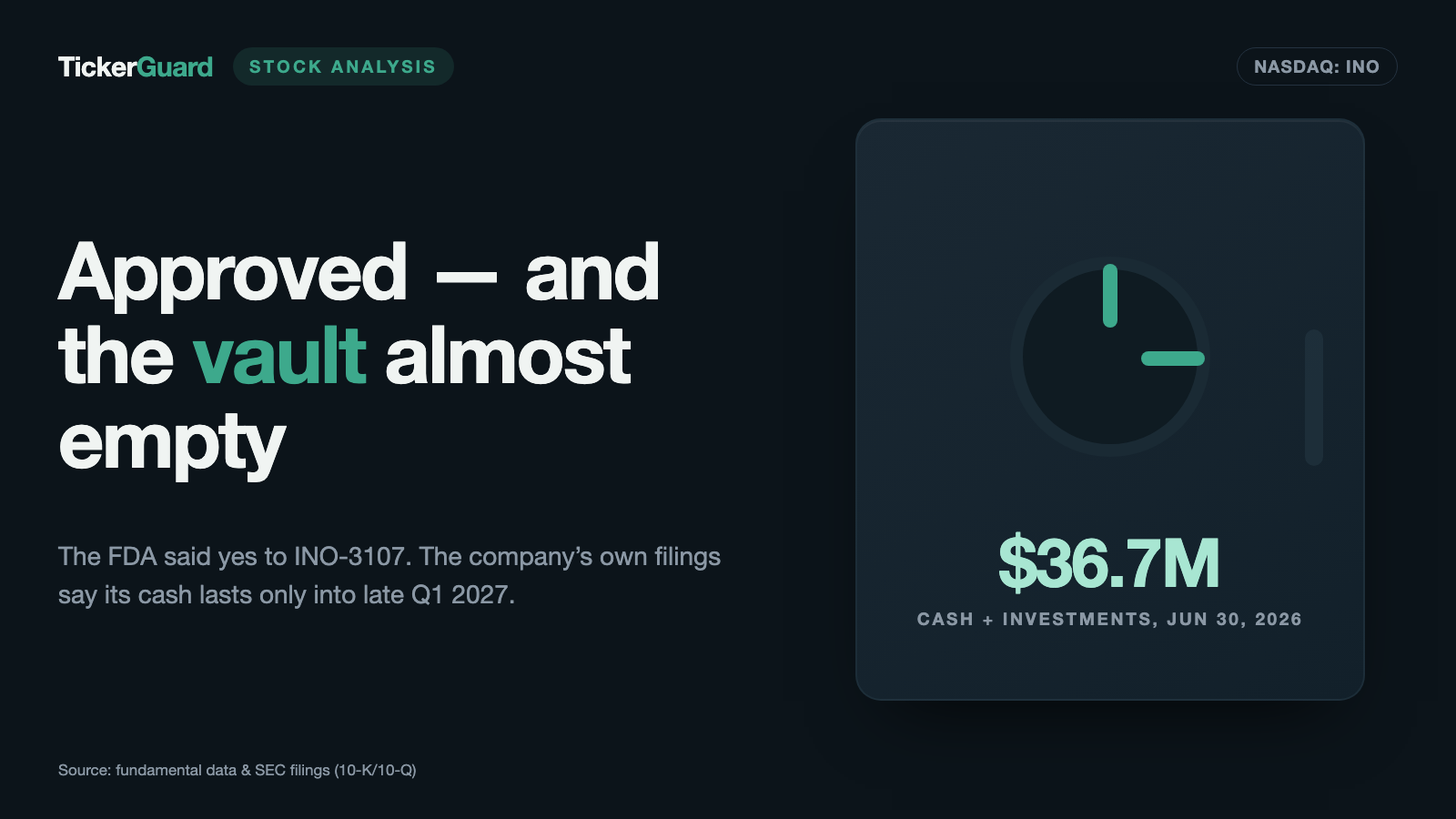
That defines the central tension of this analysis: Medically, Inovio has reached its goal — an approved product. Financially, the company stands where approval costs the most money: at the start of commercialization, with $36.7 million in cash as of June 30, 2026, and a competitor that has been working the market since late 2025.
Company history for investors
-
2021
A full treasury in pandemic times
At the end of 2021, $401.3M sits in cash and investments, and R&D costs $249.2M a year. For shareholders, the peak of the reserves — five years of decline follow.
-
2024
1-for-12 reverse split
On January 24, 2024, every twelve shares become one. The price looks higher, but dilution continues: 36.1M shares at the end of 2024, up from 22.8M a year earlier.
-
2025
Competitor approved, own application accepted
August 2025: Precigen’s PAPZIMEOS gets full approval. December 2025: the FDA accepts Inovio’s application but doubts the accelerated pathway. Inovio becomes second to market.
-
2026
Two offerings and a going-concern warning
April 2026 at $1.40 and July 2026 at $0.95 per share, each with warrants. The going-concern doubt remains; cash is meant to last into late first quarter 2027.
-
2026
FDA approval of VOCERYQ
On October 30, 2026, the FDA grants INO-3107 accelerated approval as VOCERYQ. For shareholders, the starting gun for a costly launch against an established competitor.
How the stock landed on our desk
Inovio made our research list through our in-house Reddit hype scanner, which tracks stocks that investors are talking about unusually often in online forums. The reason is obvious: the decision date. The FDA had set October 30, 2026 for its decision. After the late-July offering, the stock fell to $0.66 (July 30), recovered to $1.43 by early September (September 4) and slid again in October: to $0.80 on October 21 and to $0.60 on decision day itself — on a day with 69.3 million shares traded (fundamental data). The approval was announced only after the market closed (Inovio press release of October 30, 2026, 6:01 p.m. Eastern Time). How the market values it will show in trading from November 2, 2026; we deliberately quote no price after that in this analysis.
The pandemic showed how volatile such stories can be: back then, Inovio was working on the COVID-19 vaccine candidate INO-4800 and still held $401.3 million in cash and short-term investments at the end of 2021. How another vaccine hopeful of that era fared is the subject of our Novavax stock analysis. For Inovio, we reviewed the annual report (10-K) for 2025, the quarterly reports (10-Q) through June 30, 2026, the August 12, 2026 earnings release, the current reports (8-K) and prospectuses for the offerings, and the FDA and Inovio press releases on the approval, checked through November 1, 2026. The quarterly report for the period ended September 30, 2026 had not been filed by then, and neither had an 8-K on the approval.
The numbers over the years — an honest look
First, what impresses. Inovio has cut costs radically. Research and development spending fell from $249.2 million in 2021 to $54.2 million in 2025, and the net loss from $303.7 million to $84.9 million. In the second quarter of 2026, total operating expenses were $18.6 million, down from $23.1 million a year earlier. And the company achieved what many biotechs never do: an approval, plus Breakthrough Therapy and Orphan Drug designations. For the launch, according to the August 12, 2026 earnings release, Inovio hired Syneos Health as its contract sales organization instead of building its own sales force.
The flip side: there was no product revenue through June 30, 2026. Total revenue in 2025 was $65,343 from a collaboration; in the first half of 2026 it was zero. Research was paid for out of the treasury — and the chart shows what happened to it:
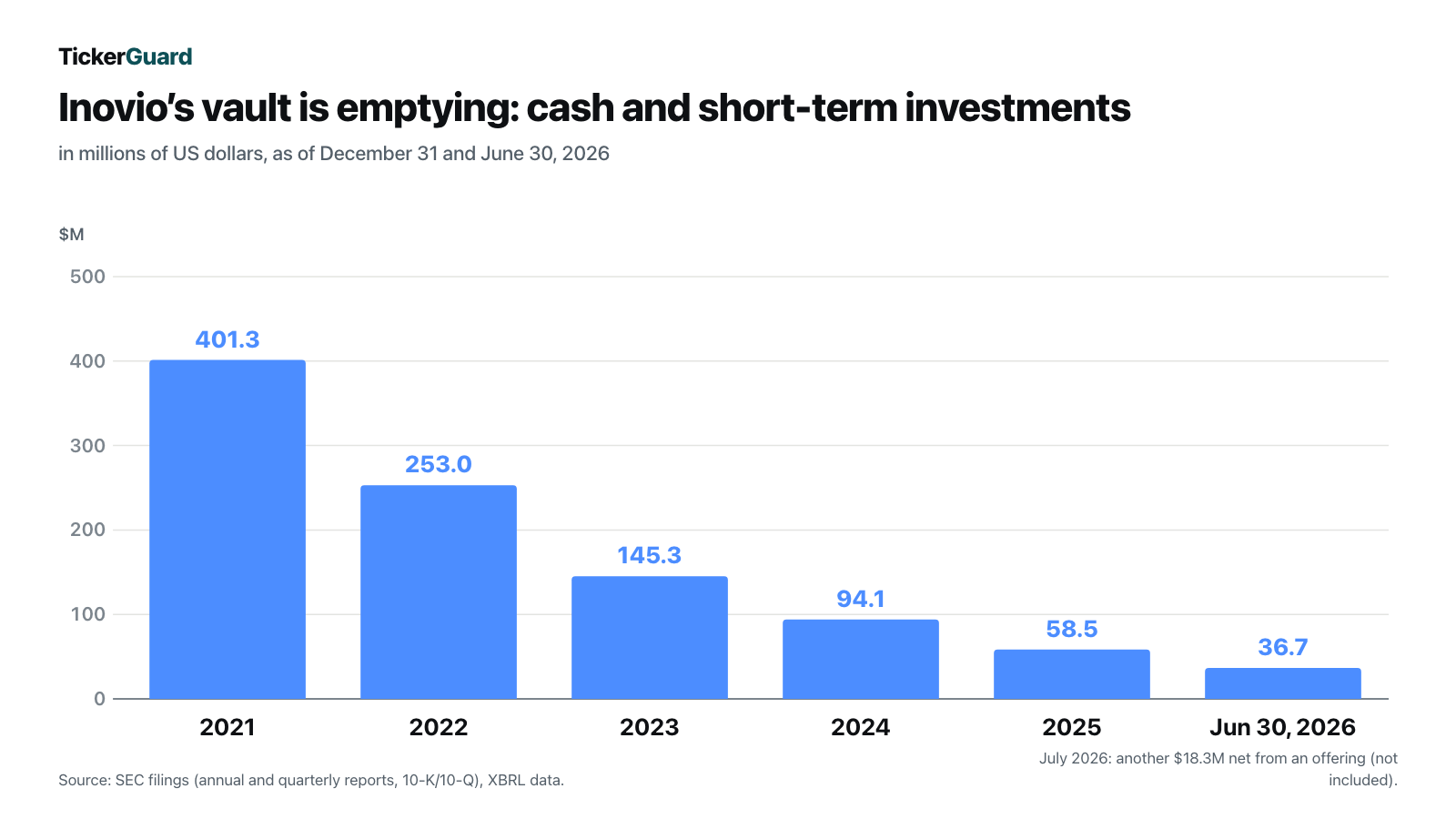
Operating cash outflow was $88.6 million in 2025 and $39.6 million in the first half of 2026. Since inception, Inovio had accumulated losses of $1.84 billion by June 30, 2026. One detail deserves a second look: the quarterly net loss fell to just $6.0 million in the second quarter of 2026, from $23.5 million a year earlier. That was not the business, though, but a $13.9 million gain from remeasuring warrants — because the share price fell. The company says so itself:
“As the fair value of the warrants fluctuates with our share price and other market inputs, this adjustment can result in significant variability in our reported net loss.”
— Inovio Pharmaceuticals, SEC filing 8-K of August 12, 2026, Exhibit 99.1 (second-quarter 2026 earnings release)
In plain terms: when the stock falls, the loss looks smaller; when it rises — after an approval, say — the reported loss gets bigger without a single extra dollar being spent. Remember: At Inovio, cash burn tells you more than the quarterly loss.
What the filings say — the uncomfortable truths
Uncomfortable truth No. 1: The company itself doubts it can continue
Anyone preparing a balance sheet has to assess whether the company can survive the next twelve months on its own. If it cannot say so with confidence, it must disclose it — accountants call this a going-concern warning. In plain terms: it is the sentence in which a company says, “without fresh money, things get tight.” Inovio put it in its 2025 annual report, and auditor Ernst & Young highlighted it in its opinion. The latest quarterly report repeats it:
“In light of these factors, management believes that there is substantial doubt about the Company's ability to continue as a going concern beyond the first quarter of 2027.”
— Inovio Pharmaceuticals, SEC quarterly report 10-Q for the period ended June 30, 2026, Note 2 “Going Concern”
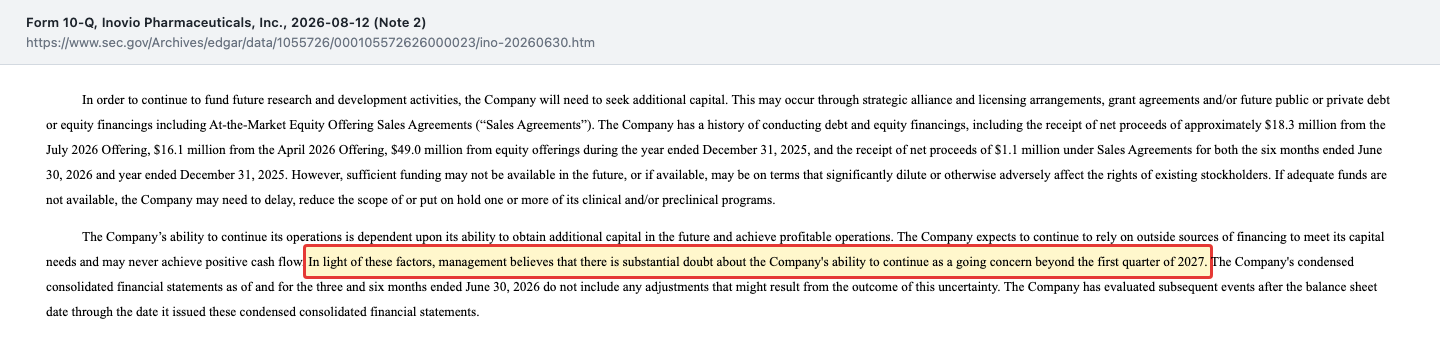
The math behind it is simple: $36.7 million in cash on June 30, 2026, plus $18.3 million from the July offering, minus the roughly $18 million Inovio itself guided for third-quarter cash burn — which by our rough estimate leaves about $37 million on September 30, 2026. The company expects that to last into late first quarter 2027, explicitly “through a potential launch of INO-3107.” That is less than half a year after approval. A launch, however, costs money first — sales, inventory, physician education — before it brings any in. Remember: An approval doesn’t fill the treasury. Only sold doses do.
Uncomfortable truth No. 2: Your slice of the pie shrank fourfold — and the knife is still on the table
The share count shows how a company without revenue paid for five years of research. Picture it this way: every new share is another slice cut from the same pie — your slice gets smaller. Adjusted for the January 2024 reverse split, in which every twelve old shares became one new share, Inovio had about 18.1 million shares at the end of 2021, 22.8 million at the end of 2023 and 103.4 million on August 10, 2026.
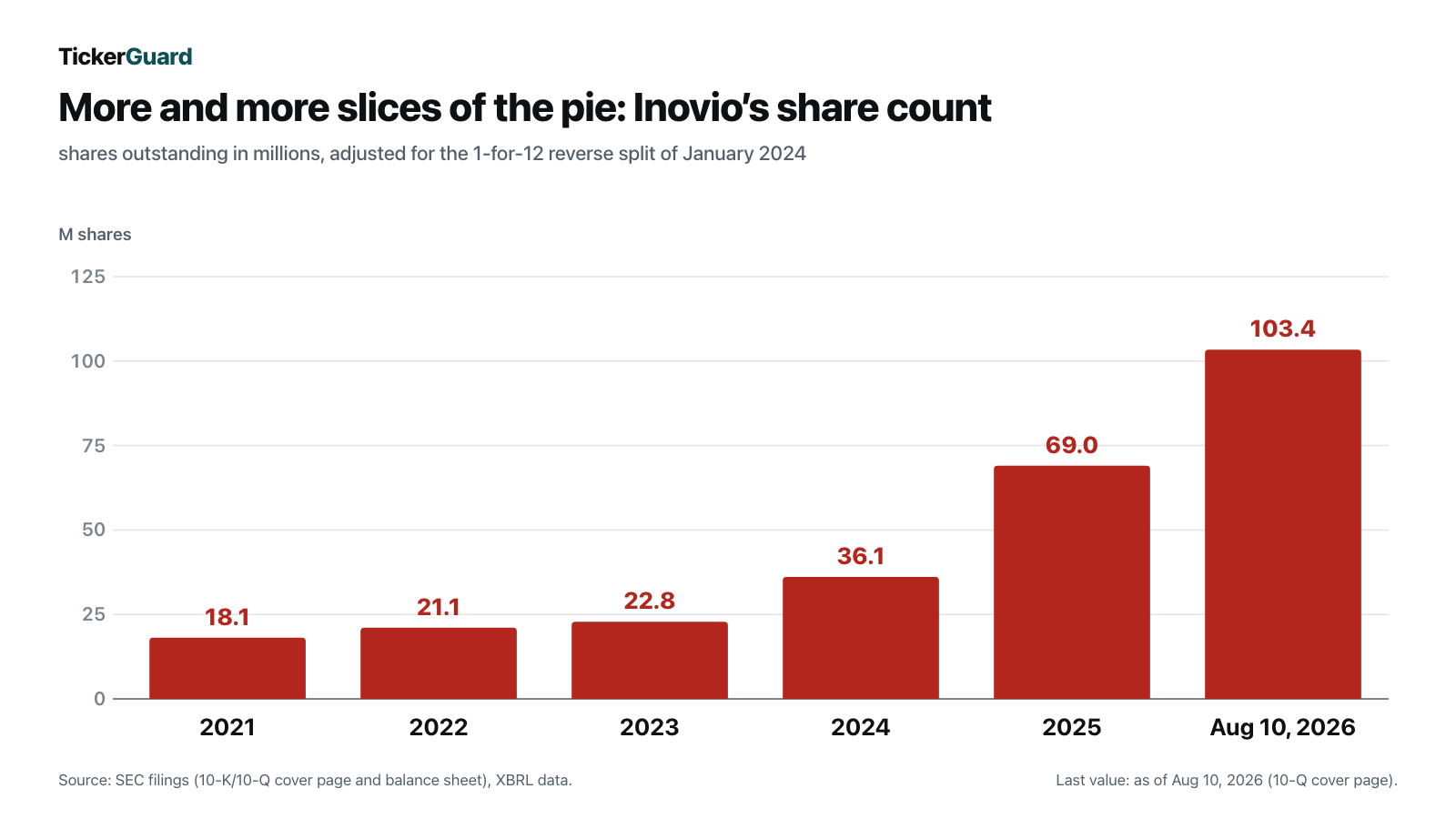
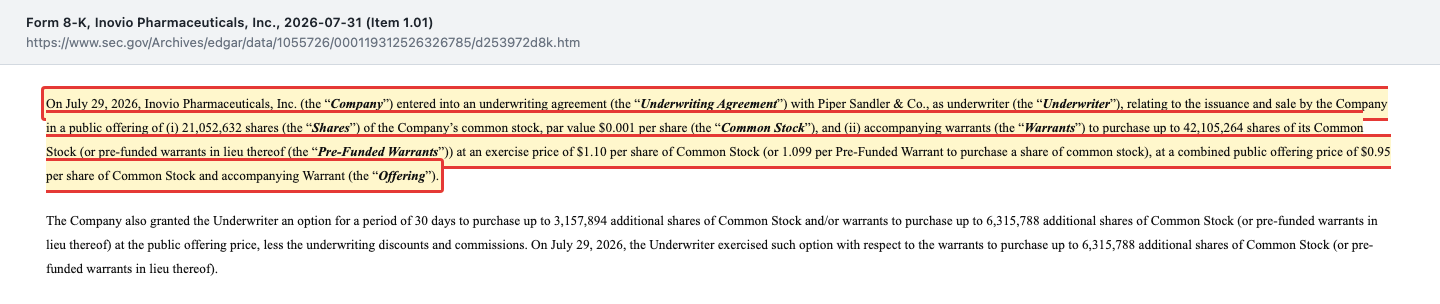
The offering prices tell the story too: $3.00 per share in December 2024, $1.90 in November 2025, $1.40 in April 2026 and $0.95 in July 2026 — three of them with warrants on top (December 2024, April 2026, July 2026). The latest prospectus supplement (424B5 of July 30, 2026) cites $1.03 on July 28 as the last reported price before the deal. In plain terms: buyers of the new shares got a discount plus the right to buy more shares later at a fixed price. The current report on the latest offering describes it this way:
“On July 29, 2026, Inovio Pharmaceuticals, Inc. (the “Company”) entered into an underwriting agreement (the “Underwriting Agreement”) with Piper Sandler & Co., as underwriter (the “Underwriter”), relating to the issuance and sale by the Company in a public offering of (i) 21,052,632 shares (the “Shares”) of the Company’s common stock, par value $0.001 per share (the “Common Stock”), and (ii) accompanying warrants (the “Warrants”) to purchase up to 42,105,264 shares of its Common Stock (or pre-funded warrants in lieu thereof (the “Pre-Funded Warrants”)) at an exercise price of $1.10 per share of Common Stock (or 1.099 per Pre-Funded Warrant to purchase a share of common stock), at a combined public offering price of $0.95 per share of Common Stock and accompanying Warrant (the “Offering”).”
— Inovio Pharmaceuticals, SEC filing 8-K of July 31, 2026, Item 1.01
All told, 97.7 million warrants are outstanding: 48.4 million at $1.10, 25.0 million at $1.40, 14.3 million at $1.75 and 10.0 million at $3.76 (as of June 30, 2026 per the quarterly report, plus the July tranche). That is almost as many potential new shares as are outstanding today. And the next cut of the knife is prepared: since July 10, 2026, a shelf registration (S-3) for up to $300 million has been effective, which lets Inovio issue new securities quickly. Whether and how many warrants get exercised after the approval is something we logged as a side find.
Uncomfortable truth No. 3: Inovio arrives second — and the first mover is already selling strongly
VOCERYQ is not the first approval for this disease. In August 2025, Precigen received full, traditional approval for PAPZIMEOS in adults with RRP. Inovio was unusually candid about it in its 2025 annual report:
“As a result, we may be at a potential competitive disadvantage in this indication, if approved, as INO-3107 would be a second entrant.”
— Inovio Pharmaceuticals, SEC annual report 10-K for 2025, Item 1 “Competition”

How big that head start is shows up in Precigen’s quarterly report for the period ended June 30, 2026: PAPZIMEOS generated $53.1 million in product revenue in the second quarter of 2026 and $74.7 million in the first half. That tells us two things. First, there is a real market — physicians and payers pay for an RRP drug. Second, the competitor already occupies it, with physician relationships, reimbursement channels and experience. Inovio argues with a simpler regimen: according to its annual report, VOCERYQ does not require additional surgery before later doses, while PAPZIMEOS may. Whether physicians weigh it that way only sales will tell. How sluggish a launch can be despite approval is shown in our ImmunityBio stock analysis.
Uncomfortable truth No. 4: An approval on probation — and two readings of the same study
VOCERYQ received accelerated approval, not traditional approval. In plain terms: the FDA lets a drug onto the market early because an intermediate goal — here, fewer surgeries — makes a benefit likely. Final proof must follow in a confirmatory trial; if it fails, the approval can be withdrawn. Getting there was not easy. When the FDA accepted the application for review in December 2025, it questioned exactly that pathway:
“In the file acceptance letter the FDA noted as a potential review issue its preliminary conclusion that the company had not provided adequate information to justify eligibility for the accelerated approval pathway.”
— Inovio Pharmaceuticals, SEC annual report 10-K for 2025, Item 1 “Business”

In the end the FDA granted the accelerated pathway — a real success. It is worth taking a look at the numbers it relies on. In its annual report, Inovio highlights that 81.3 percent of patients (26 of 32) needed fewer surgeries in the year after treatment. In its October 30, 2026 announcement, the FDA puts a stricter number front and center: of 26 patients with at least three surgeries in the prior year, 7 (27 percent) needed no surgery at all in the first year after treatment. Both numbers are correct — they just measure different things. The study was open-label, without a control group, in 32 adults. According to Inovio’s press release, the FDA wants a draft protocol for the confirmatory trial by the end of 2026, and Inovio expects final alignment by mid-2027. Such a trial costs money that is not in the treasury today.
Valuation: What the market paid on decision day
What is Inovio worth? There is no price-to-earnings ratio without earnings, and no price-to-sales ratio without sales. That leaves market value: with 103,397,518 shares (August 10, 2026) and the $0.60 close on October 30, 2026 — the day of the approval, but before it was announced — that came to about $62 million. For comparison: by our rough estimate, nearly $37 million of that was still sitting in the treasury at the end of September. The market was valuing the technology, the pipeline and a possible approval at only about $25 million. That likely reflects concern about a rejection — and the expectation of another offering.
After the approval, that math is outdated; the new price forms only from November 2, 2026. Two figures that don’t change so quickly matter for context. First, counting the 97.7 million warrants, any future company value is spread across almost twice as many shares. Second, the yardstick is PAPZIMEOS with $53.1 million in revenue in the second quarter of 2026. Anyone valuing Inovio today is essentially betting on how much of that market the second entrant can win — and how many new shares it takes to get there.
Opportunities and risks at a glance
What speaks for Inovio:
- A first approved product: FDA approval of VOCERYQ on October 30, 2026, with Breakthrough Therapy and Orphan Drug designations.
- A proven market: competitor PAPZIMEOS generated $53.1 million in revenue in the second quarter of 2026 — physicians and payers pay for an RRP drug.
- Strict cost discipline: R&D spending cut from $249.2 million (2021) to $54.2 million (2025); operating expenses of $18.6 million in the second quarter of 2026.
- Possible funding without a new offering: up to $113.3 million from warrants with exercise prices up to $1.75, and up to $20 million in milestones from China for VGX-3100.
- A regimen without additional surgery before later doses — an advantage over PAPZIMEOS, according to Inovio.
What speaks against it:
- Going-concern warning in the 2025 10-K and the 10-Q for the period ended June 30, 2026; cash lasts only into late first quarter 2027, per the company.
- Heavy dilution: share count more than quadrupled since the end of 2023 (22.8 million to 103.4 million), plus 97.7 million warrants and a $300 million shelf registration.
- Second to market against a fully approved competitor that is already selling; no in-house sales force, but a contracted sales organization.
- Accelerated approval on probation: confirmatory trial required, based on an open-label study in 32 patients, with complete elimination of surgery in 27 percent.
- A quarterly result that swings with the share price: warrant remeasurements distort the reported loss in both directions.
A human conclusion
Back to the finish-line trap. Inovio has achieved something many biotech companies never do: an approved drug, after years of setbacks. That deserves respect. The trap is mistaking the cheers of that day for an answer to the next question. And that question is no longer “Will VOCERYQ be approved?” but: How many doses can a second entrant sell against a well-established first mover — and how many new shares will Inovio need before those sales cover its costs? Until the quarterly report for the period ended September 30, 2026 is out, the picture is defined by $36.7 million in cash as of June 30, a going-concern warning and almost 100 million warrants. Anyone who has answered that question for themselves knows what they are getting into — with or without the stock. What you make of it is your decision. And that is how it should be.
Sources
All primary documents used in this analysis — so you can read them yourself:
- Inovio Pharmaceuticals, Inc. — SEC quarterly report 10-Q for the period ended June 30, 2026 (filed August 12, 2026)
- Inovio Pharmaceuticals, Inc. — SEC filing 8-K of August 12, 2026, Exhibit 99.1 (second-quarter 2026 earnings release)
- Inovio Pharmaceuticals, Inc. — SEC filing 8-K of July 31, 2026 (July 2026 offering) and prospectus supplement 424B5 of July 30, 2026
- Inovio Pharmaceuticals, Inc. — SEC shelf registration S-3 of July 2, 2026 (effective July 10, 2026)
- Inovio Pharmaceuticals, Inc. — SEC quarterly report 10-Q for the period ended March 31, 2026 (filed May 13, 2026)
- Inovio Pharmaceuticals, Inc. — SEC annual report 10-K for 2025 (filed March 12, 2026) and 10-K for 2024 (filed March 18, 2025)
- Inovio Pharmaceuticals, Inc. — SEC filing 8-K of October 6, 2026 (bylaws amendment, exclusive forum)
- Precigen, Inc. — SEC quarterly report 10-Q for the period ended June 30, 2026 (filed August 4, 2026), PAPZIMEOS product revenue
- U.S. Food and Drug Administration — press announcement on the approval of VOCERYQ, October 30, 2026
- Inovio Pharmaceuticals, Inc. — press release on the accelerated approval of VOCERYQ, October 30, 2026
- Inovio’s complete SEC filing history: EDGAR overview (sec.gov)
- Fundamental data (prices through the October 30, 2026 close; retrieved November 1, 2026), cross-checked against the SEC filings and the SEC’s XBRL data series.
- Reddit mentions: our in-house Reddit hype scanner.
Transparency & disclaimer: this analysis is journalistic commentary on publicly available information. It is not investment advice, not a regulated investment research product and not a solicitation to buy or sell securities. Equity investments carry substantial risk up to and including total loss. All information is provided without warranty; the as-of date for each figure is stated in the text. Positions held by the operator are disclosed daily; where one exists, it appears as a notice at the top of this deep dive.
Key figures at a glance
All monetary figures in millions of $; earnings per share as reported.
| Metric | 2021 | 2022 | 2023 | 2024 | 2025 |
|---|---|---|---|---|---|
| Revenue | 1.8 | 10.3 | 0.8 | 0.2 | 0.1 |
| Operating Income (EBIT) | -301.2 | -267.6 | -143.9 | -112.4 | -86.8 |
| Net Income | -303.7 | -279.8 | -135.1 | -107.3 | -84.9 |
| Net Margin | -17,109.9% | -2,726.7% | -16,239.9% | -49,254.3% | -130,000.0% |
| Earnings Per Share | -17.45 $ | -14.07 $ | -6.09 $ | -3.95 $ | -1.81 $ |
Source: fundamental data & SEC filings (annual and quarterly reports, 10-K/10-Q)
Our Bottom Line at a Glance
- Approval positive
- FDA accelerated approval of VOCERYQ (INO-3107) on 10/30/2026 for adults with RRP; Breakthrough Therapy and Orphan Drug designations. Confirmatory trial required.
- Liquidity & going concern negative
- $36.7M in cash and short-term investments (06/30/2026) plus $18.3M from July 2026; going-concern warning in the 2025 10-K and the 10-Q for 06/30/2026; cash lasts into late Q1 2027, per the company.
- Dilution negative
- Share count from 22.8M (end of 2023, adjusted) to 103.4M (08/10/2026); 97.7M warrants outstanding; $300M shelf registration effective since 07/10/2026.
- Competition negative
- Precigen’s PAPZIMEOS has held full approval since August 2025 and generated $53.1M in product revenue in Q2 2026; Inovio calls itself a “second entrant” in its 2025 10-K.
- Costs positive
- R&D spending cut from $249.2M (2021) to $54.2M (2025); operating expenses of $18.6M in Q2 2026 versus $23.1M a year earlier.
Inovio is a textbook case of the finish-line trap: on October 30, 2026, the FDA approved VOCERYQ, the company’s first product. But as of June 30, 2026, only $36.7 million sat in cash and short-term investments, the company itself doubts it can continue as a going concern, the share count has more than quadrupled since the end of 2023, and competitor PAPZIMEOS already sells more than $50 million a quarter. Approval starts an expensive race; it doesn’t end one. Not investment advice.
What Our Rating Means
Substance risk
We found at least one documented issue that threatens the company itself — regardless of how the stock is currently valued.
Red, because there is a documented substance risk: in its 2025 annual report and its quarterly report for the period ended June 30, 2026, Inovio reports substantial doubt about its ability to continue as a going concern, and by its own account the cash lasts only into late first quarter 2027 — less than half a year after approval and thus well under four quarters at the current burn. The October 30, 2026 approval is a real success, but it brings in money only with sold doses; until then Inovio depends on new shares, warrant exercises or partner money. The decision is yours.
A journalistic assessment by our editorial team at the time of the deep dive, based on public sources — not investment advice and not a solicitation to buy or sell. Your personal circumstances (investment goals, risk capacity, taxes) cannot be taken into account. What our levels mean, how verdicts are formed, and what conflicts of interest exist →
Worth Noting
- Inovio made our research list through our in-house Reddit hype scanner (Reddit hype run of November 1, 2026).
- The October 30, 2026 approval is based on the FDA and Inovio press releases of the same day; no 8-K on it had been filed through 11/01/2026. The quarterly report for 09/30/2026 had not been filed either.
- The time of the announcement (10/30/2026, 6:01 p.m. Eastern Time, after the close) comes from the press wire of Inovio’s release (PR Newswire, 10:01 p.m. UTC), not from an SEC filing.
- Cash and short-term investments per year summed by us from the XBRL data of the 10-K/10-Q (cash and cash equivalents plus short-term investments). Share counts before 2024 divided by 12 (1-for-12 reverse split of 01/24/2024).
- Cash at 09/30/2026 (about $37M) is our own rough estimate: $36.7M (06/30/2026) plus $18.3M net from July 2026 minus about $18M of guided Q3 2026 cash burn.
- Market value calculated by us: 103,397,518 shares (10-Q cover page, 08/10/2026) × $0.60 close (10/30/2026); the share count matches the fundamental data exactly. Cross-check: the 07/30/2026 prospectus supplement cites $1.03 (07/28/2026); the gap is the actual share price decline up to decision day.
- Warrant total: 49,285,715 (table in the 10-Q for 06/30/2026) plus 48,421,052 from the July 2026 offering (42,105,264 plus 6,315,788 from the underwriter’s option, 8-K of 07/31/2026) = 97,706,767.
Stock Watch
This analysis is as of November 1, 2026. Stock Watch will tell you what's changed at INO since then.
Later $1 a month per stock — signing up is free, and you'll be the first to know when it launches.
The full analysis as a PDF for later
We will send you this analysis as a PDF — to print, file away, and read at your own pace. And we will add you to the free Stock Watch list for Inovio Pharmaceuticals Inc (INO), so you hear about it when something material in this analysis changes.
Frequently Asked Questions
Inovio Pharmaceuticals, Inc. (Nasdaq: INO) of Plymouth Meeting, Pennsylvania, develops DNA medicines: small DNA rings that the body’s cells use as blueprints for proteins. They are delivered with the company’s own CELLECTRA device, which opens cells with a brief electrical pulse. Its first approved product is VOCERYQ (INO-3107) for the rare airway disease RRP.
Yes. On October 30, 2026, the FDA granted accelerated approval to INO-3107 as VOCERYQ for adults with recurrent respiratory papillomatosis (RRP). The basis is an open-label study in 32 patients; 7 of 26 patients with at least three surgeries in the prior year needed no surgery for a year afterward. A confirmatory trial is required.
As of June 30, 2026, Inovio had $36.7 million in cash and short-term investments, and a July offering added $18.3 million net. The company guided to about $18 million of cash burn in the third quarter of 2026. According to its quarterly report, the cash lasts into late first quarter 2027; the report contains a going-concern warning.
In its 2025 annual report and its quarterly report for the period ended June 30, 2026, Inovio states there is substantial doubt about its ability to continue as a going concern beyond the first quarter of 2027. It is not a bankruptcy filing, but a signal that without new money — from shares, warrants or partnerships — operations are not secured.
Precigen with PAPZIMEOS. The drug has held full approval since August 2025 and, according to Precigen’s quarterly report, generated $53.1 million in product revenue in the second quarter of 2026 and $74.7 million in the first half. In its 2025 annual report, Inovio itself says it may be at a competitive disadvantage as a second entrant.
Adjusted for the 1-for-12 reverse split of January 2024, the share count rose from 22.8 million at the end of 2023 to 103.4 million on August 10, 2026. In addition, 97.7 million warrants are outstanding at exercise prices of $1.10 to $3.76, and a shelf registration for up to $300 million has been effective since July 2026.
Found an error?
Did you spot a factual error, an outdated number, or a typo in this deep dive? Let us know briefly — your report goes straight to the editorial team.