Gibraltar Industries: $243 Million Written Down, Sold for $80 Million – Now It Is Rebuilding on Debt
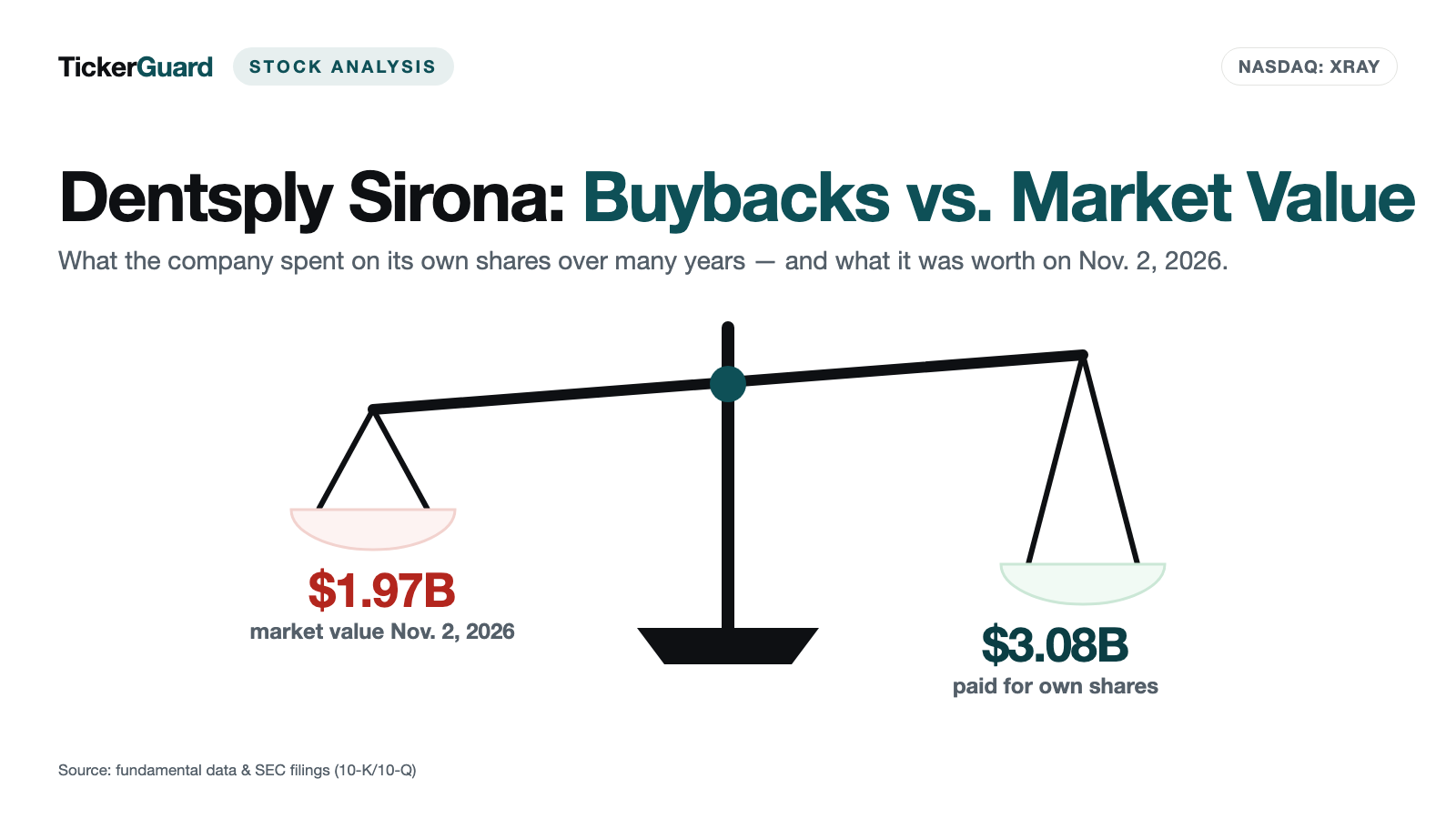
At the end of 2025, Gibraltar Industries owed its banks nothing. Six months later it carried $1.25 billion of loans, used to buy the roofing-accessories maker OmniMax. The solar business is gone — sold for just under $80 million combined after about $243 million of write-downs — and in October 2026 the company agreed to sell its highest-margin unit to pay down debt. Its filings with the U.S. securities regulator, the SEC, show what sits beneath the makeover. Gibraltar let the rest of the solar business go in July 2026 for $5 million.
 Thomas Mücke
Founder & Publisher
As of Today
As of: November 2, 2026
- Closing price
- 41.60 $ +3.80%
- Market Capitalisation
- 1.3 $B
- P/E
- 19.9
- Growth Score
- 4/10
- AAQS
- 8/10
This analysis has a cut-off date. The Stock Guard tells you when something material changes in the numbers. Reserve your free spot
Chart
Interactive price chart (TradingView).
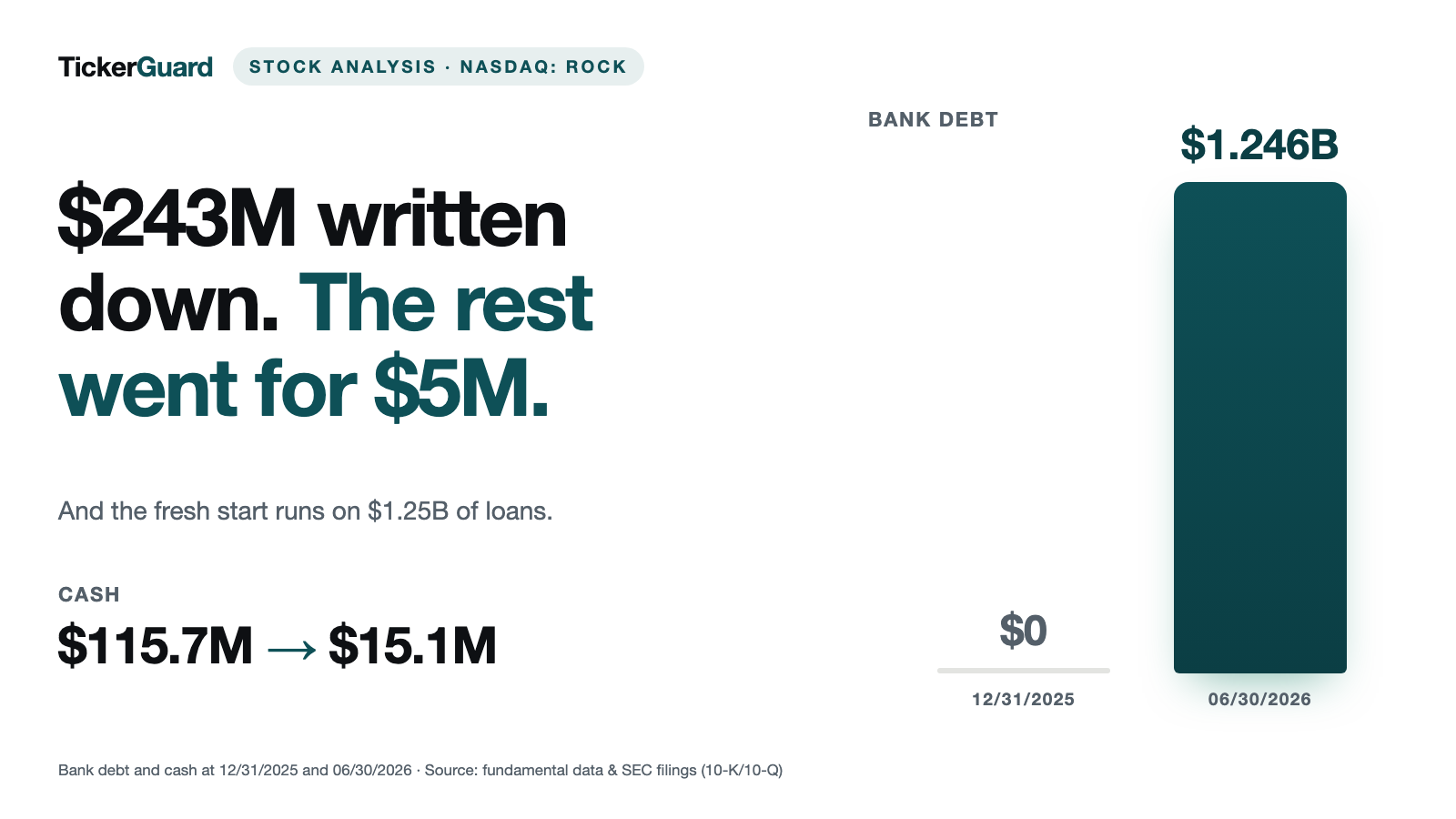
52-week range: 33.80 $ to 61.50 $ · Last price: 41.60 $ (As of: November 2, 2026)
Note: pure fact-based analysis, not investment advice and not a solicitation to buy or sell. All figures without guarantee.
There is an investor trap that feels like a fresh morning: the fresh-start trap. Psychologists call it the fresh-start effect — on January 1, after a move, after a new job, we feel as if the old ledger has been wiped clean. Stocks trigger the same reflex. A company sells its problem child, buys something new, calls it a “strategic plan” — and your brain writes off the old mistakes as if they never happened. Gibraltar Industries (Nasdaq: ROCK) is in the middle of exactly that kind of fresh start. Here is how the company describes itself:
“The Company is a leading manufacturer and provider of products and services for the residential, agtech, and infrastructure markets, and it operates and reports its results through three reporting segments: Residential, Agtech, and Infrastructure.”
— Gibraltar Industries, Inc., SEC quarterly report 10-Q for June 30, 2026, Item 2 “Overview”
A year earlier, that sentence would have named a fourth segment: solar. And soon the third will be gone too. One pair of numbers shows how radical the makeover is: on December 31, 2025, Gibraltar had zero bank debt and $115.7 million of cash. On June 30, 2026, $1.246 billion of loans stood against $15.1 million of cash. So before the fresh start sweeps you along, let’s read together what the company has told the U.S. securities regulator, the SEC — the annual reports (10-K) for 2024 and 2025, the quarterly reports (10-Q) through June 30, 2026, and the current reports (8-K) through October 2026. Filing false information with the SEC carries penalties, which makes these documents some of the most reliable sources there are. In the end, the decision is yours.
What Gibraltar actually does — everything that hangs off a roof
Gibraltar is a supplier to homebuilding, specifically for the parts nobody thinks about when buying a house. Think of it this way: if the roof is the hat of a house, Gibraltar supplies the brim, the hatband and the rain gutter. The company started out as a steel processor — until October 2004, the SEC listed it as Gibraltar Steel Corp. Today it is organized in three segments; the figures are for continuing operations in 2025:
- Residential: roof trims and flashings, gutters and downspouts, metal roofing, roof and foundation ventilation, mail and package systems, retractable awnings. $824.1 million of revenue, adjusted EBITDA of $160.8 million (19.5 percent margin).
- Agtech: design and construction of greenhouses for produce and flower growers and for research, and since the Lane Supply acquisition in February 2025 also canopies for fuel stations and quick-service restaurants. $219.3 million of revenue, adjusted EBITDA of $23.2 million (10.6 percent).
- Infrastructure: the D.S. Brown subsidiary, with expansion joints, bridge bearings and pavement seals for bridges, highways and airports. $92.1 million of revenue, adjusted EBITDA of $25.2 million (27.3 percent per the August 5, 2026 earnings release).
Adjusted EBITDA is operating profit before interest, taxes, depreciation and amortization, excluding special charges — a rough measure of what the day-to-day business throws off before the banks, the tax authorities and old purchase prices take their cut. Altogether, the company booked $1.136 billion of revenue in 2025 and $185.3 million of adjusted EBITDA. Its customers are mainly home improvement retailers, wholesalers, distributors and contractors in the U.S. and Canada; at the end of 2025 about 2,300 people worked for Gibraltar, and about 3,300 after the OmniMax deal, per the annual report. CEO Bill Bosway (William T. Bosway) also chairs the board.
The makeover has three building blocks. First, the solar business (Renewables: racking, foundations and electrical systems for solar farms) was put up for sale in June 2025. Second, on February 2, 2026, Gibraltar bought OmniMax International, a maker of roofing accessories and gutters with brands such as Amerimax and Berger, for $1.343 billion. Third, the bridge-components unit D.S. Brown is set to go to Saint-Gobain for $208 million. That sets up the central tension of this analysis: the roofline business makes good money and is winning customers — but the fresh start is being paid for with loans, the old solar misstep cost real equity, and the balance sheet now consists largely of purchased hopes.
Company history for investors
-
2004
Gibraltar Steel becomes Gibraltar Industries
Until 10/20/2004, the SEC lists the company as Gibraltar Steel Corp, then as Gibraltar Industries. Older filings are found under the steel name.
-
2025
Solar business put up for sale
In June 2025, Renewables becomes a discontinued operation; about $243 million of write-downs follow through June 2026. The company posts a 2025 net loss of $44.4 million.
-
2025
OmniMax deal announced
On 11/17/2025, Gibraltar announces the $1.335 billion purchase of OmniMax, funded with debt. The stock falls 20.3% that day, to $47.14.
-
2026
Deal closed, $1.3 billion of loans
On 02/02/2026, OmniMax is acquired, financed with two term loans of $650 million each. Zero debt becomes $1.246 billion by 06/30/2026.
-
2026
Solar sold, bridge unit to follow
In February and July 2026, the solar business brings in about $80 million combined. On 10/14/2026, the $208 million sale of D.S. Brown is agreed, proceeds for debt repayment.
How the stock landed on our desk
Gibraltar landed on our research list via our in-house Reddit hype scanner — though it is no storm. According to ApeWisdom, the stock ranked 92nd on November 3, 2026, with three mentions in 24 hours. The reason it is being talked about is in the filings: on October 15, 2026, Gibraltar disclosed the D.S. Brown sale in an 8-K, and as of November 3, 2026, the third-quarter report with updated guidance was still outstanding. Then there is the price chart. On the day the OmniMax deal was announced, the stock fell from $59.15 (close on November 14, 2025) to $47.14 (November 17, 2025), a drop of 20.3 percent. On November 2, 2026, it closed at $41.61 — about 32 percent below its highest close of the prior twelve months ($61.54 on November 7, 2025; fundamental data).
The other side is visible too: about 1.97 million Gibraltar shares were sold short (fundamental data, retrieved November 3, 2026) — about 6.6 percent of the 29.7 million shares outstanding (our own calculation). Short sellers bet on falling prices; some of them are likely betting against the makeover. The three analysts tracked by our data provider, on the other hand, are upbeat: two “strong buy,” one “buy,” and an average price target of $75.25 (as of November 2, 2026). Average here means all price targets added up and spread evenly — with only three votes, each one moves the figure a lot. That is the view of those analysts, not an assessment by TickerGuard. Keep this in mind: at Gibraltar, two camps are arguing over the same question — will the fresh start carry the debt it cost?
The numbers over the years, given their due
First, what Gibraltar genuinely does well. Continuing operations (that is, without solar) were profitable in every year from 2023 through 2025: net income of $91.4 million (2023), $135.0 million (2024) and $97.6 million (2025). Free cash flow — the money left over after capital spending — was $91.0 million in 2025. According to the company, the roofline business is gaining share: in the second quarter of 2026, building products grew 12.7 percent organically even though the company described the market as “flat-to-down.” That 12.7 percent applies to building products only; for the company as a whole, organic growth in the same quarter was 5 percent (8-K of August 5, 2026). And Gibraltar says it expanded with one large customer: it will now supply trims and flashings to more than 1,700 of that customer’s locations.
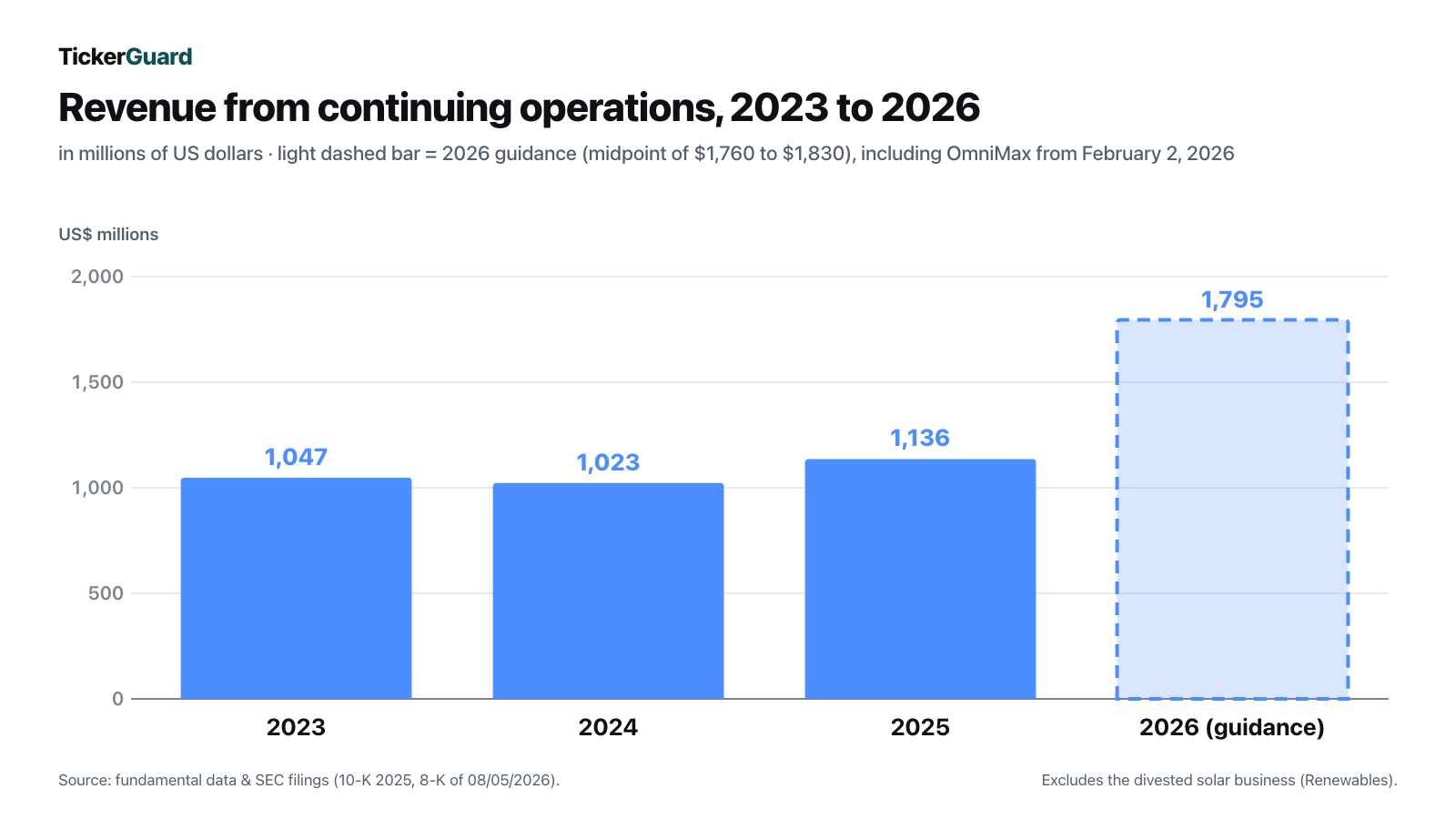
The chart shows the catch as well. On its own, Gibraltar has barely grown: $1,047 million of revenue in 2023, $1,023 million in 2024 and $1,136 million in 2025 — and the 2025 gain came mostly from acquisitions (Lane Supply and three metal roofing companies for a combined $226 million or so). In January 2026, the company had to concede that 2025 fell short of its own guidance: revenue of $1,128 million to $1,138 million instead of $1,150 million to $1,175 million (8-K of January 21, 2026). The jump to $1.76 billion to $1.83 billion in the 2026 guidance — about $1,795 million at the midpoint — is mostly bought. In the second quarter of 2026, organic growth was 5 percent; total growth, thanks to OmniMax, was 64.6 percent, to $509.5 million.
And the bottom line for the company as a whole, including solar, looks different from continuing operations: a net loss of $44.4 million in 2025 and a net loss of $59.3 million in the first half of 2026. In short: the core business makes money, but the growth is purchased — and the cleanup has eaten the profits of the last two years.
What the filings say — the uncomfortable truths
Uncomfortable truth No. 1: The solar adventure ended with a $243 million write-down — and $80 million of proceeds
In June 2025, Gibraltar decided to sell its solar business. It was not a small appendage: it generated $330.7 million of revenue in 2023, $285.4 million in 2024 and $233.4 million in 2025. But buyers offered less than hoped. The 2025 annual report speaks of “lower credible purchase offers,” and the write-downs followed quarter after quarter: $162.7 million in the third quarter of 2025, $13.3 million in the fourth, $47.4 million in the first and $20.0 million in the second quarter of 2026. The quarterly report sums it up:
“Subsequent to classification as held for sale and as discontinued operations, the Company recognized a combined impairment loss and remeasurement adjustment in aggregate of approximately $243 million before income taxes.”
— Gibraltar Industries, Inc., SEC quarterly report 10-Q for June 30, 2026, Item 2 “Discontinued Operations”
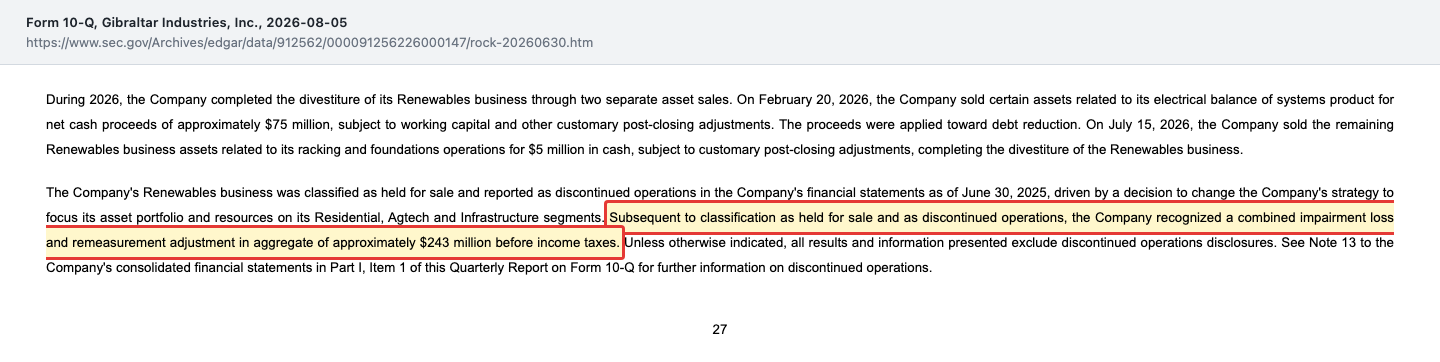
The sale happened in two steps. The electrical balance-of-systems unit (eBOS) brought in net proceeds of $74.9 million on February 20, 2026, and a book gain of $20.6 million. The rest — racking and foundations for solar farms — went to Unirac in July, and this is the real punchline:
“On July 15, 2026, the Company sold assets related to its Renewables racking and foundations business for $5.0 million in cash, subject to customary post-closing adjustments.”
— Gibraltar Industries, Inc., SEC quarterly report 10-Q for June 30, 2026, Note 14 “Subsequent Event”

That adds up to roughly $80 million of proceeds for a business that still had $233.4 million of revenue in 2025 and on which about $243 million was written off. On top of that came a settlement of disputed warranty claims from the solar business: $25.0 million, accrued in the first quarter and paid in the second quarter of 2026. Think of it like selling a car you once paid good money for at scrap value — and covering an old repair bill on your way out. Keep this in mind: a fresh start doesn’t cancel the bill. Shareholders paid for solar — with a loss year in 2025 and a loss in the first half of 2026.
Uncomfortable truth No. 2: A debt-free balance sheet turned into $1.25 billion of loans — and negative tangible equity
Gibraltar didn’t buy OmniMax with its own money but with the banks’ money. On February 2, 2026, it signed a new credit agreement: two term loans of $650 million each and a $500 million revolving credit facility. The 2025 annual report is unusually blunt on this point:
“The Company incurred substantial indebtedness in connection with the acquisition of OmniMax.”
— Gibraltar Industries, Inc., SEC annual report 10-K for 2025, Item 1A “Risks Related to the Company’s Indebtedness”
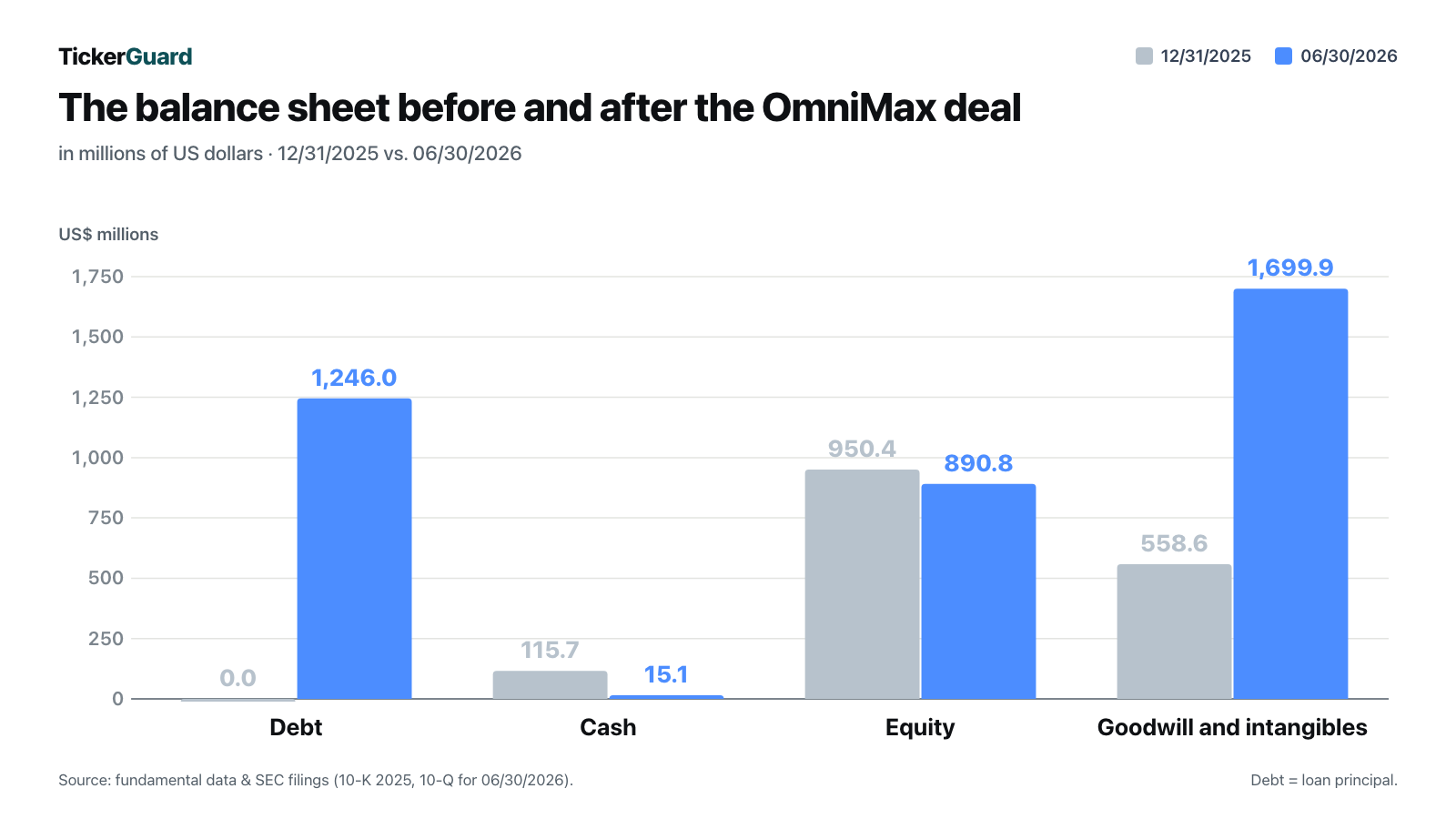
At June 30, 2026, there were $625 million outstanding on term loan A, $600 million on term loan B and $21 million on the revolver — $1,246.0 million in total, after $75 million of early repayments in February. The interest floats with the market rate (SOFR) plus a margin; in the second quarter of 2026 it cost $21.0 million, versus $0.4 million a year earlier. That is about a third of operating income of $59.8 million. The lenders have set rules in return — covenants, the house rules a lender imposes on a borrower:
“The Credit Agreement contains financial covenants requiring the Company to maintain a maximum consolidated total net leverage ratio of 5.25 to 1.00, which steps down to 4.25 to 1.00 over time, and a minimum interest coverage ratio of 3.00 to 1.00, in each case measured as of the last day of each fiscal quarter, with measurement to commence on the last day of the first full fiscal quarter after February 2, 2026.”
— Gibraltar Industries, Inc., SEC quarterly report 10-Q for June 30, 2026, Note 7 “Long-Term Debt”
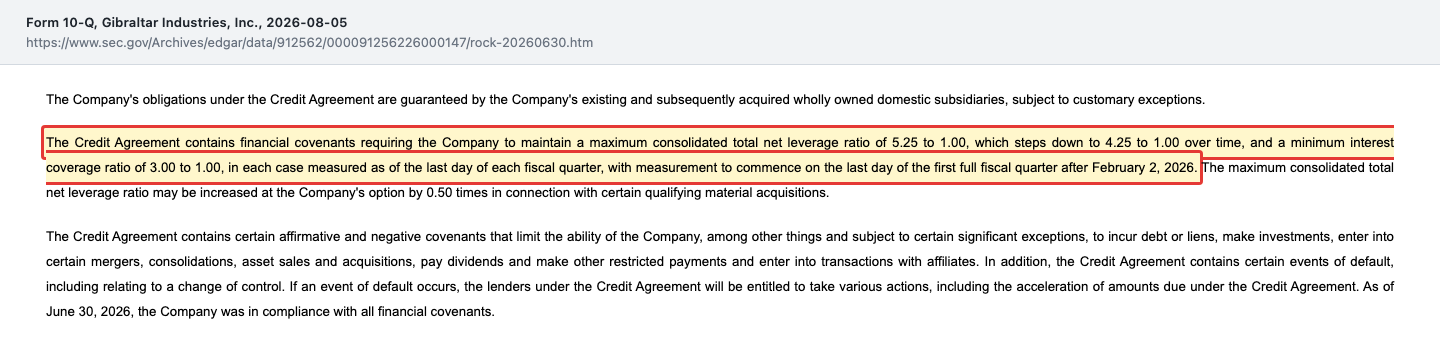
At June 30, 2026, Gibraltar was in compliance with all covenants, and $470.3 million of the revolver was still available. A back-of-the-envelope calculation shows the order of magnitude: net debt of about $1.23 billion ($1,246.0 million minus $15.1 million of cash) is roughly 3.8 to 4.0 times the adjusted EBITDA the company expects for 2026 ($310 million to $326 million). The contractual definition differs; the direction holds. At the time of the deal, Gibraltar itself cited leverage of 3.7 times — counting planned cost savings — and set a target of 2.0 to 2.5 times within 24 months of closing (8-K of November 17, 2025). For what it looks like when covenants get tight and a company has to renegotiate, see our Dentsply Sirona analysis — Gibraltar is not there.
The second issue sits in equity. Of the $890.8 million (06/30/2026), $939.1 million is goodwill and $760.8 million is other intangibles (mainly acquired customer relationships and trademarks) — $1,699.9 million in total. Goodwill arises when a company pays more for a business than its inventory and equipment are worth: the premium for customers and reputation. Strip these items out and you are left with tangible equity of about minus $809 million (our own calculation). That is not an insolvency signal — relationships with big-box retailers are real assets. But the solar business just showed how quickly such values can melt. Keep this in mind: Gibraltar has traded its balance sheet for a promise — and the promise is called OmniMax.
Uncomfortable truth No. 3: OmniMax brings revenue — but little profit so far, and interest eats the gain
Gibraltar paid $1.343 billion for OmniMax. When announcing the deal, it cited expected 2025 adjusted revenue of $565 million and adjusted EBITDA of $110 million for OmniMax — so the price was roughly twelve times that EBITDA; counting cost savings and tax benefits, Gibraltar itself put the “effective” multiple at 8.4. What OmniMax has actually contributed since the deal is in the notes to the quarterly report:
“Since the acquisition date through June 30, 2026, OmniMax contributed approximately $270.9 million in net sales and $17.5 million in operating profit.”
— Gibraltar Industries, Inc., SEC quarterly report 10-Q for June 30, 2026, Note 5 “Acquisitions”
$17.5 million of operating profit on $270.9 million of revenue is about 6.5 cents per revenue dollar (our own calculation). The Residential segment posted an 18.9 percent operating margin in the second quarter of 2025, before the deal; in the second quarter of 2026 it was 14.2 percent. The purchase price allocation is still preliminary, per the quarterly report, and part of the costs are one-time. But two burdens remain: the company estimates intangible amortization alone at $54.0 million for 2027, and interest ran to $21.0 million in the second quarter of 2026. That is why earnings per share from continuing operations fell from $0.99 to $0.92 in the second quarter of 2026 despite 64.6 percent more revenue; the first quarter of 2026 even showed a loss from continuing operations of $12.1 million. The company’s own guidance calls for 2026 earnings per share under GAAP — the unvarnished U.S. accounting rules — of $2.40 to $2.80, versus $3.25 in 2025. That leaves $1.89 to $2.29 to be earned in the second half, after $0.51 in the first half. The company reaffirmed the guidance on August 5, 2026. Keep this in mind: more revenue is not more profit when the revenue was bought on credit.
Uncomfortable truth No. 4: Ten customers make up 43 percent of revenue — and OmniMax sells to the same ones
If you sell roofing accessories in volume, you sell to a handful of big retailers and building-supply distributors. The annual report puts a number on the concentration risk — picture a neighbor telling you his shop is doing great, but ten customers bring in almost half the revenue. You would hesitate for a second:
“The Company's ten largest customers accounted for approximately 43%, 42%, and 46% of the Company's net sales during 2025, 2024, and 2023, respectively, with its largest customer accounting for approximately 12%, 16% and 17% of the Company's consolidated net sales during each of the years 2025, 2024, and 2023, respectively. In many cases, these customers are also significant customers of OmniMax.”
— Gibraltar Industries, Inc., SEC annual report 10-K for 2025, Item 1A “Risk Factors”
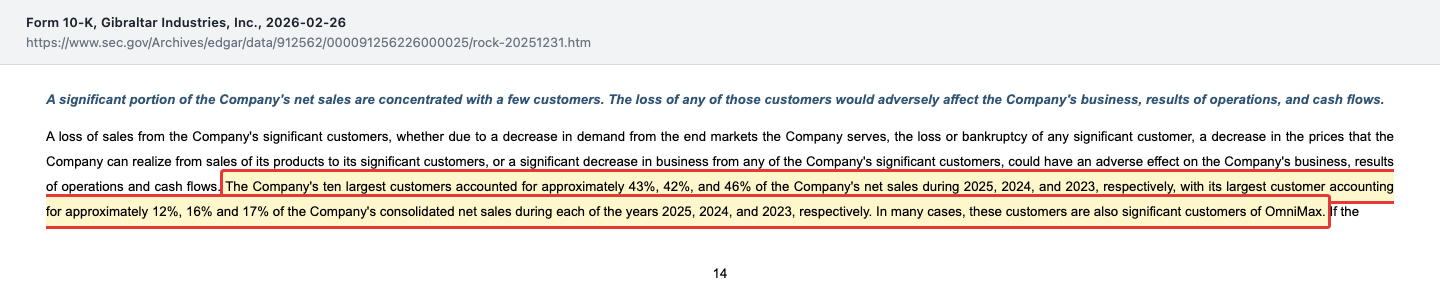
The last sentence is the important one. OmniMax was not an acquisition into a new customer base but one onto the same shelves. That has advantages — Gibraltar can supply big customers with more from a single source, and the new award for about 630 additional locations (now more than 1,700 for that customer) shows it works. But it also means the concentration risk grew rather than shrank with the deal. A large customer that switches suppliers or works down its inventory now hits both parts at once. The fourth quarter of 2025 showed how fast that can happen: per the release of January 21, 2026, retailers’ inventory reductions slowed the planned price increases. The lesson: selling more to the same customers makes you stronger — and more exposed.
Valuation: cheap compared to what?
With 29,683,889 shares outstanding (as of August 3, 2026) and a closing price of $41.61 on November 2, 2026, the market value was about $1.24 billion. Add net debt of about $1.23 billion and the whole company costs about $2.47 billion — roughly 7.6 to 8.0 times the adjusted EBITDA the company expects for 2026 (our own calculation). On guided adjusted earnings per share ($3.65 to $4.05), the price-to-earnings ratio is about 10 to 11; on GAAP earnings ($2.40 to $2.80), about 15 to 17. Against guided revenue ($1.76 billion to $1.83 billion), the market pays about 70 cents per revenue dollar.
That sounds moderate. Two things belong in the picture. First, the gap between “adjusted” and GAAP: restructuring and acquisition costs are stripped out — in the first half of 2026 alone, $36.5 million of pre-tax acquisition-related costs. Second, the company’s own buybacks: in 2025, Gibraltar repurchased 914,679 of its shares for $60.0 million, about $65.60 apiece on average — more than half above the price on November 2, 2026. Since February 2026, spare cash has gone to debt repayment; a $200 million buyback program runs through April 2028 but had not been used through June 30, 2026. Gibraltar pays no dividend. For comparison (our own calculation): for D.S. Brown, Gibraltar is getting $208 million, about 8.3 times the unit’s 2025 adjusted EBITDA ($25.2 million); for OmniMax, it paid about 12 times the adjusted EBITDA cited at the time of the deal ($110 million). Keep this in mind: the valuation only looks cheap if the guidance holds and the sale proceeds bring the debt down — otherwise the company is mainly leveraged.
Upside and risks at a glance
What speaks for Gibraltar:
- Profitable core: net income from continuing operations positive every year from 2023 through 2025 ($91.4 million, $135.0 million and $97.6 million), free cash flow of $91.0 million in 2025.
- Share gains, per the company: building products up 12.7 percent organically in the second quarter of 2026 in what the company called a flat-to-down market; a new award for about 630 additional locations, now more than 1,700 for that customer (deliveries starting in the fourth quarter of 2026).
- A deleveraging plan: $208 million from the D.S. Brown sale is earmarked for debt repayment; the company targets leverage of 2.0 to 2.5 times within 24 months of the deal.
- 2026 guidance reaffirmed on August 5, 2026; OmniMax cost synergy target raised to $29.4 million (+$3.2 million), $17.0 million of it in 2026.
- Moderate valuation: enterprise value of roughly 7.6 to 8.0 times expected 2026 adjusted EBITDA (as of 11/02/2026, our own calculation).
What speaks against it:
- High debt: $1,246.0 million of loans against $15.1 million of cash (06/30/2026), at floating rates; interest expense of $21.0 million in the second quarter of 2026.
- Equity cushion: tangible equity of about −$809 million (our own calculation); goodwill and intangibles of $1,699.9 million.
- Costly solar misstep: about $243 million of write-downs, roughly $80 million of proceeds, plus a $25.0 million warranty settlement; net losses in 2025 (−$44.4 million) and the first half of 2026 (−$59.3 million).
- Bought growth: only 5 percent organic growth in the second quarter of 2026; OmniMax so far at 6.5 cents of operating profit per revenue dollar; 2025 guidance missed, as disclosed in January 2026.
- Concentration: ten customers with 43 percent of 2025 revenue, many of them also major OmniMax customers; dependence on U.S. housing.
A human conclusion
Back to the fresh-start trap from the beginning. Its core isn’t that fresh starts are bad — Gibraltar has a core business that wins customers and makes money, and a management team that discloses the solar exit, write-downs included, openly in its filings. Its core is that the fresh start doesn’t erase the old bill. The filings show both halves: $243 million of write-downs on a solar business that ultimately fetched about $80 million; a balance sheet that flipped from debt-free to $1.25 billion of loans within six months; and a bet that a roofing-accessories maker earning 6.5 cents per revenue dollar so far can carry the interest. So the honest question for you is not “Is the makeover a good idea?” but: how would you know it is working? For Gibraltar, it comes down to three numbers: GAAP earnings per share that reach the $2.40 to $2.80 guidance, net debt that visibly falls after the D.S. Brown sale — and organic growth that doesn’t come only from acquisitions. If you see all three, you have a thesis. If not, you just had a fresh morning. What you make of it is your decision — and that is exactly how it should be.
Sources
All primary documents used in this analysis — so you can check them yourself:
- Gibraltar Industries, Inc. — SEC current report 8-K of October 15, 2026 (sale of D.S. Brown, Items 1.01 and 7.01) with Exhibit 99.1 (press release)
- Gibraltar Industries, Inc. — SEC current report 8-K of August 5, 2026, Exhibit 99.1 (second-quarter 2026 results and guidance)
- Gibraltar Industries, Inc. — SEC quarterly report 10-Q for June 30, 2026 (filed August 5, 2026)
- Gibraltar Industries, Inc. — SEC current report 8-K of July 16, 2026 (sale of the remaining solar business)
- Gibraltar Industries, Inc. — SEC quarterly report 10-Q for March 31, 2026 (filed May 7, 2026)
- Gibraltar Industries, Inc. — SEC current report 8-K of February 26, 2026, Exhibit 99.1 (2025 results, 2026 guidance)
- Gibraltar Industries, Inc. — SEC annual report 10-K for 2025 (filed February 26, 2026)
- Gibraltar Industries, Inc. — SEC current report 8-K of February 23, 2026, Exhibit 99.1 (eBOS sale)
- Gibraltar Industries, Inc. — SEC current report 8-K of January 21, 2026, Exhibit 99.1 (preliminary 2025 results)
- Gibraltar Industries, Inc. — SEC current report 8-K of November 17, 2025, Exhibit 99.1 (OmniMax acquisition)
- Gibraltar Industries, Inc. — SEC annual report 10-K for 2024 (filed February 19, 2025)
- Full SEC filing history: EDGAR overview for Gibraltar Industries (sec.gov)
- Fundamental data (prices, short interest, analyst ratings; data as of November 2, 2026), cross-checked against the SEC filings.
- Reddit mentions: ApeWisdom (retrieved November 3, 2026); surfaced by our in-house Reddit hype scanner.
Transparency & disclaimer: This analysis is a journalistic assessment of publicly available information. It is not investment advice, not a financial analysis in the regulatory sense, and not a solicitation to buy or sell securities. Investing in stocks involves substantial risk, up to and including the total loss of your investment. All information without guarantee; the data date is noted in the text. We disclose any positions held by the publisher on a current basis; if one exists, it appears as a note at the top of this analysis.
Key figures at a glance
All monetary figures in millions of $; earnings per share as reported.
| Metric | 2021 | 2022 | 2023 | 2024 | 2025 |
|---|---|---|---|---|---|
| Revenue | 1,339.8 | 1,390.0 | 1,377.7 | 1,308.8 | 1,135.5 |
| Operating Income (EBIT) | 97.0 | 130.1 | 150.7 | 143.0 | 122.8 |
| Net Income | 75.6 | 82.4 | 110.5 | 137.3 | 97.6 |
| Net Margin | 5.6% | 5.9% | 8.0% | 10.5% | 8.6% |
| Earnings Per Share | 2.29 $ | 2.56 $ | 3.59 $ | 4.46 $ | 3.25 $ |
Source: fundamental data & SEC filings (annual and quarterly reports, 10-K/10-Q)
Our Bottom Line at a Glance
- Core business & market position positive
- Continuing operations profitable every year from 2023 through 2025 (most recently $97.6 million), free cash flow of $91.0 million in 2025. Building products grew 12.7 percent organically in the second quarter of 2026 in what the company called a flat-to-down market.
- Portfolio overhaul negative
- Solar business sold for about $80 million combined after about $243 million of write-downs, plus a $25 million warranty settlement; net losses for the company as a whole in 2025 (−$44.4 million) and the first half of 2026 (−$59.3 million).
- Debt & balance sheet negative
- $1,246.0 million of loans against $15.1 million of cash (06/30/2026), interest expense of $21.0 million in the second quarter of 2026; tangible equity about −$809 million (own calculation). Covenants met at 06/30/2026, $470.3 million of revolver availability.
- OmniMax integration neutral
- Since closing, $270.9 million of revenue and $17.5 million of operating profit (through 06/30/2026); cost synergy target raised to $29.4 million (+$3.2 million), 2026 guidance reaffirmed on 08/05/2026. Whether the return covers the interest is not yet proven.
- Deleveraging neutral
- Sale of D.S. Brown for $208 million agreed (10/14/2026), proceeds earmarked for debt repayment; the unit being sold had the highest adjusted EBITDA margin in 2025, at 27.3 percent. Closing expected before the end of 2026.
Gibraltar Industries is a textbook case of the fresh-start trap: a profitable roofline building-products business that is winning share, according to the company — and an overhaul that has cost real equity. The solar business fetched only about $80 million after about $243 million of write-downs, and the OmniMax deal turned a debt-free balance sheet into $1.25 billion of loans. Buying the stock is a bet that OmniMax and the D.S. Brown proceeds bring leverage down fast enough. Not investment advice.
What Our Rating Means
Open questions
The business works in principle, but one material question is open. As long as it stays open, our findings do not carry a quality verdict.
The core business holds up: profitable in every year from 2023 through 2025, positive free cash flow, covenants met and $470 million of revolver availability. The open operating question is whether the growth bought on credit earns enough to carry interest and repayment — so far OmniMax has delivered 6.5 cents of operating profit per revenue dollar. Yellow rather than red because no covenant has been breached, interest coverage is adequate and a debt-reduction step has been agreed; a failed D.S. Brown sale or a guidance cut would change the picture. The decision is yours.
A journalistic assessment by our editorial team at the time of the deep dive, based on public sources — not investment advice and not a solicitation to buy or sell. Your personal circumstances (investment goals, risk capacity, taxes) cannot be taken into account. What our levels mean, how verdicts are formed, and what conflicts of interest exist →
Worth Noting
- This analysis was triggered by our in-house Reddit hype scanner; per ApeWisdom (retrieved 11/03/2026), rank 92 with 3 mentions in 24 hours. Shares sold short about 1.97 million (fundamental data, retrieved 11/03/2026), about 6.6% of the 29,683,889 shares outstanding (own calculation). Price references: $59.15 (11/14/2025), $47.14 (11/17/2025), $61.54 (11/07/2025, highest close of the twelve months), $41.61 (11/02/2026).
- The 10-Q for 09/30/2026 had not been filed as of 11/03/2026; the most recent periodic report is the 10-Q for 06/30/2026. Own calculations: net debt = $1,246.0 million loan principal minus $15.1 million cash; tangible equity = 890.8 minus 939.1 goodwill minus 620.1 customer relationships minus 140.7 other intangibles; enterprise value = market value $1.235 billion plus net debt $1.231 billion.
- This analysis covers the common stock of Gibraltar Industries, Inc. (Nasdaq: ROCK, CIK 0000912562); filings until October 2004 are listed under Gibraltar Steel Corp at the SEC. Not to be confused with other companies named Gibraltar. Market value from 29,683,889 shares × $41.61 (11/02/2026).
Stock Watch
This analysis is as of November 3, 2026. Stock Watch will tell you what's changed at ROCK since then.
Later $1 a month per stock — signing up is free, and you'll be the first to know when it launches.
The full analysis as a PDF for later
We will send you this analysis as a PDF — to print, file away, and read at your own pace. And we will add you to the free Stock Watch list for Gibraltar Industries Inc (ROCK), so you hear about it when something material in this analysis changes.
Frequently Asked Questions
Gibraltar Industries, Inc. (Nasdaq: ROCK), based in Buffalo, New York, mainly makes building products around the roofline: roofing accessories and trims, gutters, metal roofing, ventilation and mailbox systems. It also builds greenhouses and canopies (Agtech) and makes bridge components (Infrastructure), a unit it agreed to sell in October 2026. Revenue from continuing operations in 2025: $1.136 billion.
OmniMax International makes roofing accessories and gutters, including under the Amerimax and Berger brands. Gibraltar bought it on February 2, 2026, for $1.343 billion and financed the deal with $1.3 billion of new loans. From closing through June 30, 2026, OmniMax contributed $270.9 million of revenue and $17.5 million of operating profit.
According to its quarterly report, Gibraltar wanted to focus on its Residential, Agtech and Infrastructure segments and put the solar business up for sale in June 2025. Buyers offered less than hoped: about $243 million was written off before taxes, and the two sales in February and July 2026 brought in $74.9 million and $5.0 million. A $25 million warranty settlement came on top.
At June 30, 2026, Gibraltar had $1,246.0 million of loans ($625 million term loan A, $600 million term loan B, $21 million on the revolver) against $15.1 million of cash; at the end of 2025 it had no debt. It was in compliance with its covenants (net leverage of no more than 5.25 times, interest coverage of at least three times) at June 30, 2026.
On October 14, 2026, Gibraltar agreed to sell its Infrastructure subsidiary D.S. Brown to Saint-Gobain for $208 million. According to CEO Bill Bosway, the gross proceeds will be used to accelerate debt reduction. The unit had the highest adjusted EBITDA margin in the company in 2025, at 27.3 percent. Closing is expected before the end of 2026, subject to antitrust clearance.
No. Gibraltar declared no dividends in 2024 or 2025 and, per its annual report, does not expect to pay any in the foreseeable future. The credit agreement also restricts payouts. Instead, the company bought back 914,679 shares for $60.0 million in 2025; a $200 million program runs through April 2028 but had not been used through June 30, 2026.
At $41.61 (November 2, 2026), the market value was about $1.24 billion and the enterprise value including net debt about $2.47 billion — roughly 7.6 to 8.0 times expected 2026 adjusted EBITDA. On guided adjusted earnings per share, the price-to-earnings ratio is about 10 to 11; on GAAP earnings, about 15 to 17.
Found an error?
Did you spot a factual error, an outdated number, or a typo in this deep dive? Let us know briefly — your report goes straight to the editorial team.