Portillo’s: The Hot Dog Chain Owes Its Former Owners More Than It Owes the Bank
Portillo’s just reported a strong third quarter: revenue up 7.0 percent, $4.8 million in net income, a raised full-year outlook — and the stock jumped 28.8 percent on Nov. 5, 2026. The same filings contain a number that is easy to miss: under a tax deal from its IPO, the chain owes its former owners an estimated $343.2 million, more than its $327.2 million in bank debt. Add a Texas expansion that disappointed and a round of closures. One good quarter is a start; the balance sheet shows how much road is left.
 Thomas Mücke
Founder & Publisher
As of Today
As of: November 10, 2026
- Closing price
- 7.00 $ +1.30%
- Market Capitalisation
- 0.5 $B
- Growth Score
- 3/10
- AAQS
- 4/10
Price change since November 9, 2026: +1.6%
This analysis has a cut-off date. The Stock Guard tells you when something material changes in the numbers. Reserve your free spot
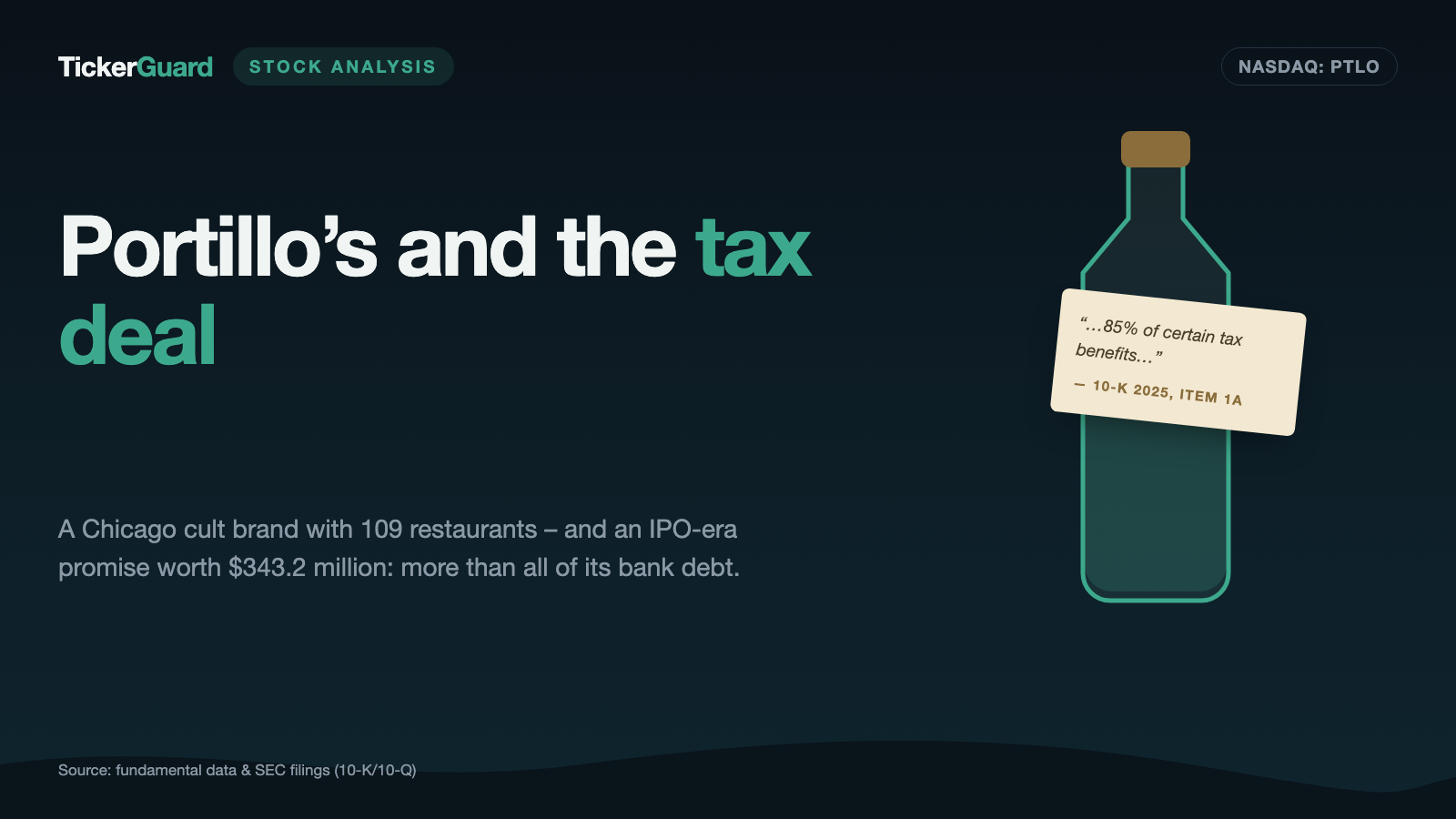
Chart
Interactive price chart (TradingView).
52-week range: 3.50 $ to 7.00 $ · Last price: 7.00 $ (As of: November 10, 2026)
Note: pure fact-based analysis, not investment advice and not a solicitation to buy or sell. All figures without guarantee.
There is an investor weakness that gets especially loud after a good earnings report: recency bias. The brain gives the latest news more weight than everything that came before. At Portillo’s (Nasdaq: PTLO), the latest news is excellent. On Nov. 5, 2026, the Chicago restaurant chain reported third-quarter revenue up 7.0 percent, net income of $4.8 million and a raised full-year outlook. The stock closed at $5.45 the day before and at $7.02 on the day of the report — a 28.8 percent jump in a single session. “It’s finally turning,” whispers recency bias.
What stands out is who pushes back hardest: the CEO himself. In the same earnings release, Brett Patterson said the company was encouraged — but that one quarter does not make a trend. So let’s make a deal: before you believe the latest quarter, let’s read together everything Portillo’s has filed with the U.S. securities regulator, the SEC — the 2025 annual report (10-K), the quarterly report (10-Q) for the period ended Sept. 27, 2026, and the current reports (8-K) through the closure decision of November 2026. The central tension of this analysis runs through every section: Portillo’s restaurants make good money — but between their cash registers and the shareholder stand bank interest, a tax deal with the former owners, and an expansion push that did not work out in Texas.
What the company actually does
Portillo’s started in 1963 with a small trailer that founder Dick Portillo called “The Dog House.” Today the chain sells Chicago street food: Chicago-style hot dogs, the Italian beef sandwich, burgers, salads, and a chocolate cake that is almost as famous as a shake as the hot dogs are. As of Sept. 27, 2026, Portillo’s operated 109 restaurants in 11 states, all company-owned with no franchisees; one of them belongs to the C&O joint venture, in which Portillo’s holds half. At the end of 2025, 50 of the then 102 restaurants were in Illinois.
What sets it apart is volume. A Portillo’s is not a small snack bar but a large hall, nearly always with a double-lane drive-thru. A restaurant in the comparable base generated an average of $8.2 million in revenue in the twelve months through Sept. 27, 2026 — in everyday terms, about $22,000 on every single day of the year. A year earlier it was $8.6 million. Keep that number in mind, because it is both the biggest strength and the first warning light: the brand draws enormous crowds — but per restaurant it is drawing slightly fewer.
One note on the calendar: the fiscal year ends on the last Sunday in December. Fiscal 2025 ran through Dec. 28, 2025, and the third quarter of 2026 ended on Sept. 27, 2026.
Company history for investors
-
1963
A trailer called “The Dog House”
Dick Portillo sells hot dogs from a small trailer in Chicago. The brand grows into a chain whose core is still the Chicago area today.
-
2021
IPO on Nasdaq
First trading day on Oct. 21, 2021, at an IPO price of $20. The IPO creates the tax deal now estimated at $343.2 million.
-
2025
Reset after the Texas disappointment
In September 2025, Portillo’s slows its expansion and CEO Michael Osanloo leaves. For shareholders, the old-pace growth story ends.
-
2026
New leadership, strong quarter, closures
Brett Patterson takes over in February. November brings a strong third quarter, a raised outlook and the decision to close weak restaurants.
How the stock landed on our desk
No fundamental screen flagged Portillo’s — other investors’ attention did. Our in-house Reddit hype scanner, which counts which smaller U.S. stocks are mentioned unusually often in Reddit forums, flagged PTLO in November 2026, a few days after the Nov. 5 jump. According to our fundamental data, about 9.2 million shares changed hands that day, compared with an average of about 2.0 million a day in October 2026. The low was only six weeks earlier: on Sept. 25, 2026, the stock closed at $3.50. By Nov. 9, it had almost doubled to $6.89.
One more number amplifies moves like this: according to fundamental data (retrieved Nov. 10, 2026), about 9.6 million PTLO shares were sold short, roughly 14 percent of the float. Short sellers bet on falling prices; when the news turns, they have to buy back and push the price up further. That is neither a buy signal nor a warning — it simply explains why the stock reacted so sharply. For the anchor on the other side: at the IPO in October 2021, the shares were priced at $20, and on Nov. 17, 2021, they closed at $54.22.
The numbers over the years: more revenue, little free cash
First, what genuinely impresses. Revenue has grown every year since the IPO, from $535.0 million in fiscal 2021 to $732.1 million in fiscal 2025. And the third quarter of 2026 was strong: $194.1 million in revenue, 7.0 percent more than a year earlier, operating income more than doubled to $11.8 million, and net income of $4.8 million versus $0.8 million. The restaurants themselves kept 20.7 percent of revenue as restaurant-level adjusted EBITDA, before corporate overhead and depreciation (prior year: 20.2 percent).
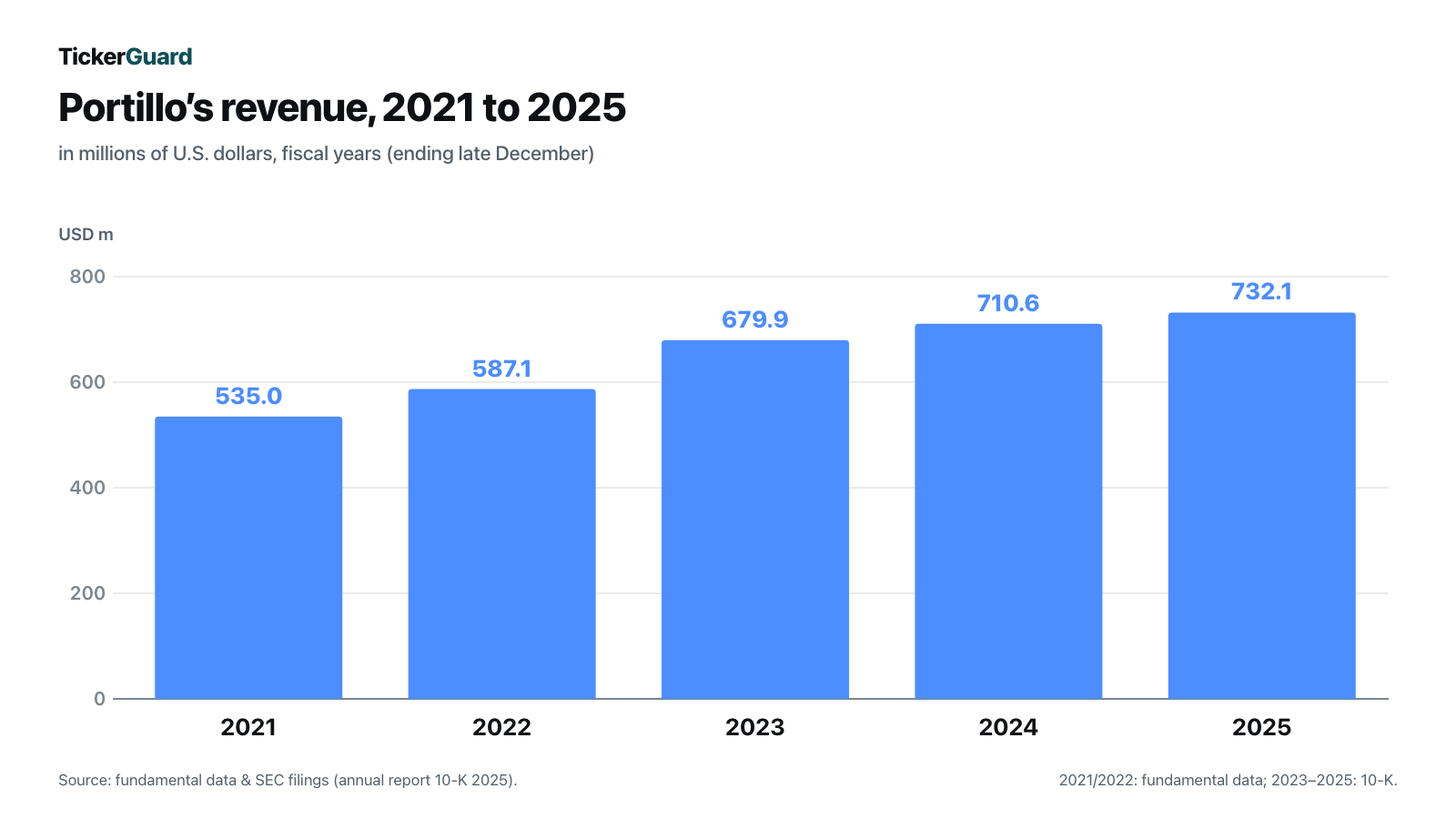
Now the caveat. Growth came almost entirely from new restaurants. Same-restaurant sales — restaurants open for at least two years — fell 0.6 percent in 2024 and 0.5 percent in 2025; 2026 followed with −0.1 percent in the first quarter and −1.2 percent in the second. Even the 1.4 percent gain in the third quarter came from prices, not guests: the average check rose 2.1 percent while transactions fell 0.7 percent. After three quarters of 2026, same-restaurant sales stand at 0.0 percent. And part of the better result came from opening fewer restaurants: pre-opening expenses fell by $2.6 million in the third quarter, and dead-site costs by $3.3 million.
What actually stays in the till is shown by free cash flow — operating cash flow minus investment in restaurants and equipment:
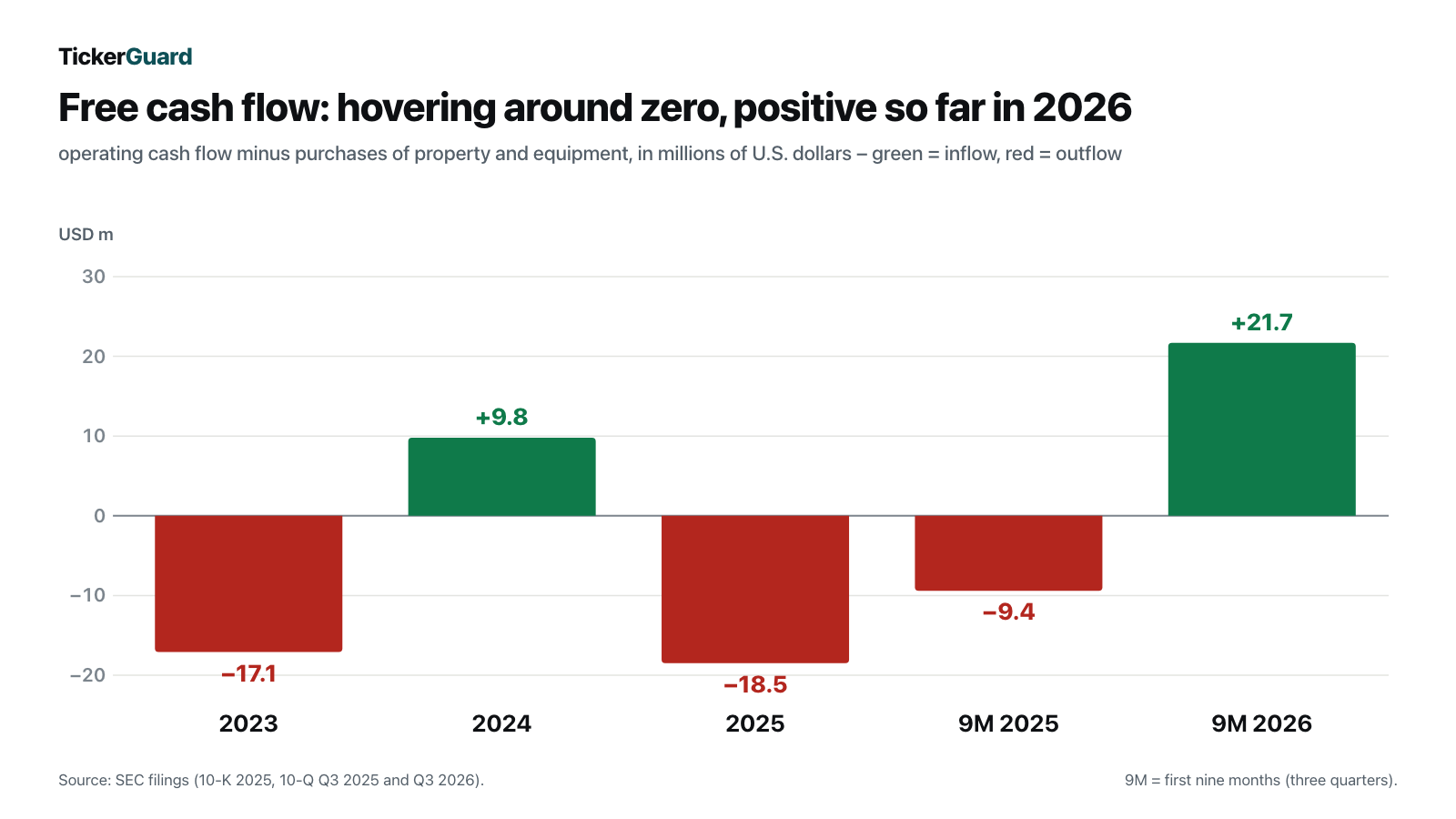
The 2026 turnaround is real, but it has a clear cause: purchases of property and equipment fell from $58.1 million to $40.1 million in the first three quarters, while operating cash flow rose from $48.7 million to $61.8 million. Portillo’s used the money to repay $9.7 million of debt. Remember: building less leaves more cash — sensible, but not yet proof that existing restaurants are attracting more guests. The CEO says as much:
“While we are encouraged by the progress, one quarter does not establish a trend.”
— Brett Patterson, CEO of Portillo’s, third-quarter 2026 earnings release, Exhibit 99.1 to the 8-K of Nov. 5, 2026
What the filings say — the uncomfortable truths
Uncomfortable truth No. 1: The former owners share in the tax savings
At its IPO in October 2021, Portillo’s made the former owners a promise that sits deep in the filings: a Tax Receivable Agreement, or TRA. In everyday terms: you buy a house, and the previous owner negotiates that you will hand over 85 percent of every tax saving the house brings you for decades. That is how the agreement works — 85 percent of certain tax benefits from the IPO structure flow to the former owners, not to today’s shareholders. Portillo’s put a number on it in its latest quarterly report:
“As of September 27, 2026, we estimate that our obligation for future payments under the TRA totaled $343.2 million.”
— Portillo’s Inc., 10-Q for the quarter ended Sept. 27, 2026, Item 2, “Tax Receivable Agreement”

For scale: the sum is larger than all bank borrowings ($327.2 million) and equals roughly two-thirds of the market value of about $501 million (at $6.89 on Nov. 9, 2026). To be fair: payments are only due if Portillo’s actually realizes the tax savings, and the company expects to fund them from exactly those savings. In 2026 it paid $7.9 million for tax year 2024; for 2025 it expects $2.3 million. But 15 percent of the savings for shareholders instead of 100 percent — that is the difference between a tax benefit and a tax benefit for someone else. And one clause weighs even more:
“The TRA could make us a less attractive target for an acquisition, particularly if an acquirer cannot use some or all of the tax benefits, and could negatively impact shareholder value.”
— Portillo’s Inc., 10-K for fiscal 2025, Item 1A “Risk Factors”

Anyone in the forums counting on a takeover should know this: a buyer takes on not just restaurants and loans, but also a bill that can come due all at once in a change of control. Remember: at Portillo’s, part of every future tax saving already belongs to someone else.
Uncomfortable truth No. 2: Texas was not a sure thing
The 2021 IPO story was: a Chicago cult brand conquers the country. Texas was supposed to be the proof — by the end of 2025 it had 14 restaurants, more than any state other than Illinois. The annual report now reads differently:
“In September 2025, the Company announced a strategic reset to its development strategy, following disappointing results from new market expansion, particularly in Texas.”
— Portillo’s Inc., 10-K for fiscal 2025, Item 7 “Management’s Discussion and Analysis”

Longtime CEO Michael Osanloo left on Sept. 21, 2025, alongside the reset. And the reset is not over: on Nov. 4, 2026, the board approved closing a “mid-to-high single digit number” of underperforming restaurants outside Chicagoland, most of them in the fourth quarter of 2026. What it will cost, the company does not yet know:
“However, the Company expects that its analysis will result in material cash and non-cash charges, the majority of which are expected to be recognized in the fiscal fourth quarter of 2026.”
— Portillo’s Inc., 8-K of Nov. 5, 2026, Item 2.05 “Costs Associated with Exit or Disposal Activities”

According to the same filing, the charges include lease-related costs, severance and asset impairments. The raised outlook is not a contradiction: it refers to adjusted EBITDA, an earnings measure before interest, taxes, depreciation and amortization from which the company strips such special items. In GAAP net income, the closures will show up. Honestly, closing weak locations is still a good sign — it shows management willing to admit mistakes. Remember: closing a restaurant costs once; keeping a bad one open costs every year.
Uncomfortable truth No. 3: Interest eats along — and much of the balance sheet is purchase price
As of Sept. 27, 2026, Portillo’s owed its banks $327.2 million: $242.2 million on the term loan and $85.0 million on the revolver, both maturing on Jan. 27, 2030. The rate was about 6.5 percent and floats with the SOFR benchmark. In the first three quarters of 2026, that cost $16.8 million in interest — against operating income of $30.0 million. More than half of what the business earned before interest went to the banks; for full-year 2025 it was $22.8 million of interest on $43.7 million of operating income. According to the quarterly report, Portillo’s was in compliance with its financial covenants, cash stood at $24.8 million and $60.8 million of the revolver was available.
Then there is the balance sheet. Of $1,624.5 million in total assets, $394.3 million is goodwill and $221.7 million trade names — according to the annual report, mostly from the purchase price allocation in the “Berkshire Acquisition,” the buyout by private equity firm Berkshire Partners, which still held about 5.2 percent at the end of 2025. Put simply: it is the premium someone once paid for the brand over the value of the buildings. Together that is $616.0 million, more than total equity of $517.4 million. As long as the brand holds, that is no problem. But in the third quarter of 2025, Portillo’s already saw “impairment indicators”; the test at the time ended without a goodwill write-down. The next regular test takes place in the fourth quarter of 2026 — the same quarter in which the closures are booked.
Uncomfortable truth No. 4: Management is almost entirely new
Since September 2025, Portillo’s has replaced nearly its entire top team. Michael Osanloo was succeeded on an interim basis by Michael A. Miles Jr.; since Feb. 23, 2026, Brett Patterson, previously CEO of the restaurant chain Miller’s Ale House, has been in charge. CFO Michelle Hook left in May 2026, an interim CFO took over at $14,000 per week (8-K of May 21, 2026), and since Sept. 7, 2026, Kevin Kalicak, formerly finance chief at Olive Garden (Darden), has been CFO. Chief People Officer Jill Waite left on Nov. 1, 2026 (8-K of Oct. 6, 2026), and the third quarter included $1.4 million in costs for a workforce reduction at headquarters.
A new team may be exactly the right thing — Patterson and Kalicak bring experience from large restaurant chains. But it also means the numbers recency bias is leaning on are the first from a team that has not worked together for a full year.
Valuation: what about $500 million in market value buys
At $6.89 (close on Nov. 9, 2026) and 72,766,838 Class A shares per the quarterly report cover, the market value was about $501 million. Revenue over the last twelve reported months (October 2025 through September 2026) was $761.4 million. That is a price-to-sales ratio of about 0.66 — the market pays 66 cents per dollar of revenue. Diluted earnings per share for those twelve months were $0.23; a price-to-earnings ratio of about 30 is high for a company without guest growth.
More telling is everything that ranks ahead of the shareholder. Add bank debt net of cash (about $302 million) to the market value and you get an enterprise value of about $804 million — eight times the midpoint of the raised 2026 adjusted EBITDA outlook ($99.5 million). Include the $343.2 million tax deal and it becomes about 11.5 times. Restaurant lease liabilities ($355.8 million on the balance sheet) are not even counted. Neither calculation is wrong — but only the second shows what a buyer of the whole company would actually take on.
The view from Wall Street: according to fundamental data (retrieved Nov. 10, 2026), three analysts rate the stock “Strong Buy,” nine “Hold,” and none recommends selling. The average price target is about $6.06 — below the price after the jump. The pros were cautious before the quarter, and their targets lag the stock. How another restaurant company with a strong brand and a difficult structure fares is shown in our analysis of Biglari Holdings, owner of Steak ’n Shake; how a small, long-established chain earns its money, in our analysis of Flanigan’s.
Upside and risks at a glance
What speaks for Portillo’s:
- Strong brand with high volumes: $8.2 million in revenue per restaurant (twelve months through Sept. 27, 2026), restaurant-level margin of 20.7 percent in the third quarter of 2026.
- Strong third quarter of 2026: revenue +7.0 percent, same-restaurant sales +1.4 percent, net income $4.8 million; adjusted EBITDA outlook raised to $98 million to $101 million.
- More cash through discipline: free cash flow of +$21.7 million in the first nine months of 2026, $9.7 million of debt repaid, 2026 capital spending of about $55 million.
- A clear plan: a smaller prototype from 2028 (about 4,600 square feet, more than 40 percent smaller), a cash-on-cash return target above 20 percent for new restaurants and 2 to 3 percent annual same-restaurant sales growth.
- Experienced new leadership from the restaurant industry (Miller’s Ale House, Olive Garden).
What speaks against it:
- A $343.2 million tax deal in favor of the former owners, subject to acceleration in a change of control.
- $327.2 million in bank debt; interest swallows more than half of operating income.
- No guest growth: same-restaurant sales negative in 2024 and 2025; the third-quarter 2026 gain came from pricing while transactions fell 0.7 percent.
- Disappointing expansion outside Chicagoland, closures with still-unquantified “material” costs in the fourth quarter of 2026, goodwill and trade names ($616.0 million) above total equity.
- Almost entirely new management whose strategy has produced one quarter of results.
A human conclusion
Back to recency bias from the beginning. It says: a strong quarter, a raised outlook, almost a double since September — it is turning. The filings say: maybe. Portillo’s restaurants are good, the brand is strong, and the new leadership is doing what sensible leadership should do — build less, close weak locations, pay down debt. But two years without guest growth, an expansion push that had to be corrected, and a balance sheet carrying bank debt and a tax deal worth about $670 million combined do not disappear with one good quarter.
So the honest question for you is not “How strong was the last quarter?” but: Do you believe the existing restaurants will attract more guests again — not just bigger checks — and that this will last long enough to carry the interest and the payments to the former owners? If so, you have a thesis you can test against the next quarterly reports. If not, you only had the last quarter on your mind. What you make of it is your decision. And that is how it should be.
Sources
All original documents used in this analysis — so you can check them yourself:
- Portillo’s Inc. — quarterly report 10-Q for the period ended Sept. 27, 2026 (filed Nov. 5, 2026)
- Portillo’s Inc. — current report 8-K of Nov. 5, 2026 (Items 2.02 and 2.05: results and closure plan) with Exhibit 99.1, third-quarter 2026 earnings release with outlook
- Portillo’s Inc. — 8-K of Oct. 6, 2026: departure of the Chief People Officer (Item 5.02)
- Portillo’s Inc. — quarterly report 10-Q for the period ended June 28, 2026 (filed Aug. 5, 2026)
- Portillo’s Inc. — 8-K of Aug. 4, 2026: new CFO (Item 5.02)
- Portillo’s Inc. — 8-K of June 30, 2026 and 8-K of May 21, 2026: interim CFO (Item 5.02)
- Portillo’s Inc. — 8-K of June 12, 2026: annual meeting results (Item 5.07)
- Portillo’s Inc. — quarterly report 10-Q for the period ended March 29, 2026 (filed May 5, 2026)
- Portillo’s Inc. — annual report 10-K for fiscal 2025 (filed Feb. 24, 2026)
- Portillo’s Inc. — quarterly report 10-Q for the period ended Sept. 28, 2025 (filed Nov. 4, 2025)
- Full filing history: EDGAR, CIK 0001871509
- Fundamental data (prices and trading volume through Nov. 9, 2026, revenue 2021 and 2022, short interest, analyst ratings; retrieved Nov. 10, 2026).
- Earnings call transcripts were not reviewed; the basis is exclusively the mandatory SEC filings.
Transparency & disclaimer: This analysis is a journalistic assessment of publicly available information and does not constitute investment advice, a regulated financial analysis, or a solicitation to buy or sell securities. Equity investments carry substantial risk, including total loss. All information is provided without guarantee; the data date is noted throughout the text. Positions held by the operator are disclosed daily; where one exists, it appears as a notice at the top of this deep dive.
Key figures at a glance
All monetary figures in millions of $; earnings per share as reported.
| Metric | 2021 | 2022 | 2023 | 2024 | 2025 |
|---|---|---|---|---|---|
| Revenue | 535.0 | 587.1 | 679.9 | 710.6 | 732.1 |
| Operating Income (EBIT) | 30.0 | 41.3 | 55.4 | 58.0 | 51.2 |
| Net Income | 6.0 | 10.9 | 18.4 | 29.5 | 19.3 |
| Net Margin | 1.1% | 1.8% | 2.7% | 4.2% | 2.6% |
| Earnings Per Share | 0.17 $ | 0.25 $ | 0.32 $ | 0.46 $ | 0.27 $ |
Source: fundamental data & SEC filings (annual and quarterly reports, 10-K/10-Q)
Our Bottom Line at a Glance
- Brand & restaurants positive
- $8.2 million in revenue per restaurant (twelve months through Sept. 27, 2026) and a 20.7 percent restaurant-level margin in the third quarter of 2026 — high volumes for a quick-service chain.
- Growth & guests negative
- Same-restaurant sales negative in 2024 (−0.6 percent) and 2025 (−0.5 percent), 0.0 percent after three quarters of 2026; the third-quarter gain came from pricing while transactions fell 0.7 percent.
- Earnings power & cash flow neutral
- Thin profit margin (net 2.0 percent of revenue in Q1–Q3 2026); free cash flow negative in 2023 and 2025, +$21.7 million so far in 2026 thanks to lower capital spending.
- Balance sheet & obligations negative
- $327.2 million in bank debt and a $343.2 million tax deal with former owners (Sept. 27, 2026); $16.8 million in interest against $30.0 million in operating income in Q1–Q3 2026; goodwill and trade names exceed equity.
- Leadership & strategy neutral
- New CEO since February 2026, new CFO since September 2026; reset after the Texas disappointment, closures in the fourth quarter of 2026, a smaller prototype from 2028.
Portillo’s has a strong brand with high revenue per restaurant and reported a clear improvement for the third quarter of 2026, including a raised outlook. But guest traffic has not grown for two years, the Texas expansion disappointed, and between the restaurant till and the shareholder stand $327.2 million in bank debt and a $343.2 million tax deal with the former owners. Not investment advice.
What Our Rating Means
Open questions
The business works in principle, but one material question is open. As long as it stays open, our findings do not carry a quality verdict.
Yellow here stands for an open operating question: the turnaround is one quarter old, guest traffic at existing restaurants has not grown since 2024, and the new leadership still has to show that closures and the new prototype work. A substance risk is not documented — covenants are met, operating income covers interest about 1.8 times, and free cash is flowing in 2026. The large tax deal and the price jump are price questions, not quality questions. The decision is yours.
A journalistic assessment by our editorial team at the time of the deep dive, based on public sources — not investment advice and not a solicitation to buy or sell. Your personal circumstances (investment goals, risk capacity, taxes) cannot be taken into account. What our levels mean, how verdicts are formed, and what conflicts of interest exist →
Worth Noting
- Data date: earnings, balance sheet and cash flow figures as of Sept. 27, 2026 (10-Q filed Nov. 5, 2026) or Dec. 28, 2025 (10-K filed Feb. 24, 2026); outlook per Exhibit 99.1 to the 8-K of Nov. 5, 2026; share count per the 10-Q cover as of Oct. 29, 2026; prices, volume, short interest and analyst ratings per fundamental data (close Nov. 9, 2026, retrieved Nov. 10, 2026). All SEC filings through Nov. 10, 2026 have been reviewed; there is no merger or takeover filing.
- The costs of the restaurant closures approved in November 2026 are not yet quantified; according to the 10-Q, they will appear mostly in the annual report (10-K) for fiscal 2026.
- The fiscal year ends on the last Sunday in December; the third quarter of 2026 ended on Sept. 27, 2026. Not to be confused with Berkshire Hathaway: the former majority owner is the private equity firm Berkshire Partners.
Stock Watch
This analysis is as of November 11, 2026. Stock Watch will tell you what's changed at PTLO since then.
Later $1 a month per stock — signing up is free, and you'll be the first to know when it launches.
The full analysis as a PDF for later
We will send you this analysis as a PDF — to print, file away, and read at your own pace. And we will add you to the free Stock Watch list for Portillo's Inc (PTLO), so you hear about it when something material in this analysis changes.
Frequently Asked Questions
Portillo’s (Nasdaq: PTLO), based in Oak Brook, Illinois, runs restaurants serving Chicago street food such as hot dogs, Italian beef sandwiches and chocolate cake. As of Sept. 27, 2026, it operated 109 company-owned restaurants in 11 states, most with drive-thrus. The average restaurant generated $8.2 million in revenue in the twelve months through September 2026.
An agreement from the 2021 IPO: Portillo’s pays former owners 85 percent of certain tax savings. As of Sept. 27, 2026, the company estimated future payments at $343.2 million, mostly over the next 15 years. In a change of control, they may be accelerated, which makes a takeover more expensive.
As of Sept. 27, 2026, Portillo’s owed its banks $327.2 million, maturing on Jan. 27, 2030, at about 6.5 percent interest. In the first three quarters of 2026, interest expense was $16.8 million against $30.0 million in operating income. On top come $343.2 million under the tax deal and restaurant lease obligations.
On Nov. 4, 2026, the board approved closing a mid-to-high single-digit number of underperforming restaurants outside Chicagoland, mostly in the fourth quarter of 2026. Each location was assessed on sales, margins and outlook. According to the 8-K, the costs will be material but are not yet quantified.
In the quarter ended Sept. 27, 2026, revenue rose 7.0 percent to $194.1 million, same-restaurant sales rose 1.4 percent and net income reached $4.8 million versus $0.8 million. The 2026 adjusted EBITDA outlook was raised to $98 million to $101 million. The gain came from higher prices; transactions fell 0.7 percent.
Brett Patterson has been CEO since Feb. 23, 2026, after leading Miller’s Ale House. He succeeded Michael Osanloo, who left in September 2025, and an interim CEO. Kevin Kalicak, formerly at Olive Garden (Darden), has been CFO since Sept. 7, 2026. The Chief People Officer left on Nov. 1, 2026.
Found an error?
Did you spot a factual error, an outdated number, or a typo in this deep dive? Let us know briefly — your report goes straight to the editorial team.