Flanigan's Enterprises: A Record Quarter, 62 Percent Insider Ownership, and an Uninsured Class Action
Flanigan's Enterprises has run restaurants and liquor stores in South Florida for 66 years — a record nine-month report, solid real estate, and not a single analyst conference call. The catch: about 62.3 percent of the stock sits with officers and directors, only around 149 shareholders are on the books, and an uninsured class action under the U.S. wage law (FLSA) is already driving up legal costs. Buy in, and you're effectively pulling up a chair at the Flanigan family's table — and you won't be able to get up again quickly.
 Thomas Mücke
Founder & Publisher
Thomas Mücke
Founder & Publisher
As of Today
As of: September 25, 2026
- Closing price
- 45.10 $ +1.60%
- Market Capitalisation
- 0.1 $B
- P/E
- 15.1
- Growth Score
- 6/10
- AAQS
- 3/10
This analysis has a cut-off date. The Stock Guard tells you when something material changes in the numbers. Reserve your free spot
Chart
Interactive price chart (TradingView).
52-week range: 27.60 $ to 51.80 $ · Last price: 45.10 $ (As of: September 25, 2026)
Note: pure fact-based analysis, not investment advice and not a solicitation to buy or sell. All figures without guarantee.
There is a reflex that catches experienced investors especially hard — precisely because it feels like a mark of good judgment: the spectacle reflex. It whispers to you: if a stock holds no analyst call, issues no guidance, and nobody on Reddit is writing about it, there can't be anything interesting there. So you scroll on, to the stock with the big price jump, the spectacular story, the loud ticker. That is almost exactly the trap you'd fall into with Flanigan's Enterprises, Inc. (NYSE American: BDL) — because this company does literally nothing to stand out. No earnings call, no forecast, no press release on the quarterly result. Just a quarterly report (10-Q) it dutifully files with the U.S. securities regulator, the SEC, the way it has for decades. On 08/11/2026 it was that time again — and what's in it made us sit up: a record quarter, solid real estate, a rising dividend. So let's make a deal: we read the report together before you decide whether "boring" is really the right word here. And we'll read the uncomfortable parts too — an uninsured class action, a stock that practically belongs to a single family. Because a filing to the SEC is honest under penalty of law, spectacular or not.
What Flanigan's actually does — seafood, cocktails, and the liquor store next door
Flanigan's Enterprises runs a two-sided business with a very simple logic: it operates restaurants under the brand "Flanigan's Seafood Bar and Grill" and package liquor stores under "Big Daddy's Liquors" or "Big Daddy's Wine & Liquors" — almost entirely in South Florida. As of 09/27/2025 (unchanged from a year earlier), that was 32 self-operated or controlled units plus 5 franchise units: two combination restaurant/package store locations, nine restaurant-only sites (some with a sports bar), nine package-store-only locations, ten restaurants run as limited partnerships, one Flanigan's-operated franchise restaurant, and one restaurant run by an unrelated third party ("The Whale's Rib"). Picture the everyday version: a neighborhood bar that also runs the liquor store right next to it — buy a six-pack to go, and the sale lands in the same corporate family as your bar tab.
The cleverest part of the structure sits in the limited partnerships: Flanigan's invests capital in eleven South Florida restaurants and is sole general partner with a controlling interest in ten of them — only the franchise restaurant in Fort Lauderdale (owned by Patrick J. Flanigan, the CEO's brother) has Flanigan's as a limited partner only. The ten general-partner LPs are fully consolidated. The mechanics: outside investors put capital into a single restaurant and receive up to 25 percent per year, fee-free, until their capital is fully returned — after that, investors and Flanigan's split the distributable cash flow 50/50. On top, Flanigan's collects a 3 percent brand-use fee on gross revenue from every LP, regardless of results. As of 09/27/2025, all LPs but two had already returned their invested capital in full.
The company's history goes back to 1959, when Flanigan's was incorporated in Florida, starting as a chain of small cocktail lounges and package stores. By 1970 that had grown into the "Big Daddy's" chain between Vero Beach and Homestead. The company's namesake is founder Joseph "Big Daddy" Flanigan — his face is, in fact, a registered trademark of the company, as the 2025 annual report notes:
"The face comprising this trademark is that of the Company's founder, Joseph 'Big Daddy' Flanigan, and is a federally registered trademark owned by us."
— Flanigan's Enterprises, Inc., SEC annual report 10-K for fiscal 2025, Item 1 "Trademarks"
Through the 1970s Flanigan's expanded beyond Florida into five other "Sun Belt" states and, in 1982, all the way to Philadelphia. That excursion didn't end well: in 1975 the package-store chain pulled back to South Florida, and both 10-Ks on hand (for 2025 and 2024) list, as Exhibit 2, a striking document bundle — "Plan of Reorganization, Amended Disclosure Statement, Amended Plan of Reorganization … Order Confirming Plan of Reorganization," filed with a Form SB-2 on 05/05/1987. A court-confirmed reorganization plan from that period is therefore documented; the filings on hand never use the term "Chapter 11" — so we name only what is actually documented: a restructuring in the mid-1980s from which the company emerged with a court-confirmed plan. Since March 1985, Flanigan's has granted franchise licenses, and starting in fiscal 1987 the lounges were systematically converted into full-service restaurant kitchens. Today restaurant food makes up roughly 80 percent, the bar roughly 20 percent, of restaurant revenue.
Where the stock landed on our desk
Flanigan's has sat on our research list for years, rarely near the top — the stock fails almost every momentum filter our in-house stock scanner runs, because it barely trades and almost never makes headlines. The trigger for this analysis was simply the calendar: on 08/11/2026, Flanigan's filed its quarterly report (10-Q) for the third quarter of fiscal year 2026 with the SEC — the 13 weeks through 06/27/2026. A routine, legally mandated report, in other words, not an event that would reach any news ticker. But that's exactly what makes it interesting: a company nobody watches also has nobody asking it uncomfortable questions. So we took that job on ourselves.
A company that doesn't talk to Wall Street
Before we get to the numbers, one finding that frames the whole analysis: Flanigan's holds no earnings calls, issues no guidance, and no transcripts of analyst conversations exist — we searched specifically for them across every filing on hand and found nothing. The only voice of management is the written MD&A in the quarterly and annual reports. That means: no analysts pressing on the quarterly call, no public debate over assumptions and risks — only what management chooses to write into the filing itself.
What it does write deserves credit. In the annual report (10-K) for fiscal 2025, management explicitly told investors to expect a declining margin in the liquor business for fiscal 2026:
"We anticipate that the gross profit margin for package liquor store merchandise will decrease for our fiscal year 2026 due to higher costs and a reduction in pricing of certain package store merchandise to remain competitive."
— Flanigan's Enterprises, Inc., SEC annual report 10-K for fiscal 2025, MD&A
And that's exactly what happened: over the first 39 weeks of fiscal 2026, the package-store gross margin fell from 25.21 to 24.44 percent. A second, equally unflattering line from the latest quarterly report reads simply: "Inflation is having a material impact on our operating results." For you as a reader, that's a rare kind of honesty: a management that predicts its own deterioration and then lets it happen instead of dressing it up earns more trust than one that only announces records. The catch remains: with no analyst calls, nobody is live-checking these statements — the only check is you, reading the next report.
The numbers over the years — seven years without much fanfare
First, the big picture, excluding rental income, the way the 2025 annual report itself presents the prior years: revenue climbed from $115.4 million (fiscal 2019) through $112.3 million (fiscal 2020, the pandemic dip), $136.5 million (fiscal 2021), $157.3 million (fiscal 2022), $173.4 million (fiscal 2023), $187.2 million (fiscal 2024), to $205.2 million (fiscal 2025) — a quiet, almost linear climb, without the roller coaster you know from some other stocks.
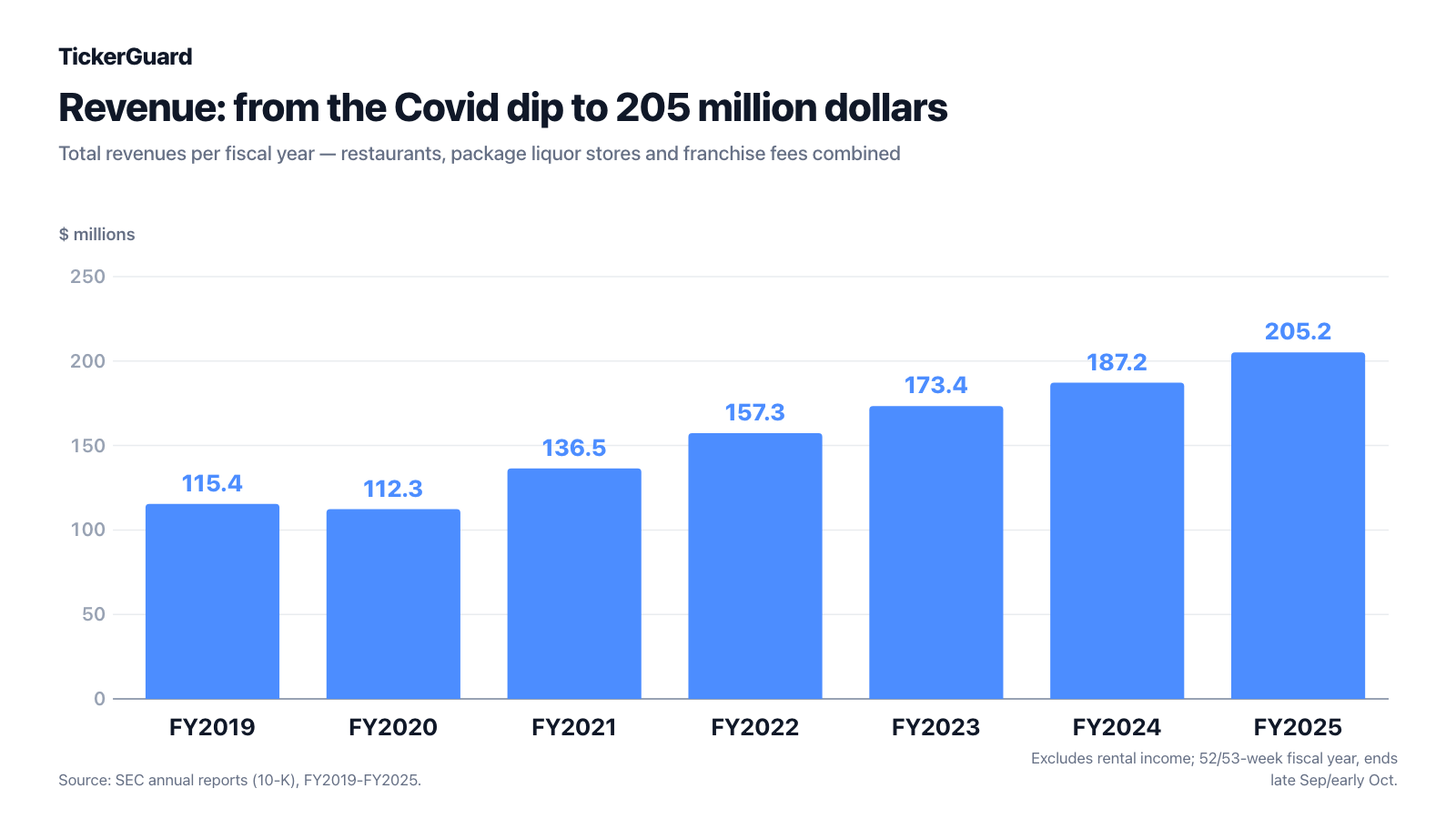
The bottom line is where it gets interesting. In fiscal 2025, net income attributable to stockholders was $5.033 million, EPS $2.71; in fiscal 2024 it was $3.356 million and $1.81. One year stands out from the pattern: in fiscal 2021, Flanigan's reported net income attributable to stockholders of $11.784 million — nearly triple a normal year. The reason is in the fiscal 2021 annual report: a "Gain on forgiveness of PPP loans" of $10.136 million — the forgiveness of federal pandemic relief loans (Paycheck Protection Program) booked as a one-time gain. Strip out that non-recurring effect and 2021 would have been an entirely ordinary year. Anyone reading the earnings history should mentally back that one outlier out.
Keep two things in mind for every Flanigan's earnings figure. First: the net margin is structurally thin, usually in the 2 to 3 percent range of revenue — normal for the low-margin restaurant and retail business, but it also means small cost swings move the bottom line hard in percentage terms. Second: because of the limited-partnership structure, a meaningful share of consolidated net income does not belong to shareholders of the publicly traded stock but to outside investors in the restaurant partnerships (non-controlling interests, or NCI) — over the first 39 weeks of fiscal 2026, that was roughly 40 percent of consolidated net income. Earnings per share (EPS) correctly reflects only the remaining stockholders' share — an important distinction that's easy to miss when comparing against other restaurant chains.
The fresh report: a record quarter with price increases behind it
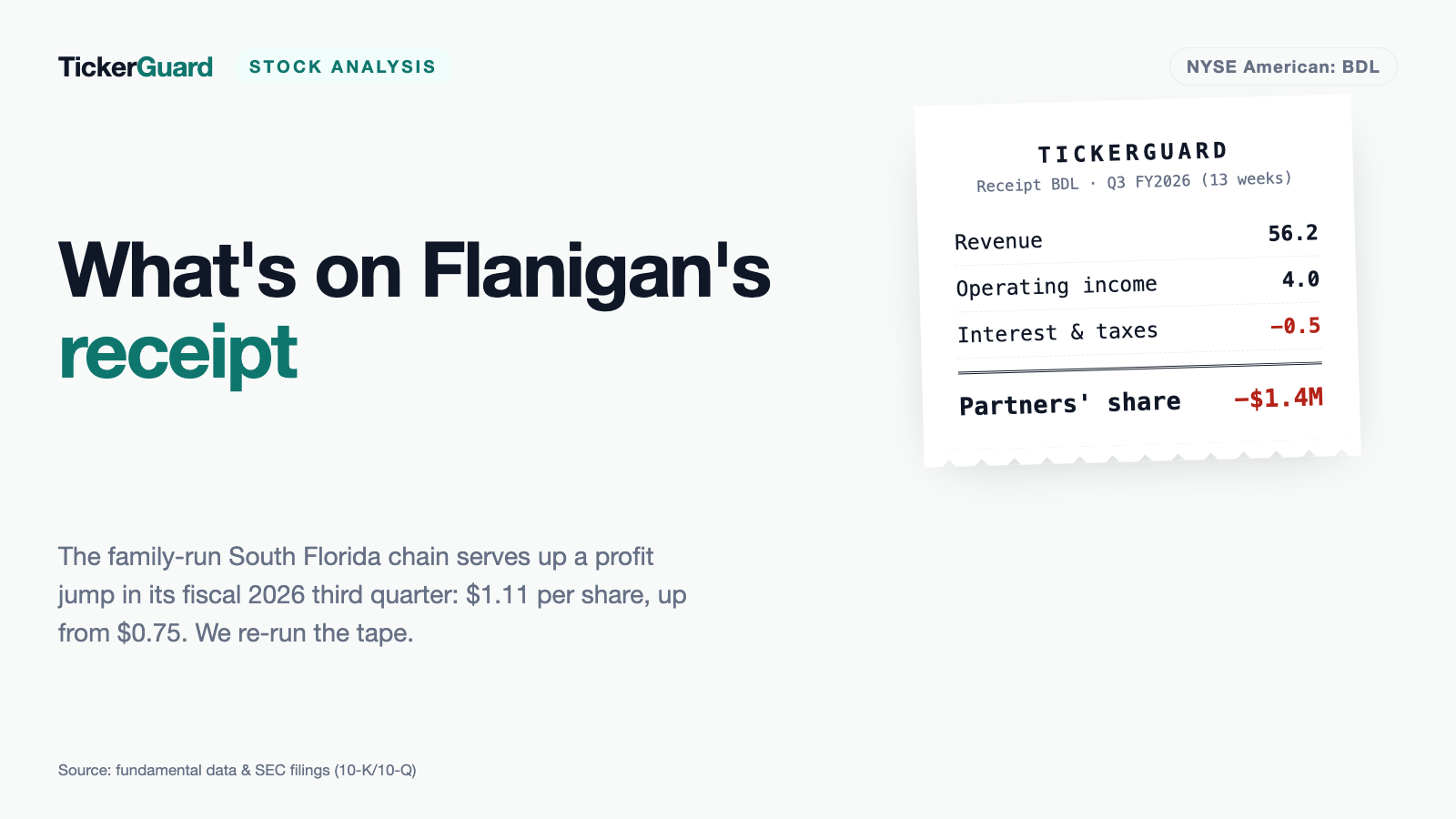
Now to the actual trigger for this analysis. In the third quarter of fiscal 2026 (13 weeks through 06/27/2026), revenue rose to $56.2 million — up 8.3 percent from the prior-year quarter. Operating income climbed to $4.0 million (prior-year quarter: $2.852 million). Interest, taxes, and a small loss on debt extinguishment together took off about −$0.5 million, leaving consolidated net income at $3.460 million. Of that, the share belonging to outside partnership investors (NCI) took −$1.4 million — Flanigan's stockholders were left with $2.061 million (prior-year quarter: $1.392 million), for EPS of $1.11 after $0.75 in the prior-year quarter.
Over the first 39 weeks of fiscal 2026, that adds up to revenue of $165.286 million (prior year: $155.248 million, +6.47 percent), EPS of $3.09 (prior year: $2.23), and operating cash flow of $12.825 million (prior year: $7.150 million) — notably more cash from operations than in the prior-year period.
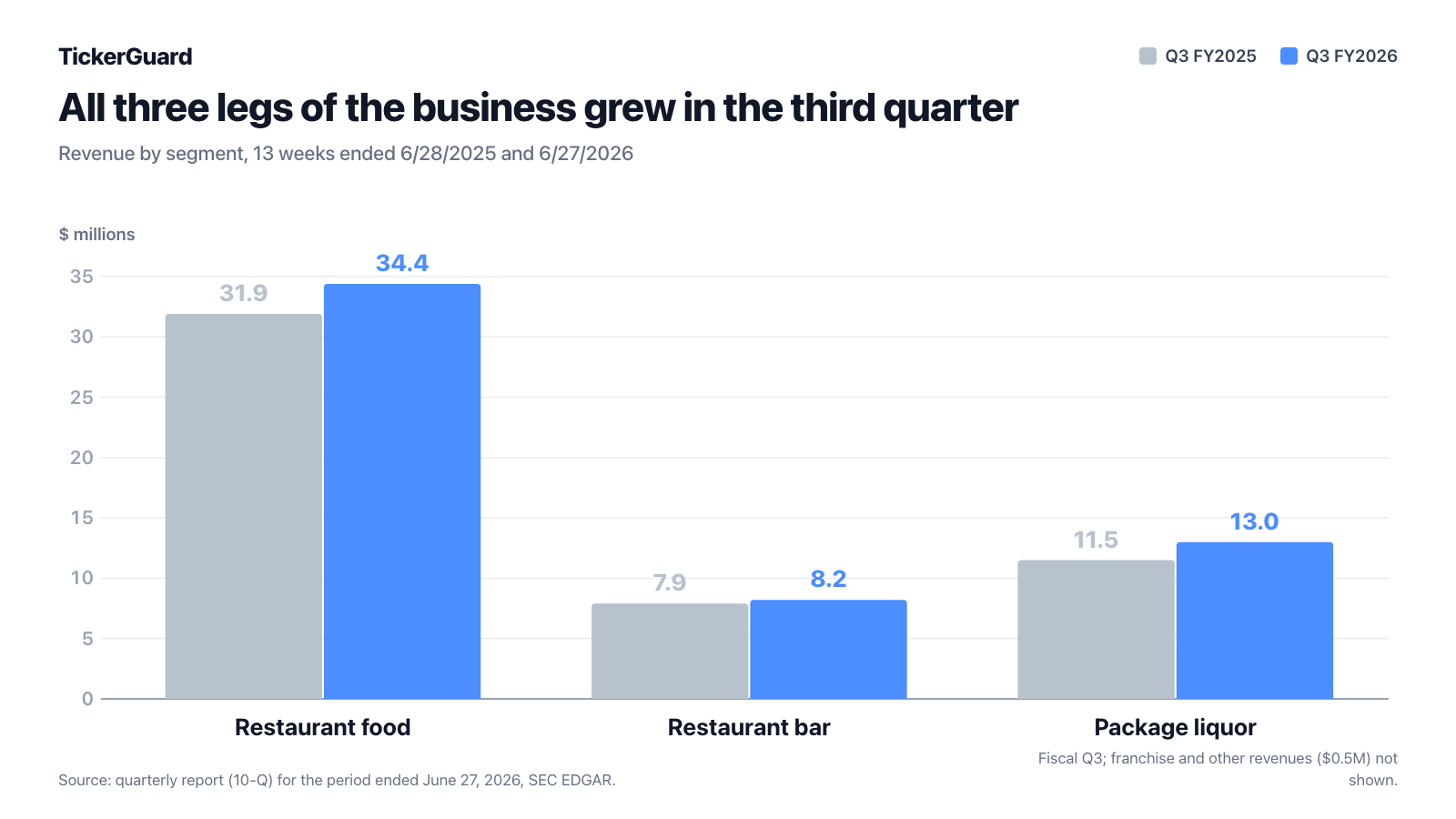
All three segments contributed: restaurant food rose from $31.9 million to $34.4 million, the bar from $7.9 million to $8.2 million, package liquor stores from $11.5 million to $13.0 million — plus franchise and other revenue of roughly $0.5 million. On a same-store basis, restaurant food grew 7.90 percent, the bar 3.93 percent (dampened by softening alcohol consumption at restaurants), and package liquor stores a strong 12.64 percent — per the MD&A, driven by more store traffic, including e-commerce. The main driver behind it all was targeted price increases:
"Effective March 1, 2026, we increased our menu prices for our bar offerings to target an increase to our bar revenues of approximately 3.68% annually and we increased our menu prices for our food offerings to target an increase to our food revenues of approximately 3.25% annually."
— Flanigan's Enterprises, Inc., SEC quarterly report 10-Q, Q3 fiscal 2026, MD&A "Revenues"

Notably, despite Florida's minimum-wage increase, the payroll ratio fell in the quarter from 31.04 to 29.89 percent of revenue — more revenue per labor hour more than offset the higher wages.
One-time items checked: before you take the record quarter at face value, we deliberately combed the report for one-off gains — after all, "record profit" is a phrase that, at other companies in this series, has often masked a one-time accounting gain. Not at Flanigan's: the only special items in the quarter are tiny, a $40,000 loss on debt extinguishment and a $19,000 gain on the sale of equipment. The earnings jump is operational — price increases plus more customers — so adjusted and reported results are practically identical. There's no going-concern language, and management explicitly reaffirms liquidity:
"We believe that our current cash availability from our cash on hand, positive cash flow from operations, and proceeds from borrowings will be sufficient to fund our operations and planned capital expenditures for at least the next twelve months."
— Flanigan's Enterprises, Inc., SEC quarterly report 10-Q, Q3 fiscal 2026, MD&A "Liquidity and Capital Resources"

The capital structure stays clean too: no buybacks, no new shares — the share count has been constant at 1,858,647 shares for years (10-Q cover page, as of 08/10/2026). The rise in long-term debt from $19.1 million to $29.4 million has a concrete cause: a real estate purchase. Flanigan's acquired the "Stuart Property" at 950 S. Federal Highway, Stuart, Florida, in the third quarter — for $8.45 million, paid entirely in cash. The company already operates its own restaurant, Store #75, on that site; two vacant hotel buildings from the seller, a franchise hotel, are slated for demolition. The purchase was financed through three pieces: the mortgage on the Flanigan's Calusa Center in Miami was increased to $11.1 million (5.995 percent fixed through 02/28/2041), plus a new $3.375 million mortgage on Store #19 in Hollywood (same terms) and another $3.15 million mortgage on Store #75 itself (5.975 percent, maturing 05/31/2033). Cash still rose — from $20.1 million to $28.8 million.

What the filings say — the uncomfortable truths
Uncomfortable truth No. 1: the FLSA class action has no insurance coverage
Since 03/31/2025, a lawsuit under the Fair Labor Standards Act (FLSA) — the federal law on minimum wage and overtime — has been running against Flanigan's, one of its five franchisees, and three of its controlled limited partnerships. The quarterly report describes the current status:
"On March 31, 2025, a lawsuit was filed against the Company, one of its five franchisees and three of its controlled limited partnerships alleging violations of the Fair Labor Standards Act ("FLSA"), including failure to pay overtime and improper use of the tip credit. During the second quarter of fiscal year 2026, the Court conditionally certified a FLSA collective action. The opt-in period expired on July 23, 2026, with approximately fifty current and former non-exempt servers and bartenders comprising the collective. There is no insurance coverage for this action."
— Flanigan's Enterprises, Inc., SEC quarterly report 10-Q, Q3 fiscal 2026, Note 9 "Litigation"

In everyday terms: imagine your own small business gets sued by fifty former employees over unpaid overtime — and your business liability policy doesn't cover that particular risk at all. Every dollar of legal fees and any eventual settlement would hit the bottom line directly. That's exactly the situation at Flanigan's, and the cost is already measurable: SG&A rose 31.47 percent in the third quarter, "primarily due to increased legal costs." The filing names no potential size for the exposure — the decisive hearing on whether the case actually continues as a collective action is, per the filing, still pending.
Uncomfortable truth No. 2: you're a guest at the Flanigan family's table
Flanigan's is officially a "controlled company" — a status defined under the rules of the NYSE American and the SEC for companies where one person or a small group holds a voting majority. The proxy statement for the 2026 annual meeting puts it this way:
The Board of Directors has determined that we are a "controlled" company as defined by the NYSE AMERICAN and SEC rules since more than 50% of our issued and outstanding common stock is owned by limited liability companies controlled by our Chief Executive Officer, common stock owned by our Chief Executive Officer, his immediate family and other directors and officers.
— Flanigan's Enterprises, Inc., SEC proxy statement (DEF 14A), filed January 23, 2026
In concrete terms: CEO James G. Flanigan controls roughly 52.8 percent of the vote through Flanigan Family Stock Holdings LLC (741,796 shares) and Motta-Flanigan LLC (138,694 shares), plus his own holdings; all officers and directors together reach 62.3 percent. Only 3 of 9 directors qualify as independent, and there is no compensation committee — the board handles that function itself. CEO compensation for fiscal 2025 was $145,000 in base salary plus a $1,364,000 bonus. On top, family members run their own franchise locations: the Coconut Grove restaurant is 52.28 percent owned by the CEO himself and 40 percent by his brother Michael — it generated gross revenue of $20.986 million in fiscal 2025 and paid $482,000 in franchise fees to the public company. The Pompano Beach restaurant is 100 percent owned by brother Patrick J. Flanigan (a director) — revenue $8.373 million, fees $195,000.
For you as an investor, that cuts two ways. First: illiquidity. Only about 149 people are on the books as shareholders of record, and the float is a mere 528,190 shares. Buying or selling in meaningful size moves the price noticeably — this is no stock for short-term trading. Second: voice. No matter how an annual meeting votes, the outcome is effectively decided beforehand. Investing here means buying in as a silent co-owner of a family business — not as a co-owner with influence. You may recognize this pattern from our analysis of the restaurant holding company Biglari: there too a single individual controls the publicly traded vehicle, and the remaining shareholders just come along for the ride.
Uncomfortable truth No. 3: almost everything sits in a single hurricane zone
"All but one (1) of our restaurants and package liquor stores are located in South Florida, with the remaining restaurant located in Central Florida" — all but a single location sit in South Florida. That's concentration risk in the literal sense: every hurricane season from June through November can force closures, and the company itself warns that adequate windstorm insurance may not remain available on reasonable terms — in the worst case, Flanigan's would have to self-insure hurricane damage. Today the annual insurance package already costs roughly $3.855 million, of which $1.079 million is property coverage alone. A more geographically diversified restaurant chain could better absorb a single severe storm; structurally, Flanigan's cannot.
Uncomfortable truth No. 4: a fiscal year with a built-in free week
Flanigan's reports on the convention "Saturday closest to September 30" — fiscal years 2025 and 2024 each ran 52 weeks. The current fiscal year 2026 ends, per SEC entity data and the cover page of the latest quarterly report, on 10/03/2026; that derives to 53 weeks instead of the usual 52 (no explicit "53-week" statement appears in the filings on hand, so we flag the figure explicitly as derived from entity data). That sounds like a technicality, but it has consequences: the extra week mechanically lifts reported annual revenue by roughly 2 percent, without a single additional guest walking through the door beyond a normal year. Anyone admiring growth in the next annual report should keep that free week in mind.
Valuation: what the market pays for a 66-year-old family business
With 1,858,647 shares outstanding and a price of $41.60 (as of 08/11/2026), market capitalization works out to roughly $77 million — our fundamental data feed lists about $86 million for the same date, apparently on a somewhat higher reference price; we use the traceable, self-calculated figure here. On that basis, the trailing-twelve-month price-to-earnings ratio runs about 13, price-to-book about 1.1 (book value per share: $37.02), and EV/EBITDA about 5.4 (source: fundamental data, as of 08/11/2026) — none of these metrics signals an expensive stock, which shouldn't be a surprise given the illiquidity: a thin market demands a discount.
The dividend has risen steadily for years: $0.50 per share in fiscal 2024, $0.55 in fiscal 2025, most recently $0.60 for fiscal 2026 — paid 06/26/2026 — for a yield of roughly 1.4 percent. More important than the yield is the substance behind it: as of 06/27/2026, real estate carried a net book value of $89.5 million and $28.8 million in cash sat against only $31.4 million in total debt. Of the locations the company uses, 13 properties or parcels — plus now the newly acquired Stuart Property — are owned by the company outright rather than leased. In short: Flanigan's largely owns itself, before a single shareholder even enters the picture.
Opportunities and risks at a glance
What speaks for Flanigan's:
- A broad-based record quarter: revenue $56.2 million (+8.3 percent), EPS $1.11 after $0.75, all three segments (food, bar, liquor) grew on a same-store basis.
- Solid balance-sheet substance: $89.5 million in real estate (net) plus $28.8 million in cash against only $31.4 million in total debt; 13 company-owned locations plus the newly acquired Stuart Property.
- A rising, well-covered dividend ($0.50 → $0.55 → $0.60, fiscal years 2024 through 2026) against operating cash flow of $12.825 million over 39 weeks.
- A management that openly forecasts its own headwinds (a declining liquor margin) and lets them play out rather than dressing them up.
What speaks against it:
- An uninsured FLSA class action with roughly 50 plaintiffs and already-visible costs (SG&A up 31.47 percent in the quarter) — the potential size remains open.
- Extreme control concentration: 62.3 percent of the vote with officers and directors, only 149 shareholders of record, a float of just 528,190 shares — little say, little liquidity.
- Concentration risk in South Florida: nearly every location sits in a single hurricane zone, and windstorm insurance may become harder to obtain.
- No analyst calls, no guidance discussion — the only check on management is you, reading each quarterly report yourself.
- Fiscal year 2026 runs 53 weeks instead of the usual 52 — annual and Q4 growth will be noticeably flattered as a result.
A human conclusion
Back to the spectacle reflex from the start. Flanigan's Enterprises will never hand you a price jump everyone's talking about the next day — there's no noise, no hype, not even an analyst call for that. What's there instead is a 66-year-old family business that just posted record figures in its latest quarterly report, largely owns its own real estate, and has raised its dividend for years running. But "family business" isn't a figure of speech here: buy Flanigan's stock, and you're literally pulling up a chair at a table where the Flanigan family holds 62.3 percent of the vote — and where an uninsured lawsuit still carries no price tag. You're welcome at that table, but you don't set the menu, and you can't get up and leave quickly if the dish stops agreeing with you. Whether that trade-off — solid substance against little say and an open legal risk — is worth it to you is a question only you can answer. What you make of it is your decision. And that is exactly as it should be.
Sources
All original documents used in this analysis — to read for yourself:
- Flanigan's Enterprises, Inc. — SEC quarterly report 10-Q for the third quarter of fiscal 2026 (period through June 27, 2026, filed August 11, 2026)
- Flanigan's Enterprises, Inc. — SEC quarterly report 10-Q for the second quarter of fiscal 2026 (period through March 28, 2026)
- Flanigan's Enterprises, Inc. — SEC quarterly report 10-Q for the first quarter of fiscal 2026 (period through December 27, 2025)
- Flanigan's Enterprises, Inc. — SEC annual report 10-K for fiscal 2025 (period through September 27, 2025, filed December 19, 2025)
- Flanigan's Enterprises, Inc. — SEC annual report 10-K for fiscal 2024 (period through September 28, 2024, filed December 27, 2024)
- Flanigan's Enterprises, Inc. — SEC proxy statement DEF 14A (filed January 23, 2026)
- Flanigan's Enterprises, Inc. — SEC current report 8-K of January 12, 2026 (management reorganization)
- Flanigan's Enterprises, Inc. — SEC current report 8-K of March 2, 2026 (annual meeting results)
- Flanigan's Enterprises, Inc. — SEC annual report 10-K for fiscal year 2021 (filed January 14, 2022; source for the $10.136 million PPP loan forgiveness gain)
- Full SEC filing history of Flanigan's Enterprises: EDGAR overview (sec.gov)
- Fundamental data (metrics, valuation, time series; data as of August 11, 2026), reconciled with the SEC filings.
Transparency & disclaimer: This analysis is a journalistic contextualization of publicly available information and is not investment advice, not a financial analysis in the regulatory sense, and not a solicitation to buy or sell securities. Stock investments carry substantial risks up to total loss. All information without warranty; the data cut-off is noted in the text. Positions held by the operator are disclosed daily; where one exists, it appears as a notice at the top of this deep dive.
Key figures at a glance
All monetary figures in millions of $; earnings per share as reported.
| Metric | 2021 | 2022 | 2023 | 2024 | 2025 |
|---|---|---|---|---|---|
| Revenue | 137.0 | 158.0 | 174.4 | 188.3 | 205.2 |
| Operating Income (EBIT) | 8.7 | 6.9 | 7.0 | 6.4 | 8.1 |
| Net Income | 11.8 | 6.3 | 4.0 | 3.4 | 5.0 |
| Net Margin | 8.6% | 4.0% | 2.3% | 1.8% | 2.5% |
| Earnings Per Share | 6.34 $ | 3.40 $ | 2.15 $ | 1.81 $ | 2.71 $ |
Source: fundamental data & SEC filings (annual and quarterly reports, 10-K/10-Q)
Our Bottom Line at a Glance
- Brand & business model positive
- A 66-year-old, clearly profitable two-sided business of restaurants and package liquor stores with 32 self-operated/controlled plus 5 franchise units in South Florida (as of 09/27/2025). The limited-partnership structure with a 3 percent brand fee plus profit share has been proven for decades.
- Numbers & latest quarter positive
- A record quarter: revenue $56.2 million (+8.3 percent, Q3 fiscal 2026), EPS $1.11 after $0.75 in the prior-year quarter, operating cash flow over 39 weeks $12.825 million (prior year: $7.150 million). Growth across all three segments, driven by price increases and more guests, not by one-time items.
- Balance sheet & real estate positive
- Real estate with a net book value of $89.5 million plus $28.8 million in cash against only $31.4 million in total debt (as of 06/27/2026); 13 company-owned locations plus the newly acquired Stuart Property ($8.45 million, paid entirely in cash). The dividend has risen for years ($0.50 → $0.55 → $0.60, fiscal 2024–2026).
- FLSA lawsuit & governance negative
- An uninsured FLSA class action with roughly 50 plaintiffs has been running since 03/31/2025, with an unquantified potential size; administrative expense rose 31.47 percent in the third quarter because of it. On top, a "controlled company" structure with 62.3 percent voting share held by officers and directors, no compensation committee, and several related-party family franchises.
- Concentration risk & illiquidity negative
- Aside from one location, the entire business sits in South Florida — a hurricane zone where windstorm insurance may, per the company's own risk factor, become harder to obtain on reasonable terms. On top, only about 149 shareholders of record and a float of 528,190 shares: buying or selling in size is practically impossible.
Flanigan's Enterprises is a solid, profitable family business with a record quarter, a rising dividend, and considerable real estate substance — but also a stock that effectively belongs to the Flanigan family (62.3 percent held by officers and directors, only 149 shareholders of record), is almost entirely concentrated in a single hurricane zone, and has faced an uninsured FLSA class action of unquantified size since 03/31/2025. Investors get substance without a say. Not investment advice.
What Our Rating Means
Open questions
The business works in principle, but one material question is open. As long as it stays open, our findings do not carry a quality verdict.
For green, clarity is missing on two open operating questions: the FLSA class action running since 03/31/2025 is uninsured and its potential size unquantified — a genuine uncertainty for earnings, even though the costs so far (SG&A +31.47 percent in the quarter) remain small. Add to that the business's near-total concentration in South Florida, where the company itself warns that windstorm insurance may become harder to obtain. For red, the substance evidence is missing: there is no going-concern language, the balance sheet is solid with $28.8 million in cash against $31.4 million in total debt and $89.5 million in net real estate book value, operating cash flow over 39 weeks is clearly positive at $12.825 million, and the business model itself has been profitable for decades. The narrow shareholder base and thin trading are deliberately excluded from this rating — those are price and liquidity questions, not questions about the company's quality. The decision is yours.
A journalistic assessment by our editorial team at the time of the deep dive, based on public sources — not investment advice and not a solicitation to buy or sell. Your personal circumstances (investment goals, risk capacity, taxes) cannot be taken into account. What our levels mean, how verdicts are formed, and what conflicts of interest exist →
Worth Noting
- This analysis was triggered by the quarterly report (10-Q) for the third quarter of fiscal year 2026 (13 weeks through 06/27/2026), filed 08/11/2026 — a routine mandatory filing, not a headline event. Data cut-off for all research: 08/12/2026.
- Fiscal year 2026 ends 10/03/2026 and therefore derives to 53 weeks instead of the usual 52 (fiscal 2025/2024 each ran 52); annual and Q4 comparisons in the upcoming annual report should be read adjusted accordingly.
- Because of the limited-partnership structure, roughly 40 percent of consolidated net income goes to outside partnership investors (non-controlling interests); reported earnings per share (EPS) correctly reflects only the share belonging to Flanigan's stockholders.
Stock Watch
This analysis is as of August 26, 2026. Stock Watch will tell you what's changed at BDL since then.
Later $1 a month per stock — signing up is free, and you'll be the first to know when it launches.
The full analysis as a PDF for later
We will send you this analysis as a PDF — to print, file away, and read at your own pace. And we will add you to the free Stock Watch list for Flanigans Enterprises Inc (BDL), so you hear about it when something material in this analysis changes.
Frequently Asked Questions
Flanigan's Enterprises, Inc. (NYSE American: BDL, headquartered in Fort Lauderdale, Florida, founded 1959) operates 32 self-operated or controlled units plus 5 franchise units in South Florida (as of 09/27/2025) under the brands "Flanigan's Seafood Bar and Grill" (restaurants) and "Big Daddy's Liquors" (package liquor stores). Ten restaurants run as limited partnerships, where Flanigan's earns a 3 percent brand fee plus a profit share as general partner.
Because practically the entire stock sits with a single family. CEO James G. Flanigan controls roughly 52.8 percent of the vote per the 2026 proxy statement, all officers and directors together 62.3 percent. Only about 149 people are on the books as shareholders of record, and the float is just 528,190 shares. The NYSE American accordingly classifies Flanigan's officially as a "controlled company" — buying or selling in larger size moves the price noticeably.
Since 03/31/2025 a lawsuit under the Fair Labor Standards Act (FLSA) has been running over allegedly unpaid overtime and an improper tip-credit calculation. The court conditionally certified the case as a collective action in the second quarter of fiscal 2026; the opt-in period for roughly 50 current and former servers and bartenders expired 07/23/2026. There is no insurance coverage, and the filing names no potential dollar amount — administrative expense already rose 31.47 percent in the third quarter due to legal costs.
Yes, and it has risen for years: $0.50 per share in fiscal 2024, $0.55 in fiscal 2025, and $0.60 for fiscal 2026, paid 06/26/2026. At a price of $41.60 (as of 08/11/2026), that works out to a yield of roughly 1.4 percent.
Because Flanigan's runs many restaurants as limited partnerships with outside investors. Over the first 39 weeks of fiscal 2026, roughly 40 percent of consolidated net income went to those partnership investors (non-controlling interests). Reported earnings per share (EPS) correctly reflects only the remaining stockholders' share.
Flanigan's reports on the convention "Saturday closest to September 30." Fiscal years 2025 and 2024 each ran 52 weeks; the current fiscal year 2026 ends 10/03/2026, which derives to 53 weeks instead of 52. The extra week mechanically lifts reported annual growth by roughly 2 percent without a single additional guest walking through the door — worth keeping in mind when reading the upcoming annual report.
The SEC filings on hand document a court-confirmed reorganization plan from the mid-1980s: both annual reports (10-K for 2025 and 2024) list, as Exhibit 2, a "Plan of Reorganization" along with an "Order Confirming Plan of Reorganization," filed with a Form SB-2 on 05/05/1987. The term "Chapter 11" never appears in the filings — only the restructuring itself, from which Flanigan's emerged with a confirmed plan, is documented.
Found an error?
Did you spot a factual error, an outdated number, or a typo in this deep dive? Let us know briefly — your report goes straight to the editorial team.