Who Really Owns the Revenue at Enovix? 65 Percent Comes From a Single Defense Subcontractor in South Korea
On August 12, 2026, Enovix reported the milestone shareholders had waited years for: its silicon-anode battery survived more than 1,000 charge cycles at the lead smartphone customer. On August 13, chief executive Raj Talluri resigned. We read the quarterly report that sits between those two dates and find a company whose story is about smartphones while 65 percent of its revenue comes from a single defense subcontractor in South Korea — funded with $532.5 million of convertible notes. No recommendation here — just the question of who this company actually owes its money to.
 Thomas Mücke
Founder & Publisher
Thomas Mücke
Founder & Publisher
As of Today
As of: October 5, 2026
- Closing price
- 2.70 $ -4.60%
- Market Capitalisation
- 0.6 $B
- Growth Score
- 4/10
- AAQS
- 3/10
Price change since August 20, 2026: -17.4%
This analysis has a cut-off date. The Stock Guard tells you when something material changes in the numbers. Reserve your free spot
Chart
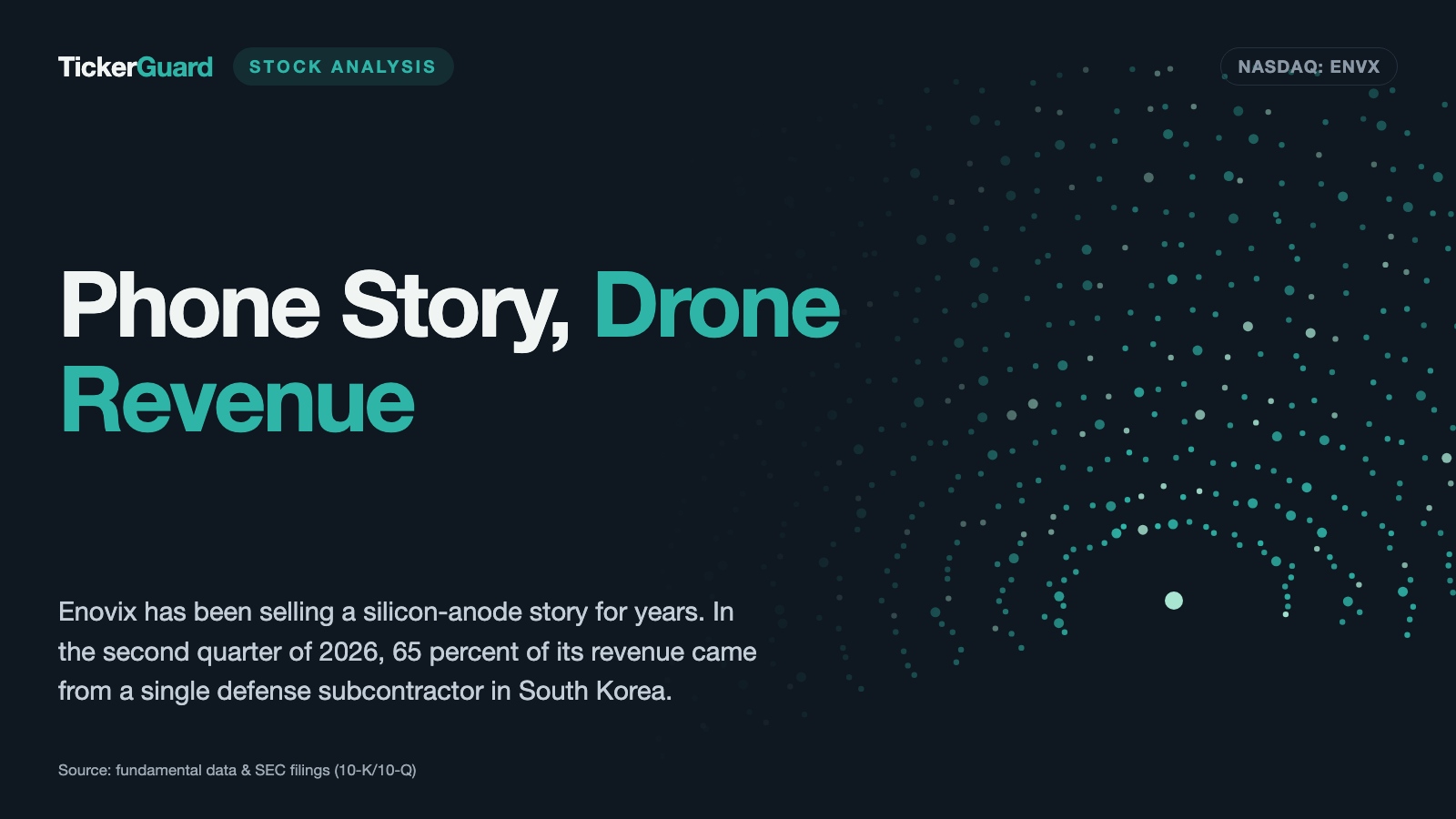
Interactive price chart (TradingView).
52-week range: 2.60 $ to 13.20 $ · Last price: 2.70 $ (As of: October 5, 2026)
Note: pure fact-based analysis, not investment advice and not a solicitation to buy or sell. All figures without guarantee.
There is an investor weakness that feels like patience — which is exactly why it lasts so long: the moving finish line. It works like this. A company promises a breakthrough. It then genuinely delivers milestones — test results, certifications, hurdles cleared — and every one of them feels like a step closer to the end. Except the finish line moves a little further out each time. You end up counting the steps and mistaking that for progress, because you stopped measuring the distance.
Enovix Corporation (NASDAQ: ENVX) has been supplying material for that trap for years — and in August 2026 it produced two headlines that only make sense read together. On August 12, the company said its lead customer had confirmed that Enovix batteries passed more than 1,000 charge cycles under the 0.2C discharge test: the milestone the stock has been waiting on for years. On August 13, chief executive Raj Talluri resigned. So here is the deal: we will read the quarterly report that sits between those two dates together, and look at what this company actually lives on while it waits for the breakthrough. What you do with that is up to you.
What Enovix actually does — one battery idea and two very different factories
Enovix was founded in Silicon Valley in 2006 and listed in July 2021 — not through a conventional initial public offering, but by merging with a blank-check company, the Rodgers Silicon Valley Acquisition Corp. The U.S. securities regulator, the SEC, still carries that former name in the company\'s registration data, and it explains why a semiconductor veteran named T. J. Rodgers has sat on the board for years. The head office is in Fremont, California; manufacturing left long ago.
The technical idea is quickly told. In a normal lithium-ion battery, the negative electrode — the anode — is mostly graphite. Silicon could hold several times more lithium per gram, but it has a catch: it swells while charging and shrinks while discharging until the cell falls apart mechanically. Picture trying to fit a sponge into a rigid shoebox that soaks itself full every time you use it. So Enovix does not wind its cells; it stacks the electrodes and holds them under pressure with a proprietary, patented restraint — the annual report calls it a "constraint system." The goal is a cell with a 100 percent silicon anode that still survives many hundreds of charge cycles.
More interesting for shareholders than the chemistry is where the company physically stands. Enovix effectively runs two very different factories. One sits in the Penang Science Park in Malaysia, is called Fab2, opened in 2024 and holds three lines — a pilot line, the "Agility" line and a high-volume manufacturing line. That is where the silicon-anode cell that carries the entire equity story is built. The other sits in Nonsan, South Korea; it arrived in 2023 with the acquisition of battery maker Routejade, was expanded in 2025 with a second facility (acquired from SolarEdge, April 2025), and mostly produces conventional and silicon-blended graphite cells for defense, medical and industrial customers.
The 10-K for fiscal 2025 shows how unevenly the capital is spread: of $170.3 million in property and equipment as of December 28, 2025, $125.3 million sat in Malaysia, $38.2 million in South Korea and just $5.5 million in the United States. Hold on to that picture, because it is the tension running through this analysis: the factory holding three quarters of the capital produces almost no revenue. The factory producing the revenue barely appears in the story.
For scale: Enovix employed roughly 664 people as of December 28, 2025, 12 percent of them in the United States and 88 percent across Asia-Pacific — South Korea, Malaysia, India and China. The company reports as a single operating segment; the filings contain no separate profit-and-loss statement for the two plants.
One convention to settle up front, so the dates in this analysis do not confuse: Enovix does not report in calendar months but in a fiscal year of 52 or 53 weeks ending on the Sunday nearest December 31. That is why fiscal 2025 closed on December 28, 2025 and the second quarter of 2026 on July 5, 2026. The odd cut-off dates are not typos; they are exactly the dates used in the filings with the U.S. securities regulator, the SEC — and in substance each fiscal year lines up with the calendar year.
Company history for investors
-
2021
July: listing through a blank-check company
Enovix reaches the Nasdaq by merging with Rodgers Silicon Valley Acquisition Corp. For shareholders, the starting point: roughly 145 million shares and no revenue from the core business.
-
2023
October: acquisition of Routejade in South Korea
The deal brings two plants with four production lines — and for the first time a business that actually takes in money. It remains the source of most revenue today.
-
2024
Opening of the Fab2 plant in Malaysia
Silicon-anode production moves to Penang. Three quarters of property and equipment has sat there ever since — along with every hope for the smartphone business.
-
2025
July and September: $232.1 million from warrants, $360 million from notes
A warrant dividend creates 26.5 million new shares; a 4.75 percent convertible note follows in September. For existing holders: more cash in the bank, less ownership per share.
-
2026
August 12: Enovix discloses more than 1,000 confirmed charge cycles
The buyer itself certifies the cell's cycle life — during the second quarter of 2026 (ended July 5), disclosed on August 12. It is the most important technical proof in company history, yet still no date is given for volume revenue.
-
2026
August 13: chief executive resigns
Raj Talluri leaves one day after the best quarterly report of his tenure. The stock falls to a new annual low within two trading sessions.
How this stock reached our desk — a selloff with two explanations
ENVX came to us through our daily Reddit sweep — the review of the most heavily discussed U.S. stocks in the large retail forums (run of August 21, 2026). Why it shows up there is visible in the price data. As of August 20, 2026, ENVX traded at $3.27 — roughly 77 percent below its 52-week high of $14.21 and only about 7 percent above its 52-week low of $3.06. Year to date the stock was down about 55 percent, with roughly 30 percent of that in the final month alone.
The drop has a date. On August 12, 2026, Enovix reported quarterly results after the close; the stock finished that day at $4.73. On August 17, the day the CEO departure was disclosed, 34.1 million shares changed hands — a multiple of normal volume — and the stock fell roughly 18 percent to $3.60. The next session took it down to the annual low of $3.06.
One more factor both explains and amplifies moves like that: as of August 20, 2026, roughly 50.1 million shares were sold short — about a quarter of the freely tradable float. Selling short means borrowing shares, selling them, and hoping to buy them back cheaper later. A stock carrying that kind of short interest reacts disproportionately to news of any kind, in both directions. Buying here means buying not just a company but a positioning.
Which is precisely why the filings matter more than the chart. Let us start with what genuinely impresses.
The numbers over the years — credit where it is due
It would be unfair to dismiss Enovix as a pure promise machine. Revenue is growing, and it has done so for years without interruption: $6.2 million (2022), $7.6 million (2023), $23.1 million (2024), $31.8 million (2025) — up 37.9 percent in the latest fiscal year. The first half of 2026 added $16.6 million, up 32 percent year over year; the quarter ended July 5, 2026 came in at $9.0 million, the fifth consecutive quarter of year-over-year growth and at the high end of the company\'s own guidance.
The gross margin trend is more striking still. In 2023 it was deeply negative — $7.6 million of revenue against $63.1 million of cost of revenue, a gross loss of $55.4 million. By 2024 the gross loss had shrunk to $2.0 million, and in 2025 Enovix posted its first gross profit of $6.1 million. The quarter ended July 5, 2026 was the seventh in a row with a positive gross profit. For a company that manufactures cells, that is not a given: it means each battery sold now brings in more than it costs to make.
And then there is the other side of the same table:
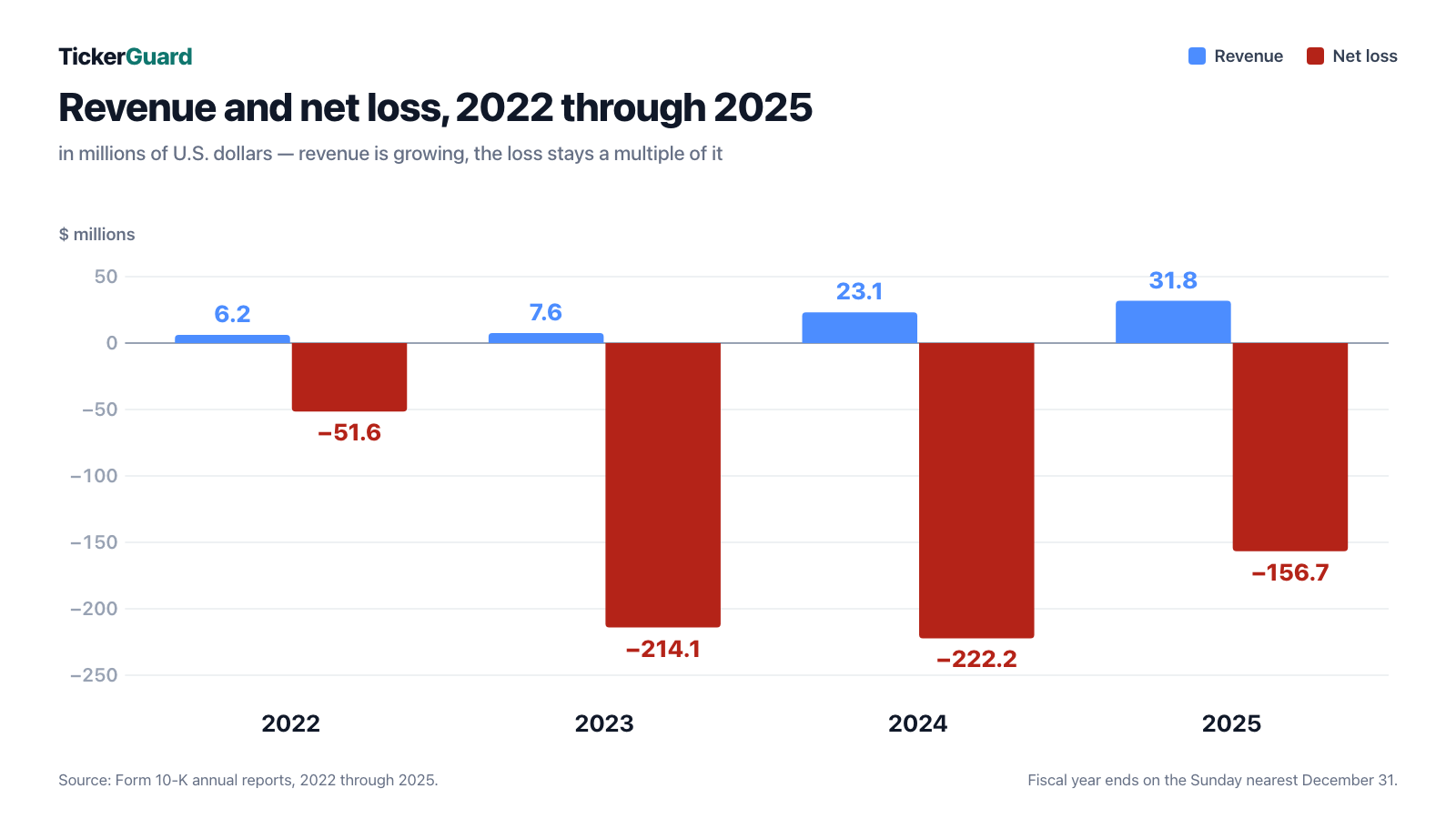
Net losses were $51.6 million (2022), $214.1 million (2023), $222.2 million (2024) and $156.7 million (2025). The accumulated deficit — every loss since inception added up — reached $1.06 billion as of July 5, 2026. Put differently: for every dollar of 2025 revenue there was roughly $4.90 of loss sitting next to it. The first half of 2026 changed little: $16.6 million of revenue against $81.3 million of net loss attributable to common stockholders.
An important qualifier on scale: a large share of those costs is research. Enovix spent $88.4 million on research and development in 2023, $124.5 million in 2024 and $110.3 million in 2025 — more than three times annual revenue in the latest year. For a technology developer that is not inherently wrong. It simply does not answer the question of when it turns into a business. And it explains why the company would not survive a month without the capital markets.
Uncomfortable truth No. 1: two thirds of revenue comes from one defense subcontractor
Follow Enovix in the press and you read about smartphones, smart eyewear and silicon anodes. Open the notes to the Form 10-Q for the quarter ended July 5, 2026 and you read something else:

Who Customer A is comes out in the risk factors of the same report:
"Our current revenue stream is derived largely from a limited number of key customers, particularly those in the defense sector. One customer, a defense subcontractor in South Korea, accounted for the majority of our total revenue for the fiscal quarter ended July 5, 2026 and fiscal year 2025."
— Enovix Corporation, Form 10-Q for the quarter ended July 5, 2026, Part II, Item 1A (Risk Factors)
The geographic breakdown in the 10-K for fiscal 2025 confirms the picture: of $31.8 million in annual revenue, $21.6 million was billed in South Korea, $4.3 million in Switzerland, $2.1 million in the United States, $1.5 million in Norway and $1.0 million in Taiwan. Nor is this new: one customer accounted for 75 percent of revenue in 2023, 50 percent in 2024 and 64 percent in 2025.
That is the real punchline about Enovix, and it is remarkably little known: the company whose stock trades as a bet on the smartphone battery of the future earns its money today from conventional cells for aerial and subsea drones and naval munitions — built in a Korean plant bought in 2023. From the Malaysian factory, which holds $125.3 million of the $170.3 million in property and equipment, the quarter ended July 5, 2026 brought the first smart-eyewear product revenue of any size: roughly 2,100 AI-1 batteries shipped against a customer order for 50,000 packs. The company itself calls the amount "modest."
Fairness requires a caveat: the concentration is a dependency, but not an immediate threat to survival. Enovix does not live off revenue in the first place; it lives off its balance sheet. Losing that customer would cost $9 million of quarterly revenue, not $43 million of quarterly loss. Which is also the uncomfortable version of the same statement: revenue is not this company\'s livelihood right now, it is evidence. And the evidence currently carries the wrong return address.
Uncomfortable truth No. 2: $532.5 million of debt — and 43.2 million shares that do not exist yet
The $552.1 million of cash, marketable securities and restricted cash Enovix reported as of July 5, 2026 looks like safety. Most of it is borrowed.
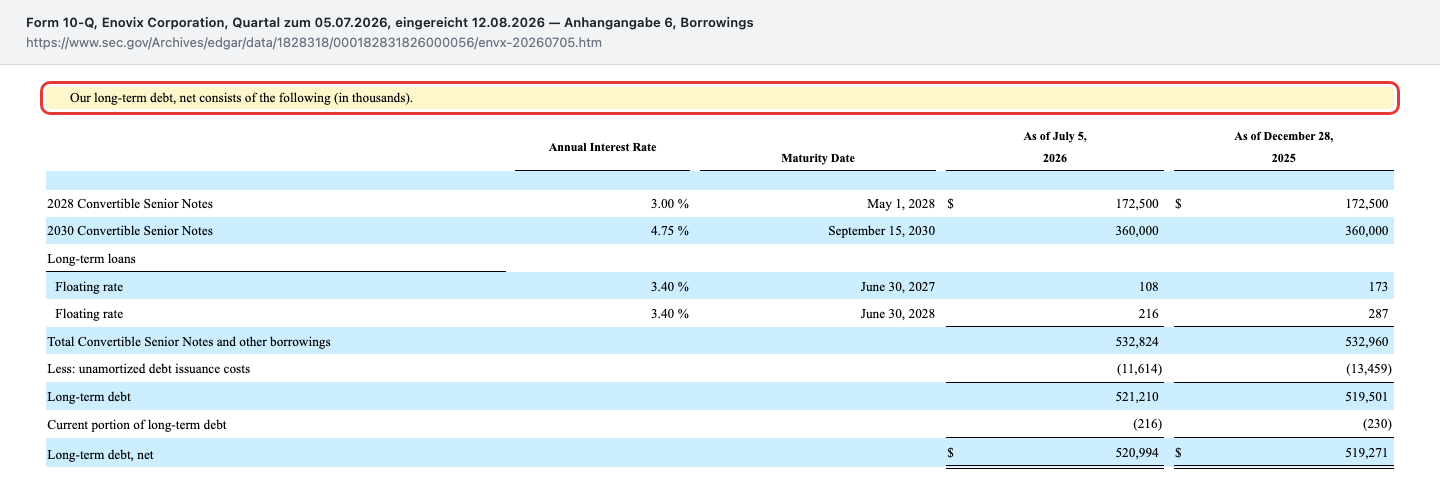
A convertible note is a loan with an exchange right: the holder collects interest and may, under set conditions, swap the note for stock. For the company it is cheap money — 3.00 and 4.75 percent are remarkably low for a business that loses money every quarter. For the existing shareholder it is a bet that the swap never happens.
The arithmetic: Enovix issued the first note in April 2023 at $172.5 million (due May 1, 2028) and the second on September 10, 2025 at $360.0 million (due September 15, 2030). Interest expense consequently rose to $6.5 million in the quarter ended July 5, 2026, from $1.7 million a year earlier — up 282 percent. On the other side, Enovix earned $5.1 million of interest income on the invested proceeds in the same quarter. Net, the financing currently costs roughly $1.4 million per quarter, which is why the debt load is large but not an acute problem.
The problem sits elsewhere: dilution. "Dilution" sounds harmless, but it simply means your slice of the pie shrinks because new slices get handed out without the pie getting bigger. The quarterly report lists how many shares could theoretically still arrive:
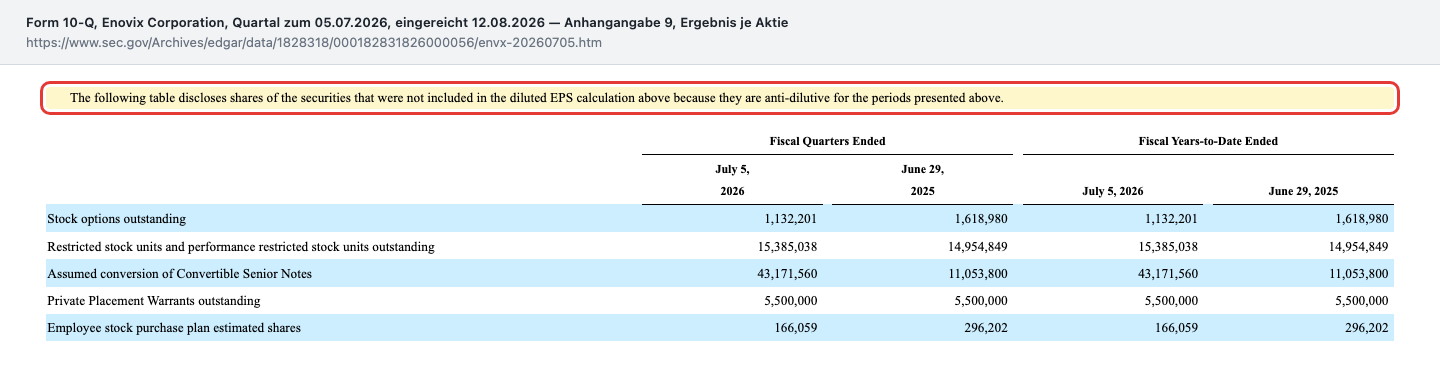
That adds up to 65.4 million potential shares. One item has since resolved itself: the 5,500,000 private placement warrants left over from the 2021 blank-check structure expired unexercised on July 14, 2026 — they carried a $10.66 strike and were far out of the money. That leaves roughly 59.9 million potential new shares against 219,448,535 outstanding as of August 7, 2026: dilution potential of about 27 percent.
Back out the conversion rights against the note principal and you get an average exchange price of roughly $12.33 per share ($532.5 million divided by 43,171,560 shares). At $3.27 on August 20, 2026, conversion is a long way off — which is good and bad news at once for existing holders. Good: no new shares for now. Bad: if the price stays where it is, the $172.5 million has to be repaid in cash on May 1, 2028, and the $360.0 million on September 15, 2030.
And dilution is not a theory here, it is the history of this stock. In July 2025 Enovix paid an unusual special dividend: warrants distributed to its own shareholders. Exercising them brought the company $232.1 million in gross proceeds — and created 26,526,344 new shares.
How long the cash lasts can be estimated roughly. Free cash outflow in the first half of 2026 was $67.7 million; annualized, about $135 million. Against $552.1 million of cash and securities that implies runway of roughly four years, assuming spending stays flat. The company itself puts it more cautiously:
"We have incurred operating losses and negative cash flows from operations since inception through July 5, 2026 and expect to continue to incur operating losses for the foreseeable future."
— Enovix Corporation, Form 10-Q for the quarter ended July 5, 2026, Liquidity and Capital Resources
What the report explicitly does not contain is a going-concern warning. Enovix states that its cash will be sufficient for the next twelve months. If you want to see what a battery company looks like when that sentence is missing, our analysis of Eos Energy Enterprises is the comparison: negative equity and a far tighter financing position. On this point Enovix is clearly in better shape.
Uncomfortable truth No. 3: the CEO left one day after the best quarter of his tenure
On August 12, 2026, Raj Talluri, chief executive of Enovix, faced analysts with the best news of his tenure: the lead customer had confirmed 1,000 charge cycles, revenue came in at the high end of guidance, and the drone pipeline had grown 41 percent in a single quarter. He framed it as "Enovix is executing the transition from technology validation to commercial scale." One day later he was gone.

The board handled the succession on August 14 in two moves. T. J. Rodgers — founder of Cypress Semiconductor, non-executive chairman since April 2023 and, per the company\'s own press release, its largest shareholder — became executive chairman and thus operationally involved. Chief financial officer Ryan Benton, with the company since April 2025, additionally took on the role of interim chief executive while an external and internal search runs. Combining the CFO and CEO roles temporarily is not unusual at this size, but it does weaken internal control: the person responsible for the numbers is currently also responsible for the business those numbers describe.
In the press release of August 17, Rodgers framed the change himself:
"This is a CEO transition, not a strategy transition. Our customer programs and the teams responsible for their execution remain unchanged. The Company also reaffirms its Q3’26 financial guidance and reiterates the news of the breakthrough technical progress on cycle life reported in our August 12 Q2’26 investor call."
— T. J. Rodgers, executive chairman, Enovix Corporation, press release dated August 17, 2026 (Exhibit 99.1 to Form 8-K)
That reaffirmation is worth more than a reassuring sentence: it is a public, testable commitment. Third-quarter guidance calls for revenue of $9.0 million to $10.0 million, a non-GAAP operating loss of $29.0 million to $32.0 million and capital expenditures of $8.0 million to $12.0 million. Whether it holds will show up in the next quarterly report.
Context matters here: the whole executive layer is in motion. On July 9, 2026, Enovix announced the appointment of Michael Vyvoda as chief operating officer effective July 29 — a manager who previously spent five years running product operations for Apple\'s AirPods line. You can read that as reinforcement or as churn. Neither reading is provable. What is provable is that a company describing itself as being at the decisive stage of its history has, within roughly five weeks, acquired a new chief operating officer (announced July 9, 2026, effective July 29), an operationally engaged chairman and an interim chief executive (both appointed on August 14, 2026).
Considerably earlier, on May 5, 2026 — two months before quarter-end — Enovix had also announced a new sales leader: Steve Bakos. He does not come from the battery industry but from semiconductors, with more than 35 years in the global semiconductor business according to the company, most recently at Infineon Technologies and before that at Linear Technology, Intersil and Exar (Form 8-K dated May 5, 2026, Item 7.01, Exhibit 99.1). That hire has nothing to do with the change at the top: it came roughly 14 weeks earlier.
One legacy issue has largely resolved itself. The securities class action filed in 2023 over allegedly misleading statements about the manufacturing ramp is formally still pending but much reduced. In October 2025 the court struck two of the three remaining statements; on April 21, 2026 it denied class certification, and the appeals court declined to hear a petition against that denial. Enovix has recorded no liability for the matter.
What the stock costs
Everything below carries the data date of August 20, 2026 and should be read as an order of magnitude, not a day price. The closing price was $3.27; at 219,448,535 shares outstanding that gives a market capitalization of roughly $718 million. The cross-check works: share count from the cover page of the August 7, 2026 quarterly report times closing price yields exactly that figure.
There is no price-to-earnings ratio — Enovix loses money. Two other measures do the work. First the price-to-sales ratio: against trailing twelve-month revenue of $35.9 million (fiscal 2025 plus the first half of 2026 minus the first half of 2025), the stock trades at roughly 20 times sales. Second, enterprise value — market capitalization plus debt minus cash: $718 million plus roughly $543 million of borrowings minus $552.1 million of cash and securities gives about $709 million, essentially the same number. The reason is notable: the cash almost exactly offsets the debt. What you buy here is neither a debt problem nor a cash cushion, but the technology and the factories.
Against that stands book equity of $209.9 million as of July 5, 2026 (total assets $799.6 million, total liabilities $587.6 million). That works out to a price-to-book ratio of roughly 3.4 — you pay about three and a half times balance-sheet substance.
The professionals\' view is far friendlier than the tape. Of 13 analysts with published views as of August 20, 2026, nine rated the stock a strong buy, two a buy and two a hold; none recommended selling. The average price target was $10.86 — more than three times the price at the time. Such targets deserve caution: they generally assume smartphone qualification arrives. That is precisely the open question. Facing the analysts are the short sellers, who have sold roughly a quarter of the float. Rarely have two professional camps been positioned so far apart.
Two metrics from our in-house stock scanner round out the picture — with a warning attached: both are of limited use for a company without earnings. The Piotroski F-Score, a nine-point balance-sheet health check, sits at 3 out of 9. To translate: 3 out of 9 is weak — a genuinely healthy company scores 8 or 9, a solid one 6 or 7. The Altman Z-Score, a bankruptcy early-warning measure, stands at −0.82, deep in the distress zone. It was designed for industrial companies with running earnings and automatically penalizes any loss-maker; with $552.1 million of cash and no material maturity before May 2028 — aside from $10.4 million in continuously rolled-over short-term loans — it clearly overstates the situation.
Upside and risks at a glance
What speaks for Enovix:
- The key technical milestone is documented. In the quarter ended July 5, 2026, the lead customer — not the company — confirmed more than 1,000 charge cycles under the 0.2C test. An independent laboratory had already confirmed 935 Wh/L of volumetric energy density for the AI-1 smartphone cell in December 2025, 12 percent above a leading silicon-doped commercial cell tested.
- Seven consecutive quarters of positive gross profit. A gross loss of $55.4 million in 2023 turned into a gross profit of $6.1 million in 2025 — each cell sold now brings in more than it costs.
- Funding secured into 2028 at least. $552.1 million of cash, securities and restricted cash (July 5, 2026), $453.6 million of working capital, no going-concern warning, no material maturity before May 1, 2028 — aside from $10.4 million in continuously rolled-over short-term loans; interest expense is currently covered roughly four fifths by interest income.
- A second business that is genuinely growing. The drone, defense and industrial pipeline grew from $130 million to roughly $183 million in one quarter; South Korean capacity is being expanded, with new capacity announced for mid-2027.
- The leadership change came without a strategy break or a guidance cut. On August 17, 2026, the board explicitly reaffirmed third-quarter guidance and pulled its largest shareholder, T. J. Rodgers, into an operating role.
What speaks against it:
- Extreme customer concentration at the wrong end. A single defense subcontractor in South Korea accounted for 65 percent of revenue in the quarter ended July 5, 2026, two customers for 80 percent — while the business meant to justify the valuation contributes almost nothing.
- The deadline keeps moving. After the 1,000 cycles comes the final accelerated cycle-life test, with completion expected in the fourth quarter of 2026 — and only then system-level field testing. The company gives no date for volume smartphone revenue.
- An accumulated deficit of $1.06 billion (July 5, 2026) and $67.7 million of free cash outflow in the first half of 2026 alone — at that rate the cash lasts roughly four years, while the second note runs to 2030.
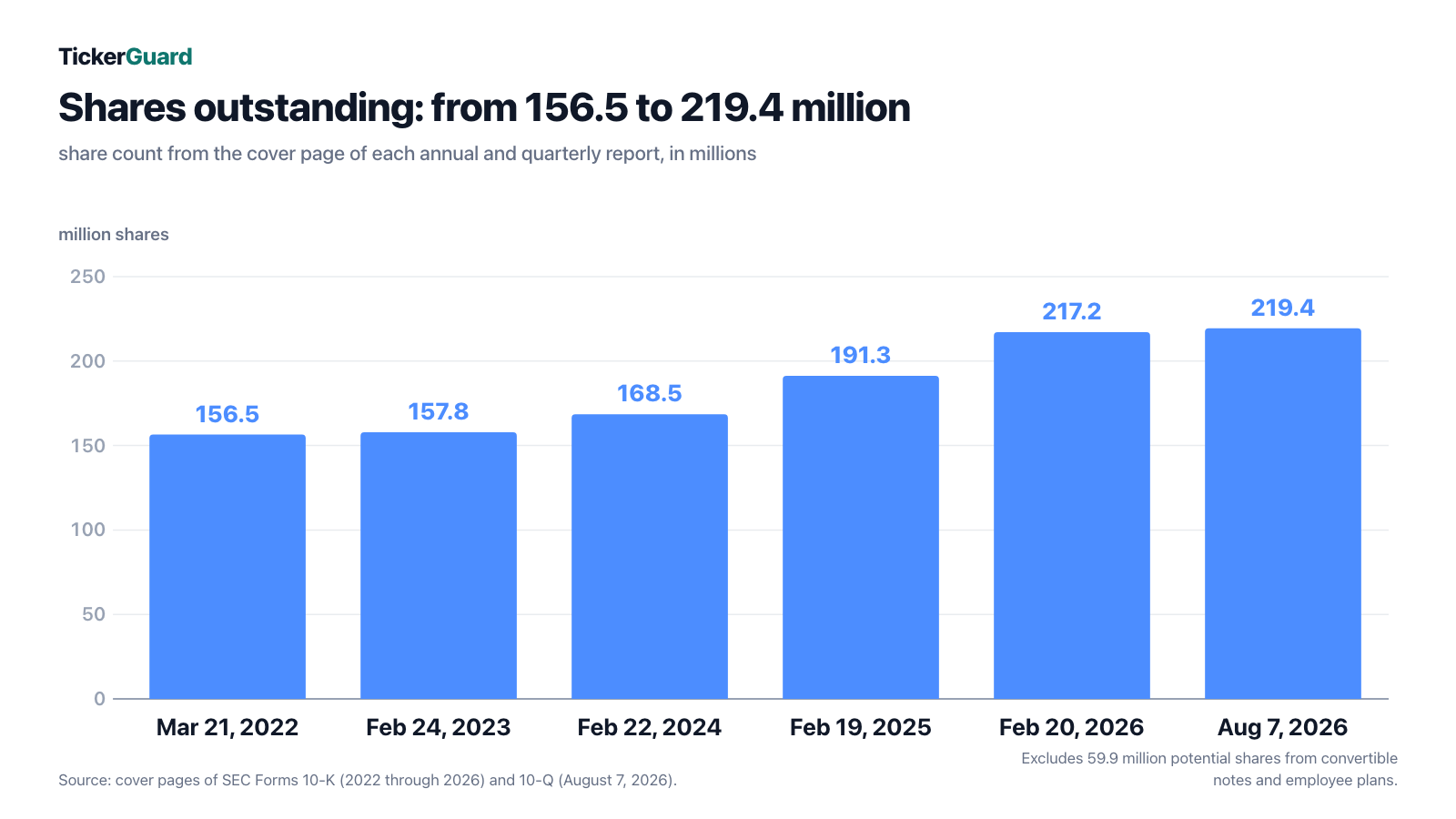
- About 27 percent dilution potential. Roughly 59.9 million potential new shares stand against 219.4 million outstanding (August 7, 2026), 43.2 million of them from the convertible notes; the share count has already risen about 40 percent since March 2022.
- A leadership gap at the decisive moment. The chief executive left one day after the most important milestone, the CFO is running the company on an interim basis in a dual role, and the search for a permanent solution is ongoing.
- The stock is a positioning battle. Roughly a quarter of the float was sold short as of August 20, 2026, which amplifies moves in both directions regardless of the fundamentals.
A human conclusion
Back to the moving finish line. In August 2026 Enovix genuinely delivered what it had promised for years: 1,000 charge cycles, confirmed by the customer rather than by its own press office. That is a real stage win, and anyone holding the stock for that reason has an argument. It simply does not answer the question that matters: when does this become revenue? The next test is running, field testing comes after that, and there is no date. The step was taken — the finish line did not come any closer.
What almost gets lost in all this is the real irony of the company. While everyone watches Malaysia, where $125.3 million of the $170.3 million in property and equipment sits, the money is made in South Korea, with conventional cells for drones and defense systems, out of a plant bought in 2023. You could say Enovix has a working business; it is just not the one the stock is bought for. Whether that is reassuring or unsettling depends on which of the two companies you thought you were buying.
And then there is August 13. A chief executive who leaves one day after the best quarter of his tenure "to pursue another opportunity" leaves a gap no press release closes — not even the very clear one from T. J. Rodgers. It can be exactly as harmless as it says. It can also be what such exits often are: the decision of someone who knows the road to the finish line better than the market does.
So the question this analysis leaves you with is not "is Enovix cheap at $3.27?" but rather: are you buying a battery technology that still owes its proof, or a Korean defense supplier with a very expensive research department? Both sit inside the same ticker, and the quote screen does not tell them apart. What you do with that is your decision. And that is exactly as it should be.
If you want to see the same patience test at another battery developer, our analysis of Amprius Technologies covers the closest comparison: another silicon-anode maker, another promise measured against shipped product rather than press releases.
Sources
- Form 10-Q for the quarter ended July 5, 2026, Enovix Corporation, filed August 12, 2026 (SEC EDGAR, CIK 0001828318) — most recent periodic report
- Form 8-K dated August 12, 2026, Exhibit 99.1 — second-quarter 2026 earnings release including third-quarter guidance
- Form 8-K dated August 17, 2026, Items 5.02 and 7.01 — resignation of chief executive Raj Talluri, appointment of T. J. Rodgers as executive chairman and Ryan Benton as interim chief executive
- Press release dated August 17, 2026 (Exhibit 99.1 to Form 8-K) — T. J. Rodgers quotation, reaffirmed third-quarter guidance
- Form 8-K dated July 9, 2026, Item 5.02 — appointment of Michael Vyvoda as chief operating officer
- Form 10-Q for the quarter ended April 5, 2026, filed May 14, 2026
- Form 10-K for fiscal 2025, filed February 25, 2026
- Form 10-K for fiscal 2024, filed February 25, 2025
- Complete SEC filing history for Enovix Corporation: EDGAR overview (sec.gov)
- Fundamental data (market capitalization, valuation metrics, price history, analyst coverage, short interest; data as of August 20, 2026), reconciled against the SEC filings.
Transparency & disclaimer: This analysis is journalistic commentary on publicly available information. It is not investment advice, not a regulated financial analysis and not a solicitation to buy or sell securities. Equity investments carry substantial risk up to and including total loss. All information without warranty; the as-of date for each figure is noted in the text. Positions held by the operator are disclosed daily; where one exists, it appears as a notice at the top of this deep dive.
Key figures at a glance
All monetary figures in millions of $; earnings per share as reported.
| Metric | 2021 | 2022 | 2023 | 2024 | 2025 |
|---|---|---|---|---|---|
| Revenue | 0.0 | 6.2 | 0.3 | 23.1 | 31.8 |
| Operating Income (EBIT) | -69.5 | -127.1 | -165.5 | -242.7 | -176.6 |
| Net Income | -125.9 | -51.6 | -154.1 | -222.2 | -156.7 |
| Net Margin | -104,895,000.0% | -832.3% | -58,590.9% | -963.2% | -492.6% |
| Earnings Per Share | -1.07 $ | -0.33 $ | -0.97 $ | -1.27 $ | -0.75 $ |
Source: fundamental data & SEC filings (annual and quarterly reports, 10-K/10-Q)
Our Bottom Line at a Glance
- Technical proof positive
- In the quarter ended July 5, 2026, the lead customer confirmed more than 1,000 charge cycles under the 0.2C test; an independent laboratory had confirmed 935 Wh/L of volumetric energy density for the AI-1 smartphone cell in December 2025, 12 percent above a leading silicon-doped cell tested.
- Commercialization negative
- The $31.8 million of fiscal 2025 revenue comes overwhelmingly from the Korean defense business acquired in 2023; the Malaysian plant contributed roughly 2,100 AI-1 batteries and a first revenue contribution the company itself calls "modest" in the quarter ended July 5, 2026.
- Customer concentration negative
- A single customer — described in the 10-Q risk factors as a defense subcontractor in South Korea — accounted for 65 percent of revenue in the quarter ended July 5, 2026, with two customers at 80 percent combined. In fiscal 2023 one customer represented 75 percent.
- Funding and liquidity neutral
- $552.1 million of cash and securities against $543.2 million of total debt (July 5, 2026); no material maturity before May 1, 2028 — aside from $10.4 million in continuously rolled-over short-term loans —, no going-concern warning, and $6.5 million of interest expense offset by $5.1 million of interest income — but $67.7 million of free cash outflow in six months.
- Dilution negative
- Shares outstanding rose from 156.5 million (March 21, 2022) to 219,448,535 (August 7, 2026); roughly 59.9 million potential shares sit on top, 43,171,560 of them from the convertible notes — about 27 percent of dilution potential.
- Leadership negative
- Chief executive Raj Talluri resigned effective August 13, 2026, one day after the report on the 1,000 charge cycles; chief financial officer Ryan Benton has since run the company on an interim basis in a dual role, with chairman T. J. Rodgers as executive chairman. Third-quarter guidance was reaffirmed on August 17, 2026.
In August 2026 Enovix documented the most important technical milestone in its history — the lead customer confirmed more than 1,000 charge cycles — and lost its chief executive one day later. Fiscal 2025 revenue of $31.8 million comes overwhelmingly from the Korean defense business acquired in 2023: a single customer accounted for 65 percent of revenue in the quarter ended July 5, 2026, while $125.3 million of the $170.3 million in property and equipment sits in the Malaysian smartphone plant. All of it is funded with $532.5 million of convertible notes that could create 43.2 million new shares. Not investment advice.
What Our Rating Means
Open questions
The business works in principle, but one material question is open. As long as it stays open, our findings do not carry a quality verdict.
Yellow, and the reasoning has nothing to do with the share price decline — a fallen price is not a quality argument. The hard findings for red are absent: the Form 10-Q for the quarter ended July 5, 2026 contains no going-concern warning, equity is positive at $209.9 million, $552.1 million of cash covers $543.2 million of total debt, the first note does not mature until May 1, 2028, and four fifths of interest expense is paid out of interest income. What is missing for green is proof that the technology becomes a business: after twenty years of development and $1.06 billion of accumulated deficit, two thirds of revenue comes from a single defense subcontractor in South Korea, while the plant carrying the valuation shipped its first meaningful products in the quarter ended July 5, 2026 — roughly 2,100 batteries. On top of that sits an open leadership question: the chief executive left one day after the most important milestone, and the chief financial officer is running the company on an interim basis. Whether the final cycle-life test succeeds in the fourth quarter of 2026 and turns into volume revenue will only show in the coming reports. The decision is yours.
A journalistic assessment by our editorial team at the time of the deep dive, based on public sources — not investment advice and not a solicitation to buy or sell. Your personal circumstances (investment goals, risk capacity, taxes) cannot be taken into account. What our levels mean, how verdicts are formed, and what conflicts of interest exist →
Worth Noting
- This analysis originated from our daily Reddit sweep of the most heavily discussed U.S. stocks (run of August 21, 2026), not from a fundamental hit in our in-house stock scanner.
- Data status: the Form 10-Q for the quarter ended July 5, 2026 (filed August 12, 2026) was fully evaluated, and every filing from that date onward was reviewed. The earnings release Form 8-K of August 12, 2026 and the Form 8-K of August 17, 2026 are incorporated; the insider filing (Form 4) of August 17, 2026 covers only 1,015 shares withheld for taxes and does not change the picture. Price, valuation and analyst data as of August 20, 2026.
- The leadership change of August 13-14, 2026 postdates the quarterly report: the officers named in the 10-Q, Raj Talluri (chief executive) and T. J. Rodgers (non-executive chairman), have since been replaced by Ryan Benton (interim chief executive alongside his CFO role) and T. J. Rodgers as executive chairman.
- The Altman Z-Score of −0.82 and the Piotroski F-Score of 3 (as of August 20, 2026) come from our in-house stock scanner. Both measures were designed for profitable industrial companies and describe a research-driven, cash-rich loss maker only imperfectly.
- Possible confusion: Enovix Corporation was named Rodgers Silicon Valley Acquisition Corp until July 2021 and is not the same company as silicon-anode competitor Amprius Technologies (AMPX) or solid-state developer QuantumScape (QS).
Stock Watch
This analysis is as of August 26, 2026. Stock Watch will tell you what's changed at ENVX since then.
Later $1 a month per stock — signing up is free, and you'll be the first to know when it launches.
The full analysis as a PDF for later
We will send you this analysis as a PDF — to print, file away, and read at your own pace. And we will add you to the free Stock Watch list for Enovix Corp (ENVX), so you hear about it when something material in this analysis changes.
Frequently Asked Questions
Enovix Corporation (NASDAQ: ENVX), based in Fremont, California, develops and manufactures lithium-ion batteries built around a proprietary silicon-anode architecture designed to store more energy in the same space. Production runs in two plants: Fab2 in Penang, Malaysia (silicon-anode cells for smartphones and smart eyewear) and Nonsan, South Korea (conventional and silicon-blended cells for defense, medical and industrial customers, acquired with Routejade in 2023). Fiscal 2025 revenue was $31.8 million.
Mostly from South Korea, not from smartphones. Per the Form 10-Q for the quarter ended July 5, 2026, a single customer accounted for 65 percent of quarterly revenue; the risk factors describe that customer as "a defense subcontractor in South Korea." A second customer represented 15 percent. In fiscal 2025, $21.6 million of the $31.8 million in annual revenue was billed in South Korea. The Malaysian plant generated its first meaningful product revenue in the quarter ended July 5, 2026: roughly 2,100 AI-1 batteries shipped for smart eyewear.
On August 12, 2026, Enovix said its lead customer had confirmed that its cells passed more than 1,000 charge cycles under the 0.2C discharge test — the most important technical hurdle on the path to smartphone qualification. Qualification is not complete, however: one final accelerated cycle-life test is running, with completion expected in the fourth quarter of 2026, to be followed by system-level field testing. No date was given for volume revenue.
Per the Form 8-K filed August 17, 2026, Dr. Raj Talluri resigned as chief executive, president and director effective August 13, 2026, "in order to pursue another opportunity." The filing states explicitly that the resignation was not the result of any disagreement with the company on operations, policies or practices. Chairman T. J. Rodgers became executive chairman and chief financial officer Ryan Benton additionally took over as interim chief executive; third-quarter 2026 guidance was reaffirmed at the same time.
As of July 5, 2026 the balance sheet showed two convertible notes: $172.5 million at 3.00 percent due May 1, 2028 and $360.0 million at 4.75 percent due September 15, 2030 — together roughly 98 percent of total debt of $543.2 million. Against that stood $552.1 million of cash, marketable securities and restricted cash. Quarterly interest expense of $6.5 million was offset by $5.1 million of interest income.
Shares outstanding rose from 156.5 million on March 21, 2022 to 219,448,535 on August 7, 2026, a gain of roughly 40 percent. On top of that sit about 59.9 million potential new shares: 43,171,560 from the assumed conversion of the convertible notes, 15,385,038 from employee equity awards and 1.1 million from options. That is roughly 27 percent of the current count. The 5.5 million private placement warrants from the listing structure expired unexercised on July 14, 2026.
As of July 5, 2026 Enovix held $552.1 million of cash, marketable securities and restricted cash plus $453.6 million of working capital. Free cash outflow in the first half of 2026 was $67.7 million; annualized at roughly $135 million, that implies runway of about four years. The company states in its quarterly report that its cash will be sufficient for the next twelve months; the report contains no going-concern warning.
As of August 20, 2026 (closing price $3.27), market capitalization was roughly $718 million and enterprise value roughly $709 million. Against trailing twelve-month revenue of $35.9 million that is about 20 times sales, and against book equity of $209.9 million about 3.4 times book. There is no price-to-earnings ratio because Enovix loses money. Nine of 13 analysts rated the stock a strong buy with an average target of $10.86, while roughly a quarter of the float was sold short.
Found an error?
Did you spot a factual error, an outdated number, or a typo in this deep dive? Let us know briefly — your report goes straight to the editorial team.