Alpha Tau Stock: A Billion Dollars of Market Value, Not One Dollar of Revenue — and a 100 Percent Response Rate Measured in Nine Patients
Alpha Tau implants tiny radioactive seeds into a tumor and lets them irradiate the cancer from the inside — a genuinely novel idea, approved in Israel and, since February 2026, in Japan. The market values the company at roughly $1.10 billion (data as of July 27, 2026). We read the annual report (20-F) for 2025 and every interim report (6-K) through July 21, 2026, and checked what carries that price: the company has never booked a dollar of revenue since it began operating in 2016, its one U.S. pivotal trial runs without a control group, and its newest headline rate describes nine evaluable patients out of eleven enrolled. Not investment advice — just a careful count of the denominators underneath the percentages.
 Thomas Mücke
Founder & Publisher
Thomas Mücke
Founder & Publisher
As of Today
As of: September 17, 2026
- Closing price
- 15.50 $ +3.00%
- Market Capitalisation
- 1.4 $B
- AAQS
- 1/10
Price change since August 4, 2026: +30.3%
This analysis has a cut-off date. The Stock Guard tells you when something material changes in the numbers. Reserve your free spot
Chart
Interactive price chart (TradingView).
52-week range: 3.50 $ to 15.50 $ · Last price: 15.50 $ (As of: September 17, 2026)
Note: pure fact-based analysis, not investment advice and not a solicitation to buy or sell. All figures without guarantee.
Here is a number: 100 percent. Read it again — did your brain ask "of what"? Probably not, and that is not a personal failing; it is how the percent sign works on all of us. Psychologists call it denominator neglect: a rate feels like a law of nature, a measured property of the world, and the little number underneath it — the how-many-people-was-that — quietly vanishes. Ten percent of a thousand and ten percent of ten look identical on the page and are not remotely the same knowledge. In the summer of 2026 hardly any stock rewards that reflex like Alpha Tau Medical (Nasdaq: DRTS): an Israeli company that implants tiny radioactive seeds into tumors, carries two FDA Breakthrough Device Designations, won an approval in Japan in February 2026, signed its first large U.S. commercial partner in June 2026 — and is valued by the market at roughly $1.10 billion (data as of July 27, 2026). So let's make a deal: we read only what Alpha Tau itself reported to the U.S. securities regulator, the SEC — a filing is honest under penalty of law — and every time a percentage shows up, we go looking for its denominator. Our material: the annual report (20-F) for 2025, filed March 9, 2026, and every interim report (6-K) through July 21, 2026. One housekeeping note, because it explains the paperwork: Alpha Tau is a Foreign Private Issuer — an Israeli company listed in New York — so it files a 20-F once a year and 6-K interim reports rather than the 10-K and 10-Q you know from U.S. companies. At the end you will not get a verdict from us. You will get the denominators.
What Alpha Tau actually does — a sparkler inside the stain, not a floodlight through the wall
Alpha Tau Medical, headquartered in Jerusalem, is what the filings call a clinical-stage oncology therapeutics company — which is the industry's honest way of saying: we develop, we do not yet sell. The company was established in November 2015 and began operating in January 2016; the underlying technology was developed in 2003 at Tel Aviv University by Professors Itzhak Kelson and Yona Keisari. Since March 8, 2022 the shares have traded on the Nasdaq, following a merger with the special purpose acquisition company Healthcare Capital Corp — a SPAC, that is, one of the blank-check vehicles of the 2021 boom. That origin matters for one reason we will come back to: it left warrants on the balance sheet.
The product is called Alpha DaRT, short for Diffusing Alpha-emitters Radiation Therapy, and the idea behind it is genuinely elegant. Conventional radiotherapy is a floodlight: the beam comes from outside and has to travel through healthy tissue to reach the tumor, which is exactly why dosing is a compromise between killing the cancer and sparing the patient. Alpha particles would be the better ammunition — they are biologically far more destructive — but they have a crippling flaw: their range is less than 100 micrometers, under a tenth of a millimeter. Point them at a tumor from outside and they never arrive. Alpha Tau's answer is to stop shooting from outside. The company builds tiny stainless steel or titanium seeds embedded with Radium-224 and injects them straight into the tumor with proprietary applicators. The radium itself stays attached to the seed, but as the annual report describes, "its daughter atoms detach, spontaneously decay and recoil in succession" — the decay products break loose and travel deeper into the tumor, emitting alpha particles as they go, until they stabilize in inert form. The seeds are placed a few millimeters apart so their fields overlap. Radium-224 has a half-life of about 3.7 days; the rest of the chain runs out in roughly 12 hours. In an everyday image: instead of shining a floodlight through the wall to burn out a stain, you place a handful of tiny sparklers directly inside the stain — each burns fiercely, none reaches further than a few millimeters, and within days they burn themselves out and go quiet. That is the whole pitch, and it is a good one.
The scale of the effort is real: as of December 31, 2025 the company had 11 clinical studies ongoing worldwide, across skin, head and neck, pancreatic and brain tumors, and employed 130 people, 112 of them in Israel. It holds a marketing approval in Israel (August 2020) plus, since February 2026, one in Japan. Which brings us to the central tension of this analysis, and it runs through every chapter: two denominators are moving the wrong way. The medical denominator — how many people stand underneath a success rate — is still counted in single and low double digits. The financial denominator — how many shares stand underneath your slice — grows every year. How quickly an impressive percentage from a handful of patients can outrun what it actually proves is something we took apart in our analysis of Fractyl Health, where a celebrated number turned out to describe ten patients against eight. Here the arithmetic is, if anything, tighter.
Company history for investors
-
2015
Founding of Alpha Tau
The company was founded to commercialize the Alpha DaRT technology developed at Tel Aviv University.
-
2020
First marketing approval in Israel
Approval for skin or oral squamous cell carcinoma was the first regulatory milestone after four years of development.
-
2021
Two FDA Breakthrough Device designations
The FDA designated Alpha DaRT a breakthrough technology for skin/oral cancer and recurrent glioblastoma, signaling priority review.
-
2022
IPO via SPAC merger
A merger with blank-check company Healthcare Capital Corp brought the shares to the Nasdaq, leaving warrants on the balance sheet ever since.
-
2026
Distribution agreement with Tolmar
Tolmar secured exclusive U.S. prostate-cancer rights and pays up to $161.5 million in milestones at closing — the first major industry partner.
Where the ticker comes from — and why most of our yardsticks cannot measure this company
DRTS reached our desk through our Reddit hype scanner, which evaluates daily which micro and small caps are the talk of the U.S. stock forums (data basis: ApeWisdom) — the run of July 28, 2026; in the previous pass, on July 16, 2026, it counted all of 2 mentions in 24 hours. That silence is itself a finding: this is not a meme rally. Whoever holds this stock holds it on the science — and on a share price that has run hard in 2026: up 146.7 percent year to date and 321.0 percent above the twelve-month low, while sitting about 10.1 percent below the twelve-month high (data as of July 27, 2026). Our scanner lists are recomputed daily, so what appears on them today can look different tomorrow.
Now the honest part: most of our yardsticks simply do not bite on this company. There is no price-to-sales ratio, because there are no sales. There is no price-to-earnings ratio, because there have never been earnings. The Piotroski F-Score, a nine-point test of balance-sheet health, comes out at 3 out of 9 — which here means less "weak company" than "a test that counts revenue growth and margins finds almost nothing to count at a company without revenue". Conversely the Altman distress score reads 19.4, far above the 1.1 warning threshold — also not a clean bill of health but an artifact: a company with plenty of cash, almost no debt and no revenue scores beautifully in that formula by construction. What actually carries meaning are three numbers from the balance sheet itself: an equity ratio of 72.3 percent, a debt-to-equity ratio of 0.10, and a return on equity of minus 90.5 percent, which says nothing more than that equity is being burned here every year (data as of July 27, 2026). For Alpha Tau that means: no metric as a guardrail, no grade from the database — only the original documents. All the more important to actually read them.
The numbers over the years — honestly appraised
Let's start with what is genuinely impressive, and with this company it is not the income statement — it is the regulatory ledger. August 2020: marketing approval in Israel for squamous cell carcinoma of the skin or oral cavity. June 2021: the FDA grants Alpha DaRT a Breakthrough Device Designation for patients with skin or oral SCC without a curative standard of care. October 2021: a second Breakthrough Device Designation, for recurrent glioblastoma. That program is a real distinction, not a marketing badge — it is reserved for devices addressing life-threatening conditions where, in the FDA's criteria, no approved alternatives exist or the device offers significant advantages, and it buys the developer closer contact with the agency and prioritized review. February 2026: the first approval in a major market — Japan's Ministry of Health, Labour and Welfare granted shonin pre-market approval for unresectable locally advanced or locally recurrent head and neck cancer. May 2026: the operational milestone — the U.S. pivotal ReSTART trial completed enrollment with 88 patients, and the company had submitted the first module of its modular PMA application in January 2026. June 2026: on June 11 the FDA cleared enrollment of the remaining seven patients in the REGAIN glioblastoma trial and authorized two additional U.S. academic centers to join. For a company of this size, that is a decade of patient, unglamorous work paying off.
Then, on June 3, 2026, came the news investors in this sector wait years for: the first large commercial partner. Tolmar, a U.S. specialty pharmaceutical company focused on urology and oncology, takes exclusive U.S. commercialization rights for prostate cancer — for 20 years from first commercial sale, with an option on bladder cancer. At closing Tolmar pays $20 million for new shares at $11.99 (a 25 percent premium to the 30-trading-day VWAP) and $15 million toward building a new U.S. production facility, with up to $96.5 million in development and regulatory milestones and up to $65 million in commercial milestones on top. The catch is in the fine print and belongs on the table right away: Alpha Tau manufactures and supplies, Tolmar controls pricing and sales — and the supply price to Tolmar is set at 60 percent of the onward net sales price. Of every dollar of end-customer revenue, Alpha Tau books 60 cents and carries the manufacturing cost out of it.
Now the income statement, which is short because it starts where other companies' statements are already in their third line. There is no revenue line. Research and development, net ran to $26.4 million (2023), $27.0 million (2024) and $32.1 million (2025); general and administrative added $8.4 million in 2025, marketing $1.9 million. The total operating loss came to $35.7 million (2023), $36.0 million (2024) and $42.3 million (2025); the net loss was $29.2 million, $31.8 million and $42.6 million across those three years. As of December 31, 2025 the accumulated deficit stood at $190.1 million, and from inception through that date the company had raised $234.2 million in total — $225.3 million from issuing shares, $8.8 million from government grants. In the first quarter of 2026 the pace picked up sharply: R&D alone rose 53 percent to $11.0 million (prior-year quarter: $7.2 million), and the operating loss grew to $13.3 million from $9.3 million. The reported net loss of $22.9 million looks more dramatic than the operations are: $9.6 million of it is financial expense from remeasuring warrants — more on that below.
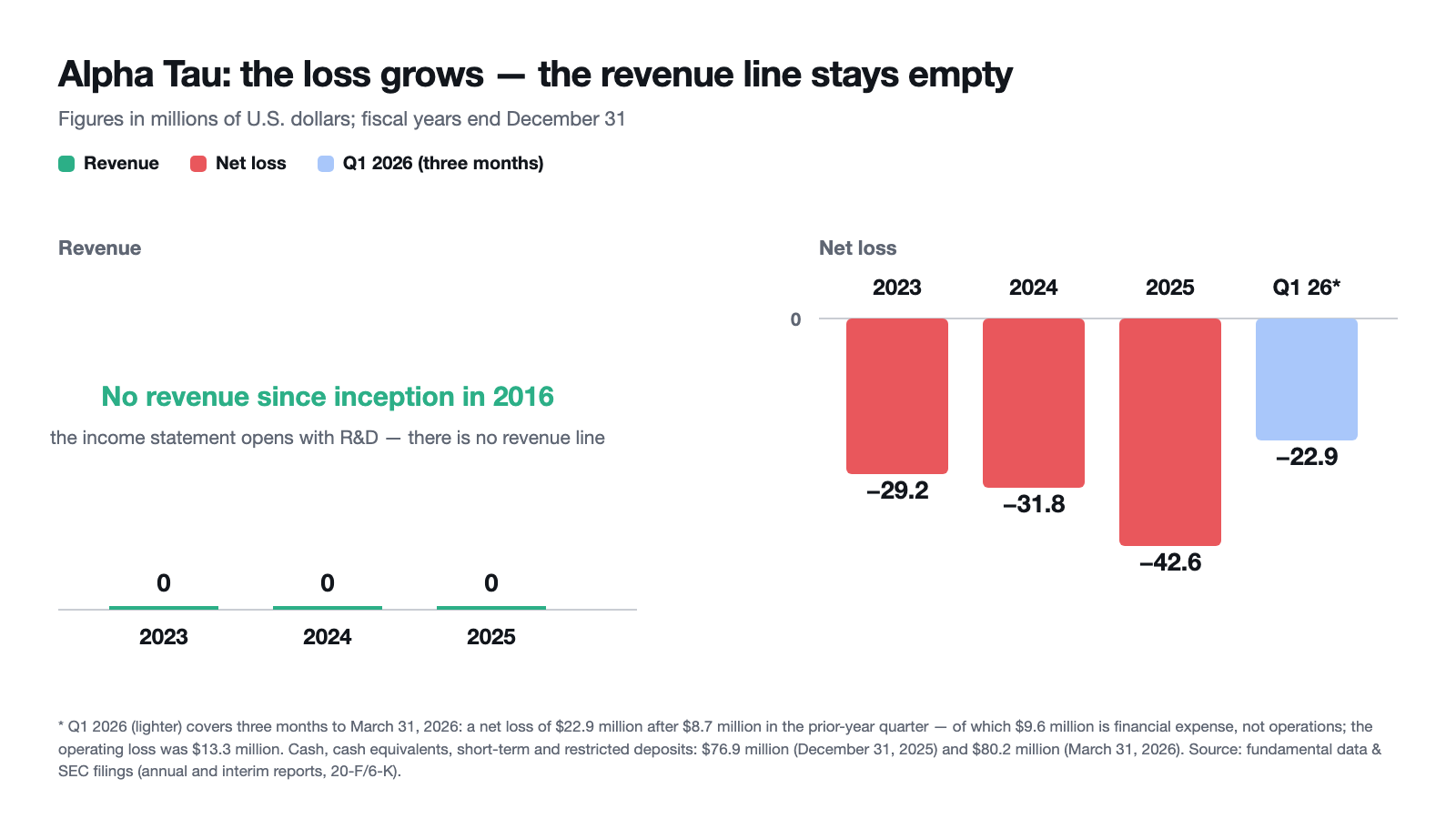
One number deserves genuine credit before we turn the page, because we went looking for the opposite and did not find it: there is no going-concern warning in these filings. Not a word about "substantial doubt" — the phrase that haunts the annual reports of so many clinical-stage companies, and that we found, for instance, in the auditor's opinion at Replimune. Instead, Alpha Tau puts a surprisingly concrete clock on it: "We believe that our existing cash and cash equivalents will enable us to fund its operating expenses and capital expenditure requirements for at least the next two years." As of March 31, 2026 the company held $80.2 million in cash, cash equivalents, short-term and restricted deposits (December 31, 2025: $76.9 million), against an operating cash burn of $26.7 million in 2025 (2024: $19.8 million). On the 2025 burn rate, that is roughly three years of air — and the $35 million Tolmar commitment comes on top at closing. Remember the yardstick: the runway is real, but it is measured against a burn rate the company is deliberately accelerating.
What the filings say — the uncomfortable truths
Uncomfortable truth no. 1: ten years of operations, not one dollar of revenue
Alpha Tau began operating in January 2016. In the decade since, through a Nasdaq listing, two Breakthrough Device Designations and approvals in two countries, the company has never booked a single dollar of revenue. It says so itself, in the first bullet of its own risk summary:
"We have incurred significant losses since inception and have not generated any revenue to date. We expect to incur losses over the next several years and may not be able to achieve or sustain revenues or profitability in the future."
— Alpha Tau Medical Ltd., SEC annual report 20-F for 2025, Item 3.D "Risk Factors"

The same passage adds the sentence that sets the clock: the company's commercial revenues, if any, "will be derived from sales of products that we do not expect to be commercially available for many years, if at all". Read that clause twice — many years, if at all — and then set it beside a market value of roughly $1.10 billion. That is not an accusation; it is a description of what kind of asset this is. There is no business here to value in the ordinary sense: no revenue to multiply, no margin to model, no earnings to discount. What the market is pricing is a probability — the chance that a technology which works in a laboratory and in a few dozen patients will work in a regulated pivotal trial, get approved, get manufactured at scale, get reimbursed, and get prescribed. Every one of those five gates is still ahead. Remember the distinction: a company with no revenue is not cheap or expensive — it is a bet with a price tag.
Uncomfortable truth no. 2: the pivotal trial has no control group
This is the finding that matters most, and it is the one the headlines never carry. Alpha Tau's path to the U.S. market runs through ReSTART, its first and only pivotal trial, in patients with recurrent cutaneous squamous cell carcinoma. The FDA's investigational device exemption permits up to 86 patients at up to 25 U.S. sites; the first patient was treated in March 2023, and enrollment completed in May 2026 with 88 patients. The company plans to submit the data as part of a modular PMA application — the demanding approval route reserved for the highest-risk devices. Here is how the annual report describes the study's design:
"The pivotal study is a prospective, multi-center, single-arm, open label trial enrolling up to 86 patients with recurrent cutaneous squamous cell carcinoma."
— Alpha Tau Medical Ltd., SEC annual report 20-F for 2025, Item 4.B "Business Overview", ReSTART study design

Unpack those two terms, because they carry the weight. Single-arm means every patient gets Alpha DaRT; nobody gets a comparator. There is no group to measure against, so the trial cannot answer "better than what?" — only "what happened to the people we treated". Open label means neither patient nor physician is blinded; everyone knows the experimental therapy is being given, and the person judging whether a tumor shrank knows it too. The gold standard of medicine — the randomized controlled trial, where a coin flip decides who gets the therapy and nobody knows who got it — is the gold standard precisely because it strips out the two things a single-arm open-label study cannot: the natural course of the disease, and hope. In an everyday image: it is a taste test where every taster is told in advance which dish the chef is proud of, and there is no second dish.
To be fair, and this matters: none of this is irregular. Single-arm pivotal trials are common and accepted in device development and in oncology when the population has no curative standard of care — you cannot ethically randomize dying patients to nothing — and the FDA granted the IDE and the Breakthrough Device Designation knowing the design exactly. Alpha Tau is not cutting a corner; it is walking a legitimate path. But the path has a consequence that belongs to you, not to the regulator: a single-arm trial produces a number, not a comparison. If ReSTART reports, say, a 50 percent response rate around the end of 2026, the honest question — 50 percent versus what those same patients would have done otherwise — will have no answer in the data. The company's own risk factors concede the general point: "The results of preclinical studies and clinical trials of our products conducted to date and ongoing or future studies and trials of our current, planned or future products may not be predictive of the results of later clinical trials, and interim results of a clinical trial do not necessarily predict final results." Remember the image: one dish, and every taster was told whose it was.
Uncomfortable truth no. 3: the percentages that carry the story describe three, nine and fifty-eight people
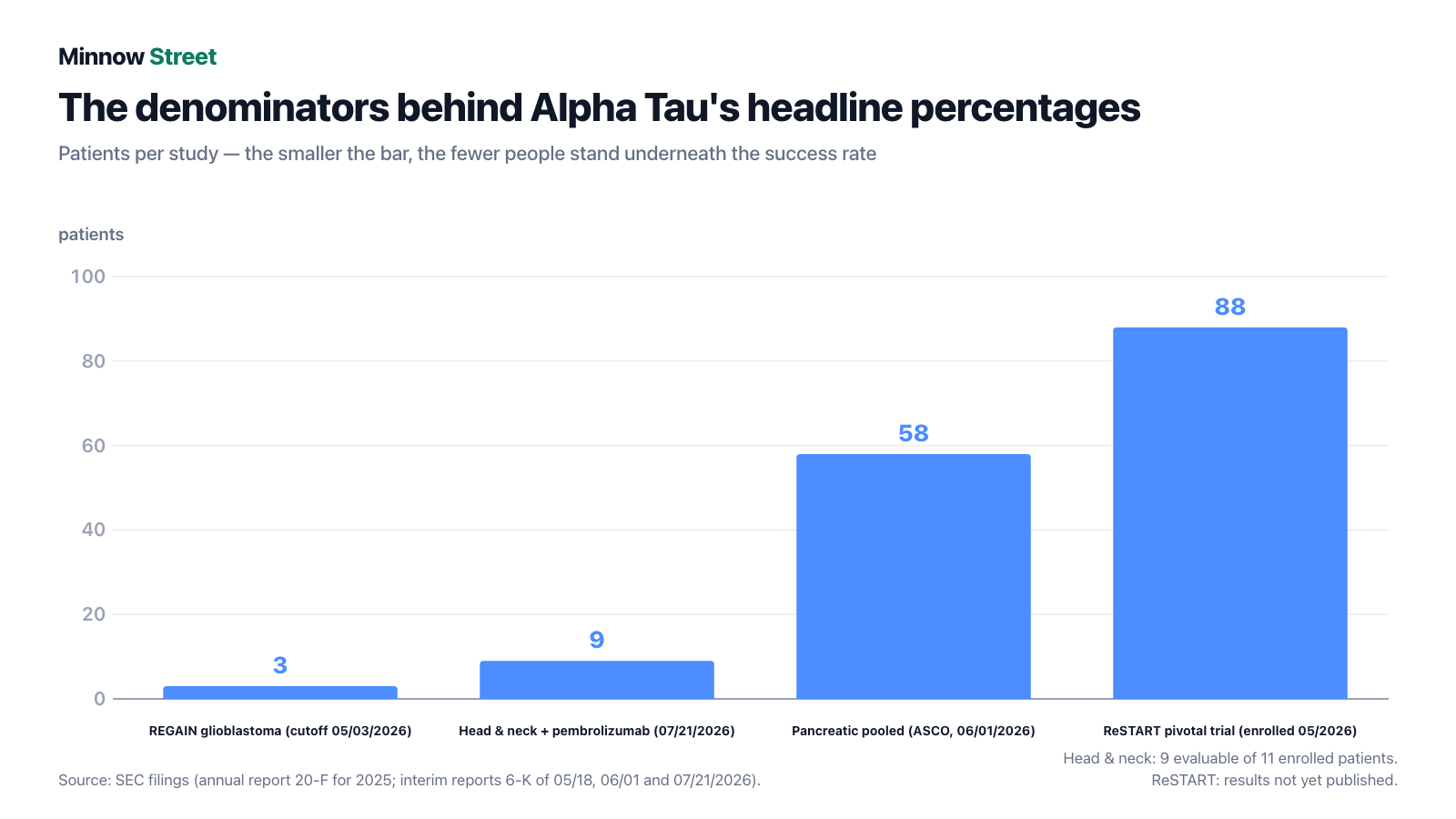
Now we go looking for the denominators — and this is where the opening reflex gets its bill. On July 21, 2026 Alpha Tau reported the complete data from its study of Alpha DaRT combined with pembrolizumab in elderly patients with locally advanced or metastatic head and neck squamous cell carcinoma: a 100 percent objective response rate, four complete and five partial responses, and a median overall survival of 18.2 months. Every one of those figures is true. Here is the denominator, from the same document: eleven patients were enrolled and two died before response evaluation — one before receiving Alpha DaRT at all, the other shortly after treatment from an unrelated cardiovascular event — leaving nine evaluable. Nine out of nine is 100 percent. It is also nine people. The study was designed for up to 48 patients and stopped early under a Simon two-stage adaptive design because more than six patients responded — entirely regular, and a deliberately early draw.
The pattern repeats across the pipeline. In recurrent glioblastoma the company reported in May 2026, from the U.S. REGAIN trial, "100% local disease control, 67% complete response rate" as of the May 3, 2026 cutoff. The denominator: three patients treated — one each in December 2025, February and March 2026 — because the FDA had requested an interim safety look before the trial's scope was expanded. Two of those three showed a complete response; the third had stable disease with a 30 percent tumor reduction. The largest published data set is also the most sober one: the pooled analysis of three prospective pancreatic cancer studies from Montreal and Jerusalem, presented at the 2026 ASCO Annual Meeting on June 1, 2026, covering 58 patients. There the headline is not a response rate but survival — a median overall survival of 11.2 months for metastatic second-line patients from study enrollment against roughly four to six months in the published literature — alongside treatment-associated adverse events in 36 percent of subjects, Grade 3 or higher in 9 percent, with no treatment-related deaths. Notice the direction: as the denominator grows, the numbers get quieter. That is not a scandal — it is what regression to the mean looks like, and it is the single most reliable pattern in early clinical data.
There is a second, subtler denominator in the same release, and Alpha Tau names it itself. The 100 percent is set against the 19 percent that pembrolizumab alone achieves — except that 19 percent does not come from the same study but from the historical KEYNOTE-048 trial in a different patient population. The company says so explicitly:
"Caution should be exercised in comparing results from unrelated clinical studies due to differences in study designs, patient populations and other relevant factors."
— Alpha Tau Medical Ltd., SEC interim report 6-K of July 21, 2026, exhibit 99.1, section "Efficacy Results"
And to be scrupulously fair to Alpha Tau: the company does not hide any of this. The patient counts sit in the same paragraphs as the percentages; the three-patient interim analysis is described as exactly that, and its purpose — an FDA-requested safety look — is stated. The filings even concede the general limitation in plain words: earlier results "may not be predictive of the results of later clinical trials, and interim results of a clinical trial do not necessarily predict final results", and clinical data "are often susceptible to various interpretations and analyses". What the company controls is the press release headline; what you control is whether you read to the denominator. Remember the mechanism: a percentage from three or nine patients is a reason to run the next trial — it is not evidence that the trial will work.
Uncomfortable truth no. 4: nearly 19 million warrants — and since June 30, 2026 they are in the money
Remember the SPAC from the opening? Here is its bill. Note 8 of the annual report lists what the March 2022 merger left behind: 13,605,561 public and 2,142,000 private warrants, each on one ordinary share, exercise price $11.50, exercisable within five years of the grant date — so through roughly March 2027. Add 3,237,000 warrants from the June 2025 Oramed arrangement at $3.90 and $3.474, expiring October 24, 2027. In total, 18,984,561 warrants were outstanding as of March 1, 2026, alongside options on 15,985,500 shares and 597,700 RSUs held by employees, directors and service providers. Add it up: roughly 35.6 million potential new shares against 90,176,067 outstanding (March 31, 2026) — about 39 percent.
And the call is getting closer. On June 30, 2026 the stock closed above $11.50 for the first time since June 2022; on July 27, 2026 it stood at $12.21. The 15.7 million SPAC warrants are therefore in the money — worth something to their holders, and expiring within months. Were they all exercised, roughly $181 million would flow into the company, more than double today's cash pile; at the same time the share count would grow by about 17 percent. You cannot have both at once. That is the heart of every dilution.
The second half of this find is an accounting mechanic that distorts the reported loss in a direction nobody expects. The warrants do not sit in equity; they sit on the balance sheet as a liability measured at fair value. When the share price rises, their value rises — and the difference lands in the income statement as financial expense. That is exactly what happened in the first quarter of 2026: the warrants liability jumped from $5.354 million to $15.748 million, and $9.6 million of the $22.9 million net loss was that single line. The share price stood at $7.07 on March 31, 2026. Put plainly: the better the stock does, the bigger the loss the company reports — without a cent more leaving the building. So read the next interim report from the financial-expense line up before you flinch at the loss. One item for the calendar: once the closing price reaches $18.00 for 20 out of 30 trading days, the company may redeem the public warrants for one cent apiece and force exercise. Through July 27, 2026 that price had never been reached.
For completeness, the third channel: since May 1, 2026 a shelf registration for $300 million has been effective, containing a sales agreement for up to $100 million of shares sold straight into the market. That is money management can draw without a fresh announcement — the prospectus itself calculates that at $8.08 per share (the last reported sale price on April 22, 2026) it would mean about 12.4 million new shares. None of this is forbidden or hidden; for a company without revenue it is the normal way to breathe. But it belongs in the same arithmetic as the response rates: the medical denominator stays small, the financial one grows.
Uncomfortable truth no. 5: nothing is approved in the United States — and the biggest risk is not in the lab
Two facts round out the picture, and they pull in different directions. The first is regulatory. Despite ten years of work, two Breakthrough Device Designations and approvals in Israel and Japan, the U.S. market — the only one that would justify a billion-dollar valuation — remains closed:
"To date, we have not obtained authorization from the FDA to market any product candidate in the United States, and we are currently pursuing PMA approval for our Alpha DaRT technology, which may limit our ability to implement product changes following any potential approval."
— Alpha Tau Medical Ltd., SEC annual report 20-F for 2025, Item 3.D "Risk Factors"

The PMA is the heavyweight route: the filing itself notes it is "much more costly and uncertain than the 510(k) clearance process and generally takes from one to three years, or even longer, from the time the application is submitted". Alpha Tau is filing it modularly — submitting pieces as they are ready, with the non-clinical module already in as of January 2026 — which spreads the work but does not shorten the odds. And note what a Breakthrough Device Designation is and is not: per the FDA's own program description it buys "more interactive and timely communications" and "prioritized review", while expressly "preserving the statutory standards" for approval. It is a faster queue, not a lower bar.
The second fact has nothing to do with medicine. Alpha Tau's people, laboratories and manufacturing sit in Jerusalem, and the annual report says something about that which most investors never read:
"Our commercial insurance does not cover losses resulting from war or terrorist attacks. While the Israeli government has in the past provided compensation for certain damages caused by such events, we cannot assure you that such government compensation programs will continue, or if continued, will be sufficient to compensate us fully for any losses incurred."
— Alpha Tau Medical Ltd., SEC annual report 20-F for 2025, Item 3.D "Risk Factors"

The same section names the mechanism that hits a company like this hardest: prolonged conflicts "have in the past required significant mobilization of military reservists, including personnel employed in the sector in which we operate, which may affect workforce availability". Alpha Tau's own report notes that the majority of its trials and preclinical studies are led internally rather than through external contract research organizations, and that the bulk of R&D spending goes to internal personnel and to manufacturing the Alpha DaRT sources for its own studies. Translated: this company is its people in Jerusalem. To be fair, the report also states that as of its date, regional security conditions had not had a material impact on results — and the risk is one every Israeli issuer carries. But it is an unhedged, uninsurable risk sitting underneath a billion-dollar valuation, and it deserves to be named rather than assumed away.
Valuation: a billion dollars for a probability
In late July 2026 Alpha Tau's market value stood at roughly $1.10 billion (data as of July 27, 2026), across 90,325,876 shares — the most recent count any filing gives, from the proxy statement for the annual general meeting with a record date of May 12, 2026; roughly 1.67 million more shares go to Tolmar when its agreement closes ($20 million at $11.99 apiece — no filing has put a number on the shares yet). Now try to value it, and watch the standard tools break in your hands. A price-to-sales ratio cannot be computed — the denominator is zero. A price-to-earnings ratio cannot be computed — there have never been earnings; the first quarter of 2026 produced a loss of $0.26 per share (prior-year quarter: $0.12). What remains is the balance sheet, and it gives the plainest reading available: book value per share is about $0.77 (March 31, 2026), which puts the price-to-book ratio around 16. More concretely: of the roughly $1.10 billion the market assigns this company, about $80 million is money in the bank (March 31, 2026) — and after deducting all liabilities, net current assets come to just $41.9 million, or 3.8 percent of the price. Essentially all of the rest is the expectation that Alpha DaRT gets approved and sells. That is not a criticism of the price — it is what the price is. Every clinical-stage company is valued this way; the only question is whether the probability being priced matches the evidence on the table.
The professionals' view is unanimous and thin: four analysts cover the stock at a consensus of 4.5 on a scale where 5 is the top mark (data as of July 27, 2026). Treat that consensus for what it is: on a pre-revenue company whose pivotal data has not yet been published, an analyst rating is not a measurement but a modeled guess at the same probability you are guessing at, and four voices in unison are less a second opinion than an echo. The ownership structure is more interesting: insiders hold roughly 31 percent of the shares, institutions only about 5 percent (data as of July 27, 2026). This is a company that belongs chiefly to its founders and early backers — with everything good about that (patience) and everything uncomfortable (a thin float, little outside scrutiny). The real test, though, is on the calendar rather than in the models: the company expects ReSTART top-line data around the end of 2026, with REGAIN enrollment completing in the second half of 2026 and further data there around year-end. Put differently: the market has already priced the answer to a question the data has not yet been asked.
Opportunities and risks at a glance
What speaks for Alpha Tau:
- A genuinely novel mechanism with a real scientific rationale: Radium-224 seeds whose daughter atoms diffuse a few millimeters through the tumor, harnessing alpha radiation's destructive power while turning its sub-100-micrometer range from a defect into a safety feature (annual report 20-F for 2025, Item 4.B).
- Regulatory progress that is datable, not promissory: marketing approval in Israel (August 2020), two FDA Breakthrough Device Designations (June and October 2021), Japan's shonin pre-market approval in February 2026 — the first approval in a major market — and the FDA's clearance of June 11, 2026 to complete REGAIN enrollment with two additional U.S. academic centers.
- The first large commercial partner is signed: on June 3, 2026 Tolmar took exclusive U.S. prostate cancer rights, paying $20 million of equity at $11.99 per share and $15 million toward a new U.S. plant at closing, with up to $161.5 million in milestones — an outside specialist examined the technology and put money behind it.
- No going-concern warning anywhere in the filings: $80.2 million of cash, cash equivalents, short-term and restricted deposits (March 31, 2026) against a 2025 operating cash burn of $26.7 million, an equity ratio of 72.3 percent and a debt-to-equity ratio of 0.10 (data as of July 27, 2026).
- Breadth and safety record: 11 clinical studies ongoing worldwide as of December 31, 2025, across skin, head and neck, pancreatic and brain tumors; in the July 21, 2026 combination study no Alpha DaRT-associated serious adverse events were observed and the only two associated events were Grade 1.
What speaks against it:
- Not one dollar of revenue since operations began in 2016: a net loss of $42.6 million and an accumulated deficit of $190.1 million (December 31, 2025); the filings expect products to be commercially available only "for many years, if at all".
- The one U.S. pivotal trial is "single-arm, open label" — no control group, no blinding; it will produce a response rate, not a comparison, and the FDA route is a PMA, which the filing itself calls "much more costly and uncertain" than the alternatives and typically takes one to three years or longer.
- The headline percentages rest on tiny denominators: a 100 percent response rate = nine evaluable of eleven enrolled patients, two of whom died before evaluation (July 21, 2026); 67 percent complete response = two of three (cutoff May 3, 2026); the largest published data set covers 58 patients. The 19 percent benchmark it is compared against comes from an unrelated trial — the company warns about that itself.
- Dilution is structural: 18,984,561 warrants, options on 15,985,500 shares and 597,700 RSUs (as of March 1, 2026) together equal roughly 39 percent of shares outstanding; the weighted share count rose 27 percent in twelve months; and since May 1, 2026 a $300 million shelf including a $100 million at-the-market program has been available. R&D spending is rising 53 percent year over year against a fixed cash pile.
- Unhedgeable geography: people, labs and manufacturing sit in Jerusalem, commercial insurance "does not cover losses resulting from war or terrorist attacks", and reservist mobilization can pull staff out of a company whose work is done almost entirely in-house.
A human conclusion
Back to the number we opened with. 100 percent. You now know it means nine people, out of eleven who were treated at all — and knowing that does not make it worthless. Four complete responses in elderly patients with advanced head and neck cancer, in a setting where the standard of care produces a response in fewer than one in five, is a genuinely remarkable thing that happened to four human beings. Hold both thoughts at once, because this is the whole discipline: the finding is real, and it is not yet evidence. Those are not contradictory statements. They are the difference between a reason to keep going and a reason to bet a billion dollars.
What we found in the filings is a company that is more honest than its headlines: the patient counts sit right there next to the percentages, the single-arm design is stated plainly, the war risk is named, the warning against cross-trial comparisons is in the company's own press release, and — unlike so many of its peers — there is no going-concern warning to explain away. What we also found is a valuation with nothing underneath it but a probability: no revenue in ten years, roughly $80 million of the $1.10 billion in actual money, a price-to-book ratio around 16 — and beside it roughly 39 percent of additional shares waiting as warrants, options and RSUs, the largest tranche of which went into the money on June 30, 2026 and expires around March 2027. Between those findings sits a date: the end of 2026, when ReSTART finally reports and this technology gets measured against a pre-specified endpoint in 88 patients instead of three. Whether you want to own the bet before that answer arrives — paying today's price for tomorrow's proof — or would rather read the readout first and possibly pay more for certainty, is not a question the filings can settle for you. But at least now, when the next press release leads with a percentage, you will do the thing your brain did not want to do at the top of this page: you will look for the denominator. What you make of it is your decision. And that is exactly as it should be.
Sources
All original documents used in this analysis — to read for yourself:
- Alpha Tau Medical Ltd. — SEC annual report 20-F for 2025 (filed March 9, 2026)
- Alpha Tau Medical Ltd. — SEC interim report 6-K of May 18, 2026, exhibit 99.1: first quarter 2026 financial results and corporate update (most recent financial report)
- Alpha Tau Medical Ltd. — SEC interim report 6-K of May 11, 2026: interim results from the U.S. REGAIN glioblastoma trial (three patients, cutoff May 3, 2026)
- Alpha Tau Medical Ltd. — SEC interim report 6-K of July 21, 2026: complete data from the Alpha DaRT plus pembrolizumab combination study in head and neck cancer
- Alpha Tau Medical Ltd. — SEC interim report 6-K of June 3, 2026: collaboration agreement with Tolmar for prostate cancer in the United States
- Alpha Tau Medical Ltd. — SEC interim report 6-K of June 1, 2026: pooled survival data from three pancreatic cancer studies (ASCO 2026)
- Alpha Tau Medical Ltd. — SEC interim report 6-K of June 11, 2026: FDA clearance to complete enrollment in the REGAIN glioblastoma trial
- Alpha Tau Medical Ltd. — SEC shelf registration F-3 of April 28, 2026 ($300 million, including a $100 million at-the-market program)
- Alpha Tau Medical Ltd. — SEC interim report 6-K of June 25, 2026: resolutions of the annual general meeting of June 23, 2026
- Alpha Tau Medical Ltd. — SEC annual report 20-F for 2024 (filed March 12, 2025)
- Alpha Tau Medical Ltd.'s complete SEC filing history: EDGAR overview (sec.gov) — including the insider filings (Form 4) and sale notices (Form 144) of June 3 through July 7, 2026
- Fundamental data (share count, market value, ratios, analyst consensus; data as of July 27, 2026), reconciled with the SEC filings.
- Reddit mentions: ApeWisdom, run of our in-house Reddit hype scanner of July 28, 2026; reference value 2 mentions in 24 hours on July 16, 2026.
Transparency & disclaimer: This analysis is a journalistic contextualization of publicly available information and is not investment advice, not a financial analysis in the regulatory sense, and not a solicitation to buy or sell securities. Stock investments carry substantial risks up to total loss. All information without guarantee; the data cut-off is noted in the text in each case. Positions held by the operator are disclosed daily; where one exists, it appears as a notice at the top of this deep dive.
Key figures at a glance
All monetary figures in millions of $; earnings per share as reported.
| Metric | 2021 | 2022 | 2023 | 2024 | 2025 |
|---|---|---|---|---|---|
| Revenue | 0.0 | 0.0 | 0.0 | 0.0 | 0.0 |
| Operating Income (EBIT) | -13.8 | -32.1 | -35.7 | -36.0 | -42.3 |
| Net Income | -27.3 | -33.8 | -29.2 | -31.8 | -42.6 |
| Earnings Per Share | -0.40 $ | -0.53 $ | -0.42 $ | -0.45 $ | -0.53 $ |
Source: fundamental data & SEC filings (annual and quarterly reports, 10-K/10-Q)
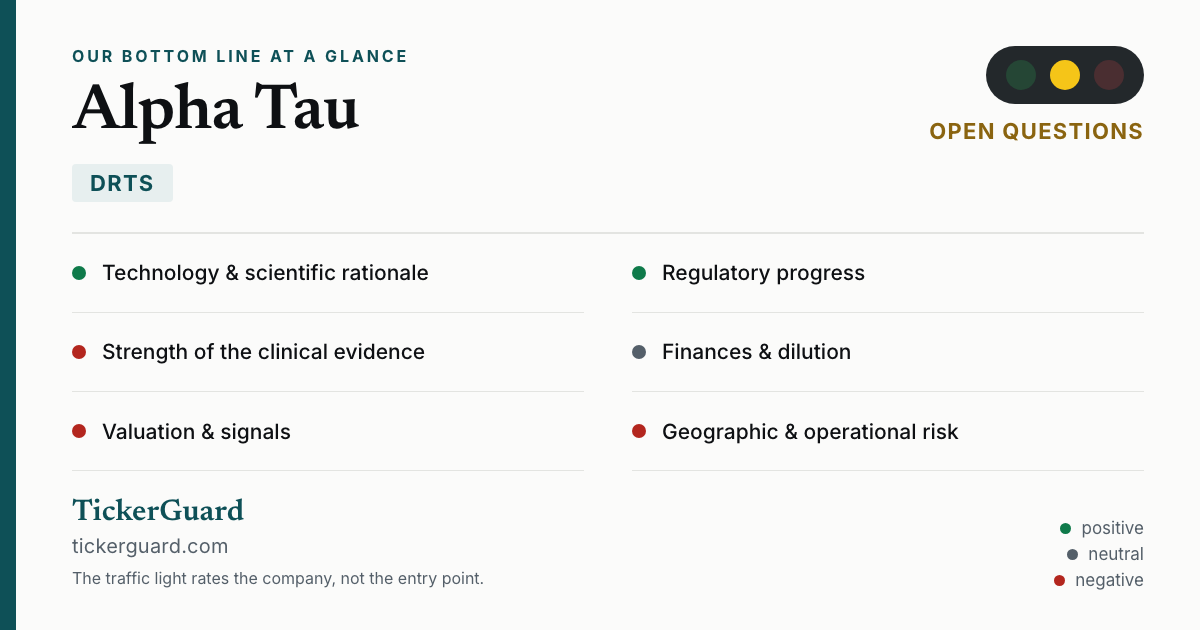
Our Bottom Line at a Glance
- Technology & scientific rationale positive
- A genuinely novel mechanism rather than a me-too: Radium-224 seeds implanted in the tumor whose daughter atoms detach, recoil and diffuse a few millimeters, turning alpha radiation's sub-100-micrometer range from a fatal defect into a containment feature; developed at Tel Aviv University in 2003, 11 clinical studies ongoing worldwide (annual report 20-F for 2025, Item 4.B).
- Regulatory progress positive
- Datable, not promissory: marketing approval in Israel (August 2020), two FDA Breakthrough Device Designations (June and October 2021), Japan's shonin pre-market approval in February 2026 — the first approval in a major market — the pivotal ReSTART trial reaching completed enrollment with 88 patients in May 2026, the first modular PMA module submitted in January 2026, and the FDA's clearance of June 11, 2026 to complete REGAIN enrollment with two additional U.S. academic centers.
- Strength of the clinical evidence negative
- The pivotal trial is "prospective, multi-center, single-arm, open label" — no control group, no blinding, so it yields a response rate rather than a comparison. The quoted percentages rest on tiny denominators: a 100 percent objective response rate = nine evaluable of eleven enrolled patients, two of whom died before evaluation (July 21, 2026); 67 percent complete response = two of three (cutoff May 3, 2026); the largest published data set covers 58 patients (ASCO, June 1, 2026). The 19 percent benchmark comes from an unrelated trial — the company warns about that comparison itself.
- Finances & dilution neutral
- No revenue in ten years, a net loss of $42.6 million and an accumulated deficit of $190.1 million (12/31/2025) — but, unusually for the sector, no going-concern warning: $80.2 million of cash and deposits (03/31/2026) against a 2025 operating burn of $26.7 million is roughly three years of air, with $35 million more from Tolmar at closing. Against that: R&D spending rose 53 percent year over year in Q1 2026, the weighted share count grew 27 percent in twelve months, and 18,984,561 warrants plus options on 15,985,500 shares and 597,700 RSUs equal roughly 39 percent of additional shares.
- Valuation & signals negative
- A market value of roughly $1.10 billion for which no P/S and no P/E can be computed; of that, about $80 million is money in the bank and, after deducting all liabilities, only $41.9 million of net current assets remains — 3.8 percent of the price. Price-to-book around 16, with the stock up 146.7 percent year to date (data as of July 27, 2026). Four analysts cover the stock at a consensus of 4.5 out of 5 — unanimity that is more echo than second opinion on a pre-revenue company whose pivotal data has not been published.
- Geographic & operational risk negative
- People, laboratories and manufacturing sit in Jerusalem, and the company runs the majority of its trials and preclinical work in-house rather than through CROs. The annual report states plainly that "our commercial insurance does not cover losses resulting from war or terrorist attacks" and that reservist mobilization may affect workforce availability; state compensation is possible but not assured (annual report 20-F for 2025, Item 3.D).
Alpha Tau is a rare thing: a clinical-stage company whose filings are more honest than its own headlines. The technology is genuinely novel, the regulatory ledger is real and datable — Israel 2020, two FDA Breakthrough Device Designations in 2021, Japan's approval in February 2026, the first large U.S. commercial partner in June 2026 — and there is no going-concern warning to explain away, with $80.2 million of cash covering roughly three years at the 2025 burn rate. But the market pays about $1.10 billion for a company that has never booked a dollar of revenue in ten years, whose one U.S. pivotal trial runs without a control group, and whose newest headline rate describes nine evaluable patients. Roughly $80 million of that valuation is money; the rest is a probability — and beside it sit roughly 39 percent of additional shares as warrants, options and RSUs. Not investment advice.
What Our Rating Means
Open questions
The business works in principle, but one material question is open. As long as it stays open, our findings do not carry a quality verdict.
The light is yellow because the decisive operating question is open and hangs on a single event: whether the single-arm readout from 88 patients in ReSTART, expected around the end of 2026, is strong enough to carry a modular PMA through the FDA's most demanding approval route. Red is not supported by the evidence — there is no going-concern warning, the equity ratio is 72.3 percent, and $80.2 million covers roughly twelve quarters at the 2025 burn rate, far more than the four below which we assign red. Green is not supported either, because there is no business yet: ten years without a dollar of revenue, and evidence built on response rates with three, nine and 58 patients in the denominator. That the stock has run hard in 2026 and trades at some 16 times book value is a price argument and does not change this rating. The decision is yours.
A journalistic assessment by our editorial team at the time of the deep dive, based on public sources — not investment advice and not a solicitation to buy or sell. Your personal circumstances (investment goals, risk capacity, taxes) cannot be taken into account. What our levels mean, how verdicts are formed, and what conflicts of interest exist →
Worth Noting
- DRTS reached our research list via the Reddit hype scanner (ApeWisdom, run of July 28, 2026; reference value 2 mentions in 24 hours on July 16, 2026) — the silence is itself a finding: this is a conviction rally, not a forum rally. We do carry metrics for DRTS, but our scanner lists are recomputed daily, and several of our yardsticks (P/S, P/E, Piotroski) cannot be formed meaningfully for a company without revenue; the Altman reading of 19.4 is an artifact of the same fact, not a clean bill of health.
- Alpha Tau is a Foreign Private Issuer and files a 20-F annual report plus 6-K interim reports instead of 10-K/10-Q; quarterly figures therefore arrive as a press-release exhibit to a 6-K. The most recent financial report used here is the 6-K of May 18, 2026 carrying the figures as of March 31, 2026; every filing after it through July 21, 2026 was reviewed. Identity verified on EDGAR (CIK 0001871321): no Form 15, no successor issuer — the living filer is the original entity from the March 2022 SPAC merger.
- Between June 3 and July 7, 2026, chief financial officer Raphi Levy reported sales of 112,270 shares in total at prices between $9.47 and $14.00 (Forms 4 and 144), halving his directly held stake from 180,180 to 90,180 shares. Measured against 90,176,067 shares outstanding that is 0.12 percent — below our materiality threshold, hence a note rather than a chapter. The annual general meeting of June 23, 2026 re-elected David Milch and Ruth Alon as directors through 2029, re-appointed Uzi Sofer as chairman with a compensation package, and re-appointed Kost Forer Gabbay & Kasierer (a member of Ernst & Young Global) as auditor for 2026.
- Amounts in Alpha Tau's filings are stated in thousands of U.S. dollars; we converted them to millions in the text. The functional and reporting currency is the U.S. dollar even though a substantial part of expenses — chiefly personnel — is incurred in New Israeli Shekels, so a currency exposure remains and the filing names it explicitly. Valuation figures are dated to July 27, 2026 (market value roughly $1.10 billion on about 90 million shares); analyses are evergreen, daily prices are not a buy argument.
Download the verdict card (traffic light and rating of this analysis as an image, PNG)
Stock Watch
This analysis is as of August 26, 2026. Stock Watch will tell you what's changed at DRTS since then.
Later $1 a month per stock — signing up is free, and you'll be the first to know when it launches.
The full analysis as a PDF for later
We will send you this analysis as a PDF — to print, file away, and read at your own pace. And we will add you to the free Stock Watch list for Alpha Tau Medical Ltd (DRTS), so you hear about it when something material in this analysis changes.
Frequently Asked Questions
It does not — yet. Alpha Tau Medical Ltd. (Nasdaq: DRTS) is a clinical-stage oncology company and has not generated any revenue since it began operating in January 2016: "We have incurred significant losses since inception and have not generated any revenue to date" (annual report 20-F for 2025). Operations are financed by selling shares and by government grants — $234.2 million in total from inception through December 31, 2025, of which $225.3 million came from share issuances and $8.8 million from grants.
Alpha DaRT (Diffusing Alpha-emitters Radiation Therapy) uses tiny stainless steel or titanium seeds embedded with Radium-224 that are injected directly into a solid tumor. Alpha particles are biologically very destructive but travel less than 100 micrometers, so they cannot be aimed at a tumor from outside the body. Alpha Tau's answer: the radium stays on the seed while its daughter atoms detach, decay and recoil deeper into the tumor, emitting alpha particles as they go. The seeds are placed a few millimeters apart; Radium-224 has a half-life of about 3.7 days and the rest of the decay chain runs out in roughly 12 hours (annual report 20-F for 2025, Item 4.B).
No. The annual report for 2025 states: "To date, we have not obtained authorization from the FDA to market any product candidate in the United States, and we are currently pursuing PMA approval for our Alpha DaRT technology […]" Alpha DaRT holds two FDA Breakthrough Device Designations (June 2021 for squamous cell carcinoma of the skin or oral cavity, October 2021 for recurrent glioblastoma) — but that program grants faster interaction and prioritized review while expressly preserving the statutory approval standards. It is approved for marketing in Israel (August 2020) and, since February 2026, in Japan for unresectable locally advanced or locally recurrent head and neck cancer.
No. The annual report for 2025 describes it as a "prospective, multi-center, single-arm, open label trial enrolling up to 86 patients with recurrent cutaneous squamous cell carcinoma" — meaning every patient receives Alpha DaRT, there is no control group, and nobody is blinded. Enrollment completed in May 2026 with 88 patients; per the interim report of May 18, 2026 top-line data is expected around the end of 2026, supporting a modular PMA application. Single-arm designs are common and accepted where no curative standard of care exists, but they produce a response rate rather than a comparison.
Nine patients. On July 21, 2026 Alpha Tau reported complete data from its study of Alpha DaRT combined with pembrolizumab in elderly patients with head and neck cancer: a 100 percent objective response rate, four complete and five partial responses, and a median overall survival of 18.2 months. Eleven patients were enrolled; two died before response evaluation, leaving nine evaluable. The study was designed for up to 48 patients and stopped early under a Simon two-stage adaptive design because more than six patients responded.
As of March 31, 2026 the company held $80.2 million in cash, cash equivalents, short-term and restricted deposits (December 31, 2025: $76.9 million), against an operating cash burn of $26.7 million in 2025 (2024: $19.8 million). There is no going-concern warning in the filings; the annual report for 2025 sets a deadline instead, stating that existing cash "will enable us to fund its operating expenses and capital expenditure requirements for at least the next two years". The Tolmar collaboration adds $35 million at closing. Research and development spending, however, rose 53 percent year over year in the first quarter of 2026, to $11.0 million.
Substantially, and steadily. The weighted average share count used to compute the loss per share rose from 70,450,897 (Q1 2025) to 89,705,391 (Q1 2026) — about 27 percent in twelve months. As of March 1, 2026 there were also 18,984,561 warrants outstanding, 15.7 million of them struck at $11.50 and expiring around March 2027, plus options on 15,985,500 shares and 597,700 RSUs — together roughly 39 percent of the 90,176,067 shares outstanding. On top of that, a $300 million shelf registration including a $100 million at-the-market program has been effective since May 1, 2026.
Because it is a Foreign Private Issuer: Alpha Tau Medical Ltd. is an Israeli company (headquartered in Jerusalem, CIK 0001871321) whose shares list on the Nasdaq. Foreign private issuers file an annual report on Form 20-F once a year and interim reports on Form 6-K, rather than the quarterly 10-Q and annual 10-K that U.S. domestic companies file. Practically, that means quarterly information arrives as a 6-K press-release exhibit rather than as a full quarterly report. Despite the Israeli domicile, the functional and reporting currency is the U.S. dollar.
Found an error?
Did you spot a factual error, an outdated number, or a typo in this deep dive? Let us know briefly — your report goes straight to the editorial team.