C3.ai Trades Simply as “AI” — Yet Its Revenue Fell 36 Percent in the Middle of the AI Boom
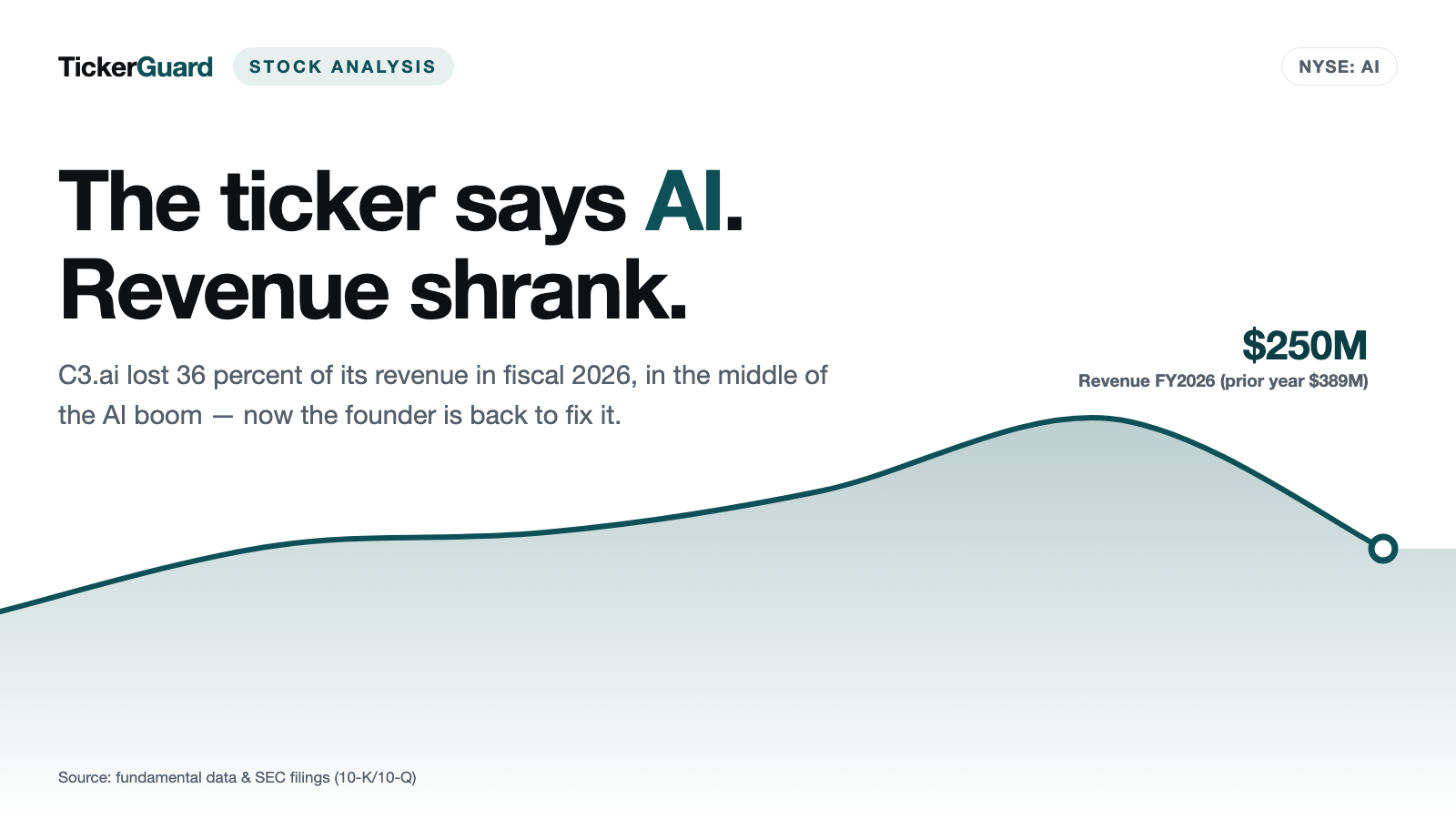
Ticker AI, a famous founder, $651 million in cash and securities: C3.ai looks like the perfect AI stock. Its filings with the U.S. securities regulator tell a different story: a fiscal 2026 with 36 percent less revenue, a $470 million loss and almost no revenue from new customers. Now Tom Siebel is back at the helm — and the $76 million cash increase in the first quarter came almost entirely out of his own pocket.
 Thomas Mücke
Founder & Publisher
As of Today
As of: November 6, 2026
- Closing price
- 11.70 $ +2.72%
- Market Capitalisation
- 1.9 $B
- Growth Score
- 1/10
- AAQS
- 2/10
Price change since November 6, 2026: +0.1%
This analysis has a cut-off date. The Stock Guard tells you when something material changes in the numbers. Reserve your free spot
Chart
Interactive price chart (TradingView).
52-week range: 7.80 $ to 16.10 $ · Last price: 11.70 $ (As of: November 6, 2026)
Note: pure fact-based analysis, not investment advice and not a solicitation to buy or sell. All figures without guarantee.
There is an investor trap that starts with a person, not a number. Let’s call it the captain trap: a ship runs into heavy weather, it drifts off course — and then the old captain comes back on board. Instantly everything feels safer. He built the ship, he knows every plank, he will sort it out. What gets lost is that the weather hasn’t changed, and neither has the leak in the hull. C3.ai (NYSE: AI) is exactly that kind of ship. The stock trades under arguably the best ticker on the exchange, “AI,” and since May 8, 2026, founder Thomas M. Siebel has been back at the helm. So here’s the deal: before you rely on the captain, let’s read the company’s filings with the U.S. securities regulator, the SEC, together — and see what shape the ship is in. Then you decide.
What C3 AI actually sells — a construction kit for AI in large enterprises
C3.ai sells software that large companies and government agencies use to build and run artificial intelligence applications. Think of it as a construction kit: the platform (C3 Agentic AI Platform) is the foundation, and ready-made applications run on top of it — for predicting equipment failures, managing supply chains, or for defense and intelligence work. On top of that come generative AI tools, programs that answer questions in plain language and kick off workflows on their own. The company describes itself in its annual report like this:
“C3 AI is the Enterprise AI application software company.”
— C3.ai, SEC annual report 10-K for the fiscal year ended April 30, 2026, Item 1 “Business”
Almost all of the money comes from subscriptions: in the first quarter of fiscal 2027 they made up 94 percent of revenue; the rest comes from consulting and paid custom development. C3.ai sells directly and through partners such as Microsoft, Amazon Web Services, Google, McKinsey and Baker Hughes. Oilfield services company Baker Hughes had been the exclusive channel partner for the oil and gas industry since 2019; since a contract revision in April 2025, that is no longer the case. One important note for every figure in this article: C3.ai’s fiscal year ends on April 30. “Fiscal 2026” therefore runs from May 2025 through April 2026, and the “first quarter of fiscal 2027” covers May through July 2026. As of April 30, 2026, C3.ai had 764 full-time employees.
Company history for investors
-
2020
IPO on the NYSE
In December 2020, C3.ai goes public under the ticker AI. Through Class B shares with 50 votes each, Siebel secures long-term influence (conversion no later than Dec. 11, 2040).
-
2025
Record year, then a CEO change
In FY2025 (ended April 2025), revenue reaches $389.1M. In September 2025, Stephen Ehikian becomes CEO; Siebel remains chairman.
-
2026
Restructuring and slump
February 2026: restructuring with about 26 percent job cuts. FY2026 ends with $250.3M in revenue (−36%) and a $470.4M loss — the low point for shareholders.
-
2026
The founder returns
On 05/08/2026, Siebel becomes CEO again; on 06/01/2026, he pays $68.8M to exercise options. A signal of confidence, not yet proof of a turnaround.
-
2026
Stabilization in Q1 FY2027
May through July 2026: $52.4M in revenue, operating cash flow positive again ($2.1M). FY2027 guidance: $210M to $240M — still below last year.
How the stock landed on our desk
C3.ai made our research list through our in-house Reddit hype scanner, which tracks stocks that investors are talking about unusually often in online forums (run of November 7, 2026). There is plenty to talk about. The share price fell from $15.52 (November 7, 2025) to as low as $7.76 (March 27, 2026) and stood at $11.69 on November 6, 2026. On top of that, a lot of money was betting on further declines: according to fundamental data (retrieved November 7, 2026), about 42.2 million shares were sold short — roughly 28 percent of the free float. In other words, more than one in four freely tradable shares had been borrowed and sold by people betting on another drop. The data gives no reporting date, so the figure is only an order of magnitude. Setups like that pull in forum attention like a magnet.
C3.ai is not the only software vendor trying to make money selling AI to governments and corporations while wrestling with its numbers — we examined a similar pattern in our BigBear.ai stock analysis. For C3.ai we reviewed the annual report (10-K) for the fiscal year ended April 30, 2026, the quarterly reports (10-Q) through July 31, 2026, the earnings releases of June 3 and September 2, 2026, the current reports (8-K) through the annual meeting on October 26, 2026, and Thomas Siebel’s insider filings (Form 4).
The numbers over the years — an honest look
First, what is genuinely impressive. Between fiscal 2021 and fiscal 2025, C3.ai more than doubled its revenue, from $183.2 million to $389.1 million. It has well-known customers in industry, energy and the U.S. military, and according to its September 2, 2026 earnings release, research firm Forrester named C3 AI a leader in enterprise AI. The flip side: C3.ai did not turn a profit in any of those years. And then came fiscal 2026:
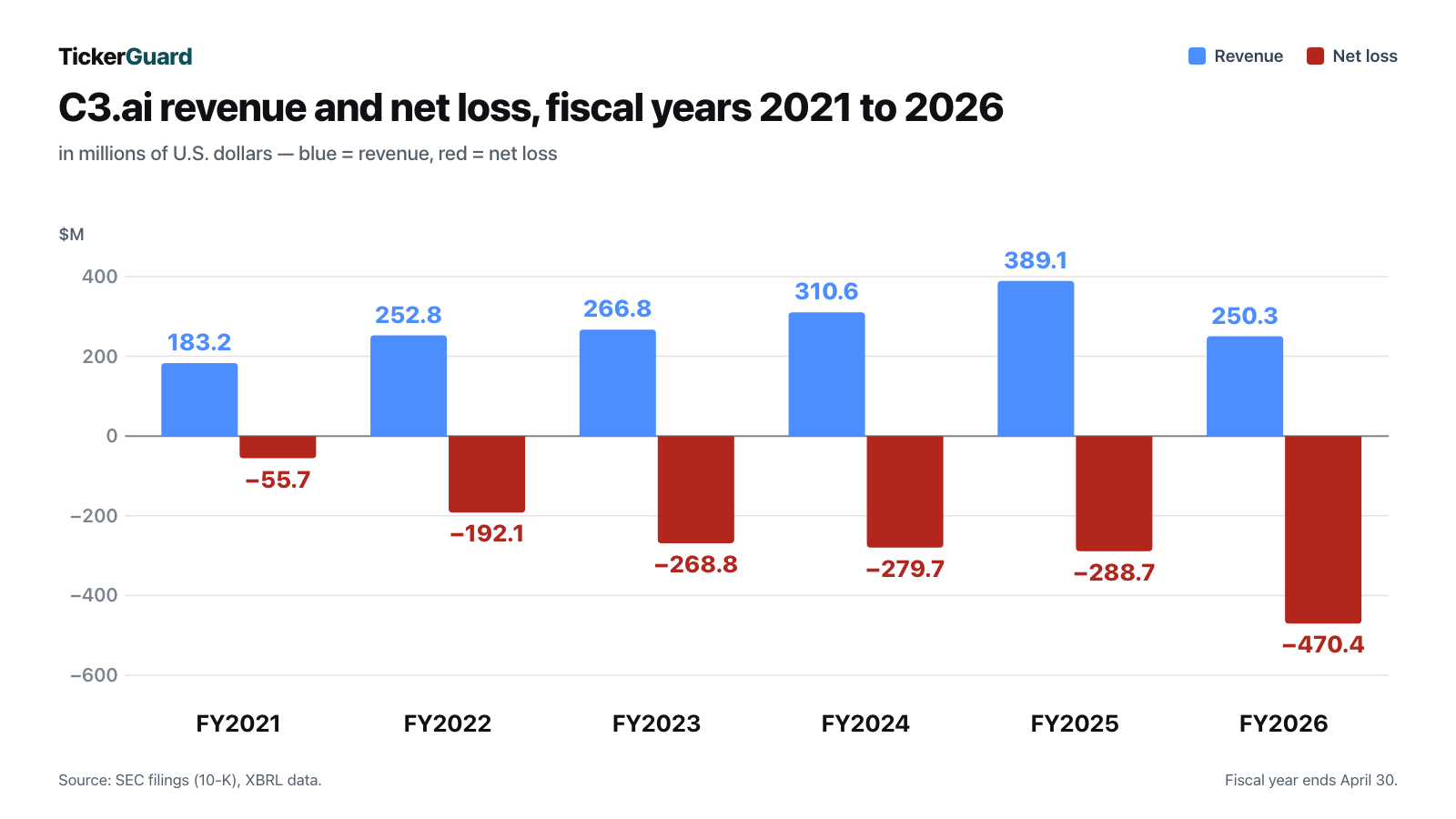
Revenue fell 36 percent in fiscal 2026 — in the middle of a boom in which almost any company with AI in its name had a tailwind. Margins took an even harder hit. Gross margin, the share of revenue left after the direct costs of data centers and customer support, dropped from 61 percent to 31 percent. The reason is simple: the cost of running the software rose from $153.2 million to $172.9 million while revenue shrank. Put plainly, the factory keeps running, but fewer orders come in. The net loss rose to $470.4 million, and accumulated losses since inception reached $1.94 billion by July 31, 2026.
Since the third quarter of fiscal 2026 (November 2025 to January 2026), revenue has steadied at a low level. The quarterly view shows it:
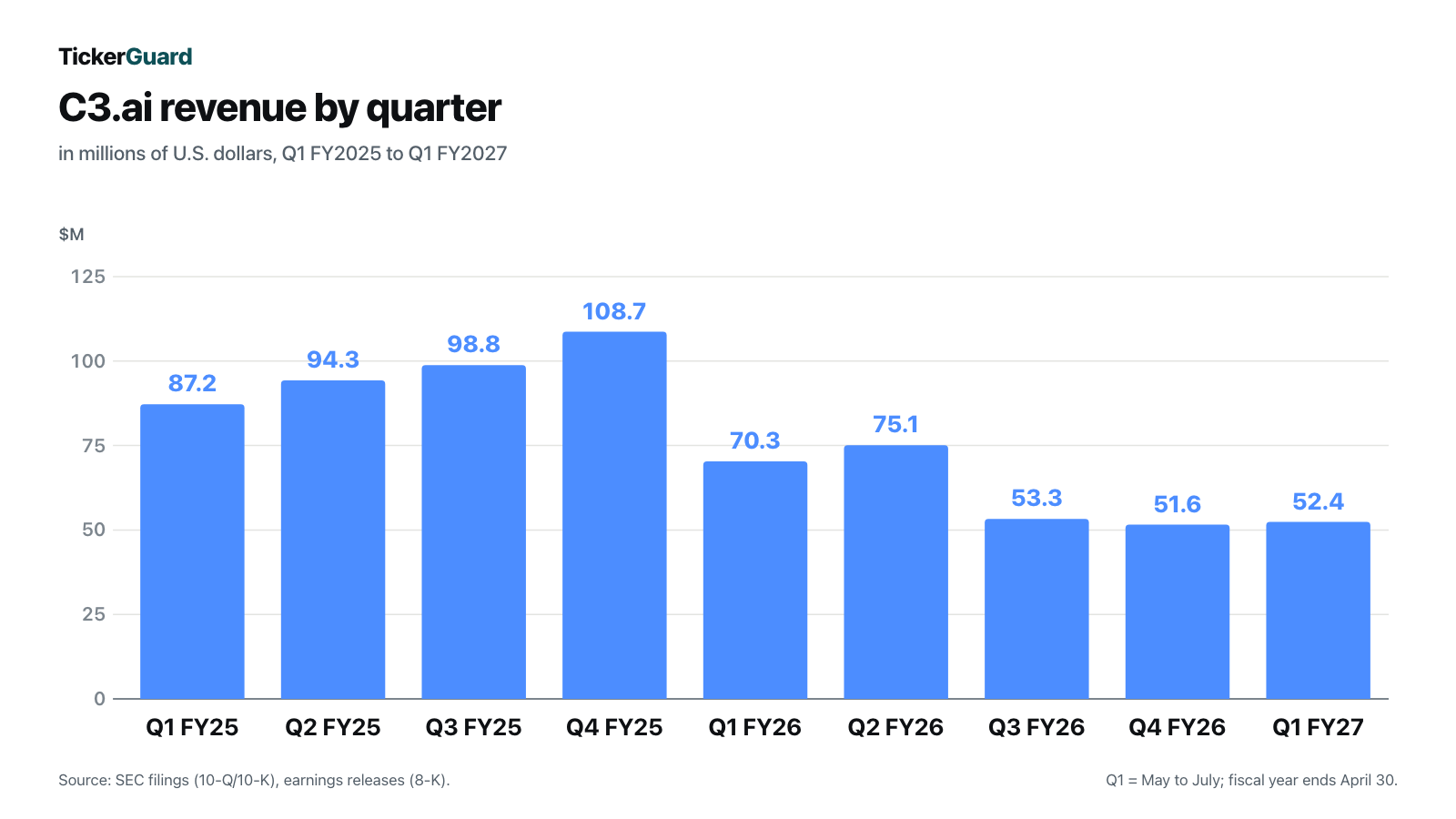
In the first quarter of fiscal 2027 (May through July 2026), revenue was $52.4 million — squarely within the company’s own guidance of $50 million to $54 million, but 25 percent below the prior-year quarter. There are early bright spots: operating cash flow turned positive at $2.1 million for the first time since spring 2025, and the adjusted operating loss (excluding stock-based compensation and restructuring) narrowed from $54.4 million in the prior quarter (February through April 2026) to $36.2 million. Siebel cites a 73 percent sequential increase in bookings, but gives no absolute figure — so this management claim can’t be verified from the outside. Whether it shows up in the backlog will be visible at the earliest in the quarterly report for the period ended October 31, 2026, typically filed in early December. For the second quarter, C3.ai expects revenue of $51 million to $55 million, and for all of fiscal 2027 $210 million to $240 million — once again below last year’s $250.3 million. Remember: stabilized is not the same as turned around.
What the filings say — the uncomfortable truths
Uncomfortable truth No. 1: The slump came in the middle of the AI boom — and the company names homemade causes
When an AI company’s revenue falls in precisely the years in which corporations pour billions into AI, the market is rarely to blame. C3.ai says so with remarkable candor in its annual report:
“We experienced a decline in revenue and an increase in operating losses in the fiscal year 2026 as compared to the prior fiscal year. The results were attributed, in part, to disruption from a comprehensive restructuring of our global sales and services organizations, our Chief Executive Officer (“CEO”) and Chairman’s unanticipated health limitations and unsatisfactory execution by our global sales and services organizations.”
— C3.ai, SEC annual report 10-K for the fiscal year ended April 30, 2026, Item 1A “Risk Factors”
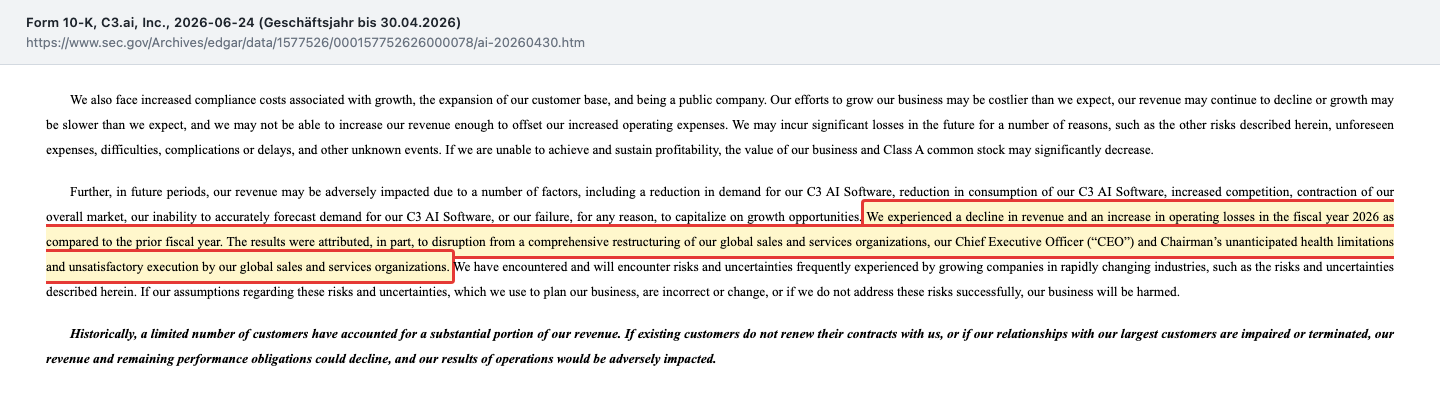
The timeline behind it: from September 2025, Stephen Ehikian ran the company as CEO, while Siebel remained chairman of the board. On February 24, 2026, the board approved a restructuring aimed at cutting about 26 percent of the workforce (roughly 280 full-time positions) and about 30 percent of annual vendor costs. On May 8, 2026, Siebel took over as CEO again, and Ehikian became president. The good news in that paragraph: problems made at home can be fixed at home. The bad news: if customers switched to competitors during that period, they don’t automatically come back just because the founder did.
Uncomfortable truth No. 2: There is almost no new business in revenue
A subscription software company lives on two things: keeping existing customers and winning new ones. For the first quarter of fiscal 2027, the quarterly report shows how thin the second leg has become:
“Approximately 1% and 32%, respectively, of the total subscription revenue for the three months ended July 31, 2026 and 2025 was attributable to revenue from new customers, and the remaining 99% and 68%, respectively, was attributable to revenue from existing customers.”
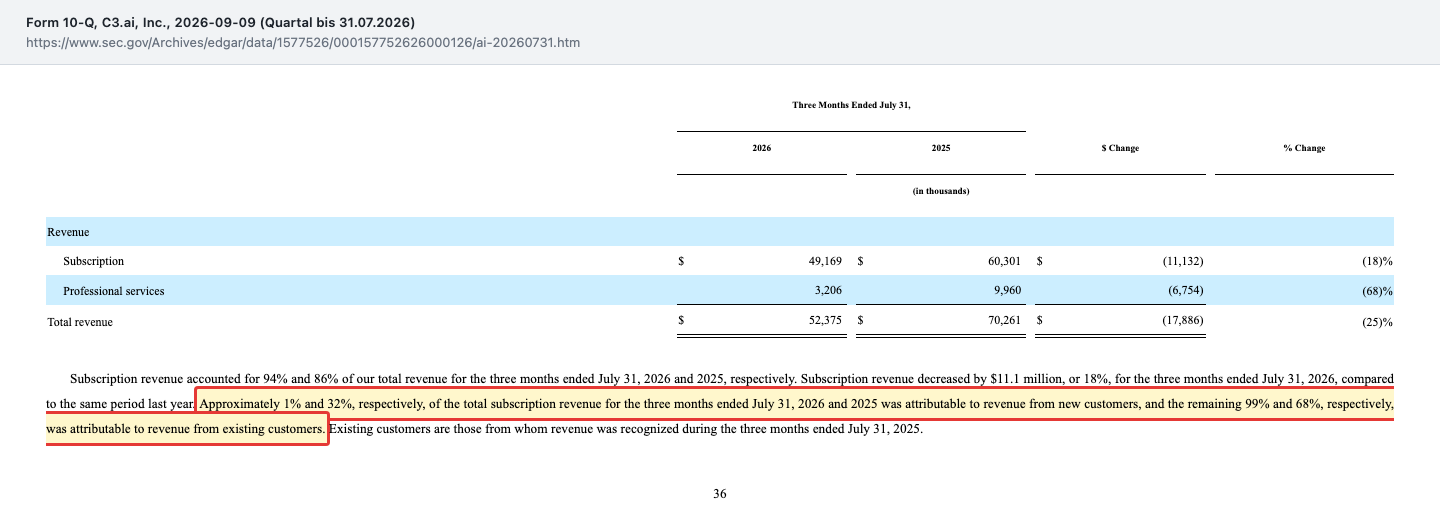
For context: according to the report, an “existing” customer is any customer from whom C3.ai already recognized revenue in the prior-year quarter. New contracts at C3.ai often start as smaller pilot projects and grow later, so a low share in a single quarter is not a verdict on its own. But it fits the rest of the picture: remaining performance obligations — contracted revenue not yet recognized — stood at $200.0 million on July 31, 2026, after $203.1 million on April 30, 2026. The backlog isn’t growing. And a single customer accounted for 15 percent of revenue in the first quarter. Anyone betting on the turnaround is betting that the announced deals show up as revenue in the coming quarters.
Uncomfortable truth No. 3: Cash grew by $76 million — almost all of it came out of the founder’s pocket
The earnings release for the first quarter contains a sentence that sounds like a turnaround:
“Cash balance was $651.1 million, up $76 million QoQ.”
— Thomas M. Siebel, CEO of C3.ai, SEC filing 8-K of September 2, 2026, Exhibit 99.1 (earnings release for the first quarter of fiscal 2027)
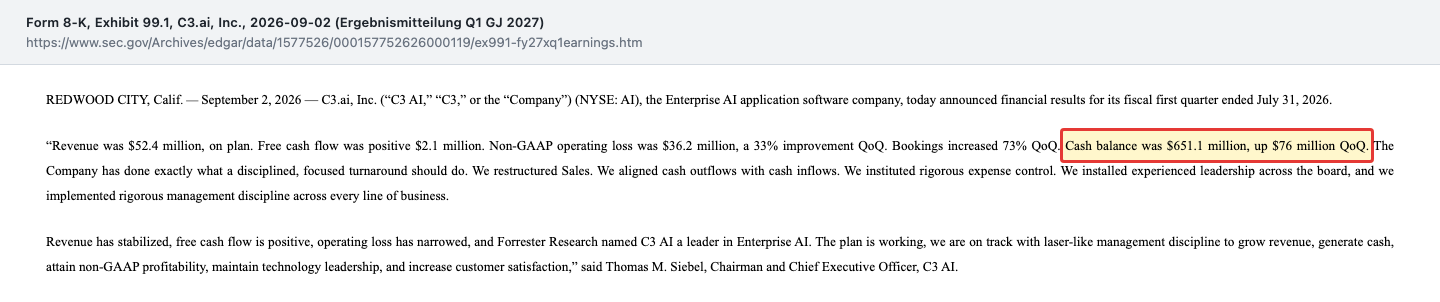
The cash flow statement in the same release shows the source: operations contributed $2.1 million, stock option exercises $72.8 million. And almost all of that was paid by one man. According to his insider filing (Form 4 of June 3, 2026), Thomas Siebel exercised 6,166,667 options at $11.16 each on June 1, 2026 — about $68.8 million of his own money, for options that would not have expired until 2030. He kept the shares and transferred them to his living trust (The Siebel Living Trust, of which he is trustee). Putting that much of his own money into the company earlier than necessary can be read as a sign of confidence. For completeness, though: between May and July 2026, Siebel also sold about 1.42 million shares from very old, low-priced options under a trading plan adopted in September 2024 (other small sales in his filings were automatic tax withholdings on vested stock awards) — at average prices between $8.65 and $11.11, for about $13.7 million in total. For those old options he had first paid exercise prices of $2.04 and $3.90, about $3.1 million combined. That leaves a net commitment of roughly $58 million (before taxes).
For you as a shareholder, this cuts two ways. The $651.1 million in cash and securities is a thick cushion, and the balance sheet shows no financial debt. But the cushion grew through a one-time inflow, not through the business. And there is a second, quieter calculation: stock-based compensation cost $59.2 million in the first quarter — more than total revenue of $52.4 million. That cost doesn’t leave as cash; it arrives as new shares. Picture it this way: every new share is another slice cut from the same pie — your slice gets smaller. The weighted-average share count rose about 14.5 percent from the prior-year quarter to 155.0 million in the first quarter of fiscal 2027. Whether cash also grows without the founder is something we track on our side finds page for unusual discoveries in the filings.
Uncomfortable truth No. 4: One man, nearly half the votes
C3.ai has two classes of stock. The listed share (Class A) carries one vote; Class B carries fifty. The quarterly report spells out what follows:
“As of July 31, 2026, Mr. Siebel and related entities beneficially owned approximately 87.8% of our Class B common stock and approximately 14.0% of our outstanding Class A common stock, resulting in beneficial ownership of capital stock representing approximately 48.9% of the voting power of our outstanding capital stock.”
— C3.ai, SEC quarterly report 10-Q for the period ended July 31, 2026, Item 1A “Risk Factors”
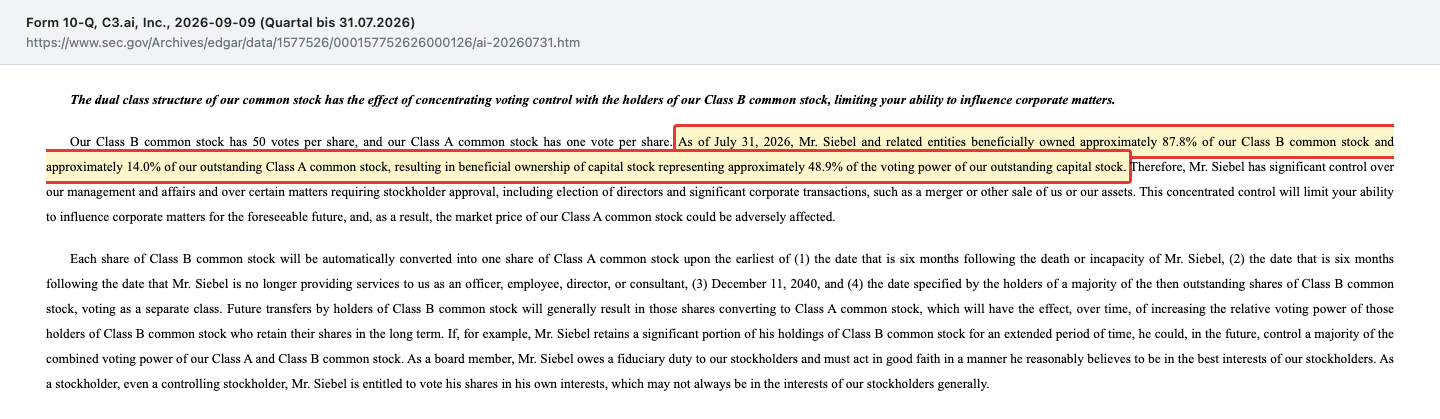
In other words: on almost any important vote — who sits on the board, whether to sell the company — Siebel needs only a few allies. The company hinges on one person, and the company says so itself. In its annual report it calls Siebel “critical” to strategy, sales and engineering and notes that it carries no key-person life insurance. His health was already one reason for the slump. It is also before the courts: a class action accuses C3.ai and Siebel of misleading investors about his health between February and July 2025. The court dismissed the complaint in its entirety on July 14, 2026 — but on August 7, 2026, the plaintiff filed an amended complaint, and on September 8 C3.ai again moved to dismiss. Three shareholder derivative suits on the company’s behalf are stayed until that case is decided. A separate class action over the IPO has been running since 2022: on March 12, 2026, the court dismissed most claims there but let stand the allegation against the company, Siebel and two other defendants that the December 2020 IPO registration statement contained a misleading statement about a reseller. The outcome is open.
Valuation: What the market is charging for the turnaround
With no profits, C3.ai has no price-to-earnings ratio. That leaves revenue as the yardstick. With 160.8 million shares (Classes A and B, August 31, 2026) and the November 6, 2026 close of $11.69, C3.ai was worth about $1.88 billion on the market. Subtract $651.1 million in cash and securities and roughly $1.23 billion remains for the actual business. That is about 5.3 times revenue for the last four quarters ($232.4 million) and a little more than five times the midpoint of full-year guidance ($225 million). Without subtracting cash, the price-to-sales ratio is about 8. For a company with shrinking revenue, a 32 percent gross margin in the first quarter of fiscal 2027 (fiscal 2026: 31 percent) and heavy losses, that is no bargain. The market is paying mainly for the hope that the turnaround succeeds.
The professionals are cool on it: of 13 analysts whose ratings are captured in the fundamental data as of November 7, 2026, one rates the stock a buy, six a hold and six a sell; the average price target is $8.90. Probably not in the price are two lawsuits in which C3.ai itself is the plaintiff. Against engine maker Cummins, a jury awarded C3.ai $23.3 million in damages for trade secret misappropriation on May 19, 2026; none of it has been booked, and the quarterly report for the period ended July 31, 2026 no longer mentions the case. What lies behind that — a settlement, an appeal or simply a shortened disclosure — the report doesn’t say. In Rome, C3.ai is seeking €2.1 billion from Italian utility Enel. Both are possibilities, not assets — the outcome is open.
Opportunities and risks at a glance
What speaks for C3.ai:
- A thick cushion: $651.1 million in cash and securities (July 31, 2026), no financial debt on the balance sheet.
- First signs of stabilization: revenue around $52 million for three quarters, positive operating cash flow in the first quarter of fiscal 2027 ($2.1 million), adjusted operating loss cut by a third from the prior quarter.
- A founder with his own money at stake: $68.8 million for exercised options on June 1, 2026.
- Recognized technology and well-known customers, including U.S. government agencies and industrial groups; strong partners such as Microsoft, AWS and Google.
- Possible inflows from lawsuits as plaintiff (Cummins verdict of $23.3 million, claim against Enel of €2.1 billion), neither booked.
What speaks against it:
- Revenue down 36 percent in fiscal 2026, guidance for fiscal 2027 lower still ($210 million to $240 million).
- Almost no new business in revenue (about 1 percent of subscription revenue in the first quarter of fiscal 2027), backlog flat at about $200 million.
- Gross margin halved (61 to 31 percent in fiscal 2026), net loss of $470.4 million.
- Stock-based compensation above revenue ($59.2 million versus $52.4 million in the first quarter of fiscal 2027) — steady dilution.
- Dependence on one person: 48.9 percent of the voting power with Siebel, a health history, pending lawsuits on that very issue.
A human conclusion
Back to the captain trap. Thomas Siebel is no ordinary returnee: he founded C3.ai, he put in $68.8 million of his own money, and under him revenue has at least steadied. That deserves respect. The trap lies in mistaking the captain’s return for the end of the storm. The SEC filings say something else: the ship is taking on less water, but it isn’t sailing any faster yet. Revenue is at half the record quarter, there is hardly any new business in revenue, and guidance for the current year is below last year. What it looks like when an AI label alone doesn’t carry a company is also shown in our Veritone stock analysis. For C3.ai, the story will be decided in the next quarterly reports: do announced deals turn into growing revenue — and does cash grow without the founder? Once you’ve answered those questions for yourself, you know what you’re getting into — with or without the stock. What you make of it is your decision. And that’s how it should be.
Sources
All primary documents used in this analysis — so you can read them yourself:
- C3.ai, Inc. — SEC quarterly report 10-Q for the period ended July 31, 2026 (filed September 9, 2026)
- C3.ai, Inc. — SEC filing 8-K of September 2, 2026, Exhibit 99.1 (earnings release for the first quarter of fiscal 2027)
- C3.ai, Inc. — SEC annual report 10-K for the fiscal year ended April 30, 2026 (filed June 24, 2026) and 10-K for the fiscal year ended April 30, 2025 (filed June 23, 2025)
- C3.ai, Inc. — SEC filing 8-K of June 3, 2026, Exhibit 99.1 (earnings release for the fourth quarter and fiscal 2026)
- C3.ai, Inc. — quarterly reports 10-Q for the periods ended January 31, 2026, October 31, 2025 and July 31, 2025
- C3.ai, Inc. — SEC filing 8-K of July 17, 2026 (dismissal of the class action) and 8-K of October 30, 2026 (annual meeting of October 26, 2026)
- Thomas M. Siebel — insider filing (Form 4) of June 3, 2026 (exercise of 6,166,667 options at $11.16)
- C3.ai’s complete SEC filing history: EDGAR overview (sec.gov)
- Fundamental data (prices through the November 6, 2026 close; retrieved November 7, 2026), cross-checked against the SEC filings and the SEC’s XBRL data series.
- Reddit mentions: our in-house Reddit hype scanner.
Transparency & disclaimer: this analysis is journalistic commentary on publicly available information. It is not investment advice, not a regulated investment research product and not a solicitation to buy or sell securities. Equity investments carry substantial risk up to and including total loss. All information is provided without warranty; the as-of date for each figure is stated in the text. Positions held by the operator are disclosed daily; where one exists, it appears as a notice at the top of this deep dive.
Key figures at a glance
All monetary figures in millions of $; earnings per share as reported.
| Metric | 2022 | 2023 | 2024 | 2025 | 2026 |
|---|---|---|---|---|---|
| Revenue | 252.8 | 266.8 | 310.6 | 389.1 | 250.3 |
| Operating Income (EBIT) | -196.1 | -290.5 | -318.3 | -324.4 | -487.7 |
| Net Income | -192.1 | -268.8 | -279.7 | -288.7 | -470.4 |
| Net Margin | -76.0% | -100.8% | -90.1% | -74.2% | -187.9% |
| Earnings Per Share | -1.84 $ | -2.45 $ | -2.34 $ | -2.24 $ | -3.35 $ |
Source: fundamental data & SEC filings (annual and quarterly reports, 10-K/10-Q)
Our Bottom Line at a Glance
- Revenue trend negative
- FY2026 revenue (ended 04/30/2026) $250.3M after $389.1M (−36%); Q1 FY2027 $52.4M (−25%); FY2027 guidance $210M to $240M.
- New business negative
- Only about 1% of Q1 FY2027 subscription revenue from new customers (prior year 32%); remaining performance obligations $200.0M (07/31/2026) after $203.1M (04/30/2026).
- Liquidity positive
- $651.1M in cash and securities (07/31/2026), no financial debt; operating cash flow Q1 FY2027 +$2.1M after −$190.2M in FY2026.
- Costs & dilution negative
- Gross margin FY2026 31% after 61%; stock-based compensation Q1 FY2027 $59.2M on $52.4M of revenue; weighted-average share count +14.5% year over year.
- Leadership & control neutral
- Founder Siebel CEO again since 05/08/2026, 48.9% of voting power (07/31/2026), $68.8M of his own money for an option exercise on 06/01/2026; class action over his health refiled after dismissal.
C3.ai is a textbook case of the captain trap: founder Thomas Siebel has been back since May 2026 and invested $68.8 million of his own money. But revenue fell 36 percent in fiscal 2026, almost no revenue came from new customers in the first quarter of fiscal 2027, and guidance sits below last year. $651 million in cash buys time for a turnaround — it hasn’t been proven yet. Not investment advice.
What Our Rating Means
Open questions
The business works in principle, but one material question is open. As long as it stays open, our findings do not carry a quality verdict.
Yellow, because the turnaround is unproven: revenue collapsed 36 percent in fiscal 2026, gross margin halved, new customers contributed only about 1 percent of subscription revenue in the first quarter of fiscal 2027, and guidance for fiscal 2027 is lower still. It is not red, because no substance risk is documented: $651.1 million in cash and securities with no financial debt, positive operating cash flow in the first quarter, and no going-concern doubt. At a little more than five times revenue, the market is mainly pricing in hope for the turnaround. The decision is yours.
A journalistic assessment by our editorial team at the time of the deep dive, based on public sources — not investment advice and not a solicitation to buy or sell. Your personal circumstances (investment goals, risk capacity, taxes) cannot be taken into account. What our levels mean, how verdicts are formed, and what conflicts of interest exist →
Worth Noting
- C3.ai made our research list through our in-house Reddit hype scanner (Reddit hype run of November 7, 2026).
- The fiscal year ends April 30; FY2026 = May 2025 through April 2026, Q1 FY2027 = May through July 2026. The 10-Q for the quarter ended October 31, 2026 had not been filed as of November 7, 2026.
- Quarterly revenue for Q4 FY2025 ($108.7M) and Q4 FY2026 ($51.6M) from the earnings release (8-K, Exhibit 99.1) of June 3, 2026; other quarters from the 10-Qs and XBRL data.
- Market cap calculated independently: 160,779,856 shares (157,279,864 Class A + 3,499,992 Class B, 10-Q cover page, 08/31/2026) × $11.69 close (11/06/2026) = $1.880B; matches the fundamental data. Revenue for the last four quarters: 75.1 + 53.3 + 51.6 + 52.4 = $232.4M.
- Siebel’s option exercise: 6,166,667 × $11.16 = $68.8M (Form 4 of 06/03/2026, transaction 06/01/2026, options expiring 08/26/2030). Sales under a Rule 10b5-1 trading plan (adopted 09/20/2024) between 05/15 and 07/15/2026: 1,416,208 shares (Forms 4 of 05/19, 06/15 and 07/16/2026).
- Short interest (about 42.2M shares, roughly 28% of the free float) and analyst ratings from fundamental data retrieved 11/07/2026; the data does not state a reporting date.
Stock Watch
This analysis is as of November 7, 2026. Stock Watch will tell you what's changed at AI since then.
Later $1 a month per stock — signing up is free, and you'll be the first to know when it launches.
The full analysis as a PDF for later
We will send you this analysis as a PDF — to print, file away, and read at your own pace. And we will add you to the free Stock Watch list for C3.ai, Inc. (AI), so you hear about it when something material in this analysis changes.
Frequently Asked Questions
C3.ai, Inc. (NYSE: AI), based in Redwood City, California, sells artificial intelligence software to large enterprises and government agencies: a platform for building and running AI applications, ready-made industry applications for areas such as maintenance and supply chains, and generative AI tools. In the first quarter of fiscal 2027, 94 percent of revenue came from subscriptions.
In fiscal 2026 (ended April 30, 2026), revenue fell 36 percent to $250.3 million. In its annual report, C3.ai names three reasons itself: disruption from the restructuring of its sales and services organizations, unanticipated health limitations of founder and CEO Thomas Siebel, and unsatisfactory execution in sales.
As of July 31, 2026, C3.ai held $651.1 million in cash and securities; the balance sheet shows no financial debt. Of the roughly $76 million increase in the quarter, $72.8 million came from exercised stock options, $68.8 million of it from Thomas Siebel. Operations contributed $2.1 million.
Yes. Thomas M. Siebel resumed the CEO role on May 8, 2026, and remained chairman of the board; Stephen Ehikian, CEO since September 2025, became president. As of July 31, 2026, Siebel controlled about 48.9 percent of the voting power, mainly through Class B shares carrying 50 votes each.
C3.ai’s fiscal year ends on April 30. Fiscal 2026 therefore covers May 2025 through April 2026, and the first quarter of fiscal 2027 covers May through July 2026. The quarterly report for August through October 2026 is typically filed in early December.
According to its September 2, 2026 earnings release, C3.ai expects fiscal 2027 (ending April 30, 2027) revenue of $210 million to $240 million and a non-GAAP operating loss of $123 million to $155 million. For the second quarter (August through October 2026), the company guides to revenue of $51 million to $55 million.
Found an error?
Did you spot a factual error, an outdated number, or a typo in this deep dive? Let us know briefly — your report goes straight to the editorial team.