Veritone: The AI Is Real — and on November 15, 2026 a Note Comes Due That Is Nearly Four Times the Cash Balance
Veritone has spent years building its own AI operating system, aiWARE, and sells it to sports networks, HR departments and American police agencies. It shows up on every list of AI stocks. The filings with the U.S. securities regulator, the SEC, tell a second story alongside that one: $12.424 million of cash as of June 30, 2026, a convertible note of $45.58 million maturing on November 15, 2026, a working capital deficit of $53.058 million and an explicit statement of "substantial doubt" about the company's ability to continue as a going concern. The auditor wrote that doubt into two consecutive opinions and was dismissed on April 23, 2026. We read the primary documents line by line — and keep what the company can do strictly apart from what it is missing.
 Thomas Mücke
Founder & Publisher
Thomas Mücke
Founder & Publisher
As of Today
As of: September 17, 2026
- Closing price
- 1.10 $ -0.90%
- Market Capitalisation
- 0.1 $B
- Growth Score
- 2/10
- AAQS
- 3/10
Price change since September 4, 2026: +21.3%
This analysis has a cut-off date. The Stock Guard tells you when something material changes in the numbers. Reserve your free spot
Chart
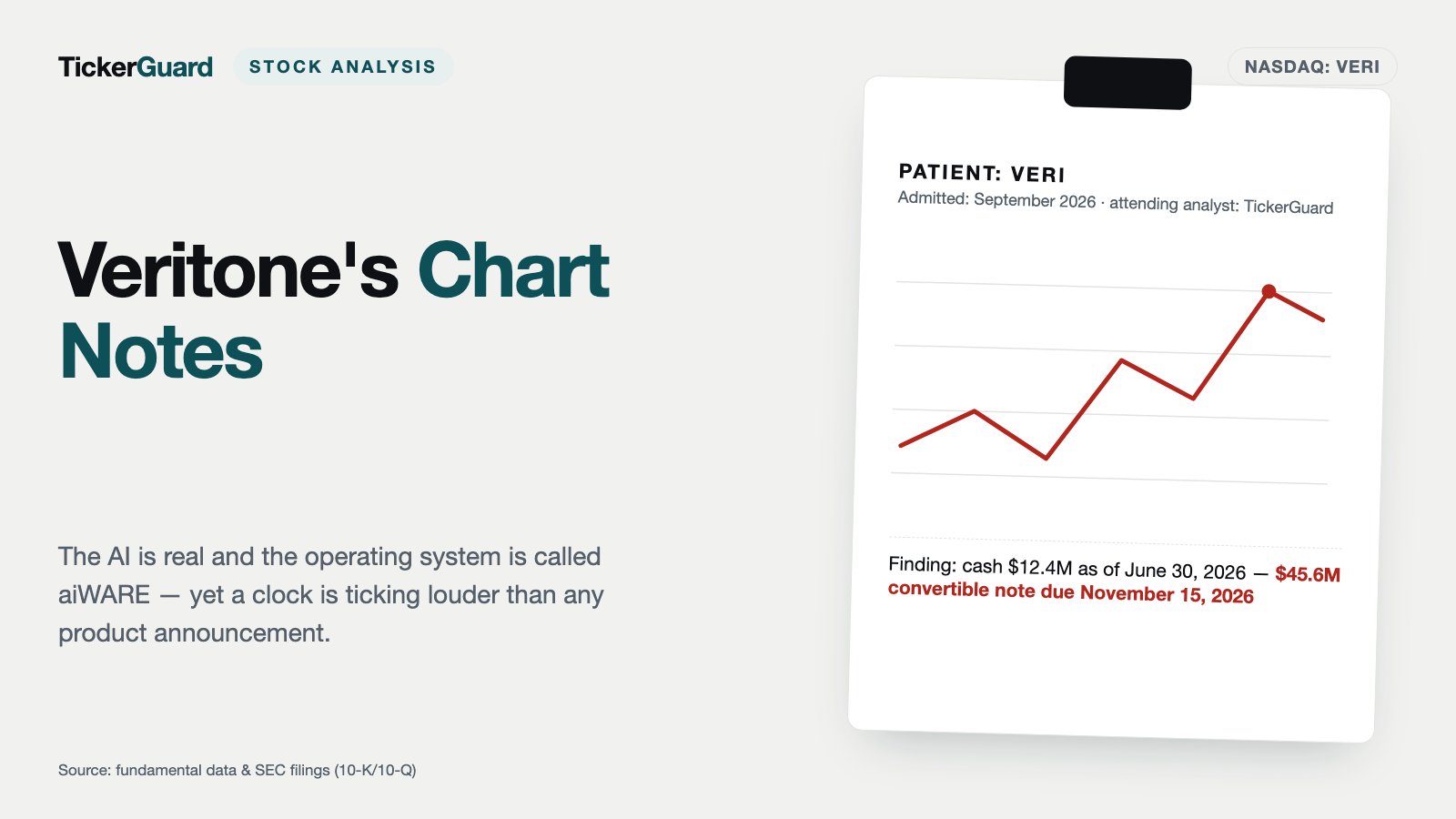
Interactive price chart (TradingView).
52-week range: 0.785 $ to 8.40 $ · Last price: 1.10 $ (As of: September 17, 2026)
Note: pure fact-based analysis, not investment advice and not a solicitation to buy or sell. All figures without guarantee.
There is an investor trap nobody ever mentions from a conference stage, because it is so undramatic: maturity blindness. We read business models, we read growth rates, we read product announcements — and we skip the one line that decides everything: what is owed, and when. A company can have an excellent product, loyal customers and an energetic chief executive, and still fail on a calendar date. At Veritone, that trap fits into a single comparison. As of June 30, 2026, the company held $12.424 million in cash. On November 15, 2026, a convertible note of $45.58 million comes due. That is roughly four times as much.
So here is the deal. We will read the quarterly report (10-Q) as of June 30, 2026, the annual report (10-K) for 2025, the notice withdrawing prior figures and the notice of the auditor change — documents that carry legal liability for being honest. Then you decide. The central tension of this analysis is already set, and it runs through every chapter: the AI label is earned, the product is real and deployed by actual government agencies — but the company is currently deciding its existence against a clock rather than against a market.
What Veritone Actually Sells: an Operating System for Data That Does Not Fit a Spreadsheet
Veritone is based in Irvine, California and employed 446 people as of December 31, 2025, 437 of them full time: 102 in California, 170 spread across 35 other U.S. states, 31 in Israel and 143 in countries including the United Kingdom, France, Australia and India. Co-founder Ryan Steelberg serves as President, Chief Executive Officer and Chairman of the Board; Michael L. Zemetra is Chief Financial Officer.
The product is called aiWARE and the annual report describes it as an "AI operating system." What does that mean in practice? Picture an archive holding ten thousand hours of video, plus radio traffic, photographs and scanned case files. A computer can do nothing with that on its own — it is unstructured information, meaning anything that does not fit into a table. aiWARE chains together different AI models on demand: one recognizes faces, one converts speech to text, one identifies logos, one summarizes. What comes out is searchable, sortable information. The company puts the number of covered "cognitive categories" at more than 20 in its 10-K for 2025.
"To address the ever-growing challenges surrounding unstructured data, we developed aiWARE, our proprietary AI operating system. aiWARE orchestrates AI models, together with a suite of powerful applications on a secure open platform to reveal valuable insights from vast amounts of structured and unstructured data."
— Veritone, SEC annual report 10-K for 2025, Part I, Item 1 ("Our Solution")
The selling happens in two worlds. The first is commercial enterprise: sports networks and media companies that want searchable archives, rights holders licensing footage, advertisers, and a sizable talent acquisition business (including the Broadbean brand) that distributes job postings across more than 2,500 job boards and optimizes them with predictive models. Alongside that sits the growth hope, Veritone Data Refinery (VDR): it lets companies prepare their own data holdings for AI training and license them to hyperscalers. That is the one segment currently growing in earnest.
The second world is the public sector, and it is the more convincing one. Police agencies are drowning in video from body cameras, patrol cars, interview rooms and surveillance systems. Faces and personal data must be obscured before anything is released — hours of manual work per video. Veritone\'s Redact application does it automatically, Investigate consolidates digital evidence and Illuminate searches it for legal proceedings. In the second quarter of 2026 the company reported a multi-year contract with the California Highway Patrol, one of the largest state police agencies in the United States. That is not a label; it is a product with a federal cloud accreditation (FedRAMP) and a real use case.
And the competition? The annual report names it — and the list is uncomfortable.
"The market for AI-enabled solutions is rapidly evolving and highly competitive, and we face competition from various sources, including large, well-capitalized technology companies such as Google, Microsoft, Amazon, Axon and Palantir, and in some cases smaller companies specializing in the management of content and digital data."
— Veritone, SEC annual report 10-K for 2025, Part I, Item 1 ("Competition")
Note the phrase "well-capitalized." It is the phrase the rest of this analysis turns on. Veritone competes against opponents whose war chests exceed its entire annual revenue, and that race costs money that is currently in short supply.
Company history for investors
-
2021
Convertible note of $201.25 million issued (November)
Priced at 1.75 percent interest with a $36.76 conversion price, against a share price of $27.74. That same note becomes the existential question five years later.
-
2024
Sale of advertising agency Veritone One (October 17)
Purchase price $104 million, cash proceeds $59.053 million. The additional earnout of up to $18 million was not achieved in 2025 — a budgeted source of cash disappeared.
-
2025
Equity raises totaling $154.7 million
Used to repay the secured term loan in full and part of the convertible note. The price: share count rose from 40.2 million to 92.6 million within the year.
-
2026
Third-quarter 2025 figures withdrawn (April 8)
Restated quarterly revenue fell from $29.118 million to $26.632 million. For shareholders that meant the most recently published numbers could not be relied upon.
-
2026
Auditor Grant Thornton dismissed (April 23)
Eight days after the annual report and after two consecutive opinions citing doubt about going concern. The filing states there were no disagreements on accounting matters.
-
2026
Workforce cut and salary reduction (June and July)
At least 25 percent fewer employees than at March 31, 2026 and up to 30 percent lower operating expenses; the chief executive halved his base salary to $332,500.
-
2026
Authorized capital raised to 225 million shares (July 7)
After 150 million previously and 75 million at the end of 2024. The room for further dilution now exceeds the entire existing share count.
How the Stock Landed on Our Desk: Through the Hype, Not the Numbers
VERI reached our research list not through a metric but through the attention screen of our in-house stock scanner: the list of tickers mentioned unusually often in the large retail investor forums, as of September 6, 2026. That is deliberately a weak trigger — attention is not a fundamental, and that is precisely what makes it interesting. Anyone who finds a stock through a forum list gets the story first and the numbers last.
Reverse the order and start with the SEC filing index, and 2026 looks like this. On April 1, Veritone reported that its annual accounts would be late (Form NT 10-K). On April 14 came the filing that the third-quarter 2025 figures were no longer reliable — management and the audit committee had determined that on April 8. On April 15 the delayed annual report arrived, on April 28 the auditor change, on May 21 a $50 million program to sell its own shares, on June 10 the announcement of a workforce reduction, and on July 16 the news that the chief executive had halved his salary. That is not a stock chart. That is a medical chart.
Two dated price anchors for everything that follows — daily prices deliberately play no role in this analysis. The closing price on September 4, 2026 was $0.907. And documented in a mandatory filing: Chief Executive Officer Ryan Steelberg bought 148,810 shares at a weighted average of $0.851 on August 21, 2026, in a range of $0.84 to $0.86, according to his Form 4 insider report. For comparison: when Veritone issued its convertible note in November 2021, the same stock traded at $27.74 per share, as recorded in the note disclosure.
The Numbers Over the Years, Fairly Credited
First what genuinely speaks for Veritone, and there is more of it than the headlines suggest. In the second quarter of 2026 revenue grew again — against the prior-year quarter and against the previous quarter. It rose 4.6 percent to $24.263 million (prior-year quarter: $23.193 million) and 19.8 percent against a weak first quarter of 2026. Managed services grew 15.2 percent, carried by licensing and representation. In the data business, VDR, the company reports multi-million dollar orders from existing major hyperscalers; in the public sector it closed more than 100 agency contracts according to the earnings release, and more than 200 commercial contracts, including agreements with CNN and Sony Pictures Entertainment.
Management is also delivering on cost. Since January 1, 2023, Veritone says it has taken more than $60 million of annualized cost out of the business. The most recent cut, from June 2026, had produced $11.3 million of annualized savings by August 13, 2026, with roughly 14 percent fewer employees; the plan calls for a reduction of at least 25 percent against the March 31, 2026 headcount. In July 2026 the chief executive voluntarily halved his base salary from $665,000 to $332,500. These are not marketing gestures; they are in mandatory filings.
And the losses are shrinking. Operating loss fell from $99.570 million (2023) through $88.206 million (2024) to $81.254 million (2025) — all three on the same continuing-operations basis, after the advertising agency subsidiary Veritone One was sold in October 2024. Cash used in operations improved too: from $59.307 million (2024, continuing operations) to $53.205 million (2025) and most recently $22.126 million in the first half of 2026.
A note on the honesty of that series before anyone goes looking for longer ones: revenue and loss figures before 2023 are not comparable with today\'s, because the sale of Veritone One is treated retrospectively as a discontinued operation. Hence a three-year series rather than a five-year one — three figures that measure the same thing beat five where two measure something else.
Now the chart that captures the core of the business. It splits recurring revenue — in the trade, annual recurring revenue or ARR — into two halves: the predictable subscription business and the volatile consumption business.
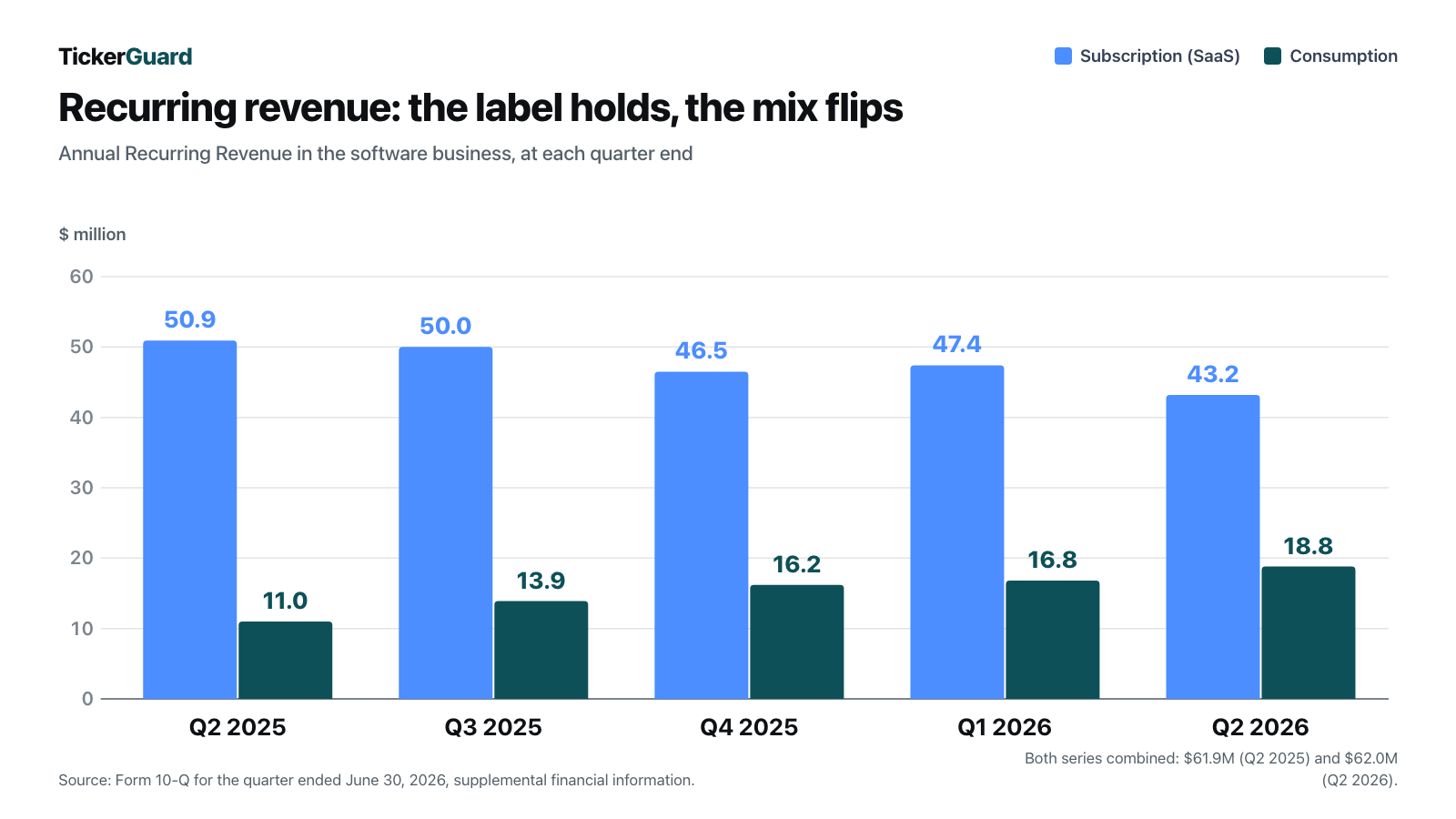
This is the most important chart in the analysis, and it needs a translation. "Recurring revenue" sounds like rent arriving every month. Veritone, however, adds two very different things together: genuine subscriptions — the $43.2 million — and revenue billed by usage, which only arises when a customer consumes something. That is the $18.8 million, and it includes the VDR data business with its multi-million-dollar one-off orders. The headline reads a reassuring "$62.0 million, unchanged." Underneath, the business is shifting from predictable to unpredictable. Quarter by quarter it looks like this — subscription revenue of $50.9 million, $50.0 million, $46.5 million, $47.4 million and $43.2 million against consumption revenue of $11.0 million, $13.9 million, $16.2 million, $16.8 million and $18.8 million, each at quarter end from June 30, 2025 through June 30, 2026.
Two more figures from the same table in the quarterly report complete the picture. The software customer count fell for five consecutive quarters — 3,066 / 3,021 / 2,978 / 2,897 / 2,829 — and new bookings in a quarter fell from $14.965 million (Q2 2025) to $13.949 million (Q2 2026). The company attributes the customer decline to fewer consumption-based customers in talent acquisition.
Margin is under pressure too. Gross profit — what is left after direct cost of delivery — came in at 58.5 percent of revenue in the second quarter of 2026, down from 67.5 percent a year earlier. The reason is the same as above: the growing data business carries lower margins than the shrinking subscription business. Growth that costs margin is expensive growth.
What the Filings Say: the Uncomfortable Truths
Uncomfortable Truth No. 1: the Clock — $45.58 Million Due, $12.424 Million on Hand
In November 2021, at the peak of the technology boom, Veritone issued a convertible note of $201.25 million carrying 1.75 percent interest and a conversion price of $36.76 per share. It has repurchased pieces of it three times since — in December 2022 at roughly 65 percent of par, in December 2023 at roughly 75 percent, and in November 2025 another $45.670 million for $39.049 million in cash plus 625,000 shares. What remains is $45.58 million of principal, due November 15, 2026.
At a share price near a dollar, the $36.76 conversion price is pure theory: the note will not be converted into shares, it has to be repaid in cash. Against that stood, as of June 30, 2026: $12.424 million of cash, $28.042 million of receivables, current assets of $47.482 million against current liabilities of $100.540 million — a working capital deficit of $53.058 million. And in the first half of 2026, another $22.126 million flowed out of operations.
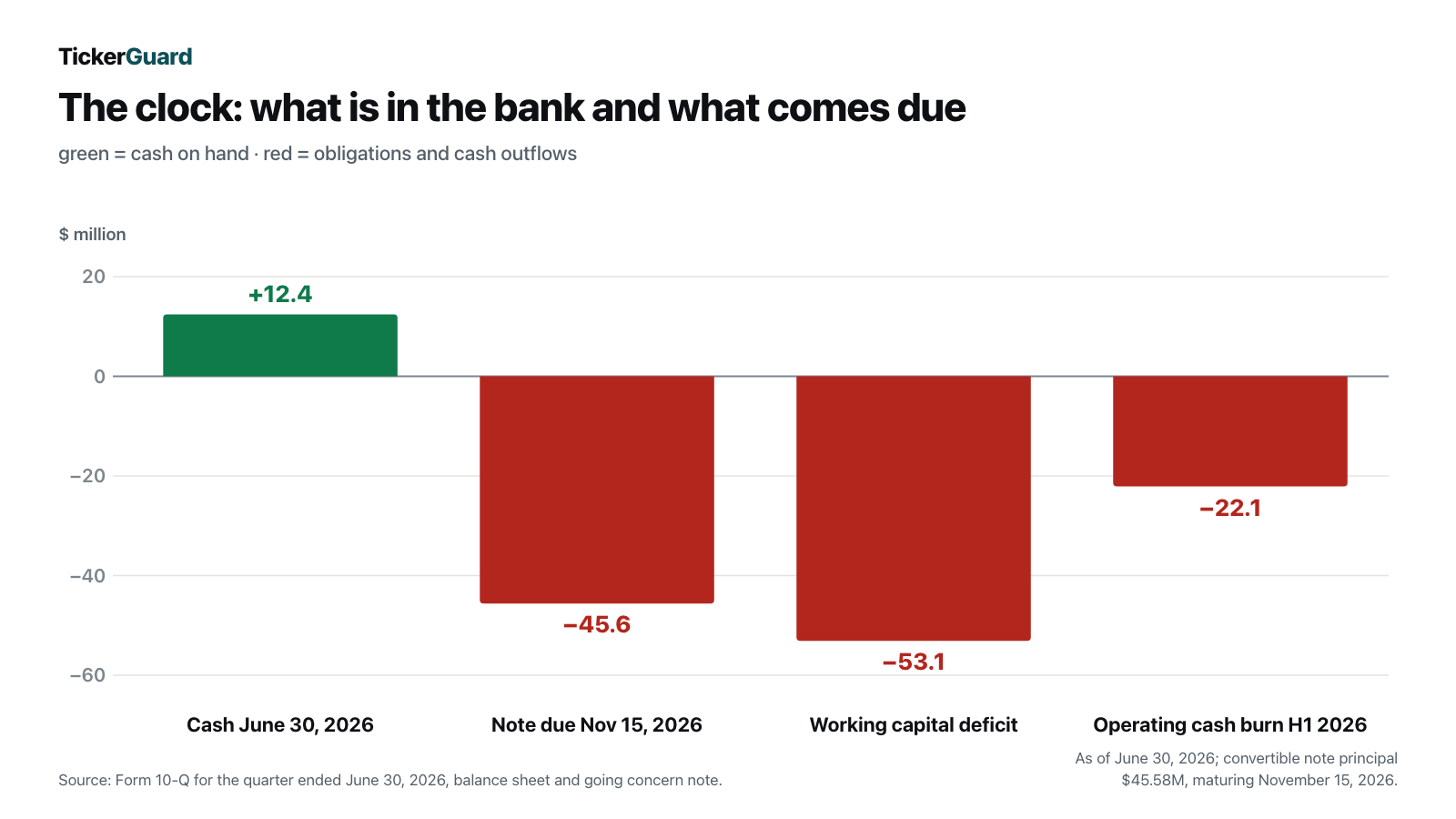
The company writes this position down itself, in the language of accounting. "Going concern" is the assumption that a business will still exist a year from now and therefore need not value its assets at fire-sale prices. When a report explicitly casts doubt on that assumption, it is the sharpest warning the rulebook allows.

"However, due to the Company\'s projected cash needs combined with its current liquidity level and history of net losses and cash used to fund operating activities, there is substantial doubt regarding its ability to continue as a going concern for a period of at least one year from the date of issuance of these consolidated financial statements."
— Veritone, SEC quarterly report 10-Q as of June 30, 2026, Note 2
How the company intends to close the gap is also there: new shares, new debt, or further cost cuts. For the first route there has been an at-the-market program of up to $50 million since May 21, 2026, run through UBS, Needham and Craig-Hallum. Through June 30, 2026 it had sold 5,911,219 shares for $9.376 million net, and through August 13, 2026 another 1,297,485 shares for roughly $1.8 million. That is about $11.2 million of $50 million. The remainder — just under $39 million — would, at a share price near a dollar, require roughly 39 million additional shares. Against 100.5 million shares outstanding, that is dilution of about 39 percent.
There is also a preview of how creditors assess Veritone. In November 2025 the company bought part of the note back below par — and had to record the transaction under accounting rules as a "troubled debt restructuring."

Uncomfortable Truth No. 2: the Auditor Wrote Doubt Into Two Opinions — Then Was Dismissed
An auditor is the last independent party standing between a company and its shareholders. When it writes a paragraph about doubt over going concern into its opinion, that is not a formality, it is a signal. Grant Thornton LLP did so for fiscal 2024 and for fiscal 2025. On April 23, 2026 — eight days after the annual report was published — the firm was dismissed by resolution of the audit committee.

Fairness requires the other half: the same notice states explicitly that there were no disagreements between company and auditor on accounting matters. An auditor change without a dispute is not automatically a scandal, and a new firm can cut costs — an obvious motive at a company trying to remove 30 percent of its operating expenses. The timing remains notable all the same.
More notable still is what the auditor added in its final opinion for 2025. It classified the effect of the material weaknesses as a "critical audit matter" — the category reserved for the hardest points of an audit — and justified it with a sentence worth reading twice: the ineffective system of internal control "affects substantially all consolidated financial statement account balances and disclosures."
How many such weaknesses there are, and how old, is set out in Item 9A of the annual report: five. The newest was identified while preparing the 2025 accounts (revenue recognition for non-routine transactions), one dates from the 10-Q as of June 30, 2024, and the remaining three from fiscal 2022 and 2023 — foreign currency translation, IT access controls, and a shortage of "a sufficient number of qualified resources" — meaning simply too few qualified people in accounting. Status as of December 31, 2025: not one remediated. Translated plainly for investors: this company\'s numbers carry an elevated probability of error, and the company says so itself.
Uncomfortable Truth No. 3: a Quarter Had to Be Withdrawn — Because Software Was Swapped for an Asset
On April 8, 2026, management and the audit committee determined that the third-quarter 2025 figures could no longer be relied upon. The largest single error: Veritone had delivered on-premise software to a customer and received not cash but a non-monetary asset — and valued it too highly.

Together with four smaller corrections, that produced the following restatement for the third quarter of 2025: revenue fell from $29.118 million to $26.632 million, the net loss rose from $26.880 million to $29.239 million, and loss per share went from $0.41 to $0.45. For the first nine months of 2025, revenue fell from $75.594 million to $72.288 million.
Why this is more than a bookkeeping slip: barter is not an outlier at Veritone but a documented part of the business. The 10-K for 2025 explains that the company provides software licenses in the ordinary course of business in exchange for trade credits, redeemable for advertising media, for a share of data-business revenue, or for other goods and services. That non-cash revenue appears as its own line in the cash flow statement: $1.511 million in 2025 and $0.849 million in the first half of 2026. Revenue that never becomes cash is a category of risk all its own at a company holding $12.4 million.
Uncomfortable Truth No. 4: Equity Consists Entirely of Goodwill — on a Tangible Basis It Is Negative
As of June 30, 2026 the balance sheet shows equity of $37.869 million. That sounds like a cushion. Then look at what the asset side is made of: of $148.494 million in total assets, $54.007 million is goodwill and $29.688 million is other intangible assets — $83.695 million together, or 56 percent.
Goodwill is the amount a buyer paid above net asset value for an acquired business. In everyday terms: it is the receipt for a promise, not an object on a shelf. Subtract both items from equity and what remains is tangible equity of minus $45.826 million, roughly minus $0.46 per share. Put differently: the entire book substance of this company is a valuation assumption about past acquisitions. Should it be written down in one of the coming reviews, the equity disappears.
The accumulated deficit shows how long this has been running. It rose from $429.896 million (December 31, 2023) to $579.012 million (December 31, 2025) and $620.680 million as of June 30, 2026. Over its life, Veritone has lost roughly six and a half times its current annual revenue.
Uncomfortable Truth No. 5: 170 Percent More Shares in Two and a Half Years — and the Ceiling Was Just Raised Again
Shares outstanding: 37.186 million as of December 31, 2023, 40.218 million as of December 31, 2024, 92.627 million as of December 31, 2025, 99.078 million as of June 30, 2026 and 100,457,068 as of August 11, 2026. That is roughly 170 percent in two and a half years, and the jump falls almost entirely in 2025: that year Veritone raised $154.700 million from sales of stock and pre-funded warrants according to the cash flow statement, using $41.176 million to repay the secured term loan and $38.656 million to buy back convertible notes.
Dilution, in everyday terms: the cake does not get smaller, it just gets cut into more slices. Convert it into revenue per share. In 2023 each share carried roughly $2.69 of revenue ($99.986 million divided by 37.186 million shares); in 2025 it was roughly $1.00 ($92.192 million divided by 92.627 million). A decline of 63 percent — not because the business collapsed, but because your slice of it shrank.
And the ceiling for further slices has just been raised. Authorized capital went from 75 million shares (December 31, 2024) to 150 million (December 31, 2025); on July 7, 2026 the annual meeting approved a further increase to 225 million shares and added 3 million shares to the employee equity plan. Of the $50 million at-the-market program, roughly $39 million is still undrawn. On top of that, the quarterly report lists 14.535 million shares from options, employee awards, warrants and the convertible note that are currently excluded from the diluted count — including 2,508,683 warrants at an exercise price of $2.576, valid through December 12, 2028.
Valuation: What the Market Pays for $92 Million of Revenue
Let us use the dated anchor: $0.907 at the close on September 4, 2026, multiplied by 100,457,068 shares (as of August 11, 2026). That gives a market capitalization of roughly $91 million. Add the $45.58 million convertible note and subtract the $12.424 million of cash (both as of June 30, 2026), and enterprise value lands around $124 million.
Set against 2025 revenue of $92.192 million, that is a price-to-sales ratio of about 1.0 and an enterprise value of roughly 1.35 times revenue. Against the midpoint of the company\'s own 2026 guidance ($107.5 million), it would be 0.85 and 1.15. No price-to-earnings ratio can be formed — there is no profit, and there never has been a meaningful one in company history.
For a software business with a gross margin above 58 percent, that is optically cheap — the reason for the discount sits in the chapters above: the market is not pricing growth here, it is pricing a probability. And book value offers no safety net — $0.38 per share on the balance sheet, minus $0.46 on a tangible basis.
What the company itself promises is considerable: revenue of $100 million to $115 million for 2026 and a non-GAAP net loss of $22 million to $32 million, plus the chief executive\'s statement that the company is "strongly positioned to achieve operating profitability as early as the first half of 2027." Let us test that guidance, because it is the decisive check. First-half 2026 revenue was $44.522 million. To reach the bottom of the range, the second half would need $55.5 million; to reach the top, $70.5 million. Against the company\'s own first half, that is a jump of 25 to 58 percent; against the second half of 2025 ($46.536 million), a gain of 19 to 51 percent. A company whose revenue has moved sideways for three years, and whose subscription revenue just fell 15 percent, would have to achieve in six months what has eluded it for twelve quarters.
For context, the professional view: four analysts cover the stock, with an average price target of roughly $5.17 (data as of September 6, 2026). That is close to six times the anchor price. A target like that is only reachable if the refinancing succeeds — that is what the number says, not the analysts. What a comparable bet looks like — where the AI story is true and the share count still grows faster than revenue — we took apart in our analysis of BigBear.ai, with one decisive difference: there, several hundred million dollars sit in the bank.
Upside and Risks at a Glance
Upside
- The product is real and deployed. aiWARE, Redact and iDEMS run at U.S. government agencies; the second quarter of 2026 added a multi-year contract with the California Highway Patrol, one of the largest state police agencies in the country, plus more than 100 further agency contracts. A FedRAMP accreditation is in place for the federal cloud — a hurdle that costs competitors years.
- The VDR data business is genuinely growing. The consumption-based portion of recurring revenue rose from $10.957 million to $18.757 million within twelve months, up 71.2 percent as of June 30, 2026; the company reports multi-million dollar orders from existing major hyperscalers and, per its quarterly report, is now under contract with the majority of leading hyperscalers.
- The cost base is visibly falling. More than $60 million of annualized cost removed since January 1, 2023, of which $11.3 million comes from the June 2026 cut alone (as of August 13, 2026); general and administrative expense fell to $11.135 million in the second quarter of 2026 from $12.653 million a year earlier. Operating loss dropped from $99.570 million (2023) to $81.254 million (2025).
- Management is committing its own money. The chief executive halved his base salary from $665,000 to $332,500 in July 2026 and bought 148,810 shares in the open market at a weighted average of $0.851 on August 21, 2026, according to his insider report.
- The valuation is low. Roughly one times annual revenue at a gross margin above 58 percent — if the refinancing succeeds, the discount is substantial.
Risks
- The maturity is the business risk. A $45.58 million convertible note due November 15, 2026 against $12.424 million of cash and a working capital deficit of $53.058 million (June 30, 2026). The report itself cites substantial doubt about going concern and states that shareholders could lose "all or part of their investment" in the common stock.
- The rescue costs ownership. Roughly $39 million of the at-the-market program is still undrawn; at a share price near a dollar that equals about 39 percent additional shares. Authorized capital was raised to 225 million shares on July 7, 2026.
- The numbers themselves are a risk. Five material weaknesses, the oldest from fiscal 2022, none remediated as of December 31, 2025; one withdrawn quarter (Q3 2025); and an auditor that classified the effect of those weaknesses as a critical audit matter because it affects "substantially all consolidated financial statement account balances and disclosures."
- The core business is shrinking. Subscription revenue down 15.1 percent to $43.245 million within twelve months, software customers down for five consecutive quarters to 2,829, quarterly new bookings down from $14.965 million to $13.949 million, gross margin down from 67.5 percent to 58.5 percent.
- Guidance is ambitious. Revenue of $100 million to $115 million for 2026 after $44.522 million in the first half requires a half-over-half jump of 25 to 58 percent — from a revenue line that has moved sideways since 2023.
- No asset cushion. Goodwill and intangibles make up 56 percent of total assets; tangible equity is negative at minus $45.826 million (June 30, 2026).
A Human Conclusion
Back to the maturity blindness from the opening. What is unusual about Veritone is that nearly everything a good investment story needs is present: a product that actually exists and that real government agencies use. A founder who is still there, who halved his salary and buys shares with his own money. A growth field that is genuinely growing. A valuation that looks like a bargain. And still the whole thing hangs on a single date that appears in no product announcement: November 15, 2026.
That is not a death sentence. Refinancings succeed all the time — an exchange offer to noteholders, a new loan, a larger share sale, or in extremis the sale of a business unit. Veritone proved in 2025 that it can raise $154.7 million of equity, and it used that money to retire a secured term loan in full. It is only that every one of those solutions is paid for by today\'s shareholder, in the same currency: their stake. So the honest question about this stock is not whether Veritone survives — it is who owns the company afterward.
If you follow this name, you do not need a price ticker. Four lines will do, and all of them sit in documents anyone can read for free: an 8-K announcing an agreement with the noteholders before November 15, 2026; the share count on the cover page of the next quarterly report; the "Annual Recurring Revenue (SaaS)" line in the supplemental table of that same report — most recently $43.245 million; and the going-concern sentence in the notes, which either stays or disappears. What you do with that is your decision. And that is exactly as it should be.
Sources
- SEC quarterly report 10-Q as of June 30, 2026, filed August 13, 2026 (balance sheet, statement of operations, cash flow statement, Note 2 on going concern, Note 5 on the convertible note, supplemental table on recurring revenue, subsequent events)
- SEC annual report 10-K for 2025, filed April 15, 2026 (business model, competition, employees, accounting for barter transactions, Item 9A on material weaknesses, audit opinion with going-concern paragraph)
- SEC annual report 10-K for 2024, filed April 1, 2025 (comparative 2023 and 2024 figures on a continuing-operations basis)
- SEC Form 8-K of April 14, 2026 (Item 4.02) — determination that the third-quarter 2025 figures can no longer be relied upon, with the restated amounts
- SEC Form 8-K of April 28, 2026 (Item 4.01) — dismissal of auditor Grant Thornton LLP and disclosure of the going-concern paragraphs in both opinions
- SEC Form 8-K of June 10, 2026 (Item 2.05) and Form 8-K/A of August 13, 2026 — restructuring plan, workforce reduction and quantified charges
- SEC Form 8-K of July 16, 2026 (Item 8.01) — voluntary 50 percent reduction of the chief executive\'s base salary
- SEC Form 8-K of August 13, 2026, Exhibit 99.1 (second-quarter 2026 earnings release) — 2026 guidance, recurring revenue, status of cost reductions, chief executive quote
- SEC Form 4 insider report of August 24, 2026 — purchase of 148,810 shares by Chief Executive Officer Ryan Steelberg on August 21, 2026
- Source: fundamental data & SEC filings (annual and quarterly reports, 10-K/10-Q). Every figure in this analysis comes from the primary documents linked above; the price anchor of $0.907 is the closing price on September 4, 2026, and the share count of 100,457,068 comes from the cover page of the quarterly report (as of August 11, 2026).
Disclaimer: this article is journalistic research and analysis. It is not investment advice and not a solicitation to buy or sell securities. Share prices can move sharply and a total loss is possible. The author holds no position in Veritone, Inc. at the time of publication. All information is given in good faith from the primary sources named; no warranty is made as to completeness or accuracy.
Key figures at a glance
All monetary figures in millions of $; earnings per share as reported.
| Metric | 2021 | 2022 | 2023 | 2024 | 2025 |
|---|---|---|---|---|---|
| Revenue | 57.7 | 149.7 | 100.0 | 92.6 | 92.2 |
| Operating Income (EBIT) | -47.7 | -38.0 | -99.6 | -88.2 | -76.1 |
| Net Income | -47.8 | -25.6 | -58.6 | -37.4 | -111.7 |
| Net Margin | -82.8% | -17.1% | -58.6% | -40.4% | -121.2% |
| Earnings Per Share | -1.44 $ | -0.71 $ | -1.59 $ | -0.98 $ | -1.76 $ |
Source: fundamental data & SEC filings (annual and quarterly reports, 10-K/10-Q)
Our Bottom Line at a Glance
- Product and market access positive
- aiWARE is a real, deployed AI operating system with FedRAMP accreditation for the secure government cloud; the second quarter of 2026 added a multi-year contract with the California Highway Patrol and more than 100 further agency contracts (earnings release of August 13, 2026). The Veritone Data Refinery data business grew recurring revenue from $10.957 million to $18.757 million within twelve months.
- Liquidity and maturity negative
- As of June 30, 2026, $12.424 million of cash stood against a convertible note of $45.580 million maturing on November 15, 2026 and a working capital deficit of $53.058 million. The 10-Q explicitly cites "substantial doubt" about going concern; a further $22.126 million flowed out of operations in the first half of 2026.
- Reporting quality and controls negative
- Five material weaknesses in internal control, the oldest from fiscal 2022/2023, were all unremediated as of December 31, 2025; the auditor classified their effect as a critical audit matter because it affects "substantially all consolidated financial statement account balances and disclosures." The third-quarter 2025 figures were withdrawn on April 8, 2026 and Grant Thornton LLP was dismissed on April 23, 2026.
- Growth and customer base negative
- Revenue has moved sideways for three years ($99.986 million, $92.637 million and $92.192 million for 2023 through 2025 on a continuing-operations basis). Predictable subscription revenue fell 15.1 percent within twelve months to $43.245 million, the software customer count declined for five consecutive quarters from 3,066 to 2,829, and gross margin fell from 67.5 percent to 58.5 percent in the second quarter of 2026.
- Dilution negative
- Shares outstanding rose from 37.186 million (December 31, 2023) to 100,457,068 (August 11, 2026), up roughly 170 percent; revenue per share fell from about $2.69 to about $1.00. Authorized capital was raised to 225 million shares on July 7, 2026, and roughly $39 million of the $50 million at-the-market program is still undrawn — about 39 percent of additional shares at a price near a dollar.
- Cost discipline and management commitment positive
- Veritone says it has removed more than $60 million of annualized cost since January 1, 2023, including $11.3 million from the June 2026 cut (as of August 13, 2026) with roughly 14 percent fewer employees. Operating loss fell from $99.570 million (2023) to $81.254 million (2025). The chief executive halved his base salary from $665,000 to $332,500 in July 2026 and bought 148,810 shares at a weighted average of $0.851 on August 21, 2026.
Veritone is the rare case where the AI label is earned and the stock still hangs on something else entirely: aiWARE runs at U.S. police and judicial agencies, the data business grew 71.2 percent, and the chief executive halved his own salary and bought shares in the open market. Against that stands a convertible note of $45.58 million maturing on November 15, 2026, while only $12.424 million of cash was on hand as of June 30, 2026 — plus an explicit statement of substantial doubt about going concern, five unremediated material weaknesses dating back to 2022, one withdrawn quarter, and an auditor dismissed eight days after writing its second going-concern paragraph. Anyone buying here is not buying a valuation but a bet that the refinancing succeeds — and a bet on how much of their own stake survives it. Not investment advice.
What Our Rating Means
Substance risk
We found at least one documented issue that threatens the company itself — regardless of how the stock is currently valued.
Red describes the company here, not the share price — and the finding rests on documented balance-sheet risks, several at once, not on valuation. The quarterly report as of June 30, 2026 itself cites "substantial doubt" about going concern; $12.424 million of cash stands against $45.58 million repayable on November 15, 2026, with a working capital deficit of $53.058 million and $22.126 million of cash burn in the first half alone. Cash runway is therefore well short of four quarters. On top of that comes a reporting finding that would suffice on its own: five material weaknesses in internal control, the oldest from fiscal 2022, not one remediated as of December 31, 2025, one withdrawn quarter, and an auditor who tied the effect of those weaknesses to "substantially all consolidated financial statement account balances and disclosures" and was dismissed eight days after the annual report. Tangible equity is negative at minus $45.826 million. Explicitly excluded from this judgment: the low share price and the cheap multiple — those are price arguments, not quality arguments. Equally explicit: the product is real, the data business is growing, management is cutting hard and buying its own stock. If the refinancing succeeds, this judgment can change. Until then the maturity weighs more than the product quality. The decision is yours.
A journalistic assessment by our editorial team at the time of the deep dive, based on public sources — not investment advice and not a solicitation to buy or sell. Your personal circumstances (investment goals, risk capacity, taxes) cannot be taken into account. What our levels mean, how verdicts are formed, and what conflicts of interest exist →
Worth Noting
- VERI reached our research list through the attention screen of our in-house stock scanner (tickers mentioned most often in the large retail investor forums, as of September 6, 2026) — not through a fundamental metric.
- Every figure in this analysis comes from primary SEC documents (10-K for 2024 and 2025, 10-Q as of 06/30/2026, Forms 8-K of 04/14, 04/28, 06/10, 07/16 and 08/13/2026, Form 8-K/A of 08/13/2026, Form 4 of 08/24/2026). The price anchor of $0.907 is the closing price on September 4, 2026 and deliberately not a daily quote.
- Revenue and earnings series are deliberately limited to 2023 through 2025: the sale of advertising agency subsidiary Veritone One in October 2024 is treated retrospectively as a discontinued operation, so older figures measure something different.
- Possible confusion: Veritone, Inc. (Nasdaq: VERI) should not be mistaken for similarly named consulting or staffing firms. The Broadbean brand belongs to the talent acquisition business; the divested advertising agency Veritone One has not been part of the group since October 2024.
Stock Watch
This analysis is as of September 7, 2026. Stock Watch will tell you what's changed at VERI since then.
Later $1 a month per stock — signing up is free, and you'll be the first to know when it launches.
The full analysis as a PDF for later
We will send you this analysis as a PDF — to print, file away, and read at your own pace. And we will add you to the free Stock Watch list for Veritone Inc (VERI), so you hear about it when something material in this analysis changes.
Frequently Asked Questions
Veritone, Inc. (Nasdaq: VERI) of Irvine, California sells AI software. At its center is aiWARE, a proprietary "AI operating system" that chains together AI models to make video, audio and images searchable. Customers include media companies, rights holders, HR departments and, above all, U.S. government agencies — for example to redact police video automatically. The company had 446 employees as of December 31, 2025.
Because a convertible note of $45.58 million matures on November 15, 2026, while only $12.424 million of cash was on hand as of June 30, 2026. Add a working capital deficit of $53.058 million and $22.126 million of operating cash burn in the first half of 2026. The quarterly report therefore states verbatim that there is "substantial doubt" about the ability to continue as a going concern for at least one year.
No. Operating loss was $81.254 million in 2025, after $88.206 million (2024) and $99.570 million (2023). The net loss was $111.732 million in 2025 and $41.668 million in the first half of 2026. Accumulated deficit reached $620.680 million as of June 30, 2026 — roughly six and a half times annual revenue. For 2026 the company guides to a non-GAAP net loss of $22 million to $32 million.
On April 8, 2026 management and the audit committee determined the figures were no longer reliable. The main cause was on-premise software delivered in exchange for a non-monetary asset rather than cash, which Veritone valued roughly $2.2 million too high — "approximately 8%" of quarterly revenue. Restated, quarterly revenue fell from $29.118 million to $26.632 million and the net loss rose from $26.880 million to $29.239 million.
Substantially. Shares outstanding rose from 37.186 million (December 31, 2023) through 40.218 million (2024) and 92.627 million (2025) to 100,457,068 as of August 11, 2026 — roughly 170 percent in two and a half years. Revenue per share fell from about $2.69 (2023) to about $1.00 (2025). On July 7, 2026 shareholders raised authorized capital to 225 million shares.
Barely in total, sharply in composition. Total recurring revenue stood at $62.002 million on June 30, 2026 after $61.867 million a year earlier. Within that, predictable subscription revenue fell from $50.910 million to $43.245 million, down 15.1 percent, while the consumption-based portion rose from $10.957 million to $18.757 million, up 71.2 percent. The software customer count declined for five consecutive quarters from 3,066 to 2,829.
It is ambitious. The company guides to $100 million to $115 million (earnings release of August 13, 2026), while the first half of 2026 delivered $44.522 million. The second half would therefore have to produce $55.5 million to $70.5 million — a jump of 25 to 58 percent over the company's own first half and 19 to 51 percent over the second half of 2025 ($46.536 million).
Grant Thornton LLP was dismissed by resolution of the audit committee on April 23, 2026, eight days after the 2025 annual report was filed. The Form 8-K of April 28, 2026 states there were no disagreements on accounting matters — but also that the opinions for 2024 and 2025 each contained an explanatory paragraph about substantial doubt regarding the ability to continue as a going concern.
Found an error?
Did you spot a factual error, an outdated number, or a typo in this deep dive? Let us know briefly — your report goes straight to the editorial team.