NuScale Power: If Its Partner Signs a Binding Power Deal, NuScale Pays First — About $16 Million per Module
According to its own quarterly report, NuScale is the only small-reactor developer with an NRC design approval (Standard Design Approval); it holds $1.86 billion in cash and investments and carries no debt. Yet it booked just $0.9 million in revenue in the first nine months of 2026, and all of its sales run through a single exclusive partner, ENTRA1. NuScale has already paid that partner $507 million for a non-binding agreement — and if the plan with utility TVA becomes binding, about $16 million per module comes due. Being first to approval is not the same as being first to profit.
 Thomas Mücke
Founder & Publisher
As of Today
As of: November 5, 2026
- Closing price
- 4.37 $ -14.81%
- Market Capitalisation
- 1.8 $B
- Growth Score
- 3/10
- AAQS
- 5/10
This analysis has a cut-off date. The Stock Guard tells you when something material changes in the numbers. Reserve your free spot
Chart
Interactive price chart (TradingView).
52-week range: 5.10 $ to 37.90 $ · Last price: 4.37 $ (As of: November 5, 2026)
Note: pure fact-based analysis, not investment advice and not a solicitation to buy or sell. All figures without guarantee.
There is an investor weakness that strikes hardest with new technologies: the pioneer trap. It goes like this: whoever clears a hard hurdle first, the brain reasons, will also be first to make the big money. First to the summit, first with the patent, first with the approval. With NuScale Power (NYSE: SMR), the story is especially seductive because its first half is true: according to its own quarterly report, NuScale is the first and only small modular reactor developer whose design has been approved by the U.S. Nuclear Regulatory Commission (NRC). The second half — the big money — is in the same filings, just not where you would expect it.
So let's make a deal: before you buy into the pioneer story, let's read together what NuScale itself has told the U.S. securities regulator, the SEC — the annual report (10-K) for 2025, the quarterly reports (10-Q) through the third quarter of 2026 filed on Nov. 5, 2026, and the current reports (8-K) since August. The central tension of this analysis is quickly stated and runs through every chapter: the news everyone is waiting for — a binding power deal — would first cost NuScale money, and a lot of it. Until then, the stock is carried mainly by its cash. What you make of that is up to you.
What NuScale actually does
NuScale develops a small modular reactor — in everyday terms: instead of a giant nuclear plant built on site over decades, a power plant made of building blocks that are prefabricated in a factory and then lined up. One block, the NuScale Power Module, produces up to 77 megawatts of electricity, according to the earnings release of Nov. 5, 2026; up to twelve modules make a 924-megawatt plant. The company does not build or operate power plants itself. It wants to sell the modules and later offer services such as start-up and refueling. Until now, according to the 10-Q, revenue has come mainly from engineering and licensing work for prospective customers.
The road to customers runs through a single partner: ENTRA1 Energy. The 10-Q describes ENTRA1 as the exclusive global partner for commercializing and developing all NuScale products — and as a prospective customer. Beyond that sits a network of suppliers and construction partners; in October 2026, NuScale signed a contract with South Korea's Doosan to fabricate the upper reactor coolant system, the first major component of an actual module. The only international customer so far is RoPower in Romania, where the government approved the investment decision on Feb. 12, 2026; NuScale does not expect the next contract stage until RoPower has secured financing.
Why the market is so drawn to this company is also in the filing: data centers — driven in part by artificial intelligence — need enormous amounts of power, and the U.S. government wants to expand nuclear capacity to 400 gigawatts by 2050. The demand story is big. But keep this in mind from the start: strong demand for electricity is not yet an order for modules.
Company history for investors
-
2020
First NRC design approval
The U.S. nuclear regulator approves the 50-megawatt design, making NuScale the first small-reactor developer past this hurdle. The approval alone brings no revenue.
-
2022
Listing via a SPAC
The merger with Spring Valley Acquisition Corp. brings NuScale to the NYSE. At the end of 2022, 226.4 million shares are outstanding — the baseline for later dilution.
-
2023
First U.S. project ends
On Nov. 7, 2023, NuScale agrees with utility group UAMPS to wind down the Carbon Free Power Project. The first planned U.S. customer drops out.
-
2025
77-megawatt approval, ENTRA1 agreement
In May, the NRC approves the 77-megawatt design; in August, the partnership agreement with ENTRA1 follows. The non-binding TVA agreement costs NuScale $507.4 million.
-
2026
New shares, stock below cash
Through June, NuScale sells $1.0 billion in stock; in August, a $750 million program starts. On Nov. 5, the stock closes at $4.37 — roughly at the level of its cash.
How the stock landed on our desk
NuScale did not land on our list through a single scanner hit but through the quarterly report of Nov. 5, 2026, and two numbers that did not fit together. First, the stock fell that day from $5.13 to $4.37 — its lowest close in twelve months, after $53.43 on Oct. 15, 2025. Second, our fundamental data (retrieved Nov. 6, 2026) show short interest of 91.6 million shares — about a fifth of the Class A shares. Short sellers bet on falling prices; a fifth is unusually high.
A third number should make you sit up: at $4.37, the whole company was worth about $1.88 billion on the market — roughly what it holds in cash and investments ($1,864.1 million as of Sept. 30, 2026). In other words, the market paid almost nothing for the approval, the patents and the plans. Whether that is an opportunity or a warning depends on what will happen to that cash. That is the core of this analysis.
The numbers over the years: approval yes, revenue barely
First, what genuinely impresses. NuScale has achieved what others are still working toward: the NRC's first design approval for a 50-megawatt module in 2020 and approval of the 77-megawatt design in May 2025. According to the 2025 annual report, the company holds 513 issued patents with 268 more pending. And the balance sheet is unusually strong for a development-stage company: $1,864.1 million in cash and investments as of Sept. 30, 2026 — $513.4 million in cash, $420.0 million in short-term and $930.7 million in long-term investments — and no debt at all. Investment income (mainly interest) on that cushion alone brought in $19.1 million in the third quarter of 2026.
Now the chart that grounds the pioneer story — revenue and operating cash outflow since 2021:
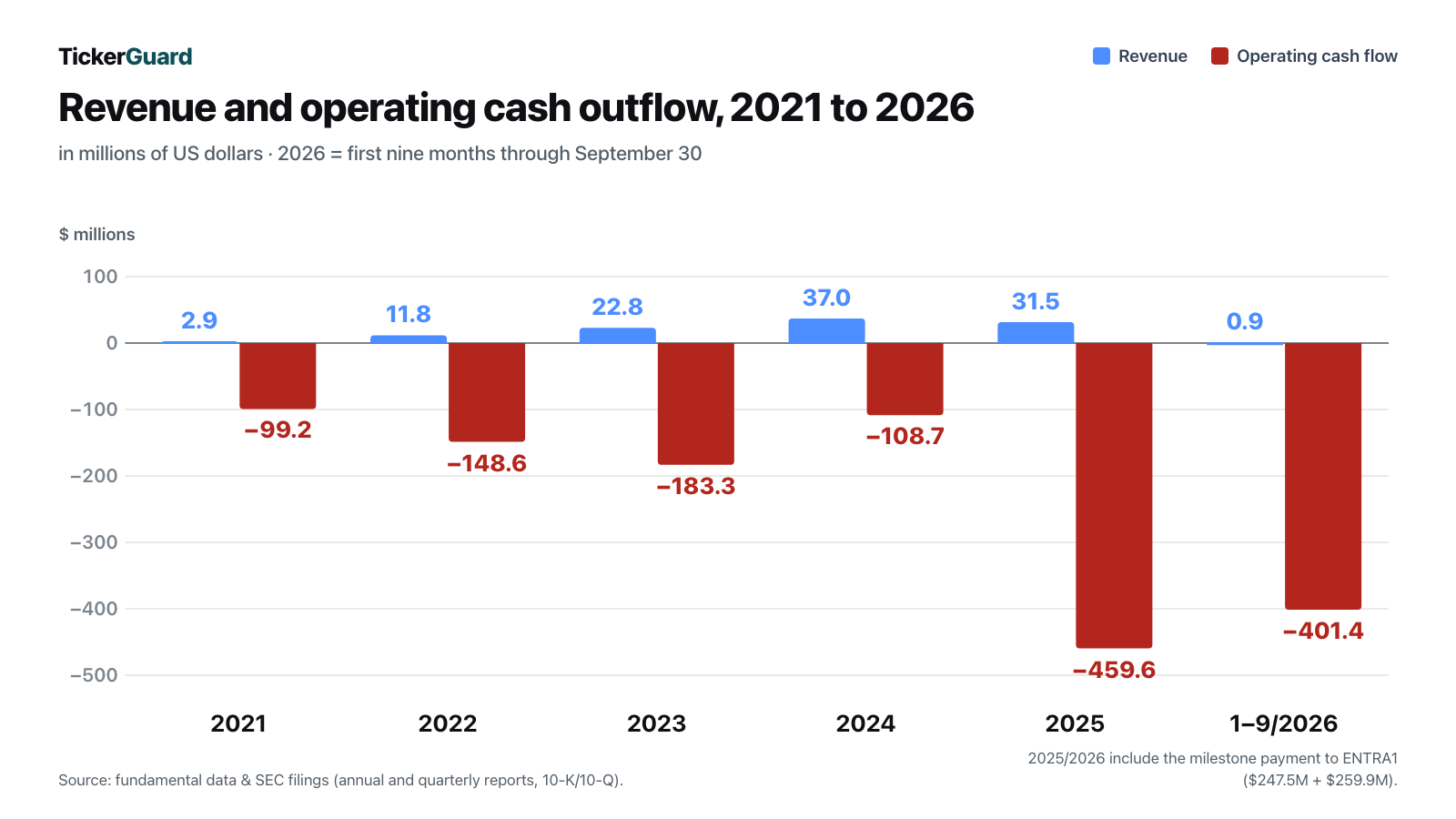
Revenue has never exceeded $37.0 million a year (2024), and much of it came from a single client: in the third quarter of 2025, according to the 10-Q, 96 percent of revenue came from engineering firm Fluor, for design work on the Romanian project. That work ended in late 2025 — and with it almost all revenue: $0.9 million in the first nine months of 2026 and $0.3 million in the third quarter. Fluor, once the largest shareholder, has since sold all of its NuScale shares, according to the 10-Q.
The net loss swings because of one-off items: $180.1 million (2023), $348.4 million (2024, including a $223.0 million loss on the fair value of warrants), $664.5 million (2025, including the $507.4 million milestone payment to ENTRA1) and $142.5 million in the first nine months of 2026. Excluding the ENTRA1 payment, operating cash outflow in the first nine months of 2026 was about $141.5 million — a long runway relative to the cash pile. The company itself writes:
"We believe that we have sufficient Cash and cash equivalents and Investments, along with continued access to capital markets, to satisfy our cash requirements for the next 12 months and beyond."
— NuScale Power Corporation, 10-Q for the quarter ended Sept. 30, 2026, Item 2 "Liquidity and Capital Resources" (10-Q 2026)
Note the phrase "along with continued access to capital markets": selling more shares is explicitly part of the plan. Remember this picture: the cash is big, but it was filled with new shares — and a contract already exists for its biggest potential outlays. Which brings us to the uncomfortable truths.
What the filings say — the uncomfortable truths
Uncomfortable truth No. 1: $507 million went to the company's own sales partner for a non-binding letter of intent
On Aug. 27, 2025, NuScale and ENTRA1 signed the Partnership Milestones Agreement (PMA). It requires NuScale to pay ENTRA1 so-called milestone contributions when ENTRA1 advances power projects with third parties — in three tranches of 15, 35 and 50 percent. A non-binding agreement is enough for the first tranche. That came on Sept. 2, 2025: ENTRA1 and the federal utility Tennessee Valley Authority (TVA) agreed to jointly develop plants with up to 6 gigawatts. What it cost NuScale is in the notes:
"In 2025, the criteria for triggering payment of Milestone Contribution 1 was achieved, as ENTRA1 entered into a non-binding agreement relating to 72 NPMs. As such, we incurred an expense of $507,393, with $247,509 being settled in 2025 and $259,884 settled during the nine months ended September 30, 2026."
— NuScale Power Corporation, 10-Q for the quarter ended Sept. 30, 2026, Note 9 (10-Q 2026; amounts in thousands of dollars)
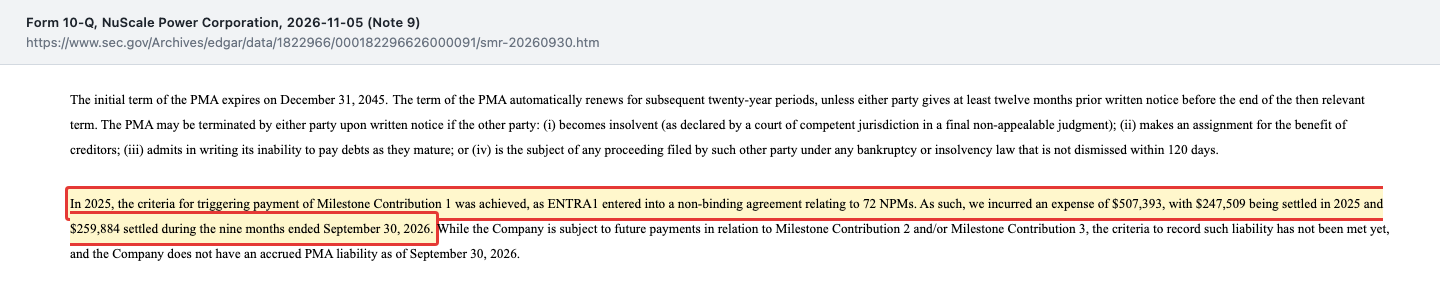
In everyday terms: a builder pays his broker half a billion as a contractually fixed milestone contribution — creditable against future projects per the contract — because a homeowner said, without commitment, that he could imagine a house. No contract with the builder exists yet. To be fair: according to the annual report, the contributions are credited against future ENTRA1 projects if a project fails. But the same report warns that ENTRA1 may not generate any future projects — in which case the contributions would be "unrecoverable." For comparison: $507.4 million is more than 16 times total 2025 revenue ($31.5 million).
Uncomfortable truth No. 2: the best news costs even more up front
Here is the passage that carries this whole analysis. Many shareholders are waiting for the non-binding TVA agreement to become a binding power deal. That would be real progress — but the annual report describes what it means for NuScale first:
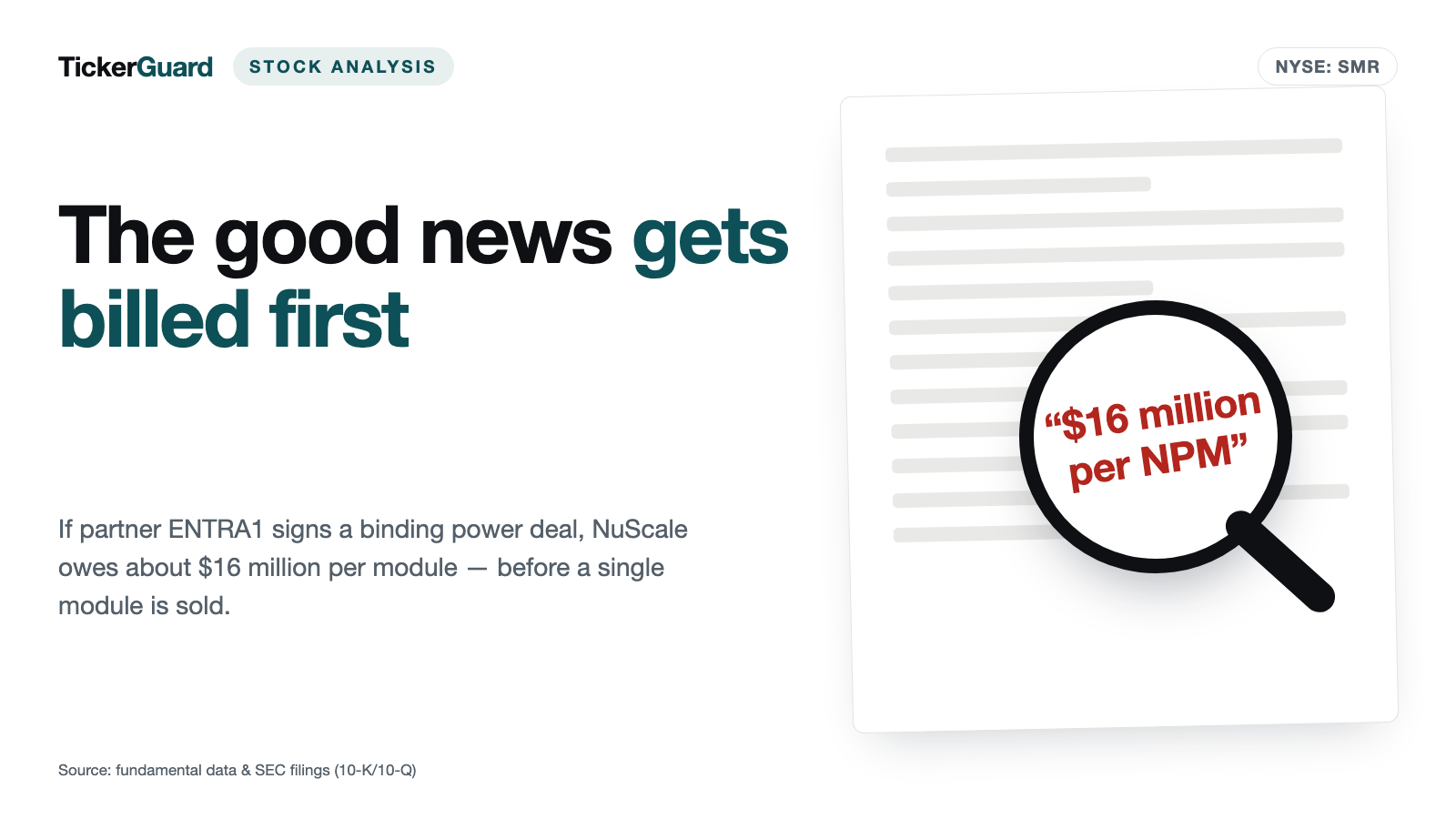
"Under the PMA, the Company will be obligated to make Milestone Contribution 2 to ENTRA1, or its designated affiliate upon the execution by ENTRA1, or its designated affiliate, of a binding power purchase agreement, energy off-take agreement or document with a Third Party in connection with the development of an Energy Project or the deployment of one or more NPMs into a potential Energy Project, in the amount of approximately $16 million per NPM included in such binding agreement."
— NuScale Power Corporation, 10-K for fiscal 2025, Item 1A "Risk Factors" (10-K 2025)
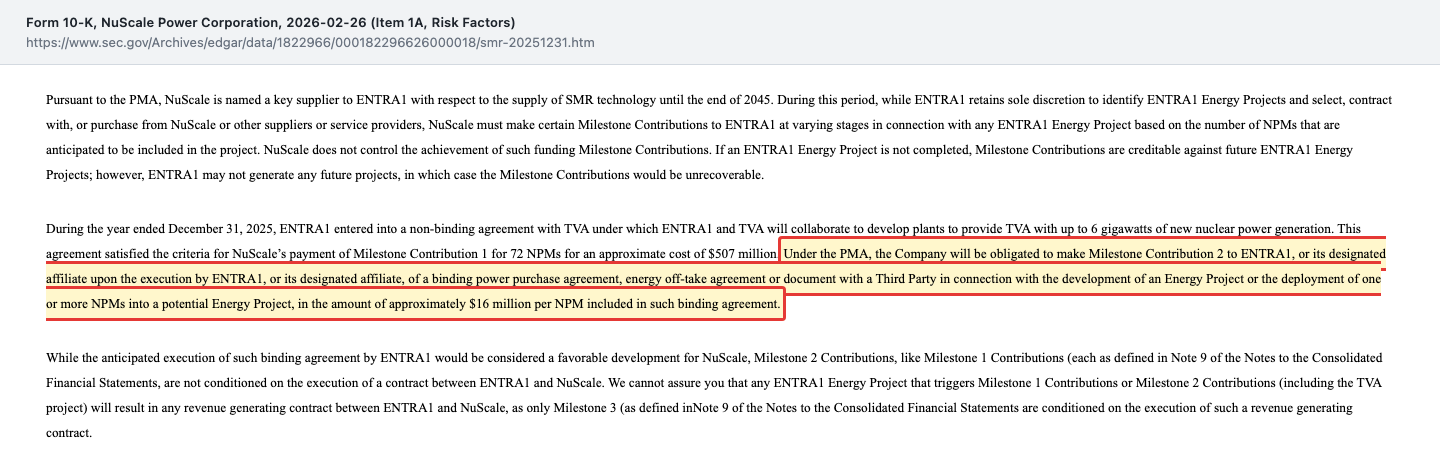
Let's do the math. If a binding deal covers the same 72 modules, that would be about $1.15 billion — roughly 62 percent of the $1,864.1 million in cash and investments as of Sept. 30, 2026. The report stresses in the same section that this second tranche is not tied to a supply contract between ENTRA1 and NuScale either; only the third tranche (50 percent) is. Working back from the 15 percent rate gives a total of about $3.4 billion for 72 modules, including about $1.7 billion in the third tranche — which, however, would coincide with a real order for NuScale. For context: as of Sept. 30, 2026, NuScale had not recorded any liability for further contributions, according to the 10-Q, because the criteria had not yet been met. Remember the sentence that sums up the tension: at NuScale, the bill arrives before the order.
Uncomfortable truth No. 3: nothing moves without ENTRA1 — and ENTRA1 is what the lawsuit is about
You might object: then NuScale should simply find other partners. It is not that easy. The 10-Q describes the balance of power in one sentence:
"While ENTRA1 can decide in its sole discretion whether to participate in commercialization and development opportunities with NuScale, NuScale must obtain ENTRA1’s consent to pursue opportunities without their involvement."
— NuScale Power Corporation, 10-Q for the quarter ended Sept. 30, 2026, Item 2 "Overview" (10-Q 2026)

The 2025 annual report adds: ENTRA1 holds the exclusive worldwide rights for commercialization, distribution and development; if the alliance ends, non-circumvention restrictions apply, and NuScale could face significant damages if it causes a material breach. On top of that comes a fixed sales and marketing agreement of $34.8 million a year. Put simply: the manufacturer has handed its entire sales function to one general agent — and pays that agent milestone contributions (creditable against future ENTRA1 projects per the contract) even for letters of intent.
That very relationship is the subject of a class action. Since Feb. 18, 2026, the case "Truedson v. NuScale Power Corporation" has been pending in federal court in Oregon; the 10-Q summarizes the allegation:
"The amended complaint in the lawsuit, Truedson v. NuScale Power Corporation, et al. (Case No. 26-cv-00328) (the “Truedson Class Action”), asserts claims under federal securities laws that the defendants made false and misleading statements and failed to disclose material facts, relating to ENTRA1’s experience, qualifications and capabilities as a developer of nuclear power plants, and further asserts that Fluor and the individual defendants are controlling persons within the meaning of federal securities laws, and that Fluor sold securities while in possession of material, non-public information in violation of Section 20A of the Securities Exchange Act of 1934."
— NuScale Power Corporation, 10-Q for the quarter ended Sept. 30, 2026, Note 16 "Commitments and Contingencies" (10-Q 2026)
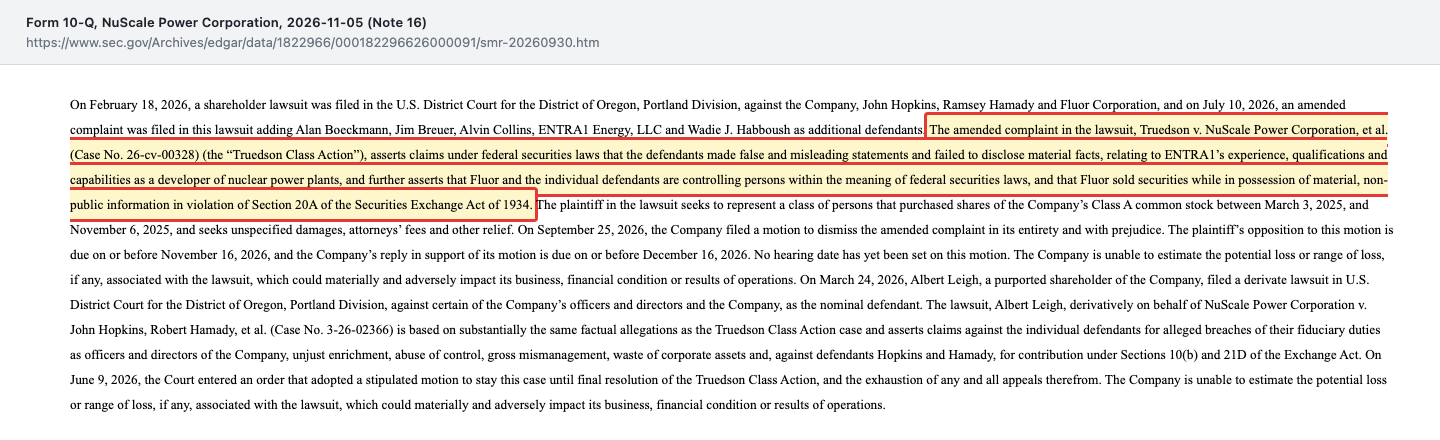
Important context: these are allegations, not a verdict. NuScale moved to dismiss the complaint in its entirety on Sept. 25, 2026; the plaintiff's opposition is due by Nov. 16, 2026, and NuScale's reply by Dec. 16, 2026. Two shareholder derivative suits against officers and directors were also filed (March 24, 2026, now stayed, and Oct. 28, 2026). NuScale says it cannot estimate any potential loss. What matters for you: the reliability of the most important partner is thus also the subject of litigation.
Uncomfortable truth No. 4: your slice of the pie keeps shrinking — and the next serving is already ordered
Where did the $1.86 billion come from? Not from the business, but from selling new shares into the market through at-the-market programs — think of a baker who keeps baking extra rolls, making each one worth a little less. The share count has nearly doubled since the end of 2022:
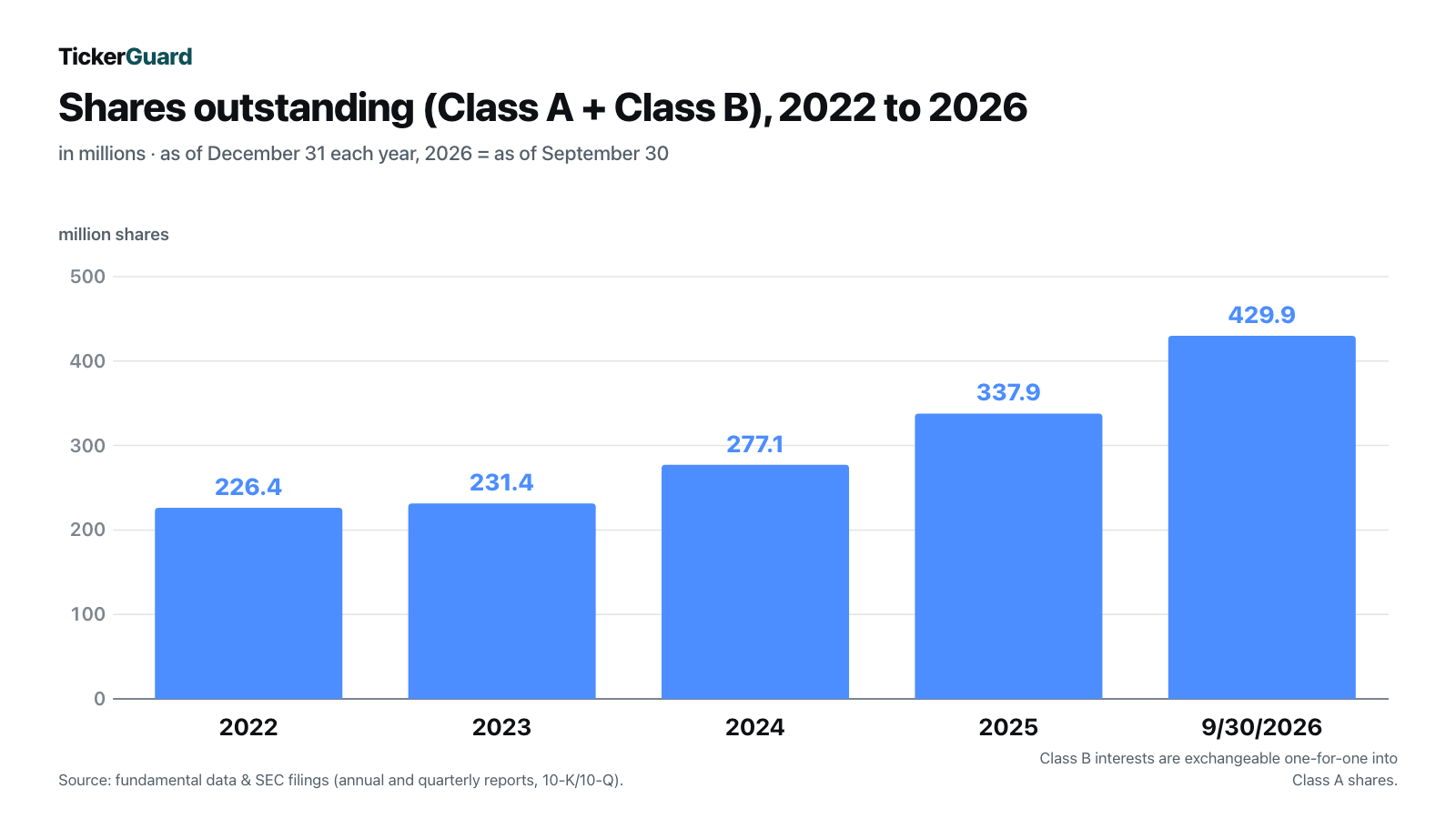
Through June 2026 alone, NuScale sold 89.7 million new shares at an average of $11.14, raising $1.0 billion. On Aug. 11, 2026, the next program followed, for up to $750 million; according to the 10-Q, nothing had been sold under it in the third quarter. A simple calculation shows how much it could matter: at the Nov. 5, 2026, close of $4.37, $750 million would equal about 172 million new shares — roughly 40 percent of the 429.9 million outstanding on Oct. 30, 2026. And the lower the price, the more shares the same amount requires. Remember: the cash is shareholders' money, not customers' money — and, according to the company, it can be topped up with new shares through the ongoing program of up to $750 million.
Valuation: the market pays roughly the cash
A price-to-earnings ratio is impossible without earnings, and a price-to-sales ratio on $0.9 million of nine-month revenue would be a fantasy figure. The most honest yardstick is the balance sheet. At $4.37 (Nov. 5, 2026, close) and 429.9 million shares, the market value was about $1.88 billion. Against that stood $1,864.1 million in cash and investments and $1,974.4 million in equity (Sept. 30, 2026) — about $4.59 of book value per share. The stock traded slightly below book value. For comparison: at the price cited in the prospectus supplement of Aug. 11, 2026 ($9.18 on Aug. 10), the market value would have been more than twice as high.
Why is a company with this much cash worth so little? Because the cash is not free. A large part is earmarked under the ENTRA1 contract once things get serious with TVA, and on top come fixed commitments of $169.8 million per the 10-Q, including $109.9 million in 2027. The professionals' view is split accordingly: according to our fundamental data (retrieved Nov. 6, 2026), 18 analysts cover the stock — 6 at buy, 8 at hold, 4 at sell — with an average price target of $10.38. Average here means all targets added up and divided by the number of analysts; a single very high target pulls it up sharply. Analyst price targets are third-party opinions, not a TickerGuard forecast, and have often been far off the actual share price in the past.How another small-reactor developer looks in its own filings is covered in our analysis of Oklo. For NuScale, the bottom line: whoever buys is mainly buying cash — and the bet that it flows into orders rather than milestone contributions.
Upside and risks at a glance
What speaks for NuScale:
- Unique regulatory position: the first and only NRC design approval for a small modular reactor (50 megawatts in 2020, 77 megawatts in May 2025); 513 issued and 268 pending patents (2025 annual report).
- Strong balance sheet: $1,864.1 million in cash and investments, no debt (Sept. 30, 2026); $19.1 million in investment income (mainly interest) in the third quarter of 2026 alone.
- Runway: excluding the ENTRA1 payment, operating cash outflow in the first nine months of 2026 was about $141.5 million.
- Valuation close to cash and slightly below book value (about $4.59 per share as of Sept. 30, 2026; close of $4.37 on Nov. 5, 2026).
- First real fabrication: in October 2026, NuScale contracted Doosan for the upper reactor coolant system; Romania approved the investment decision for RoPower in February 2026.
What speaks against it:
- Almost no revenue: $0.9 million in the first nine months of 2026, and no binding module order in the filings.
- Existential dependence on ENTRA1: exclusive worldwide commercialization, and NuScale needs ENTRA1's consent to go its own way.
- Milestone contributions before revenue: $507.4 million already paid; a binding power deal triggers about $16 million per module, roughly $1.15 billion for 72 modules.
- Ongoing dilution: share count up from 226.4 million (end of 2022) to 429.9 million, with a new program of up to $750 million since Aug. 11, 2026.
- Legal risk: a class action over statements about ENTRA1 and two derivative suits; NuScale says the potential loss cannot be estimated.
A human conclusion
Back to the pioneer trap from the beginning. Its core is not that the pioneer achieved nothing — according to its own quarterly report, NuScale has achieved what no one before it did — the NRC's Standard Design Approval — and sits on a cash pile many development-stage companies would envy. Its core is that "first to approval" quietly turns into "first to profit" in your head. The filings tell a different sequence: first the approval, then milestone contributions to the company's own sales partner for a letter of intent (creditable against future ENTRA1 projects per the contract), then an even larger payment for a binding power deal — and only after that, perhaps, the order through which NuScale itself makes money. In between, the cash gets topped up with new shares.
So the honest question is not "Is this the winner of the reactor race?" but rather: Do you believe ENTRA1 will deliver the contracts — and that at the end of the chain, more will be left for today's shareholders than the cash they are paying for right now? If yes, you have a thesis. If not, you had a pioneer story. What you do with it is your call — and that is exactly how it should be.
Sources
All original documents used in this analysis — to read for yourself:
- NuScale Power Corporation — 10-Q for the quarter ended Sept. 30, 2026 (filed Nov. 5, 2026)
- NuScale Power Corporation — 8-K of Nov. 5, 2026 (Item 2.02) with Exhibit 99.1, third-quarter 2026 earnings release
- NuScale Power Corporation — 10-Q for the quarter ended June 30, 2026 (filed Aug. 5, 2026)
- NuScale Power Corporation — 10-Q for the quarter ended March 31, 2026 (filed May 7, 2026)
- NuScale Power Corporation — 8-K of Aug. 11, 2026: sales agreement for up to $750 million (Item 1.01)
- NuScale Power Corporation — Prospectus supplement 424B5 of Aug. 11, 2026
- NuScale Power Corporation — 10-K for fiscal 2025 (filed Feb. 26, 2026)
- NuScale Power Corporation — 10-K for fiscal 2024 (filed March 3, 2025)
- NuScale Power Corporation — 10-K for fiscal 2023 (filed March 15, 2024)
- Full SEC filing history of NuScale Power: EDGAR, CIK 0001822966
- Fundamental data (prices through Nov. 5, 2026, analyst price target, short interest; retrieved Nov. 6, 2026), cross-checked against the price cited in the prospectus supplement of Aug. 11, 2026.
- Earnings call transcripts were not used; the analysis relies solely on mandatory SEC filings.
Transparency & disclaimer: This analysis is a journalistic assessment of publicly available information and does not constitute investment advice, a regulated financial analysis, or a solicitation to buy or sell securities. Equity investments carry substantial risk, including total loss. All information is provided without guarantee; the data date is noted throughout the text. Positions held by the operator are disclosed daily; where one exists, it appears as a notice at the top of this deep dive.
Key figures at a glance
All monetary figures in millions of $; earnings per share as reported.
| Metric | 2021 | 2022 | 2023 | 2024 | 2025 |
|---|---|---|---|---|---|
| Revenue | 2.9 | 11.8 | 22.8 | 37.0 | 31.5 |
| Operating Income (EBIT) | -174.3 | -230.0 | -275.6 | -138.7 | -689.6 |
| Net Income | -102.5 | -57.1 | -58.4 | -136.6 | -355.8 |
| Net Margin | -3,581.2% | -483.5% | -255.9% | -368.8% | -1,130.3% |
| Earnings Per Share | -2.35 $ | -1.12 $ | -0.80 $ | -1.47 $ | -2.17 $ |
Source: fundamental data & SEC filings (annual and quarterly reports, 10-K/10-Q)
Our Bottom Line at a Glance
- Technology & approval positive
- The first and only NRC design approval for a small modular reactor: 50 megawatts in 2020, 77 megawatts in May 2025. Plus 513 issued and 268 pending patents (10-K 2025) and, since October 2026, a first fabrication contract with Doosan.
- Balance sheet & liquidity positive
- $1,864.1 million in cash and investments, no debt, $1,974.4 million in equity (Sept. 30, 2026). Excluding the ENTRA1 payment, operating cash outflow was about $141.5 million in the first nine months of 2026.
- Revenue & business model negative
- $0.9 million in revenue in the first nine months of 2026 (prior year: $29.7 million, mostly from Fluor). No binding module order is documented in the filings.
- Dependence on ENTRA1 negative
- ENTRA1 holds exclusive worldwide commercialization rights; NuScale needs its consent to go its own way. $507.4 million has already been paid for a non-binding agreement, and a binding power deal costs about $16 million per module.
- Dilution negative
- Share count up from 226.4 million (end of 2022) to 429.9 million (Sept. 30, 2026); another program of up to $750 million since Aug. 11, 2026.
- Legal risks negative
- Class action since Feb. 18, 2026, over statements about ENTRA1's experience, plus two derivative suits; motion to dismiss of Sept. 25, 2026, pending, and NuScale says any loss cannot be estimated.
According to its own quarterly report, NuScale has what no competitor has — an NRC design approval (Standard Design Approval) for a small modular reactor — and $1.86 billion in cash with no debt. Revenue, by contrast, barely exists, all sales run exclusively through ENTRA1, and the agreement with that partner requires payments before any order: $507.4 million for a letter of intent and about $16 million per module for a binding power deal. The cash pile was filled with new shares. Not investment advice.
What Our Rating Means
Substance risk
We found at least one documented issue that threatens the company itself — regardless of how the stock is currently valued.
Red here does not mean a cash crunch — the cash pile is large and debt-free. It reflects a documented existential dependence on a single counterparty: ENTRA1 exclusively controls the path to customers, NuScale cannot go its own way without ENTRA1's consent, and the partnership agreement obliges NuScale to pay amounts in the billions before any order for NuScale is certain. Add almost no revenue of its own and a class action that targets exactly this partnership. That the stock trades near its cash does not change this assessment — that is a price argument, not a quality argument. The decision is yours.
A journalistic assessment by our editorial team at the time of the deep dive, based on public sources — not investment advice and not a solicitation to buy or sell. Your personal circumstances (investment goals, risk capacity, taxes) cannot be taken into account. What our levels mean, how verdicts are formed, and what conflicts of interest exist →
Worth Noting
- Data as of: balance sheet, income and cash flow figures as of Sept. 30, 2026 (10-Q filed Nov. 5, 2026) or Dec. 31, 2025 (10-K filed Feb. 26, 2026); share count per the 10-Q cover as of Oct. 30, 2026; prices, analyst target and short interest per fundamental data (close of Nov. 5, 2026, retrieved Nov. 6, 2026). All SEC filings through Nov. 6, 2026, were reviewed; the Nov. 5, 2026, earnings release (8-K, Exhibit 99.1) contains no guidance.
- The $1.15 billion for the second milestone contribution is a calculation (about $16 million per module × the 72 modules of the non-binding TVA agreement). How many modules a binding deal would include is open; the payment scales with that number.
- Not to be confused: the ticker SMR stands for NuScale Power, not for the generic abbreviation "SMR" (small modular reactor). Until May 2, 2022, the listed company was named Spring Valley Acquisition Corp.
Stock Watch
This analysis is as of November 6, 2026. Stock Watch will tell you what's changed at SMR since then.
Later $1 a month per stock — signing up is free, and you'll be the first to know when it launches.
The full analysis as a PDF for later
We will send you this analysis as a PDF — to print, file away, and read at your own pace. And we will add you to the free Stock Watch list for Nuscale Power Corp (SMR), so you hear about it when something material in this analysis changes.
Frequently Asked Questions
NuScale Power (NYSE: SMR), based in Corvallis, Oregon, develops small modular nuclear reactors. One "NuScale Power Module" produces up to 77 megawatts of electricity, and up to twelve modules form a 924-megawatt plant. NuScale wants to sell the modules but does not build power plants itself. So far, revenue has come mainly from engineering and licensing work — $0.9 million in the first nine months of 2026.
According to the 10-Q, ENTRA1 Energy is the exclusive global partner for commercializing and developing all NuScale products. NuScale needs ENTRA1's consent to pursue opportunities without it. For a non-binding agreement between ENTRA1 and utility TVA covering 72 modules, NuScale paid ENTRA1 $507.4 million, with the final $259.9 million installment paid in 2026.
According to the 2025 annual report, the second milestone contribution then comes due: about $16 million per module included in the binding agreement — roughly $1.15 billion for 72 modules. This payment does not require a supply contract with NuScale. Only the third tranche is tied to an order for NuScale. As of Sept. 30, 2026, no liability had been recorded for it.
As of Sept. 30, 2026, NuScale held $1,864.1 million in cash and investments and had no debt. Excluding the payment to ENTRA1, operating cash outflow in the first nine months of 2026 was about $141.5 million. The company considers its resources sufficient for the next twelve months and beyond — explicitly together with continued access to capital markets.
Shares outstanding (Class A and Class B) rose from 226.4 million at the end of 2022 to 429.9 million on Sept. 30, 2026. Through June 2026, NuScale sold 89.7 million new shares at an average of $11.14. Since Aug. 11, 2026, another program of up to $750 million has been in place; nothing had been sold under it in the third quarter of 2026.
The Truedson class action in federal court in Oregon alleges that NuScale, executives and Fluor made misleading statements about ENTRA1's experience, qualifications and capabilities as a power plant developer; it covers purchases between March 3 and Nov. 6, 2025. NuScale moved to dismiss on Sept. 25, 2026. These are allegations, not a ruling.
Found an error?
Did you spot a factual error, an outdated number, or a typo in this deep dive? Let us know briefly — your report goes straight to the editorial team.