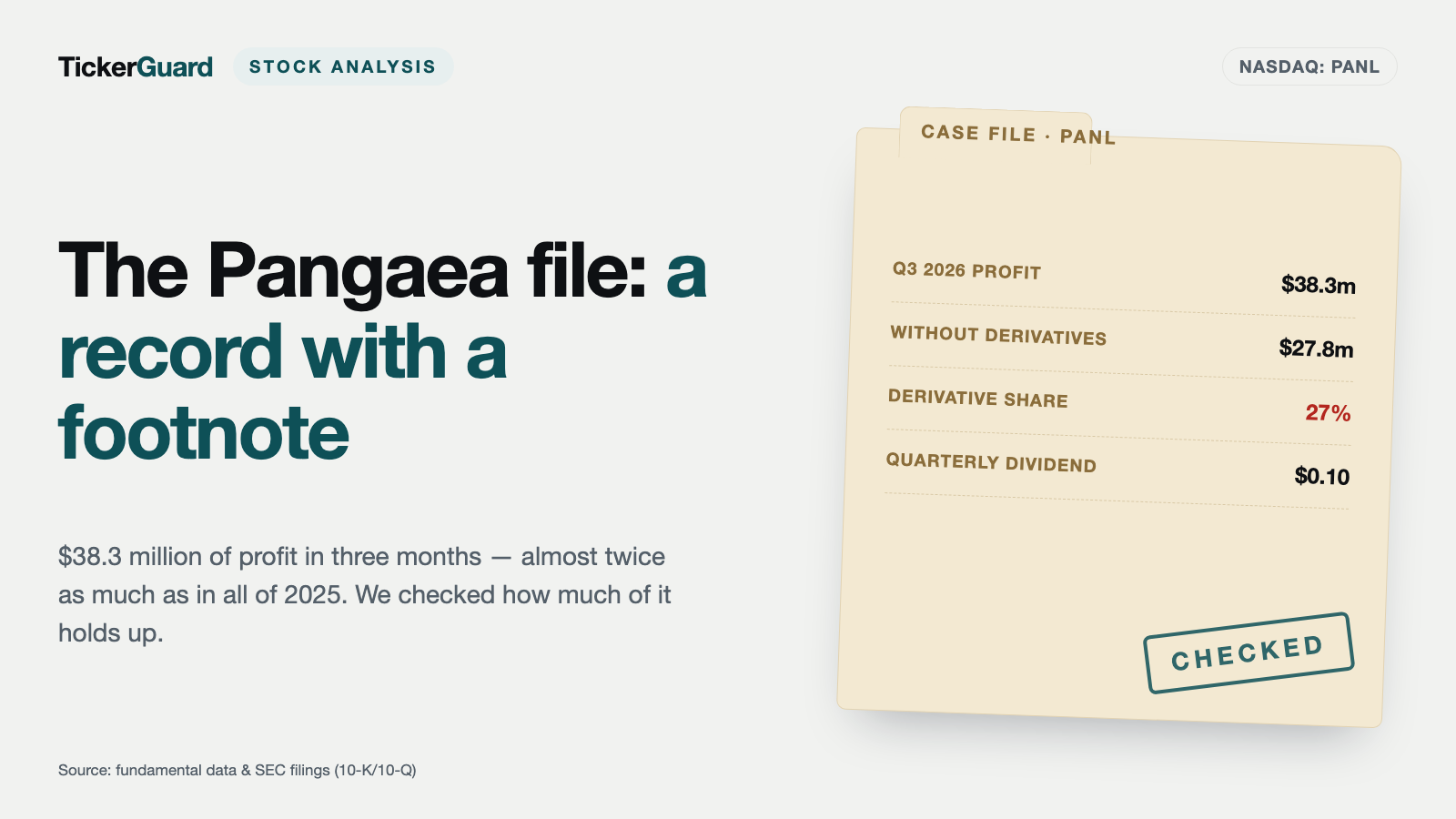
Pangaea Logistics earned almost twice its full-year 2025 profit in three months – and a good quarter of it came from derivatives
Annualize this quarter and Pangaea Logistics (Nasdaq: PANL) trades at a price-to-earnings ratio of about 3. But of $38.3 million of profit for shareholders (July through September 2026), $10.5 million came from fuel and freight derivatives, and according to the CEO the third quarter is the strongest period for the ice-class fleet. The progress is real all the same: revenue up 29.9 percent, the dividend back at $0.10 a quarter, debt refinanced more cheaply. Extrapolate, and you are counting on a summer that does not come four times a year.
 Thomas Mücke
Founder & Publisher
As of Today
As of: November 5, 2026
- Closing price
- 7.40 $ -1.90%
- Market Capitalisation
- 0.5 $B
- P/E
- 12.4
- Growth Score
- 3/10
- AAQS
- 6/10
Price change since November 5, 2026: +0.4%
This analysis has a cut-off date. The Stock Guard tells you when something material changes in the numbers. Reserve your free spot
Chart
Interactive price chart (TradingView).
52-week range: 4.70 $ to 9.40 $ · Last price: 7.40 $ (As of: November 5, 2026)
Note: pure fact-based analysis, not investment advice and not a solicitation to buy or sell. All figures without guarantee.
From July through September 2026, Pangaea Logistics Solutions (Nasdaq: PANL) earned $38.3 million for its shareholders. In all of 2025, it earned $19.4 million. That invites a mental shortcut almost every investor has used without noticing: take the latest quarter, multiply it by four and treat the result as the new normal. Multiply by four and the stock looks like a bargain at a price-to-earnings ratio of about 3. Psychologists call it recency bias — the most recent data point weighs more in our heads than everything before it.
We are not going to do that. Instead, we read the quarterly report Pangaea filed with the U.S. securities regulator, the SEC, on November 5, 2026, line by line and ask: how much of this record is business, how much is hedging, and how much is season? The decision at the end is yours.
What Pangaea Logistics actually does
Grain, coal, iron ore, bauxite, cement, limestone: commodities that are poured loose into huge cargo holds are called dry bulk. Pangaea carries this kind of cargo across the oceans — about 26.2 million tons to more than 300 ports in 2025 (annual report on Form 10-K for 2025). Think of it as a trucking company whose trucks happen to be 60,000-ton ships. As of September 30, 2026, Pangaea owned 38 vessels, six of them through Nordic Bulk Holding, a subsidiary in which it holds two-thirds; in the third quarter, about 31 chartered-in vessels came on top. The company also runs port and terminal operations in Fort Lauderdale, Baltimore, Port Aransas, Tampa and Lake Charles.
The trick is the ice. According to its 2025 annual report (10-K), Pangaea operates the world's largest fleet of ice-class 1A dry bulk carriers above 60,000 tons — reinforced ships allowed into the Baltic Sea and the Gulf of St. Lawrence in winter and the Arctic in summer. Whoever holds the biggest key ring for a hard-to-reach door can charge more for passage. The TCE rate shows it (simply put: what a ship earns per day after voyage costs): in the third quarter of 2026 it was $20,414, 13 percent above the market indices for comparable vessel sizes (Baltic Panamax, Supramax and Handysize). Long-term contracts of affreightment (COAs — commitments to carry set volumes over years) add stability.
Company history for investors
-
2014
Listing via a SPAC
Pangaea reaches Nasdaq through the blank-check company Quartet — and has reported like a U.S. company on Form 10-K/10-Q ever since, despite its Bermuda domicile.
-
2024
Fleet acquisition: 15 Handysize vessels
The fleet grows by 58 percent, paid partly in shares — the seller becomes the largest shareholder at about 29 percent and is linked to the ship manager.
-
2025
May 2025: dividend halved
The quarterly dividend falls from $0.10 to $0.05, alongside a buyback of up to $15 million — of which roughly $3 million is used.
-
2026
June 2026: board downsized
Three directors are removed under a bye-law clause and the board shrinks to seven; Mads Boye Petersen has been CEO since January 1, 2026.
-
2026
August to October 2026: dividend back, debt refinanced
The dividend returns to $0.10; a $145 million loan at SOFR plus 1.60 percent replaces more expensive financings.
How the stock landed on our desk
The occasion is the quarterly report (10-Q) and the earnings release (8-K, Exhibit 99.1) of November 5, 2026. This is our first English edition; our German analysis has covered Pangaea since July 2026, and a lot has moved since then: the dividend has doubled again, the Tampa terminal is running, the CEO since January 1, 2026 is Mads Boye Petersen (his predecessor Mark Filanowski retired), and the board removed three of its members. What a record quarter is worth at a cyclical shipping company is a question we have worked through before — in our analysis of Dorian LPG, a gas carrier.
The numbers over the years
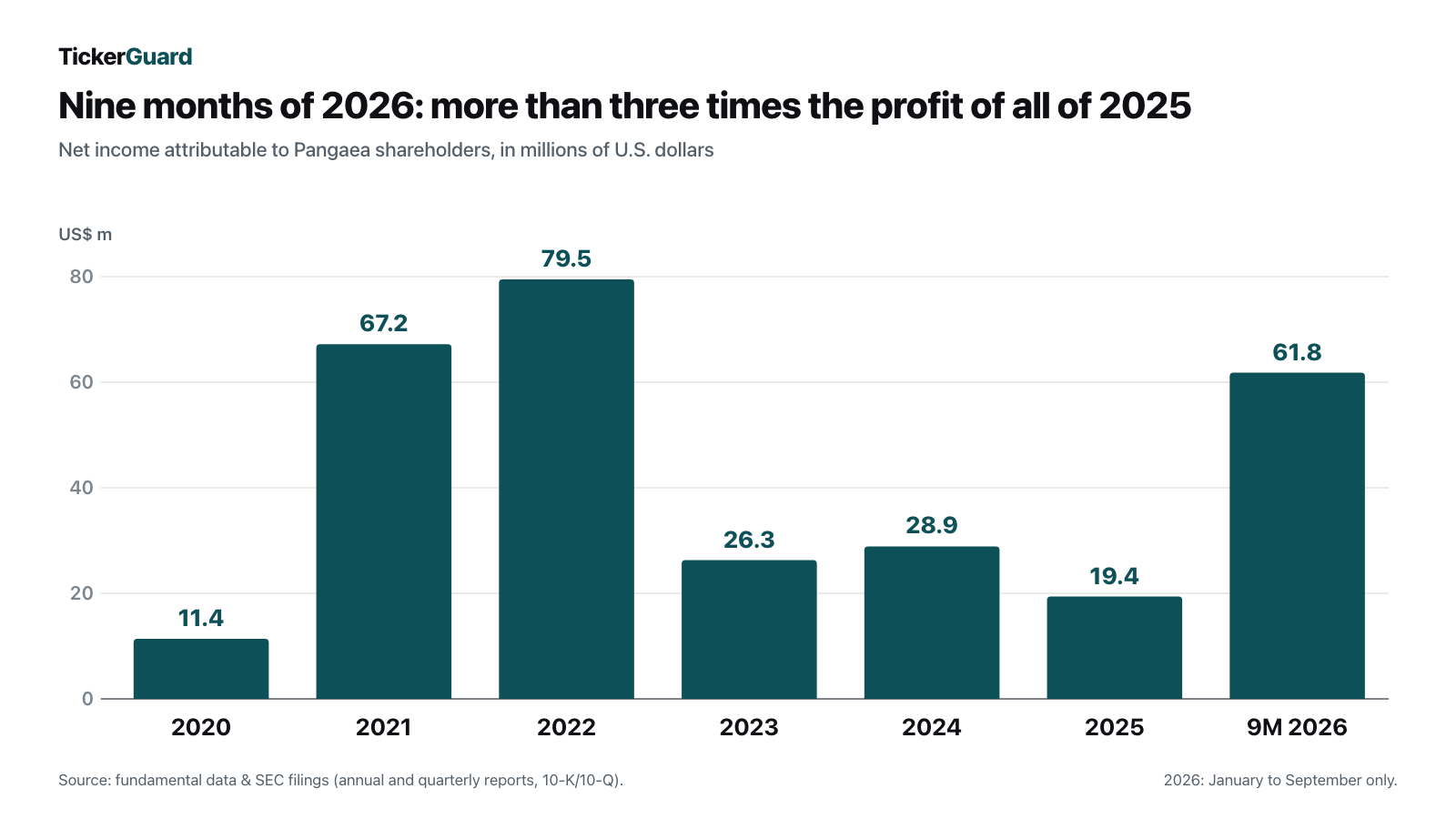
This business breathes with the freight cycle. In the boom years 2021 and 2022, Pangaea earned $67.2 million and $79.5 million, followed by $26.3 million (2023), $28.9 million (2024) and $19.4 million (2025). In the first nine months of 2026, it has already earned $61.8 million — more than three times all of last year. One thing matters for understanding the company: Pangaea has been profitable in every calendar year since 2020, even though individual quarters (early 2025) brought losses.
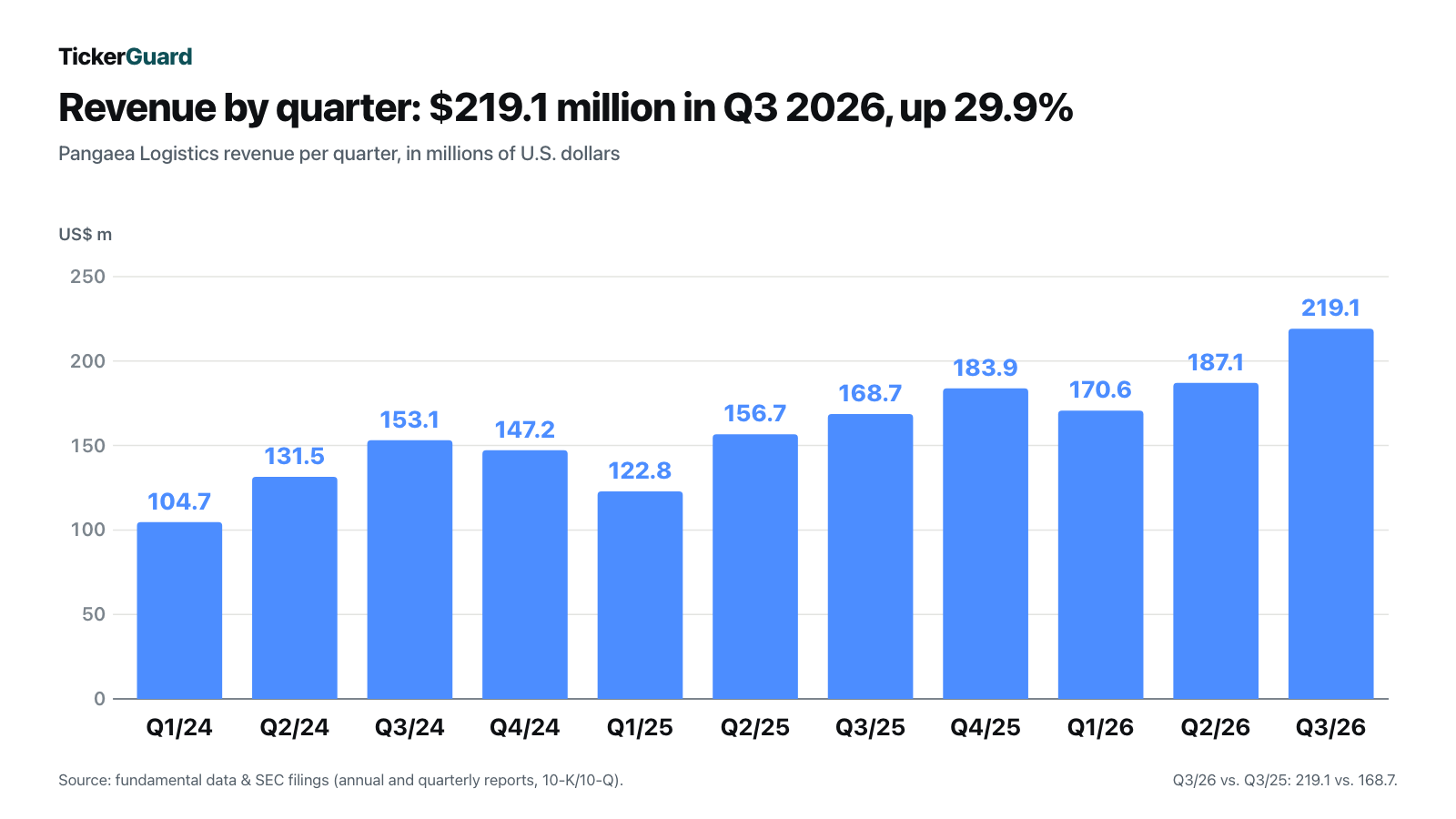
Revenue shows the same wave, only flatter. In the third quarter of 2026, it rose 29.9 percent to $219.1 million (prior-year quarter: $168.7 million). Higher freight rates were the main driver: the Baltic Dry Index, the benchmark for dry bulk freight, was 54 percent above the prior-year quarter. On top of that, time-charter days roughly doubled (1,020 vs. 495), and port and terminal revenue rose 73 percent to $7.1 million.
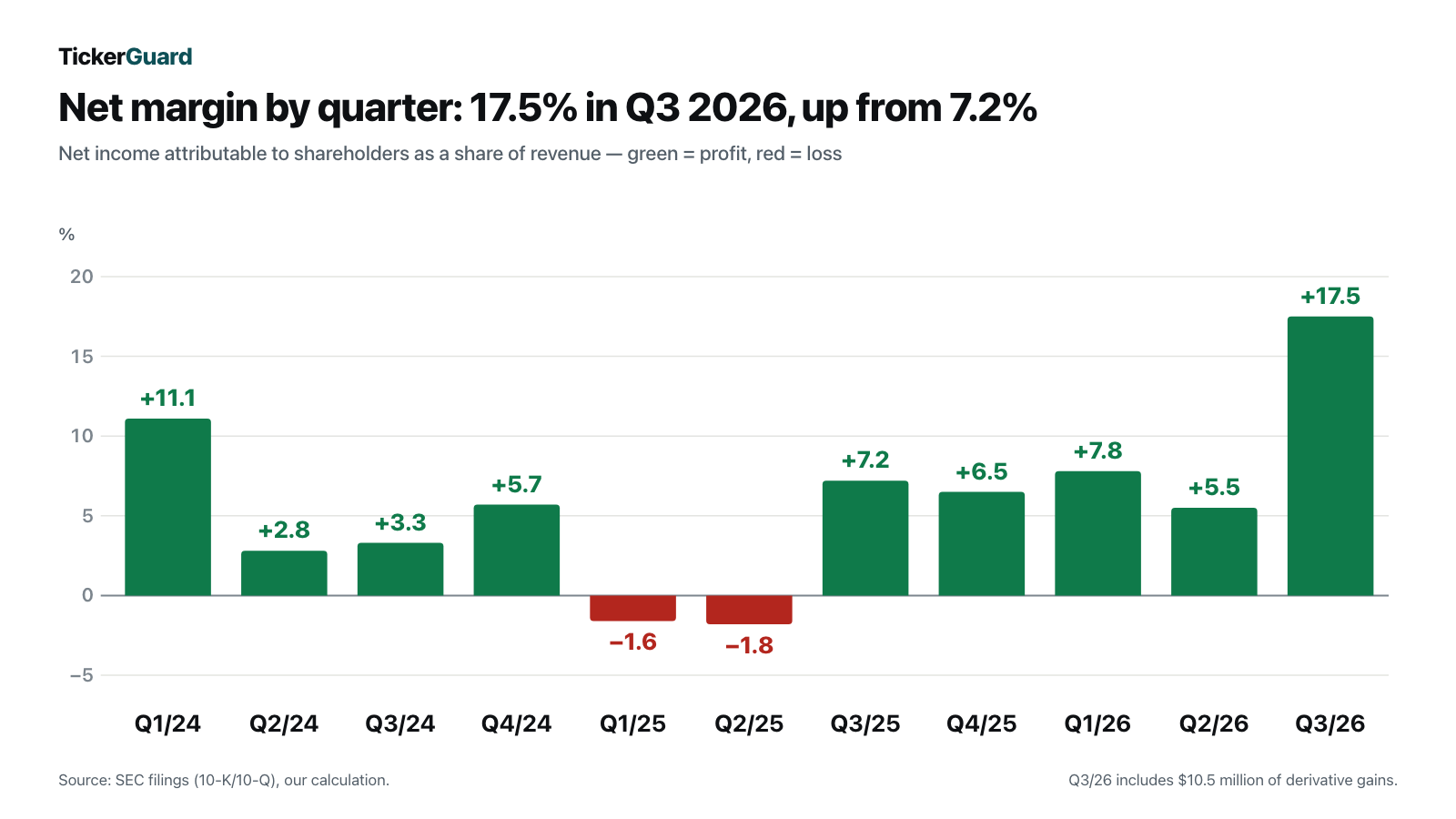
Profit jumped further. The net margin — the share of revenue left over as profit for shareholders — climbed to 17.5 percent from 7.2 percent a year earlier. Earnings per share rose from $0.19 to $0.59, and Pangaea's adjusted operating result before depreciation (adjusted EBITDA) rose 81.3 percent to $52.4 million — a record, according to the company.
Cash flow confirms the picture: operations generated $83.1 million in the first nine months, up from $38.6 million a year earlier. Current assets ($310.4 million) comfortably exceed current liabilities ($203.9 million). The quarterly report contains no going-concern doubt and no equity raise; since the start of the year, the share count rose only through stock compensation, from 64.97 million to 65.47 million.
What is left of the record profit: derivatives, season and adjusted numbers
Now to the core. Pangaea hedges against swinging fuel prices with so-called swaps — think of it like a fixed-price heating-oil contract: if the price rises, the other side pays the difference. On top of that come freight forwards and an interest rate cap. Because none of these contracts is designated as an accounting hedge, their gains and losses go straight into earnings. In the third quarter of 2026, they added up to a $10.5 million gain: $11.5 million from fuel swaps, minus $1.0 million from freight forwards. $4.6 million of it is unrealized — valuation gains on open positions that the next price drop can reverse.
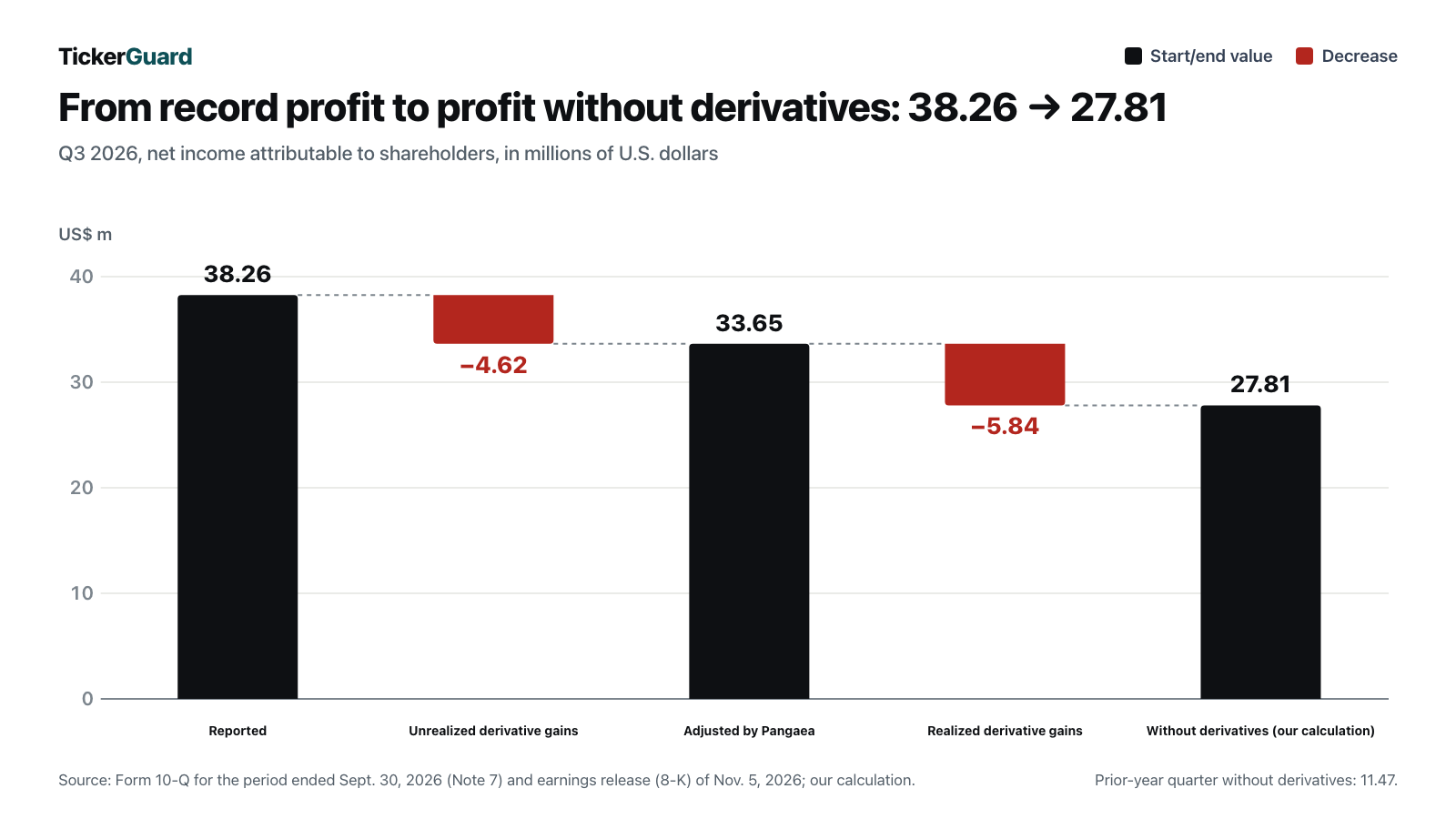
Pangaea itself strips out only the unrealized part and reports adjusted net income of $33.6 million ($0.52 per share). We go one step further and also deduct the realized $5.8 million: that leaves $27.8 million, or about $0.43 per share. In the prior-year quarter, the same figure was $11.5 million ($0.18). Like Pangaea, we attribute the derivatives fully to shareholders. Even on this strictest basis, profit more than doubled — the record is not an accounting trick, but it is a good quarter smaller than the headline says.
Is stripping it out fair? Partly. The swaps are not a bet but a hedge, and they did exactly their job — the quarterly report says so itself:
“Bunker consumption costs increased by $8.4 million, or 21%, primarily due to higher average bunker prices. This was offset by an increase in unrealized gains of $5.3 million on bunker derivatives in the quarter.”
— Pangaea Logistics Solutions, Form 10-Q for the period ended September 30, 2026, Management’s Discussion and Analysis (Voyage Expenses)

Anyone stripping out the hedge should remember that without it, the fuel bill would have hit in full. The catch lies elsewhere: derivatives swing both ways. In the first quarter of 2026, unrealized valuations added about $6.6 million; in the second quarter, they cost $6.7 million (profit fell to $10.2 million, adjusted $16.9 million); in the third, they added $4.6 million again (our calculation from the quarterly reports). Over nine months, all derivative gains add up to $20.8 million — a good third of the $61.8 million profit.
The second factor is the season. CEO Petersen says so himself in the earnings release:
“The third quarter represents our strongest period for Arctic ice-class activity, and this year that seasonal strength was reinforced by a strengthening dry bulk market.”
— Mads Boye Petersen (CEO), earnings release (8-K, Exhibit 99.1) of November 5, 2026
For the fourth quarter, Pangaea had already fixed 5,040 shipping days at $21,423 per day as of November 5, 2026 — a higher daily rate than in the third quarter ($20,414). At the same time, the quarterly report announces a one-time loss of about $2.7 million in the fourth quarter from the early repayment of loans (more on that below). In our own quarterly series, though, the season does not show up the same way every year: in 2025 the third quarter was the strongest of the year, while in 2024 its net margin of 3.3 percent was below the first quarter's 11.1 percent. Bottom line: the business has clearly improved. Multiplying the peak by four would still be a mistake — freight rates and derivatives can turn just as quickly, as the years 2023 to 2025 after the boom showed.
What management promised — and what the earnings calls reveal
We read eleven earnings call transcripts, from November 9, 2023 to August 11, 2026; there is no transcript for the second quarter of 2024. The transcript of the November 6, 2026 call was not yet available at the time of writing. The texts come from a third-party provider and may contain errors. We weight the Q&A more heavily than the prepared remarks.
The near-term preview holds. In almost every call, Pangaea discloses how many shipping days of the current quarter are already booked and at what rate. Ten times, this preview can be compared with the quarterly figure reported later: the deviation ranged from minus 7 to plus 9 percent. Most recently, 4,873 days were booked at $20,258 in August 2026; the third quarter came in at $20,414. In May 2026, asked about the second quarter, Petersen expected “maybe a tick higher” than the booked $18,808; it ended at $18,153.
The dividend — sustainable, cut, doubled. In November 2024, it still sounded like this:
“Importantly, we believe our dividend policy is sustainable through the economic cycle, given the proven consistency of our business.”
— Earnings call of November 13, 2024, Mark Filanowski (then CEO), prepared remarks
In March 2025, an analyst asked directly whether the amount would be maintained. Filanowski answered: “we don't have a fixed formula, but we look at it every quarter” — he did not confirm the amount. Two months later, the dividend was halved, and asked what had changed, he said in the Q&A:
“We want to keep a consistent dividend and it doesn't necessarily mean a consistent amount.”
— Earnings call of May 13, 2025, Mark Filanowski (then CEO), Q&A
Between those two calls, the tone flipped: from “sustainable through the cycle” to “consistent does not mean the same amount.” In August 2026 came the reversal upward. CFO Gianni Del Signore explained the return to $0.10 like this:
“This increase reflects the strengthening fundamentals and the balance sheet of the business and underscores our commitment to returning capital to shareholders, consistent with the disciplined capital allocation strategy we have always followed.”
— Earnings call of August 11, 2026, Gianni Del Signore (CFO), prepared remarks
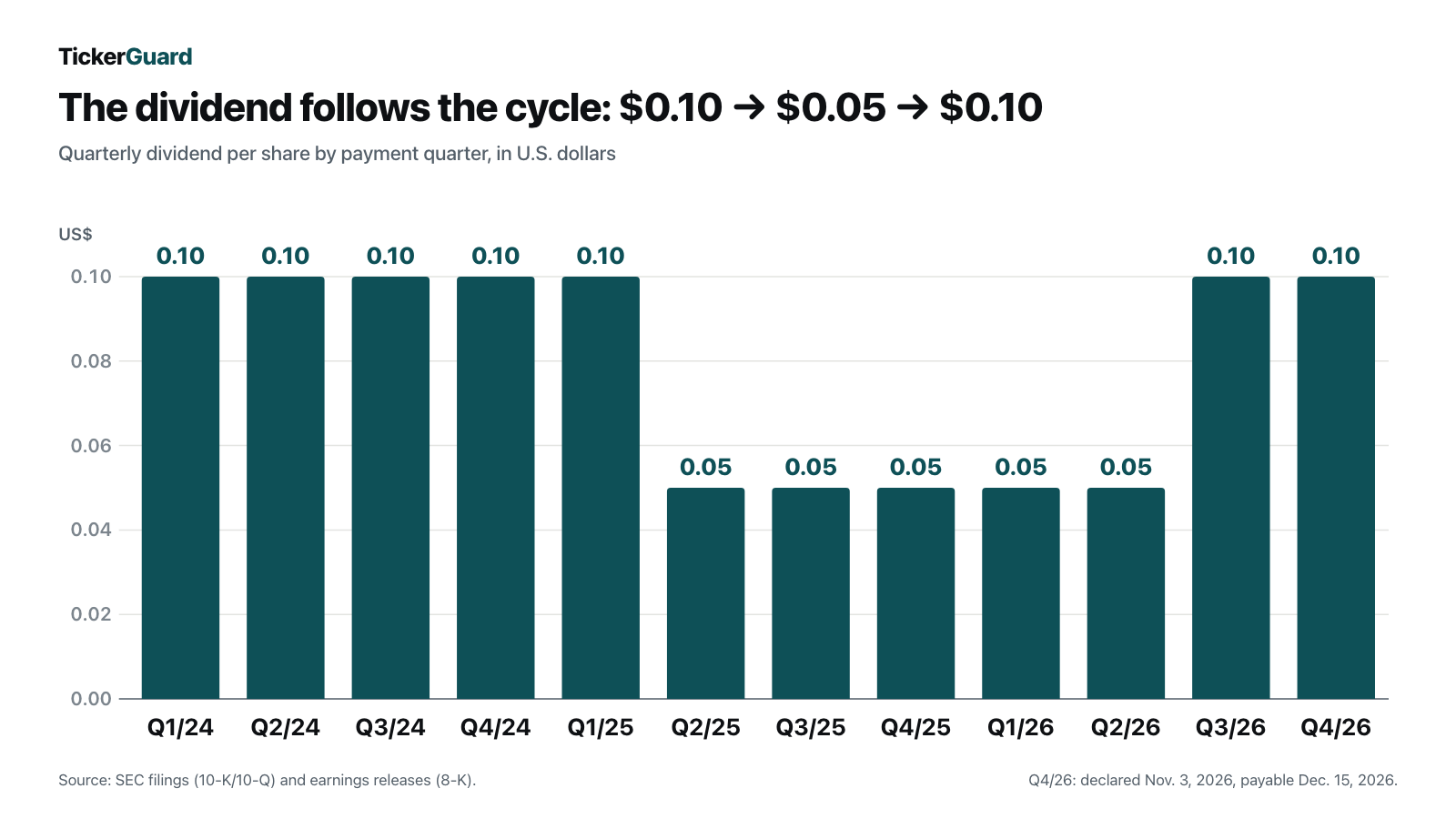
He did not mention that the dividend had been halved five quarters earlier. In the Q&A of the same call, analyst Liam Burke (B. Riley) asked how management weighs paying down debt against a higher dividend; the answer covered refinancing and cash, not a payout rule. Pangaea has not named such a rule or ratio in any of the eleven calls. What that means for you: the dividend follows the cycle, not a formula.
Buyback announced, barely used. Alongside the cut in May 2025 came a repurchase program of up to $15 million. In 2025, Pangaea bought back about 600,000 shares for roughly $3 million, according to CEO Petersen (earnings call of March 11, 2026); in the first nine months of 2026, none at all, according to the cash flow statement. The program does not come up in the May and August 2026 calls.
Tampa — late, but delivered. In November 2024, Filanowski said in the Q&A: “We've already got booked for next year, probably at least 20 or 25 voyages into Tampa.” The start was then pushed back several times — in November 2025, for instance, with these words: “Expansion at the port of Tampa, Florida is delayed a bit due to equipment deliveries, but we expect to begin operations early next year.” The terminal started operating in the second quarter of 2026, about a year later than originally indicated; according to the earnings release, the third quarter was its first full quarter.
The refinancing — and an open balloon payment. In August 2026, Del Signore announced that a $24 million balloon payment would be refinanced “in the coming months.” In the Q&A, he clarified that it sits in the Nordic Bulk Holding joint venture with Glencore and that the partners would decide what to do. The October 2026 refinancing covered other loans (see below); in the report for September 30, 2026, the NBHC loan of $26.6 million maturing in March 2027 is still on the list of debt.
What did not come up again. In May 2025, Filanowski said: “By year-end, we hope to have implemented cost savings of at least 2.5 million annually.” The figure does not appear in the five later calls — which neither proves nor disproves whether the savings were achieved. And in May 2026, Petersen announced: “So in the secondhand market, we do expect to be more active there on the buying side over the next year or so.” Through September 30, 2026, no vessel purchase has been reported.
Finally, it is striking how few people ask: only one to five analysts asked questions per call, two in August 2026. Nobody raised the board downsizing of June 2026.
What the filings say — the uncomfortable truths
Uncomfortable truth No. 1: The dividend is a decision, not a promise
Anyone buying Pangaea for the payout should know the fine print. The 2025 annual report puts it plainly:
“We cannot assure you that we will be able to pay regular quarterly dividends, and our ability to pay dividends will be subject to the limitations set forth above and in the section of this Form 10-K titled ‘Risk Factors.’ … On February 5, 2026, the Company's Board of Directors declared a quarterly cash dividend of $0.05 per common share.”
— Pangaea Logistics Solutions, SEC annual report on Form 10-K for 2025, Item 5 (Dividends)
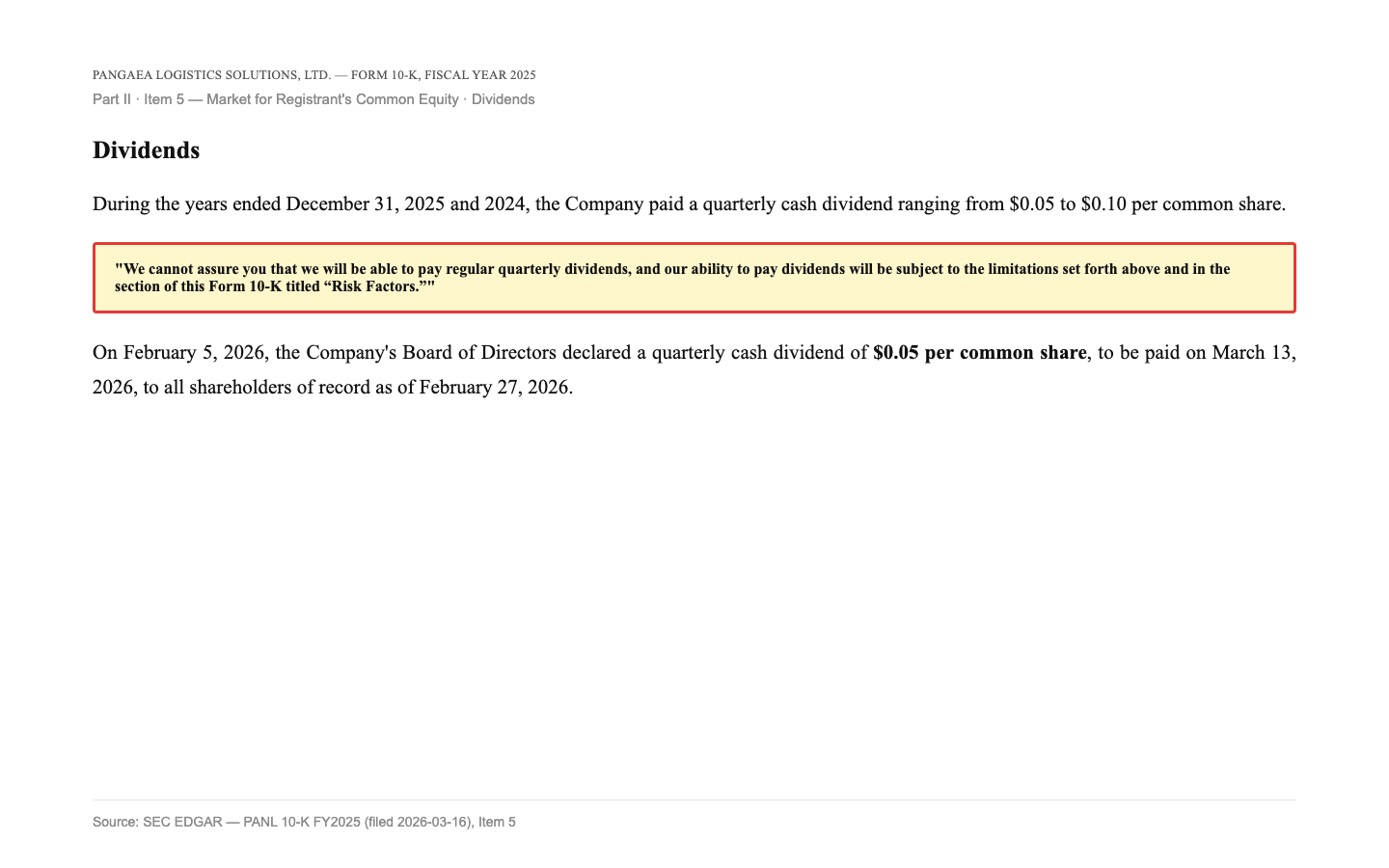
With 65.5 million shares, a $0.10 dividend costs about $6.5 million per quarter. In the third quarter of 2026, operations brought in about $57 million — so for now it is well covered. The lesson of 2025 still holds: when the 2024 payout ($18.7 million) exceeded free cash flow (minus $3.7 million, because of the fleet acquisition), the dividend was cut. If the freight market falls, it can happen again.
Uncomfortable truth No. 2: The debt got cheaper, but it has not gone away
Ships cost nine-figure sums and are usually bought on credit. As of September 30, 2026, Pangaea carried $340.9 million of debt including leases (end of 2025: $375.6 million), against $144.9 million of cash. According to the company, net debt equals 1.4 times adjusted EBITDA over the last twelve months — at the end of June 2026 it was still 2.1. In October 2026 (credit agreement dated October 16), a refinancing followed:
“Borrowings under the Facility bear interest at three-month Term SOFR, subject to a zero percent floor, plus a margin of 1.60% per annum. Principal is repayable in 24 quarterly installments of approximately $2.8 million each, commencing January 31, 2027, with an additional balloon payment of approximately $77.4 million due at maturity in October 2032. The Facility is guaranteed by the Company and secured by first-priority mortgages on seven vessels owned by the Company’s wholly owned subsidiaries.”
— Pangaea Logistics Solutions, Form 10-Q for the period ended September 30, 2026, Note 14 (Subsequent Events)

With the $145 million, Pangaea repaid a $38.7 million loan (interest rate per the quarterly report: 6.14 percent) and four Bulk Nordic vessel financings totaling $95.3 million (7.06 percent); $1.5 million went to fees and $8.4 million stayed in the bank. The report does not state the new rate as a single percentage because it floats with SOFR — the earnings release speaks of a “meaningfully lower margin.” The price: a one-time loss of about $2.7 million in the fourth quarter. And the basic rule from the annual report still applies — the loans are secured by ship mortgages, and the banks require that vessel values do not fall below a certain share of the debt:
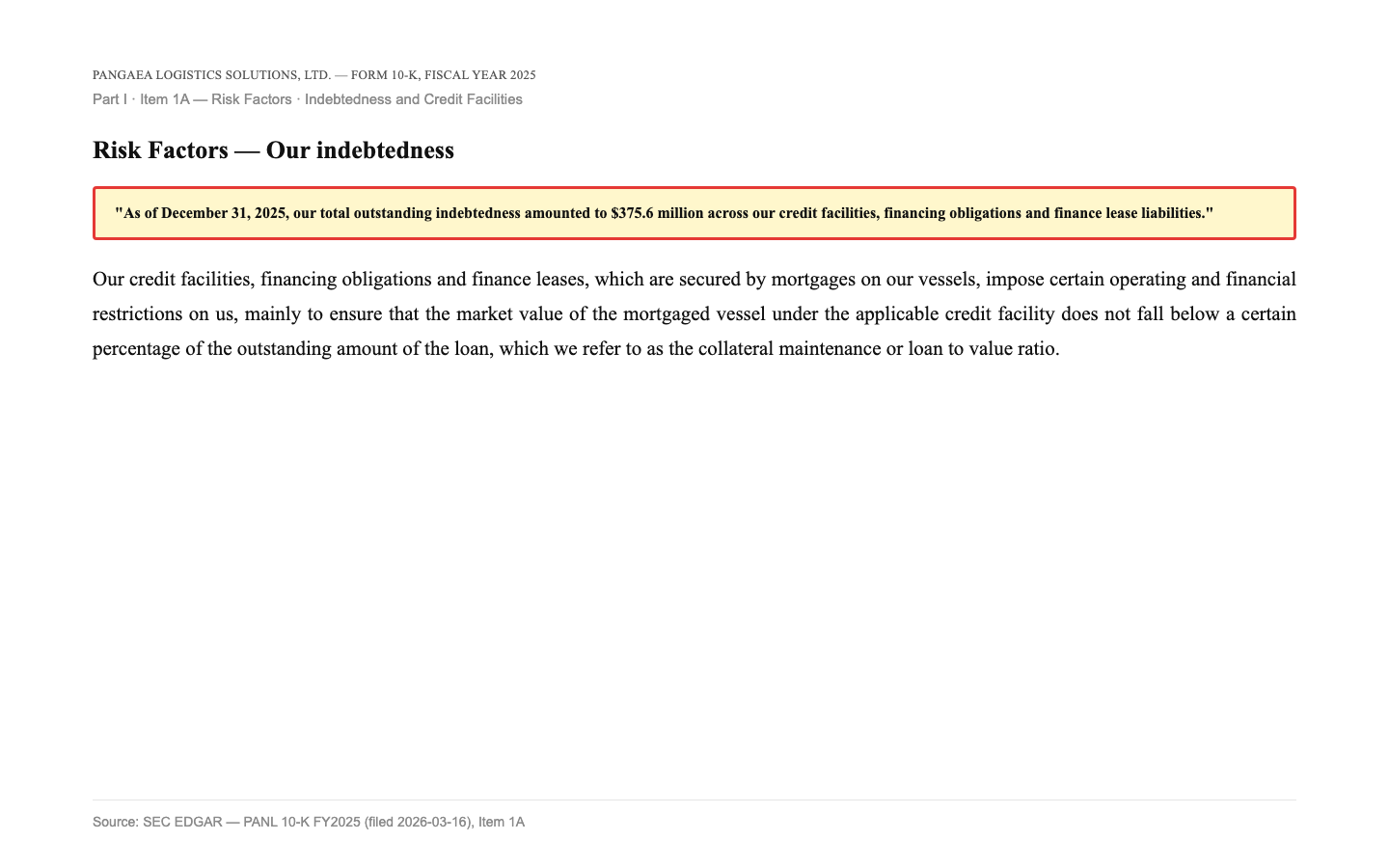
As of September 30, 2026, Pangaea was in compliance with all covenants. Under the contract terms as of September 30, before the refinancing, about $50.7 million in loan payments (principal and interest) were due in 2027 — including the NBHC loan maturing in March 2027 — plus $50.9 million on vessel financings; part of that has been replaced by the October refinancing. With $144.9 million of cash, that is manageable. A downturn that pushes down vessel values remains the risk.
Uncomfortable truth No. 3: Ties in the ownership, a shake-up on the board
Part of the fleet is technically managed by MTM Ship Management — a related party: a part-owner of Strategic Investment LLC, which according to the quarterly report (Note 8) holds about 29 percent of Pangaea's shares, has an indirect stake in MTM. The 15 Handysize vessels that grew the fleet by 58 percent at the end of 2024 also came from this circle (Strategic Shipping). The 2025 annual report and the 2026 proxy statement document it:
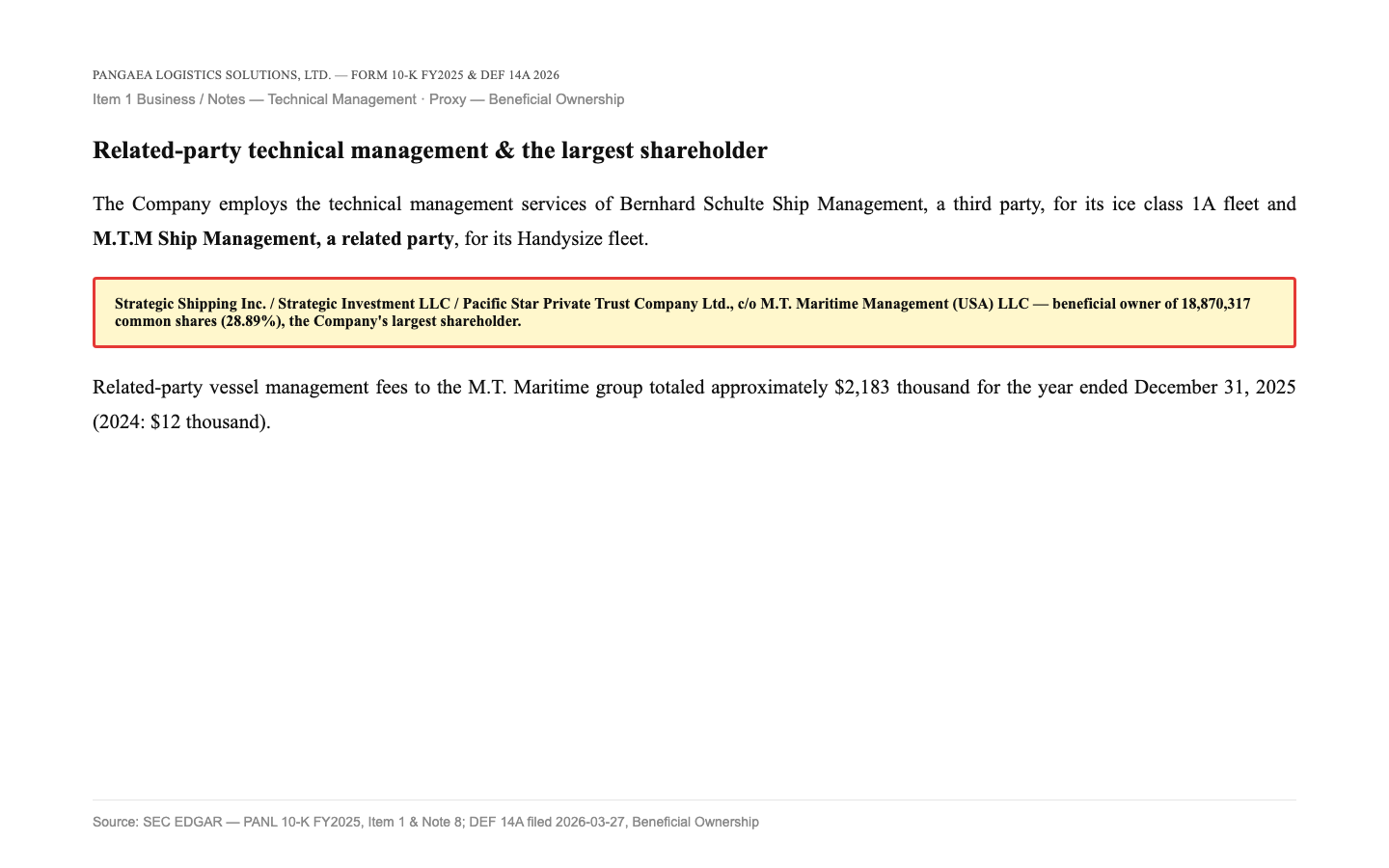
The fees paid to MTM are small — $0.65 million in the third quarter of 2026, about 0.3 percent of revenue. Christina Tan, through whom the link runs, left the board on December 18, 2025. What is new is a different event: on June 7, 2026, the board removed three of its members.
“On June 7, 2026, pursuant to 24.1.7 of the Bye-Laws of Pangaea Logistics Solutions Ltd. (the “Company”), Eric S. Rosenfeld, David D. Sgro and Anthony Laura were removed from the Board of Directors of the Company. 24.1.7 of the Company’s Bye-Laws provides that the office of a director shall be vacated if he or she is requested to resign in writing by not less than three quarters of the other directors.”
— Pangaea Logistics Solutions, Form 8-K of June 8, 2026, Item 5.02

As its only reason, the filing says a seven-member board is appropriate for the company's size and more efficient. No filing gives other reasons, and we do not imply any. For shareholders, it simply means: the board has become smaller, while the largest single shareholder, at about 29 percent, is unchanged.
Valuation
We use the November 5, 2026 closing price: $7.37. With 65,473,772 shares (cover page of the 10-Q, as of November 4, 2026), that gives a market value of about $482 million; the fundamental data show the same figure. Shareholders' equity was $481.0 million on September 30, 2026, about $7.35 per share — so the stock trades at roughly book value. For a shipping company, book value mostly reflects the ships: you pay about what the fleet is worth on the books.
On the profit of the last four quarters ($73.6 million), the price-to-earnings ratio is about 6.6, and the $0.40 annual dividend equals a yield of about 5.4 percent (all our calculation). Both look cheap — but the P/E rests on a peak quarter with derivative gains, and the yield depends on a dividend that was already halved once in 2025. The old rule for cyclicals applies: a low P/E in good times is not a bargain signal, because profit can fall again. So here is a cross-check over a whole cycle: from 2020 to 2025, Pangaea earned an average of about $38.8 million a year. Average here means all six annual profits added up and spread evenly across the years — the 2021 and 2022 boom years pull it up, 2020 and 2025 pull it down. On that basis, the P/E would be about 12.4 (our calculation). One caveat: before the late-2024 acquisition, the fleet and the share count were smaller. Three analysts cover the stock according to fundamental data (as of November 5, 2026), all with positive ratings — thin coverage.
Opportunities and risks at a glance
What speaks for Pangaea Logistics:
- A niche with pricing power: by its own account the world's largest ice-class 1A fleet above 60,000 tons; daily earnings in the third quarter of 2026 were 13 percent above the market indices.
- Profit more than doubled even without derivatives ($27.8 million vs. $11.5 million in the third quarter); 5,040 shipping days are booked for the fourth quarter at $21,423.
- A stronger balance sheet: $144.9 million of cash, net debt at 1.4 times adjusted EBITDA, cheaper refinancing through 2032, all covenants met.
- The stock trades at roughly book value; the dividend is back at $0.10 a quarter and currently covered by operations.
What speaks against it:
- Cyclicality: profit was $79.5 million in 2022 and $19.4 million in 2025; the third quarter is the seasonal peak of the ice-class fleet.
- A good third of nine-month 2026 profit came from derivatives that swing both ways.
- The dividend follows no rule: halved in 2025, doubled in 2026; the $15 million buyback is barely used.
- Ship-secured debt of $340.9 million with collateral clauses; a one-time loss of about $2.7 million from the refinancing in the fourth quarter.
- The largest shareholder (about 29 percent) is linked to the ship manager; the board was shrunk under a bye-law clause in June 2026.
A human conclusion
Back to recency bias — the reflex to multiply the latest quarter by four. With Pangaea, it leads you astray, but not as far as you might fear. The record is real: even without any derivative gain, quarterly profit more than doubled, the debt is cheaper, the cash pile is bigger, the dividend is back. But a good quarter of the quarterly profit came from hedges, and the third quarter is peak season for the ice-class fleet. The same management that called the dividend “sustainable through the economic cycle” in 2024 halved it six months later.
So the honest question for you is not “Was the quarter good?” — it was — but: Which number do you multiply by four — the $38.3 million in the headline, the $27.8 million without derivatives, or the profits of a whole cycle including its weak years? What you make of it is your decision. And that is how it should be.
Sources
The original documents used, for your own reading:
- Pangaea Logistics Solutions — quarterly report (10-Q) for the period ended September 30, 2026, filed November 5, 2026
- Pangaea Logistics Solutions — earnings release (8-K, Exhibit 99.1) of November 5, 2026 and presentation (Exhibit 99.2)
- Pangaea Logistics Solutions — quarterly report (10-Q) for the period ended June 30, 2026 and earnings release (8-K) of August 10, 2026
- Pangaea Logistics Solutions — current report (8-K) of June 8, 2026, Item 5.02 (board)
- Pangaea Logistics Solutions — quarterly report (10-Q) for the period ended March 31, 2026
- Pangaea Logistics Solutions — annual report (10-K) for 2025, filed March 16, 2026
- Pangaea Logistics Solutions — proxy statement (DEF 14A) 2026
- All SEC filings, including insider filings (Form 4): EDGAR overview (sec.gov)
- Earnings calls from November 9, 2023 to August 11, 2026: eleven third-party transcripts (none for the second quarter of 2024; the November 6, 2026 transcript was not yet available).
- Fundamental data (quarterly series, price and analyst coverage, as of November 5, 2026), cross-checked against the SEC filings.
Transparency & disclaimer: This analysis is a journalistic assessment of publicly available information. It is not investment advice, not a financial analysis under any regulatory framework and not a solicitation to buy or sell securities. Stock investments carry substantial risk, up to and including total loss. All information is provided without guarantee; the as-of date of the data is noted in the text. Positions held by the operator are disclosed daily; where one exists, it appears as a notice at the top of this deep dive.
Key figures at a glance
All monetary figures in millions of $; earnings per share as reported.
| Metric | 2021 | 2022 | 2023 | 2024 | 2025 |
|---|---|---|---|---|---|
| Revenue | 718.1 | 699.7 | 499.3 | 536.5 | 632.0 |
| Operating Income (EBIT) | 78.9 | 105.5 | 44.6 | 48.4 | 37.9 |
| Net Income | 67.2 | 79.5 | 26.3 | 28.9 | 19.4 |
| Net Margin | 9.4% | 11.4% | 5.3% | 5.4% | 3.1% |
| Earnings Per Share | 1.50 $ | 1.76 $ | 0.58 $ | 0.63 $ | 0.30 $ |
Source: fundamental data & SEC filings (annual and quarterly reports, 10-K/10-Q)
Our Bottom Line at a Glance
- Business model & ice-class niche positive
- By its own account (2025 10-K), the world's largest ice-class 1A fleet above 60,000 tons, long-term contracts of affreightment and five owned port operations. Daily earnings per vessel of $20,414 in the third quarter of 2026 were 13 percent above the market indices.
- Q3 2026 results & earnings quality neutral
- Revenue up 29.9 percent to $219.1 million, net income attributable to shareholders $38.3 million vs. $12.2 million. That includes $10.5 million of derivative gains (mostly fuel swaps) and the seasonal peak of the ice-class fleet; without derivatives, $27.8 million remain, more than twice the prior-year quarter.
- Balance sheet & financing positive
- Cash of $144.9 million, debt of $340.9 million, net debt at 1.4 times adjusted EBITDA (September 30, 2026), all covenants met, nine-month operating cash flow of $83.1 million. Refinancing of $145 million at SOFR plus 1.60 percent through 2032.
- Dividend & capital return neutral
- The quarterly dividend has been $0.10 again since August 2026 and is currently covered by operations. It follows no stated rule, though: “sustainable through the economic cycle” in 2024, halved in 2025. The $15 million buyback program has barely been used, at roughly $3 million.
- Governance & ownership neutral
- The largest shareholder (about 29 percent) is linked to the technical ship manager MTM (fees of $0.65 million in the third quarter). In June 2026, the board removed three directors under a bye-law clause and shrank to seven members; the filing cites only efficiency.
- Valuation neutral
- At the November 5, 2026 close ($7.37), the stock trades at roughly book value, the trailing four-quarter P/E is about 6.6 and the dividend yield about 5.4 percent (our calculation). The P/E rests on a peak quarter; over the 2020 to 2025 cycle it would be about 12.4.
Pangaea Logistics delivered a genuine record quarter: even without derivative gains, profit more than doubled, the balance sheet is stronger, the debt has been refinanced more cheaply and the dividend is back at $0.10. A good quarter of the quarterly profit, however, came from hedges, the third quarter is the seasonal peak, and both the dividend and longer-term commitments follow the cycle more than any rule. Not investment advice.
What Our Rating Means
Quality confirmed
Business model, numbers and balance sheet hold up to our review. Whether the current price supports an entry is a separate question — it hangs on the price, not on the company.
Green, because the substance is documented: Pangaea has been profitable in every calendar year since 2020, operating cash flow is positive ($83.1 million in the first nine months of 2026), net debt stands at 1.4 times adjusted EBITDA, all covenants are met, and the ice-class niche has earned above-market rates for years. In the filings through September 30, 2026, we find no customer, loan or counterparty that endangers the company. What remains is cyclicality: profits and the dividend move with freight rates, and part of the record quarter came from derivatives. Add a governance point (a related ship manager, a downsized board) without documented harm. Those are questions of price and cycle, not of substance. The decision is yours.
A journalistic assessment by our editorial team at the time of the deep dive, based on public sources — not investment advice and not a solicitation to buy or sell. Your personal circumstances (investment goals, risk capacity, taxes) cannot be taken into account. What our levels mean, how verdicts are formed, and what conflicts of interest exist →
Worth Noting
- Occasion: the quarterly report (10-Q) for the period ended September 30, 2026 and the earnings release (8-K, Exhibit 99.1), both filed on November 5, 2026; first English edition of our German analysis (first published July 10, 2026).
- Data as of: SEC filings retrieved on November 6, 2026; price, market value and valuation data as of November 5, 2026 (close $7.37). Market value cross-check: 65,473,772 shares × $7.37 = $482.5 million, matching the fundamental data.
- Method: the profit bridge without derivatives is our own calculation from Note 7 of the quarterly report (realized and unrealized derivative gains), with derivatives attributed fully to shareholders as Pangaea does. Eleven earnings call transcripts (November 9, 2023 to August 11, 2026, third party, may contain errors) were checked against the filings; the November 6, 2026 transcript was not available.
- AI classification: uses AI (2025 Form 10-K: machine learning for vessel speed and fuel savings, an internal AI team). The 2026 quarterly reports contain no new AI disclosures; the classification is unchanged.
Stock Watch
This analysis is as of November 6, 2026. Stock Watch will tell you what's changed at PANL since then.
Later $1 a month per stock — signing up is free, and you'll be the first to know when it launches.
The full analysis as a PDF for later
We will send you this analysis as a PDF — to print, file away, and read at your own pace. And we will add you to the free Stock Watch list for Pangaea Logistic (PANL), so you hear about it when something material in this analysis changes.
Frequently Asked Questions
Pangaea Logistics Solutions (Nasdaq: PANL) is a dry bulk shipping company: it carries loose commodities such as grain, coal, iron ore, bauxite and cement across the oceans and runs port and terminal operations in Fort Lauderdale, Baltimore, Port Aransas, Tampa and Lake Charles. As of September 30, 2026, it owned 38 vessels, including what it calls the world's largest fleet of ice-class 1A bulk carriers above 60,000 tons. It is incorporated in Bermuda and based in Newport, Rhode Island.
Of $38.3 million of net income attributable to shareholders, about $10.5 million were derivative gains, mostly from bunker fuel hedges; $4.6 million of that was unrealized. Pangaea strips out only that part and reports adjusted net income of $33.6 million. Without any derivatives, our calculation leaves $27.8 million, about $0.43 per share — more than twice the $11.5 million of the prior-year quarter.
In May 2025, Pangaea halved the quarterly dividend to $0.05 after weak quarters and a 2024 in which the payout exceeded free cash flow; a buyback program was announced at the same time. In August 2026, the dividend went back to $0.10, which the CFO attributed to stronger fundamentals and a stronger balance sheet. Management has not named a fixed payout rule in any of the eleven earnings calls we reviewed.
In October 2026 (credit agreement dated October 16), a subsidiary drew a $145 million loan priced at three-month SOFR plus 1.60 percent, maturing in October 2032 and secured by seven vessels. It repaid a $38.7 million loan (6.14 percent) on October 21 and four vessel financings totaling $95.3 million (7.06 percent) on October 23. Pangaea expects a one-time loss of about $2.7 million from the transaction in the fourth quarter of 2026.
At the November 5, 2026 close of $7.37, Pangaea is worth about $482 million, roughly its shareholders' equity of $481.0 million. By our calculation, the trailing four-quarter P/E is about 6.6 and the dividend yield about 5.4 percent. The P/E, however, rests on a peak quarter with derivative gains, the yield on a payout that was already halved once in 2025. Calculated over the 2020 to 2025 cycle, the P/E would be about 12.4.
We reviewed eleven transcripts from November 9, 2023 to August 11, 2026. The preview of already-booked shipping days usually landed within a few percent of the later quarterly figure. Longer-term announcements look more mixed: the dividend was called sustainable through the cycle in 2024 and halved in 2025, the Tampa terminal opened about a year later than indicated, and management gave no later figure for a $2.5 million savings target.
On June 7, 2026, the board removed Eric S. Rosenfeld, David D. Sgro and Anthony Laura under bye-law 24.1.7, which applies when at least three quarters of the other directors request a resignation in writing. The Form 8-K of June 8, 2026 only states that a seven-member board is more appropriate and efficient for the company's size. No filing gives further reasons.
Although Pangaea is a Bermuda company, it reports like a U.S. company, filing an annual report on Form 10-K and quarterly reports on Form 10-Q rather than the foreign-issuer Form 20-F. For investors, that means quarterly numbers in the familiar U.S. format. The fiscal year matches the calendar year; the latest quarterly report, for September 30, 2026, was filed on November 5, 2026.
Found an error?
Did you spot a factual error, an outdated number, or a typo in this deep dive? Let us know briefly — your report goes straight to the editorial team.