Dorian LPG after the record quarter: why a price-to-earnings ratio of 6 proves nothing here
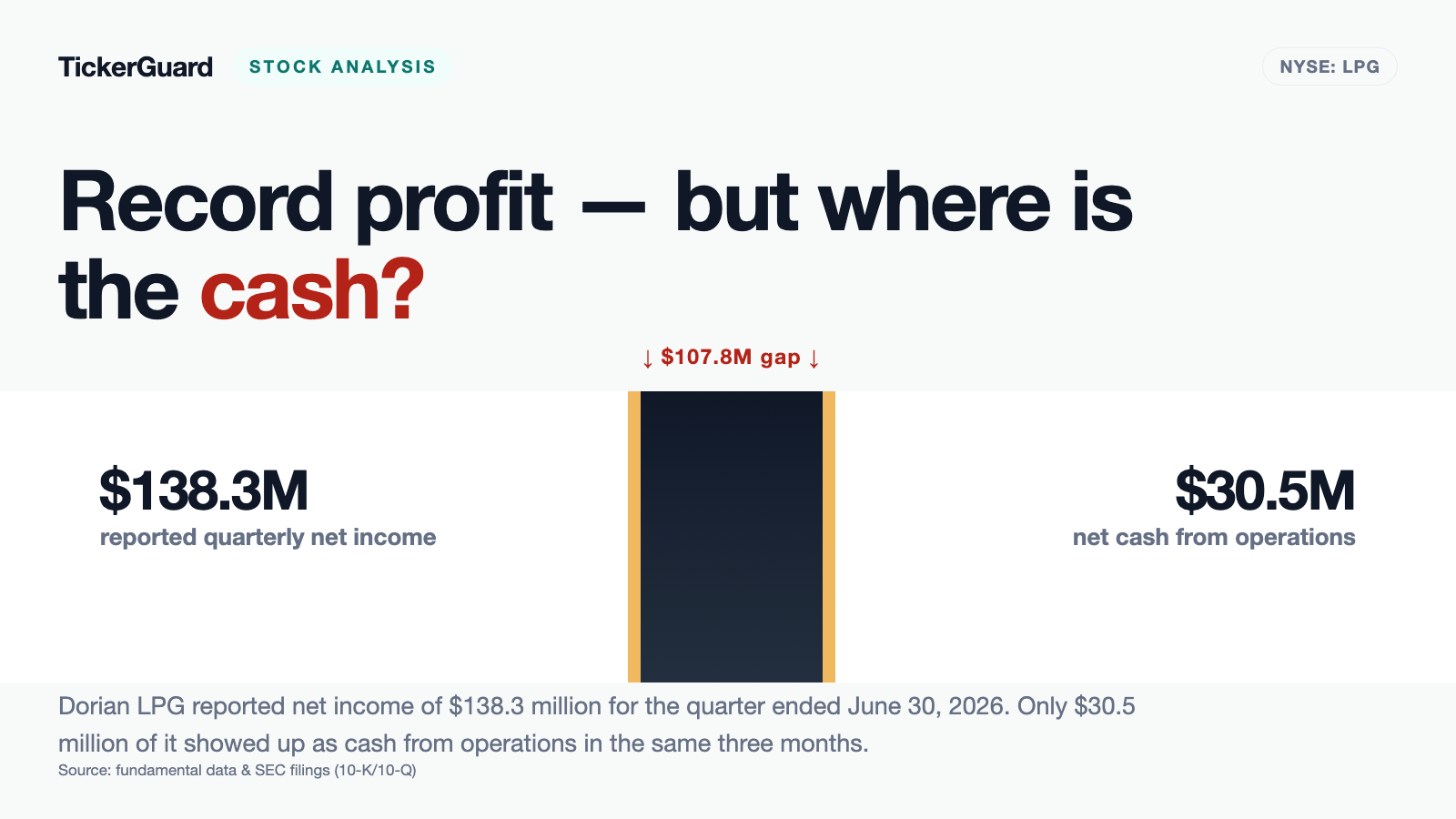
Dorian LPG posted the best result in its history for the quarter ended June 30, 2026: $138.3 million in net income, $3.24 per diluted share, and a time charter equivalent rate of $75,926 per available day. On trailing twelve-month earnings the stock now trades at roughly six times profit. We read the quarterly report — and found three things that put that number in its place: $30.1 million came from selling a ship, only $30.5 million of the profit arrived as operating cash, and the freight-rate record rests on a closed strait. Buy this stock and you are not buying a shipowner. You are buying a chokepoint.
 Thomas Mücke
Founder & Publisher
Thomas Mücke
Founder & Publisher
As of Today
As of: September 18, 2026
- Closing price
- 58.20 $ -0.30%
- Market Capitalisation
- 2.6 $B
- P/E
- 12.4
- Growth Score
- 6/10
- AAQS
- 4/10
This analysis has a cut-off date. The Stock Guard tells you when something material changes in the numbers. Reserve your free spot
Chart
Interactive price chart (TradingView).
52-week range: 23.90 $ to 58.30 $ · Last price: 58.20 $ (As of: September 18, 2026)
Note: pure fact-based analysis, not investment advice and not a solicitation to buy or sell. All figures without guarantee.
There is an investing trap that works so well because it feels like diligence: call it the summit illusion. You dutifully check the numbers, find a price-to-earnings ratio of about 6 — the share price divided by earnings per share, a rough measure of how many years of profit you are paying for — and conclude: cheap. But in a cyclical business a low price-to-earnings ratio is often not a bargain at all. It simply tells you that the number in the denominator has peaked. From below, a summit looks like the start of the climb. Dorian LPG (NYSE: LPG), an owner of very large gas carriers, is a textbook case in the summer of 2026. So here is the deal: before you let a single number reassure you, let us read together what the company itself told the U.S. securities regulator, the SEC. A quarterly report is honest under penalty of law. What you do with it is up to you.
So you know where this is heading, here is the central tension of this analysis up front. Dorian is unquestionably well run and financially strong — $342.1 million in cash, $1,236.5 million in equity, and a management team selling older ships at top prices rather than ordering new ones at the peak. The question is not whether the company is any good. The question is what the record profit you are valuing at six times is actually made of, and how much of it would survive a normal freight market. Remember this: in a cyclical business, the cheapest-looking metric is almost always the most dangerous one.
What Dorian LPG actually does
Pumping oil and gas in Texas releases enormous volumes of liquefied petroleum gas — propane and butane, the stuff in a backyard grill tank and the fuel that heats millions of kitchens and feeds chemical plants across Asia. That gas has to cross oceans, and crossing oceans requires specialised ships that carry it chilled and liquefied. That is Dorian's business: very large gas carriers, VLGCs in the trade, typically around 84,000 cubic metres. Think of them as floating pipelines connecting export terminals on the U.S. Gulf Coast with buyers in the Far East and Europe, where no pipe reaches.
As of June 30, 2026 the fleet counted 27 vessels, six of them chartered in. After two tankers were sold in July 2026, the same filing reports only 25 vessels as of July 30, 2026 — the fleet is shrinking, and deliberately so. Add a dual-fuel ship delivered in 2026 that can also carry ammonia, and one newbuilding ordered on June 22, 2026 at HD Hyundai Heavy Industries, 90,000 cubic metres, scheduled for delivery in the third calendar quarter of 2029.
The money is made on freight. What a ship actually earns per day after voyage costs — bunkers, port fees, commissions — is measured across the industry as the TCE rate (time charter equivalent). This single number decides everything. Against it stands a second figure the CFO put at roughly $26,000 to $27,000 per day for the coming year on the August 5, 2026 earnings call: the daily cash cost per ship. The gap between the two is profit, and because costs are fairly rigid while the revenue side is not, every move in rates flows straight through to the bottom line.
One detail surprises many investors: Dorian barely markets its ships alone. Almost all revenue runs through the Helios Pool, a commercial pool owned half by Dorian and half by MOL Energia, a subsidiary of Japanese shipping group Mitsui O.S.K. Lines. Partners throw their vessels into one basket, share cargoes and earnings, and present a larger front to the market. As of June 30, 2026, 31 gas carriers traded in the pool. On the balance sheet this shows up as a receivable from a related party — and that is where a lot of money is currently sitting.
How this stock reached our desk
The occasion is a document with a date on it. On August 5, 2026 Dorian LPG filed its quarterly report (Form 10-Q) for the quarter ended June 30, 2026 with the SEC, alongside the earnings release attached as Exhibit 99.1 to a current report (Form 8-K). Dorian's fiscal year ends on March 31, so this quarter is the first of fiscal 2027 even though it corresponds to the second calendar quarter of 2026. Read shipping filings by calendar year and you will compare the wrong things.
What the report contains is remarkable enough to be worth the time: the highest quarterly profit and the highest daily earnings per ship in the history of a company founded in 2013. Reports like this are also exactly the ones where reading the footnotes pays off most — because a record absorbs all the attention.
The numbers over the years — credit where it is due
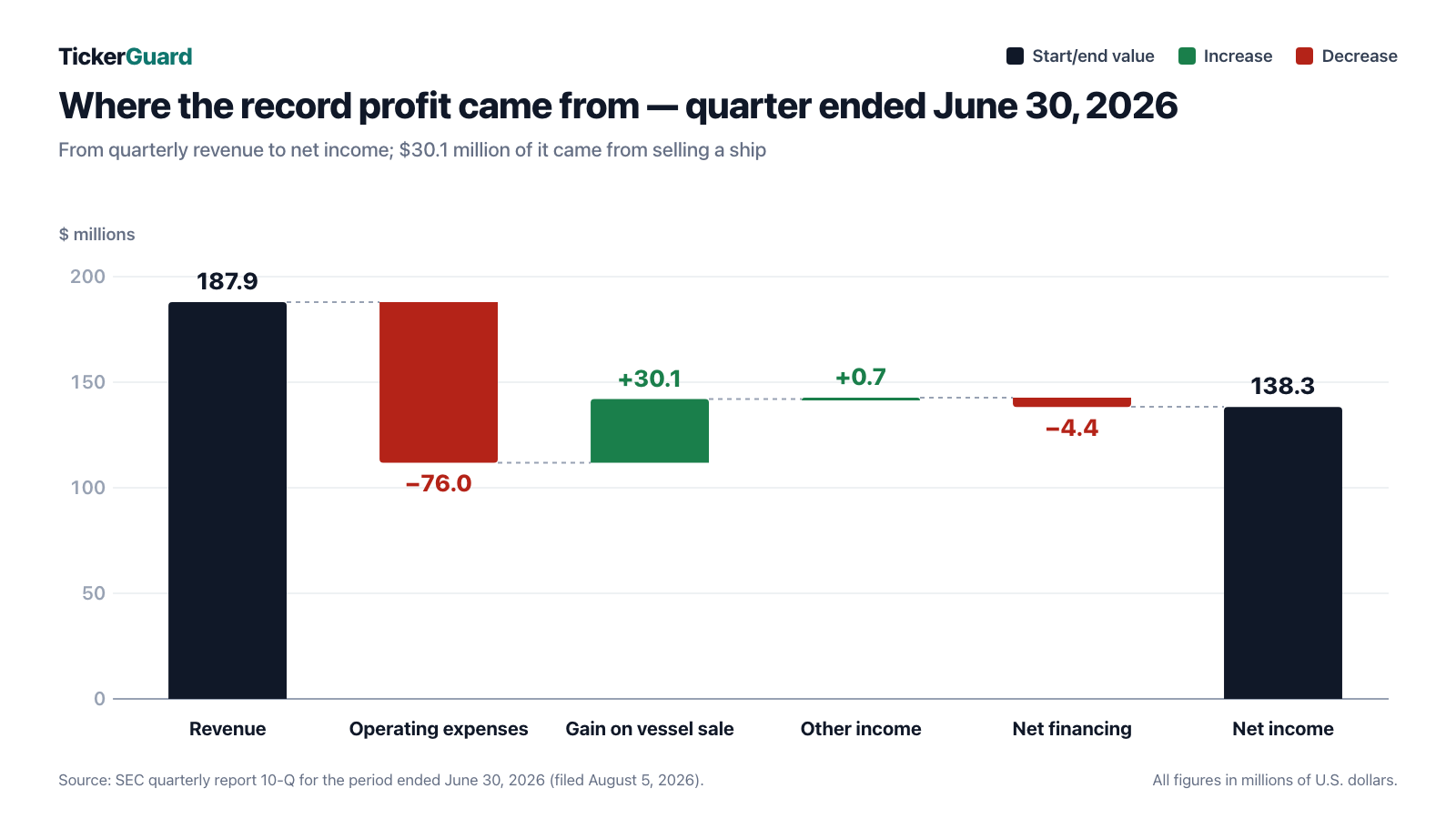
Start with what genuinely impresses. In the quarter ended June 30, 2026 revenue rose to $187.9 million from $84.2 million a year earlier, an increase of 123.1 percent. Net income jumped from $10.1 million to $138.3 million, and diluted earnings per share from $0.24 to $3.24. Adjusted EBITDA climbed from $38.6 million to $165.4 million. And daily vessel operating expenses actually fell, from $11,466 to $10,356. None of that is an accounting trick. It is an exceptionally well-run quarter.
The driver is the daily rate. The TCE rate rose from $39,726 to $75,926 per available day, an increase of $36,200 per ship per day, while available days grew from 2,086 to 2,469. For context, the Baltic Exchange benchmark for the Ras Tanura–Chiba route averaged $199.694 per metric ton over the quarter, against $63.500 a year earlier.
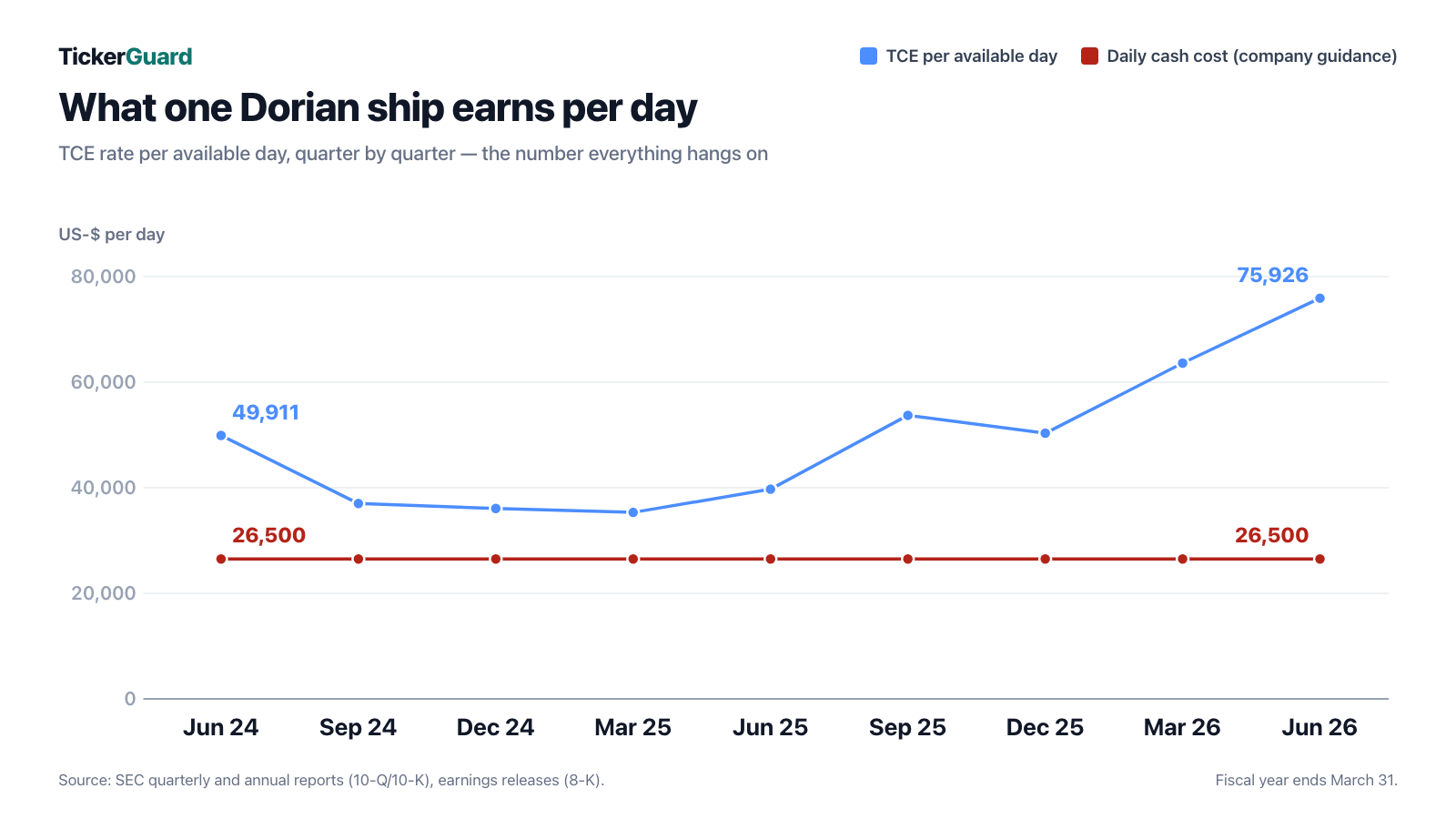
Now the view that dissolves the summit illusion — the annual series. In the fiscal year ended March 31, 2024 Dorian earned $307.4 million, or $7.60 per share. In the fiscal year ended March 31, 2025 it earned $90.2 million, or $2.14 per share — down 71 percent with essentially the same fleet, the same management and the same customers. In the fiscal year ended March 31, 2026 it climbed back to $193.7 million, or $4.54 per share. Anyone extrapolating the $307 million in the spring of 2024 was two thirds wrong twelve months later. Anyone treating the $90 million as the new normal was equally wrong. That is not an anecdote. That is the operating manual for this stock.
Being fair also means saying this: Dorian was profitable in every one of those years, including the weak one. And the balance sheet has improved. As of June 30, 2026 it held $342.1 million in cash and $1,236.5 million in equity against $507.5 million of debt, giving a book value of roughly $28.90 per share. Net debt — debt less cash — is about $165 million and still falling; on the August 5, 2026 call the CFO put the current cash balance at "almost $600 million" after the sale proceeds landed. This is a balance sheet that can absorb a downturn without breaking a sweat.
What management said — and what came of it
We went through management's own words over three years: the public transcripts of the last ten earnings calls — from fiscal 2024 Q3 through the quarter ended June 30, 2026 — plus the chief executive's comment in every earnings release filed with the SEC since November 2023. Three things stand out: notable reliability on everything operational, a systematic tilt in the rate guidance, and a crack running straight through the latest call.
First the reliability. On anything involving ships, shipyards and costs, this management delivers. The ammonia-capable newbuilding ordered in fiscal 2024 Q3 arrived exactly on time in late March 2026, the large drydocking programme with twelve dockings closed on schedule, and the daily cost guidance of roughly $26,000 held for years. The dividend was always declared plainly as irregular, so the cuts from $1.00 to $0.70 and later $0.50 broke no promise. In May 2025, at the bottom, chief executive John Hadjipateras wrote of a "volatile geopolitical and economic environment" and a "heavy drydocking schedule"; in August 2025, with quarterly profit down to $10.1 million, he pointed to bookings "for the current quarter at strong rates supporting our positive outlook" — which proved right: in the quarter ended September 30, 2025 the TCE rate rose to $53,725 per available day.
The rate guidance is a different matter. For five quarters running, the booking rate quoted on the call came in above what was ultimately realised:
- For the December 2024 quarter, more than $40,000 per day was cited; $36,071 was realised.
- For the March 2025 quarter, more than $37,000 was cited; $35,324 was delivered.
- For the June 2025 quarter, roughly $42,000 was cited; $39,726 was delivered.
- For the September 2025 quarter, more than $67,000 was cited for roughly 70 percent of days — $53,725 was realised, a gap of about $13,000 per day.
- For the December 2025 quarter, roughly $57,000 was cited; $50,333 was delivered.
An analyst raised the largest miss directly. CFO Ted Young conceded that it had not worked quite so well that time and promised the new $57,000 figure would land much closer. It missed again, by nearly $7,000 per day. Management explains the gaps with settlement timing, discharge-port options and drydocking days — plausible case by case, but the direction was the same five times over: down. The consequence is telling. Since the call for the December 2025 quarter, no forward booking figures have been given at all; the company says it will publish them later in the quarter instead, to make them more useful to investors. The CFO held that line again on August 5, 2026: asked how the current September quarter is tracking, he said it would be "premature" to comment. If you own this stock, read management's rate guidance as a ceiling, not as an expected value.
Then the crack. On the August 5, 2026 call, chartering executive Taro Rasmussen described the quarter as shaped by "the de facto closure of the Strait of Hormuz" and said that "prospects for enduring peace are fragile". Minutes later, in the question-and-answer session, the chief executive was asked what happens to the market if the ceasefire holds. His answer:
"You see the shipping markets, every time there's a threat of peace, the oil price goes down and the shipping markets seem to suffer. And I think it's kind of silly, to be honest. … So I think it's — I'm not worried about it."
— John Hadjipateras, Chairman, President and Chief Executive Officer, Dorian LPG, question-and-answer session of the fiscal first quarter 2027 earnings call, August 5, 2026
The question-and-answer section carries more weight than prepared remarks because nobody is reading from a script. And here the chief executive's view sits crosswise to that of his own chartering specialist, and to the risk language in the quarterly report itself. He may well turn out to be right, and trade flows may normalise upward. But "I'm not worried about it" is a posture, not an analysis. As a shareholder you should know that your company's earnings power currently hinges on a question its chief executive considers silly.
A second, smaller crack is just as telling. Asked by an analyst whether the conservative stance meant fleet renewal rather than growth, Hadjipateras first said "we believe that the best way to go forward is conservatively" — and one exchange later, on the follow-up: "We would not exclude fleet expansion." Both in the same call. For a shipowner sitting on record cash, the second sentence is the more important one.
And one more constant: the justification for the dividend is almost word for word the same in both calls. In May 2026 the $1.00 payout "reflects a constructive market outlook while also allowing the company the flexibility for future fleet reinvestment." In August 2026, the same formula. Read a commitment into that and you are reading too much — more on this below.
Uncomfortable truth no. 1: $30.1 million of the record came from selling a ship
This is where the record splits in two. Of the $138.3 million in quarterly net income, $30.1 million did not come from moving gas but from selling a ship: on May 6, 2026 Dorian disposed of the 2015-built VLGC Cobra and booked the excess over carrying value as a gain.
"On May 6, 2026, we completed the sale of the 2015-built VLGC Cobra and recognized a gain of $30.1 million during the three months ended June 30, 2026."
— Dorian LPG Ltd., Form 10-Q for the quarter ended June 30, 2026, Note 5

Dorian strips this out itself. In the August 5, 2026 earnings release the company reports adjusted net income of $107.2 million, or $2.52 per diluted share instead of $3.24 — adjusted for the $30.1 million vessel gain and a $0.9 million unrealized gain on derivatives. That is the number to use if you want to know what the shipping business earned. It is still excellent: $2.52 in a single quarter, against $0.27 a year earlier.
And there is more coming. In July 2026 Dorian sold two further ships, the Corsair and the Constellation, for a combined $166.4 million. The expected book gain of roughly $63.5 million lands in the next quarterly report. A third vessel, the Clermont, is also up for sale; the CFO expects that transaction to close in September or October 2026.
"In July 2026, we completed the sale of our 2014-built VLGC Corsair and 2015-built VLGC Constellation receiving total vessel sale proceeds, net of commission, of $166.4 million. As of June 30, 2026, the carrying value of the two vessels totaled $102.8 million and the cumulative gain on sale of the vessels is expected to be approximately $63.5 million."
— Dorian LPG Ltd., Form 10-Q for the quarter ended June 30, 2026, Note 17 (Subsequent Events)

To be fair: selling old ships at the top of the market is good craft, not a scandal. Carrying value of the fleet fell from $1,189.3 million on March 31, 2026 to $971.0 million on June 30, 2026. But that is precisely the point. Every tanker sold lifts reported profit once and shrinks the machine that produces profit in future. Extrapolate this quarter and you are extrapolating an effect that abolishes itself.
Uncomfortable truth no. 2: $138 million of profit, $30 million of cash
The second gap is the real surprise in this filing. Profit is an accounting figure; cash is cash. In the record quarter the two diverged sharply: against $138.3 million of net income stands net cash from operating activities of just $30.5 million — a gap of roughly $108 million. For context, the cash balance rose only from $327.4 million to $342.1 million over the quarter.
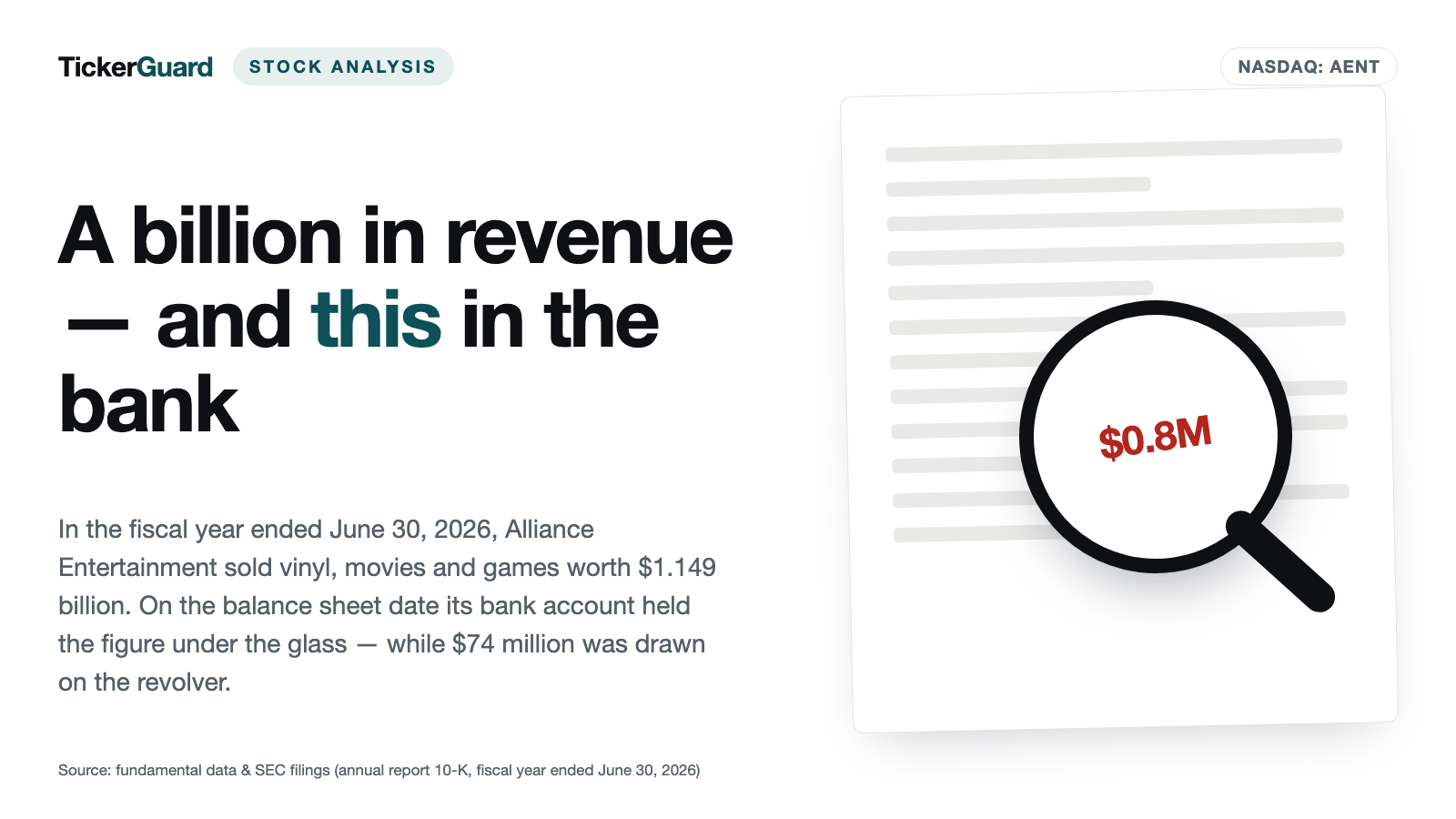
"Net cash provided by operating activities for the three months ended June 30, 2026 was $30.5 million, compared to $0.8 million for the three months ended June 30, 2025. … partially offset by changes in working capital, mainly from amounts due from the Helios Pool as distributions from the Helios Pool are impacted by the timing of the completion of voyages, spot market rates and bunker prices."
— Dorian LPG Ltd., Form 10-Q for the quarter ended June 30, 2026, management's discussion and analysis (Operating Cash Flows)

Note 4 supplies the explanation: net receivables from the Helios Pool rose from $123.4 million on March 31, 2026 to $211.9 million on June 30, 2026. Close to $90 million of the quarter's profit is therefore still sitting with the pool, waiting to be settled. Put plainly: you had a record month as a contractor, but half the invoices are still unpaid.
Is that alarming? No — provided the money arrives. Dorian owns half the pool, the pool carries no third-party debt, and the CFO cited a current cash balance of "almost $600 million" on August 5, 2026, which suggests prompt settlement. But it is a line item to check in the next report rather than skip. A receivable is a promise, not money. Similar dynamics show up across tanker shipping — at Teekay, too, the interplay of spot rates and settlement timing determines when a good quarter turns into actual cash.
Uncomfortable truth no. 3: the record rests on a closed strait
Now the cause. Dorian does not attribute the rate jump to its own performance but to geopolitics. The filing cites "higher spot rates", and the earnings call made clear where those came from: the de facto closure of the Strait of Hormuz, which collapsed Middle East liftings and pushed trade flows onto long detours. Longer voyages mean more ship-days for the same volume of gas — and therefore higher prices.
"TCE rates rose by $36,200 per available day from $39,726 for the three months ended June 30, 2025 to $75,926 for the three months ended June 30, 2026, primarily due to higher spot rates; partially offset by higher bunker prices."
— Dorian LPG Ltd., Form 10-Q for the quarter ended June 30, 2026, management's discussion and analysis (Revenues)

The filing also quantifies how much room there is before the balance sheet feels pain: for the one vessel carrying an impairment indicator, even a 30 percent reduction in ten-year average spot rates would trigger no write-down; only at minus 40 percent would roughly $4.0 million be at stake. That is reassuring for the balance sheet — and says nothing about earnings. If the daily rate falls back from $75,926 to the $39,726 of the prior-year quarter, revenue halves while the daily cash cost of $26,000 to $27,000 stays put.
You can spin that positively: the rate lever works both ways, and Dorian still makes money at $40,000 a day. You can also state it plainly: in this business the difference between a record year and a lean one comes down to world events, not to management. Dorian shares that exposure with other bulk and tanker owners; we saw it just as clearly at Heidmar.
Uncomfortable truth no. 4: the filing calls the dividend irregular
Dorian pays out generously. On May 7, 2026 the board declared $1.00 per share, totalling $42.8 million; on July 16, 2026 another $1.00, payable on or about August 12, 2026. On the August 5, 2026 call the CFO put cumulative distributions since September 2021 at $19.65 per share and nearly $811 million, against $974 million of cumulative net income over the same period. That is a payout ratio of roughly 83 percent. Impressive.
Except that none of it is promised. The filing calls these payments irregular dividends and spells out who decides:
"The cash dividends referenced in this report are irregular dividends. … The Board of Directors, in its sole discretion, may increase, decrease or eliminate the dividend at any time."
— Dorian LPG Ltd., Form 10-Q for the quarter ended June 30, 2026, Note 11 (Dividends)

History shows the wording is meant literally: quarterly tranches ranged between $0.50 and $1.00 per share over recent fiscal years, and stood at $0.65 in November 2025. A payout that follows earnings in a cyclical business also follows them down. As a side note, the $100 million buyback authority approved in February 2022 had been used to the tune of only $7.9 million as of June 30, 2026 — Dorian would rather distribute cash than repurchase its own shares.
Valuation: what a price-to-earnings ratio of 6 really tells you
Now we dissolve the summit illusion. At the valuation date of August 5, 2026, with 42,782,681 shares outstanding (as of July 30, 2026, per the cover page of the quarterly report), Dorian carried a market capitalization of roughly $1.84 billion. Trailing twelve-month earnings — fiscal 2026 less its first quarter plus the new record quarter — come to about $7.54 per share. That produces a price-to-earnings ratio of roughly 6. Strip out the vessel gain and it is about 6.3.
Now run the other calculation. Take the $90.2 million of fiscal 2025 — not a disaster year, simply a weak one — and you get $2.14 per share and a price-to-earnings ratio of roughly 20. Same stock, same fleet, same price: a bargain on one reading, expensive on the other. The only difference is which point of the swing you put in the denominator.
The asset view is sturdier. Book value per share stood at roughly $28.90 on June 30, 2026, giving a price-to-book ratio of about 1.5. For a shipowner at a cyclical high that is neither cheap nor expensive — and book value is itself cyclical, because vessel prices track freight rates. To Dorian's credit, it has just demonstrated that the books are not optimistic. The Corsair and Constellation went for $166.4 million, roughly $63.5 million above carrying value. On the sale of the Cobra, the CFO noted in May 2026 that the price exceeded the ship's 2015 contract price.
The professional view is muted. The mean analyst price target sits at $51, while earnings estimates for the current and next fiscal year of roughly $4.29 and $3.59 per share are well below the $7.54 of the trailing twelve months (data as of August 5, 2026). In other words, the professionals themselves assume the record will not repeat — which explains the low price-to-earnings ratio and simultaneously deflates it.
Opportunities and risks at a glance
What argues for Dorian LPG:
- Exceptional earnings power in an upswing: $187.9 million of revenue and $165.4 million of adjusted EBITDA in a single quarter (ended June 30, 2026), with daily vessel operating expenses falling from $11,466 to $10,356.
- A very strong balance sheet: $342.1 million of cash against $507.5 million of debt and $1,236.5 million of equity as of June 30, 2026; the CFO cited "almost $600 million" of cash on August 5, 2026 after sale proceeds landed. No going-concern doubt, no dilution pressure.
- Counter-cyclical craft: several older ships sold at top prices ($166.4 million for two tankers in July 2026, roughly $63.5 million above carrying value) against a single newbuilding for 2029 delivery — management is not growing the fleet at the peak.
- Evidence the books are not overstated: ships sold above carrying value, and even a 30 percent reduction in ten-year average spot rates would trigger no write-down per the filing.
- A demonstrated willingness to distribute: roughly $811 million of dividends against $974 million of cumulative net income since mid-2021 (CFO, August 5, 2026).
What argues against:
- The record is only partly operational: $30.1 million of the $138.3 million quarterly profit came from selling the Cobra; adjusted net income is $107.2 million, or $2.52 per diluted share.
- Profit is not cash: against the record profit stood only $30.5 million of net cash from operations, because the Helios Pool receivable rose from $123.4 million to $211.9 million.
- Extreme cyclicality, proven in its own history: $307.4 million of annual net income in fiscal 2024, then $90.2 million in fiscal 2025 — down 71 percent with an unchanged fleet.
- Political concentration risk: the company attributes the record rates to the de facto closure of the Strait of Hormuz. A durable ceasefire would shorten the detours; in the question-and-answer session on August 5, 2026 the chief executive called that concern "silly", while his own chartering executive described peace prospects as "fragile".
- No dividend commitment: the filing expressly labels the payments irregular, and the board may eliminate them at any time. Recent tranches ranged from $0.50 to $1.00 per share.
- The engine is getting smaller: fleet carrying value fell from $1,189.3 million to $971.0 million within one quarter, and a single newbuilding only arrives in 2029.
A human conclusion
Remember the summit illusion from the opening — the reflex to treat a low price-to-earnings ratio as proof? After reading the quarterly report you now know why that single number proves so little at Dorian LPG. It rests on a profit that is close to a quarter book gain on a ship sale, of which only a fifth arrived as cash, and whose underlying cause is a closed strait. And this same company demonstrated two years ago how quickly $307 million can become $90 million.
It would be unfair to stop there. Because what remains once you subtract the illusion is a remarkably well-run company. Management sells old ships above carrying value instead of ordering new ones at the top. The balance sheet raises no existential question. The adjusted quarterly result of $2.52 per diluted share is real, it comes from moving gas, and it is nearly ten times the prior-year quarter. Nothing here is rotten. The only thing that deceives is the number you would most like to look at on its own.
What you do with that is your decision. And that is exactly as it should be. Weighing the findings honestly, one operating question stays open — not whether the company holds up, but what the next profit will be made of once the detours disappear and there are no more ships to sell. Buy in here and you are not buying a price-to-earnings ratio of 6. You are buying a bet that the world stays unsettled. Whether you like that bet is not an arithmetic question.
Sources
- Dorian LPG Ltd. — Form 10-Q for the quarter ended June 30, 2026 (filed August 5, 2026)
- Dorian LPG Ltd. — fiscal first quarter 2027 earnings release (Exhibit 99.1 to the Form 8-K filed August 5, 2026)
- Dorian LPG Ltd. — Form 10-K for the fiscal year ended March 31, 2026 (filed May 27, 2026)
- Dorian LPG Ltd. — fiscal 2026 earnings release (Exhibit 99.1 to the Form 8-K filed May 20, 2026)
- Dorian LPG Ltd. — fiscal 2025 earnings release (Exhibit 99.1 to the Form 8-K filed May 22, 2025)
- Dorian LPG Ltd. — Form 8-K filed July 16, 2026 (declaration of the $1.00 per share irregular dividend)
- Dorian LPG Ltd. — Form 8-K filed July 30, 2026 (amended executive severance plan, Item 5.02)
- Public transcripts of the ten quarterly earnings calls from fiscal 2024 Q3 through the quarter ended June 30, 2026, including in full the calls of May 20, 2026 (fiscal 2026) and August 5, 2026 (fiscal first quarter 2027).
- Fundamental data (key figures, share count, valuation, analyst estimates; data as of August 5, 2026).
Disclaimer: this article is journalistic analysis, not investment advice, and not a solicitation to buy or sell securities. Share prices fluctuate and a total loss is possible. Positions held by the operator are disclosed daily; where one exists, it appears as a notice at the top of this deep dive. Make your own decisions and seek independent advice if in doubt.
Key figures at a glance
All monetary figures in millions of $; earnings per share as reported.
| Metric | 2022 | 2023 | 2024 | 2025 | 2026 |
|---|---|---|---|---|---|
| Revenue | 274.2 | 389.7 | 560.7 | 353.3 | 481.5 |
| Operating Income (EBIT) | 92.4 | 198.4 | 328.8 | 112.6 | 207.5 |
| Net Income | 71.9 | 172.4 | 307.4 | 90.2 | 193.7 |
| Net Margin | 26.2% | 44.2% | 54.8% | 25.5% | 40.2% |
| Earnings Per Share | 1.78 $ | 4.29 $ | 7.60 $ | 2.14 $ | 4.55 $ |
Source: fundamental data & SEC filings (annual and quarterly reports, 10-K/10-Q)
Our Bottom Line at a Glance
- Earnings power in the upswing positive
- In the quarter ended June 30, 2026 revenue rose to $187.9 million (up 123.1 percent) and adjusted EBITDA to $165.4 million, while daily vessel operating expenses fell from $11,466 to $10,356. Even adjusted for the vessel sale, the result is $2.52 per diluted share — nearly ten times the prior-year quarter.
- Balance sheet & funding positive
- As of June 30, 2026 the company held $342.1 million of cash and $1,236.5 million of equity against $507.5 million of debt; net debt of roughly $165 million continues to fall. On August 5, 2026 the CFO cited a cash balance of "almost $600 million" after sale proceeds landed. No going-concern language, no dilution, and a largely hedged loan book.
- Quality of the record profit negative
- $30.1 million of the $138.3 million quarterly profit came from selling the VLGC Cobra (Form 10-Q for the quarter ended June 30, 2026, Note 5), which is why the company itself reports adjusted net income of only $107.2 million. At the same time just $30.5 million reached the bank account, because the Helios Pool receivable rose from $123.4 million to $211.9 million. A record that is still largely outstanding.
- Freight cycle & geopolitics negative
- The daily rate per ship jumped from $39,726 to $75,926 — per the filing on higher spot rates, per the August 5, 2026 call on the de facto closure of the Strait of Hormuz. Annual net income has already fallen once from $307.4 million (FY 2024) to $90.2 million (FY 2025), down 71 percent with an unchanged fleet. Daily cash costs of $26,000 to $27,000 do not move with it.
- Capital allocation & fleet policy positive
- Rather than ordering ships at the peak, Dorian sells old ones above carrying value: $166.4 million for the Corsair and Constellation in July 2026, roughly $63.5 million above book, with another sale announced. Only one newbuilding is on order, for 2029 delivery. Fleet carrying value fell from $1,189.3 million to $971.0 million in a single quarter — counter-cyclically right, but the earnings base is shrinking.
- Dividend policy neutral
- Since September 2021 the company has distributed $19.65 per share and nearly $811 million against $974 million of cumulative net income (CFO, August 5, 2026). The quarterly report nonetheless labels the payments irregular dividends, and the board may increase, decrease or eliminate them at any time in its sole discretion. Recent tranches ranged from $0.50 to $1.00 per share.
Dorian LPG posted the best result in its history for the quarter ended June 30, 2026: $138.3 million of net income, $3.24 per diluted share and a TCE rate of $75,926 per available day. Three findings temper the number: $30.1 million came from selling a ship (adjusted net income is $107.2 million), only $30.5 million of it arrived as operating cash because the Helios Pool receivable rose to $211.9 million, and the record rates are attributed by the company to the de facto closure of the Strait of Hormuz. The balance sheet is very strong and management is acting counter-cyclically. The low price-to-earnings ratio of roughly 6 measures the top of the cycle, not the substance — on fiscal 2025 earnings it would be roughly 20. Not investment advice.
What Our Rating Means
Open questions
The business works in principle, but one material question is open. As long as it stays open, our findings do not carry a quality verdict.
There is no substance risk here: no going-concern language, no negative equity, no dilution, $342.1 million of cash against $507.5 million of debt and $1,236.5 million of equity as of June 30, 2026, and a management team that sells old ships above carrying value rather than ordering new ones at the peak. Red would be wrong. Green would be wrong too: one material operating question stays open — what the profit will consist of once the geopolitical detours disappear and there are no more ships to sell. The company has already shown how quickly $307.4 million of annual net income turns into $90.2 million (fiscal 2024 and 2025), and in the record quarter only a fifth of reported profit arrived as cash. Where the evidence sits between two levels, the more cautious one applies. The share price plays no part in this rating. The decision is yours.
A journalistic assessment by our editorial team at the time of the deep dive, based on public sources — not investment advice and not a solicitation to buy or sell. Your personal circumstances (investment goals, risk capacity, taxes) cannot be taken into account. What our levels mean, how verdicts are formed, and what conflicts of interest exist →
Worth Noting
- Occasion and data cut-off: rewritten on the occasion of the Form 10-Q for the quarter ended June 30, 2026 (first quarter of fiscal 2027), filed August 5, 2026, together with the earnings release (Exhibit 99.1 to the Form 8-K of the same day). All filings dated August 5, 2026 or later were reviewed; nothing new was filed between the quarterly report and the editorial cut-off on August 6, 2026. Price and valuation data are dated August 5, 2026.
- Identity and legal form: Dorian LPG Ltd., CIK 0001596993, ISIN MHY2106R1100, listed on the New York Stock Exchange. A Marshall Islands corporation headquartered in Stamford, Connecticut, with operations managed from Athens/Piraeus. Despite the offshore domicile it is a U.S. domestic issuer filing Forms 10-K and 10-Q as a large accelerated filer, with no former names and no successor CIK. Fiscal year ends March 31 — the second calendar quarter of 2026 is the first quarter of fiscal 2027.
- Share count and market-capitalization cross-check: 42,782,681 shares outstanding per the cover page of the quarterly report (as of July 30, 2026), unchanged from March 31, 2026; 54,647,868 shares issued less 11,865,187 treasury shares. No convertible instruments. 42,782,681 shares at $43.05 (August 5, 2026) gives roughly $1.84 billion, matching the fundamental data — the deviation is far below one fifth. The book value in the fundamental data ($26.62) still refers to March 31, 2026; this analysis uses the filed figure of roughly $28.90 as of June 30, 2026.
- Earnings-call review: no in-house transcripts were on file for LPG (query on August 6, 2026 returned zero rows). The analysis therefore draws on the public transcripts of the ten calls from fiscal 2024 Q3 through fiscal 2027 Q1 — the calls of May 20, 2026 and August 5, 2026 were pulled in full and every quote verified word for word — plus the verbatim chief-executive comments in eight earnings releases filed with the SEC between November 2, 2023 and August 5, 2026. Finding across the series: on ships, shipyards and costs management delivers, but rate guidance came in too high five quarters running (December 2024 through December 2025), and since the December 2025 quarter call no forward booking rates are given at all. Also notable, on the August 5, 2026 call the chief executive calls concern about a peace deal "silly" while his own chartering executive describes peace prospects as "fragile" in the same conversation, and the dividend rationale is almost identical in both calls. One transcript discrepancy (the ordinal number of the dividend, May 20, 2026) was not adopted — the cumulative amounts and the SEC earnings releases govern.
- One-off items and adjusted figures: the reported quarterly profit of $138.3 million includes a $30.1 million gain on the sale of the Cobra (May 6, 2026) and a $0.9 million unrealized gain on derivatives. The company itself reports $107.2 million, or $2.52 per diluted share, as adjusted net income. The following quarter will add an expected gain of roughly $63.5 million from the Corsair and Constellation, plus a further gain from the announced sale of the Clermont. Extrapolating the unadjusted quarterly or trailing twelve-month profit would be misleading.
- AI classification: unchanged as neutral. The only mention of artificial intelligence in the Form 10-Q for the quarter ended June 30, 2026 is once again the generic cybersecurity boilerplate in the cautionary statement list (misuse or misapplication of AI in the business). No AI revenue, no documented operational AI use, no specific AI business risk. The existing file dated July 10, 2026 remains valid.
- Special-situation screening (SEC EDGAR, CIK 1596993): no Form 15 or Form 25 in the relevant period — the only Form 15-12B dates from January 26, 2018 and did not concern the listed common stock. No going concern, no strategic review, no pending takeover; the unsolicited stock-for-stock approach by BW LPG and the associated proxy campaign date from 2018 and were withdrawn later that year. On July 24, 2026 the board amended the executive severance plan, removing carve-outs from the change-of-control definition that were "no longer appropriate in view of the Company's current shareholders" (Form 8-K filed July 30, 2026, Item 5.02). The finding does not clear the materiality threshold for a separate side-find entry but is documented here.
Stock Watch
This analysis is as of August 26, 2026. Stock Watch will tell you what's changed at LPG since then.
Later $1 a month per stock — signing up is free, and you'll be the first to know when it launches.
The full analysis as a PDF for later
We will send you this analysis as a PDF — to print, file away, and read at your own pace. And we will add you to the free Stock Watch list for Dorian LPG Ltd (LPG), so you hear about it when something material in this analysis changes.
Frequently Asked Questions
Dorian LPG Ltd. (NYSE: LPG) owns and operates very large gas carriers (VLGCs) that ship liquefied petroleum gas such as propane and butane across the oceans, mostly from U.S. export terminals to Asia and Europe. The fleet counted 27 vessels as of June 30, 2026 and 25 after two sales in July 2026. The company is a Marshall Islands corporation headquartered in Stamford, Connecticut.
Net income was $138.3 million, or $3.24 per diluted share, against $10.1 million ($0.24) in the prior-year quarter. That figure includes a $30.1 million book gain on the sale of the VLGC Cobra. The company itself reports adjusted net income of $107.2 million, or $2.52 per diluted share.
Because much of the revenue had not yet been distributed. Net receivables from the Helios Pool, through which Dorian markets its ships, rose from $123.4 million to $211.9 million during the quarter. The filing names that working-capital change explicitly: distributions from the pool depend on the timing of voyage completion, spot market rates and bunker prices.
Because everything hangs on the time charter equivalent rate per available day. It rose from $39,726 in the June 2025 quarter to $75,926 in the June 2026 quarter, but stood at just $35,324 in the March 2025 quarter. Daily cash costs of roughly $26,000 to $27,000 barely move. That is why annual net income fell from $307.4 million in fiscal 2024 to $90.2 million in fiscal 2025.
No, and the company says so itself. The quarterly report describes the payments as irregular dividends and states that the board may increase, decrease or eliminate them at any time in its sole discretion. The most recent declarations were $1.00 per share on May 7 and July 16, 2026; in November 2025 the tranche was $0.65.
Although Dorian LPG is a Marshall Islands corporation, it files as a U.S. domestic issuer on Forms 10-K and 10-Q rather than on the foreign private issuer Form 20-F. Its fiscal year ends on March 31, which is why the quarter ended June 30, 2026 is the first quarter of fiscal 2027.
The Helios Pool is a commercial pool owned half by Dorian LPG and half by MOL Energia, a subsidiary of Mitsui O.S.K. Lines. The partners place their ships in a shared basket and split cargoes and earnings. As of June 30, 2026, 31 gas carriers traded in the pool. Almost all of Dorian's revenue flows through it and is reported as related-party pool revenue.
The arithmetic is right but proves little. It rests on trailing twelve-month earnings of roughly $7.54 per share, the highest in company history. On fiscal 2025 earnings of $2.14 per share the same ratio would be about 20. Analyst estimates for the next two fiscal years, at $4.29 and $3.59 per share, sit well below the record level (data as of August 5, 2026).
Found an error?
Did you spot a factual error, an outdated number, or a typo in this deep dive? Let us know briefly — your report goes straight to the editorial team.