Energy Fuels: If the Stock Is Below $20.93 at Closing, the Company Owes the Sellers of Germany's Vacuumschmelze Up to $135 Million More
The merger agreement for German magnet maker Vacuumschmelze contains a clause worth knowing: if Energy Fuels stock averages below $20.93 before closing, the sellers receive up to $135 million in additional preferred shares. On Nov. 4, 2026, it closed at $7.18, and the company's own pro forma figures already assume the full top-up. Meanwhile, uranium finally earns a hefty margin — just not the group as a whole.
 Thomas Mücke
Founder & Publisher
As of Today
As of: November 4, 2026
- Closing price
- 7.20 $ -0.83%
- Market Capitalisation
- 1.9 $B
- Growth Score
- 5/10
- AAQS
- 4/10
Price change since November 4, 2026: +0.3%
This analysis has a cut-off date. The Stock Guard tells you when something material changes in the numbers. Reserve your free spot

Chart
Interactive price chart (TradingView).
52-week range: 7.20 $ to 27.70 $ · Last price: 7.20 $ (As of: November 4, 2026)
Note: pure fact-based analysis, not investment advice and not a solicitation to buy or sell. All figures without guarantee.
There is one investor weakness that strikes reliably after every crash: the anchoring trap. The brain memorizes one number — usually the highest price it has ever seen — and measures everything that follows against it. For Energy Fuels Inc. (NYSE American: UUUU), that anchor sits at $27.72, the closing price on Jan. 28, 2026. On Nov. 4, 2026, the stock closed at $7.18. If you only look at the distance, you see a bargain at minus 74 percent. The odd part: the company has written an anchor into its own contracts as well, at $20.93. More on that in a moment.
The tension at the heart of this analysis is easy to state: the uranium business is finally making money — and the group is spending it on a magnet strategy whose centerpiece is still losing money. We read the reports Energy Fuels files with the U.S. securities regulator, the SEC: the annual report (10-K) for 2025, the quarterly reports (10-Q) through the third quarter of 2026, filed on Nov. 4, 2026, and the current reports (8-K) since June 2026. What you make of it is up to you.
What Energy Fuels actually does
Energy Fuels is first of all a uranium producer. Its core asset is the White Mesa Mill near Blanding, Utah — a processing plant that turns ore into uranium oxide (U3O8), the yellow powder that later becomes fuel for nuclear reactors. The quarterly report describes it as “the only licensed and operating uranium mill and the only uranium mill capable of producing separated REE oxides in the U.S.” Most of the ore comes from the Pinyon Plain mine in Arizona, where about 320,000 pounds of uranium oxide were mined in the third quarter of 2026 at an average grade of 1.04 percent.
The second leg is rare earths: 17 metals without which there are no strong permanent magnets — and without those, no electric motors, wind turbines or guided missiles. The mill already separates the magnet metal mix neodymium-praseodymium (NdPr), and at pilot scale also the heavy elements terbium and dysprosium. Energy Fuels wants to source the raw material, the mineral monazite, from its own mineral sands projects: Vara Mada in Madagascar, Bahia in Brazil and Donald in Australia (15.3 percent stake, with the right to earn up to 49 percent). None of them is producing yet.
Then, in 2026, came the leap downstream under the motto “mine to magnet.” On Aug. 28, 2026, Energy Fuels took over Australian Strategic Materials (ASM), including a plant in South Korea that turns rare earth oxides into metals and alloys. On June 23, 2026, it also signed an agreement to buy Vacuumschmelze (VAC) of Hanau, Germany, a maker of magnets and magnetic materials with facilities in Germany, Finland, the U.S., Slovakia, Malaysia and China. That deal has not closed yet. As of Dec. 31, 2025, Energy Fuels had about 1,069 employees.
Company history for investors
-
2024
Acquisition of Base Resources
On Oct. 2, 2024, Energy Fuels acquires Base Resources and with it the Vara Mada mineral sands project in Madagascar — the start of its own rare earth feedstock base.
-
2025
$700 million convertible notes
On Oct. 1, 2025, Energy Fuels issues $700 million in 0.75 percent convertible notes, convertible at about $20.34. The cash pile grows, and so does potential dilution.
-
2026
Vacuumschmelze agreement
On June 23, 2026, Energy Fuels signs the VAC deal for $718 million in cash, 65.853 million shares and up to $135 million in preferred shares.
-
2026
ASM acquisition closed
On Aug. 28, 2026, Australian Strategic Materials and its metals plant in South Korea become part of Energy Fuels, paid for with 14,808,572 new shares and about $26 million in cash to ASM shareholders.
-
2026
VAC numbers and a new share program
On Oct. 13 and 14, 2026, Energy Fuels discloses VAC's losses and customer dispute and announces a new at-the-market program of up to $500 million.
How this stock reached our desk
Through our in-house Reddit hype scanner: on Nov. 5, 2026, Energy Fuels ranked No. 34 with 16 mentions in 24 hours among the most-discussed U.S. stocks in the big Reddit investing forums; a day earlier it was not on the list at all (ApeWisdom, retrieved Nov. 5, 2026). The company had supplied the trigger itself: on Nov. 4, 2026, it filed its third-quarter report. We found no separate earnings release on Form 8-K under Item 2.02 in the SEC filing index for that day.
An attention signal is not a reason to buy for us; it is a question. And with this chart, the question is obvious: from the closing high of $27.72 (Jan. 28, 2026), the stock went to $16.12 the day before the VAC signing (June 22), to $11.26 on Oct. 6 and to $7.18 on Nov. 4, 2026 (fundamental data; the filings themselves cite the June 22 and Oct. 6 prices). We described what a smaller uranium rival without its own mill looks like in our IsoEnergy stock analysis. And our Ucore Rare Metals stock analysis shows the rare earth world from the perspective of a would-be supplier that has signed a memorandum of understanding with VAC on possible deliveries.
The numbers over the years: the uranium engine is finally running
Let us start with what is genuinely impressive. Energy Fuels has gone from occasional seller to regular producer. In the third quarter of 2026, it sold 320,000 pounds of uranium oxide at an average of $88.90 per pound — 270,000 pounds under long-term contracts with utilities and 50,000 pounds on the spot market. Cost per pound sold fell to $34.04, from $53.22 a year earlier. That leaves almost $55 per pound between selling price and cost. In the prior-year quarter, the gap was just over $19. For comparison: according to the quarterly report, the spot price stood at $89.75 per pound on Sept. 30, 2026 and $93.25 on Oct. 30, with the long-term contract price at $97 (figures from industry service TradeTech).
The quarterly report attributes the lower cost to Pinyon Plain ore: mining and haulage to the mill cost about $14 per recovered pound over the entire last mill campaign. In the company's own words:
“Based on expected decreasing cost of goods sold and conservative uranium price forecasts, gross margins from the Company’s uranium sales have increased throughout 2026.”
— Energy Fuels Inc., Form 10-Q for the quarter ended Sept. 30, 2026, Item 2 (Outlook for Remainder of 2026)
For full-year 2026, Energy Fuels guides to 2.0 to 2.5 million pounds mined and 1.5 to 2.0 million pounds sold. In the base case, its long-term contracts cover 890,000 pounds for 2027 and the same for 2028. As of Sept. 30, 2026, it held 1.32 million pounds of finished uranium oxide in inventory, carried at a weighted average of about $34 per pound.
Here is how it looks over the years:
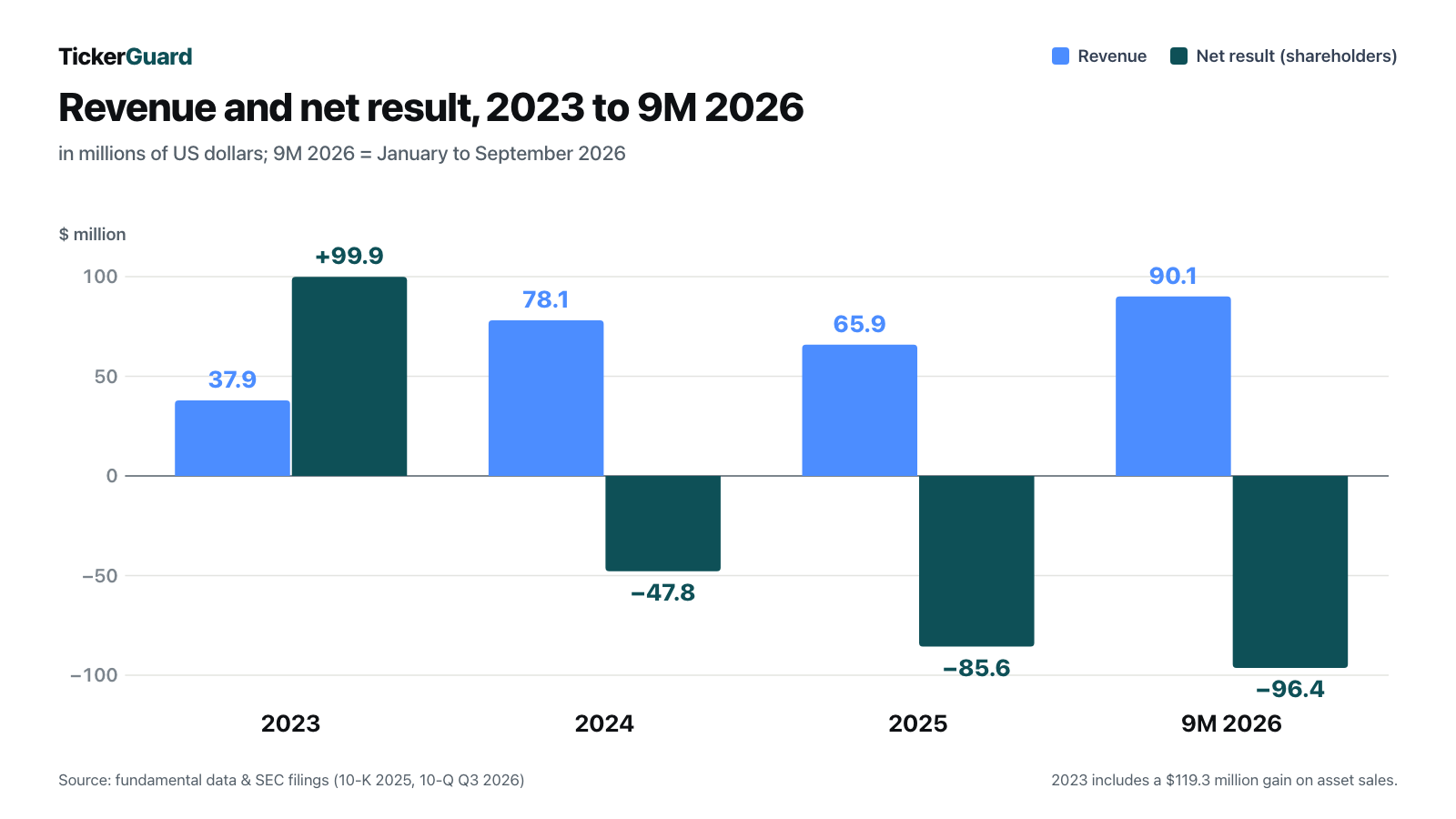
At $90.1 million, revenue for the first nine months of 2026 already exceeds every full prior year — almost all of it ($89.1 million) from uranium. The 2025 revenue of $65.9 million still included $15.8 million from the Kwale mineral sands project in Kenya, which is now under reclamation. The 2023 profit is not an operating result: according to the 2025 annual report, it came from a $119.3 million gain on asset sales. Without that one-off, Energy Fuels did not make money from operations in any of the years shown.
What the filings say — the uncomfortable truths
Uncomfortable truth No. 1: despite the uranium margin, the group is deep in the red
This is the contradiction to understand first. In the third quarter of 2026, the uranium business generated $28.45 million in revenue against $10.9 million in costs. Even so, Energy Fuels lost $52.2 million in the quarter, more than three times as much as a year earlier ($16.7 million). For the first nine months, the loss was $96.4 million. The quarterly report puts it plainly:
“The Company has had negative net cash flows from operating activities and net losses in previous years and through September 30, 2026.”
— Energy Fuels Inc., Form 10-Q for the quarter ended Sept. 30, 2026, Item 2 (Known Trends or Uncertainties)

Where the money goes is in the income statement: $54.1 million in selling, general and administrative expense over nine months, $29.0 million for exploration, development and processing, $9.3 million for mines on standby and $22.1 million in transaction and integration costs for ASM and VAC, $9.0 million of it in the third quarter. In the third quarter, an easily overlooked line came on top: a $28.0 million “other loss,” mainly mark-to-market losses on the marketable securities in which Energy Fuels parks its cash, plus interest on the convertible notes. Operating cash outflow for the first nine months of 2026 was $38.5 million — less than a year earlier ($73.3 million), but still an outflow.
Uncomfortable truth No. 2: the VAC deal has a value top-up for a falling stock built in — and a debt repayment comes on top of the price
Now to the company's own anchor. For Vacuumschmelze, Energy Fuels pays $718 million in cash and 65,853,000 new shares. At the June 22, 2026 closing price of $16.12, the company valued the deal at about $1.9 billion. Then comes the clause you should know about:
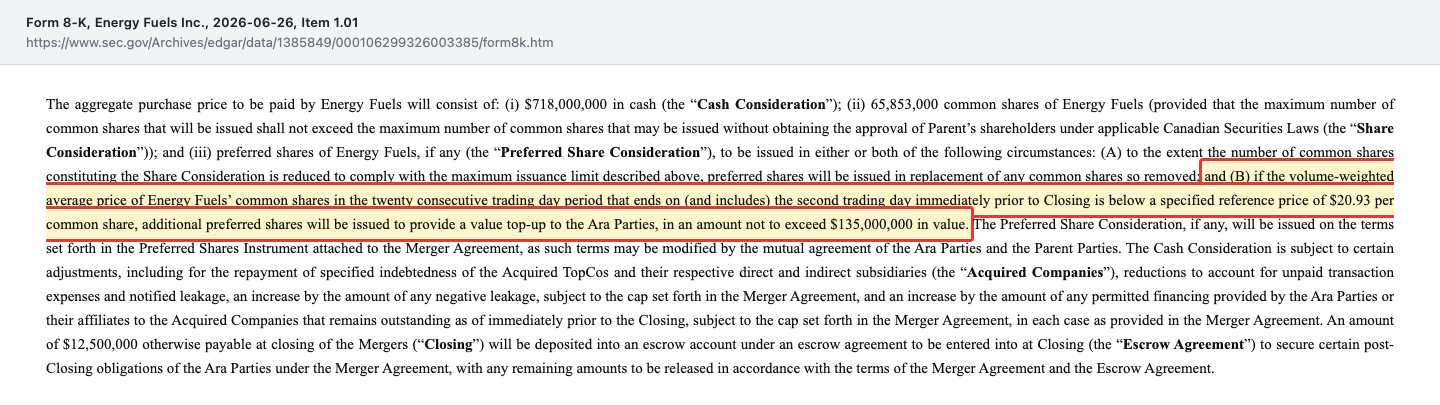
“and (B) if the volume-weighted average price of Energy Fuels’ common shares in the twenty consecutive trading day period that ends on (and includes) the second trading day immediately prior to Closing is below a specified reference price of $20.93 per common share, additional preferred shares will be issued to provide a value top-up to the Ara Parties, in an amount not to exceed $135,000,000 in value.”
— Energy Fuels Inc., Form 8-K of June 26, 2026, Item 1.01
In everyday terms: the seller takes part of the price in Energy Fuels stock but does not want to carry the full price risk. If the stock falls, Energy Fuels tops up — to the cap. The stock was already below the reference price at $16.12 the day before signing, and stood at $7.18 on Nov. 4, 2026 — almost $14 below it. How the top-up is calculated in detail is set out in an exhibit to the agreement; either way, the pro forma figures of Oct. 13, 2026 already assume the full $135 million, with $16.4 million in annual dividends charged against common shareholders; according to the same exhibit, the preferred shares are redeemable solely for cash.
Who pays what? For Energy Fuels, the dollar value of the price actually falls, because at $7.18 the 65,853,000 shares are worth only about $473 million instead of about $1.06 billion at the June price. But the payment is the same number of shares — and they make up a larger part of a lower-valued company. Existing shareholders bear the difference: they are diluted just as much in share terms, and ahead of them will stand preferred shareholders with $16.4 million in annual dividends.
And that is not the whole price. According to the same pro forma exhibit, Energy Fuels must also repay $186.0 million of VAC debt at closing that falls due on a change of control; the $250 million Goldman Sachs loan commitment is meant for that. Run it against today's cushion: cash and securities totaled $881.1 million on Sept. 30, 2026 ($76.4 million in cash, $779.5 million in short-term and $25.2 million in long-term marketable securities). Minus the $718 million cash price, minus the $186.0 million debt repayment, plus the $250 million loan — that leaves about $227 million on paper, before ongoing losses, the mill expansion or the projects are paid for. Against it would stand the $700 million convertible notes, the new bank loan and whatever VAC group debt is not repaid; according to the pro forma exhibit, $300 million of the cash price goes directly to a lender to satisfy VAC debt. The thick cushion, in other words, is a cushion before the deal. According to the quarterly report, the deal is expected to close “as soon as Q1 2027”; the agreement's outside date is March 22, 2027, extended automatically to June 22, 2027 if only regulatory approvals are outstanding.
Uncomfortable truth No. 3: VAC is losing money — and fighting a major customer
So what exactly is Energy Fuels buying? VAC's financial statements are attached to the 8-K of Oct. 13, 2026. In 2025, the VAC group generated 325.1 million euros in revenue, posted a gross loss of 22.0 million euros and ended with a loss after tax of 87.9 million euros. In the first half of 2026, revenue grew 34.8 percent to 211.5 million euros and gross profit turned positive (16.8 million), but the loss after tax was still 57.4 million euros. The group carries a syndicated term loan (165 million euros face amount) and a fully drawn $300 million U.S. construction loan.
The most sensitive point is in the same filing. U.S. subsidiary e-VAC Magnetics built a magnet plant in Sumter, South Carolina — according to the business description in the 8-K, in connection with an offtake agreement. And the customer has given notice of termination of that agreement, according to the VAC group's management discussion:
“The customer purported to provide official notice of termination of the commercial supply agreement on July 1, 2026. On July 7, 2026, e-VAC Magnetics LLC commenced arbitration proceedings, seeking a declaration that the termination was wrongful under the express terms of the commercial supply agreement, together with an award of the payments the customer is obligated to make to e-VAC Magnetics LLC over the remaining life of the commercial supply agreement.”
— Energy Fuels Inc., Form 8-K of Oct. 13, 2026, Item 8.01 (VAC group management discussion, customer contract dispute)

The filings do not name the customer. According to VAC's interim financial statements, the contract represents a substantial component of e-VAC's expected future revenues. VAC's management considers the group able to continue for at least twelve months, but explicitly bases that on two letters of comfort from its owners, the Ara funds (the one for the group capped at 43.5 million euros, the one for e-VAC without a cap), and on $28.4 million in additional loans from them. A letter of comfort is, simply put, a parent's promise not to let the child go under. The letters come from the Ara funds and, according to the filing, secure financing through Sept. 30, 2027; whether and how Energy Fuels steps into their place after the deal, the filings do not say. At least this much: according to the 8-K of Oct. 13, 2026, Energy Fuels already knew about the dispute, which began in April 2026, during the negotiation of the merger agreement (“Energy Fuels was aware of this dispute during the negotiation of the Merger Agreement”); the termination notice itself followed on July 1, after signing. In the amendment of Oct. 13, 2026, the parties expressly addressed the dispute, including a possible purchase price adjustment for any loss in value related to that contract — the filing gives no amount. The pro forma exhibit also mentions a possible contingent asset related to conditions at VAC, but expressly recognizes none.
Uncomfortable truth No. 4: your slice of the pie keeps shrinking
Dilution, in everyday terms: the pie is cut into more slices, and your slice gets smaller. At Energy Fuels, that is not an accident but a pattern:
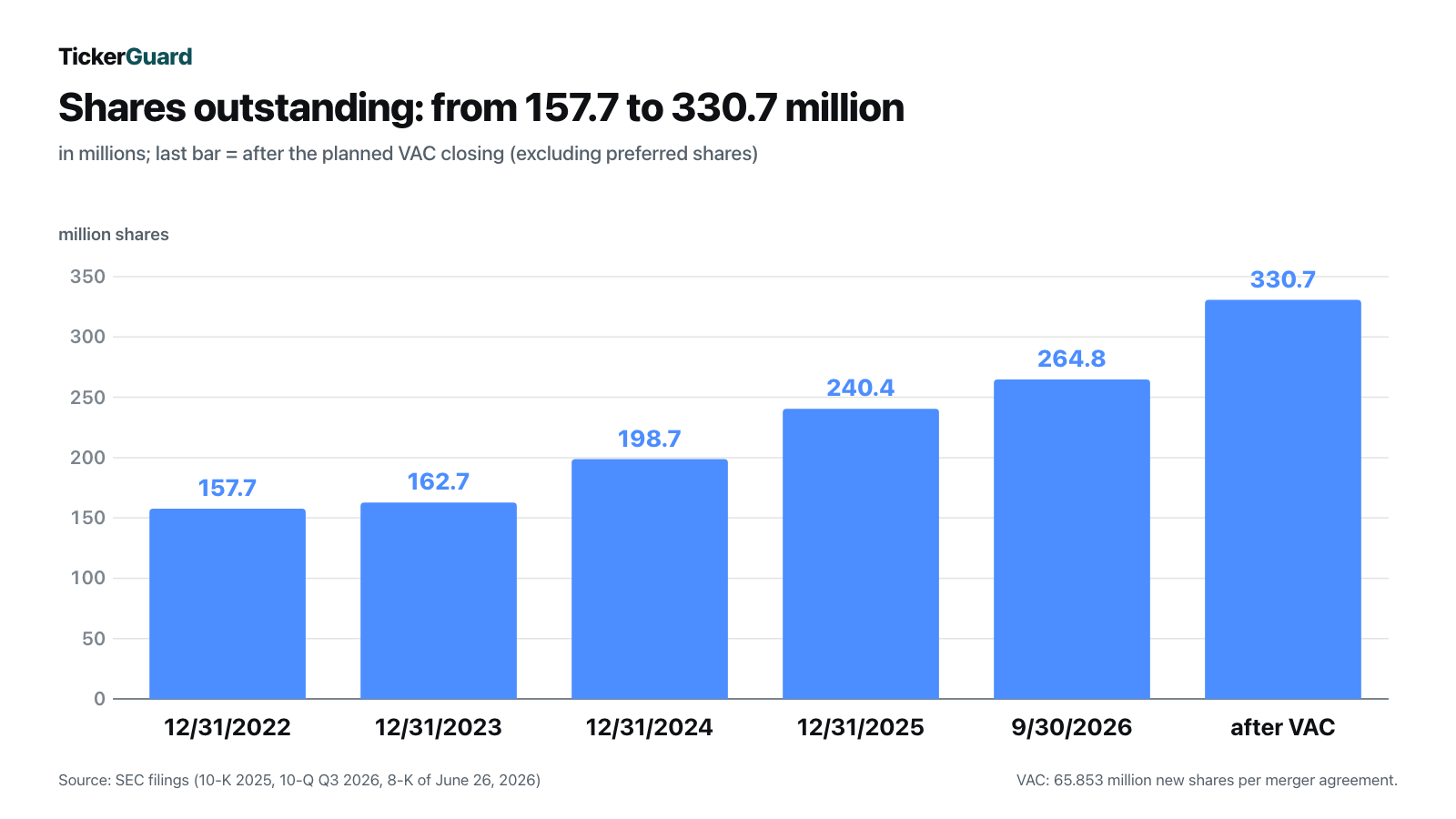
The new shares came from three sources: ongoing sales through the market (the at-the-market program), acquisitions and employee plans. In the first nine months of 2026 alone, Energy Fuels sold 8.38 million shares through the market for net proceeds of $153.1 million; ASM brought 14,808,572 new shares on Aug. 28. That exhausted the old $300 million program — and on Oct. 14, 2026, the company announced the next one:
“Pursuant to the ATM Prospectus Supplement, the Company may, at its discretion from time to time, sell up to an additional $500 million of common shares under its "at the market" program.”
— Energy Fuels Inc., Form 8-K of Oct. 14, 2026, Item 8.01

The accompanying prospectus supplement of Oct. 13, 2026 does the math itself: at the then-price of $11.26, the program would have meant 44.4 million new shares. At $7.18, it would be almost 70 million. As of Oct. 30, 2026, the share count on the cover of the quarterly report was unchanged at 264.8 million. In the background sit the convertible notes from October 2025: $700 million at 0.75 percent interest, due 2031, convertible at about $20.34 per share — roughly 34.4 million shares, cushioned by capped call hedges the company bought. At $7.18, conversion is far away; in that case the notes remain debt to be repaid in cash in 2031.
Valuation: what the market pays for uranium plus a magnet bet
There is no price-to-earnings ratio because there are no earnings. That leaves three orders of magnitude, all at the Nov. 4, 2026 close ($7.18) and 264.8 million shares.
First, the market value: about $1.90 billion. That is roughly the amount at which Energy Fuels valued the Vacuumschmelze deal in June. Put differently: the market values the entire group — uranium mill, mines, securities portfolio and ASM — at about the price of a single, loss-making acquisition as of June.
Second, price to sales. Over the last four quarters (Q4 2025 through Q3 2026), Energy Fuels generated about $117.2 million in revenue. The market value is therefore about 16 times sales. Today's uranium business alone does not explain that value; the price evidently reflects expectations for the rare earth business.
Third, price to book. Shareholders' equity stood at $962.1 million as of Sept. 30, 2026, about $3.63 per share. The $7.18 price is just under twice book value. Subtract cash and securities ($881.1 million combined) from the market value and add the convertible notes ($700 million face value), and you arrive at an enterprise value of a little over $1.7 billion.
The “professional view” is much more optimistic: the average price target of the eight analysts covering the stock was about $23.69, according to fundamental data retrieved on Nov. 5, 2026; six rated it a strong buy, one a buy and one a hold. In the same retrieval, about 58.1 million shares were sold short, more than a fifth of the free float. Part of that may be hedging by buyers of the convertible notes; how large that part is, the data do not say. Such targets are model assumptions about uranium prices, rare earth prices and a smooth VAC deal; they are not evidence.
Upside and risks at a glance
What speaks for Energy Fuels:
- A strategic asset: the White Mesa Mill, according to the quarterly report the only licensed and operating uranium mill in the U.S. and the only one that can also produce separated rare earth oxides.
- The uranium business pays: $88.90 selling price versus $34.04 cost per pound in the third quarter of 2026; long-term supply contracts through 2032, with 890,000 pounds in the base case for 2027.
- A thick cushion before the deal: $932.3 million in working capital as of Sept. 30, 2026; according to the report, resources are sufficient to carry out the business plan for at least twelve months.
- Tailwind from Washington: a conditional $725 million, 20-year loan commitment from the U.S. Office of Strategic Capital (June 18, 2026) for the mill expansion and a U.S. metals plant.
- Technical progress in heavy rare earths: on Aug. 19, 2026, Energy Fuels announced that Japan's largest permanent magnet maker had qualified the mill's terbium oxide for commercial production.
What speaks against it:
- Losses despite the uranium margin: a $96.4 million net loss in the first nine months of 2026 and operating cash outflows in every period shown, from 2023 through the first nine months of 2026.
- A big acquisition with open issues: VAC lost 87.9 million euros in 2025, a major customer of the U.S. subsidiary purported to give notice of termination of a material supply agreement on July 1, 2026 (e-VAC is contesting it in arbitration), and its going-concern assessment relies on its owners' letters of comfort, which run through Sept. 30, 2027.
- The cushion shrinks: after the price, the debt repayment and the Goldman Sachs loan, about $227 million of the $881.1 million in cash and securities would remain on paper — against $700 million in convertible notes.
- Even deeper in the red pro forma: with ASM and VAC, Energy Fuels would have lost $255.5 million in 2025 on paper (pro forma exhibit of Oct. 13, 2026).
- Ongoing dilution: from 157.7 million to 264.8 million shares since the end of 2022, another 65.9 million for VAC, a new $500 million program and $700 million in convertible notes.
- Many financing commitments are still just commitments: the $725 million from the Office of Strategic Capital is subject to due diligence and closing conditions, as is the $250 million Goldman Sachs loan.
- A change in a key role: on Sept. 28, 2026, Chief Legal Officer Nathan Longenecker informed the company of his decision to depart following a transition period expected to conclude on Dec. 15, 2026 (8-K of Oct. 13, 2026).
A human conclusion
Back to the anchoring trap from the start. $27.72 is no information about what Energy Fuels is worth today — it is a memory of a January in which the market believed a different story. And the $20.93 in the VAC agreement is just an anchor, too. It does have a consequence for shareholders, though: if the price is below that level before closing, the company tops up in preferred shares — at most $135 million, and its own pro forma figures already assume exactly that cap in full.
What the filings do show is a company with two faces. One is a uranium producer that, after years, finally sells at a meaningful margin. The other is a very large bet on a Western rare earth supply chain, paid for with cash, new shares and commitments — with a centerpiece that is itself losing money and has a major customer in arbitration. The honest question is not “Is the stock cheap after a 74 percent drop?” but: Do you trust that uranium profits plus a loss-making magnet maker will turn into a profitable whole before the cushion is used up? What you make of it is your decision. And that is how it should be.
Sources
All original documents used in this analysis — so you can check them yourself:
- Energy Fuels Inc. — Form 10-Q for the quarter ended Sept. 30, 2026 (filed Nov. 4, 2026)
- Energy Fuels Inc. — Form 10-Q for the quarter ended June 30, 2026 (filed Aug. 5, 2026)
- Energy Fuels Inc. — Form 10-Q for the quarter ended March 31, 2026 (filed May 6, 2026)
- Energy Fuels Inc. — Form 10-K for 2025 (filed Feb. 26, 2026)
- Energy Fuels Inc. — Form 8-K of June 26, 2026: VAC merger agreement, Goldman Sachs commitment, Office of Strategic Capital commitment, annual meeting
- Energy Fuels Inc. — Form 8-K of Aug. 28, 2026: completion of the ASM acquisition
- Energy Fuels Inc. — Form 8-K of Oct. 13, 2026: VAC merger amendment, VAC group management discussion, departure of the Chief Legal Officer, plus Exhibits 99.2 (VAC interim financial statements as of June 30, 2026) and 99.3 (pro forma financial information)
- Energy Fuels Inc. — Prospectus supplement 424B5 of Oct. 13, 2026 for the at-the-market program
- Energy Fuels Inc. — Form 8-K of Oct. 14, 2026: new at-the-market program of up to $500 million
- Full SEC filing history of Energy Fuels Inc.: EDGAR, CIK 0001385849
- Fundamental data (prices, 52-week range, analyst price target, short interest; data as of Nov. 4/5, 2026), cross-checked against the prices cited in the SEC filings for June 22, Aug. 28 and Oct. 6, 2026.
- Reddit mentions: ApeWisdom (as of Nov. 5, 2026); surfaced via our in-house stock scanner.
- Earnings call transcripts were not evaluated; this analysis relies solely on the mandatory SEC filings.
Transparency & disclaimer: This analysis is a journalistic assessment of publicly available information and does not constitute investment advice, a regulated financial analysis, or a solicitation to buy or sell securities. Equity investments carry substantial risk, including total loss. All information is provided without guarantee; the data date is noted throughout the text. Positions held by the operator are disclosed daily; where one exists, it appears as a notice at the top of this deep dive.
Key figures at a glance
All monetary figures in millions of $; earnings per share as reported.
| Metric | 2021 | 2022 | 2023 | 2024 | 2025 |
|---|---|---|---|---|---|
| Revenue | 3.2 | 12.5 | 37.9 | 78.1 | 65.9 |
| Operating Income (EBIT) | -35.4 | -44.9 | -32.4 | -37.2 | -101.2 |
| Net Income | 1.5 | -59.8 | 99.9 | -47.8 | -85.6 |
| Net Margin | 48.4% | -478.2% | 263.3% | -61.1% | -129.9% |
| Earnings Per Share | 0.01 $ | -0.38 $ | 0.62 $ | -0.28 $ | -0.37 $ |
Source: fundamental data & SEC filings (annual and quarterly reports, 10-K/10-Q)
Our Bottom Line at a Glance
- Uranium business positive
- In the third quarter of 2026, Energy Fuels sold 320,000 pounds of uranium oxide at $88.90 per pound at a cost of $34.04; a year earlier, the cost was $53.22. According to the filings, the White Mesa Mill is the only licensed and operating uranium mill in the U.S.
- Balance sheet & liquidity neutral
- Strong before the deal: $932.3 million in working capital as of 9/30/2026, including $855.9 million in cash and short-term marketable securities ($881.1 million including long-term securities), against $700 million in 0.75 percent convertible notes due 2031. After the VAC price, debt repayment and Goldman Sachs loan, about $227 million in cash and securities would remain on paper.
- Profitability negative
- A $96.4 million net loss in the first nine months of 2026 and negative operating cash flow in every year from 2023 to 2025 ($15.4 million, $44.0 million and $89.5 million) and in the first nine months of 2026 ($38.5 million); the 2023 profit came from asset sales.
- VAC acquisition negative
- VAC lost 87.9 million euros in 2025, a major customer of the U.S. subsidiary declared termination of a material offtake agreement on 7/1/2026; e-VAC considers it wrongful and the matter is in arbitration, and the merger agreement obliges Energy Fuels to issue up to $135 million in additional preferred shares below a $20.93 average price.
- Dilution negative
- From 157.7 million shares at the end of 2022 to 264.8 million on 9/30/2026, about 330.7 million after VAC; plus a new $500 million at-the-market program (10/14/2026).
- Strategic position neutral
- A mine-to-magnet chain under construction, backed by a conditional $725 million loan commitment from the U.S. Office of Strategic Capital — but that commitment is subject to due diligence and closing conditions, and the feedstock projects are not producing yet.
Energy Fuels has a uranium business that, in 2026, sells at a clear margin for the first time, and, before the VAC deal, a balance sheet with $932 million in working capital. Even so, the group posts heavy losses and, with ASM and VAC, is building a magnet supply chain whose largest piece is itself loss-making, has a major customer in arbitration and is paid for with cash, new shares and possible preferred shares. Not investment advice.
What Our Rating Means
Open questions
The business works in principle, but one material question is open. As long as it stays open, our findings do not carry a quality verdict.
Uranium earns, the group does not — and the planned magnet acquisition is itself losing money. That leaves the decisive open operating question of whether Energy Fuels as a whole will ever be profitable; with VAC, the group would have been even deeper in the red pro forma in 2025. Substance is documented too: a strategically unique uranium mill, a $55 per-pound gap between price and cost and, today, a cushion that exceeds the convertible notes; interest income on the securities portfolio ($24.6 million in nine months) covers the interest on the convertible notes. After the VAC deal, only about $227 million in cash and securities would remain on paper — whether that remaining cushion lasts until breakeven, the filings do not show; nor do they document an acute substance risk. Hence yellow. Whether just under twice book value is a fair price is not something a traffic light decides. The decision is yours.
A journalistic assessment by our editorial team at the time of the deep dive, based on public sources — not investment advice and not a solicitation to buy or sell. Your personal circumstances (investment goals, risk capacity, taxes) cannot be taken into account. What our levels mean, how verdicts are formed, and what conflicts of interest exist →
Worth Noting
- Data as of: balance sheet, earnings and cash flow figures as of 9/30/2026 (10-Q of 11/4/2026) or 12/31/2025 (10-K of 2/26/2026); prices, range, analyst target and short interest per fundamental data as of 11/4–11/5/2026; share count per the 10-Q cover as of 10/30/2026. All SEC filings through 11/5/2026 were reviewed; there was no 8-K earnings release (Item 2.02) on 11/4/2026.
- The VAC acquisition had not closed as of the data date. All VAC figures come from the VAC group's financial statements (Ara VAC IE Aggregator, LP) in euros, attached to the 8-K of 10/13/2026; the pro forma figures are an arithmetic combination, not reported results.
- The 2023 profit ($99.9 million) includes a $119.3 million gain on asset sales and is not an operating result.
- The interest burden of the convertible notes is covered by interest income: in the first nine months of 2026, $24.6 million in interest income compared with $7.2 million in interest expense (10-Q, Note 15). The $72.8 million operating loss, by contrast, does not cover the interest.
Stock Watch
This analysis is as of November 5, 2026. Stock Watch will tell you what's changed at UUUU since then.
Later $1 a month per stock — signing up is free, and you'll be the first to know when it launches.
The full analysis as a PDF for later
We will send you this analysis as a PDF — to print, file away, and read at your own pace. And we will add you to the free Stock Watch list for Energy Fuels Inc. (UUUU), so you hear about it when something material in this analysis changes.
Frequently Asked Questions
Energy Fuels Inc. (NYSE American: UUUU) mines and processes uranium in the U.S. Its core asset is the White Mesa Mill in Utah, according to its quarterly report the only licensed and operating uranium mill in the U.S., which can also separate rare earth oxides. It also owns mineral sands projects in Madagascar, Brazil and Australia and, since Aug. 28, 2026, a metals and alloys plant in South Korea.
The uranium business is, the group is not. In the third quarter of 2026, Energy Fuels sold uranium at $88.90 per pound at a cost of $34.04. The bottom line still showed a $52.2 million net loss, and $96.4 million for the first nine months of 2026 — due to overhead and development costs, deal costs and mark-to-market losses on securities.
On June 23, 2026, Energy Fuels agreed to buy Vacuumschmelze (VAC) of Hanau, Germany, a maker of magnets and magnetic materials. The price: $718 million in cash, 65,853,000 new shares and up to $135 million in preferred shares if the stock is below $20.93 before closing. The deal is expected to close as soon as the first quarter of 2027.
No. According to the financial statements in the 8-K of Oct. 13, 2026, the VAC group lost 87.9 million euros after tax in 2025 on revenue of 325.1 million euros, and 57.4 million euros in the first half of 2026 on revenue of 211.5 million euros. In addition, a major customer of U.S. subsidiary e-VAC Magnetics declared termination of its supply agreement on July 1, 2026; e-VAC disputes it, and arbitration is under way.
The share count rose from 157.7 million at the end of 2022 to 264.8 million on Sept. 30, 2026. The VAC closing would add 65.853 million. On Oct. 14, 2026, Energy Fuels also announced a new at-the-market program of up to $500 million, on top of $700 million in convertible notes with a conversion price of about $20.34.
As of Sept. 30, 2026, Energy Fuels reported $932.3 million in working capital, including $76.4 million in cash, $779.5 million in short-term marketable securities and 1.32 million pounds of finished uranium oxide in inventory. Against that stand $700 million in convertible notes due 2031. The VAC closing requires $718 million in cash plus a $186.0 million debt repayment, partly covered by a $250 million Goldman Sachs loan commitment. About $227 million in cash and securities would remain on paper.
The filings give no reason for share price moves. What can be documented is the timeline: a closing high of $27.72 on Jan. 28, 2026, $16.12 before the VAC signing on June 22, $11.26 on Oct. 6 and $7.18 on Nov. 4, 2026. In between came the VAC agreement, the disclosure of VAC's losses and customer dispute, and a new $500 million at-the-market program.
Found an error?
Did you spot a factual error, an outdated number, or a typo in this deep dive? Let us know briefly — your report goes straight to the editorial team.