Ranpak: Amazon and Walmart Are Key Customers — and Can Get Up to 48 Percent More Shares
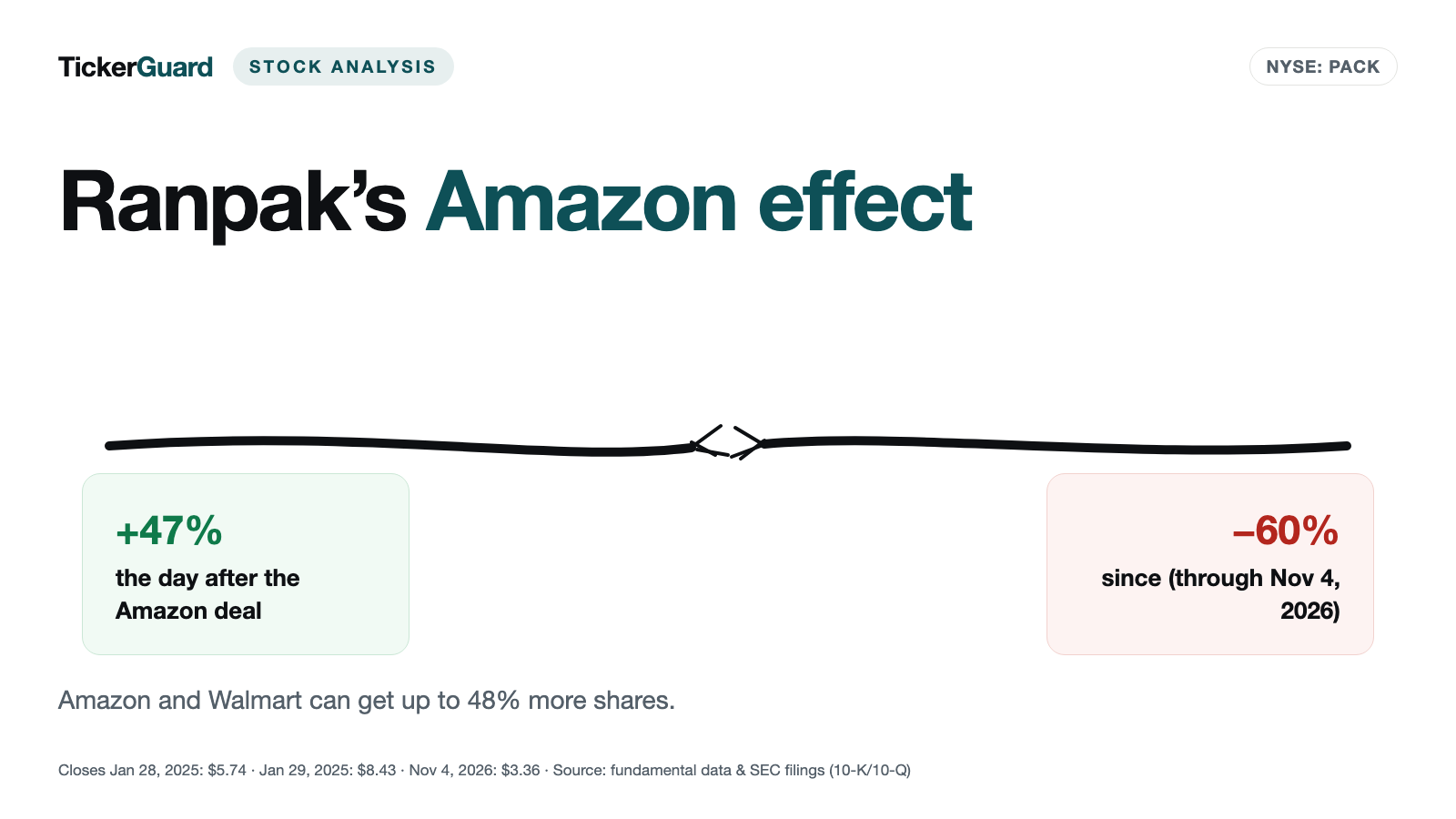
The day after the Amazon deal in January 2025, Ranpak stock jumped 47 percent; on November 4, 2026, it stood a little more than 60 percent below that close. Ranpak places machines that turn paper into cushioning and sells the paper that runs through them — to more than 30,000 end users, including Amazon and Walmart. Revenue grew from $326.5 million in 2022 to $420.2 million in the twelve months through September 2026. Every one of those years ended in a net loss, and the two big customers hold warrants on up to 41.2 million new shares. We read the company’s filings with the U.S. securities regulator through November 5, 2026. A famous name on the customer list is a calling card, not a bank statement.
 Thomas Mücke
Founder & Publisher
As of Today
As of: November 4, 2026
- Closing price
- 3.36 $ +12.75%
- Market Capitalisation
- 0.3 $B
- Growth Score
- 3/10
- AAQS
- 3/10
This analysis has a cut-off date. The Stock Guard tells you when something material changes in the numbers. Reserve your free spot
Chart
Interactive price chart (TradingView).
52-week range: 3.00 $ to 7.60 $ · Last price: 3.36 $ (As of: November 4, 2026)
Note: pure fact-based analysis, not investment advice and not a solicitation to buy or sell. All figures without guarantee.
On January 28, 2025, Ranpak stock closed at $5.74. On the next trading day it closed at $8.43, almost 47 percent higher. In between came a single piece of news: Amazon had signed a deal. You know the feeling when a famous name shows up on a list and every doubt goes quiet? “If Amazon is in, it can’t be wrong.” That is the authority reflex, which psychologists also call the halo effect: the shine of a big name spills over onto everything near it — including things the big name never checked.
Since August 2025, Ranpak has had two such names: Amazon and Walmart. Even so, the stock closed at $3.36 on November 4, 2026, a little more than 60 percent below the January 29, 2025 close. Before you decide whether the market is missing something or the big customers see something different than you do, let’s read together what Ranpak has filed with the U.S. securities regulator, the SEC.
The tension running through this analysis: The big customers bring growth and credibility. But Ranpak pays for them with warrants on almost half its own share count, interest on a loan of more than $400 million swallows the operating result, and the legacy paper business is treading water.
What Ranpak Actually Does
Ranpak Holdings Corp. is a Delaware corporation headquartered in Concord Township, Ohio, with more than 800 employees, about 300 of them in the U.S. (as of December 31, 2025). The company dates back to 1972; it has traded on the New York Stock Exchange under the ticker PACK since June 2019, after the blank-check company One Madison Corporation acquired it. That vehicle’s sponsor, One Madison Group, is controlled by Omar Asali, Ranpak’s Chairman and CEO, according to the annual report.
The business model works like an office coffee machine: Ranpak usually places the machine at the customer’s site through distributors and makes its money on the beans — in this case, the paper. Ranpak’s machines crimp, fold or cut kraft paper into cushioning, void fill and wrapping so goods don’t break in the box. As of December 31, 2025, the annual report counts more than 145,000 systems at more than 30,000 end users. About 40 percent of revenue comes from e-commerce end users, the rest from industrial manufacturers, machinery makers and other sectors. Geographically, 47 percent of 2025 revenue came from North America, 45 percent from Europe and 8 percent from Asia and other regions.
Revenue splits into four product lines (third quarter of 2026, per the quarterly report):
- Void-fill: $42.2 million, down 2.8 percent from a year earlier — the largest line.
- Cushioning (PadPak brand): $35.9 million, essentially flat.
- Wrapping (WrapPak and Geami brands): $9.2 million, up 8.2 percent.
- Automation: $14.6 million, up 22.7 percent. Here Ranpak sells equipment that automatically fills, closes and resizes boxes at the end of the packing line, plus camera systems for inspection.
Automation is the growth story. Its share of revenue rose from 8 percent in 2024 to 10 percent in 2025; for 2026 Ranpak expects about $60 million. Unlike the cushioning machines, this equipment is usually sold rather than leased. The cameras inspect boxes using machine learning, and a unit called R Squared Robotics works with three-dimensional computer vision and artificial intelligence. Our company-specific AI rating therefore classifies Ranpak as “sells AI” — with the caveat that AI revenue is not broken out separately and paper remains the core business.
Rule of thumb: at Ranpak, the machine doesn’t make money when it is installed, but with every foot of paper that runs through it. How many machines are in the field and how much paper they use decides the business.
Company history for investors
-
1972
Founded
Ranpak starts out in 1972 with paper-based protective packaging. The model of a placed machine plus consumable paper still carries the company today.
-
2019
Listing via One Madison
In June 2019 Ranpak lists on the NYSE through the blank-check company One Madison. Since then it has been a public company filing reports with the SEC.
-
2024
New $410M term loan
On 12/19/2024 Ranpak refinances with a $410M loan due 2031. Interest expense rises to $34.3M in 2025.
-
2025
Amazon deal with warrants
On 01/28/2025 Amazon receives warrants on up to 18.7M shares at $6.8308. The next day the stock closes at $8.43, almost 47% higher.
-
2025
Walmart follows
On 08/22/2025 Walmart receives warrants on up to 22.5M shares at the same price. Together the big customers could receive up to 48% more shares.
-
2026
Shareholders approve
The annual meeting on 05/21/2026 approves, under NYSE rules, the issuance of the Walmart warrant shares. That clears the way for full dilution.
-
2026
Guidance reaffirmed, stock at a low
On 10/29/2026 Ranpak reaffirms full-year guidance, with automation up 22.7%. On 11/03/2026 the stock closes at $2.98, its lowest since at least October 2024.
How the Stock Landed on Our Desk
No metrics screen flagged Ranpak; other investors’ attention did. On November 5, 2026, our in-house Reddit hype scanner picked up the ticker PACK, with two mentions. That is not a buy or sell signal, only a sign that people in forums are talking about a stock. The day before, November 4, 2026, the stock closed at $3.36; the day before that at $2.98, its lowest close since at least October 2024 (source: fundamental data). You can find current price and metrics data on our Ranpak stock page.
On the reporting situation: the fiscal year matches the calendar year. The latest periodic report is the quarterly report on Form 10-Q for September 30, 2026, filed on October 29, 2026 — the same day as the earnings release (Form 8-K, Exhibit 99.1) that reaffirmed full-year guidance. No later filing through November 5, 2026 changes that picture.
The Numbers Over the Years — An Honest Look
First, what genuinely impresses: Ranpak is growing. Revenue rose from $326.5 million in 2022 to $395.0 million in 2025 and to $420.2 million in the twelve months through September 30, 2026. Adjusted EBITDA, the metric Ranpak builds its guidance on (earnings before interest, taxes, depreciation, amortization and certain special items; not a U.S. GAAP measure), climbed from $62.5 million to $84.5 million over the same span, with a setback to $79.2 million in 2025. And cash is flowing again: operating activities brought in $24.8 million in the first nine months of 2026, versus just $3.6 million a year earlier.
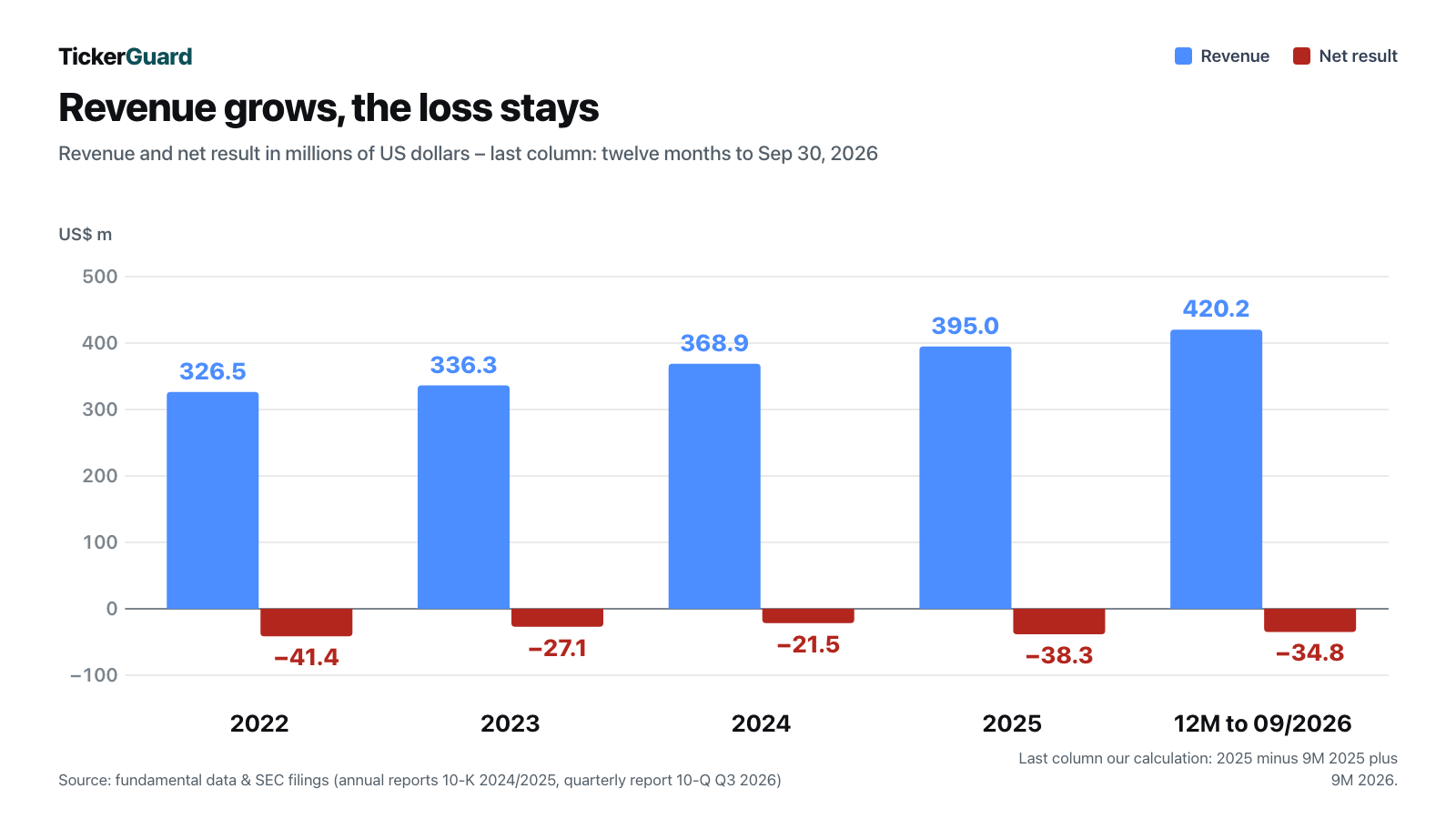
Now for the bottom line. Ranpak lost $41.4 million in 2022, $27.1 million in 2023, $21.5 million in 2024, $38.3 million in 2025 and $34.8 million in the twelve months through September 2026. The smaller 2024 loss was driven by one-time items: it included $16.1 million from a patent litigation settlement and $5.4 million from the sale of patents (2025 annual report). And gross margin, the share of revenue left after direct costs, fell from 37.9 percent in 2024 to 33.1 percent in 2025 (our calculation). In the third quarter of 2026 it recovered to 35.6 percent.
Where the money goes between EBITDA and the net result is shown in the second chart:
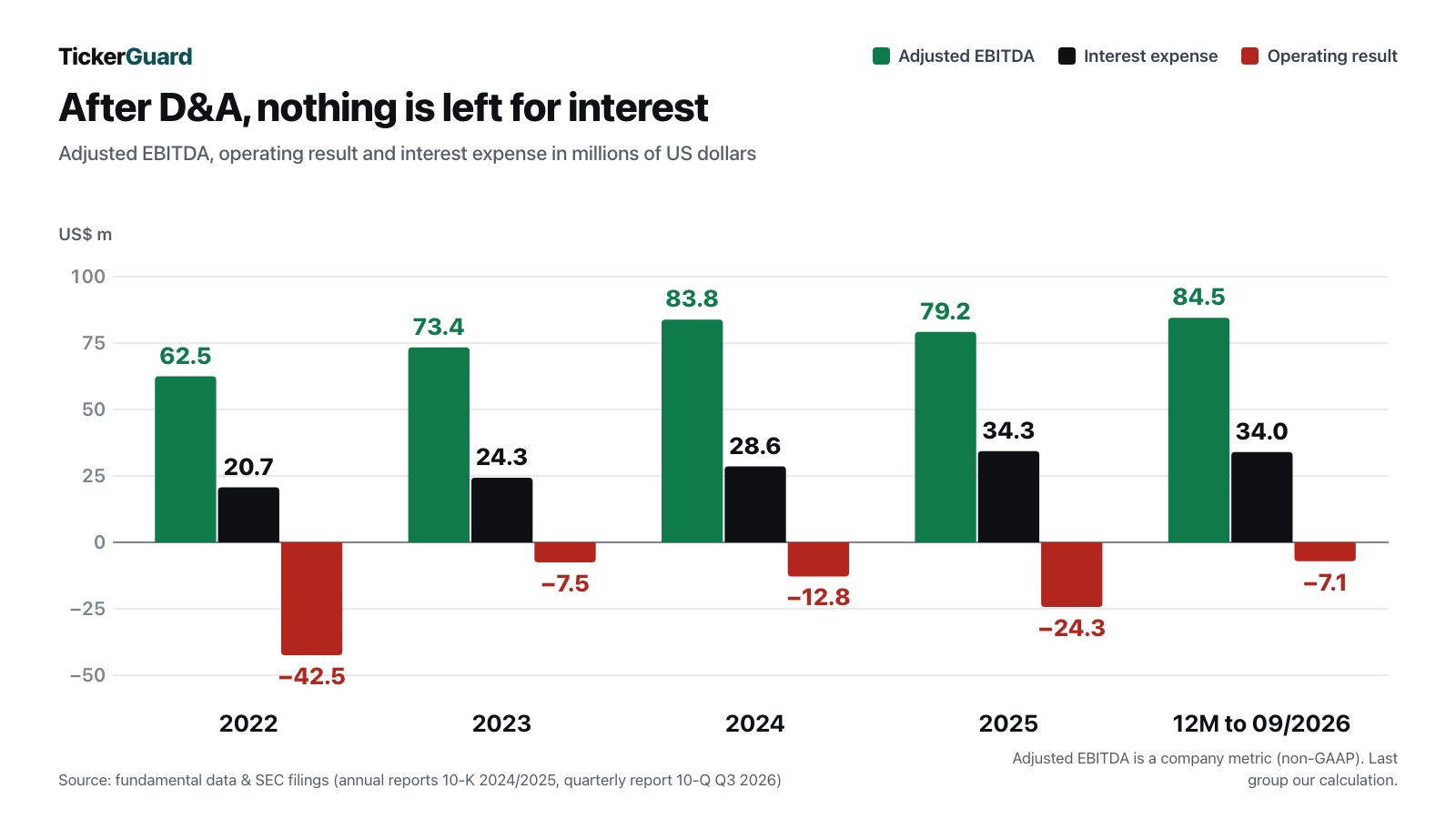
What sits between the green and the red bars is mostly depreciation and amortization: on the machines in the field, which Ranpak keeps having to build (in 2025 it bought $27.0 million of new converter equipment), and on intangible assets such as customer relationships and technology ($28.8 million in 2025). Rule of thumb: EBITDA is the result before the machines age — but the machines age anyway.
What the Filings Say — The Uncomfortable Truths
Four findings from the filings that you won’t see at the top of any press release.
Uncomfortable Truth No. 1: The Big Customers Have Reserved a Slice of the Company
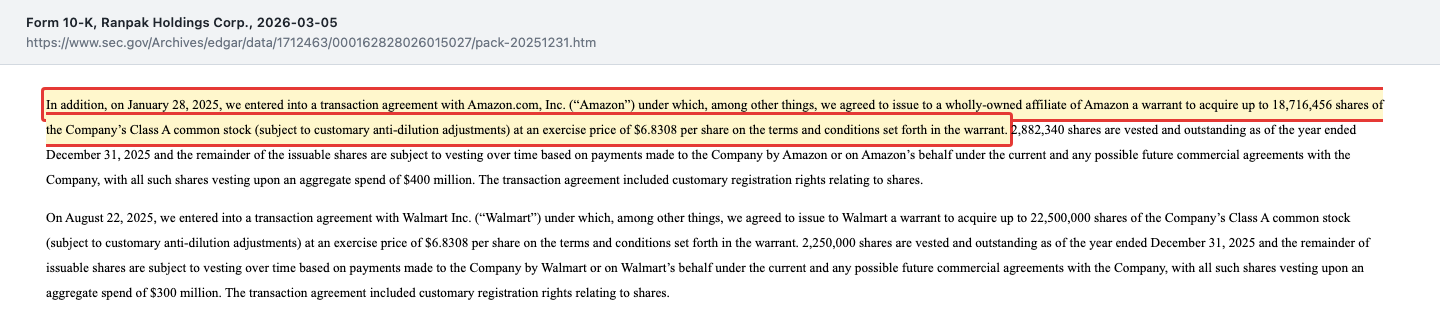
For Amazon and Walmart, Ranpak paid a special price: warrants. A warrant is the right to buy shares later at a fixed price. On January 28, 2025, Amazon received warrants on up to 18,716,456 shares; on August 22, 2025, Walmart received warrants on up to 22,500,000 shares — both at $6.8308 per share.
“In addition, on January 28, 2025, we entered into a transaction agreement with Amazon.com, Inc. (“Amazon”) under which, among other things, we agreed to issue to a wholly-owned affiliate of Amazon a warrant to acquire up to 18,716,456 shares of the Company’s Class A common stock (subject to customary anti-dilution adjustments) at an exercise price of $6.8308 per share on the terms and conditions set forth in the warrant.”
The scale: together that is up to 41.2 million shares — up to 48 percent on top of the 85,786,446 shares outstanding (October 22, 2026). They vest piece by piece as the two customers buy more: all Amazon shares at $400 million of purchases, all Walmart shares at $300 million. As of September 30, 2026, 3,556,136 Amazon shares and 2,250,000 Walmart shares had vested, 5.8 million in total. None has been exercised yet; Amazon’s rights run until 2033, Walmart’s until 2035, and a change of control would make all remaining warrants exercisable immediately.
They already cost Ranpak today. The grant-date value of the warrants, $118.1 million combined, is deducted from revenue over the life of the agreements: $4.6 million in the first nine months of 2026, versus $2.8 million a year earlier. Your slice of the pie gets smaller — in step with how much more the big customers order. At Ranpak, growth with Amazon and Walmart and dilution by Amazon and Walmart are two sides of the same coin.
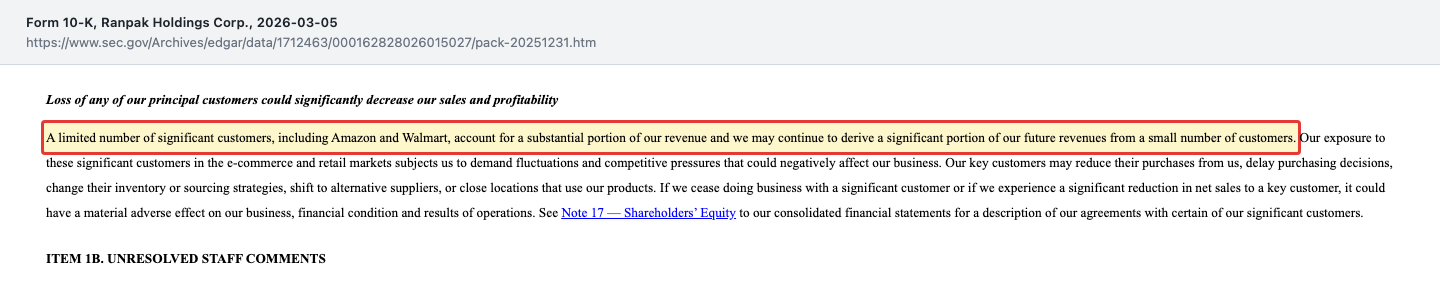
Then there is the dependence. A single customer, not named in the filings, accounted for 12.6 percent of 2025 revenue. Ranpak itself writes:
“A limited number of significant customers, including Amazon and Walmart, account for a substantial portion of our revenue and we may continue to derive a significant portion of our future revenues from a small number of customers.”
The 2026 trend is interesting: in the third quarter, according to the quarterly report, no single customer exceeded 10 percent of revenue, after 12.4 percent in the prior-year quarter; over nine months it was exactly 10.0 percent. Whether the largest customer is ordering less or the others are growing faster, the filings don’t say.
Uncomfortable Truth No. 2: Operating Income Doesn’t Cover the Interest
As of September 30, 2026, Ranpak still owed its lenders $402.8 million under a term loan from December 2024, due in December 2031. The terms are in the quarterly report:
“The interest rate for the Term Facility as of September 30, 2026 and December 31, 2025 was 8.19% and 8.42%, respectively, and the effective interest rate was 9.30% for both periods.”
— Ranpak, quarterly report on Form 10-Q as of September 30, 2026, Note 7
That adds up to $34.0 million of interest expense in the twelve months through September 2026. The operating result — profit from the business after all costs, depreciation and amortization, but before interest and taxes — came to minus $7.1 million over the same period (our calculation from the annual and quarterly reports). It has not been positive in any year since 2022. Even adding back amortization of intangible assets such as customer relationships and technology leaves about $21.6 million — roughly two-thirds of the interest bill (our calculation).
This is not an acute emergency: Ranpak reports no required mandatory prepayments and compliance with all debt covenants (quarterly report as of September 30, 2026), adjusted EBITDA for the twelve months through September 2026 would cover the interest about two and a half times, nothing is drawn on the $50 million revolving credit facility (after $2.9 million committed to letters of credit, $47.1 million is available), and the main loan isn’t due until December 2031. Ranpak itself aims to bring leverage below three times adjusted EBITDA (earnings release of March 5, 2026). By our calculation, it stood at about 4.3 times as of September 30, 2026: $416.0 million of debt including leases and financing arrangements, minus $53.4 million of cash, divided by $84.5 million of adjusted EBITDA. Getting to the target takes either about $36 million more EBITDA or a little over $100 million less net debt. Rule of thumb: a loan costs money every month, including the months when the business leaves nothing over.
Uncomfortable Truth No. 3: The Balance Sheet Holds Goodwill the Market No Longer Pays For
Ranpak’s balance sheet as of September 30, 2026 includes $453.1 million of goodwill — the premium paid in acquisitions above the value of identifiable assets — plus another $268.1 million of intangible assets such as customer relationships and trademarks. Together that is $721.2 million, more than total shareholders’ equity of $513.9 million. North America was already a close call at the 2025 annual test:
“However, the test for one of our goodwill reporting units that encompasses our business in North America indicated that fair value of the reporting unit was close to approximating carrying value.”
— Ranpak, annual report on Form 10-K for 2025, Item 7, “Critical Accounting Policies and Estimates”
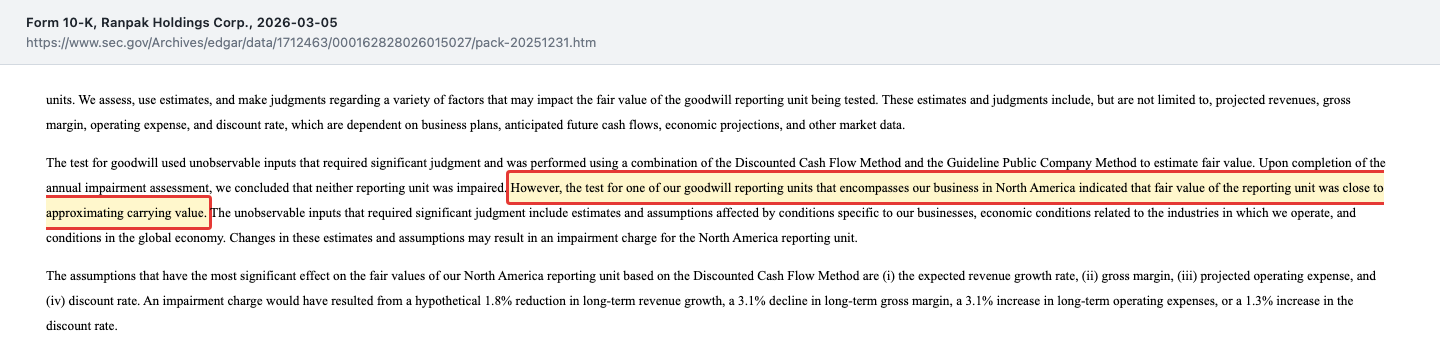
Since then, the share price has dropped from $5.41 (December 31, 2025) to $3.36 (November 4, 2026), and the market value of about $288 million is below goodwill alone. As of September 30, 2026, Ranpak nevertheless saw no reason for an interim test. The next regular test, as of October 1, 2026, will appear in the 2026 annual report. An impairment costs no cash, but it would visibly shrink equity.
Uncomfortable Truth No. 4: The Paper Business Is Shrinking at the Margins
Ranpak’s heart is paper, not automation. And there, the third quarter of 2026 went backward: paper volume fell 2.5 percent, and 4.9 percent in Europe and Asia; only higher prices and a better product mix (up 3.5 percent) kept paper revenue stable. The installed base shrank from 145.6 thousand to 142.8 thousand machines in a year. On top of that comes a headwind on the biggest cost item, paper itself:
“Energy price volatility has in the past increased the cost of paper, and we have experienced and expect to continue to experience headwinds from higher global energy prices resulting from the recent U.S.-Iran hostilities.”
— Ranpak, quarterly report on Form 10-Q as of September 30, 2026, Item 2
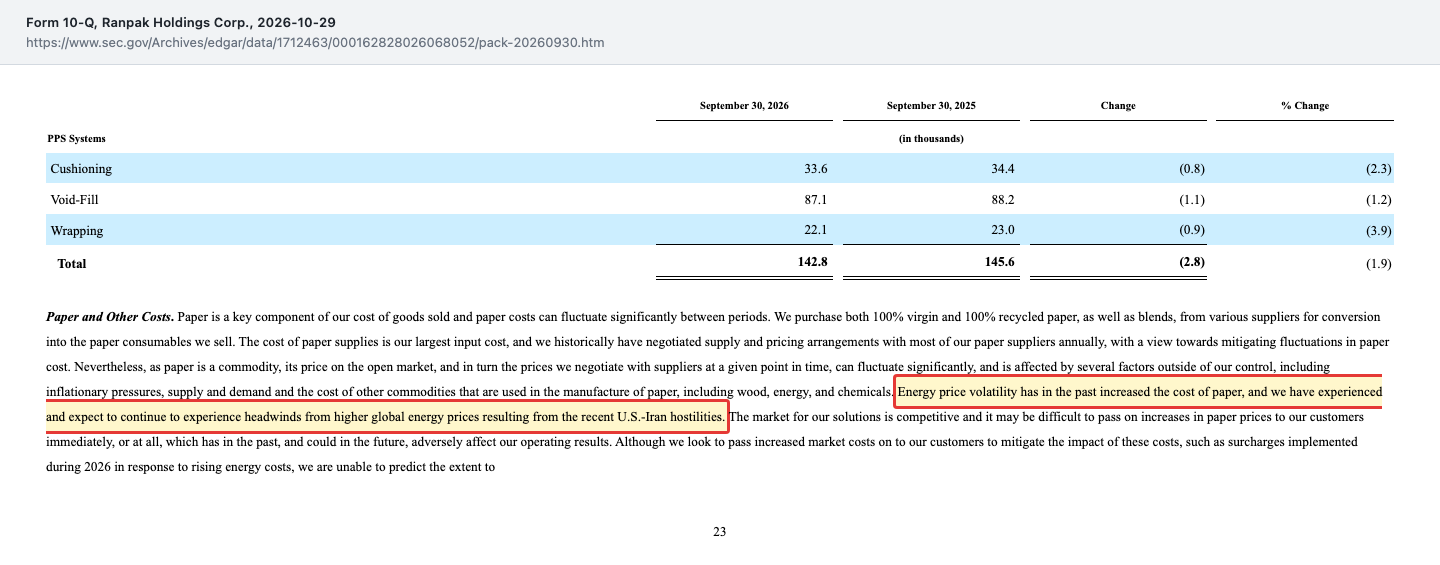
Ranpak introduced energy surcharges in 2026 and still expects, per the quarterly report, “some continued pressure on our gross margin” relative to its historical margin profile. Rule of thumb: when volume falls and only price holds revenue up, a business isn’t growing — it’s getting more expensive.
Valuation: What the Market Pays for Ranpak
At the $3.36 close on November 4, 2026, the 85,786,446 shares are worth about $288 million; the fundamental data show the same market value. Anyone buying the whole company, though, would also take on the debt. With $416.0 million of debt minus $53.4 million of cash, the enterprise value comes to about $651 million (our calculation, as of September 30, 2026).
- Price to sales: about 0.7 times trailing twelve-month revenue ($420.2 million).
- Enterprise value to adjusted EBITDA: about 7.7 times ($84.5 million).
- Price to book: about 0.56 — the market pays a little over half of book equity. Excluding goodwill and intangible assets, however, equity is negative, about minus $207 million (our calculation).
- Price to earnings: not meaningful, because there are no earnings.
And the warrants? At $3.36 they are deep under water: nobody pays $6.83 for a share that trades at half that. If the stock rose above $6.83 and all 41.2 million warrants were exercised for cash, Ranpak would receive about $281.5 million — roughly today’s market value (our calculation). The warrants also allow cashless exercise, in which the holder receives only the gain in value in shares.
For 2026, Ranpak guided to revenue of $415 million to $445 million and adjusted EBITDA of $83.5 million to $95.0 million (earnings release of March 5, 2026) and reaffirmed that on October 29, 2026. After nine months, it stands at $308.3 million of revenue and $60.5 million of adjusted EBITDA. To reach the low end, Ranpak needs $106.7 million of revenue and $23.0 million of EBITDA in the fourth quarter — both slightly less than in the fourth quarter of 2025 ($111.9 million and $24.0 million, our calculation). The low end is therefore no stretch; the top end of $445 million in revenue would require a fourth quarter of $136.7 million, about 22 percent more than a year earlier (our calculation). Longer term, Ranpak wants to double revenue within five years (earnings release of March 5, 2026).
The view from the pros: according to fundamental data, three analysts cover the stock, two rate it a “strong buy” and one a “hold”; their average price target is $5.17 (as of November 5, 2026). Average means: all price targets added up and spread evenly — with only three votes, a single outlier can move it a lot. Three opinions are not a broad consensus.
How the two big customers that carry so much weight at Ranpak are doing themselves is covered in our Amazon stock analysis and our Walmart stock analysis.
Upside and Risks at a Glance
What speaks for Ranpak:
- Growth in automation. Up 76.3 percent to $44.6 million in the first nine months of 2026, with about $60 million expected for the full year.
- Big customers with skin in the game. Through their warrants, Amazon and Walmart benefit from a rising share price themselves — which could give both an incentive to expand the relationship.
- Better cash flow. Operating cash flow of $24.8 million in the first nine months of 2026, versus $3.6 million; selling, general and administrative expenses 13.2 percent lower in the third quarter.
- No acute funding question. $53.4 million of cash, $47.1 million of available revolver capacity, main loan not due until late 2031; the earlier material weaknesses in internal controls are reported as remediated in the 2025 annual report.
- Paper instead of plastic. According to Ranpak, all its packaging is recyclable and biodegradable — an argument when online retailers want to move away from plastic.
What speaks against it:
- A loss every year. Net result negative every year since 2022, most recently minus $34.8 million over twelve months.
- Interest burden. $402.8 million term loan at 8.19 percent; operating income doesn’t cover the interest.
- Dilution from the big customers. Up to 41.2 million new shares possible, 48 percent of today’s count.
- Customer and ownership concentration. One customer accounted for 12.6 percent of 2025 revenue; investor JS Capital held about 36 percent of the shares at the end of 2025 and, per the annual report, can strongly influence key votes.
- Impairment risk. $453.1 million of goodwill against a market value of about $288 million.
- A shrinking base. Fewer machines in the field, falling paper volumes in the third quarter of 2026, energy prices as a cost driver.
A Human Bottom Line
Remember January 29, 2025, when the name Amazon lifted the stock by almost half in a single day? The authority reflex worked back then. The filings show what a big name actually means: more revenue, yes — but also a discount in the form of warrants, a dependence that Ranpak itself describes as a risk, and at the end of the year a loss anyway, because the loan costs interest month after month.
Does that make Ranpak a bad company? No. The business of machines plus consumable paper is proven, automation is growing strongly, and cash flow improved markedly in 2026. But the company carries a debt load that has exceeded its operating result for years, and a balance sheet full of goodwill the market no longer pays for. The next checkpoints are clear: the fourth quarter of 2026 against the reaffirmed guidance, the North America goodwill test in the 2026 annual report, and whether Ranpak actually pushes leverage below three times adjusted EBITDA.
What you make of it is your call. And that’s exactly how it should be.
Sources and Data Cutoff
- Quarterly report on Form 10-Q for the third quarter of 2026 (as of September 30, 2026, filed October 29, 2026, latest periodic report), 10-Q as of June 30, 2026 (July 30, 2026), 10-Q as of March 31, 2026 (April 30, 2026) and 10-Q as of September 30, 2025 (October 30, 2025)
- Annual report on Form 10-K for 2025 (March 5, 2026) and annual report on Form 10-K for 2024 (March 17, 2025)
- Earnings releases (Form 8-K, Exhibit 99.1): fourth quarter of 2025 with 2026 guidance (March 5, 2026), second quarter of 2026 (July 30, 2026), third quarter of 2026 (October 29, 2026)
- Form 8-K on the annual meeting of May 21, 2026 (approval of the Walmart warrant share issuance)
- Price and metrics data: source fundamental data, data as of November 5, 2026 (closes through November 4, 2026, analyst count and price target)
Data cutoff: company figures as of December 31, 2025 (fiscal 2025) and September 30, 2026 (latest periodic report of October 29, 2026); share count as of October 22, 2026. We reviewed the list of SEC filings through November 5, 2026. Prices: closes of January 28 and 29, 2025, December 31, 2025, September 30, November 3 and November 4, 2026. Calculated values (twelve-month figures, operating result before amortization of intangible assets, leverage, enterprise value, valuation multiples, equity excluding intangibles, warrant exercise proceeds, fourth-quarter requirement for guidance) are our own estimates and labeled as such.
Note: This article is journalistic analysis, not investment advice, and not a solicitation to buy or sell securities. Shares of highly leveraged companies can be very volatile; you can lose some or all of your money. Positions held by the operator are disclosed daily; where one exists, it appears as a notice at the top of this deep dive.
Key figures at a glance
All monetary figures in millions of $; earnings per share as reported.
| Metric | 2021 | 2022 | 2023 | 2024 | 2025 |
|---|---|---|---|---|---|
| Revenue | 383.9 | 326.5 | 336.3 | 368.9 | 395.0 |
| Operating Income (EBIT) | 12.2 | -42.5 | -7.5 | -12.8 | -24.3 |
| Net Income | -2.8 | -41.4 | -27.1 | -21.5 | -38.3 |
| Net Margin | -0.7% | -12.7% | -8.1% | -5.8% | -9.7% |
| Earnings Per Share | -0.04 $ | -0.51 $ | -0.33 $ | -0.26 $ | -0.45 $ |
Source: fundamental data & SEC filings (annual and quarterly reports, 10-K/10-Q)
Our Bottom Line at a Glance
- Growth positive
- Revenue from $326.5M (2022) to $420.2M (twelve months to 09/30/2026); automation up 76.3% in the first nine months of 2026.
- Profitability negative
- Net loss every year since 2022; operating result most recently −$7.1M against $34.0M of interest expense (twelve months to 09/30/2026, our calculation).
- Debt negative
- $402.8M term loan at 8.19% (09/30/2026), about 4.3 times adjusted EBITDA; company target: below 3 times.
- Dilution negative
- Warrants for Amazon and Walmart on up to 41.2M shares at $6.8308, 48% of the 85.8M shares outstanding; 5.8M vested (09/30/2026).
- Liquidity positive
- Cash of $53.4M, revolver undrawn ($47.1M available after letters of credit), operating cash flow of $24.8M in the first nine months of 2026; main loan due 12/2031.
- Balance sheet quality negative
- Goodwill of $453.1M above the market value of about $288M (11/04/2026); 2025 test for North America close to carrying value; excluding goodwill and intangibles, equity of about −$207M (our calculation).
Ranpak earns money with leased paper-converting machines and a growing packaging automation business; its key customers are Amazon and Walmart. Revenue is growing, but depreciation, amortization and a $402.8 million term loan leave a net loss every year, and the big customers hold warrants on up to 48 percent more shares. Not investment advice.
What Our Rating Means
Substance risk
We found at least one documented issue that threatens the company itself — regardless of how the stock is currently valued.
Red because one criterion of our traffic-light rule is documented: operating income does not cover interest expense, not in any year since 2022 and not in the twelve months through September 30, 2026 (minus $7.1 million against $34.0 million of interest, our calculation from the filings). This is not acute: no going-concern doubt, $53.4 million of cash, an undrawn revolver and a main loan not due until December 2031; interest is paid out of operating cash flow — though after capital expenditures practically nothing was left in the first nine months of 2026 ($24.8 million of operating cash flow against $25.2 million of capex). But as long as the business leaves nothing for the lenders after depreciation and amortization, the company depends on growth that has yet to arrive. That the stock trades below book value is a price question and does not change the color. The decision is yours.
A journalistic assessment by our editorial team at the time of the deep dive, based on public sources — not investment advice and not a solicitation to buy or sell. Your personal circumstances (investment goals, risk capacity, taxes) cannot be taken into account. What our levels mean, how verdicts are formed, and what conflicts of interest exist →
Worth Noting
- This analysis was prompted by the stock appearing in our in-house Reddit hype scanner on 11/05/2026 (two mentions), not by a metrics screen.
- Not to be confused with Karat Packaging (ticker KRT) or other companies with “Pack” in their name; PACK is the ticker of Ranpak Holdings Corp.
- Basis: 10-K 2024 (03/17/2025) and 2025 (03/05/2026), 10-Q Q3 2025 and Q1, Q2 and Q3 2026 (latest periodic report of 10/29/2026), 8-K earnings releases of 03/05, 07/30 and 10/29/2026, 8-K of 05/22/2026 on the annual meeting held 05/21/2026; Form 144 of 11/04/2026 (5,903 shares) reviewed, no bearing on the analysis; SEC filing list reviewed through 11/05/2026, no Form 15, Form 25-NSE only in 2019/2020.
- Calculated values are our estimates: twelve-month figures = full year 2025 minus nine months 2025 plus nine months 2026; leverage = (416.0 − 53.4) / 84.5 $M; enterprise value = 288.2 + 416.0 − 53.4 $M; operating result before amortization of intangible assets = −7.1 + 28.7 $M.
Stock Watch
This analysis is as of November 5, 2026. Stock Watch will tell you what's changed at PACK since then.
Later $1 a month per stock — signing up is free, and you'll be the first to know when it launches.
The full analysis as a PDF for later
We will send you this analysis as a PDF — to print, file away, and read at your own pace. And we will add you to the free Stock Watch list for Ranpak Holdings Corp (PACK), so you hear about it when something material in this analysis changes.
Frequently Asked Questions
Ranpak, based in Concord Township, Ohio, places machines at customer sites that turn kraft paper into cushioning, void fill and wrapping, and earns money on the consumable paper. It also sells equipment that automatically fills, closes and resizes boxes. As of December 31, 2025, more than 145,000 systems were installed at more than 30,000 end users; 2025 revenue was $395.0 million.
Because heavy depreciation, amortization and interest eat up the operating surplus. In the twelve months through September 30, 2026, adjusted EBITDA was $84.5 million, the operating result after depreciation and amortization minus $7.1 million and interest expense $34.0 million (our calculation). The bottom line was a loss of $34.8 million.
Amazon (January 2025) and Walmart (August 2025) may together buy up to 41.2 million Ranpak shares at $6.8308 each, depending on how much they spend with Ranpak. Measured against 85.8 million shares outstanding, that would be up to 48 percent more. As of September 30, 2026, 5.8 million had vested; none had been exercised.
As of September 30, 2026, Ranpak owed $402.8 million under a term loan due in December 2031 at an 8.19 percent interest rate. Including leases and financing arrangements, debt totaled $416.0 million against $53.4 million of cash. By our calculation, that is about 4.3 times adjusted EBITDA; Ranpak targets less than three times.
Ranpak expects 2026 revenue of $415 million to $445 million and adjusted EBITDA of $83.5 million to $95.0 million, and reaffirmed that guidance on October 29, 2026. After nine months it had $308.3 million of revenue and $60.5 million of adjusted EBITDA. Automation is expected to contribute about $60 million.
The largest shareholder at the end of 2025 was investor JS Capital with about 36 percent of the shares; per the annual report, it can strongly influence key votes. Chairman and CEO is Omar Asali, whose One Madison Group took Ranpak public in 2019 through a blank-check company. Amazon and Walmart hold non-voting warrants.
Yes, on a small scale. In its automation business, which made up 10 percent of revenue in 2025, Ranpak sells camera systems that inspect boxes using machine learning, and it runs a unit called R Squared Robotics for AI-supported computer vision. Our AI rating is therefore “sells AI”; Ranpak does not report AI revenue separately.
Found an error?
Did you spot a factual error, an outdated number, or a typo in this deep dive? Let us know briefly — your report goes straight to the editorial team.