FMC: The Anchor Investor Paid $13.30 – Weeks Later Came a Quarter With a $2.07 Billion Loss
In September 2026, Belgium's Tessenderlo Group bought about 20 percent of FMC Corporation for $403.2 million. In Q3 2026, price concessions on channel inventory cut revenue to $105.9 million, the loss reached $2,066.9 million, and stockholders' equity is gone on paper. We read the SEC filings and test how much shelter a big investor's slipstream really offers.
 Thomas Mücke
Founder & Publisher
As of Today
As of: November 3, 2026
- Closing price
- 6.10 $ -6.31%
- Market Capitalisation
- 0.9 $B
- Growth Score
- 3/10
- AAQS
- 0/10
Price change since November 3, 2026: +0.2%
This analysis has a cut-off date. The Stock Guard tells you when something material changes in the numbers. Reserve your free spot
Chart
Interactive price chart (TradingView).
52-week range: 4.50 $ to 18.10 $ · Last price: 6.10 $ (As of: November 3, 2026)
Note: pure fact-based analysis, not investment advice and not a solicitation to buy or sell. All figures without guarantee.
You know the feeling on a bike when a big truck is rolling along right in front of you? The wind is gone, you coast almost on your own, and it feels safe. The stock market has the same feeling, and it is a trap: the slipstream trap. It snaps shut when a large, experienced investor buys into a stock — and we conclude that we are protected riding behind. If a professional paid $13.30, then $6 must be a bargain. Right?
That is exactly what happened at FMC Corporation (NYSE: FMC). On Sept. 23, 2026, the Belgian industrial group Tessenderlo bought about 20 percent of the crop protection company — at $13.30 per share, for $403.2 million. A few weeks later, FMC reported a quarter with $105.9 million in revenue and a $2,066.9 million loss. On Nov. 3, 2026, the stock closed at $6.09.
So let's make a deal: before you tuck in behind the truck, we read together what FMC has filed with the U.S. securities regulator, the SEC — the fresh quarterly report (10-Q) for Sept. 30, 2026, the three quarterly reports before it, the annual reports (10-K) for 2024 and 2025, and the current reports (8-K) since July 2026. Companies that file false information with the SEC face penalties, which makes these filings some of the most reliable sources there are. In the end, you decide.
What FMC actually does — crop protection for the world's fields
FMC has been incorporated in Delaware since 1928 and is headquartered in Philadelphia. This is how the company describes itself:
“FMC Corporation is a global agricultural sciences company dedicated to providing farmers innovative solutions that increase the productivity and resilience of their land.”
— FMC Corporation, SEC quarterly report 10-Q for Sept. 30, 2026, Item 2 "Overview"
In everyday terms: FMC sells what farmers use to protect their crops from insects, weeds and fungi — insecticides, herbicides and fungicides, plus biologicals and plant health products. Its workhorse is the insecticide Rynaxypyr (active ingredient chlorantraniliprole), described in the 2025 annual report as "the world's leading insect control technology," with annual revenue of about $0.8 billion. Much of FMC's product is sold to distributors who stock it and pass it on to growers — the filings call them "channel customers." At the end of 2025, FMC employed about 5,500 people, 39 percent of them in Asia. Pierre Brondeau is CEO and also chairman of the board.
For the future, FMC is betting on four new active ingredients: Isoflex, fluindapyr, Dodhylex and rimisoxafen. In June 2026, FMC signed a supply and license agreement for rimisoxafen with the agricultural company Corteva, which paid $200 million up front.
That defines the central tension of this analysis: a crop protection group with what its own annual report calls the world's leading insecticide, new active ingredients and a freshly arrived anchor investor — whose equity is used up after five consecutive loss-making quarters and whose distributors are sitting on overpriced inventory.
Company history for investors
-
2025
India business put up for sale
In July 2025, the board approves the sale; Q3 2025 brings about $510 million in charges. For shareholders, the start of the losing streak.
-
2025
Dividend cut from $0.58 to $0.08
In October 2025, FMC cuts its quarterly dividend by 86 percent to prioritize debt reduction. The stock nearly halves on Oct. 30, 2025.
-
2025
Goodwill written off entirely
In Q4 2025, FMC writes off its entire goodwill of $1,356.2 million. At year-end, equity stands at $2,071.5 million, down from $4,487.5 million a year earlier.
-
2026
Strategic review and new notes
In February 2026, FMC explores options up to a sale; in June come $1.2 billion of 8 percent secured notes and a $200 million prepayment from Corteva.
-
2026
Tessenderlo takes a 20 percent stake
On Sept. 23, 2026, Tessenderlo buys new shares for $403.2 million at $13.30 apiece. The share count is up about 24.5 percent since the start of the year.
-
2026
Price actions and negative equity
In Q3 2026, price concessions cost $639 million in revenue and the loss reaches $2,066.9 million. Stockholders' equity falls to −$19.4 million.
How the stock landed on our desk
The trigger was a profit warning. On Oct. 15, 2026, FMC cut its third-quarter expectation to revenue of $65 million to $125 million and announced sweeping price concessions. The stock fell from $8.09 to $5.62 that day — about 30 percent. Results followed on Oct. 29, the quarterly report on Oct. 30. CEO Brondeau explained the collapse this way:
“Third-quarter demand was weaker than we expected, driven by challenging market conditions and elevated levels of higher-priced FMC products held in inventory by certain channel customers, which are limiting product movement and replenishment demand”
— Pierre Brondeau, chairman and CEO, SEC current report 8-K of Oct. 15, 2026, Exhibit 99.1
It is not the first crash. On Oct. 30, 2025, after third-quarter 2025 results and the announcement of a dividend cut, the stock fell from $29.04 to $15.53. In the twelve months before the latest report, the highest close was $18.07 (April 13, 2026) and the lowest $4.47 (Oct. 28, 2026). About 30.5 million shares were sold short (fundamental data, retrieved Nov. 4, 2026) — according to the data provider, roughly 24 percent of the free float. In other words, about a quarter of the freely tradable shares is positioned for falling prices.
The 17 analysts tracked by the data provider are cautious: three "strong buy," twelve "hold," one "sell," one "strong sell." The average price target is $7.91 (as of Nov. 4, 2026). Average means: all price targets added up and spread evenly — a single outlier up or down moves it noticeably. That is the view of those analysts, not an assessment by TickerGuard. We did not have a transcript of the Oct. 30, 2026 earnings call; management statements in this analysis come from the earnings releases filed with the SEC.
The numbers over the years — an honest look
First, what FMC did well for a long time. In 2022, the company posted $5,802.3 million in revenue and earned $736.5 million. In 2023, revenue dropped to $4,486.8 million, yet net income rose to $1,321.5 million — mainly thanks to a $1,119.3 million income tax benefit. In 2024, revenue was $4,246.1 million and net income $341.1 million. That was a solid, profitable business with farmers around the world.
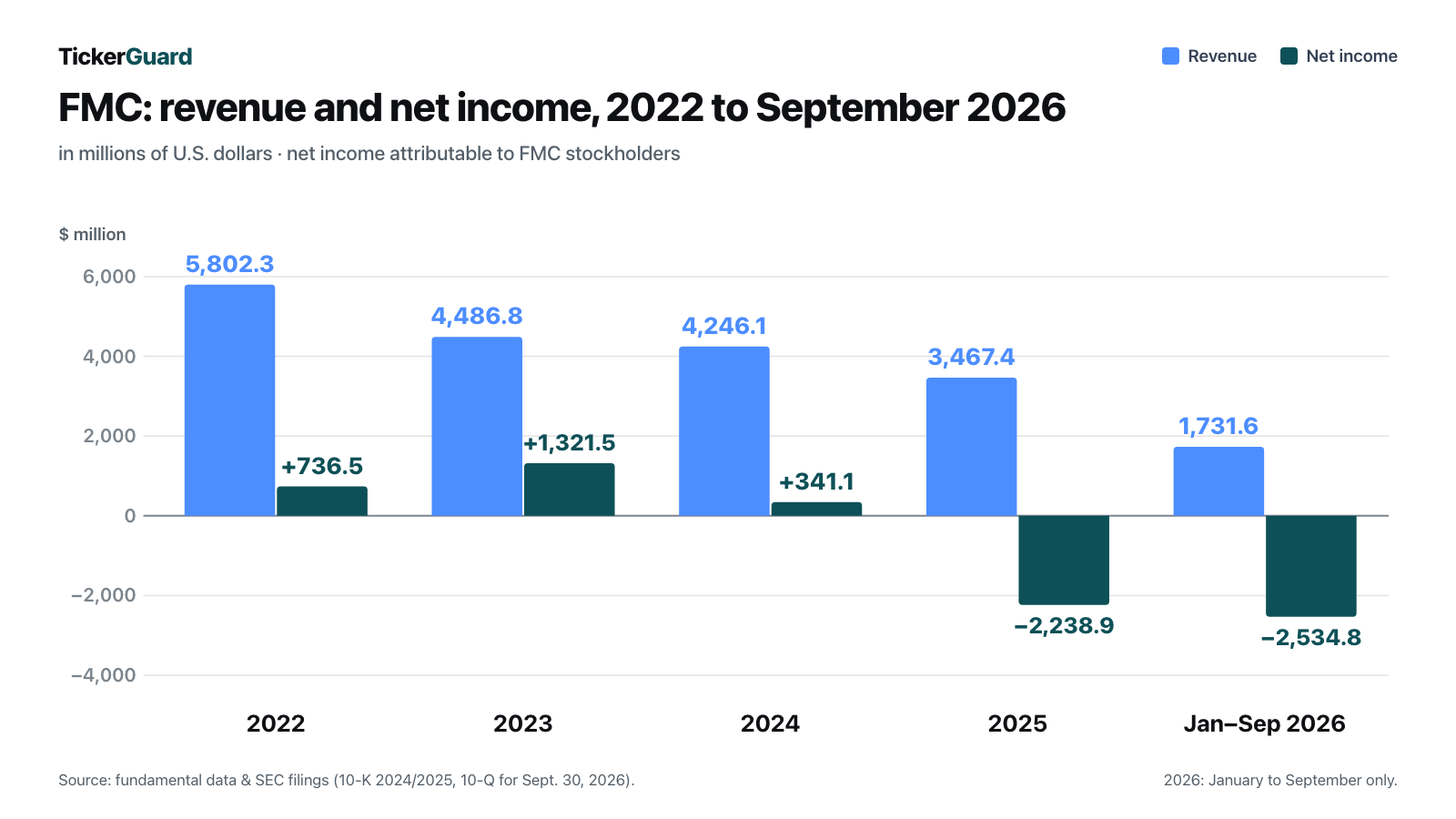
Then the picture flipped. In 2025, revenue fell to $3,467.4 million, and the bottom line showed a $2,238.9 million loss. The two largest items: in Q4 2025, FMC wrote off its entire goodwill from past acquisitions, $1,356.2 million, and the planned sale of the India business brought about $522 million in charges. From January through September 2026, another $2,534.8 million in losses followed. Together that is about $4.8 billion in 21 months.
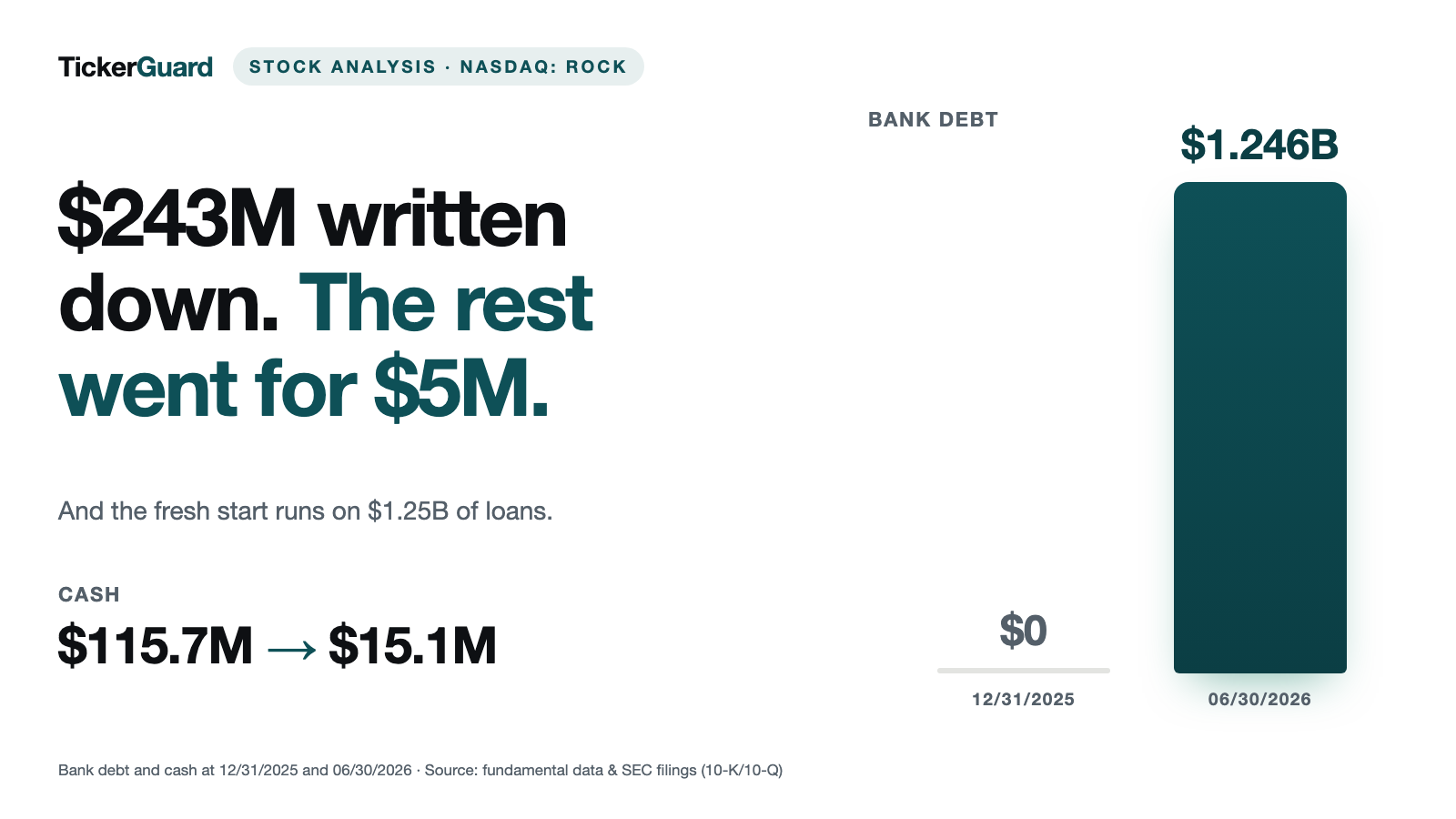
For context: a large part of these losses are non-cash entries — write-downs of values carried on the balance sheet. But the cash is not flowing as it used to either. Operations generated $736.7 million in 2024, used $6.2 million in 2025 and used $231.3 million from January through September 2026 (continuing operations, per the annual and quarterly reports). Q3 2026 alone showed a small inflow of $7 million.
In short: For years, FMC was a reliable earner. Since 2025 it has not made money, and the write-downs have hollowed out the balance sheet.
What the filings say — the uncomfortable truths
Uncomfortable truth No. 1: The equity is used up
Equity is what belongs to shareholders on paper once all liabilities are subtracted from all assets — the cushion between the company and its creditors. At FMC it stood at $4,487.5 million at the end of 2024. At Sept. 30, 2026 it was minus $19.4 million. In everyday terms: the house is worth less than the mortgage on it.
The final push came from a tax entry in Q3 2026. Companies may record future tax savings from losses as an asset — but only as long as it is credible they will earn enough to use them. FMC itself now has doubts:
“As a result of this assessment, we recorded valuation allowances in Switzerland and the United States of approximately $491 million and $317 million, respectively, during the three months ended September 30, 2026.”
— FMC Corporation, SEC quarterly report 10-Q for Sept. 30, 2026, Note 16 "Income Taxes"
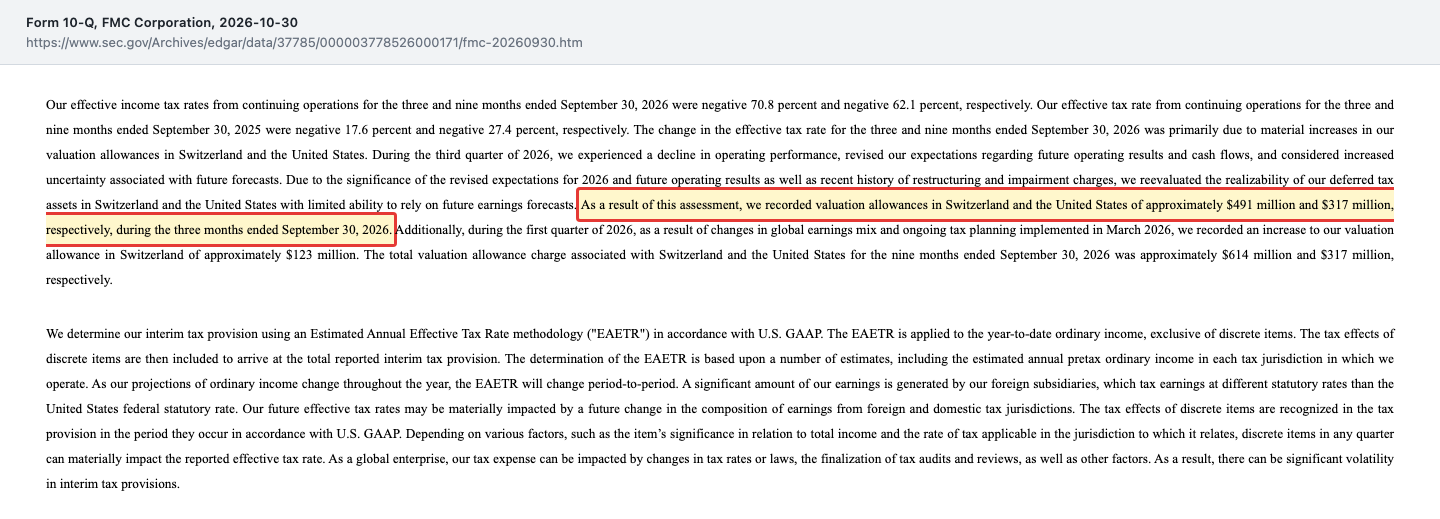
Add a further $287.5 million impairment of the value of its crop protection brands (Notes 4 and 8), and the balance sheet lost in one quarter values that had built up over years. Deferred tax assets fell from $1,215.6 million at the end of 2025 to $435.0 million.
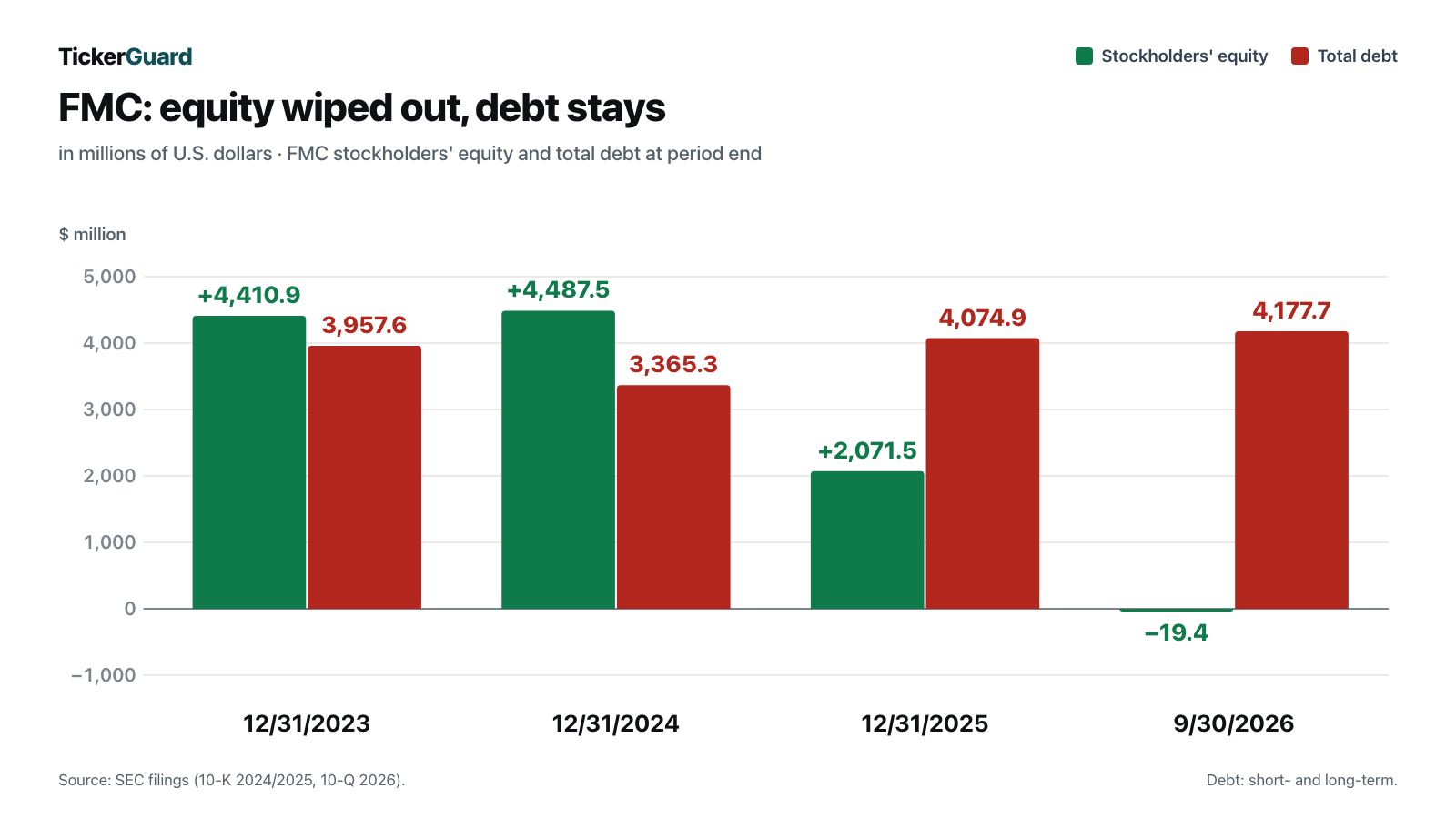
The debt, meanwhile, has stayed: $4,177.7 million at Sept. 30, 2026, including $1,200 million from 8 percent notes issued in June 2026 and secured by substantially all assets of the company and its guarantor subsidiaries in the U.S., Canada and Switzerland. Net interest expense rose to $209.7 million in the first nine months of 2026, from $175.2 million a year earlier. The quarterly report contains no going-concern warning.
Uncomfortable truth No. 2: The distributors' warehouses are full — and FMC is paying for it
How can a company with billions in revenue book only $105.9 million in a quarter? The quarterly report gives the answer:
“As a result, we recorded charges of approximately $672 million during the three months ended September 30, 2026, which includes approximately $639 million recorded to Revenue on the consolidated statement of income.”
— FMC Corporation, SEC quarterly report 10-Q for Sept. 30, 2026, Item 2 "Third Quarter 2026 Highlights"
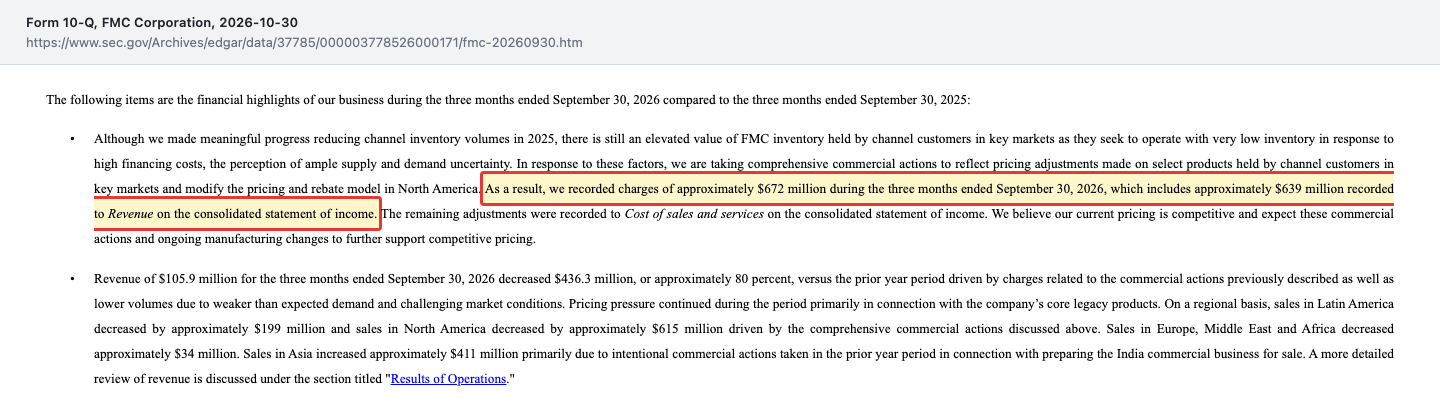
The problem is a full warehouse at the customer. FMC products were sold to distributors at prices that no longer match the market — partly because generic copies are pushing prices down. Distributors hardly reorder while they sit on expensive inventory. So FMC is meeting them halfway. According to the earnings release, about $500 million of the charge relates to the switch to a new pricing and rebate model in North America and about $175 million to price concessions on inventory in Brazil, Argentina, the U.S. and Canada. As a result, North American revenue for the quarter was actually negative, at minus $370.7 million.
The catch: according to the earnings release, the $175 million is real money FMC will be missing later:
“The adjustments do not impact current period cash and are the only component of the Adjusted EBITDA charge expected to reduce future cash collections.”
— FMC Corporation, SEC current report 8-K of Oct. 29, 2026, Exhibit 99.1
Without the price actions and without India, FMC says its Q3 2026 revenue would have been $745 million — 22 percent less than a year earlier. So the business underneath is shrinking too. Volumes fell 21 percent as distributors sharply cut replenishment orders in the final weeks of the quarter.
Uncomfortable truth No. 3: The bestseller has lost its patent protection
For years, Rynaxypyr was FMC's cash machine. But the protection is gone:
“The composition of matter patents on our Rynaxypyr® active and Cyazypyr® active ingredients have expired in all major markets, which will affect our ability to compete effectively.”
— FMC Corporation, SEC annual report 10-K for 2025, Item 1A "Risk Factors"
According to the annual report, the patents on the manufacturing process also expired in many major markets in December 2025. Put simply: the recipe is now public, and anyone may cook the dish. In the first nine months of 2026, prices fell 5 percent on average — from lower prices for partners that buy diamide active ingredients such as Rynaxypyr from FMC, planned price cuts on the branded product and more competition in Latin America and Asia, where, according to the report, generics are pushing prices down. How another major crop protection supplier is wrestling with very different legacy burdens is the subject of our Bayer analysis.
Uncomfortable truth No. 4: The banks loosened the rules — and the cushion is thin
Credit agreements contain covenants: ratios the company must meet, or the banks may demand their money back. One of them is interest coverage — how many times adjusted earnings cover the interest bill. FMC had its covenants relaxed in April 2026: the leverage ratio is not tested at all in the first three quarters of 2026, and the minimum interest coverage was lowered to 2.00.
“Our actual interest coverage for the four consecutive quarters ended September 30, 2026 was 2.28, which is above the minimum interest coverage of 2.00.”
— FMC Corporation, SEC quarterly report 10-Q for Sept. 30, 2026, Note 9 "Debt"

At the same interest burden, the credit agreement's adjusted earnings can fall by only a little more than 12 percent before the limit is reached (our calculation). And FMC has already said it needs more relief:
“While the company expects to be in compliance with covenants at September 30, 2026, the company intends to engage in discussions with its bank group on potential further modifications to its covenants over the next year to provide greater flexibility as the commercial actions described above are implemented.”
— FMC Corporation, SEC current report 8-K of Oct. 15, 2026, Exhibit 99.1
For context: at Sept. 30, 2026, FMC had $735.8 million in cash and could draw another $1,661.4 million from its credit facility (maturing in 2028). Cash is not acutely tight. But a company that keeps asking its banks for new rules is not negotiating from a position of strength.
Uncomfortable truth No. 5: The slipstream comes at a price
Now to the anchor investor from the beginning. The quarterly report describes the deal soberly:
“Tessenderlo Group purchased 30,319,166 shares at a price of $13.30 per share, which represents approximately 20 percent of the outstanding shares of FMC common stock.”
— FMC Corporation, SEC quarterly report 10-Q for Sept. 30, 2026, Item 2 "Overview"
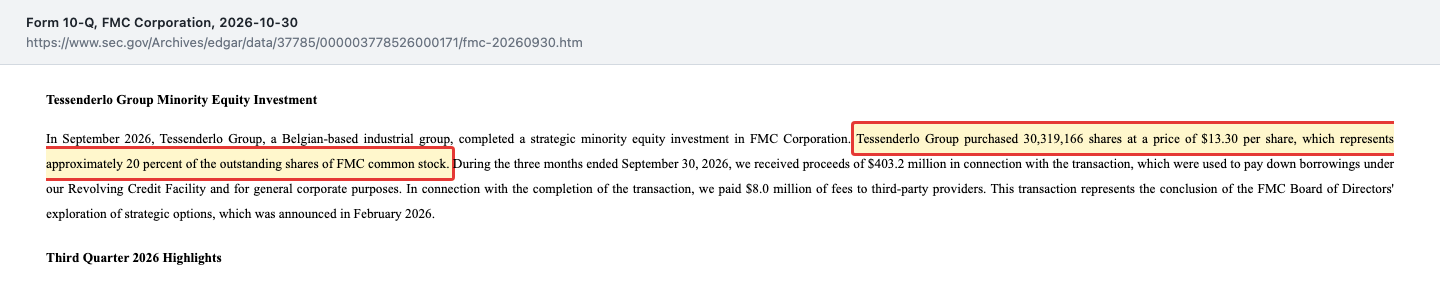
Three things belong in the picture. First: this deal ended the review of strategic options announced in February 2026, which explicitly included a sale of the whole company. No takeover came. Second: the shares are newly issued. The share count rose from about 124.9 million at the end of 2025 to 155.6 million at Sept. 30, 2026, an increase of about 24.5 percent. Because Tessenderlo paid above the market price (close on the agreement date, June 30, 2026: $11.50; on the closing date, Sept. 23, 2026: $9.90), this was not cheap dilution for the other shareholders — but your slice of the pie is still smaller.
Third, and this is the core of the slipstream trap: Tessenderlo cannot simply pull over. Under the investor agreement (8-K of Sept. 23, 2026), the group may not sell or hedge its shares for 36 months, is bound by a standstill that among other things restricts further purchases, and generally votes with the board at shareholder meetings — except on a change of control. Since Oct. 21, 2026, Tessenderlo CEO Luc Tack has sat on FMC's board. At $6.09 (Nov. 3, 2026), the paper loss on the 30,319,166 shares bought in September is about $218.6 million (our calculation). The truck in front of you is not driving faster — it just cannot get off the road.
One more number: the dividend was cut in October 2025 from $0.58 to $0.08 per quarter. The secured notes further restrict payouts, and FMC has agreed with its banks not to buy back shares until the end of 2028.
In short: equity used up, distributor warehouses full, patents expired, banks with little room to spare, an anchor investor with tied hands — every point is in a report filed with the SEC.
Valuation: cheap is relative here
At $6.09 (close on Nov. 3, 2026) and 155.6 million shares, the market capitalization was about $947 million. Add $4,177.7 million of debt, less $735.8 million in cash. The enterprise value — what a buyer would have to pay for the whole business including its debt — is therefore about $4.39 billion (our calculation).
Revenue over the last four quarters (Q4 2025 through Q3 2026) adds up to $2,814.9 million. That gives a price-to-sales ratio of about 0.34 — dirt cheap at first glance. Measured by enterprise value, though, it is 1.6 times revenue, and that is the number that matters when debt is about 4.4 times the market value. There is no price-to-earnings ratio, because there are no earnings. For full-year 2026, FMC itself expects negative adjusted EBITDA of minus $104 million to minus $124 million and free cash outflow of $150 million to $350 million.
Anyone who still finds the stock cheap is betting on the turnaround management holds out for 2027 and 2028. In everyday terms: the low market value is like a cheap house with a big mortgage — the price on the door is small, the bill behind it is not.
Upside and risks at a glance
What speaks for FMC
- Four new active ingredients (Isoflex, fluindapyr, Dodhylex, rimisoxafen); Corteva paid $200 million up front for rimisoxafen (June 2026).
- Liquidity: $735.8 million in cash and $1,661.4 million in undrawn credit (Sept. 30, 2026); next bond maturity in 2029; no going-concern warning.
- Excluding the price actions, the business generated adjusted EBITDA of $113 million in Q3 2026; for Q4, FMC expects $210 million to $230 million.
- The sale of the India business for $252 million is expected to close in 2026; the proceeds are earmarked for debt reduction.
- An anchor investor with 20 percent and a 36-month lock-up brings stability to the shareholder base.
What speaks against it
- FMC stockholders' equity is negative (−$19.4 million, Sept. 30, 2026) after a $2,534.8 million loss in nine months.
- Operations used $231.3 million of cash from January through September 2026; for the full year, FMC expects free cash flow of minus $150 million to minus $350 million.
- Interest coverage of 2.28 against a 2.00 minimum; further covenant relief announced; 8 percent interest on the new secured notes.
- Patents on the bestseller Rynaxypyr have expired, generics are squeezing prices, and about $175 million in future cash collections is lost to the price concessions.
- Environmental risks: according to the quarterly report, reasonably possible environmental losses exceed accrued reserves by about $304 million (Sept. 30, 2026).
Conclusion: a slipstream is not a seat belt
Back to the slipstream trap from the start. Yes, an experienced industrialist paid $13.30 per FMC share. But he bought before the quarter with a $2.07 billion loss, he may not sell for three years, and his entry price says nothing about what the stock is worth today. A truck that cannot brake itself will not shield you from the pothole.
FMC is not a worthless company: it has active ingredients farmers buy worldwide, new products in the pipeline and enough credit for the coming quarters. Management writes in its earnings release:
“We believe completing this work, together with the progress across our operational priorities, positions FMC for improved performance in 2027 and a stronger growth and earnings profile in 2028.”
— Pierre Brondeau, SEC current report 8-K of Oct. 29, 2026, Exhibit 99.1
So the honest question for you is not "Is $6 cheap if the pro paid $13.30?" but: Do you believe FMC can clear its distributors' warehouses, beat generic competition with new active ingredients and keep its banks on board — before the missing equity becomes a problem? If you have a reasoned answer, you have a thesis. If all you have is the anchor investor's entry price, you are riding in the slipstream. What you make of it is your decision. And that is as it should be.
Sources
- FMC Corporation — SEC quarterly report 10-Q for Sept. 30, 2026 (filed Oct. 30, 2026)
- FMC Corporation — SEC current report 8-K of Oct. 29, 2026, Exhibit 99.1 (Q3 2026 results and outlook)
- FMC Corporation — SEC current report 8-K of Oct. 21, 2026 (Amendment No. 8 to the credit agreement)
- FMC Corporation — SEC current report 8-K of Oct. 21, 2026 (Luc Tack joins the board)
- FMC Corporation — SEC current report 8-K of Oct. 15, 2026, Exhibit 99.1 (outlook update and commercial actions)
- FMC Corporation — SEC current report 8-K of Sept. 23, 2026 (closing of the Tessenderlo investment, investor agreement)
- FMC Corporation — SEC quarterly report 10-Q for June 30, 2026 (filed July 30, 2026)
- FMC Corporation — SEC quarterly report 10-Q for Mar. 31, 2026 (filed April 30, 2026)
- FMC Corporation — SEC annual report 10-K for 2025 (filed Feb. 27, 2026)
- FMC Corporation — SEC quarterly report 10-Q for Sept. 30, 2025 (filed Oct. 30, 2025)
- FMC Corporation — SEC annual report 10-K for 2024 (filed Feb. 28, 2025)
- Full SEC filing history: EDGAR overview FMC Corporation (sec.gov)
- Fundamental data (prices, short interest, analyst ratings; data as of Nov. 4, 2026), cross-checked against the SEC filings. No earnings call transcripts were available.
Transparency & disclaimer: This analysis is a journalistic assessment of publicly available information. It is not investment advice, not a financial analysis in the regulatory sense, and not a solicitation to buy or sell securities. Investing in stocks involves substantial risk, up to and including the total loss of your investment. All information without guarantee; the data date is noted in the text. Our own calculations are marked as such and are not company figures. Positions held by the operator are disclosed daily; where one exists, it appears as a notice at the top of this deep dive.
Key figures at a glance
All monetary figures in millions of $; earnings per share as reported.
| Metric | 2021 | 2022 | 2023 | 2024 | 2025 |
|---|---|---|---|---|---|
| Revenue | 5,045.2 | 5,802.3 | 4,486.8 | 4,246.1 | 3,467.4 |
| Operating Income (EBIT) | 1,166.5 | 1,290.9 | 837.9 | 651.6 | -1,886.6 |
| Net Income | 739.6 | 736.5 | 1,318.8 | 341.1 | -2,238.9 |
| Net Margin | 14.7% | 12.7% | 29.4% | 8.0% | -64.6% |
| Earnings Per Share | 5.73 $ | 5.81 $ | 10.51 $ | 2.72 $ | -17.88 $ |
Source: fundamental data & SEC filings (annual and quarterly reports, 10-K/10-Q)
Our Bottom Line at a Glance
- Products & pipeline positive
- Rynaxypyr generated about $0.8 billion in revenue in 2025; four new active ingredients, with Corteva paying $200 million up front for rimisoxafen in June 2026. Excluding the price actions, Q3 2026 adjusted EBITDA was $113 million.
- Liquidity neutral
- $735.8 million in cash and $1,661.4 million in undrawn credit (Sept. 30, 2026); Tessenderlo's money ($403.2 million) used to repay debt; no going-concern warning. Against that: operations used $231.3 million in nine months.
- Balance sheet negative
- FMC stockholders' equity of −$19.4 million (Sept. 30, 2026), down from $2,071.5 million at the end of 2025; total debt of $4,177.7 million, including $1.2 billion of 8 percent secured notes.
- Earnings power & pricing negative
- A $2,534.8 million loss in nine months of 2026; Rynaxypyr patents expired, prices down 5 percent on average, Q3 volumes down 21 percent; about $175 million in future cash collections forgone.
- Loan covenants negative
- Interest coverage of 2.28 against a 2.00 minimum (Sept. 30, 2026), covenants amended three times since April 2026, further relief announced on Oct. 15, 2026.
FMC shows how the slipstream trap works: an anchor investor paid $13.30 per share in September 2026, and a few weeks later FMC reported a $2,066.9 million quarterly loss and negative equity. The business is alive — with established active ingredients, new products and enough credit — but the balance sheet, cash burn and covenants leave little room. Not investment advice.
What Our Rating Means
Substance risk
We found at least one documented issue that threatens the company itself — regardless of how the stock is currently valued.
Red, because there is a documented substance risk: FMC stockholders' equity was negative at −$19.4 million on Sept. 30, 2026, operations are using cash (−$231.3 million from January through September 2026), and the banks' interest-coverage covenant is met only narrowly (2.28 against a 2.00 minimum). Arguing against an acute emergency are $2.4 billion in cash and undrawn credit and the absence of a going-concern warning. The low share price and the anchor investor's entry price do not change this finding. The decision is yours.
A journalistic assessment by our editorial team at the time of the deep dive, based on public sources — not investment advice and not a solicitation to buy or sell. Your personal circumstances (investment goals, risk capacity, taxes) cannot be taken into account. What our levels mean, how verdicts are formed, and what conflicts of interest exist →
Worth Noting
- This analysis was prompted by the profit warning of Oct. 15, 2026 and the quarterly report 10-Q for Sept. 30, 2026 (filed Oct. 30, 2026). Shares sold short: about 30.5 million (fundamental data, retrieved Nov. 4, 2026). Price references: $29.04 (Oct. 29, 2025), $15.53 (Oct. 30, 2025), $18.07 (April 13, 2026, twelve-month closing high), $9.90 (Sept. 23, 2026), $8.09 (Oct. 14, 2026), $5.62 (Oct. 15, 2026), $4.47 (Oct. 28, 2026, low), $6.09 (Nov. 3, 2026).
- Our calculations: market cap = 155,558,399 shares × $6.09 = $947.4 million; enterprise value = 947.4 + 4,177.7 debt − 735.8 cash = $4,389.3 million; four-quarter revenue = 3,467.4 − 2,384.1 + 1,731.6 = $2,814.9 million; shares at 12/31/2025 = 185,983,792 − 61,049,736 = 124,934,056; Tessenderlo paper loss = 30,319,166 × ($13.30 − $6.09) = $218.6 million; covenant headroom = 1 − 2.00/2.28 = 12.3 percent.
- This analysis covers the common stock of FMC Corporation (NYSE: FMC, CIK 0000037785). Adjusted EBITDA, revenue excluding India and free cash flow are company measures outside U.S. GAAP (non-GAAP). No earnings call transcripts were available.
Stock Watch
This analysis is as of November 4, 2026. Stock Watch will tell you what's changed at FMC since then.
Later $1 a month per stock — signing up is free, and you'll be the first to know when it launches.
The full analysis as a PDF for later
We will send you this analysis as a PDF — to print, file away, and read at your own pace. And we will add you to the free Stock Watch list for FMC Corporation (FMC), so you hear about it when something material in this analysis changes.
Frequently Asked Questions
FMC Corporation (NYSE: FMC), based in Philadelphia, develops and sells crop protection products: insecticides, herbicides and fungicides plus biologicals. Its most important product is the insecticide Rynaxypyr, with about $0.8 billion in revenue in 2025. FMC employs about 5,500 people (Dec. 31, 2025) and is betting on four new active ingredients, including rimisoxafen.
FMC granted distributors about $639 million in price concessions on inventory and changed its pricing and rebate model in North America. That cut Q3 2026 revenue to $105.9 million, from $542.2 million a year earlier. Excluding these actions and India, FMC puts revenue at $745 million, still 22 percent below the prior year.
Yes. At Sept. 30, 2026, FMC stockholders' equity was minus $19.4 million, down from $2,071.5 million at the end of 2025. The main reasons are a $2,534.8 million loss in nine months, including an $808.8 million charge related to deferred tax assets and a $287.5 million impairment of intangible assets. The quarterly report contains no going-concern warning.
Tessenderlo Group is a Belgian industrial group focused on agriculture. On Sept. 23, 2026, it bought 30,319,166 newly issued FMC shares at $13.30, $403.2 million in total, and holds about 20 percent. It may not sell for 36 months; Tessenderlo CEO Luc Tack has been on FMC's board since Oct. 21, 2026.
Since the cut announced in October 2025, FMC pays $0.08 per share per quarter, down from $0.58. On Oct. 15, 2026, a total of $12.6 million went to shareholders. The secured notes issued in June 2026 restrict payouts; according to FMC, future dividends depend on earnings, financial condition and other factors.
At Sept. 30, 2026, yes: interest coverage was 2.28 against an agreed minimum of 2.00; the leverage ratio was not tested in the first three quarters of 2026. On Oct. 15, 2026, however, FMC announced talks with its banks about further relief over the next year. Cash and undrawn credit together came to about $2.4 billion.
According to the earnings release of Oct. 29, 2026, FMC expects Q4 2026 revenue excluding India of $1.04 billion to $1.14 billion and adjusted EBITDA of $210 million to $230 million. For full-year 2026, the company expects adjusted EBITDA of minus $104 million to minus $124 million and negative free cash flow of $150 million to $350 million.
Found an error?
Did you spot a factual error, an outdated number, or a typo in this deep dive? Let us know briefly — your report goes straight to the editorial team.