Bayer: The Share Price Nearly Doubled — and the Settlement Behind It Still Lacks Final Approval
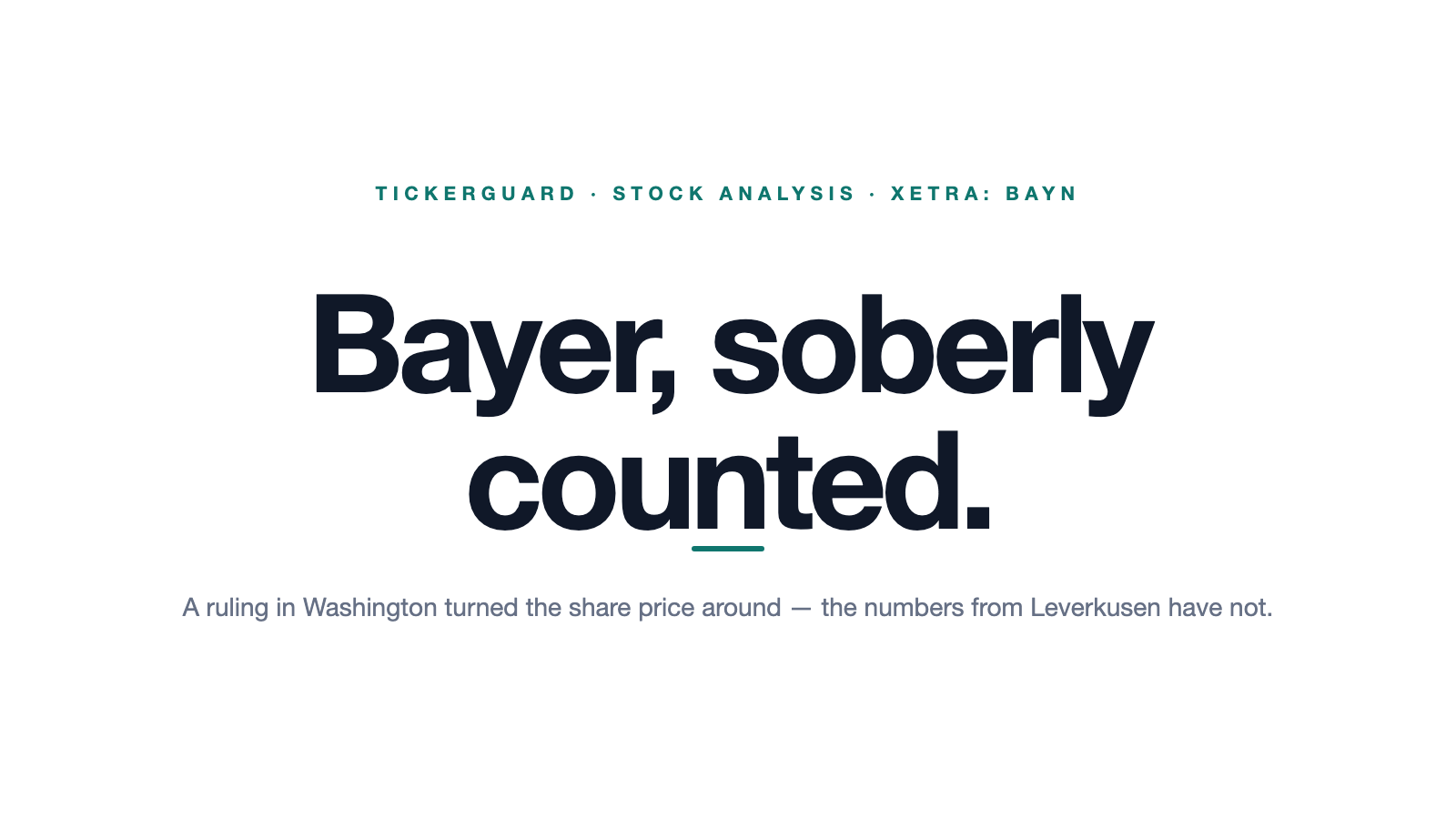
A ruling by the U.S. Supreme Court pulled Bayer stock out of the cellar in the summer of 2026. At the same time, the company's own half-year report states that the $7.25 billion class settlement can be terminated and that appeals could take "several years." We read the annual report, the half-year report and the opinion itself — and separate what has been decided from what merely looks that way.
 Thomas Mücke
Founder & Publisher
Thomas Mücke
Founder & Publisher
Chart
Interactive price chart (TradingView).
Note: pure fact-based analysis, not investment advice and not a solicitation to buy or sell. All figures without guarantee.
There is one reflex that catches investors out reliably whenever an old problem case is involved. Call it the closure reflex: a risk has hung over a stock for years, then one piece of good news arrives — and the switch in your head flips instantly from "unresolved" to "done." Almost always there is still a long stretch of road in between, and in that moment nobody is interested in it any more. That is exactly what happened to Bayer AG (XETRA: BAYN) in 2026.
On June 25, 2026, the U.S. Supreme Court decided Monsanto Co. v. Durnell seven to two in favor of Bayer subsidiary Monsanto. One pair of prices shows how forcefully the market took that in: the stock closed at €39.59 on June 24, 2026 and at €47.00 on June 25 — 18.7 percent in a single day. Across the twelve months through August 21, 2026, its low close was €26.055 on November 7, 2025 and its high close €53.36 on July 3, 2026 (XETRA closing prices throughout). More than a doubling, in other words, at a company whose first-half 2026 revenue fell 0.8 percent in nominal terms.
So let us make a deal: we drop the headlines and read only what Bayer itself reported — the Annual Report 2025 of March 4, 2026, the Half-Year Financial Report as of June 30, 2026 published on August 4, 2026, and the Quarterly Statement as of March 31, 2026 — plus the Supreme Court opinion in the original. And we check whether the line has really been drawn under this case. What you make of it is your decision.
What Bayer Actually Does — Three Divisions and a Company With No SEC Filings
Bayer is a life science group headquartered in Leverkusen, Germany, founded in 1863, employing 87,830 people as of June 30, 2026 (June 30, 2025: 89,556; December 31, 2025: 88,078). The business rests on three legs:
- Crop Science — seeds, plant traits and crop protection. The largest division, with €21,622 million in revenue in 2025. This is also where the glyphosate business sits, held through the subsidiary Monsanto.
- Pharmaceuticals — prescription medicines, chiefly cardiology, oncology, women's health and radiology. €17,829 million in revenue in 2025.
- Consumer Health — over-the-counter products such as Aspirin, Bepanthen and Elevit. €5,802 million in revenue in 2025.
One point up front, because it shapes the entire evidence trail: there is no Bayer filing with the U.S. securities regulator, the SEC. No annual report 10-K, no quarterly report 10-Q, no entry in the SEC ticker registry. Bayer is listed in the Prime Standard of the Frankfurt Stock Exchange and reports under European capital markets law: audited IFRS consolidated financial statements, a half-year financial report under section 115 of the German Securities Trading Act, and quarterly statements. In the United States there is only an over-the-counter American Depositary Receipt under the symbol BAYRY, quoted on OTCQX, which creates no separate reporting duty. A depositary receipt is a claim ticket: a bank holds the real shares in Germany and issues tradable certificates against them. Four of them correspond to exactly one ordinary share: against 982,424,082 Bayer shares, fundamental data show 3,929,696,328 depositary receipts outstanding — precisely four times as many. The check against prices: on August 21, 2026, BAYRY closed at $14.03 and the ordinary share at €48.04, with the euro at $1.1679; €48.04 times 1.1679 is $56.11, divided by four $14.03. Every figure in this analysis therefore carries "Source: fundamental data and reports of Bayer AG" rather than "SEC filings (10-K/10-Q)."
One more thing belongs at the start, because it makes the whole case easier to follow. Bayer reports earnings in two flavors. One is EBITDA before special items — operating profit before interest, taxes, depreciation and amortization, adjusted for one-off effects such as restructuring and litigation. The other is net income, what actually remains for shareholders. At most companies the two move roughly in parallel. At Bayer they have diverged dramatically for years — and the story sits in that gap.
Company history for investors
-
2023
Dividend cut to the legal minimum
€0.11 per share instead of €2.40, announced for three years. For shareholders it meant the payout fell from €2,358 million to €108 million and went into debt reduction.
-
2025
Third straight loss year
Net income came in at minus €3,620 million and special items in EBIT at minus €6,185 million. The operating business delivered €9,669 million of EBITDA before special items in the same year.
-
2026
February: class settlement worth up to $7.25 billion
Monsanto agrees a compensation program with declining payments over as much as 21 years. Shareholders saw a cap for the first time — but only a proposed one.
-
2026
June: U.S. Supreme Court rules seven to two for Monsanto
Federal law preempts state-law failure-to-warn claims. The closing price rose 18.7 percent on the ruling date, from €39.59 to €47.00, and reached €53.36 on July 3, 2026.
-
2026
July: €3.0 billion from Apollo and $5 billion of new bonds
Apollo takes a minority stake in the long-acting contraceptives business. Bayer then cut its year-end net financial debt guidance to €29.0 billion to €30.0 billion.
-
2026
August: approval hearing moved to September 14
After the ruling, requests to revoke already-filed opt-outs arrived. For shareholders it means the date on which the settlement can become binding moves back.
How the Stock Landed on Our Desk
Not through a metrics screen, but through a price move that matched no number coming out of the company. Between the €26.055 close on November 7, 2025 and the €53.36 close on July 3, 2026 lies more than a doubling. Over the same period, first-half 2026 group revenue fell 0.8 percent in nominal terms and second-quarter core earnings per share dropped 16.7 percent to €0.95. When price and numbers diverge that far, the explanation is not in the balance sheet.
The trigger was not in Leverkusen but in Washington. On June 25, 2026, the U.S. Supreme Court handed down its opinion in Monsanto Co. v. Durnell. Plaintiff John Durnell had sued in Missouri state court in 2019, alleging that he had used Roundup for about 20 years and developed non-Hodgkin's lymphoma as a result; a jury awarded him more than one million dollars on a failure-to-warn theory. The Supreme Court reversed:
"Held: FIFRA expressly preempts Durnell's state-law failure-to-warn claim because the claim would require Monsanto to add a cancer warning to Roundup's label."
- U.S. Supreme Court, Monsanto Co. v. Durnell, No. 24-1068, syllabus, decided June 25, 2026
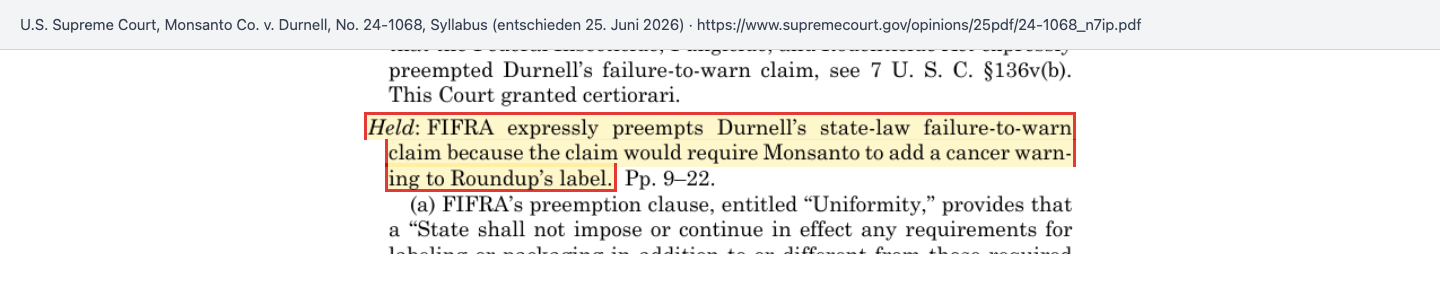
The margin was clear: Justice Kavanaugh wrote the majority opinion, joined by Roberts, Thomas, Alito, Sotomayor, Kagan and Barrett — seven votes. Jackson and Gorsuch dissented. Bayer's own half-year report says the decision "helps to bring significant containment to the Roundup litigation" and should foreclose future claims based on state failure-to-warn theories, "which make up the vast majority of claims in the litigation to date."
That is a real, large, genuinely good piece of news. The point of this analysis is not to talk it down — it is to check what it does not settle.
The Numbers Over the Years — Honestly Appraised
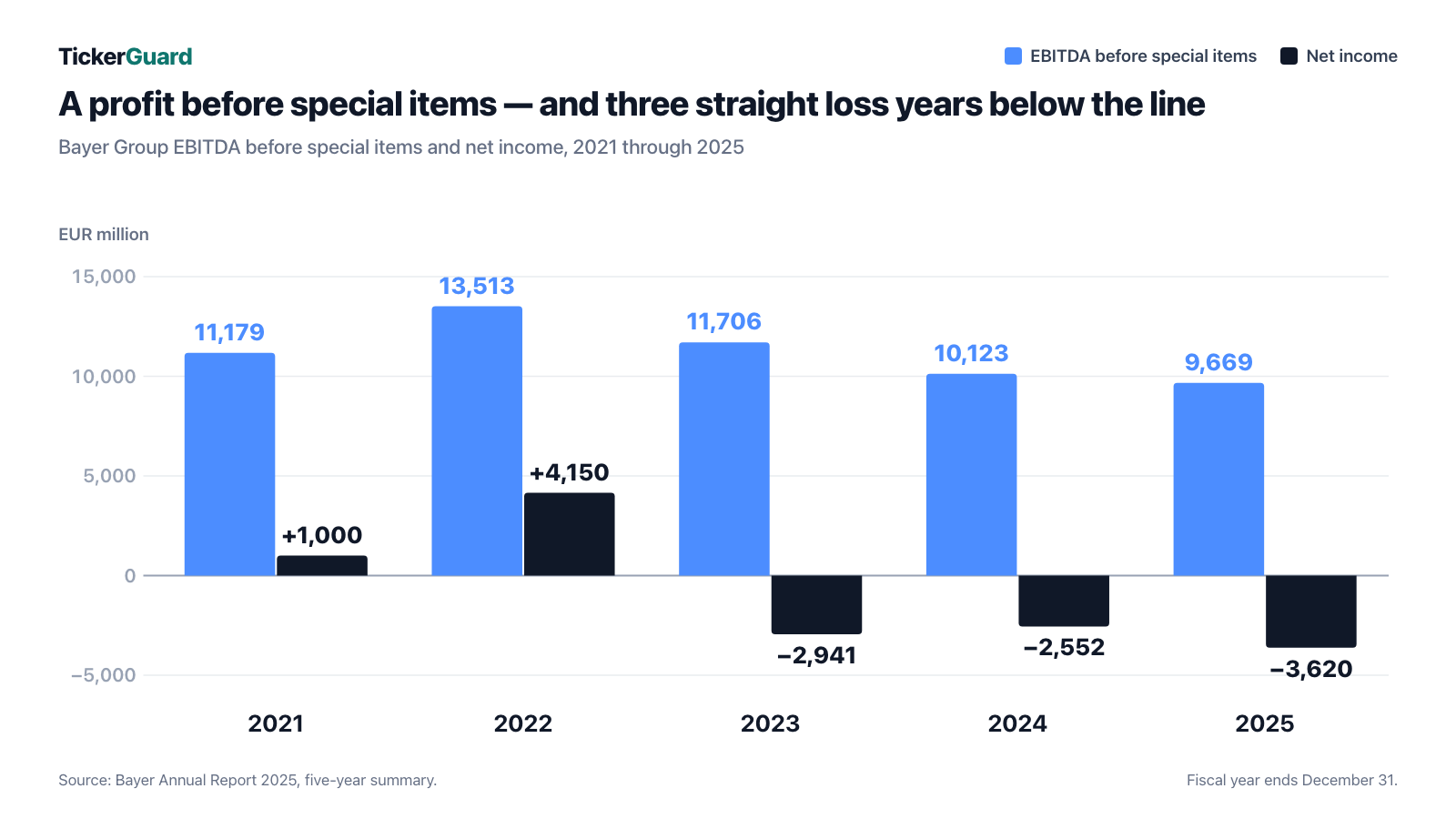
First, what impresses without qualification: Bayer's operating business has stayed remarkably steady right through the litigation. The five-year summary in the Annual Report 2025 shows EBITDA before special items of €11,179 million (2021), €13,513 million (2022), €11,706 million (2023), €10,123 million (2024) and €9,669 million (2025). A decline, yes — but not a collapse, and that in an agricultural market under heavy generic price pressure and with a pharmaceuticals arm in the middle of a patent cliff.
Then the second row of numbers, same table, one line down. Net income came in at €1,000 million (2021), €4,150 million (2022), minus €2,941 million (2023), minus €2,552 million (2024) and minus €3,620 million (2025). Three straight loss years, €9,113 million in total.
The current year looks better, and that belongs in the picture too. In the first half of 2026, group revenue came to €24,277 million — down 0.8 percent nominally, but up 3.3 percent on a currency- and portfolio-adjusted basis. EBITDA before special items rose 6.6 percent to €6,597 million, lifting the margin to 27.2 percent. Net income swung to plus €2,982 million from €1,100 million a year earlier.
Crop Science did most of the lifting: divisional revenue climbed to €12,468 million in the first half, EBITDA before special items rose 20.5 percent to €3,916 million, and the margin improved by 5.1 percentage points to 31.4 percent. Bayer cites two reasons: growth in soybean and corn seed, and "significantly lower cost of goods sold as a result of our efficiency programs." Glyphosate-based herbicides, of all things, grew by double digits in the second quarter — from €652 million to €734 million. Across the full half year, though, they slipped from €1,243 million to €1,212 million. Both figures sit in the same table and both belong here: the strong quarter is real, but it is not yet a trend.
Pharmaceuticals, by contrast, marked time: €8,707 million in first-half revenue, with EBITDA before special items down 5.7 percent to €2,297 million. Consumer Health delivered €2,936 million in revenue and €656 million in EBITDA before special items, down 2.5 percent.
What the Reports Say — the Uncomfortable Truths
Uncomfortable truth no. 1: the class settlement needs approval — and can be terminated
In February 2026 Monsanto agreed two settlements: a nationwide class settlement covering all current and potential future claims alleging non-Hodgkin's lymphoma, plus a separate agreement resolving certain other Roundup claims. In the words of the half-year report: "To fund the class, Monsanto will make declining capped annual payments for up to 21 years totaling up to US$7.25 billion." It covers people already diagnosed with non-Hodgkin's lymphoma or diagnosed within 16 years after the settlement takes effect.
Now comes the part the closure reflex skips. A U.S. class settlement needs court approval. The Circuit Court of the City of St. Louis, Missouri, granted preliminary approval in March 2026. Class members could then object or opt out until June 4, 2026. The half-year report states:
"Monsanto has the right to terminate the class settlement if the number of opt-outs is excessive."
- Bayer AG, Half-Year Financial Report as of June 30, 2026, Notes, "Legal Risks"

Two sentences later comes the second caveat: "If the state trial court finally approves the class settlement, such approval order would be subject to potential appeals. The class settlement does not become final and effective until all appeal procedures have been concluded, which could take several years."
And there is a development that surfaced only after the half-year report and therefore appears in none of the three reports — the source is the newswire report of the evening of August 6, 2026, linked in the sources list below: both sides had jointly moved to postpone the final approval hearing — because after the Supreme Court decision, requests to revoke opt-outs already filed had come in, and their validity needed to be sorted out first. The Circuit Court of the City of St. Louis, Missouri, agreed; the new date is September 14, 2026. Translation: some plaintiffs who opted out in June to sue on their own are having second thoughts after the ruling and want back into the settlement. Good news for Bayer, bad news for the timetable.
Keep this in mind for the rest of the analysis: a settlement that can be terminated and whose effectiveness hangs on multi-year appeals is not a line under the case — it is a very good interim result.
Uncomfortable truth no. 2: €9.6 billion already sits on the balance sheet — but has not been spent yet
A provision is the accounting equivalent of a savings account for a bill that has not landed yet: the expense is booked, the cash has not moved. Bayer has built a very large savings account for glyphosate.
"As of December 31, 2025, Bayer’s provision and liabilities for the glyphosate litigation totaled US$11.3 billion (€9.6 billion)."
- Bayer AG, Annual Report 2025, Note [30] "Legal Risks"

The same note lists the second legacy issue from the Monsanto acquisition: PCBs, a group of chemicals whose manufacture the Environmental Protection Agency banned in 1979. Five attorney-general lawsuits are still pending — Delaware, Maine, Maryland, New Jersey and Vermont. Earlier proceedings brought by seven other states were settled for roughly $456 million in total, and the Oregon case alone for $698 million. In April 2026 a new front opened: seed company Latham Quality filed a class action alleging monopolization of the U.S. market for genetically modified corn traits and seeking treble damages. Bayer says it intends to defend itself vigorously.
Uncomfortable truth no. 3: the cash is going out now
Building provisions costs profit. Using them costs cash. 2026 is the year the booking turns into a wire transfer.
"Payments to resolve legal proceedings, which largely related to the PCB and glyphosate litigations, resulted in a net outflow of €2,246 million (H1 2025: €140 million)."
- Bayer AG, Half-Year Financial Report as of June 30, 2026, net cash used in operating activities

Free cash flow — what is left after capital spending and interest — came in at minus €2,691 million for the first half of 2026. Adjusted for the litigation payments it would have been minus €445 million. Net financial debt climbed from €29,843 million (December 31, 2025) through €32,518 million (March 31, 2026) to €33,647 million as of June 30, 2026 — against equity of €29,708 million. Cash and cash equivalents shrank from €6,671 million to €4,289 million.
Chief Executive Bill Anderson flagged this himself in the annual report, unusually plainly:
"We anticipate that litigation impacts will burden our cash position in 2026 and lead to negative free cash flow for the year."
- Bill Anderson, Chairman of the Board of Management, Bayer AG, Annual Report 2025, Letter to Stockholders, "Outlook 2026"
The guidance confirms it: for 2026 Bayer expects free cash flow of minus €2.5 billion to minus €1.5 billion; adjusted for the settlement payments it would be plus €2.0 billion to €3.0 billion. The credit ratings mirror the situation: S&P Global Ratings and Fitch both rate Bayer BBB with a negative outlook, Moody's rates it Baa2 and lifted its outlook to stable on July 10, 2026. That is still solid investment grade, but the lower half of it.
Uncomfortable truth no. 4: the patent cliff is real — and the successors are not big enough yet
A patent-protected drug is a license to print money; when protection lapses, generics arrive and the price collapses. Bayer is running down two such cliffs at once: the anticoagulant Xarelto and the eye medicine Eylea.
In the first half of 2026 Xarelto sales fell 42.5 percent to €738 million (prior-year period €1,283 million). Eylea dropped 28.7 percent to €1,196 million (prior year €1,677 million). Together that is €1,026 million of revenue gone in six months.
Two growth drivers push the other way: the prostate cancer drug Nubeqa grew 53.5 percent to €1,629 million and the kidney medicine Kerendia 75.3 percent to €603 million — €827 million of additional sales combined. Arithmetically, that does not yet close the gap.
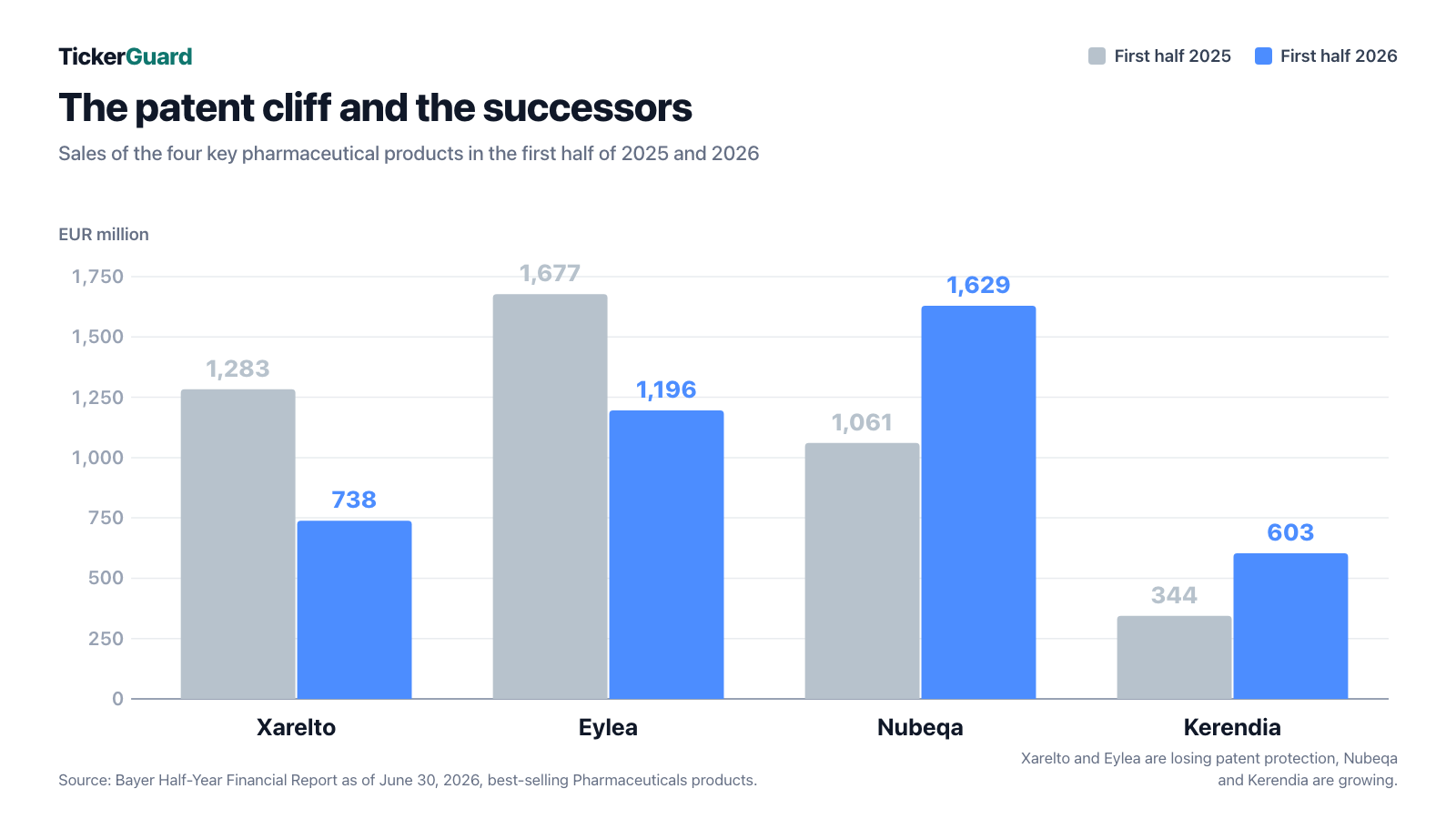
That is why divisional earnings are under pressure even with flat revenue: Pharmaceuticals EBITDA before special items fell 5.7 percent to €2,297 million in the first half. Bayer points to higher selling expenses for the launches of Lynkuet, Nubeqa and Kerendia plus increased research spending. New products cost before they carry. The pipeline is visible: sevabertinib received U.S. Food and Drug Administration priority review in May 2026, and applications for asundexian were accepted by the FDA, the Japanese ministry and the European Medicines Agency in May and June 2026. That is future revenue, not today's.
Uncomfortable truth no. 5: an 11-cent dividend — and authorized capital worth about 35 percent
Bayer was a dividend stock for decades: €2.70 per share for 2016, then €2.80 for 2017, 2018 and 2019, €2.00 for 2020 and 2021, and most recently €2.40 for 2022. Since fiscal 2023 it has been €0.11 — the legal minimum. The annual report puts it like this:
"We amended our dividend policy for fiscal 2023, announcing that we planned to pay out the legally required minimum for three years."
- Bayer AG, Annual Report 2025, "To Our Stockholders," section "Dividend to remain at €0.11 as previously communicated"
Do the arithmetic: three years means 2023, 2024 and 2025. The Annual Stockholders' Meeting approved the €0.11 for 2025 on April 24, 2026 — a total payout of €108 million against €2,358 million for 2022. The announced period has therefore run out. What applies to fiscal 2026 appears in none of the three reports. The answer arrives with the annual reporting on February 24, 2027, and the resolution follows at the Annual Stockholders' Meeting on April 30, 2027.
The second item here is the capital side. The Annual Stockholders' Meeting of April 25, 2025 authorized the Board of Management, with Supervisory Board consent, to increase the capital stock by up to €875 million against cash contributions until April 24, 2028 — the "Authorized Capital 2025." Against a capital stock of €2,515 million, that is arithmetically about 35 percent of the 982.4 million shares outstanding. Dilution means your slice of the cake gets smaller without the cake growing. Existing holders keep their subscription rights in principle; these may be excluded only for fractional amounts. The authorization has not been used so far.
Instead, Bayer took a different route in July 2026: U.S. asset manager Apollo Global Management is paying €3.0 billion for a minority stake in a new entity holding the long-acting reversible contraceptives business, with Bayer keeping majority ownership and operational control. In the same month Bayer placed $5.0 billion (€4.4 billion) of bonds in five tranches with coupons between 5.125 and 6.375 percent, and cut a bank credit facility signed in February from $8.0 billion to $3.0 billion. Because of the Apollo payment, Bayer lowered its year-end 2026 net financial debt guidance from €32.0 billion to €33.0 billion down to €29.0 billion to €30.0 billion. We saw a similar pattern — repair the balance sheet before the market forces you to — at Commerzbank, though there it came from a position of strength.
Valuation — the Order of Magnitude
At an XETRA close of €48.04 on August 21, 2026 and 982,424,082 shares outstanding, Bayer carries a market value of roughly €47.2 billion. Add net financial debt of €33.6 billion and enterprise value comes to about €80.8 billion.
Measured against the company's own guidance — Bayer expects €9.4 billion to €9.9 billion of EBITDA before special items for 2026 at June 30 exchange rates — the multiple is roughly 8.2 to 8.6. Core earnings per share are guided at €4.20 to €4.70, which puts the price-to-earnings ratio on a core basis at roughly 10 to 11. On revenue (guidance €44.7 billion to €46.7 billion), the price-to-sales ratio is about 1.0. Book value per share stood at €30.11 as of June 30, 2026, so the stock trades at roughly 1.6 times balance-sheet equity.
The honest reading: for a pharmaceutical and agricultural group those are not demanding multiples. Every single one of them, however, carries an asterisk. The price-to-earnings ratio refers to core earnings — unadjusted net income was negative in three of the last five years. And a good 40 percent of enterprise value is debt; whoever buys Bayer buys a heavily indebted company with an open legal file. A comparison suggests itself: Organon slashed its dividend from $0.28 to $0.02 per share on May 1, 2025 for exactly the same reason — debt reduction — and then became a takeover target.
The professionals’ view, as context rather than truth: as of August 22, 2026 the average analyst price target stood at €56.83 according to fundamental data, with the current-year core earnings estimate at €4.51 — inside the €4.20 to €4.70 range Bayer itself guides to. Two caveats. After a rally of this size, price targets are the fastest thing to be revised; they describe where the stock has been rather than where it is going. And they average individual opinions that all face the same open question we do: what does the court in St. Louis do on September 14? The more solid forward-looking figure in this analysis therefore remains Bayer’s own guidance, which comes from a named, accountable source.
Opportunities and Risks at a Glance
Opportunities
- The Supreme Court decision of June 25, 2026 removes the legal basis for what Bayer describes as the vast majority of pending claims — it should end existing cases and prevent future ones.
- Crop Science is delivering again: EBITDA before special items up 20.5 percent to €3,916 million in the first half of 2026, a 31.4 percent margin, driven by efficiency programs and the re-registration of dicamba-based products in the United States.
- The balance sheet is getting outside help: €3.0 billion from Apollo, which cut year-end 2026 net debt guidance by €3 billion to €29.0 billion to €30.0 billion.
- Adjusted for the settlement payments, Bayer expects positive free cash flow of €2.0 billion to €3.0 billion in 2026 — the operating business funds itself.
- The pharmaceutical pipeline is producing: Nubeqa and Kerendia added €827 million of half-year revenue between them, Beyonttra and Lynkuet have their first full sales year in 2026, and asundexian and sevabertinib are in regulatory review.
- The announced three-year phase of minimum dividends ended with fiscal 2025 — a return to higher payouts is conceivable for the first time since 2023.
Risks
- The class settlement worth up to $7.25 billion has only preliminary approval. Monsanto may terminate it if opt-outs are excessive, the final approval hearing was pushed to September 14, 2026, and appeals could take "several years" by Bayer's own account.
- The ruling only blocks failure-to-warn claims. Other legal theories and the PCB cases in five U.S. states are untouched; an antitrust class action over corn seed traits was added in April 2026.
- Net financial debt of €33,647 million as of June 30, 2026 exceeded equity of €29,708 million; two of three rating agencies carry a negative outlook.
- Free cash flow is negative in 2026 by the company's own guidance (minus €2.5 billion to minus €1.5 billion); €2,246 million already flowed out for legal proceedings in the first half.
- The patent cliff keeps biting: Xarelto and Eylea lost €1,026 million of combined revenue in the first half of 2026, and Pharmaceuticals EBITDA before special items fell 5.7 percent.
- The Authorized Capital 2025 permits a cash capital increase of up to €875 million of capital stock until April 24, 2028 — arithmetically about 35 percent of today's share count.
- There is no statement yet on the dividend for fiscal 2026; the previous commitment expired with 2025.
A Human Conclusion
Back to the closure reflex. It is especially seductive here because the Bayer problem is so old: ever since the Monsanto acquisition, every investor has carried the glyphosate file somewhere in the back of their mind, and a seven-to-two decision by the highest U.S. court feels like the end of the story. It is a very large step in that direction — just not the end.
What the reports actually say is more sober than the headline. A settlement that can be terminated. An approval hearing that got postponed. Appeals that could take "several years." And alongside it, a group that is doing decent operational work — €6,597 million of EBITDA before special items in the half year, a Crop Science business at a 31.4 percent margin — but that has three loss years behind it and, by its own guidance, will burn cash in 2026.
None of that makes Bayer a bad company. The Board of Management explicitly judges the group's continued existence to be not at risk, the rating is investment grade, and the pipeline is delivering. It makes Bayer a company whose most important number over the coming months will not appear in a quarterly report but in a court docket in Missouri. Whoever holds or buys the stock is buying a solid operating business plus a bet that an American judge signs off in September and that nobody successfully appeals afterwards.
So the most honest sentence in this analysis is a date. The final approval hearing is on September 14, 2026, the third-quarter statement follows on November 3, 2026, and on February 24, 2027 we learn what Bayer proposes as a dividend for 2026. Everything else until then is interpretation. What you make of it is your decision. And that is exactly as it should be.
Sources
- Bayer AG, Half-Year Financial Report as of June 30, 2026 (published August 4, 2026) — key data, significant events, business development by division, financial position, guidance, notes ("Legal Risks"), subsequent events, financial calendar
- Bayer AG, Annual Report 2025 (published March 4, 2026) — five-year summary, letter to stockholders, divisional key data, takeover-relevant disclosures (Authorized Capital 2025), Note [30] "Legal Risks"
- Bayer AG, Quarterly Statement as of March 31, 2026 — significant events, net financial debt, corporate outlook
- U.S. Supreme Court, Monsanto Co. v. Durnell, No. 24-1068 — slip opinion of June 25, 2026 (syllabus, majority and dissenting opinions)
- Bayer AG, "Managing the Roundup™ Litigation" — the company’s continuously updated status page on the class settlement and the state of the proceedings
- Newswire report of August 6, 2026 — joint motion by both sides, postponing the final approval hearing to September 14, 2026
- Price, market value and range data: fundamental data, XETRA closing prices through August 21, 2026
Journalistic analysis, not investment advice and not a solicitation to buy or sell securities. Stocks can lose their entire value. All figures come from the original documents linked above and are stated with their respective reporting dates. Positions held by the operator are disclosed daily; where one exists, it appears as a notice at the top of this deep dive.
Our Bottom Line at a Glance
- Glyphosate legal risk neutral
- The U.S. Supreme Court ruling of June 25, 2026 (seven to two) blocks state-law failure-to-warn claims — the legal basis of the vast majority of pending cases. But the class settlement worth up to $7.25 billion has only preliminary approval, can be terminated if opt-outs are excessive, and does not become effective until all appeals have concluded, which the half-year report says "could take several years."
- Operating business positive
- First-half 2026 EBITDA before special items rose 6.6 percent to €6,597 million and the margin to 27.2 percent. Crop Science gained 20.5 percent to €3,916 million at a 31.4 percent margin, driven by soybean and corn seed and lower cost of goods sold from the efficiency programs.
- Earnings quality negative
- Bayer reported a net loss in each year from 2023 through 2025, €9,113 million in total, while EBITDA before special items ranged from €9.7 billion to €11.7 billion. The difference is overwhelmingly special charges for legal cases; special items in EBIT came to minus €6,185 million in 2025 (Annual Report 2025).
- Balance sheet and cash flow negative
- Net financial debt rose to €33,647 million as of June 30, 2026, above equity of €29,708 million. First-half free cash flow was minus €2,691 million with €2,246 million of litigation payments, and Bayer guides to negative free cash flow of minus €2.5 billion to minus €1.5 billion for 2026.
- Pharma pipeline and patent cliff neutral
- Xarelto (down 42.5 percent to €738 million) and Eylea (down 28.7 percent to €1,196 million) shed €1,026 million of first-half revenue, while Nubeqa (up 53.5 percent) and Kerendia (up 75.3 percent) added €827 million. Divisional EBITDA before special items still fell 5.7 percent to €2,297 million because launch spending comes first.
- Shareholder returns and capital measures negative
- Since 2023 Bayer has paid only the legal minimum dividend of €0.11 per share (€108 million in total, against €2,358 million for 2022); the announced three-year period ended with 2025 and no successor statement exists. In parallel, the Authorized Capital 2025 of up to €875 million — arithmetically about 35 percent of shares outstanding — runs until April 24, 2028.
Bayer scored its biggest legal win since the Monsanto acquisition in the summer of 2026: the U.S. Supreme Court, seven to two, knocked out the legal basis of the vast majority of glyphosate claims. Operationally the group is doing solid work — €6,597 million of half-year EBITDA before special items, Crop Science at a 31.4 percent margin. The case is still not closed: the class settlement worth up to $7.25 billion has only preliminary approval, the decisive hearing was postponed to September 14, 2026, and by the company's own guidance 2026 will be a year of negative free cash flow. Not investment advice.
What Our Rating Means
Open questions
The business works in principle, but one material question is open. As long as it stays open, our findings do not carry a quality verdict.
The business carries: three divisions with global positions, €9.7 billion of EBITDA before special items in the weakest year, an investment-grade rating, and a Board of Management that explicitly judges the group's continued existence not to be at risk. What is missing for green is decisive: this company's most important open question is settled not in a plant but in a Missouri courtroom — the class settlement worth up to $7.25 billion still has only preliminary approval, can be terminated, and takes effect only after multi-year appeals. Add three straight loss years, net financial debt above equity, and negative free cash flow guided for 2026. That is a large open question, not a documented threat to the substance of the business — hence yellow. The decision is yours.
A journalistic assessment by our editorial team at the time of the deep dive, based on public sources — not investment advice and not a solicitation to buy or sell. Your personal circumstances (investment goals, risk capacity, taxes) cannot be taken into account. What our levels mean, how verdicts are formed, and what conflicts of interest exist →
Worth Noting
- The hook for this analysis is the price move following the U.S. Supreme Court ruling of June 25, 2026 in Monsanto Co. v. Durnell, not a screener hit.
- Data as of August 21, 2026. All company figures come from the Annual Report 2025 (published March 4, 2026), the Half-Year Financial Report as of June 30, 2026 (published August 4, 2026) and the Quarterly Statement as of March 31, 2026. The court figures come from the U.S. Supreme Court slip opinion of June 25, 2026. Price and market-value data from fundamental data, XETRA closing prices through August 21, 2026.
- The analyst price target of €56.83 quoted here (as of August 22, 2026, fundamental data) is a third-party figure offered as context, not a price target of this publication. The same source shows $15.895 for the BAYRY depositary receipt.
- Bayer is not an SEC filer: no 10-K, no 10-Q, no 20-F. The U.S. depositary receipt BAYRY trades over the counter and creates no separate reporting duty; the authoritative listing is the Prime Standard of the Frankfurt Stock Exchange under BAYN.
- Added after the half-year financial report of August 4, 2026: on August 5 and 6, 2026 the final approval hearing for the glyphosate class settlement was moved to September 14, 2026 because requests to revoke already-filed opt-outs arrived after the Supreme Court ruling.
- A stumbling block when comparing half-year figures: the reconciliation line includes Bayer 04 Leverkusen Fussball GmbH. High transfer income at the soccer club flattered the prior-year result and therefore depresses the year-on-year comparison for 2026 — a group effect, not a statement about the life science business.
The full analysis as a PDF for later
We will send you this analysis as a PDF — to print, file away, and read at your own pace.
Frequently Asked Questions
The trigger was the U.S. Supreme Court ruling of June 25, 2026 in Monsanto Co. v. Durnell. The court held seven to two that federal law preempts state-law claims over a missing cancer warning on the Roundup label. The XETRA closing price jumped from €39.59 on June 24, 2026 to €47.00 on June 25, a gain of 18.7 percent, and reached €53.36 by July 3, 2026.
No. The ruling only blocks failure-to-warn claims. The class settlement agreed in February 2026 has only preliminary approval, and the final approval hearing was postponed to September 14, 2026. Bayer itself writes that the settlement does not become final and effective until all appeal procedures have concluded, which "could take several years."
Under the class settlement, Monsanto will make declining, capped annual payments for up to 21 years totaling up to $7.25 billion, according to the half-year financial report. €432 million of that already flowed into a trust fund in the first half of 2026. Provisions and liabilities for the entire glyphosate complex stood at $11.3 billion as of December 31, 2025.
For fiscal 2025 the Annual Stockholders' Meeting approved €0.11 per share on April 24, 2026 — the legal minimum, as it was for 2023 and 2024. The annual report explicitly frames that policy as covering three years. What applies to fiscal 2026 is open; the answer comes with the annual reporting on February 24, 2027.
Net financial debt stood at €33,647 million as of June 30, 2026, up from €29,843 million at the end of 2025. Equity was €29,708 million. For year-end 2026 Bayer expects €29.0 billion to €30.0 billion after Apollo Global Management committed €3.0 billion for a minority stake in a new Bayer entity.
When a drug loses patent protection, generics enter and the price collapses. At Bayer this hit two revenue pillars at once in the first half of 2026: Xarelto lost 42.5 percent to €738 million and Eylea 28.7 percent to €1,196 million. Nubeqa and Kerendia added €827 million between them over the same period.
Bayer is listed in the Prime Standard of the Frankfurt Stock Exchange and reports under European capital markets law: audited IFRS consolidated statements, a half-year financial report under section 115 of the German Securities Trading Act, and quarterly statements. In the United States only an over-the-counter American Depositary Receipt trades under BAYRY, which creates no separate SEC reporting duty.
At June 30, 2026 exchange rates Bayer expects revenue of €44.7 billion to €46.7 billion, EBITDA before special items of €9.4 billion to €9.9 billion and core earnings per share of €4.20 to €4.70. Free cash flow is guided at minus €2.5 billion to minus €1.5 billion; adjusted for the settlement payments it would be plus €2.0 billion to €3.0 billion.
Found an error?
Did you spot a factual error, an outdated number, or a typo in this deep dive? Let us know briefly — your report goes straight to the editorial team.