Wave Life Sciences: From Weight-Loss Hype to a Crash – What Is Left After an 83 Percent Drop
In December 2025, Wave Life Sciences shares shot up to $21.31; in November 2026 they trade at $3.58. In between came a stock offering at $19, a one-day collapse of half the share price and a move from Singapore to Delaware. We read the SEC filings: $431 million in cash, not a single product, roughly $60 million going out the door every quarter. The old price is an anchor, not a yardstick – the trials will decide what this company is worth.
 Thomas Mücke
Founder & Publisher
As of Today
As of: November 3, 2026
- Closing price
- 3.60 $ +1.70%
- Market Capitalisation
- 0.7 $B
- Growth Score
- 5/10
- AAQS
- 2/10
Price change since November 3, 2026: +0.6%
This analysis has a cut-off date. The Stock Guard tells you when something material changes in the numbers. Reserve your free spot
Chart
Interactive price chart (TradingView).
52-week range: 3.10 $ to 21.30 $ · Last price: 3.60 $ (As of: November 3, 2026)
Note: pure fact-based analysis, not investment advice and not a solicitation to buy or sell. All figures without guarantee.
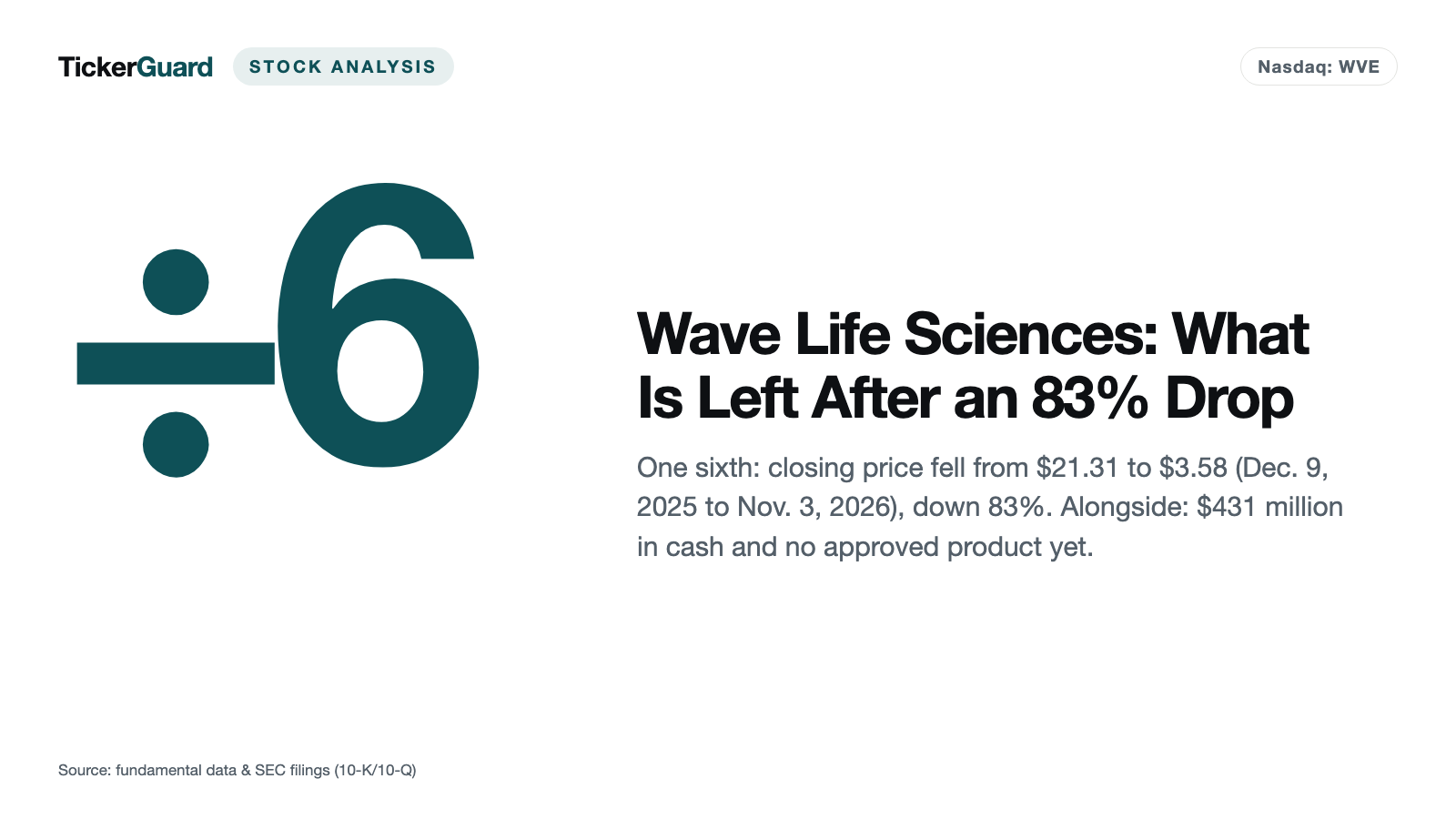
You know the feeling: a stock that once cost $21 is suddenly available for $3.58. Your brain does the math instantly – that is one sixth of the old price, something has to come back. Psychologists call this the anchoring effect. The first number we see sticks like a ship's anchor in harbor mud, and we measure every new number against it, whether or not it has anything to do with value.
Wave Life Sciences (Nasdaq: WVE) comes with two such anchors. On Dec. 9, 2025, the stock closed at $21.31; the same day, the company priced new shares at $19 apiece; the offering closed on Dec. 11 and raised $402.5 million before fees. On Nov. 3, 2026, it closed at $3.58 – 83 percent below the high. So let's make a deal: we leave both anchors on the dock for a moment and read what Wave has filed with the U.S. securities regulator, the SEC – the fresh quarterly report (10-Q) for Sept. 30, 2026, the quarterly reports before it, the annual reports (10-K) for 2024 and 2025, the paperwork for the move to Delaware and the annual meeting proxy. Filing false information with the SEC carries penalties, which makes these reports some of the most reliable sources there are. At the end, the decision is yours.
What Wave Life Sciences actually does
Wave develops medicines made of short, chemically tailored RNA strands called oligonucleotides. Think of it this way: genes are the blueprints in the archive, RNA is the copy carried to the construction site. Wave does not touch the archive; it intercepts the copy – either to destroy it (RNA interference, or RNAi: a component never gets built) or to correct a single typo in it (RNA editing). The platform behind this is called PRISM. The company is based in Cambridge, Massachusetts, had 317 full-time employees at the end of 2025 and is led by CEO Paul Bolno.
Three programs lead the pipeline:
- WVE-007 for obesity. It is designed to silence the INHBE gene and burn fat without costing muscle – unlike the well-known weight-loss injections, which take muscle along with the pounds. Per the company's plan, it would be injected only once or twice a year. A Phase 2a trial in people with higher body weight is underway, and a combination trial with tirzepatide has started.
- WVE-006 for alpha-1 antitrypsin deficiency (AATD), an inherited disease that damages the lungs and liver – about 200,000 people with the Pi*ZZ form in the U.S. and Europe, according to Wave. In October 2026, Wave announced alignment with the U.S. Food and Drug Administration (FDA) on a registrational trial with an interim analysis after one year.
- WVE-008 for a genetic liver disease (PNPLA3 I148M). Wave plans to file for its first clinical trial in the fourth quarter of 2026.
So far, Wave makes money only through partners. The most important is British drugmaker GSK, which has been developing programs on the Wave platform since 2023 and pays upfront and milestone fees. GSK is also the second-largest shareholder, with 18,245,691 shares or 9.25 percent (proxy statement, DEF 14A of Oct. 14, 2026). How this RNA technology looks at a company that has already turned it into products is covered in our analysis of Alnylam.
That sets up the central tension of this analysis: a platform that convinces a drugmaker like GSK and whose drug candidates show the intended effect in early trials – but a company without a product that burns about $60 million every quarter and whose value depends on trial results still to come.
Company history for investors
-
2015
Nasdaq IPO
In November 2015, the Singapore company lists on Nasdaq. From its founding in 2012 through Sept. 30, 2026, Wave has raised about $2.09 billion in net proceeds – without selling a product to this day.
-
2023
GSK partnership begins
GSK pays $120 million upfront and buys shares at $4.68. For shareholders, the most important validation of the platform and still the main source of income.
-
2025
Weight-loss data and stock offering
After three-month WVE-007 data, the stock jumps as high as $21.31 in December 2025; Wave sells new shares at $19 and raises $402.5 million gross.
-
2026
GSK hands back WVE-006
In February 2026, Wave regains full rights to WVE-006. More potential upside for shareholders – but Wave now pays for the costly registrational trial alone.
-
2026
Crash after six-month data
On March 26, 2026, the stock falls from $12.30 to $6.20: only 1% placebo-adjusted weight loss. The weight-loss hype is gone from the price.
-
2026
Move from Singapore to Delaware
On Aug. 7, 2026, shares are exchanged one-for-one for Delaware shares. Little changes for shareholders: same ticker, same SEC registration, U.S. law instead of Singapore law.
New passport, same company: the move from Singapore to Delaware
Anyone opening the SEC database runs into a form that sets off alarm bells for many investors: a Form 15 dated Aug. 10, 2026. Usually it means a company is deregistering. Not here. The old parent company, Wave Life Sciences Ltd. of Singapore, deregistered because its shares now have a single holder – the new parent. On Aug. 7, 2026, all Singapore shares were exchanged one-for-one for shares of Wave Life Sciences, Inc., a Delaware corporation. The required filing (Form 8-K12B) says so explicitly:
“Pursuant to Rule 12g-3(a) under the Exchange Act, Wave-Delaware is the successor issuer to Wave-Singapore, Wave-Delaware Common Stock is deemed to be registered under Section 12(b) of the Exchange Act, and Wave-Delaware is subject to the periodic and current reporting requirements of the Exchange Act and the rules and regulations promulgated thereunder.”
— Wave Life Sciences, Inc., SEC current report 8-K12B of Aug. 7, 2026, Introductory Note
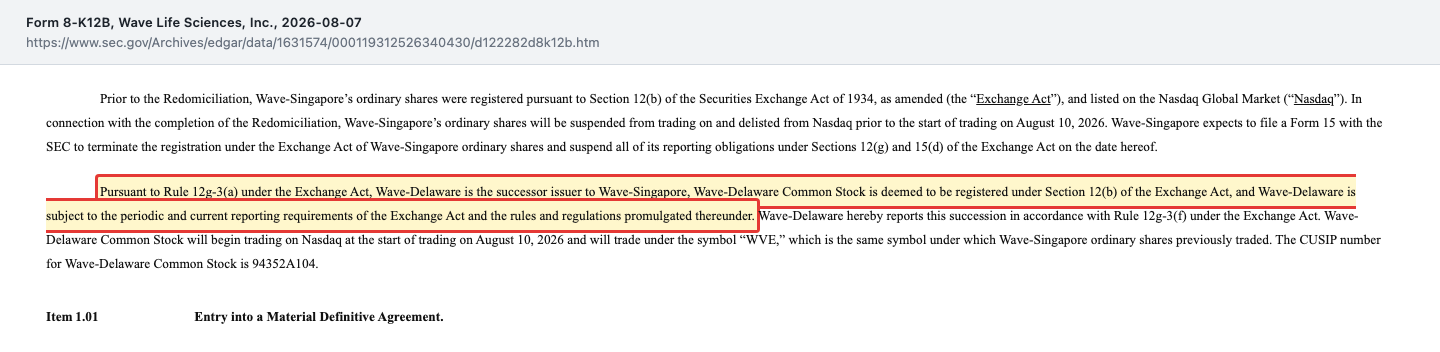
Little changed for shareholders: the SEC registration (CIK 0001631574) is the same, the stock has traded under the same WVE symbol on Nasdaq since Aug. 10, 2026, the management team and board stayed in place, and the next quarterly report arrived on schedule on Oct. 27, 2026 under the new name. Wave justified the move by noting that headquarters, manufacturing, research and most employees are already in the U.S., and that duplicate reporting and legal costs would go away. One side effect sits in the same 8-K: the new charter lets the board issue up to 30 million preferred shares without a shareholder vote and contains several hurdles against hostile takeovers.
Remember: a Form 15 is not always a goodbye. Here, it is just the old passport being handed in.
How the stock landed on our desk
The trigger is the quarterly report of Oct. 27, 2026 – and a price chart that reads like a textbook case of anchoring. On Dec. 8, 2025, Wave reported first data for WVE-007: three months after a single injection, participants had lost 9.4 percent of their visceral fat and gained 3.2 percent of lean mass (each versus baseline). The stock jumped from a $7.49 close on Dec. 5 to $18.52 on Dec. 8 and $21.31 on Dec. 9. Wave seized the moment: new shares were priced at $19 on Dec. 9, 2025, and the offering closed on Dec. 11.
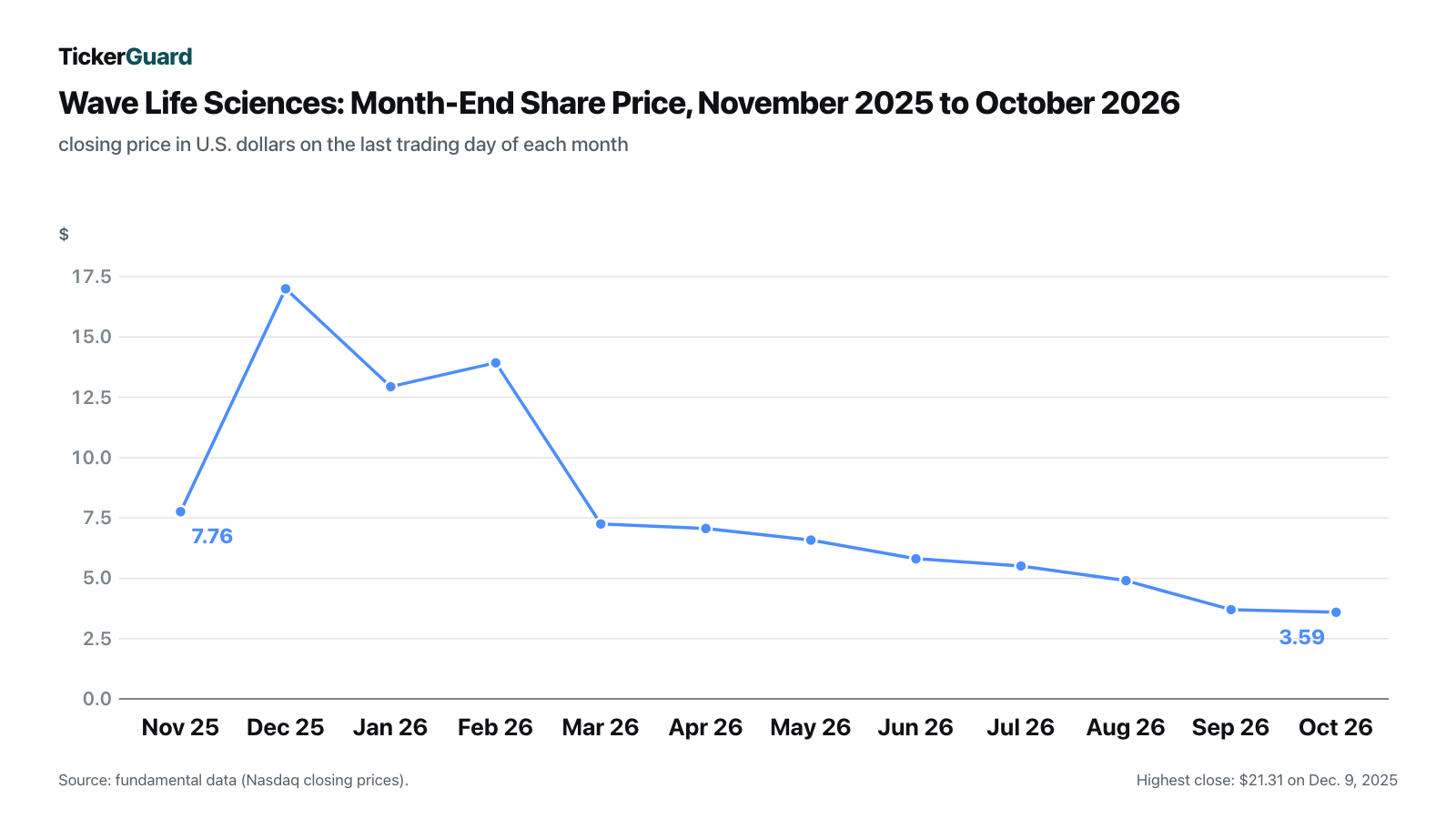
The break came on March 26, 2026, with the six-month data. The stock fell in a single day from $12.30 to $6.20, down 49.6 percent, on more than 50 million shares traded. Since then it has slid further almost every month. The lowest close in the twelve months before this analysis was $3.09 on Oct. 14, 2026.
About 21.2 million shares were sold short (fundamental data, retrieved Nov. 4, 2026), just under 11 percent of shares outstanding: a meaningful part of the market is betting on further declines. The 21 analysts tracked by our data provider see it differently: 17 “strong buy,” 2 “buy,” 2 “hold,” with an average price target of $17.11 (as of Nov. 4, 2026). The average means all price targets added up and spread evenly – a few very high targets pull it up sharply. That is these analysts' view, not TickerGuard's assessment. And that price target is an anchor, too.
The numbers over the years – an honest look
First, what Wave has genuinely achieved. A company without a product that has raised about $2.09 billion in net proceeds from investors and partners since its founding in 2012 through Sept. 30, 2026 (10-Q for Sept. 30, 2026) lives on trust – and Wave has earned it more than once. GSK paid $120 million upfront in 2023 and bought shares on top; in September 2026, GSK selected a candidate developed on the Wave platform for its own pipeline, triggering a $12 million milestone. Three more partner programs are moving toward such a selection; the contract puts $330 million to $375 million in potential milestones plus royalties on each program. And the WVE-006 trial data so far show the effect the company is aiming for: harmful misfolded protein fell 70.5 percent in the 200 mg cohort, healthy protein made up 64.4 percent of the total, without clinically meaningful liver test elevations (10-Q for Sept. 30, 2026). A caveat: this is an early-stage trial with a small number of participants, and no registrational trial has started yet.
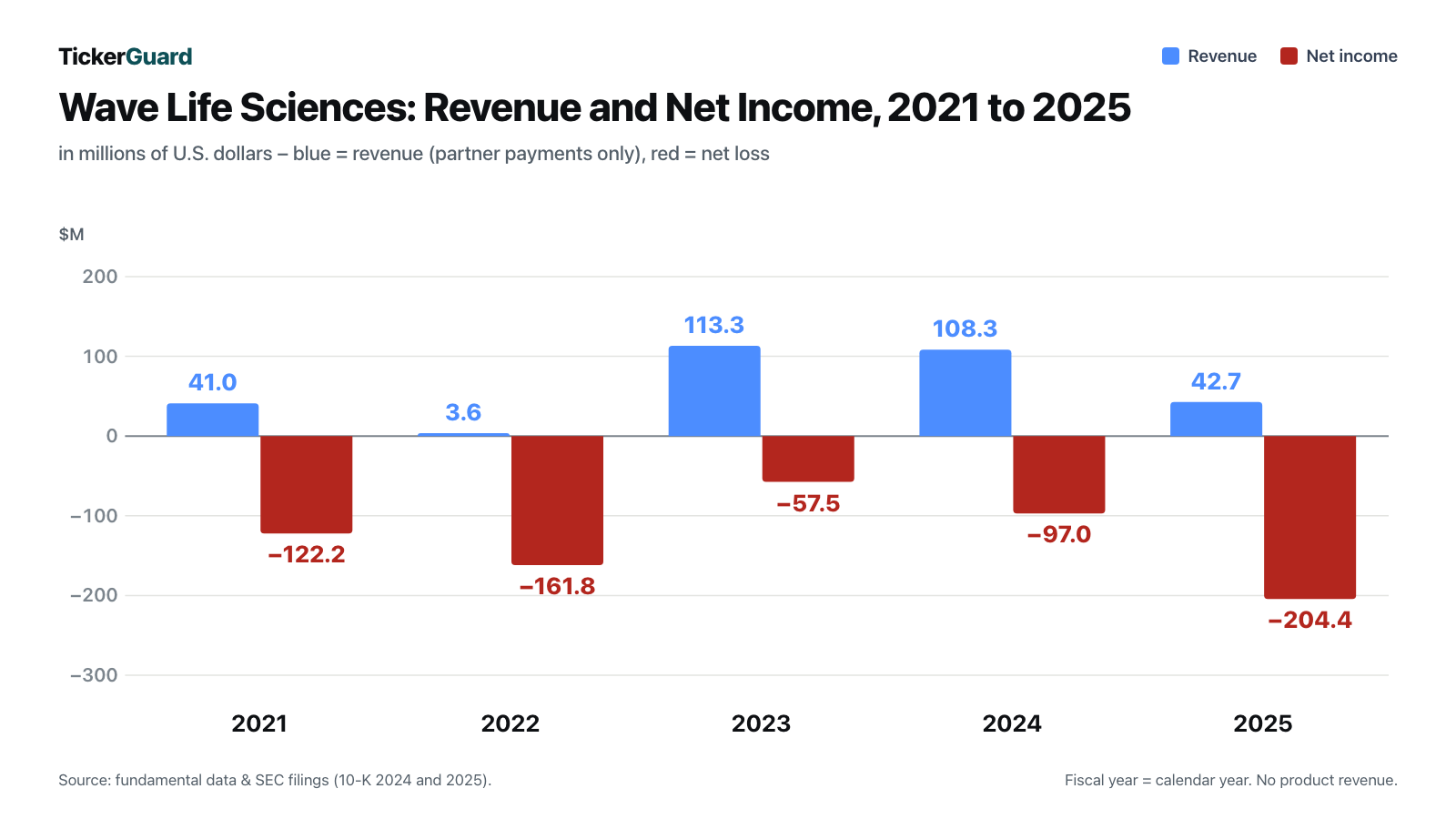
The chart shows the pattern of a research company: revenue is not revenue in the usual sense but the accounting of partner contracts, and it swings depending on when a contractual obligation counts as fulfilled. In 2023 and 2024 it topped $100 million because upfront payments from GSK and Japan's Takeda were recognized; the Takeda collaboration ended in October 2024. In 2025, revenue fell to $42.7 million, the loss rose to $204.4 million, and operations used $187.5 million in cash.
For the first nine months of 2026, Wave reports $53.7 million in revenue, more than in all of 2025. But $35.9 million of that is the remaining balance of the WVE-006 contract with GSK, recognized in one go after it ended in February 2026, and $12.0 million is the milestone mentioned above. Strip out both and about $5.8 million remains (our calculation). The net loss came to $157.4 million after $151.2 million in the prior-year period.
In short: the science delivers, the partners pay – but these are the numbers of a company living off its savings.
What the filings say – the uncomfortable truths
Uncomfortable truth No. 1: No product, and none in sight
The quarterly report puts it as plainly as a company can:
“We have not generated any product revenue since our inception and do not expect to generate any revenue from the sale of products for the foreseeable future.”
— Wave Life Sciences, Inc., SEC quarterly report 10-Q for Sept. 30, 2026, Item 2 “Revenue”

Q3 2026 revenue was $13.2 million. $12.0 million of it was the one-time GSK milestone; the recurring remainder was about $1.2 million (our calculation). Against that stood $53.8 million in research and development and $25.4 million in general and administrative expenses; the net loss was $61.9 million. By the company's own timetable, any Wave drug is still years from market: for WVE-006, Wave first plans a two-year registrational trial, with potential accelerated approval based on an interim analysis after one year.
Uncomfortable truth No. 2: The weight-loss data that halved the stock
WVE-007 carried the excitement – lose fat, keep muscle, one or two shots a year. What the six-month data from March 2026 actually showed is stated soberly in the quarterly report:
“At six-month follow-up, a single 240 mg dose of WVE-007 demonstrated significant placebo-adjusted reductions in visceral fat (-14%; p<0.05) and total fat (-5%), stabilization of lean mass (+2%), and reductions in waist circumference (-3%) and body weight (-1%).”
— Wave Life Sciences, Inc., SEC quarterly report 10-Q for Sept. 30, 2026, Item 2 “Obesity”

“Placebo-adjusted” means what participants on a dummy drug achieved anyway has been subtracted. Wave stresses that losing dangerous belly fat while keeping muscle is valuable for health, and that participants were leaner (average body mass index of 32) than in typical obesity trials. The market read the number on the far right: 1 percent of body weight. Measured against the weight-loss injections from companies like Eli Lilly – whose business we examined in our analysis of Eli Lilly – that is very little. Whether a higher dose, repeated injections or heavier patients deliver more is what the ongoing Phase 2a trial is meant to show; Wave expects first data from the 600 mg Phase 1 cohort in the fourth quarter of 2026.
Uncomfortable truth No. 3: The cash pile shrinks by about $60 million a quarter
At the end of 2025, Wave held $602.1 million; on Sept. 30, 2026, it had $431.0 million in cash and marketable securities – $171.1 million less in nine months. In Q3 2026 alone, operations used about $60.1 million (our calculation from the cash flow statements: $173.3 million for nine months minus $113.1 million for the first half). Wave expects the money to last into the third quarter of 2028 – arithmetically that works at the current pace plus the $12 million GSK payment due in the fourth quarter of 2026, with little room to spare. The report also says where no further money is committed today:
“We do not currently have any committed external source of funds, except for possible future payments from GSK under our collaboration with them.”
— Wave Life Sciences, Inc., SEC quarterly report 10-Q for Sept. 30, 2026, Item 2 “Funding Requirements”
A tool is already in place: through a program with investment bank Jefferies – the agreement was amended and restated on Aug. 7, 2026, with the move – Wave can sell up to $250 million of new shares into the market over time. No shares were sold under it in the first nine months of 2026; in the first nine months of 2025, the same program raised $42.6 million. Purely as arithmetic, $250 million at $3.58 a share would mean almost 70 million new shares, a good third of today's share count (our calculation). The report contains no going-concern warning; Wave expects to have enough cash for at least twelve months.
Uncomfortable truth No. 4: Your slice of the pie keeps shrinking
At the end of 2024 there were 153.0 million Wave shares; on Sept. 30, 2026, there were 197.2 million – up 28.9 percent. That includes the December 2025 offering, the conversion of 3.9 million preferred shares and exercised warrants. Put simply: when new slices keep getting cut, your slice gets smaller even if the pie stays the same. Add 7.1 million pre-funded warrants, 24.4 million options and 3.0 million restricted stock units (RSUs), and Wave reaches about 231.7 million shares (our calculation, as of Sept. 30, 2026).
And it continues. For the annual meeting on Nov. 12, 2026, the board asks shareholders to add 11 million shares to the employee equity plan. The proxy explains why:
“As of October 1, 2026, 68% of our outstanding stock options were underwater, with such underwater options having a weighted-average exercise price of $10.06 per share, a weighted average term of 7.31 years and individual option exercise prices ranging up to $50 per share, as compared to the $3.88 per share closing price of our shares of common stock as reported by The Nasdaq Stock Market on October 1, 2026. As of October 1, 2026, all outstanding stock options had a weighted-average exercise price of $7.97 per share and weighted average term of 7.00 years.”
— Wave Life Sciences, Inc., SEC proxy statement (DEF 14A) of Oct. 14, 2026, Proposal 3
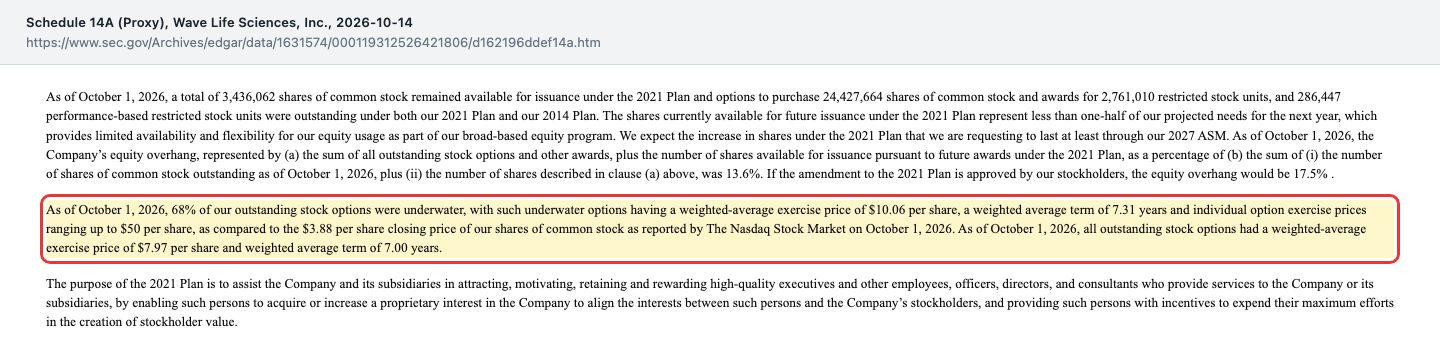
That is the flip side of the crash: to retain scientists whose options are worthless, a company has to grant new ones. According to the proxy, equity plan overhang would rise from 13.6 to 17.5 percent. A number from the quarterly report fits the picture: stock-based compensation rose to $30.1 million in the first nine months of 2026 from $17.6 million a year earlier, and general and administrative expenses in Q3 rose 40 percent to $25.4 million.
Uncomfortable truth No. 5: GSK handed WVE-006 back
GSK originally secured the worldwide rights to WVE-006. The quarterly report states it plainly:
“On February 2, 2026, the Company announced that it regained full rights to WVE-006, an investigational GalNAc-conjugated RNA editing oligonucleotide for alpha-1 antitrypsin deficiency, which was originally the subject of an exclusive global license to GSK under the GSK Collaboration Agreement.”
— Wave Life Sciences, Inc., SEC quarterly report 10-Q for Sept. 30, 2026, Note 7
Both readings are possible. The optimistic one: Wave keeps the full value if WVE-006 is approved and controls the pace itself – the FDA alignment of October 2026 supports that. The cautious one: GSK is not continuing the program, and Wave now pays for the expensive registrational trial alone. According to Wave's announcement of Feb. 2, 2026 (8-K, Exhibit 99.1), the handback was agreed by both sides: GSK's respiratory portfolio focuses on large-scale diseases, and Wave is well placed to advance a program in a rare condition like AATD. Per the announcement, the agreement was made before data from the next trial cohort became available. Program spending rose to $3.1 million in Q3 2026 from $1.0 million a year earlier – and the actual registrational trial has not started yet.
In short: no product, disappointing weight data, a shrinking cash pile, a growing share count and a partner that handed back a program – none of these is a balance-sheet failure, but together they explain the stock price better than any anchor.
Valuation: what the market pays for the science
At $3.58 (close on Nov. 3, 2026) and 197.2 million shares (Oct. 21, 2026), the market value was about $706 million. Subtract the $431.0 million in cash and marketable securities – Wave has no financial debt – and the market is paying about $275 million for the platform, the programs and the partner contracts combined (our calculation). Stockholders' equity stood at $401.9 million on Sept. 30, 2026, so the market value is about 1.8 times book value. There is no price-to-earnings ratio and no meaningful price-to-sales ratio, because there are no earnings and no product revenue.
The market's math is therefore a bet on time: $275 million for three clinical programs and a GSK contract – but also for a company that will likely need more money than it has before its first possible approval filing. Every quarter without new data eats about $60 million of the $431 million. Optimists see a bargain, short sellers a value that keeps shrinking. Both are opinions, not TickerGuard's assessment.
Opportunities and risks at a glance
What speaks for Wave
- $431.0 million in cash and marketable securities, no financial debt (Sept. 30, 2026); runway into the third quarter of 2028 according to the company.
- WVE-006 shows the intended effect in the trial (−70.5 percent harmful protein, 64.4 percent healthy protein) without clinically meaningful liver test elevations (10-Q for Sept. 30, 2026); FDA alignment on the registrational path in October 2026.
- GSK selected another candidate in September 2026 ($12 million milestone), and three more partner programs are advancing.
- WVE-007 preserves lean mass in the data and cuts visceral fat (−14 percent placebo-adjusted after six months); a Phase 2a trial in people with higher body weight is underway.
- Major shareholder RA Capital holds 16.8 percent (August 2026) and has a board seat through Peter Kolchinsky; partner GSK is the second-largest shareholder with 9.25 percent (DEF 14A of Oct. 14, 2026).
What speaks against it
- No product revenue since inception and none in sight; net loss of $61.9 million in Q3 2026.
- About $60 million of cash going out per quarter, no committed funding other than possible GSK payments, a $250 million share sales program ready to go.
- Only 1 percent placebo-adjusted weight loss after six months for WVE-007; a 49.6 percent one-day drop on March 26, 2026.
- Share count up 28.9 percent since the end of 2024, 11 million more plan shares up for a vote, 68 percent of options underwater.
- GSK handed back the rights to WVE-006 in February 2026; Wave must fund the registrational trial alone.
Conclusion: the anchor and the ship
Back to the anchor from the start. $21.31, the $19 offering price, the $17.11 average price target – all three numbers are real, and none of them tells you what Wave is worth today. The company you get for $3.58 has $431 million in the bank, spends about $60 million of it every quarter, sells nothing and depends on three programs whose decisive data are still to come. A stock that has fallen 83 percent can fall another 50 percent. It can also double. The old price does not decide either outcome.
So the honest question for you is not “How cheap is this compared with December?” but: Do you believe WVE-006 or WVE-007 will deliver data in the next two years that a partner or the market will pay for – before the cash runs low and new shares shrink your stake? If you have a reasoned answer, you have a thesis. If all you have is the old price in your head, you have an anchor. What you make of it is your decision. And that is how it should be.
Sources
- Wave Life Sciences, Inc. — SEC quarterly report 10-Q for Sept. 30, 2026 (filed Oct. 27, 2026)
- Wave Life Sciences, Inc. — SEC current report 8-K of Oct. 27, 2026, Exhibit 99.1 (third-quarter 2026 results)
- Wave Life Sciences, Inc. — SEC proxy statement (DEF 14A) of Oct. 14, 2026
- Wave Life Sciences, Inc. — Form 15-12G of Wave Life Sciences Ltd. (Singapore), Aug. 10, 2026
- Wave Life Sciences, Inc. — SEC current report 8-K12B of Aug. 7, 2026 (redomiciliation to Delaware)
- Wave Life Sciences Ltd. — SEC quarterly report 10-Q for June 30, 2026 (filed July 30, 2026)
- Wave Life Sciences Ltd. — SEC quarterly report 10-Q for March 31, 2026 (filed April 28, 2026)
- Wave Life Sciences Ltd. — SEC current report 8-K of March 26, 2026, Exhibit 99.1 (six-month WVE-007 data)
- Wave Life Sciences Ltd. — SEC current report 8-K of Feb. 2, 2026, Exhibit 99.1 (WVE-006 rights regained from GSK)
- Wave Life Sciences Ltd. — SEC annual report 10-K for 2025 (filed Feb. 26, 2026)
- Wave Life Sciences Ltd. — SEC current report 8-K of Dec. 8, 2025, Exhibit 99.1 (three-month WVE-007 data)
- Wave Life Sciences Ltd. — SEC quarterly report 10-Q for Sept. 30, 2025 (filed Nov. 10, 2025)
- Wave Life Sciences Ltd. — SEC annual report 10-K for 2024 (filed March 4, 2025)
- Full SEC filing history: EDGAR overview for Wave Life Sciences (sec.gov)
- Fundamental data (prices, short interest, analyst ratings; as of Nov. 4, 2026), cross-checked against the SEC filings. Earnings call transcripts were not reviewed for this analysis.
Transparency & disclaimer: This analysis is a journalistic assessment of publicly available information. It is not investment advice, not a financial analysis in the regulatory sense and not a solicitation to buy or sell securities. Investing in stocks involves substantial risk, up to and including total loss. All information without guarantee; data dates are noted in the text. Figures marked “our calculation” are derived from the SEC filings and are not company figures. Positions held by the operator are disclosed daily; where one exists, it appears as a notice at the top of this deep dive.
Key figures at a glance
All monetary figures in millions of $; earnings per share as reported.
| Metric | 2021 | 2022 | 2023 | 2024 | 2025 |
|---|---|---|---|---|---|
| Revenue | 41.0 | 3.6 | 113.3 | 108.3 | 42.7 |
| Operating Income (EBIT) | -127.0 | -162.7 | -68.0 | -110.4 | -215.4 |
| Net Income | -122.2 | -161.8 | -57.5 | -97.0 | -204.4 |
| Net Margin | -298.4% | -4,434.7% | -50.8% | -89.6% | -478.3% |
| Earnings Per Share | -2.36 $ | -2.05 $ | -0.54 $ | -0.70 $ | -1.21 $ |
Source: fundamental data & SEC filings (annual and quarterly reports, 10-K/10-Q)
Our Bottom Line at a Glance
- Platform & partners positive
- GSK selected another candidate in September 2026 ($12 million milestone), three partner programs are advancing; WVE-006 cut harmful protein by 70.5 percent in the trial, without clinically meaningful liver test elevations (10-Q for Sept. 30, 2026).
- Liquidity neutral
- $431.0 million in cash and marketable securities, no debt (Sept. 30, 2026); about $60 million of operating cash outflow in Q3 2026, runway into Q3 2028 according to the company.
- Business model negative
- No product revenue since inception and none for the foreseeable future; Q3 2026 revenue of $13.2 million, of which $12.0 million was a one-time milestone; net loss of $61.9 million.
- WVE-007 data negative
- Six months after one dose, placebo-adjusted −14% visceral fat but only −1% body weight; the stock fell 49.6 percent on March 26, 2026. Phase 2a data are still pending.
- Dilution negative
- Share count up from 153.0 million (end of 2024) to 197.2 million (Sept. 30, 2026); $250 million share sales program in place, 11 million more plan shares up for a vote on Nov. 12, 2026.
Wave Life Sciences is a textbook case of anchoring: the stock fell from $21.31 to $3.58, and the old price says nothing about today's value. Underneath is a research company with $431 million in cash, no product and about $60 million going out per quarter, whose value hinges on the next trial data. Not investment advice.
What Our Rating Means
Open questions
The business works in principle, but one material question is open. As long as it stays open, our findings do not carry a quality verdict.
The platform convinces GSK, the WVE-006 trial data so far show the intended effect without clinically meaningful liver test elevations (10-Q for Sept. 30, 2026), and with $431 million in cash and no debt the money lasts a good seven quarters by our calculation. Yellow rather than green because a material operating question is open: Wave has no product, and its value hinges on trial results still to come – the WVE-007 weight data have disappointed so far. Yellow rather than red because the cash runway is well above four quarters and there is no balance-sheet or governance failure. New shares on the road to approval are still likely. The decision is yours.
A journalistic assessment by our editorial team at the time of the deep dive, based on public sources — not investment advice and not a solicitation to buy or sell. Your personal circumstances (investment goals, risk capacity, taxes) cannot be taken into account. What our levels mean, how verdicts are formed, and what conflicts of interest exist →
Worth Noting
- The analysis was triggered by the 10-Q for Sept. 30, 2026 (filed Oct. 27, 2026) and the earnings release. Price references (closes): $7.49 (12/05/2025), $18.52 (12/08/2025), $21.31 (12/09/2025, twelve-month high), $12.30 (03/25/2026), $6.20 (03/26/2026), $3.09 (10/14/2026, low), $3.58 (11/03/2026). Shares sold short about 21.2 million (fundamental data, retrieved 11/04/2026).
- Our calculations: Q3 cash outflow = $173.3M (nine months) − $113.1M (first half). Market value = 197,228,968 × $3.58 = $706.1M; enterprise value = $706.1M − $431.0M = about $275M. Recurring revenue Jan.–Sept. 2026 = $53.7M − $35.9M − $12.0M = $5.8M. Fully diluted = 197.2 + 7.1 + 24.4 + 3.0 = 231.7 million shares.
- Identity: same SEC registration CIK 0001631574. Until Aug. 7, 2026, the parent was Wave Life Sciences Ltd. (Singapore); since then Wave Life Sciences, Inc. (Delaware) as successor issuer (8-K12B of Aug. 7, 2026). The Form 15-12G of Aug. 10, 2026 covers only the old Singapore shares. Earnings call transcripts were not reviewed.
Stock Watch
This analysis is as of November 4, 2026. Stock Watch will tell you what's changed at WVE since then.
Later $1 a month per stock — signing up is free, and you'll be the first to know when it launches.
The full analysis as a PDF for later
We will send you this analysis as a PDF — to print, file away, and read at your own pace. And we will add you to the free Stock Watch list for Wave Life Sciences, Inc. (WVE), so you hear about it when something material in this analysis changes.
Frequently Asked Questions
Wave Life Sciences, Inc. (Nasdaq: WVE) of Cambridge, Massachusetts, develops RNA medicines on its PRISM platform. Its main programs are WVE-007 for obesity, WVE-006 for alpha-1 antitrypsin deficiency and WVE-008 for a genetic liver disease. Wave has no approved products; so far, revenue comes only from partner contracts, mainly with GSK.
After three-month WVE-007 data, the close rose as high as $21.31 in December 2025. On March 26, 2026, it fell in one day from $12.30 to $6.20, because six-month data showed only 1 percent placebo-adjusted weight loss. On Nov. 3, 2026, the stock closed at $3.58, 83 percent below the high.
Yes. On Aug. 7, 2026, all shares of Wave Life Sciences Ltd. of Singapore were exchanged one-for-one for shares of Wave Life Sciences, Inc. of Delaware. The new company is the successor issuer under the same SEC registration (CIK 0001631574) and still trades as WVE on Nasdaq. The Form 15 of Aug. 10, 2026 covered only the old Singapore shares.
At Sept. 30, 2026, Wave had $431.0 million in cash and marketable securities and no debt. Operations used about $60 million in Q3 2026. Wave expects the cash to last into the third quarter of 2028. Apart from possible GSK payments there is no committed funding; a share sales program of up to $250 million is in place.
WVE-006 is designed to use RNA editing to correct the error behind alpha-1 antitrypsin deficiency, an inherited lung and liver disease; it is not approved. In the early-stage trial, harmful protein fell 70.5 percent. GSK handed back the rights in February 2026; in October 2026, Wave announced FDA alignment on a two-year registrational trial with an interim analysis after one year.
The share count rose from 153.0 million at the end of 2024 to 197.2 million on Sept. 30, 2026, up 28.9 percent. Including pre-funded warrants, options and RSUs, it is about 231.7 million. On Nov. 12, 2026, the annual meeting votes on 11 million more plan shares.
Found an error?
Did you spot a factual error, an outdated number, or a typo in this deep dive? Let us know briefly — your report goes straight to the editorial team.