Hamilton Beach: The Profit Jump Came From the Courtroom, Not the Kitchen
Five times the earnings per share in the first nine months of 2026 — and most of it comes from a Supreme Court ruling: a one-time tariff refund that Hamilton Beach reports in its quarterly report filed with the U.S. securities regulator, the SEC, on November 4, 2026. The same day, the company cut its revenue outlook to zero growth. The brand behind toasters, blenders and coffee makers — made by third-party manufacturers — sells mostly through Walmart and Amazon. On the earnings call about the guidance cut, not a single analyst asked a question. What is left of the profit if the refund does not come back?
 Thomas Mücke
Founder & Publisher
As of Today
As of: November 4, 2026
- Closing price
- 34.60 $ +6.10%
- Market Capitalisation
- 0.5 $B
- Growth Score
- 4/10
- AAQS
- 4/10
Price change since November 4, 2026: -0.1%
This analysis has a cut-off date. The Stock Guard tells you when something material changes in the numbers. Reserve your free spot
Chart
Interactive price chart (TradingView).
52-week range: 13.80 $ to 38.80 $ · Last price: 34.60 $ (As of: November 4, 2026)
Note: pure fact-based analysis, not investment advice and not a solicitation to buy or sell. All figures without guarantee.
There is an investor trap everyone knows from the grocery store: the sale-sticker trap. A bright red tag on the shelf says “was $4.99, now $2.99,” and your hand reaches out before your head has asked anything. Look closer and the shelf label also shows the unit price — the price per ounce. Sometimes that has not dropped at all, because the package simply got smaller. With stocks, the red tag is the price-to-earnings ratio, or P/E: it tells you how many years of earnings you pay for a share. A P/E around 8 looks like a bargain. Hamilton Beach Brands (NYSE: HBB) of Glen Allen, Virginia, carries exactly that kind of tag in early November 2026. So let’s make a deal: before you let the sticker guide you, let’s read the unit price together — in what the company itself has reported to the U.S. securities regulator, the SEC: the quarterly report (10-Q) for the period ended September 30, 2026, the earnings release from the same day, the annual report (10-K) for 2025, and the transcripts of 15 earnings calls. For the quarterly and annual reports, the CEO and CFO certify their accuracy with their signatures. The punchline up front: most of the 2026 profit did not come out of the kitchen but out of a Supreme Court ruling. In the end, you decide.
What Hamilton Beach actually does — toasters, blenders and two big customers
Hamilton Beach designs, markets and distributes small electric appliances for the kitchen and home: air fryers, blenders, coffee makers, toasters, slow cookers, irons. Its own brands are Hamilton Beach, Proctor Silex and Weston, with Hamilton Beach Professional and Lotus at the premium end. It also sells appliances to restaurants, bars and hotels and runs a small medical-technology unit, Hamilton Beach Health, which has sold devices from its partner HealthBeacon since 2022 and acquired the Irish company in February 2024 for €6.9 million. It manufactures nothing itself; Hamilton Beach works with third-party manufacturers, mostly in Asia. Think of a publisher: it does not print the books, but it owns the titles and decides what goes into the stores.
Here, the stores are mainly two: Walmart accounted for about 29 percent of 2025 revenue and Amazon for about 19 percent; the five largest customers together for 62 percent. As of December 31, 2025, about 660 people in five countries worked for the company. The business is highly seasonal: revenue rises in the second half and peaks in the fourth quarter, the holiday season. Hamilton Beach has been a standalone public company since September 29, 2017, when its former parent NACCO Industries spun it off to its shareholders.
That defines the core tension of this analysis, and it runs through every chapter: the balance sheet at September 30, 2026 is stronger than at any year-end since 2021 and the P/E looks cheap — but the earnings behind that ratio came mostly from a one-time tariff refund in 2026, and by the company’s own guidance the underlying business is not growing this year.
Company history for investors
-
2017
Spin-off from NACCO Industries (September 29)
NACCO shareholders received one Class A and one Class B share per share. Class B carries ten votes; through it, members of the founding family can, according to the 2025 annual report, together exercise the large majority of the voting power, and there is no voting agreement among them.
-
2024
Purchase of HealthBeacon for €6.9 million
Expansion of the Hamilton Beach Health unit. The announced profit contribution from 2025 stayed small: $0.37 million in the first nine months of 2026.
-
2025
Tariff shock and a 7.3 percent revenue decline
China tariffs briefly at 125 percent made retailers delay orders; operating profit fell from $43.2 million to $36.6 million, mainly because of tariffs added later.
-
2026
Supreme Court strikes down IEEPA tariffs (February 20)
Basis of the $36.5 million refund in the second quarter. It carries the year’s earnings jump and is non-recurring according to the quarterly report; management expects about $4 million more in the fourth quarter.
-
2026
Guidance cut (November 4)
2026 revenue now flat instead of growing, operating profit down roughly 17 to 19 percent (“high teens”). Cash-flow guidance rose to $40 million to $50 million, calculated without tariff refunds.
How the stock landed on our desk
The occasion for this analysis is the fresh quarterly report. On November 4, 2026, Hamilton Beach filed its 10-Q for the period ended September 30, 2026 and released its earnings the same day (current report 8-K, Item 2.02, Exhibit 99.1). The two belong together, because only the earnings release contains the guidance — and management cut it that day.
On top of that, the share price demands an explanation: on November 4, 2025 the stock closed at $14.25; on November 4, 2026 at $34.64 — a gain of about 143 percent in twelve months (source: fundamental data). Before the report, the fundamental data showed a P/E of about 7.7. A stock that has more than doubled and still looks cheap is not a reason to grab it for us but a question: what is inside the earnings figure the price is being divided by?
One-time items and adjusted figures — what is left of the earnings jump
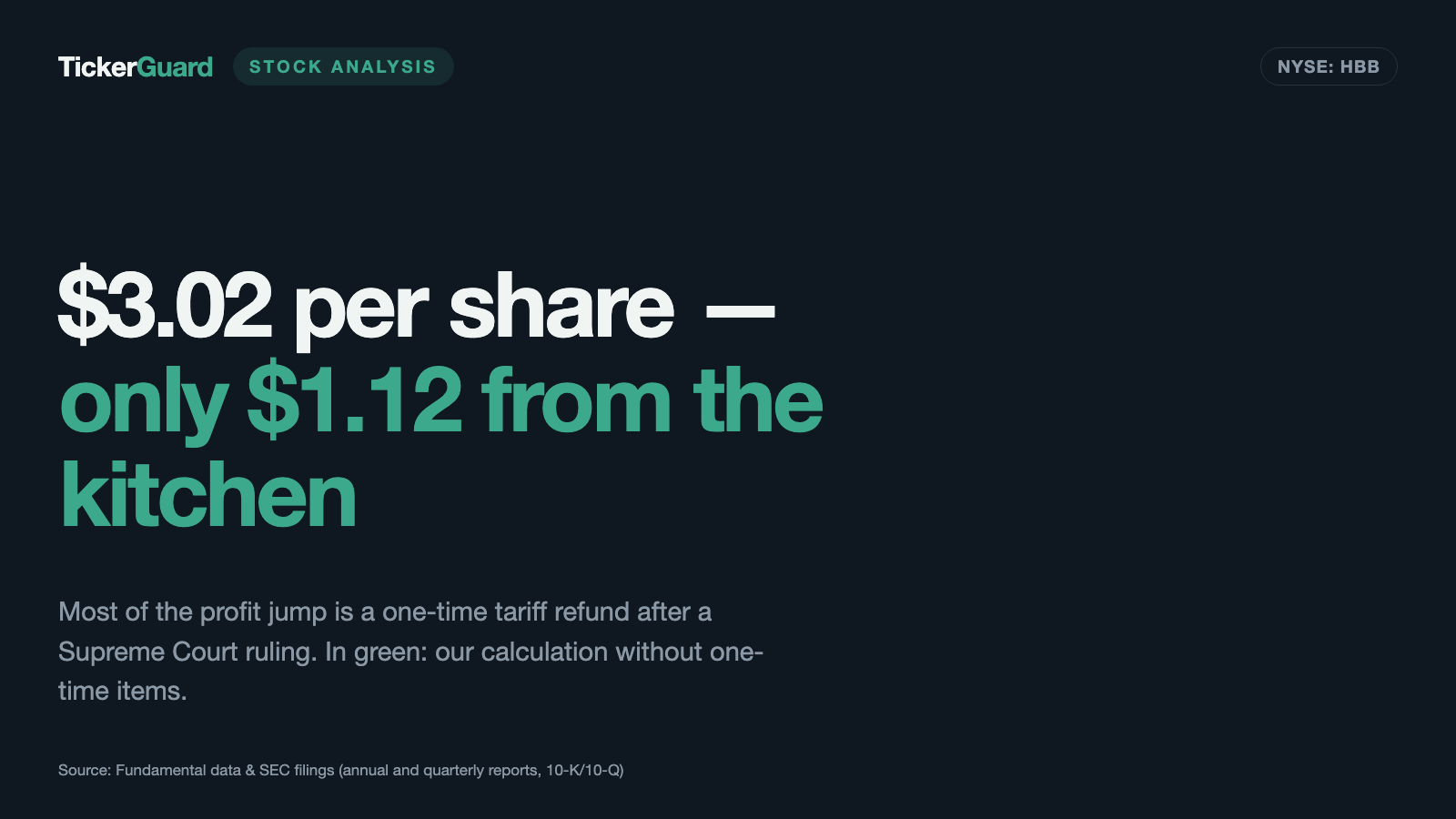
First the reported numbers for January through September 2026: revenue rose 2.8 percent to $404.9 million. Pretax income jumped from $10.6 million to $54.8 million, net income from $7.9 million to $40.8 million, and earnings per share from $0.58 to $3.02. When profit grows fivefold on nearly flat revenue, there is almost always a special reason. The result up front: without one-time items, $3.02 per share shrinks to $1.12 — on a strict view, to just $0.75. One important point: Hamilton Beach publishes no adjusted earnings figure for 2026. All adjusted figures in this analysis are therefore our own calculation from the amounts the company discloses; the full calculation is in the “Worth Noting” box at the end. Here are the five items you need to know.
First: the $36.5 million tariff refund
In 2025, the U.S. government imposed additional tariffs under an emergency statute, the International Emergency Economic Powers Act (IEEPA), and sharply tightened them in April 2025. Hamilton Beach imports almost everything and paid accordingly. On February 20, 2026, the Supreme Court ruled that the statute does not authorize tariffs. Hamilton Beach filed for refunds — and received them in the second quarter of 2026. The quarterly report describes the accounting this way:
“During the three and nine months ended September 30, 2026, the Company received $0.0 million and $36.5 million, respectively, of IEEPA Tariff Refunds and recognized such refunds as a reduction of cost of sales in the Consolidated Statements of Operations.”
— Hamilton Beach Brands Holding Company, SEC quarterly report 10-Q for the period ended September 30, 2026, Note 6 “Tariff matters (IEEPA)”
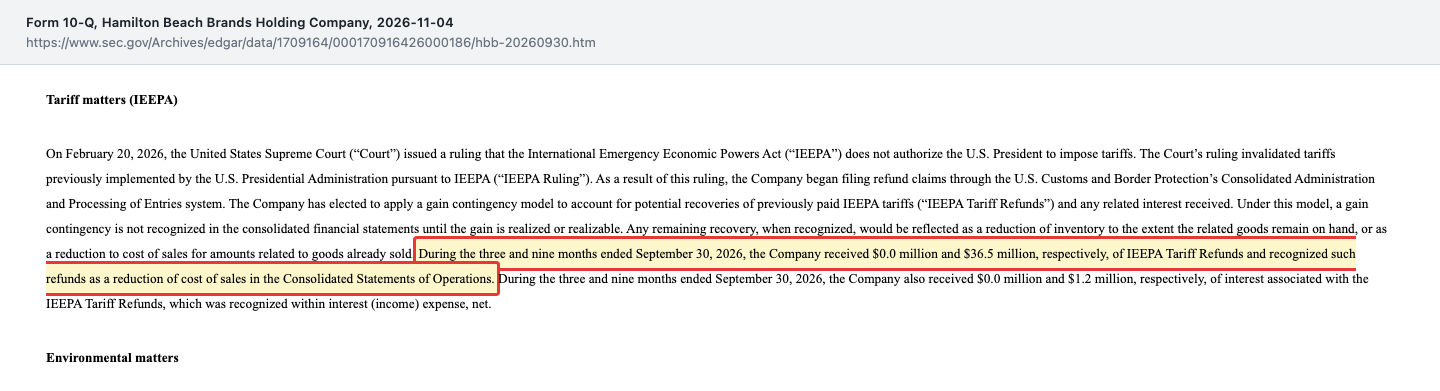
According to the same note, $1.2 million of interest on the refund was added and booked in net interest. Think of it as a tax refund: it shows you overpaid last year — not that you are earning more this year. Refund and interest together account for about two-thirds of nine-month pretax income ($37.7 million of $54.8 million).
Second: selling through tariff-free inventory
The second benefit is quieter but also one-time. After the ruling, Hamilton Beach sold inventory that no longer carries IEEPA tariffs — and the margin on it is higher than normal. The quarterly report says explicitly how long that lasts and strips out both benefits itself:
“These benefits are non-recurring and will not persist beyond the sell-through of the affected inventory. Excluding these benefits, gross profit margin would have been 26.9%.”
— Hamilton Beach Brands Holding Company, SEC quarterly report 10-Q for September 30, 2026, MD&A (Item 2), first nine months, “Gross profit”
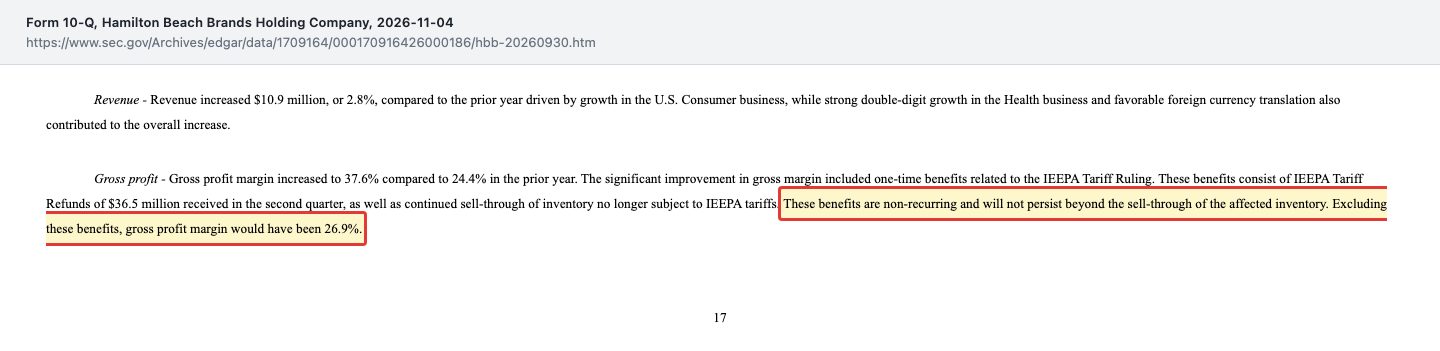
Gross margin is the share of revenue left after the cost of goods. Reported, it was 37.6 percent; excluding both benefits, 26.9 percent (prior year: 24.4 percent). The company does not quantify the sell-through benefit on its own; the two margins imply about $6.8 million.
Third and fourth: two items pointing the other way
Fairness requires the reverse view too. Hamilton Beach is replacing its old accounting and inventory system (an ERP system) and is therefore depreciating the legacy system on an accelerated basis: $4.2 million in nine months, $1.3 million of it in the third quarter; for the full year, the November earnings release cites about $5 million (the August guidance still assumed about $6 million) and calls it non-recurring. These costs depress 2026 earnings — without them, profit would be higher. The fourth item is unusual: mainly because the share price rose, incentive-related personnel costs rose too, by $4.0 million in the third quarter and $6.8 million over nine months. The company does not call this one-time, and as long as the share price stays high, it isn’t. We therefore do not adjust for it.
Fifth: a small gain from terminated interest rate hedges
In the third quarter, Hamilton Beach repaid half of its loan and in the process terminated interest rate swaps covering $25 million that had protected it against rising rates. The value those hedges had built up went into earnings in one go: according to the quarterly report, about $0.9 million (“approximately $0.9 million of previously deferred gains … were reclassified … into earnings”). It is small, but it is one-time — we take it out.
The bridge: what is left without one-time items
Putting the five items together gives this picture — our calculation; the only non-GAAP measure the company itself reports is net cash:
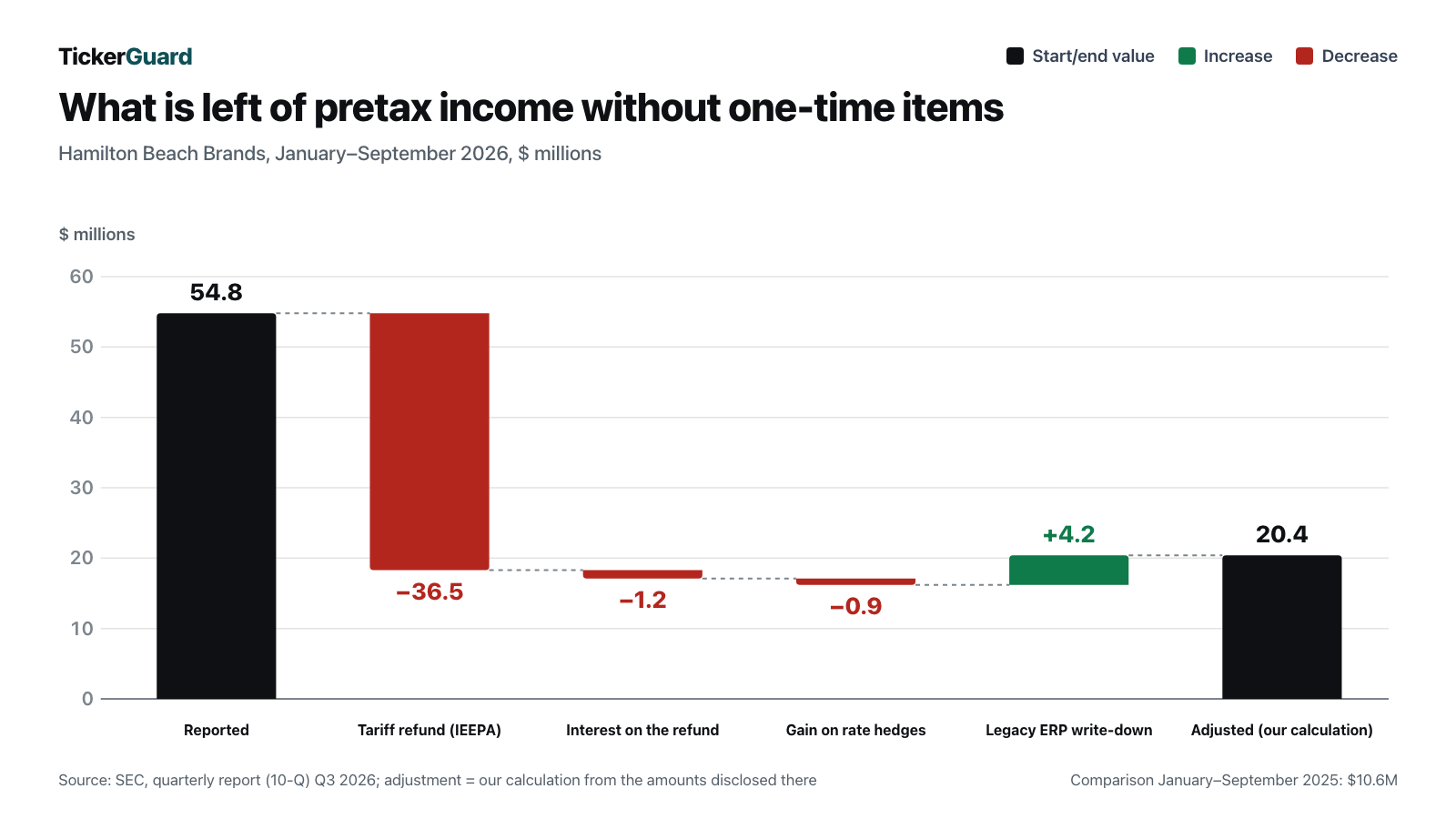
Per share, that means $1.12 instead of $3.02, and about $0.75 without the sell-through benefit. Compared with the prior year: the first nine months of 2025 were also depressed by $5.0 million of one-time tariff costs; without them, pretax income was about $15.6 million. On an adjusted basis, 2026 is therefore at best just under a third above the prior year and at worst about 13 percent below it. In no version is it a fivefold increase.
The third quarter alone: weaker than a year ago on an adjusted basis
There was no refund in the third quarter of 2026. Reported revenue rose 5.6 percent to $140.3 million, operating profit from $2.9 million to $4.4 million, and earnings per share from $0.12 to $0.26. That looks like a doubling. But the prior-year quarter had been depressed by the $5.0 million of one-time tariff costs; excluding them, management itself cited operating profit of $7.9 million at the time. For the third quarter of 2026, adding back the accelerated depreciation ($1.3 million) gives about $5.7 million — less than the prior year’s $7.9 million, and that is before subtracting an unquantified sell-through benefit, which the quarterly report names as the main driver of the margin jump from 21.1 percent to 27.5 percent. Selling, general and administrative expenses rose by $9.0 million, including $4.0 million of higher incentive-related personnel costs, mainly due to the higher share price — almost as much as the entire quarterly operating profit of $4.4 million. Quarterly earnings of $0.26 per share also include the $0.9 million from the terminated hedges (about $0.05 per share); on the other hand, the tax rate was 31.6 percent instead of 18.4 percent because the prior-year quarter included a one-time tax benefit.
Remember the unit price: the red tag says $3.02 of earnings per share — the unit price, depending on the calculation, says $0.75 to $1.12.
The numbers over the years — honestly assessed
Let’s start with what speaks for Hamilton Beach, because that is quite a lot.
First: this company reliably makes money. From 2021 through 2025, net income was between $21.3 million and $30.8 million every year, and earnings per share between $1.53 and $2.20. Gross margin rose from 20.7 percent (2021) to 26.0 percent (2024) and 25.7 percent (2025) — according to management, partly because higher-margin product lines are gaining share.
Second: the dividend keeps rising. The dividend paid per share rose every year, from $0.395 (2021) to $0.475 (2025); since the second quarter of 2026 it has been $0.125 per quarter.
Third: the balance sheet at September 30, 2026 is stronger than at any year-end since 2021. As of September 30, 2026, Hamilton Beach had $92.5 million in cash and only $25.0 million of borrowings — half of the loan was repaid in the third quarter. The earnings release shows net cash of $67.5 million; a year earlier there was $32.8 million of net debt. Equity rose to $220.8 million, a little over half of total assets of $428.3 million. The $125 million credit facility runs until December 13, 2029, with $97.0 million of excess availability at the reporting date. Accounts payable include $43.6 million under a program through which suppliers can sell their invoices to a bank (year-end 2025: $29.9 million; year-end 2024: $56.9 million); according to the annual report, the payment terms toward the bank are the same as toward the suppliers, and, according to the annual report, Hamilton Beach does not rely on the program to manage its cash flow. Management writes that cash, the credit facility and operating cash flow will provide sufficient liquidity for the next twelve months; the report contains no going-concern warning.
And now the part you have to read alongside. Revenue has been treading water for years: $658.4 million (2021), $640.9 million (2022), $625.6 million (2023), $654.7 million (2024) and $606.9 million (2025). And the cash that is actually left over swings widely:
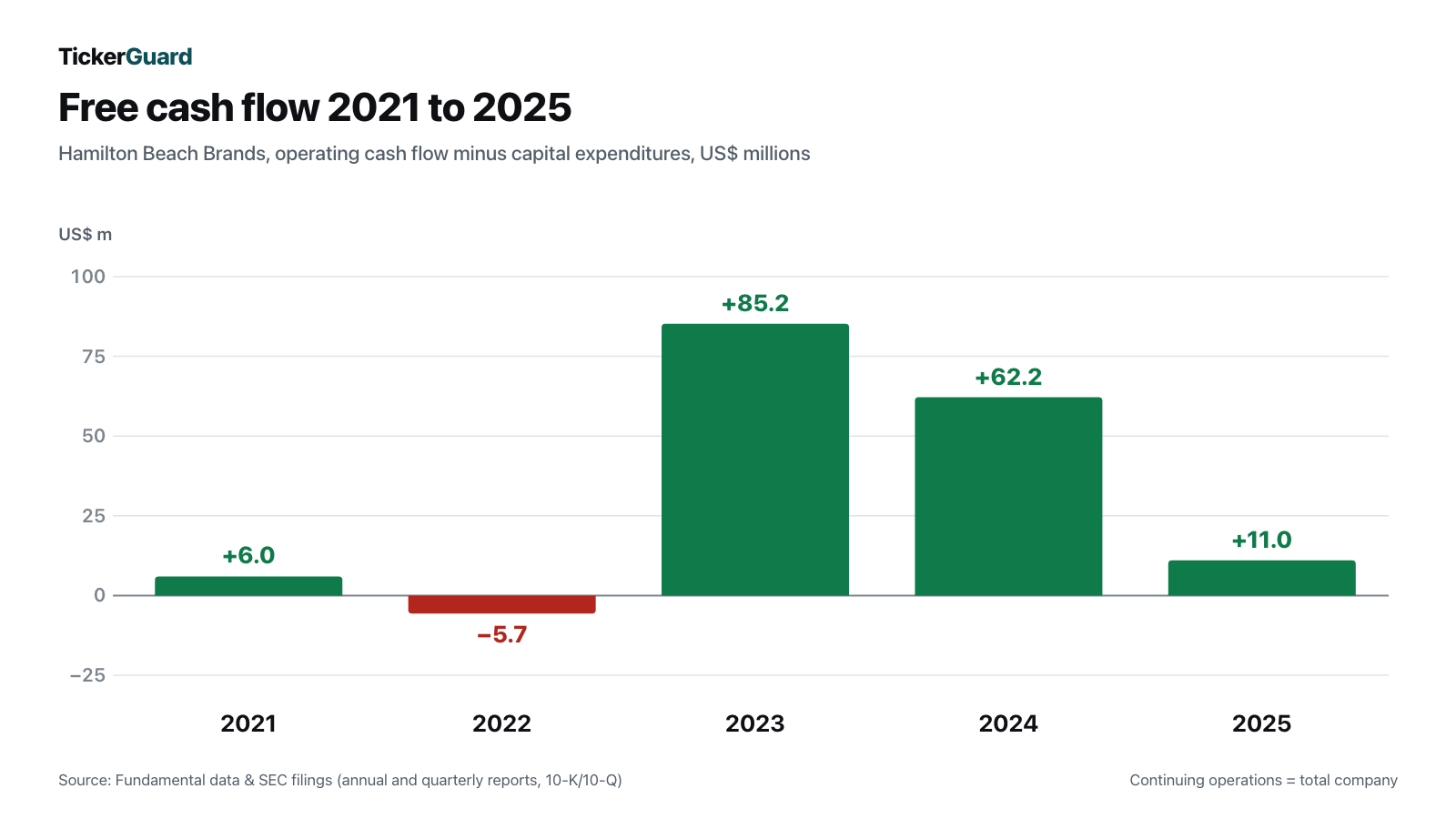
Free cash flow is the money left after running the business and investing in equipment and buildings — the pool from which dividends and buybacks are paid. At Hamilton Beach it depends on inventory: pre-financing a lot of goods before the holidays leaves little cash at year-end, and vice versa. In 2023 the company reduced inventory (the cash flow statement shows a $30.8 million release from inventory) and was flush with cash; in 2024 the inflow stayed high even though inventory was built up again toward year-end; in 2025 it bought ahead of the tariffs. In the first nine months of 2026, free cash flow was $79.3 million, including the tariff refund (operating cash flow minus capital expenditures; subtracting all cash used for investing, as the company’s guidance does, gives $79.0 million).
What management promised — and what happened
For this chapter we read the transcripts of 15 earnings calls, the conference calls management holds with analysts after each quarterly report — from the first quarter of 2023 through the third quarter of 2026 (call of November 4, 2026). We weighted the Q&A sessions most heavily, because that is where management speaks without a prepared script. What stands out is how thin those sessions are: usually a single participant asks the decisive questions, Adam Bradley of AJB Capital; on five of the 15 calls (first and second quarters of 2023, first and second quarters of 2024 and, of all calls, the one with the guidance cut on November 4, 2026) nobody asked a question, and the transcript of the fourth-quarter 2024 call ends before the Q&A. Critical follow-up is rare at Hamilton Beach.
Promise 1: the latest tariff changes will not hurt 2025 profit
In February 2025, shortly before the big tariff rounds, the CFO sounded confident:
“We expect we'll be able to offset any additional impact from tariffs through select price increases and supplier concessions and therefore, don't anticipate the recent change in tariffs to pressure our profitability in 2025.”
— Sally Cunningham, Senior Vice President, Chief Financial Officer and Treasurer, fourth-quarter 2024 earnings call (February 2025)
In the end, profit fell anyway – but mainly because of tariffs that came only after this statement. In April 2025, tariffs arrived that briefly reached 125 percent on imports from China; retailers paused orders, 2025 revenue fell 7.3 percent and operating profit dropped from $43.2 million to $36.6 million. A year later, the same CFO presented the year like this:
“if you exclude the onetime incremental tariff expense and the accelerated depreciation and write-off related to our enterprise software transition, 2025 operating profit actually increased to $43.5 million or 7.2% of sales.”
— Sally Cunningham, CFO, fourth-quarter 2025 earnings call (February 2026)
The February 2025 expectation referred to the tariff changes of that time; the 125 percent spike in April came afterward. The CFO did cite the reported $36.6 million in the same remarks.
Promise 2: out of China on schedule
In April 2025, President and CEO R. Scott Tidey laid out a clear schedule:
“we have already transitioned approximately 15% of our manufacturing out of China and expect to have two-thirds of our U.S. sales coming from outside of China by the end of 2025, with the remainder to be moved in the first half of next year.”
— R. Scott Tidey, President and CEO, first-quarter 2025 earnings call (April 2025)
No later call gives a number for the progress achieved, only general progress (“manufacturing diversification continues to progress,” July 2025). In February 2026 the tone had changed: “In some cases, it's more economically beneficial to manufacture in China, while in others, it's more cost effective to source production from Vietnam, Thailand or Indonesia.” By our reading, the schedule turned into flexibility. According to the annual reports, the share of suppliers based in China fell from about three-fourths (2024) to about two-thirds (2025).
Promise 3: the Lotus premium brand and its Signature line
The Lotus premium brand gets praise on almost every call; management gives no revenue figures for it. The only tangible item is the launch date of the Signature line, and it keeps slipping: in July 2025 it was the “Lotus Signature line that will launch in mid-2026,” in February 2026 “Lotus Signature scheduled to launch this fall,” and in August 2026 finally:
“We remain on track to launch Lotus Signature in the fourth quarter of this year and early next year”
— R. Scott Tidey, President and CEO, second-quarter 2026 earnings call (August 2026)
On the November 4, 2026 call, the line was that “Lotus Signature soft launched in Q3 ahead of its broader launch earlier next year.” Since July 2025, management has given four different timing statements; since the November 4 call, the broad launch has been announced for early 2027. At the same time, an important license fell away — the Bartesian agreement (cocktail machines) expired at the end of 2025, according to Tidey a sales headwind of “roughly $22 million.” Even so, in February 2026 he held out a return to revenue growth “in the mid-single-digit range” for 2026.
Promise 4: the 2026 outlook — and what was left of it on November 4
Management issued that outlook in February 2026 and reaffirmed it in May and August. On November 4, 2026, it gave way:
“As a result, the Company now expects 2026 revenue to be flat year over year compared to prior guidance of growth approaching mid-single digit range.”
— Hamilton Beach Brands Holding Company, third-quarter 2026 earnings release, 8-K Item 2.02, Exhibit 99.1, “Outlook”
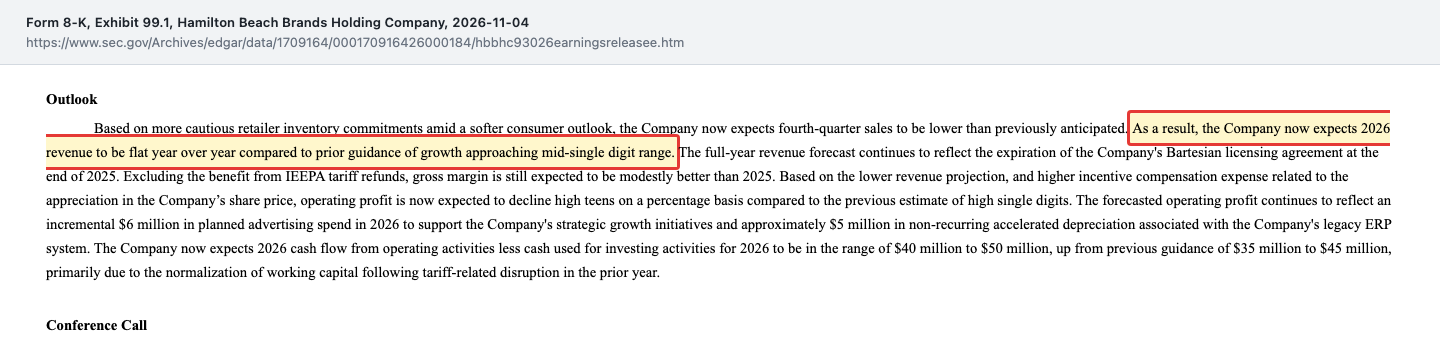
In the release, CEO Tidey blames more cautious retailers: “several of our retail partners have become more cautious with their inventory commitments for the upcoming holiday season.” According to the release, operating profit is now expected to “decline high teens on a percentage basis”; on the call, the CFO said “in the high teens” — roughly 17 to 19 percent, after a decline in the high single digits had been expected before. The reasons given are the lower revenue and higher incentive compensation, mainly driven by the share price. The entire outlook excludes tariff refunds, as the CFO stated explicitly on the call: “our outlook excludes the benefit from the $36.5 million IEEPA tariff refund we received in the second quarter and the additional $4 million IEEPA tariff refund anticipated in the fourth quarter.” The margin promise, by contrast, was kept: excluding the tariff benefits, nine-month gross margin of 26.9 percent was above the 25.7 percent of 2025, as announced in February (“similar to slightly better”).
Promise 5: buybacks “to offset dilution” — and the answer
In July 2025, the CFO described the buyback goal like this: “we buy back as many shares as we grant as a part of our compensation package, and that's about 300,000 shares.” On the August 2026 call, Adam Bradley addressed the gap directly: “Lots of cash in the bank.” — lots of cash. The CFO’s answer:
“Our share repurchases continue to be based on a number of factors including our outlook, what we plan to do with the cash, and other strategic as well as honestly the float that's out there and it's available for repurchase.”
— Sally Cunningham, CFO, second-quarter 2026 earnings call (August 2026)
The quarterly report for September 30, 2026 shows the result: in nine months, Hamilton Beach repurchased 178,190 shares under the program for $3.5 million, only 24,908 in the third quarter and none at all in September. Of the $25 million program (2026 through 2027), $21.5 million remains, and the share count is so far below the roughly 300,000 per year cited in July 2025. Against that, the notes to the quarterly report (Note 4) show about 226,000 newly issued Class A shares in nine months — 178,190 were repurchased under the program, 191,765 in total including 13,575 shares withheld to cover taxes. So the buybacks have not offset the issuance so far; the fourth quarter is still to come.
Promise 6: the health unit makes money from 2025
In May 2024, then-CEO Gregory Trepp announced that “Hamilton Beach Health is expected to contribute to operating profit in 2025 and beyond” — it happened late and small: in January through September 2026, the unit earned $0.37 million on $7.4 million of revenue, under 2 percent of group revenue. The announced pill-management platform was still only “upcoming” in November, and its target area changed twice without any reason given on the calls (most recently to rheumatology and gastroenterology).
The bottom line of this chapter: management delivered on margin; on revenue and Lotus it fell short of its own words, and buybacks are so far below the scale named in 2025. Whether the China schedule was met, management has not backed with numbers.
What the filings say — the uncomfortable truths
Uncomfortable truth no. 1: two customers bring in almost half of revenue
Imagine your neighbor tells you his business is doing great — and then mentions in passing that two customers bring in almost every second dollar. Would you swallow hard for a moment? At Hamilton Beach, it reads like this in the annual report:
“Walmart Inc. and its global subsidiaries (“Walmart”) accounted for approximately 29%, 29% and 27% of our revenue in 2025, 2024 and 2023, respectively.”
— Hamilton Beach Brands Holding Company, SEC annual report 10-K for 2025, Item 1 “Customers”
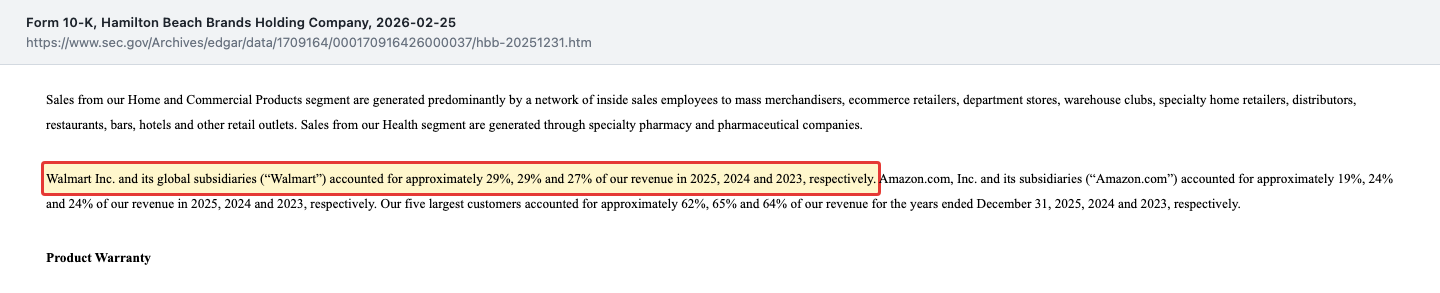
For Amazon, it was still 24 percent in both 2024 and 2023. According to the annual report there are no long-term supply contracts with either; orders come one purchase order at a time. The third quarter of 2026 shows how strong the effect is: the quarterly report explicitly attributes the revenue gain to the recovery at “one large retailer” that had held back orders a year earlier — and management blames the guidance cut on more cautious retailers. This is not an existential threat; the relationships are long established. But the inventory decisions of individual retailers hit revenue directly.
Uncomfortable truth no. 2: two-thirds of suppliers are in China
“Our suppliers are primarily located in the Asia-Pacific region, with approximately two-thirds of our suppliers currently based in China.”
— Hamilton Beach Brands Holding Company, SEC annual report 10-K for 2025, Item 1A “Risk Factors”
That is why trade policy is not a footnote for Hamilton Beach but the main driver of its margin: in 2025 tariffs cost money, in 2026 their removal brought money back. The IEEPA tariffs are gone. Whether the announced move of production succeeded, management has not backed with numbers, as shown above.
Uncomfortable truth no. 3: the founding family holds 81 percent of the votes
Hamilton Beach has two share classes. Only Class A, with one vote per share, trades on the exchange; Class B is not listed, carries ten votes per share and can be converted into Class A. According to the cover page of the quarterly report, there were 9,856,278 Class A shares and 3,582,852 Class B shares on October 30, 2026. The annual report draws the conclusion:
“On the basis of this common stock ownership, certain members of the Company’s extended founding family could exercise 81.0% of the Company’s total voting power.”
— Hamilton Beach Brands Holding Company, SEC annual report 10-K for 2025, Item 1A “Risk Factors”
Put simply: you have a seat at the table, but the family holds the house keys. That cuts both ways. The good side: a family with that much weight can plan in decades, the company is conservatively financed and pays a reliable dividend. The other side: a takeover offer that would reward outside shareholders in one stroke would likely have little chance of success without the consent of members of the founding family. On the question of whether the net cash goes to shareholders or stays in the company, the family could also have the final say — provided its members vote together; according to the annual report there is no voting agreement among them. The CFO named the float (“the float that's out there”) as one of the factors in the buybacks, without elaborating. The annual report offers a clue: at the end of 2025, members of the founding family also held about 34.4 percent of the listed Class A shares, so only part of them trades freely. By our reading, that limits large buybacks, because every share repurchased thins out trading further.
Uncomfortable truth no. 4: for the holiday quarter the guidance points, by our calculation, to less revenue — and the cash guidance excludes the refund
The new guidance can be worked back to what it implies for the current fourth quarter. The calculation in this paragraph is ours, not a company figure. “Flat” means revenue of about $606.9 million, as in 2025. After nine months, $404.9 million is booked; that leaves about $202 million for the fourth quarter — compared with $212.9 million in the fourth quarter of 2025, a decline of about 5 percent, in the seasonally most important quarter of all. Part of that is the expired Bartesian agreement: excluding its prior-year revenue, the CFO expects fourth-quarter revenue to rise 1.3 percent and full-year revenue 3.4 percent.
The cash deserves a second look, because at first glance the numbers do not fit together. Hamilton Beach raised its guidance for operating cash flow less investing to $40 million to $50 million. But after nine months, $79.0 million is already in. The two cannot simply be subtracted from each other, because the guidance is calculated without the refund. Management already said so in May 2026 (“Our current earnings and cash flow outlook excludes any potential impact from IEPA-related refunds”), and the CFO confirmed it on November 4, 2026 for the new outlook, including the further $4 million expected in the fourth quarter.
On the same basis everything fits: $79.0 million after nine months, less the $36.5 million refund and $1.2 million of interest on it, is about $41 million — at the low end of the $40 million to $50 million range. Excluding refunds, that leaves a roughly balanced fourth quarter by our calculation ($40 million to $50 million minus $41.3 million, so about minus $1 million to plus $9 million); for comparison, operating cash inflow in the fourth quarter of 2025 was about $28.5 million, before capital expenditures. The expected $4 million refund would come on top. As the reason for the raise, the earnings release cites the normalization of working capital after the prior year’s tariff disruption. In August the company also said it would reinvest part of the refund in the business to support long-term growth (“reinvest a portion of these proceeds back into the business”); for 2026 it also plans about $6 million of additional advertising. And the incentive compensation, driven mainly by the share price, whose increase in the third quarter was almost as high as operating profit, grows along with the stock: if the share price keeps rising, so do these costs.
What else the filings say
Beyond the quarterly numbers, 2026 brought only a few filings that complete rather than change the picture. On June 18, 2026, General Counsel Andrew C. Carington left effective immediately (current report 8-K, Item 5.02); the same day, Brent A. Ashley filed his initial ownership report (Form 3) as the new Senior Vice President, General Counsel and Secretary. According to an insider filing (Form 4), the CFO sold 3,000 Class A shares at $32.50 on August 27, 2026 and held 39,430 shares afterward; the other insider filings through October 5, 2026 concern share grants to directors (each at the start of a quarter) and to executives (February 20, 2026, compensation plan) as well as, on May 29, 2026, gifts of Class B share interests within the founding family; there were no open-market purchases. According to a beneficial ownership filing (SC 13G/A) of August 14, 2026, Ameriprise Financial (together with its subsidiary Columbia Management) holds 5.4 percent of the Class A shares. After the quarterly report and the earnings release of November 4, 2026, no further filing was made through November 5, 2026. In our AI classification, Hamilton Beach remains “Neutral”: AI shows up only as a marketing tool (tests for AI-driven search, an advertising pilot on ChatGPT), not in the business model.
Valuation — the unit price behind the sale sticker
At the closing price of $34.64 on November 4, 2026 and 13,439,130 shares of both classes (cover page of the quarterly report, as of October 30, 2026), Hamilton Beach is worth about $466 million. Subtracting net cash of $67.5 million leaves about $398 million for the actual business.
Now the price tags. The last four quarters — the fourth quarter of 2025 ($1.38 per share) plus January through September 2026 ($3.02) — add up to $4.40 of earnings per share and a P/E of about 8. That is the red sticker. Excluding refund, interest and hedge gain and adding back the accelerated depreciation leaves about $2.50 and a P/E of about 14; also excluding the sell-through benefit, about $2.13 and a P/E of about 16. The fourth quarter of 2025 enters unadjusted at $1.38, even though, according to the CFO, it contains the entire 2025 accelerated write-down of the legacy system ($1.6 million); taking it out would raise four-quarter earnings by just under $0.09 and lower the adjusted P/E by about half a point. On 2025 full-year earnings ($1.95), the P/E would be about 18. The price-to-book ratio is about 2.1 (equity of $220.8 million, September 30, 2026). The quarterly dividend of $0.125, annualized, equals a yield of about 1.4 percent at the November 4, 2026 closing price.
For comparison: a year earlier, at $14.25 (November 4, 2025), the same stock would have traded at a little over 7 times 2025 full-year earnings. The share price has more than doubled since then, while adjusted earnings for the last four quarters are between just under a tenth ($2.13 versus $1.95) and a little over a quarter ($2.50 versus $1.95) above 2025 earnings. There is hardly a reliable “view from the pros”: the fundamental data list a single price target of $13, with no visible number of analysts behind it — we attach no weight to it. To see how the same tariff refund played out at another importer, look at our analysis of Carter’s: there, too, most of the reported quarterly profit came from refunded tariffs.
Opportunities and risks at a glance
What speaks for Hamilton Beach:
- Healthy balance sheet: more cash than debt and $220.8 million of equity as of September 30, 2026; $125 million credit facility through December 2029.
- Reliably profitable: net income between $21.3 million and $30.8 million every year from 2021 through 2025.
- Rising dividend: paid per share from $0.395 (2021) to $0.475 (2025), $0.125 per quarter since the second quarter of 2026.
- Better margin even without tariff benefits: 26.9 percent in the first nine months of 2026 after 25.7 percent in 2025, as management had announced.
- Well-known brands in a mass market (Hamilton Beach, Proctor Silex, Weston); management gives no revenue figures for the premium push Lotus, and the Signature line launch has slipped several times.
What speaks against it:
- The 2026 earnings jump is a one-off, mainly because of the tariff refund; adjusted, by our calculation $0.75 to $1.12 instead of $3.02 per share remain for nine months.
- No growth: 2026 revenue guidance cut to “flat” on November 4, operating profit expected to fall by roughly 17 to 19 percent (“high teens”); by our calculation, the third quarter was weaker than a year earlier on an adjusted basis.
- Customer concentration: Walmart 29 percent, Amazon 19 percent, the five largest customers 62 percent of 2025 revenue, with no long-term supply contracts.
- China dependence: about two-thirds of suppliers in China; whether the announced move of production succeeded is not backed by numbers.
- Family control: 81.0 percent of the voting power with the founding family; despite net cash, only $3.5 million of buybacks in nine months.
A human conclusion
Back to the sale-sticker trap from the beginning. Its core is not that the offer is bad — Hamilton Beach is a solid, conservatively run company with net cash, a rising dividend and well-known mass-market brands. Its core is that the red tag hides the unit price. The P/E of around 8 rests on earnings that came mostly from a court ruling; the unit price, by our calculation, is about twice as high — for a company that by its own guidance is not growing this year, whose revenue depends almost by half on two retailers, and whose share price has more than doubled in twelve months. Working back from the lowered full-year guidance, our calculation shows a revenue decline for the holiday quarter; excluding the expired Bartesian agreement, the CFO expects a slight increase. On the other side stand a healthy balance sheet, a dependable dividend and a family at the helm. The honest question is therefore not “How low is the P/E?” but: What are you paying here for a dollar of earnings that will come back next year? What you make of it is your decision. And that’s how it should be.
Sources
All primary documents used in this analysis — read them yourself:
- Hamilton Beach Brands Holding Company — SEC quarterly report 10-Q for the period ended September 30, 2026 (filed November 4, 2026)
- Hamilton Beach Brands Holding Company — third-quarter 2026 earnings release, 8-K Item 2.02, Exhibit 99.1 (filed November 4, 2026)
- Hamilton Beach Brands Holding Company — SEC quarterly report 10-Q for June 30, 2026 and second-quarter 2026 earnings release (8-K, Exhibit 99.1, August 5, 2026)
- Hamilton Beach Brands Holding Company — SEC quarterly report 10-Q for March 31, 2026 and first-quarter 2026 earnings release (8-K, Exhibit 99.1, May 6, 2026)
- Hamilton Beach Brands Holding Company — SEC annual report 10-K for 2025 (filed February 25, 2026) and fourth-quarter 2025 earnings release (8-K, Exhibit 99.1, February 25, 2026)
- Hamilton Beach Brands Holding Company — third-quarter 2025 earnings release (8-K, Exhibit 99.1, November 5, 2025)
- Hamilton Beach Brands Holding Company — SEC annual report 10-K for 2024
- Full SEC filing history including insider filings (Form 4), the 8-K and Form 3 of June 18, 2026 and the SC 13G/A of August 14, 2026: EDGAR overview (sec.gov)
- Earnings call transcripts for the first quarter of 2023 through the third quarter of 2026 (call of November 4, 2026); webcast archive on the company’s investor relations site (hamiltonbeachbrands.com).
- Fundamental data (price history, price target; data as of November 4, 2026), cross-checked against the SEC filings and the SEC’s XBRL data series.
This article is journalistic analysis and not investment advice. It contains no buy or sell recommendation and is not a solicitation to buy or sell securities. Stocks can lose substantial value; a total loss of invested capital is possible. All figures come from the primary sources named above and carry the reporting dates stated; later developments are not reflected. Positions held by the operator are disclosed daily; where one exists, it appears as a notice at the top of this deep dive.
Key figures at a glance
All monetary figures in millions of $; earnings per share as reported.
| Metric | 2021 | 2022 | 2023 | 2024 | 2025 |
|---|---|---|---|---|---|
| Revenue | 658.4 | 640.9 | 625.6 | 654.7 | 606.9 |
| Operating Income (EBIT) | 31.5 | 38.8 | 35.1 | 43.2 | 36.6 |
| Net Income | 21.3 | 25.3 | 25.2 | 30.8 | 26.5 |
| Net Margin | 3.2% | 3.9% | 4.0% | 4.7% | 4.4% |
| Earnings Per Share | 1.53 $ | 1.81 $ | 1.80 $ | 2.20 $ | 1.97 $ |
Source: fundamental data & SEC filings (annual and quarterly reports, 10-K/10-Q)
Our Bottom Line at a Glance
- Balance sheet strength positive
- As of September 30, 2026, $92.5 million in cash stood against $25.0 million of borrowings (net cash $67.5 million), and equity was $220.8 million. The $125 million credit facility runs through December 2029; the quarterly report contains no going-concern warning.
- Earnings quality negative
- Earnings per share for the first nine months of 2026 ($3.02) rest mostly on the one-time tariff refund and the interest on it. By our calculation, the third quarter of 2026 was also below the prior year on an adjusted basis.
- Growth and guidance negative
- 2025 revenue of $606.9 million was below the 2021 level ($658.4 million). On November 4, 2026, management cut its 2026 revenue guidance to flat and expects operating profit to decline by roughly 17 to 19 percent (“high teens”).
- Customers and supply chain negative
- Walmart (29 percent) and Amazon (19 percent) brought in almost half of 2025 revenue, with no long-term supply contracts; about two-thirds of suppliers are in China. Not an existential threat, but tariffs and the ordering behavior of a few retailers largely determine revenue and margin.
- Payouts and ownership neutral
- The dividend paid per share rose every year from 2021 to 2025, and has been $0.125 per quarter since the second quarter of 2026. Members of the founding family can together exercise the large majority of the voting power; despite net cash, the company repurchased only $3.5 million of stock in the first nine months of 2026.
Hamilton Beach Brands is a solid, conservatively financed company with net cash (September 30, 2026) and a rising dividend. But the jump in nine-month 2026 earnings to $3.02 per share comes mostly from a one-time tariff refund; our calculation leaves $0.75 to $1.12. On November 4, 2026, management cut its 2026 revenue guidance to flat. The reported P/E of around 8 is about 14 to 16 on an adjusted basis by our calculation. Not investment advice.
What Our Rating Means
Open questions
The business works in principle, but one material question is open. As long as it stays open, our findings do not carry a quality verdict.
Yellow, because a material operating question is open without any substance risk: the 2026 profit rests on a one-time tariff refund, the underlying business is stagnating (revenue guidance cut, adjusted third-quarter operating profit below the prior year by our calculation), and almost half of revenue depends on two retailers. Against red stand the net cash, $220.8 million of equity and a profit in every year since 2021; the share-price rise plays no role in this rating.
A journalistic assessment by our editorial team at the time of the deep dive, based on public sources — not investment advice and not a solicitation to buy or sell. Your personal circumstances (investment goals, risk capacity, taxes) cannot be taken into account. What our levels mean, how verdicts are formed, and what conflicts of interest exist →
Worth Noting
- The occasion for this analysis is the quarterly report (10-Q) for September 30, 2026 with the earnings release (8-K Item 2.02, Exhibit 99.1) of November 4, 2026. We also reviewed the 2025 annual report (10-K, filed February 25, 2026), the quarterly reports for March 31 and June 30, 2026, the earnings releases since November 2025, the 8-K and Form 3 of June 18, 2026, all insider filings (Form 4) through October 5, 2026, the SC 13G/A of August 14, 2026 and the transcripts of 15 earnings calls (first quarter of 2023 through third quarter of 2026, call of November 4, 2026). The 10-Q/A of February 25, 2026 only adds missing machine-readable tagging (XBRL) to the first-quarter 2025 report and changes no figures; no further filing was made after November 4 through November 5, 2026.
- Adjusted figures are our own calculation from reported numbers; Hamilton Beach publishes no adjusted earnings figure for 2026. Pretax income January–September 2026: 54.8 − 36.5 refund − 1.2 interest − 0.9 gain from terminated interest rate hedges (Q3) + 4.2 ERP accelerated depreciation = $20.4M; at the 25.5% tax rate about $15.2M or $1.12 per diluted share (13.519M). Sell-through benefit: 152.2 gross profit − 26.9% × 404.9 revenue − 36.5 = about $6.8M; excluding it $13.6M or about $0.75. Prior year: 10.6 + 5.0 tariff costs = $15.6M (the 2025 ERP accelerated depreciation of $1.6M fell in the fourth quarter of 2025, according to the CFO). Q3: 4.4 + 1.3 = about $5.7M operating profit versus 2.9 + 5.0 = $7.9M (Q3 2025). Implied fourth quarter from guidance: revenue 606.9 − 404.9 = about $202M; cash flow excluding the refund (basis per the CFO on 2026-11-04): 79.0 − 36.5 − 1.2 = $41.3M after nine months; 40 to 50 − 41.3 = about minus $1M to plus $9M in the fourth quarter, before the roughly $4M refund expected there.
- Valuation figures dated and evergreen: closing price $34.64 on November 4, 2026 × 13,439,130 Class A and B shares (2026-10-30) = about $465.5M; cross-check against the market value in the fundamental data ($438.8M, computed with the November 3 price of $32.64): nearly the same share count (difference of about 4,500 shares), difference almost entirely due to price. Reported P/E 34.64 / 4.40; adjusted 34.64 / 2.50 or 2.13 (fourth quarter of 2025 unchanged at $1.38; excluding its $1.6M ERP accelerated depreciation, about $0.09 more). AI classification: Neutral (dossier of August 6, 2026); no AI references in the 10-Q for September 30, 2026 or Exhibit 99.1. Do not confuse: Hamilton Beach Brands is not Hamilton Insurance Group (ticker HG). Analyses are evergreen; daily prices are no reason to buy.
Stock Watch
This analysis is as of November 5, 2026. Stock Watch will tell you what's changed at HBB since then.
Later $1 a month per stock — signing up is free, and you'll be the first to know when it launches.
The full analysis as a PDF for later
We will send you this analysis as a PDF — to print, file away, and read at your own pace. And we will add you to the free Stock Watch list for Hamilton Beach Brands Holding Co Class A (HBB), so you hear about it when something material in this analysis changes.
Frequently Asked Questions
Hamilton Beach Brands Holding Company (NYSE: HBB) of Glen Allen, Virginia, designs and sells small electric kitchen and household appliances — air fryers, blenders, coffee makers, toasters — under brands such as Hamilton Beach, Proctor Silex, Weston and Lotus, plus commercial appliances and a small medical-technology unit. Products are made by third-party manufacturers; about two-thirds of suppliers are in China. Walmart and Amazon together accounted for 48 percent of 2025 revenue.
Mainly because of a tariff refund. On February 20, 2026, the Supreme Court ruled the IEEPA tariffs unlawful; Hamilton Beach received $36.5 million back in the second quarter plus $1.2 million of interest. Reported earnings per share for the first nine months rose from $0.58 to $3.02. Excluding the refund, the interest on it and a small gain from terminated interest rate hedges, and adding back an accelerated write-down, our calculation leaves $1.12.
Not in its earnings release: the release of November 4, 2026 contains only one non-GAAP measure, net cash. On earnings calls, management occasionally cites adjusted operating profit, for example $43.5 million for 2025 excluding one-time tariff costs and the accelerated write-down. The quarterly report also states gross margin excluding the one-time tariff benefits: 26.9 percent instead of 37.6 percent for the first nine months of 2026. All adjusted earnings figures for 2026 in this analysis are our own calculation from disclosed amounts.
On November 4, 2026, the company cut its 2026 revenue guidance from growth approaching the mid-single-digit range to flat year over year, because retailers are ordering more cautiously ahead of the holiday season. Operating profit is expected to decline “in the high teens,” roughly 17 to 19 percent. Guidance for operating cash flow less investing was raised to $40 million to $50 million. According to the CFO, the entire outlook excludes the $36.5 million tariff refund and a further refund of about $4 million expected in the fourth quarter.
At the closing price of $34.64 (November 4, 2026) and $4.40 of earnings per share over the last four quarters, the reported P/E is about 8. Excluding the tariff refund, our calculation puts it at about 14; also excluding the benefit from selling tariff-free inventory, at about 16. On 2025 full-year earnings of $1.95 per share, it would be about 18.
Very little. As of September 30, 2026, it had $92.5 million in cash against $25.0 million drawn on its $125 million credit facility, which runs until December 13, 2029 — net cash of $67.5 million. A year earlier, the company still had $32.8 million of net debt. Equity was $220.8 million on total assets of $428.3 million.
Hamilton Beach has two share classes: listed Class A shares carry one vote each, unlisted Class B shares ten. According to the 2025 annual report, members of the extended founding family can exercise 81.0 percent of the voting power. On October 30, 2026 there were 9,856,278 Class A and 3,582,852 Class B shares. Ameriprise Financial reported a 5.4 percent stake in Class A on August 14, 2026.
Found an error?
Did you spot a factual error, an outdated number, or a typo in this deep dive? Let us know briefly — your report goes straight to the editorial team.