Rent the Runway: Its Financiers Own 86 Percent of the Stock — and All of the Debt
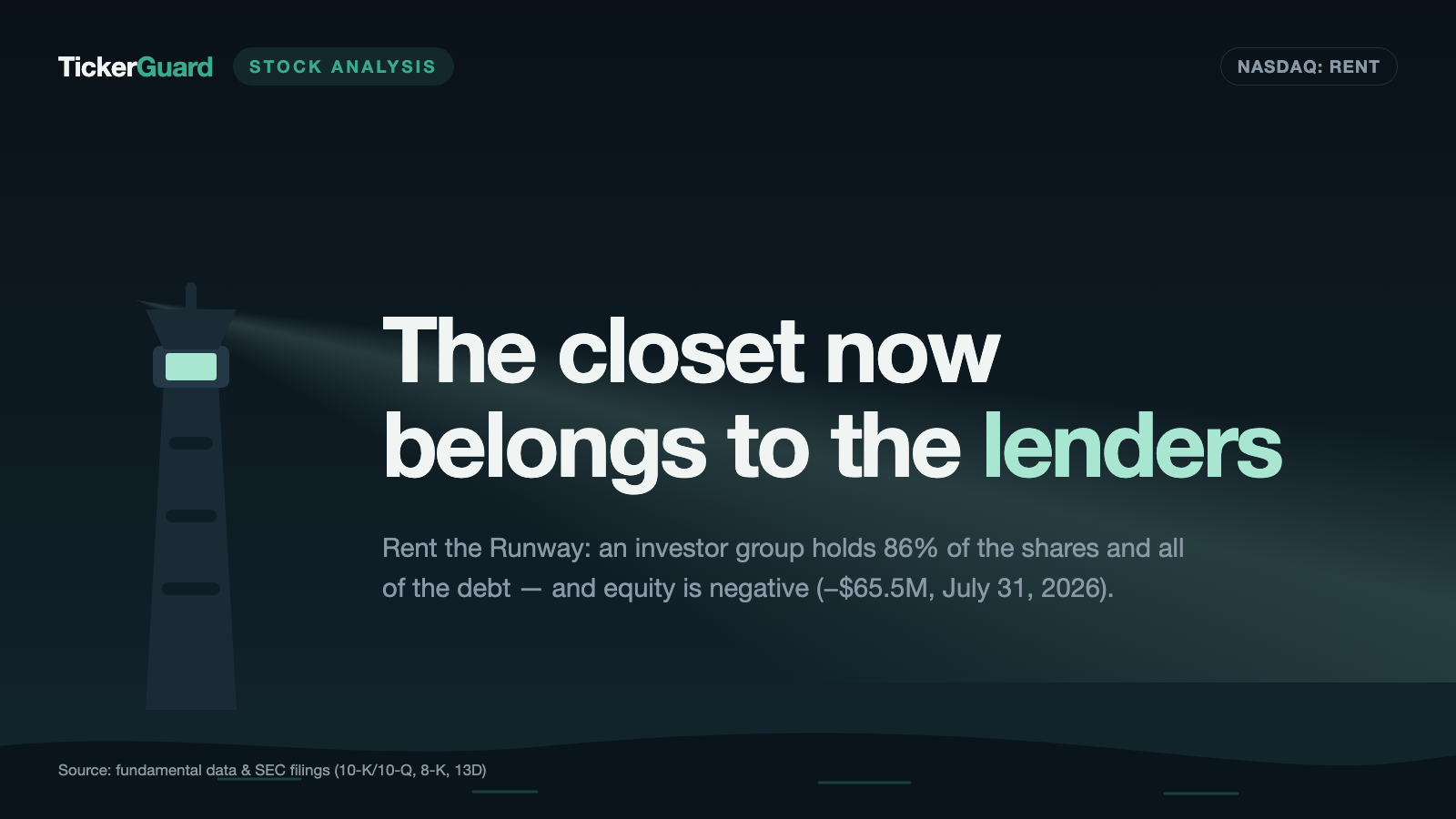
Rent the Runway rents designer clothing by subscription and reported the highest quarterly revenue in its history for the second quarter of 2026. At the same time, shareholders’ equity is negative, free cash flow has not been positive in any fiscal year since 2021, and after a debt-for-equity swap and a rights offering, one investor group holds 86.2 percent of the shares and the entire loan — of 4.2 million new shares in October 2026, about 5,900 were left for everyone else. Buy in today and you get a seat at the table, not the head of it.
 Thomas Mücke
Founder & Publisher
As of Today
As of: November 6, 2026
- Closing price
- 2.20 $ -3.52%
- Market Capitalisation
- 77.0 $M
- P/E
- 0.2
- Growth Score
- 4/10
- AAQS
- 1/10
Price change since November 6, 2026: +0.5%
This analysis has a cut-off date. The Stock Guard tells you when something material changes in the numbers. Reserve your free spot
Chart
Interactive price chart (TradingView).
52-week range: 1.60 $ to 9.40 $ · Last price: 2.20 $ (As of: November 6, 2026)
Note: pure fact-based analysis, not investment advice and not a solicitation to buy or sell. All figures without guarantee.
There is an investor weakness that strikes crashed stocks with particular reliability: anchoring. The brain remembers the first number it saw for a stock and measures everything afterward against it. At Rent the Runway (Nasdaq: RENT), that anchor is huge. On its first trading day, Oct. 27, 2021, the stock closed at $19.29 — after the 1-for-20 reverse stock split of April 2024, that equals $385.80. On Nov. 6, 2026, it closed at $2.19. “From almost $400 to $2 — that has to be cheap,” the anchor whispers. That exact sentence is what is making the stock interesting again on internet forums.
So let’s make a deal: before you trust the anchor, let’s read together what Rent the Runway itself has filed with the U.S. securities regulator, the SEC — the annual report (10-K) for fiscal 2025, the quarterly report (10-Q) as of July 31, 2026, and the current reports (8-K) through the close of the rights offering in October 2026. The central tension of this analysis runs through every chapter: The business is growing again — but the company now belongs overwhelmingly to its financiers. Buy a share today and you buy a small seat at a table where others make the decisions.
What Rent the Runway actually does
Rent the Runway (RTR) was founded in November 2009 and calls itself the “Closet in the Cloud.” Think of a library where you borrow designer dresses, coats and bags instead of books. Subscribers pay a monthly fee, receive a set number of items at home, wear them, send them back and swap them for new ones. Customers who don’t want a subscription can rent single pieces for an occasion (“Reserve”), and retired items are sold second-hand (“Resale”) at up to 90 percent off retail. According to the quarterly report, about 90 percent of revenue in the first half of 2026 came from subscribers.
The business has a built-in cost block you need to understand: the clothes are the product. RTR buys them, depreciates them over three years (accessories over two), cleans, repairs and ships them from its own fulfillment centers in New Jersey and Texas. As of Jan. 31, 2026, the company had 942 full-time and 73 part-time employees, most of them in those centers. Keep this in mind: At RTR, the closet is not a warehouse but the factory — and it wears out every month.
Company history for investors
-
2009
Founded in New York
Rent the Runway starts in November 2009 as a designer-dress rental. The later subscription model makes rental inventory its core — and its biggest cost.
-
2021
IPO on Nasdaq
First trading day on Oct. 27, 2021, closing at $19.29 — $385.80 after the later reverse split. For many investors, that price becomes the anchor.
-
2024
1-for-20 reverse stock split
Effective Apr. 2, 2024, to regain compliance with Nasdaq’s $1 minimum bid rule. It changes nothing about the company’s value, but every price comparison.
-
2025
Recapitalization and change of control
On Oct. 28, 2025, $234.2 million of debt is swapped for 26.2 million shares. Lender CHS then holds 59.9 percent of the voting power.
-
2026
New leadership, financiers at 86 percent
Co-founder Jennifer Hyman leaves in May, Paige Thomas takes over in September. After the October rights offering, the investor group holds 86.2 percent of the shares.
How the stock landed on our desk
No metrics scanner flagged Rent the Runway; other investors’ attention did. Our in-house Reddit hype scanner, which counts how often stocks are mentioned in Reddit forums, flagged RENT in early November 2026. The trail was already visible in trading: according to our fundamental data, about 6.7 million shares changed hands on Oct. 23, 2026, and about 26.1 million on Oct. 26, 2026 — on the other October days before that, volume ranged between roughly 65,000 and 200,000. The closing price rose from $1.71 on Oct. 14 to $2.82 on Oct. 26, a gain of more than 60 percent, and slipped back to $2.19 by Nov. 6.
One more number helps explain such moves: according to fundamental data (retrieved Nov. 7, 2026), about 1.76 million RENT shares were sold short — short sellers bet on falling prices. That is about one third of the roughly 5.2 million shares that, by our calculation, are not held by the investor group. With so few freely traded shares, even small buying waves can move the price sharply. That is neither a buy signal nor a warning — it is a sign that someone is telling a story right now. Our job is to hold that story up against the filings.
The numbers over the years: more revenue, never free cash
A note up front: RTR’s fiscal year ends on Jan. 31. “Fiscal 2025” therefore covers Feb. 1, 2025, through Jan. 31, 2026 — essentially calendar 2025.
First, what genuinely impresses. Revenue has grown clearly since the IPO, from $203.3 million in fiscal 2021 to $329.8 million in fiscal 2025. And 2026 picked up speed: in the second quarter (May through July 2026), RTR reported $97.7 million in revenue, up 20.8 percent year over year, and according to the earnings release an all-time high. Gross margin rose by about six percentage points to 36.1 percent, and the net loss roughly halved to $12.9 million. Adjusted EBITDA — a profit measure before interest, taxes, depreciation and amortization from which the company strips out further items — came to $12.6 million, or 12.9 percent of revenue.
Now the curve that shows what is left after all bills and purchases — free cash flow, meaning operating cash flow plus investing cash flow:
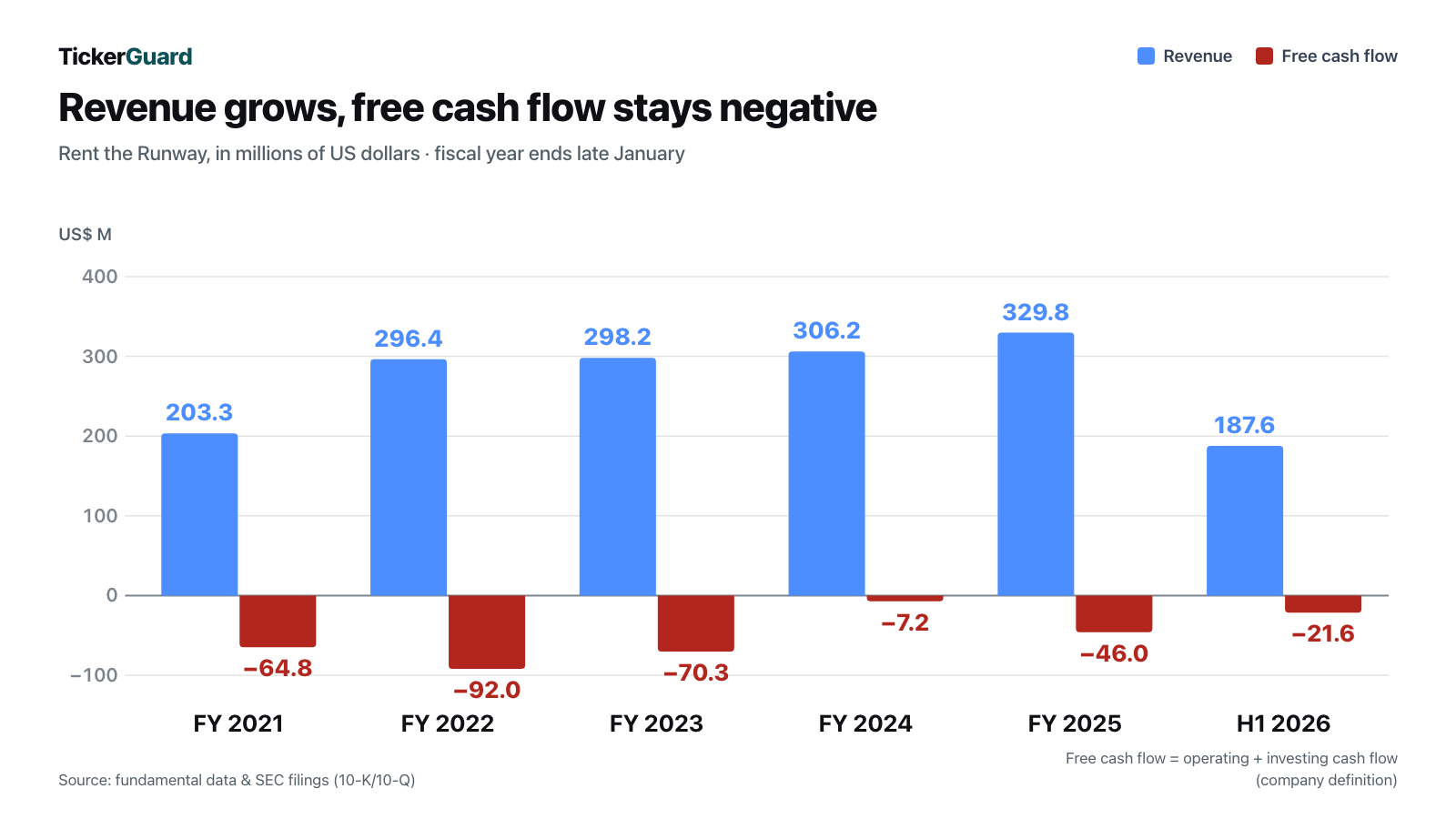
Free cash flow has not been positive in a single fiscal year since 2021. The closest call was 2024 at −$7.2 million; in 2025 it slid to −$46.0 million because RTR sharply increased rental product purchases ($75.9 million in cash, up from $49.2 million). Another $21.6 million flowed out in the first half of 2026. That is also the catch in adjusted EBITDA: it excludes rental product depreciation — $14.7 million in the second quarter of 2026 alone. For a rental company, that is not a side item but the wear and tear of the actual product. Keep this in mind: Adjusted EBITDA shows a company without clothing costs. No such company exists.
Where the cash stands, the company says itself — with a notable qualification:
“The Company expects that its existing resources and future cash flows from operations and cash and cash equivalents, will provide it with sufficient liquidity to meet its obligations for at least the next twelve months from the issuance date of these financial statements.”
— Rent the Runway, Inc., SEC quarterly report 10-Q as of July 31, 2026, Note 3 “Liquidity”
The same section describes the situation behind it: $29.0 million in cash as of July 31, 2026, no remaining borrowing availability, an additional $10 million loan from its own financiers on Sept. 1, 2026 — and the sentence that the company plans to explore “additional funding sources.” The next source of money came in October 2026, and it leads straight to the uncomfortable truths.
What the filings say — the uncomfortable truths
Uncomfortable truth No. 1: The 2025 profit was a bookkeeping entry
Anyone who only looks at the bottom line sees something new for fiscal 2025: net income of $22.6 million, after losses of $211.8 million (2021), $138.7 million (2022), $113.2 million (2023) and $69.9 million (2024). But that profit did not come from the clothing business. It came from the recapitalization of Oct. 28, 2025, in which the main lender swapped most of its claims for shares:
“As the carrying value of debt reduced by the fair value of the equity issued exceeded the total undiscounted future cash payments, the Company recognized a gain on troubled debt restructuring, net of allocated transaction costs of $11.8 million incurred, of $96.3 million during the year ended January 31, 2026.”
— Rent the Runway, Inc., SEC annual report 10-K for fiscal 2025, Note 9 “Long-Term Debt”

In everyday terms: the bank forgives part of your mortgage because you sign over a large part of your house. On paper you are richer afterward — but only because you own less. Without that entry, an operating loss of $57.5 million remains, larger than the year before ($47.5 million). If a database shows RENT with a low price-to-earnings ratio, this one-off is what you are seeing. Keep this in mind: A profit from swapping debt for shares cannot be repeated.
Uncomfortable truth No. 2: The interest has not gone away — it is being added to the tab
The second-quarter 2026 income statement looks reassuring: net interest expense fell to $0.2 million, from $6.9 million a year earlier. That is not because RTR hardly owes anything — as of July 31, 2026, the books showed $120.0 million of term loans plus $5.4 million of accrued interest. It is because of the accounting and a payment holiday:
“Pursuant to the Second Amendment, from April 1, 2026 to May 3, 2027, interest payable on the term loans under the New Credit Agreement will be capitalized and added to the principal amount of the term loan outstanding at the end of each fiscal quarter. This transaction was accounted for as a debt modification. The effective interest rate of the new term loans issued to the Lender as of July 31, 2026 was 0.48%.”
— Rent the Runway, Inc., SEC quarterly report 10-Q as of July 31, 2026, Note 6 “Long-Term Debt”
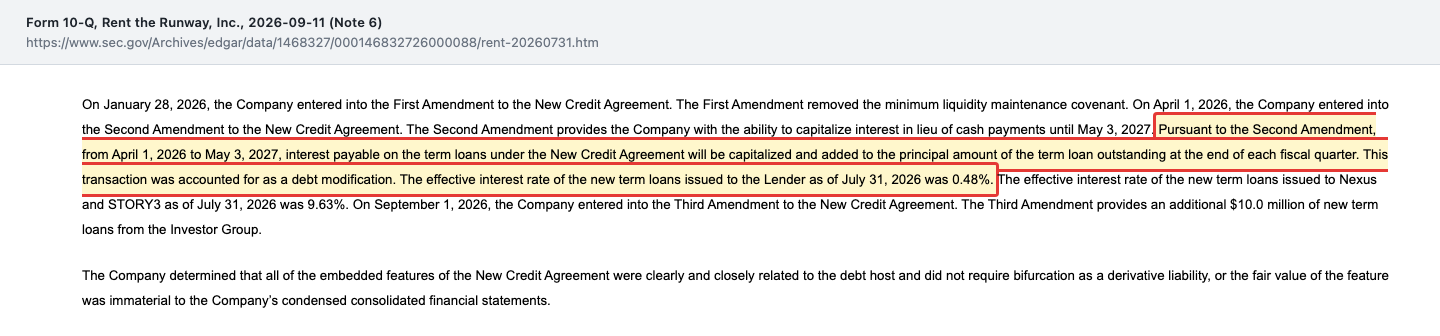
Two things are packed into those sentences. First, the contractual interest, per the annual report, is a reference rate (SOFR) plus 5.00 percentage points — it is simply not paid in cash but added to the loan, $2.7 million in the second quarter of 2026. Second, the 0.48 percent is an accounting effect. In the restructuring, all future payments to the main lender were booked up front as debt, so the interest barely appears as an expense even though it still has to be paid. The loan therefore grows every quarter, and another $10 million of new loans was added on Sept. 1, 2026. Everything matures on Oct. 28, 2029. Keep this in mind: What looks like an interest-free loan in the income statement is a loan with a payment holiday.
Uncomfortable truth No. 3: The majority decides alone — and it is getting bigger
On Oct. 28, 2025, RTR closed the recapitalization: main lender CHS US Investments exchanged $100 million of its claims for a new loan and the rest for 26,175,193 new shares; together with investors Nexus and STORY3, it provided $20 million of new loans. According to the 8-K filed on Oct. 29, 2025, this constituted a change of control. Since then:
“The Investor Group held 84% of the voting power of the Company’s outstanding Class A Common Stock as of July 31, 2026.”
— Rent the Runway, Inc., SEC quarterly report 10-Q as of July 31, 2026, Note 13 “Related Party Transactions”
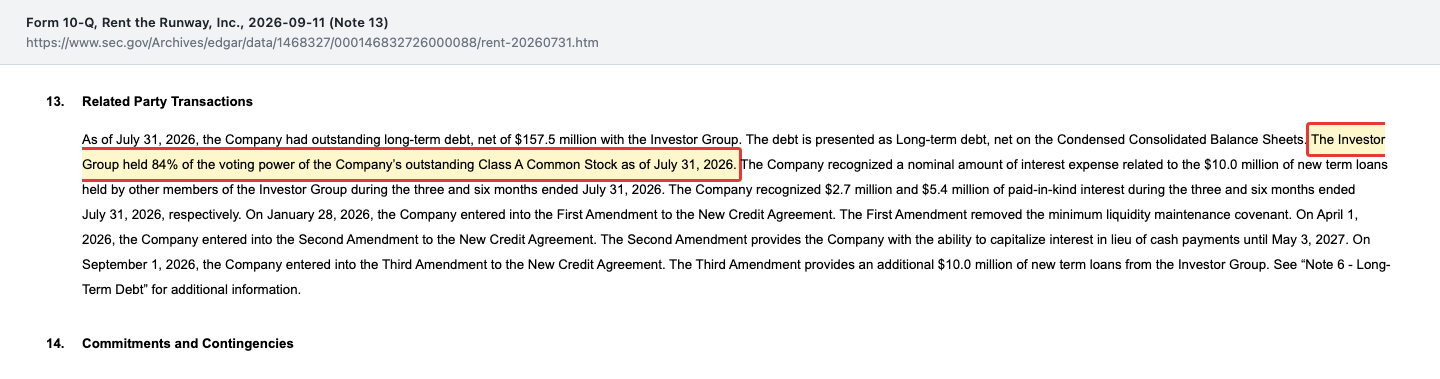
That makes RTR a “controlled company” under Nasdaq rules, allowed to skip some protections for minority shareholders. The company says so itself in its risk factors: “Our stockholders do not have the same protections as those afforded to stockholders of companies that are not “controlled,” which could make our Class A common stock less attractive to investors or otherwise harm our stock price.” (10-Q as of July 31, 2026, Item 1A).
Back in October 2025, RTR had already completed a first rights offering of $12.5 million at $4.08 per share; of the 3,063,725 new shares, the investor group took 2,320,769 through its backstop (8-K of Oct. 29, 2025). In October 2026, the majority then grew even larger. RTR again offered all shareholders subscription rights: $15 million of new shares at $3.55 apiece. But on the record date, Sept. 25, 2026, the stock traded at just $1.67, according to the prospectus. Hardly any outside shareholder pays more than double the market price — and that is exactly what happened:
“(I) All shares issued in satisfaction of the Backstop Commitment and (II) 2,495,391 shares issued to the Investor Group as subscribers in connection with the Rights Offering, were issued in a transaction pursuant to Section 4(a)(2) of the Securities Act of 1933, as amended (the “Securities Act”).”
— Rent the Runway, Inc., SEC current report 8-K of Oct. 26, 2026, Item 8.01
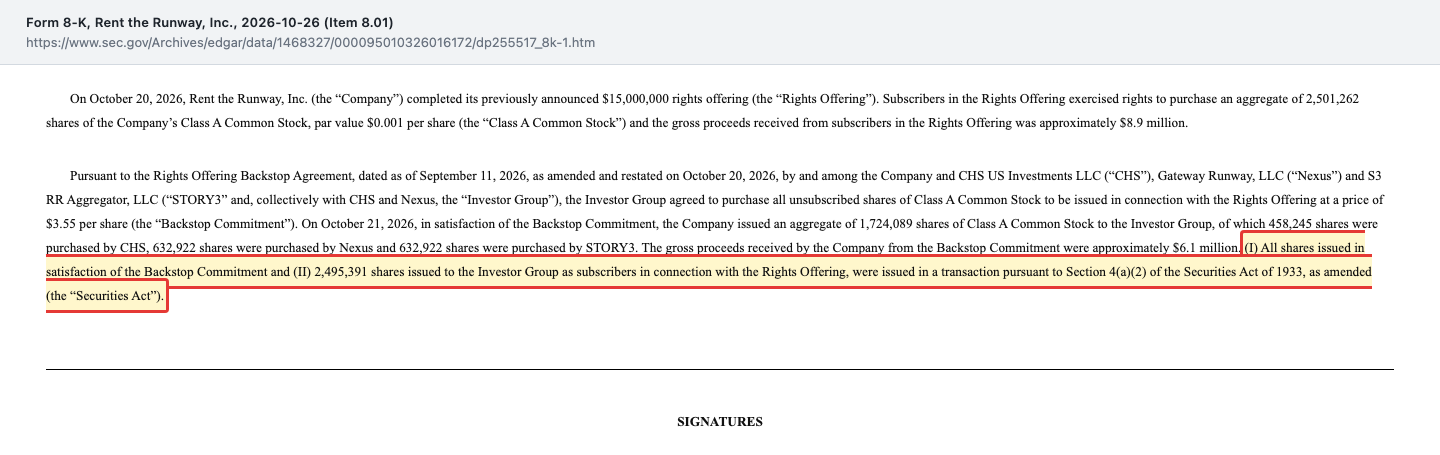
Let’s do the math: 4,225,351 new shares were created in total. The investor group took 2,495,391 as a subscriber and 1,724,089 through its backstop — 4,219,480 shares combined. That left about 5,900 shares for everyone else. According to their beneficial ownership filings (Schedule 13D/A of Oct. 23, 2026), CHS now holds 60.4 percent, and Nexus and STORY3 hold 12.9 percent each — 86.2 percent combined. To be fair: the financiers put in fresh money at more than twice the market price instead of piling on new debt. For small shareholders, the result is still this: Their slice of the pie has shrunk to a fraction in a year and a half.
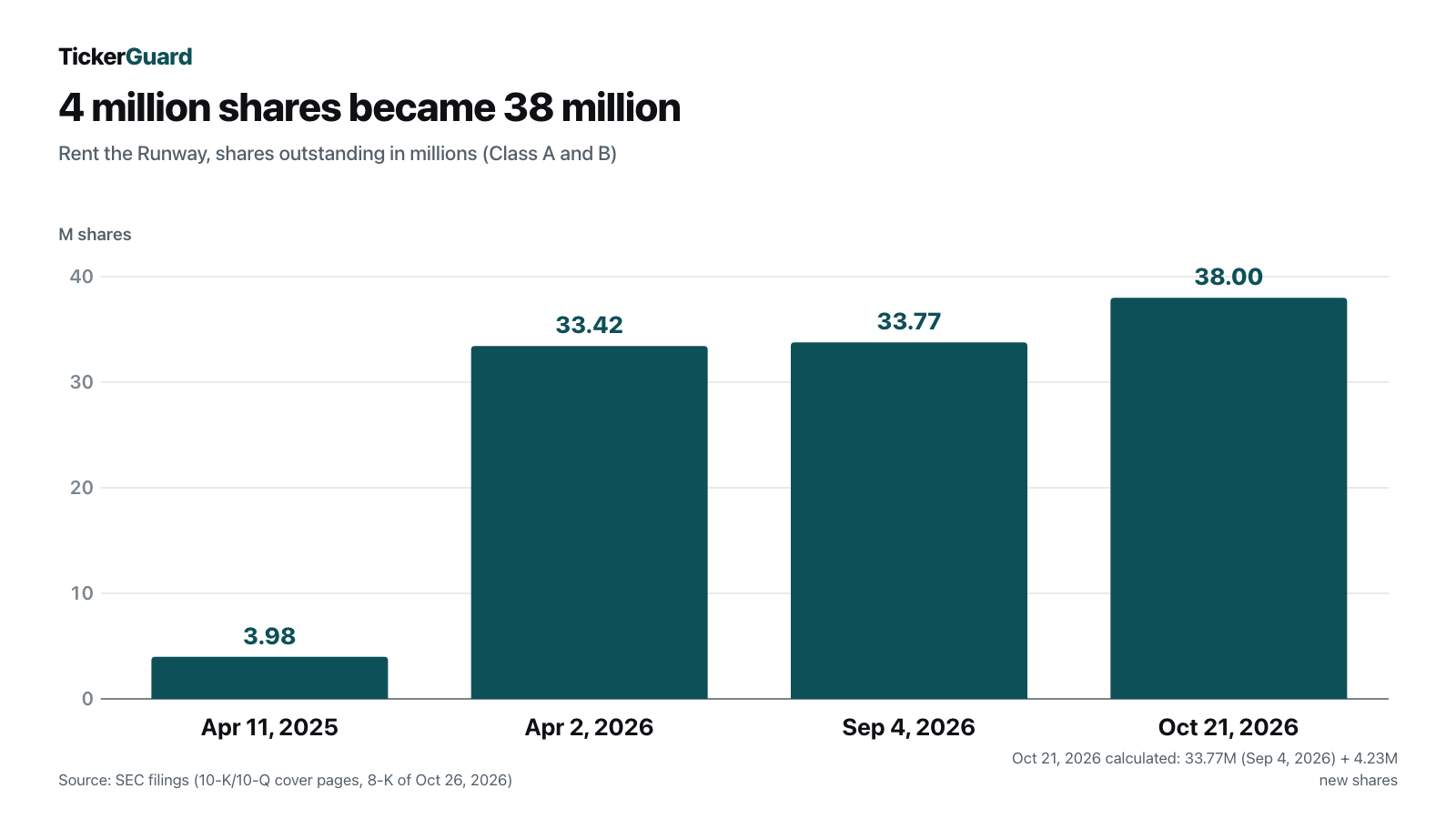
We described a similar pattern — debt swapped for shares, existing shareholders heavily diluted — in our analysis of Beyond Meat. At RTR, there is an added twist: lender and majority owner are the same parties. Whoever negotiates interest holidays, new loans and new shares sits on both sides of the table.
Uncomfortable truth No. 4: Fewer active subscribers, new leadership, negative equity
The second-quarter 2026 revenue gain came only marginally from more customers. Active subscribers stood at 140,826 as of July 31, 2026 — 3.8 percent fewer than a year earlier (146,373) and fewer than at fiscal year-end on Jan. 31, 2026 (143,796). According to the quarterly report, the gain came mainly from higher revenue per subscriber — subscription prices were raised in August 2025 — and from more resale purchases; average active subscribers grew by only 1.0 percent. Higher prices on a shrinking period-end base are growth that cannot be repeated indefinitely. For the third quarter of 2026, the company expects revenue of $87 million to $90 million and a negative adjusted EBITDA margin of −3 to −6 percent; for the full fiscal year, it reaffirmed double-digit revenue growth and an adjusted EBITDA margin of 4 to 7 percent.
At the same time, the top was replaced. Co-founder Jennifer Hyman stepped down as CEO effective May 15, 2026, and advises the company through January 2027 for $62,500 a month (8-K of May 13, 2026); CFO Siddharth Thacker left in early June 2026. After an interim CEO, Paige Thomas has led the company since Sept. 14, 2026; she joined in June 2026 as Chief Commercial Officer and previously ran Saks OFF 5TH. On top of that comes a settlement of the IPO class action: $9.0 million, of which $3.1 million in cash from RTR, $2.9 million from insurers and $3.0 million in stock or cash; the court set the final approval hearing for Dec. 15, 2026.
And beneath it all lies the balance sheet: as of July 31, 2026, assets of $192.4 million faced liabilities of $257.9 million. Shareholders’ equity was negative at −$65.5 million, and accumulated losses since founding total $1,132.2 million. A company in this position does not live on its own strength but on its financiers continuing to play along.
Valuation: what $2 a share really buys
A price-to-earnings ratio is worthless here: the only annual profit came from the restructuring. A price-to-book ratio doesn’t work because equity is negative. That leaves price-to-sales. At $2.19 (close Nov. 6, 2026) and about 38.0 million shares, the market value was about $83 million. Revenue over the last twelve reported months (August 2025 through July 2026) was $366.9 million. That gives a price-to-sales ratio of about 0.23 — the market values one dollar of revenue at 23 cents. A note on the metric boxes on this page, which come automatically from our database: their market value may still be based on the share count before the rights offering (33.77 million), and any price-to-earnings ratio shown there is distorted by the restructuring gain.
That sounds cheap, and this is exactly where the anchor from the beginning takes hold. Because the financiers stand ahead of the shareholders: the loan comprises $120.0 million of principal and $5.4 million of accrued interest (July 31, 2026) plus the additional $10 million loan of Sept. 1, 2026 — at least $135.4 million combined, more than the entire market value. Cash was $29.0 million as of July 31, 2026; afterward, $10 million of loans and $15 million gross from the rights offering came in. That $25 million roughly equals one half-year of free cash outflow ($21.6 million in the first half of 2026) — a current cash figure will only come with the next quarterly report as of Oct. 31, 2026. Our fundamental data (retrieved Nov. 7, 2026) contain no analyst consensus with current ratings. How another fashion business built on pre-owned designer goods holds up in its filings is shown in our analysis of The RealReal. At RTR, the rule is: Whoever buys the stock buys what is left after the financiers — and the financiers largely decide how big that is.
Upside and risks at a glance
What speaks for Rent the Runway:
- Growth is back: $97.7 million in revenue in the second quarter of 2026, up 20.8 percent and a record quarter; gross margin 36.1 percent (prior year 30.0).
- Well-known brand with recurring revenue: about 90 percent of revenue from subscribers, about 3.5 million lifetime customers according to the company.
- Financiers keep backing it: a $10 million additional loan (September 2026) and $15 million through the rights offering at $3.55 per share (October 2026), more than twice the Sept. 25 market price.
- Debt cut done: $234.2 million of debt was swapped for shares in 2025, the rest runs until Oct. 28, 2029, and cash interest is paused until May 3, 2027.
- A new CEO with retail experience (Saks OFF 5TH, Nordstrom Rack) since Sept. 14, 2026; AI-powered outfit suggestions available to all customers since June 2026.
What speaks against it:
- Negative equity of $65.5 million and $29.0 million in cash as of July 31, 2026.
- No free cash: free cash flow negative in every fiscal year since 2021, −$21.6 million in the first half of 2026.
- Control by one group: 86.2 percent of the shares and the entire loan with the same financiers, a “controlled company” with fewer minority protections.
- Massive dilution: from 3.98 million shares (April 2025) to about 38.0 million (October 2026).
- Declining active subscribers (−3.8 percent as of July 31, 2026), a negative EBITDA outlook for the third quarter, and turnover in the CEO and CFO roles in 2026.
A human conclusion
Back to the anchoring from the beginning. The anchor says: the stock once stood at the equivalent of $385.80, now it’s $2.19 — so it must be cheap. The filings tell a different story. The 2021 share and today’s share are no longer the same thing: through the reverse split, the debt swap and the rights offerings, one stake has become many small ones, and the majority sits with the financiers who also own the entire loan. The old price is no longer a yardstick for the new one.
That doesn’t mean RTR has to fail. The business is growing again, the financiers just put in fresh money above the market price, and a new CEO has taken over. So the honest question for you is not “How far has the stock fallen?” but: Do you believe that, in the end, enough will be left for the 14 percent outside the investor group — after the loan, accrued interest and every future funding round? If yes, you have a thesis. If not, you had an anchor. What you make of it is your decision. And that is how it should be.
Sources
All original documents used in this analysis — to read for yourself:
- Rent the Runway, Inc. — Quarterly report 10-Q as of July 31, 2026 (filed Sept. 11, 2026)
- Rent the Runway, Inc. — Current report 8-K of Sept. 11, 2026 (Item 2.02) with Exhibit 99.1, second-quarter 2026 earnings release with outlook
- Rent the Runway, Inc. — Current report 8-K of Oct. 26, 2026: completion of the rights offering
- Rent the Runway, Inc. — Prospectus 424B3 of Sept. 30, 2026, for the rights offering
- Rent the Runway, Inc. — Current report 8-K of Sept. 11, 2026: rights offering backstop agreement (Item 1.01)
- Rent the Runway, Inc. — Current report 8-K of Sept. 1, 2026: $10 million incremental loan (Item 1.01)
- Rent the Runway, Inc. — Current report 8-K of Sept. 4, 2026: class action settlement (Item 1.01)
- Rent the Runway, Inc. — Quarterly report 10-Q as of April 30, 2026 (filed June 3, 2026)
- Rent the Runway, Inc. — Current report 8-K of May 13, 2026: Jennifer Hyman’s resignation (Item 5.02)
- Rent the Runway, Inc. — Annual report 10-K for fiscal 2025 (filed Apr. 14, 2026)
- Rent the Runway, Inc. — Annual report 10-K for fiscal 2024 (filed Apr. 15, 2025)
- Rent the Runway, Inc. — Current report 8-K of Oct. 29, 2025: recapitalization and change of control
- Beneficial ownership filings of the major shareholders (Schedule 13D/A of Oct. 23, 2026) and the full filing history: EDGAR, CIK 0001468327
- Fundamental data (prices and trading volume through Nov. 6, 2026, short interest; retrieved Nov. 7, 2026), cross-checked against the Sept. 25, 2026, price stated in the Sept. 30, 2026, prospectus.
- Earnings call transcripts were not evaluated; the analysis is based solely on the mandatory SEC filings.
Transparency & disclaimer: This analysis is a journalistic assessment of publicly available information and does not constitute investment advice, a regulated financial analysis, or a solicitation to buy or sell securities. Equity investments carry substantial risk, including total loss. All information is provided without guarantee; the data date is noted throughout the text. Positions held by the operator are disclosed daily; where one exists, it appears as a notice at the top of this deep dive.
Key figures at a glance
All monetary figures in millions of $; earnings per share as reported.
| Metric | 2022 | 2023 | 2024 | 2025 | 2026 |
|---|---|---|---|---|---|
| Revenue | 203.3 | 296.4 | 298.2 | 306.2 | 329.8 |
| Operating Income (EBIT) | -122.0 | -82.1 | -72.0 | -47.3 | -57.5 |
| Net Income | -211.8 | -138.7 | -113.2 | -69.9 | 22.6 |
| Net Margin | -104.2% | -46.8% | -38.0% | -22.8% | 6.9% |
| Earnings Per Share | -67.20 $ | -43.17 $ | -33.12 $ | -18.51 $ | 1.88 $ |
Source: fundamental data & SEC filings (annual and quarterly reports, 10-K/10-Q)
Our Bottom Line at a Glance
- Revenue & growth positive
- Record quarter with $97.7 million in revenue (Q2 2026, up 20.8 percent), gross margin 36.1 percent. In fiscal 2025, revenue grew 7.7 percent to $329.8 million.
- Earnings power & cash flow negative
- Free cash flow negative in every fiscal year since 2021 (FY 2025: −$46.0 million, H1 2026: −$21.6 million). The 2025 net income stems from a $96.3 million restructuring gain; operating result −$57.5 million.
- Balance sheet & debt negative
- Equity −$65.5 million, cash $29.0 million (July 31, 2026). Loan of $120.0 million plus accrued interest and a $10 million additional loan; cash interest is paused only until May 3, 2027.
- Ownership & control negative
- The investor group holds 86.2 percent of the shares and the entire loan (13D/A of Oct. 23, 2026); RTR is a “controlled company” with fewer minority protections.
- Dilution negative
- Share count from 3.98 million (April 2025) to about 38.0 million (October 2026) through the debt swap and two rights offerings (October 2025 at $4.08, October 2026 at $3.55).
- Customer base & leadership neutral
- Active subscribers down 3.8 percent to 140,826 (July 31, 2026); co-founder and CFO left in 2026, new CEO since Sept. 14, 2026. The financiers put in fresh money at $3.55 per share in October 2026.
Rent the Runway is growing again and reported a record quarter in the second quarter of 2026. But equity is negative, free cash flow has not been positive in any fiscal year since 2021, and the only annual profit came from the restructuring. After the debt swap and the rights offering, the investor group owns 86.2 percent of the shares and the entire loan, and the share count has grown almost tenfold in a year and a half. Not investment advice.
What Our Rating Means
Substance risk
We found at least one documented issue that threatens the company itself — regardless of how the stock is currently valued.
Red here stands for a documented substance risk: equity is negative at −$65.5 million (July 31, 2026), free cash flow has been negative in every fiscal year since 2021, and the $29.0 million cash balance holds up only because the same financiers who own 86.2 percent of the shares provide the loan, the interest holiday and new equity. That dependence on a single investor group is existential. The 2026 revenue growth is real but does not change this assessment as long as it generates no free cash; the low share price is a price argument, not a quality argument. The decision is yours.
A journalistic assessment by our editorial team at the time of the deep dive, based on public sources — not investment advice and not a solicitation to buy or sell. Your personal circumstances (investment goals, risk capacity, taxes) cannot be taken into account. What our levels mean, how verdicts are formed, and what conflicts of interest exist →
Worth Noting
- Data as of: balance sheet, earnings and cash flow figures as of July 31, 2026 (10-Q filed Sept. 11, 2026) or Jan. 31, 2026 (10-K filed Apr. 14, 2026); share count per the 10-Q cover as of Sept. 4, 2026, plus 4,225,351 new shares per the 8-K of Oct. 26, 2026; stakes per Schedule 13D/A of Oct. 23, 2026; prices, trading volume and short interest per fundamental data (close Nov. 6, 2026, retrieved Nov. 7, 2026). All SEC filings through Nov. 7, 2026, were reviewed; the quarterly report as of Oct. 31, 2026, was not yet available.
- Any price-to-earnings ratio shown in databases is distorted by the $96.3 million restructuring gain (October 2025) and says nothing about ongoing earnings power.
- The fiscal year ends January 31: “fiscal 2025” = Feb. 1, 2025, through Jan. 31, 2026. All prices before April 2024 must be adjusted for the 1-for-20 reverse stock split (effective Apr. 2, 2024).
Stock Watch
This analysis is as of November 7, 2026. Stock Watch will tell you what's changed at RENT since then.
Later $1 a month per stock — signing up is free, and you'll be the first to know when it launches.
The full analysis as a PDF for later
We will send you this analysis as a PDF — to print, file away, and read at your own pace. And we will add you to the free Stock Watch list for Rent the Runway Inc (RENT), so you hear about it when something material in this analysis changes.
Frequently Asked Questions
Rent the Runway (Nasdaq: RENT), based in Brooklyn, New York, rents designer apparel by subscription: customers pay monthly, receive clothes at home, wear them and swap them for new ones. It also offers one-off rentals for occasions and sells pre-owned items. About 90 percent of revenue in the first half of 2026 came from subscribers.
Mostly its financiers. After the October 2025 recapitalization and the October 2026 rights offering, an investor group of CHS US Investments (60.4 percent), Nexus and STORY3 (12.9 percent each) holds 86.2 percent of the shares combined (Schedule 13D/A of Oct. 23, 2026). The same group also holds the entire loan.
The $22.6 million net income for fiscal 2025 (ended Jan. 31, 2026) came from a $96.3 million accounting gain on the recapitalization, in which the lender swapped $234.2 million of debt for shares. The operating loss widened to $57.5 million, from $47.5 million the year before.
As of July 31, 2026, the books showed $120.0 million of term loans plus $5.4 million of accrued interest; another $10 million was added on Sept. 1, 2026. The loan runs until Oct. 28, 2029, at SOFR plus 5.00 percentage points. Until May 3, 2027, interest is not paid in cash but added to the loan.
Rent the Runway raised $15 million and issued 4,225,351 new shares at $3.55 — on the Sept. 25, 2026, record date, the stock traded at $1.67. The investor group took 4,219,480 of the new shares, leaving about 5,900 for all other shareholders. Its stake rose to 86.2 percent.
Like many fashion retailers, Rent the Runway closes its fiscal year on Jan. 31, after the holiday season. Fiscal 2025 therefore covers Feb. 1, 2025, through Jan. 31, 2026, and the second quarter of 2026 covers May through July 2026. The shares have also been consolidated 1-for-20 since April 2024.
Found an error?
Did you spot a factual error, an outdated number, or a typo in this deep dive? Let us know briefly — your report goes straight to the editorial team.