Unisys: The Pension Gap Is More Than Twice the Company’s Market Value
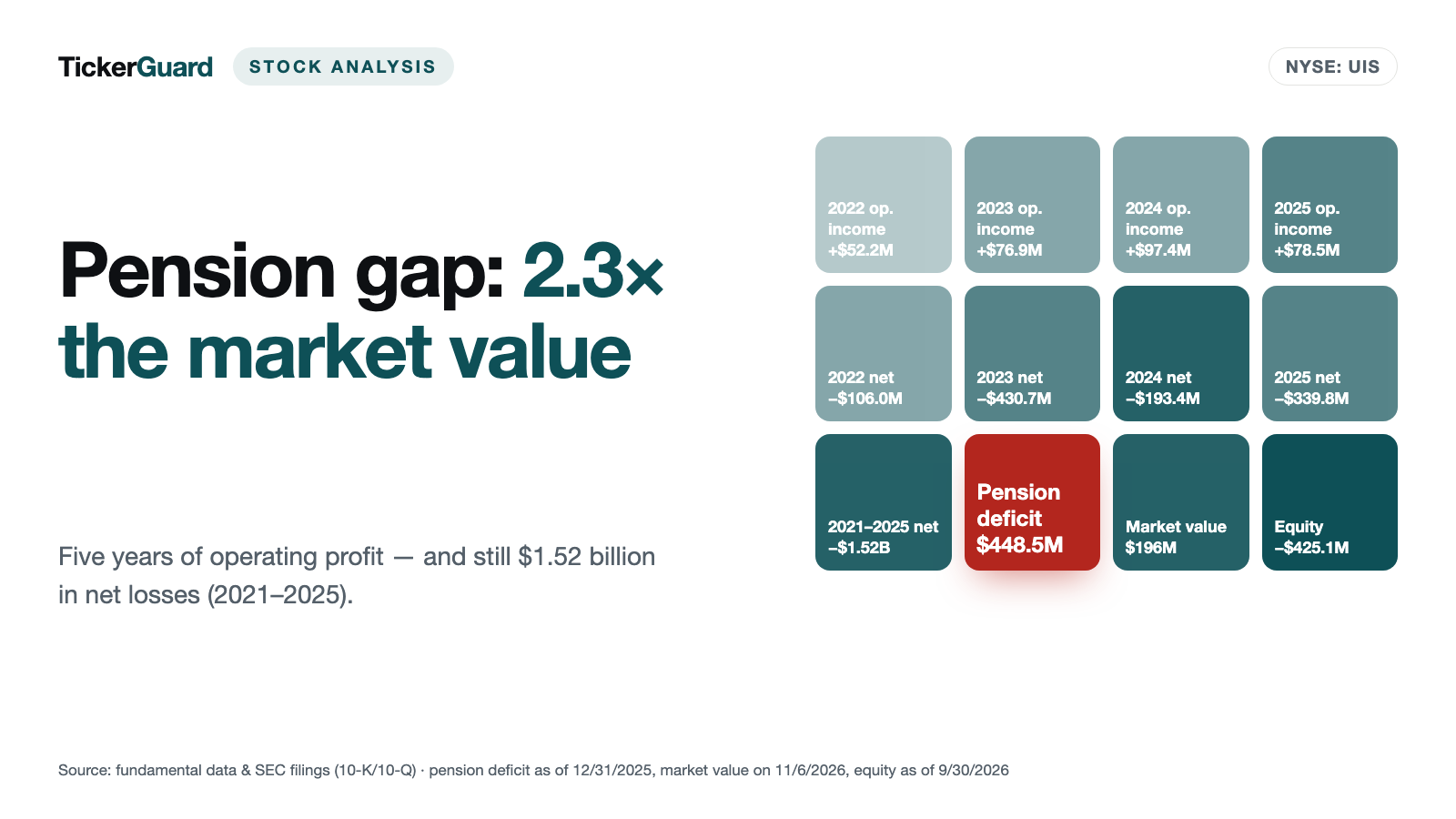
150 years of corporate history are not a pension fund: the Unisys pension plans’ funding deficit alone ($448.5 million at the end of 2025) is more than twice the company’s market value (about $196 million on November 6, 2026). The business has posted an operating profit every year since 2021 — and a net loss every year as well, $1.52 billion combined through 2025. Add stockholders’ equity of minus $425.1 million, notes at a 10.625 percent coupon and full-year guidance that rides on a single quarter.
 Thomas Mücke
Founder & Publisher
As of Today
As of: November 6, 2026
- Closing price
- 2.70 $ +9.35%
- Market Capitalisation
- 0.2 $B
- Growth Score
- 4/10
- AAQS
- 3/10
Price change since November 6, 2026: +0.4%
This analysis has a cut-off date. The Stock Guard tells you when something material changes in the numbers. Reserve your free spot
Chart
Interactive price chart (TradingView).
52-week range: 2.00 $ to 4.80 $ · Last price: 2.70 $ (As of: November 6, 2026)
Note: pure fact-based analysis, not investment advice and not a solicitation to buy or sell. All figures without guarantee.
There is an investor weakness that hits old, familiar names especially reliably: the legacy bonus. It goes like this: a company that has been around for generations, whose name appears in every history of computing, that serves banks, travel and transportation companies — a company like that, the brain insists, cannot really be in trouble. With Unisys (NYSE: UIS), that bonus is especially large. The company itself advertises that it has been helping clients for more than 150 years. And after a slide, the stock looks like a bargain: it cost $6.47 at the start of 2025 and $2.69 on November 6, 2026.
So let’s make a deal: before you give in to the legacy bonus, let’s read together what Unisys itself has reported to the U.S. securities regulator, the SEC — the annual reports (10-K) for 2023 through 2025, the quarterly reports (10-Q) through the third quarter of 2026, filed on November 5, 2026, and the earnings releases (8-K). The central tension of this analysis runs through every chapter: the ongoing business makes money — but the burdens of the past, above all pensions, eat it up again year after year. What you make of it is your call.
What Unisys actually does
Unisys is an IT services company headquartered in Blue Bell, Pennsylvania. It looks after the computing estate of large companies and government agencies — think of it as the building manager for a corporation’s technology. It repairs, maintains, modernizes and runs. According to the 2025 annual report, Unisys employed about 15,000 people as of December 31, 2025, including 4,200 in India and 2,300 in the United States. No single client accounted for more than 10 percent of 2025 revenue.
The business has three parts. Digital Workplace Solutions (DWS) runs service desks and on-site support for workplaces. Cloud, Applications & Infrastructure Solutions (CA&I) moves applications to the cloud and operates them. And Enterprise Computing Solutions (ECS) holds the company’s crown jewel: ClearPath Forward, a proprietary mainframe operating environment on which, according to the annual report, clients in financial services, travel and transportation, healthcare and the public sector process transactions at scale. Since the second quarter of 2026, these software licenses and the related support have simply been called “ClearPath” in the filings (previously “License and Support”); everything else is “Technology Solutions & Services” (TS&S).
The gap between the two worlds is huge. In the third quarter of 2026, ClearPath earned a gross margin of 73.1 percent, the rest of the services business 16.6 percent. Keep this picture in mind: a small, highly profitable software island carries a large, rather thin-margin services business. That matters because the island does not deliver its revenue evenly, but in big chunks — more on that later.
Company history for investors
-
2022
Cyberattack and control weaknesses
Attackers exfiltrate source code from a software lab; at the end of 2022, Unisys reports material weaknesses in its internal controls. A warning sign for shareholders; the control weaknesses were later remediated.
-
2023
Pensions transferred to insurers
Unisys transfers obligations for about 12,550 retirees to insurers. Settlement losses from pension transfers of $348.9 million in 2023 push the annual net loss to $430.7 million.
-
2024
Settlement with the SEC
On Oct. 22, 2024, Unisys settles the SEC proceeding over its cybersecurity risk disclosures with a $4 million civil penalty, without admitting wrongdoing. In December, a settlement with Atos brings in $40 million.
-
2025
Expensive new notes, extra pension payment
In June, Unisys issues $700 million in notes at 10.625 percent and makes a discretionary $250 million contribution to its U.S. pension plans. The pension deficit falls to $448.5 million.
-
2026
Write-off, next pension transfer, guidance raised
DWS goodwill is fully written off, and the next pension transfer follows in September. In November, Unisys raises its revenue guidance — equity stands at −$425.1 million.
How the stock landed on our desk
Unisys made our research list through the Reddit hype scanner — in other words, through unusually heavy attention in investor forums. The share price supplies the backdrop: on November 4, 2026, the day of the third-quarter earnings release, the stock closed at $2.35; two trading days later it closed at $2.69 — a gain of just over 14 percent. On November 5 and 6, more than 2.5 million shares changed hands each day, about three and a half times the average of the 50 trading days before November 4 (about 0.72 million; our own analysis of daily closing data, as of November 7, 2026).
The longer curve is less friendly: on January 2, 2025, the stock cost $6.47; on December 31, 2025, it was $2.76. In the twelve months through November 6, 2026, the closing price ranged from $2.00 (April 10, 2026) to $4.78 (June 1, 2026). Our fundamental data (retrieved November 7, 2026) also show about 5.8 million shares sold short, roughly 9 percent of the float — a noticeable group is betting on falling prices. The Piotroski score, a report card for balance-sheet quality from 0 to 9 points, stands at 1. A truly healthy company scores 8 or 9; a 1 is a warning sign we checked against the filings — the uncomfortable truths below confirm it.
The numbers over the years: the business earns, the bottom line loses
First, what genuinely impresses. Unisys posted an operating profit in every year from 2021 through 2025 — it took in more than the ongoing business cost: $154.0 million (2021), $52.2 million (2022), $76.9 million (2023), $97.4 million (2024) and $78.5 million (2025). And that is after goodwill impairments of $39.1 million and $55.0 million in 2024 and 2025. Excluding such items, Unisys reports 2025 non-GAAP operating profit of $176.9 million, a 9.1 percent margin. The latest quarter looks solid too: third-quarter 2026 revenue rose 2.5 percent to $471.5 million, the non-GAAP margin reached 7.2 percent after 5.4 percent a year earlier, and new business — the value of newly signed contracts — grew 78 percent to $221 million. Backlog stood at $2.92 billion at the end of September 2026.
Now for the chart that grounds the legacy bonus — operating income and net income side by side:
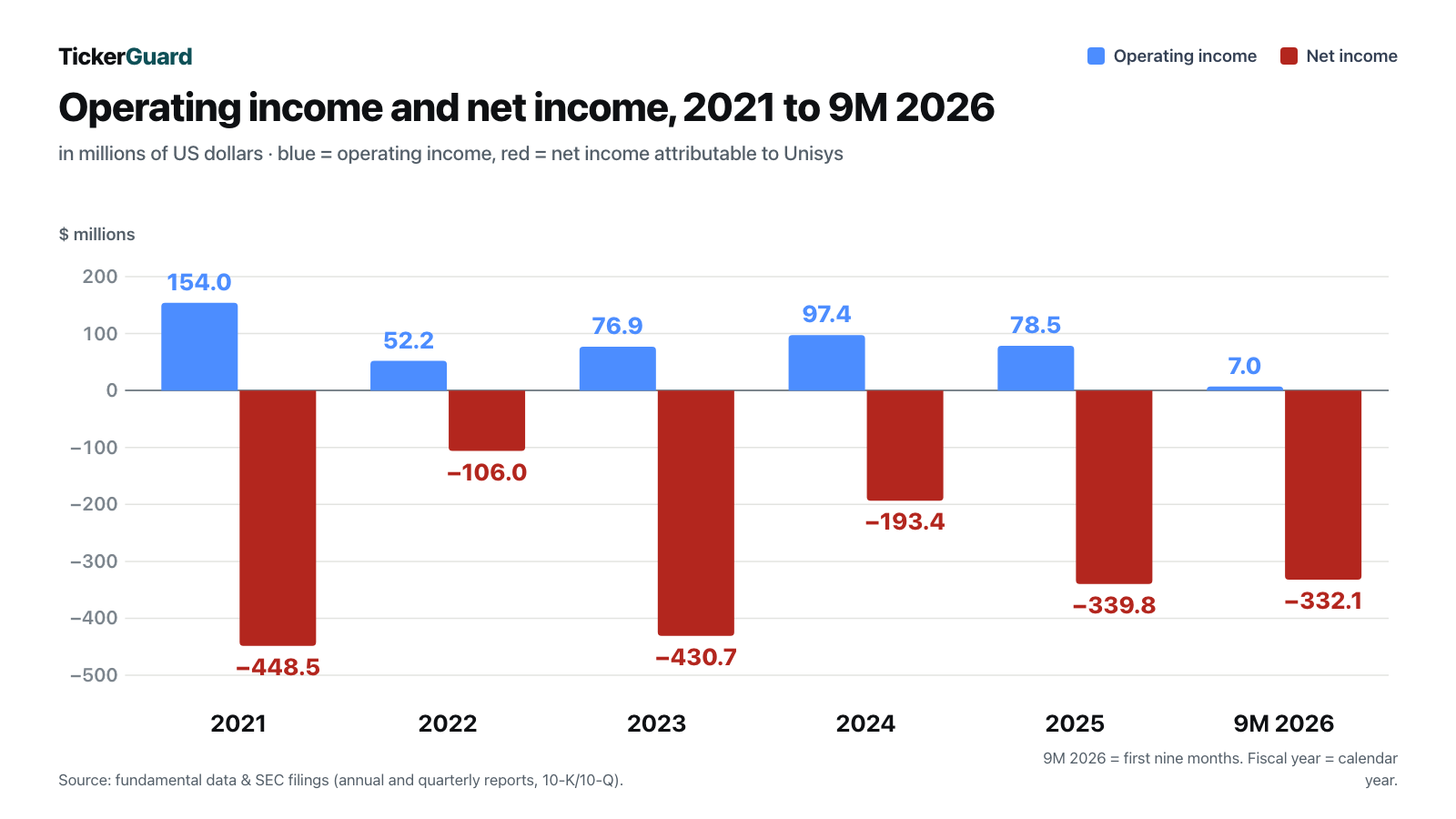
Added up, Unisys earned $459.0 million from operations from 2021 through 2025 — and lost $1.52 billion on the bottom line (exactly $1,518.4 million). The first nine months of 2026 added another $332.1 million in losses. Where does the money go? The three big items between operating income and net income are easy to name, taking 2023 to 2025 as an example: combined operating income of $252.8 million faced $879.7 million in pension and postretirement expense, $116.1 million in interest and $265.0 million in income taxes.
To be fair: much of the pension expense did not leave as cash. For years, Unisys has been transferring pension obligations to insurers — and each time it must book accumulated actuarial losses in one go: $348.9 million in 2023, $228.2 million in 2025 and $151.2 million in the first nine months of 2026. These settlement losses move amounts that were already recorded as losses within equity; they are not new cash going out the door. The taxes, in turn, arise because Unisys pays tax on profits abroad, while its U.S. losses produce no tax benefit, according to the 10-Q. Still, remember: at Unisys, operating profit is the start of the calculation, not the result.
What the filings say — the uncomfortable truths
Uncomfortable truth No. 1: The pension load has shrunk, but it still costs cash every single year
Unisys has promised defined-benefit pensions to many former employees. Those promises exceed the assets set aside in the pension plans. According to the earnings release of February 24, 2026, the plans’ funding deficit was $448.5 million at the end of 2025, down from $750.2 million a year earlier. For comparison: this deficit alone was about 2.3 times the company’s entire market value of about $196 million on November 6, 2026. A newer deficit figure will only be reported with the 2026 annual report; the balance sheet as of September 30, 2026, shows $492.1 million in long-term pension and postretirement liabilities — also more than twice the market value. The improvement over the prior year is real — but it was bought dearly: in 2025, Unisys contributed $343.7 million to its pension plans, including a discretionary $250 million payment. And it continues:
“Based on current funding requirements and assumptions, the company estimates future total cash contributions of approximately $101 million in 2027 to its global defined benefit pension plans.”
— Unisys Corporation, SEC quarterly report 10-Q for the period ended Sept. 30, 2026, Item 2 “Pension and Postretirement Benefits”

Think of it as a backpack full of yesterday’s retirement promises. The backpack has gotten lighter — since the third quarter of 2025, Unisys has transferred about $520 million of U.S. pension obligations to insurers, according to the 10-Q; the target is about $600 million, with the next step planned for the first half of 2027. But every year, the company has to top it up with cash: about $97 million for 2026, about $101 million for 2027 and, according to the 2025 annual report, roughly another $241 million combined for 2028 through 2030. A large share of the cash the business throws off is already spoken for.
So what is left for shareholders and noteholders? Let’s run the numbers. Before pension payments, Unisys generated free cash flow — cash from the business after capital spending — of $127.7 million in 2025; interest is already paid in that figure, because it runs through operating cash flow. After $345.3 million in contributions to pension and postretirement plans, free cash flow was minus $217.6 million (the $345.3 million includes postretirement benefits in addition to the $343.7 million paid into the pension plans). Without the discretionary $250 million payment, it would have been a plus of about $32 million — not much for a company with $1.95 billion in revenue. So far, 2026 looks weaker: in the first nine months, free cash flow was already minus $43.2 million before pensions and minus $132.2 million after; since June 2025, the expensive notes have required interest payments twice a year. A lot rides on the fourth quarter — in 2025, it alone brought in $112.9 million before pensions. For 2028 through 2030, Unisys plans contributions of about $80 million a year on average ($241 million divided by three years), slightly less than in 2026 and 2027. Keep in mind: meaningfully more cash for shareholders only frees up once the business, before pensions, generates clearly more than the roughly $100 million a year that goes into the pension plans — in 2025, it barely managed that with $127.7 million; so far in 2026, it has not.
Uncomfortable truth No. 2: Equity is negative, and the money costs 10.625 percent
Subtract everything Unisys owes from everything it owns, and nothing is left for shareholders — there is a deficit: stockholders’ equity of −$425.1 million as of September 30, 2026 (end of 2025: −$282.6 million). Against that stands $731.4 million in debt, at its core notes issued in June 2025 with an original principal of $700 million, of which $698.4 million was outstanding as of September 30, 2026. They mature on January 15, 2031, and carry a 10.625 percent coupon — roughly $74 million a year. The annual report spells out the risk itself:
“Our business may not generate cash flows from operations sufficient to pay off these notes and we may need to refinance these notes prior to maturity or explore additional sources of debt and/or equity to repay these notes.”
— Unisys Corporation, SEC annual report 10-K for 2025, Item 1A “Risk Factors”

Interest coverage shows what that means — how many times operating income could pay the interest bill. In 2025, operating income of $78.5 million compared with $53.4 million in interest expense, just under 1.5 times. In the first nine months of 2026, it was $7.0 million in operating income against $55.8 million in interest — less than once, partly because of a $48.7 million impairment. On a non-GAAP basis, $79.1 million covered interest a little more than 1.4 times. According to the 2025 annual report, the rating agencies place Unisys at “B” (Standard & Poor’s) and “B2” (Moody’s) — both below investment grade, downgraded in 2024 and 2025, respectively. In fairness: the filings show no acute cash crunch. As of September 30, 2026, Unisys held $264.2 million in cash and an undrawn credit facility with $89.1 million of availability, and it was in compliance with all covenants. However, $187.1 million of that cash sat abroad, and according to the 10-Q, about a quarter of it cannot readily be moved.
Uncomfortable truth No. 3: AI is already eating parts of the old business — and the workplace unit is weakening
Unisys sells AI-enabled services itself, such as a service desk that uses generative and agentic AI. Yet the same annual report contains a sentence that any shareholder of a services company should take seriously:
“Some of these technological developments, especially AI, have reduced and replaced some of our historical services and solutions and will continue to do so in the future, which could also negatively impact revenue and gross margin due to cost savings gained from automation.”
— Unisys Corporation, SEC annual report 10-K for 2025, Item 1A “Risk Factors”

The everyday picture: a janitorial service whose clients are installing self-cleaning windows sells them the windows — but afterward, nobody pays for the cleaning. How hard the pressure already bites shows in the workplace unit, DWS. Its gross margin fell to 9.5 percent in the third quarter of 2026, from 16.2 percent a year earlier; Unisys cites known client attrition and higher implementation and delivery costs. Back in the second quarter, the company had already lowered its expectations for this unit and wrote off the remaining goodwill:
“The impairment charge represented the entire remaining goodwill balance allocated to the DWS reporting unit, resulting in a full write-off of the reporting unit's goodwill.”
— Unisys Corporation, SEC quarterly report 10-Q for the period ended Sept. 30, 2026, Item 1, Note 12 “Goodwill and Intangible Assets”

Goodwill is the premium a company paid above book value when it bought a business. Writing it off completely is management’s way of saying: what we once expected from this unit is no longer realistic. No cash goes out — but expectations for one of the three business units have visibly dropped.
Uncomfortable truth No. 4: The year is decided in the fourth quarter
Remember the profitable software island, ClearPath? Its revenue comes in chunks, because, according to the annual report, license renewals are recognized in full at the time of renewal. And in 2025, a large share of them fell into the fourth quarter:
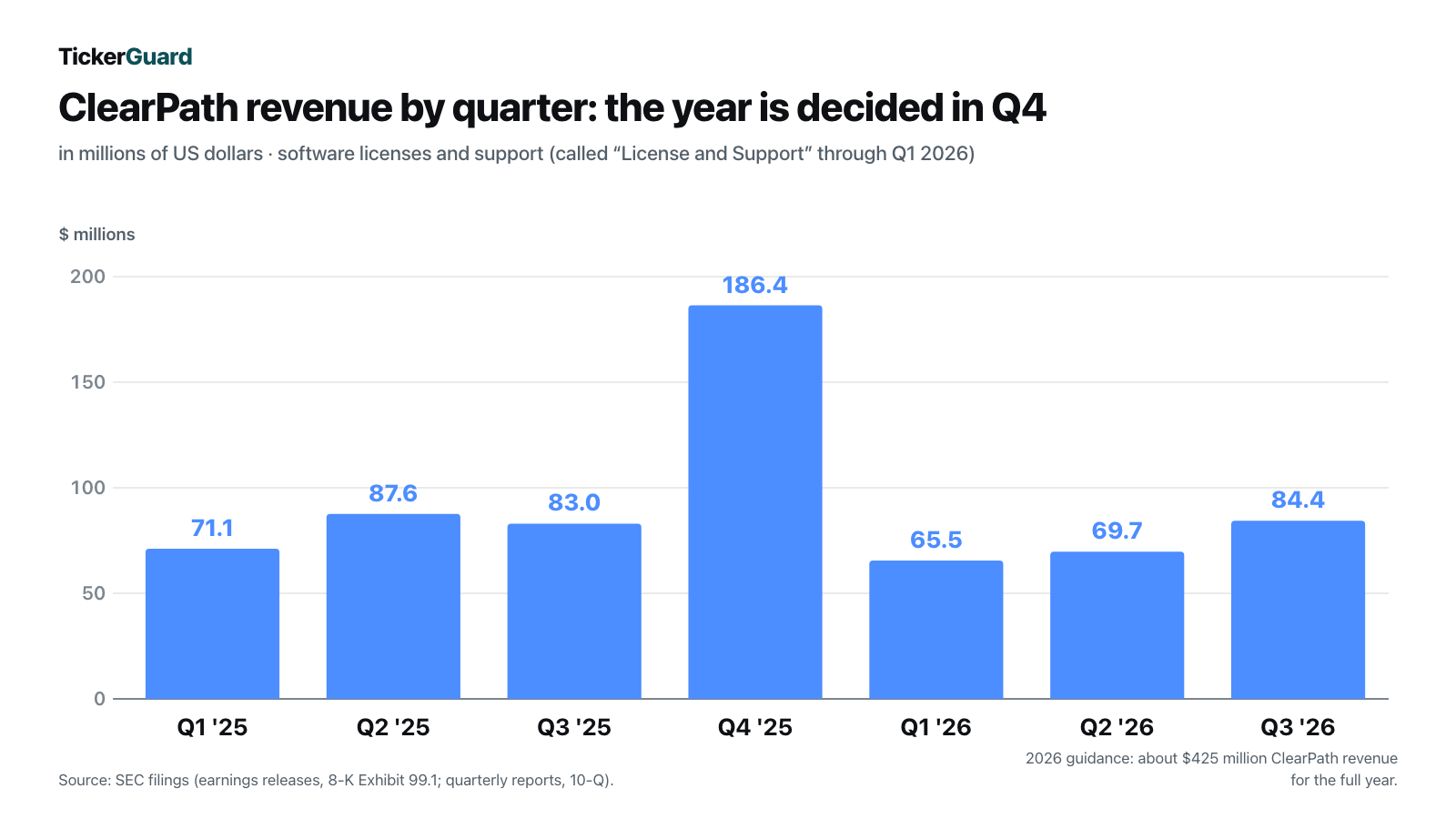
On November 4, 2026, Unisys reaffirmed a 2026 non-GAAP operating margin of 9 to 11 percent, assuming about $425 million in ClearPath revenue. After nine months, the books show $219.6 million in ClearPath revenue and a non-GAAP margin of 5.7 percent. Let’s do the math: to hit the target, about $205 million in ClearPath revenue has to come in during the fourth quarter — more than the $186.4 million of the strong prior-year quarter. For the low end of the margin range, fourth-quarter non-GAAP operating profit needs to reach about $96 million (prior-year quarter: $103.4 million). That is possible, as last year shows. But: if a single large client pushes its renewal into the new year, the amount is almost entirely missing from the current year. In the same release, Unisys raised its revenue guidance — to a constant-currency decline of 3.0 to 1.5 percent, from minus 5.0 to 3.5 percent previously.
Valuation: a tenth of annual revenue
A price-to-earnings ratio cannot be calculated without earnings. At $2.69 (close on November 6, 2026) and 72,933,732 shares (cover of the quarterly report, as of September 30, 2026), the market value was about $196 million — roughly a tenth of 2025 revenue of $1.95 billion. On August 31, 2026, Unisys also registered 3.9 million additional shares for its equity compensation plan (Form S-8 registration statement) — a little more than 5 percent of shares outstanding, which can go to executives and employees over time. At first glance, that looks very inexpensive. But whoever buys the stock buys the burdens along with it: subtract cash of $264.2 million from debt of $731.4 million, and $467.2 million in net debt remains; on top of that come $492.1 million in long-term pension and postretirement liabilities on the balance sheet (all as of September 30, 2026). Together with the market value, the company is valued at about $1.16 billion — roughly 4.1 times 2025 adjusted earnings before interest, taxes, depreciation and amortization (EBITDA) of $278.8 million. For an IT services provider, that is low, but not absurdly low — the discount reflects the burdens.
Wall Street coverage is thin: according to our fundamental data (retrieved November 7, 2026), four analysts rate the stock — one “strong buy,” two “buy,” one “hold” — with an average price target of $4.81. Average here means: all price targets added up and divided by the number of analysts; with only four votes, a single target moves the figure a lot. Analyst price targets are third-party opinions, not a TickerGuard forecast, and have often been far off the actual price in the past. How a larger competitor from the same industry looks in its filings is covered in our analysis of DXC Technology. With Unisys, the rule is: the stock is only cheap if you leave out the pension load.
Upside and risks at a glance
What speaks for Unisys:
- Operating profit every year from 2021 through 2025 (between $52.2 million and $154.0 million); 2025 non-GAAP operating margin of 9.1 percent.
- Proprietary, highly profitable software: ClearPath earned a 73.1 percent gross margin in the third quarter of 2026.
- Improving new business: total contract value of new business up 78 percent to $221 million in the third quarter of 2026, backlog of $2.92 billion; 2026 revenue guidance raised.
- Shrinking pension load: funding deficit down from $750.2 million (end of 2024) to $448.5 million (end of 2025); about $520 million of U.S. obligations transferred to insurers since the third quarter of 2025.
- No acute cash crunch: $264.2 million in cash, undrawn credit facility ($89.1 million available), in compliance with all covenants, notes not due until 2031 (as of 9/30/2026).
What speaks against it:
- A net loss in every year from 2021 through 2025, $1.52 billion combined; another $332.1 million in the first nine months of 2026.
- Negative stockholders’ equity of $425.1 million (9/30/2026).
- Expensive debt: $698.4 million in notes at 10.625 percent; interest coverage below one in the first nine months of 2026 (operating income of $7.0 million vs. $55.8 million in interest).
- Ongoing pension contributions: about $97 million (2026), about $101 million (2027) and about $241 million combined for 2028 through 2030.
- According to the annual report, AI is already replacing parts of the old business; DWS goodwill fully written off, DWS margin down to 9.5 percent in the third quarter of 2026.
- 2026 guidance depends on about $205 million in fourth-quarter ClearPath revenue.
A human conclusion
Back to the legacy bonus from the beginning. Its core is not that the old name is worthless — Unisys does have a business that makes an operating profit year after year, software on which financial services, travel and transportation companies process their transactions, and a management team that is reducing the pension load step by step. Its core is that “around for 150 years” turns into “will always be around” in your head. The filings show a company whose past — pensions, expensive debt, a shrinking services business — costs more than its present earns. At least so far: in 2025, $127.7 million in cash was left before pensions, and about $100 million a year flows into the pension plans.
So the honest question for you is not “Is such a famous name a bargain at $2.69?” but rather: Do you believe Unisys will soon generate clearly more cash before pensions than the roughly $100 million that goes into the pension plans every year — faster than AI shrinks the old services business, and in time to service the notes through 2031? If yes, you have a thesis you can test against every quarterly report. If not, you had a legacy bonus. What you do with this is your decision. And that is how it should be.
Sources
All original documents used in this analysis — so you can read them yourself:
- Unisys Corporation — Quarterly report 10-Q for the period ended Sept. 30, 2026 (filed Nov. 5, 2026)
- Unisys Corporation — Current report 8-K of Nov. 4, 2026 (Item 2.02) with Exhibit 99.1, third-quarter 2026 earnings release with guidance
- Unisys Corporation — Quarterly report 10-Q for the period ended June 30, 2026 (filed July 30, 2026) and second-quarter 2026 earnings release (8-K, Exhibit 99.1)
- Unisys Corporation — Quarterly report 10-Q for the period ended March 31, 2026 (filed May 6, 2026)
- Unisys Corporation — Fourth-quarter and full-year 2025 earnings release (8-K of Feb. 24, 2026, Exhibit 99.1)
- Unisys Corporation — Annual report 10-K for 2025 (filed Feb. 25, 2026)
- Unisys Corporation — Annual report 10-K for 2024 (filed Feb. 21, 2025)
- Unisys Corporation — Annual report 10-K for 2023 (filed Feb. 26, 2024)
- Unisys Corporation — Form S-8 registration statement of Aug. 31, 2026 (3.9 million shares for the equity compensation plan)
- Full SEC filing history of Unisys: EDGAR, CIK 0000746838
- Fundamental data (prices through Nov. 6, 2026, analyst price target, short interest, Piotroski score; retrieved Nov. 7, 2026); market value checked against the share count on the cover of the 10-Q filed Nov. 5, 2026.
- Earnings call transcripts were not used; the analysis relies solely on mandatory SEC filings.
Transparency & disclaimer: This analysis is a journalistic assessment of publicly available information and does not constitute investment advice, a regulated financial analysis, or a solicitation to buy or sell securities. Equity investments carry substantial risk, including total loss. All information is provided without guarantee; the data date is noted throughout the text. Positions held by the operator are disclosed daily; where one exists, it appears as a notice at the top of this deep dive.
Key figures at a glance
All monetary figures in millions of $; earnings per share as reported.
| Metric | 2021 | 2022 | 2023 | 2024 | 2025 |
|---|---|---|---|---|---|
| Revenue | 2,054.4 | 1,979.9 | 2,015.4 | 2,008.4 | 1,950.1 |
| Operating Income (EBIT) | 154.0 | 52.2 | 76.9 | 97.4 | 133.5 |
| Net Income | -449.8 | -106.0 | -430.7 | -193.4 | -339.8 |
| Net Margin | -21.9% | -5.4% | -21.4% | -9.6% | -17.4% |
| Earnings Per Share | -6.77 $ | -1.57 $ | -6.31 $ | -2.79 $ | -4.77 $ |
Source: fundamental data & SEC filings (annual and quarterly reports, 10-K/10-Q)
Our Bottom Line at a Glance
- Operating business positive
- Operating profit every year from 2021 through 2025 ($52.2 million to $154.0 million), 2025 non-GAAP margin of 9.1 percent. Third-quarter 2026 revenue up 2.5 percent, new business up 78 percent.
- ClearPath software positive
- Proprietary mainframe software with a 73.1 percent gross margin (third quarter of 2026); but license renewals arrive in chunks, and the 2026 guidance needs about $205 million in the fourth quarter.
- Pension burden negative
- Pension funding deficit of $448.5 million (end of 2025), $879.7 million in pension and postretirement expense from 2023 to 2025; contributions of about $97 million (2026) and about $101 million (2027) expected.
- Balance sheet & debt negative
- Equity of −$425.1 million, $698.4 million in notes at 10.625 percent through 2031; interest coverage below one in the first nine months of 2026. Cash of $264.2 million, credit facility undrawn (9/30/2026).
- AI & services business negative
- According to the 2025 annual report, AI has already replaced parts of the historical offering. DWS goodwill fully written off ($47.2 million), DWS gross margin at 9.5 percent in the third quarter of 2026.
Unisys makes money from its ongoing business and owns, in ClearPath, highly profitable proprietary software. On the bottom line, though, every year from 2021 through 2025 ended in a loss, $1.52 billion combined — driven by pension expense, interest and taxes. Equity is negative, the notes are expensive, and the 2026 guidance hinges on the fourth quarter. Not investment advice.
What Our Rating Means
Substance risk
We found at least one documented issue that threatens the company itself — regardless of how the stock is currently valued.
Red here does not mean an acute cash crunch — cash, an undrawn credit facility and covenant compliance argue against that, and the notes do not mature until 2031. Red stands for documented substance findings: negative stockholders’ equity of $425.1 million and interest coverage below one in the first nine months of 2026 (operating income of $7.0 million vs. $55.8 million in interest), plus a pension burden that ties up about $100 million in cash every year. That the stock trades at a tenth of annual revenue does not change this assessment — that is a price argument, not a quality argument. The decision is yours.
A journalistic assessment by our editorial team at the time of the deep dive, based on public sources — not investment advice and not a solicitation to buy or sell. Your personal circumstances (investment goals, risk capacity, taxes) cannot be taken into account. What our levels mean, how verdicts are formed, and what conflicts of interest exist →
Worth Noting
- Data as of: balance sheet, earnings and cash flow figures as of 9/30/2026 (10-Q filed 11/5/2026) or 12/31/2025 (10-K filed 2/25/2026); pension deficit per the earnings release of 2/24/2026; prices, analyst target and short interest per fundamental data (close 11/6/2026, retrieved 11/7/2026). All SEC filings through 11/7/2026 were reviewed; the earnings release of 11/4/2026 (8-K, Exhibit 99.1) contains the reaffirmed 2026 guidance.
- The roughly $205 million in ClearPath revenue and roughly $96 million in non-GAAP operating profit for the fourth quarter of 2026 are our own calculations from company guidance ($425 million ClearPath, 9 to 11 percent margin on reported revenue growth of −0.4 to +1.1 percent) and the nine-month figures.
- Non-GAAP figures are company calculations excluding pension expense, goodwill impairments, certain legal matters and cost-reduction charges; they do not replace audited U.S. GAAP results.
Stock Watch
This analysis is as of November 7, 2026. Stock Watch will tell you what's changed at UIS since then.
Later $1 a month per stock — signing up is free, and you'll be the first to know when it launches.
The full analysis as a PDF for later
We will send you this analysis as a PDF — to print, file away, and read at your own pace. And we will add you to the free Stock Watch list for Unisys Corporation (UIS), so you hear about it when something material in this analysis changes.
Frequently Asked Questions
Unisys (NYSE: UIS), based in Blue Bell, Pennsylvania, is an IT services company with about 15,000 employees (end of 2025). It manages workplace technology, cloud and applications for large clients and sells ClearPath Forward, its own mainframe software on which clients in financial services, travel and transportation, healthcare and the public sector process transactions. 2025 revenue was $1,950.1 million.
Three large items sit between operating income and net income at Unisys: pension expense, interest and taxes. From 2023 to 2025, $252.8 million in operating income faced $879.7 million in pension and postretirement expense, $116.1 million in interest and $265.0 million in taxes. Much of the pension expense consists of non-cash settlement losses from transferring obligations to insurers.
The pension plans’ funding deficit was $448.5 million at the end of 2025, down from $750.2 million at the end of 2024. The balance sheet as of Sept. 30, 2026, showed $492.1 million in long-term pension and postretirement liabilities. Unisys expects cash contributions of about $97 million for 2026 and about $101 million for 2027.
As of Sept. 30, 2026, Unisys had $731.4 million in debt, mainly $698.4 million in notes with a 10.625 percent coupon due Jan. 15, 2031. Against that stood $264.2 million in cash and an undrawn credit facility. Stockholders’ equity was negative at $425.1 million.
ClearPath Forward is Unisys’ proprietary mainframe software, with a 73.1 percent gross margin in the third quarter of 2026. License renewals are recognized in full when signed; in 2025, a large share fell into the fourth quarter. To reach the 2026 guidance of about $425 million in ClearPath revenue, about $205 million has to come in during the fourth quarter, by our math.
At $2.69 (Nov. 6, 2026), the market value was about $196 million, roughly a tenth of 2025 revenue. Adding $467.2 million in net debt and $492.1 million in pension liabilities values the company at about $1.16 billion, roughly 4.1 times 2025 adjusted EBITDA. That is context, not a recommendation.
Found an error?
Did you spot a factual error, an outdated number, or a typo in this deep dive? Let us know briefly — your report goes straight to the editorial team.