Novo Nordisk: Revenue Up 18 Percent in the First Half — and Why the Company Itself Expects 2 Percent
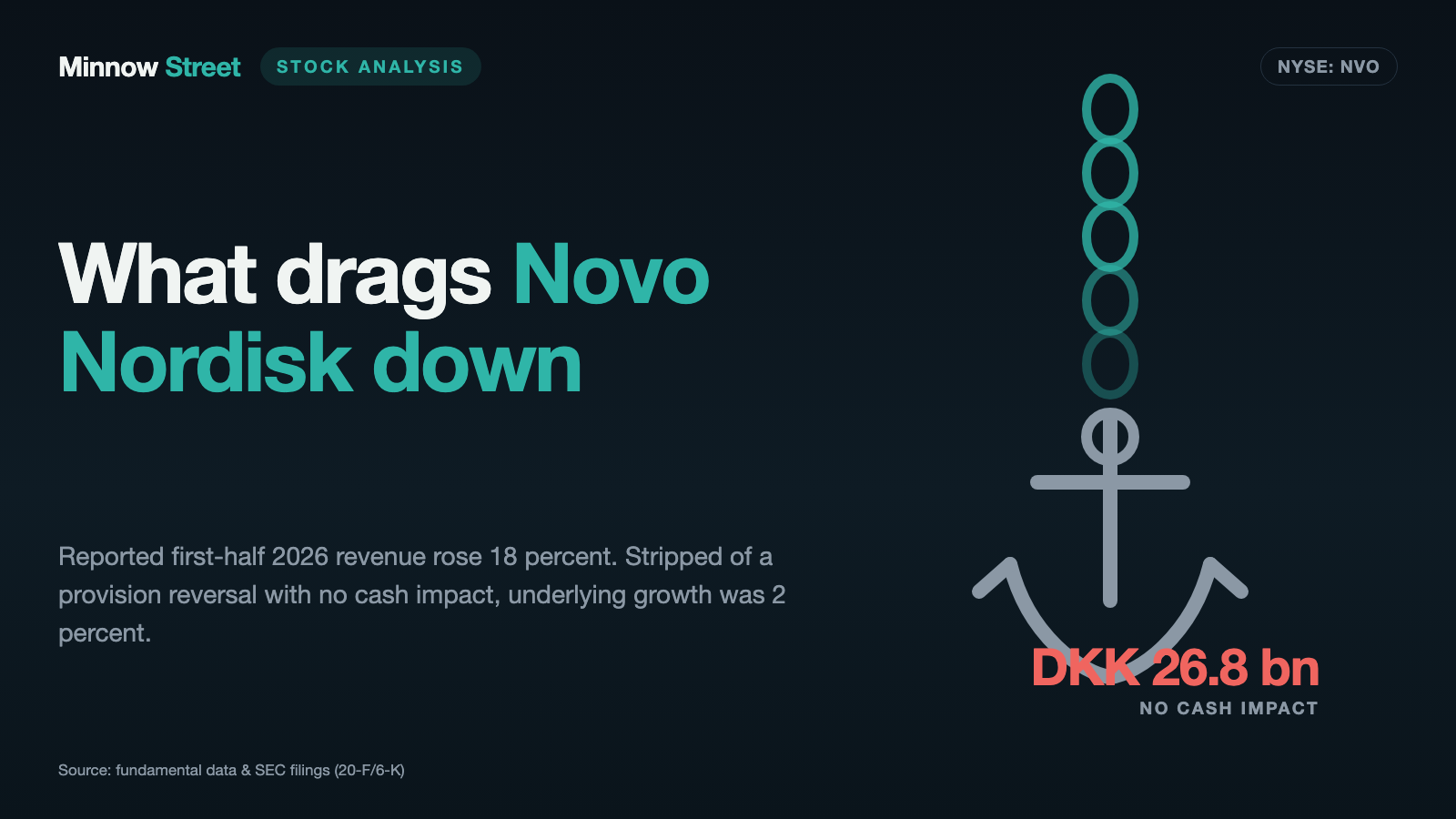
By now everybody knows Ozempic and Wegovy. Novo Nordisk's first-half 2026 report shows 18 percent revenue growth at constant exchange rates — adjusted, it is 2 percent. The DKK 26.8 billion difference is the reversal of a rebate provision tied to the US 340B program, and the filing says it explicitly: no cash impact. For the full year 2026 the company itself expects 0 percent to minus 6 percent on an adjusted basis. Meanwhile US sales of the Wegovy injectable fell 22 percent in the second quarter, the US list price drops to $675 on January 1, 2027, and the ZEUS cardiovascular trial failed on July 31, 2026. We read the original filings and separate what is business from what is bookkeeping.
 Thomas Mücke
Founder & Publisher
Thomas Mücke
Founder & Publisher
As of Today
As of: October 7, 2026
- Closing price
- 38.30 $ +1.90%
- Market Capitalisation
- 166.6 $B
- P/E
- 9.4
- Growth Score
- 5/10
- AAQS
- 7/10
This analysis has a cut-off date. The Stock Guard tells you when something material changes in the numbers. Reserve your free spot
Chart
Interactive price chart (TradingView).
52-week range: 35.30 $ to 64.00 $ · Last price: 38.30 $ (As of: October 7, 2026)
Note: pure fact-based analysis, not investment advice and not a solicitation to buy or sell. All figures without guarantee.
There is an investor trap that springs shut precisely when you feel informed: the familiarity trap. It works like this. You hear a brand name in a waiting room, at the office, on a talk show — Ozempic. Your neighbor is on Wegovy. For years the stuff was in short supply at the pharmacy. And quietly your brain draws a conclusion it never says out loud: if everyone knows it and everyone wants it, the stock must be doing well. Familiarity feels like knowledge. It is not. Novo Nordisk A/S of Bagsværd, just outside Copenhagen, is exactly the case to test that on: the company behind both medicines, in the insulin business since 1923, with DKK 309.1 billion of revenue in 2025. So let us make a deal. Before you mistake the label "global leader in weight-loss drugs" for "doing fine," we will read together what the company itself has told the U.S. securities regulator, the SEC — the annual report for 2025 and every interim filing through August 2026. Those documents are honest under threat of criminal penalty. And this one describes a revenue jump that is largely an accounting entry, a forecast from the company itself pointing downward, and a price under serious pressure.
That fixes the central tension of this analysis, and it runs through every chapter: demand for the medicines keeps growing — the price is falling faster than the volume is rising.
Table of contents
- What Novo Nordisk actually does
- How the stock landed on our desk
- Why there is no 10-K here, but a 20-F
- The numbers over the years — honestly credited
- What the filings say: five uncomfortable truths
- What the market is paying
- Opportunities and risks at a glance
- A human conclusion
- Sources
What Novo Nordisk actually does — one molecule, two names, one global market
At its core Novo Nordisk sells a single molecule under two brand names. It is called semaglutide, it mimics a gut hormone the body makes on its own, and it lowers blood sugar while dulling hunger. In the diabetes dose it is Ozempic (injection) or the Ozempic pill, formerly Rybelsus. In the higher obesity dose it is Wegovy. Specialists call the drug class GLP-1; think of it as a messenger that delivers the "I am full" note to the brain earlier than usual.
The group runs two reporting segments. The large one is Obesity and Diabetes care, which produced DKK 139.4 billion of adjusted revenue in the first half of 2026; alongside the GLP-1 products it contains the classic insulin business (DKK 24.6 billion in the half, down 7 percent at constant exchange rates). The small one is Rare disease — hemophilia products, growth hormones — at DKK 9.1 billion in the half. As of December 31, 2025 the company employed 69,505 people, roughly 10 percent fewer than a year earlier: in September 2025 it launched a company-wide transformation and, according to the annual report, let go of about 9,000 employees globally. The August 4, 2026 interim report puts headcount at about 66,700.
Two things matter to you as an investor before we get to the numbers. First, the company replaced its leadership within months in 2025. On August 7, 2025 Maziar Mike Doustdar took over as president and chief executive from Lars Fruergaard Jørgensen; on November 14, 2025 an extraordinary general meeting elected a new board with Lars Rebien Sørensen as chair. Second, the sharpest competitor is Eli Lilly with tirzepatide (Mounjaro and Zepbound) — if you want the view from the other side of the market, our Eli Lilly analysis is the counter-check. And if you want to see how fast pharmaceutical revenue can disappear once demand turns, our BioNTech analysis is worth the detour.
How the stock landed on our desk
Novo Nordisk did not reach our research list through one of our metrics scanners, but through the hot list of a large German retail-investor forum — on August 13, 2026 the stock was among the most-discussed names there. That is an attention signal, not a quality signal, which is exactly why it deserves an honest look: attention gathers around falling prices just as reliably as around rising ones.
We will place the metrics in context in the valuation chapter. For now, just so you carry the order of magnitude: as of August 13, 2026 the market capitalization stood at roughly $200 billion, the trailing twelve-month price-to-earnings ratio at about 11, and return on equity at roughly 60 percent. Keep the sentence that will accompany us through this analysis: a low valuation says nothing about the future — it says what the market expects of the future.
Why there is no 10-K here, but a 20-F
A short stop, because it causes confusion otherwise. US companies file an annual report on Form 10-K and quarterly reports on Form 10-Q with the SEC. Novo Nordisk is a Danish company and is classified there as a foreign private issuer. For that filer type there is no 10-K and no 10-Q. Instead there is an annual report on Form 20-F, filed for 2025 on February 4, 2026, and a running stream of interim reports on Form 6-K, which is where the quarterly and half-year numbers live. The most recent of those, and the one we work from here, is the first-half 2026 report filed August 4, 2026. We reviewed every 6-K filed after it through August 10, 2026; they cover the ongoing share repurchase program and transactions by managers, and they change nothing about the picture.
Two more peculiarities worth knowing. First, Novo Nordisk reports under IFRS and in Danish kroner, while the stock trades in the United States in dollars. Every revenue and earnings figure in this analysis is therefore in kroner; as a rough conversion anchor, the first-half 2026 average rate was about DKK 6.40 to the dollar (first-half 2026 report). Because the reporting currency and the listing currency differ, several standard metrics — the Altman Z-score, net current asset value per share — cannot be computed cleanly. We leave them out rather than manufacture false precision. Second, on the NYSE you do not trade the original share but an ADR, a receipt issued by a US bank against a foreign share. The annual report is unambiguous:
“Each ADR represents one deposited Novo Nordisk B share. One ADR carries the same voting rights as one Novo Nordisk B share.”
— Novo Nordisk A/S, SEC annual report on Form 20-F for 2025, Item 12.D American Depositary Shares
One ADR therefore equals one B share, and every per-share figure the company publishes applies unchanged to your ADR. The depositary is J.P. Morgan; 488,654,572 ADRs were outstanding as of December 31, 2025, about 15.31 percent of the issued B share capital.
The numbers over the years — honestly credited
Let us start with what genuinely impresses, because there is plenty of it. Novo Nordisk has more than doubled in five years: revenue rose from DKK 140.8 billion in 2021 to DKK 309.1 billion in 2025, operating profit from DKK 58.6 billion to DKK 127.7 billion. The obesity business alone grew from DKK 6 billion in 2019 to DKK 82 billion in 2025. This is not a flash in the pan; it is one of the great success stories of European industry. And the company earns very well doing it: the 2025 gross margin was 81.0 percent, the operating margin 41.3 percent, return on equity roughly 60 percent (data as of August 13, 2026). For comparison, an industrial company with a 10 percent operating margin counts as solid. Novo Nordisk runs at four times that.
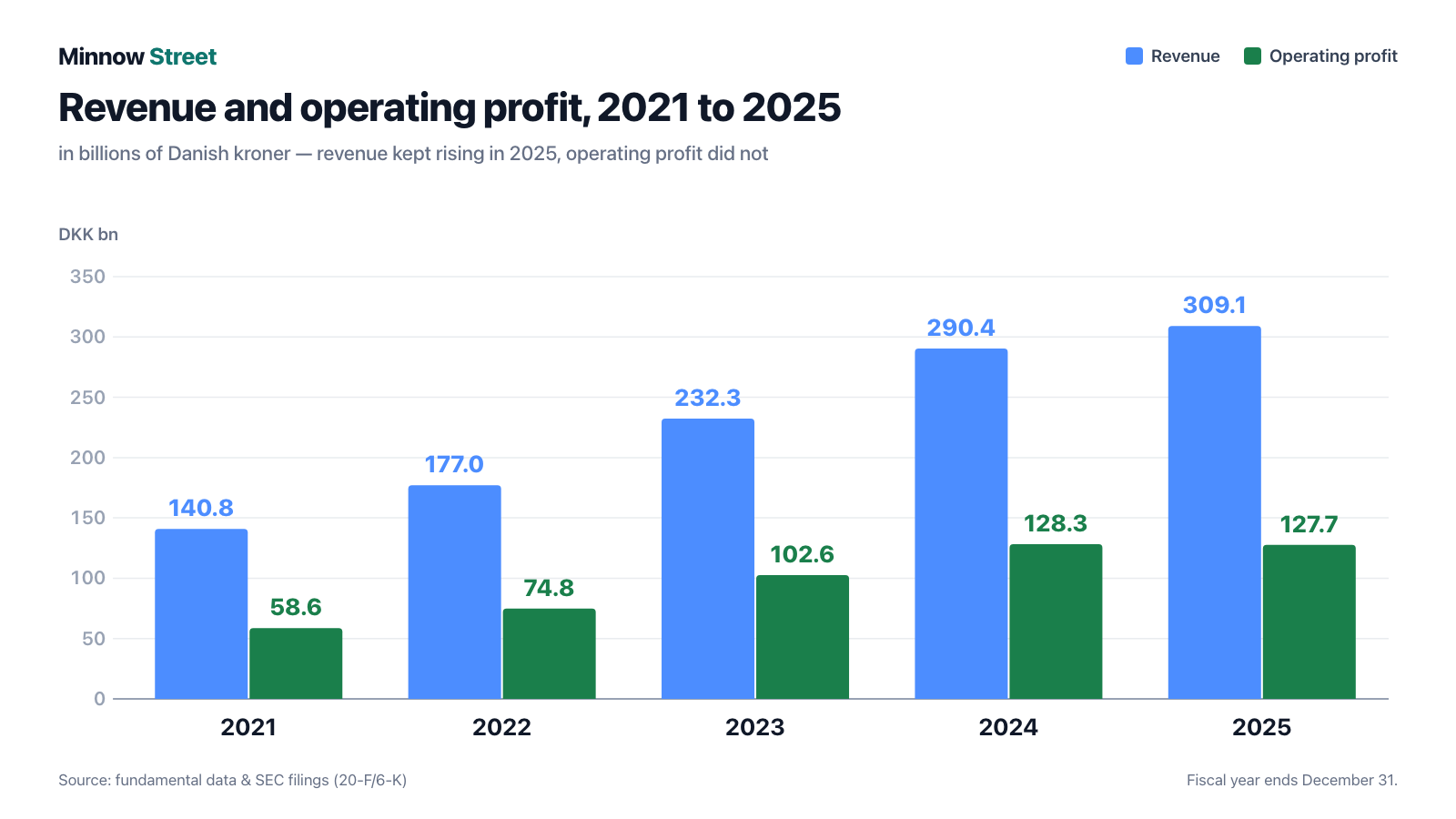
Now the kink you can see in the chart if you look closely: in 2025 revenue still rose 6 percent in kroner, but operating profit fell 1 percent — from DKK 128.3 billion to DKK 127.7 billion. The company explains this in its full-year 2025 release with about DKK 8 billion of one-off restructuring costs and with charges tied to the acquired Catalent sites; without those costs, operating profit would have risen 6 percent. That is a fair explanation. The finding stands anyway: for the first time in years, profit did not grow with revenue. And in the final quarter of 2025 revenue actually fell — to DKK 79.1 billion, down 8 percent in kroner and 2 percent at constant exchange rates.
The balance sheet deserves honest credit too. As of June 30, 2026, total assets of DKK 594.9 billion stood against equity of DKK 221.3 billion — an equity ratio of 37.2 percent, up from 35.7 percent at the end of 2025. Financial debt was around DKK 140 billion, cash DKK 44.5 billion. Moody's rates the group Aa3 and S&P rates it AA, credit grades that only a handful of industrial companies worldwide reach. Anyone looking for a solvency risk at Novo Nordisk will not find one. The problems sit elsewhere, and they start right here.
What the filings say: five uncomfortable truths
Uncomfortable truth No. 1: the first-half revenue jump is mostly an accounting entry
Read the first-half 2026 headline and you picture a company in peak form: revenue up 18 percent at constant exchange rates, operating profit up 27 percent. Both figures are correct. And both say almost nothing about the business. In the first quarter of 2026 Novo Nordisk reversed a provision it had built years earlier for possible rebate claims under the US 340B program, which obliges manufacturers to grant discounts to certain clinics and institutions. For as long as it was disputed whether and how much had to be paid, the money sat on the balance sheet as a liability. When the matter was settled, the provision disappeared — and the amount landed in the income statement as revenue.
Put in everyday terms: imagine you had set aside $200 a month for three years against a disputed back payment. One day the notice arrives saying you owe nothing. Your bank balance does not change by a cent in that moment — but your personal annual accounts would show a record profit. That is exactly what happened here, only with DKK 26.8 billion ($4.2 billion). The filing says so itself, in a subordinate clause:
“Reported sales in H1 2026 were positively impacted by a DKK 26.8 billion sales rebate provision reversal in Q1 2026, related to the US 340B Drug Pricing Program. … The reversal of these provisions has no cash impact.”
— Novo Nordisk A/S, SEC interim report on Form 6-K filed August 4, 2026, first-half 2026 report, Commercial execution

Novo Nordisk therefore runs an adjusted series in parallel — and it looks distinctly different. That is notably fair: the company does not hide the effect, it places it in its own tables right next to the reported figures. You only have to look.
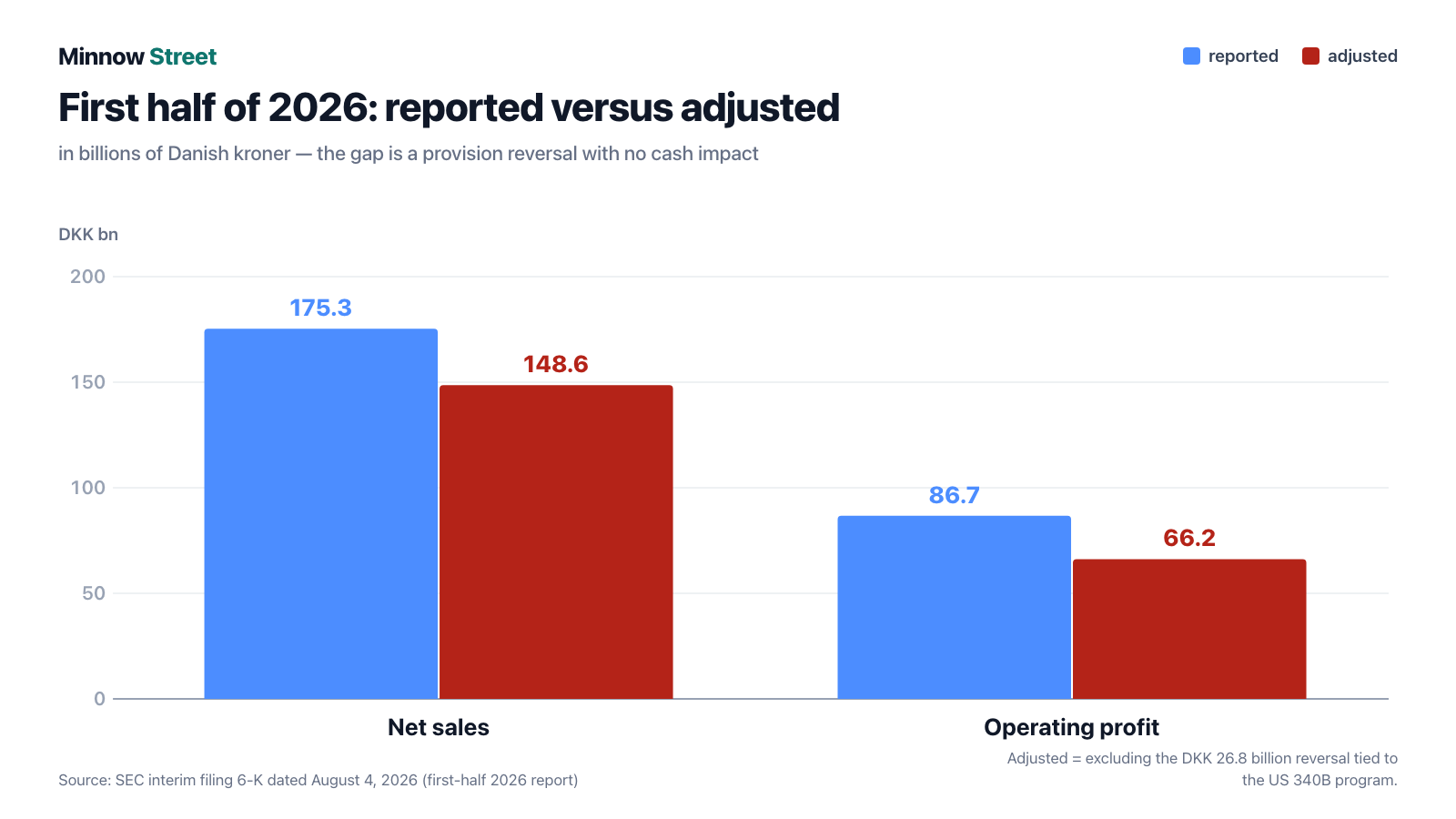
Translated into growth rates: up 18 percent reported, up 2 percent adjusted; for operating profit, up 27 percent reported against up 2 percent adjusted. Remember the rule: when a company shows you two revenue series, the lower one is the interesting one.
Uncomfortable truth No. 2: the company itself expects no growth in 2026
The most honest forecast about a company usually comes from the company. And Novo Nordisk's sounds different from the headline. In the August 4, 2026 interim report the group raised its 2026 outlook — and still ended up with a zero and a minus range:
“Adjusted sales growth is now expected to be 0% to -6% at CER, with fluctuations in growth rates expected across quarters. The improved outlook is mainly driven by increased expectations for GLP-1 product sales.”
— Novo Nordisk A/S, SEC interim report on Form 6-K filed August 4, 2026, first-half 2026 report, Guidance

For context, on May 6, 2026 the company still expected minus 4 percent to minus 12 percent. Raising it to 0 percent to minus 6 percent is genuinely good news; it moves the expected decline upward. It does not turn the decline into growth. And the filing names the causes without varnish: lower realized prices, the Most Favoured Nations agreement with the US administration from November 2025, the semaglutide compound patent expiry in certain markets outside the United States, and intensifying competition. In Canada the patent has already lapsed; the interim report notes that this produced lower realized prices there while volumes stayed broadly stable.
One detail that is easy to miss, and that mirrors truth No. 1 in reverse: the filing notes that on a non-adjusted basis the midpoint of the 2026 guidance would be plus 5 percent for revenue and plus 12 percent for operating profit. In plain language: the 2026 IFRS accounts will show growth even though the company itself expects a decline. Anyone reading only the headline will not notice.
How serious the situation is in the core business shows up in the segments. In the first half of 2026 adjusted revenue in diabetes care fell 5 percent at constant exchange rates to DKK 95.4 billion; GLP-1 diabetes sales fell 5 percent, insulin 7 percent, and in the United States insulin fell 17 percent. Only obesity care grew, up 19 percent to DKK 44.1 billion. The historic core business is shrinking while the younger branch catches the fall. That can work out. It is something other than "everything is growing."
Uncomfortable truth No. 3: the price is falling faster than the volume is rising
Here is the heart of the tension. Take the Wegovy injectable in the United States — the group's flagship, the product people spent years on waiting lists for. In the second quarter of 2026 its revenue fell 22 percent at constant exchange rates, and 17 percent across the half year. The reason is stated explicitly in the filing: "driven by lower realised prices, partly countered by increased volumes." Lower realized prices on rising volumes.
Translated: more packs cross the counter than ever, and less money comes in. That pattern is the real story of this analysis, and it fits into one image: the cake is getting bigger while your slice is cut thinner. The group numbers confirm it. The adjusted gross margin was 78.2 percent in the second quarter of 2026, down from 82.7 percent a year earlier; across the half year, 79.3 percent against 83.1 percent. Four percentage points of gross margin sounds small — on DKK 148.6 billion of adjusted half-year revenue it is roughly DKK 5.6 billion that simply never arrives. Alongside prices, the filing cites about DKK 3 billion of one-off costs for right-sizing manufacturing capacity agreements.
And the price pressure is at its beginning, not its end. In the same report the group announces that effective January 1, 2027 it will lower the US list price of Wegovy and Ozempic to $675 — a cut of roughly 50 percent for Wegovy and roughly 35 percent for Ozempic, by the company's own arithmetic. The filing states that the change is expected to weigh on cash flow in 2027. In fairness: the list price is not the realized price, rebates to payers sit in between, and in return the company expects far more patients, not least through the Bridge program in the US Medicare system, which has been running since July 1, 2026. The bet is that volume beats price. Whether it pays off, nobody knows today.
One bright spot in the same numbers, so the picture stays complete: the Wegovy pill, on the US market since January 5, 2026, is the strongest GLP-1 volume launch the country has seen — more than 265,000 prescriptions in the week ending July 17, 2026 and over five million since launch. Self-pay prices run from $149 to $299 a month by dose. Outside the United States it is working too: obesity care grew 40 percent in the half year, and 57 percent in Europe and Canada. The demand is unmistakably there. The only question is at what price.
Uncomfortable truth No. 4: the big diversification bet just failed
A company that depends on one active ingredient for more than 90 percent of its revenue needs a second leg. Novo Nordisk's biggest hope outside the GLP-1 world was called ziltivekimab — an antibody against inflammation, meant to prevent heart attacks and strokes in high-risk patients. On July 31, 2026 the phase 3 ZEUS trial with more than 6,300 participants read out. It leaves no room for interpretation:
“While ziltivekimab demonstrated target engagement and inhibition of the IL-6 pathway, as reflected by expected reductions in free IL-6 and high-sensitivity C-reactive protein (hsCRP) respectively, this did not translate into major adverse cardiovascular events (MACE) risk reduction versus placebo … (hazard ratio, 0.99; 95% confidence interval, 0.88 to 1.11).”
— Novo Nordisk A/S, SEC interim report on Form 6-K filed July 31, 2026, ZEUS phase 3 readout

A short translation of the statistics: a hazard ratio compares the risk in the treatment arm with the risk in the placebo arm. A value of 1.00 means no difference at all. A value of 0.99 with a confidence interval running from 0.88 to 1.11 means the effect cannot be distinguished from zero. For Novo Nordisk that is a double loss — the trial itself and the years of development behind it. In the second quarter of 2026 the group booked DKK 6.3 billion of non-cash impairments on pipeline assets, DKK 4.0 billion of it on the compound monlunabant. That is why reported operating profit fell 16 percent in the quarter while adjusted operating profit rose 11 percent.
The other side of the pipeline belongs in the picture too. In July 2026 the Wegovy pill and the 7.2 mg dose were approved in the European Union (average weight loss of 16.6 percent and 20.7 percent respectively), the phase 3 HIBISCUS trial with etavopivat in sickle cell disease met both co-primary endpoints, and in December 2025 the group bought Akero Therapeutics for $54 per share (about $4.7 billion) plus a contingent value right of $6 per share — for a phase 3 liver compound. The pipeline is not empty. It is simply still, overwhelmingly, a bet on the same metabolic field.
Uncomfortable truth No. 5: who owns the company — and who does not
As of February 3, 2026 there were 1,074,872,000 A shares and 3,390,128,000 B shares outstanding, according to the annual report. Only the B shares trade on an exchange; your ADR stands for one of them. All of the A shares are held by Novo Holdings A/S, the investment arm of the Novo Nordisk Foundation. That amounts to 76.02 percent of all voting rights on roughly a quarter of the capital; additional B shares add another 1.26 percent. The filing states that these A shares cannot be sold for as long as the foundation exists.
What that means in practice appears under corporate governance:

That the power is real became visible in the autumn of 2025: an extraordinary general meeting replaced the board on November 14, 2025. Put in everyday terms, you are a co-owner of an outstanding company — but you sit in a club where a single member holds 76 of 100 votes and is barred by its own statutes from ever giving them up. There is nothing secret or unfair about it; the foundation structure has shielded Novo Nordisk from short-term pressure for decades and many regard it as a strength. But it is a fact you should know before you buy: a say in this company is not something you get.
What shareholders do get is money. For 2025 the group paid a total dividend of DKK 11.70 per share; for 2026 it declared an interim dividend of DKK 3.75 per share, payable to ADR holders on August 25, 2026. A share repurchase program of up to DKK 15 billion is running; through August 3, 2026 it had bought back 27,064,179 B shares for DKK 7.53 billion. In the first half of 2026 a total of DKK 41.2 billion flowed to shareholders.
What the market is paying
Now the order of magnitude — deliberately as a range and with a date, not as a daily quote. As of August 13, 2026 the market capitalization stood at roughly $200 billion. That implies, broadly: a trailing twelve-month price-to-earnings ratio of about 11, a price-to-sales ratio of about 4, an enterprise value of roughly ten times operating profit before depreciation and amortization, and a price-to-book ratio of about 6.
A price-to-earnings ratio of 11 sounds like a bargain for a global leader with a 40 percent operating margin. Two objections belong with it. First, trailing twelve-month earnings contain exactly the DKK 26.8 billion provision reversal from truth No. 1 — without it the multiple would sit closer to 13 or 14. Second, a low multiple at a company that forecasts its own earnings decline is not a discount but a price: the market pays less because it expects less. Whether it expects too little is precisely the question this analysis cannot answer for you.
The professionals' view, as of August 13, 2026: of twelve recorded analyst opinions, four rate the stock a strong buy, one a buy, five a hold, one a sell and one a strong sell. That produces a consensus slightly above hold — visibly split. The average price target sits in the region of the current price level. There is no clear majority opinion on this name right now, and that is itself a piece of information.
Two metrics we deliberately omit: the Altman Z-score and net current asset value per share. Both set balance sheet figures against market capitalization — and because Novo Nordisk keeps its books in Danish kroner while the ADR trades in dollars, the result would be false precision. The Piotroski score, a nine-point checklist for balance sheet quality, stands at 5 out of 9 (data as of August 13, 2026). That is mid-table: not a warning sign, but not evidence of special strength either; a genuinely healthy, growing company typically scores 7 or 8. Interest coverage — how many times operating profit covers the interest bill — runs at about 30 times. Financial strain is very far away.
Opportunities and risks at a glance
Opportunities
- Volumes keep growing, and substantially. The number of people treated with obesity products rose 69 percent within twelve months to 4.9 million as of June 30, 2026. Outside the United States the obesity business grew 40 percent in the first half of 2026, and 57 percent in Europe and Canada.
- The Wegovy pill is the strongest GLP-1 launch the United States has seen. More than five million prescriptions since the January 5, 2026 launch, more than 265,000 per week in the week ending July 17, 2026 — and it opens the self-pay channel, which carries no payer rebates.
- The balance sheet can carry any dry spell. A 37.2 percent equity ratio, credit ratings of Aa3 (Moody's) and AA (S&P), interest coverage of about 30 times, and free cash flow of DKK 55.3 billion in the first half of 2026 against DKK 38.4 billion a year earlier.
- The investment burden is easing. Capital expenditure falls from DKK 60.1 billion in 2025 to an expected DKK 55 billion in 2026, and the filing says it should decline further in the years after — which frees up cash.
- The price pressure is partly self-chosen. The 2027 list-price cut and the Most Favoured Nations agreement are entry tickets into Medicare and into the self-pay market. If volume rises faster than price falls, the arithmetic turns.
Risks
- The company's own outlook points down. Adjusted revenue and operating profit growth of 0 percent to minus 6 percent for 2026 (as of August 4, 2026) — at a company many investors still hold as a growth stock.
- The price erosion is documented and accelerating. The US Wegovy injectable fell 22 percent at constant exchange rates in the second quarter of 2026 despite higher volumes; the adjusted gross margin dropped to 78.2 percent from 82.7 percent; and from January 1, 2027 the US list price falls roughly 50 percent for Wegovy and 35 percent for Ozempic.
- Concentration risk in semaglutide. The overwhelming share of revenue hangs on one molecule. Patent protection has already lapsed in certain markets outside the United States; Cipla has filed a generic application for Ozempic in the United States, and Sandoz sued on June 30, 2026 before the Unified Patent Court to revoke a semaglutide patent covering 18 EU countries.
- The diabetes core business is shrinking. Down 5 percent on an adjusted basis in the first half of 2026, insulin down 7 percent (down 17 percent in the United States). The 2025 annual report concedes lost GLP-1 volume market share in both indications.
- The pipeline outside GLP-1 just took a hit. ZEUS missed its primary endpoint on July 31, 2026, followed by DKK 6.3 billion of pipeline impairments in the second quarter.
- No say in the company. A foundation holding company permanently controls 76.02 percent of the votes; on the NYSE the group qualifies as a controlled company and is exempt from three governance rules.
A human conclusion
Back to the familiarity trap from the opening. It is so treacherous because it does not feel like speculation but like common sense: everyone knows Ozempic, so business must be booming. And business is booming — in volumes, not in kroner. That is the difference the filings expose and the headline blurs. An 18 percent revenue gain that is 2 percent adjusted. A record prescription count for a product whose revenue fell 22 percent in the same quarter. A company that raises its guidance — to minus 6 percent through zero.
What follows from that depends on what you are betting on. If you believe the number of patients worldwide will grow several times over and that a halved list price is exactly the door-opener for it, you are looking at a global leader with a first-class balance sheet at a price-to-earnings ratio of about 11 — and at the prospect that the bad news is precisely what pushed the valuation down. If you believe instead that a drug price which has started falling rarely rises again, you are looking at a business giving up a slice of margin quarter after quarter while its only real growth driver hangs on the same molecule as everything else.
Both readings fit the same numbers. We have laid them out for you, with dates and citations, so that you do not confuse the fame of a product with the condition of a company. What you make of it is your decision. And that is exactly as it should be.
Sources
- Novo Nordisk A/S — SEC annual report on Form 20-F for fiscal 2025, filed February 4, 2026 (CIK 0000353278)
- Novo Nordisk A/S — SEC interim report on Form 6-K filed August 4, 2026: financial report for January 1 to June 30, 2026
- Novo Nordisk A/S — SEC interim report on Form 6-K filed February 3, 2026: financial report for fiscal 2025
- Novo Nordisk A/S — SEC interim report on Form 6-K filed May 6, 2026: financial report for the first three months of 2026
- Novo Nordisk A/S — SEC interim report on Form 6-K filed July 31, 2026: ZEUS phase 3 trial readout for ziltivekimab
- SEC EDGAR — complete filing history for Novo Nordisk A/S (CIK 0000353278); every 6-K through August 10, 2026 reviewed
- Fundamental data (market capitalization, valuation metrics, analyst opinions; data as of August 13, 2026)
Disclaimer: This article is journalistic analysis of publicly available mandatory filings. It is not investment advice, not a buy or sell recommendation and not a solicitation to buy or sell securities. Share prices can move sharply; a total loss of invested capital is possible. All figures come from the original documents linked above and carry the reporting dates stated there; price moves after August 13, 2026 are not reflected. Positions held by the operator are disclosed daily; where one exists, it appears as a notice at the top of this deep dive.
Key figures at a glance
All monetary figures in millions of kr; earnings per share as reported.
| Metric | 2021 | 2022 | 2023 | 2024 | 2025 |
|---|---|---|---|---|---|
| Revenue | 140,800.0 | 176,954.0 | 232,261.0 | 290,403.0 | 309,064.0 |
| Operating Income (EBIT) | 58,644.0 | 74,809.0 | 102,574.0 | 128,339.0 | 127,658.0 |
| Net Income | 47,757.0 | 55,525.0 | 83,683.0 | 100,988.0 | 102,434.0 |
| Net Margin | 33.9% | 31.4% | 36.0% | 34.8% | 33.1% |
| Earnings Per Share | 10.37 kr | 12.22 kr | 18.62 kr | 22.63 kr | 23.03 kr |
Source: fundamental data & SEC filings (annual and quarterly reports, 10-K/10-Q)
Our Bottom Line at a Glance
- Market position and demand positive
- Novo Nordisk is one of two companies that define the global GLP-1 market. The number of people treated with its obesity products rose 69 percent within twelve months to 4.9 million as of June 30, 2026; outside the United States the obesity business grew 40 percent at constant exchange rates in the first half of 2026, and 57 percent in Europe and Canada. The Wegovy pill has passed five million prescriptions since its US launch on January 5, 2026.
- Balance sheet and financial strength positive
- As of June 30, 2026 the equity ratio stood at 37.2 percent (DKK 221.3 billion of DKK 594.9 billion), and free cash flow in the first half reached DKK 55.3 billion against DKK 38.4 billion a year earlier. Credit ratings are Aa3 (Moody's) and AA (S&P), interest coverage runs at about 30 times (data as of August 13, 2026). No solvency risk is visible.
- Earnings quality and transparency neutral
- Reported first-half 2026 revenue rose 18 percent at constant exchange rates; adjusted, it rose 2 percent. The DKK 26.8 billion difference is a provision reversal tied to the US 340B program with no cash impact. On the positive side, Novo Nordisk publishes both series side by side and names the effect itself. On the negative side, anyone reading only the IFRS numbers will see a 2026 growth picture that the company's own guidance contradicts.
- Price trajectory negative
- US sales of the Wegovy injectable fell 22 percent at constant exchange rates in the second quarter of 2026 and 17 percent across the half year — on rising volumes, purely because of lower realized prices. The adjusted gross margin fell to 78.2 percent in the quarter from 82.7 percent. Effective January 1, 2027 the group cuts the US list price of Wegovy and Ozempic to $675 (roughly minus 50 percent and minus 35 percent), with an expected drag on 2027 cash flow.
- Pipeline and concentration negative
- The overwhelming share of revenue depends on the semaglutide molecule. The phase 3 ZEUS trial with ziltivekimab missed its primary endpoint on July 31, 2026 (hazard ratio 0.99; confidence interval 0.88 to 1.11); the second quarter of 2026 brought DKK 6.3 billion of non-cash impairments on pipeline assets, DKK 4.0 billion of it on monlunabant. In parallel, semaglutide patent protection is lapsing in certain markets; Cipla has filed a US generic application and Sandoz sued on June 30, 2026 to revoke an EU patent.
- Ownership and shareholder voice neutral
- Novo Holdings A/S, the investment arm of the Novo Nordisk Foundation, holds every A share according to the annual report for 2025 and therefore 76.02 percent of the votes on roughly a quarter of the capital; the A shares cannot be sold for as long as the foundation exists. On the NYSE the group qualifies as a controlled company and is exempt from three governance rules. The structure has shielded Novo Nordisk from short-term pressure for decades — but minority shareholders have effectively no say, as the extraordinary general meeting of November 14, 2025 demonstrated.
Novo Nordisk is a financially first-class global leader whose volumes keep growing while its realized prices fall. The headline first-half 2026 revenue jump rests mostly on a provision reversal with no cash behind it; adjusted growth was 2 percent, and the company itself expects a range of 0 percent to minus 6 percent for 2026. Add a failed diversification bet (ZEUS, July 31, 2026) and an announced halving of the US list price effective January 1, 2027. Anyone who invests here is betting that volume outruns price. Not investment advice.
What Our Rating Means
Open questions
The business works in principle, but one material question is open. As long as it stays open, our findings do not carry a quality verdict.
The substance is beyond dispute: a 37.2 percent equity ratio, Aa3/AA credit ratings, interest coverage of about 30 times and DKK 55.3 billion of free cash flow in the first half of 2026 — there is no solvency risk in the sense of our traffic light. What remains open is one material operating question, and a big one: whether volumes can absorb the price erosion is unproven. The company forecasts 0 percent to minus 6 percent on an adjusted basis for 2026, the diabetes core business is shrinking, the gross margin gives ground quarter after quarter, and the largest diversification attempt failed on July 31, 2026. Hence yellow — not because of the share price, but because of that open question. The decision is yours.
A journalistic assessment by our editorial team at the time of the deep dive, based on public sources — not investment advice and not a solicitation to buy or sell. Your personal circumstances (investment goals, risk capacity, taxes) cannot be taken into account. What our levels mean, how verdicts are formed, and what conflicts of interest exist →
Worth Noting
- Hook: on August 13, 2026 Novo Nordisk ranked among the most-discussed names on the hot list of a large German retail-investor forum — an attention signal, not a quality signal.
- Data basis: SEC annual report on Form 20-F for 2025 (04.02.2026) and interim reports on Form 6-K filed 03.02.2026, 06.05.2026, 31.07.2026 and 04.08.2026; every 6-K through 10.08.2026 reviewed. Market data as of August 13, 2026.
- Not to be confused: Novo Nordisk A/S (NYSE: NVO) is not the same entity as Novo Holdings A/S, its controlling shareholder, nor as Novonesis A/S, the enzyme group also controlled by the foundation.
- Currency note: Novo Nordisk reports under IFRS in Danish kroner while the ADR trades in US dollars. The conversion anchor is the first-half 2026 average rate of about DKK 6.40 to the dollar. The Altman Z-score and net current asset value per share are deliberately not reported.
Stock Watch
This analysis is as of August 29, 2026. Stock Watch will tell you what's changed at NVO since then.
Later $1 a month per stock — signing up is free, and you'll be the first to know when it launches.
The full analysis as a PDF for later
We will send you this analysis as a PDF — to print, file away, and read at your own pace. And we will add you to the free Stock Watch list for Novo Nordisk A/S (NVO), so you hear about it when something material in this analysis changes.
Frequently Asked Questions
Because reported revenue contains a one-off entry. In the first quarter of 2026 Novo Nordisk reversed a rebate provision of DKK 26.8 billion tied to the US 340B Drug Pricing Program. The Form 6-K filed August 4, 2026 states that this reversal has no cash impact. On an adjusted basis, first-half revenue rose only 2 percent at constant exchange rates — DKK 148.6 billion adjusted against DKK 175.3 billion reported.
According to the first-half report filed August 4, 2026, the group expects adjusted revenue growth of 0 percent to minus 6 percent at constant exchange rates, and the same range for adjusted operating profit. That is already the raised guidance; on May 6, 2026 it still expected minus 4 percent to minus 12 percent. The filing cites lower realized prices, the Most Favoured Nations agreement in the United States, patent expiries and intensifying competition.
Exactly one. The annual report on Form 20-F for 2025 puts it verbatim: "Each ADR represents one deposited Novo Nordisk B share." An ADR also carries the same voting rights as one B share. The depositary is J.P. Morgan; 488,654,572 ADRs were outstanding as of December 31, 2025, about 15.31 percent of the issued B share capital. Every per-share figure the company publishes therefore applies unchanged per ADR.
Because the U.S. securities regulator, the SEC, classifies it as a foreign private issuer. That filer type files neither a 10-K nor a 10-Q. Instead Novo Nordisk files an annual report on Form 20-F once a year — for 2025 on February 4, 2026 — and a running stream of interim reports on Form 6-K, which is where quarterly and half-year numbers appear. It reports under IFRS in Danish kroner, and its fiscal year ends December 31.
US sales of the Wegovy injectable fell 22 percent at constant exchange rates in the second quarter of 2026, purely because of lower realized prices on rising volumes. Effective January 1, 2027, Novo Nordisk also cuts the US list price of Wegovy and Ozempic to $675 — by its own arithmetic a reduction of roughly 50 percent and 35 percent respectively. The filing expects this to weigh on cash flow in 2027.
The phase 3 trial with more than 6,300 participants missed its primary endpoint on July 31, 2026. Ziltivekimab lowered inflammation markers but did not reduce the risk of major adverse cardiovascular events versus placebo (hazard ratio 0.99; confidence interval 0.88 to 1.11). In the second quarter of 2026 the group booked DKK 6.3 billion of non-cash impairments on pipeline assets, DKK 4.0 billion of it on monlunabant.
Voting control sits with Novo Holdings A/S, the investment arm of the Novo Nordisk Foundation. According to the annual report for 2025 it holds all 1,074,872,000 A shares and therefore 76.02 percent of the voting rights on roughly a quarter of the capital, plus 177,560,500 B shares. The A shares cannot be sold for as long as the foundation exists. On the NYSE, Novo Nordisk therefore qualifies as a controlled company and is exempt from three governance rules.
It is cheap by its own history, but there are reasons. As of August 13, 2026 market capitalization stood at roughly $200 billion, the trailing twelve-month price-to-earnings ratio at about 11 and the price-to-sales ratio at about 4. Trailing earnings, however, include the one-off 340B reversal; without it the multiple would sit closer to 13 or 14. And the company itself forecasts an adjusted earnings decline of up to 6 percent for 2026.
Found an error?
Did you spot a factual error, an outdated number, or a typo in this deep dive? Let us know briefly — your report goes straight to the editorial team.