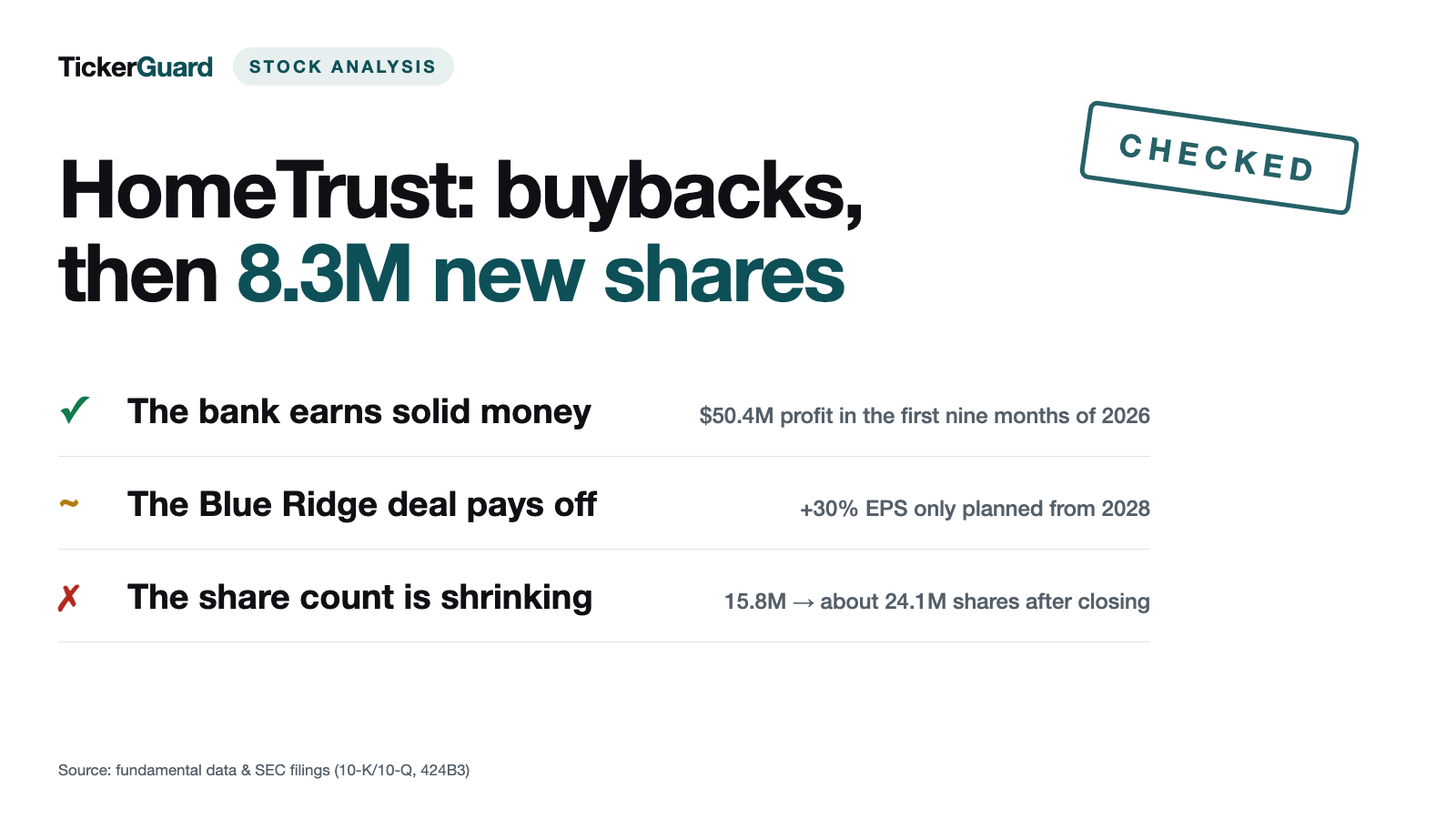
HomeTrust Stock: Buying Back Shares as “Undervalued” — Then Issuing 8.3 Million New Ones for a Deal
In 2026 HomeTrust Bancshares spent $75.0 million buying back its own stock because the shares were “currently undervalued” — and now it plans to pay for Blue Ridge Bankshares with about 8.3 million new shares of that very stock. On paper the much-awarded North Carolina regional bank is in good shape: a 4.46 percent net interest margin, a common equity tier 1 ratio above 13 percent, accolades from Forbes to KBW. But who checks the math behind the badges? We look at the currency a bank uses to go shopping.
 Thomas Mücke
Founder & Publisher
As of Today
As of: November 23, 2026
- Closing price
- 45.50 $ +0.20%
- Market Capitalisation
- 0.8 $B
- Growth Score
- 6/10
- AAQS
- 8/10
Price change since November 20, 2026: +0.2%
This analysis has a cut-off date. The Stock Guard tells you when something material changes in the numbers. Reserve your free spot
Chart
Interactive price chart (TradingView).
52-week range: 39.50 $ to 51.90 $ · Last price: 45.50 $ (As of: November 23, 2026)
Note: pure fact-based analysis, not investment advice and not a solicitation to buy or sell. All figures without guarantee.
There is an investor trap that springs with a smile: the badge trap. A company collects awards — “Best U.S. Banks,” “America’s Best Banks,” “Top 50 Community Banks,” “Best Place to Work” in all five states it operates in — and your brain concludes that whatever this company does must be well thought out. Anyone with that many trophies surely does not need checking. HomeTrust Bancshares (NYSE: HTB) of Asheville, North Carolina, lists those badges in every press release. So let’s make a deal: we set the badges aside for a moment and read what the bank told the U.S. securities regulator, the SEC — the annual report (10-K) for 2025, the quarterly report (10-Q) of November 6, 2026, the third-quarter earnings release and the merger prospectus of November 3, 2026. At the end, you decide.
What HomeTrust Actually Does — From Mutual Thrift to Commercial Bank
At its core, a bank is a trader in money. It takes in deposits and lends them out at a higher rate — to businesses, developers, home buyers. What remains after interest costs, measured against all interest-earning assets, is the net interest margin. At HomeTrust it was 4.46 percent in the third quarter of 2026: for every $100 the bank lent or invested, $4.46 of net interest income remained on an annualized basis. That is a high figure for a regional bank; the bank itself calls it a “top-quartile” net interest margin. In the first nine months of 2026, $136.1 million came from net interest income and $28.3 million from fees, loan sales and leasing.
The bank was founded in Asheville in 1926 and for a long time was a mutual — a savings institution owned by its depositors, not by shareholders. On July 10, 2012, it converted to stock form and went public. Since then it has grown mainly through acquisitions, most recently Quantum Capital in Atlanta (February 2023). Today it runs a little over 30 locations in North Carolina, South Carolina, East Tennessee, Southwest Virginia and Georgia and had 574 employees at the end of 2025. Two technical changes are worth knowing: since January 2024 the fiscal year ends on December 31 instead of June 30, and in February 2025 the stock moved from Nasdaq to the New York Stock Exchange.
That sets up the central tension of this analysis, and it runs through every chapter: HomeTrust thinks its own stock is too cheap and buys it back — and in the same year agrees to pay for an acquisition with more than eight million new shares of exactly that stock.
Company history for investors
-
1926
Founded in Asheville
The bank starts out as a savings institution in Asheville, North Carolina. For shareholders: a bank with deep roots in its region.
-
2012
From mutual to stock company
On July 10, 2012, the bank converts and goes public. For shareholders: since then it has grown mainly through acquisitions.
-
2024
New fiscal year
From 2024 the fiscal year ends on December 31 instead of June 30. For shareholders: old and new annual figures compare only with care.
-
2025
Move to the NYSE
In February 2025 the stock moves from Nasdaq to the New York Stock Exchange. For shareholders: same company, new trading venue.
-
2026
Buybacks and the Blue Ridge deal
HomeTrust buys back 1.61 million shares and agrees to pay for Blue Ridge with about 8.3 million new ones. For shareholders: many more shares on balance.
How the Stock Landed on Our Desk
No valuation screen flagged HomeTrust. It was our Reddit hype scanner, part of our in-house stock scanner that counts what investors talk about in online forums. According to ApeWisdom, the ticker HTB showed up on November 23, 2026, with just two mentions in 24 hours, rank 144. That is not hype, that is a whisper — and not a buy signal. With quiet names, though, it pays to ask why anyone is talking about them at all. At HomeTrust the answer is easy to find: on August 17, 2026, the bank announced the acquisition of Blue Ridge Bankshares, a bank a little more than half its own size.
A note on the data: some financial-data sources still list HomeTrust with a fiscal year ending in June. What counts are the filings themselves — and since 2024 they follow the calendar year. Keep this in mind for everything that follows: A bank’s profit shows how well it runs. The share count shows what it pays with.
The Numbers Over the Years — An Honest Look
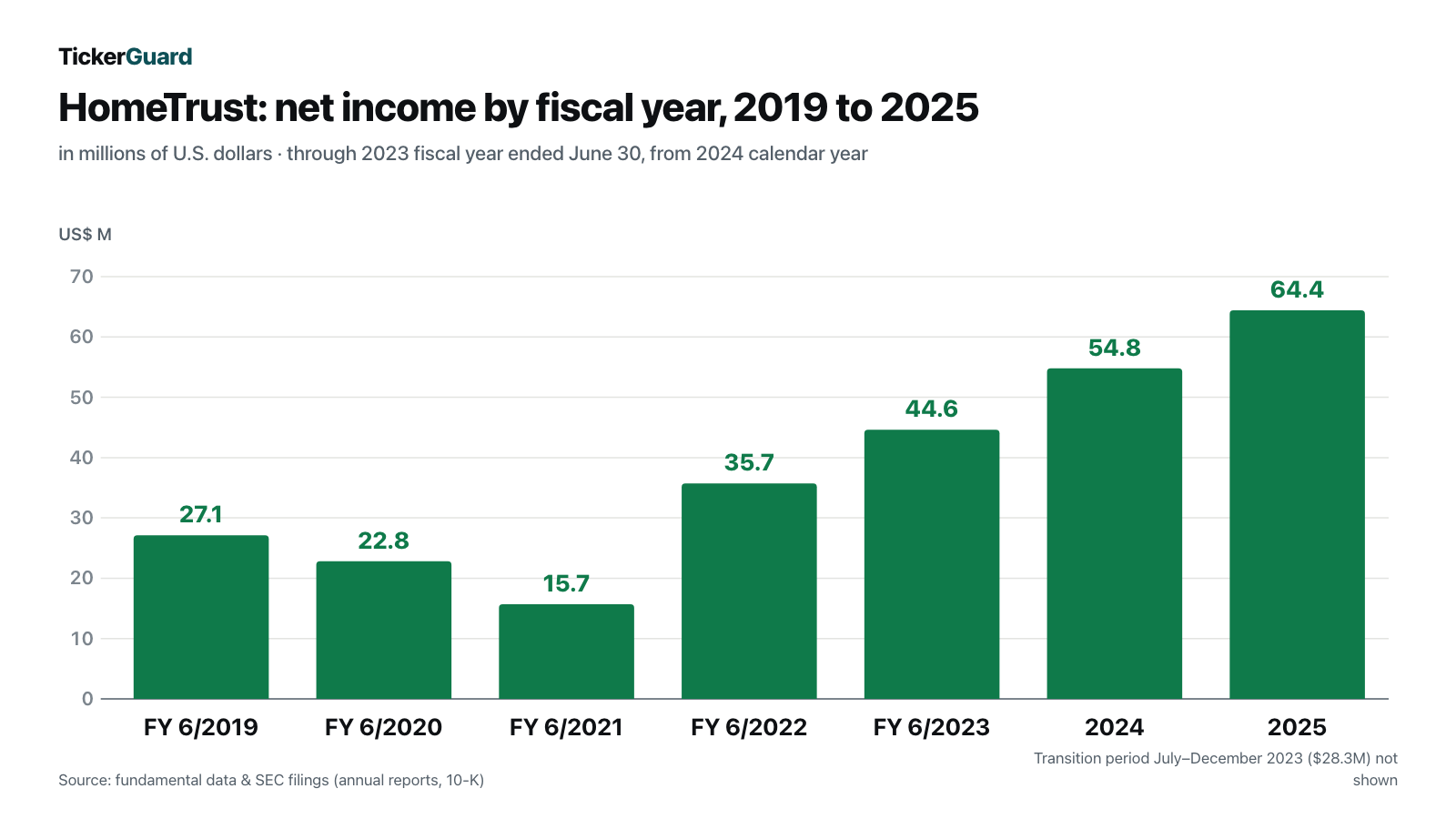
First, what genuinely impresses. HomeTrust has gained a lot of earning power over the past few years. Net income rose from $15.7 million in the fiscal year ended June 2021 via $35.7 million (June 2022) to $44.6 million in the fiscal year ended June 2023, then to $54.8 million in calendar 2024 and $64.4 million in calendar 2025. Before that it earned $27.1 million (fiscal year ended June 2019) and $22.8 million (June 2020). The six-month transition period from July to December 2023, created by the change in fiscal year, brought in $28.3 million.
2026 is going well, too. In the first nine months the bank earned $50.4 million, up from $48.2 million a year earlier, or $3.04 per diluted share versus $2.79. Return on equity was 11.28 percent, and the net interest margin rose to 4.39 percent (prior year: 4.27). The third quarter alone brought $18.0 million — but that includes a $1.9 million tax benefit from purchased renewable-energy tax credits, a one-off item.
And the capital cushion is thick. The common equity tier 1 ratio — the share of top-quality capital relative to risk-weighted loans and investments — was 13.34 percent on September 30, 2026; a bank counts as “well capitalized” from 6.5 percent. Put simply, HomeTrust holds more than twice the buffer regulators require for the top grade. That is why it can buy back stock at all. Which brings us to the uncomfortable truths.
What the Filings Say — The Uncomfortable Truths
Uncomfortable Truth No. 1: “Undervalued” for the buyback — good enough as currency for the deal
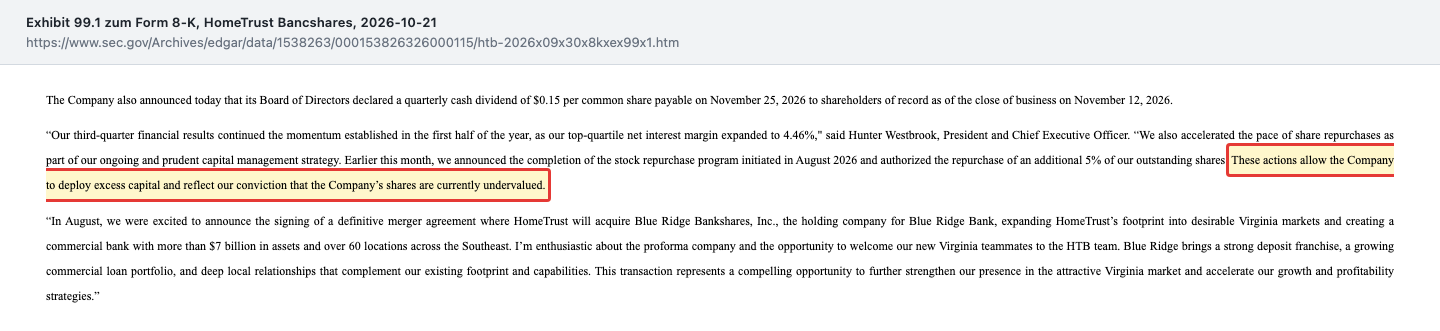
A share buyback is like a baker buying back his own rolls because he thinks he sold them too cheaply: whoever stays owns a bigger slice of the pie. HomeTrust bought back heavily in 2026 — 1.61 million shares through September at an average of $46.15, $75.0 million in total. Together with $7.1 million in dividends, the bank paid out more than it earned in nine months. CEO Hunter Westbrook gave the reason in the earnings release of October 21, 2026:
“These actions allow the Company to deploy excess capital and reflect our conviction that the Company’s shares are currently undervalued.”
— HomeTrust Bancshares, third-quarter 2026 earnings release (Exhibit 99.1 to the 8-K of October 21, 2026)
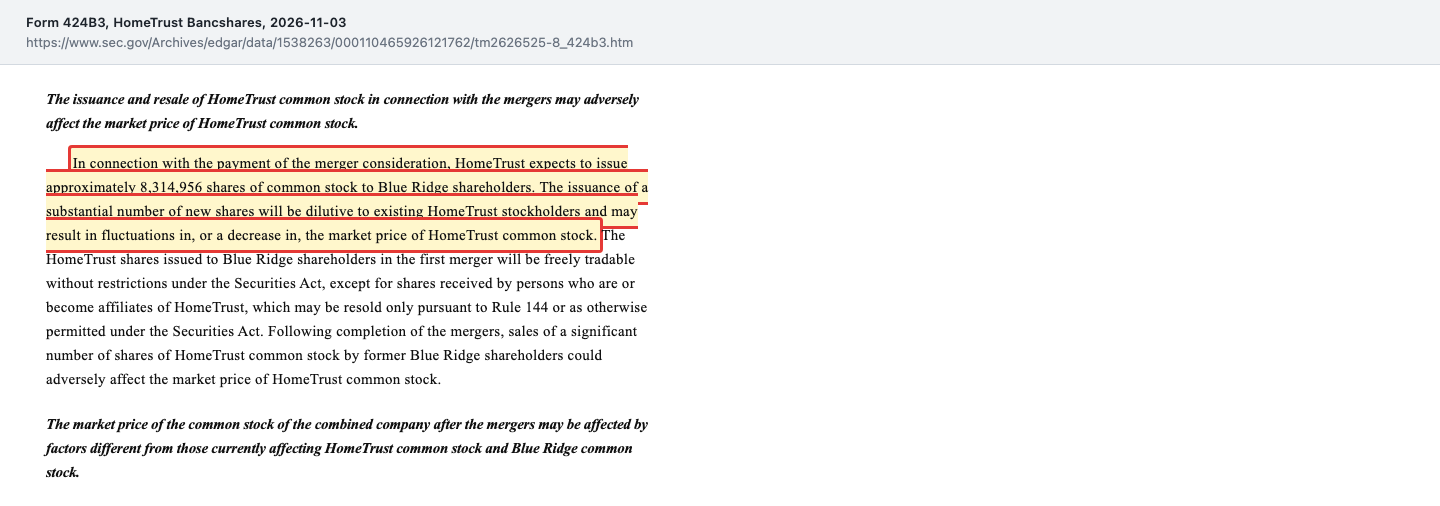
Two months earlier, on August 16, 2026, HomeTrust had signed an agreement to pay for Blue Ridge Bankshares of Richmond, Virginia, entirely in its own stock: 0.086 HomeTrust shares per Blue Ridge share. The merger prospectus gives the number:
“In connection with the payment of the merger consideration, HomeTrust expects to issue approximately 8,314,956 shares of common stock to Blue Ridge shareholders. The issuance of a substantial number of new shares will be dilutive to existing HomeTrust stockholders and may result in fluctuations in, or a decrease in, the market price of HomeTrust common stock.”
— HomeTrust Bancshares, merger prospectus 424B3 of November 3, 2026, risk factors
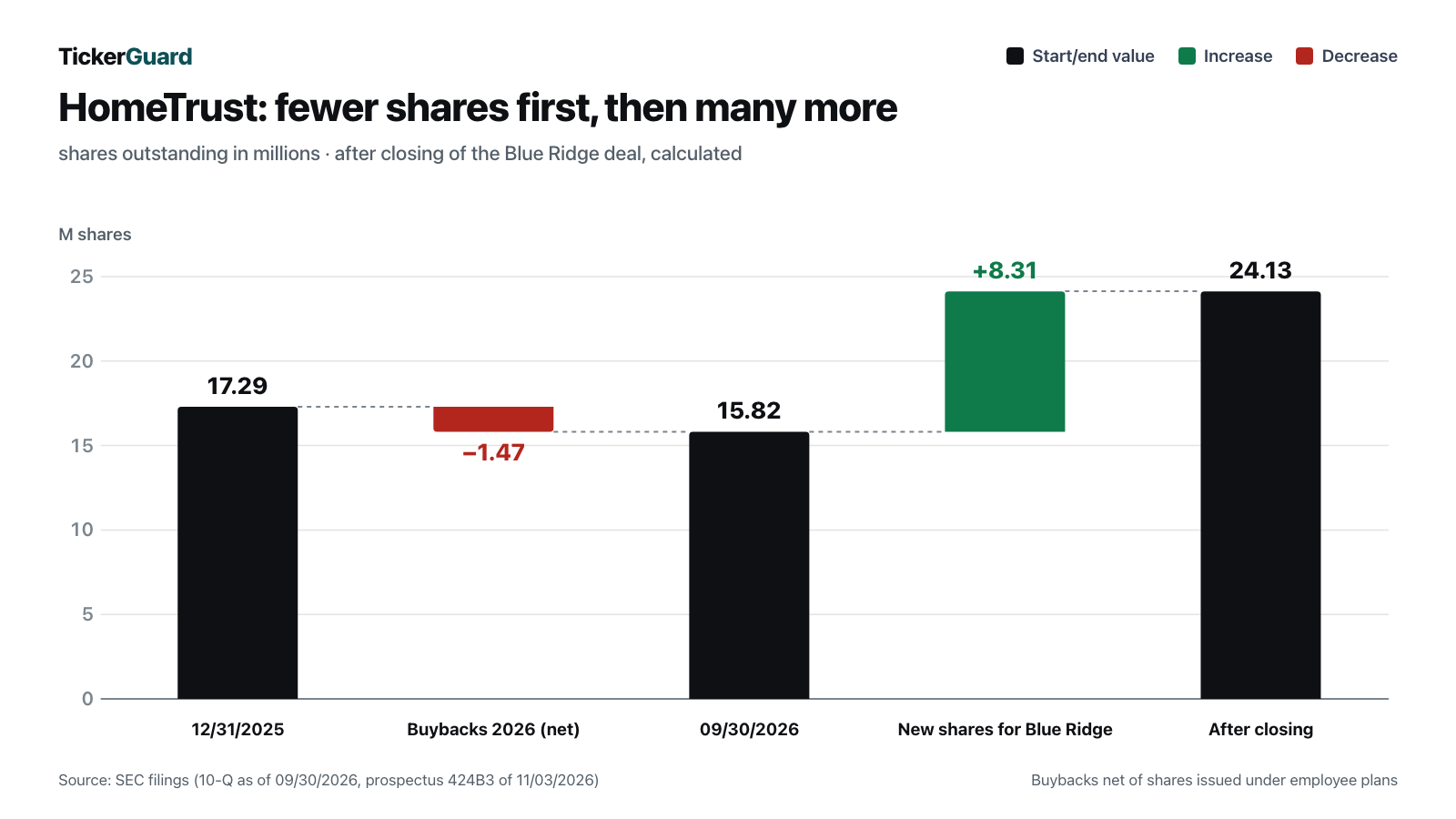
Dilution means your slice of the pie gets smaller because more people sit at the table. The chart shows the movement. At the end of 2025, 17.29 million shares were outstanding; buybacks (net of shares issued under employee plans) reduced that by 1.47 million to 15.82 million by September 30, 2026. With 8.31 million new shares for Blue Ridge, the count would be 24.13 million on our math — about 40 percent more than at the end of 2025. Blue Ridge shareholders are expected to own about 35 percent of the bank afterward.
In fairness, both can make sense at the same time. In a stock deal, what matters is how expensive your own currency is relative to what you are buying. On the last trading day before the announcement, August 14, 2026, HomeTrust stock closed at $49.98, about 1.48 times its tangible book value of $33.67 as of June 30, 2026. For Blue Ridge it offered $4.28 per share (based on the five-day average price of $49.82), about 1.40 times Blue Ridge’s tangible book value ($3.05) — on that basis, HomeTrust paid with the slightly more expensive currency (our math). The buybacks fit that picture: on average the bank repurchased at $46.15, about 1.37 times the same tangible book value. Buying your own stock back cheaper and using it as currency at a higher price can be perfectly consistent; what the new shares are ultimately worth, though, depends on the share price on closing day. Still, the story has a contradiction: if you think your stock is undervalued, you are reluctant to hand out a lot of it. The second buyback program for 832,000 shares, authorized on August 4, 2026, kept running through the end of September at an average of $47.70; in September alone, after the signing, HomeTrust bought back 357,259 shares. On November 20, 2026, the stock closed at $45.41.
Uncomfortable Truth No. 2: The bank being acquired has only just left regulatory supervision
Blue Ridge is no small add-on. As of June 30, 2026, it had $2.3 billion in total assets, $1.8 billion in loans and $1.9 billion in deposits — a little more than half the size of HomeTrust itself. And it has a history that the prospectus describes openly:
“The additional capital also supported Blue Ridge’s efforts to remediate the issues identified in Blue Ridge Bank’s Consent Order with the Office of the Comptroller of the Currency that had been issued in January 2024, which replaced a formal written agreement entered into by Blue Ridge Bank with the Office of the Comptroller of the Currency in August 2022.”
— HomeTrust Bancshares, merger prospectus 424B3 of November 3, 2026, “Background of the Mergers”
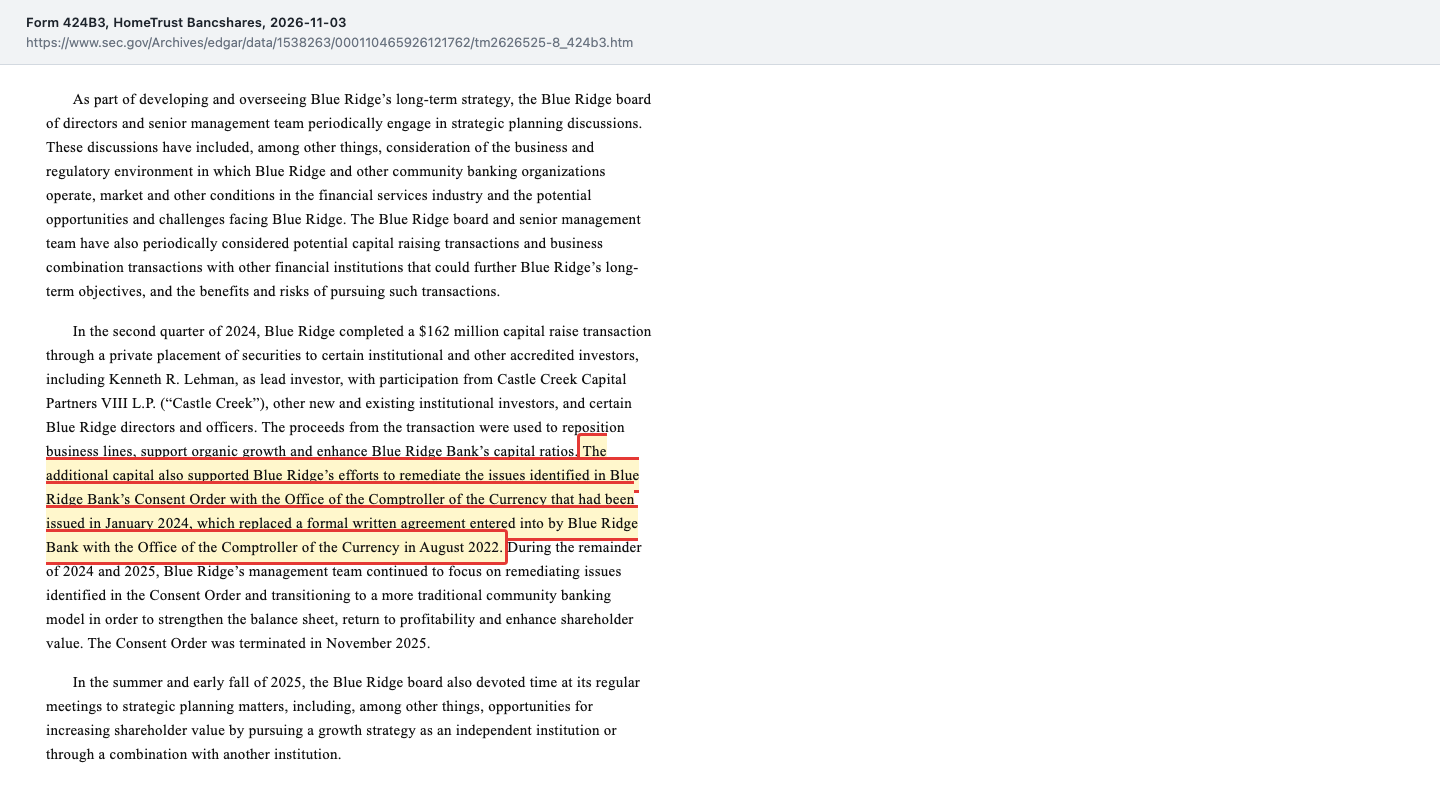
A consent order is something like probation for a bank: the regulator spells out what needs fixing and watches closely until it is done. To get there, Blue Ridge needed a $162 million capital injection in 2024; the order was terminated in November 2025. Since March 2026 an interim CEO has been running the bank. It is not yet earning reliably again: according to the prospectus, it posted a net loss of $0.46 million in the first half of 2026 and net income of $10.7 million in 2025 — the latter helped by a $4.0 million release of credit-loss reserves.
What the package costs shows up in the prospectus’s pro forma math, the calculation “as if both were already combined”: in the first half of 2026, the combined bank would have earned $1.57 per diluted share instead of the $1.93 HomeTrust earned on its own. The promised roughly 30 percent increase in earnings per share depends on cost savings that, according to the press release, are only supposed to be fully realized from 2028 — and that the pro forma figures expressly exclude. On top of that comes about 8.3 percent less tangible book value per share at closing, which management estimates it will earn back in about 3.25 years, and $153.9 million in new goodwill on the balance sheet. For how neighboring banks are run, see our Carter Bankshares analysis and our analysis of First National Corp. — both regional banks from Virginia.
Uncomfortable Truth No. 3: Problem loans are rising — reserves are falling
While the merger plan moves forward, one spot on the bank’s own balance sheet is getting restless. Nonperforming assets — loans no longer paying interest plus repossessed collateral — rose from $47.1 million on March 31, 2026, to $54.7 million on June 30 and $70.4 million on September 30, 2026, or 1.59 percent of total assets. Part of that is guaranteed by the U.S. Small Business Administration (SBA); excluding it, $47.7 million or 1.08 percent remains. The earnings release also names the quarter’s driver:
“In addition, one $18.0 million commercial loan relationship was newly classified as nonperforming during the quarter ended September 30, 2026 although no loss is anticipated.”
— HomeTrust Bancshares, third-quarter 2026 earnings release, “Asset Quality”
A broader measure is classified assets — mostly loans, everything where the bank itself has doubts about full repayment. They rose 39.2 percent year to date, from $66.2 million to $92.1 million, or 2.08 percent of total assets. At the same time, the allowance for credit losses — the cushion for expected defaults — fell from 1.16 to 1.09 percent of loans. That is not necessarily a mistake: the bank expects no loss on the largest new case, and actual net charge-offs over nine months were a low 0.17 percent annualized, mostly in truck financing. But the two lines are moving apart. For a bank about to integrate a second bank with a troubled past, this is exactly where to look first in the next reports.
Valuation: What the Late-November 2026 Price Implies
On November 20, 2026, HomeTrust stock closed at $45.41; with 15.82 million shares, that is a market value of about $718 million. Against book value of $36.05 per share as of September 30, 2026, the stock trades at 1.26 times book; against tangible book value ($33.70, excluding goodwill and core deposit intangibles) at 1.35 times. On earnings per share over the past four quarters ($3.97), the price-to-earnings ratio is a little over 11. For a bank earning an 11 percent return on equity, that is a normal valuation, not a cheap one. The quarterly dividend of $0.15 yields about 1.3 percent a year at that price.
The pros’ view: according to fundamental data (as of November 23, 2026), five analysts cover the stock — two rate it a strong buy, one a buy and two a hold; the average price target is $55.25. Keep in mind: price targets are opinions with a number attached, not forecasts. For the valuation after the deal, what matters most is whether the cost savings materialize — without them, earnings per share fall at first.
Opportunities and Risks at a Glance
What speaks for HomeTrust:
- Strong earning power: a 4.46 percent net interest margin in the third quarter of 2026, net income of $64.4 million in 2025 after $15.7 million in the fiscal year ended June 2021.
- A thick capital cushion: a common equity tier 1 ratio of 13.34 percent as of September 30, 2026, more than twice the “well capitalized” threshold.
- Acquisition experience: since 2013 the bank has integrated six acquisitions and one package of ten branches, most recently Quantum Capital in Atlanta in 2023.
- Buying Blue Ridge turns HomeTrust into a bank with more than $7 billion in total assets and over 60 locations; if the cost savings come through, earnings per share are supposed to be about 30 percent higher from 2028.
- A valuation without excess: 1.35 times tangible book value and a P/E of a little over 11 (price of November 20, 2026).
What speaks against it:
- A contradictory capital policy: $75.0 million in buybacks through September 2026 justified as “undervalued,” then about 8.31 million new shares as the purchase price — taking the count from 15.82 million to 24.13 million on our math.
- The acquired bank was under regulatory orders from 2022 until November 2025, is run by an interim CEO and posted a small loss in the first half of 2026.
- On a pro forma basis, earnings per share fall at first (first half of 2026: $1.57 instead of $1.93), and tangible book value per share drops by about 8.3 percent; making up for that depends on cost savings from 2028.
- Rising problem loans: nonperforming assets of $70.4 million (1.59 percent), classified assets up 39.2 percent year to date, while the allowance shrinks.
- Part of third-quarter 2026 profit came from purchased tax credits ($1.9 million), a one-off item.
A Human Conclusion
Back to the badge trap. Its core is not that the awards are wrong — by everything the filings show, HomeTrust is a profitable, well-capitalized regional bank that has grown from a depositor-owned savings institution into a solid commercial bank. Its core is that badges switch off questions. And here there is one question no certificate answers: why does a bank buy back its stock because it thinks it is too cheap, and in the same year agree to hand out more than eight million of those shares for a bank that has only just been released from regulatory supervision?
There may be a good answer — the tangible-book math does not argue against HomeTrust, and the bank has digested acquisitions before. So the honest question for you is: Do you trust management to deliver the promised cost savings from Blue Ridge while its own problem loans are rising — and are you willing to hand a good third of your bank to new co-owners for it? If yes, you have a thesis. If all you saw were the badges, you have a label. What you make of it is your decision. And that is how it should be.
Sources
All original documents used in this analysis — so you can read them yourself:
- HomeTrust Bancshares, Inc. — SEC quarterly report 10-Q as of September 30, 2026 (filed November 6, 2026)
- HomeTrust Bancshares, Inc. — third-quarter 2026 earnings release (Exhibit 99.1 to the 8-K of October 21, 2026)
- HomeTrust Bancshares, Inc. — merger prospectus 424B3 for the acquisition of Blue Ridge Bankshares (filed November 3, 2026)
- HomeTrust Bancshares, Inc. — press release on the merger agreement (exhibit to the 8-K of August 17, 2026)
- HomeTrust Bancshares, Inc. — 8-K filings on the buyback programs of August 4, 2026 and October 5, 2026
- HomeTrust Bancshares, Inc. — SEC annual report 10-K for 2025 (filed March 13, 2026)
- Complete SEC filing history of HomeTrust Bancshares: EDGAR overview (sec.gov)
- Fundamental data (prices, analyst estimates; as of November 23, 2026), cross-checked against the SEC filings and the SEC’s XBRL data series.
- Reddit mentions: ApeWisdom (as of November 23, 2026); accessed via our in-house Reddit hype scanner.
Transparency & disclaimer: This analysis is a journalistic assessment of publicly available information and is not investment advice, not a financial analysis in the regulatory sense and not a solicitation to buy or sell securities. Stock investments carry substantial risk, up to and including total loss. All information without guarantee; the data date is noted in the text. Positions held by the operator are disclosed daily; where one exists, it appears as a notice at the top of this deep dive.
Key figures at a glance
All monetary figures in millions of $; earnings per share as reported.
| Metric | 2022 | 2023 | 2024 | 2025 | 2026 |
|---|---|---|---|---|---|
| Revenue | 155.3 | 216.1 | 265.8 | 295.1 | 292.5 |
| Operating Income (EBIT) | 45.4 | 57.2 | 63.3 | 69.9 | 81.0 |
| Net Income | 35.7 | 44.6 | 50.0 | 54.8 | 64.4 |
| Net Margin | 23.0% | 20.6% | 18.8% | 18.6% | 22.0% |
| Earnings Per Share | 2.26 $ | 2.83 $ | 2.97 $ | 3.22 $ | 3.76 $ |
Source: fundamental data & SEC filings (annual and quarterly reports, 10-K/10-Q)
Our Bottom Line at a Glance
- Earning power positive
- A 4.46 percent net interest margin in the third quarter of 2026, net income of $50.4 million in the first nine months of 2026 (prior year: $48.2 million) and an 11.28 percent return on equity. Net income more than quadrupled from the fiscal year ended June 2021 ($15.7 million) to 2025 ($64.4 million).
- Capital positive
- A common equity tier 1 ratio of 13.34 percent as of September 30, 2026, more than twice the “well capitalized” threshold (6.5 percent). It fell from 13.83 percent at the start of the year because buybacks and dividends ($82.1 million) exceeded profit.
- Capital policy negative
- $75.0 million in buybacks through September 2026 justified as “undervalued,” while about 8.31 million new shares serve as the purchase price for Blue Ridge — the share count rises from 15.82 million to 24.13 million on our math.
- Blue Ridge acquisition neutral
- More scale in Virginia and about 30 percent higher earnings per share from 2028 — if the cost savings materialize. Pro forma EPS for the first half of 2026 was $1.57 instead of $1.93; Blue Ridge was under regulatory orders until November 2025 and posted a small loss in the first half of 2026.
- Credit quality negative
- Nonperforming assets rose from $47.1 million (03/31/2026) to $70.4 million (09/30/2026), classified assets by 39.2 percent year to date to $92.1 million; the allowance fell from 1.16 to 1.09 percent of loans. Net charge-offs remain low at 0.17 percent.
- Valuation neutral
- 1.35 times tangible book value and a P/E of a little over 11 at the $45.41 close (11/20/2026) — fair for a bank earning an 11 percent return on equity, but with no visible discount for the merger risks.
HomeTrust is a case for the badge trap: a much-awarded, profitable regional bank with a thick capital cushion that bought back its own stock as “undervalued” in 2026 and then issues about 8.3 million new shares for Blue Ridge Bankshares — a bank that was under regulatory orders until November 2025. At the same time its own problem loans are rising. Investors are betting that management digests this deal as well as earlier ones. Not investment advice.
What Our Rating Means
Open questions
The business works in principle, but one material question is open. As long as it stays open, our findings do not carry a quality verdict.
Yellow, because the banking business works but a material operating question is open: from 2027 HomeTrust will integrate a bank a little more than half its size that was only released from a regulatory order in November 2025 and posted a loss in the first half of 2026 — just as its own nonperforming assets rose by half within two quarters. Whether the promised cost savings arrive from 2028 is unproven. We see no risk to the bank’s substance: it is profitable and very well capitalized with a 13.34 percent common equity tier 1 ratio. The decision is yours.
A journalistic assessment by our editorial team at the time of the deep dive, based on public sources — not investment advice and not a solicitation to buy or sell. Your personal circumstances (investment goals, risk capacity, taxes) cannot be taken into account. What our levels mean, how verdicts are formed, and what conflicts of interest exist →
Worth Noting
- The analysis was triggered by the Reddit hype scanner; ApeWisdom counted two mentions in 24 hours on 11/23/2026 (rank 144). Price reference: $45.41 close on 11/20/2026 according to fundamental data; closing prices cited in the merger prospectus: $49.98 (08/14/2026) and $47.14 (10/27/2026).
- Data as of: the latest periodic report is the 10-Q as of 09/30/2026 (filed 11/06/2026); the earnings release came on 10/21/2026 (8-K Item 2.02). No further filing followed the 10-Q through 11/23/2026. Merger data from the 424B3 prospectus of 11/03/2026 and the press release of 08/17/2026.
- Fiscal year: through 2023 it ended on June 30, since 2024 on December 31; the July–December 2023 transition period (net income $28.3 million) is covered by the 10-KT transition report. Some data sources still show the old fiscal year end.
- Share count from the 10-Q cover (15,816,410 as of 10/30/2026). Market value cross-check: 15.82 million shares times $47.14 (close on 10/27/2026 per the prospectus) gives about $746 million, 3.8 percent above the fundamental-data value (about $718 million at $45.41).
- Our math: payouts in the first nine months of 2026 ($75.0M + $7.1M = $82.1M vs. $50.4M profit); share count after closing (15.82M + 8.31M = 24.13M); price to tangible book on 08/14/2026 ($49.98 vs. $33.67 = 1.48) and the Blue Ridge price to its tangible book ($4.28 vs. $3.05 = 1.40); valuation on trailing four-quarter EPS ($3.97).
Stock Watch
This analysis is as of November 24, 2026. Stock Watch will tell you what's changed at HTB since then.
Later $1 a month per stock — signing up is free, and you'll be the first to know when it launches.
The full analysis as a PDF for later
We will send you this analysis as a PDF — to print, file away, and read at your own pace. And we will add you to the free Stock Watch list for HomeTrust Bancshares, Inc. (HTB), so you hear about it when something material in this analysis changes.
Frequently Asked Questions
HomeTrust Bancshares, Inc. (NYSE: HTB) is the holding company of HomeTrust Bank in Asheville, North Carolina. Founded in 1926, the bank has a little over 30 locations in North Carolina, South Carolina, East Tennessee, Southwest Virginia and Georgia and lends mainly to commercial real estate, businesses, equipment lessees and home buyers. As of September 30, 2026, it had $4.42 billion in total assets and $3.58 billion in deposits.
HomeTrust wants to expand into Virginia and become a bank with more than $7 billion in total assets and over 60 locations. It is paying entirely in stock: 0.086 HomeTrust shares per Blue Ridge share, about 8.3 million new shares in total, worth about $448.1 million when the deal was signed in August 2026. From 2028, cost savings are expected to lift earnings per share by about 30 percent.
HomeTrust’s special meeting is on December 14, 2026, in Asheville; shareholders vote on issuing the roughly 8.3 million new shares. Holders of record on October 23, 2026, may vote. Blue Ridge votes on the same day. According to the company, closing is planned for early in the first quarter of 2027 and still requires regulatory approval.
Through September 30, 2026, HomeTrust repurchased 1,610,743 of its own shares at an average of $46.15, $75.0 million in total. Two programs for 870,000 and 832,000 shares have been completed, and a third for 790,000 shares has been authorized. Shares outstanding fell from 17.29 million at the end of 2025 to 15.82 million.
HomeTrust pays $0.15 per share per quarter; the latest dividend is payable on November 25, 2026. In the first nine months of 2026, dividends totaled $0.43 per share, up from $0.36 a year earlier. At the closing price of November 20, 2026 ($45.41), the quarterly dividend works out to an annual yield of about 1.3 percent.
The board moved the fiscal year end from June 30 to December 31, effective January 1, 2024. For the gap from July to December 2023, the bank filed a separate transition report (10-KT); net income for that six-month period was $28.3 million. Older figures therefore refer to fiscal years ending in June, newer ones to calendar years.
Found an error?
Did you spot a factual error, an outdated number, or a typo in this deep dive? Let us know briefly — your report goes straight to the editorial team.