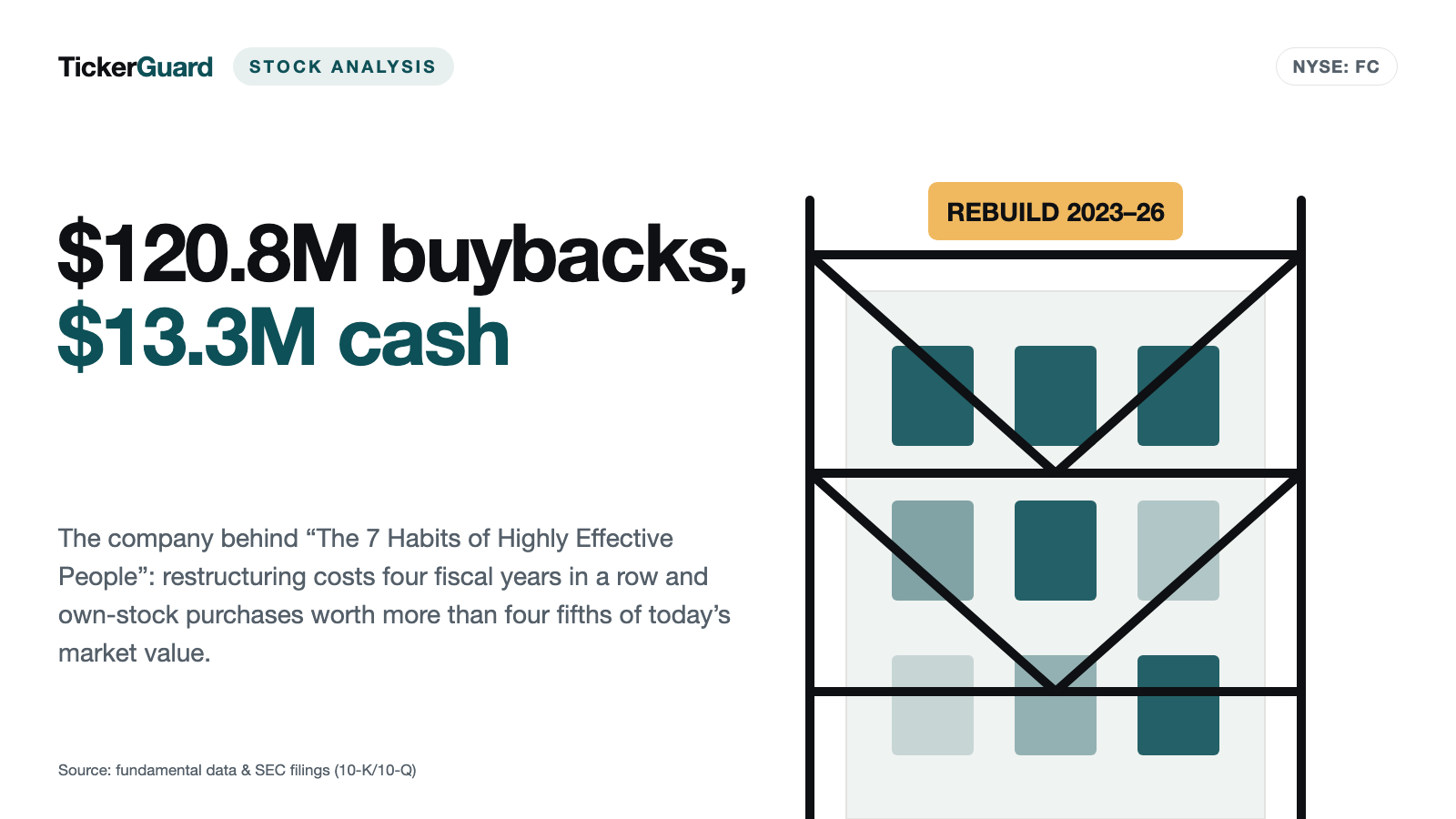
Franklin Covey, the Company Behind “The 7 Habits”: $120.8 Million Spent on Its Own Stock, $13.3 Million Left in Cash
Has the teacher of effectiveness used its own money effectively? Franklin Covey, the company behind Stephen R. Covey’s worldwide bestseller, sells leadership training as a subscription, to corporations and to schools. In fiscal 2023 through 2026 the company put $120.8 million into its own shares while net income fell from $23.4 million (fiscal 2024) to $4.9 million (fiscal 2026) and cash shrank to $13.3 million. The annual report filed on November 12, 2026 shows how much of that is restructuring, how much is accounting, and what the subscription business really carries. Not investment advice — only a look at what a $13 share price really buys after $53.
 Thomas Mücke
Founder & Publisher
As of Today
As of: November 23, 2026
- Closing price
- 13.10 $ -0.80%
- Market Capitalisation
- 0.2 $B
- Growth Score
- 4/10
- AAQS
- 2/10
Price change since November 20, 2026: -0.7%
This analysis has a cut-off date. The Stock Guard tells you when something material changes in the numbers. Reserve your free spot
Chart
Interactive price chart (TradingView).
52-week range: 11.50 $ to 25.60 $ · Last price: 13.10 $ (As of: November 23, 2026)
Note: pure fact-based analysis, not investment advice and not a solicitation to buy or sell. All figures without guarantee.
You may know the book: Stephen R. Covey’s “The 7 Habits of Highly Effective People.” The company behind it, Franklin Covey (NYSE: FC), closed at $53.83 on August 15, 2022 and at $13.19 on November 20, 2026 (closing prices from fundamental data). That is three quarters lower. And right here lurks an investor trap that anyone who has fallen for a price tag with a crossed-out number already knows: the anchoring bias. When the tag says “was 50, now 13,” the 13 feels like a gift — whether or not the item is still worth 13 today. In the stock market, the anchor is the old share price. Before you see a bargain in that, let’s read together what Franklin Covey has reported to the U.S. securities regulator, the SEC — the annual report (10-K) for fiscal 2026, filed on November 12, 2026, the earnings release of November 4, 2026 with its fiscal 2027 guidance, and the quarterly report (10-Q) for the period ended May 31, 2026. That is where you find out what $13 buys today. In the end, you decide.
What Franklin Covey actually does — leadership training as a subscription
The company was incorporated in Utah in 1983, later operated as Franklin Quest and merged with Stephen R. Covey’s Covey Leadership Center in 1997 to form Franklin Covey. It sells training programs meant to help companies, government agencies and schools lead, align and coordinate their people. The annual report sums it up in one sentence:
“Franklin Covey is a global company focused on organizational performance improvement.”
— Franklin Covey Co., SEC annual report 10-K for fiscal 2026, Item 1 “Business”
In everyday terms: Franklin Covey is a mix of gym membership and personal trainer, just for managers. The subscription is called the “All Access Pass”: a company pays for access to all courses, online content and tools and books trainers and consultants on top. Besides the “7 Habits,” programs such as “The 4 Disciplines of Execution” (executing strategy) and “The Speed of Trust” (trust within teams) are part of it, and since fiscal 2026 also courses on working with artificial intelligence. According to the annual report, the subscription also includes an “AI Coach,” an AI assistant for practicing the content.
The business has two pillars. The Enterprise Division brought in $182.7 million of revenue in fiscal 2026, of which $142.6 million came from North America and $40.1 million from international operations. The Education Division with its “Leader in Me” program reached $76.2 million; according to the earnings release, more than 8,000 schools worldwide use it. Franklin Covey is based in Draper, Utah, and had about 1,010 associates as of August 31, 2026. Effective September 1, 2026, Sean Covey, previously head of the Education Division, became Chief Product Officer; John Buchanan joined the company as Executive Vice President for the Education Division.
Important for every year mentioned here: the fiscal year ends on August 31. “Fiscal 2026” ran from September 1, 2025 to August 31, 2026. That names the central tension of this analysis, and it runs through every chapter: in four years Franklin Covey has spent about four fifths of what the entire company is worth on the market today on its own stock — while booking restructuring costs every year since fiscal 2023 in order to grow again.
Company history for investors
-
1983
Incorporated in Utah
The company is incorporated in Utah in 1983 and later operates as Franklin Quest. For shareholders: the origin of “Franklin” in today’s company name.
-
1997
Merger with the Covey Leadership Center
The merger creates Franklin Covey Co. For shareholders: Stephen R. Covey’s content acquired back then is still the core of the offering.
-
2021
Paul S. Walker becomes CEO
Walker, with the company since 2000, takes over in September 2021. For shareholders: revenue of $287.2M in 2024, the restructuring and the large buybacks fall under his tenure.
-
2024
Revenue of $287.2 million
In fiscal 2024 revenue reaches its highest level of fiscal 2023 through 2026, with net income of $23.4M. For shareholders: both have been lower since.
-
2025
New go-to-market model in North America
Franklin Covey restructures its sales approach; 80 associates are affected by the restructuring. For shareholders: net income falls to $3.1M, with the payoff expected from 2026.
-
2026
Trading plans run out, cash at $13.3 million
The last trading plan ends in January 2026; on August 31, $13.3M is left in cash. For shareholders: further buybacks now depend on cash generation.
How the stock landed on our desk
The trigger for this analysis is the share price after the annual results. On November 4, 2026, after the market closed, Franklin Covey reported its fiscal 2026 numbers and issued guidance for fiscal 2027. The stock closed at $17.33 that day and at $13.19 on November 20, 2026, a decline of 24 percent in two and a half weeks (closing prices from fundamental data). The lowest close of 2026 was $11.54 on March 13.
A share price that has lost three quarters of its value in four years is, in the screens of our stock scanners, a reason to read up, not a finding. Keep one thing in mind about Franklin Covey from the start: the old price says nothing about today’s value — it is only the price someone once paid.
The numbers over the years: revenue down since 2024, profit shrunk to a fifth
First, what speaks for Franklin Covey. It is a subscription business with a high gross margin: of $261.5 million in fiscal 2026 revenue, $196.0 million remained after direct costs, 75 percent. According to the annual report, contracts are usually invoiced when they are signed or at the start of each annual contract period. As of August 31, 2026, the balance sheet therefore showed $116.1 million of “deferred revenue” — revenue billed in advance that is recognized over the life of the contracts; that was 4 percent more than a year earlier. 59 percent of North American subscription contracts run for at least two years. And Franklin Covey has no financial debt: its $62.5 million credit line was undrawn at year-end.
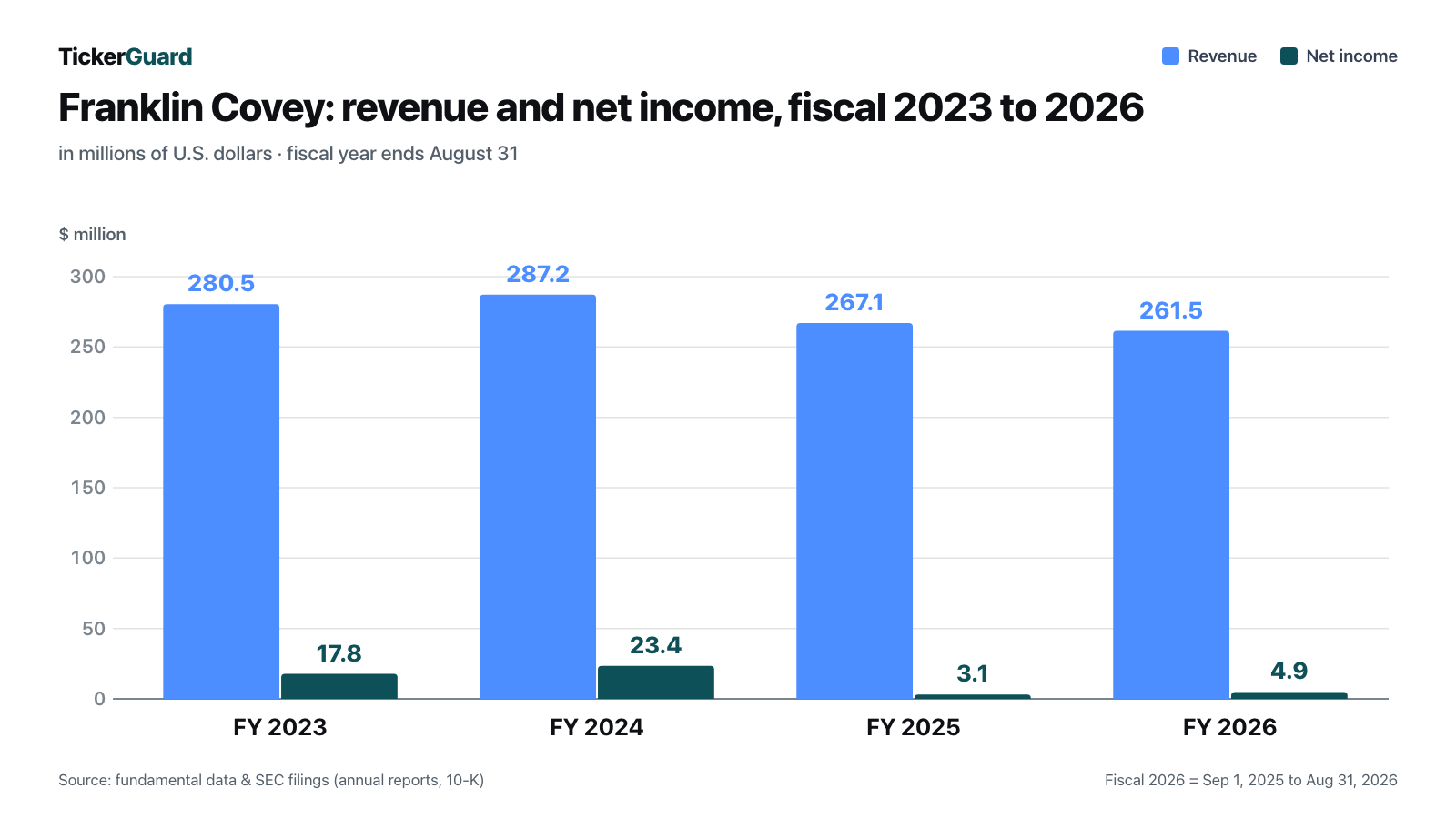
The second half of the picture belongs here too. Revenue has declined two years in a row, from $287.2 million in fiscal 2024 to $261.5 million in fiscal 2026. Net income fell even more: from $23.4 million to $3.1 million in fiscal 2025 and $4.9 million in fiscal 2026, or $0.42 per share. As the reason for the decline in North America, the annual report cites lower invoicing in fiscal 2025 because of “canceled or postponed government contracting” as well as geopolitical and macroeconomic uncertainty. Because subscription revenue is spread over the contract term, a weak sales year still shows up in revenue a year later.
That is why the company is betting on a new go-to-market model that it introduced in North America in fiscal 2025. The first evidence is there: invoiced amounts in North America rose 4 percent to $151.4 million in fiscal 2026, and deferred revenue there rose 17 percent to $59.2 million. The Education Division grew 2 percent, its subscription revenue 10 percent. And in the fourth quarter (June to August 2026) Franklin Covey earned $7.1 million, after $4.4 million in the prior-year quarter. According to the annual report, the fourth quarter can be stronger than the others, mainly because schools hold professional development days then; for the first nine months of fiscal 2026 the bottom line was a loss of $2.2 million. So much for the good news. Now for what is in the fine print.
What the filings say — the uncomfortable truths
Uncomfortable truth No. 1: $120.8 million for its own shares — more than four fifths of today’s market value
A share buyback is like buying out roommates in a shared apartment: whoever stays owns a bigger piece of the apartment afterwards. That pays off if the price is right — and if there is still money left for rent and repairs. In fiscal 2023 through 2026, Franklin Covey spent a total of $120.8 million on its own stock: $35.6 million, $30.7 million, $26.4 million and $28.1 million. Operations generated $146.6 million of cash over the same period (our calculation from the cash flow statements). The buybacks therefore consumed more than four fifths of the cash the business produced. For comparison: at the closing price of November 20, 2026, the whole company is worth about $149.5 million; the buybacks equal about 81 percent of that (our calculation).
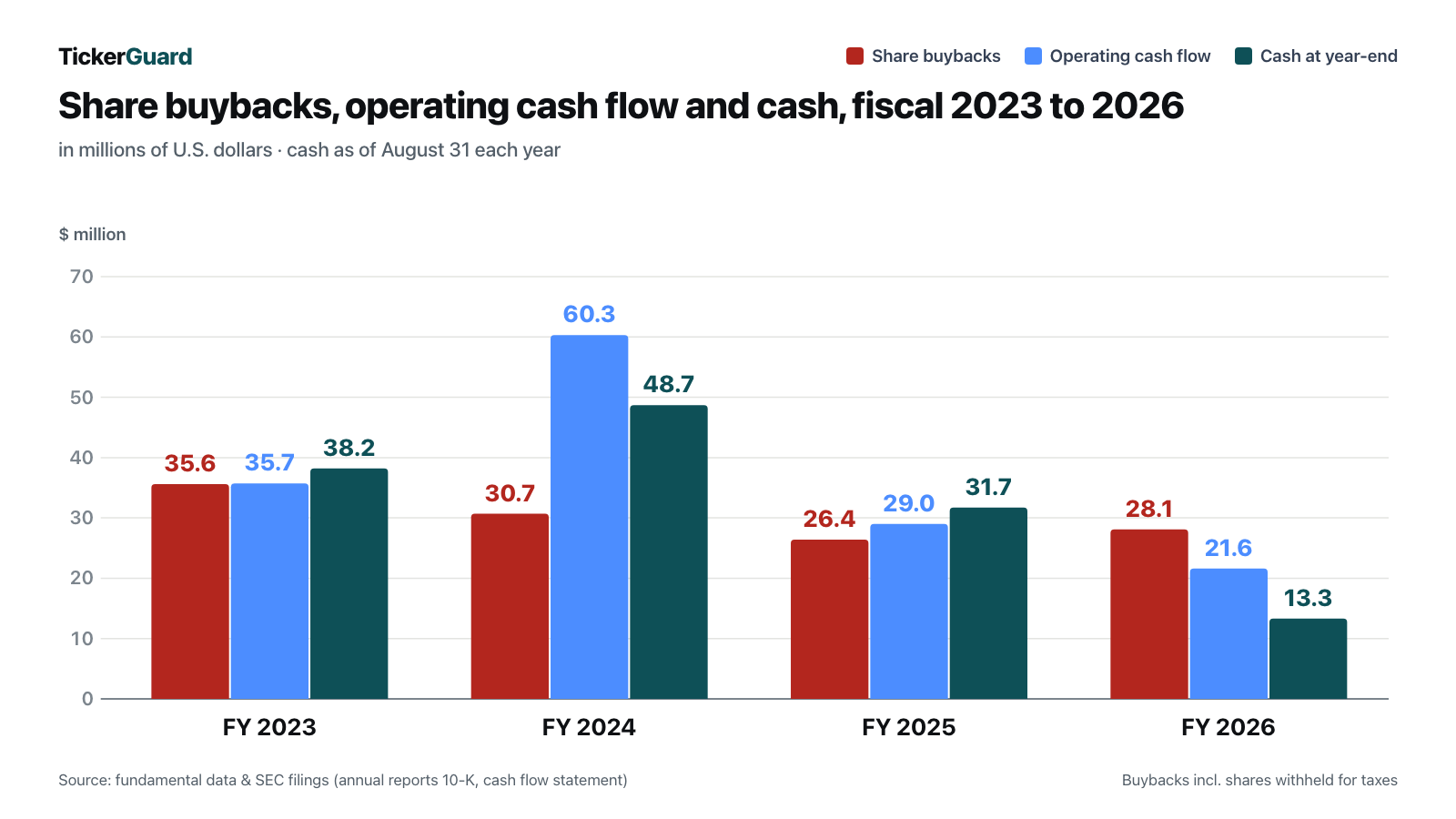
The ratio was starkest in fiscal 2026. The company bought back about 1,573,000 shares for $28.1 million, of which about 1,504,000 on the open market and about 69,000 withheld to cover taxes on vesting employee stock awards. Its free cash flow — what was left after investments in technology and new course content — was $9.2 million by its own definition. The buybacks were three times as large. The annual report puts it this way:
“At August 31, 2026, we had $13.3 million of cash, with no borrowings on our $62.5 million revolving credit facility, even after spending $28.1 million on purchases of our common stock and $12.4 million on capital assets during fiscal 2026.”
— Franklin Covey Co., SEC annual report 10-K for fiscal 2026, Item 7 “Management’s Discussion and Analysis”

Back to the anchor. In fiscal 2023 and 2024, when Franklin Covey spent $66.3 million on buybacks, closing prices ranged between $33.93 and $52.34. In fiscal 2025 ($26.4 million) they ranged between $18.40 and $44.09. In fiscal 2026 the company paid about $17.89 per share on average (our calculation: $28.13 million divided by 1,572,577 shares, including the withheld ones). All of these prices are above the closing price of November 20, 2026. After that the company no longer bought on the open market: its two automatic trading plans were completed in October 2025 and January 2026. In the third quarter (March to May 2026) Franklin Covey bought no shares on the open market, according to its quarterly report, and in the fourth quarter only 1,484 withheld employee shares. Open-market buying ended in January 2026; the low for the year followed on March 13, 2026, at $11.54. The program still has $19.7 million authorized.
To be fair: the share count really has come down. On average, 13.64 million shares were outstanding in fiscal 2023 and 11.55 million in fiscal 2026, a decline of 15 percent. As of October 31, 2026 the annual report lists 11,335,471 shares. Every remaining shareholder therefore owns a bigger slice — of a pie that has not grown over the same period. Shareholders’ equity fell from $66.9 million (August 2025) to $51.4 million. Keep in mind: a buyback is an investment in the company’s own stock. Whether it was a good one depends on the price — and here that price was almost always above today’s.
Uncomfortable truth No. 2: “infrequently occurring” — four fiscal years in a row
The metric Franklin Covey itself puts front and center is adjusted earnings before interest, taxes, depreciation and amortization, “Adjusted EBITDA.” It came to $28.9 million in fiscal 2026, almost six times net income of $4.9 million. What gets excluded is spelled out in the earnings release:
“The Company defines Adjusted EBITDA as net income or loss excluding the impact of interest, income taxes, intangible asset amortization, depreciation, stock-based compensation expense, and certain other infrequently occurring items such as restructuring and building exit costs.”
— Franklin Covey Co., earnings release of November 4, 2026 (Exhibit 99.1 to SEC Form 8-K), section “Non-GAAP Financial Information”
“Infrequently occurring” is the key phrase. Restructuring costs — mostly severance — hit Franklin Covey in each of the four fiscal years 2023 through 2026: $0.6 million in fiscal 2023, $3.0 million in fiscal 2024 for more than 50 associates, $6.7 million in fiscal 2025 for 80 associates, and again $6.7 million in fiscal 2026, split between a first plan ($3.4 million, about 45 associates) and a “long-term” plan ($3.3 million, 36 employees). On top came building exit costs of $2.1 million (fiscal 2025) and $1.4 million (fiscal 2026). And the restructuring is not over:
“We expect to incur additional costs under this long-term plan in fiscal 2027.”
— Franklin Covey Co., SEC annual report 10-K for fiscal 2026, Note 14 “Restructuring”

The second large item between net income and the adjusted figure is stock-based compensation: $6.6 million in fiscal 2026, more than all of net income. That is real pay for employees, just not paid in cash — and part of the buybacks serves to mop up the shares issued for it. Keep in mind: a company that restructures every year does not have one-time costs, it has restructuring costs. The more meaningful profit figure is closer to $4.9 million than to $28.9 million.
Uncomfortable truth No. 3: much of the profit increase is accounting
Net income rose from $3.1 million to $4.9 million in fiscal 2026. Where the increase came from is revealed in an inconspicuous paragraph on amortization. When Franklin Covey merged with the Covey Leadership Center in 1997, rights to content and licenses came onto the balance sheet and have been written off year after year ever since — much like a company car whose cost is spread over its useful life as an expense. In fiscal 2026 the company re-assessed that useful life:
“Based on the re-evaluation of these intangible assets, we extended the useful lives of these assets by approximately 5 years.”
— Franklin Covey Co., SEC annual report 10-K for fiscal 2026, Item 7, section “Amortization”

Amortization of intangible assets fell as a result — primarily for this reason, according to the report — by $1.9 million to $2.5 million. Pre-tax income rose by only $1.0 million in the same year, from $6.1 million to $7.1 million. Without the lower amortization it would have declined (our calculation). The rest of the increase in net income comes from taxes: the effective tax rate fell from 49 percent to 30 percent. The re-assessment is permitted and disclosed; Stephen R. Covey’s content is in fact still being sold today. It just doesn’t change the cash — and it means the fiscal 2026 profit increase comes, arithmetically, from lower amortization and a lower tax rate, not from more revenue.
Uncomfortable truth No. 4: the signed but unbilled backlog is shrinking
The company’s strongest argument for fiscal 2027 is better “visibility” into future revenue. In the earnings release, CEO Paul Walker points to the 17 percent increase in deferred revenue in North America. A second figure in the annual report points the other way:
“Our unbilled deferred revenue at August 31, 2026 was $67.3 million compared with $72.8 million at the end of fiscal 2025.”
— Franklin Covey Co., SEC annual report 10-K for fiscal 2026, Item 7 “Fiscal 2026 Financial Overview”
This refers to contracts that are signed but not yet billed — for example the second and third year of a multi-year subscription. That backlog fell by $5.5 million, or 7.6 percent (our calculation). Both can be true at once: more was invoiced, and less signed business is sitting in the drawer for later. For the fiscal 2027 outlook, that means more of the hoped-for growth has to come from new deals. The company expects fiscal 2027 revenue of $263 million to $273 million and Adjusted EBITDA of $29 million to $34 million. That already reflects the planned handover of its own China office to a local licensee by the end of February 2027, which costs about $2.0 million of revenue.
Uncomfortable truth No. 5: artificial intelligence can replace trainers, too
In its annual report Franklin Covey describes artificial intelligence mainly as an opportunity: the more machines do, the more valuable human leadership skills become. In fiscal 2026 the company launched courses on working with AI, added an AI assistant to the subscription and is piloting AI-assisted practice tools. But the risk factors also state the flip side:
“Third parties may be able to use AI to create technology that could reduce demand for our products.”
— Franklin Covey Co., SEC annual report 10-K for fiscal 2026, Item 1A “Risk Factors”
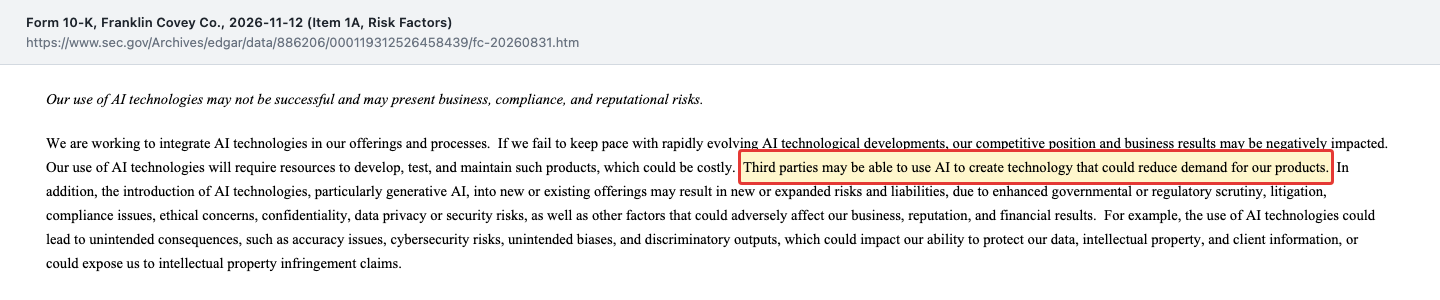
In the competition section the company gets more specific: new technologies, “particularly AI,” are reshaping how training is delivered. For a business that sells knowledge through courses, videos and coaching, that is not a side issue. For a look at a learning company that builds AI directly into its product, see our Duolingo analysis. Whether companies will pay less for leadership training because an AI coach takes over part of the work is not yet answered by the filings. They only show that Franklin Covey is asking the question itself.
Valuation: what the price of November 20, 2026 pays for
To do the math we need a share count and a price, both dated. The cover page of the annual report lists 11,335,471 shares as of October 31, 2026. At the closing price of November 20, 2026 ($13.19, fundamental data), that gives a market value of about $149.5 million. As a cross-check against a price from an SEC document: the insider filings of November 17, 2026 cite $14.54 per share, which would be about $164.8 million. Since Franklin Covey has no financial debt, the whole company costs about $136 million after deducting cash of $13.3 million (our calculation, excluding lease obligations).
Three yardsticks. First, Adjusted EBITDA: $136 million is 4.7 times the $28.9 million of fiscal 2026 and 4.3 times the midpoint of fiscal 2027 guidance ($31.5 million). That is cheap — if you exclude restructuring and stock compensation the way the company does. Second, net income: $13.19 divided by $0.42 of earnings per share gives a price-to-earnings ratio of about 31. That is expensive, and, as shown, it partly rests on lower amortization. Third, cash: free cash flow as defined by the company was $9.2 million, about 6 percent of market value. That is respectable, but down from $12.1 million the year before.
For context, an outside view, not ours: on November 20, 2026 the fundamental data listed three analysts, all with a positive rating and an average price target of about $26. Three voices make a thin sentiment reading. And price targets are anchors themselves.
Upside and risks at a glance
What speaks for Franklin Covey:
- A subscription business with a gross margin of about 75 percent in fiscal 2026 and $116.1 million of deferred revenue on the balance sheet (August 31, 2026).
- No financial debt; the $62.5 million credit line is undrawn and runs until March 2028.
- First evidence for the new go-to-market model: in North America, invoiced amounts rose 4 percent in fiscal 2026 and deferred revenue 17 percent.
- The Education Division is growing (revenue up 2 percent, subscription revenue up 10 percent) and, according to the company, reaches more than 8,000 schools.
- The share count has fallen 15 percent since fiscal 2023; for fiscal 2027 the company expects growth in revenue and Adjusted EBITDA again.
What speaks against it:
- Revenue has declined two fiscal years in a row, net income from $23.4 million (2024) to $4.9 million (2026).
- Restructuring costs in each of fiscal 2023 through 2026, with more announced for fiscal 2027.
- Much of the 2026 profit increase comes from longer amortization periods and a lower tax rate.
- Cash has dropped to $13.3 million; in fiscal 2025 and 2026 buybacks exceeded free cash flow ($26.4 million vs. $12.1 million and $28.1 million vs. $9.2 million).
- Signed but unbilled backlog fell from $72.8 million to $67.3 million; the company itself names AI tools from third parties as a risk to demand.
A human conclusion
Back to the anchoring bias. It works on investors who have $53 in their heads and see $13. And it shows up in every purchase decision that can only be judged in hindsight against a later price — a company’s included. Franklin Covey put $120.8 million into its own shares over four years, almost always at prices above today’s, and, after its last trading plan ran out in January 2026, made no more open-market purchases through the end of August, not even at the low for the year in March; $13.3 million is left in cash. That is not an accounting breach and not a scandal. It is a capital allocation decision that has not paid off so far.
Take the anchor away, and what remains is a debt-free subscription provider with a well-known brand, about $260 million of revenue, a small profit, a restructuring that has cost money every year since fiscal 2023, and guidance that promises growth again in fiscal 2027. So the question for you is not “Is the stock cheap after falling 75 percent?” but: Do you believe the new go-to-market model can turn 4 percent more invoicing into lasting profit growth — and that companies will keep paying for leadership training in the age of AI coaches? What you make of that is your decision. If yes, you have a thesis. If all you had in mind was $53, you have bought an anchor.
Sources
All primary documents used in this analysis — to read for yourself:
- Franklin Covey Co. — SEC annual report 10-K for fiscal 2026 (through August 31, 2026, filed November 12, 2026)
- Franklin Covey Co. — Earnings release for fiscal 2026 with fiscal 2027 guidance (Exhibit 99.1 to Form 8-K of November 4, 2026)
- Franklin Covey Co. — SEC quarterly report 10-Q for the period ended May 31, 2026 (filed July 7, 2026)
- Franklin Covey Co. — SEC annual report 10-K for fiscal 2025 (filed November 12, 2025)
- Franklin Covey Co. — Form 8-K of September 1, 2026 (Item 5.02, leadership changes)
- Insider filings (Form 4) of November 12, 16 and 17, 2026 in the EDGAR overview for Franklin Covey (sec.gov)
- Fundamental data (prices, analyst ratings; as of November 20, 2026), reconciled with the SEC filings.
Transparency & disclaimer: this analysis is journalistic commentary on publicly available information. It is not investment advice, not a regulated investment research product and not a solicitation to buy or sell securities. Equity investments carry substantial risk up to and including total loss. All information is provided without warranty; the as-of date for each figure is stated in the text. Positions held by the operator are disclosed daily; where one exists, it appears as a notice at the top of this analysis.
Key figures at a glance
All monetary figures in millions of $; earnings per share as reported.
| Metric | 2022 | 2023 | 2024 | 2025 | 2026 |
|---|---|---|---|---|---|
| Revenue | 262.8 | 280.5 | 287.2 | 267.1 | 261.5 |
| Operating Income (EBIT) | 23.7 | 26.4 | 33.0 | 5.7 | 7.2 |
| Net Income | 18.4 | 17.8 | 23.4 | 3.1 | 4.9 |
| Net Margin | 7.0% | 6.3% | 8.1% | 1.1% | 1.9% |
| Earnings Per Share | 1.27 $ | 1.24 $ | 1.74 $ | 0.24 $ | 0.42 $ |
Source: fundamental data & SEC filings (annual and quarterly reports, 10-K/10-Q)
Our Bottom Line at a Glance
- Revenue negative
- Revenue fell from $287.2 million in fiscal 2024 to $261.5 million in fiscal 2026. For fiscal 2027 the company expects $263 million to $273 million; invoiced amounts in North America rose 4 percent in fiscal 2026.
- Earnings power negative
- Net income fell from $23.4 million (fiscal 2024) to $4.9 million (fiscal 2026). The increase over fiscal 2025 comes mainly from amortization periods extended by about five years and a tax rate of 30 instead of 49 percent.
- Business model positive
- Subscription business with a gross margin of about 75 percent in fiscal 2026; $116.1 million of deferred revenue as of August 31, 2026, and 59 percent of North American subscription contracts run for at least two years.
- Balance sheet & cash neutral
- No financial debt, $62.5 million credit line undrawn. But cash fell from $48.7 million (August 2024) to $13.3 million (August 2026), and shareholders’ equity from $66.9 million to $51.4 million within one year.
- Capital allocation negative
- $120.8 million for its own stock in fiscal 2023 through 2026, almost always at prices above that of November 20, 2026; in fiscal 2026 three times free cash flow of $9.2 million.
- Restructuring & AI neutral
- Restructuring costs of $0.6 million, $3.0 million, $6.7 million and $6.7 million in fiscal 2023 through 2026, with more announced for fiscal 2027. The annual report names AI tools from third parties as a possible risk to demand.
Franklin Covey is a case of the anchoring bias: the stock has lost three quarters of its value since August 2022, and the company spent $120.8 million on its own shares over four years, mostly above today’s price. The subscription business is debt-free and has a high gross margin, but revenue and profit have declined since 2024, restructuring costs have recurred every year since fiscal 2023, and the 2026 profit increase rests largely on accounting and taxes. Not investment advice.
What Our Rating Means
Open questions
The business works in principle, but one material question is open. As long as it stays open, our findings do not carry a quality verdict.
Yellow, because the business works but a material operating question is open: whether the new go-to-market model can durably reverse the revenue decline. Revenue fell two years in a row, net income stands at $4.9 million, and restructuring costs have recurred every year since fiscal 2023. The filings do not show a substance risk: Franklin Covey has no financial debt, an undrawn $62.5 million credit line, $116.1 million of deferred revenue and positive operating cash flow of $21.6 million. The lower cash balance is a result of buybacks, not of losses. The decision is yours.
A journalistic assessment by our editorial team at the time of the deep dive, based on public sources — not investment advice and not a solicitation to buy or sell. Your personal circumstances (investment goals, risk capacity, taxes) cannot be taken into account. What our levels mean, how verdicts are formed, and what conflicts of interest exist →
Worth Noting
- The trigger for this analysis is the share price decline after the annual results of Nov 4, 2026: from $17.33 (Nov 4, 2026) to $13.19 (Nov 20, 2026). Further closing prices from fundamental data: $53.83 (Aug 15, 2022, highest close since 2021), $11.54 (Mar 13, 2026, lowest close of 2026).
- As of: the latest periodic report is the annual report (10-K) for fiscal 2026, filed on Nov 12, 2026; all filings through Nov 23, 2026 were reviewed. After it came only insider filings (Form 4) of Nov 16 and 17, 2026: tax withholding on employee stock awards at $14.54 and a gift; Chief Product Officer Sean Covey had sold 8,000 shares at an average of $15.43 on Nov 10, 2026 (filed Nov 12, 2026).
- Share count from the 10-K cover page (Oct 31, 2026): 11,335,471. Market value of about $149.5M is our calculation; cross-check with the price from the Form 4 filings of Nov 17, 2026 ($14.54 on Nov 13, 2026): about $164.8M, a difference of about 10 percent.
- Our calculations: buybacks fiscal 2023–2026 (35.6 + 30.7 + 26.4 + 28.1 = $120.8M); operating cash flow fiscal 2023–2026 (35.7 + 60.3 + 29.0 + 21.6 = $146.6M); average price fiscal 2026 ($28.13M / 1,572,577 shares = about $17.89, including withheld shares); enterprise value (149.5 − 13.3 = about $136M, excluding lease obligations); decline in unbilled deferred revenue (72.8 − 67.3 = $5.5M, 7.6 percent).
- According to the 10-K, buyback figures include both open-market purchases and shares withheld for taxes on employee stock awards. Free cash flow as defined by the company: operating cash flow less purchases of property and equipment, curriculum development costs and content or license rights.
- The fiscal year differs from the calendar year: “fiscal 2026” means the twelve months through Aug 31, 2026; “third quarter” means March to May 2026.
Stock Watch
This analysis is as of November 24, 2026. Stock Watch will tell you what's changed at FC since then.
Later $1 a month per stock — signing up is free, and you'll be the first to know when it launches.
The full analysis as a PDF for later
We will send you this analysis as a PDF — to print, file away, and read at your own pace. And we will add you to the free Stock Watch list for Franklin Covey Company (FC), so you hear about it when something material in this analysis changes.
Frequently Asked Questions
Franklin Covey Co. (NYSE: FC) sells leadership and effectiveness training, known for “The 7 Habits of Highly Effective People.” Companies usually buy it as a subscription (the “All Access Pass”), schools through the “Leader in Me” program. In fiscal 2026 (ended August 31, 2026) revenue was $261.5 million, of which $182.7 million came from the Enterprise Division and $76.2 million from the Education Division.
Yes, but narrowly. In fiscal 2026 Franklin Covey earned $4.9 million, or $0.42 per share, after $3.1 million the year before and $23.4 million in fiscal 2024. Adjusted EBITDA was $28.9 million; it excludes, among other items, restructuring costs of $6.7 million and stock-based compensation of $6.6 million.
In fiscal 2023 through 2026 Franklin Covey spent a total of $120.8 million on its own stock, including $28.1 million for about 1,573,000 shares in fiscal 2026 alone. After its last trading plan ended in January 2026, the company bought no more shares on the open market through August 31, 2026. As of that date, $19.7 million remained authorized under the program.
No financial debt. As of August 31, 2026 Franklin Covey had $13.3 million of cash and an undrawn $62.5 million credit line that matures on March 27, 2028. The credit agreement requires leverage below three times adjusted EBITDA and a fixed charge coverage ratio above 1.15, and permits buybacks only while both covenants are met.
Franklin Covey’s fiscal year ends on August 31. Fiscal 2026 ran from September 1, 2025 to August 31, 2026, and fiscal 2027 ends on August 31, 2027. Annual results are therefore published in November; the annual report for fiscal 2026 was filed with the SEC on November 12, 2026.
According to the earnings release of November 4, 2026, Franklin Covey expects fiscal 2027 revenue of $263 million to $273 million (fiscal 2026: $261.5 million) and Adjusted EBITDA of $29 million to $34 million (fiscal 2026: $28.9 million). The figures include the transfer of the China business to a licensee, which costs about $2.0 million of revenue.
Found an error?
Did you spot a factual error, an outdated number, or a typo in this deep dive? Let us know briefly — your report goes straight to the editorial team.