PCB Bancorp: The $64.9 Million Government Coupon the Bank Itself Booked Wrong
Since 2022 the U.S. Treasury has held $69.1 million of PCB Bancorp preferred stock, which the bank could, under conditions, buy back for about $4.3 million — a $64.9 million discount. According to the quarterly report for Sept. 30, 2026, the conditions were not met, and valuing exactly this option cost the bank a restated quarterly report in 2025. Meanwhile PCB, the house bank for many Korean-American business owners in Los Angeles, is earning more than it has in years. The SEC filings also show how heavily the bank leans on commercial real estate and how much of its deposits are uninsured. Not investment advice — only the question of what a coupon is worth when nobody has met its fine print yet.
 Thomas Mücke
Founder & Publisher
As of Today
As of: November 23, 2026
- Closing price
- 28.40 $ +1.20%
- Market Capitalisation
- 0.4 $B
- Growth Score
- 6/10
- AAQS
- 7/10
Price change since November 20, 2026: +1.2%
This analysis has a cut-off date. The Stock Guard tells you when something material changes in the numbers. Reserve your free spot
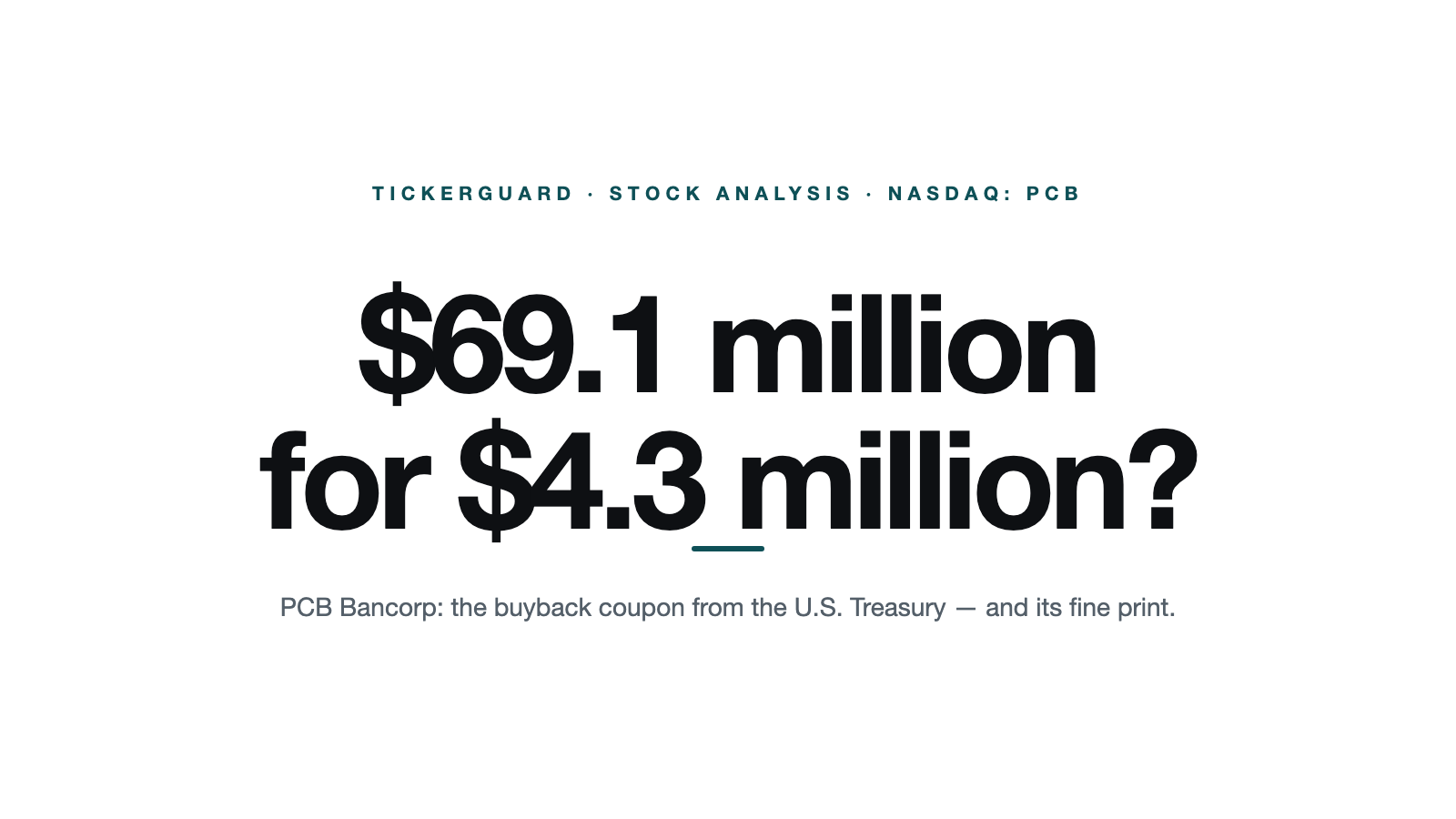
Chart
Interactive price chart (TradingView).
52-week range: 21.20 $ to 31.00 $ · Last price: 28.40 $ (As of: November 23, 2026)
Note: pure fact-based analysis, not investment advice and not a solicitation to buy or sell. All figures without guarantee.
Almost every kitchen drawer has one: a coupon for a big amount, with the fine print on the back. Valid only above a minimum purchase, only on certain days, only for certain items. In our heads, the coupon already counts as cash. That is the coupon trap: a discount tied to conditions gets treated as if it had already been redeemed. PCB Bancorp (Nasdaq: PCB) has a coupon like that in its filings — issued by the U.S. Treasury, worth about $64.9 million, against a market value of roughly $395 million. In the spring of 2025 the bank itself booked it as an asset, at $35.8 million, and six weeks later said its value was immaterial. Before you put it into your math, let’s read the fine print together in PCB’s filings with the U.S. securities regulator, the SEC, from the annual report (10-K) for 2025 to the quarterly report (10-Q) for Sept. 30, 2026. In the end, the decision is yours.
What PCB Bancorp actually does — the house bank of Korean-American business owners
PCB Bancorp is the holding company of PCB Bank, a commercial bank founded in 2003 and headquartered on Wilshire Boulevard in Los Angeles. Until 2019 the holding company was called Pacific City Financial Corp. Every earnings release describes its customers in one sentence:
“PCB Bancorp is the bank holding company for PCB Bank, a California state chartered bank, offering a full suite of commercial banking services to small to medium-sized businesses, individuals and professionals, primarily in Southern California, and predominantly in Korean-American and other minority communities.”
— PCB Bancorp, earnings release for the third quarter of 2026 (Exhibit 99.1 to the 8-K of October 29, 2026)
In everyday terms: PCB is where the owner of a restaurant, a wholesaler or a medical practice in Los Angeles keeps the business account, takes out the loan for the shop building and often finances the property they rent out. At the end of 2025 the bank ran nine branches in Los Angeles and Orange counties, three on the East Coast (New York and New Jersey), two in Texas and one in Georgia, plus loan officers for loans guaranteed by the U.S. Small Business Administration (SBA). It had 262 full-time and three part-time employees.
The business is classic banking: borrow from depositors, lend at a higher rate. At Sept. 30, 2026, the bank had $2.85 billion of loans on its books — 69 percent commercial real estate, 16 percent business loans and 15 percent residential mortgages and other consumer loans (our calculation from the loan table) — funded by $3.08 billion of deposits. That defines the central tension of this analysis, and it runs through every chapter: PCB is earning more than it has in years and holds thick capital buffers — but it leans heavily on commercial real estate and on expensive, half-uninsured deposits, and its biggest special asset is a discount whose conditions it has not met.
Company history for investors
-
2003
Bank founded in Los Angeles
Today’s PCB Bank is founded; the holding company follows in 2007. For shareholders: a young bank that grew with Korean-American entrepreneurs.
-
2019
Pacific City Financial becomes PCB Bancorp
The holding company changes its name. For shareholders: older SEC filings appear under the former name.
-
2022
$69.1 million from the U.S. Treasury
On May 24, 2022, the government buys preferred stock under ECIP. For shareholders: cheap tier 1 capital that does not belong to common shareholders.
-
2025
Buyback option and restated quarterly report
In January 2025 PCB gets an option to repurchase at a discount; booking it has to be reversed in July 2025. For shareholders: a discount with conditions and a remediated control weakness.
-
2026
Record quarter and new buyback program
PCB earns $12.2 million in the third quarter of 2026, and in September the board authorizes up to 700,000 share repurchases. For shareholders: earnings power is back, capital flows back.
How the stock landed on our desk
PCB reached our desk through our in-house stock scanner “Reddit Hot Stocks”, which flags small U.S. stocks that come up unusually often in investor forums — a sign of attention, not of quality. On November 20, 2026, the stock closed at $28.07 (fundamental data); a year earlier, on November 20, 2025, it had closed at $21.18, so it is up about a third. Over the same period earnings per share rose as well: $2.32 in the first nine months of 2026, after $1.94 a year earlier. On the past four quarters’ earnings, the price works out to a price-to-earnings ratio of about 9.5 (our calculation).
For a larger rival in the same market, see our analysis of Hope Bancorp, also based in Los Angeles and also serving Korean-American customers. Keep one thing in mind from the start: with a bank, what matters is not the profit of a good year, but what is on the books when a bad one arrives.
The numbers over the years: a record quarter after three weaker years
First, what speaks for PCB. In the third quarter of 2026 the bank earned $12.2 million, by its own account a quarterly record. In the first nine months of 2026 it earned $33.4 million, 18.3 percent more than a year earlier. The annualized return on tangible common equity (excluding the Treasury’s preferred stock) was 14.4 percent in the third quarter. The bank spent 49.6 cents of costs to generate each dollar of revenue — a good efficiency ratio for a small bank.
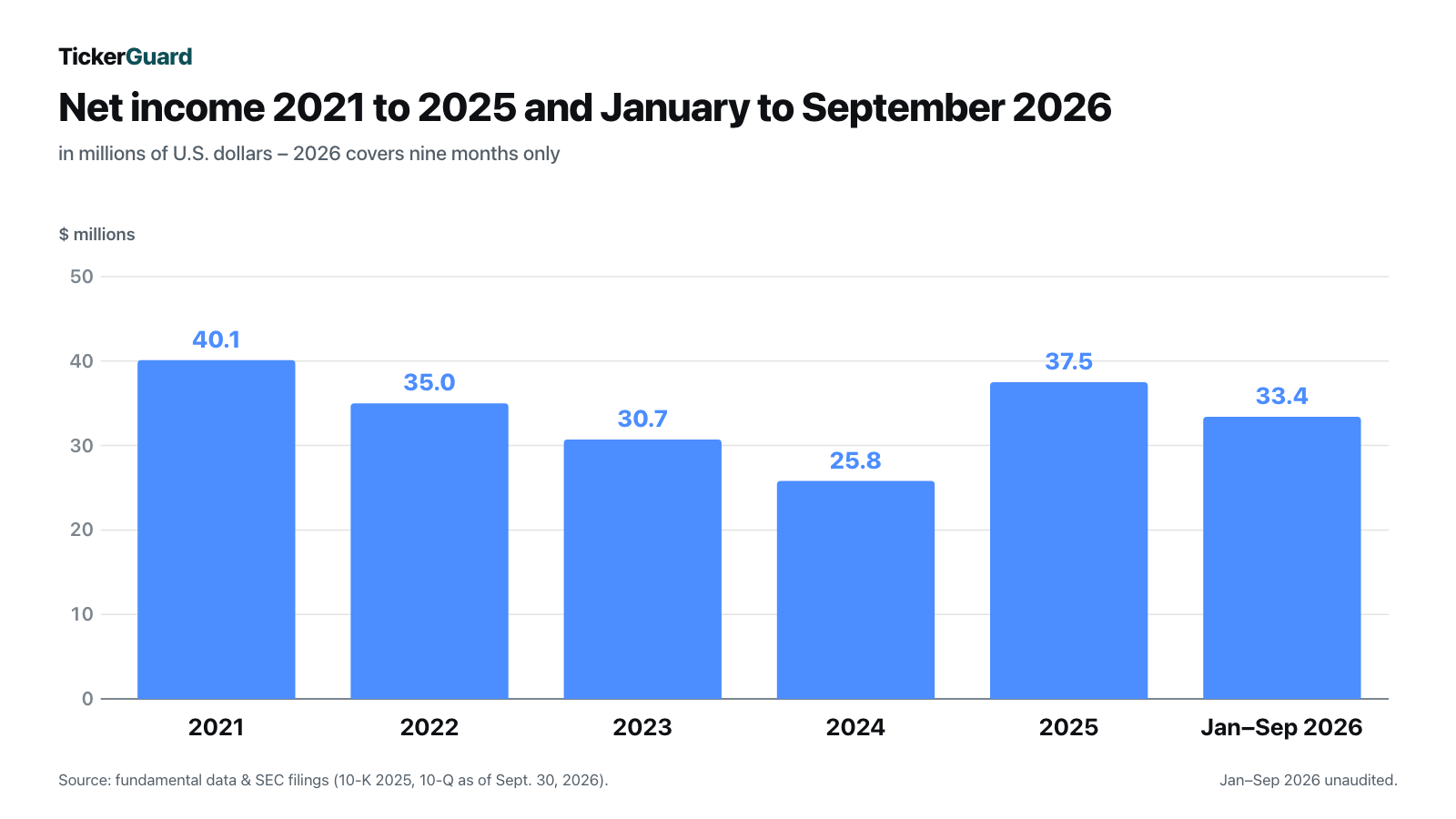
The other half of the picture belongs here too. The 2021 profit was an outlier: the bank released $4.6 million of loan-loss reserves that year, and deposits cost almost nothing. Profit then fell for three straight years, to $25.8 million in 2024. The next chart shows why. As policy rates rose, PCB had to pay its depositors more. Interest expense climbed from $4.3 million in 2021 to $92.2 million in 2024 — more than that year’s entire net interest income.
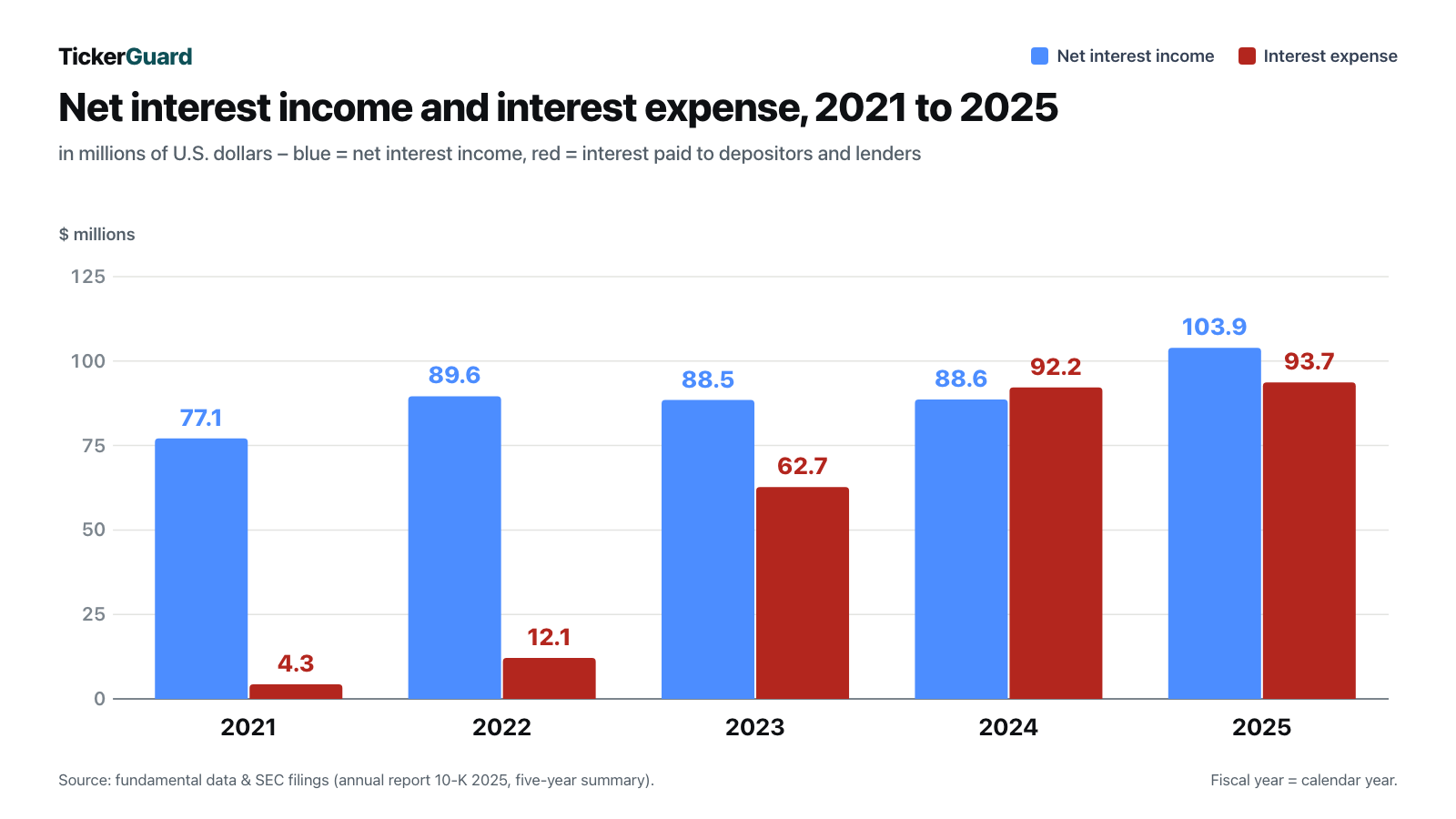
PCB started earning more again as its loan book grew and deposits became cheaper. In 2025, net interest income rose to $103.9 million and the net interest margin (the spread between what loans earn and what funding costs, measured against all interest-earning assets) from 3.17 to 3.29 percent. In the third quarter of 2026 it was 3.35 percent. Credit losses stayed small: in the first nine months of 2026 the bank charged off $130,000 of loans on a $2.85 billion book.
The capital cushion is thick. At Sept. 30, 2026, the holding company’s common equity tier 1 ratio was 11.98 percent and its total capital ratio 15.63 percent. The bank itself came in at 13.96 and 15.20 percent — regulators require 6.5 and 10 percent from it to be called “well capitalized.” Cash stood at $413.2 million, 11.7 percent of total assets. Remember: the 2026 results come from the lending business, not from one-time items — and the capital goes well beyond what is required. Now to the fine print.
What the filings say — the uncomfortable truths
Uncomfortable truth no. 1: The $64.9 million discount is a coupon with conditions
On May 24, 2022, PCB sold the U.S. Treasury 69,141 preferred shares at $1,000 each, $69.1 million in total. The money came from ECIP, the Emergency Capital Investment Program the government used after the pandemic to strengthen banks that serve minority and low-income communities. Preferred stock sits between a loan and a share: regulators count it as tier 1 capital, it pays a dividend, and it ranks ahead of common shareholders in a liquidation. At PCB the dividend rate depends on lending during the first ten years and is capped at 2 percent. It cost nothing for the first two years, 2 percent a year from the second quarter of 2024, and only 0.5 percent since the first quarter of 2025.
On January 16, 2025, an additional agreement followed. It allows PCB to repurchase the preferred shares at a price set by a present-value formula. Because the shares pay almost no dividend and have no maturity, that price is small. Calculated at Sept. 30, 2026 and at a 0.5 percent dividend rate, it would be $4.3 million, a $64.9 million discount. That is 19.5 percent of common equity of $333.0 million, or about $4.62 per common share (our calculation). The catch is in the quarterly report:
“However, the Company does not currently meet any of the Threshold Conditions necessary to exercise the purchase option, and there can be no assurance whether and when the Threshold Conditions will be met.”
— PCB Bancorp, SEC quarterly report 10-Q for Sept. 30, 2026, note “Emergency Capital Investment Program”
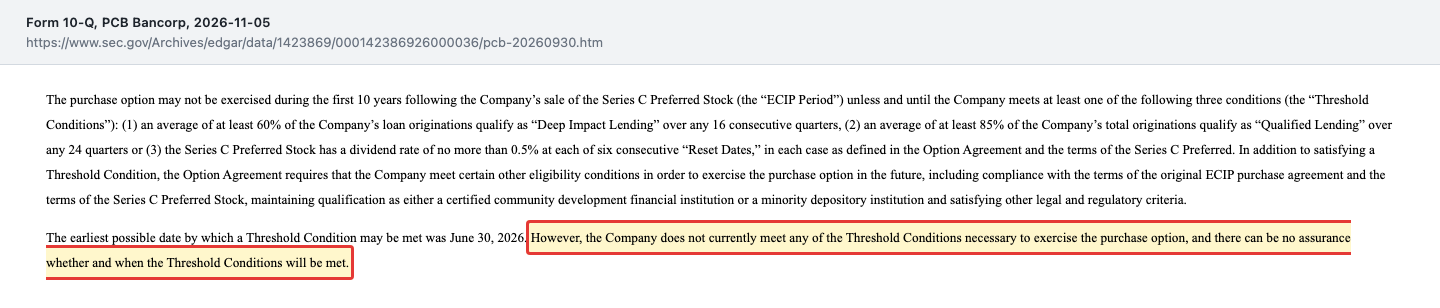
The three thresholds in plain English: either an average of 60 percent of new loans must go to especially high-impact borrowers over 16 consecutive quarters, or an average of 85 percent to qualifying borrowers over 24 quarters, or the preferred dividend rate must be no more than 0.5 percent at six consecutive reset dates. On top of that, PCB must comply with its agreements with the Treasury and the terms of the preferred stock, remain a certified community development financial institution (CDFI) or a minority depository institution, and satisfy other legal and regulatory criteria.
This is where you pause: the dividend rate has been 0.5 percent since early 2025 — so why is the third threshold not met? The answer is not in the quarterly report but in the 2022 terms of the preferred stock: the reset dates are annual. The first was the second anniversary of issuance in May 2024, and one follows each year after that. Six consecutive reset dates therefore means six years in a row. Even if the first reset date in May 2024 already counted, the sixth would not arrive until 2029 (our calculation from the terms of the preferred stock). How many reset dates PCB already has behind it, and how close the bank is to the two lending thresholds, the quarterly report does not say. It only gives the earliest date on which any threshold could have been met: June 30, 2026 — three months later, none was. Arithmetically, that date fits the first threshold: from issuance in mid-2022 to mid-2026 is 16 quarters (our reading).
Without a threshold, a repurchase at a discount is ruled out during the first ten years after issuance, that is, until May 2032. After that, the option agreement allows it even without a threshold for as long as the option runs: until 15 years after issuance. At the full $69.1 million, PCB may redeem the preferred stock with regulatory approval from the fifth anniversary of issuance, that is, from May 2027 — without any discount. Remember: the discount appears in the report as a worked example, not as an asset on the balance sheet.
Uncomfortable truth no. 2: This option cost a restated quarterly report in 2025
PCB has experienced first-hand how tricky this coupon is. The bank could not file its report for the quarter ended March 31, 2025 on time because it needed more time to value the repurchase option. On May 22, 2025, it received a Nasdaq notice that it was out of compliance with the periodic filing requirement for continued listing; the report followed on June 9, 2025. In it, the option was booked as a $35.8 million asset. Six weeks later PCB took that back:
“The Company has further evaluated the fair value of the purchase option under ASC 820, Fair Value Measurement, and concluded that the fair value is immaterial.”
— PCB Bancorp, SEC current report 8-K of July 24, 2025, Item 4.02
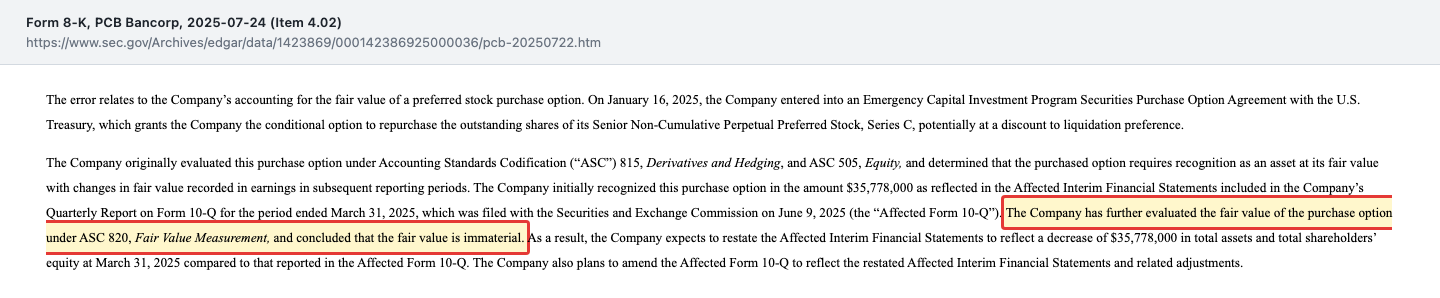
The bank declared the quarterly report no longer reliable, cut total assets and shareholders’ equity at March 31, 2025 by $35.8 million and filed a restated version on July 24, 2025. Earnings were unaffected. How $35.8 million turns into “immaterial,” the filing explains only briefly: PCB had first recorded the option at fair value as an asset under the accounting rules for derivatives (ASC 815); after re-evaluating it under the fair value standard ASC 820, no material value remained. Which assumption changed, it does not say. PCB also disclosed a material weakness in internal control: unusual contracts with derivative features had not been systematically reviewed for their accounting. In its 2025 annual report the bank says the weakness has been remediated and the new controls were tested successfully over two quarters; auditor Crowe LLP opined that internal control over financial reporting was effective at Dec. 31, 2025. That is a proper clean-up. But it shows that even the bank first misjudged the value of its coupon — namely, too high.
Uncomfortable truth no. 3: Commercial real estate was above the regulators’ threshold at the end of 2025
U.S. bank regulators use a rule of thumb for banks with heavy commercial real estate lending: if loans on non-owner-occupied commercial property exceed 300 percent of total risk-based capital and have grown by at least 50 percent in three years, they take a closer look. Owner-occupied business property does not count. PCB writes in its annual report:
“As of December 31, 2025, using regulatory definitions in the CRE Concentration Guidance, our CRE loans represented 307.7% of our total risk-based capital, as compared to 297.0%, 280.7% and 253.9% as of December 31, 2024, 2023 and 2022, respectively.”
— PCB Bancorp, SEC annual report 10-K for 2025, Item 1A “Risk Factors”

The threshold is not a ban, and PCB does not say it meets the second criterion — growth of 50 percent in three years. Right after the quoted sentence, the bank warns that the FDIC, the federal deposit insurer, could restrict its growth because of this concentration. Elsewhere in the annual report, in the section on supervision and regulation, it says it has discussed the guidance with the FDIC and considers its risk management sufficient. The quarterly report for Sept. 30, 2026 does not give a newer ratio. In the third quarter of 2026 the loan book shrank by $87.2 million, or 3.0 percent, with commercial real estate down $61.9 million. CEO Henry Kim explained:
“As part of that strategy, we selectively reduced certain large commercial lending relationships that no longer met our risk and return objectives.”
— PCB Bancorp, earnings release for the third quarter of 2026 (Exhibit 99.1 to the 8-K of October 29, 2026)
In the same quarter, nonaccrual loans rose from $8.7 million to $12.3 million, and for non-owner-occupied commercial property from $1.3 million to $4.6 million. Measured against the loan book, that is 0.43 percent — low, but the direction is up. PCB holds an allowance for credit losses of $34.1 million, 1.20 percent of loans.
Uncomfortable truth no. 4: Half the deposits are uninsured
A bank lives on the trust of its depositors. In the U.S., the FDIC insures deposits up to $250,000 per customer per bank; anything above that is not protected and is therefore considered less stable. At Sept. 30, 2026, PCB estimated that $1.53 billion, or 49.6 percent of its deposits, were not covered. At the end of 2025 the figure was 45.4 percent, at Sept. 30, 2025 it was 43.8 percent.
The type of deposit matters too: 54.6 percent were time deposits that have to be rolled over at market rates, and only 18.8 percent were noninterest-bearing checking accounts. $245.8 million came through deposit brokers and $120.0 million from the California State Treasurer. That is why PCB pays a lot for its funding: 3.77 percent on interest-bearing deposits in the third quarter of 2026. Against this stand large reserves — $413.2 million of cash and $1.87 billion of unused borrowing capacity with the Federal Home Loan Bank, the Federal Reserve and other banks. Remember: cash and unused borrowing capacity (about $2.29 billion together) exceed the $1.53 billion of uninsured deposits at Sept. 30, 2026 — but 54.6 percent of PCB’s deposits are time deposits that have to be rolled over at market rates.
Valuation: what the November 20, 2026 price pays for
To do the math we need a share count and a price, both dated. The cover of the quarterly report lists 14,056,981 shares as of October 30, 2026. At the closing price of November 20, 2026 ($28.07, fundamental data), that gives a market value of about $395 million. As a cross-check against a price in an SEC filing: director Daniel Cho sold 15,471 shares at $29.20 on November 17, 2026, according to his insider filing (Form 4); at that price the value would be about $410 million.
Now three yardsticks. First, earnings: over the past four quarters PCB earned $2.96 per share ($0.64 in the fourth quarter of 2025 plus $2.32 from January to September 2026, our calculation). That is a P/E of about 9.5. Second, book value — and here the metric deserves a second look. PCB calculates book value per common share of $28.61 by dividing total shareholders’ equity by the common shares; that includes the Treasury’s $69.1 million of preferred stock, which does not belong to common shareholders. PCB itself reports the figure without it in the earnings release: $23.69 per share. The price is 1.18 times that figure.
Third, the coupon. If PCB ever redeems it, about $4.62 per share would be added; common equity per share would rise from $23.69 to about $28.31 (our calculation). The November 20, 2026 price would then be slightly below common equity per share. Whether and when that happens is written nowhere. PCB also pays a dividend of $0.22 per quarter — $0.88 a year, or 3.1 percent of the price — and in the first nine months of 2026 bought back 219,526 shares for $5.8 million, about $26.51 apiece. Since September 28, 2026, a new program allows repurchases of up to 700,000 shares, just under 5 percent, through September 22, 2027.
What insiders did in 2026: In a notice of proposed sale (Form 144) filed November 17, 2026, director Daniel Cho gave notice of the planned sale of 75,000 shares, a good three quarters of the 98,000 shares he had previously reported holding directly. Through November 20, 2026, he had sold 17,882 of them according to his insider filings (Form 4); further sales are therefore possible. The only open-market purchases by an insider in 2026 were reported by director and major shareholder Sang Young Lee: 18,709 shares in February and March 2026 at prices between $21.75 and $22.75, through a family trust that held about 1.6 million shares afterward.
For context, an outside view rather than ours: on November 20, 2026, the fundamental data listed three analysts, all at “hold,” with a price target of $32.50 and expected earnings of $3.08 per share for 2026. Three voices are a thin read on sentiment, not a roadmap.
Opportunities and risks at a glance
What speaks for PCB Bancorp:
- Earnings rose 18.3 percent to $33.4 million in the first nine months of 2026; return on tangible common equity was 14.4 percent in the third quarter.
- Thick capital: common equity tier 1 ratio of 11.98 percent and total capital ratio of 15.63 percent (Sept. 30, 2026), far above the minimums.
- Plenty of liquidity: $413.2 million of cash and $1.87 billion of unused borrowing capacity.
- Small losses: $130,000 of charge-offs in nine months; nonperforming loans at 0.43 percent of the book.
- A repurchase option on the Treasury’s preferred stock at a $64.9 million discount, if PCB reaches one of the thresholds.
- Ongoing payouts: a $0.22 quarterly dividend and a new buyback program for up to 700,000 shares.
What speaks against it:
- The conditions for the discount are not met; without them a repurchase at a discount is ruled out until May 2032.
- Commercial real estate loans at 307.7 percent of total risk-based capital (end of 2025), above the level at which regulators take a closer look.
- 49.6 percent of deposits are uninsured, 54.6 percent are expensive time deposits (Sept. 30, 2026).
- In 2025 PCB had to restate a quarterly report and disclose a material weakness; the weakness is reported as remediated.
- Nonperforming loans rose 40.5 percent to $12.3 million in the third quarter of 2026 while the loan book shrank 3.0 percent.
A human conclusion
Back to the coupon trap. Its core is not that the coupon is fake — the table in the quarterly report is real, so is the agreement with the Treasury, and $64.9 million would be a lot of money for a bank with $333 million of common equity. Its core is that the fine print decides whether it ever gets redeemed. At PCB, even the bank itself first valued it too high and had to take back a quarterly report over it.
Take the coupon away and what remains is a solidly profitable community bank with a thick capital cushion that leans heavily on Southern California commercial real estate and draws a good share of its funding from expensive, uninsured time deposits. So the question for you is not “What is the discount worth?” but: How would you judge the bank if the coupon did not exist — and do you trust that Southern California commercial real estate will get through a downturn as well as the balance sheet suggests? What you make of it is your decision. And that is how it should be.
Sources
All primary documents used in this analysis — so you can read them yourself:
- PCB Bancorp — SEC quarterly report 10-Q for Sept. 30, 2026 (filed November 5, 2026)
- PCB Bancorp — earnings release for the third quarter of 2026 (Exhibit 99.1 to the 8-K of October 29, 2026) and dividend release of October 29, 2026
- PCB Bancorp — SEC quarterly report 10-Q for June 30, 2026 and SEC quarterly report 10-Q for March 31, 2026
- PCB Bancorp — SEC annual report 10-K for 2025 (filed March 16, 2026)
- PCB Bancorp — 8-K of July 24, 2025 (Item 4.02, non-reliance on a quarterly report) and release on the Nasdaq notice of May 23, 2025
- PCB Bancorp — release on the buyback program of September 28, 2026 and 8-K of September 24, 2026 (Item 5.02, CEO employment agreement)
- PCB Bancorp — option agreement with the U.S. Treasury of January 16, 2025 (Exhibit 10.9 to the annual report 10-K for 2024) and terms of the preferred stock (Exhibit 3.1 to the 8-K of May 24, 2022)
- Insider filings (Form 4) and notices of proposed sale (Form 144) through November 23, 2026 in the EDGAR overview for PCB Bancorp (sec.gov)
- Fundamental data (prices, analyst ratings; data as of November 20, 2026), checked against the SEC filings.
Transparency & disclaimer: This analysis is a journalistic assessment of publicly available information. It is not investment advice, not a financial analysis in the regulatory sense and not a solicitation to buy or sell securities. Investing in stocks involves substantial risk, up to and including total loss. All information without guarantee; the data date is noted in the text. Positions held by the operator are disclosed daily; where one exists, it appears as a notice at the top of this deep dive.
Key figures at a glance
All monetary figures in millions of $; earnings per share as reported.
| Metric | 2021 | 2022 | 2023 | 2024 | 2025 |
|---|---|---|---|---|---|
| Revenue | 99.9 | 116.3 | 161.9 | 191.9 | 209.4 |
| Operating Income (EBIT) | 57.0 | 49.4 | 43.3 | 36.3 | 52.5 |
| Net Income | 40.1 | 35.0 | 30.7 | 25.8 | 37.5 |
| Net Margin | 40.1% | 30.1% | 19.0% | 13.4% | 17.9% |
| Earnings Per Share | 2.63 $ | 2.32 $ | 2.13 $ | 1.80 $ | 2.62 $ |
Source: fundamental data & SEC filings (annual and quarterly reports, 10-K/10-Q)
Our Bottom Line at a Glance
- Earnings power positive
- Earnings rose 18.3 percent to $33.4 million in the first nine months of 2026; return on tangible common equity was 14.4 percent in the third quarter of 2026. From 2021 to 2024 profit had fallen three years in a row, from $40.1 million to $25.8 million.
- Capital & liquidity positive
- CET1 ratio of 11.98 percent, total capital ratio of 15.63 percent, $413.2 million of cash and $1.87 billion of unused borrowing capacity (Sept. 30, 2026).
- Credit risk neutral
- Loans on non-owner-occupied commercial real estate equaled 307.7 percent of total risk-based capital at the end of 2025, above the 300 percent regulatory threshold. Nonperforming loans rose to $12.3 million in the third quarter of 2026 but remain low at 0.43 percent.
- Deposits negative
- 49.6 percent of deposits were uninsured at Sept. 30, 2026 (a year earlier 43.8 percent), 54.6 percent were time deposits; interest-bearing deposits cost 3.77 percent in the third quarter of 2026.
- ECIP option neutral
- PCB could, under conditions, buy back the Treasury’s $69.1 million of preferred stock for about $4.3 million (as of Sept. 30, 2026). According to its quarterly report, the bank does not currently meet the conditions.
- Financial reporting negative
- In July 2025 PCB declared its report for the quarter ended March 31, 2025 no longer reliable and disclosed a material weakness; Nasdaq had earlier flagged the late filing. According to the 2025 annual report, the weakness has been remediated.
PCB Bancorp is a case of the coupon trap: a $64.9 million discount on the U.S. Treasury’s preferred stock appears in the quarterly report, but it depends on conditions the bank does not meet. Without it, what remains is a profitable community bank with thick capital that leans heavily on commercial real estate and funds itself to a large extent with expensive, uninsured time deposits. Not investment advice.
What Our Rating Means
Open questions
The business works in principle, but one material question is open. As long as it stays open, our findings do not carry a quality verdict.
Yellow, because the bank earns well and holds far more capital than required, but one material question is open, namely how well the balance sheet would hold up in a downturn: loans on non-owner-occupied commercial real estate stood at 307.7 percent of total risk-based capital at the end of 2025, above the 300 percent level at which regulators take a closer look (the bank gives no newer ratio), and at Sept. 30, 2026, half of the deposits were uninsured. Add the quarterly report restated in 2025; the control weakness is reported as remediated. The filings do not show a threat to the bank’s substance: at Sept. 30, 2026, nonperforming loans were 0.43 percent and cash was $413.2 million. The decision is yours.
A journalistic assessment by our editorial team at the time of the deep dive, based on public sources — not investment advice and not a solicitation to buy or sell. Your personal circumstances (investment goals, risk capacity, taxes) cannot be taken into account. What our levels mean, how verdicts are formed, and what conflicts of interest exist →
Worth Noting
- The analysis was prompted by a hit in our in-house “Reddit Hot Stocks” scanner. Closing prices per fundamental data: $28.07 (11/20/2026), $21.18 (11/20/2025).
- Data date: the latest periodic report is the 10-Q for Sept. 30, 2026, filed November 5, 2026; all filings through November 24, 2026 were reviewed. After November 5, 2026, only a notice of proposed sale (Form 144) covering 75,000 shares and two insider filings (Form 4, filed November 18 and November 23, 2026) by director Daniel Cho followed, covering sales of 17,882 shares in total between November 17 and 20, 2026.
- Share count from the 10-Q cover (10/30/2026): 14,056,981. Market value of about $395 million is our calculation; cross-check at the sale price in the Form 4 of 11/18/2026 ($29.20 on 11/17/2026): about $410 million, a difference of about 4 percent.
- Our calculations: common equity $333.0 million ($402.1 million equity minus $69.1 million preferred); discount of $64.9 million = 19.5 percent of that and $4.62 per share ($64.873 million divided by 14,056,981 shares); trailing four-quarter earnings of $2.96 per share ($0.64 in Q4 2025 as the difference between $2.58 for 2025 and $1.94 for January to September 2025, plus $2.32 for January to September 2026); commercial real estate share 1,975.8 of 2,847.2 million in loans.
- The company’s book value per common share of $28.61 includes the preferred stock; without it the figure is $23.69 (“TCE per common share” in the earnings release; PCB has no intangible assets).
- Reset dates of the third threshold: the terms of the preferred stock (Exhibit 3.1 to the 8-K of 5/24/2022) set the first reset date on the second anniversary of issuance and one per year after that; according to the quarterly report, the option applies during the first 15 years after issuance.
- Insider filings (Form 4) in 2026: open-market purchases only by Sang Young Lee (18,709 shares, 2/23 to 3/6/2026, through a family trust holding 1,601,551 shares afterward); sales by Daniel Cho (direct holdings down from 98,000 to 80,118 shares; the Form 144 notice of 11/17/2026 covers 75,000 shares); CEO Henry Kim exercised options on 7,000 shares in August 2026.
- Do not confuse: PCB Bancorp has nothing to do with the abbreviation PCB for printed circuit boards.
Stock Watch
This analysis is as of November 24, 2026. Stock Watch will tell you what's changed at PCB since then.
Later $1 a month per stock — signing up is free, and you'll be the first to know when it launches.
The full analysis as a PDF for later
We will send you this analysis as a PDF — to print, file away, and read at your own pace. And we will add you to the free Stock Watch list for PCB Bancorp (PCB), so you hear about it when something material in this analysis changes.
Frequently Asked Questions
PCB Bancorp (Nasdaq: PCB) is the holding company of PCB Bank in Los Angeles, founded in 2003. The bank offers commercial banking services to small and mid-sized businesses and individuals, mainly in Southern California and predominantly in Korean-American communities. At Sept. 30, 2026, it held $2.85 billion of loans and $3.08 billion of deposits.
On May 24, 2022, the U.S. Treasury bought 69,141 PCB Bancorp preferred shares at $1,000 each under the ECIP program, $69.1 million in total. They count as tier 1 capital and have paid a 0.5 percent annual dividend since the first quarter of 2025. They do not belong to common shareholders.
Only under conditions. An agreement dated January 16, 2025 allows a repurchase at present value, about $4.3 million instead of $69.1 million as calculated at Sept. 30, 2026. PCB must first reach one of three thresholds. According to its quarterly report for Sept. 30, 2026, the bank currently meets none of them.
Its report for the quarter ended March 31, 2025 booked the repurchase option on the preferred stock as a $35.8 million asset. In July 2025 the bank concluded the value is immaterial, declared the report no longer reliable and restated it. The material weakness it disclosed was reported as remediated in the 2025 annual report.
On October 28, 2026, the board declared a quarterly dividend of $0.22 per common share, payable on or about November 20, 2026. Annualized that is $0.88, about 3.1 percent at the November 20, 2026 close of $28.07. For 2025, PCB declared a total of $0.80 per share.
At Sept. 30, 2026, 69 percent of its $2.85 billion of loans were commercial real estate loans. Loans on non-owner-occupied commercial property equaled 307.7 percent of total risk-based capital at the end of 2025, above the 300 percent level at which U.S. regulators take a closer look.
Found an error?
Did you spot a factual error, an outdated number, or a typo in this deep dive? Let us know briefly — your report goes straight to the editorial team.