Lands’ End: A Price-to-Earnings Ratio of 0.7 — the Profit Comes From Selling Half the Brand
Lands’ End sells apparel, swimwear and school uniforms, almost all of it online. In April 2026 the company gave up half of its brand rights for $300 million and used the cash to repay a loan that cost 12 percent interest. Since then a book gain of $491.6 million sits in its accounts, and databases show a price-to-earnings ratio of 0.7. The SEC filings show what the ongoing business earns, what the company pays for its own name, and who got to sell into the $45 partial tender offer. Not investment advice — only the question of what an apparel retailer earns once it pays rent on its own name.
 Thomas Mücke
Founder & Publisher
As of Today
As of: November 20, 2026
- Closing price
- 8.35 $ -4.24%
- Market Capitalisation
- 0.2 $B
- P/E
- 0.7
- Growth Score
- 6/10
- AAQS
- 2/10
This analysis has a cut-off date. The Stock Guard tells you when something material changes in the numbers. Reserve your free spot
Chart
Interactive price chart (TradingView).
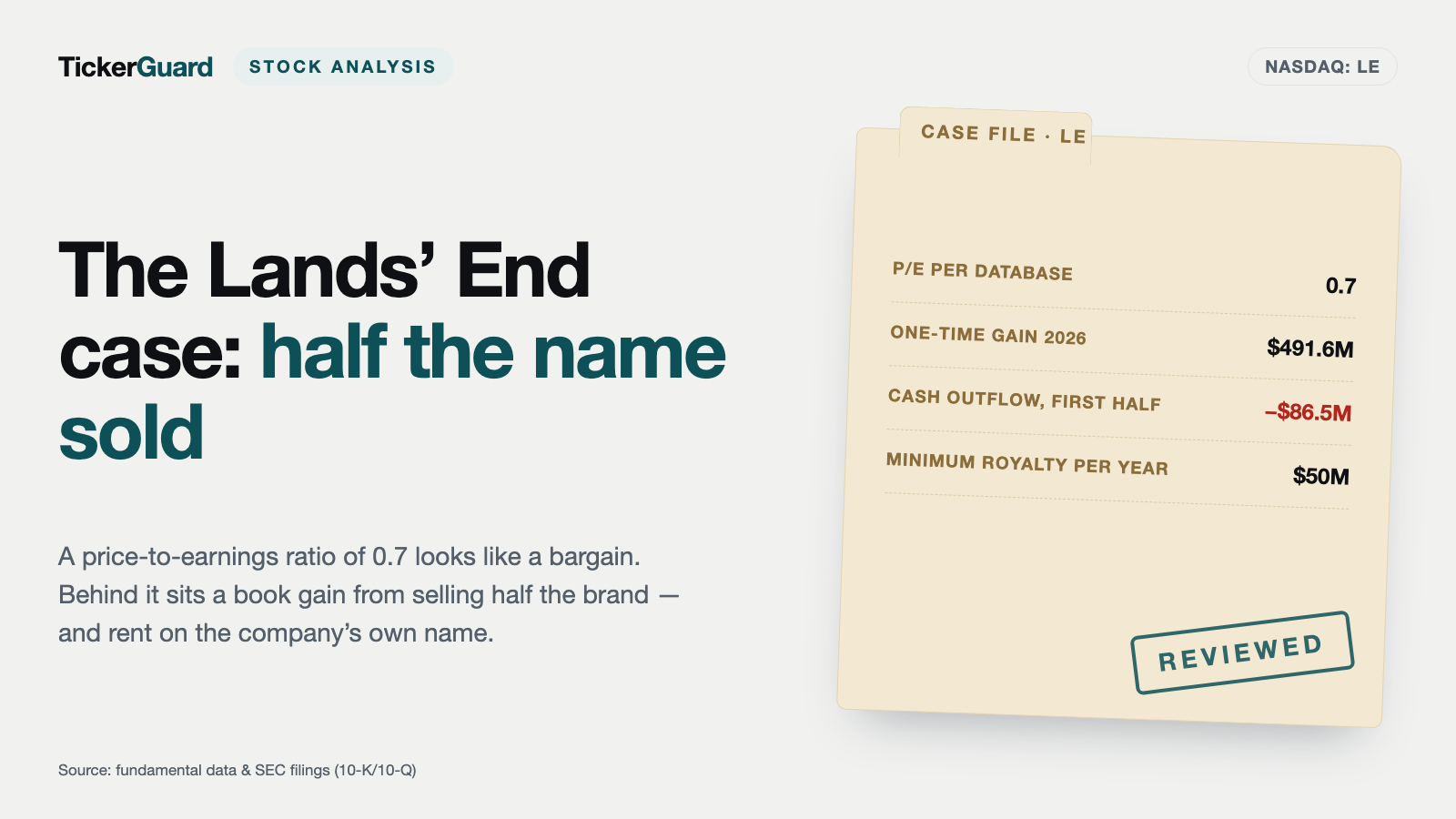
52-week range: 8.40 $ to 19.20 $ · Last price: 8.35 $ (As of: November 20, 2026)
Note: pure fact-based analysis, not investment advice and not a solicitation to buy or sell. All figures without guarantee.
There is an investor trap that fits a clothing retailer better than any other: the closeout trap. In a store, a closeout lot is a pile of merchandise that comes in once, sells once and never returns to the shelf. Anyone who takes that one week’s sales for the normal run misjudges the whole business. On the stock market, the closeout lot sits in the earnings line. Lands’ End (Nasdaq: LE) reports net income of $334.1 million for the first half of its fiscal 2026 — against a market value of about $247 million. Databases therefore show a price-to-earnings ratio of 0.7. Before you file the stock under bargain of the year, we read together what Lands’ End has told the U.S. securities regulator, the SEC — the quarterly report on Form 10-Q for July 31, 2026, the earnings release of September 3, 2026, the annual report on Form 10-K for fiscal 2025, and the filings on the sale of half the brand. They show what is closeout and what is assortment. In the end, the decision is yours.
What Lands’ End Actually Does — Catalog Clothing, Now 95 Percent Online
Lands’ End was founded in 1963 by Gary Comer and started out selling sailboat hardware by catalog. Today it is an apparel retailer that sells mainly through its own website. The latest quarterly report describes the business in one sentence:
“Lands’ End is a leading digital retailer of solution-based apparel, swimwear, outerwear, accessories, footwear, home products and uniforms.”
— Lands’ End, Inc., quarterly report on Form 10-Q for July 31, 2026, Item 2 “Executive Overview”
In everyday terms: Lands’ End is the mail-order house for the rain jacket, the swimsuit and the polo shirt with a company logo. According to the annual report, more than 95 percent of the business is done online. Revenue comes through six channels. In the first half of fiscal 2026, 62 percent came from the company’s own U.S. online store, 20 percent from “Outfitters” (workwear for businesses and school uniforms), just under 6 percent from sales on third-party online marketplaces, about 7.5 percent from Europe and just under 5 percent from its own stores and from licensing.
The company is based in Dodgeville, Wisconsin, and employs about 3,900 people according to the annual report for fiscal 2025; roughly 1,500 seasonal workers join for back-to-school and the holidays. From 2002 to 2014 Lands’ End belonged to the department store group Sears; on April 4, 2014 the shares were distributed to Sears stockholders, and the company has been listed on Nasdaq since. Its largest shareholder dates from that period: Edward S. Lampert held 51.4 percent of the shares according to his ownership filing of April 3, 2026.
One point matters for every annual figure: the fiscal year does not end in December but on the Friday around January 31. “Fiscal 2025” ran through January 30, 2026; “fiscal 2026” ends on January 29, 2027. About a third of annual revenue falls into the final quarter with the holiday season. That names the central tension of this analysis, and it runs through every chapter: Since April 2026 the Lands’ End balance sheet has looked better than it has in years — but it looks that way because the company gave up half of its most valuable asset, and the ongoing business still has to justify that.
Company history for investors
-
1963
Founded as a catalog for sailing gear
Gary Comer founds Lands’ End. For shareholders: mail order is still the core; more than 95 percent of the business is now done online.
-
2002
Acquired by Sears
Lands’ End becomes a Sears subsidiary and leaves the stock market. For shareholders: the origin of today’s ownership structure.
-
2014
Separation and Nasdaq listing
Sears distributes the shares to its stockholders on April 4, 2014. For shareholders: Lands’ End is independent again but keeps a major holder from the Sears era.
-
2023
Goodwill impairment
In fiscal 2023 Lands’ End writes off $106.7 m of goodwill; the net loss is $130.7 m. For shareholders: the low point before two years of small profits.
-
2026
Half the brand sold to WHP Global
On April 1, 2026, $300 m arrives and the $234 m term loan is repaid. For shareholders: less debt, in exchange for a minimum royalty of $50 m a year.
-
2026
New chief executive
Charlie Cole takes over from Andrew McLean on July 13, 2026. For shareholders: the overhaul of the ongoing business is in new hands.
How the Stock Landed on Our Desk
The trigger for this analysis is the price. On November 20, 2026, the stock closed at $8.35, the lowest close of the past twelve months (closing prices per fundamental data). At the end of January 2026, shortly after the brand deal was announced, it had still stood at $17.76. At the same time the fundamental data show ratios that make any value hunter sit up: a price-to-earnings ratio of about 0.7 and a price at half of book equity.
A stock that costs less on paper than a single year’s profit is, in the grids of our stock scanners, a case for a closer read and not a case for grabbing. What a similar setup looks like at another U.S. apparel retailer that also trades below book value is the subject of our analysis of Kohl’s. For Lands’ End, keep one thing in mind from the start: A price-to-earnings ratio only tells you something if the earnings come back.
The Numbers Over the Years: $44.3 Million Earned, $36.7 Million Paid in Interest
First, what speaks for Lands’ End. After a hard year the company returned to the black. Fiscal 2023 showed a net loss of $130.7 million, mainly because of a goodwill impairment of $106.7 million. Fiscal 2024 and fiscal 2025 followed with small profits of $6.2 million and $5.5 million. Adjusted EBITDA rose over that period from $84.3 million to $92.6 million to $102.3 million. Operations generated $49.6 million of cash in fiscal 2025.
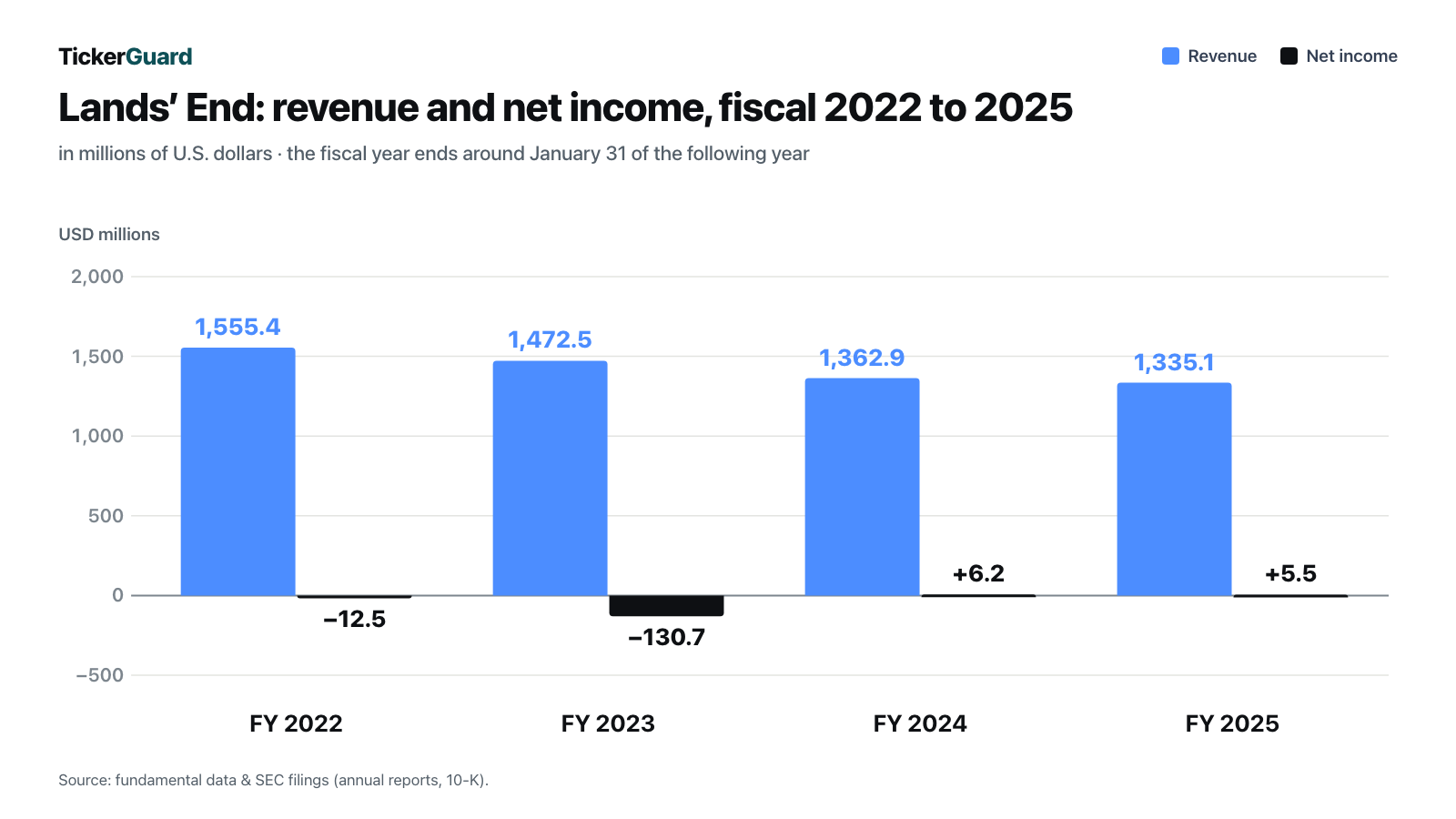
The other half of the picture belongs here too. Revenue has declined three years in a row, by a combined 14 percent from fiscal 2022 to fiscal 2025. And profits stayed small because a large part of operating income went to lenders: in fiscal 2025 Lands’ End earned $44.3 million in operating income and paid $36.7 million in interest. The reason was a term loan with $234 million outstanding, which carried an interest rate of 12.04 percent at the end of January 2026.
That loan no longer exists. On April 1, 2026, Lands’ End repaid it in full with the cash from the brand deal. In the second quarter of fiscal 2026, interest expense was $1.0 million, down from $9.3 million a year earlier. As of July 31, 2026, financial debt consisted only of $60.0 million drawn on a revolving credit facility that is secured by inventory and receivables and moves with the season. Stockholders’ equity rose from $244.3 million at the end of January to $492.9 million. So much for the good news. Now to the question of what it cost.
What the Filings Say — The Uncomfortable Truths
Uncomfortable Truth No. 1: The Price-to-Earnings Ratio of 0.7 Is a Closeout Lot
On April 1, 2026, Lands’ End contributed all of its brand rights and license agreements to a new entity, LE Topco, LLC, and sold half of it for $300 million in cash to WHP Global, a company that owns and licenses brands. The brand had been carried on the balance sheet at $257.0 million. Lands’ End puts the value of the whole new entity at $748.6 million. The difference, $491.6 million, appears in the first half of fiscal 2026 as “Gain on WHP Transaction” in the income statement.
That produces the number that stands out in every database: $334.1 million of first-half net income, $10.96 per share. For all of fiscal 2026 the company expects net income of $317 million to $325 million, or $10.87 to $11.14 per share, according to its earnings release of September 3, 2026. At a price of $8.35 that makes a price-to-earnings ratio below one.
This profit is not money the business earned, and it will not come back — you can only sell half of a brand once. The company strips it out itself. Its adjusted result for the first half of fiscal 2026 is a loss of $0.8 million. For the full year it guides to adjusted net income of $13 million to $21 million, or $0.44 to $0.72 per share. On those figures, the price-to-earnings ratio at the November 20, 2026 close is between about 12 and 19 (our calculation). Keep in mind: the gap between 0.7 and 12 to 19 is not a math error. It is a closeout lot.
Uncomfortable Truth No. 2: Lands’ End Now Pays Rent on Its Own Name
The sale changed the business model. The brand no longer belongs to Lands’ End but to the joint venture, and Lands’ End needs a license to keep selling clothing under its own name. That license costs a share of sales, but at least $50 million a year. The minimum applies through contract year 11, then rises by one percent a year for ten years and is $55.2 million a year after that. The agreement initially runs for ten years beyond the first contract year and then renews up to twelve times for seven years each.
To put the size in context: $50 million is more than the entire operating income of fiscal 2025 ($44.3 million) and more than the interest Lands’ End paid that year ($36.7 million). Interest has turned into rent. Part of that rent flows back, because Lands’ End owns half of the landlord. In the first four months (April 1 to July 31, 2026), Lands’ End paid $18.9 million in royalties to the joint venture. The venture took in $24.3 million in total and had $1.9 million of operating expenses. Lands’ End’s share of its earnings was $4.4 million after amortization; the cash actually distributed through the end of July was $2.4 million. Under the agreement, cash above $5 million is distributed to both partners quarterly.
What happens if business weakens and the minimum royalty still comes due is something the company describes itself, in its quarterly report for May 1, 2026:
“Termination of the License Agreement would result in termination of substantially all rights necessary to operate our business using the ‘Lands’ End’ brand, would significantly impair our ability to operate our business as currently conducted and could have a material adverse effect on our results of operations.”
— Lands’ End, Inc., quarterly report on Form 10-Q for May 1, 2026, Item 1A “Risk Factors”
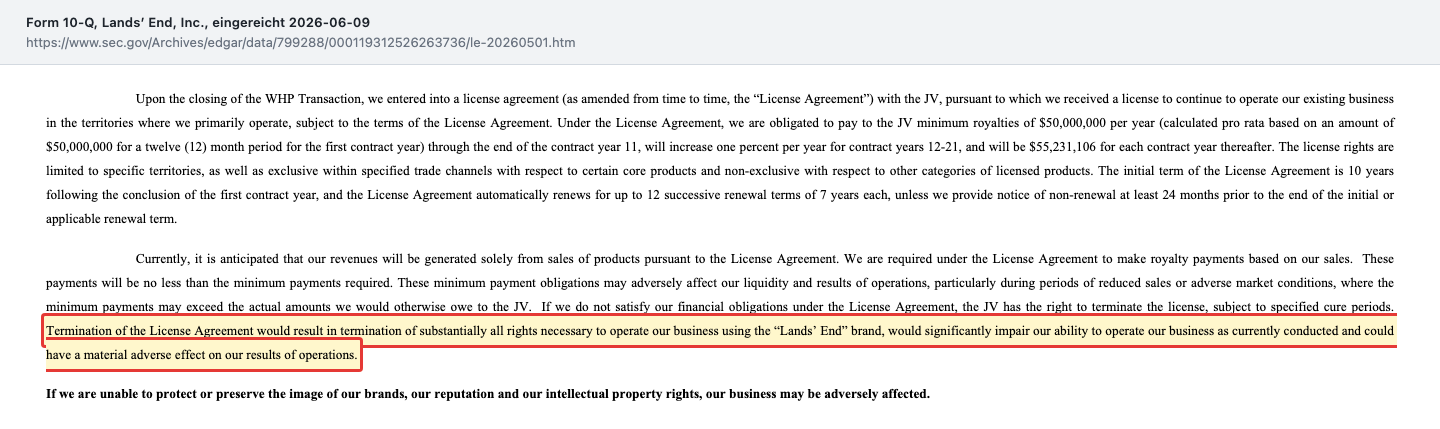
The joint venture may terminate only if Lands’ End fails to pay the minimum royalty or undisputed royalty amounts and also lets a cure period pass. That is a narrow ground for termination. But who decides inside the joint venture is spelled out in the filing on the closing of the deal:
“Managers appointed by WHP collectively have an extra vote permitting WHP to control decisions of the LE Topco Board, which is subject to change in the future based on the relative ownership percentages of WHP and Sellers in LE Topco.”
— Lands’ End, Inc., Form 8-K of April 1, 2026, Item 1.01
Both partners hold 50 percent, but WHP has the deciding vote. That is why Lands’ End no longer carries the brand as an asset of its own but as a stake in a business run by someone else: $377.6 million as of July 31, 2026. Two clauses are worth knowing. For the first three years the partners generally may not sell their stakes to third parties. And if WHP Global itself goes public or is sold, Lands’ End can, under certain conditions, have the right or the obligation to exchange its stake in the brand entity for units of WHP. Whether and when that happens is not in Lands’ End’s hands.
Uncomfortable Truth No. 3: The Quarterly Profit Came From a Tariff Refund
For the second quarter of fiscal 2026, Lands’ End reported net income of $3.5 million after a loss of $3.7 million a year earlier, along with revenue growth of 2.7 percent and a gross margin of 52.0 percent, up from 48.8 percent. Where the better margin came from, the report says in one sentence:
“The gross margin increase was primarily driven by the IEEPA tariff refund, partially offset by the new royalty structure associated with the JV and temporary costs associated with our new warehouse management system.”
— Lands’ End, Inc., quarterly report on Form 10-Q for July 31, 2026, Item 2 “Gross Profit”
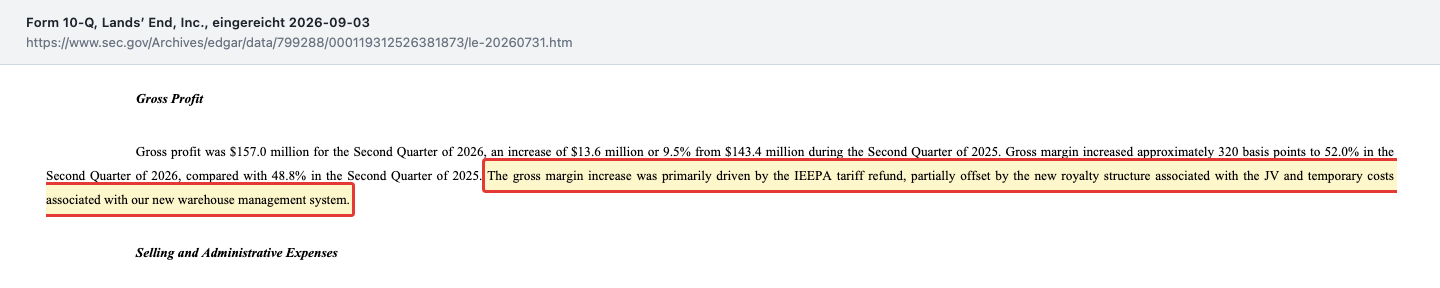
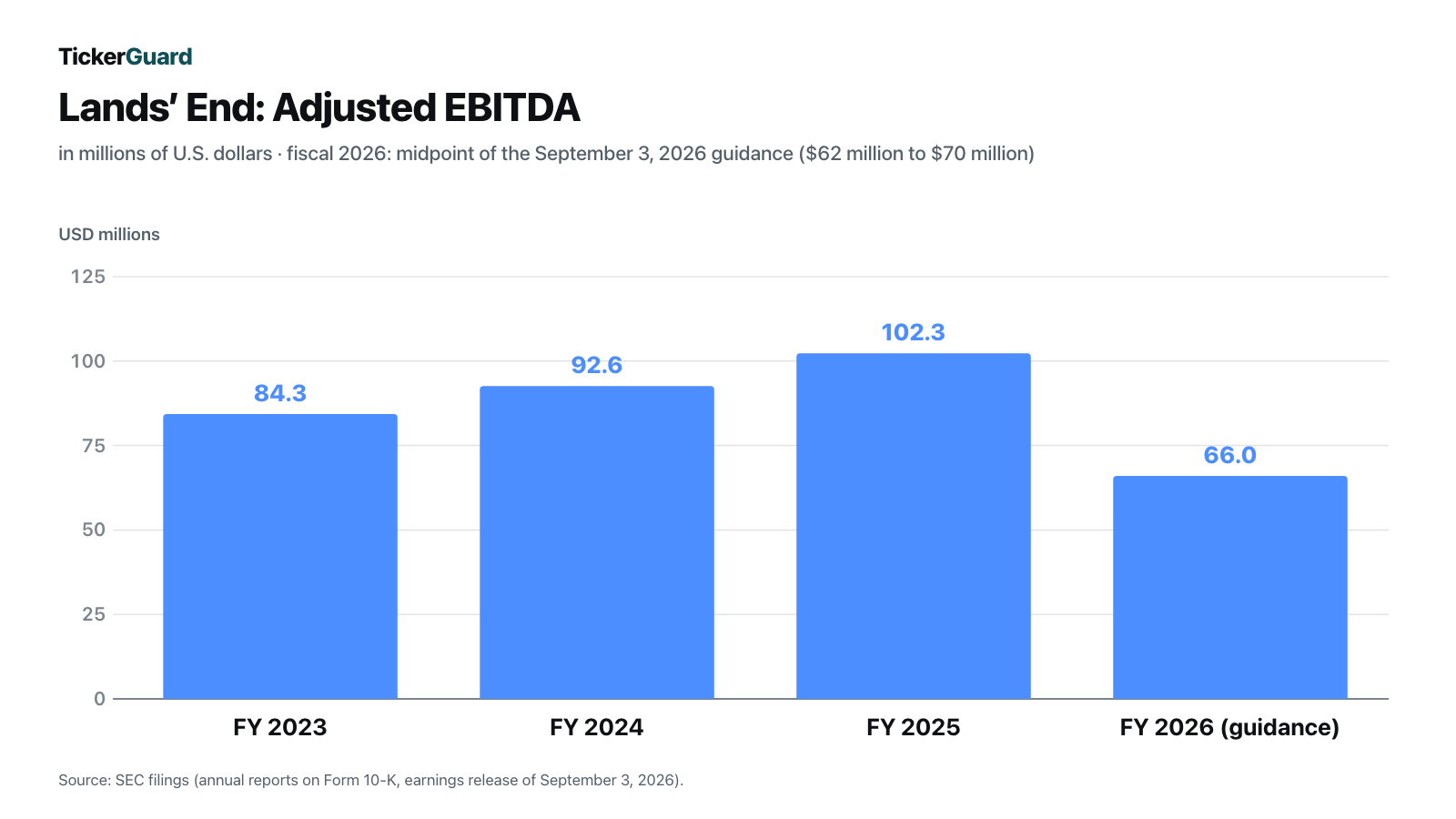
The refund concerns tariffs Lands’ End had previously paid on imported merchandise and that were booked as a recovery in the quarter; the report does not say whether the cash has already arrived. In the reconciliation to its adjusted results the company puts a number on it: $24.9 million. Income before taxes was $8.2 million in the quarter; without the refund it would have been a loss of $16.7 million (our calculation). In fairness, the same quarter carried $11.7 million of costs for the restructuring and the leadership change, which do not recur every quarter either. Strip out both and the other special items, and what remains is the yardstick the company itself uses — Adjusted EBITDA. It fell 25 percent to $11.3 million in the second quarter and from $24.6 million to $5.1 million in the first half.
Keep in mind: since April 2026 the royalty has been part of cost of sales. Gross margins from that point on are therefore no longer directly comparable with those of prior years.
The report gives three reasons for the decline: the new royalty, which is booked in cost of sales; higher tariff costs; and the rollout of a new warehouse management system that disrupted shipping in the first quarter. Revenue fell 8.5 percent in that quarter; Chief Financial Officer Bernie McCracken said on September 3, 2026 that the U.S. online store and the Outfitters business were back to normal. The holiday quarter can therefore make up part of the damage.
That leaves the cash. In the first half of fiscal 2026, operations used $86.5 million, after generating $0.5 million a year earlier. Inventories grew by $73.9 million and stood at $342.0 million at the end of July, 13 percent above the prior year; $26.0 million went out as income taxes. The company attributes the outflow to the closing of the brand deal and the normal seasonal inventory build. As of July 31, 2026, there was $16.1 million in cash, $60.0 million was drawn on the credit facility and another $89.3 million was available. On its own liquidity, Lands’ End writes in the quarterly report that cash, operating cash flow and the credit facility will be adequate for at least the next twelve months. Where the $300 million went is shown in the first-half cash flow statement: $234.0 million to repay the term loan, $26.0 million in income taxes, $10.8 million in share buybacks, plus the costs of the deal itself. Keep in mind: the loan is gone, but so is the cash from the brand sale.
Uncomfortable Truth No. 4: $45 a Share Was Paid for Only 7.2 Percent of the Shares — and More Than Half of That Went to the Majority Shareholder
The brand deal came with a partial tender offer for the company’s shares. WHP Global offered Lands’ End stockholders to buy up to 2,222,222 shares at $45.00 each, $100 million in total. On the day of closing, April 1, 2026, the stock closed at $11.56 (fundamental data). The offer price was thus almost four times the market price. How the company accounts for that premium is in the notes to the quarterly report:
“For accounting purposes, the difference between the purchase price paid by WHP Global in the tender offer and the trading price of the Company’s common stock on the day of the closing of the transaction in the amount of $74.3 million was treated as additional consideration for the sale of the 50% stake in the JV and a corresponding deemed distribution to shareholders. The Company did not receive or distribute this cash consideration.”
— Lands’ End, Inc., quarterly report on Form 10-Q for July 31, 2026, Note 5 “Equity Method Investment”
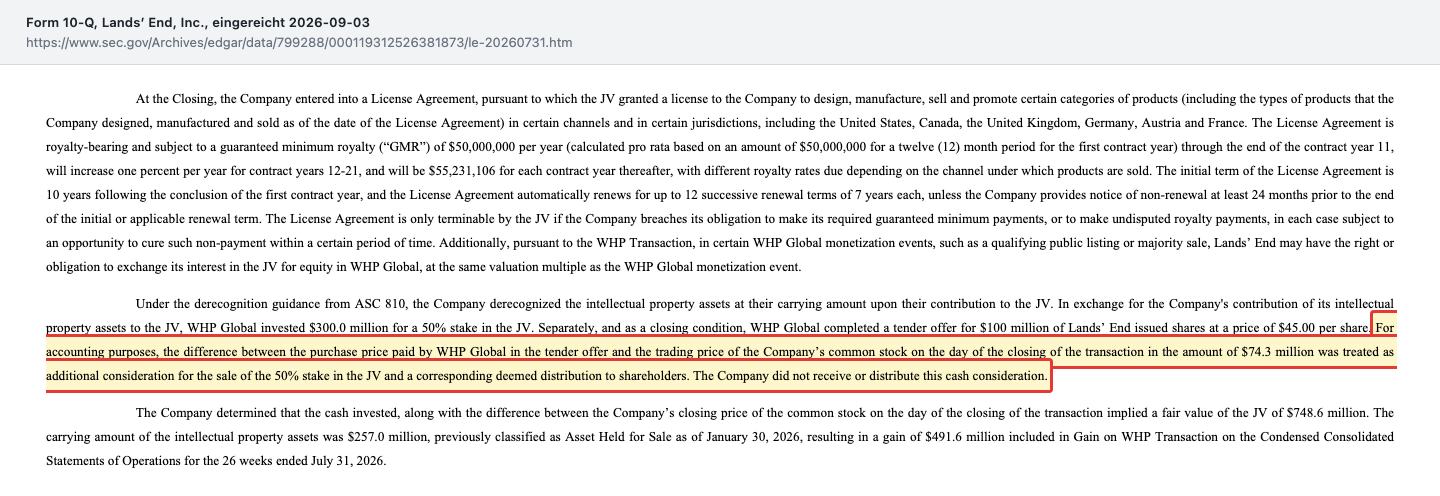
In plain language: WHP did not pay $300 million for half the brand but, in economic terms, $374.3 million. $300 million went to the company, and $74.3 million went as a premium directly to the stockholders whose shares were accepted in the offer. The accepted shares numbered 2,222,222, or 7.2 percent of all shares. Of those, 1,300,653 came from Edward S. Lampert and accounts attributed to him, according to the ownership filing of April 3, 2026. That is 58.5 percent of the accepted shares and proceeds of about $58.5 million (our calculation). His stake in Lands’ End at that time was a little over half of the shares; the offer was open to all stockholders. For every share that was not accepted in it, the market price has applied ever since.
A second find sits in the section on related party transactions:
“This payment was reviewed and approved by the Audit Committee of the Company's Board of Directors.”
— Lands’ End, Inc., quarterly report on Form 10-Q for July 31, 2026, Note 15 “Related Party Transactions”

The payment in question: in the first half of fiscal 2026 Lands’ End covered legal fees of $3.5 million for Edward S. Lampert and related funds, incurred in negotiating the deal. The company’s reasoning is that the fees were incurred in connection with, and for the benefit of, the joint venture transaction. On top of that came transaction success bonuses for management, approved by the board on March 5, 2026: two times annual base salary for the then chief executive, one and a half times for the chief financial officer and the head of the licensing business, paid in installments. In total Lands’ End booked $35.0 million of restructuring and other costs in the first half of fiscal 2026, of which $29.4 million was for exploring and completing strategic alternatives.
All of this is disclosed and was approved by the Audit Committee. It simply shows how the weights are distributed: one stockholder holds the majority, and he has committed to Lands’ End to vote in favor of a possible exchange of the brand stake into WHP units. Against a stockholder with a little over half of the shares, no majority can be formed at the stockholder meeting.
Uncomfortable Truth No. 5: Leadership Is Changing in the Middle of the Overhaul
Three months after the deal closed, the chief executive changed. On June 30, 2026, Lands’ End announced that Charlie Cole would take over on July 13; his predecessor Andrew McLean left the executive suite and the board. According to the filing, Cole was previously, among other roles, chief executive of FTD and chief digital officer of TUMI. On July 9, 2026, Peter L. Gray resigned with immediate effect; he had run the licensing business and was also chief administrative officer and general counsel. On October 26, 2026, Martin Christopher, who was responsible for the technology transformation, resigned effective November 6. Since September 2026 the insider filings with the SEC have listed James Ferolo as the new chief digital and technology officer.
A new chief executive after a major overhaul is not an alarm signal. But the task on which this year’s numbers depend — the new warehouse system and the technology behind it — is now in new hands, shortly before the quarter that brings about a third of annual revenue. The insider filings on Form 4 since the summer are unremarkable: on October 7, 2026, Kym Maas, the president for product, sold 10,000 shares at an average of $10.59; two directors took part of their fees in shares instead of cash at the end of October, valued at $9.51 per share.
Valuation: What the November 20, 2026 Price Pays For
To do the math we need a share count and a price, both dated. The cover of the quarterly report gives 29,544,154 shares as of September 1, 2026. At the close of November 20, 2026 ($8.35, fundamental data) that makes a market value of about $247 million. As a cross-check with a price from an SEC document: the insider filings of November 3, 2026 state $9.51 per share, which would be about $281 million. Add the drawn credit facility and subtract cash ($60.0 million and $16.1 million as of July 31, 2026), and the whole company costs about $291 million.
Now three yardsticks, and none of them is the price-to-earnings ratio of 0.7. First, Adjusted EBITDA: the midpoint of the full-year guidance is $66 million, and enterprise value is a little over four times that (291 divided by 66 is 4.4). That is low. Second, adjusted earnings: $0.44 to $0.72 per share means a price-to-earnings ratio between about 12 and 19. That is no longer low. The difference between the two yardsticks is depreciation, interest and taxes — and capital expenditures of about $40 million that the company plans for fiscal 2026.
Third, the assets. Stockholders’ equity was $492.9 million as of July 31, 2026, or $16.42 per share; the price is at half of that. The largest item in it is the half stake in the brand entity at $377.6 million, about $12.60 per share (both calculated on the 30.0 million shares at the balance sheet date). Arithmetically, the market value is therefore below the carrying value of the half stake in the brand entity. Three things cloud that picture. The carrying value of the stake derives from the price WHP paid including the $45 tender offer, not from a market price. Lands’ End cannot sell the stake for three years and does not control the entity. And the value of the brand depends to a large extent on the royalty Lands’ End pays itself: $18.9 million of the brand entity’s $24.3 million of revenue in the first four months came from its own tenant.
For context, an outside view that is not ours: the fundamental data listed two analysts on November 20, 2026, both with a positive rating. Two voices are a thin read of sentiment and not a road map.
Upside and Risks at a Glance
What speaks for Lands’ End:
- The $234 million term loan at about 12 percent interest has been repaid since April 1, 2026; interest expense fell from $9.3 million to $1.0 million in the second quarter of fiscal 2026.
- Stockholders’ equity doubled to $492.9 million (July 31, 2026); the November 20, 2026 price is at half of book value per share.
- Lands’ End still owns half of the brand entity; if WHP Global licenses the brand to more partners, half of the earnings flow to Lands’ End.
- Buybacks: in the second quarter of fiscal 2026 the company repurchased 910,253 shares at an average of $11.60, about 3 percent of the shares; $89.2 million remains authorized through March 2029. The average price was above the November 20, 2026 close ($8.35) and far below the $45 paid in WHP’s offer.
- The disruption from the new warehouse system is behind it, the company says; in the second quarter of fiscal 2026 the U.S. online store grew 9.0 percent, partly on carryover shipments from the first quarter.
What speaks against it:
- Revenue has declined three fiscal years in a row and fell another 2.6 percent in the first half of fiscal 2026.
- At least $50 million a year in royalties to an entity controlled by WHP Global — regardless of how business is going.
- Adjusted EBITDA is guided to fall to $62 million to $70 million in fiscal 2026 (prior year $102.3 million); the profit of the second quarter came from a tariff refund.
- $86.5 million of operating cash outflow in the first half of fiscal 2026, $16.1 million in cash and a credit facility drawn by $60.0 million ahead of the holiday season.
- A majority shareholder with a little over half of the shares, a new chief executive and three departures from senior management since July 2026.
A Human Conclusion
Back to the closeout trap. Its core is not that the closeout lot is fake — the $491.6 million is properly booked, the $300 million really arrived, and the expensive loan is really gone. Its core is that a closeout lot comes only once and still shapes the number everyone sees first. At Lands’ End it shapes two: the price-to-earnings ratio of 0.7 and a book value that consists, to three quarters, of a stake the company neither runs nor may sell in the next few years.
Take the closeout lot away and what remains is an apparel retailer with about $1.3 billion in revenue that has been shrinking for three years, is earning clearly less this year than last, and now pays rent on its name. So the question for you is not “Is a price-to-earnings ratio of 0.7 cheap?” but: Do you trust the new chief executive to earn durably more with this business than the $50 million royalty — and do you believe the half stake in the brand will one day turn into cash at a price that you, too, will receive? What you make of it is your decision. If so, you have a thesis. If all you saw was the 0.7, you mistook a closeout lot for the assortment.
Sources
All original documents used in this analysis — to read for yourself:
- Lands’ End, Inc. — quarterly report on Form 10-Q for July 31, 2026 (filed September 3, 2026)
- Lands’ End, Inc. — earnings release for the second quarter of fiscal 2026 with guidance (Exhibit 99.1 to the Form 8-K of September 3, 2026)
- Lands’ End, Inc. — quarterly report on Form 10-Q for May 1, 2026 (filed June 9, 2026)
- Lands’ End, Inc. — Form 8-K of April 1, 2026 (closing of the WHP transaction, license agreement, repayment of the term loan) and Form 8-K of April 1, 2026 (share repurchase program)
- Lands’ End, Inc. — annual report on Form 10-K for fiscal 2025 (filed March 26, 2026) and annual report on Form 10-K for fiscal 2024 (filed March 27, 2025)
- Lands’ End, Inc. — Forms 8-K on leadership changes (Item 5.02): March 11, 2026 (transaction success bonuses), June 30, 2026 (new chief executive), July 10, 2026 and October 30, 2026
- Ownership filing (Schedule 13D/A) by Edward S. Lampert of April 3, 2026, insider filings (Form 3 and Form 4) and notices of proposed sale (Form 144) through November 3, 2026 in the EDGAR overview for Lands’ End (sec.gov)
- Fundamental data (prices, analyst ratings; data as of November 20, 2026), reconciled with the SEC filings.
Transparency & disclaimer: this analysis is journalistic commentary on publicly available information. It is not investment advice, not a regulated investment research product and not a solicitation to buy or sell securities. Equity investments carry substantial risk up to and including total loss. All information is provided without warranty; the as-of date for each figure is stated in the text. Positions held by the operator are disclosed daily; where one exists, it appears as a notice at the top of this analysis.
Key figures at a glance
All monetary figures in millions of $; earnings per share as reported.
| Metric | 2022 | 2023 | 2024 | 2025 | 2026 |
|---|---|---|---|---|---|
| Revenue | 1,636.6 | 1,555.4 | 1,472.5 | 1,362.9 | 1,335.1 |
| Operating Income (EBIT) | 79.8 | 24.7 | -77.5 | 51.0 | 44.3 |
| Net Income | 33.4 | -12.5 | -130.7 | 6.2 | 5.5 |
| Net Margin | 2.0% | -0.8% | -8.9% | 0.5% | 0.4% |
| Earnings Per Share | 0.99 $ | -0.38 $ | -4.09 $ | 0.20 $ | 0.18 $ |
Source: fundamental data & SEC filings (annual and quarterly reports, 10-K/10-Q)
Our Bottom Line at a Glance
- Revenue negative
- Revenue declined three years in a row from fiscal 2022 to fiscal 2025, from $1,555.4 million to $1,335.1 million. It fell another 2.6 percent in the first half of fiscal 2026; in the second quarter of fiscal 2026 it rose 2.7 percent.
- Earnings power negative
- Adjusted EBITDA fell from $24.6 million to $5.1 million in the first half of fiscal 2026; for fiscal 2026 the company guides to $62 million to $70 million after $102.3 million the year before. Net income for the second quarter of fiscal 2026 includes a tariff refund of $24.9 million.
- Debt & balance sheet positive
- The $234 million term loan at about 12 percent interest was repaid on April 1, 2026. As of July 31, 2026, $60.0 million was drawn on a credit facility, $89.3 million was available, and stockholders’ equity was $492.9 million.
- Cash flow neutral
- In the first half of fiscal 2026, operations used $86.5 million of cash, including the seasonal inventory build ($73.9 million) and income taxes ($26.0 million). Fiscal 2025 as a whole generated $49.6 million; the final quarter usually brings the inflow. Neutral rather than negative because the first half is seasonally the weak one and contains one-time payments from the brand deal.
- Brand & royalty negative
- Since April 1, 2026, the brand has belonged to a joint venture in which WHP Global decides. Lands’ End pays at least $50 million a year in royalties; if it fails to pay, the license can be terminated.
- Owners & leadership neutral
- Edward S. Lampert held 51.4 percent of the shares according to his filing of April 3, 2026. Charlie Cole has been chief executive since July 13, 2026; three senior managers have left since July 2026. Lands’ End covered $3.5 million of the majority shareholder’s legal fees, approved by the Audit Committee.
Lands’ End is a case of the closeout trap: the price-to-earnings ratio of 0.7 comes from a one-time book gain of $491.6 million on the sale of half the brand. The expensive loan is repaid and the balance sheet is relieved. In return the company now pays at least $50 million a year in royalties, revenue has been falling for three years, and Adjusted EBITDA is set to drop by about a third in the current fiscal year. Not investment advice.
What Our Rating Means
Open questions
The business works in principle, but one material question is open. As long as it stays open, our findings do not carry a quality verdict.
Yellow, because the business holds up but one material operating question is open: whether Lands’ End, after three years of falling revenue and with a minimum royalty of $50 million a year, can earn enough on a lasting basis. Adjusted EBITDA is guided to fall from $102.3 million to $62 million to $70 million in fiscal 2026, and the quarterly profit came from a tariff refund. The filings do not document a threat to the company’s substance: the term loan is repaid, equity is $492.9 million, the credit facility has $89.3 million of headroom, and the company considers its resources adequate for at least twelve months. The decision is yours.
A journalistic assessment by our editorial team at the time of the deep dive, based on public sources — not investment advice and not a solicitation to buy or sell. Your personal circumstances (investment goals, risk capacity, taxes) cannot be taken into account. What our levels mean, how verdicts are formed, and what conflicts of interest exist →
Worth Noting
- The trigger for this analysis is the price of 11/20/2026: $8.35, the lowest close of the past twelve months, at a price-to-earnings ratio of about 0.7 as shown in the fundamental data. Other closing prices per fundamental data: $17.76 (01/30/2026), $11.56 (04/01/2026).
- Data as of: the latest periodic report is the Form 10-Q for 07/31/2026, filed 09/03/2026; all filings through 11/22/2026 were reviewed. After 09/03/2026 only insider filings (Forms 3/4, Form 144) and the Form 8-K of 10/30/2026 (Item 5.02) followed.
- Share count from the cover of the Form 10-Q (09/01/2026): 29,544,154. The market value of about $247 m is our calculation; cross-check with the price from the Form 4 filings of 11/03/2026 ($9.51 on 10/30/2026): about $281 m, a difference of about 12 percent.
- Our calculations: income before taxes for the second quarter of fiscal 2026 without the tariff refund ($8.2 m minus $24.9 m = −$16.7 m); Lampert’s proceeds from the tender offer (1,300,653 shares × $45 = about $58.5 m); economic price for half the brand ($300 m plus $74.3 m = $374.3 m, half of $748.6 m); book value per share $16.42 ($492.9 m divided by 30.023 m shares on 07/31/2026); stake per share about $12.60 ($377.6 m divided by the same 30.023 m shares).
- The 51.4 percent stake is based on 30,751,337 shares (03/23/2026). The share count has since fallen through buybacks; no newer ownership filing by Lampert is available.
- The fiscal year differs from the calendar year: “fiscal 2026” means the 52 weeks ending 01/29/2027, “second quarter of fiscal 2026” the 13 weeks ended 07/31/2026.
Stock Watch
This analysis is as of November 22, 2026. Stock Watch will tell you what's changed at LE since then.
Later $1 a month per stock — signing up is free, and you'll be the first to know when it launches.
The full analysis as a PDF for later
We will send you this analysis as a PDF — to print, file away, and read at your own pace. And we will add you to the free Stock Watch list for Lands’ End Inc (LE), so you hear about it when something material in this analysis changes.
Frequently Asked Questions
Lands’ End, Inc. (Nasdaq: LE) sells apparel, swimwear, outerwear, footwear, home products and uniforms, more than 95 percent of it online according to its annual report. It also sells workwear to businesses and school uniforms (Outfitters), sells on third-party marketplaces, and runs a European business and its own stores. In fiscal 2025, which ended January 30, 2026, revenue was $1,335.1 million.
Because earnings contain a one-time item. On April 1, 2026, Lands’ End sold half of its brand rights to WHP Global for $300 million and booked a gain of $491.6 million. First-half net income of $334.1 million therefore exceeds the market value. On an adjusted basis the company guides to earnings of $0.44 to $0.72 per share for fiscal 2026.
On April 1, 2026, Lands’ End contributed all of its brand rights to a new entity, LE Topco, LLC, and sold 50 percent of it to WHP Global for $300 million. WHP controls the entity’s decisions. Lands’ End now pays a royalty of at least $50 million a year to use its own name and used the proceeds to repay a $234 million term loan.
In fiscal 2024 and fiscal 2025 Lands’ End earned $6.2 million and $5.5 million. For the first half of fiscal 2026 it reports net income of $334.1 million because of the brand sale; on an adjusted basis it was a loss of $0.8 million. Adjusted EBITDA fell from $24.6 million to $5.1 million in the half, and operations used $86.5 million of cash.
The largest shareholder is Edward S. Lampert. According to his ownership filing of April 3, 2026, he held 15,815,723 shares, or 51.4 percent. WHP Global acquired 2,222,222 shares, or 7.2 percent, on April 1, 2026 through a tender offer at $45 per share. Of those shares, 1,300,653 came from Lampert and accounts attributed to him.
The Lands’ End fiscal year ends on the Friday around January 31. Fiscal 2025 ran through January 30, 2026, and fiscal 2026 ends on January 29, 2027. About 34 percent of annual revenue in fiscal 2024 and fiscal 2025 fell into the final quarter with the holiday season, which therefore decides the full-year result.
According to its earnings release of September 3, 2026, Lands’ End expects fiscal 2026 revenue of $1.30 billion to $1.35 billion, adjusted net income of $13 million to $21 million and Adjusted EBITDA of $62 million to $70 million (prior year $102.3 million). For the third quarter it guides to revenue of $300 million to $330 million and Adjusted EBITDA of $14 million to $18 million.
Found an error?
Did you spot a factual error, an outdated number, or a typo in this deep dive? Let us know briefly — your report goes straight to the editorial team.