Riskified Stock: Growth Jumps to 41 Percent — and Riskified Pays for the Fraud Itself
Riskified checks for online merchants whether an order is genuine, and it is liable when the check gets it wrong. In the third quarter of 2026 revenue grew faster than at any time since the IPO. Cost of revenue, mostly reimbursed fraud cases, grew faster still, and while the company bought back its own stock, early backers sold. Not investment advice — just the question of what is left of the growth when the costs grow faster.
 Thomas Mücke
Founder & Publisher
As of Today
As of: November 17, 2026
- Closing price
- 9.69 $ +2.87%
- Market Capitalisation
- 1.3 $B
- Growth Score
- 6/10
- AAQS
- 5/10
This analysis has a cut-off date. The Stock Guard tells you when something material changes in the numbers. Reserve your free spot
Chart
Interactive price chart (TradingView).
52-week range: 3.80 $ to 10.40 $ · Last price: 9.69 $ (As of: November 17, 2026)
Note: pure fact-based analysis, not investment advice and not a solicitation to buy or sell. All figures without guarantee.
There is an investor trap you drive into with your eyes wide open: the speedometer trap. Watch nothing but the speedometer and every burst of acceleration feels great — until the gas pump tells you what it cost. On the stock market, the speedometer is revenue growth. On November 11, 2026, Riskified (NYSE: RSKD) reported a reading the company had not seen since its IPO: up 41 percent in the third quarter. The stock closed 22 percent higher that day. So let’s make a deal: before the acceleration carries you away, we read together what Riskified has reported to the U.S. securities regulator, the SEC — the annual report (Form 20-F) for 2025 and the 2026 reports on Form 6-K, including the earnings release of November 11, 2026, furnished with the Form 6-K of November 12. The fuel consumption is in there too. In the end, you decide.
What Riskified Actually Does — a Fraud Check That Is Liable for Its Own Mistakes
Picture an online merchant that receives an order for an expensive smartphone at three in the morning — new customer, shipping address abroad. Is that a real buyer or someone with stolen card details? Decline, and the merchant may lose an honest sale. Accept, and if it was fraud, the bank claws the money back and the goods are gone. In payments, that clawback is called a chargeback.
Riskified takes that decision off the merchant’s hands. Its software checks every order in a fraction of a second against hundreds of attributes and says yes or no. What sets it apart is the promise behind the answer: if Riskified says yes and the order turns out to be fraud, Riskified pays. That is why the core product is called “Chargeback Guarantee,” and the annual report describes it like this:
“We guarantee the outcome of these decisions by assuming the cost of fraud associated with each order that we approve.”
— Riskified Ltd., annual report on Form 20-F for 2025, Item 4.B “Business Overview”
Riskified is paid a share of the value of every order it approves. The rate depends on the risk: lower for a fashion retailer than for a travel site. Put in everyday terms, Riskified is half bouncer, half insurer. The bouncer gets a small tip for every guest he lets in — and pays out of his own pocket when a guest skips out on the bill. The better the models, the more of the tip is left over.
The company was incorporated in Israel in November 2012 and has been listed on the New York Stock Exchange since July 2021; its principal executive offices are in New York, and most of its 670 employees (as of December 31, 2025) work in Israel. Co-founder Eido Gal still runs the company as chief executive and chairs the board. Customers named in the annual report include Ring, Lastminute.com, SHEIN and Macy’s. In 2025, orders worth $155.1 billion ran through the platform. Because Riskified is a foreign private issuer, it files no quarterly reports on Form 10-Q the way U.S. companies do: its quarterly numbers arrive as an earnings release attached to a Form 6-K, and they are unaudited. Its fiscal year is the calendar year. That gives us the central tension of this analysis, and it runs through every chapter: Riskified is growing faster than at any time since its IPO — but every additional dollar of revenue comes with additional liability, and right now cost of revenue is growing faster than revenue.
Company history for investors
-
2012
Founded in Israel
Riskified is incorporated on November 26, 2012, and starts operating in January 2013. For shareholders: the start of the data collection its models still rest on.
-
2021
IPO in New York
The Class A shares have traded on the NYSE since July 2021. The same year ends with a loss of $179.4 million. For shareholders: plenty of capital, but two share classes.
-
2023
First buyback program
In August 2023 the board authorizes the first $75 million for share repurchases; five more tranches follow. For shareholders: the share count falls, and so does the cash.
-
2025
First profitable quarter
The fourth quarter of 2025 ends with a $5.8 million profit, the full year with a $27.6 million loss. For shareholders: evidence the model can earn money, not yet a steady state.
-
2026
Growth jumps, backers sell
Third-quarter revenue up 41 percent at a 43 percent gross margin; the number of Class B shares halves. For shareholders: more speed, less margin, control with the founders.
How the Stock Landed on Our Desk
This analysis was prompted by the earnings release of November 11, 2026, and by what the market made of it. Riskified reported its strongest revenue growth since the IPO and raised its full-year guidance for the third time this year. The stock closed that day at $10.37, up from $8.48 the day before; about ten million shares changed hands, a multiple of an ordinary day. At the end of 2025 it had closed at $4.97 (closing prices per fundamental data).
In the grids of our stock scanners, a name like this stands out first for its momentum: on November 17, 2026, the price was a good 150 percent above its low of the preceding twelve months. A price-to-earnings ratio cannot be calculated, because there is no annual profit. What the business looks like on the other side of the same checkout, at the payment service itself, is the subject of our analysis of PayPal. Keep one thing in mind from the start: revenue shows how much risk the company has taken on. Only gross margin shows how well it judged that risk.
The Numbers Over the Years — An Honest Look
First, what speaks for Riskified, and it is not a short list. Revenue has risen every year: from $229.1 million in 2021 to $344.6 million in 2025. The loss has shrunk every year: from $179.4 million in the IPO year to $27.6 million in 2025.
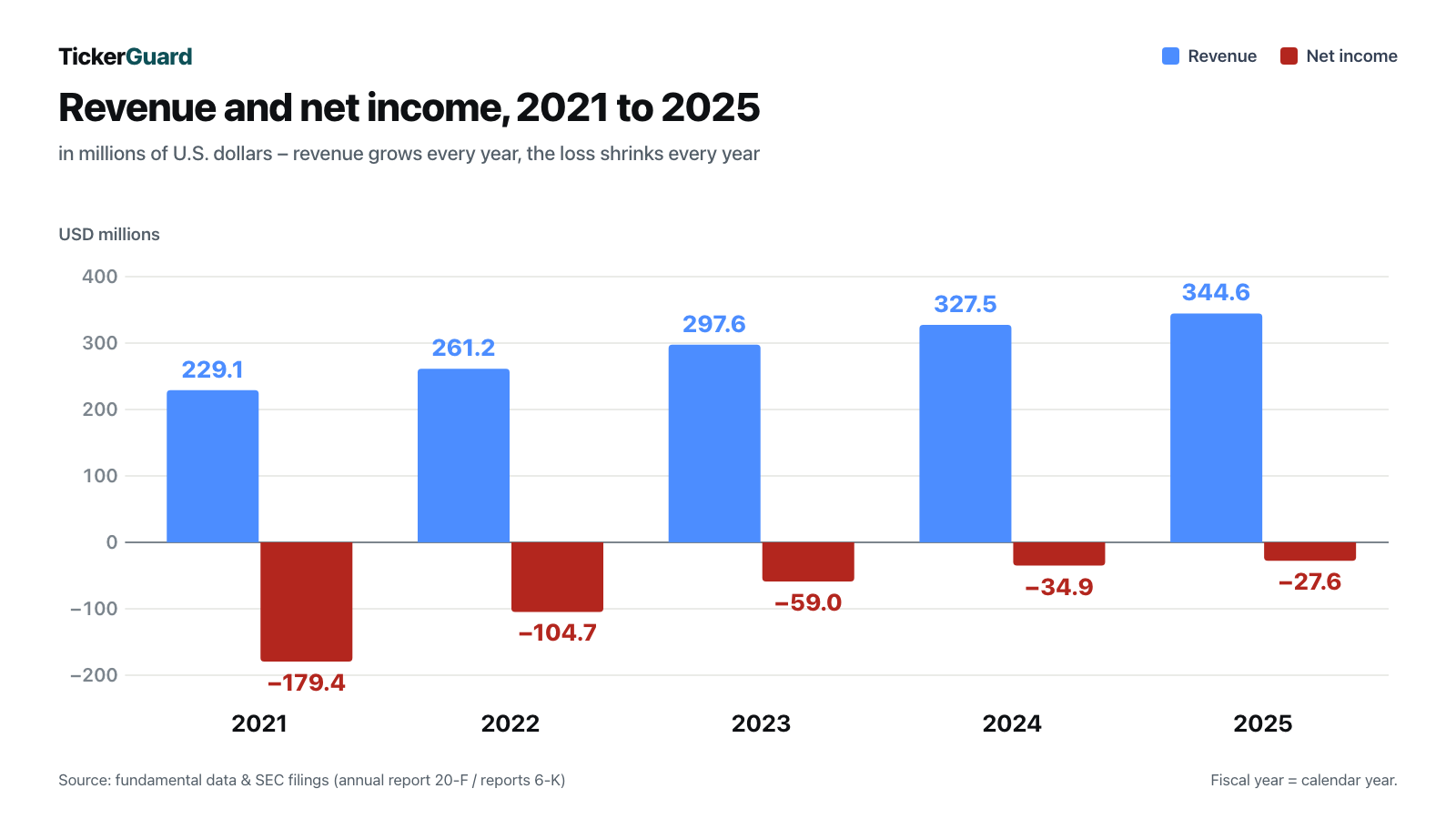
The cash register now works for the company rather than against it. Operations have generated cash since 2023: $33.9 million in 2025 and $38.7 million in the first nine months of 2026. The final quarter of 2025 was the first quarter with a profit under U.S. accounting rules (GAAP), $5.8 million. And the balance sheet is clean: as of September 30, 2026, there were $234.9 million in cash, deposits and investments, and no financial debt.
Then came 2026, and the speedometer needle jumped. Year-over-year revenue growth went from 7 percent in the first quarter to 22 percent in the second and 41 percent in the third. Full-year guidance moved with it: from $372 million to $384 million in March to $427 million to $433 million in November. The second series in the same picture runs the other way:
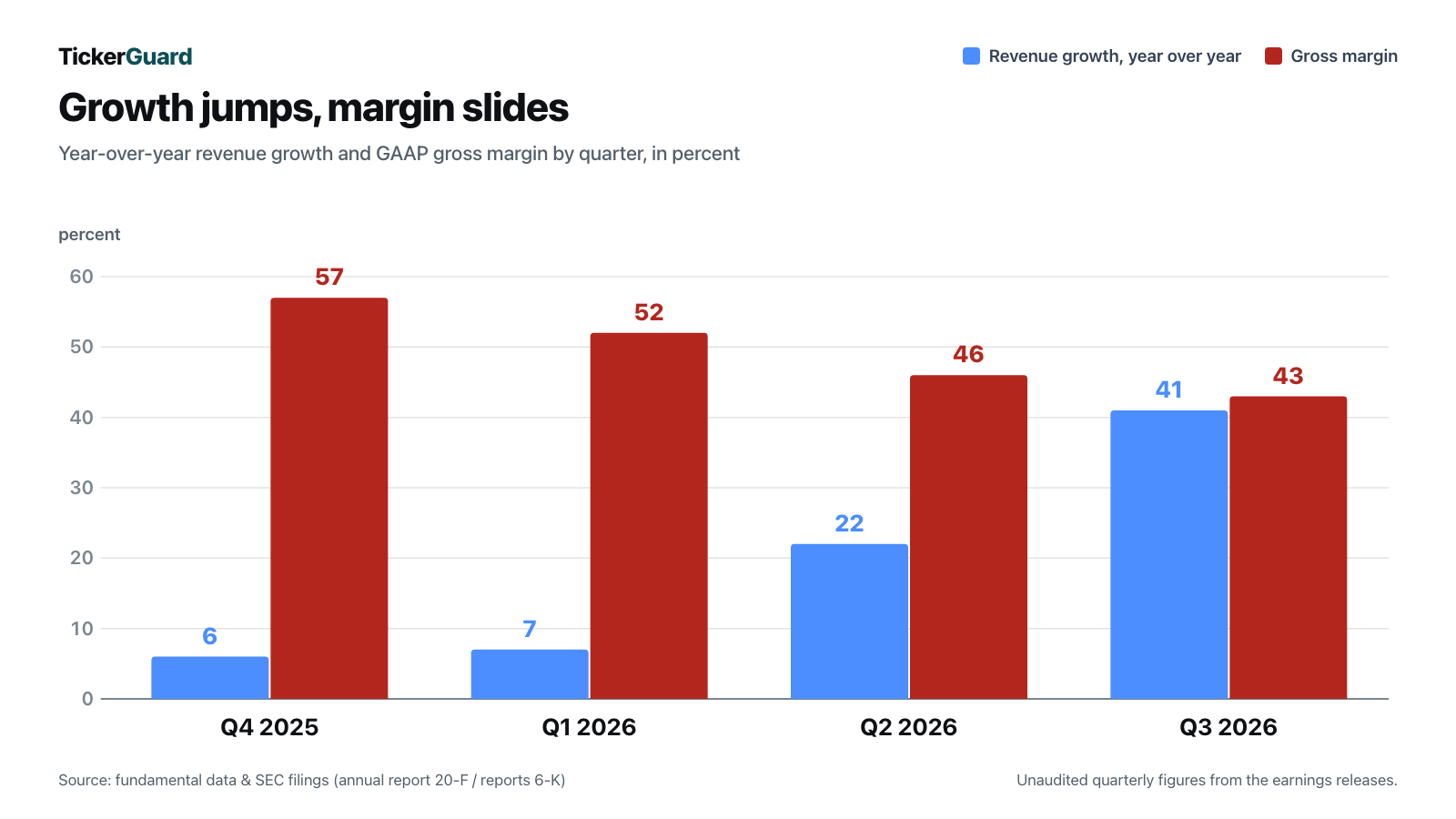
Gross margin is the part of revenue left after direct costs — at Riskified, mostly after reimbursed fraud cases. It swings with the seasons, so the fair test is the same quarter a year earlier: in the first quarter of 2026 it was still above the prior year (52 versus 49 percent), in the second below it (46 versus 49), in the third well below it (43 versus 50). The decline, in other words, is not seasonal. Which brings us to the uncomfortable truths.
What the Filings Say — The Uncomfortable Truths
Uncomfortable Truth No. 1: Cost of Revenue Is Growing Faster Than Revenue
The headline of the earnings release is the growth. The line that matters sits further down:
“GAAP gross profit margin of 43% for the three months ended September 30, 2026 compared to 50% in the prior year.”
— Riskified Ltd., Form 6-K of November 12, 2026, Exhibit 99.1 (third-quarter 2026 earnings release)

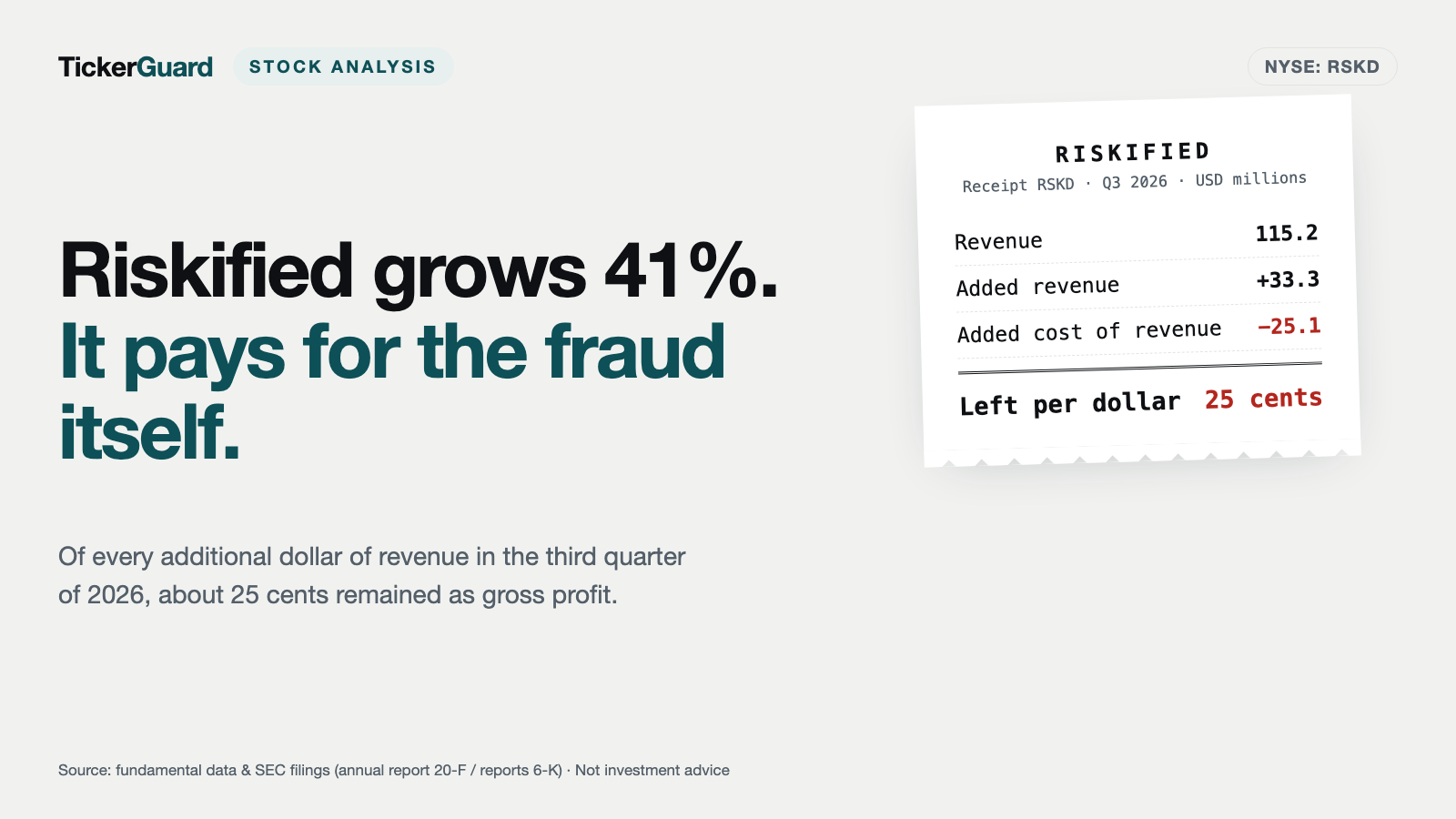
In dollars: third-quarter 2026 revenue rose by $33.3 million to $115.2 million. Cost of revenue rose by $25.1 million to $65.9 million — an increase of 62 percent. According to the annual report it consists primarily of reimbursed fraud cases, plus personnel, hosting and data costs; the release does not break down the increase. Of every additional dollar of revenue, about 25 cents remained as gross profit. Gross profit grew 20 percent, half as fast as revenue.
The release says where the growth comes from: billings in the category Riskified calls “Digital Finance” more than quadrupled from a year earlier, carried by customers that joined the platform in the second quarter. The company does not say how large that category is or which customers are behind it. Nor does the release give a reason for the lower margin. The annual report, however, describes the pattern precisely:
“For example, our CTB Ratio and gross profit margins are sometimes negatively impacted in the first several quarters following the onboarding of significant merchants in new industry verticals or geographic regions, as our AI Technologies adapt to the unique fraud patterns and other characteristics associated with transaction volume in those industries or regions. Model performance will generally normalize over time as our AI Technologies gather more data and their accuracy improves.”
— Riskified Ltd., annual report on Form 20-F for 2025, Item 3.D “Risk Factors”
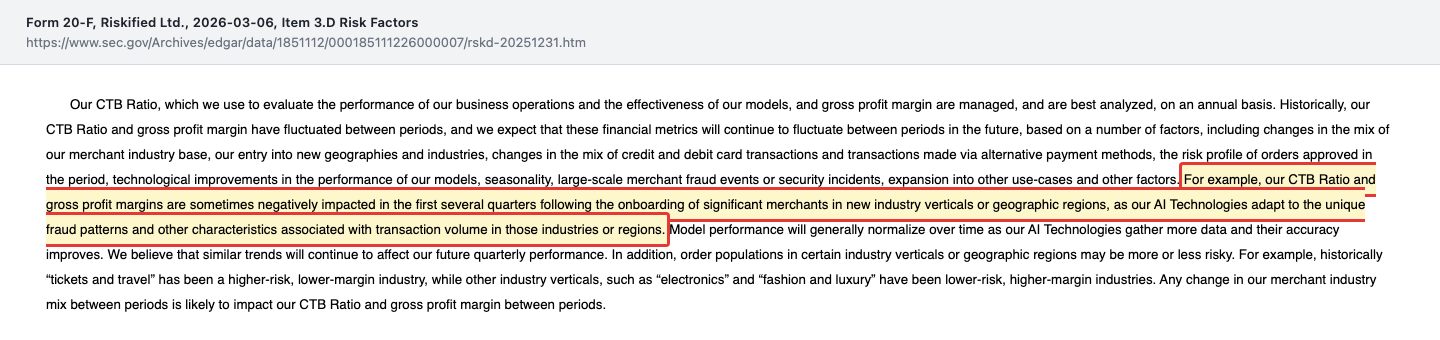
The “CTB Ratio” is the ratio of fraud reimbursements to the fees billed — in the bouncer picture, how much of the tip goes to covering unpaid bills. For 2025 the annual report puts it at 42 percent, up from 40 percent a year earlier. Riskified does not report the ratio for the quarters of 2026. In fairness: the company itself says the models settle down as they collect more data, and it wants margin and CTB Ratio judged on an annual basis, not by the quarter. That is plausible. For the new customers it is not yet proven. Remember this: at Riskified, growth is not proof of good models. The proof arrives a few quarters later, once the chargebacks have been settled.
Uncomfortable Truth No. 2: No Annual Profit Since the Founding — and the “Adjusted” Result Leaves Out Stock Compensation
Riskified puts one metric up front in every release: “Adjusted EBITDA,” an adjusted operating result before interest, taxes, depreciation and amortization. For the first nine months of 2026 it came to plus $18.2 million. Under accounting rules, the same period ended with a loss of $14.8 million. The annual report is blunt on this point:
“We have not been profitable since our inception in 2012 and have incurred significant net losses in prior years, including net losses of $27.6 million and $34.9 million for the years ended December 31, 2025 and 2024, respectively.”
— Riskified Ltd., annual report on Form 20-F for 2025, Item 3.D “Risk Factors”
The largest item between the two figures is stock-based compensation: $31.0 million in nine months, about 10 percent of revenue. Employees and management are paid to a good extent in shares. That costs no cash, but it spreads the company across more shares — your slice of the pie gets smaller unless someone pushes back. As of December 31, 2025, there were 17.4 million unvested stock awards and 5.3 million options outstanding, together about 17 percent of today’s share count.
The same goes for free cash flow, the second favorite number in the releases: $37.1 million in nine months is real money. It only comes out that high, though, because part of the payroll is paid in shares rather than cash. Two things are working in the company’s favor here: stock compensation is falling ($31.0 million versus $40.1 million in the prior-year period), and the operating loss is shrinking. A third works against it: interest income fell from $10.6 million to $6.3 million over nine months, because the cash pile has become smaller. The next truth shows why.
Uncomfortable Truth No. 3: The Company Bought Back Stock — Early Backers Sold, and Power Now Rests With Two Founders
Riskified has been buying back its own stock since August 2023. Through September 30, 2026, it spent $354.6 million on that, more than the company still holds in cash and investments. In the first nine months of 2026 alone it spent $94.1 million on about 20.4 million shares, roughly $4.62 apiece on average. The number of shares outstanding has fallen by just under 10 percent since the end of 2025, to 133.6 million. That is about 14.5 million fewer shares, not 20.4 million: by the numbers, about 5.8 million new shares were added over the same period, and the cash flow statement points only to stock compensation (exercised options, vested stock awards) as the source. Shareholders’ equity shrank from $294.8 million to $213.6 million over the same period.
Measured against the mid-November 2026 price, those purchases were a good deal for everyone who stayed: the average price of about $4.62 is less than half the closing price of November 17, 2026 ($9.69). The interesting part is who did not. Twice, Riskified bought shares directly from funds of the venture capital firm Pitango: three million shares at $4.64 in November 2025 and one million at $4.26, agreed in March 2026. A Pitango partner sat on Riskified’s board at the time of both agreements; the audit committee and the board approved the purchases. The investment firm General Atlantic, the largest single shareholder at the end of January 2026 with just under 16 million shares, filed in August 2026 to sell a third of them; its representative left the board on November 5, 2026. The funds of Qumra Capital, whose managing partner is director Erez Shachar, sold about 6.4 million shares from May 21 to September 16, 2026, according to insider filings (Form 4) — under a trading plan (Rule 10b5-1) adopted on March 16, 2026, according to most of those filings. Shachar himself disclaims beneficial ownership of those shares in the filings, except to the extent of his pecuniary interest. Management sold smaller blocks, likewise under pre-arranged trading plans according to Form 4: co-founder Assaf Feldman sold a combined 656,096 shares on August 12 and 14, 2026 (plan adopted March 16, 2026), and chief financial officer Aglika Dotcheva 260,000 shares (plan adopted September 15, 2025), at prices of about $6.00 to $6.50. A plan like that fixes sales in advance; that the first of them fell on the day of the half-year results was therefore not a spur-of-the-moment decision. Feldman still held 9,113,300 Class B shares afterward. Sales like these are legal and reported; early backers usually exit after more than ten years. What can be said: buybacks and sales ran over the same period, and Pitango is the only seller Riskified bought from directly.
The consequence is on the balance sheet. Riskified has two share classes: Class A shares with one vote and Class B shares with ten votes that become Class A shares when sold. At the end of 2025 there were 44.1 million Class B shares; on September 30, 2026, there were 21.1 million. Of these, according to the ownership filings of October 15, 2026, 9,113,300 each belong to the two founders, Eido Gal and Assaf Feldman, in Feldman’s case mostly through a holding company. These Class B shares alone carry about 56 percent of all votes with just under 14 percent of the capital; add the Class A shares from the same filings and it is about 58.5 percent of the votes with about 18.7 percent of the capital. The annual report names the threshold:
“As long as at least 13,468,409 Class B ordinary shares remain outstanding, and without giving effect to any future issuances, the holders of our Class B ordinary shares will hold a majority of the outstanding voting power and will continue to control the outcome of matters submitted to shareholders for approval.”
— Riskified Ltd., annual report on Form 20-F for 2025, Item 3.D “Risk Factors”
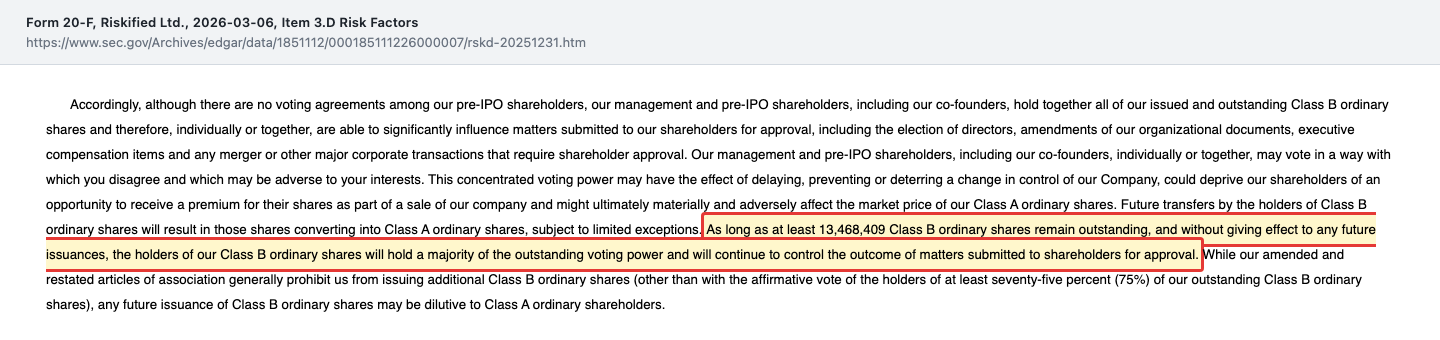
For you as a shareholder, that means: what happens to the cash — more buybacks, an acquisition, who sits on the board — is, when it comes down to it, decided by two people. That need not be a drawback; founders who stay while the financiers leave are not the worst sign. It is simply not a vote in which yours tips the balance.
Uncomfortable Truth No. 4: A Third of Revenue Hangs on Five Customers
Riskified works for large merchants, and large merchants are few. The annual report puts a number on it:
“In addition, our five largest merchants in aggregate accounted for approximately 32%, 34%, and 38% of our revenues for the years ended December 31, 2025, 2024 and 2023, respectively.”
— Riskified Ltd., annual report on Form 20-F for 2025, Item 3.D “Risk Factors”
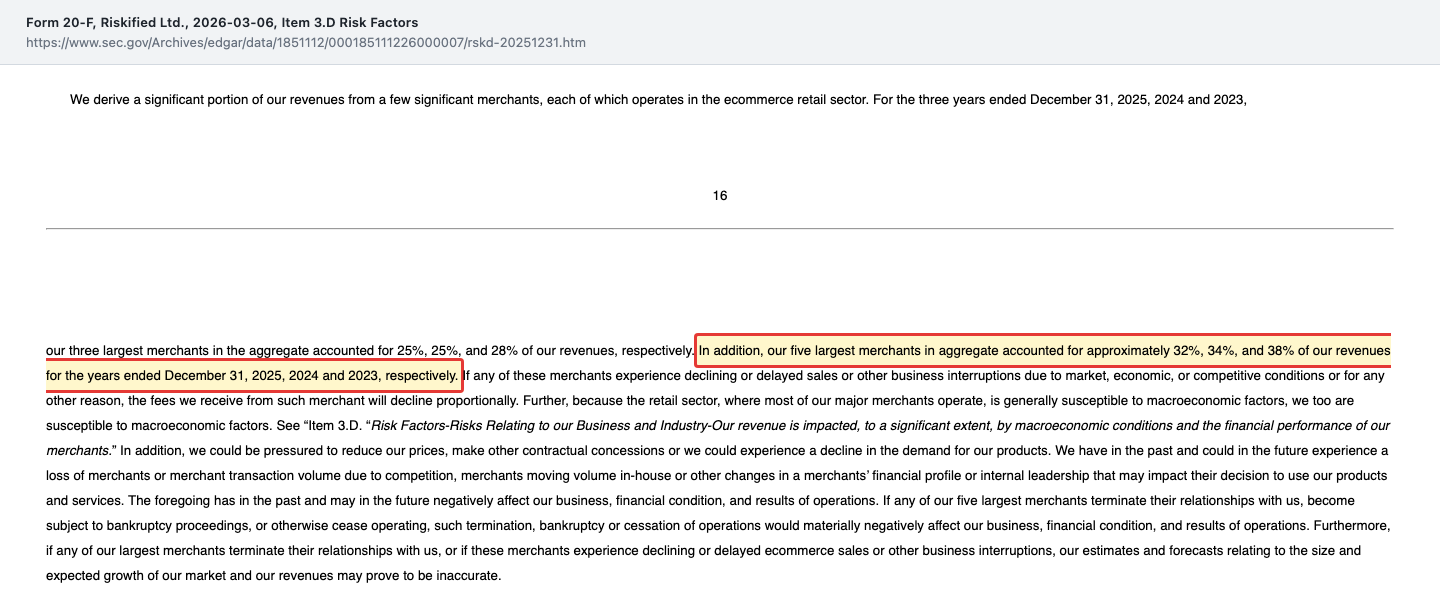
The three largest merchants alone accounted for 25 percent in 2025. The direction is right: the share of the top five has fallen from 38 to 32 percent in two years, and the new customers of 2026 should spread it further — by how much will only be in the next annual report. Until then: if one of the big ones switches providers or builds fraud screening in-house, a noticeable part of revenue goes missing. Customers leaving is not a theory at Riskified: in 2025, the loss of merchants from the year before cost $19.1 million in revenue, according to the annual report.
Valuation: What the Mid-November 2026 Price Demands
To do the math we need a share count and a price, both dated. The latest balance sheet shows 133.6 million Class A and Class B shares combined as of September 30, 2026. The closing price on November 17, 2026, was $9.69 (fundamental data), which gives a market value of about $1.29 billion. As a cross-check: a notice of proposed sale (Form 144) dated November 13, 2026, values the stock at $9.42, which would be about $1.26 billion.
Subtract the $234.9 million in cash and investments, and a good one billion dollars is left for the business itself. That is about two and a half times the revenue Riskified expects for 2026 (midpoint of the range: $430 million) and about 26 times the expected adjusted operating result (midpoint: $41 million) — the very number that leaves out stock compensation. There is no price-to-earnings ratio, for lack of an annual profit.
The professionals are split: of six analysts tracked in the fundamental data on November 17, 2026, three rate the stock a strong buy, two a hold and one a strong sell. Treat ratings like these as a mood reading, not a timetable. The price has almost doubled since the end of 2025. It no longer pays for the company that grew 5 percent a year, but for the one that manages 41 percent in a quarter — and it assumes the margin comes back.
Upside and Risks at a Glance
What speaks for Riskified:
- Accelerating growth: up 7, 22 and 41 percent in the first three quarters of 2026, with full-year guidance raised three times.
- The loss has shrunk every year since 2021; operations have generated cash since 2023 ($38.7 million in nine months of 2026).
- A balance sheet with no financial debt and $234.9 million in cash, deposits and investments (September 30, 2026).
- The share count is falling: just under 10 percent fewer shares outstanding since the end of 2025, bought at prices far below the mid-November 2026 level.
- Dependence on the five largest customers is easing (38 percent in 2023, 32 percent in 2025), and the founders have stayed on board.
What speaks against it:
- Cost of revenue, mostly reimbursed fraud cases, is growing faster than revenue: gross margin of 43 percent in the third quarter of 2026, down from 50 percent a year earlier.
- No annual profit since the founding in 2012; the adjusted result leaves out $31.0 million of stock compensation in nine months.
- Early backers sold on a large scale in 2026, executives in smaller blocks, mostly under pre-arranged trading plans (on August 12 and 14, 2026, Feldman 656,096 and Dotcheva 260,000 shares); General Atlantic still holds about 10.6 million Class A shares.
- Through their Class B shares alone, two founders control about 56 percent of the votes with just under 14 percent of the capital.
- Five customers account for about a third of revenue; the quarterly figures are unaudited, and most employees work in Israel.
A Human Conclusion
Back to the speedometer trap. Its core is not that speed is bad — Riskified really is moving faster in 2026, and the company behind it is sturdier than it was three years ago: a smaller loss, cash from operations, no debt. Its core is that the speedometer is the one number everybody sees, while the fuel consumption is in the fine print. At a company that pays out of its own pocket for every fraud it approves, consumption is not a side issue. It is the business.
So the honest question for you is not “How fast is Riskified growing?” but: Do you believe the models will become as good with the new customers as with the old ones — and are you prepared to wait a few quarters for the evidence while two founders alone decide what happens to the cash? If so, you have a thesis. If all you saw was the 41 percent, you had a speedometer reading. What you make of it is your decision. And that is how it should be.
Sources
All original documents used in this analysis — to read for yourself:
- Riskified Ltd. — third-quarter 2026 earnings release (Exhibit 99.1 to the Form 6-K of November 12, 2026) and the Form 6-K itself (resignation of a director)
- Riskified Ltd. — annual report on Form 20-F for 2025 (filed March 6, 2026)
- Riskified Ltd. — earnings releases for the second quarter of 2026 (Form 6-K of August 12, 2026), the first quarter of 2026 (Form 6-K of May 13, 2026) and the fourth quarter of 2025 (Form 6-K of March 4, 2026)
- Riskified Ltd. — Form 6-K of June 5, 2026 (additional repurchase program) and Form 6-K of April 3, 2026 (repurchase from Pitango)
- Ownership filings (Schedule 13G/A): Eido Gal (October 15, 2026), Assaf Feldman (October 15, 2026), General Atlantic (November 13, 2026)
- Notices of proposed sale (Form 144): General Atlantic (August 17, 2026) and Qumra Capital (November 13, 2026); insider filings (Form 4) from May to October 2026 in the EDGAR overview
- Complete SEC filing history of Riskified Ltd.: EDGAR overview (sec.gov)
- Fundamental data (prices, analyst estimates; as of November 17, 2026), reconciled with the SEC filings and the SEC’s XBRL series.
Transparency & disclaimer: this analysis is journalistic commentary on publicly available information. It is not investment advice, not a regulated investment research product and not a solicitation to buy or sell securities. Equity investments carry substantial risk up to and including total loss. All information is provided without warranty; the as-of date for each figure is stated in the text. Positions held by the operator are disclosed daily; where one exists, it appears as a notice at the top of this analysis.
Key figures at a glance
All monetary figures in millions of $; earnings per share as reported.
| Metric | 2021 | 2022 | 2023 | 2024 | 2025 |
|---|---|---|---|---|---|
| Revenue | 229.1 | 261.2 | 297.6 | 327.5 | 344.6 |
| Operating Income (EBIT) | -55.9 | -109.3 | -76.8 | -47.9 | -29.1 |
| Net Income | -179.4 | -104.7 | -59.0 | -34.9 | -27.6 |
| Net Margin | -78.3% | -40.1% | -19.8% | -10.7% | -8.0% |
| Earnings Per Share | -2.35 $ | -0.62 $ | -0.33 $ | -0.20 $ | -0.18 $ |
Source: fundamental data & SEC filings (annual and quarterly reports, 10-K/10-Q)
Our Bottom Line at a Glance
- Growth positive
- Revenue rose every year from 2021 to 2025 and accelerated sharply in 2026: up 41 percent in the third quarter of 2026 to $115.2 million. Full-year guidance was raised three times, most recently on November 11, 2026, to $427 million to $433 million.
- Margin & cost of revenue negative
- Cost of revenue grew 62 percent in the third quarter of 2026, and gross margin fell from 50 to 43 percent. Because Riskified pays for approved fraud itself, it is an open question whether its models will become as accurate with the new customers as with the old ones.
- Profitability neutral
- No annual profit since the founding in 2012, but a loss that shrinks every year (2025: $27.6 million) and cash from operations since 2023. The adjusted result leaves out $31.0 million of stock-based compensation in nine months of 2026.
- Balance sheet positive
- As of September 30, 2026, there were $234.9 million in cash, deposits and investments and no financial debt. Buybacks reduced shareholders’ equity from $294.8 million at the end of 2025 to $213.6 million.
- Ownership & control negative
- Early backers sold on a large scale in 2026, executives in smaller blocks, mostly under pre-arranged trading plans, while the company was buying back stock. According to filings as of September 30, 2026, the two founders hold about 56 percent of the votes through their Class B shares alone, with just under 14 percent of the capital.
- Customer base neutral
- The five largest merchants accounted for about 32 percent of revenue in 2025, the three largest for 25 percent. The dependence has been easing since 2023 (38 percent) but remains noticeable.
Riskified is a case for the speedometer trap: the 41 percent growth in the third quarter of 2026 is real, and with a shrinking loss, cash from operations and a debt-free balance sheet the company is sturdier than it was three years ago. But a company that pays for every fraud it approves only grows well if the margin keeps up — and it fell from 50 to 43 percent. Add a change of ownership away from the headlines: early backers sold, two founders decide. Not investment advice.
What Our Rating Means
Open questions
The business works in principle, but one material question is open. As long as it stays open, our findings do not carry a quality verdict.
Yellow, because the business works but one material operating question is open: gross margin fell to 43 percent in the third quarter of 2026, and only the coming quarters will show whether it recovers with the new customers. There has been no annual profit since 2012, and five customers account for about a third of revenue. Against that stand a debt-free balance sheet and cash from operations; we see no risk to the company’s substance. The decision is yours.
A journalistic assessment by our editorial team at the time of the deep dive, based on public sources — not investment advice and not a solicitation to buy or sell. Your personal circumstances (investment goals, risk capacity, taxes) cannot be taken into account. What our levels mean, how verdicts are formed, and what conflicts of interest exist →
Worth Noting
- The analysis was prompted by the third-quarter 2026 earnings release of 11/11/2026 (Form 6-K of 11/12/2026) and that day’s price jump. Price references (closing prices per fundamental data): $4.97 (12/31/2025), $8.48 (11/10/2026), $10.37 (11/11/2026), $9.69 (11/17/2026).
- Data status: the latest periodic report is the earnings release as of 09/30/2026; all filings through 11/13/2026 were reviewed (Schedule 13G/A, Form 144). A foreign private issuer’s quarterly figures are unaudited. Revenue and net income for 2021 to 2025 come from the SEC’s XBRL series.
- Share count from the balance sheet as of 09/30/2026 (133,606,673 Class A and Class B shares). Market-value cross-check: 133.6 million shares times $9.42 (Form 144 of 11/13/2026) comes to about $1.26 billion and matches the value in the fundamental data.
- The founders’ share of the votes (about 56%) is our own calculation: 18,226,600 Class B shares times ten votes, divided by all votes as of 09/30/2026 (323.1 million); the founders’ Class A shares are not included. With the Class A shares from the 13G/A filings (6,786,467 combined, excluding stock awards) the result is about 58.5% of the votes and 18.7% of the capital.
Stock Watch
This analysis is as of November 18, 2026. Stock Watch will tell you what's changed at RSKD since then.
Later $1 a month per stock — signing up is free, and you'll be the first to know when it launches.
The full analysis as a PDF for later
We will send you this analysis as a PDF — to print, file away, and read at your own pace. And we will add you to the free Stock Watch list for Riskified Ltd. (RSKD), so you hear about it when something material in this analysis changes.
Frequently Asked Questions
Riskified Ltd. (NYSE: RSKD) checks in real time for online merchants whether an order is genuine or fraud. With its core product, “Chargeback Guarantee,” the software decides whether to approve or decline, and Riskified bears the cost when an approved order is later charged back as fraud. The company is paid a risk-based share of the value of every approved order. In 2025, orders worth $155.1 billion ran through the platform.
Not on an annual basis. According to its annual report (Form 20-F) for 2025, Riskified has not been profitable in any year since its founding in 2012; the 2025 loss was $27.6 million, and the first nine months of 2026 showed a loss of $14.8 million. The fourth quarter of 2025 was its first profitable quarter ($5.8 million). Operations have generated cash since 2023, $33.9 million in 2025.
Because cost of revenue — according to the annual report mostly reimbursed fraud cases — is rising faster than revenue. In the third quarter of 2026 revenue grew 41 percent and cost of revenue 62 percent; gross margin fell from 50 to 43 percent. The earnings release gives no reason. The annual report explains, however, that large new merchants from new industries can weigh on the margin for the first several quarters until the models have adapted.
Riskified has Class A shares with one vote and Class B shares with ten votes. As of September 30, 2026, there were 112.6 million Class A and 21.1 million Class B shares. Founders Eido Gal and Assaf Feldman each held 9,113,300 Class B shares according to their ownership filings; those Class B shares alone carry about 56 percent of all votes with just under 14 percent of the capital. General Atlantic held 9.5 percent of the Class A shares, Capital World Investors 8,515,809 shares, about 7.6 percent of the Class A shares (our own calculation; the filing itself states 9.3 percent based on 91,847,753 shares).
Yes. Since August 2023 the board has authorized repurchases totaling $450 million, most recently another $75 million on June 4, 2026. Through September 30, 2026, the company had spent $354.6 million, of which $94.1 million in the first nine months of 2026. The number of shares outstanding has fallen by just under 10 percent since the end of 2025, to 133.6 million.
In its earnings release of November 11, 2026, Riskified expects full-year 2026 revenue of $427 million to $433 million and an adjusted operating result (Adjusted EBITDA) of $39 million to $43 million. It was the third increase this year; in March 2026 the revenue range had been $372 million to $384 million. The company gives no guidance for net income under accounting rules.
Riskified is an Israeli company and counts as a foreign private issuer with the U.S. securities regulator, the SEC. Instead of an annual report on Form 10-K it files an annual report on Form 20-F, and instead of quarterly reports on Form 10-Q it publishes its quarterly numbers as an earnings release attached to a Form 6-K. Those figures are unaudited and carry fewer footnote disclosures than a quarterly report. Its fiscal year is the calendar year.
Found an error?
Did you spot a factual error, an outdated number, or a typo in this deep dive? Let us know briefly — your report goes straight to the editorial team.