Lexeo Therapeutics: 80 Percent Fewer Heart Rhythm Events — in Seven Patients. And the Rent May Be Paid in Shares
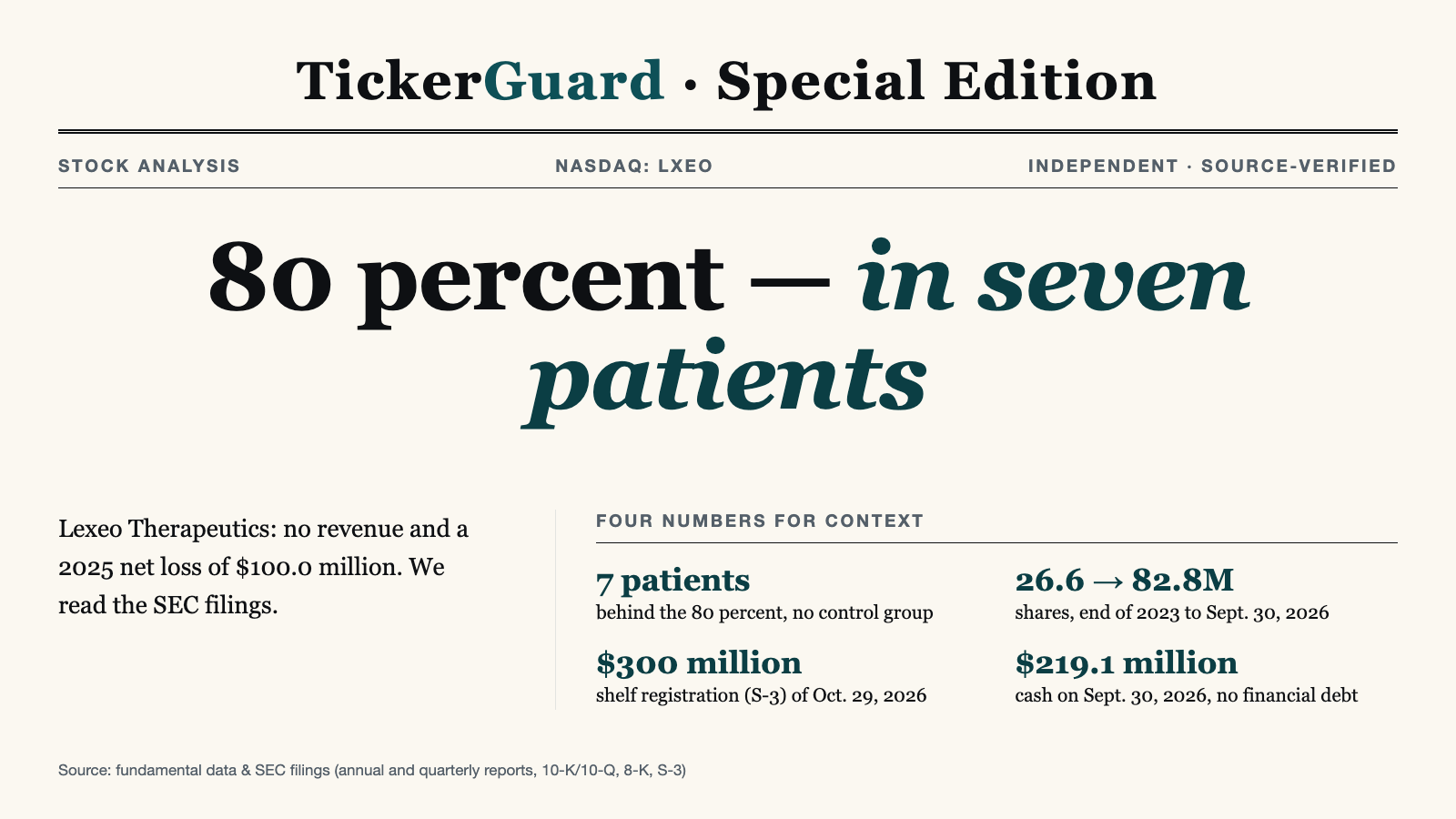
Lexeo Therapeutics, a gene therapy developer from New York, reported on November 16, 2026 for its cardiac program LX2020 a mean 80 percent fewer short bursts of racing heartbeat (non-sustained ventricular tachycardia) — measured in seven patients in a study with no control group. There is no revenue; the research is paid for with new shares, whose number has more than tripled since the end of 2023, from 26.6 to 82.8 million. On October 29, 2026, Lexeo had a shelf of up to $300 million registered (about $164.6 million of it new, the rest carried over from an older shelf), against a market value of about $267 million — and since October 22, 2026, the company may pay its rent in shares.
 Thomas Mücke
Founder & Publisher
As of Today
As of: November 16, 2026
- Closing price
- 2.90 $ -11.61%
- Market Capitalisation
- 0.3 $B
- Growth Score
- 2/10
- AAQS
- 1/10
Price change since November 16, 2026: -10.2%
This analysis has a cut-off date. The Stock Guard tells you when something material changes in the numbers. Reserve your free spot
Chart
Interactive price chart (TradingView).
52-week range: 2.60 $ to 10.60 $ · Last price: 2.90 $ (As of: November 16, 2026)
Note: pure fact-based analysis, not investment advice and not a solicitation to buy or sell. All figures without guarantee.
On November 16, 2026, Lexeo Therapeutics (Nasdaq: LXEO) reported a number that makes you pause: on average 80 percent fewer heart rhythm events of a particular kind in patients who received the gene therapy LX2020 at the high dose. The number sits right below the headline of the announcement. How many patients that was is stated a few paragraphs further down: seven. That is how an investor trap that feels like certainty works — the percentage trap: a big percentage looks like a measurement, and you stop asking how many people it was measured in.
Both things are true. The 80 percent is as reported, an interim result in a serious inherited disease. And seven patients in a study with no comparison group are a beginning, not proof; whether the result holds will only be shown by a larger study. Then come several numbers that appear in no headline: Lexeo earns no money and pays for its research with new shares. Since the end of 2023 the share count has more than tripled, a new shelf for further securities is larger than the company’s market value, and since October 2026 Lexeo may also pay its rent in shares.
So let us make a deal: we read together what Lexeo has told the U.S. securities regulator, the SEC — the quarterly report (10-Q) for September 30, 2026, filed on November 16, 2026, the announcement of the same day, the shelf registration of October 29, 2026 and the annual report (10-K) for 2025. The CEO and the CFO must personally certify that the quarterly and annual reports are accurate. At the end you will know what the 80 percent carries, what the cash carries and what remains open. The decision is yours.
What Lexeo actually does
According to its quarterly report, Lexeo Therapeutics was founded on February 17, 2017, is based in New York and has been listed on the Nasdaq since its initial public offering in November 2023. The company develops gene therapies. In everyday terms: in some inherited diseases the body lacks the blueprint for a particular protein. A gene therapy sends a correct copy of that blueprint into the affected cells, packed inside the shell of a virus that serves as the delivery vehicle. The treatment is designed as a one-time infusion. For its most important programs, Lexeo uses a delivery vehicle called AAVrh10, which according to the company reaches heart muscle cells particularly well.
Two programs carry the company:
- LX2006 targets the heart muscle disease in Friedreich’s ataxia, a rare inherited disease that damages nerves and the heart. According to the 2025 annual report, about 5,000 people in the United States live with Friedreich’s ataxia, about 80 percent of them develop the heart disease, and it is the leading cause of death in these patients. The pivotal study SUNRISE-FA 2 has been running since June 2026.
- LX2020 targets an inherited heart muscle disease caused by errors in the PKP2 gene (arrhythmogenic cardiomyopathy). It leads to rhythm disturbances up to sudden cardiac death. Lexeo estimates the number of people affected in the United States at about 60,000. LX2020 is in an early Phase I/II study; the 80 percent comes from this program.
There are also earlier projects and an acquisition: on September 29, 2026, Lexeo acquired the small company Mantle Therapeutics, which works on tablets and other drugs against the nerve damage of Friedreich’s ataxia. For an Alzheimer’s program (LX1001) whose early study is complete, Lexeo is looking for a partner according to the 2025 annual report. On December 31, 2025, the company had 59 full-time employees, 41 of them in research and development.
What Lexeo does not have is an approved product. The quarterly report says so without detours: there has been no revenue from product sales so far. That names the field of tension in this analysis, and it runs through every chapter: For both heart programs Lexeo reports improvements in the interim data, and the cash balance is well filled — but every number so far comes from a few patients, and every dollar in the bank comes from shareholders whose stake shrinks with every new share.
Company history for investors
-
2017
Founding in New York
Lexeo is formed on February 17, 2017, as a Delaware entity. For shareholders: a young company that has lost money since its founding.
-
2023
IPO at $11.00
In November 2023 Lexeo goes public on the Nasdaq and raises $100.3 million net. For shareholders: the price against which every later price must be measured.
-
2024
Private placement and highest price
In March 2024, 6.3 million new shares bring in $88.7 million net; in June 2024 the stock closes at $18.76. For shareholders: fresh money at about $15 per share.
-
2025
Two capital raises, share count more than doubled
In May 2025 Lexeo sells shares at about $2.88 with warrants, in October at $8.00. For shareholders: the share count rises from 33.1 to 73.0 million.
-
2026
Pivotal study, acquisition, new data
June: pivotal study for LX2006 starts. September: acquisition of Mantle. November: 80 percent fewer rhythm events in seven patients. For shareholders: progress that costs money.
How the stock landed on our desk
Lexeo landed on our desk through a single trading day. On November 16, 2026, the company published the interim data for LX2020, the quarterly figures and the quarterly report. That day about 37.6 million shares changed hands — about 45 percent of the 82.8 million shares outstanding; on each of the five trading days before, it was between 0.4 million and 1.7 million (source: fundamental data, as of November 18, 2026). The stock opened at $3.55, reached an intraday high of $4.30 and a low of $3.00, and closed at $3.23 — about 13 percent above the $2.87 close of November 13, 2026. The gain did not hold: on the next trading day, November 17, 2026, the stock closed at $2.855, just below the close of November 13, 2026, on volume of about 3.9 million shares.
For context on the price level: at the initial public offering in November 2023, the stock cost $11.00. It reached its highest close on June 13, 2024, at $18.76, and its lowest on April 7, 2025, at $1.79. In the twelve months to November 16, 2026, it ranged between $2.55 and $10.99 during trading. Why the stock closed on November 16, 2026, below its opening price and well below the day’s high is not stated in any SEC filing; we do not speculate about it.
Something else matters: on a day like that, the headline is read faster than the quarterly report published the same day. That is exactly where the percentage trap snaps shut. So keep this in mind from the start: every percentage from a study comes with three questions — how many patients, compared with what, and observed for how long.
The numbers over the years — honestly appraised
First the positives. Lexeo has brought two gene therapies far enough that the U.S. Food and Drug Administration (FDA) has given both a special status for expedited review: LX2006 received the “Breakthrough Therapy” designation in July 2025, LX2020 the “Regenerative Medicine Advanced Therapy” status in August 2026. For LX2006 the protocol of the pivotal study is final, and the study has been running since June 2026. According to the quarterly report, the interim data on it show improvements in the heart and in nerve symptoms over up to 36 months. One number from it, as of October 2025: in the six participants with an abnormal baseline left ventricular mass index (LVMI, a measure of heart muscle mass in the left chamber), that value improved by a mean 23 percent after twelve months; the report names 10 percent as the threshold for the pivotal study. Here, too, the question about the denominator belongs: six patients. The pivotal study itself is small, with 13 treated and 13 untreated participants; the LVMI is measured after six months.
And the cash balance is well filled. On September 30, 2026, Lexeo held $90.2 million in cash and $128.9 million in U.S. Treasury securities — $219.1 million in total. There is no financial debt, only lease obligations of $6.2 million. Equity was $216.7 million, or 89 percent of total assets of $243.9 million. At the end of 2024 the cash balance had still been $128.5 million.
Now the other side. A developer without a product has no revenue, only costs. Net loss was $66.4 million in 2023, $98.3 million in 2024 and $100.0 million in 2025. Cash used in operations in the same years was $59.5 million, $81.2 million and $98.6 million.
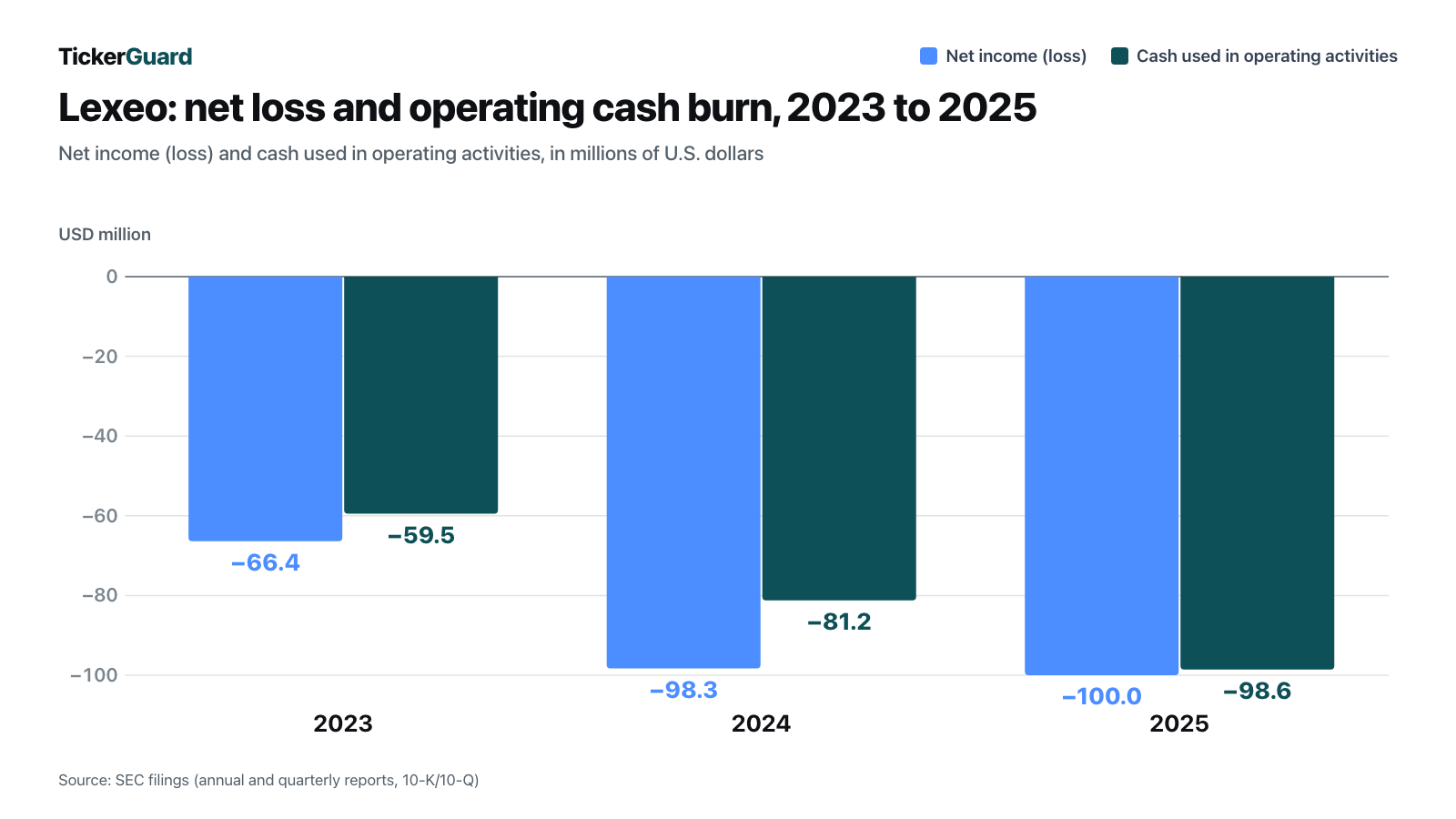
In the first nine months of 2026, another $84.4 million of loss was added (prior-year period: $79.0 million); cash used in operations was $67.3 million (prior year: $78.5 million). The total accumulated deficit since the founding stood at $464.5 million on September 30, 2026.
The third quarter of 2026 looks like a cost jump at first glance: net loss rose from $20.3 million to $38.3 million, research costs from $15.7 million to $34.5 million. The quarterly report explains most of it: $9.9 million relate to the acquisition of Mantle, whose research projects were expensed immediately under accounting rules, and $3.5 million to a milestone payment to the licensor Adverum, which fell due when the pivotal study for LX2006 started. Together that is $13.4 million of the $18.8 million increase. The remaining roughly $5.4 million is spread, according to the quarterly report, mainly across manufacturing costs ($2.1 million), license costs from option agreements ($1.1 million) and clinical trial expenses ($0.9 million).
A word on administrative costs, because they stand out in 2025: they were $45.5 million in 2025 after $31.7 million in 2024. The annual report names $11.7 million of higher legal and proceedings costs as the main reason, without attributing them to a particular proceeding. The only material proceeding the reports mention is a trade-secrets dispute with the competitor Rocket Pharmaceuticals that, according to the quarterly report, was settled amicably and without admission of liability in June 2025. In the first nine months of 2026, administrative costs fell to $21.5 million (prior-year period: $38.6 million); the quarterly report names $21.0 million of lower legal and proceedings costs as the main reason.
What the filings say — the uncomfortable truths
Uncomfortable truth No. 1: Behind the 80 percent stand seven patients and no comparison group
The announcement of November 16, 2026, states the data situation itself; you only have to put it together. In the HEROIC-PKP2 study, ten participants were treated: three at a low dose, seven at a high dose. According to the announcement, the study is “single-arm, open-label.” That means: everyone receives the drug, nobody a placebo, and doctors and patients know it. Each participant is compared only with his or her own values before treatment.
The results of the seven high-dose participants, as of October 15, 2026: the number of non-sustained ventricular tachycardias (NSVT) — short bursts of racing heartbeat that, according to Lexeo, are closely associated with the risk of life-threatening rhythm disturbances — fell by a mean 80 percent, and six of the seven showed an improvement. The number of extra heartbeats (PVCs) fell by a mean 44 percent, in five of seven. Five of seven reported feeling better. Nine of the ten participants were observed for at least twelve months. In everyday terms: it is as if you tested a new suspension on seven cars without sending an eighth car with the old suspension over the same road. Six of seven ride more smoothly afterward. Whether the suspension is the reason, you only know with more cars and a comparison.
On safety: Lexeo calls LX2020 “generally well tolerated.” The announcement also mentions elevated liver values in the high-dose group, which were treated, and one serious event: a ventricular tachycardia three months after treatment, which Lexeo attributes to the natural course of the disease.
What matters for shareholders is what the FDA makes of such data. Lexeo writes that the agency is “open” to accepting the NSVT count as a surrogate endpoint in a pivotal study. The same document contains this sentence:
“The final study design including the statistical analysis plan and confirmatory strategy remains subject to future discussions with the FDA.”
— Lexeo Therapeutics, Inc., Announcement of interim data for LX2020 and third-quarter 2026 results (8-K, Exhibit 99.1, November 16, 2026)

The timeline: design, analysis plan and confirmatory strategy are to be settled in the first half of 2027, and the pivotal study is to start in the second half of 2027. So between the announcement of November 16, 2026, and a possible approval filing for LX2020 lie at least one more study and several conversations with the agency. Lexeo is also not alone in this field: according to the 2025 annual report, Rocket Pharmaceuticals and Tenaya Therapeutics are likewise developing gene therapies meant to bring a working PKP2 gene into the heart.
Uncomfortable truth No. 2: The cash lasts until the year the first approval filing is planned
$219.1 million sounds like a lot. The quarterly report puts it in context itself:
“We believe that our cash, cash equivalents, and investments in U.S. Treasury securities balances will be sufficient to fund our planned operating expenses and capital expenditure requirements into 2028.”
— Lexeo Therapeutics, Inc., SEC quarterly report 10-Q for September 30, 2026, Item 2 “Liquidity and capital resources”
“Into 2028” means: until sometime in 2028. Now put the programs’ timeline next to it. For LX2006, Lexeo expects the first results of the pivotal study in the second half of 2027 (announcement of September 22, 2026) and wants to file for approval in the first half of 2028. For LX2020, the pivotal study is only to start in the second half of 2027. By the company’s own reckoning, the cash therefore lasts about until the filing for the first program — not until a decision by the agency, not until a product launch and not until the end of the second pivotal study.
A check with the report’s numbers: in the first nine months of 2026, $67.3 million flowed out of operations, an average of $22.4 million per quarter. At an unchanged pace, $219.1 million would arithmetically last for just under ten quarters. Lexeo itself reckons more cautiously because costs are set to rise: the report announces higher research and administrative costs, among other things for preparing a product launch. What happens if the money does not last is in the notes to the quarterly report:
“If the Company is unable to obtain additional funding before achieving sufficient profitability and positive cash flows from operations, if ever, the Company will be forced to delay, reduce or eliminate some or all of its research and development programs, which could adversely affect its business prospects, or the Company may be unable to continue operations.”
— Lexeo Therapeutics, Inc., SEC quarterly report 10-Q for September 30, 2026, Note 1 “Need for Additional Capital”

Sentences like this appear in the reports of many young biotech companies. In the same section of the notes, management confirms that the funds last for at least twelve months from the publication of the report. But the sentence tells you where the next money has to come from — from new shareholders. On top of that come future payments tied to success: for Mantle, the quarterly report names up to $30.6 million upon development successes, of which $2.0 million in shares and up to $18.6 million in cash to a research partner of Mantle; to the licensor Adverum, development and regulatory milestones of up to $17.5 million in total can fall due, of which $3.5 million has been reached twice.
Uncomfortable truth No. 3: Your slice of the pie has shrunk to a third since the end of 2023
Dilution means: the company issues new shares, the pie is cut into more slices, and your slice gets smaller. At Lexeo that is not a side effect but the financing. Including the initial public offering, the company has sold shares in four large steps; in 2026, sales through the stock market and two smaller issuances came on top:
- November 2023, initial public offering: about 10.1 million shares at $11.00, net $100.3 million.
- March 2024, private placement: about 6.3 million shares, net $88.7 million — which equals about $15 per share before costs.
- May 2025, private placement: 20.8 million shares at about $2.88, plus pre-funded warrants for 7.0 million shares and warrants for 13.9 million shares; net $73.1 million.
- October 2025, public offering: about 18.0 million shares at $8.00, plus pre-funded warrants for 1.25 million shares; net $143.9 million together.
- January to September 2026, sales through the stock market (a so-called at-the-market program with the bank Leerink for up to $75.0 million): 7.5 million shares at an average of $5.26, net about $37.7 million. In the third quarter of 2026 the average price was $4.70.
- 2026, two smaller issuances: 867,302 shares from exercised warrants at $2.82 (together $2.4 million) and 632,907 shares as part of the purchase price for Mantle Therapeutics in September 2026.
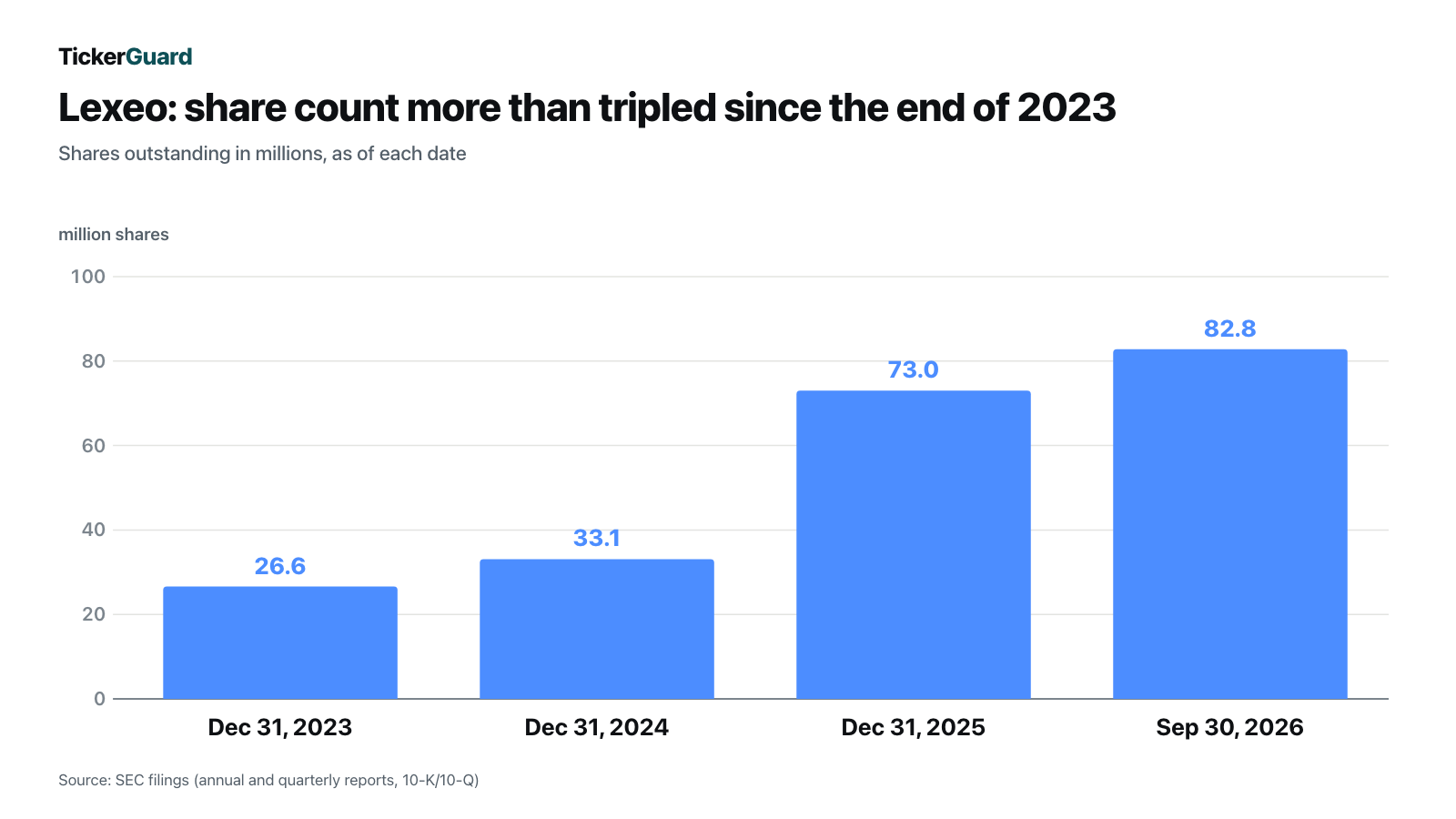
The result: 26.6 million shares at the end of 2023, 82.8 million on September 30, 2026. Anyone who owned one percent of the company at the end of 2023 and bought nothing more owns about a third of a percent today. And the list is not over. The quarterly report lists how many more shares are already committed: 13.0 million from warrants that can be exercised at $2.82 per share until May 28, 2029, and 7.3 million from pre-funded warrants. These are claims on shares whose purchase price has almost entirely been paid already; they can be exchanged for shares at $0.0001 each and do not expire. Together that is 20.4 million shares, about a quarter of today’s share count. At the closing price of $3.23 on November 16, 2026, the stock is above the $2.82 exercise price of the warrants; if all 13.0 million were exercised, about $36.7 million would flow to Lexeo — dilution and a source of cash at the same time. On top come 7.0 million employee options and 1.5 million committed employee shares.
On October 29, 2026, Lexeo filed a registration on Form S-3 with the SEC. Such a form is a standing authorization: it allows the company to issue new securities quickly later on, without going through a fresh review each time. The shelf: up to $300 million. It is not entirely new: about $135.4 million of it is securities from the December 2024 shelf that Lexeo had not sold and carried over into the new one; about $164.6 million is new. The notice of effectiveness has been on EDGAR since November 4, 2026, and with it the offering under the old shelf is deemed terminated. The at-the-market program with Leerink also ran under the old shelf; further sales require a new prospectus supplement, and none had been filed by November 16, 2026. Of the program's $75.0 million, about $35.4 million is unused. At the closing price of November 16, 2026, Lexeo was worth about $267 million on the stock market. The shelf is therefore larger than the market value of the entire company. That is a permission, not an announcement; whether and to what extent it will be used is open.
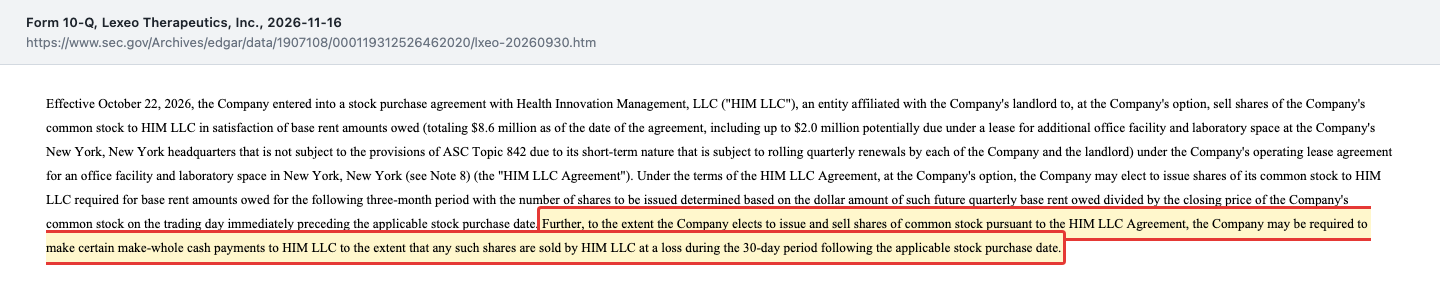
One detail from the notes belongs here. Since October 22, 2026, Lexeo may pay its rent in shares: an agreement with an entity affiliated with the landlord allows base rent totaling $8.6 million to be settled quarterly with new shares. The report also names the catch:
“Further, to the extent the Company elects to issue and sell shares of common stock pursuant to the HIM LLC Agreement, the Company may be required to make certain make-whole cash payments to HIM LLC to the extent that any such shares are sold by HIM LLC at a loss during the 30-day period following the applicable stock purchase date.”
— Lexeo Therapeutics, Inc., SEC quarterly report 10-Q for September 30, 2026, Note 9 “Capital Stock”
Whether Lexeo uses the option, the report does not say; it is the company’s choice. The amount is small relative to the cash balance. The agreement gives Lexeo the option to conserve cash and pay with shares. How other biotech companies fund their research is something we described at Autolus, a developer of cell therapies, and at Atai, a clinical-stage biotech company.
Valuation — what the November 16, 2026, close pays for
How expensive is the stock? At the closing price of $3.23 on November 16, 2026, and 82,788,599 shares outstanding (as of November 12, 2026, according to the cover page of the quarterly report), Lexeo comes to a market value of about $267 million. If you add the 7.3 million pre-funded warrants, which are economically already shares, it is about $291 million. A price-to-earnings or price-to-sales ratio cannot be formed because there is neither profit nor revenue. At the closing price of November 17, 2026 ($2.855), it was only about $236 million.
That leaves the view of the cash. Of the $267 million of market value, $219.1 million sat on the balance sheet on September 30, 2026, as cash and Treasury securities, which is $2.65 per share. For everything else — two gene therapies in clinical testing, the acquired projects, the team — the stock market paid arithmetically about $48 million that day, about $72 million counting the pre-funded warrants; at the closing price of November 17, 2026, it was only about $17 million. That sounds like little. But the calculation has a catch: the cash does not stay put. It shrank in the first nine months of 2026 from $246.6 million to $219.1 million despite a net inflow of $40.9 million from financing, mainly from share sales. So the stock market is not valuing today’s cash but what is left of it after the next years of studies — and how many shares there are by then.
On book value: equity of $216.7 million equals $2.62 per share; the price on November 16, 2026, was about 1.2 times that.
The view of the professionals, with due caution: according to fundamental data (as of November 18, 2026), nine analysts follow the stock, all nine with a buy rating, and the mean price target is about $25. Price targets are opinions, not facts. A price target at just under eight times the price mainly shows how far apart the expectations of the supporters and the price in the market are.
So what does the price pay for? A bet with two unknowns: that the interim data hold up in larger studies and the FDA goes along with the shortened paths — and that the road there gets by with fewer new shares than the $300 million shelf allows.
Opportunities and risks at a glance
What speaks for Lexeo:
- Two gene therapies for which Lexeo reports improvements in interim data, with special FDA status: “Breakthrough Therapy” for LX2006 (July 2025), “Regenerative Medicine Advanced Therapy” for LX2020 (August 2026).
- The pivotal study for LX2006 has been running since June 2026; Lexeo expects first results in the second half of 2027 and the approval filing in the first half of 2028.
- For the heart disease in Friedreich’s ataxia there is, according to the 2025 annual report, no approved treatment so far.
- $219.1 million of liquidity, no financial debt, an equity ratio of 89 percent (September 30, 2026); runway into 2028 according to the company.
- Administrative costs have fallen markedly, mainly because of lower legal and proceedings costs (nine months 2026: $21.5 million after $38.6 million).
- On November 16, 2026, the stock market arithmetically paid about $48 million beyond the cash.
What speaks against it:
- No approved product, no product revenue; accumulated deficit of $464.5 million (September 30, 2026).
- The 80 percent for LX2020 comes from seven patients with no control group; the design of the pivotal study has not yet been finally agreed with the FDA.
- The pivotal study for LX2006 is also small and open-label: 13 treated and 13 untreated participants, measuring a surrogate marker in the heart after six months.
- Heavy dilution: share count more than tripled since the end of 2023, another 20.4 million shares in warrants and pre-funded warrants, a shelf of $300 million, about $164.6 million of it new.
- By its own reckoning the cash lasts about until the first approval filing, not until an approval or a product launch.
- Competition in both programs, among others from Rocket Pharmaceuticals and Tenaya Therapeutics (PKP2) as well as Solid Biosciences and Larimar Therapeutics (Friedreich’s ataxia).
A human conclusion
Back to the percentage trap from the beginning. Its core is not that the number is wrong. The 80 percent is as reported, and whether it holds will only be shown by a larger study with a comparison group. Its core is that a percentage makes you forget to ask about the denominator. At Lexeo there are two denominators. One is the seven patients it was measured on. The other is the 82.8 million shares across which every future success is divided — and that number is growing.
So the honest question for you is not “Does the therapy work?” but: do you trust interim data from a few patients to survive two pivotal studies — and do you factor in how many new shares are added by then? If your answer is yes, you have two programs with special FDA status and $219.1 million of cash on your side. If your answer is no, you have three years of rising losses and a tripled share count on yours. What you make of it is your decision. And that is how it should be.
Sources
All original documents used in this analysis — to read for yourself:
- Lexeo Therapeutics, Inc. — SEC quarterly report 10-Q for September 30, 2026 (filed November 16, 2026)
- Lexeo Therapeutics, Inc. — Announcement of interim data for LX2020 and third-quarter 2026 results (8-K, Exhibit 99.1, filed November 16, 2026)
- Lexeo Therapeutics, Inc. — Shelf registration of up to $300 million, about $135.4 million of it carried over from the December 2024 shelf (Form S-3, filed October 29, 2026)
- Lexeo Therapeutics, Inc. — Notice of completion of the acquisition of Mantle Therapeutics (8-K, filed September 29, 2026)
- Lexeo Therapeutics, Inc. — Announcement of the acquisition of Mantle Therapeutics and the LX2006 timeline (8-K, Exhibit 99.1, filed September 22, 2026)
- Lexeo Therapeutics, Inc. — Announcement on the design of the pivotal study SUNRISE-FA 2 (8-K, Exhibit 99.1, filed June 15, 2026)
- Lexeo Therapeutics, Inc. — SEC quarterly report 10-Q for June 30, 2026 (filed August 12, 2026)
- Lexeo Therapeutics, Inc. — SEC quarterly report 10-Q for March 31, 2026 (filed May 11, 2026)
- Lexeo Therapeutics, Inc. — SEC annual report 10-K for 2025 (filed March 30, 2026)
- Lexeo Therapeutics, Inc. — SEC annual report 10-K for 2024 (filed March 24, 2025)
- Complete SEC filing history of Lexeo Therapeutics, Inc.: EDGAR overview (sec.gov)
- Fundamental data (prices, trading volume, market value, analyst estimates; as of November 18, 2026), reconciled with the SEC filings.
Transparency & disclaimer: this analysis is journalistic commentary on publicly available information. It is not investment advice, not a regulated investment research product and not a solicitation to buy or sell securities. It is also not medical advice; statements about studies reflect the status of company disclosures. Equity investments carry substantial risk up to and including total loss. All information is provided without warranty; the as-of date for each figure is stated in the text. Positions held by the operator are disclosed daily; where one exists, it appears as a notice at the top of this analysis.
Key figures at a glance
All monetary figures in millions of $; earnings per share as reported.
| Metric | 2021 | 2022 | 2023 | 2024 | 2025 |
|---|---|---|---|---|---|
| Revenue | 1.7 | 0.7 | 0.0 | 0.0 | 0.0 |
| Operating Income (EBIT) | -50.6 | -60.5 | -68.5 | -105.8 | -109.3 |
| Net Income | -50.6 | -59.3 | -66.4 | -98.3 | -100.0 |
| Net Margin | -3,055.0% | -9,063.8% | – | – | – |
| Earnings Per Share | -2.01 $ | -2.36 $ | -2.49 $ | -3.09 $ | -1.86 $ |
Source: fundamental data & SEC filings (annual and quarterly reports, 10-K/10-Q)
Our Bottom Line at a Glance
- Study data neutral
- LX2020: mean 80 percent reduction in NSVT rhythm events in seven high-dose participants, six of seven improved (data as of October 15, 2026). The study is open-label with no control group; the design of the pivotal study has not yet been finally agreed with the FDA.
- Balance sheet & cash positive
- $219.1 million in cash and U.S. Treasury securities, no financial debt, equity of $216.7 million on total assets of $243.9 million (September 30, 2026). According to the company, that lasts into 2028.
- Profitability negative
- No product revenue. Net loss of $66.4 million in 2023, $98.3 million in 2024, $100.0 million in 2025 and $84.4 million in the first nine months of 2026. Accumulated deficit of $464.5 million (September 30, 2026).
- Dilution negative
- Share count rose from 26.6 million (December 31, 2023) to 82.8 million (September 30, 2026). Another 20.4 million shares sit in warrants and pre-funded warrants. On October 29, 2026, a shelf of up to $300 million was registered, about $164.6 million of it new.
- Path to approval neutral
- LX2006: pivotal study with 13 treated and 13 untreated participants running since June 2026, first results expected in the second half of 2027, filing planned for the first half of 2028. LX2020: pivotal study to start in the second half of 2027. Both paths rely on surrogate endpoints.
- Competition neutral
- According to the 2025 annual report, Rocket Pharmaceuticals and Tenaya Therapeutics are also developing PKP2 gene therapies; in Friedreich's ataxia, Lexeo names Solid Biosciences and Larimar Therapeutics, among others. There is no approved treatment for the heart disease in Friedreich's ataxia so far.
Lexeo Therapeutics is a good illustration of the percentage trap: the reported 80 percent reduction in rhythm events for LX2020 is an interim result and comes from seven patients with no control group. The company has no product and no revenue, lost $100.0 million in 2025 and has more than tripled its share count since the end of 2023. Against that stand $219.1 million of liquidity with no financial debt and a running pivotal study for LX2006. What remains open is whether the data hold up in larger studies and how many new shares the road there costs. Not investment advice.
What Our Rating Means
Open questions
The business works in principle, but one material question is open. As long as it stays open, our findings do not carry a quality verdict.
Lexeo does not yet have an operating business — no product, no revenue. The rating here reflects that the outcome hinges on individual events: trials and approvals. The filings show no acute risk to the company's substance: the cash of $219.1 million lasts, according to the company, into 2028, there is no financial debt, and management expresses no doubt about the company's ability to continue. What remains open is the question on which everything hangs — whether interim data from few patients become approved drugs. For LX2006 the pivotal study is running; for LX2020 its design has not yet been agreed with the FDA. Until then Lexeo earns nothing and finances itself with new shares; the shelf of $300 million registered in October 2026 is larger than the market value. If you hold the stock, you are betting on two studies and accepting further dilution; if you wait, the first things to read are the results of the pivotal study for LX2006 and the share count in the next report. The decision is yours.
A journalistic assessment by our editorial team at the time of the deep dive, based on public sources — not investment advice and not a solicitation to buy or sell. Your personal circumstances (investment goals, risk capacity, taxes) cannot be taken into account. What our levels mean, how verdicts are formed, and what conflicts of interest exist →
Worth Noting
- The trigger for this analysis was the interim data for LX2020 and the quarterly report (10-Q) of November 16, 2026, for the quarter ended September 30, 2026; every filing made since then was reviewed (as of November 18, 2026).
- The study information reflects company disclosures and consists of interim results of open-label studies with few participants; it is not a medical assessment. NSVT stands for non-sustained ventricular tachycardia, PVC for extra heartbeats originating in the ventricle.
- Market value is calculated with the 82,788,599 shares outstanding according to the cover page of the quarterly report; the 7.3 million pre-funded warrants are not included. Valuation figures are dated (closing price of November 16, 2026) and are not a price target.
Stock Watch
This analysis is as of November 18, 2026. Stock Watch will tell you what's changed at LXEO since then.
Later $1 a month per stock — signing up is free, and you'll be the first to know when it launches.
The full analysis as a PDF for later
We will send you this analysis as a PDF — to print, file away, and read at your own pace. And we will add you to the free Stock Watch list for Lexeo Therapeutics, Inc. (LXEO), so you hear about it when something material in this analysis changes.
Frequently Asked Questions
Lexeo Therapeutics, Inc. (Nasdaq: LXEO) of New York develops gene therapies for inherited heart and nerve diseases. Its two most important programs are LX2006 for the heart muscle disease in Friedreich's ataxia and LX2020 for a heart muscle disease caused by the PKP2 gene. The company was founded in 2017, went public in November 2023 and has no approved product.
No. Lexeo has no revenue from product sales and has lost money since its founding. The net loss was $66.4 million in 2023, $98.3 million in 2024 and $100.0 million in 2025. In the first nine months of 2026 it was $84.4 million. The accumulated deficit stood at $464.5 million on September 30, 2026.
On November 16, 2026, Lexeo reported for LX2020 a mean 80 percent reduction in non-sustained ventricular tachycardias (NSVT) from baseline. It was measured in seven high-dose participants of an open-label Phase I/II study with no control group, as of October 15, 2026. Six of the seven showed an improvement. A pivotal study is to start in the second half of 2027.
On September 30, 2026, Lexeo had $219.1 million in cash and U.S. Treasury securities and no financial debt. According to the company, that funds operations into 2028. In the first nine months of 2026, $67.3 million flowed out of operations. Lexeo expects rising costs and points out that additional capital will be needed.
Shares outstanding rose from 26.6 million on December 31, 2023, to 82.8 million on September 30, 2026, more than triple. Another 20.4 million shares can arise from warrants and pre-funded warrants. On October 29, 2026, Lexeo also registered a shelf of up to $300 million, about $164.6 million of it new and about $135.4 million carried over from an older shelf.
There is no approval date. For LX2006, the pivotal study SUNRISE-FA 2 has been running since June 2026; Lexeo expects first results in the second half of 2027 and the approval filing with the U.S. agency FDA in the first half of 2028. For LX2020, the pivotal study is to start in the second half of 2027. Whether and when the FDA approves is open.
Found an error?
Did you spot a factual error, an outdated number, or a typo in this deep dive? Let us know briefly — your report goes straight to the editorial team.