Atai Stock: $6.75 Is Certain — the Other $2.50 Hangs on Three Conditions
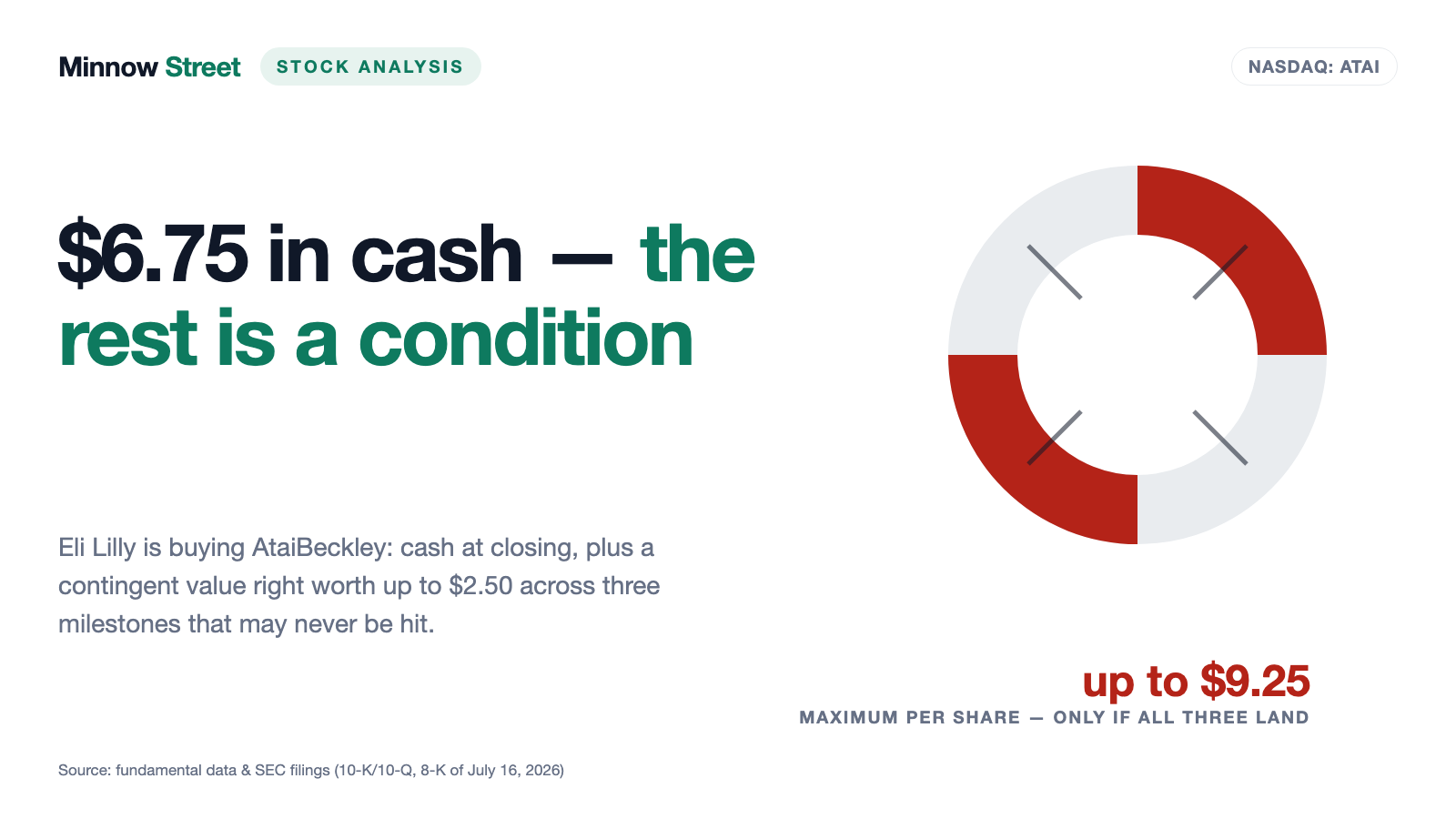
On July 15, 2026, AtaiBeckley signed a merger agreement with Eli Lilly. Overnight, a bet on four molecules turned into an arithmetic problem: $6.75 a share in cash at closing, plus a contingent value right worth up to $2.50 — payable only if a Phase 3 trial starts and two federal agencies cooperate. We read the current report (8-K), the annual report (10-K) for 2025 and the quarterly report (10-Q) as of March 31, 2026 side by side: the reported $660.0 million loss never moved $530.0 million of that money, the actual burn was $102.7 million, and the share count had more than doubled in the twelve months before. Not investment advice — only the arithmetic that hides behind the words “up to”.
 Thomas Mücke
Founder & Publisher
Thomas Mücke
Founder & Publisher
As of Today
As of: September 11, 2026
- Closing price
- 7.40 $ 0.00%
- Market Capitalisation
- 2.7 $B
- Growth Score
- 4/10
- AAQS
- 1/10
Price change since August 4, 2026: +2.8%
This analysis has a cut-off date. The Stock Guard tells you when something material changes in the numbers. Reserve your free spot
Chart
Interactive price chart (TradingView).
52-week range: 3.40 $ to 7.40 $ · Last price: 7.40 $ (As of: September 11, 2026)
Note: pure fact-based analysis, not investment advice and not a solicitation to buy or sell. All figures without guarantee.
There are two words your eye slides over even though they carry the whole sentence: "up to." They sit in every shop window ("up to 70 percent off"), in every broadband ad ("up to 250 Mbps") — and, since July 16, 2026, in a current report filed with the U.S. securities regulator, the SEC. The psychology behind it is anchoring: out of any string of numbers, the largest one sticks and the condition in front of it evaporates. That is exactly what is happening here. AtaiBeckley Inc. (Nasdaq: ATAI) is being acquired by Eli Lilly and Company, and the headline reads "up to $9.25 per share." Only one of those figures is certain: 6.75. The rest is a promise with three conditions, three deadlines and one federal agency the company itself calls unpredictable. So let us make a deal: we read what AtaiBeckley actually filed — the current report (8-K) of July 16, 2026, the annual report (10-K) for 2025 and the quarterly report (10-Q) as of March 31, 2026. A filing to the SEC is honest under penalty of law. At the end you will not get a verdict from us. You will get the arithmetic. The "up to" is yours to weigh.
July 15, 2026: what Eli Lilly is actually offering
On July 15, 2026, AtaiBeckley signed an Agreement and Plan of Merger with Eli Lilly and Company, an Indiana corporation, and a purpose-built Delaware subsidiary called Albali Acquisition Corporation. The structure is standard: the subsidiary merges into AtaiBeckley, AtaiBeckley survives as a wholly owned subsidiary of Lilly, and the stock leaves the Nasdaq. The board approved it unanimously. On July 16, 2026 the current report landed at the SEC. And there sits the fate of your shares:
"[…] will be converted into the right to receive (i) $6.75 (the “Closing Amount”) per share in cash, without interest, plus (ii) one contingent value right per share (each, a “CVR” […]), representing the right to receive up to an aggregate of $2.50 in cash per CVR upon achievement, if any, of specified clinical and regulatory milestones […]"
— AtaiBeckley Inc., SEC current report 8-K filed July 16, 2026, Item 1.01
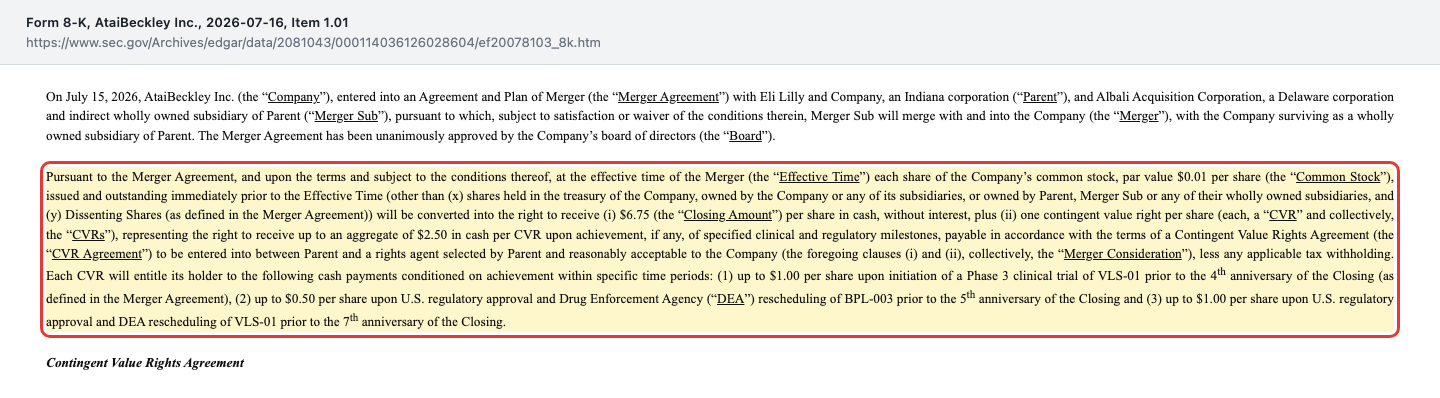
Translate that into plain language. A contingent value right — CVR — is a voucher for a later cash payment that is honored only if something specific happens. It is not a security in the usual sense: no vote, no dividend, no ownership. Here it pays in three steps, and each has its own clock:
- Up to $1.00 if a Phase 3 trial of VLS-01 begins before the fourth anniversary of closing.
- Up to $0.50 if BPL-003 wins U.S. approval and is rescheduled out of the strictest controlled-substance category by the Drug Enforcement Administration before the fifth anniversary.
- Up to $1.00 if the same happens for VLS-01 before the seventh anniversary.
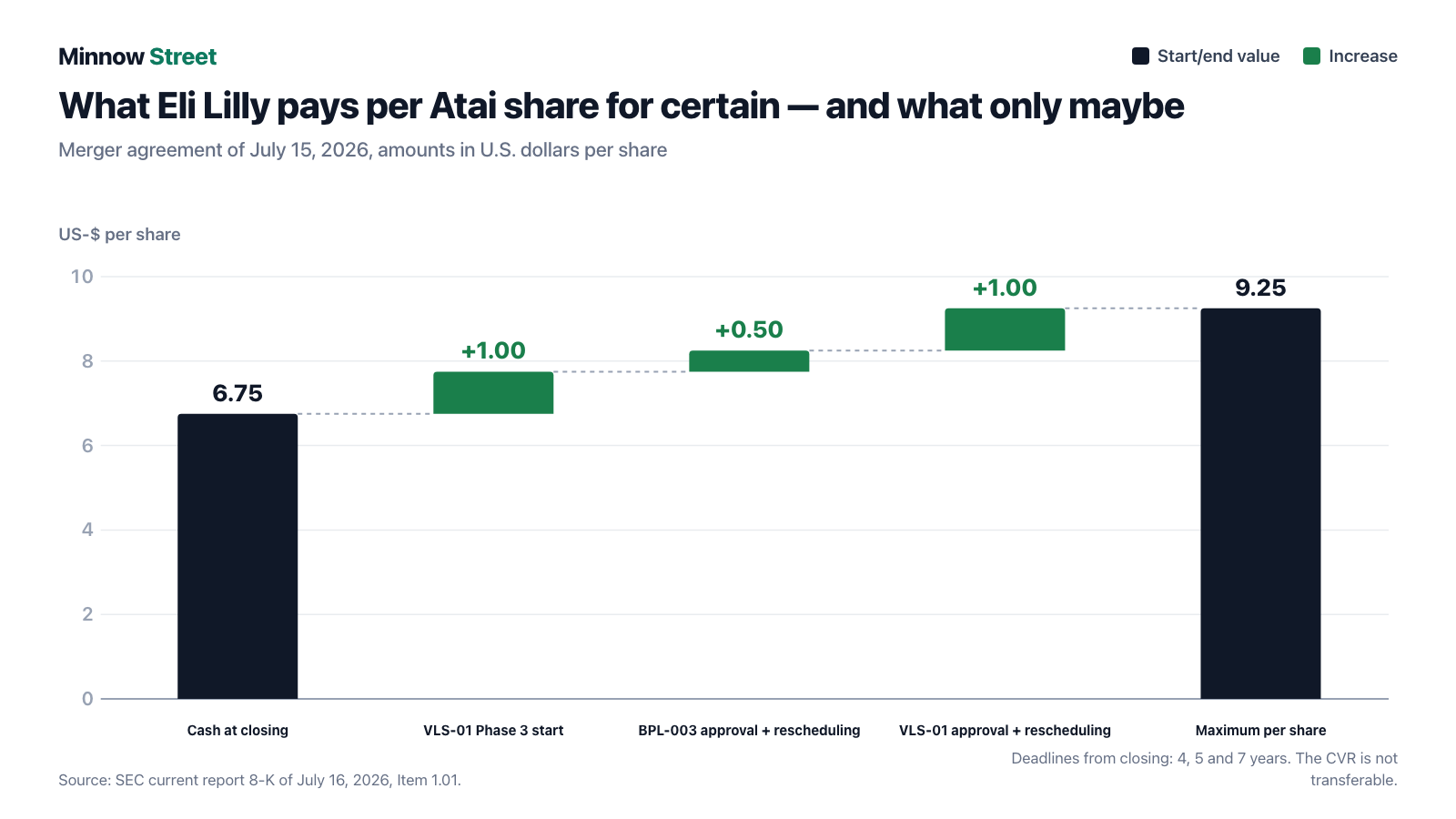
And then the same document takes the voucher's mobility away:
"The CVRs will not be transferable (except in limited circumstances), will not be registered under the Securities Act of 1933, as amended […], will not be listed on any securities exchange, and will not have any voting or dividend rights."
— AtaiBeckley Inc., SEC current report 8-K filed July 16, 2026, Item 1.01, "Contingent Value Rights Agreement"
That is the real news for shareholders: whoever holds the stock at closing receives cash — plus a piece of paper they cannot sell, that has no price on any exchange, and whose value will not be settled for four to seven years. Remember: a CVR is not a security, it is a ticket in a queue.
The rest of the agreement is plumbing, but the plumbing matters. Closing rests on three conditions: the approval of a majority of all outstanding shares at a special meeting, expiration of the waiting period under the Hart-Scott-Rodino antitrust act plus any other required clearances, and the absence of a law or order blocking the deal. There is a no-shop covenant — AtaiBeckley may not go looking for better offers — with the customary escape hatch: if an unsolicited superior proposal arrives, the board may negotiate and ultimately terminate. Lilly then has four business days to match. The price of that escape hatch is a termination fee of $104,300,000. The outside date falls six months after signing and extends automatically to nine if antitrust or foreign-investment clearances are still missing. Stock options struck below $6.75 are cashed out and also receive a CVR; options struck at or above the closing amount are cancelled for no consideration. Apeiron Investment Group Ltd. and all directors and officers have signed voting and support agreements covering, per the joint press release of July 16, 2026, roughly 15 percent of the shares. That release also puts the premium at about 40 percent to the 30-day volume-weighted average price through July 15, 2026, expects closing in the third quarter of 2026, and notes there is no financing condition.
What AtaiBeckley actually does — nasal sprays for the depression nobody can treat
Before we talk price, it helps to know what is being bought. Start with the problem, because it is real and it is enormous. Depression is treated today mainly with SSRIs and SNRIs — the familiar antidepressants. They work well for many people. For a large minority they do not: by the company's account, drawing on the clinical literature, roughly 65 percent of patients do not achieve remission after up to four antidepressant trials. Of an estimated 300 million people with depression worldwide, about half are considered treatment-resistant, meaning at least two different antidepressants have failed them. That is the gap AtaiBeckley aims at, and the tool it has chosen is the one class of compounds mainstream psychiatry spent fifty years refusing to touch: psychedelics.
The pipeline is four names, and it is worth knowing which is which. BPL-003 is the lead: a nasal spray of mebufotenin benzoate — the compound better known as 5-MeO-DMT — for treatment-resistant depression. VLS-01 is a buccal film (a strip that dissolves against the inside of your cheek) of DMT for the same indication. EMP-01 is an oral form of R-MDMA for social anxiety disorder. And a discovery program is hunting for molecules with the therapeutic effect but without the hallucinations — which, if it ever works, would remove the single biggest obstacle to prescribing these drugs at scale. Translated into everyday terms: the company is trying to turn substances that currently require a clinic, a supervisor and a long afternoon into something closer to an appointment you can schedule.
The data that convinced Lilly comes from the completed Phase 2b study of BPL-003, and it is considerably larger than the early coverage of this company suggested: 196 patients were enrolled and 193 went into the topline efficacy dataset, across 38 sites in six countries. A single 12 mg dose (73 patients) and a single 8 mg dose (46 patients) were compared with a sub-perceptual 0.3 mg comparator (74 patients). At Day 29 the MADRS depression score fell by 11.2 points on 12 mg and 12.0 points on 8 mg, against 5.8 points for the comparator, both statistically significant. At Day 57 the reductions still stood at 10.7 and 10.3 points against 5.2. About 99 percent of treatment-emergent adverse events were mild or moderate, there were no drug-related serious adverse events, and the majority of patients met discharge-readiness criteria 90 minutes after dosing. The 8 mg dose was carried into Phase 3. In October 2025 BPL-003 received breakthrough therapy designation from the FDA. After an End-of-Phase 2 meeting with the agency in February 2026, the Phase 3 program — two pivotal trials named ReConnection 1 and ReConnection 2, each a 12-week core study plus a 52-week extension — was targeted for the second quarter of 2026; the joint press release of July 16, 2026 says Phase 3 activities have been initiated.
The corporate history matters here, because it explains half the numbers below. The company as it exists today was assembled in November 2025, when atai Life Sciences N.V. combined with Beckley Psytech Limited — the British company that originated BPL-003. Then, on December 30, 2025, it moved house: the Dutch company merged into a Luxembourg entity, which converted the same day into a Delaware corporation called AtaiBeckley Inc. That is why the shares are now plain U.S. common stock with a $0.01 par value, why the company files 10-Ks rather than the 20-F forms of a foreign issuer — and why its own SEC archive is split in two. Which brings us to the central tension of this analysis: a takeover turns a bet on molecules into an arithmetic problem. $6.75 is contractually committed, $2.50 hangs on conditions that may never occur — and whether that price is a gift or a rescue is answered only by the numbers underneath it.
How the ticker reached our desk
Honesty first: this stock did not reach us through a fundamental screen. It reached us through the chatter. Our Reddit hype scanner reads daily which small and mid caps are suddenly being talked about in the U.S. stock forums (data basis: ApeWisdom). As of July 16, 2026 it counted 12 mentions in 24 hours for ATAI — a quiet hum rather than a drumbeat. Psychedelics stocks do have a way of turning quiet hums into stories, and the merger agreement had been signed the day before.
For the record, on what our own metrics can contribute: the company row for ATAI was created in our database with this analysis, on July 27, 2026 — until December 30, 2025 AtaiBeckley was a Dutch naamloze vennootschap and fell straight through the grid of our U.S. universe. The first run after that computed what a single day of data allows (as of July 27, 2026, price $7.18 from the July 24 close): a fundamental rating of D, minus 11 on our scale, a Piotroski score of 5 out of 9 and an Altman Z of 11.80. What is missing is missing for a mundane reason: no relative strength rating, no Stan Weinstein stage, no EPS rating — the price series in our data is simply too short for them. Across our stock scanners that leaves the ticker on exactly one substantive list: "EPS acceleration". Momentum and quality screens do not pick it up. Two working lists carry it as well — the Reddit hype run and our side-finds file — but both came out of this research itself and prove nothing about the company. And every one of these lists is recomputed daily: this is a dated snapshot, not a property of the business.
Numbers without judgment are decoration, so here is the judgment. Five out of nine on Piotroski is midfield — genuinely healthy companies sit at 8 or 9. The Altman Z of 11.80 looks spectacularly safe, but at a company with no meaningful revenue it is mostly the arithmetic of a lot of cash and almost no debt; about the odds of the molecules working, it says nothing at all. And a fundamental rating of D is no surprise for a company without an approved product — it is a description of the business model. So the core of it holds: this analysis rests on the SEC filings, not on metric guardrails. The values are one day old, and at a company without a product they carry little weight anyway. There is no shortcut here — only the original documents. All the more reason to read them properly.
The numbers over the years — honestly appraised
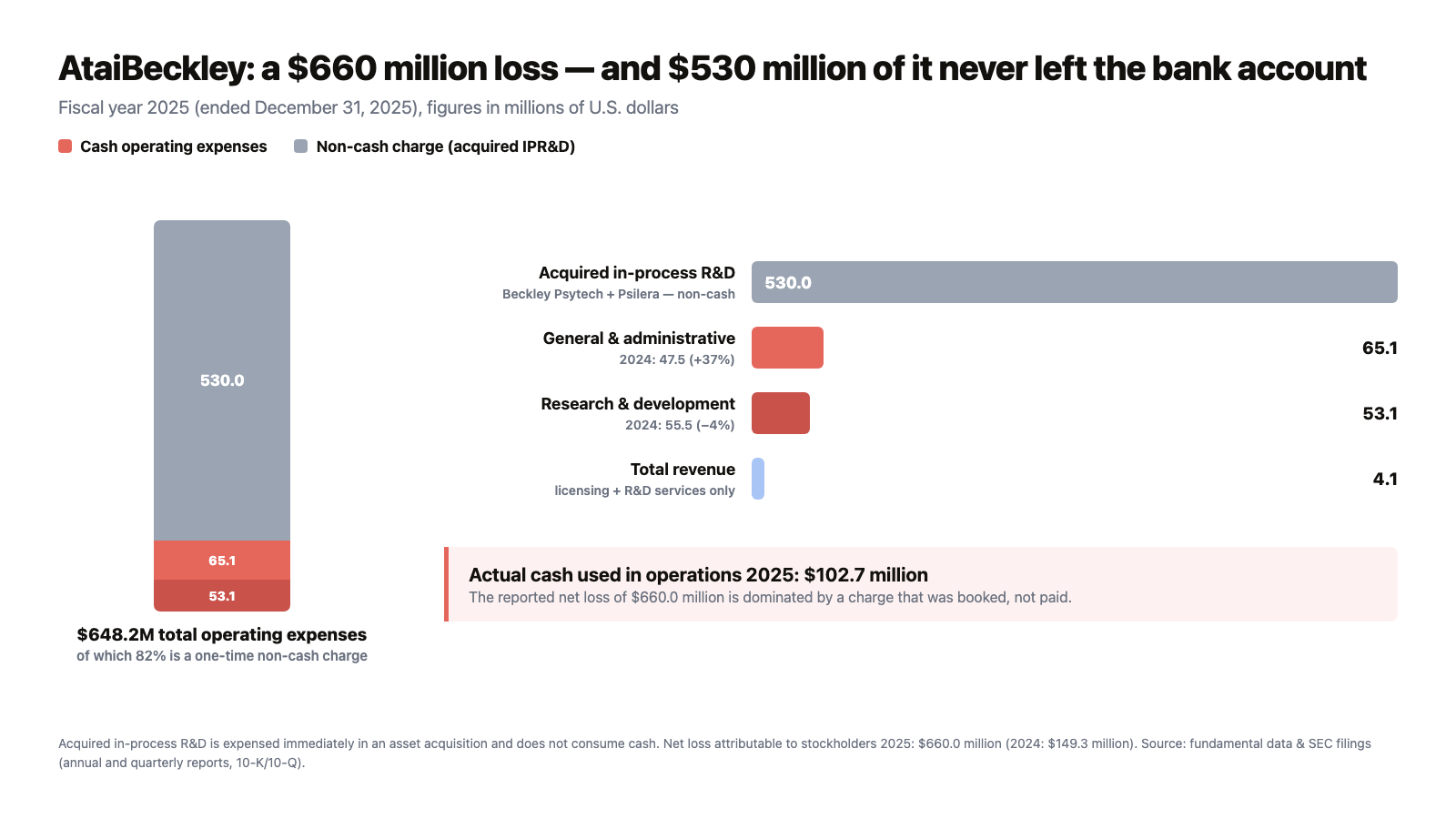
Let us start with the number everyone quotes, and then take it apart. For fiscal year 2025 (ended December 31, 2025), AtaiBeckley reported a net loss attributable to stockholders of $660.0 million, against $149.3 million in 2024 — a loss more than four times larger. Read as a headline, that is a company incinerating a quarter of itself in a year. Read in the income statement, it is something quite different. Of $648.2 million in total operating expenses, $530.0 million is a single line: "acquisition of in-process research and development" — the accounting treatment of the Beckley Psytech and Psilera deals. When a company buys assets rather than a business, the research it has bought must be expensed immediately and in full. No cash leaves the building. It is a bookkeeping entry recording that AtaiBeckley paid for Beckley's science with its own shares.
Strip it out, and the operating company underneath looks like this: research and development of $53.1 million (2024: $55.5 million — down 4 percent) and general and administrative expenses of $65.1 million (2024: $47.5 million — up 37 percent, largely the professional fees for the combination and the move to Delaware). And the number that settles the argument, because cash cannot be booked into existence: net cash used in operating activities was $102.7 million in 2025 (2024: $82.4 million). That is the real burn. Remember the mechanism: a charge is not a payment — but a payment is always a payment.
So much for the reassuring direction. Now the other one. The first quarter of 2026 shows what happens when the accounting noise stops and the actual science starts costing money: research and development rose 54 percent to $17.4 million (prior-year quarter: $11.3 million) and administration 36 percent to $14.4 million, for total operating expenses of $31.9 million — up 45 percent. Inside the R&D line you can watch the pipeline wake up: BPL-003 consumed $2.5 million against nothing a year earlier, VLS-01 $5.5 million against $2.3 million, EMP-01 $1.7 million against $0.4 million. The quarter's net loss attributable to stockholders was $29.8 million (prior-year quarter: $26.4 million) — an honest, boring, cash-shaped loss with no $530 million theatrics in it. And revenue went the wrong way: $1.0 million, down 39 percent. Which raises the question this company's income statement never quite answers on its own.
What the filings say — the uncomfortable truths
Uncomfortable truth no. 1: there is no product business — and the "revenue" is not from the drugs
AtaiBeckley reported $4.1 million of total revenue in 2025. It is tempting to read that as a small drug business starting to turn. It is not. $0.2 million was licensing income, and $3.9 million came from research and development services performed by Nualtis — a subsidiary the group ended up owning in October 2024 when the secured debt it held in a company called IntelGenx was discharged in exchange for it. In other words: essentially all of the revenue comes from a lab-services business acquired through a bankruptcy workout, not from a single molecule in the pipeline. The annual report does not dress this up:
"We are a clinical stage biotechnology company with a limited operating history. We anticipate that we will incur significant losses for the foreseeable future and have incurred losses in each year since our inception. Our net loss attributable to AtaiBeckley, Inc. stockholders for the years ended December 31, 2025 and 2024 was $660.0 million and $149.3 million, respectively. We have no products that are approved for commercial sale and have not generated any commercial product revenue."
— AtaiBeckley Inc., SEC annual report 10-K 2025, Item 1A "Risk Factors"

The cumulative price of that sentence is on the balance sheet: an accumulated deficit of $1.4 billion as of March 31, 2026 — every dollar this organization and its predecessors have lost since inception, stacked up. Against it stands stockholders' equity of $198.7 million and total assets of $264.9 million. This is entirely normal for the industry, and it is exactly why the industry is dangerous: a clinical-stage biotech is a bet that the science arrives before the money runs out, and nothing else. How long that road can be — and that it sometimes ends well — is something you can watch in our analysis of Cytokinetics. Remember the yardstick: until a regulator says yes, a pipeline is a cost, not a business.
Uncomfortable truth no. 2: the shares paid for the science — the count more than doubled in twelve months
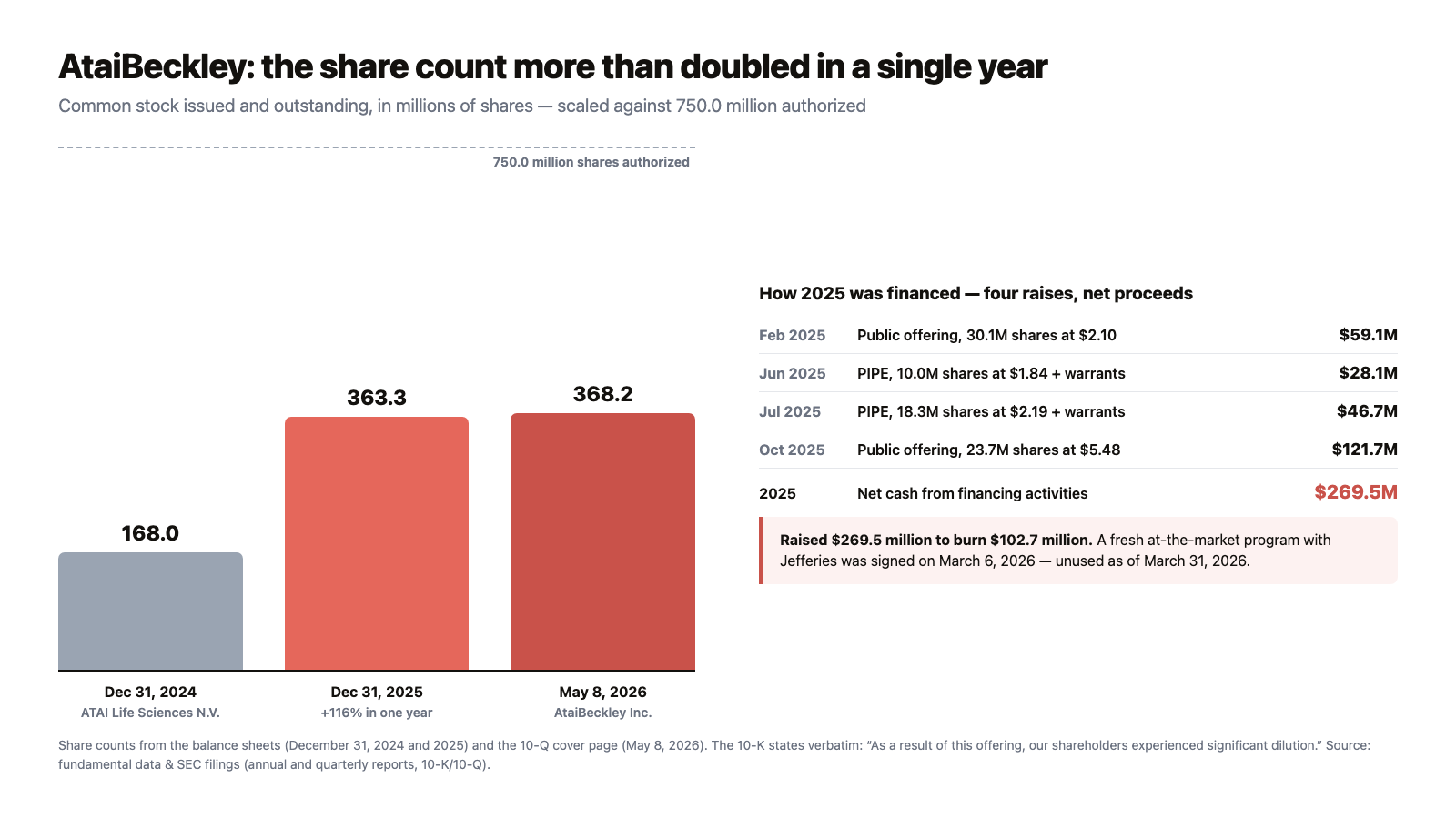
If there is no revenue, the money has to come from somewhere, and at AtaiBeckley it came from you. Look at the share count on the balance sheets: 167,959,752 shares issued and outstanding on December 31, 2024 — and 363,280,522 on December 31, 2025. That is plus 116 percent in one year; by May 8, 2026 it stood at 368,166,674. Four raises did it, and the annual report lists them in a single unbroken passage: a February 2025 public offering of 30.1 million shares at $2.10 (net $59.1 million), a June PIPE at $1.84 (net $28.1 million), a July PIPE at $2.19 (net $46.7 million), and an October offering of 23.7 million shares at $5.48 (net $121.7 million). And it does not hedge about what this meant for the people already holding:
"As a result of this offering, our shareholders experienced significant dilution."
— AtaiBeckley Inc., SEC annual report 10-K 2025, Item 1A "Risk Factors"

Put the two numbers from the last chapter side by side and the machine becomes visible: financing activities brought in $269.5 million in 2025, and operations consumed $102.7 million. The company raised roughly two and a half times what it burned — which is prudent, and which is also the point: the fuel is not sales, it is your ownership percentage. And the tank was being refilled. On March 6, 2026 AtaiBeckley signed a new at-the-market program with Jefferies, letting it sell stock straight into the market whenever it liked; as of March 31, 2026 it had not used it. With 750.0 million shares authorized against 368.2 million outstanding, the room to keep going was roughly the size of the company again. What serial dilution looks like when the story runs longer than the results is something we traced at Virgin Galactic.
For the takeover, this chapter has an uncomfortable punchline. Anyone who bought in February 2025 at $2.10 is looking at more than a tripling at $6.75. Anyone who subscribed in October 2025 at $5.48 is looking at a premium of about 23 percent, before counting the CVR. And anyone who was there before the Beckley Psytech combination is splitting their claim across more than twice as many heads. A takeover price is always a price per share — never a price per shareholder.
Uncomfortable truth no. 3: "funded into 2029" — on a burn rate that was climbing
Here is where the lighting flips the other way. The liquidity note in the quarterly report opens under a heading that would stop most readers cold — "Liquidity and Going Concern" — and then says something considerably calmer than the heading suggests:
"The Company has incurred significant losses and negative cash flows from operations since its inception. As of March 31, 2026, the Company had cash and cash equivalents of $43.1 million and short-term securities of $166.8 million and its accumulated deficit was $1.4 billion. [...] The Company currently expects that its existing cash and cash equivalents and short-term securities as of March 31, 2026 will be sufficient to fund its operating expenses and capital expenditure requirements for at least the next 12 months from the date the unaudited condensed consolidated financial statements are issued."
— AtaiBeckley Inc., SEC quarterly report 10-Q as of March 31, 2026, Note 1 "Organization and Description of Business — Liquidity and Going Concern"

Be precise about what that does and does not say, because this is where careless bears get it wrong: the auditors and the company raise no substantial doubt about the company's ability to continue. "Liquidity and Going Concern" is the standard name for the note, not a warning inside it. Management goes further in the MD&A, estimating that cash "will be sufficient to fund operations into 2029". Now do the arithmetic yourself, because that is the part the lighting hides. Cash and short-term securities as of March 31, 2026: $209.9 million. "Into 2029" means somewhere north of two and a half years from that date. That implies an average burn of roughly $75 to $80 million a year. But the company burned $102.7 million in 2025 — and the first quarter of 2026 ran at $31.9 million of operating expenses, which annualizes to about $127 million. The runway promise therefore required spending to fall by roughly a third, in the very years the company planned to run two pivotal Phase 3 trials with 52-week extensions — the single most expensive thing a biotech ever does. A company that lasted into 2028 on a similar promise is our Taysha analysis. Remember the image: a runway is a division, and the company controls the number underneath it.
And this is precisely where the takeover answers a question that would otherwise have stayed open. A company with $209.9 million, two pivotal trials ahead of it and a fresh at-the-market program in the drawer is a company facing more raises. The Lilly agreement takes that question off the table — and takes with it everything above $9.25 a share that might one day have arrived.
Uncomfortable truth no. 4: two of the three CVR steps depend on an agency the company cannot handicap
Suppose everything works. The Phase 3 trials read out well, the FDA approves BPL-003. You would think that is the finish line. It is not — because the active ingredient is 5-MeO-DMT, and under U.S. law that currently sits in Schedule I of the Controlled Substances Act: the category defined as having no accepted medical use, which by definition may not be prescribed, marketed or sold. Approval by the FDA does not move it. A separate agency, the DEA, has to reschedule the substance through a formal rule-making process — notice, public comment, requests for hearing — and then every U.S. state has to make its own determination on top. The annual report walks through this and lands on a sentence that deserves its own line:
"Commercial marketing in the United States will also require scheduling-related legislative or administrative action. Scheduling determinations by the DEA are dependent on FDA approval of a substance or a specific formulation of a substance. [...] There can be no assurance that the DEA will make a favorable scheduling decision."
— AtaiBeckley Inc., SEC annual report 10-K 2025, Item 1A "Risk Factors"

Now set that sentence next to the merger agreement. Two of the three CVR steps — $1.50 of the $2.50, or 60 percent of the contingent half — explicitly require "U.S. regulatory approval and DEA rescheduling." The company is handing its shareholders a claim whose trigger it describes in its own annual report as uncertain, on deadlines of five and seven years. Translate it into an everyday image: you are given a voucher that only becomes valid once a second authority unlocks the cabinet the medicine is kept in — and the manufacturer writes, in its own filing, that it does not know whether that key will be turned. How completely a clinical-stage story can hinge on a single regulator's decision is the whole subject of our Replimune analysis. Remember the sequence: with psychedelics, FDA approval is the second-to-last gate, not the last one.
Valuation: what $6.75 means — and what $2.50 on condition is worth
Since July 15, 2026 the valuation of this stock has stopped being a question of multiples and become a question of probability. Both sides of the arithmetic are still worth a look.
What the buyer is paying. Per the two companies' own statement, the cash portion represents an aggregate equity value of about $2.8 billion, and the CVR a further potential $1.0 billion — up to roughly $3.8 billion in total for four drug candidates, none of them approved. Measured against stockholders' equity of $198.7 million (March 31, 2026), the certain part alone is about fourteen times the accounting substance. That is less absurd than it sounds: at a company whose only real asset is intellectual property that accounting rules force it to expense rather than capitalize, book value says almost nothing. But it is the honest measure of how much of this price is expectation. A second anchor from the company's own filing: on June 30, 2025, the market value of the stock held by non-affiliates was about $361.3 million. In twelve months the valuation of this company multiplied several times over — on trial data, an FDA meeting and finally a takeover offer, rather than a single dollar of product revenue.
What the market is pricing. Per fundamental data, market value stood at $2.656 billion on 369,954,432 shares as of July 27, 2026. Cross-check: 369,954,432 shares times the contractual closing amount of $6.75 comes to $2.497 billion. The difference of roughly 6 percent is exactly what investors are willing to assign to the contingent value right — about $0.43 per share, or a good sixth of the $2.50 maximum. That is not our forecast; it is a derivation. It is how the market prices the three conditions on that date. Anyone buying the stock above the closing amount is buying that residual alone — and carrying, on top of it, the risk that nothing closes at all.
What the conventional ratios say. Almost nothing, and saying so is more honest than computing them anyway. A price-to-earnings ratio does not exist — there are no earnings and none are forecast. A price-to-sales ratio computes into the hundreds and tells you nothing, because the denominator is a lab-services line item with no connection to the investment case. The one figure that still carries information is enterprise value of roughly $2.4 billion (market value less net cash, data as of July 27, 2026) — what you are actually paying for the science. The professionals are unanimous, for whatever unanimity is worth here: seven analysts cover the stock — five strong buy, two buy, no holds and no sells — with an average price target of about $9.59 (data as of July 27, 2026). That is no longer an independent estimate of business value; it is practically the maximum of the offer. The targets have slid onto the deal. Roughly 44.8 percent of the stock sits with institutions, insiders hold about 2.3 percent, and short interest is negligible at about 0.1 percent of the float.
Opportunities and risks at a glance
What speaks for AtaiBeckley:
- A signed agreement with one of the largest pharmaceutical companies in the world: $6.75 per share in cash, a premium of roughly 40 percent to the 30-day volume-weighted average price through July 15, 2026, no financing condition, unanimously recommended by the board, closing expected in the third quarter of 2026 (8-K filed July 16, 2026).
- An additional claim of up to $2.50 per share through the contingent value right — a maximum of $9.25 per share, and per the press release a potential additional aggregate equity value of about $1.0 billion.
- Real clinical data behind the price: the completed Phase 2b study of BPL-003, with 193 evaluable patients across 38 sites in six countries, met its primary and all key secondary endpoints; about 99 percent of adverse events were mild or moderate and the majority of patients were discharge-ready 90 minutes after dosing. FDA breakthrough therapy designation followed in October 2025.
- A real and enormous unmet need: roughly 65 percent of depression patients reach no remission after up to four antidepressant trials, and about half of the estimated 300 million people with depression worldwide are considered treatment-resistant (annual report 10-K for 2025, Item 1).
- No going-concern doubt and no debt overhang: $209.9 million of cash and short-term securities as of March 31, 2026, the old Hercules term loan repaid and terminated in May 2025, plus $20.9 million in COMPASS Pathways shares as a non-dilutive reserve.
What speaks against it:
- The deal has not closed: it needs the approval of a majority of all outstanding shares while only about 15 percent are locked up by voting agreements, plus antitrust clearance. The outside date falls six months after signing and extends to nine if clearances are missing.
- The contingent value right is not money: not transferable, not listed, no voting or dividend rights — and $1.50 of the $2.50 requires DEA rescheduling, about which the annual report itself says: "There can be no assurance that the DEA will make a favorable scheduling decision."
- Without the deal the old arithmetic returns: no approved product, $4.1 million of 2025 revenue from licensing and the Nualtis lab-services subsidiary, a $1.4 billion accumulated deficit (March 31, 2026), and a first-quarter 2026 expense run rate annualizing to about $127 million.
- Dilution is the business model of this balance sheet: from 168.0 million to 363.3 million shares during 2025 and 368.2 million by May 8, 2026, four raises worth $269.5 million, a fresh at-the-market program signed March 6, 2026, and 750.0 million shares authorized.
- Anyone buying above $6.75 today is paying for the contingent half alone while carrying the deal risk. A termination fee of $104.3 million — more than half of stockholders' equity — also makes a competing bid expensive.
A human conclusion
Back to the two words from the beginning. "Up to" is the politest form of vagueness the language of business has, and it works so well precisely because the reader's eye drops it. Three findings remain, and each one changes depending on which number you remember.
Finding one: the certain part is the smaller part of the headline — and the only one that actually exists. $6.75 in cash is contractually committed, without a financing condition, unanimously recommended. Everything above it is a voucher you cannot sell and that pays, at the earliest, when a trial begins.
Finding two: the price is not explained by the balance sheet but by what the balance sheet is not allowed to show. The frightening $660.0 million loss is four-fifths a charge for research bought with shares; $102.7 million actually moved. That bought research is exactly what Lilly wants — and it is invisible in the one place people look for it. Value this company by substance and you find $198.7 million of equity. Value it by possibility and you find $2.8 billion. Both readers are holding the same filing.
Finding three: the question has shifted, but it has not gone away. Until July 15, 2026 it was: does a nasal spray of 5-MeO-DMT halve depression scores in several hundred patients? Since then it is: will a majority of all outstanding shares approve, will the antitrust agencies clear it — and will the $0.43 the market currently assigns to each CVR turn into $2.50 or into nothing? Between here and there sit two pivotal trials, a DEA rule-making and deadlines of four to seven years. That is not a criticism of the company. It is a description of what a clinical-stage biotech is: an option on a molecule — one that somebody has now bought.
What you make of it is your decision. And that is exactly as it should be.
Sources
All original documents used in this analysis — to read for yourself:
- AtaiBeckley Inc. — SEC current report 8-K filed July 16, 2026 (Items 1.01/7.01/9.01: Agreement and Plan of Merger with Eli Lilly and Company, Contingent Value Rights Agreement, voting and support agreements, joint press release as Exhibit 99.1)
- AtaiBeckley Inc. — SEC soliciting material DEFA14A filed July 16, 2026 (investor questions and answers: $9.25 maximum, one-step merger, Nasdaq delisting)
- Apeiron Investment Group Ltd. / Christian Angermayer — SEC beneficial ownership report SCHEDULE 13D/A No. 4 filed July 17, 2026 (56,812,134 shares = 15.4 percent, voting and support agreements)
- AtaiBeckley Inc. — SEC annual report 10-K for 2025 (filed March 6, 2026)
- AtaiBeckley Inc. — SEC quarterly report 10-Q as of March 31, 2026 (filed May 12, 2026)
- AtaiBeckley Inc. — SEC current report 8-K of March 6, 2026 (Open Market Sale Agreement with Jefferies, the at-the-market program)
- AtaiBeckley Inc.'s complete SEC filing history (CIK 0002081043): EDGAR overview (sec.gov)
- Predecessor Atai Beckley N.V. / ATAI Life Sciences N.V. (CIK 0001840904), including the Form 15-12G deregistration of December 31, 2025: EDGAR overview (sec.gov)
- Fundamental data (metrics, quarterly series, valuation, analyst estimates; data as of July 27, 2026), reconciled with the SEC filings.
- Metrics and rankings from our in-house stock scanner (as of July 27, 2026, price $7.18 from the July 24, 2026 close): fundamental rating D at 44 out of 100, Piotroski score 5 out of 9, Altman Z 11.80; no relative strength rating, no Weinstein stage and no EPS rating, because the price series is too short; listed in "EPS acceleration". The lists are recomputed daily.
- Reddit mentions: ApeWisdom (12 mentions in 24 hours, as of July 16, 2026).
Transparency & disclaimer: This analysis is a journalistic contextualization of publicly available information and is not investment advice, not a financial analysis in the regulatory sense, and not a solicitation to buy or sell securities. Stock investments carry substantial risks up to total loss — with clinical-stage biotechnology, the total loss of the invested capital is a realistic scenario, and even signed acquisitions can fail. All information without guarantee; the data cut-off is noted in the text in each case. Positions held by the operator are disclosed daily; where one exists, it appears as a notice at the top of this deep dive.
Key figures at a glance
All monetary figures in millions of $; earnings per share as reported.
| Metric | 2021 | 2022 | 2023 | 2024 | 2025 |
|---|---|---|---|---|---|
| Revenue | 20.4 | 0.2 | 0.3 | 0.3 | 4.1 |
| Operating Income (EBIT) | -120.3 | -144.4 | -125.5 | -102.7 | -99.8 |
| Net Income | -167.8 | -152.4 | -40.2 | -149.3 | -660.0 |
| Net Margin | -823.6% | -65,401.3% | -12,810.2% | -48,464.0% | -16,142.0% |
| Earnings Per Share | -1.04 $ | -0.98 $ | -0.25 $ | -0.93 $ | -2.91 $ |
Source: fundamental data & SEC filings (annual and quarterly reports, 10-K/10-Q)
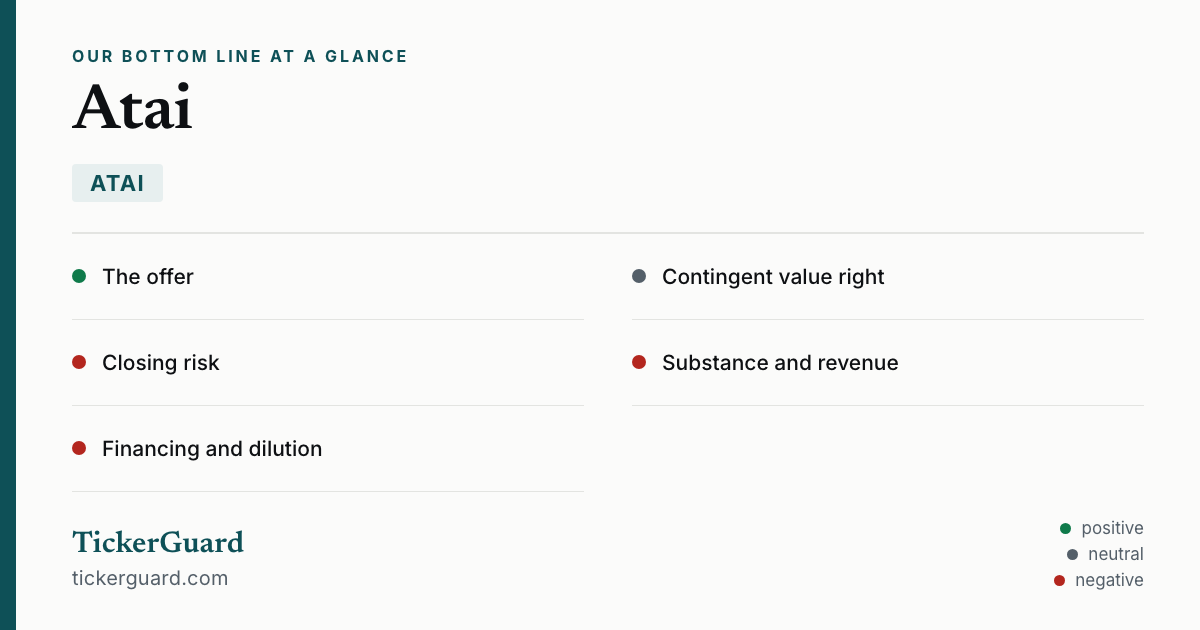
Our Bottom Line at a Glance
- The offer positive
- A merger agreement signed July 15, 2026 with Eli Lilly and Company: $6.75 per share in cash, no financing condition, unanimously recommended by the board, a premium of roughly 40 percent to the 30-day volume-weighted average price through July 15, 2026. Closing is expected in the third quarter of 2026 (current report 8-K filed July 16, 2026).
- Contingent value right neutral
- Up to $2.50 more per share — but in three steps with deadlines of four, five and seven years, $1.50 of it dependent on rescheduling by the Drug Enforcement Administration, about which the 2025 annual report gives no assurance at all. The rights are not transferable, not listed on any exchange, and carry no voting or dividend rights (8-K filed July 16, 2026).
- Closing risk negative
- The deal needs the approval of a majority of all outstanding shares; per the press release of July 16, 2026 only about 15 percent are locked up by voting agreements (Apeiron Investment Group and the directors and officers; the 13D/A of July 17, 2026 reports 56,812,134 shares, or 15.4 percent). Add antitrust clearance, an outside date of six to nine months, and a $104.3 million termination fee.
- Substance and revenue negative
- No approved product and no product revenue: 2025's $4.1 million came from licensing and the Nualtis research-services subsidiary. The accumulated deficit reached $1.4 billion against stockholders' equity of $198.7 million (March 31, 2026). The offer price pays for possibilities, not earnings.
- Financing and dilution negative
- The share count rose from 168.0 million to 363.3 million during 2025 and 368.2 million by May 8, 2026; four raises brought in $269.5 million against a $102.7 million burn. The 10-K concedes "our shareholders experienced significant dilution"; a fresh at-the-market program with Jefferies was signed March 6, 2026, and 750.0 million shares are authorized.
Since July 15, 2026 AtaiBeckley has stopped being a science case and become an arithmetic case. Eli Lilly is paying $6.75 a share in cash and adding a non-transferable contingent value right worth up to $2.50 — $1.50 of it dependent on an agency the company will not vouch for in its own annual report. Underneath sits a business with no approved product: $4.1 million of 2025 revenue from licensing and lab services, a $1.4 billion accumulated deficit, a share count that more than doubled in twelve months — and a reported $660.0 million loss of which $530.0 million never left the bank account. Not investment advice.
What Our Rating Means
Open questions
The business works in principle, but one material question is open. As long as it stays open, our findings do not carry a quality verdict.
Whoever holds today holds a claim on $6.75 in cash — provided a majority of all outstanding shares approves and the antitrust agencies clear it; only about 15 percent of the votes are locked up. Whoever buys new above $6.75 is buying the contingent half alone: a non-transferable right worth up to $2.50 on deadlines of four to seven years, of which the market was pricing roughly $0.43 per share as of July 27, 2026. Whoever waits gives up nothing but the spread and gets the two documents that actually decide this: the proxy statement with the full contingent value rights agreement, and the result of the special meeting. The decision is yours.
A journalistic assessment by our editorial team at the time of the deep dive, based on public sources — not investment advice and not a solicitation to buy or sell. Your personal circumstances (investment goals, risk capacity, taxes) cannot be taken into account. What our levels mean, how verdicts are formed, and what conflicts of interest exist →
Worth Noting
- ATAI reached our research list through the Reddit hype scanner (ApeWisdom, 12 mentions in 24 hours, as of July 16, 2026). The company row in our database was created with this analysis on July 27, 2026 — until December 30, 2025 AtaiBeckley was a Dutch N.V. The first run after that returns, as of July 27, 2026: fundamental rating D (44 out of 100), Piotroski score 5 out of 9, Altman Z 11.80, price $7.18 (close of July 24, 2026); relative strength rating, Weinstein stage and EPS rating are absent for lack of price history, and the only substantive list carrying the ticker is "EPS acceleration". These lists are recomputed daily. The assessment here still rests on the SEC filings: a midfield Piotroski score and an arithmetically high Altman Z, drawn from a one-day-old data row, say little at a company with no approved product.
- The SEC history of this ticker is split across two CIKs: the current filer is AtaiBeckley Inc. (CIK 0002081043), while everything before the December 30, 2025 redomiciliation sits under Atai Beckley N.V. / ATAI Life Sciences N.V. (CIK 0001840904), which deregistered via Form 15-12G on December 31, 2025.
- The $6.75 offer price and the $9.25 maximum are contractually agreed amounts from the current report 8-K filed July 16, 2026, not daily quotes. Market value and analyst figures carry the data cut-off of July 27, 2026. Even signed acquisitions can fail, and with clinical-stage biotechnology the total loss of invested capital is a realistic scenario.
Download the verdict card (traffic light and rating of this analysis as an image, PNG)
Stock Watch
This analysis is as of August 26, 2026. Stock Watch will tell you what's changed at ATAI since then.
Later $1 a month per stock — signing up is free, and you'll be the first to know when it launches.
The full analysis as a PDF for later
We will send you this analysis as a PDF — to print, file away, and read at your own pace. And we will add you to the free Stock Watch list for AtaiBeckley Inc. (ATAI), so you hear about it when something material in this analysis changes.
Frequently Asked Questions
Per the current report (8-K) filed July 16, 2026, each share receives $6.75 in cash at closing plus one non-transferable contingent value right worth up to $2.50 — a maximum of $9.25 per share. The cash portion is a premium of roughly 40 percent to the 30-day volume-weighted average price through July 15, 2026, and an aggregate equity value of about $2.8 billion.
A contingent value right (CVR) is a claim on a later cash payment that is honored only on specific events. Here it pays up to $1.00 if a Phase 3 trial of VLS-01 starts within four years, up to $0.50 on approval and DEA rescheduling of BPL-003 within five years, and up to $1.00 for VLS-01 within seven. It is not transferable and not listed on any exchange.
The stock stays on the Nasdaq and is measured against its own numbers again: no approved product, $4.1 million of 2025 revenue, and $209.9 million of liquidity as of March 31, 2026 against a first-quarter 2026 expense run rate annualizing to about $127 million. If AtaiBeckley terminates for a superior proposal, a $104.3 million termination fee falls due.
Both companies expect closing in the third quarter of 2026. It requires the approval of a majority of all outstanding shares at a special meeting and antitrust clearance under the Hart-Scott-Rodino Act. The outside date falls six months after signing and extends automatically to nine months if antitrust or foreign-investment clearances remain outstanding.
Mostly on paper. Of $648.2 million in 2025 operating expenses, $530.0 million was a non-cash "acquisition of in-process research and development" charge for the Beckley Psytech and Psilera deals — research bought with shares must be expensed immediately. The cash costs were research and development of $53.1 million and administration of $65.1 million; net cash used in operations was $102.7 million (2024: $82.4 million).
No product revenue. Total 2025 revenue was $4.1 million: $0.2 million of licensing income and $3.9 million of research and development services from the Nualtis subsidiary — nothing from the drug pipeline. The annual report states the company has "no products that are approved for commercial sale and have not generated any commercial product revenue". The accumulated deficit reached $1.4 billion as of March 31, 2026.
The share count more than doubled in 2025: from 167,959,752 (December 31, 2024) to 363,280,522 (December 31, 2025), reaching 368,166,674 by May 8, 2026. Four raises brought in $269.5 million net (February at $2.10, June at $1.84, July at $2.19, October at $5.48). The 10-K concedes: "As a result of this offering, our shareholders experienced significant dilution." 750.0 million shares are authorized.
The completed Phase 2b study enrolled 196 patients, with 193 in the topline efficacy dataset across 38 sites in six countries. At Day 29 the MADRS score fell 12.0 points on 8 mg and 11.2 points on 12 mg, against 5.8 points for the comparator. About 99 percent of adverse events were mild or moderate. FDA breakthrough therapy designation followed in October 2025.
Found an error?
Did you spot a factual error, an outdated number, or a typo in this deep dive? Let us know briefly — your report goes straight to the editorial team.