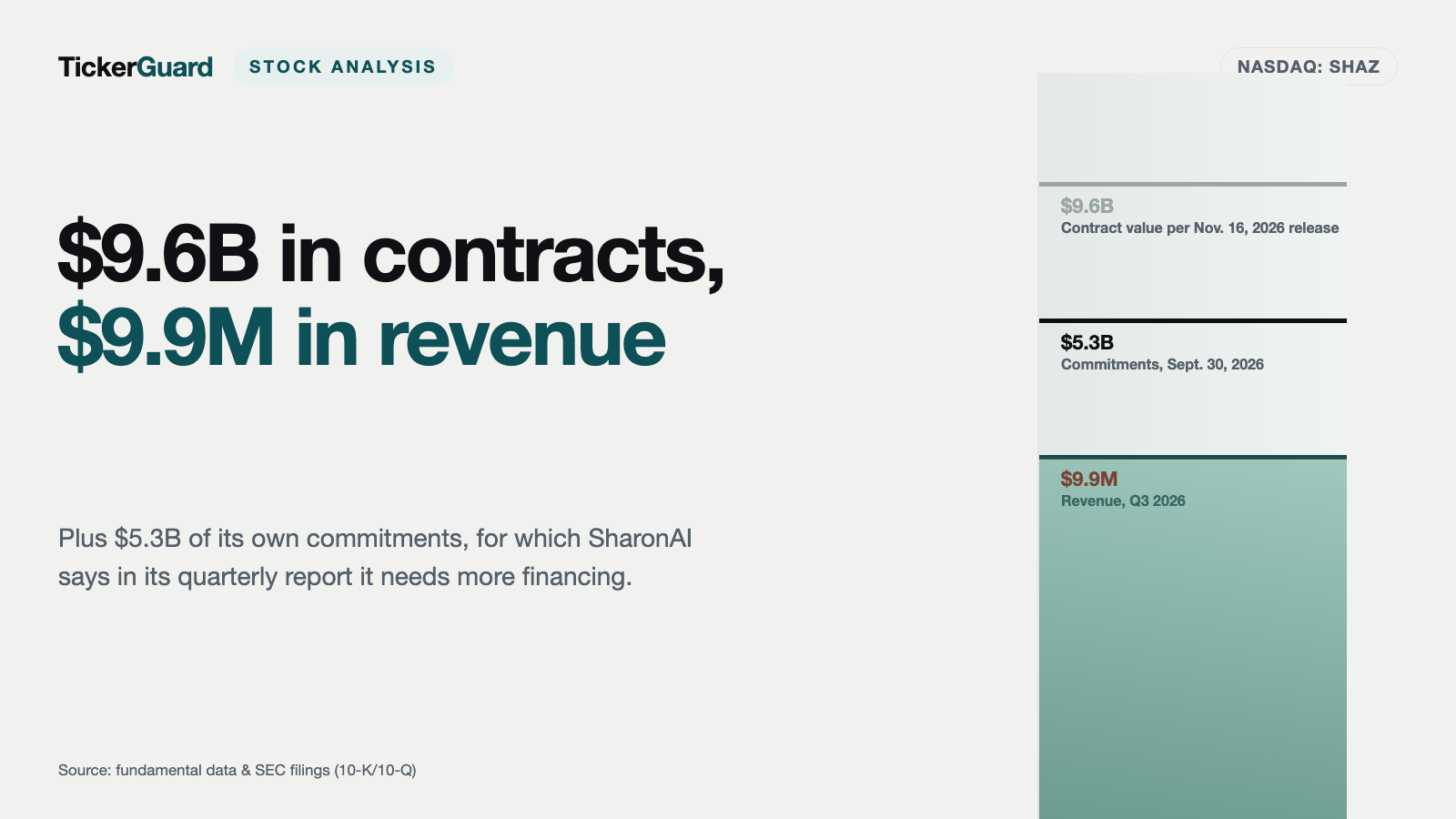
SharonAI: $9.6 Billion on the Order Pad — and $9.9 Million of Revenue in the Quarter
On November 16, 2026, SharonAI cost less on the stock market than it held in unrestricted cash on September 30, 2026 — and yet that is no cushion. The Australian renter of AI computing power reports about $9.6 billion of contract value, but $9.9 million of third-quarter revenue and $5.3 billion of its own commitments for which, in its own words, it needs further backers. Not investment advice — just the difference between an order pad and a bank statement.
 Thomas Mücke
Founder & Publisher
As of Today
As of: November 16, 2026
- Closing price
- 20.13 $ -10.77%
- Market Capitalisation
- 0.8 $B
- AAQS
- 3/10
This analysis has a cut-off date. The Stock Guard tells you when something material changes in the numbers. Reserve your free spot
Chart
Interactive price chart (TradingView).
52-week range: 0.037 $ to 92.70 $ · Last price: 20.13 $ (As of: November 16, 2026)
Note: pure fact-based analysis, not investment advice and not a solicitation to buy or sell. All figures without guarantee.
There is an investor trap that begins with a very large number: the order-pad trap. It works like this: a contractor shows you a stack of signed orders, and you mistake the stack for his bank balance. An order, after all, is first of all an obligation: buy the materials, deliver on time, pass the acceptance. Money comes at the end. SharonAI (Nasdaq: SHAZ) showed a very thick stack on November 16, 2026: about $9.6 billion of contract value over five and a half years. The quarterly report, filed the same day with the U.S. securities regulator, the SEC, shows revenue for the third quarter of 2026: $9.9 million.
Both numbers are correct. Between them lies a factor of roughly one thousand — and everything a company has to do to turn an order into revenue. For SharonAI that means: spend billions on computers, set them up in leased data centers and get them running on time.
So let’s put the order pad next to the bank statement: we read together what SharonAI reported to the SEC — the quarterly report (10-Q) for September 30, 2026, filed on November 16, 2026, the earnings release of the same day, the annual report (10-K) for 2025 and the current reports (8-K) on contracts and financings. The CEO and CFO must personally certify the accuracy of the reports. By the end you will know what is on the order pad, how much of it has reached the books, and who pays the bills in the meantime. The decision is yours.
What SharonAI actually does — compute for rent, out of Australia
SharonAI calls itself a “neocloud” operator. That means a provider that rents out nothing but computing power for artificial intelligence. The company buys graphics processors (GPUs) from NVIDIA — the specialty chips on which AI models are trained and run — assembles them into large compute clusters and rents out their capacity under multi-year contracts. In an everyday image: SharonAI is a car-rental company that stocks only race cars — it has to pay for every car itself before the customer wires the first monthly installment.
The computers do not sit in buildings of its own. According to the quarterly report, SharonAI uses data centers run by others, among them the Australian provider NEXTDC. As of September 30, 2026, the report cites 129 megawatts of contracted capacity in Australia and New Zealand; in total, the company says it has secured up to 212 megawatts for 2027. The selling point is “sovereign”: the data stays in the country.
The company is young. According to the quarterly report, the operating company SharonAI Inc. was founded on February 15, 2024, and took over computers that had previously been used to mine cryptocurrencies. Until June 2025 it also operated data storage on the Filecoin network; that business was discontinued. SharonAI came to the stock market through a shell company (SPAC) called Roth CH: the merger closed on December 17, 2025, and six days later the shares were consolidated at a ratio of 1 to 50. The stock has been listed on the Nasdaq since February 2026. As of March 18, 2026, the annual report counted 25 people — employees, directors, advisors and contractors combined.
That names the central tension of this analysis, and it runs through every chapter: in less than a year, SharonAI has gathered billion-dollar contracts and billion-dollar capital — but almost all of it is still a promise. The revenue, the delivery and most of the financing are still to come.
Company history for investors
-
2024
Founded from crypto computers
SharonAI Inc. is formed on February 15, 2024, and takes over computers from crypto mining. For shareholders: a very young company with no long history in today’s business.
-
2025
Shell company and reverse split
The merger with the shell company Roth CH closes on December 17, 2025; a 1-for-50 reverse split follows on December 23. For shareholders: prices from before are not comparable.
-
2026
Nasdaq IPO at $30
In February 2026, SharonAI issues 4,166,666 shares for $125 million. For shareholders: the start of a series of capital raises in the same year.
-
2026
First billion-dollar contract
On March 31, 2026, the ESDS contract for about $1.25 billion follows, delivery date September 16, 2026. For shareholders: an idea turns into a delivery obligation.
-
2026
NVIDIA agreement and $1.95 billion of capital
May and June 2026: convertible notes of $350 million and $700 million, private placement of about $900 million at $68.73 per share. For shareholders: full cash, smaller stake.
-
2026
First acceptance, first secured loan
August 2026: a customer accepts about 1,000 graphics processors. September 28: a loan of up to $356 million. For shareholders: first revenue from a large contract, first secured loan.
-
2026
Quarterly report with warning signs
November 16, 2026: $9.9 million of revenue, $5.3 billion of commitments, material weakness in controls. For shareholders: the order pad is full, the bank statement is not yet.
How the stock landed on our desk
SharonAI landed on our desk through the quarterly report itself: on November 16, 2026, the company filed its report (10-Q) for the third quarter of 2026, together with an earnings release whose headline cites $9.6 billion of contract value.
The stock has had a wild year. In the Nasdaq IPO of February 2026, 4,166,666 shares were issued for a total of $125 million, that is, at $30 per share. On June 18, 2026, the stock closed at $92.70, its highest closing price since the IPO. At the end of September 2026 it stood at $54.60, at the end of October at $22.68. On November 16, 2026, the day of the quarterly results, it closed at $20.13 (source: fundamental data, as of November 17, 2026). Why the price fell so sharply in October is not stated in any SEC filing, and we will not speculate.
What matters is something else: anyone who bought at the June closing high paid a good four and a half times the price of November 16, 2026 — for the same company, which at that time had reported fewer contracts than it has today. So remember from the start: a contract value tells you what a customer wants to pay. It does not tell you what it costs to be able to deliver.
Billions raised, millions earned — the numbers honestly appraised
First, what is genuinely impressive. A company that still had $71.1 million in cash at the end of 2025 has raised capital in quick succession over nine months: $125 million from the IPO, $350 million from a convertible note in May, about $900 million from a private placement of shares in June, $700 million from a second convertible note in the same month. On September 30, 2026, $1,341.3 million sat in unrestricted cash. Equity rose from minus $10.1 million (December 31, 2025) to plus $1,084.5 million.
The customer side is real, too. Through September 30, 2026, four large contracts are individually quantified in the mandatory filings and reports:about $1.25 billion with the customer ESDS Software Solutions (March 2026), about $950 million with a technology company that is not named, $1.32 billion with an AI lab that is likewise not named (July 2026), and about $373 million over five years with an unnamed AI platform (signed after June 30, 2026, according to the quarterly report for that date). After September 30, 2026, the latest quarterly report adds two more: about $1.0 billion over five years with a global services company and $170 million over four years with a U.S.-based AI inference platform. On top comes a six-year collaboration with NVIDIA from June 2026. Customers have already paid money in advance: the balance sheet shows $329.4 million of customer deposits received. And in August 2026, the technology company accepted the first partial facility with about 1,000 graphics processors.
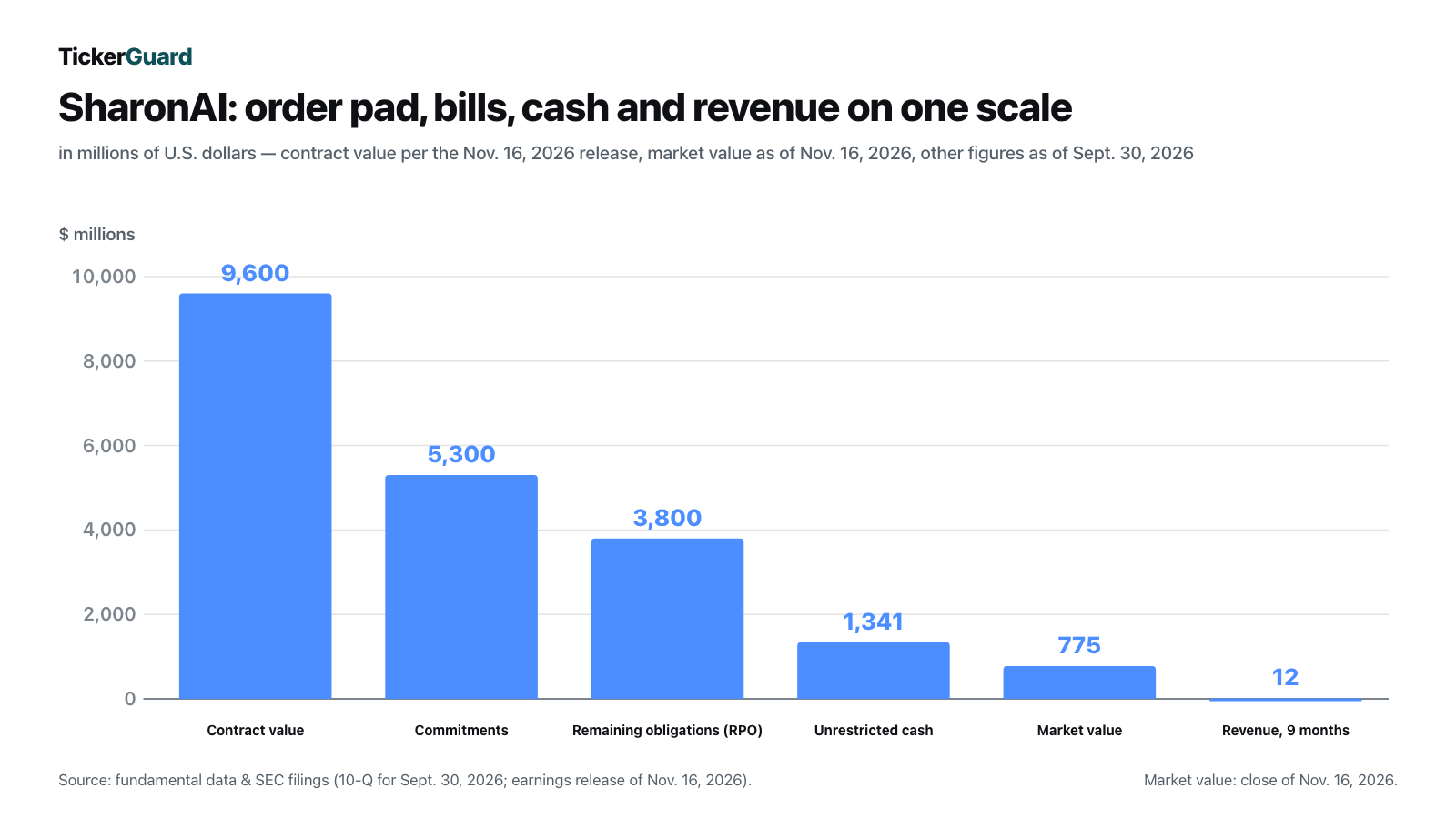
Now the other side. Revenue was $0.4 million in 2024 and $1.6 million in 2025. In the first quarter of 2026 it was $0.3 million, in the second $1.9 million, in the third $9.9 million — $12.2 million together in nine months. Growth is steep, the base tiny. Against third-quarter revenue of $9.9 million stood $26.3 million of selling and administrative expenses, $4.8 million of stock-based compensation and $15.5 million of other expenses, including $6.7 million of depreciation. The operating loss was $37.5 million, the net loss $43.8 million.
One figure stands out and demands an explanation: the net loss for the first nine months of 2026 of $494.2 million. Of that, $470.7 million is a valuation effect in which no cash flowed. In December 2025, SharonAI had issued convertible notes of about $103.7 million — IOUs that can be exchanged for shares. They were converted on June 11, 2026, at a calculated price of $12.53 per share. On the stock market, the shares cost $71.51 that day. The holders received 8,430,784 shares with a market value of about $603 million. Because the notes were carried at fair value, SharonAI had to book the increase in that fair value over the previous carrying amount ($129.0 million at the end of 2025) as a loss. No money was lost — but your slice of the pie got smaller: this one conversion alone accounts for about 22 percent of all shares outstanding today.
The cash inflow needs a reading aid as well. Operations brought in $208.2 million over nine months. That did not come from earned money but from $331.5 million of customer deposits. In the third quarter alone, $66.1 million flowed out of operations and a further $477.6 million into capital spending. The total balance of cash (including restricted balances) fell in those three months from $2,049.3 million to $1,499.9 million.
What the filings say — the uncomfortable truths
Uncomfortable truth No. 1: Of $9.6 billion on the order pad, $3.8 billion appears in the report
The number in the headline of the earnings release is called Total Contract Value (TCV). The release explains in a footnote what it is: an operating metric, not revenue under U.S. accounting rules, and subject to change through contract amendments and terminations. The accounting rules know a related, stricter measure: remaining performance obligations (RPO). On that, the quarterly report says:
“As of September 30, 2026, the Company had $3.8 billion of unsatisfied RPO, of which 35% was expected to be recognized over the initial 24 months ending September 30, 2028, 40% between months 25 and 48, and the remaining balance of 25% recognized between months 49 and 78.”
— SharonAI Holdings Inc., SEC quarterly report 10-Q for September 30, 2026, Note 3 “Revenue”
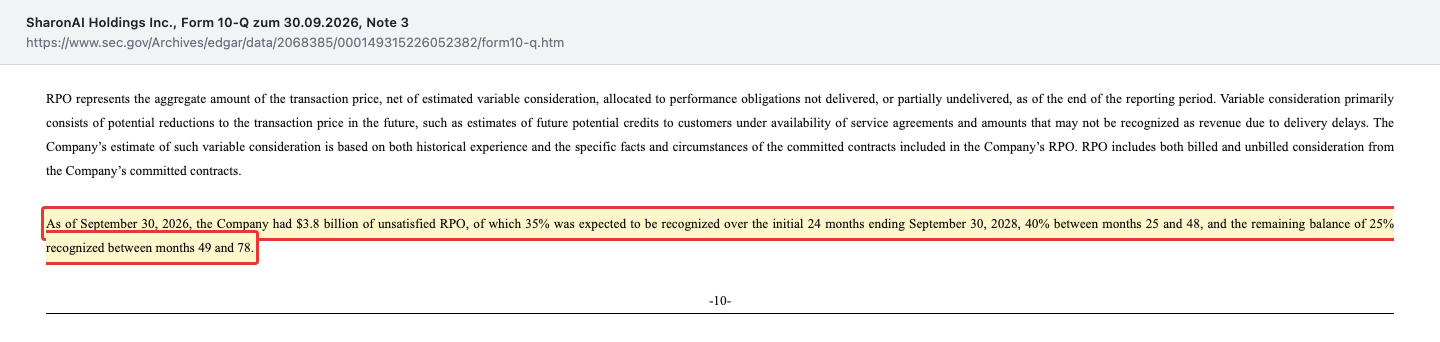
Between $9.6 billion and $3.8 billion lies $5.8 billion. Part of that can be explained from the reports. The two figures have different cut-off dates: after September 30, 2026, according to the quarterly report, two contracts of about $1.0 billion and $170 million were added. Take those out and about $4.6 billion remains for which the report provides no bridge. Two sentences from the documents belong side by side, though: in the release, the CEO says the contract value includes only the minimum price for about 40,000 graphics processors from the NVIDIA program. The quarterly report confirms that the agreement includes minimum revenue provisions, which are, however, subject to third-party utilization, service availability and other contractual adjustments — and continues:
“The arrangement does not specify a fixed aggregate contractual value because the consideration depends on utilisation, third-party revenue and the contractual adjustment provisions.”
— SharonAI Holdings Inc., SEC quarterly report 10-Q for September 30, 2026, Note 20 “Commitments”
NVIDIA’s role is unusual, and you should know it. According to the quarterly report for June 30, 2026, the collaboration is built so that SharonAI sells the computing capacity to third parties, while NVIDIA earns on the sale of the hardware and in addition receives a share of the cloud revenue. In connection with this agreement, SharonAI has committed to procure computers and infrastructure for about $4 billion. NVIDIA is thus two things at once for SharonAI: supplier of the chips and contract partner in the project for which the largest individually named procurement obligation exists.
And even a firm contract is not firm for its entire term. For the 60-month ESDS contract, the mandatory filing of April 1, 2026, says: “The Customer may not terminate the Service Order for convenience during the first 36 months of the Service Order Initial Term.” So during the first 36 months, the customer cannot cancel without cause. What applies afterward, the filing does not spell out; it only mentions that compensation payments are due on early termination, without stating their amount. For context: the four individually quantified large contracts add up to about $3.89 billion. That is slightly more than the $3.8 billion that the report shows as remaining performance obligations; the report does not allocate that figure to individual contracts. The order of magnitude fits the four contracts, not the $9.6 billion.
Uncomfortable truth No. 2: The bills come before the revenue — and the financing is not secured
Anyone who rents out computing power has to buy the computers first. The quarterly report quantifies this: on September 30, 2026, SharonAI had commitments totaling $5.3 billion; after the cut-off date, about $50 million more were added. The balance sheet of the same day already showed $1,236.6 million of open supplier invoices, mainly for facilities under construction. Against that stood $1,341.3 million of unrestricted cash. In the section on the company’s ability to continue operating, the report draws a clear conclusion:
“The Company will be required to maintain access to additional sources of financing in order to meet all of these commitments.”
— SharonAI Holdings Inc., SEC quarterly report 10-Q for September 30, 2026, Note 1 “Going Concern”
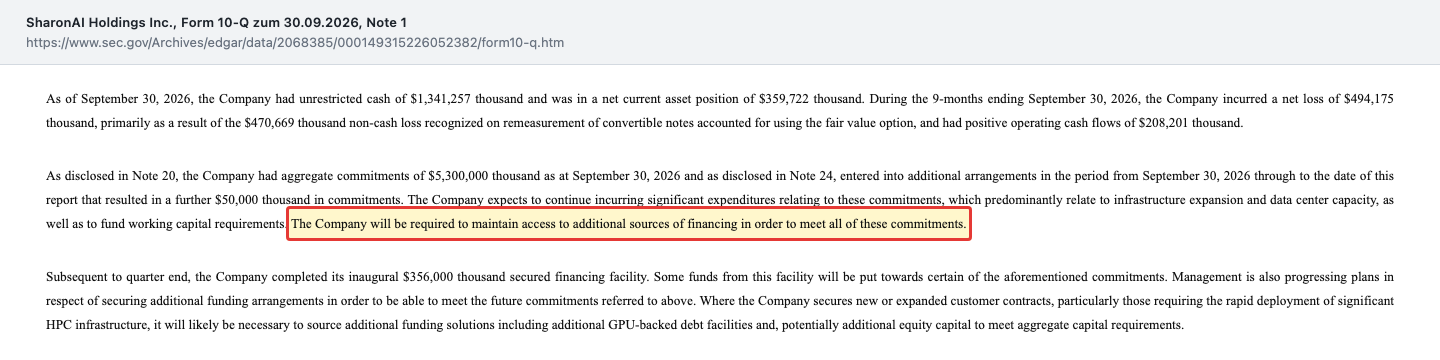
Management nevertheless concludes that the company can meet its obligations for at least twelve months. The reasoning: if need be, it could stretch the build-out and cut spending. There is a first building block: on September 28, 2026, two subsidiaries signed a credit agreement for up to $356 million, secured by the graphics processors and the rights under a customer contract. According to the mandatory filing, the interest rate for the larger part is fixed at 9.95 percent a year; the loan is to be repaid in a single sum 42 months after the first drawdown. For two of the large contracts — ESDS and the AI lab — the planned debt financing of the computers has not yet been bindingly agreed. The quarterly report puts it this way: “However, no binding financing arrangements have been finalised or locked in as at the date of this document.” In other words, as of the date of the report, no binding financing agreements had been concluded or fixed.
Honesty requires pointing out a blur in the report itself. The $5.3 billion appears in the notes (Note 1), and management bases its going-concern assessment on it. The management discussion in the same document, by contrast, says contractual purchase and infrastructure commitments totaled approximately $1 billion as of September 30, 2026. The report does not explain how the two figures fit together; elsewhere, the notes distinguish between orders that are already binding and purchases that are merely planned.
Is it all worth it? The filings give no margin per contract. For one contract, though, both sides stand next to each other: against the AI lab contract of $1.32 billion over five years, the quarterly report sets estimated capital expenditure commitments of $746 million. Out of the difference, data center rent, power, operations and interest still have to be paid — and after five years, the computers are five years old.
Translated into the image from the beginning: the contractor has the orders, part of the materials and a first loan. For the larger part of the materials, he is still looking for the bank. On top come the two convertible notes totaling $1.05 billion: they cost about $54 million of interest a year (6.00 percent on $350 million, 4.75 percent on $700 million) — more than four times the revenue of the first nine months of 2026. The business model resembles that of other data-center builders we have looked at, such as Applied Digital.
Uncomfortable truth No. 3: Delay can cost contract term — and the first reported delivery date is behind us
The quarterly report’s risk factors contain a paragraph that is unusually blunt. SharonAI has committed in its customer contracts to deliver certain quantities of graphics processors by certain dates. For every day of delay, the term could be shortened; if acceptance fails by certain deadlines, the customer may be entitled to terminate. And then:
“Investors should understand that execution risk is extremely high in the critical 2026–2027 period, and that any delay directly reduces the aggregate revenue that can be generated over the life of the various customer contracts.”
— SharonAI Holdings Inc., SEC quarterly report 10-Q for September 30, 2026, Item 1A “Risk Factors”
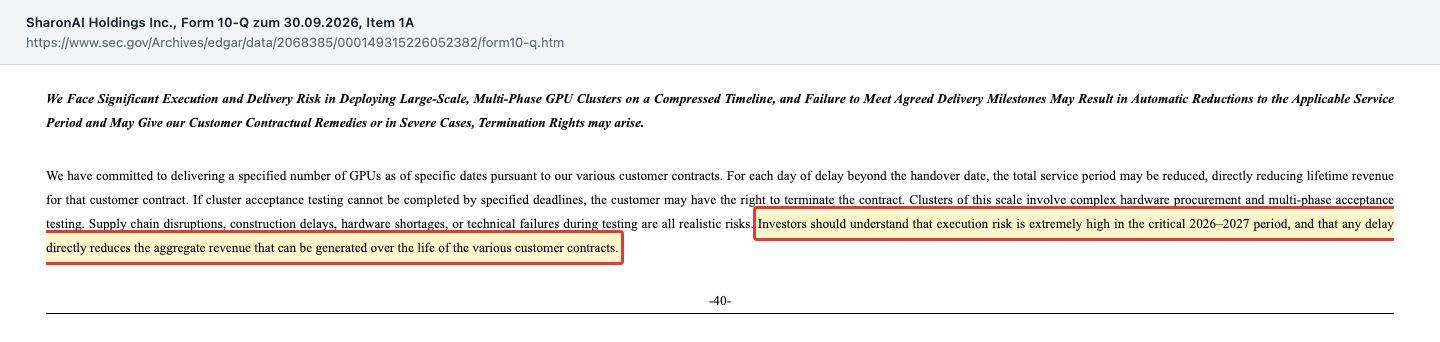
This is no mere boilerplate. For the first large contract, the mandatory filing of April 1, 2026, names a date: the ESDS facility with about 8,200 graphics processors is to be delivered by September 16, 2026, subject to the contract terms. Two months after that date, on November 16, 2026, the company reports the status: the data center is powered up, and the computers are going through final commissioning, testing and a review by NVIDIA. Management expects completion for ESDS and the technology company in December 2026 and January 2027. Whether the date was moved by mutual agreement, and whether the later start shortens the term or triggers credits, neither the release nor the quarterly report says.
The most important figure in the release hangs on that start. Annualized run-rate revenue (ARR: the expected monthly revenue times twelve) from ongoing contracts stood at about $50 million in September 2026. For January 2027 the company expects $400 million to $450 million. That would be eight to nine times as much within four months. The release expressly says the figure is not a revenue forecast. At least: according to the release, power is available at all sites with customer contracts without having to wait for a grid expansion. How capital-hungry this business is even for larger providers is shown by our analysis of Nebius, another renter of AI computing power.
Uncomfortable truth No. 4: Accounting is not keeping pace
A company that still counted 25 heads in March 2026 has moved billions since then. The quarterly report states openly that the controls for this are not sufficient. It reports a material weakness in internal controls. In an everyday image: there is a cash register, but not yet enough people to count it, and too little separation between the one who books and the one who checks. The first sub-item on the list reads:
“Insufficient accounting and financial reporting resources and technical expertise to appropriately apply U.S. GAAP to complex financial instruments and transactions.”
— SharonAI Holdings Inc., SEC quarterly report 10-Q for September 30, 2026, Item 4 “Controls and Procedures”
That this has practical consequences is shown by the same report in Note 2. As of June 30, 2026, a restricted balance from a customer deposit was understated by $187.9 million, as were the related liability and the cash inflow from operations. The report corrects this and states that net loss and accumulated deficit were not affected:
“In addition, it was identified that the Restricted cash and cash equivalents balance was understated by $187,901 thousand as of June 30, 2026 in respect of a customer deposit received during the three-month period ending June 30, 2026, with a corresponding understatement of Contract liabilities, non-current.”
— SharonAI Holdings Inc., SEC quarterly report 10-Q for September 30, 2026, Note 2 “Reclassifications and correction of an error”

It is not the only correction of the year. SharonAI filed the report for the second quarter on August 6, 2026, and five days later in a corrected version (10-Q/A), because prior-year figures for earnings per share and share count were wrong. A mandatory filing of September 23, 2026, was initially filed under the heading “change of auditor,” when a press release was meant; the correction followed the same day. And in the management discussion of the latest quarterly report, a half-sentence still sits in square brackets, as is usual in drafts: “[and accordingly the quarter reflects only an initial contribution from these contracts]”. Add to that the gap mentioned above between the notes ($5.3 billion of commitments) and the management discussion (approximately $1 billion). None of this changes a result. Together it fits what the report itself identifies as a material weakness.
The auditor belongs in the picture. On January 6, 2026, the firm HoganTaylor replaced its predecessor CBIZ CPAs, which had issued no audit report during its tenure. HoganTaylor audited the 2025 and 2024 financial statements without qualification; it was not engaged to audit internal controls. According to the 2025 annual report, management identified the material weakness; the current report on the auditor change of September 24, 2026, describes it as a material weakness identified by HoganTaylor. On September 20, 2026, SharonAI informed the firm that it would not continue the audit; since September 23, 2026, Ernst & Young has been engaged. According to the mandatory filing, there were no disagreements with HoganTaylor. The move to one of the four large audit firms is a step forward in itself, as is the new finance leadership: Anuj Goel has been CFO since August 24, 2026, joined, according to the quarterly report, by a head of accounting and further specialists. A financial statement fully audited by Ernst & Young does not exist yet, though; the first will be the one for 2026.
Uncomfortable truth No. 5: Your slice of the pie shrank to less than a third in 2026
On December 31, 2025, there were 11,832,164 Class A shares. On September 30, 2026, there were 38,341,987 — more than three times as many. That is called dilution: the pie is cut into more pieces, and your piece gets smaller. If you held one percent of the company at the end of 2025 and bought nothing more, you hold about 0.3 percent today.
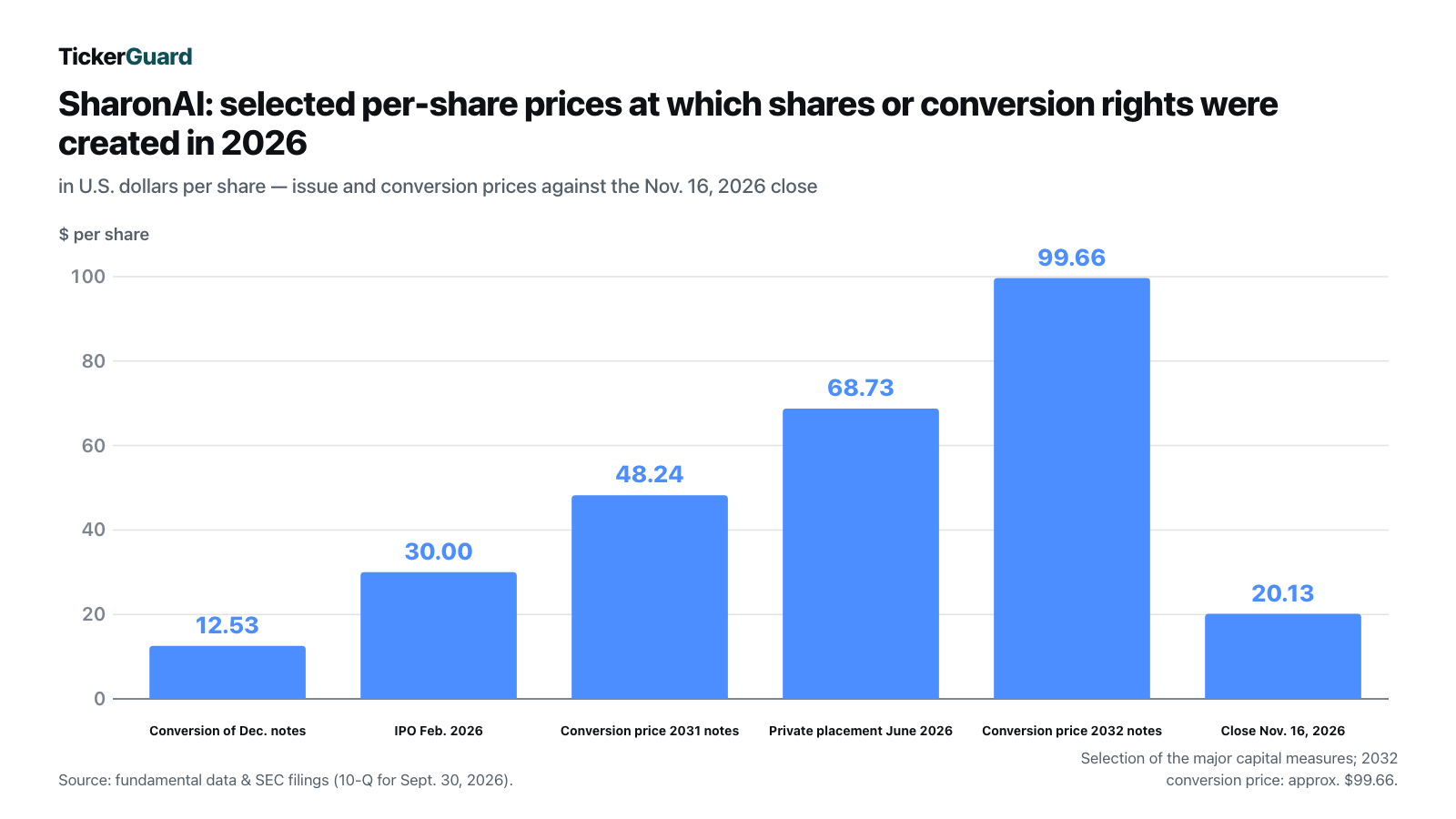
The prices at which the new shares came into being are far apart. The holders of the December notes got their shares cheapest: $12.53. In the February IPO it was $30. The investors in the June 2026 private placement bought at the highest price: $68.73 per share for 6,719,896 shares, plus prepaid warrants for a further 6,374,823 shares — about $900 million together. At the closing price of $20.13 on November 16, 2026, these buyers are down about 71 percent.
For the two convertible notes, the price decline has a special meaning. Conversion happens only if it pays off for the holders, that is, if the stock stands above the conversion price: $48.24 for the note due 2031, about $99.66 for the note due 2032. From the closing price of November 16, 2026, the stock would have to rise to 2.4 times and to almost five times that level, respectively. If that does not happen, the $1.05 billion is simply debt that has to be repaid in 2031 and 2032. If conversion does happen, about 14.3 million new shares would be created at the initial conversion prices, according to the quarterly report, and at most 24.2 million according to the risk factors in the same report. Together with options, share commitments and warrants (1.4 million), that would be about 41 percent of today’s share count at the initial conversion prices, and about two-thirds at the ceiling. As long as the notes are outstanding, SharonAI also may not pay a dividend without the creditors’ consent.
One more detail on power within the company: besides the Class A shares there are 136,341 Class B shares with 160 votes each. According to the annual report for 2025, they are held by three shareholders: entities related to CEO James Manning, co-founder Andrew Leece and Nicholas Hughes-Jones, the head of business development (as of March 2026). That makes 21.8 million votes together — measured against the 38.3 million votes of Class A, about 36 percent of all votes, at 0.35 percent of all shares.
Valuation — what the November 16, 2026 close demands
How expensive is the stock? At the closing price of $20.13 on November 16, 2026, and a combined 38,478,328 shares outstanding of both classes (as of November 10, 2026, per the cover page of the quarterly report), SharonAI has a market value of about $775 million. A price-to-earnings ratio cannot be calculated because there are no earnings.
Depending on which number you hold it against, the stock looks very expensive or very cheap — and that is the order-pad trap in its purest form. Measured against revenue over the last four quarters of $12.5 million, the company costs 62 times revenue. Measured against the annualized run-rate revenue of September 2026 (about $50 million), it is a good 15 times. Measured against the $400 million to $450 million the company expects for January 2027, it would be less than twice. And measured against equity of $1,084.5 million ($28.18 per share), the stock trades at about 71 percent of book value — market value is even below unrestricted cash of $1,341.3 million as of September 30, 2026.
Cheaper than its own cash: that sounds like a bargain, but it is not a calculation that works out. The cash is spoken for. Against it stand $1,236.6 million of open supplier invoices and $1.05 billion of convertible notes, plus the $5.3 billion of commitments for further build-out. A large part of the equity is tied up in facilities under construction ($1,385.0 million), which earn money only once they are accepted.
So what does the price demand? Less than the headline suggests. A market value of $775 million for a company that credits itself with $9.6 billion of contract value can be read to mean that delivery, commissioning and financing are still outstanding and that more shares or debt may become necessary. The company itself points to this: for new or expanded customer contracts, it will likely need further loans secured by graphics processors and possibly additional equity.
Risks and opportunities at a glance
What speaks for SharonAI:
- $1,341.3 million of unrestricted cash and $1,084.5 million of equity (September 30, 2026).
- Through September 30, 2026, four individually quantified large contracts totaling about $3.89 billion, followed by two more of about $1.0 billion and $170 million; $3.8 billion of remaining performance obligations and $329.4 million of customer deposits already received.
- The first partial facility with about 1,000 graphics processors was accepted by the customer in August 2026; revenue rose to $9.9 million in the third quarter of 2026.
- According to the release of November 16, 2026, power is available at all sites with customer contracts.
- A first secured loan of $356 million with Goldman Sachs participating; according to the company, more than $2.6 billion of capital raised since December 2025.
- New finance leadership and a switch to Ernst & Young as auditor (September 2026).
What speaks against it:
- $5.3 billion of commitments and $1,236.6 million of open supplier invoices against $1,341.3 million of unrestricted cash; according to the report, further financing is required and for two large contracts has not yet been agreed on a binding basis.
- The company itself calls the execution risk for 2026 to 2027 “extremely high”; the delivery date of the first large contract named in the current report of April 1, 2026 (September 16, 2026) has passed; according to the company, commissioning and testing are still under way. Whether the date was adjusted has not been published.
- Dependence on few counterparties: NVIDIA as supplier and partner, a few large customers, third-party data centers.
- Operating loss of $37.5 million in the third quarter of 2026 on $9.9 million of revenue.
- Share count more than tripled in 2026; $1.05 billion of convertible notes whose conversion prices lie far above the stock price.
- Material weakness in internal controls, a corrected reporting error of $187.9 million, two changes of auditor in nine months.
A human conclusion
Back to the order-pad trap from the beginning. Its core is not that the orders were invented. The contracts are filed with the SEC, customers have prepaid $329.4 million, and the first facility is running. Its core is that a big number makes you forget the sequence: first come the bills, then the delivery, then the acceptance — and only then the revenue. At SharonAI, between the order pad and the bank statement stand $5.3 billion that someone still has to advance, and a schedule that the company itself calls extremely risky.
So the honest question for you is not “Is $9.6 billion a lot?” but: do you trust a company not yet three years old to get computers worth billions onto the grid on time — and to find backers for it without your share shrinking again the way it did in 2026? If your answer is yes, you should know: a market value below equity is no cushion, because the cash is spoken for. If your answer is no, you have on your side the sentence about the extremely high execution risk — it comes from the company itself. What you make of it is your decision. And that is how it should be.
Sources
All original documents used in this analysis — to read for yourself:
- SharonAI Holdings Inc. — SEC quarterly report 10-Q for September 30, 2026 (filed November 16, 2026)
- SharonAI Holdings Inc. — Earnings release for the third quarter of 2026 (8-K Item 2.02, Exhibit 99.1, filed November 16, 2026)
- SharonAI Holdings Inc. — SEC quarterly report 10-Q for June 30, 2026 (filed August 6, 2026) and corrected version 10-Q/A (filed August 11, 2026)
- SharonAI Holdings Inc. — SEC quarterly report 10-Q for March 31, 2026 (filed May 15, 2026)
- SharonAI Holdings Inc. — SEC annual report 10-K for 2025 (filed March 31, 2026)
- SharonAI Holdings Inc. — Current report 8-K of April 1, 2026: contract with ESDS Software Solutions
- SharonAI Holdings Inc. — Current report 8-K of April 28, 2026: $350 million convertible note
- SharonAI Holdings Inc. — Current report 8-K of June 25, 2026: private placement and $700 million convertible note
- SharonAI Holdings Inc. — Current report 8-K of October 1, 2026: secured loan of $356 million
- SharonAI Holdings Inc. — Current reports on the auditor: 8-K of January 7, 2026 and 8-K of September 24, 2026; corrected filing 8-K/A of September 23, 2026
- Complete SEC filing history of SharonAI Holdings Inc.: EDGAR overview (sec.gov)
- Fundamental data (prices, market value; as of November 17, 2026), reconciled with the SEC filings.
Transparency & disclaimer: this analysis is journalistic commentary on publicly available information. It is not investment advice, not a regulated investment research product and not a solicitation to buy or sell securities. Equity investments carry substantial risk up to and including total loss. All information is provided without warranty; the as-of date for each figure is stated in the text. Positions held by the operator are disclosed daily; where one exists, it appears as a notice at the top of this deep dive.
Key figures at a glance
All monetary figures in millions of $; earnings per share as reported.
| Metric | 2024 | 2025 |
|---|---|---|
| Revenue | 0.4 | 1.6 |
| Operating Income (EBIT) | -4.3 | -14.8 |
| Net Income | -3.9 | -39.6 |
| Net Margin | -891.0% | -2,529.2% |
| Earnings Per Share | -0.34 $ | -2.18 $ |
Source: fundamental data & SEC filings (annual and quarterly reports, 10-K/10-Q)
Our Bottom Line at a Glance
- Order book neutral
- Through September 30, 2026, four individually quantified large contracts totaling about $3.89 billion (followed by two more of about $1.0 billion and $170 million), $3.8 billion of remaining performance obligations and $329.4 million of customer deposits received (September 30, 2026). The contract value of about $9.6 billion cited in the release is not a balance-sheet measure; the report contains no bridge to the $3.8 billion, and for the NVIDIA agreement it names minimum revenue provisions but no fixed aggregate value.
- Cash & equity positive
- $1,341.3 million of unrestricted cash and $1,084.5 million of equity as of September 30, 2026, after minus $10.1 million of equity at the end of 2025. The cash is spoken for, though: $1,236.6 million of open supplier invoices stand against it.
- Financing the build-out negative
- Commitments of $5.3 billion as of September 30, 2026. According to the quarterly report, access to further sources of financing is required; for the contracts with ESDS and the AI lab, no financing was binding as of the report date. Secured: a first loan of up to $356 million — a fixed 9.95 percent for the larger part (up to $206 million), and for the rest initially 7.25 percent, rising to as much as 9.95 percent.
- Execution negative
- Third-quarter 2026 revenue of $9.9 million against a $37.5 million operating loss. The company itself calls the execution risk for 2026 to 2027 “extremely high.” The delivery date of the ESDS contract named in the current report (September 16, 2026) has passed; the company expects to complete commissioning, testing and NVIDIA verification in December 2026 and January 2027. Whether the date was adjusted has not been published.
- Dilution & debt negative
- The number of Class A shares rose from 11.8 million (December 31, 2025) to 38.3 million (September 30, 2026). Convertible notes of $1.05 billion have conversion prices of $48.24 and about $99.66 — at the $20.13 price (November 16, 2026) they are debt, due 2031 and 2032.
- Controls & reporting negative
- Material weakness in internal controls as of September 30, 2026; corrected reporting error of $187.9 million from the prior quarter; two changes of auditor within nine months. Countermeasures are under way: a new CFO since August 24, 2026, Ernst & Young as auditor since September 23, 2026.
SharonAI is the order-pad trap on a large scale: the release of November 16, 2026, cites about $9.6 billion of contract value, the quarterly report $3.8 billion of remaining performance obligations and $9.9 million of quarterly revenue. Real are the contracts, the customer deposits of $329.4 million and the unrestricted cash of $1,341.3 million. Open is whether the company delivers computers worth billions on time and gets the $5.3 billion of commitments financed — after a year in which the share count more than tripled. Not investment advice.
What Our Rating Means
Substance risk
We found at least one documented issue that threatens the company itself — regardless of how the stock is currently valued.
The filings show a risk to the company’s substance: commitments of $5.3 billion stand against $1,341.3 million of unrestricted cash, and the company itself writes that it depends on further sources of financing; for the computers of two large contracts, no debt financing was bindingly agreed as of November 16, 2026. On top come the dependence on NVIDIA and a few large customers, an execution risk that is extremely high in the company’s own words, and a material weakness in internal controls. Management considers the company’s continuation secure because it can stretch the build-out if necessary. Between yellow (open operational questions) and red (risk to substance), we therefore chose the more cautious level. That the stock trades below equity does not change this rating — it assesses the company, not the price.
A journalistic assessment by our editorial team at the time of the deep dive, based on public sources — not investment advice and not a solicitation to buy or sell. Your personal circumstances (investment goals, risk capacity, taxes) cannot be taken into account. What our levels mean, how verdicts are formed, and what conflicts of interest exist →
Worth Noting
- The trigger for this analysis was the quarterly report (10-Q) of November 16, 2026, for the quarter ended September 30, 2026, together with the earnings release of the same day; every filing made since then was reviewed.
- Total Contract Value and annualized run-rate revenue (ARR) are company-defined metrics outside U.S. accounting rules. Remaining performance obligations (RPO) are a measure under the accounting rules; the report contains no bridge between contract value and RPO.
- Market value is calculated from the share count on the quarterly report’s cover page (38,478,328 shares of both classes, November 10, 2026) and the closing price of November 16, 2026. Prices from before the Nasdaq listing in February 2026 date from the shell-company period and were not used.
Stock Watch
This analysis is as of November 18, 2026. Stock Watch will tell you what's changed at SHAZ since then.
Later $1 a month per stock — signing up is free, and you'll be the first to know when it launches.
The full analysis as a PDF for later
We will send you this analysis as a PDF — to print, file away, and read at your own pace. And we will add you to the free Stock Watch list for SharonAI Holdings Inc. (SHAZ), so you hear about it when something material in this analysis changes.
Frequently Asked Questions
SharonAI Holdings Inc. (Nasdaq: SHAZ) rents out computing power for artificial intelligence. The company buys NVIDIA graphics processors, assembles them into large compute clusters in leased data centers in Australia and New Zealand, and rents out their capacity under multi-year contracts. The operating company was founded in February 2024; the stock has been listed on the Nasdaq since February 2026.
No. In the third quarter of 2026, revenue of $9.9 million was set against an operating loss of $37.5 million and a net loss of $43.8 million. In the first nine months of 2026 the net loss was $494.2 million, of which $470.7 million came from a valuation effect on the conversion of notes, in which no cash flowed out. In 2025 the net loss was $39.8 million.
The figure is called Total Contract Value and comes from the earnings release of November 16, 2026. According to the company, it is an operating metric and not revenue under U.S. accounting rules. The quarterly report shows remaining performance obligations of $3.8 billion as of September 30, 2026, spread over 78 months. Revenue for the third quarter of 2026 was $9.9 million.
On September 30, 2026, SharonAI had $1,341.3 million of unrestricted cash. Against that stood $1,236.6 million of open supplier invoices and commitments totaling $5.3 billion. According to the quarterly report, the company needs further sources of financing for them. A first secured loan of up to $356 million was agreed on September 28, 2026.
NVIDIA supplies the graphics processors and is also the partner in a six-year collaboration concluded in June 2026 for up to 40,000 graphics processors in Australia. According to the quarterly report, this agreement includes minimum revenue provisions but no fixed aggregate contract value because the consideration depends on utilization and third-party revenue. In this context, SharonAI has committed to purchases of about $4 billion.
The number of Class A shares rose from 11.8 million on December 31, 2025, to 38.3 million on September 30, 2026, more than triple. In addition, convertible notes of $1.05 billion are outstanding, which can be exchanged for about 14.3 million shares at the initial conversion prices, and for up to 24.2 million according to the risk factors. Their conversion prices of $48.24 and about $99.66 were far above the $20.13 price of November 16, 2026.
The quarterly report for September 30, 2026, discloses a material weakness in internal controls: too few accounting specialists, insufficiently documented closing controls and a lack of segregation of duties. The same report corrects a reporting error of $187.9 million from the prior quarter. According to the report, net loss and accumulated deficit were not affected.
Found an error?
Did you spot a factual error, an outdated number, or a typo in this deep dive? Let us know briefly — your report goes straight to the editorial team.