Global Mofy Stock: AI Wiped Out Its Own 3D Library — and Almost 54 Million New Shares Are Paying for It
Beijing-based Global Mofy calls itself an AI company, and as of March 31, 2026, it wrote off $38.4 million of purchased 3D models because artificial intelligence now generates such models in minutes. Since then the number of listed shares has gone from 0.92 million to 54.59 million; the latest 45 million went to investors at 22 cents while the stock closed at $1.04. On November 16, 2026, the price nearly doubled. Not investment advice — just the math on who actually got the discount on this stock.
 Thomas Mücke
Founder & Publisher
As of Today
As of: November 17, 2026
- Closing price
- 2.00 $ +97.06%
- Market Capitalisation
- 0.1 $B
Price change since November 16, 2026: -0.5%
This analysis has a cut-off date. The Stock Guard tells you when something material changes in the numbers. Reserve your free spot
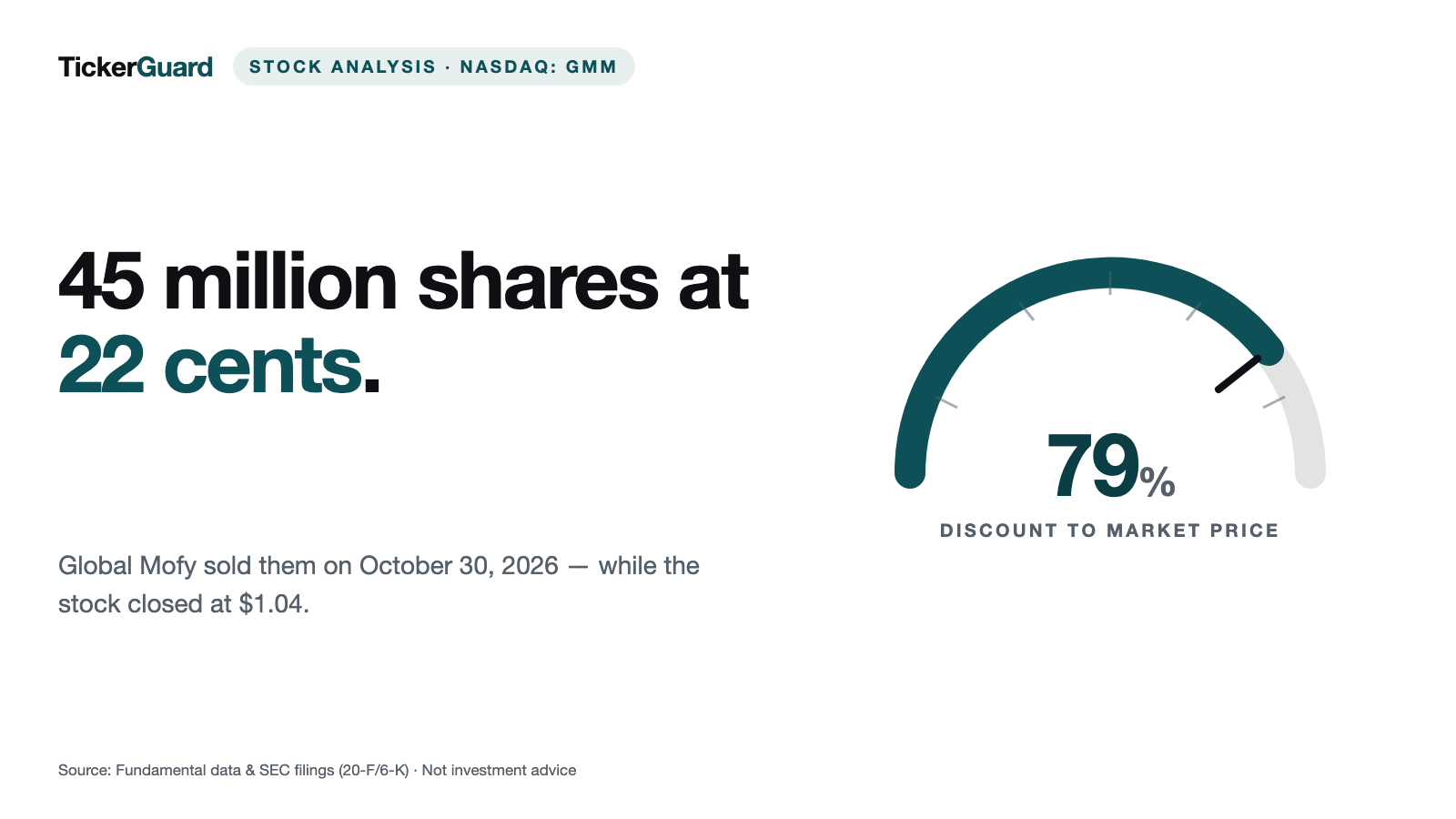
Chart
Interactive price chart (TradingView).
Last price: 2.00 $ (As of: November 17, 2026)
Note: pure fact-based analysis, not investment advice and not a solicitation to buy or sell. All figures without guarantee.
On January 9, 2026, Global Mofy (Nasdaq: GMM) wrote in its annual report that 3D digital assets would become “increasingly valuable.” As of March 31, 2026, the same company set purchased 3D models carried at $38.44 million to zero — because artificial intelligence now generates them in minutes. And on October 30, 2026, it sold 45 million new shares at 22 cents apiece while the stock closed at $1.04.
A little over two weeks later, on November 16, 2026, the stock closed at $2.01, after $1.02 the trading day before. On that single day 112.8 million shares changed hands according to fundamental data — a good two times the number of listed shares that exist. And the price history shows a 52-week high above $90. This is where an old investor weakness lurks, the strikethrough-price trap: a crossed-out old price makes the new one look cheap, even when it is not. Psychologists call it anchoring.
So let's count for ourselves — in the reports Global Mofy has to file with the U.S. securities regulator, the SEC. The tension that runs through this analysis: revenue is growing — but the share count is growing very much faster. The crossed-out price on this stock is not a discount. It is the result of two reverse splits.
What Global Mofy Actually Does — 3D Worlds for Film, Advertising and AI Training
Global Mofy AI Limited is based in Beijing, legally a Cayman Islands company, and has been listed on Nasdaq since October 2023. Until August 2024 it was called Global Mofy Metaverse Limited — first the metaverse was in the name, now artificial intelligence. The business behind it is more down to earth than either label: Global Mofy builds virtual imagery for films, television series, advertising and games. In everyday terms: a set workshop that builds its sets on a computer instead of out of wood. The filings describe three pillars: virtual technology services (fixed-price contract work, most recently about 68 percent of revenue), the development and licensing of digital assets (customers pay for the right to use 3D models of characters, props and scenes) and, since October 2025, the sale of digital assets to companies developing large language models. The fiscal year ends on September 30, so “fiscal year 2025” runs from October 2024 through September 2025. When we refer to the first half of fiscal 2026 below, we mean the six months from October 2025 through March 2026 — the latest period for which financial statements exist.
Does it sound like marketing when a company with 90 employees (table in the annual report as of September 30, 2025; the sentence above it in the same report says 50) describes itself as one of the leading “digital asset banks” in China, with more than 150,000 high-precision 3D models? In part, yes. But the library is real, and it cost real money — according to the notes to the financial statements it consists of models acquired from third-party suppliers. The most important number in this analysis revolves around exactly that library. The reports are prepared in U.S. dollars under U.S. GAAP; as a foreign private issuer, Global Mofy does not file quarterly reports but an annual report (20-F), interim financial statements for the half year and current reports (6-K).
Company history for investors
-
2023
IPO at $5.00
In October 2023 Global Mofy issues 1.2 million shares at $5.00. After the 1-for-15 and 1-for-50 reverse splits, that equals $3,750 per share today.
-
2024
New name, first reverse split
“Metaverse” becomes “AI” in August. After a Nasdaq notice in September, the 1-for-15 reverse split follows in November. For shareholders: the price looks higher, the stake stays the same.
-
2025
Record revenue, still a loss
Fiscal 2025: $55.9 million of revenue but a $19.3 million loss, mainly because of costly warrants. In October the auditor changes for the second time.
-
2026
Impairment of the 3D library
As of March 31, Global Mofy sets character and prop models worth $38.44 million to zero because AI generates them in minutes. For shareholders: equity is cut in half.
-
2026
1-for-50 reverse split and a flood of shares
A 1-for-50 reverse split in June, then placements at $0.538 and $0.22. For shareholders: 54.6 million Class A shares instead of 0.9 million at the end of March.
-
2026
Third reverse split pre-approved
On September 2, shareholders approve a 1-for-16 consolidation that takes effect if the price falls below Nasdaq's minimum bid. In October the CEO holds about 87.9% of the votes.
How the Stock Landed on Our Desk — In One Day, Every Share Traded Twice on Paper
The trigger was the trading: on November 16, 2026, the price rose from $1.02 to $2.01 (closing prices), the daily range ran from $1.40 to $4.81, and at 112.8 million shares, a good two times the number of listed shares changed hands on paper. There is no SEC filing from those days that cites a business reason; the company's latest filing before the jump is the closing notice for a share placement, dated November 6. Global Mofy made our research list through our in-house Reddit hype scanner — although “hype” is a big word here: according to ApeWisdom, the stock ranked 784th among the most-discussed stocks on November 17, 2026, with a single mention in 24 hours.
Classic metrics from our scanners help little with Global Mofy: there is no price-to-earnings ratio because there are no earnings, and every per-share metric is out of date with the next capital measure. We recently worked through how a reverse split followed by a flood of new shares plays out in detail at Ohmyhome. So what counts here is what the filings say.
The Numbers Over the Years: $48 Million Earned, $84 Million Spent on 3D Models
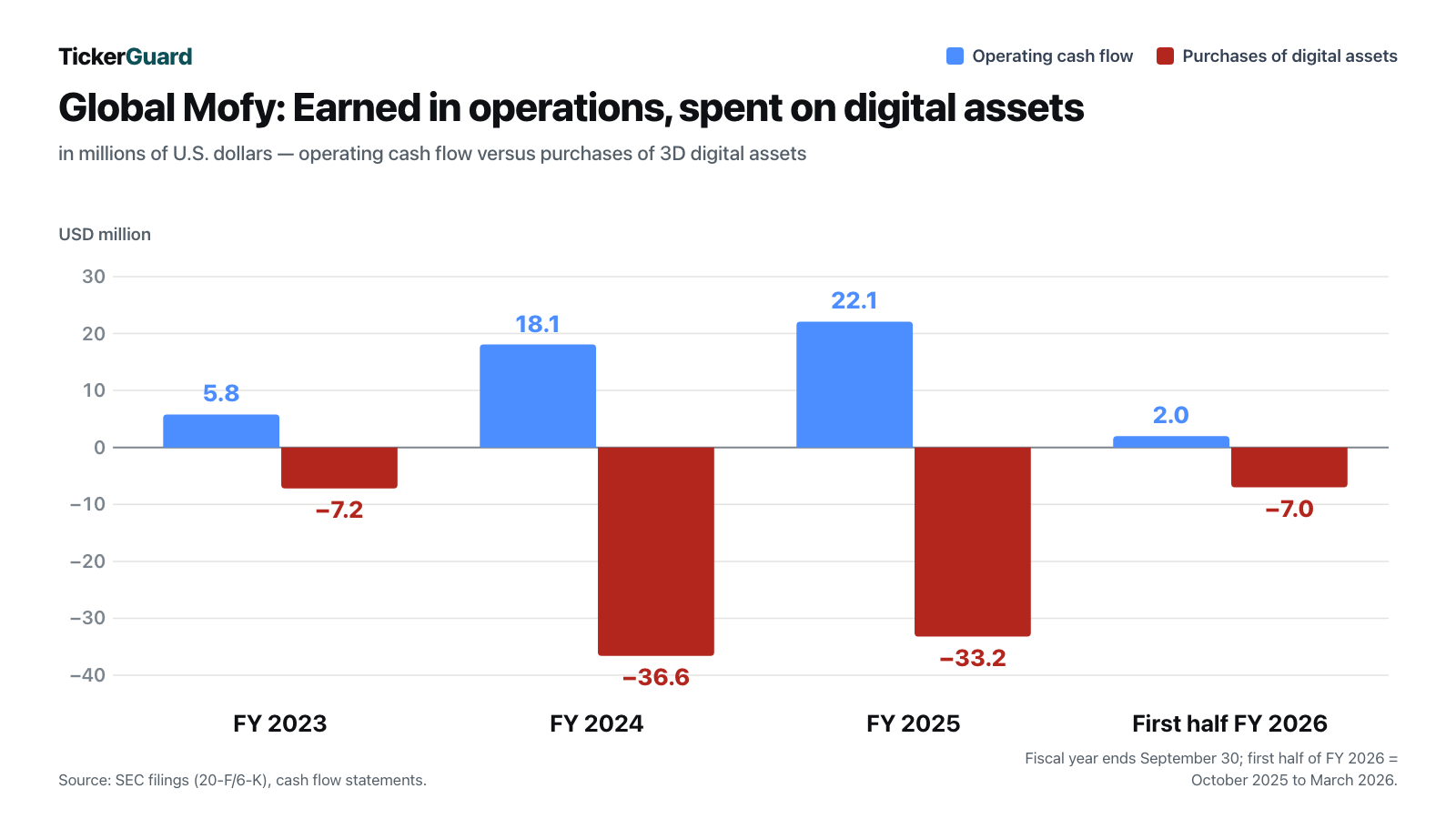
First, what deserves credit, and it is not little. Revenue has grown strongly: from $26.9 million in fiscal 2023 to $41.4 million (2024) and $55.9 million (2025). In the first half of fiscal 2026 it came to $39.9 million, 49.4 percent more than in the prior-year half. Operating income was positive in the three fiscal years 2023 through 2025 ($7.6 million, $6.8 million and $3.0 million), and operations generated cash in each of those years: $5.8 million, then $18.1 million, then $22.1 million. For a company of this size, that is a respectable record for the day-to-day business.
Now the other side. The inflow did not stay in the bank. Year after year Global Mofy bought 3D models from third-party suppliers — $7.2 million in fiscal 2023, $36.6 million in 2024, $33.2 million in 2025 and another $7.0 million in the first half of fiscal 2026. Together that is about $84 million for digital assets, against about $48 million of operating cash flow over the same period. The gap of about $36 million matches almost exactly what investors paid in for new shares and warrants over the same period according to the cash flow statements (also about $36 million).
The bottom line looks different again. In fiscal 2025, despite positive operating income, the company posted a net loss of $19.3 million — mainly because warrants issued together with new shares were, according to the annual report, worth more than the cash that came in for them (a $22.3 million charge). And in the first half of fiscal 2026, $39.9 million of revenue turned into a loss of $50.7 million. Gross margin — what is left of revenue after direct costs — fell from 44.2 percent in the prior-year half to 21.3 percent; cash stood at $2.8 million as of March 31, 2026, of which $1.5 million was restricted. Remember the sequence: first earned, then put into 3D models, then written off.
One detail from the interim financial statements deserves a second look: revenue grew 49.4 percent, but the cash came in more slowly. Receivables — invoices that have been issued but not yet paid — rose from $1.5 million to $13.3 million in six months. That is why operations generated only $2.0 million of cash in the first half of fiscal 2026, after $10.1 million in the prior-year half. Which brings us to the uncomfortable truths.
What the Filings Say — The Uncomfortable Truths
Uncomfortable Truth No. 1: AI Wiped Out the Company's Own Warehouse
On January 9, 2026, Global Mofy filed its annual report. About the 3D library it contained this sentence:
“With the rapid development of digital content industry, we believe digital assets will become increasingly valuable and have abundant use cases.”
— Global Mofy AI Limited, SEC annual report 20-F for fiscal year 2025 (filed January 9, 2026), Item 4.B “Business Overview”
Less than three months later, as of March 31, 2026, the interim financial statements read like this:
“Following the launch of the new-generation AI modeling platform, high-quality individual character and prop models that previously required manual production can now be automatically generated within minutes through AI technology based on text or image prompts.”
— Global Mofy AI Limited, interim financial statements as of March 31, 2026 (6-K of July 28, 2026, Exhibit 99.2), Note 5
The consequence follows two paragraphs further down:
“The aggregate carrying amount of these two asset groups totaled $38.44 million, and their estimated fair value was determined to be zero.”
— Global Mofy AI Limited, interim financial statements as of March 31, 2026 (6-K of July 28, 2026, Exhibit 99.2), Note 5
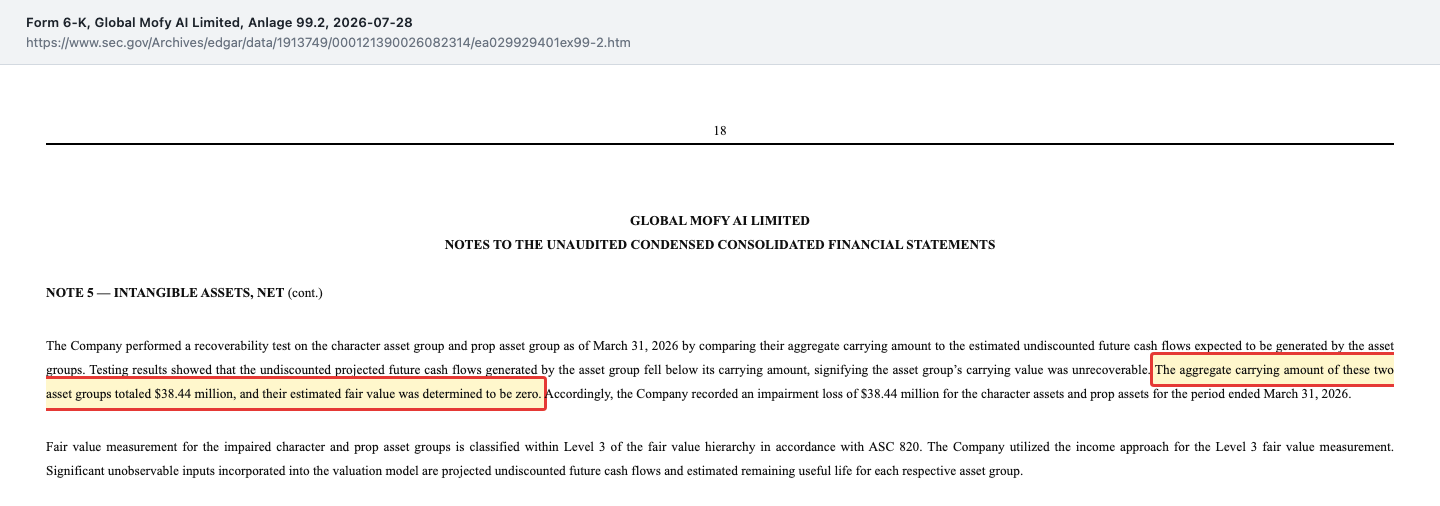
An everyday image: picture a costume rental shop that spent years and a lot of money buying costumes — and then a machine hits the market that prints any costume in minutes. The costumes still hang in the storeroom, but nobody pays a rental fee for them anymore. That is what Global Mofy describes: the $38.44 million impairment equals close to two thirds of the library's carrying amount as of September 30, 2025 ($59.7 million). Shareholders' equity halved in six months, from $62.0 million to $31.0 million. What remains is $17.3 million for complex scene models that, according to the company, cannot yet be fully replicated by AI — their expected useful life was cut from five years to three. The shift leaves marks on the day-to-day business too: licensing of digital assets brought in $7.9 million of revenue in the first half of fiscal 2026 (prior year: $11.7 million), and its gross margin fell from 53.5 percent to 2.8 percent according to the management discussion. The new business, selling digital assets to developers of large language models, brought in $4.9 million of revenue at a gross margin of 10.2 percent; according to the financial statements, what was sold were models from the company's own inventory with a remaining carrying amount of about $4.5 million (gross carrying value $4.64 million, of which only $0.18 million had been amortized). The filings do not say which groups of models those were.
To be fair: the company took the impairment itself and explained it openly, and the larger contract business grew 80 percent to $27.1 million in the same half year. But the irony stands. A company that carries artificial intelligence in its name has lost about two thirds of its largest asset to artificial intelligence.
Uncomfortable Truth No. 2: 0.9 Million Shares Became 54.6 Million
Dilution means the pie is cut into more and more slices, and yours gets smaller. At Global Mofy the pie was carved up in 2026 at a pace you have to count to believe. All figures are restated to today's shares, meaning after the 1-for-50 reverse split of June 11, 2026 (50 old shares became one new share):
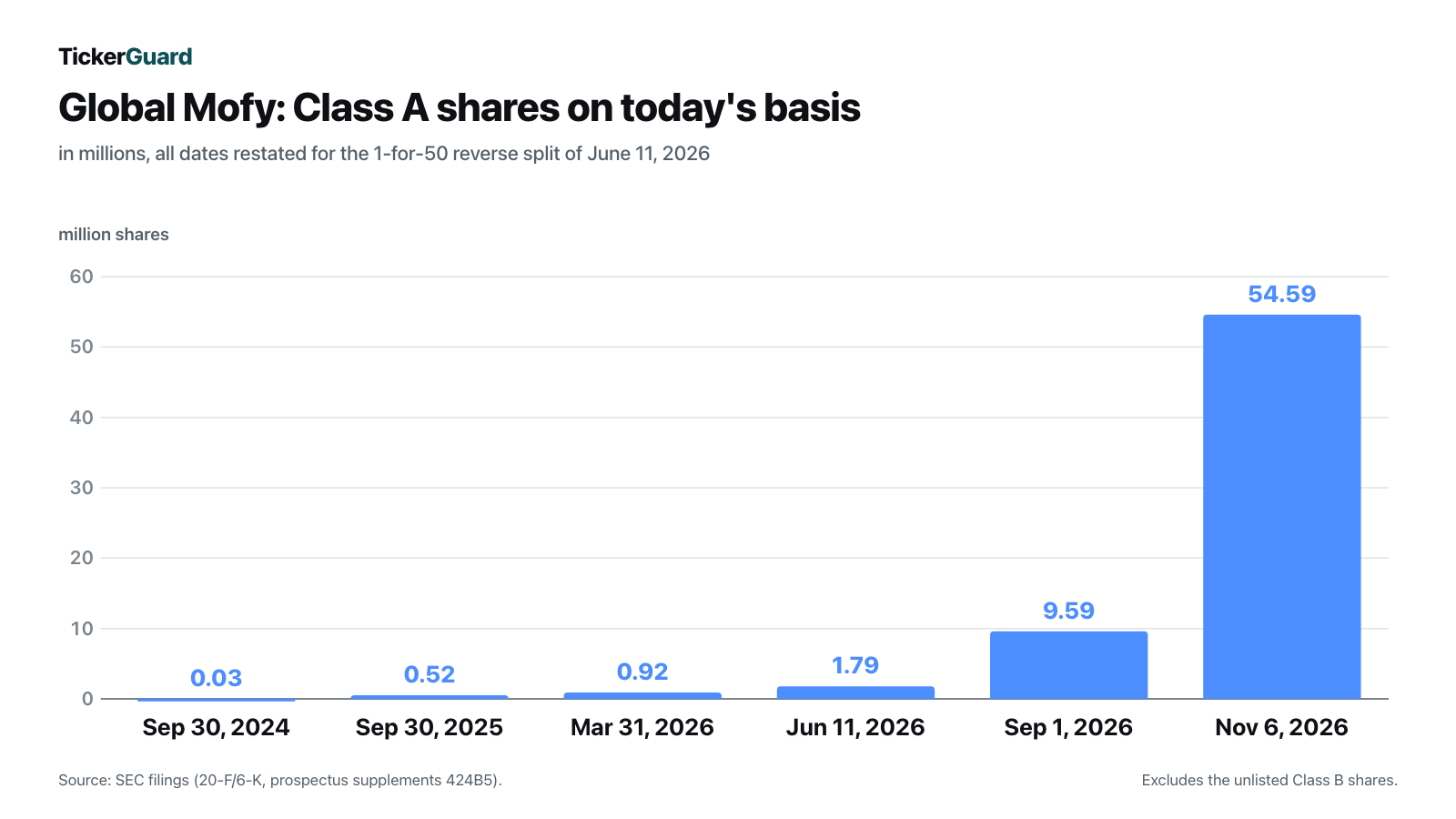
- March 31, 2026: 916,882 listed Class A shares (interim financial statements).
- May 22 to June 11, 2026: a registered direct offering for about $8 million, with two series of warrants attached. According to the prospectus supplement of November 2, the offering and the exercise of warrants together created 874,747 new shares; after the reverse split, 1,791,663 shares were outstanding.
- July 29, 2026: 2.5 million shares as payment for 2 percent of Star Touch (Beijing) Technology, priced at $0.80 per share.
- August 19, 2026: 1.5 million shares to an entity of the CEO (more on that in a moment).
- August 31, 2026: 3,796,000 shares at $0.538 to investors — against a closing price of $2.56 on August 28 according to the prospectus supplement. Count afterwards: 9,587,663 shares.
- October 30, 2026: 45 million shares at $0.22 to investors, closed on November 6. Count afterwards: 54,587,663 shares.
In a little over seven months, the number of listed shares has thus risen almost sixtyfold. In the six months before that, 400,000 shares had already been added: 300,000 from a private placement in December 2025 and 100,000 as compensation to executives. The wording of the latest placement, from the 6-K of November 2, 2026:
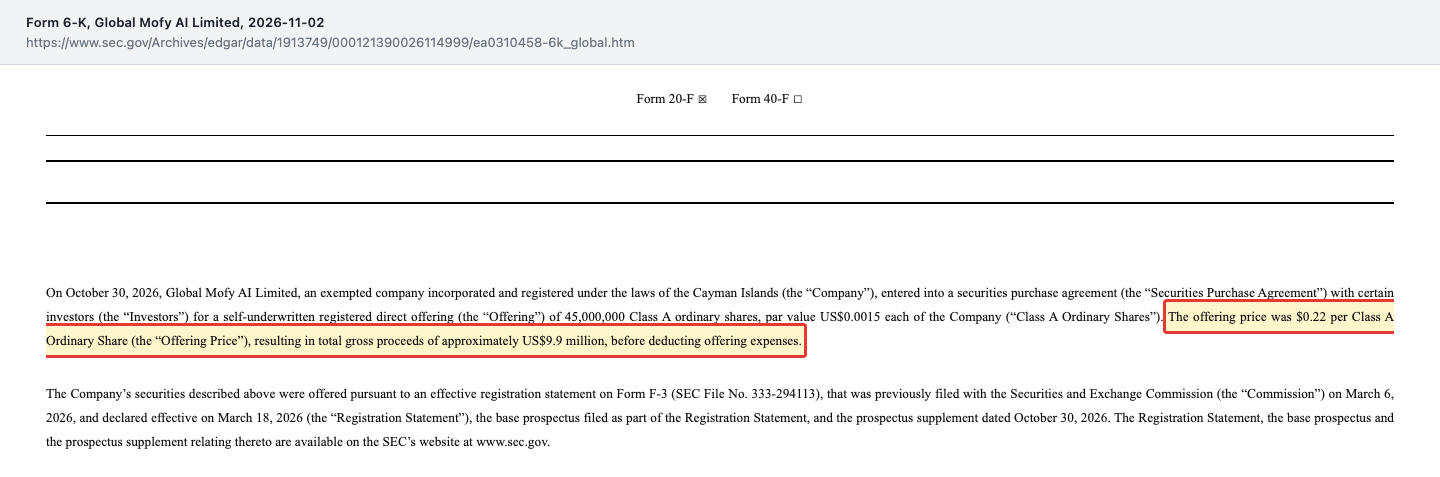
“The offering price was $0.22 per Class A Ordinary Share (the “Offering Price”), resulting in total gross proceeds of approximately US$9.9 million, before deducting offering expenses.”
— Global Mofy AI Limited, 6-K of November 2, 2026
And the sentence that belongs next to it, from the prospectus supplement for the same placement:
“On October 30, 2026, the closing price of our Class A Ordinary Shares as reported by the Nasdaq Capital Market was $1.04.”
— Global Mofy AI Limited, prospectus supplement 424B5 of November 2, 2026, cover page
Twenty-two cents against a market price of $1.04: that is a discount of about 79 percent. The end of August was the same — $0.538 against a $2.56 close, again a discount of about 79 percent. Both placements were done without a bank (“self-underwritten”), directly with investors the filings do not name. Together, 48.8 million of the 54.6 million Class A shares, about 89 percent, come from these two deals. This is where the strikethrough-price trap comes full circle: on this stock, the real discount did not go to buyers on the exchange but to the buyers of the placements.
What a placement really costs in the end is shown by the May example. On paper, Global Mofy sold shares at $0.97 on May 22, 2026 (before the reverse split), each with two warrants. Their terms allowed the exercise price to be reset as low as $0.194 and, for the second series, an exchange into shares without any payment. The result: 164,948 of today's shares were sold; together with the exercised warrants, 874,747 shares were created according to the prospectus supplement of November 2 — more than five times the number sold, for about $8 million gross. A further 774,742 shares can still come from outstanding warrants of that round (exercise price $9.70). And the shelf is not exhausted: the Form F-3 registration statement of March 2026 allows securities sales of up to $300 million in total. Because Global Mofy, as a Cayman company, relies on home country practice, it does not need the shareholder approval for such below-market issuances that Nasdaq requires of U.S. companies from 20 percent of the share capital, according to the annual report.
Uncomfortable Truth No. 3: The CEO Sits on Both Sides of the Table
On August 19 and October 19, 2026, a Global Mofy subsidiary agreed to acquire a combined 9.935 percent of a company called Qifei (Shanghai) Technology. The seller both times was James Yang Mofy Limited — an entity whose sole beneficial owner is Haogang Yang, the founder, CEO and chairman of Global Mofy. At Qifei he is the sole director and legal representative; according to the August agreement, the seller held all of Qifei's equity at the time. The 6-K of October 20 says it without detours:
“Accordingly, Mr. Yang has a material interest on both sides of the Transaction, and the Transaction constitutes a related party transaction.”
— Global Mofy AI Limited, 6-K of October 20, 2026
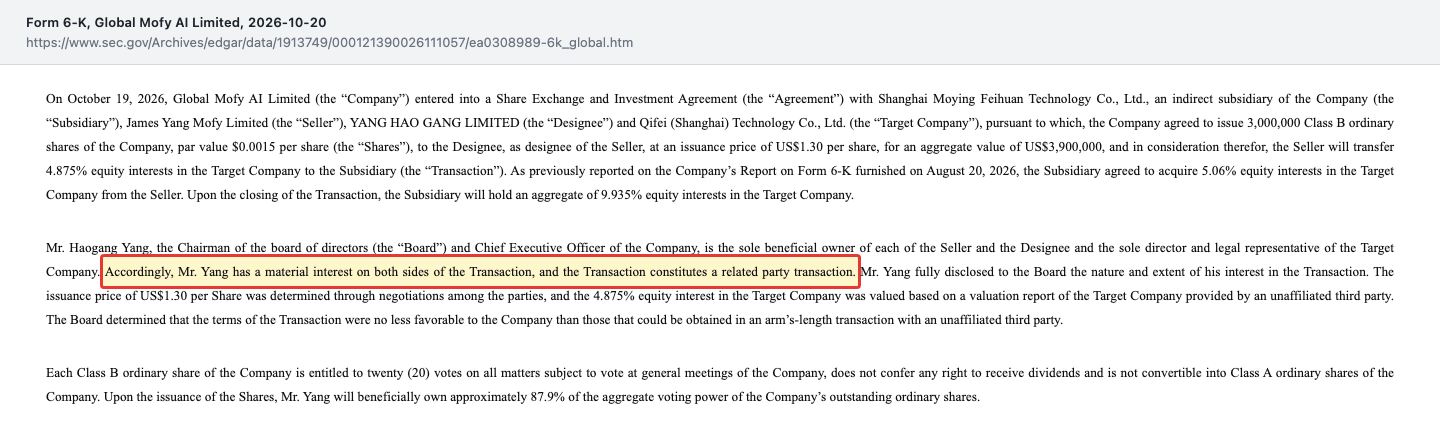
Payment was not in cash but in shares: in August, 1.5 million Class A shares priced at $2.70 (together $4.05 million for 5.06 percent); in October, 3 million Class B shares priced at $1.30 ($3.9 million for 4.875 percent). According to the 6-Ks, the shares were issued on the day of each agreement; the transfer of the stakes is subject to customary closing conditions, including Global Mofy's due diligence on Qifei and the registration in China. Both agreements value Qifei at $80 million and cite a valuation report dated August 2, 2026 — the August agreement names “China Appraisal Society” as the valuation firm, the October agreement “Beijing Zhongzhen Asset Appraisal Co., Ltd.” The filings give no revenue or earnings for Qifei. For comparison: on October 19, 2026, before the 3 million Class B shares were issued, Global Mofy itself had a market value of about $11 million (9.75 million shares at a $1.17 close according to fundamental data; our calculation). In August the audit committee, and in October the board, determined that the terms were no less favorable than those of an arm's-length transaction.
The Class B shares are the second half of the story. They are not listed and carry no dividend right — but 20 votes each. After the October issuance, Yang held about 87.9 percent of all voting power according to the 6-K. Even after the 45 million new Class A shares of November, those 3 million Class B shares alone carry 60 million of about 117.9 million votes, a good half (our calculation). Put plainly: shareholders on the exchange provide the capital, while the majority at the shareholder meeting sits with the CEO.
Another point is compensation. In the first half of fiscal 2026, Global Mofy booked $13.5 million of expense for shares issued to executives — a third of revenue; the expense costs no cash but increases the share count. That includes 4,443,027 Class B shares (on the old count; 88,860 today) for Yang as well as Wenjun Jiang (technology) and Nan Zhang (marketing) as performance compensation for fiscal 2025. The “R&D investments” of $14.4 million that the half-year press release promotes also consist, according to the financial statements, of $8.7 million of such shares. Three more points from the filings belong in the same chapter: the auditor changed twice within a little over a year (Marcum Asia until October 2024, YCM CPA until October 2025, Golden Ocean FAC PAC since; the company says there were no disagreements). The annual report names three material weaknesses in internal control over financial reporting. And CFO Chen Chen resigned on April 29, 2026; his successor is Yinping Ma.
Uncomfortable Truth No. 4: The Next Reverse Split Is Already Approved
A reverse split is like changing money: fifty one-dollar bills become one fifty. Nobody gets richer, but the price per share looks higher. Global Mofy has done it twice — 1-for-15 in November 2024, after Nasdaq had sent a notice over a price below one dollar, and 1-for-50 in June 2026. Together that is a factor of 750: 750 shares of old became one. The IPO price of October 2023, $5.00 at the time, therefore equals $3,750 per share today; the interim financial statements use that figure themselves. And the 52-week high above $90 from the opening? Those are restated prices of less than two dollars from before the reverse split.
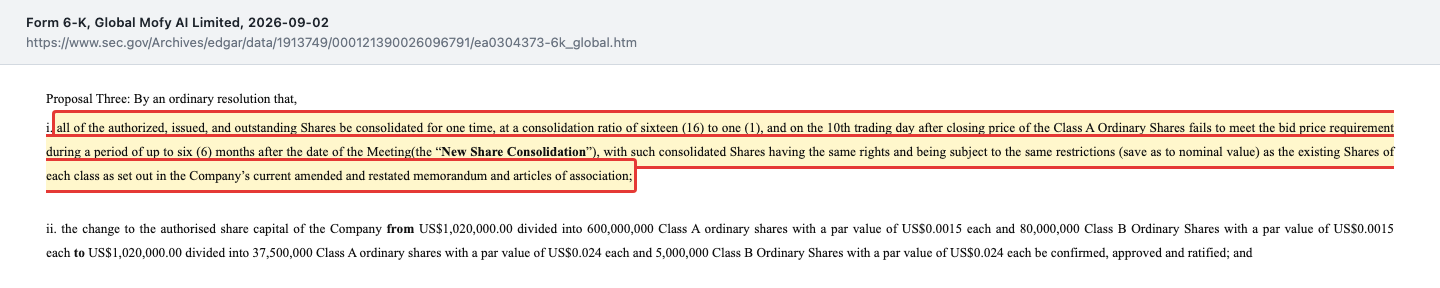
The third consolidation is already in the drawer. At the extraordinary general meeting of September 2, 2026, shareholders approved this resolution:
“all of the authorized, issued, and outstanding Shares be consolidated for one time, at a consolidation ratio of sixteen (16) to one (1), and on the 10th trading day after closing price of the Class A Ordinary Shares fails to meet the bid price requirement during a period of up to six (6) months after the date of the Meeting”
— Global Mofy AI Limited, 6-K of September 2, 2026, Proposal Three (excerpt)
The background is Nasdaq's minimum bid rule: if a stock closes below $1.00 for 30 consecutive trading days, it violates the listing requirements. Normally a company then gets 180 days. But a company that carried out a reverse split in the preceding year, or that reaches a cumulative ratio of 1-for-250 or more within two years, gets no grace period under Nasdaq Rule 5810(c)(3)(A)(iv) but a delisting determination right away, which it can appeal. Global Mofy last carried out a reverse split on June 11, 2026, so the one-year period runs until June 2027. With the two reverse splits so far (together 1-for-750), the two-year threshold is also exceeded until the end of November 2026, and if the approved 1-for-16 consolidation were added, the cumulative ratio together with the June split would be 1-for-800. A second authorization exists alongside it: on January 5, 2026, shareholders allowed the board — and confirmed on September 2 — to consolidate the shares more than once within three years, up to a cumulative ratio of 1-for-500; so far 1-for-50 of that has been used. In the prospectus supplement of November 2, 2026, the company itself warns that Nasdaq may halt trading or delist the stock, including for public interest concerns in connection with the placement. In the weeks before the jump of November 16, the closing price hovered around one dollar according to fundamental data.
Valuation: $116 Million on the Exchange, Just Under $13 Million at the Placement Price
Let's use the count after the latest placement: 54,587,663 Class A shares and 3,163,344 Class B shares, together 57.75 million. At the closing price of $2.01 on November 16, 2026, that makes a market value of about $116 million — the figure from fundamental data matches. Against that stand $69.1 million of revenue in the twelve months through March 2026 (1.7 times), shareholders' equity of $31.0 million as of March 31, 2026, and — on the company's own calculation in the prospectus supplement — net tangible assets of about $0.75 per share after the placement. So on November 16 the market paid a good two and a half times what the prospectus shows as tangible substance per share.
A second yardstick is more revealing. The investors in the October 30 placement paid $0.22 per share. At that price the whole company would be worth about $12.7 million. Between the price at which the company sold its own shares and the market price a little over two weeks later lies a factor of nine. There are no analysts to put that in context: fundamental data shows not a single estimate. And anyone who bought at the 2023 IPO and held is down more than 99.9 percent at $2.01 against a restated $3,750.
Upside and Risks at a Glance
What speaks for Global Mofy:
- The day-to-day business is growing: revenue of $55.9 million in fiscal 2025 (up 35.3 percent) and $39.9 million in the first half of fiscal 2026 (up 49.4 percent); contract work grew 80 percent.
- Hardly any bank debt: $2.2 million of short-term loans as of March 31, 2026, of which about $1.65 million was repaid in June and July 2026 according to the interim financial statements.
- Since March 2026, about $19.9 million gross has come in from three placements; management stated in the half-year report that cash, future operating cash flows and loans would be sufficient for the following twelve months.
- The impairment is booked; the new business of selling digital assets to developers of AI models brought in $4.9 million of revenue in the first half of fiscal 2026.
What speaks against it:
- A $38.44 million impairment of purchased 3D models; the remaining $17.3 million is now amortized over three years instead of five, and the company explicitly does not rule out further impairments.
- Gross margin fell from 44.2 percent to 21.3 percent; operations generated only $2.0 million of cash in the first half of fiscal 2026 (prior year: $10.1 million), while receivables rose from $1.5 million to $13.3 million.
- The number of Class A shares rose from 0.92 million to 54.59 million; the two latest placements were about 79 percent below the market price, and the $300 million shelf is largely unused.
- Deals with entities of the CEO, who held about 87.9 percent of the voting power (as of October 20, 2026); three auditors in three fiscal years and three material weaknesses in internal control.
- Two reverse splits (1-for-15 and 1-for-50) and a third (1-for-16) pre-approved; under Nasdaq's rules there is no grace period through June 2027 if the minimum bid is breached again.
A Human Conclusion: Who Really Got the Discount?
Back to the strikethrough-price trap from the beginning. The crossed-out price on the tag — ninety dollars, now two — does not tell a clearance-sale story at Global Mofy. It tells of two reverse splits that turned 750 old shares into one new share, and of placements that turned just under one million shares into more than 54 million. Behind it stands a business that really is growing, and a library that, by the company's own accounts, is two thirds worthless because it was overtaken by the very technology the company advertises. Add a CEO whose entity hands stakes in a company he runs to Global Mofy and receives shares in return, most recently shares with twenty votes each, and a resolution for the next reverse split that is only waiting for its trigger. So the honest question for you is not “How far can a stock rise that once cost ninety dollars?” but: would you buy this stock if you knew that a little over two weeks earlier, 45 million shares were issued at 22 cents each? If yes, you have a thesis, and you now know the numbers to measure it against. If no, the price tag almost got you. What you make of it is your decision. And that is exactly as it should be.
Sources
All original documents used in this analysis — to read for yourself:
- Global Mofy AI Limited — interim financial statements as of March 31, 2026 (6-K of July 28, 2026, Exhibit 99.2), management discussion (Exhibit 99.1) and press release (Exhibit 99.3)
- Global Mofy AI Limited — SEC annual report 20-F for fiscal year 2025 (filed January 9, 2026)
- Global Mofy AI Limited — 6-K of November 2, 2026 (placement of 45 million shares), prospectus supplement 424B5 of November 2, 2026 and 6-K of November 6, 2026 (closing)
- Global Mofy AI Limited — 6-K of October 20, 2026 (Qifei share exchange, Class B shares) and of August 20, 2026 (Qifei share exchange, Class A shares)
- Global Mofy AI Limited — 6-K of September 2, 2026 (results of the extraordinary general meeting, 1-for-16 consolidation) and notice of meeting (6-K of August 11, 2026, Exhibit 99.1)
- Global Mofy AI Limited — 6-K of September 1, 2026 (placement at $0.538) and prospectus supplement 424B5 of September 1, 2026
- Global Mofy AI Limited — 6-K of July 29, 2026 (Star Touch share exchange)
- Global Mofy AI Limited — 6-K of June 11, 2026 (1-for-50 reverse split)
- Global Mofy AI Limited — 6-K of May 26, 2026 (registered direct offering with warrants) and prospectus supplement 424B5 of May 26, 2026
- Global Mofy AI Limited — 6-Ks on compensation and personnel of February 5, 2026, March 24, 2026 and April 30, 2026
- Global Mofy AI Limited — Form F-3 registration statement of March 6, 2026 ($300 million shelf)
- Nasdaq — Listing Rules, 5800 Series, Rule 5810(c)(3)(A) (minimum bid price and reverse splits)
- Full SEC filing history: EDGAR overview for Global Mofy (sec.gov)
- Fundamental data (prices, trading volume, market value; data as of November 17, 2026), reconciled with the SEC filings.
- Reddit mentions: ApeWisdom (retrieved November 17, 2026); accessed via our in-house Reddit hype scanner.
Transparency & disclaimer: this analysis is journalistic commentary on publicly available information. It is not investment advice, not a regulated investment research product and not a solicitation to buy or sell securities. Equity investments carry substantial risk up to and including total loss. All information is provided without warranty; the as-of date for each figure is stated in the text. Positions held by the operator are disclosed daily; where one exists, it appears as a notice at the top of this analysis.
Our Bottom Line at a Glance
- Business model neutral
- Contract work on virtual content grew 80% to $27.1 million in the first half of fiscal 2026; licensing of digital assets shrank to $7.9 million (prior year: $11.7 million), and its gross margin fell from 53.5% to 2.8%.
- Earnings negative
- Net loss of $50.7 million in the six months through 03/31/2026 after a $38.44 million impairment of purchased 3D models; gross margin of 21.3% after 44.2% in the prior-year half.
- Balance sheet & liquidity negative
- Cash of $2.8 million as of 03/31/2026 against $2.2 million of bank loans; equity halved in six months from $62.0 million to $31.0 million. Since March 2026, fresh money has come from three share placements (about $19.9 million gross).
- Dilution negative
- Class A shares from 916,882 (03/31/2026) to 54,587,663 (11/06/2026); placements at $0.538 and $0.22 against closing prices of $2.56 and $1.04; $300 million shelf (Form F-3 of March 2026).
- Governance negative
- Agreed share exchanges with entities of the CEO (9.935% of Qifei for 1.5 million Class A and 3 million Class B shares), about 87.9% of the voting power with him (as of 10/20/2026), three auditors in three fiscal years, three material weaknesses according to the 20-F.
- Listing negative
- Reverse splits of 1-for-15 (November 2024) and 1-for-50 (June 2026), a further 1-for-16 pre-approved on 09/02/2026; in the prospectus supplement of 11/02/2026 the company warns of a trading halt or delisting.
Global Mofy shows the strikethrough-price trap in its purest form: the price history shows a 52-week high above $90, and the stock closed at $2.01 on November 16, 2026. In between lies not a clearance sale but two reverse splits, a $38.44 million impairment of the 3D library and a share count that went from 0.92 million to 54.59 million. The day-to-day business is growing, but it is financed with shares the company most recently sold for 22 cents. Anyone buying should know who bought before them, and at what price. Not investment advice.
What Our Rating Means
Substance risk
We found at least one documented issue that threatens the company itself — regardless of how the stock is currently valued.
Red, because several documented risks to the substance of the company come together: the largest asset was written down by two thirds as of March 31, 2026, cash stood at $2.8 million, and the company finances itself with shares priced about 79 percent below the market. Add deals with entities of the CEO, who holds the voting majority, two reverse splits and a pre-approved third, together with the company's own warning of a delisting. The fact that revenue is growing does not change that. The decision is yours.
A journalistic assessment by our editorial team at the time of the deep dive, based on public sources — not investment advice and not a solicitation to buy or sell. Your personal circumstances (investment goals, risk capacity, taxes) cannot be taken into account. What our levels mean, how verdicts are formed, and what conflicts of interest exist →
Worth Noting
- The hook for this analysis is our in-house Reddit hype scanner; according to ApeWisdom (retrieved 11/17/2026), one mention in 24 hours, rank 784 after rank 613 a day earlier. Price references according to fundamental data: $1.02 (close 11/13/2026), $2.01 (close 11/16/2026, daily range $1.40 to $4.81, volume 112.8 million shares); $1.04 on 10/30/2026 and $2.56 on 08/28/2026 according to the prospectus supplements.
- Data basis: the latest periodic report is the interim financial statements as of 03/31/2026 (6-K of 07/28/2026, unaudited); every filing from the annual report on Form 20-F (01/09/2026) through the Schedule 13G/A of 11/10/2026 was reviewed. The fiscal year ends on September 30.
- All share counts and per-share prices are restated for the 1-for-50 reverse split of 06/11/2026 unless stated otherwise. The voting share of the Class B shares after the November placement, the market value on 10/19/2026 and the market value at the placement price are our own calculations from the figures in the filings; the $80 million valuation of Qifei is stated in the agreements (Exhibit 10.1 to the 6-Ks of 08/20 and 10/20/2026).
- Not to be confused: Global Mofy AI Limited was called Global Mofy Metaverse Limited until August 2024 (name changed by resolution of 08/15/2024); some data services still carry the old name. No filing reports whether any of the 45 million shares issued on 11/06/2026 have already been sold on the exchange.
Stock Watch
This analysis is as of November 17, 2026. Stock Watch will tell you what's changed at GMM since then.
Later $1 a month per stock — signing up is free, and you'll be the first to know when it launches.
The full analysis as a PDF for later
We will send you this analysis as a PDF — to print, file away, and read at your own pace. And we will add you to the free Stock Watch list for Global Mofy AI Limited (GMM), so you hear about it when something material in this analysis changes.
Frequently Asked Questions
Global Mofy AI Limited (Nasdaq: GMM), based in Beijing, builds virtual imagery for films, series, advertising and games and licenses 3D models from a purchased library. Since October 2025 it has also sold such models to developers of large language models. In fiscal year 2025 (through September 30, 2025) it generated revenue of $55.9 million and had 90 employees according to the table in its annual report.
The $50.7 million loss in the six months through March 31, 2026, is mainly due to a $38.44 million impairment: according to the interim financial statements, character and prop models can now be generated by AI in minutes, and their value was set to zero. On top came $13.5 million of expense for share-based compensation to executives.
After the placement that closed on November 6, 2026, there were 54,587,663 listed Class A shares and 3,163,344 Class B shares with 20 votes each. On March 31, 2026, there were only 916,882 Class A shares, in each case restated for the 1-for-50 reverse split of June 11, 2026. On October 30, 2026, alone, 45 million shares went to investors at $0.22.
Because old prices are restated. Global Mofy carried out a 1-for-15 reverse split in November 2024 and a 1-for-50 reverse split in June 2026. A price of $2 from before June 2026 therefore shows up as $100 today. The $5.00 IPO price of October 2023 equals $3,750 per share on today's basis.
It is pre-approved. On September 2, 2026, shareholders agreed to a 1-for-16 share consolidation. Under the resolution it takes effect on the tenth trading day after the closing price fails Nasdaq's bid price requirement, provided that happens within six months of the meeting. Nasdaq requires a closing bid of at least $1.00.
Founder and CEO Haogang Yang. According to the 6-K of October 20, 2026, he held about 87.9 percent of the voting power, mainly through unlisted Class B shares with 20 votes each. One of his entities received 3 million of those shares in October 2026 in exchange for 4.875 percent of Qifei (Shanghai) Technology, a company whose sole director he is.
The fiscal year ends on September 30; fiscal year 2025 ran from October 2024 through September 2025. As a foreign private issuer, Global Mofy does not file quarterly reports with the U.S. securities regulator, the SEC, but an annual report (20-F), interim financial statements for the half year and current reports (6-K). The latest periodic report covers the six months through March 31, 2026.
Found an error?
Did you spot a factual error, an outdated number, or a typo in this deep dive? Let us know briefly — your report goes straight to the editorial team.