CS Disco: Break-even Arrived “a Full Quarter Ahead of Schedule” — It Measures $79,000, and Beneath It Sits a $5 Million Loss
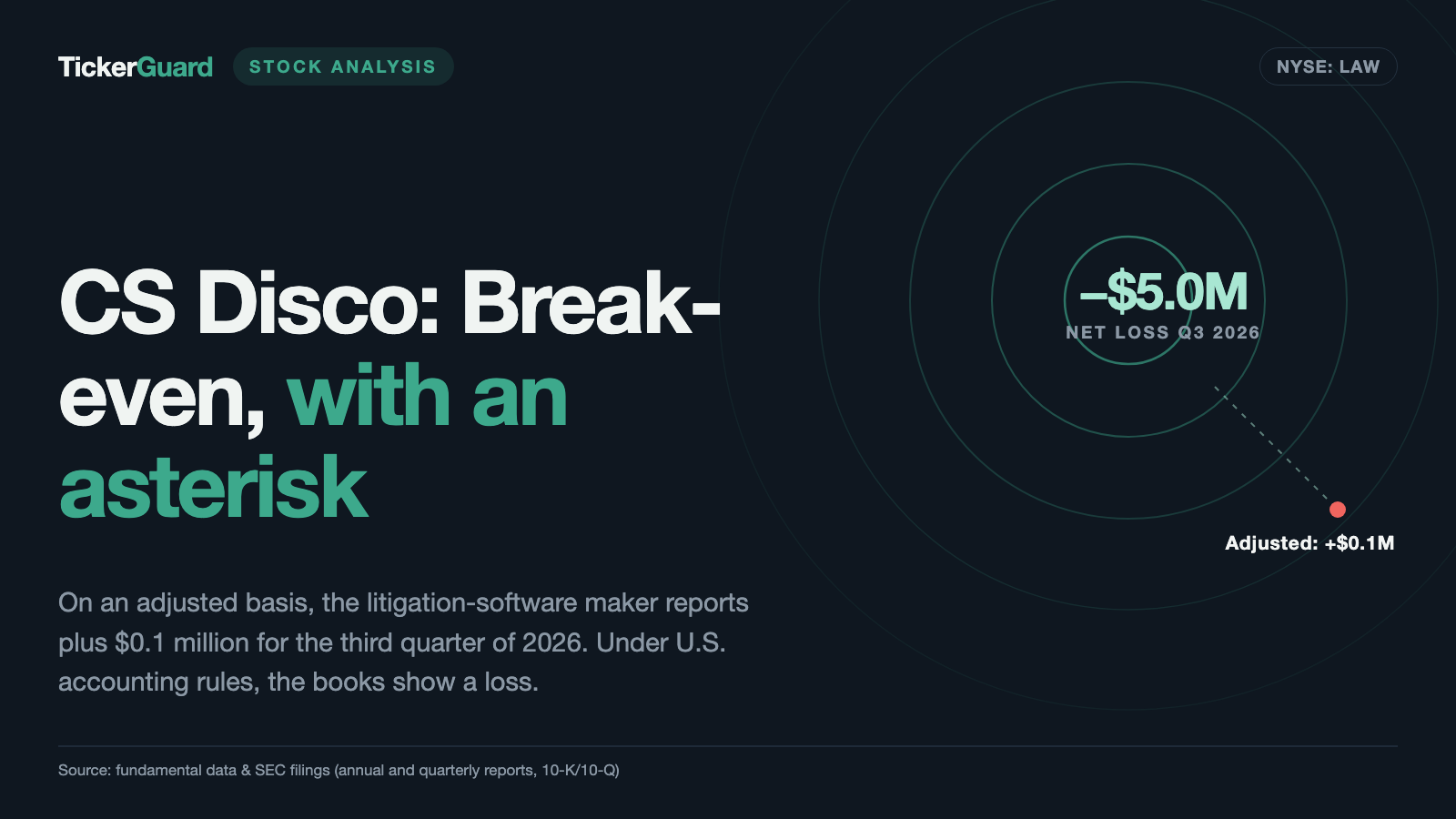
The stage-win trap: CS Disco, a litigation-software company from Austin, Texas, reported adjusted EBITDA of plus $0.1 million for the third quarter on November 4, 2026 — in its own words a full quarter ahead of schedule. In the same quarter, the books show a GAAP net loss of $5.0 million. The bridge between the two numbers is mostly $4.7 million of stock-based compensation that the adjusted figure leaves out. The loss did shrink by $8.6 million from a year earlier, but $7.0 million of that is stockholder-litigation expense that no longer occurred. And 92 percent of revenue depends on actual usage, with no purchase commitment from customers. Against that stands real substance: $96.8 million of liquidity, no financial debt, revenue growth of 11 percent. Not investment advice — just a look at the line above the finish tape, and at the lines printed beneath it.
 Thomas Mücke
Founder & Publisher
As of Today
As of: November 13, 2026
- Closing price
- 6.58 $ +1.08%
- Market Capitalisation
- 0.4 $B
- Growth Score
- 6/10
- AAQS
- 4/10
This analysis has a cut-off date. The Stock Guard tells you when something material changes in the numbers. Reserve your free spot
Chart
Interactive price chart (TradingView).
52-week range: 2.80 $ to 8.90 $ · Last price: 6.58 $ (As of: November 13, 2026)
Note: pure fact-based analysis, not investment advice and not a solicitation to buy or sell. All figures without guarantee.
There is an investor trap that feels like a moment of triumph: the stage-win trap. It works like this: a company that has lost money for years announces it has reached a goal earlier than promised — and you cheer along without asking who drew the finish line. CS Disco (NYSE: LAW) reported exactly that kind of stage win on November 4, 2026: adjusted EBITDA of plus $0.1 million for the third quarter of 2026, according to the CEO “a full quarter ahead of schedule.” The exact figure is $79 thousand. In the same release, a few tables further down, sits the net loss for the same quarter: $5.0 million.
Both numbers are correct. The difference lies in what one of them counts and the other leaves out. The finish line called “adjusted EBITDA” was defined by the company itself; net loss is defined by U.S. accounting rules.
So let’s make a deal: we read together what CS Disco reported to the U.S. securities regulator, the SEC — the quarterly report (10-Q) for September 30, 2026, filed on November 4, 2026, the earnings release of November 4, 2026, and the annual report (10-K) for 2025. The CEO and CFO must personally certify the accuracy of these reports. By the end you will know what the stage win is worth, what has actually improved behind it, and what remains open. The decision is yours.
What CS Disco actually does — software for the paper mountain before trial
CS Disco, known in the market simply as DISCO, was founded in 2013 according to its annual report, is headquartered in Austin, Texas, and has been listed on the New York Stock Exchange since its IPO in July 2021. The company sells cloud software for one very specific step in a lawsuit: discovery, the phase in which both sides must hand over every record that could matter to the case. In a large matter that means millions of emails, chat messages and files. In everyday terms: imagine having to go through a company’s entire inbox from the past ten years before a trial and mark every single message as “relevant,” “irrelevant” or “privileged.”
That is what the software is for. It collects the data, makes it searchable and helps lawyers find the documents that decide a case. The products are called DISCO Ediscovery, DISCO Hold, DISCO Request and DISCO Case Builder. On top come AI features: the annual report describes “Cecilia” as a suite that includes a chatbot answering questions about a matter’s records and an automated timeline tool; “Auto Review” handles first-pass document review with generative AI. Customers are law firms, corporate legal departments, legal services providers and government bodies. On December 31, 2025, the company counted 1,549 customers, 330 of them with more than $100,000 in revenue over twelve months; by September 30, 2026, the number of these large customers had risen to 374, according to the earnings release.
Billing is predominantly by consumption: the more data a customer keeps on the platform for its matters, the higher the invoice. In the third quarter of 2026, $38.6 million came from software and $6.7 million from services such as managed document review (DISCO Review).
That defines the central tension of this analysis, and it runs through every chapter: the business is growing at double-digit rates again and the cash position is comfortable — but under accounting rules CS Disco did not earn money in any year from 2020 through 2025, and the break-even it reports holds only in a calculation the company assembled itself.
Company history for investors
-
2013
Founding
According to the annual report, CS Disco was founded in 2013. For shareholders: a young company that, in its own words, lacks a long history on which to base revenue forecasts.
-
2021
IPO on the NYSE
CS Disco goes public in July 2021; at year-end it holds $255.5 million in cash and revenue grows 67%. For shareholders: the year with the highest revenue growth of 2021 through 2025.
-
2022
Largest loss, growth slows
The net loss reaches $70.8 million and growth drops to 18%. For shareholders: the period at the center of the later lawsuit.
-
2023
Stockholder lawsuit and standstill
A class action is filed in September 2023; full-year revenue grows just 2%. For shareholders: the question of growth quality ends up in court.
-
2024
New CEO
Eric Friedrichsen takes over in April 2024. For shareholders: since then the adjusted operating loss has narrowed, from $18.7 million (2024) to $10.2 million (2025).
-
2025
$11.5 million settlement
On December 19, 2025, the company settles with the plaintiffs without admitting liability. For shareholders: the legacy issue gets a price tag, most of it expected from insurers.
-
2026
Adjusted break-even and job cuts
Third quarter of 2026: adjusted EBITDA of plus $0.1 million on a $5.0 million net loss; on October 29, 15 jobs are cut. For shareholders: a stage win, not yet a profit.
How the stock landed on our desk
CS Disco landed on our desk through the quarterly report itself: on November 4, 2026, the company filed its 10-Q for the third quarter of 2026, together with the earnings release and an outlook for the final quarter. The headline of the release cites $45.3 million in revenue and 11 percent growth.
By then the stock had already had an eventful year. It closed 2025 at $7.76. On February 25, 2026, the day of the annual results, it marked an intraday low of $2.45, its lowest level of the past twelve months. On November 13, 2026, it closed at $6.58 (source: fundamental data, as of November 16, 2026). Since the end of September 2026 alone, when it stood at $4.10, that is a gain of about 60 percent. Why the price fell so far in early 2026 is not stated in any SEC filing, and we will not speculate.
What matters is something else: the price has risen by more than half in six weeks — part of the expectations is therefore likely already in the price; how much cannot be substantiated. This is exactly where the stage-win trap snaps shut. So remember from the start: a metric with the word “adjusted” in front of it always answers one question first — what was taken out.
The numbers over the years — honestly appraised
First, what is genuinely impressive. CS Disco more than doubled its revenue from $68.4 million in 2020 to $156.8 million in 2025. And after a dry spell the pace is picking up again: revenue grew just 2 percent in 2023, 5 percent in 2024 and 8 percent in 2025 — and 13 percent in the first nine months of 2026, to $130.4 million. In the release, the CEO speaks of the sixth consecutive quarter of double-digit growth in software.
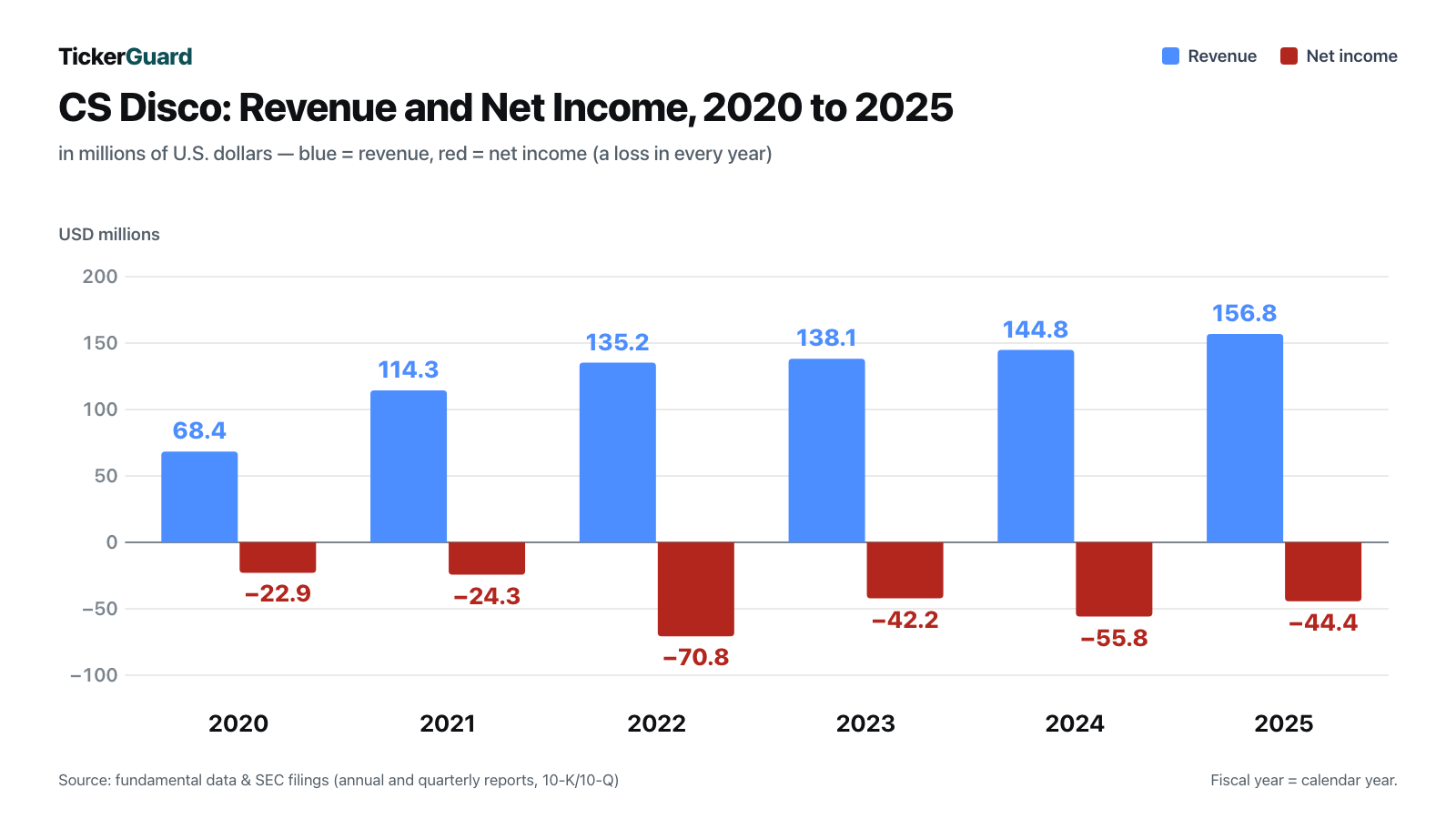
In figures: revenue from 2020 to 2025 came to $68.4 million, $114.3 million, $135.2 million, $138.1 million, $144.8 million and $156.8 million. Net income in the same years was minus $22.9 million, minus $24.3 million, minus $70.8 million, minus $42.2 million, minus $55.8 million and minus $44.4 million. Together that is a good $260 million of losses in six years. The total accumulated deficit since inception stood at $365.1 million on September 30, 2026.
The software itself is a good business, too: of every dollar of revenue in the third quarter of 2026, about 76 cents remained after direct costs, chiefly cloud infrastructure. This gross margin has been at roughly 75 percent since 2022. The losses arise further down: in research and development ($13.8 million in the quarter), sales and marketing ($16.3 million) and general and administrative expense ($9.7 million).
And the balance sheet can carry it. On September 30, 2026, CS Disco held $12.5 million in cash and $84.2 million in short-term investments in U.S. Treasury securities and highly rated corporate debt securities — $96.8 million in total. There is practically no financial debt, only lease obligations. Equity was $120.0 million, or 73 percent of total assets. Honesty requires the direction as well: at the end of 2021, after the IPO, the company held $255.5 million in cash. At the end of 2024, cash plus investments came to $129.1 million; at the end of 2025, to $114.6 million. In the first nine months of 2026, operations used $15.8 million, plus $4.2 million of capital spending, essentially on internally developed software. At that pace the cushion would last more than three years on paper.
What the filings say — the uncomfortable truths
Uncomfortable truth No. 1: Break-even leaves out $4.7 million of stock-based compensation
The sentence at the heart of the November 4, 2026, release comes from CEO Eric Friedrichsen:
“Importantly, we also reached break-even Adjusted EBITDA in Q3 - a full quarter ahead of schedule.”
— Eric Friedrichsen, CEO of CS Disco, earnings release for the third quarter of 2026 (8-K, Exhibit 99.1, November 4, 2026)
Adjusted EBITDA is not a measure from the accounting rulebook but a calculation of the company’s own. In everyday terms: it is like running your household budget without the rent and then noting that something is left at the end of the month. The math is not wrong — it simply omits an item you pay anyway. At CS Disco that item is stock-based compensation: employees receive part of their pay in shares rather than cash. That costs the company hardly any cash, but it costs you as a shareholder a slice of the pie, because new shares keep being created.
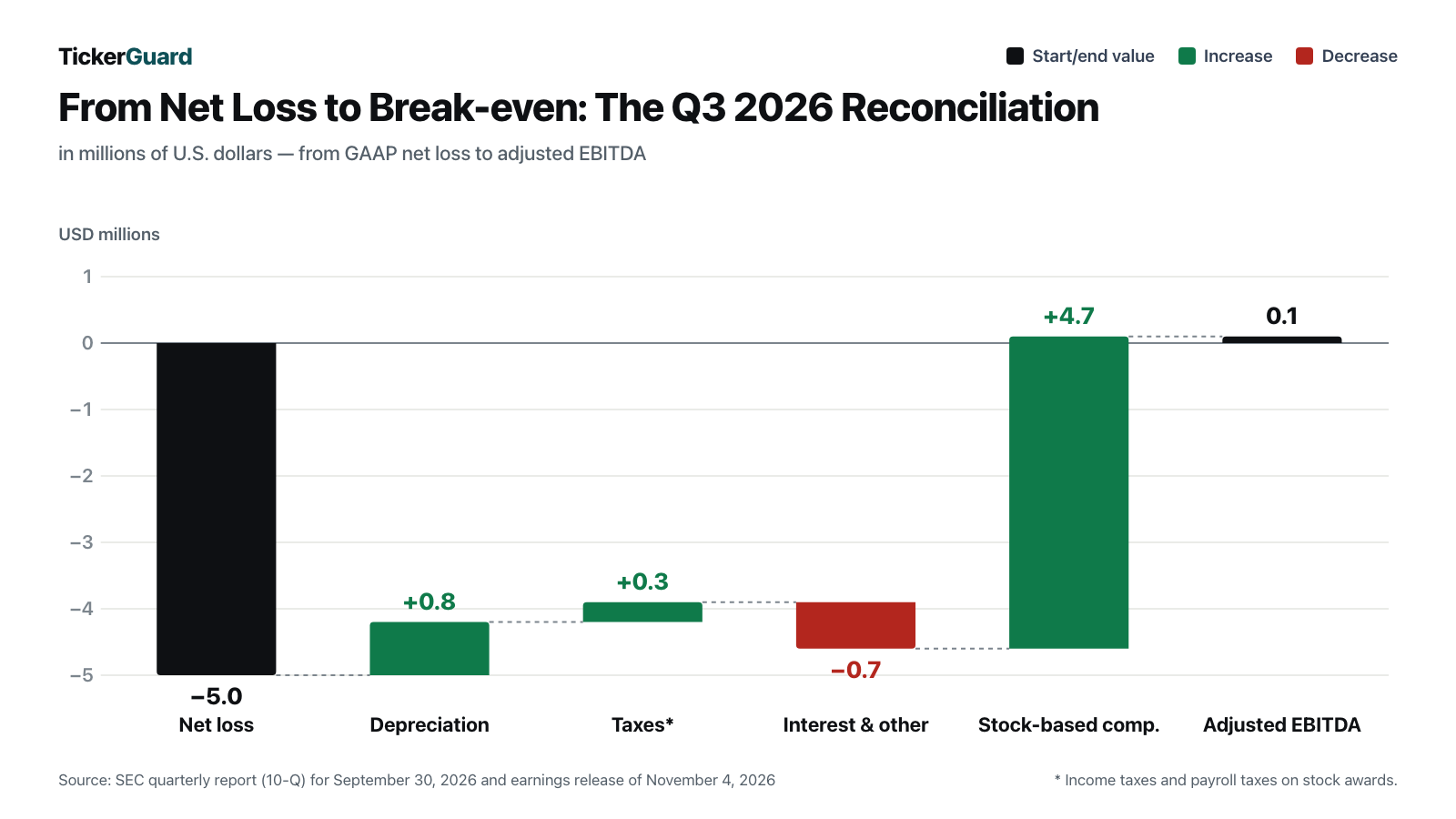
The reconciliation in the quarterly report shows it line by line: net loss of $5.0 million, plus $0.8 million of depreciation and amortization, $0.3 million of taxes (income taxes and payroll taxes on stock awards) and $4.7 million of stock-based compensation, less $0.7 million of interest income — which gives $0.1 million. Without the stock-based compensation add-back, the adjusted figure too would stand at about minus $4.7 million (exactly: $79 thousand minus $4.74 million). In the first nine months of 2026, stock-based compensation added up to $15.2 million, just under 12 percent of revenue. You can see the consequence in the share count: 63.3 million shares at the end of 2025, 65.7 million on September 30, 2026. A further 7.1 million sit in unvested stock units and outstanding options — about 11 percent of today’s share count.
Two points belong in the picture. First: stock-based compensation is falling, from $6.1 million in the year-ago quarter to $4.7 million. Second: the improvement is real on the adjusted measure as well, but small — from minus $0.3 million to plus $0.1 million. For full-year 2026 the company still expects an adjusted loss of $5.3 million to $6.8 million (outlook of November 4, 2026); in 2025 it was minus $10.2 million, in 2024 minus $18.7 million. We described the same pattern — the adjusted metric in the shop window, stock-based compensation in the stockroom — at Backblaze, a cloud-storage provider whose revenue is likewise usage-based.
And then the quarterly report contains an event the release does not mention. Six days before the release in which the CEO speaks of “another strong quarter,” on October 29, 2026, the company committed to cutting 15 jobs, about 3 percent of its global workforce. On the cost, Note 14 of the report says:
“We estimate that we will incur charges of approximately $1.4 million to $1.8 million in connection with the Plan, consisting of cash expenditures primarily for employee severance and other termination benefits.”
— CS Disco, Inc., SEC quarterly report 10-Q for September 30, 2026, Note 14 “Subsequent Events”

For scale: the severance is about as large as the upper end of what the company guides to as adjusted EBITDA for the fourth quarter ($0.0 million to $1.5 million). The definition of the metric allows one-time items to be excluded; the report does not say whether severance will be among them.
Uncomfortable truth No. 2: Four fifths of the progress is litigation expense that went away
The net loss fell from $13.7 million to $5.0 million in the third quarter of 2026. That looks like a leap. The quarterly report explains where it comes from: general and administrative expenses declined by $7.2 million, and $7.0 million of that was legal expense tied to a stockholder lawsuit that was incurred in the year-ago quarter and not in 2026. Of the $8.6 million improvement, then, about $7.0 million — a good four fifths — is not progress in the business but the end of a special burden. Strip it out, and operating expenses actually rose slightly: from $38.4 million to $39.8 million.
What was the lawsuit about? Stockholders alleged that between July 21, 2021 — the month of the IPO — and August 11, 2022, the company made misleading statements about what was driving its revenue growth. In December 2025 the parties settled:
“On December 19, 2025, without admitting liability in connection with the matter described above, the Company agreed to a settlement amount of $11.5 million, subject to court approval, recorded as an accrued legal loss and a corresponding insurance recovery asset of $8.0 million on the consolidated balance sheet as of December 31, 2025, and $8.2 million on the unaudited condensed consolidated balance sheet as of September 30, 2026.”
— CS Disco, Inc., SEC quarterly report 10-Q for September 30, 2026, Note 8 “Commitments and Contingencies”

The latest reported status: on July 1, 2026, the plaintiff moved for preliminary approval of the settlement; according to the quarterly report, both preliminary and final approval by the court were still pending (as of September 30, 2026). The balance sheet carries an $11.5 million accrual and $8.2 million of expected insurance recovery — which would put the company’s own share at about $3.3 million. That is manageable. The uncomfortable part is something else: the dispute turned on the very question that still matters today — how dependable the revenue growth is.
Uncomfortable truth No. 3: 92 percent of revenue comes with no purchase commitment
Many software companies live on subscriptions: the customer pays every month whether or not the program is used. CS Disco works differently. The quarterly report says so right at the start of management’s discussion (section “Overview,” second paragraph):
“We generate substantially all of our revenue from our customers’ actual usage of our product offerings. Customers generally do not commit to purchase a specific amount of usage on our product offerings and their usage can fluctuate based on the number and nature of legal matters they have at any particular time.”
— CS Disco, Inc., SEC quarterly report 10-Q for September 30, 2026, Item 2 “Overview”

In figures: in the first nine months of 2026, 92 percent of revenue was usage-based, and only 8 percent came from subscriptions with a committed minimum. In everyday terms: CS Disco is less a gym with an annual contract than a taxi — you pay only when someone rides. When a big legal matter ends, so does the invoice. The annual report for 2025 adds that a substantial portion of revenue comes from the top 10 percent of customers. And the quarterly report lists things the company cannot control: reduced enforcement by federal agencies, delays in federal courts during a government shutdown, a trend away from litigation toward alternative dispute resolution.
The release itself shows how much a single matter can move the numbers: in the third quarter of 2025, CS Disco recognized $1.3 million of revenue from one contract whose payment was contingent on the outcome of the legal matter. Without that item, third-quarter 2026 growth would be 15 percent rather than 11 percent — says the company. The effect cuts both ways.
Uncomfortable truth No. 4: The AI that CS Disco sells can come from others, too
CS Disco puts its AI features front and center; the CEO speaks of “AI for Litigators.” Most recently it added “Advanced Research,” an application that, according to the November 4, 2026, earnings release, carries out multi-step research autonomously. At the same time, the company changed its pricing model in 2026: according to the annual report, the Cecilia AI platform and Case Builder are now included in a single per-gigabyte rate. The AI is therefore not sold separately; it is meant to increase the volume of data on the platform. The company does not report revenue from its AI products separately.
In its risk section, the quarterly report describes how generic large language models, generative AI and general-purpose agents are evolving rapidly, and draws this conclusion:
“In the future, we may face increased competition from these offerings evolving to address a broad range of business needs.”
— CS Disco, Inc., SEC quarterly report 10-Q for September 30, 2026, Item 1A “Risk Factors”

That is risk-factor language, not a finding — so far CS Disco reports rising, not falling, software revenue. But you should know the logic behind it: reading through and summarizing large volumes of text is precisely what general-purpose AI models do well. That real AI products alone do not carry a balance sheet is something we saw at Veritone, another provider of AI software. According to the quarterly report, CS Disco’s named competitors include Consilio, Epiq, KLDiscovery, Relativity, OpenText and Nuix, as well as the legal services divisions of the large accounting firms.
Valuation: what the November 13, 2026, close implies
How expensive is the stock? At the closing price of $6.58 on November 13, 2026, and 65,688,129 shares outstanding (as of October 31, 2026, per the cover page of the quarterly report), CS Disco has a market value of about $432 million. A price-to-earnings ratio cannot be calculated because there are no earnings. That leaves the price-to-sales ratio: revenue over the last four quarters was $171.5 million, so market value equals about 2.5 times sales. Subtract the $96.8 million of liquidity and about $335 million remains for the business itself — just under twice annual revenue.
For a software company with a 76 percent gross margin and double-digit growth, the price-to-sales ratio thus stands at about 2.5; whether that is a lot or a little depends on how dependable the revenue is. For context: this revenue is tied to no contract and produced no profit in any year from 2020 through 2025; it is therefore not readily comparable with firmly committed subscription revenue. Against book value: equity of $120.0 million works out to $1.83 per share, and the price stands at 3.6 times that.
The professionals’ view, with due caution: according to fundamental data (as of November 16, 2026), three analysts cover the stock, with a mean price target of $8. Three voices are a thin basis, and price targets are opinions, not facts. One detail from the filings: CEO Friedrichsen bought 4,490 shares at $5.45 in the open market on November 6, 2026, about $24,500 (insider filing, Form 4, of November 9, 2026). That is a signal, but a small one.
Who owns the company? According to the proxy statement, four financial investors together held about 47 percent on April 15, 2026: Bessemer Venture Partners 13.5 percent, LiveOak Venture Partners 12.3 percent, The Stephens Group through SG-DISCO 12.2 percent and Georgian Partners 9.2 percent. That supports the stock as long as they hold — and weighs on it if one of them sells.
So what does the price ask for? That the stage win becomes a permanent state: that revenue keeps growing at double-digit rates, costs rise more slowly, and in the end something is left under accounting rules as well. The company’s own outlook for the final quarter of 2026 calls for revenue of $45.8 million to $47.8 million; in the year-ago quarter it was $41.2 million.
Opportunities and risks at a glance
What speaks for CS Disco:
- Growth is back: revenue up 13 percent in the first nine months of 2026 after 2 percent in 2023; 374 large customers on September 30, 2026 (up 15 percent in a year).
- A high gross margin of about 76 percent (third quarter of 2026), at roughly 75 percent since 2022.
- Losses are shrinking on both measures: nine-month net loss of $23.3 million after $35.9 million; adjusted EBITDA of minus $6.8 million after minus $8.1 million.
- A solid balance sheet: $96.8 million of liquidity, no financial debt, a 73 percent equity ratio (September 30, 2026).
- The stockholder lawsuit is settled (subject to approval); most of the amount is expected to come from insurers.
- Its own AI products already in use, and a renewed leadership team (CEO since April 2024, CFO since January 2026).
What speaks against it:
- No profitable year from 2020 through 2025: accumulated deficit of $365.1 million (September 30, 2026).
- Break-even holds only on an adjusted basis and is wafer-thin ($79 thousand); it leaves out $4.7 million of stock-based compensation in the quarter.
- Ongoing dilution: 2.4 million new shares in nine months, a further 7.1 million in unvested stock units and outstanding options.
- 92 percent of revenue with no purchase commitment; dependent on the number and size of active legal matters and on the top 10 percent of customers.
- Cash keeps shrinking: $20.0 million consumed by operations and capital spending in the first nine months of 2026.
- Job cuts in October 2026 costing $1.4 million to $1.8 million; general-purpose AI models as possible new competition.
A human conclusion
Back to the stage-win trap from the beginning. Its core is not that the win was invented. The $79 thousand is real, and so is the trend behind it: two years ago the same metric stood at minus $18.7 million for the year. Its core is that a stage win tempts you to consider the race decided. But the race that counts for you as a shareholder ends at a different line: the one where money is left after all costs, including those paid in shares. In the third quarter of 2026, the company was still $5.0 million short of it.
So the honest question for you is not “Has CS Disco turned the corner?” but: do you trust revenue that no contract locks in to grow faster than costs — for long enough that the very bottom line turns black as well? If your answer is yes, you have a $96.8 million cushion and a business that is growing again on your side. If your answer is no, you have six straight years of losses on yours. What you make of it is your decision. And that is how it should be.
Sources
All original documents used in this analysis — to read for yourself:
- CS Disco, Inc. — SEC quarterly report 10-Q for September 30, 2026 (filed November 4, 2026)
- CS Disco, Inc. — Earnings release for the third quarter of 2026 with outlook (8-K Item 2.02, Exhibit 99.1, filed November 4, 2026)
- CS Disco, Inc. — SEC quarterly report 10-Q for June 30, 2026 (filed August 5, 2026)
- CS Disco, Inc. — SEC quarterly report 10-Q for March 31, 2026 (filed May 6, 2026)
- CS Disco, Inc. — SEC annual report 10-K for 2025 (filed February 25, 2026)
- CS Disco, Inc. — Proxy statement for the 2026 annual meeting (DEF 14A, filed April 30, 2026), including the principal stockholders
- CS Disco, Inc. — Insider filing (Form 4) of November 9, 2026: share purchase by the CEO
- Complete SEC filing history of CS Disco, Inc.: EDGAR overview (sec.gov)
- Fundamental data (prices, market value, analyst estimates; as of November 16, 2026), reconciled with the SEC filings.
Transparency & disclaimer: this analysis is journalistic commentary on publicly available information. It is not investment advice, not a regulated investment research product and not a solicitation to buy or sell securities. Equity investments carry substantial risk up to and including total loss. All information is provided without warranty; the as-of date for each figure is stated in the text. Positions held by the operator are disclosed daily; where one exists, it appears as a notice at the top of this analysis.
Key figures at a glance
All monetary figures in millions of $; earnings per share as reported.
| Metric | 2021 | 2022 | 2023 | 2024 | 2025 |
|---|---|---|---|---|---|
| Revenue | 114.3 | 135.2 | 138.1 | 144.8 | 156.8 |
| Operating Income (EBIT) | -23.8 | -71.8 | -49.8 | -61.7 | -48.1 |
| Net Income | -24.3 | -70.8 | -42.2 | -55.8 | -44.4 |
| Net Margin | -21.3% | -52.3% | -30.5% | -38.5% | -28.3% |
| Earnings Per Share | -0.42 $ | -1.20 $ | -0.70 $ | -0.93 $ | -0.72 $ |
Source: fundamental data & SEC filings (annual and quarterly reports, 10-K/10-Q)
Our Bottom Line at a Glance
- Growth positive
- Third-quarter 2026 revenue of $45.3 million (up 11 percent), $130.4 million over nine months (up 13 percent) — after 2 percent growth in 2023 and 8 percent in 2025. The number of large customers rose 15 percent in a year to 374 (September 30, 2026).
- Balance sheet & cash positive
- $96.8 million in cash and short-term investments, no financial debt, equity of $120.0 million on total assets of $163.4 million (September 30, 2026). The $20.0 million consumed in nine months would leave more than three years of room on paper.
- Profitability negative
- No profitable year from 2020 through 2025; net loss of $44.4 million in 2025 and $5.0 million in the third quarter of 2026. The positive adjusted EBITDA of $79 thousand arises only after excluding $4.7 million of stock-based compensation.
- Revenue quality negative
- 92 percent of revenue in the first nine months of 2026 was usage-based; according to the quarterly report, customers generally do not commit to any volume. Revenue depends on the number and size of active legal matters and, per the 2025 annual report, substantially on the top 10 percent of customers.
- Dilution neutral
- Stock-based compensation of $15.2 million in the first nine months of 2026 (prior year $18.4 million), just under 12 percent of revenue. The share count has risen from 63.3 million to 65.7 million since the end of 2025; a further 7.1 million shares sit in unvested stock units and outstanding options (September 30, 2026).
- Legacy issues & leadership neutral
- The 2023 stockholder class action is settled for $11.5 million, of which insurers are expected to cover $8.2 million; court approval was pending on September 30, 2026. CEO Eric Friedrichsen has been in office since April 2024, CFO Aaron Barfoot since January 2026.
CS Disco is the stage-win trap in its cleanest form: the business is growing at double-digit rates again (revenue up 13 percent in the first nine months of 2026), gross margin is about 76 percent, and $96.8 million of liquidity with no financial debt buys time. But the reported break-even of $79 thousand in the third quarter of 2026 holds only on an adjusted basis; under GAAP there is a loss of $5.0 million, and about four fifths of the improvement from a year earlier is litigation expense that went away. 92 percent of revenue depends on actual usage. What remains open is whether the stage win turns into a profit after all costs. Not investment advice.
What Our Rating Means
Open questions
The business works in principle, but one material question is open. As long as it stays open, our findings do not carry a quality verdict.
The filings show no risk to the company’s substance: the cash position is comfortable, there is no debt, and the business is growing. One material operating question is open — whether CS Disco, after six straight years of losses, can earn money under GAAP as well, with revenue that is 92 percent free of any purchase commitment. The third-quarter 2026 break-even is a hint, not proof: it measures $79 thousand and leaves out $4.7 million of stock-based compensation. If you hold the stock, you are betting that revenue grows faster than costs; if you wait, the first lines to read in the next report are net loss, stock-based compensation and cash used. After a price gain of about 60 percent since the end of September 2026, part of the improvement is likely already in the price. The decision is yours.
A journalistic assessment by our editorial team at the time of the deep dive, based on public sources — not investment advice and not a solicitation to buy or sell. Your personal circumstances (investment goals, risk capacity, taxes) cannot be taken into account. What our levels mean, how verdicts are formed, and what conflicts of interest exist →
Worth Noting
- The trigger for this analysis was the quarterly report (10-Q) of November 4, 2026, for the quarter ended September 30, 2026, and the earnings release of the same day; every filing made since then was reviewed (as of November 16, 2026).
- Adjusted EBITDA is a company-defined, non-GAAP metric. It excludes depreciation and amortization, taxes, interest and other, stock-based compensation, payroll taxes on employee stock transactions, stockholder-litigation expense and other one-time items.
- The market-data feed carries the company under a different legal form; the name registered with the SEC, CS Disco, Inc., is authoritative. Valuation figures are dated (closing price of November 13, 2026) and are not a price target.
Stock Watch
This analysis is as of November 16, 2026. Stock Watch will tell you what's changed at LAW since then.
Later $1 a month per stock — signing up is free, and you'll be the first to know when it launches.
The full analysis as a PDF for later
We will send you this analysis as a PDF — to print, file away, and read at your own pace. And we will add you to the free Stock Watch list for CS Disco, Inc. (LAW), so you hear about it when something material in this analysis changes.
Frequently Asked Questions
CS Disco, Inc. (NYSE: LAW) of Austin, Texas, sells cloud software for litigation. Law firms, corporate legal departments and government bodies use it to collect, search and review large volumes of emails and documents for court proceedings. The company was founded in 2013 and went public in July 2021. On December 31, 2025, it had 1,549 customers.
Not under GAAP. The net loss was $5.0 million in the third quarter of 2026 and $44.4 million for full-year 2025. For the third quarter of 2026 the company reported adjusted EBITDA of plus $0.1 million; that metric excludes, among other things, $4.7 million of stock-based compensation. CS Disco did not report an annual profit in any year from 2020 through 2025.
Revenue rose 11 percent to $45.3 million in the third quarter of 2026 and 13 percent to $130.4 million in the first nine months. Growth was 8 percent in 2025 and 2 percent in 2023. For full-year 2026 the company guides to revenue of $176.1 million to $178.1 million (outlook of November 4, 2026).
On September 30, 2026, CS Disco held $12.5 million in cash and $84.2 million in short-term investments, $96.8 million in total. It has no financial debt, only lease obligations. In the first nine months of 2026, operations used $15.8 million and capital spending a further $4.2 million. At the end of 2025, liquidity had been $114.6 million.
Stockholders filed a class action in September 2023, alleging misleading statements about the drivers of revenue growth between July 2021 and August 2022. On December 19, 2025, CS Disco agreed to an $11.5 million settlement without admitting liability; insurers are expected to cover $8.2 million. Court approval was still outstanding on September 30, 2026.
Because customers pay by consumption. In the first nine months of 2026, 92 percent of revenue was usage-based and only 8 percent came from subscriptions with a committed minimum. According to the quarterly report, customers generally do not commit to a specific amount. When a large legal matter starts or ends, revenue rises or falls with it.
At the closing price of $6.58 on November 13, 2026, and 65,688,129 shares, market value was about $432 million. That equals roughly 2.5 times revenue over the last four quarters ($171.5 million) and 3.6 times equity. There is no price-to-earnings ratio because the company reports losses.
Found an error?
Did you spot a factual error, an outdated number, or a typo in this deep dive? Let us know briefly — your report goes straight to the editorial team.