Sturm, Ruger: Beretta Pays $44.80 a Share — and Is Offered Two and a Half Times as Many as It May Buy
A 500-year-old family group buys its way to 25 percent of U.S. gunmaker Sturm, Ruger, and by mid-November 2026 the stock trades above its offer price. Yet at that price the holders of 38 percent of all shares wanted to sell — and in the latest quarter net sales grew while distributors passed fewer guns on to retailers.
 Thomas Mücke
Founder & Publisher
As of Today
As of: November 13, 2026
- Closing price
- 50.50 $ +2.00%
- Market Capitalisation
- 0.8 $B
- P/E
- 50.5
- Growth Score
- 5/10
- AAQS
- 1/10
Price change since November 13, 2026: +0.1%
This analysis has a cut-off date. The Stock Guard tells you when something material changes in the numbers. Reserve your free spot
Chart
Interactive price chart (TradingView).
52-week range: 28.80 $ to 52.80 $ · Last price: 50.50 $ (As of: November 13, 2026)
Note: pure fact-based analysis, not investment advice and not a solicitation to buy or sell. All figures without guarantee.
“If the big money is buying, I can’t go far wrong.” That is how many of us think the moment a deep-pocketed buyer takes a stake in a company and pays a premium for it. I call it the tow-rope trap: we hitch ourselves to the big ship and stop reading the chart ourselves — its purchase price feels like a floor under the stock, its arrival like a seal of approval. Sturm, Ruger (NYSE: RGR), one of the leading U.S. makers of rifles, pistols and revolvers, is a timely case study. In October 2026 the family-owned Beretta Holding bought 2,400,184 shares at $44.80 each through a public tender offer and has owned 25.0 percent ever since. On November 13, 2026, the stock closed at $50.45 — above the price the new anchor shareholder paid. So let’s make a deal: before you let yourself be taken in tow, we read together what Ruger and Beretta filed with the U.S. securities regulator, the SEC — the quarterly report (10-Q) filed November 4, 2026, the tender offer documents and the annual report (10-K) for 2025. In the end, you decide.
What Sturm, Ruger actually does — rifles, pistols and 13 distributors
Ruger makes firearms for the U.S. commercial market: for hunters, sport shooters, collectors and people who want to protect themselves. The annual report describes the company this way:
“The Company has been in business since 1949 and was incorporated in its present form under the laws of Delaware in 1969.”
— Sturm, Ruger & Company, Inc., SEC annual report 10-K for 2025, Item 1 “Business”
Of 2025 net sales ($546.1 million), rifles accounted for $338.2 million, pistols for $141.9 million, revolvers for $39.2 million and accessories and replacement parts for $27.4 million; a small castings segment added $2.6 million. The revolver stands out: in 2023 it still brought in $72.5 million, two years later 46 percent less. Everything is manufactured in the United States — in Newport, New Hampshire; Prescott, Arizona; Mayodan, North Carolina; Earth City, Missouri; and, since July 2025, Hebron, Kentucky, a plant that came with the purchase of the assets of Anderson Manufacturing for $15.8 million. About 5 percent of sales are exports. On February 9, 2026, Ruger had approximately 1,780 full-time employees; the headquarters has moved from Southport, Connecticut, to Mayodan.
What matters for everything that follows is the sales channel. Ruger does not sell to you, nor to the gun shop around the corner, but to wholesale distributors who in turn supply the retailers:
“Over 90% of the Company’s sales are made to 13 federally licensed, independent wholesale distributors.”
— Sturm, Ruger & Company, Inc., SEC annual report 10-K for 2025, Item 1A “Risk Factors”
In everyday terms: what Ruger books as a sale is, at first, only merchandise that has moved into a middleman’s warehouse. Whether it travels on to a store and finally to a buyer is a separate matter — and Ruger publishes that data every quarter. We will come back to it. The company has been led since March 1, 2025, by Todd W. Seyfert, an outside hire; Andrew T. Wieland has been chief financial officer since April 1, 2026. Seyfert has launched a program called “Ruger 2030”: jobs were cut, the product line is being pruned and a new enterprise software system was introduced.
That gives us the central tension of this analysis: a debt-free heritage manufacturer is earning money again and has a new anchor shareholder who paid a premium — but in the latest quarter more product flowed into the distribution channel than came out of it, and at the anchor shareholder’s price a great many co-owners wanted out.
Company history for investors
-
1949
Ruger starts doing business
According to the annual report the company has been in business since 1949, and a Delaware corporation since 1969. For shareholders: in business for more than 75 years.
-
2021
The exceptional year
$730.7 million of net sales, $155.9 million of net income, 38.3 percent gross margin. For shareholders: the yardstick every later figure is measured against.
-
2025
New CEO, a loss, Beretta arrives
Todd Seyfert takes over in March, $17.0 million of write-offs follow in Q2, and in September Beretta reports 7.7 percent. For shareholders: a full-year loss of $4.4 million.
-
2026
Settlement with Beretta
On May 2 the fight for board seats ends with an agreement: 25 percent cap, voting commitments, standstill. For shareholders: $6.3 million of costs in nine months.
-
2026
Partial tender offer at $44.80
By October 15, 6,094,325 shares are tendered; Beretta buys 2,400,184 and owns 25.0 percent. For shareholders: sellers got rid of only about 39.4 percent of their shares.
How the stock landed on our desk
Sturm, Ruger reached our research list through the Reddit hype scan of November 15, 2026 — that is, through chatter in investor forums, not through a financial metric. That is neither a signal nor a recommendation; it only means many people are talking about this stock right now. The price shows what about (source: fundamental data): on September 16, 2026, the last trading day before Beretta’s offer, the stock closed at $37.08. On October 20, the day of the final results, it was $48.74; on November 4, after the quarterly numbers, $49.91; and on November 13, $50.45. A year earlier, on November 20, 2025, it had closed at $28.81.
With 15,978,256 shares outstanding (cover of the quarterly report, as of October 15, 2026), Ruger was worth about $806 million at the November 13, 2026, close. For comparison: Beretta’s offer price of $44.80 values the whole company at about $716 million. Keep this finding in mind from the start: on November 13, 2026, the stock cost more than the new anchor shareholder paid per share in October.
The numbers over the years — honestly assessed
First, what genuinely impresses. Ruger has no debt. On September 26, 2026, it held $24.2 million of cash and another $77.2 million of short-term investments, $101.4 million in total; a $40 million credit facility is unused. Stockholders’ equity was $293.3 million on total assets of $381.7 million. And 2026 is running better than the prior year: in all three quarters reported so far, net sales grew year over year (up 4.1, 19.3 and 16.5 percent); after nine months the books show $447.0 million of net sales (up 13.2 percent) and $12.9 million of net income — after a $7.9 million loss in the prior-year period. According to the quarterly report, the new Hebron plant is operating at target capacity.
Now the other side. The year-over-year comparison flatters because 2025 was a bad year. Over six years the picture looks like this:
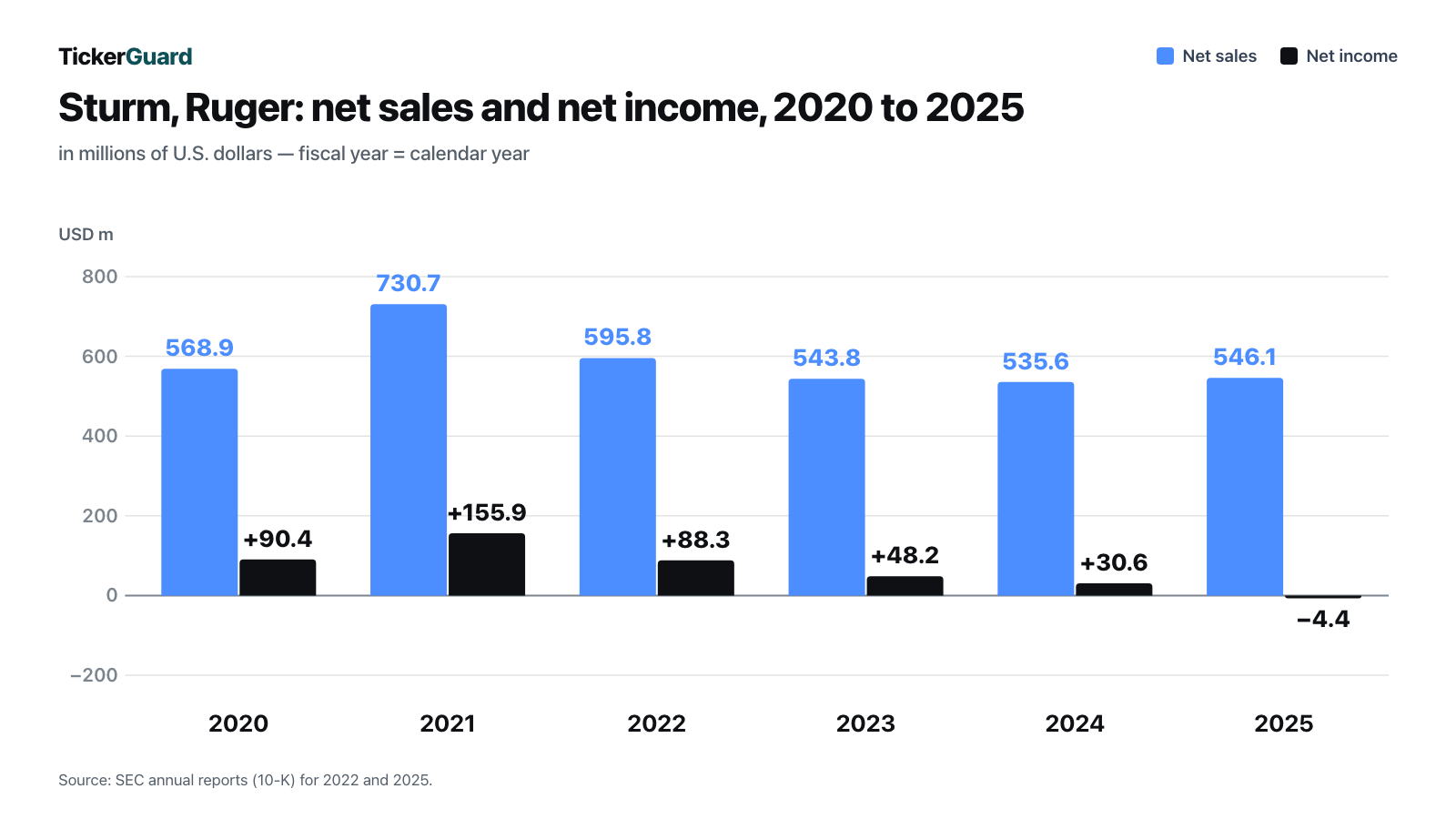
2021 was the industry’s exceptional year: $730.7 million of net sales, $155.9 million of net income, a gross margin of 38.3 percent. Gross margin is the share of every sales dollar left after manufacturing costs. It has declined every year since: 30.2 percent (2022), 24.6 percent (2023), 21.4 percent (2024) and 14.9 percent (2025). Net sales were almost unchanged from 2023 on — so Ruger did not sell less in dollars, it kept less of every sales dollar. 2025 brought special charges on top: in the second quarter Ruger wrote off $17.0 million of inventory and other assets, and the year ended with a net loss of $4.4 million.
In the first nine months of 2026 gross margin was 20.7 percent (prior-year period: 13.7 percent). That is a real recovery, but it only leads back to the 2024 level, not to that of the good years. Even less was left as operating income: $11.7 million in nine months, or 2.6 percent of net sales — in 2021 it was 27.8 percent. Remember: better than last year is not the same as good.
Beretta: from first stake to quarter-owner
The story that moved the stock is told in unusual detail in Ruger’s response to the offer (Schedule 14D-9 filed September 28, 2026). The short version:
- September 22, 2025: Beretta Holding, a family-owned group based in Luxembourg, reports a stake of about 7.7 percent — according to Ruger, without prior contact. By December 1, 2025, it rises to 9.95 percent.
- October 14, 2025: Ruger adopts a limited-duration rights plan — a “poison pill” in market slang, which makes it very expensive for a buyer to go above a threshold without the board’s consent.
- February 24, 2026: Beretta nominates four candidates of its own for the board. Two days earlier Ruger had replaced three of its directors.
- March 25, 2026: Beretta announces publicly that it wants to buy more shares at $44.80 each. Ruger initially declines.
- May 2, 2026: The two sides settle. Beretta withdraws its candidates, may go to 25 percent after regulatory approvals and may designate up to two independent directors.
- September 16, 2026: The regulatory conditions are satisfied and Ruger terminates the rights plan early. The offer starts the next day.
- October 20, 2026: Final results — Beretta owns 3,987,184 shares, 25.0 percent.
The heart of the settlement is a cap. The current report (8-K) on the agreement states:
“Effective as of the execution of the Agreement, the Beretta Holding Group and certain additional related persons will be subject to a perpetual aggregate beneficial ownership cap equal, initially, to 10% of Ruger’s issued and outstanding voting securities […].”
— Sturm, Ruger & Company, Inc., current report 8-K filed May 4, 2026, Item 1.01

The next sentence of the same report raises the cap to 25 percent after the regulatory approvals — exactly where Beretta now stands. Obligations come with it: until a date shortly before the 2029 annual meeting, Beretta must vote with the board in director elections and on most proposals. Votes above a threshold — 10 percent at first, 20 percent after that date — must permanently be cast in the same proportion as the other stockholders vote. Transactions between Ruger and Beretta, such as a tender offer or a merger, must be negotiated and approved by a committee of independent directors; if it is an extraordinary transaction, the filing says it also needs the approval of a majority of the disinterested stockholders. Whether Beretta has already designated its two directors cannot be seen from the filings: as of November 15, 2026, Ruger had not reported any appointment to the SEC.
What the filings say — the uncomfortable truths
Uncomfortable truth no. 1: in the third quarter the sales gain did not reach the stores
The earnings release of November 4, 2026, leads with 16.5 percent sales growth. The quarterly report filed the same day contains a figure that does not match:
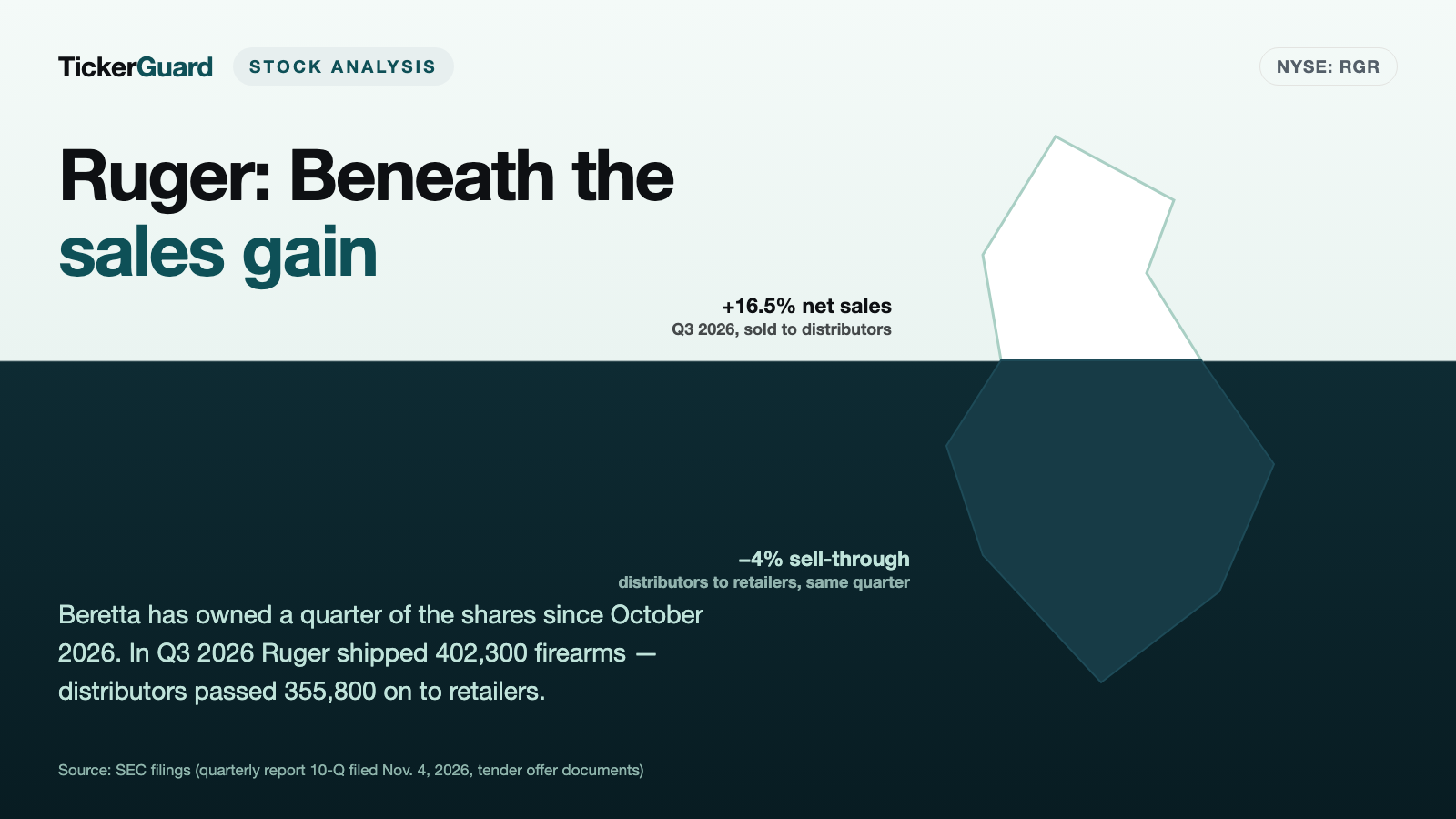
“Estimated sell-through of the Company’s products from the independent distributors to retailers decreased by 4% from the same period last year, compared to a 2% increase in adjusted NICS during the same period.”
— Sturm, Ruger & Company, Inc., SEC quarterly report 10-Q for the quarter ended September 26, 2026, Item 2 “Results of Operations”

Two explanations first. NICS is the system U.S. authorities use to run background checks on gun buyers before a purchase; the number of checks is the industry’s thermometer for demand. And the sentence sits in the report within a list about the first nine months, yet it refers to the third quarter — the table a few paragraphs later shows it: 355,800 units in the third quarter of 2026 versus 370,600 in the prior-year quarter is exactly 4 percent less. Over nine months, by contrast, sell-through rose about 5 percent (1,122,300 units versus 1,063,800). So the first half was strong and the third quarter weak.
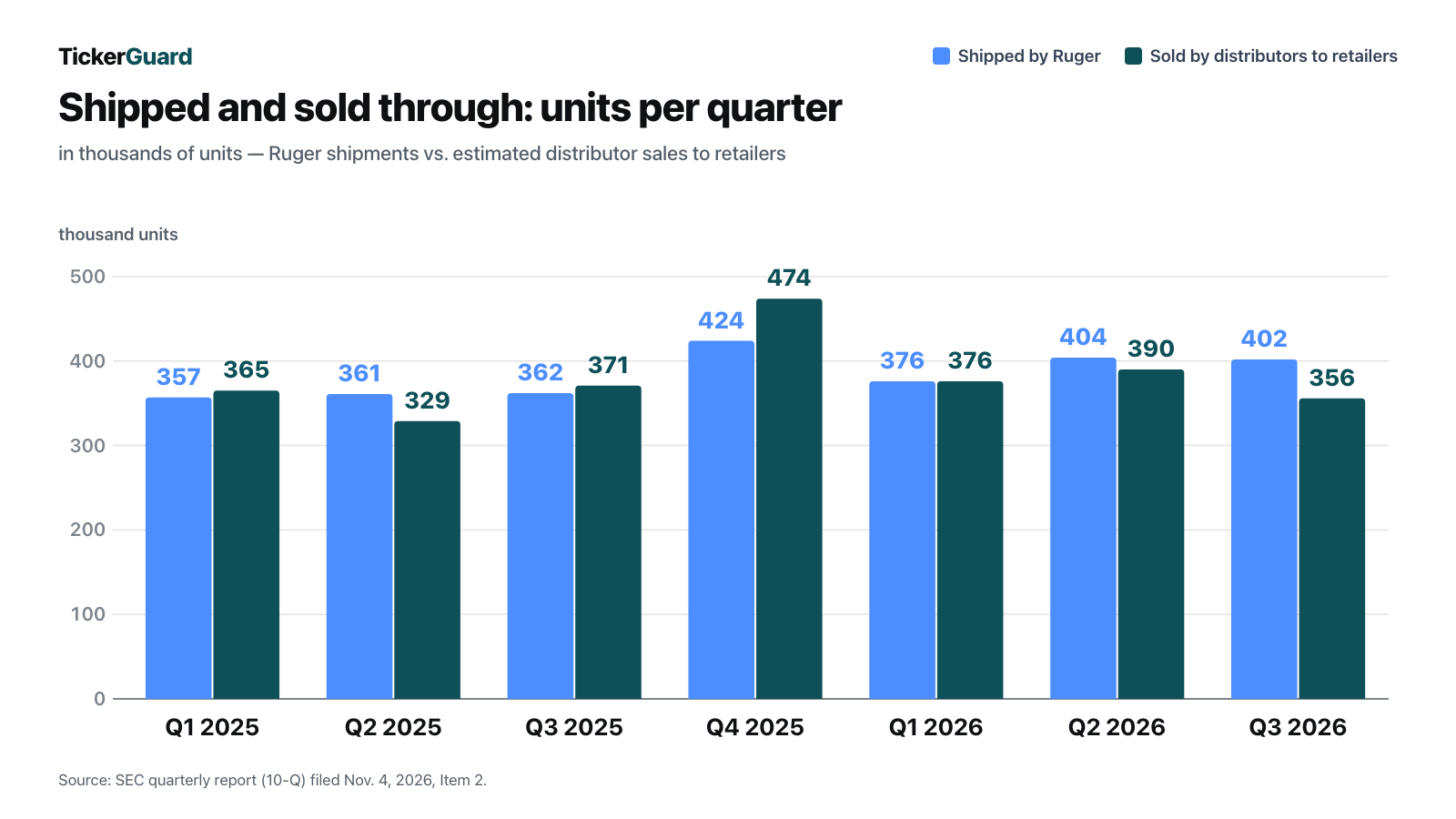
What does that mean for sales? In the third quarter Ruger shipped 402,300 units and produced as many as 434,300 — a near-term record, according to the chief executive. Distributors passed on 355,800. The difference is sitting in inventory: distributor inventory rose from 174,900 to 221,400 units in three months, the company’s own from 50,600 to 82,600. At the quarter’s average selling price ($348 per unit shipped), the 46,500 additional units at distributors are worth roughly $16 million — a little more than a tenth of quarterly net sales (our own rough calculation). Picture a baker proudly announcing he delivered more rolls to the gas stations than ever before. The question that counts: how many of them were eaten?
Two more lines of the report fit the picture. First, trade receivables — invoices customers have not yet paid: $101.7 million on September 26, 2026, versus $59.9 million on September 27, 2025, an increase of 70 percent on 16.5 percent more quarterly sales. Operating cash flow for the first nine months fell accordingly, from $38.8 million to $24.2 million. In the quarterly report Ruger attributes this to the timing of third-quarter shipments and to cash collections during the rollout of its new Oracle enterprise software system in the middle of the quarter. Second, orders: in the third quarter Ruger received orders worth $70.2 million, 20 percent less than in the prior-year quarter ($87.9 million), on almost the same number of units (290,800 versus 286,500) — the average price of units ordered fell from $307 to $242. Asked about it by an analyst on the earnings call, Seyfert said it came down to product mix.
Three things in fairness. According to Ruger, orders tend to be seasonally weaker in the third quarter than in the first, and the company says it does not plan production based on orders received. At 221,400 units, distributor inventory is only slightly above the level a year earlier (211,700); at the end of 2025 it was unusually low at 162,300. And Ruger itself calls sell-through an estimate based on unverified data from the distributors. The chief executive said on November 4, 2026, that the company was happy with consumer demand in the third quarter. Whether he is right will show in the fourth quarter — in 2025 it was by far the strongest, with 473,800 units passed on. Remember: at Ruger a sale happens when the product leaves the factory — demand only when it leaves the distributor again. How strongly retailer orders can shift a brand manufacturer’s sales from one year to the next is shown in our Traeger analysis.
Uncomfortable truth no. 2: according to Ruger, a path to 50 percent was initially on the table
Ruger’s response describes a phone call on March 9, 2026, between Seyfert and Beretta’s general manager, Robert Eckert, in which Eckert first proposed three of seven board seats. It continues:
“Mr. Eckert also stated that Beretta Holding wanted to increase its ownership of Ruger in the short term to 25%, primarily through an issuance of new shares by Ruger, and further stated that after a standstill period, Beretta Holding wanted a path to acquire 25% more (for a total stake of 50%) of Ruger at a valuation to be agreed upon in advance.”
— Sturm, Ruger & Company, Inc., response to the offer (Schedule 14D-9) filed September 28, 2026, Item 4 “Background of the Offer”

A week later, on March 16, 2026, Beretta’s chief executive withdrew that request, according to the same document: Eckert had not been authorized to make it. It matters whose account this is — it is Ruger’s view, written down in a document Ruger drafted. What is not in dispute is the outcome: as late as March 28, 2026, Ruger wrote that the partial tender offer was consistent with a strategy of “creeping acquisition of control.” Five weeks later the same board agreed to exactly that 25 percent, with a cap, voting commitments and a standstill. And the board itself writes that it does not know whether Beretta is still interested in a business combination; if so, Beretta’s interests could differ from those of the other stockholders.
The dispute was not cheap. For the first nine months of 2026 Ruger reports $6.3 million of costs for the confrontation — lawyers, advisers and preparation for the proxy fight. That is about 38 percent of pretax income of $16.4 million. Ruger excludes these costs from its “adjusted” figures and bases its dividend on them as well: for the third quarter of 2026 the dividend is 18 cents per share, about 40 percent of adjusted earnings of 44 cents; reported earnings were 36 cents. Remember: an anchor shareholder who fought for his seat is not a silent partner — and the 25 percent is a lid, not a promise of more.
Uncomfortable truth no. 3: at $44.80 a great many wanted out
The tow-rope trap lives on the assumption that the big buyer’s price is a floor. Look at how the other owners reacted to that price:
“Based on the final count by the depositary for the Tender Offer, a total of 6,094,325 Shares were validly tendered and not properly withdrawn.”
— Beretta Holding S.A., announcement of the final results of the offer, October 20, 2026 (Schedule TO-T/A, Exhibit (a)(5)(vi))
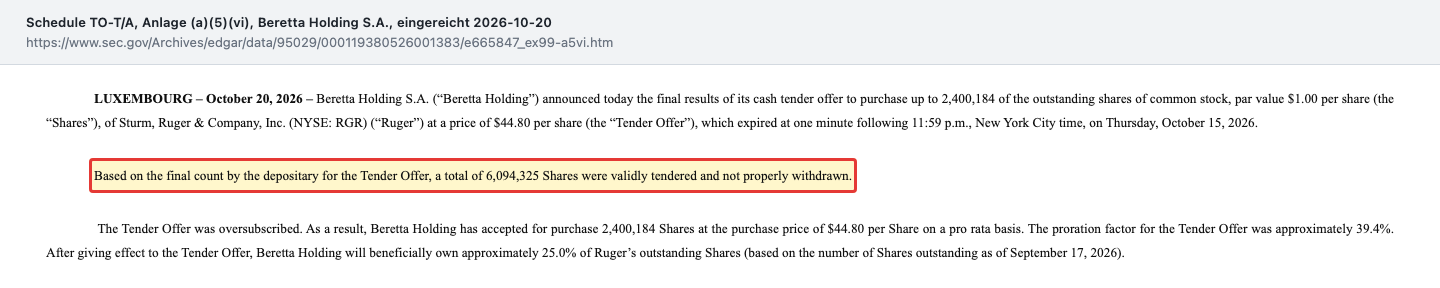
Do the math with me: 6,094,325 tendered shares are 38 percent of all 15,978,256 outstanding. Subtract the 1,587,000 shares Beretta already owned, and the holders of a little more than 42 percent of all remaining shares wanted to sell at $44.80 (our own calculation). Beretta was only allowed to buy 2,400,184; each seller therefore sold only about 39.4 percent of the shares tendered and kept the rest. According to Ruger, the offer price was 20.8 percent above the closing price on September 16, 2026, and 28.3 percent above the price on August 22, 2025, a month before Beretta’s stake became public.
Ruger’s board gave its stockholders no advice on this. On September 28, 2026, it unanimously resolved “to express no opinion and to remain neutral with respect to the Offer” — though in the May agreement it had also committed, subject to its fiduciary duties, not to recommend against tendering. What the heavy tendering means cannot be read from the filings with certainty: some investors sell on principle whenever a premium is offered, others simply wanted to cash out. Only the quantity is documented. Also documented is that the stock has since traded above the price at which so many were willing to let go. Anyone who tendered all of their shares kept about 61 percent of them — and those closed above Beretta’s $44.80 on November 13, 2026.
Uncomfortable truth no. 4: three distributors, 60 million shares and a right for Beretta alone
Back to the sales channel. Thirteen distributors sounds diversified, but three of them dominate:
“In 2025, the Company’s largest customers and the percent of firearms sales they represented were as follows: Lipsey’s – 27%; Sports South - 22%; and Davidson’s - 18%.”
— Sturm, Ruger & Company, Inc., SEC annual report 10-K for 2025, Item 1 “Business”
Together that is 67 percent of firearms sales. Three buyers decide on two thirds of what Ruger ships — and with it on how much product sits in the channel. Ruger says it reviews its distributors’ financial statements and has credit insurance for many of them. How a direct competitor in the same market is doing is shown in our Smith & Wesson analysis.
The second point concerns your slice of the pie. At the annual meeting on May 27, 2026, stockholders approved raising the number of authorized shares from 40 million to 60 million (12.5 million votes for, 1.6 million against). Just under 16 million are outstanding; the board can now issue roughly 35.5 million more shares, in most cases without asking stockholders again. The proxy statement of April 27, 2026, names no present plans to do so and makes clear that stockholders have no preemptive rights to new shares. Five days later one stockholder received something similar after all: in the agreement Ruger committed, until the standstill ends shortly before the 2029 annual meeting, to use reasonable best efforts to offer Beretta, in share issuances for cash, enough shares to keep its percentage unchanged. Dilution means the pie is cut into more slices and yours gets smaller. If it comes to that, one guest at the table may take a second helping.
Finally, the product line. In October 2026 Ruger announced it would suspend production of several product families and complete final 2026 production of others, together about $25 million of revenue and, according to the company, generate minimal to no profitability. That makes business sense but costs sales at first — and goodwill: on the earnings call a participant asked about discontent among gun owners over the decision. Seyfert replied that this was a suspension, not a permanent discontinuation.
Valuation: what the November 13, 2026, close implies
At the $50.45 close, Sturm, Ruger has a market value of about $806 million. Subtract cash and short-term investments ($101.4 million) and the operating business costs about $705 million. That yields these orders of magnitude:
- Price-to-earnings ratio of about 49 on net income of the last four quarters ($16.4 million: $3.5 million in the fourth quarter of 2025 plus $12.9 million in nine months of 2026) — you pay roughly 49 times one year’s earnings. That is a lot for a manufacturer without growth over several years and assumes earnings rise substantially.
- Price-to-sales ratio of about 1.3 ($598.1 million of net sales in the last four quarters).
- Price-to-book ratio of about 2.7 ($293.3 million of stockholders’ equity on September 26, 2026).
- About 12.6 percent above Beretta’s offer price of $44.80 — and about 75 percent above the closing price on November 20, 2025 ($28.81).
In plain terms: the market is not paying for the Ruger of the last twelve months but for a Ruger whose margin recovers further toward earlier years. For context: on 2023 net income ($48.2 million on $543.8 million of net sales) the price-to-earnings ratio would be about 17. The “professionals’ view” is thin: according to fundamental data (as of November 15, 2026) only two analysts cover the stock — too few to draw any reliable conclusion from their price targets.
Opportunities and risks at a glance
What speaks for Sturm, Ruger:
- No debt, $101.4 million of cash and short-term investments, an unused $40 million credit facility (September 26, 2026).
- Back in the black: $12.9 million of net income in nine months of 2026 after a $7.9 million loss; gross margin 20.7 percent versus 13.7 percent.
- Sales growth in all three quarters of 2026 reported so far; new products brought in $99.5 million in nine months (24 percent of firearms sales).
- A well-funded anchor shareholder from the same industry; under the agreement, cooperation in sales, sourcing and manufacturing is to be explored — on a non-binding basis.
- The dispute is settled; Ruger expects the related costs to be limited in duration.
What speaks against it:
- In the third quarter of 2026 distributor sell-through fell 4 percent while Ruger booked 16.5 percent more sales; distributor inventory rose by 46,500 units.
- Receivables 70 percent above the year-earlier date, nine-month operating cash flow of $24.2 million versus $38.8 million; third-quarter orders down 20 percent by value.
- Gross margin barely more than half the 2021 level; operating income only 2.6 percent of net sales in nine months of 2026.
- 67 percent of 2025 firearms sales through three distributors.
- A 25 percent shareholder whose interests, according to Ruger, may differ from those of the other stockholders; 35.5 million authorized but unissued shares, and only Beretta has the right to maintain its stake when new shares are issued for cash.
- A valuation of roughly 49 times net income of the last four quarters.
A human conclusion
Back to the tow-rope trap from the beginning. Its core is not that the big buyer is wrong — Beretta has known the industry for centuries and put about $107.5 million of its own money on the table. Its core is that we mistake its math for ours. Beretta paid $44.80, not $50.45. Beretta negotiated the right to two directors, the 25 percent and the right to maintain its stake when new shares are issued for cash; you get none of that. And Beretta is a manufacturer itself and, in its own words, wants to strengthen its industrial and commercial presence in the United States, a key market for the group — a different goal from yours. Let go of the tow rope and a sober finding remains: a debt-free heritage company that is earning money again after a loss-making year, with a margin half as high as in the boom, and with a third quarter in which more product went into distributors’ warehouses than came out. The honest question for you is therefore not “What does Beretta know?” but: will the product Ruger shipped in the third quarter of 2026 actually reach buyers — and what is a company worth to you that earned $16.4 million over the last four quarters and costs about $806 million on the stock market? What you make of it is your decision. And that is as it should be.
Sources
All original documents used in this analysis — to read for yourself:
- Sturm, Ruger & Company, Inc. — SEC quarterly report 10-Q for the quarter ended September 26, 2026 (filed November 4, 2026)
- Sturm, Ruger & Company, Inc. — third-quarter 2026 earnings release (8-K Item 2.02, Exhibit 99.1, November 4, 2026) and transcript of the November 4, 2026, earnings call (8-K Item 7.01, Exhibit 99.1, filed November 6, 2026)
- Sturm, Ruger & Company, Inc. — SEC quarterly reports 10-Q for the quarters ended June 27, 2026, March 28, 2026, and September 27, 2025
- Sturm, Ruger & Company, Inc. — SEC annual reports 10-K for 2025 (filed March 2, 2026), 2024 and 2022 (years 2020 to 2022)
- Sturm, Ruger & Company, Inc. — current report 8-K filed May 4, 2026 (agreement with Beretta Holding) and 8-K filed September 16, 2026 (end of the rights plan)
- Sturm, Ruger & Company, Inc. — response to the offer, Schedule 14D-9 filed September 28, 2026
- Beretta Holding S.A. — offer to purchase dated September 17, 2026 (Schedule TO-T, Exhibit (a)(1)(i)) and announcement of the final results, October 20, 2026
- Sturm, Ruger & Company, Inc. — proxy statement DEFC14A filed April 27, 2026 and 8-K filed May 28, 2026 (annual meeting results, authorized shares)
- Sturm, Ruger & Company, Inc. — current reports 8-K filed February 23, 2026 (board changes) and March 27, 2026 (new chief financial officer)
- Complete SEC filing history including insider reports (Form 4): EDGAR overview for Sturm, Ruger & Company, Inc. (sec.gov)
- Fundamental data (closing prices, analyst coverage, market-value cross-check; as of November 15, 2026), reconciled with the SEC filings.
Transparency & disclaimer: this analysis is journalistic commentary on publicly available information. It is not investment advice, not a regulated investment research product and not a solicitation to buy or sell securities. Equity investments carry substantial risk up to and including total loss. All information is provided without warranty; the as-of date for each figure is stated in the text. Positions held by the operator are disclosed daily; where one exists, it appears as a notice at the top of this deep dive.
Key figures at a glance
All monetary figures in millions of $; earnings per share as reported.
| Metric | 2021 | 2022 | 2023 | 2024 | 2025 |
|---|---|---|---|---|---|
| Revenue | 730.7 | 595.8 | 543.8 | 535.6 | 546.1 |
| Operating Income (EBIT) | 203.1 | 103.5 | 52.1 | 31.7 | -11.6 |
| Net Income | 155.9 | 88.3 | 48.2 | 30.6 | -4.4 |
| Net Margin | 21.3% | 14.8% | 8.9% | 5.7% | -0.8% |
| Earnings Per Share | 8.78 $ | 4.96 $ | 2.71 $ | 1.77 $ | -0.27 $ |
Source: fundamental data & SEC filings (annual and quarterly reports, 10-K/10-Q)
Our Bottom Line at a Glance
- Balance sheet & cash positive
- No debt; cash and short-term investments of $101.4M, stockholders’ equity of $293.3M on total assets of $381.7M (09/26/2026); $40M credit facility unused.
- Earnings power neutral
- 9M 2026: net income $12.9M after a $7.9M loss, gross margin 20.7% versus 13.7%. But: FY 2025 loss of $4.4M, 9M 2026 operating income only 2.6% of net sales; gross margin was 38.3% in 2021.
- Demand & sales channel negative
- Q3 2026: net sales +16.5%, estimated distributor sell-through −4% (355,800 vs. 370,600 units); distributor inventory +46,500 units; receivables $101.7M vs. $59.9M a year earlier; order value −20%.
- Anchor shareholder Beretta neutral
- 25.0% since 10/20/2026, capped by contract, with voting commitments and a standstill until shortly before the 2029 annual meeting. According to Ruger, Beretta’s general manager asked on March 9, 2026, for a path to 50%; Beretta withdrew this on March 16 as unauthorized. The dispute cost Ruger $6.3M in nine months of 2026.
- Customers & capital structure neutral
- 67% of 2025 firearms sales through three distributors. Authorized shares at 60M since 05/28/2026 (15,978,256 outstanding); in share issuances for cash only Beretta has a contractual right to keep its stake.
Sturm, Ruger shows how the tow-rope trap works: a well-funded industry buyer pays $44.80 a share and now owns 25 percent, and the stock trades above that. The company is debt-free and earning money again in 2026. But the margin is half the 2021 level, in the third quarter of 2026 more product went into distribution than came out, and the holders of 38 percent of all shares wanted to sell at the anchor shareholder’s price. Not investment advice.
What Our Rating Means
Open questions
The business works in principle, but one material question is open. As long as it stays open, our findings do not carry a quality verdict.
Yellow, because the business fundamentally works but material operating questions are open. In the company’s favor: a balance sheet without debt, $101.4 million of cash and short-term investments and the return to profit in 2026. Against it: the recovery is young — 2025 ended with a loss, the 20.7 percent gross margin is barely more than half the 2021 level, and in the third quarter of 2026 distributor sell-through fell while net sales, channel inventory and receivables rose. Add the dependence on three distributors and a new anchor shareholder whose role has yet to show. The filings contain no risk to the company’s substance that would justify red. The stock trading above Beretta’s offer price and the high price-to-earnings ratio do not change this assessment. The decision is yours.
A journalistic assessment by our editorial team at the time of the deep dive, based on public sources — not investment advice and not a solicitation to buy or sell. Your personal circumstances (investment goals, risk capacity, taxes) cannot be taken into account. What our levels mean, how verdicts are formed, and what conflicts of interest exist →
Worth Noting
- The stock reached our research list through the Reddit hype scan of 11/15/2026. Price reference: close of $50.45 on 11/13/2026 (09/16/2026: $37.08; 10/20/2026: $48.74; 11/04/2026: $49.91; source: fundamental data).
- Data as of: the latest periodic report is the 10-Q for the quarter ended 09/26/2026 (filed 11/04/2026); after that, through 11/15/2026, only the earnings call transcript (8-K filed 11/06/2026) and a corrected insider report (Form 4/A filed 11/13/2026).
- The sell-through sentence (−4%) appears in the 10-Q within a list about the first nine months; the quarterly table in the same report shows that it refers to the third quarter (355,800 vs. 370,600 units). Over nine months sell-through rose about 5%.
- Our own calculations: tender percentages (38% of all shares, a little over 42% of shares not owned by Beretta), value of the additional units at distributors (46,500 × $348), net income of the last four quarters ($16.4M) and all valuation ratios.
- The account of the negotiations with Beretta comes from Ruger’s response (Schedule 14D-9 filed 09/28/2026) and reflects Ruger’s view.
Stock Watch
This analysis is as of November 15, 2026. Stock Watch will tell you what's changed at RGR since then.
Later $1 a month per stock — signing up is free, and you'll be the first to know when it launches.
The full analysis as a PDF for later
We will send you this analysis as a PDF — to print, file away, and read at your own pace. And we will add you to the free Stock Watch list for Sturm Ruger & Company Inc (RGR), so you hear about it when something material in this analysis changes.
Frequently Asked Questions
Sturm, Ruger & Company (NYSE: RGR), based in Mayodan, North Carolina, has made firearms for the U.S. commercial market since 1949: rifles, pistols and revolvers under the Ruger, Marlin and Glenfield brands. Net sales were $546.1 million in 2025, of which $338.2 million came from rifles. More than 90 percent goes to 13 independent distributors. In early 2026 Ruger had approximately 1,780 employees.
According to a filing of October 20, 2026, Beretta Holding S.A. of Luxembourg owns 3,987,184 shares, or 25.0 percent. The family-owned group previously held 1,587,000 shares (about 9.9 percent); a public partial tender offer added 2,400,184 shares at $44.80 each, about $107.5 million in total.
Under the agreement of May 2, 2026, Beretta is subject to a perpetual ownership cap of 25 percent. Standstill obligations also apply until shortly before the 2029 annual meeting. Transactions between Ruger and Beretta, such as a tender offer or a merger, must be negotiated and approved by a committee of independent directors; extraordinary transactions also need a majority of the disinterested stockholders. Whether the parties will later amend the agreement cannot be read from the filings.
The offer ran from September 17 to October 15, 2026. Holders tendered 6,094,325 shares, while Beretta was allowed to buy no more than 2,400,184. Shares were therefore prorated: each seller sold about 39.4 percent of the shares tendered at $44.80 and kept the rest. Ruger’s board remained neutral and made no recommendation.
In 2025 Ruger lost $4.4 million, mainly because of inventory write-offs in the second quarter. In the first nine months of 2026 net income was $12.9 million, of which $5.8 million came in the third quarter. Gross margin was 20.7 percent. For comparison: in 2021 Ruger earned $155.9 million on a gross margin of 38.3 percent.
No, Ruger has no debt. On September 26, 2026, the balance sheet showed $24.2 million of cash and $77.2 million of short-term investments, $101.4 million in total. A $40 million credit facility that runs until January 2028 was unused. Stockholders’ equity was $293.3 million.
Yes, but not a fixed one. Each quarter Ruger pays out about 40 percent of earnings, most recently measured against adjusted earnings per share. For the third quarter of 2026 the dividend is 18 cents per share, payable December 4, 2026; for the two prior quarters it was 11 and 21 cents. In the first nine months of 2026 Ruger paid $6.4 million to stockholders.
Ruger books a sale when product is shipped to one of its 13 distributors. Whether it is sold on only shows in estimated sell-through to retailers. In the third quarter of 2026 Ruger shipped 402,300 units, while 355,800 were passed on — 4 percent fewer than in the prior-year quarter. Distributor inventory rose by 46,500 to 221,400 units.
Found an error?
Did you spot a factual error, an outdated number, or a typo in this deep dive? Let us know briefly — your report goes straight to the editorial team.