CleanSpark Stock: Meta Pays the Rent — but the Noteholders Get Paid First
A Meta subsidiary is renting an AI data center from CleanSpark for 20 years — and yet the stock fell from $12.88 to $6.15 between September 30 and November 17, 2026. The filings show a bitcoin business in which mining one bitcoin recently cost more than it brought in, and rent that services the noteholders first. Not investment advice — just the question of who gets Meta's rent first.
 Thomas Mücke
Founder & Publisher
As of Today
As of: November 16, 2026
- Closing price
- 6.20 $ -2.38%
- Market Capitalisation
- 1.6 $B
- Growth Score
- 5/10
- AAQS
- 4/10
Price change since November 17, 2026: +0.8%
This analysis has a cut-off date. The Stock Guard tells you when something material changes in the numbers. Reserve your free spot
Chart
Interactive price chart (TradingView).
52-week range: 5.70 $ to 18.80 $ · Last price: 6.20 $ (As of: November 16, 2026)
Note: pure fact-based analysis, not investment advice and not a solicitation to buy or sell. All figures without guarantee.
Meta as a tenant — and yet the share price has halved since late September. On July 14, 2026, CleanSpark (Nasdaq: CLSK) announced its first lease for an AI data center: a 20-year lease for an AI data center in Sandersville, Georgia, worth about $6.6 billion, signed with a technology company with a “high investment grade” credit profile. Two months later, a presentation to lenders named who stands behind it: a subsidiary of Meta — the company behind Facebook, Instagram and WhatsApp.
A name like that shines. And that is where an old investor weakness lies in wait, the halo effect: one bright feature colors everything else. If Meta is your tenant, it feels as though you must be a solid landlord. The market did not see it that way: the stock closed at $12.88 on September 30, 2026, and at $6.15 on November 17, 2026 — although bitcoin also fell over the same period, from about $83,600 to about $64,600 according to fundamental data.
So let’s read the filings together — the reports CleanSpark has to file with the U.S. securities regulator, the SEC. The tension that runs through this analysis: the tenant has very high credit quality — but the landlord carries a bitcoin business that is currently losing money and debt that is growing faster than the rent. And here is a question to keep in mind until the end: would you buy this stock if you didn’t know the tenant’s name?
What CleanSpark actually does — from bitcoin miner to AI data center landlord
CleanSpark is based in Henderson, Nevada, and until July 2026 it was mainly one thing: a bitcoin miner. The company runs U.S. halls full of specialized computers (225,137 machines as of June 30, 2026, according to the quarterly report) that solve the bitcoin network’s puzzles around the clock and earn newly created bitcoin in return. Think of a gold mine where computers replace excavators and electricity replaces diesel. In June 2026, the fleet averaged 42.6 exahash per second, about 4.4 percent of the network’s global computing power. Through June 30, 2026, all of the company’s revenue came from mining. The fiscal year ends September 30, so “fiscal 2025” runs from October 2024 through September 2025.
The real asset is not the fleet but access to power. CleanSpark says it controls more than 1.8 gigawatts of power, land and data centers. That is exactly what the big AI companies are looking for: an AI data center needs, above all, a thick power line. On July 10, 2026, CleanSpark leased that access at scale for the first time: 175 megawatts of data center capacity on newly acquired land next to its existing Sandersville mining site, for 20 years plus two five-year extension options, as a so-called triple-net lease — the tenant pays all operating costs itself. The same tenant also signed a letter of intent and exclusivity arrangement covering the company’s Texas portfolio (718 acres, up to 885 megawatts of secured and planned power).
According to the investor presentation of September 17, 2026, the tenant is Anviran, LLC, a wholly owned subsidiary of Meta; Meta serves as guarantor of rent and operating expenses. Rent is scheduled to start on November 30, 2027, once the first hall is complete. Until then, bitcoin mining continues in Sandersville — and then it ends there:
“The Company will continue to utilize the current Sandersville site for bitcoin mining until the lease commencement date, at which time the power will be diverted to the Sandersville AI Campus and bitcoin mining activity will cease.”
— CleanSpark, SEC quarterly report 10-Q as of June 30, 2026, Note 16 “Subsequent Events”
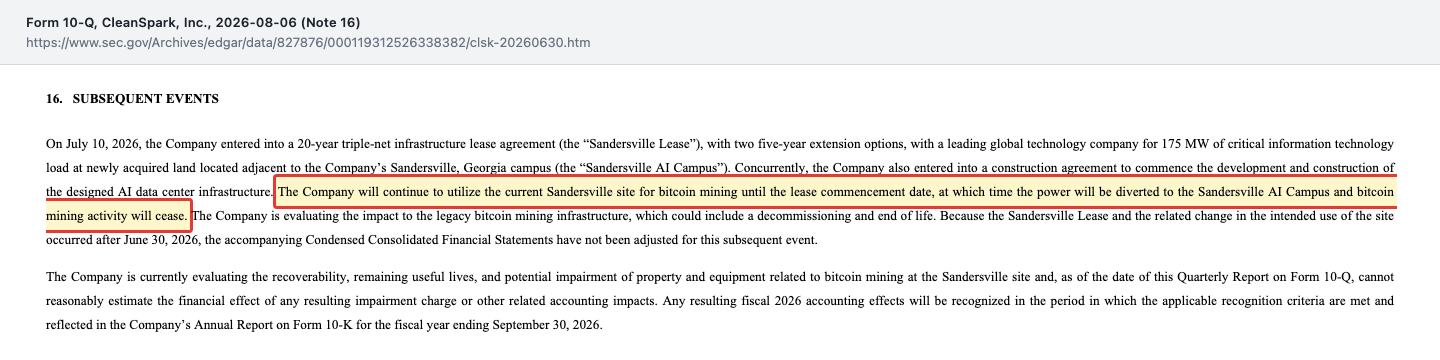
The same section says CleanSpark is reviewing the recoverability of its Sandersville mining assets and cannot yet estimate a possible impairment; any charge will be reflected in the annual report for the fiscal year ended September 30, 2026. So keep this in mind: the new contract replaces part of the old business — it does not come on top of it.
Company history for investors
-
2024
Convertible notes and first buyback
In December, CleanSpark borrows $650 million at zero interest and buys back 11.76 million shares for $145 million. For shareholders: fewer shares, but debt with a put in June 2028.
-
2025
Record year thanks to bitcoin
Fiscal 2025: $766.3 million of revenue and $364.5 million of net income, carried by $517.8 million of valuation gains. In November: $1.15 billion of convertibles and a $460 million buyback.
-
2026
Preferred dividend bought out
In March, CleanSpark pays $30 million to eliminate the profit share on preferred stock held by its CEO and other insiders. The 45 votes per preferred share remain.
-
2026
Lease with a Meta subsidiary
On July 10, CleanSpark signs a 20-year lease for 175 MW in Sandersville worth about $6.6 billion. For shareholders: the entry into the AI data center business.
-
2026
$2.276 billion of notes for the build
In September, the project company borrows $2.276 billion at 7.875 percent. For shareholders: per the illustrative calculation, rent largely services debt through 2043.
How the stock landed on our desk — little Reddit noise, but a halved share price
CleanSpark landed on our research list via our in-house Reddit hype scanner, even though the stock barely registers there (per ApeWisdom, rank 436 on November 18, 2026, one mention in 24 hours). What stands out is the share price. According to fundamental data, the stock closed at $18.81 on June 1, 2026, at $12.88 on September 30 and at $6.15 on November 17. Over the same stretch from late September, bitcoin fell from about $83,600 to about $64,600 — so the stock lost considerably more than the coin whose price drives its earnings. No company filing since September 25, 2026, names a specific trigger; the only filings since then are insider reports (Form 4/144) and ownership reports by large holders (Schedule 13G/A).
Classic metrics from our scanners only go so far with CleanSpark: there is no price-to-earnings ratio without earnings, and earnings themselves swing with the bitcoin price. How another bitcoin miner approached the shift to AI data center leasing is covered in our Riot Platforms analysis. With CleanSpark, what counts is what the filings say.
The numbers over the years: revenue more than quadrupled, earnings in lockstep with bitcoin
First, what impresses. Revenue rose from $168.4 million in fiscal 2023 to $379.0 million (2024) and $766.3 million in fiscal 2025. That is more than a fourfold increase in two years, achieved with 309 full-time employees (as of September 30, 2025). In fiscal 2025, net income came to $364.5 million.
Now the catch. Since fiscal 2024, CleanSpark has marked its bitcoin holdings to the current price at every balance sheet date (it voluntarily early-adopted the new accounting rule as of October 1, 2023); gains and losses flow straight into net income. In fiscal 2025, that produced a $425.6 million gain on holdings and $92.2 million on bitcoin posted as collateral with counterparties — $517.8 million before taxes, more than the entire net income. In the nine months ended June 30, 2026, it went the other way: bitcoin fell from about $114,100 (September 30, 2025) to about $58,500 (June 30, 2026), according to the 10-Q, valuation losses added up to $746.2 million, and the net loss to $996.9 million.
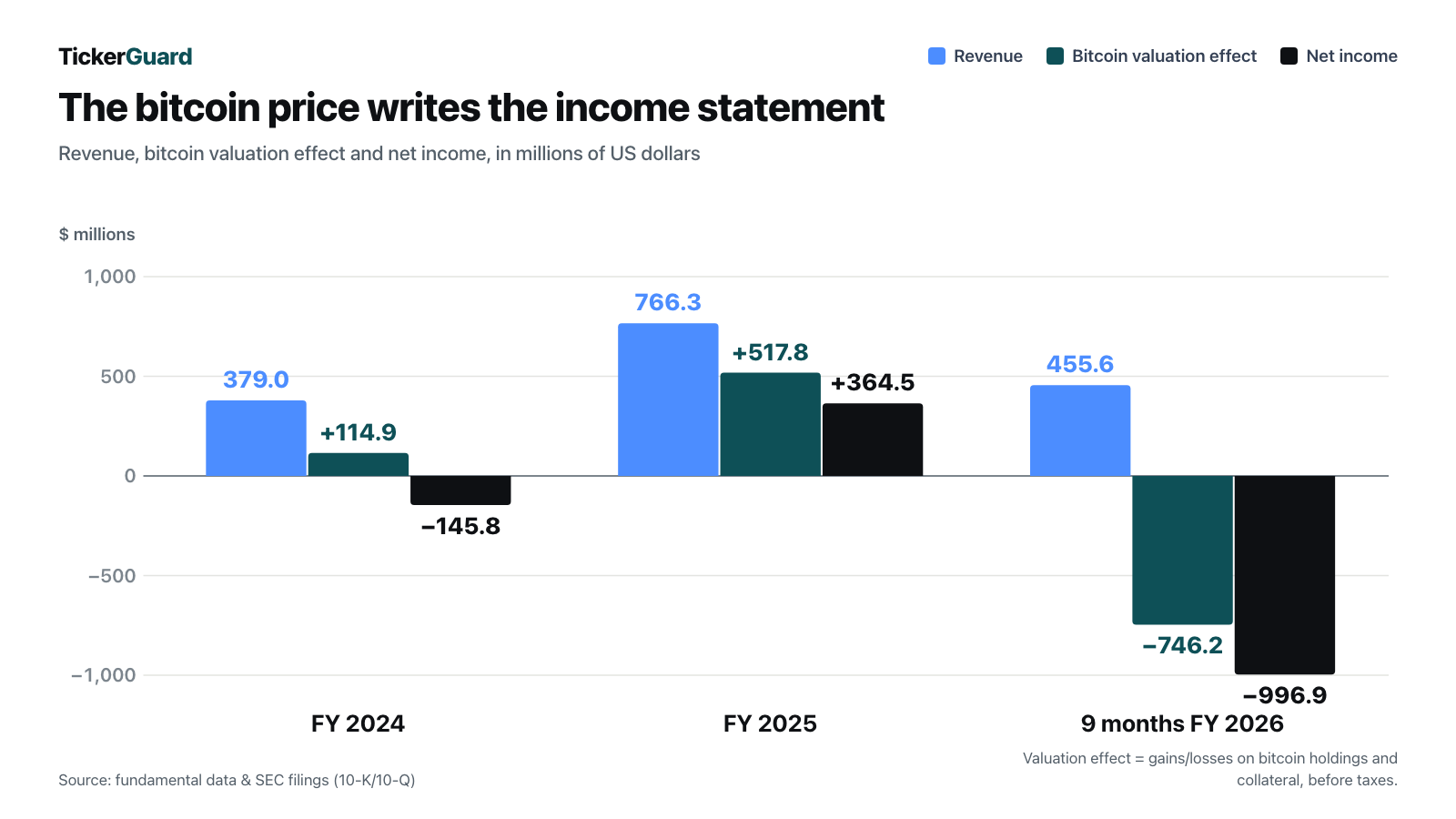
In fiscal 2024 (net loss of $145.8 million), another item weighed: a $197.0 million impairment of fixed assets. Revenue fell, too: in the April–June 2026 quarter it was $138.0 million, 30.5 percent below the prior-year quarter ($198.6 million). Stockholders’ equity — the part of the assets that belongs to shareholders after all debts — dropped from $2.18 billion to $761.3 million in nine months. Remember: at CleanSpark, the year’s result has so far been decided not by management but by the bitcoin price on the balance sheet date.
What the filings say — the uncomfortable truths
Uncomfortable truth No. 1: a mined bitcoin costs more than it brings in
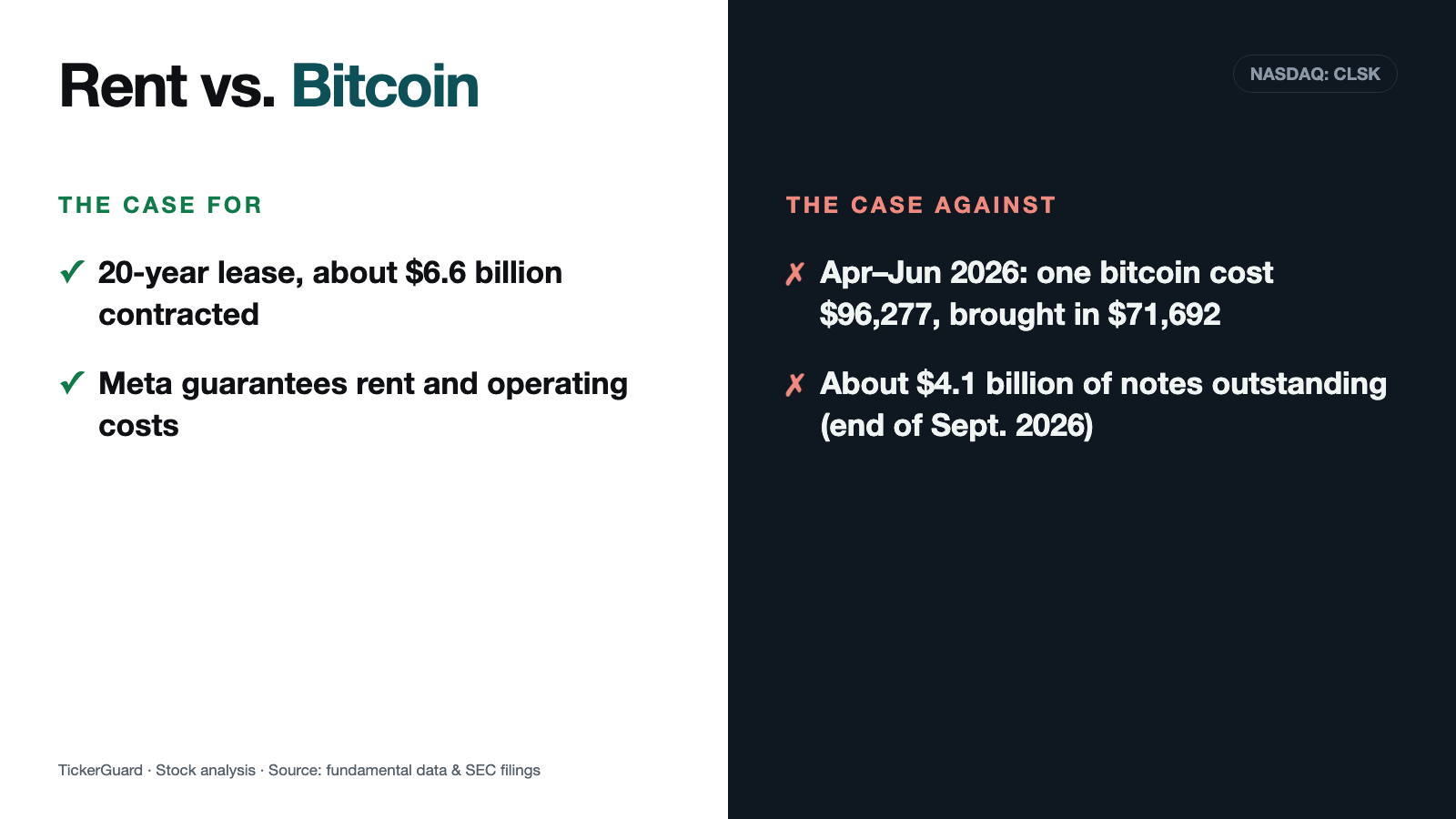
Bitcoin miners publish a calculation worth remembering: what does it cost to produce one bitcoin? CleanSpark shows it in its quarterly report — first with power only, then including depreciation of the machines (and minor financing costs). Depreciation is the loss in value of equipment that becomes obsolete within a few years; it does not leave the bank account, but it is as real as the wear on a delivery van. The result for the April–June 2026 quarter: one bitcoin cost $96,277 at owned facilities, $44,406 of it direct energy and other direct costs. On average it brought in $71,692. The company reports the ratio itself: 134.3 percent.
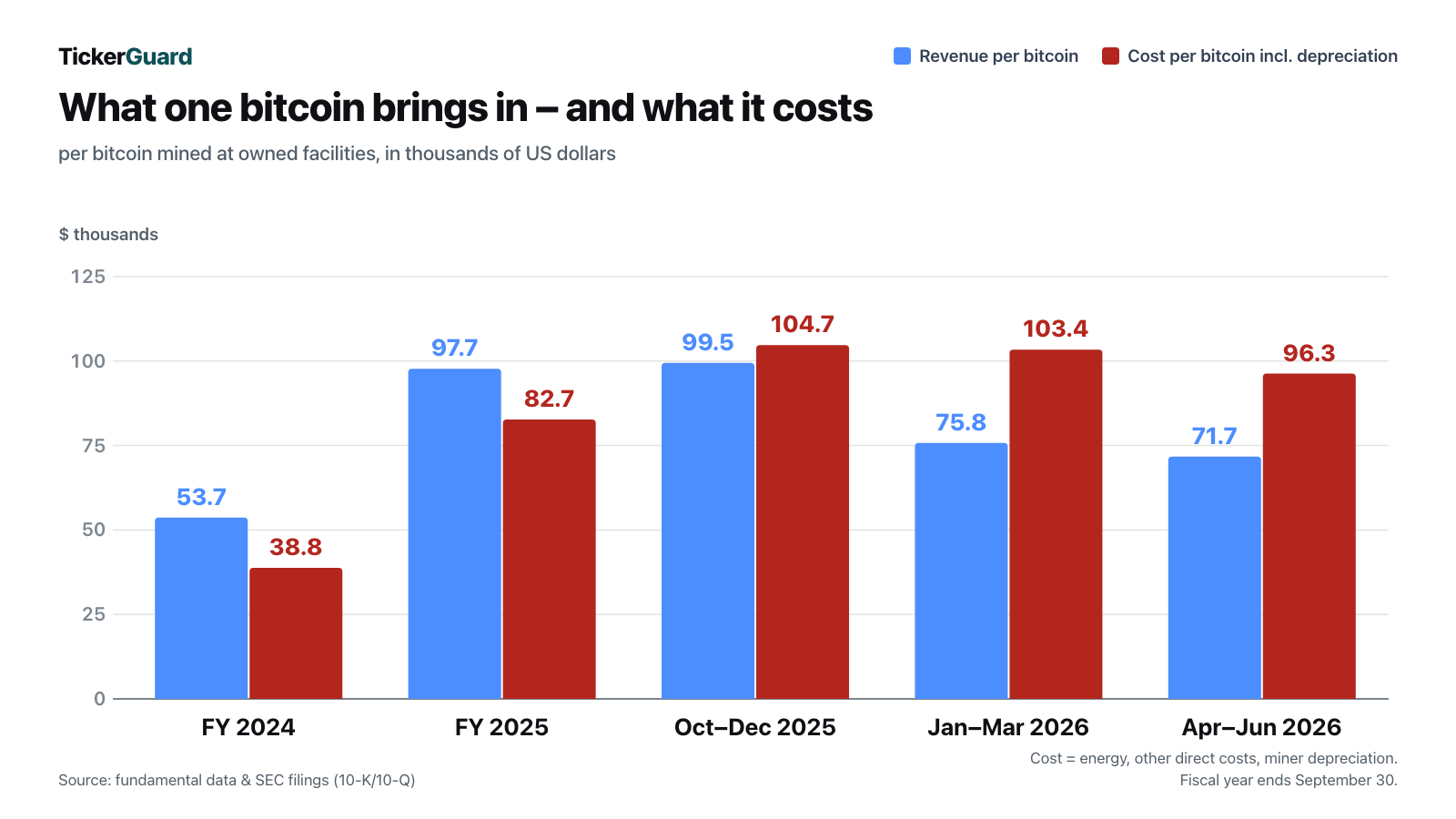
Two years earlier, the math looked completely different: in fiscal 2024, a bitcoin cost $38,766 (excluding accelerated depreciation; $39,936 including it) and brought in $53,708. In April 2024, in the middle of that fiscal year, the reward per block was halved, and since then global computing power has grown — to 976 exahash per second in June 2026, from 881 a year earlier, according to the 10-Q. More competition means each machine finds fewer bitcoin. Counting power only, CleanSpark stays in the black at 61.9 percent of revenue; the business covers its running power costs, but not the replacement of its machines. The company says so itself in its third-quarter earnings release:
“Despite currently challenging bitcoin mining economics, we have a portfolio of scarce, grid-connected power assets and multiple pathways to commercialization, and we are positioned to convert infrastructure optionality into durable cash flows and long-term shareholder value.”
— Gary Vecchiarelli, President and CFO of CleanSpark, third-quarter earnings release (8-K of August 6, 2026, Exhibit 99.1)
That is honest, and it explains the shift: in the company’s view, renting out the power is currently the better business than using it to mine bitcoin — even though rent is not scheduled to start until November 30, 2027.
Uncomfortable truth No. 2: Meta’s rent goes to the noteholders first
The Sandersville data center still has to be built. The September 17, 2026, presentation puts development costs at about $11.9 million per megawatt — a little over $2 billion for 175 megawatts (our calculation). CleanSpark borrowed that money through a separate project company, CSDC Finance I, LLC: on September 25, 2026, it closed $2.276 billion of notes, issued at 98.5 percent of principal and maturing on October 1, 2031.
“The Notes are senior secured obligations of CSDC Finance and bear interest at a rate of 7.875% per year payable semiannually in arrears on April 1 and October 1 of each year, beginning on April 1, 2027.”
— CleanSpark, current report 8-K of September 25, 2026, Item 1.01

7.875 percent on $2.276 billion is about $179 million of interest a year (our calculation). Per the filing, the proceeds will finish funding construction, reimburse CleanSpark for equity it has already contributed and fund a debt service reserve. According to the press releases of September 17 and 18, 2026, the notes are secured by substantially all assets of the project company. And the illustrative calculation in the presentation shows what that means for shareholders: of average annual net operating income of about $330 million, only about $55 million to $83 million a year is left after interest and principal in the years shown there (2029 to 2035 and 2040 to 2043); in 2044, after the final principal payment, about $373 million is left, and full rent only flows in that calculation from 2045. The notes themselves, however, mature on October 1, 2031; the presentation does not say how the illustrative calculation finances the years after that. The calculation runs to 2045, the notes only to 2031 — by then they must be repaid or refinanced, and on what terms that can be done is an open risk for shareholders. The calculation assumes a 7.5 percent coupon, not the 7.875 percent actually agreed. On top of that comes a commitment from the parent:
“CleanSpark will provide a customary completion guarantee with respect to the Sandersville Facility, under which it will fund the Issuer as necessary to ensure the timely completion of the Sandersville Facility in the event that the proceeds of the Notes and the available funds (including prior equity contributions by CleanSpark relating to the Sandersville Facility) are insufficient to do so.”
— CleanSpark, current report 8-K of September 25, 2026, Item 1.01
In plain English: if construction runs over budget or late, CleanSpark pays. And the lease itself is tied to deadlines — if CleanSpark misses the agreed financing, construction and delivery milestones, the 8-K of July 14, 2026, warns of rent abatements or termination. Meta guarantees the rent. CleanSpark guarantees the build.
Uncomfortable truth No. 3: $460 million for its own shares — at roughly $15 apiece
A share buyback is shareholder-friendly in principle: the company buys back its own shares, and your slice of the pie gets bigger. The price is what matters. In November 2025, CleanSpark issued $1.15 billion of zero-coupon convertible notes — debt that holders can take back in shares instead of cash, here at about $19.16 per share. A large part of the proceeds went right back out:
“In connection with the issuance of the 2032 Notes in November 2025 (see Note 9 - Indebtedness), the Company repurchased 30,605,456 shares of its common stock from investors in privately negotiated transactions for an aggregate repurchase price of approximately $460,000.”
— CleanSpark, SEC quarterly report 10-Q as of June 30, 2026, Note 11 (amounts in thousands)

$460 million for 30.6 million shares works out to about $15.03 apiece — the closing price on November 10, 2025, the day the notes were priced (our calculation). At the November 17, 2026, close of $6.15, the same shares are worth about $188 million (our calculation). Back in December 2024, CleanSpark had used the same pattern to repurchase 11.76 million shares for $145 million, about $12.33 apiece. In total, the company held 42.4 million treasury shares as of June 30, 2026, acquired for $608.2 million. The debt behind them remains: convertible notes of $650 million (due 2030) and $1.15 billion (due 2032), both zero-coupon, both with conversion prices far above today’s share price ($14.80 and $19.16). The buybacks were paid for with borrowed money — at more than twice the November 17, 2026, share price.
Uncomfortable truth No. 4: 2 percent of earnings for the CEO, a board member and the former CEO — retired for $30 million
Besides its common stock, CleanSpark has 1.75 million shares of Series A preferred stock. According to the 8-K of March 24, 2026, they are held by CEO and Chairman Matthew Schultz, board member Larry McNeill, an entity the two control (Celtic, LLC) and former CEO Zachary Bradford. What these shares were worth until March 2026 is spelled out in the quarterly report:
“Under the certificate of designation for the Series A Preferred Stock, holders were previously entitled to quarterly dividends on 2% of the Company’s earnings before interest, taxes and amortization, payable in cash or common stock.”
— CleanSpark, SEC quarterly report 10-Q as of June 30, 2026, Note 11
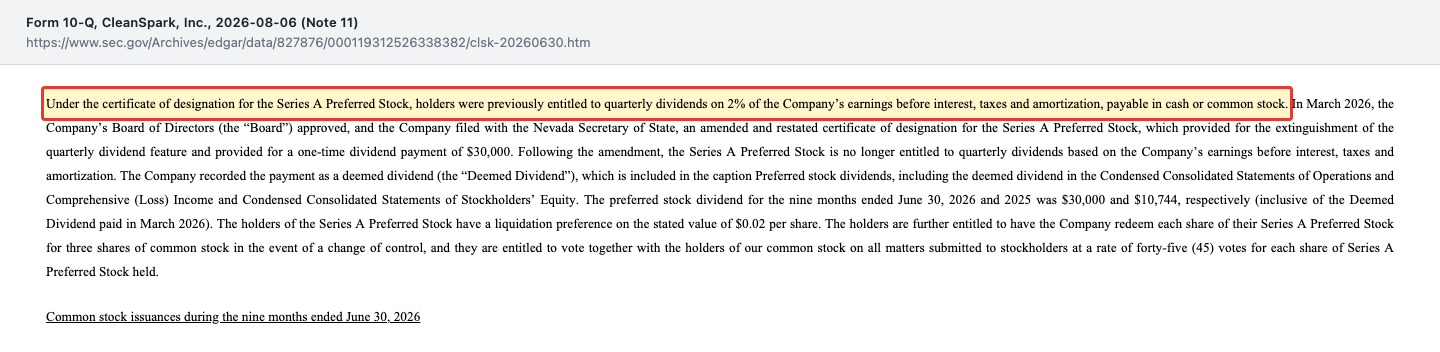
In fiscal 2025, when the bitcoin price carried the bottom line, this produced $11.1 million of preferred dividends. In March 2026, the board — excluding Schultz and McNeill — decided to eliminate the profit share and pay a one-time $30 million instead ($17.14 per preferred share). That happened in a fiscal year in which CleanSpark lost $996.9 million through June. The voting rights stayed: 45 votes per preferred share, 78.75 million votes in total — just under a quarter of all votes alongside the 256.8 million common shares (our calculation). In a change of control, each preferred share converts into three common shares. Two open cases from the quarterly report round out the picture: a 2021 shareholder class action over statements about an acquisition, and a shareholder derivative action against current and former officers and directors in a Nevada court; CleanSpark considers both without merit.
Valuation: $1.6 billion in the market, $4.1 billion in notes
Let’s use the most recent share count from a filing: 256,817,073 shares per the cover of the quarterly report (as of August 4, 2026). At the November 17, 2026, close of $6.15, that gives a market value of about $1.58 billion — matching the fundamental data. Against that stand stockholders’ equity of $761.3 million as of June 30, 2026 (so the stock traded at about twice book value), revenue of about $679 million over the twelve months through June 2026 (about 2.3 times) and a little over $1.0 billion of cash plus bitcoin as of June 30, 2026 ($202.6 million in cash, $814.9 million in bitcoin including collateral). All ratios are our calculations.
The other side of the balance sheet is larger. After September 25, 2026, about $4.1 billion of note principal is outstanding ($650 million due 2030, $1.15 billion due 2032, $2.276 billion due 2031; our calculation). Holders of the 2030 notes can demand repayment on June 15, 2028. What the market paid for on November 17, 2026, is therefore neither a mining company nor a finished landlord but a bet that the transformation succeeds before the mining business or the debt catches up with it. For context, the analyst ratings: according to fundamental data (as of November 17, 2026), 14 of 15 analysts rated the stock a buy, with an average price target of $20.87. That is a read on expectations, not evidence — the target was more than three times that day’s closing price.
Upside and risks at a glance
The case for CleanSpark:
- A 20-year lease for 175 megawatts with a Meta subsidiary, about $6.6 billion of contract value over the base term and up to $11.6 billion with both extensions, according to the company; Meta serves as guarantor of rent and operating expenses.
- Exclusivity with the same tenant for the Texas portfolio (up to 885 megawatts) — a letter of intent, but a clear sign of demand.
- About 1.8 gigawatts of U.S. power access, the scarce resource in the AI build-out.
- A little over $1.0 billion of cash plus bitcoin as of June 30, 2026; per the earnings release, the equity portion for Sandersville has already been fully funded.
The case against:
- From October 2025 to June 2026, bitcoin mining cost more than it brought in every quarter (most recently 134.3 percent of revenue including depreciation).
- Earnings swing with the bitcoin price: $364.5 million of net income in fiscal 2025, a $996.9 million loss in the nine months through June 2026; equity fell to $761.3 million.
- About $4.1 billion of note principal; per the company’s illustrative calculation, the Sandersville rent largely goes to debt service through 2043, and CleanSpark guarantees completion.
- Buybacks of $605 million at roughly $12 to $15 per share, funded with convertible notes; a $30 million buyout of the profit share on preferred stock held by CEO Schultz, board member McNeill and former CEO Bradford.
- Construction and schedule risk: missed milestones can lead to rent abatements or termination under the lease; the company flags a possible impairment of its Sandersville mining assets.
A human conclusion: the tenant is not the landlord
Back to the halo effect from the start. The Meta name shines, and rightly so: a tenant with that credit, for 20 years, with a guarantee for rent and costs — the kind of tenant landlords hope for. But buying CleanSpark stock does not buy you Meta. You are buying a landlord that still has to build the house, has borrowed the money for it at 7.875 percent and guarantees completion. A bitcoin miner whose coins recently cost more to mine than they brought in. And a company that bought back its own shares at about $15 that cost $6.15 a year later. So the honest question for you is not “Is Meta a good tenant?” but: would you buy this stock if the tenant had a name you didn’t recognize? If yes, you have a thesis, and you now know the numbers to measure it against — the next annual report, construction progress in Sandersville, June 15, 2028. If no, the glow nearly got you. What you do with this is your decision. And that’s how it should be.
Sources
All original documents used in this analysis — so you can check them yourself:
- CleanSpark, Inc. — SEC quarterly report 10-Q as of June 30, 2026 (filed August 6, 2026)
- CleanSpark, Inc. — 10-Q as of March 31, 2026 (May 11, 2026) and as of December 31, 2025 (February 5, 2026)
- CleanSpark, Inc. — SEC annual report 10-K for fiscal 2025 (filed November 25, 2025)
- CleanSpark, Inc. — Earnings release for the third quarter of fiscal 2026 (8-K of August 6, 2026, Exhibit 99.1)
- CleanSpark, Inc. — 8-K of July 14, 2026 (Sandersville lease) and press release (Exhibit 99.1)
- CleanSpark, Inc. — Sandersville investor presentation (8-K of September 17, 2026, Exhibit 99.1)
- CleanSpark, Inc. — 8-K of September 18, 2026 (note pricing) and of September 25, 2026 (closing, $2.276 billion at 7.875 percent)
- CleanSpark, Inc. — 8-K of March 24, 2026 (Series A preferred stock)
- CleanSpark, Inc. — 8-K of November 13, 2025 (2032 convertible notes and share repurchase)
- Full SEC filing history: EDGAR overview CleanSpark (sec.gov)
- Fundamental data (prices, market value, analyst ratings, bitcoin price; as of November 17, 2026), cross-checked against the SEC filings.
- Reddit mentions: ApeWisdom (retrieved November 18, 2026); surfaced by our in-house Reddit hype scanner.
Transparency & disclaimer: this analysis is journalistic commentary on publicly available information. It is not investment advice, not a regulated investment research product and not a solicitation to buy or sell securities. Equity investments carry substantial risk up to and including total loss. All information is provided without warranty; the as-of date for each figure is stated in the text. Positions held by the operator are disclosed daily; where one exists, it appears as a notice at the top of this analysis.
Key figures at a glance
All monetary figures in millions of $; earnings per share as reported.
| Metric | 2021 | 2022 | 2023 | 2024 | 2025 |
|---|---|---|---|---|---|
| Revenue | 39.3 | 131.5 | 168.4 | 379.0 | 766.3 |
| Operating Income (EBIT) | -11.9 | -37.9 | -131.0 | -149.0 | 318.9 |
| Net Income | -21.8 | -57.3 | -138.1 | -145.8 | 364.5 |
| Net Margin | -55.5% | -43.6% | -82.0% | -38.5% | 47.6% |
| Earnings Per Share | -0.74 $ | -1.35 $ | -1.35 $ | -0.67 $ | 1.15 $ |
Source: fundamental data & SEC filings (annual and quarterly reports, 10-K/10-Q)
Our Bottom Line at a Glance
- Business model neutral
- Shift from bitcoin miner to AI data center landlord: 20-year lease for 175 MW with a Meta subsidiary (07/10/2026), rent scheduled to start on 11/30/2027; until then, all revenue comes from mining.
- Bitcoin mining negative
- Cost per bitcoin including depreciation of $96,277 against $71,692 of revenue in the April–June 2026 quarter (134.3%); in fiscal 2025 it was 84.7%.
- Earnings negative
- Net loss of $996.9 million in the nine months to 06/30/2026, including $746.2 million of bitcoin valuation losses (before taxes); third-quarter revenue −30.5% to $138.0 million.
- Balance sheet & liquidity neutral
- Cash of $202.6 million and bitcoin of $814.9 million as of 06/30/2026; management says funds are sufficient for twelve months. Against that, about $4.1 billion of note principal after 09/25/2026 and equity of $761.3 million.
- Capital allocation negative
- Buybacks of $605 million (December 2024 and November 2025) at about $12.33 and $15.03 per share, funded with convertible notes; closing price on 11/17/2026: $6.15.
- Governance negative
- Buyout of the profit share (2% of earnings before interest, taxes and amortization) on preferred stock held by the CEO and other insiders for $30 million in March 2026; 45 votes per preferred share, just under a quarter of all votes.
CleanSpark shows the halo effect in its purest form: with Meta as tenant, the landlord looks as safe as the tenant. The filings tell a different story — a mining business that recently lost money including depreciation, earnings in lockstep with the bitcoin price ($996.9 million of losses in nine months) and about $4.1 billion of notes whose debt service, per the company's illustrative calculation, largely absorbs the Sandersville rent through 2043. The lease is real and valuable; shareholders, however, stand behind the noteholders. Not investment advice.
What Our Rating Means
Open questions
The business works in principle, but one material question is open. As long as it stays open, our findings do not carry a quality verdict.
Yellow, because a material operating question is open: whether the shift to landlord succeeds will only be decided with the Sandersville build and rent commencement at the end of 2027, while mining currently loses money including depreciation and earnings hinge on the bitcoin price. The evidence does not support red: as of June 30, 2026, a little over $1.0 billion of cash and bitcoin was available, management considers funds sufficient for twelve months, and Meta guarantees the rent. The heavy debt, the buybacks at about $15 and the preferred-dividend buyout are reasons for caution. The decision is yours.
A journalistic assessment by our editorial team at the time of the deep dive, based on public sources — not investment advice and not a solicitation to buy or sell. Your personal circumstances (investment goals, risk capacity, taxes) cannot be taken into account. What our levels mean, how verdicts are formed, and what conflicts of interest exist →
Worth Noting
- This analysis was triggered by our in-house Reddit hype scanner; per ApeWisdom (retrieved 11/18/2026), one mention in 24 hours, rank 436 after rank 351 a day earlier. Price references per fundamental data: $18.81 (close 06/01/2026), $12.88 (09/30/2026), $6.15 (11/17/2026).
- Data as of: the latest periodic report is the 10-Q as of 06/30/2026 (filed 08/06/2026); all filings through the Schedule 13G/A of 11/16/2026 were reviewed. The 10-K for the fiscal year ended 09/30/2026 had not been filed as of 11/18/2026; per the 10-Q, it will also reflect any impairment of the Sandersville mining assets.
- Our calculations: market value (share count × closing price), buyback price per share (purchase price ÷ shares), value of repurchased shares at the 11/17/2026 price, annual interest on the Sandersville notes ($2.276 billion × 7.875%), total note principal, voting share of the preferred stock, development cost for 175 MW. Amounts after debt service come from the illustrative calculation in the 09/17/2026 presentation, which assumes a 7.5% coupon.
- Not to be confused: CleanSpark was called Stratean Inc. until 2016 and SmartData Corp before that; until fiscal 2023 it also had an energy business, reported as discontinued operations. The tenant's name comes from the investor presentation, not from the lease itself, which has not been published.
Stock Watch
This analysis is as of November 18, 2026. Stock Watch will tell you what's changed at CLSK since then.
Later $1 a month per stock — signing up is free, and you'll be the first to know when it launches.
The full analysis as a PDF for later
We will send you this analysis as a PDF — to print, file away, and read at your own pace. And we will add you to the free Stock Watch list for CleanSpark Inc (CLSK), so you hear about it when something material in this analysis changes.
Frequently Asked Questions
CleanSpark (Nasdaq: CLSK), based in Henderson, Nevada, mines bitcoin with about 225,000 specialized machines at its own U.S. facilities and says it controls more than 1.8 gigawatts of power access. Since July 2026, it has been turning itself into an AI data center landlord. In fiscal 2025 (ended September 30, 2025), revenue was $766.3 million.
According to the investor presentation of September 17, 2026 (8-K, Exhibit 99.1), the tenant is Anviran, LLC, a wholly owned subsidiary of Meta; Meta serves as guarantor of rent and operating expenses. The lease signed on July 10, 2026, runs for 20 years, covers 175 megawatts and, according to the company, has a contract value of about $6.6 billion.
Mainly because of the bitcoin price: CleanSpark marks its holdings to market at every balance sheet date. From September 30, 2025, to June 30, 2026, bitcoin fell from about $114,100 to about $58,500; valuation losses added up to $746.2 million and the net loss to $996.9 million. On top of that, mining one bitcoin recently cost more, including depreciation, than it brought in.
After September 25, 2026, about $4.1 billion of note principal is outstanding: zero-coupon convertible notes of $650 million (due 2030) and $1.15 billion (due 2032), plus $2.276 billion of 7.875% senior secured notes issued by the project company (due 2031). Holders of the 2030 notes can demand repayment on June 15, 2028.
According to the investor presentation of September 17, 2026, rent is scheduled to start on November 30, 2027, once the first hall is complete; construction completion is expected in March 2028. The first interest payment on the Sandersville notes is already due on April 1, 2027. Missed milestones can lead to rent abatements or termination under the lease.
The 1.75 million Series A preferred shares belong to CEO Matthew Schultz, board member Larry McNeill, an entity the two control and the former CEO. Until March 2026 they were entitled to 2 percent of earnings before interest, taxes and amortization; that profit share was retired for a one-time $30 million. Each preferred share carries 45 votes.
The fiscal year ends September 30; fiscal 2026 ran from October 2025 through September 2026. The latest published report is the quarterly report (10-Q) as of June 30, 2026. The annual report (10-K) for fiscal 2026 had not been filed as of November 18, 2026; the fiscal 2025 report was filed on November 25, 2025.
Found an error?
Did you spot a factual error, an outdated number, or a typo in this deep dive? Let us know briefly — your report goes straight to the editorial team.