PayPal After the Third Quarter: Outlook Up, Reported Earnings Down — and Four Years of Barely Any New Accounts
PayPal moved 6 percent more money in the third quarter of 2026 than a year earlier: $487.1 billion in three months. Two percent of that showed up as revenue, and none of it at the bottom line — net income came in at $1,073 million against $1,248 million in the prior-year quarter, a decline of 14 percent. Earnings per share still fell only 4 percent, because roughly 117 million shares were repurchased over twelve months. The account base has barely moved in four years — 440 million as of September 30, 2026 against 435 million at the end of 2022 — and PayPal now keeps $1.76 of every $100 of payment volume instead of the $2.02 it kept in 2022. Not investment advice — but an explanation of how a raised outlook and a shrinking profit end up in the same press release.
 Thomas Mücke
Founder & Publisher
As of Today
As of: November 13, 2026
- Closing price
- 59.30 $ +1.70%
- Market Capitalisation
- 51.2 $B
- P/E
- 11.3
- Growth Score
- 6/10
- AAQS
- 8/10
Price change since August 11, 2026: +0.5%
This analysis has a cut-off date. The Stock Guard tells you when something material changes in the numbers. Reserve your free spot
Chart
Interactive price chart (TradingView).
52-week range: 39.10 $ to 65.30 $ · Last price: 59.30 $ (As of: November 13, 2026)
Note: pure fact-based analysis, not investment advice and not a solicitation to buy or sell. All figures without guarantee.
There is an investor trap that springs whenever a company moves money: the pass-through trap. It works like this. You read an enormous number — $1.79 trillion of payment volume in 2025 — and your mind immediately translates it into scale, power and growth. What it does not automatically ask is how much of that actually stays. Millions run through an ATM every year, too. The ATM owns none of it.
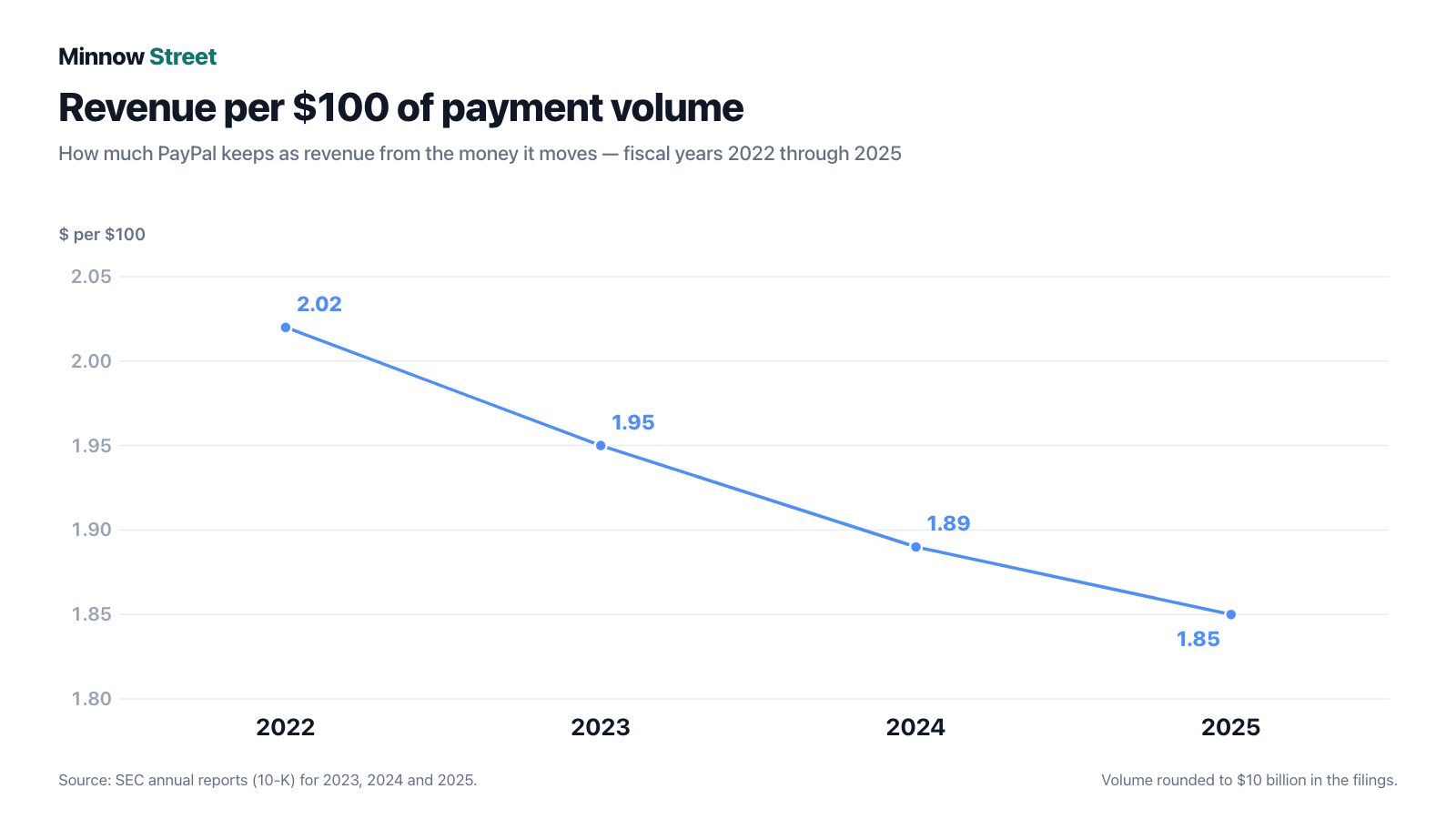
At PayPal Holdings, Inc. (NASDAQ: PYPL) the answer is $1.85 per $100. That is not a small number for a business that needs almost no factories. It is, however, less than the $2.02 of 2022 — and the trend has pointed the same way for four straight years.
So let us make a deal. Before you decide whether a household-name brand trading at a single-digit to low-double-digit price-to-earnings ratio is a bargain, we will read together what PayPal itself told the U.S. securities regulator, the SEC: the quarterly report (10-Q) as of June 30, 2026, filed on July 28, 2026, since this update also the third-quarter earnings release of October 27, 2026, the annual report (10-K) for 2025 and the current reports (Form 8-K) of recent months. These filings are honest under penalty of law. And they describe a company that pushes ever more money across the same set of people, earns less on every dollar of it — and whose earnings per share nonetheless look almost stable, because there are ever fewer shares. In the end, the decision is yours.
Q3 2026 update: what the third quarter shows
This analysis first appeared on August 11, 2026, based on the quarterly report as of June 30, 2026. On October 27, 2026 PayPal filed its figures for the third quarter (July through September 2026) with the SEC in a current report (Form 8-K, Item 2.02) including the earnings release. The full quarterly report (10-Q) had not been filed that day, and no transcript of the analyst call held the same morning could be found — so this assessment rests on the earnings release. PayPal has reported no new notes or capital measures since July 28, 2026; the only large-holder filing (Schedule 13G/A of July 29, 2026) shows BlackRock as a passive holder with 8.1 percent. The chapters below have been brought up to date wherever the picture changed.
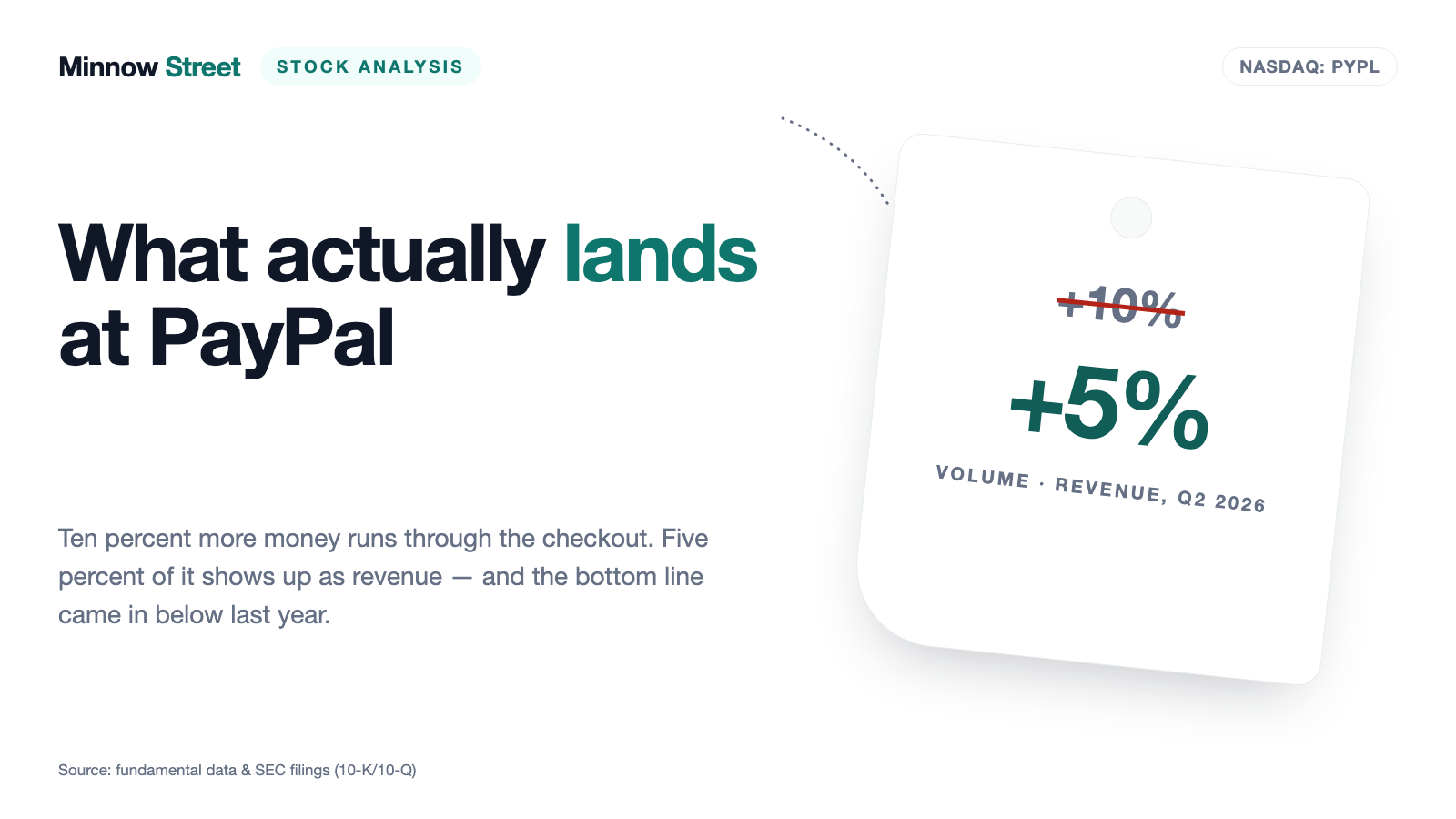
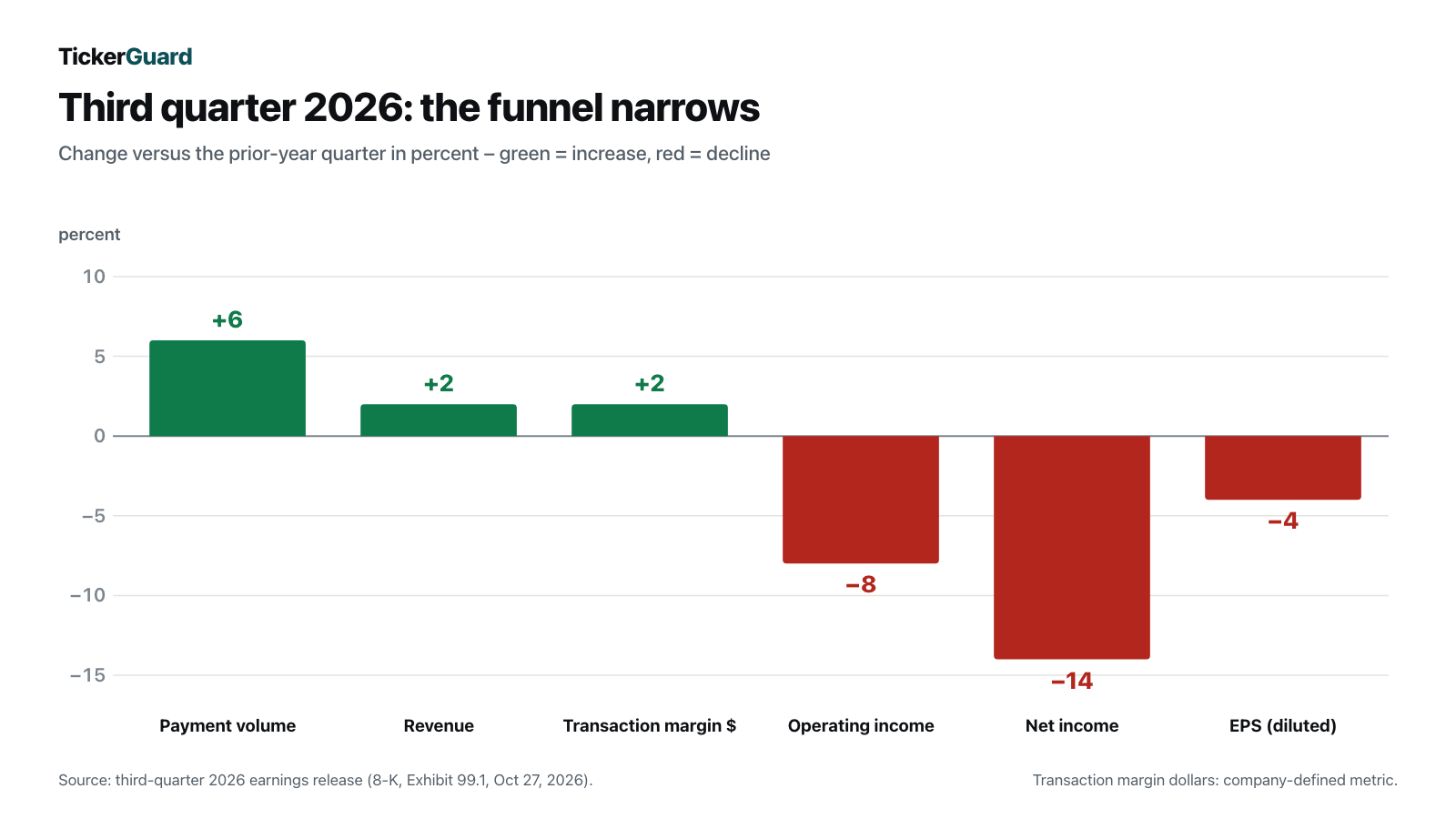
The quarter in numbers. The funnel from uncomfortable truth no. 2 has narrowed further. Payment volume: up 6 percent to $487.1 billion. Revenue: up 2 percent to $8,584 million, only 1 percent excluding currency effects. Transaction margin dollars: up 2 percent to $3,950 million. Operating income: down 8 percent to $1,402 million. Net income: down 14 percent to $1,073 million. Operating margin fell from 18.1 percent to 16.3 percent. Diluted earnings per share slipped only from $1.30 to $1.25, because profit was divided by 858 million rather than 960 million shares. Per $100 of volume, PayPal kept $1.76 by calculation — after $1.78 in the second quarter of 2026 and $1.84 in the third quarter of 2025.
What weighs on profit. Three items explain the gap between revenue and earnings. First, transaction expense — what PayPal passes on to card networks and banks — rose a little over 4.5 percent to $4,248 million, more than twice as fast as revenue. Second, the reorganization cost money: the "restructuring and other" line grew from $69 million to $255 million, of which $178 million was restructuring proper, after $1 million in the prior-year quarter. The quarterly report as of June 30, 2026 had estimated $120 million to $140 million for the first phase across the entire second half; the third quarter alone exceeds that. How the amount splits between the 2026 program and older restructurings will only be broken out in the quarterly report. Third, the effective tax rate rose from 18.6 to 21.9 percent. Losses pulled the other way: transaction and credit losses fell from $483 million to $386 million.
Two readings of the same numbers. Alongside its reported figures, PayPal also presents an adjusted calculation that strips out restructuring, amortization of acquired intangibles and results from strategic investments. On that reading operating income rose 3 percent to $1,613 million and earnings per share rose 8 percent to $1.45. Chief executive Enrique Lores puts it this way:
"We are beginning to see our strategy translate into our financial results, with strong contributions from our key growth areas and increasing diversification."
— PayPal Holdings, Inc., third-quarter 2026 earnings release (exhibit 99.1 to the Form 8-K filed October 27, 2026)
Both calculations are legitimate, but they answer different questions. The adjusted one shows how the business would look without the ongoing reorganization; the reported one shows what actually remains for shareholders. The new outlook is built the same way: for non-GAAP earnings per share in 2026 PayPal now expects about $5.60 instead of about $5.38 — the raise that made the headlines. For GAAP earnings per share the release names about $5.07 after $5.41 in 2025, a decline of roughly 6 percent, and about $1.37 for the fourth quarter after $1.53. PayPal puts the gap between the two at roughly $570 million of adjustments for the full year. Remember: what was raised is the number without restructuring costs. The number with them keeps falling.
Users, interest, cash. Active accounts rose to 440 million, 0.6 percent more than a year earlier and 1.6 million more than on June 30 — a small step, not a break in the four-year trend. Payment transactions per account climbed to 60.8 on a trailing twelve-month basis (prior year 57.6). Interest on customer balances fell from $321 million to $289 million; excluding it, transaction margin dollars grew 3 percent. Operating cash flow fell 19 percent to $1,592 million, partly because PayPal originated considerably more installment loans for resale (see our new side-finding). Buybacks absorbed $1.5 billion for roughly 28 million shares; 837 million shares remained outstanding on September 30, 2026. Cash and investments stood at $15.1 billion, debt at $13.5 billion. The $1,250 million 2.650 percent legacy note matured on October 1, 2026, after the balance sheet date; PayPal has not issued new notes since May. Whether the tranche was repaid from cash will show in the quarterly report.
Our assessment. The third quarter confirms the core thesis of this analysis rather than refuting it: volume grows, the take per dollar shrinks, and earnings per share fall only moderately because the share count shrinks faster than profit. What is new is that the reorganization now visibly costs money before it saves any — and that the raised outlook applies only to the adjusted figure, while the reported one keeps falling. The quality rating therefore stays yellow: the substance remains sound, and the operational question — whether the checkout button grows again — is as open after this quarter as it was before.
Company history for investors
-
2025
$15 billion buyback authorization
In February 2025 the board approved repurchases of up to $15.0 billion — the engine that has propped up earnings per share ever since.
-
2026
CEO change: Lores succeeds Chriss
Alex Chriss left on February 2, 2026; Enrique Lores has led since March 1 — the third CEO in a little over two years, with equity awards worth roughly $89 million.
-
2026
Reorganization with an AI savings target
In April 2026 PayPal announced a reorganization meant to save at least $1.5 billion a year through AI and automation. At first it costs money.
-
2026
$2 billion of new notes
In May 2026 PayPal borrowed $2.0 billion at 4.55 to 5.55 percent — far more expensive than the legacy notes from the zero-rate years at 2.30 to 2.85 percent.
-
2026
Outlook raised on a non-GAAP basis only
On October 27, 2026 PayPal raised its non-GAAP earnings outlook; on a GAAP basis it expects about $5.07 per share for 2026 after $5.41 the year before.
What PayPal actually does — three businesses in one stock
Almost everyone knows PayPal from exactly one place: the yellow button at the end of a checkout. That is the branded business — you visibly pay with PayPal, the merchant pays a fee for it, and you get purchase protection. It is the highest-margin business in the company and the one the market pictures when it hears the name.
It is only a third of the story. The second business is called Braintree and is precisely the opposite: invisible. When you type your card details into an app and see no PayPal logo anywhere, Braintree may still be processing the payment. The industry calls it unbranded processing. The advantage is enormous volume from large platforms. The drawback is a price war in which the processor keeps only a few basis points per transaction. In the second quarter of 2026 Braintree added roughly $400 million of revenue versus the prior-year quarter — by far the largest single growth contribution in the company. The third business is Venmo, the peer-to-peer money app that is popular in the United States and increasingly shows up as a payment method in stores and online (adding roughly $60 million of revenue in the same quarter).
Two further earnings streams have only an indirect connection to the checkout button. First, credit: installment purchases for consumers (buy now, pay later) and working-capital loans for merchants. As of June 30, 2026 the books held $5.5 billion of consumer receivables and $1.9 billion of merchant receivables. Second, interest on other people's money: substantial balances sit in customer PayPal accounts — as of September 30, 2026 the balance sheet showed $40,924 million as funds payable and amounts due to customers, money PayPal owes but administers. The income earned on it flows into revenue. The 2025 annual report puts the portion of revenue that does not come from customer contracts in the narrow sense — loan interest, hedging results, interest on customer balances — at $2.1 billion, roughly 6 percent of $33,172 million.
That frames the central tension of this analysis, and it runs through every chapter: volume is growing where PayPal earns the least and standing still where it earns the most — while the number of people using PayPal has been essentially unchanged for four years.
How the stock landed on our desk
Not through a price screen. PayPal came onto the research list through the SEC filing stream: on February 3, 2026 the company filed a current report (Form 8-K, Item 5.02) disclosing the immediate departure of chief executive Alex Chriss effective February 2, 2026 and the appointment of Enrique Lores effective March 1, 2026. An unplanned CEO change at a company this size is always a reason to read the numbers from the top. The reason to run the arithmetic came with the quarterly report as of June 30, 2026, filed on July 28, 2026.
One note before we calculate. Classic momentum and quality screens handle PayPal badly. The stock is neither a growth name (revenue grew 4.3 percent in 2025) nor a classic asset play (of $19,483 million of equity as of September 30, 2026, $10,968 million is goodwill from old acquisitions, so not tangible property). Judging PayPal requires the filings. That is what we do next, starting with what genuinely impresses. What a payment processor without a brand at the checkout looks like, incidentally, we examined elsewhere: in our analysis of Shift4 Payments.
The numbers over the years — given their due
Start with what speaks for PayPal, because there is plenty. Revenue rose in every single year: $27,518 million (2022), $29,771 million (2023), $31,797 million (2024), $33,172 million (2025). Net income rose too, and markedly: from $2,419 million (2022) through $4,246 million (2023) and $4,147 million (2024) to $5,233 million (2025). Operating income climbed to $6,065 million in 2025 from $5,325 million a year earlier. Net cash from operating activities reached $6,416 million in 2025 against capital expenditures of only $852 million — this is a business that generates cash without building plants.
The balance sheet is unremarkably healthy. As of September 30, 2026 there was $15.1 billion of cash and investments against $13.5 billion of debt, with equity of $19,483 million. Interest coverage is a non-issue: $237 million of interest expense in the first half of 2026 set against $2,915 million of operating income. There is no going-concern language, no accounting scandal, no auditor change. And with roughly 23,800 employees as of December 31, 2025 the company is lean for its size — a year earlier there were 24,400.
And the volume is growing. $1.36 trillion ran across the platform in 2022, $1.53 trillion in 2023, $1.68 trillion in 2024 and $1.79 trillion in 2025. In the second quarter of 2026 it was $486.4 billion in three months, up 10 percent year over year, and in the third quarter $487.1 billion, up 6 percent.
Hold on to this sentence before it gets uncomfortable: PayPal is not a sick company. It is a company whose best business has stopped growing. Let us look at why.
Uncomfortable truth no. 1: 440 million accounts and four years of barely any growth
A payments business lives on two things: how many people use it and how often. The first number is essentially standing still. The quarterly report as of June 30, 2026 showed 439 million active accounts against 438 million a year earlier; the change column in the report simply carried a dash. As of September 30, 2026 PayPal reports 440 million, up 0.6 percent year over year and up 1.6 million from the prior quarter.
This is not one odd quarter but a four-year trend. The annual reports give the year-end counts: 435 million (2022), 426 million (2023), 434 million (2024), 439 million (2025). Through the end of 2025 that is a net addition of roughly four million accounts in three years, or 0.9 percent — at a company that grew its payment volume by nearly a third over the same span. In 2023 the count actually shrank by 2 percent.
So where does the volume growth come from? Two sources. First, existing users transact more often: payment transactions per active account on a trailing twelve-month basis rose from 58.3 to 60.0 in the second quarter of 2026 and further to 60.8 in the third quarter. Second, and this is the larger part, from unbranded processing. Braintree contributed roughly $400 million of incremental revenue in the second quarter and roughly $810 million in the first half. For comparison: total revenue growth in the half year was $956 million.
Put in everyday terms: a restaurant with the same number of regulars for the third year running that ships ever more food because it cooks for a delivery platform on the side. Revenue rises. The kitchen is busier. But the guest at its own table — the one who pays full price — is no more numerous than before. Which leads straight to the second uncomfortable truth.
Uncomfortable truth no. 2: 10 percent more volume, 5 percent more revenue, less profit
The chain for the second quarter of 2026 reads like a funnel that narrows at every stage. Payment volume: up 10 percent to $486.4 billion. Revenue: up 5 percent to $8,682 million. Operating income: down 5 percent to $1,427 million. Net income: down 12 percent to $1,104 million. Operating margin fell from 18.1 percent to 16.4 percent, a contraction of 171 basis points. The third quarter of 2026 repeated the pattern with +6, +2, −8 and −14 percent (details in the update chapter above).
PayPal names the reason for the first narrowing itself — and the sentence carries weight precisely because a version of it appears in almost every report of recent years:
"Transaction revenues growth was lower than the growth in TPV in the three and six months ended June 30, 2026 compared to the same periods in the prior year due primarily to changes in product mix, higher co-marketing campaigns, lower foreign exchange fee revenue, and lower partner incentives."
— PayPal Holdings, Inc., Form 10-Q for the quarter ended June 30, 2026, "Net revenues"

"Product mix" is the decisive phrase. It means the cheap part is what is growing. Run the effect across the years and the subordinate clause becomes a line. We divide annual revenue by the payment volume of the same year — what remains is the amount PayPal keeps per $100 of money moved:
For the second narrowing PayPal has its own measure, reported in the earnings release: transaction margin dollars, meaning revenue less the costs incurred per transaction — in essence what the payments business leaves before salaries, marketing and development are paid. That figure rose 1 percent to $3,900 million in the second quarter of 2026. Ten percent more volume, 1 percent more transaction margin: that is the pass-through trap in two numbers. It is a company-defined, non-GAAP measure rather than a line in the financial statements — but it describes exactly the right thing here.
In fairness, the drop in net income does not come from the payments business alone. In the first half of 2026 pre-tax income fell by $429 million, of which roughly $234 million came from valuation losses on the strategic investment portfolio PayPal holds alongside operations (see our side-finding on that). Operating income itself fell "only" $119 million over the half year. The direction is unambiguous all the same: margin is moving down, not up.
Uncomfortable truth no. 3: the buyback is not a dividend, it is a treadmill
Now the part that explains the surface statistics. Net income fell 12 percent in the second quarter of 2026 — but diluted earnings per share fell only 3 percent, from $1.29 to $1.25. The reason is simple: the profit was divided by fewer shares. The diluted weighted average share count dropped from 977 million to 882 million.
This is not an accounting trick. It is real money, and the sums are large:
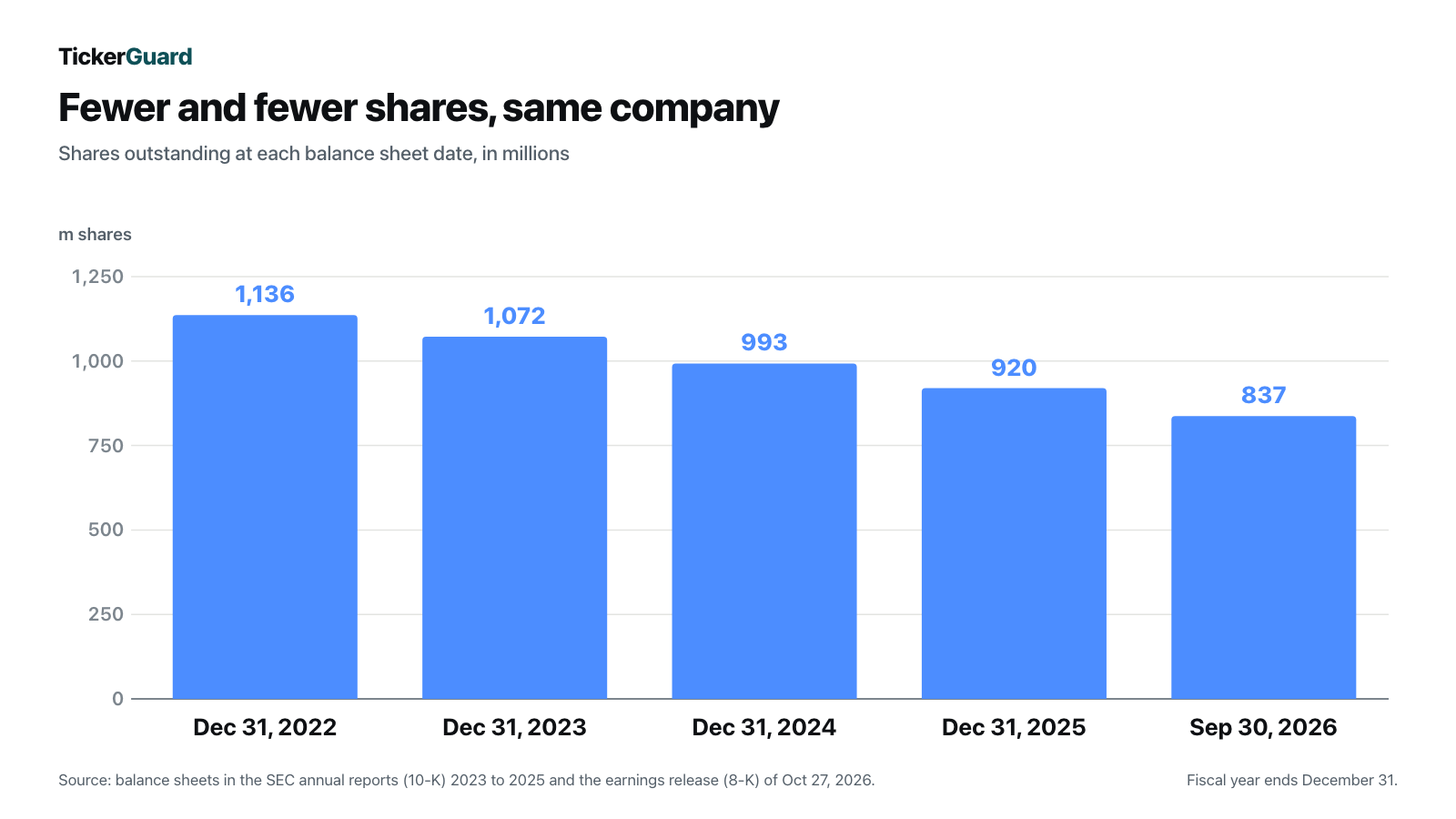
In the first half of 2026 alone PayPal repurchased 67 million shares for roughly $3.0 billion at an average of $44.99 apiece, and roughly another 28 million for $1.5 billion in the third quarter. Over the twelve months to September 30, 2026 it was roughly 117 million shares for $6.0 billion. Of the $15.0 billion repurchase authorization approved by the board in February 2025, $10.9 billion remained available on June 30, 2026; after the third-quarter purchases that works out to roughly $9.4 billion.
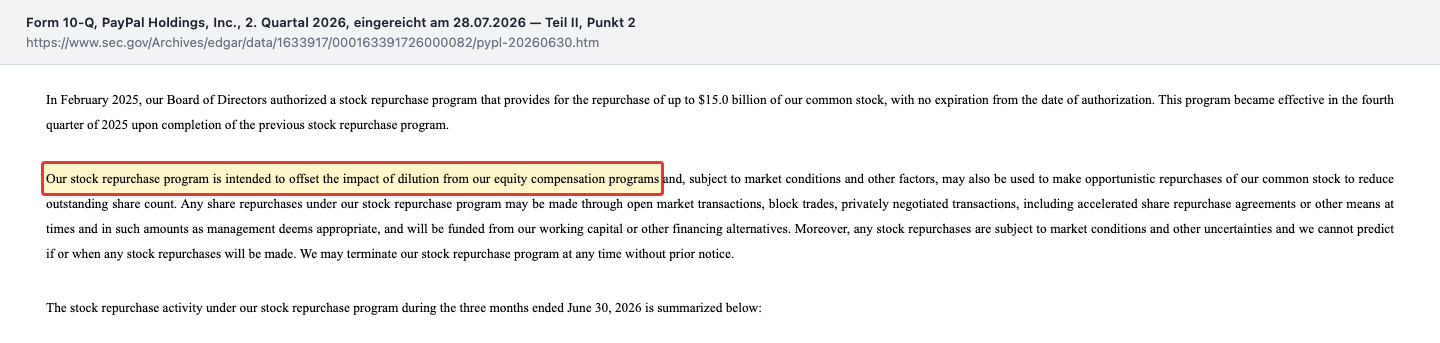
So far this reads as shareholder-friendly capital allocation, and in part it is. But PayPal describes the purpose of the program in its own report in a notable order:
"Our stock repurchase program is intended to offset the impact of dilution from our equity compensation programs and, subject to market conditions and other factors, may also be used to make opportunistic repurchases of our common stock to reduce outstanding share count."
— PayPal Holdings, Inc., Form 10-Q for the quarter ended June 30, 2026, Part II, Item 2
Dilution, in everyday terms, means your slice of the cake gets smaller because the cake is cut into more pieces. That is exactly what happens when a company pays its people in stock. PayPal does so at scale: stock-based compensation expense ran at roughly $1.0 billion in 2025. And at the annual meeting on May 19, 2026 shareholders approved a new plan authorizing up to 39.1 million new shares, plus up to 44.6 million reusable shares from the predecessor plan — together a ceiling of roughly 10 percent of the 837 million shares outstanding on September 30, 2026. A ceiling is not a forecast. It does, however, quantify what the buyback is running against.
Two more details belong to an honest account. First, price: in 2025 PayPal bought 86 million shares for $6.0 billion at an average of $69.94. In the first half of 2026 the average was $44.99. Anyone who spent six billion dollars in 2025 would have received considerably more shares for the same money six months later. Buybacks create value only when they happen below intrinsic value — and the people estimating intrinsic value are the same management.
Second, funding. In May 2026 PayPal issued $2.0 billion of new notes at 4.550, 4.950 and 5.550 percent. The report names the possible uses expressly:
"Proceeds from the issuance of these Notes may be used for general corporate purposes, which may include funding the repayment or redemption of outstanding debt, share repurchases, ongoing operations, capital expenditures, and possible acquisitions of businesses, assets, or strategic investments."
— PayPal Holdings, Inc., Form 10-Q for the quarter ended June 30, 2026, Note 12 "Debt"
Total term debt therefore rose from $10,884 million (December 31, 2025) to $12,728 million (June 30, 2026). The legacy tranches from the zero-rate years carry 2.30 to 2.85 percent; the new ones carry 4.55 to 5.55 percent. On October 1, 2026 the first large legacy note came due: $1,250 million at 2.650 percent. PayPal had issued no new notes as of October 27, 2026; total debt stood at $13.5 billion on September 30, 2026. Remember the treadmill in one sentence: the buyback shrinks the denominator, equity compensation grows it back, and the interest on the borrowed money eats into the numerator.
Uncomfortable truth no. 4: three CEOs in two years — and a lawsuit about exactly that
On February 2, 2026 Alex Chriss ceased to be chief executive, less than two and a half years after taking the job. Chief financial and operating officer Jamie Miller ran the company in the interim, and since March 1, 2026 Enrique Lores has been chief executive — previously chair of PayPal's board and for years the chief executive of HP Inc. David Dorman took over as chair. Counting the interim, that is the third name at the top in a little over two years.
The terms of the transition are in the current report of February 3, 2026 and are notably specific: base salary of $1,450,000, a target bonus of 200 percent of that, plus equity awards with a grant date value of $20 million to make him whole for forfeited awards at his former employer, $16.5 million each in annual restricted stock units and performance stock units for 2026, a further $11 million as an advanced portion of the 2027 grant, and finally a one-time price-linked award with a target grant date value of $25 million and a maximum payout of 250 percent. In total, roughly $89 million of grant date value in equity awards on arrival — paid in exactly the currency whose dilution the buyback is meant to offset.
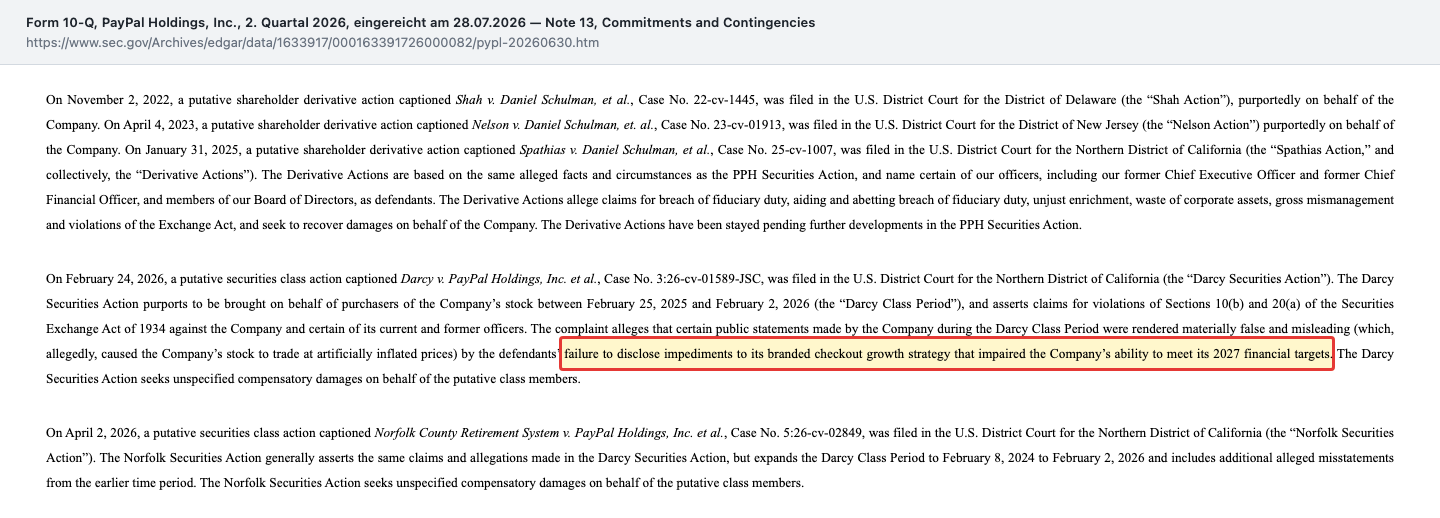
Nor is that the only echo. On February 24, 2026 a securities class action was filed in California, followed by a second on April 2, 2026; on May 21, 2026 the two were consolidated as In re PayPal Branded Checkout Securities Litigation. The allegation goes to the heart of this analysis:
"failure to disclose impediments to its branded checkout growth strategy that impaired the Company's ability to meet its 2027 financial targets"
— PayPal Holdings, Inc., Form 10-Q for the quarter ended June 30, 2026, Note 13 "Commitments and Contingencies"
Important context: a U.S. class action is an allegation, not a verdict. How quickly such a case can turn is shown a few paragraphs earlier in the same report: an older class action from 2022 was dismissed with prejudice on March 31, 2026, and the plaintiffs appealed. What makes the new case notable is less its likely outcome than its subject — it is about precisely the number we read in truth no. 1.
What AI concretely means here: a $1.5 billion savings target
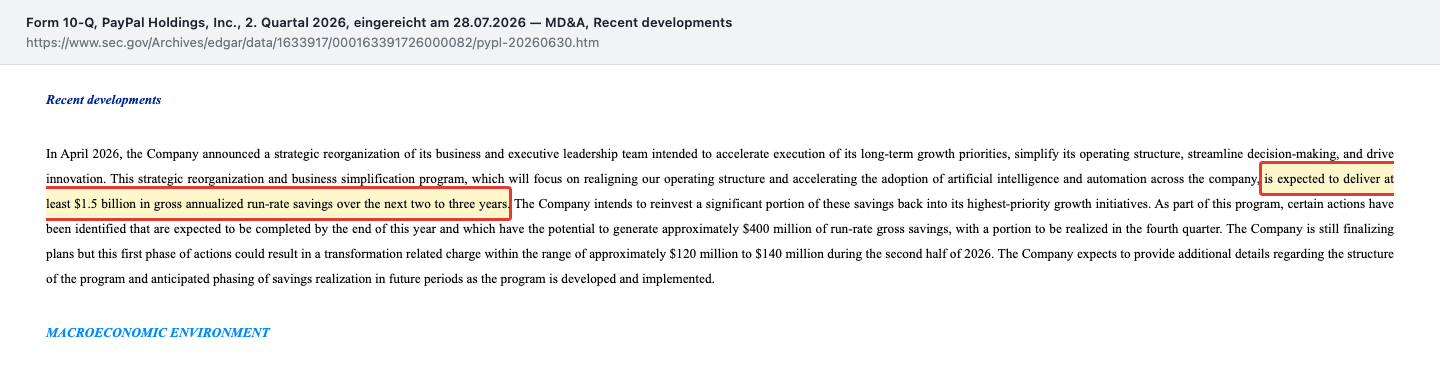
Nearly every stock analysis today runs into the question of what artificial intelligence does to the business. At PayPal the answer sits unusually precisely in the filings — and it is a cost story, not a revenue story. In April 2026 the company announced a reorganization of its business and leadership team:
"This strategic reorganization and business simplification program, which will focus on realigning our operating structure and accelerating the adoption of artificial intelligence and automation across the company, is expected to deliver at least $1.5 billion in gross annualized run-rate savings over the next two to three years."
— PayPal Holdings, Inc., Form 10-Q for the quarter ended June 30, 2026, "Recent developments"
Measured against 2025 operating income of $6,065 million, $1.5 billion is a quarter of a profit step. The report itself adds two caveats. First, PayPal intends to reinvest "a significant portion" of the savings into growth initiatives, so this is not incremental profit. Second, only a first phase has been quantified so far: roughly $400 million of run-rate gross savings by year end, against a transformation charge of $120 million to $140 million in the second half of 2026. Restructuring charges of $44 million for this program were already booked in the second quarter of 2026. In the third quarter PayPal reported $178 million of restructuring charges in total — more than had been estimated for the whole half year; the split by program is still to come. For the fourth quarter the earnings release of October 27, 2026 points to roughly $70 million of non-GAAP adjustments in total.
On the product side, AI shows up in the filings in two roles: as a tool in fraud prevention, risk management and customer service — the 2025 annual report says the company uses AI and machine learning "including fraud prevention, risk management, product optimization and customer service" — and as a future payment channel once purchases run through AI agents. AI has no revenue line of its own at PayPal. We therefore classify the company as a user of AI, not a seller of it.
What the stock costs
Orders of magnitude, not daily prices. At a market capitalization of roughly $46 billion (837 million shares as of September 30, 2026 times the $54.99 close on October 26, 2026, the trading day before the earnings release) and 2025 net income of $5,233 million, the price-to-earnings ratio is just under 9; on net income for the twelve months to September 30, 2026 ($4,727 million) it is just under 10. The price-to-sales ratio is around 1.3 on revenue for the same twelve months ($34.3 billion). For comparison with its own past: around 2021 PayPal traded at times at five times revenue. When this analysis first appeared on August 11, 2026, the stock had closed at $59.00.
A price-to-earnings ratio near ten is genuinely low for a payments company with this franchise. Before turning that into a bargain, three things belong in the picture. First, the company itself expects falling reported earnings. In the earnings release of October 27, 2026 PayPal guides to GAAP earnings per share of about $5.07 for 2026 after $5.41 in 2025, roughly 6 percent lower; in July it had only signalled a mid-single-digit percentage decline, now the number is set. Only the non-GAAP figure was raised, to about $5.60. On the GAAP guidance the price-to-earnings ratio is just under 11. A low multiple on a shrinking profit is less cheap than it looks.
Second, book value: $19,483 million of equity as of September 30, 2026 works out to roughly $23 per share. But $10,968 million of that is goodwill from old acquisitions; strip it and the remaining intangibles out and roughly $10 per share of tangible equity is left. The price-to-book comparison is of little use here, which is normal for a platform with almost no fixed assets.
Third, the dividend: $0.14 per share per quarter, most recently declared on October 27, 2026 for payment on December 24, 2026. That is roughly $0.56 a year, about 1 percent on the October 26, 2026 price — buybacks at PayPal are many times larger than the dividend. For a look at a payments peer with a very different valuation history, see our analysis of FIS.
Opportunities and risks at a glance
Opportunities
- A real, cash-generating business. $6,416 million of operating cash flow in 2025 against $852 million of capital expenditure; a network of 440 million accounts and millions of merchants cannot be rebuilt quickly.
- The buyback is affordable and continuing. Another $1.5 billion went into roughly 28 million shares in the third quarter of 2026; by calculation roughly $9.4 billion of the February 2025 authorization remains. If the share count keeps falling at the current pace, earnings per share rise even on flat profit.
- The savings program is quantified — and the non-GAAP outlook is rising. At least $1.5 billion of annual gross savings within two to three years, of which roughly $400 million is already named for the first phase through year-end 2026. On October 27, 2026 PayPal raised its non-GAAP full-year earnings per share outlook from about $5.38 to about $5.60; transaction and credit losses fell from $483 million to $386 million in the third quarter.
- A new chief executive with turnaround experience. Enrique Lores spent years steering the transformation of a large, mature technology company at HP; a substantial part of his pay package depends on the share price three to five years out.
- Sound finances. $15.1 billion of cash and investments against $13.5 billion of debt as of September 30, 2026, interest coverage far above any critical level, no indications of going-concern or listing risk.
Risks
- The user base barely grows. 440 million active accounts as of September 30, 2026 against 435 million at the end of 2022. Without new users, all growth must come from frequency or from low-margin processing.
- The take on every dollar has fallen for four years. $2.02 per $100 of volume in 2022 against $1.85 in 2025 and $1.78 and $1.76 by calculation in the second and third quarters of 2026. Transaction margin dollars rose only 2 percent in the third quarter against 6 percent more volume.
- The company itself expects lower profit. For 2026 PayPal guides to GAAP earnings per share of about $5.07 after $5.41 (earnings release of October 27, 2026); in the third quarter net income fell 14 percent, and $178 million of restructuring charges landed before the savings take effect.
- Leadership churn and pending litigation. Third chief executive in a little over two years; the consolidated class action In re PayPal Branded Checkout Securities Litigation concerns exactly the weakness of branded checkout growth. Outcome and cost are open.
- Interest cost and interest income work against each other. New notes at 4.55 to 5.55 percent replace legacy debt at 2.3 to 2.85 percent, while income on customer balances declines: it fell from $321 million to $289 million in the third quarter of 2026, and transaction margin dollars excluding that interest grew 3 percent versus 2 percent for the total.
- Equity compensation as a counterforce. Roughly $1.0 billion of expense in 2025 and a new plan for up to 83.7 million shares — roughly a tenth of the share count on September 30, 2026.
A human conclusion
We began with the pass-through trap: the mind hears "$1.79 trillion" and automatically books scale, power and growth. Now we know the conversion rate. Of every $100 passed through, $1.85 stays with PayPal, and the trend has pointed down for four years. The trap also has a second, more personal layer: you know PayPal because you use the yellow button. But that is precisely the part that has stopped growing. What has grown is the part you never see — processing other companies' card payments in the background, where far less of each dollar stays behind.
None of this makes PayPal a bad company. It is profitable, it generates cash, it has a healthy balance sheet and a network nobody rebuilds overnight. It makes PayPal a company with one open question, and that question is not "will it survive?" but: can the checkout button grow again — in users and in margin? The new chief executive, the savings program and the next few quarterly reports will answer it.
Until then, a sober rule of thumb for buybacks: a repurchase creates value when it divides up the cake. It merely conceals when it stops you noticing that the cake is getting smaller. At PayPal, net income fell 12 percent in the second quarter of 2026 and earnings per share fell 3 percent — and in the third quarter 14 and 4 percent, while the headline spoke of a raised outlook. Reading only the second number misses what happened. Reading only the first misses that shareholders genuinely hold a growing slice of a company that still earns billions.
Both numbers belong together. What you do with them is your call. And that is exactly how it should be.
Sources
- PayPal Holdings, Inc. — third-quarter 2026 earnings release (exhibit 99.1 to the Form 8-K filed October 27, 2026, Items 2.02 and 9.01) (payment volume, active accounts, revenue, earnings, balance sheet and cash flow statement as of September 30, 2026, buyback, dividend, 2026 guidance). The Form 10-Q for the quarter ended September 30, 2026 had not been filed as of October 27, 2026.
- BlackRock, Inc. — Schedule 13G/A on PayPal Holdings, Inc., filed July 29, 2026 (passive holding of 8.1 percent)
- PayPal Holdings, Inc. — Form 10-Q for the quarter ended June 30, 2026, filed July 28, 2026 (active accounts, payment volume, revenue, earnings, Note 11 "Loans and Interest Receivable," Note 12 "Debt," Note 13 "Commitments and Contingencies," Note 14 "Stockholders' Equity," Note 17 "Restructuring and Other," Part II Item 2)
- PayPal Holdings, Inc. — second quarter 2026 earnings release (exhibit 99.1 to the Form 8-K filed July 28, 2026) (transaction margin dollars, repurchase volume, 2026 guidance)
- PayPal Holdings, Inc. — Form 10-K for 2025, filed February 3, 2026 (employees, payment volume and active accounts for 2024 and 2025, revenue disaggregation, repurchases, use of AI)
- PayPal Holdings, Inc. — Form 10-K for 2024, filed February 4, 2025 (active accounts and payment volume for 2023 and 2024, share count for 2023)
- PayPal Holdings, Inc. — Form 10-K for 2023, filed February 8, 2024 (active accounts and payment volume for 2022 and 2023, share count for 2022)
- PayPal Holdings, Inc. — Form 8-K filed February 3, 2026, Item 5.02 (departure of Alex Chriss, appointment of Enrique Lores, pay package)
- PayPal Holdings, Inc. — Form 8-K filed May 21, 2026, Items 5.02 and 5.07 (2026 equity incentive award plan, annual meeting results)
- SEC EDGAR — filing history for PayPal Holdings, Inc. (CIK 0001633917)
- Fundamental data (price series; closing prices of August 11, 2026 and October 26, 2026)
Note and disclaimer: this article is journalistic commentary on publicly available company information. It is expressly not investment advice, not a personal recommendation and not a solicitation to buy or sell securities. Stocks can lose value substantially at any time, and a total loss is possible. All figures come from the linked primary sources and carry the as-of date stated there; later developments are not reflected. Positions held by the operator are disclosed daily; where one exists, it appears as a notice at the top of this deep dive.
Key figures at a glance
All monetary figures in millions of $; earnings per share as reported.
| Metric | 2021 | 2022 | 2023 | 2024 | 2025 |
|---|---|---|---|---|---|
| Revenue | 25,371.0 | 27,518.0 | 29,771.0 | 31,797.0 | 33,172.0 |
| Operating Income (EBIT) | 4,262.0 | 3,837.0 | 5,028.0 | 5,325.0 | 6,065.0 |
| Net Income | 4,169.0 | 2,419.0 | 4,246.0 | 4,147.0 | 5,233.0 |
| Net Margin | 16.4% | 8.8% | 14.3% | 13.0% | 15.8% |
| Earnings Per Share | 3.52 $ | 2.09 $ | 3.84 $ | 3.99 $ | 5.41 $ |
Source: fundamental data & SEC filings (annual and quarterly reports, 10-K/10-Q)
Our Bottom Line at a Glance
- Business model & substance positive
- A network of 440 million active accounts (September 30, 2026) and millions of merchants carried $1.79 trillion of payment volume in 2025. The business produced $6,416 million of operating cash flow in 2025 against only $852 million of capital expenditure, and $5,233 million of net income. Nobody rebuilds a network like that overnight.
- User base growth negative
- Active accounts stood at 440 million on September 30, 2026, against 438 million a year earlier and 435 million at the end of 2022 — a little over 1 percent in close to four years. Volume growth comes from higher frequency (60.8 payments per account over twelve months) and from unbranded card processing: Braintree alone added roughly $400 million of revenue in the second quarter of 2026.
- Margin per dollar moved negative
- Of every $100 passed through, PayPal kept $2.02 in 2022, $1.85 in 2025 and $1.76 by calculation in the third quarter of 2026. In the third quarter volume rose 6 percent, while revenue and the company-reported transaction margin dollars rose 2 percent each; operating margin fell from 18.1 percent to 16.3 percent. For 2026 PayPal guides to GAAP earnings per share of about $5.07 after $5.41.
- Capital allocation neutral
- The buyback is enormous and real — roughly 117 million shares for $6.0 billion in the twelve months to September 30, 2026, with the share count down from 1,136 million (end of 2022) to 837 million. It is also a counterweight to equity compensation: the quarterly report names dilution offset as the first purpose, and the 2026 plan authorizes up to 83.7 million shares. On top of that, 2025 purchases averaged $69.94 per share against $44.99 in the first half of 2026.
- Balance sheet & finances positive
- $15.1 billion of cash and investments against $13.5 billion of debt as of September 30, 2026, equity of $19,483 million, and $237 million of first-half interest expense against $2,915 million of operating income. No going-concern language, no auditor change, no listing risk. Caveat: $10,968 million of that equity is goodwill from old acquisitions.
- Leadership & legal negative
- Enrique Lores has led the company since March 1, 2026 as the third chief executive in a little over two years; Alex Chriss left on February 2, 2026 after less than two and a half years. The consolidated class action "In re PayPal Branded Checkout Securities Litigation" (May 21, 2026) alleges the company concealed impediments to branded checkout growth. The reorganization is meant to save at least $1.5 billion a year from April 2026; so far it shows up mainly as cost — $178 million of restructuring charges in the third quarter of 2026.
PayPal is the pass-through trap in pure form: $1.79 trillion of payment volume in 2025 sounds like unstoppable growth, yet only $1.76 of every $100 stays behind (third quarter of 2026) — down from $2.02 in 2022 — and the user base has barely moved at 440 million accounts for four years. In the third quarter of 2026 volume rose 6 percent and revenue 2 percent while operating income and net income fell 8 and 14 percent; that earnings per share slipped only 4 percent is down to the repurchase of roughly 117 million shares in twelve months. PayPal raised only its non-GAAP outlook. The company is financially sound and generates cash, but with its third chief executive in a little over two years, a quantified yet unproven savings program and a class action about branded checkout growth, it stands at an open point. Not investment advice.
What Our Rating Means
Open questions
The business works in principle, but one material question is open. As long as it stays open, our findings do not carry a quality verdict.
Yellow, because a material operational question is open and documented: the user base has barely grown in four years (440 million accounts on September 30, 2026 against 435 million at the end of 2022), the take per dollar moved keeps falling ($2.02 per $100 in 2022, $1.76 in the third quarter of 2026), and PayPal guides to GAAP earnings per share below the prior year for 2026. The substance, by contrast, is not in doubt: $6,416 million of operating cash flow in 2025, $15.1 billion of cash and investments against $13.5 billion of debt on September 30, 2026, no going-concern indications — so red would be wrong, and green premature as long as the highest-margin business is not growing again. Re-examined against the figures of October 27, 2026, the rating stays the same; the raised non-GAAP outlook shows progress on costs, not yet growth in branded checkout. The share price plays no part in this rating. The decision is yours.
A journalistic assessment by our editorial team at the time of the deep dive, based on public sources — not investment advice and not a solicitation to buy or sell. Your personal circumstances (investment goals, risk capacity, taxes) cannot be taken into account. What our levels mean, how verdicts are formed, and what conflicts of interest exist →
Worth Noting
- PayPal reached the research list through the SEC filing stream: the current report (Form 8-K) of February 3, 2026 announcing the change at the top. The figures rest on the quarterly report (10-Q) as of June 30, 2026, filed July 28, 2026, the earnings release of the same day, and the annual reports (10-K) for 2023 through 2025. Update of October 27, 2026: the third-quarter 2026 earnings release (8-K of October 27, 2026) is incorporated; the 10-Q for September 30, 2026 had not been filed at that point, and no call transcript could be found.
- The measure "revenue per $100 of payment volume" is our own calculation: annual revenue divided by the payment volume stated in the respective annual report. That volume is disclosed rounded to $10 billion, so the derived values are accurate to two decimal places. "Transaction margin dollars" is a company-defined, non-GAAP measure and not a line in the income statement.
- Valuation figures are dated and evergreen: market capitalization of roughly $46 billion on October 26, 2026 (837 million shares per the September 30, 2026 balance sheet x $54.99 closing price); at first publication on August 11, 2026 it was roughly $51 billion (862 million x $59.00). Daily prices are not a buy argument. Not to be confused: PayPal Holdings, Inc. (PYPL) is the parent; Braintree, Venmo, Xoom, Zettle, Honey and Paidy are subsidiaries, not separately listed companies.
Stock Watch
This analysis is as of October 27, 2026. Stock Watch will tell you what's changed at PYPL since then.
Later $1 a month per stock — signing up is free, and you'll be the first to know when it launches.
The full analysis as a PDF for later
We will send you this analysis as a PDF — to print, file away, and read at your own pace. And we will add you to the free Stock Watch list for PayPal Holdings Inc (PYPL), so you hear about it when something material in this analysis changes.
Frequently Asked Questions
From fees on the payments it processes. Three areas carry the business: the visible checkout button in online retail (the highest-margin part), invisible card processing for large platforms under the Braintree name, and the Venmo money-transfer app. On top of that come interest and fees from consumer and merchant credit as well as income on customer balances it administers. In 2025 PayPal generated revenue of $33,172 million and net income of $5,233 million.
As of September 30, 2026 PayPal reported 440 million active accounts, after 438 million a year earlier (up 0.6 percent). The number has barely moved for years: 435 million at the end of 2022, 426 million at the end of 2023, 434 million at the end of 2024 and 439 million at the end of 2025. Payment volume growth therefore comes from more transactions per account (60.8 on a trailing twelve-month basis) and from the Braintree processing business.
Payment volume rose 6 percent to $487.1 billion and revenue 2 percent to $8,584 million; operating income fell 8 percent to $1,402 million and net income 14 percent to $1,073 million. Diluted earnings per share fell only 4 percent to $1.25 because the diluted weighted average share count dropped from 960 million to 858 million. As of September 30, 2026 there were 837 million shares outstanding, against 1,136 million at the end of 2022 (earnings release of October 27, 2026).
Measured against its own history and its franchise, the valuation is low: roughly $46 billion of market capitalization (837 million shares at the October 26, 2026 close) on $4,727 million of net income for the twelve months to September 30, 2026 gives a price-to-earnings ratio just under 10, and the price-to-sales ratio is around 1.3. Against that, PayPal itself guides to GAAP earnings per share of about $5.07 for 2026 after $5.41. A low multiple on a shrinking profit is less cheap than it appears.
Enrique Lores, since March 1, 2026. His predecessor Alex Chriss left on February 2, 2026, and chief financial and operating officer Jamie Miller served in the interim. Lores had been chair of PayPal's board and spent six years as chief executive of HP Inc.; David Dorman took over as chair. On arrival Lores received equity awards with a grant date value of roughly $89 million along with a base salary of $1.45 million.
Two securities class actions filed in California in February and April 2026 were consolidated on May 21, 2026 as "In re PayPal Branded Checkout Securities Litigation." The allegation is that PayPal failed to disclose impediments to the growth strategy for its branded checkout business that impaired its ability to meet its 2027 financial targets. The class period runs from February 8, 2024 to February 2, 2026. These are allegations; no judgment has been entered.
Mainly saving money. The reorganization announced in April 2026 rests, according to the quarterly report, on accelerating the adoption of artificial intelligence and automation and is expected to deliver at least $1.5 billion of annual gross savings within two to three years, a significant portion of which is to be reinvested. Operationally PayPal has long used AI in fraud prevention, risk management and customer service. There is no separate AI revenue line.
As of September 30, 2026 PayPal reported total debt of $13.5 billion ($2,533 million short-term, $10,939 million long-term) against $15.1 billion of cash and investments. In May 2026 it added $2.0 billion of new notes at 4.550, 4.950 and 5.550 percent. The first large legacy note, $1,250 million at 2.650 percent, came due on October 1, 2026; PayPal had issued no new notes as of October 27, 2026. Interest expense on the notes ran at $225 million in the first half of 2026.
Found an error?
Did you spot a factual error, an outdated number, or a typo in this deep dive? Let us know briefly — your report goes straight to the editorial team.