First Commonwealth Stock: The Bank Pays Out More Than It Earns — While Problem Loans Nearly Double
First Commonwealth is an unexciting regional bank from Pennsylvania with a strong net interest margin and a dividend that rises every year. In the first nine months of 2026 it spent more on buybacks and dividends than it earned, while its classified loans nearly doubled from early 2025. Not investment advice — just a close look at what is going on behind the calm of a small-town bank.
 Thomas Mücke
Founder & Publisher
As of Today
As of: November 18, 2026
- Closing price
- 20.60 $ 0.00%
- Market Capitalisation
- 2.1 $B
- P/E
- 13.6
- Growth Score
- 4/10
- AAQS
- 7/10
Price change since November 18, 2026: +0.1%
This analysis has a cut-off date. The Stock Guard tells you when something material changes in the numbers. Reserve your free spot
Chart
Interactive price chart (TradingView).
52-week range: 15.60 $ to 22.00 $ · Last price: 20.60 $ (As of: November 18, 2026)
Note: pure fact-based analysis, not investment advice and not a solicitation to buy or sell. All figures without guarantee.
There is an investor trap that springs very quietly: the boredom trap. A bank with 126 branches in small towns, a dividend that inches up every year and diligent share buybacks — what could possibly happen? Precisely because nothing looks exciting, nobody looks closely. First Commonwealth Financial (NYSE: FCF) is that kind of bank. Let’s make a deal: before the calm lulls you to sleep, we read together what the bank reported to the U.S. securities regulator, the SEC — the annual report (10-K) for 2025, the quarterly reports (10-Q) of 2026, most recently the one filed on November 6, 2026, and the third-quarter earnings release of October 27, 2026. At the end, you decide.
What First Commonwealth Actually Does — a Regional Bank With Roots in 1934
At its core, a bank is a trader in money. It borrows its customers’ money in the form of deposits and lends it out at a higher rate — to businesses, to property developers, to car buyers. The gap between the two rates is the net interest margin. At First Commonwealth it was 4.11 percent in the third quarter of 2026: for every $100 the bank had lent out or invested, $4.11 of net interest income was left over on an annualized basis. That is the bank’s bread and butter. In the first nine months of 2026, $337.7 million came from the interest business and $78.3 million from fees, wealth management and insurance brokerage — so about four-fifths of revenue is net interest income.
The bank started in 1934 as First National Bank of Indiana; Indiana here is a small town in Pennsylvania, not the state. Since 1983 it has belonged to the holding company First Commonwealth Financial and has grown mainly through acquisitions, most recently Centric Financial (January 2023) and CenterBank in Cincinnati (April 2025). As of September 30, 2026, the bank had $12.2 billion in total assets, $9.54 billion in loans and $10.27 billion in deposits, with 1,575 full-time equivalent employees. Loans break down into commercial real estate (32 percent), residential real estate including home equity lines (25 percent), commercial loans and leases (22 percent), consumer loans, mainly for cars and RVs (16 percent), and construction loans for ongoing projects (5 percent).
That defines the central tension of this analysis, and it runs through every chapter: First Commonwealth is earning better than it has in years — and in 2026 it is returning more to shareholders than it earns, while the pile of shaky loans keeps growing.
Company history for investors
-
1934
Founded as First National Bank of Indiana
The bank opens in Indiana, Pennsylvania. For shareholders: an institution with a long history in its region, not a business model from a boom.
-
1983
Holding company First Commonwealth Financial
The bank becomes a subsidiary of the holding company and has since grown mainly by buying smaller banks. For shareholders: growth here often comes from acquisitions.
-
2023
Acquisition of Centric
In January 2023, Centric Financial joins with branches in Harrisburg and Lancaster. For shareholders: more scale, but also other lenders’ loans on the balance sheet.
-
2025
CenterBank in Cincinnati
In April 2025, the bank acquires CenterGroup Financial for about 3.0 million shares. For shareholders: classified loans jump in the same quarter.
-
2026
Buybacks of $125 million
By the end of September, three buyback programs are used up and the share count is down 5.7 percent. For shareholders: a bigger stake per share, but a thinner capital cushion.
How the Stock Landed on Our Desk
No valuation screen flagged First Commonwealth; other investors’ attention did. Our Reddit hype scanner, the part of our in-house stock scanner that counts what people talk about in investor forums, first recorded the ticker FCF on November 19, 2026, with seven mentions; the market value at the time was just under $2 billion. That is not a buy signal. It only means someone is talking about the stock right now — and our job is to hold the talk up against the filings.
A word on the ticker, because it practically invites confusion: FCF is the bank’s exchange symbol and has nothing to do with “free cash flow.” That metric says little about banks anyway, because loans and deposits are the business itself. The share price gives little cause for excitement, but some tailwind: the stock closed 2025 at $16.86, reached $21.95 on August 4, 2026, its highest close in ten years, and closed at $20.57 on November 18, 2026 (closing prices per fundamental data). Keep this in mind for everything that follows: At a bank, profit shows what is in the shop window. Problem loans show what is spoiling in the storeroom.
The Numbers Over the Years — An Honest Look
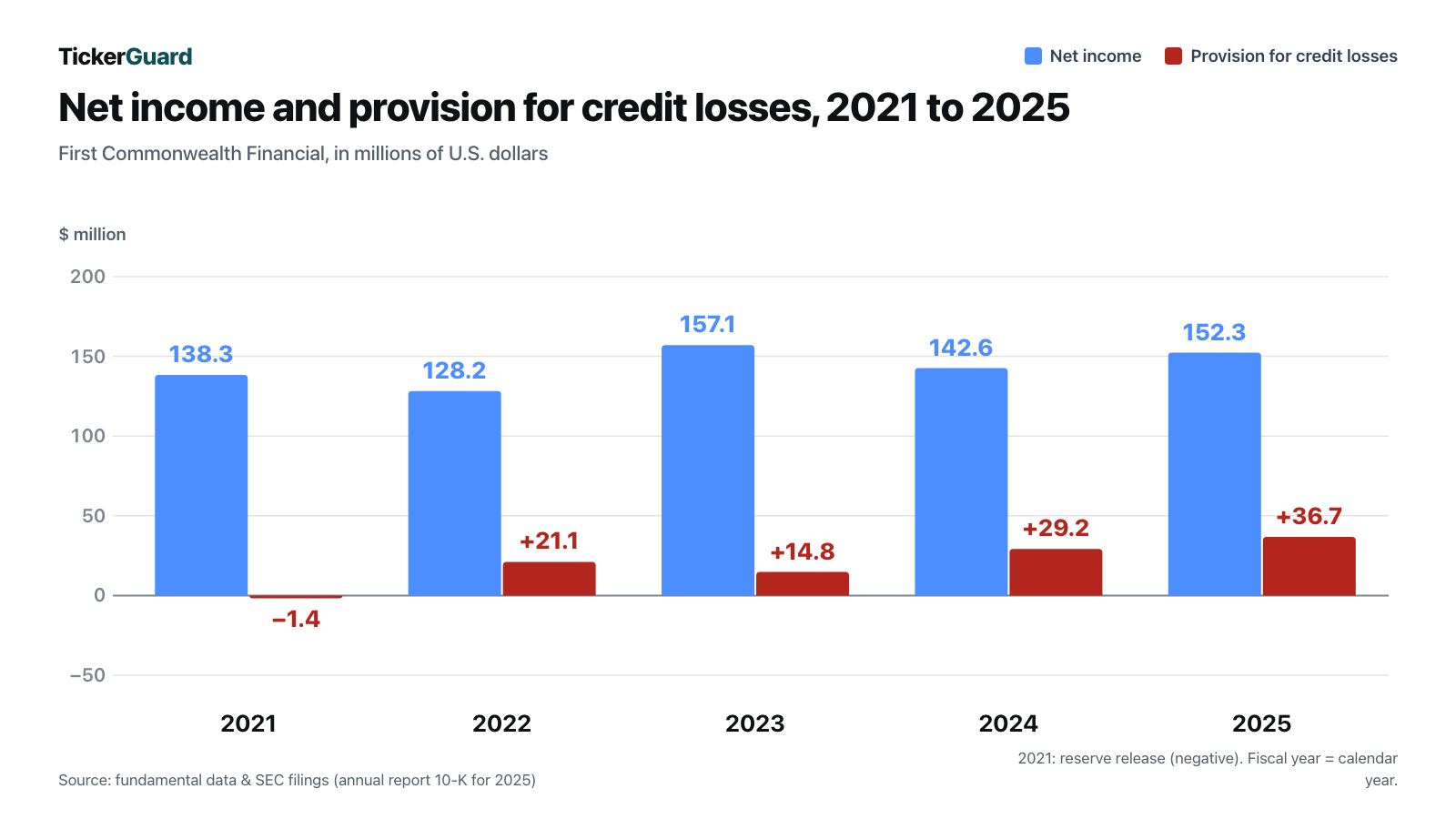
First, what speaks for the bank, and that is quite a lot. From 2021 to 2025, net income ranged between $128.2 million (2022) and $157.1 million (2023); in 2025 it was $152.3 million even though the provision for credit losses had risen to $36.7 million. Net interest income rose from $278.5 million to $426.1 million over the same period, an increase of more than half. The net interest margin climbed from 3.55 percent in 2024 to 3.84 percent in 2025 and on to 4.11 percent in the third quarter of 2026. The dividend per share rose every year, from $0.455 in 2021 to $0.535 in 2025. The fiscal year matches the calendar year.
2026 brought another step up. In the first nine months the bank earned $127.1 million, up from $107.4 million a year earlier, or $1.25 per share versus $1.04. Part of the gap is one-off: the prior-year figure was weighed down by costs of the CenterBank acquisition. The bank therefore also reports a “core” result that strips out such items: $127.3 million versus $113.4 million, an increase of a little over 12 percent. The return on average tangible common equity — equity excluding goodwill from acquisitions — was 15.73 percent in the third quarter of 2026. And of every dollar of revenue, day-to-day operations consumed about 53 cents; this core efficiency ratio stood at 53.15 percent.
The second series in the chart runs the other way. The provision for credit losses is the money a bank sets aside for expected loan losses — in everyday terms, the umbrella you buy before it rains. It has become more expensive year after year: $14.8 million in 2023, $29.2 million in 2024, $36.7 million in 2025 and already $33.9 million in the first nine months of 2026. Profit holds up because the interest margin brings in more than the provisions cost. Which brings us to the uncomfortable truths.
What the Filings Say — The Uncomfortable Truths
Uncomfortable Truth No. 1: The Third-Quarter Profit Gain Came From the Tax Line
The headline of the earnings release reads: quarterly profit rose to $44.9 million, after $44.6 million in the prior quarter and $41.3 million a year earlier. The line that matters is in the quarterly report:
“This decrease is primarily a result of a $4.7 million tax benefit recognized in the three months ended September 30, 2026 from purchasing $54.7 million in prior year tax credits at a discount.”
— First Commonwealth Financial, SEC quarterly report 10-Q as of September 30, 2026, Item 2 “Income Tax”

In plain English: the bank bought transferable tax credits for less than they are worth — renewable energy tax credits, according to the earnings release — and applies them against its own tax liability for 2025 and earlier years. That is legal and commercially sensible. It just isn’t banking. Before taxes, First Commonwealth earned $50.7 million in the third quarter — less than in the prior quarter ($56.3 million) and the prior-year quarter ($51.8 million). The effective tax rate fell to 11.3 percent; excluding the discrete item, the report gives 20.6 percent. Without the $4.7 million, quarterly net income would have been about $40.2 million by our calculation, below both comparison quarters. Pre-tax income was held back by a $5.3 million higher provision and $4.0 million higher operating expenses.
Uncomfortable Truth No. 2: Shaky Loans Have Nearly Doubled Since Early 2025
Banks grade their loans internally by credit quality. “Classified” loans are those where the bank itself sees a clear weakness in the borrower — they have not defaulted, but the rain has started. At First Commonwealth, this pile has grown since early 2025, with two small setbacks:
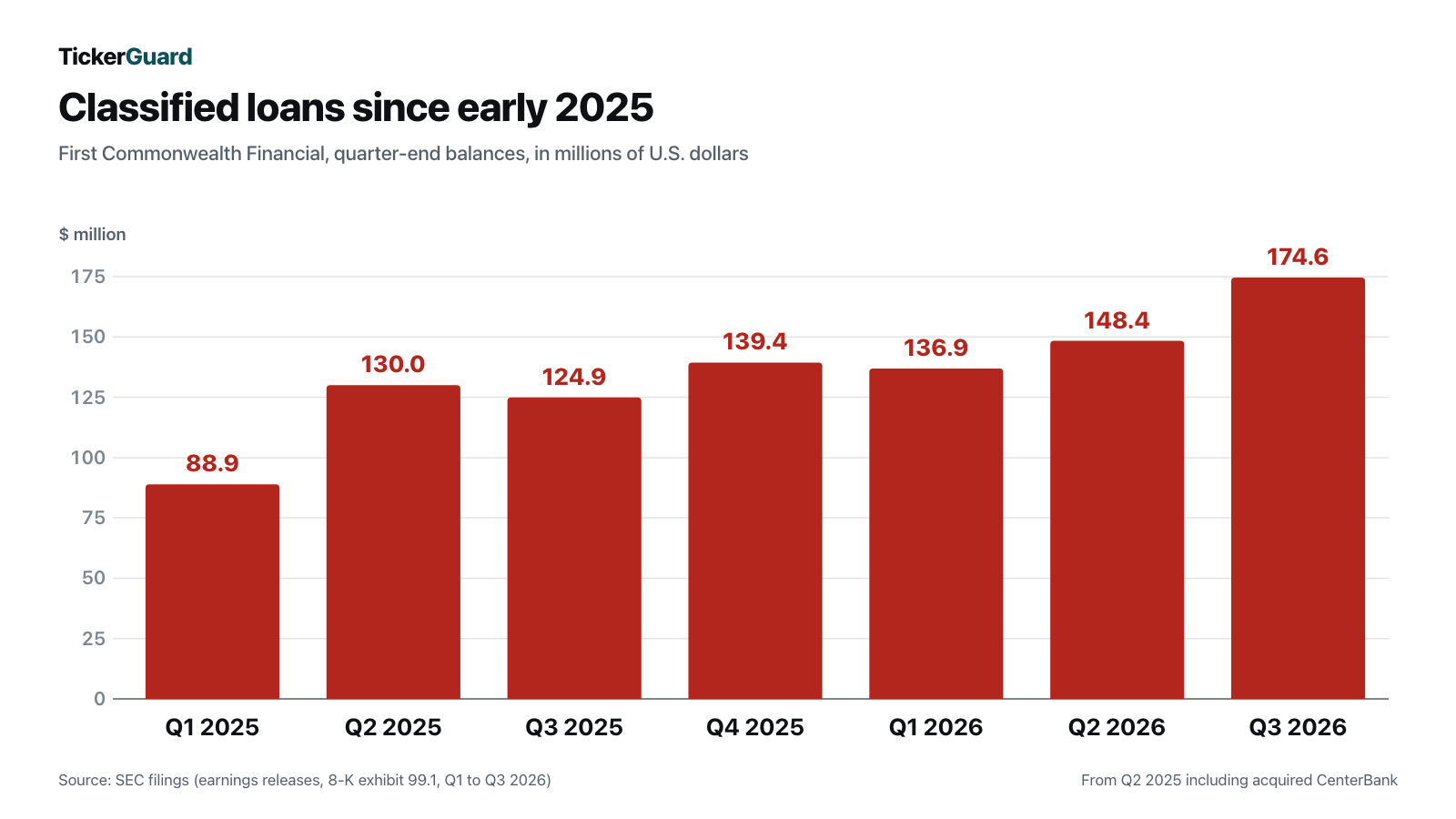
In fairness: in the second quarter of 2025, the loans of the acquired CenterBank were added, so part of the first jump is the acquisition. Since then the number has kept rising anyway, by $26.2 million in the third quarter of 2026 alone. The broader group of “criticized” loans stood at $288.0 million as of September 30, 2026, up from $248.2 million a year earlier. Nonperforming loans, on which the bank no longer books interest, also rose by $13.6 million in the third quarter to $95.2 million, or 0.99 percent of all loans. The earnings release gives the reason:
“The increase in nonperforming loans was primarily due to the migration of two commercial credits with an aggregate balance of $21.0 million to nonaccrual status.”
— First Commonwealth Financial, third-quarter 2026 earnings release (Form 8-K of October 28, 2026, Exhibit 99.1)

A second warning light: loans more than 90 days past due but still accruing interest rose from $3.2 million to $13.4 million in the third quarter. According to the earnings release, the higher provision of $14.2 million reflected $6.7 million in additional reserves, mainly for three individually analyzed commercial credits, and $3.5 million for unfunded commitments. The good news: actual net charge-offs in the third quarter were only $4.6 million, or 0.19 percent of loans on an annualized basis; the allowance for credit losses covers 1.40 percent of all loans and 1.4 times the nonperforming ones. Management knows where the problem is:
“Our near-term priorities include continuing to improve credit performance, generating profitable growth and controlling expenses to create positive operating leverage.”
— T. Michael Price, President and CEO, third-quarter 2026 earnings release (Form 8-K of October 28, 2026, Exhibit 99.1)
Remember: a loan does not turn into a loss overnight. It first migrates through the grades — and at First Commonwealth that migration has been under way since early 2025.
Uncomfortable Truth No. 3: In 2026, More Went to Shareholders Than the Bank Earned
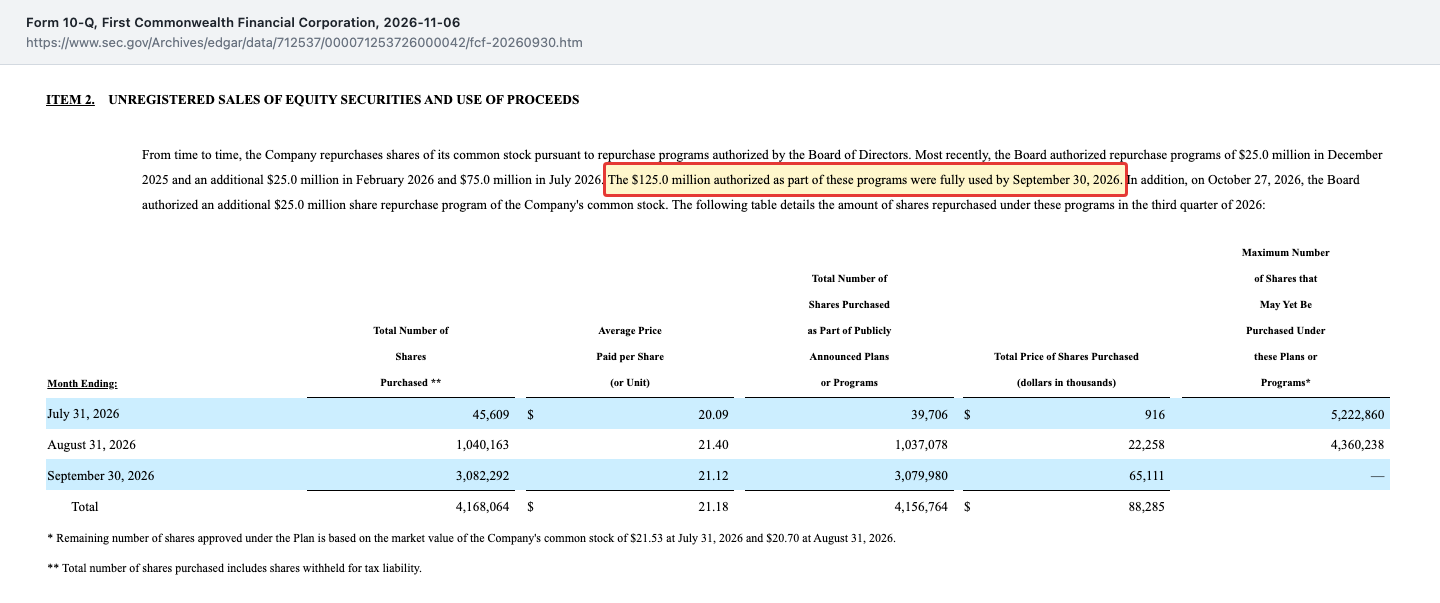
Share buybacks are seen as a sign of strength: the company buys its own stock, the share count falls, and every remaining share gets a bigger slice of the pie. First Commonwealth bought heavily in 2026. The quarterly report records how much:
“The $125.0 million authorized as part of these programs were fully used by September 30, 2026.”
— First Commonwealth Financial, SEC quarterly report 10-Q as of September 30, 2026, Part II, Item 2
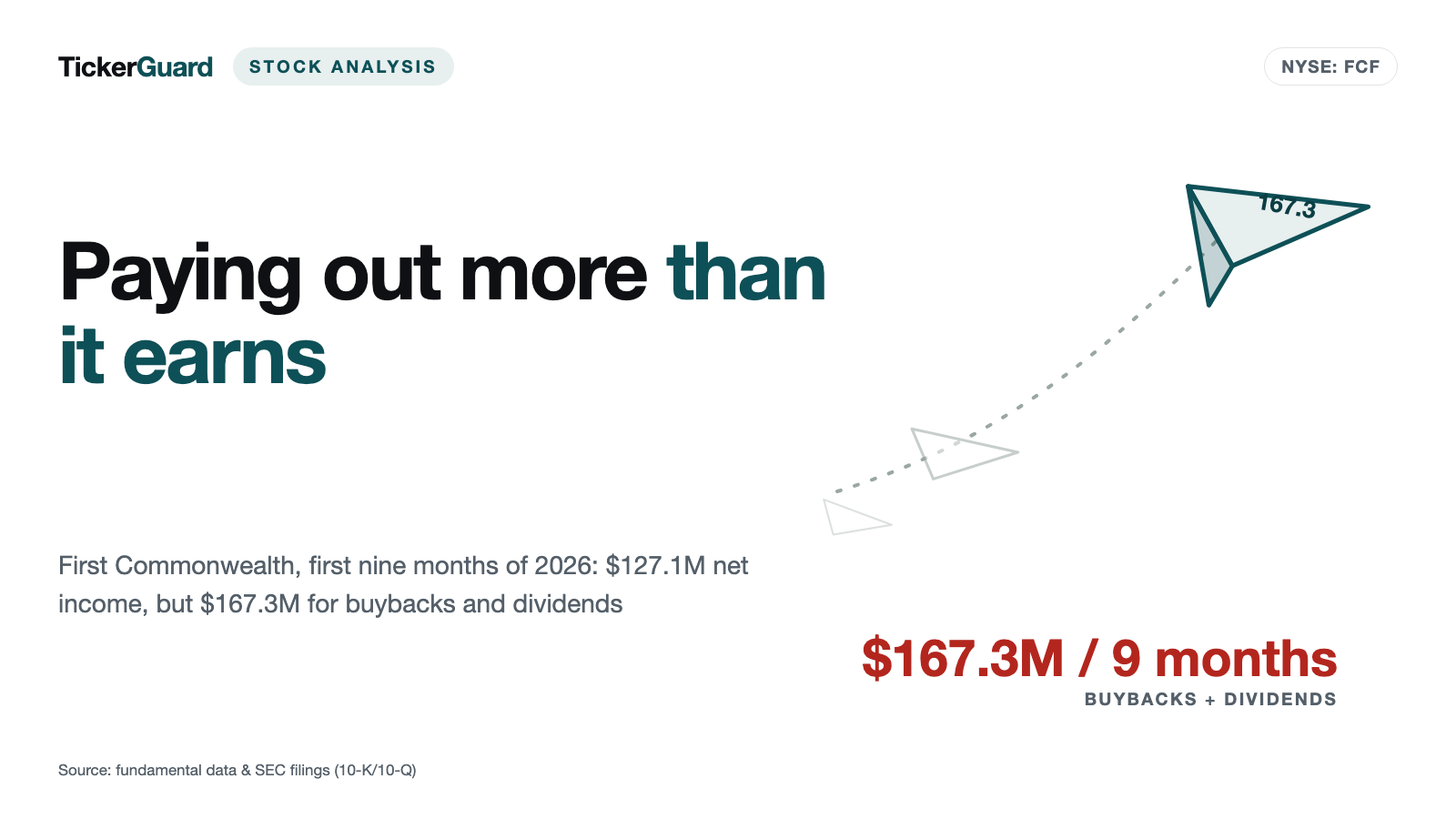
On top of that came $42.2 million in dividends. Together that is $167.3 million — against a profit of $127.1 million over the same nine months. The next chart shows how much equity shrank as a result:
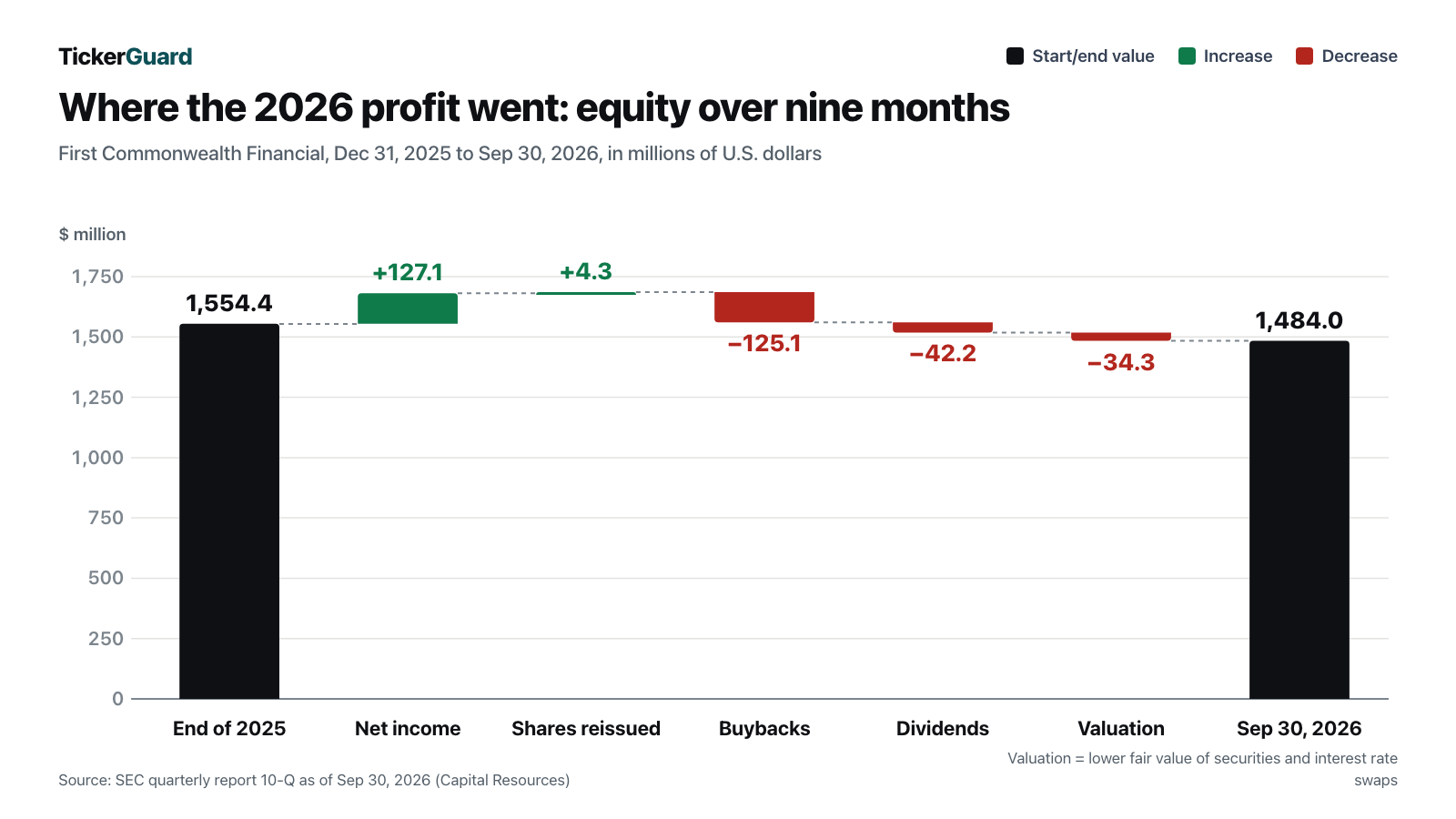
Shares outstanding fell from 102.8 million at the end of 2025 to 96.9 million, a drop of 5.7 percent; in the third quarter alone, the bank repurchased 4.16 million shares under its buyback programs for about $88 million. The price for that is in the fine print. In the same quarter, the common equity tier 1 ratio — the share of the highest-quality capital relative to risk-weighted loans and assets, the cushion that absorbs losses first — fell from 12.6 to 11.9 percent. That is still solid: the earnings release puts the excess over the “well capitalized” threshold (6.5 percent) at $539.4 million. But it is a thinner cushion at a time when shaky loans are rising.
One more thing: third-quarter buybacks were made at an average of $21.18 per share. Tangible book value per share — book value excluding acquisition goodwill — was $11.58 as of June 30, 2026. For every share it repurchased, the bank therefore paid a little over 1.8 times the substance behind it; mathematically, that lowers tangible book value per remaining share. It fell to $11.20 during the quarter; unrealized losses on securities, which grew by $28.4 million in the third quarter, also contributed. In total, $98.9 million of accumulated unrealized losses sat in equity as of September 30, 2026, almost entirely on securities. They do not flow into the regulatory ratios, because the bank uses an election available to institutions with less than $15 billion in assets. The new buyback program of October 27, 2026, covers only $25 million — far less than the $88 million of the third quarter.
Uncomfortable Truth No. 4: Office Loans Are Valued on Old Appraisals
Commercial real estate is the largest loan block at $3.04 billion, 32 percent of all loans and roughly twice shareholders’ equity. The properties are 43 percent in Ohio and 41 percent in Pennsylvania. The block is shrinking: since the end of 2025 it has fallen by $138.5 million, or 4.4 percent, according to the report because of fewer loans on non-owner-occupied commercial properties, and the internal limit for office loans was lowered in the second quarter of 2026. The most closely watched segment is office, at $414.7 million; the bank no longer rates 7.8 percent of it as pass, and for student housing the figure is 10.0 percent. For the larger office loans, the quarterly report gives a weighted average loan-to-value ratio of 45.0 percent, which sounds like a comfortable cushion — and then adds one sentence:
“Our current measure is based off of the most recent appraisal on file, the majority of which are from origination.”
— First Commonwealth Financial, SEC quarterly report 10-Q as of September 30, 2026, Item 2 (commercial real estate loans)
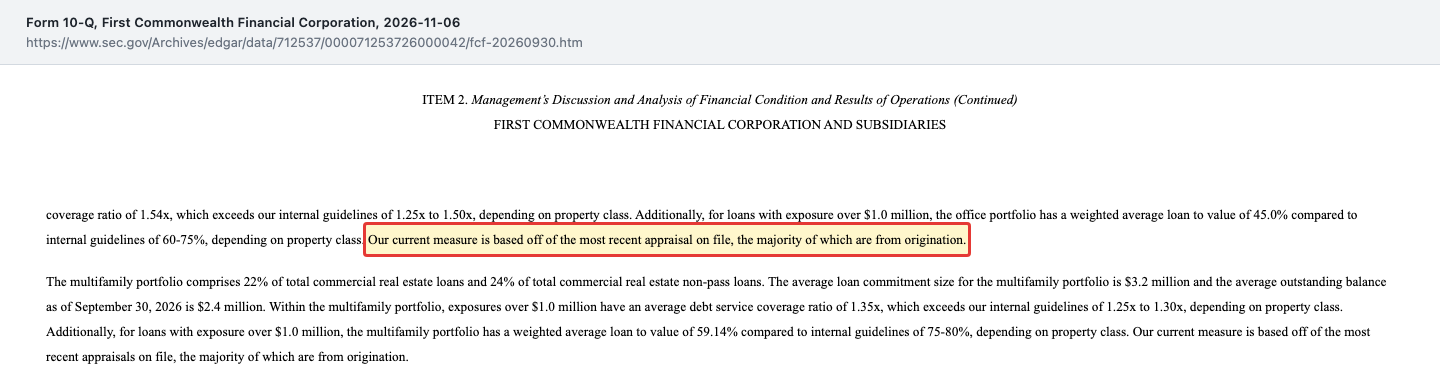
In everyday terms: the bank values your car by the purchase contract, not by today’s used-car price. The 45 percent cushion is therefore a figure from better times for office property; how much of it is left today, the report doesn’t say. For multifamily, the second-largest segment at $682.5 million, the same caveat appears. Overall, commercial real estate loans not rated pass rose by $25.1 million since the end of 2025 to $152.6 million. On the other side of the balance sheet sits funding: about $3.0 billion of deposits are not covered by federal deposit insurance, of which $0.8 billion is secured by pledged investment securities or letters of credit. Just under a quarter of deposits sit in noninterest-bearing checking accounts — a cheap, loyal foundation.
Uncomfortable Truth No. 5: The New Chief Information Officer Is the Son of the Chairman of the Board
Since April 27, 2026, Ryan L. Gorney has led the bank’s information technology, digital strategy and operations as Executive Vice President and Chief Information Officer (CIO). According to the press release, he brings more than two decades of experience, including as chief information officer of Primis Bank. The mandatory filing with the SEC contains a sentence that is missing from the press release:
“Mr. Gorney is the son of Jon L. Gorney, Chair of the Company’s Board of Directors.”
— First Commonwealth Financial, Form 8-K of April 15, 2026, Item 8.01
The relationship is disclosed and not prohibited. According to the press release, Gorney reports to President and CEO T. Michael Price and replaces a long-time business group leader who is retiring. The board of directors, which his father chairs, oversees this management team. For you as a shareholder, that is a corporate governance question, because a potential conflict of interest is on the table. Whether and how the Chairman of the Board was involved in the decision, the filing doesn’t say.
Valuation: What the Mid-November 2026 Price Demands
To do the math we need a share count and a price, both dated. The cover page of the latest quarterly report lists 96,927,715 shares outstanding as of November 5, 2026. The closing price on November 18, 2026, was $20.57 (fundamental data), for a market value of just under $2.0 billion. As a cross-check: the earnings release uses the October 26, 2026, close of $21.19, which would mean about $2.05 billion.
For banks, what matters most is the comparison with equity. At the November 18, 2026, price, the stock trades at 1.34 times book value per share ($15.31) and 1.84 times tangible book value ($11.20, both as of September 30, 2026). Measured against earnings of $1.68 per share over the past four quarters, that is a price-to-earnings ratio of just over 12. The quarterly dividend of $0.14 amounts to an annualized yield of about 2.7 percent. A bank that earns around 15.7 percent on its tangible equity can justify a premium to that book value — provided the return holds even if part of the classified loans actually default.
The professionals’ view is friendly but not euphoric: of seven analysts covered in the fundamental data on November 19, 2026, one rates the stock a strong buy and three a buy, three say hold and none says sell; the average price target is $23.79. On average they expect earnings of $1.74 per share for 2026 and $2.02 for 2027. Treat such ratings as a mood indicator, not a roadmap.
How we read another regional bank with a large commercial real estate book is shown in our analysis of Hope Bancorp; we take apart a smaller bank from upstate New York in our analysis of Arrow Financial.
Upside and Risks at a Glance
What speaks for First Commonwealth:
- A high and rising net interest margin: 4.11 percent in the third quarter of 2026, up from 3.92 percent a year earlier; net interest income up by more than half from 2021 to 2025.
- Steady profits: $128.2 million to $157.1 million a year since 2021, $127.1 million in the first nine months of 2026; return on average tangible common equity of 15.73 percent in the third quarter.
- Capital above requirements: a common equity tier 1 ratio of 11.9 percent, $539.4 million above the “well capitalized” threshold (September 30, 2026).
- Cheap funding: just under a quarter of deposits sit in noninterest-bearing checking accounts, and deposit costs fell in the third quarter of 2026.
- The dividend has risen every year since 2021; the commercial real estate book is shrinking, and the limit for office loans was lowered.
What speaks against it:
- Classified loans nearly doubled from $88.9 million (March 2025) to $174.6 million (September 2026); nonperforming loans rose to $95.2 million in the third quarter of 2026.
- The provision for credit losses has grown more expensive every year since 2023, already $33.9 million after nine months of 2026.
- Buybacks and dividends of $167.3 million exceeded profit in the first nine months of 2026; the CET1 ratio fell by 0.7 percentage points in the third quarter.
- The third-quarter 2026 profit gain came from purchased tax credits ($4.7 million); pre-tax income fell.
- Commercial real estate loans of $3.04 billion, roughly twice equity; office values mostly rest on appraisals from origination; per a Form 8-K, the CIO (Executive Vice President and Chief Information Officer) is the son of the Chairman of the Board.
A Human Conclusion
Back to the boredom trap. Its core is not that boring banks are bad — First Commonwealth is a solidly profitable, well-capitalized regional bank with 92 years of history and a net interest margin of 4.11 percent most recently. Its core is that calm invites you to look away. And 2026 is exactly the year to look: the bank is distributing more than it earns, its quarterly profit is propped up by a tax purchase, and the list of shaky loans is getting longer.
So the honest question for you is not “Is this a sound bank?” — by everything the filings show, it is. It is: Do you trust the bank to work through its problem loans before they turn into real losses — and do you think it is right to spend its capital cushion on buybacks at this stage? If you can answer yes to both, you have a thesis. If all you saw was the rising dividend, the calm has lulled you to sleep. What you do with this is your decision. And that’s how it should be.
Sources
All original documents used in this analysis — to read for yourself:
- First Commonwealth Financial Corporation — SEC quarterly report 10-Q as of September 30, 2026 (filed November 6, 2026)
- First Commonwealth Financial Corporation — third-quarter 2026 earnings release (Exhibit 99.1 to the Form 8-K of October 28, 2026)
- First Commonwealth Financial Corporation — earnings releases for the second quarter of 2026 (Form 8-K of July 28, 2026) and the first quarter of 2026 (Form 8-K of April 28, 2026)
- First Commonwealth Financial Corporation — SEC annual report 10-K for 2025 (filed March 2, 2026)
- First Commonwealth Financial Corporation — Form 8-K of April 15, 2026 (new chief information officer)
- Complete SEC filing history of First Commonwealth Financial: EDGAR overview (sec.gov)
- Fundamental data (prices, analyst estimates; as of November 19, 2026), reconciled with the SEC filings and the SEC’s XBRL series.
Transparency & disclaimer: this analysis is journalistic commentary on publicly available information. It is not investment advice, not a regulated investment research product and not a solicitation to buy or sell securities. Equity investments carry substantial risk up to and including total loss. All information is provided without warranty; the as-of date for each figure is stated in the text. Positions held by the operator are disclosed daily; where one exists, it appears as a notice at the top of this analysis.
Key figures at a glance
All monetary figures in millions of $; earnings per share as reported.
| Metric | 2021 | 2022 | 2023 | 2024 | 2025 |
|---|---|---|---|---|---|
| Revenue | 400.6 | 428.7 | 626.6 | 699.7 | 729.4 |
| Operating Income (EBIT) | 172.8 | 160.2 | 197.6 | 178.2 | 198.4 |
| Net Income | 138.3 | 128.2 | 157.1 | 142.6 | 152.3 |
| Net Margin | 34.5% | 29.9% | 25.1% | 20.4% | 20.9% |
| Earnings Per Share | 1.44 $ | 1.37 $ | 1.54 $ | 1.39 $ | 1.47 $ |
Source: fundamental data & SEC filings (annual and quarterly reports, 10-K/10-Q)
Our Bottom Line at a Glance
- Earning power positive
- The net interest margin rose to 4.11 percent in the third quarter of 2026 (prior year 3.92 percent), and nine-month net income to $127.1 million; return on average tangible common equity was 15.73 percent.
- Credit quality negative
- Classified loans rose from $88.9 million (03/31/2025) to $174.6 million (09/30/2026), and nonperforming loans reached $95.2 million in the third quarter of 2026. Net charge-offs are still low at 0.19 percent in the quarter.
- Capital & payouts negative
- Buybacks ($125.1 million) and dividends ($42.2 million) exceeded nine-month 2026 net income of $127.1 million. The CET1 ratio fell from 12.6 to 11.9 percent in the third quarter but remains $539.4 million above the “well capitalized” threshold.
- Commercial real estate neutral
- $3.04 billion, or 32 percent of loans, of which $414.7 million is office. The book has shrunk by 4.4 percent since the end of 2025, but loan-to-value figures rest mostly on appraisals from origination.
- Funding positive
- Just under a quarter of deposits sit in noninterest-bearing checking accounts, and deposit costs fell in the third quarter of 2026. About $3.0 billion of deposits are uninsured, $0.8 billion of which is secured by pledged securities or letters of credit.
- Earnings quality & leadership neutral
- The third-quarter 2026 profit gain came from purchased tax credits ($4.7 million). According to a Form 8-K, the CIO (Executive Vice President and Chief Information Officer) in office since April 2026 is the son of the Chairman of the Board.
First Commonwealth is a case for the boredom trap: the regional bank earns solidly, its net interest margin has risen, and the dividend keeps growing. But in 2026 it paid out more than it earned, its quarterly profit leaned on a tax purchase, and classified loans have nearly doubled since early 2025. Investing here means betting that the bank works through its problem loans before they cost money. Not investment advice.
What Our Rating Means
Open questions
The business works in principle, but one material question is open. As long as it stays open, our findings do not carry a quality verdict.
Yellow, because the banking business works but one material operating question is open: classified loans have nearly doubled since March 2025, nonperforming loans are rising, and the provision for credit losses has grown more expensive every year since 2023. Only the coming quarters will show whether that turns into meaningful losses. At the same time, the bank is paying out more than it earns and thereby drawing down its capital cushion. We see no risk to the company’s substance: the bank is well capitalized and profitable. The decision is yours.
A journalistic assessment by our editorial team at the time of the deep dive, based on public sources — not investment advice and not a solicitation to buy or sell. Your personal circumstances (investment goals, risk capacity, taxes) cannot be taken into account. What our levels mean, how verdicts are formed, and what conflicts of interest exist →
Worth Noting
- The analysis was prompted by the first record in the Reddit hype scanner on 11/19/2026 (seven mentions). Price references (closing prices per fundamental data): $16.86 (12/31/2025), $21.95 (08/04/2026, highest close in ten years), $20.57 (11/18/2026).
- Data status: the latest periodic report is the quarterly report 10-Q as of 09/30/2026 (filed 11/06/2026); the earnings release came on 10/28/2026 (8-K Item 2.02). All filings through 11/13/2026 were reviewed (Form 4, Form 144, 13F). Net income, net interest income and provision for 2021 to 2025 come from the 10-K and the SEC’s XBRL series.
- Share count from the 10-Q cover page (96,927,715 as of 11/05/2026). Market-value cross-check: 96.9 million shares times $21.19 (close on 10/26/2026 per the earnings release) comes to about $2.05 billion and matches the value in the fundamental data (about $1.99 billion).
- Our own calculations: quarterly profit without the tax benefit (44.9 minus 4.7 = about $40.2 million); nine-month 2026 payout ratio ($167.3 million vs. $127.1 million); buyback price vs. tangible book value ($21.18 vs. $11.58); price-to-book and P/E using earnings per share over the past four quarters ($1.68).
- Risk of confusion: the ticker FCF stands for First Commonwealth Financial, not for the metric “free cash flow.”
Stock Watch
This analysis is as of November 19, 2026. Stock Watch will tell you what's changed at FCF since then.
Later $1 a month per stock — signing up is free, and you'll be the first to know when it launches.
The full analysis as a PDF for later
We will send you this analysis as a PDF — to print, file away, and read at your own pace. And we will add you to the free Stock Watch list for First Commonwealth Financial Corporation (FCF), so you hear about it when something material in this analysis changes.
Frequently Asked Questions
First Commonwealth Financial Corporation (NYSE: FCF) is the holding company of First Commonwealth Bank, a regional bank headquartered in Indiana, Pennsylvania, with 126 branches in Pennsylvania and Ohio. It makes commercial, real estate and consumer loans, takes deposits and offers wealth management and insurance. As of September 30, 2026, it held $9.54 billion in loans against $10.27 billion in deposits.
No. FCF is the ticker symbol of First Commonwealth Financial on the New York Stock Exchange. It has nothing to do with the metric “free cash flow.” For banks, that metric says little anyway, because loans and deposits are the business itself; the net interest margin, credit quality and capital ratios matter more.
On October 27, 2026, the bank declared a quarterly dividend of $0.14 per share, 3.7 percent more than a year earlier, payable on November 20, 2026. Annualized, that is $0.56, or a yield of about 2.7 percent at the November 18, 2026, close of $20.57. The annual dividend rose from $0.455 in 2021 to $0.535 in 2025.
Losses are still low, but the early-warning signs are rising. In the third quarter of 2026, net charge-offs were $4.6 million, or 0.19 percent of loans annualized. At the same time, nonperforming loans rose to $95.2 million (0.99 percent), and classified loans climbed from $88.9 million in March 2025 to $174.6 million in September 2026.
As of September 30, 2026, the common equity tier 1 ratio was 11.9 percent and the total capital ratio 14.3 percent. According to the earnings release, that is $539.4 million above the 6.5 percent threshold at which a bank counts as well capitalized. In the third quarter, however, the CET1 ratio fell from 12.6 to 11.9 percent — in a quarter in which the bank repurchased about $88 million of its own stock.
As of September 30, 2026, the bank held $3.04 billion in commercial real estate loans, 32 percent of all loans; $414.7 million of that was office and $682.5 million multifamily. Since the end of 2025, the book has shrunk by 4.4 percent. The 45 percent loan-to-value ratio of the larger office loans rests mostly on appraisals from origination.
Mainly because of a lower tax bill. The bank bought $54.7 million of tax credits at a discount, saving $4.7 million in taxes. Net income rose to $44.9 million, while pre-tax income fell to $50.7 million from $56.3 million in the prior quarter, because the provision for credit losses and expenses went up.
Found an error?
Did you spot a factual error, an outdated number, or a typo in this deep dive? Let us know briefly — your report goes straight to the editorial team.