Viant Stock: Record Revenue With 29 Percent Growth — and $0.00 of Earnings per Share
Viant buys advertising slots for marketers by machine, mainly on streaming TV. For the third quarter of 2026 it reported record revenue, and the next day the stock fell 12 percent. The SEC filings show more than the headline: growth came mostly from two industries, GAAP net income was cut in half, and the people who buy the stock own just under a third of the business. In September, the founders’ holding company had also withdrawn an offering of 8.5 million shares after one day. Not investment advice — only the question of how big your slice is when the cake gets bigger.
 Thomas Mücke
Founder & Publisher
As of Today
As of: November 19, 2026
- Closing price
- 11.00 $ -3.08%
- Market Capitalisation
- 0.7 $B
- P/E
- 34.4
- Growth Score
- 7/10
- AAQS
- 5/10
This analysis has a cut-off date. The Stock Guard tells you when something material changes in the numbers. Reserve your free spot
Chart
Interactive price chart (TradingView).
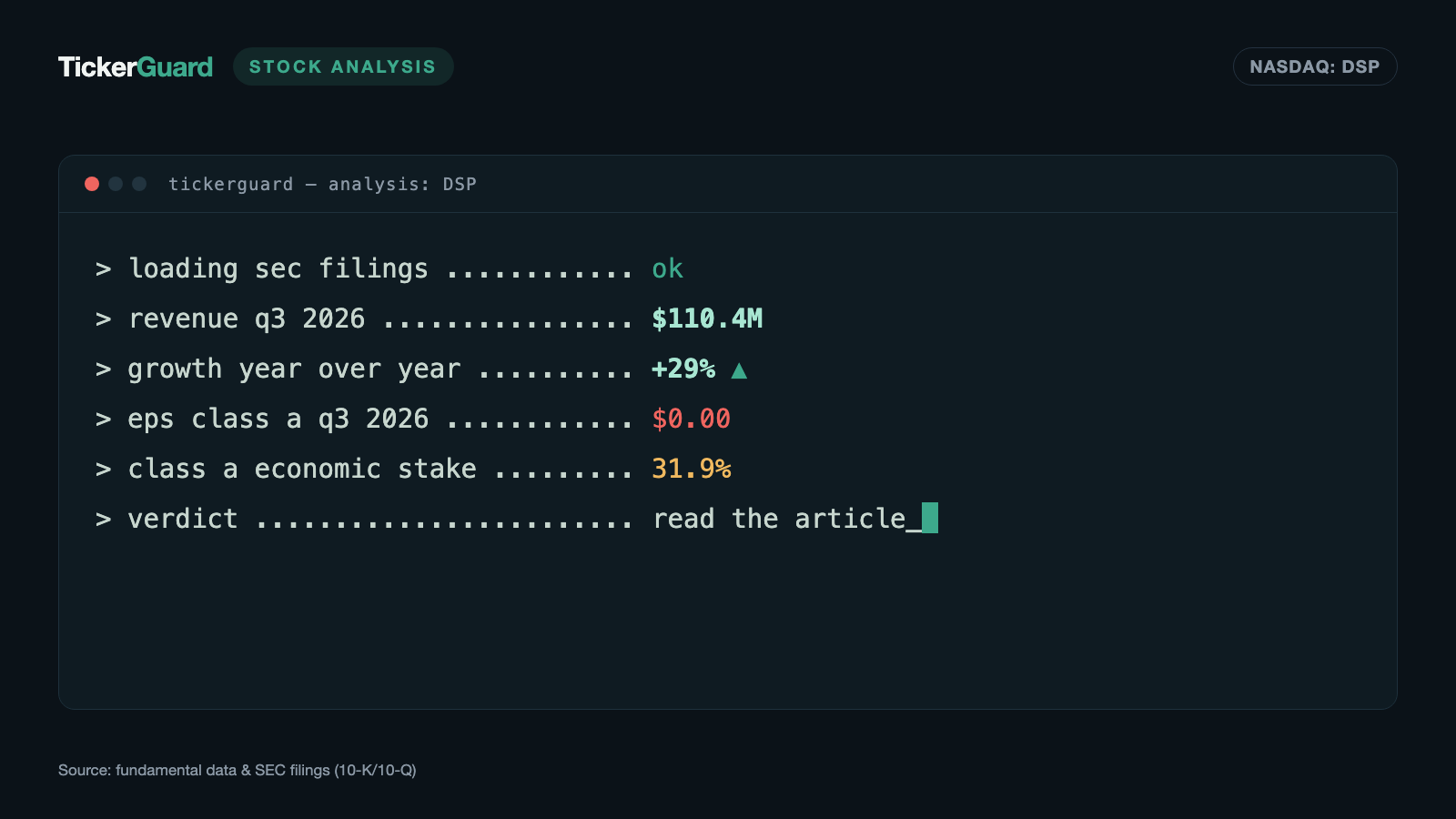
52-week range: 8.80 $ to 14.30 $ · Last price: 11.00 $ (As of: November 19, 2026)
Note: pure fact-based analysis, not investment advice and not a solicitation to buy or sell. All figures without guarantee.
There is an investor trap that waits at every birthday party: the whole-cake trap. Everyone admires how big the cake is this year — and only when the knife comes out do you see how many guests showed up and how big the slice is that ends up being yours. On the stock market, the cake is the headline: record revenue, up 29 percent. On November 9, 2026, Viant Technology (Nasdaq: DSP) put exactly that kind of cake on the table. The next trading day the stock fell 12 percent. And of the $2.6 million in quarterly net income, exactly $67,000 went to the listed Class A shares — $0.00 per share. So let’s make a deal: before you cheer the cake or curse the share price, we read together what Viant has reported to the U.S. securities regulator, the SEC — the quarterly report (Form 10-Q) for September 30, 2026, the earnings release of November 9, 2026, the annual report (Form 10-K) for 2025 and a prospectus from September that lasted exactly one day. That is where it says how big your slice is. In the end, you decide.
What Viant Actually Does — the Buyer of Ad Slots on Streaming TV
Picture a health insurer with a commercial it wants to show to people who are thinking about switching plans — not on traditional television but on ad-supported streaming services, on phones and on digital billboards. Thousands of apps and channels offer ad slots, and each one is auctioned in a fraction of a second. Nobody can buy that by hand. That is what buying platforms are for; the industry calls them demand-side platforms, or DSPs. Viant went ahead and took the abbreviation as its ticker symbol. The annual report describes the business like this:
“Our DSP is used by marketers and their advertising agencies to centralize the planning, buying and measurement of their digital advertising across most channels.”
— Viant Technology Inc., annual report on Form 10-K for 2025, Item 1 “Business”
In everyday terms: Viant is the purchasing agent who walks the wholesale market for its clients. The client says whom it wants to reach and what it may cost; Viant finds the matching ad slots, bids on them and measures afterward whether the advertising worked. Viant gets paid in two ways: a percentage of the ad spend that runs through the platform, or a fixed price per thousand ad impressions. Under the fixed-price option and some of the percentage arrangements, Viant books the purchased ad slots in its own revenue. That is why revenue contains a large pass-through item: the money handed on to the channels and apps. Viant calls these purchasing costs “traffic acquisition costs” (TAC) and prefers to work with what is left afterward — “contribution ex-TAC.” In the third quarter of 2026 that was $67.2 million out of $110.4 million of revenue.
Two things are meant to set Viant apart from larger competitors such as The Trade Desk, Google and Amazon. First, its own database that maps devices to households without relying on cookies; according to the annual report it covers 125 million households. Second, automation: since 2024 Viant has marketed tools under the name “ViantAI” that use artificial intelligence to plan, run and evaluate campaigns. Two acquisitions followed in 2026 — TVision (May; measures whether viewers actually look at the ads) and Waymark (November; generates video ads with AI). The focus is television delivered over the internet: according to the earnings release of November 9, 2026, connected TV accounted for more than half of advertiser spend on the platform in the third quarter.
The company was founded in 1999 by the brothers Tim, Chris and Russ Vanderhook. In 2016 the publisher Time Inc. acquired 60 percent; in 2019 the brothers bought that stake back; in February 2021 Viant went public on Nasdaq. Tim Vanderhook is chief executive, Chris Vanderhook is chief operating officer; headquarters is in Irvine, California, and at the end of 2025 about 380 people worked across ten offices. That names the central tension of this analysis, and it runs through every chapter: Viant is growing and its operations generate cash — but how much of that reaches you as a buyer of the stock depends on a structure that leaves the founders the larger part of the cake.
Company history for investors
-
1999
Founded by three brothers
Tim, Chris and Russ Vanderhook start the company. For shareholders: the founders still run the business today and hold the majority of the votes.
-
2019
Majority bought back
The Vanderhooks reacquire the 60 percent stake that Time Inc. had taken in 2016 (at Meredith since 2018). For shareholders: the origin of today’s ownership structure.
-
2021
IPO on Nasdaq
The Class A stock lists in February 2021; the business stays in a subsidiary in which the pre-IPO owners hold direct interests. For shareholders: a minority stake from day one.
-
2022
Revenue decline and largest loss since the IPO
Revenue falls to $197.2 million and the loss grows to $48.1 million. For shareholders: the low point from which the company has grown every year since.
-
2024
First annual profit since the IPO
Viant earns $12.5 million, starts its buyback program and launches the ViantAI tools. For shareholders: proof that the model can produce a profit.
-
2026
Acquisitions and a pulled offering
TVision and Waymark are acquired; the founders’ holding company withdraws the placement of 8.5 million shares after one day. For shareholders: more speed, more questions about the split.
How the Stock Landed on Our Desk
The trigger for this analysis is the earnings release of November 9, 2026. Viant reported what it called a record quarter, gave guidance for the fourth quarter and raised its buyback authorization by $50 million. The next day, November 10, 2026, the stock fell about 12 percent (closing prices of $14.04 and $12.33 per fundamental data). No filing gives a reason. One documented point of reference is in the release itself: the midpoint of fourth-quarter revenue guidance is about 20 percent above the year-earlier quarter, after 29 percent in the third quarter (our own calculation) — so the guidance sits below the recent pace.
Record revenue that the market answers with a decline is a classic case for a closer read in the grids of our stock scanners: on November 19, 2026, the stock closed at $11.00, about 23 percent below its highest close of the past twelve months. What the business looks like on the other side of the screen, at a provider of streaming devices and ad inventory, is the subject of our analysis of Roku. For Viant, keep one thing in mind from the start: The headline shows the whole cake. The report shows how it is divided.
The Numbers Over the Years — An Honest Look
First, what speaks for Viant, and it is a lot. After the IPO things went downhill at first: in 2022 revenue fell to $197.2 million and the loss grew to $48.1 million. Since then the company has turned around. Revenue rose to $222.9 million in 2023, $289.2 million in 2024 and $344.2 million in 2025. The loss became net income of $12.5 million in 2024 and $24.1 million in 2025. The fiscal year is the calendar year.
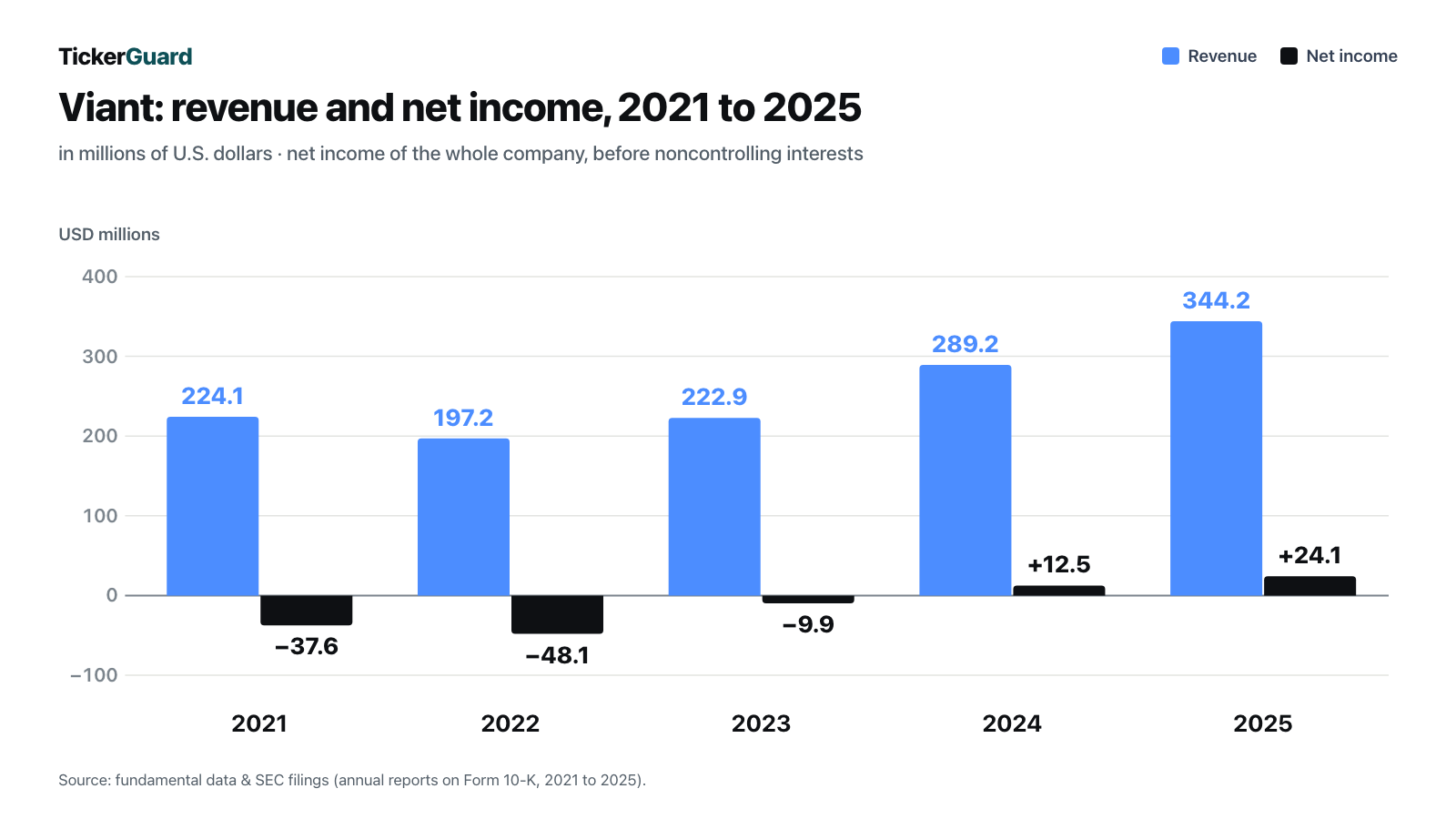
Honesty requires a footnote to the 2025 profit: it includes an income tax benefit of $14.0 million, because Viant recognized future tax benefits on its balance sheet for the first time, and in return an expense of $10.9 million for an agreement with the pre-IPO owners that we will come to. Before taxes, the company earned about $10.1 million in 2025.
The cash is sturdier evidence. Operations generated $52.6 million in 2025 and $35.7 million in the first nine months of 2026, up from $19.5 million in the same period a year earlier. Subtract spending on software and equipment ($14.9 million combined) and about $20.8 million was left over in nine months. As of September 30, 2026, there was $183.2 million of cash, no financial debt, and an undrawn $75 million credit line.
Growth accelerated in 2026: revenue up 30 percent in the first nine months, up 29 percent in the third quarter. For the fourth quarter Viant expects revenue of $130.5 million to $133.5 million and Adjusted EBITDA of $31 million to $32 million; for the full year that would come to about $435 million of revenue and about $75 million of Adjusted EBITDA. So much for the cake. Now to the cutting.
What the Filings Say — The Uncomfortable Truths
Uncomfortable Truth No. 1: Growth Hangs on Two Industries
The earnings release says 29 percent growth. Where it comes from appears in the quarterly report, in a single sentence:
“The increase was primarily due to a 81% increase in revenue from marketers in the healthcare and public services industry verticals, while revenue attributable to marketers across our remaining industry verticals increased 7%.”
— Viant Technology Inc., quarterly report on Form 10-Q for September 30, 2026, Item 2 “Results of Operations”
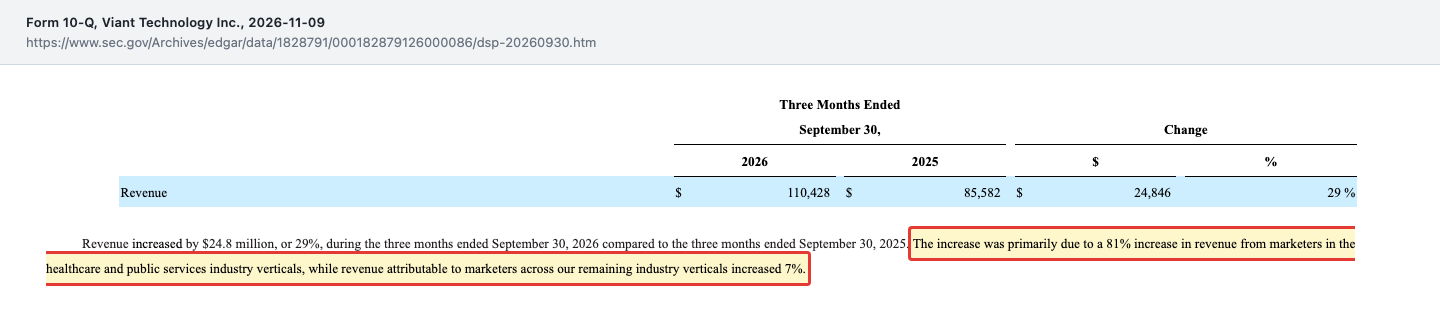
For the first nine months the report gives 61 percent growth in those two industries and 17 percent in the rest. So the business outside the two industries slowed as the year went on. The report does not break down what sits behind “public services,” nor does it say how large the two industries are relative to the rest, and it does not quantify election advertising anywhere. As a general context note, not a finding: 2026 was an election year in the United States, with Election Day on November 3, and elsewhere the report contains this risk statement:
“Political advertising could also cause our revenue to increase during election cycles and decrease during other periods, making it difficult to predict our revenue, cash flow, and operating results, all of which could fall below our expectations.”
— Viant Technology Inc., quarterly report on Form 10-Q for September 30, 2026, Item 1A “Risk Factors”
Whether, and how much of, the increase was election advertising is not in the report; we do not make that attribution. What is documented: two industries carry the pace, and the company names election cycles in general terms as a possible cause of revenue swings. The report names a second concentration among customers: in 2026 a single agency group accounts for more than a tenth of the business (2024 and 2025: nobody above 10 percent).
“For the three and nine months ended September 30, 2026, one advertising agency holding company accounted for 11.6% and 12.3% of consolidated revenue, respectively.”
— Viant Technology Inc., quarterly report on Form 10-Q for September 30, 2026, Note 2 “Concentration of Risk”

For comparison, the company’s own guidance: the midpoint of the fourth-quarter revenue range ($132 million) is about 20 percent above the year-earlier quarter ($110.1 million) — after 29 percent in the third quarter; the release does not say why the range comes out where it does. The report’s three growth figures allow a back-of-the-envelope calculation (our own, subject to rounding): the two fast-growing industries made up about 30 percent of revenue in the year-earlier quarter and a little over 40 percent in the third quarter of 2026. Keep this in mind: 29 percent is a weighted average of 81 and 7. Which of the two numbers carries on in the coming quarters is the open question.
Uncomfortable Truth No. 2: The Adjusted Result Rises, the GAAP Result Falls
In every release Viant leads with Adjusted EBITDA, an adjusted operating result before interest, taxes, depreciation and amortization. In the third quarter of 2026 it rose 24 percent to $19.8 million. Net income under U.S. accounting rules (GAAP) fell 49 percent to $2.6 million in the same quarter. Over nine months the gap is wider still: $43.8 million adjusted (prior year $32.7 million), against a GAAP net loss of $1.4 million (prior year net income of $3.6 million).
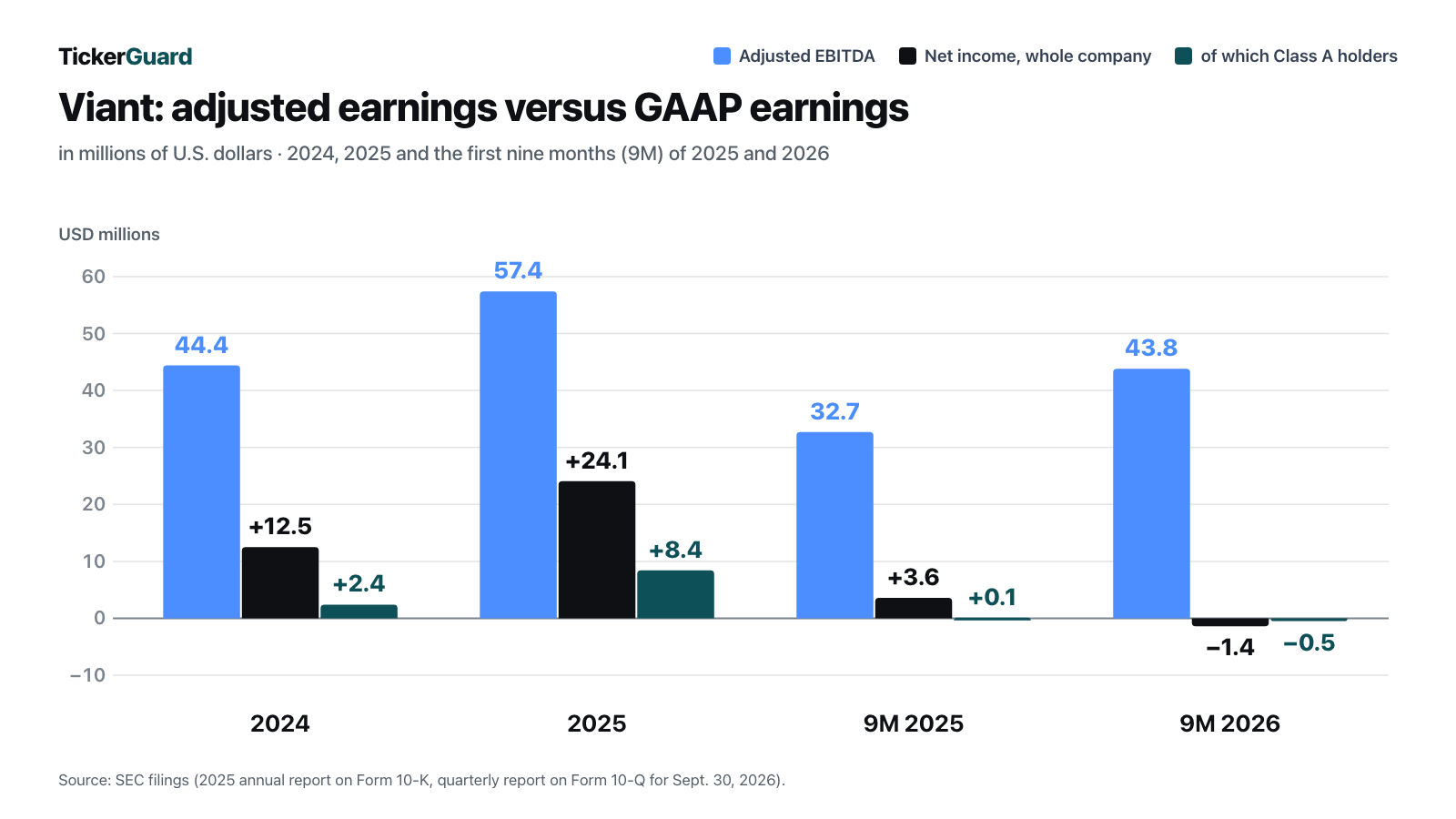
What lies between plus $43.8 million and minus $1.4 million? The reconciliation in the report names three main items: $26.9 million of stock-based compensation, $16.9 million of depreciation and amortization and $5.9 million of costs for acquisitions and contemplated transactions. At Viant, depreciation and amortization is not an accounting item without a cash side: in the same nine months $13.5 million went into internally developed software that is amortized later. In addition, general and administrative expense rose 55 percent in the third quarter; the report attributes the largest single item in that increase ($2.6 million) to “accounting and legal expenses associated with general corporate, compliance, and transaction-related matters.”
The biggest item is stock-based compensation, and it is growing faster than the business: up 46 percent in nine months, up 61 percent in the third quarter ($10.4 million after $6.4 million). Employees and management are paid to a growing extent in stock. That spares the cash, but it spreads the company across more shares — your slice of the cake gets thinner unless someone counteracts it. As of September 30, 2026, 6.7 million unvested restricted stock units were outstanding (end of 2025: 4.0 million), plus 4.1 million options and 0.5 million performance stock units. Together that is 11.3 million potential new shares, about 17 percent of the 65.5 million Class A and Class B shares outstanding on November 6, 2026.
Working the other way, Viant buys back its own stock under a program that has been in place since April 2024. According to the earnings release, from the start of the third quarter through November 6, 2026, it repurchased 1.4 million shares for $18.6 million; including shares withheld for taxes when equity awards vested, it was 1.8 million shares for $23.2 million, at an average of $12.82. On November 9, 2026, the board raised the authorization by $50 million; $70.8 million remains available. The number of Class A shares fell from 21.2 million on September 30 to 20.2 million on November 6, 2026.
In fairness: the adjusted result is not a trick but a point of view, and cash from operations ($35.7 million in nine months) shows that Viant really does earn money. But the same caveat applies: cash flow comes out that high because part of the payroll is paid in stock instead of cash. Subtract stock-based compensation alone from the nine-month adjusted result and $16.9 million is left instead of $43.8 million (coincidentally the same amount as depreciation and amortization).
Uncomfortable Truth No. 3: Class A Holders Own Just Under a Third of the Cake
Now to the actual cutting. Anyone who buys a Viant share on Nasdaq buys a Class A share of Viant Technology Inc. That company does not run the business itself. It is a holding company whose only material asset is an interest in Viant Technology LLC — the entity that contains the business. As of September 30, 2026, the holding company owned 31.9 percent of it. The other 68.1 percent is held directly by pre-IPO owners, chiefly the founding family. Those direct interests come with Class B shares: one vote each, but no claim on the holding company’s earnings, because their owners already receive their share of profit one level down.
That is why the income statement contains a line that is easy to read past. Of the quarter’s net income of $2.618 million, $2.551 million went to the pre-IPO owners. Class A holders were left with $67 thousand — on a quarterly average of 20.7 million Class A shares, that is $0.00 per share, after $0.06 a year earlier. As a matter of arithmetic, 31.9 percent of $2.618 million would be about $0.8 million; the reported amount is lower because of further items the report does not break out individually. In 2025, $8.4 million of the $24.1 million of net income was attributable to Class A holders.
That is not unfair; it is just easy to overlook: Class A holders simply own just under a third. Anyone who wants to calculate the market value correctly therefore adds Class A and Class B together (more on that below). Two things, however, go beyond the plain split. First, the tax receivable agreement from the IPO: when pre-IPO owners exchange their units for Class A shares, the holding company gains tax benefits — and it must pass 85 percent of the taxes it actually saves on to those owners. As of September 30, 2026, the balance sheet carried a liability of $13.2 million for it. Second, control:
“Through their ownership of common stock, the Vanderhook Parties control approximately 65% of the voting power of our common stock in the election of directors as of September 30, 2026. This control limits or precludes your ability to influence corporate matters.”
— Viant Technology Inc., quarterly report on Form 10-Q for September 30, 2026, Item 1A “Risk Factors”
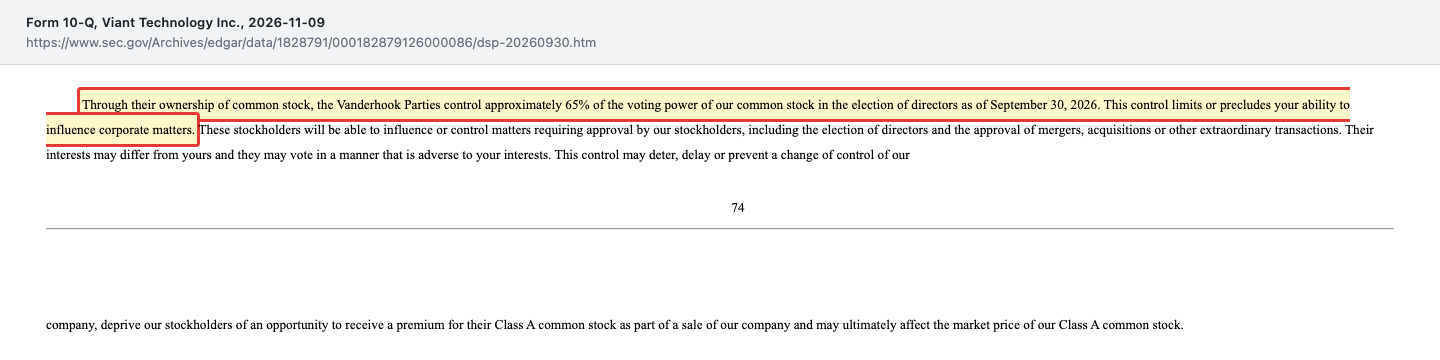
That makes Viant a “controlled company” under Nasdaq rules, free to skip some of the requirements on board independence. Tim Vanderhook is chief executive officer and chairman of the board; Chris Vanderhook is chief operating officer and also a director. Founders with a large stake are not a bad sign. It is just not a vote in which yours tips the balance.
The insider filings (Form 4) belong in the picture too. The largest sale items from May to October 2026: Capital V LLC sold a combined 112,500 Class A shares from May to July, and chief financial officer Larry Madden sold a combined 182,000 or so from May to October. Both sets of filings refer to pre-arranged trading plans under SEC Rule 10b5-1; on top of that come shares sold or withheld to cover taxes when equity awards vested. The 112,500 shares sold by Capital V equal about 0.4 percent of the 27.2 million Class B shares it held according to the September prospectus.
Uncomfortable Truth No. 4: The Founders’ Holding Company Set Out to Place 8.5 Million Shares — and Withdrew the Offering After One Day
On September 16, 2026, Viant filed a prospectus supplement (424B5) with the SEC. Capital V LLC — the holding company in which Tim, Chris and Russ Vanderhook each hold a one-third interest — planned to sell 8.5 million Class A shares in an underwritten offering. To do so it would have exchanged Class B units for Class A shares. According to the prospectus, Capital V held 27,209,326 Class B shares; the sale would thus have covered just under a third of them, and just under 13 percent of all Class A and Class B shares. No price was set; the last closing price cited in the prospectus, for September 15, 2026, was $12.60. On that basis the block would have been worth about $107 million (our own calculation: 8.5 million shares at the prior day’s close). All proceeds would have gone to Capital V. In addition, the underwriters were to receive an option to buy up to 1,275,000 new shares from the company itself.
The stock closed at $10.02 on September 17, 2026, down 19 percent from the day before ($12.37). The reversal came that same day:
“On September 17, 2026, Viant Technology Inc. (the “Company”) announced that the Company and a stockholder of the Company have determined not to proceed with the previously announced underwritten public offering of 8,500,000 shares of the Company’s Class A common stock to be sold by the stockholder, together with the related 30-day option granted to the underwriters to purchase up to 1,275,000 additional shares of Class A common stock from the Company. The decision to withdraw the offering was made in light of current market conditions.”
— Viant Technology Inc., Form 8-K of September 18, 2026, Item 7.01

Not a single share was sold. According to the announcement, the withdrawal was made in light of market conditions. Two things can be stated. The holding company set out to place just under a third of its Class B block. And the block is still there: the Class B units can be exchanged one-for-one into Class A shares. For buyers of the Class A stock that remains a possible overhang of supply, nothing more.
Uncomfortable Truth No. 5: TVision Came With a Patent Fight
Viant paid about $37.3 million for TVision in May 2026 ($16.2 million in cash, $18.9 million in its own stock, and the rest a contractual holdback that Viant expects to pay later) and $20.0 million in cash for Waymark in November. With TVision, Viant took over its litigation with Nielsen, a provider of TV audience measurement. Where things stand according to the quarterly report: in June 2026 a jury unanimously found that a Nielsen patent is not infringed; in July Nielsen moved to overturn the verdict or obtain a new trial, and those motions are pending. A second case from 2025 is active, and TVision is fighting back there with antitrust counterclaims. Part of the costs and potential losses is covered by arrangements with TVision’s former owners, but according to the report only within limits; it gives no dollar cap. The notes say the company does not expect legal proceedings to have a material effect. The report does not say what the dispute costs. Keep this in mind: a jury verdict won is not yet a final judgment.
Valuation: What the Mid-November 2026 Price Pays For
To do the math we need a share count and a price, both dated. The cover of the quarterly report gives 20,240,978 Class A shares and 45,289,716 Class B shares as of November 6, 2026. Because the Class B units carry the same economic claim on the business, they count: 65.5 million combined. At the closing price of November 19, 2026 ($11.00, fundamental data), that makes about $721 million for the whole cake. Count only the Class A shares and you get $223 million — and understate the price by more than two thirds. As a cross-check: at the closing price cited in the September prospectus ($12.60), it would be about $826 million.
Subtract the cash as of September 30 ($183.2 million) and add back the outflows reported since then ($20.0 million for Waymark, about $13 million for buybacks in October and early November; shares withheld for taxes are not included in that figure), and about $570 million is left for the business itself. That is about seven and a half times the Adjusted EBITDA Viant is pointing to for 2026 (about $75 million; 570 divided by 75 is 7.6) and a little over twice expected contribution ex-TAC (about $259 million; our own calculation: $177.7 million from nine months plus the midpoint of the fourth-quarter guidance, $81.5 million). The multiple stands or falls with whether you accept the adjusted result — the question from Truth No. 2: take stock-based compensation out of the adjusted result and the denominator shrinks — by more than half in the first nine months of 2026.
A second yardstick that needs no adjustments is free cash flow over the past twelve months (fourth quarter of 2025 plus the first nine months of 2026): operating cash flow was $68.8 million; after $1.5 million for equipment and $18.3 million for internally developed software, about $48.9 million was left (our own calculation from the annual and quarterly reports). The $570 million is just under twelve times that. Take out stock-based compensation for the same period here as well ($33.3 million), and $15.6 million remains — and the multiple rises to about 36.
A price-to-earnings ratio is misleading here. Earnings per Class A share over the past twelve months come from the fourth quarter of 2025, which was shaped by a one-time tax benefit; the first nine months of 2026 show a small loss. For context, a third-party view, not ours: the analysts covered in the fundamental data rated the stock predominantly positively on November 19, 2026. Take that as a reading of other people’s mood, not a road map — analyst consensus is no guarantee.
Upside and Risks at a Glance
What speaks for Viant:
- Growth: revenue up 30 percent in the first nine months of 2026; for the full year Viant is pointing to about $435 million (up 26 percent).
- The business brings in cash: $35.7 million from operations in the first nine months of 2026, after $19.5 million a year earlier.
- A clean balance sheet: $183.2 million of cash, no financial debt, an undrawn credit line (September 30, 2026).
- A tailwind in the market: connected TV made up more than half of advertiser spend on the platform in the third quarter of 2026, and spend there rose nearly 40 percent according to the earnings release.
- The company is buying its own stock: $18.6 million from the start of the third quarter through November 6, 2026, with another $70.8 million authorized.
What speaks against it:
- Growth is lopsided: up 81 percent in two industries, up 7 percent in the rest (third quarter of 2026); one agency group accounts for 12.3 percent of revenue.
- Under GAAP, the first nine months of 2026 show a net loss of $1.4 million; stock-based compensation rose 46 percent to $26.9 million.
- Class A holders own 31.9 percent of the business; 85 percent of certain tax savings goes to the pre-IPO owners.
- The founding family controls about 65 percent of the votes; a withdrawn offering of 8.5 million shares by its holding company (September 2026) shows that an exchangeable block remains a possible overhang of supply for the market.
- 11.3 million equity awards and options outstanding (about 17 percent of the share count) and an inherited patent fight with Nielsen.
A Human Conclusion
Back to the whole-cake trap. Its core is not that the cake is bad — Viant’s cake is real, it is growing, and the company behind it is sturdier than it was three years ago: profit instead of loss, cash from operations, no financial debt. Its core is that the size of the cake is the one number everybody sees, while the way it is divided is in the fine print. At Viant, the cake is divided among several parties: the pre-IPO owners with their 68.1 percent, the workforce with stock-based compensation growing faster than revenue, and a tax agreement that passes on 85 percent of certain savings.
So the honest question for you is not “How fast is Viant growing?” but: Do you believe the business will keep growing at a double-digit rate outside the two fast-growing industries — and are you prepared to sit as a junior partner next to a founding family that controls about 65 percent of the votes? If so, you have a thesis. If all you saw was the 29 percent, you admired the cake. What you make of it is your decision. And that is how it should be.
Sources
All original documents used in this analysis — to read for yourself:
- Viant Technology Inc. — quarterly report on Form 10-Q for September 30, 2026 (filed November 9, 2026)
- Viant Technology Inc. — third-quarter 2026 earnings release (Exhibit 99.1 to the Form 8-K of November 9, 2026) and the Form 8-K itself (increase of the buyback authorization)
- Viant Technology Inc. — Form 8-K of September 18, 2026 (withdrawal of the offering) and prospectus supplement 424B5 of September 16, 2026
- Viant Technology Inc. — annual report on Form 10-K for 2025 (filed March 11, 2026)
- Viant Technology Inc. — Form 8-K of August 10, 2026 (election of a new director); insider filings (Form 4), notices of proposed sale (Form 144) and ownership filings (Schedule 13D/A, 13G/A) from May to October 2026 in the EDGAR overview
- Complete SEC filing history of Viant Technology Inc.: EDGAR overview (sec.gov)
- Fundamental data (prices, analyst estimates; as of November 19, 2026), reconciled with the SEC filings and the SEC’s XBRL series.
Transparency & disclaimer: this analysis is journalistic commentary on publicly available information. It is not investment advice, not a regulated investment research product and not a solicitation to buy or sell securities. Equity investments carry substantial risk up to and including total loss. All information is provided without warranty; the as-of date for each figure is stated in the text. Positions held by the operator are disclosed daily; where one exists, it appears as a notice at the top of this analysis.
Key figures at a glance
All monetary figures in millions of $; earnings per share as reported.
| Metric | 2021 | 2022 | 2023 | 2024 | 2025 |
|---|---|---|---|---|---|
| Revenue | 224.1 | 197.2 | 222.9 | 289.2 | 344.2 |
| Operating Income (EBIT) | -42.8 | -49.3 | -18.3 | 3.5 | 12.1 |
| Net Income | -7.7 | -11.9 | -3.4 | 2.4 | 8.4 |
| Net Margin | -3.5% | -6.0% | -1.5% | 0.8% | 2.4% |
| Earnings Per Share | -0.56 $ | -0.84 $ | -0.23 $ | 0.12 $ | 0.12 $ |
Source: fundamental data & SEC filings (annual and quarterly reports, 10-K/10-Q)
Our Bottom Line at a Glance
- Growth neutral
- Revenue rose 29 percent to $110.4 million in the third quarter of 2026. According to the quarterly report, healthcare and public services grew 81 percent while the remaining industries grew 7 percent; one agency group accounts for 12.3 percent of nine-month revenue.
- Profitability neutral
- Net income in 2024 ($12.5 million) and 2025 ($24.1 million, including a $14.0 million tax benefit), but a net loss of $1.4 million in the first nine months of 2026. Adjusted EBITDA of $43.8 million leaves out $26.9 million of stock-based compensation.
- Cash flow & balance sheet positive
- Operations generated $35.7 million in the first nine months of 2026 (prior year $19.5 million). As of September 30, 2026, there was $183.2 million of cash and no financial debt.
- How the profit is divided negative
- Class A holders own 31.9 percent of the operating company (September 30, 2026). Of the quarter’s net income of $2.6 million, $67 thousand was attributable to them; under the tax receivable agreement, 85 percent of certain tax savings goes to the pre-IPO owners.
- Ownership & control negative
- The founding Vanderhook family controls about 65 percent of the votes; Tim and Chris Vanderhook sit on the board. The holding company Capital V announced an offering of 8.5 million shares on September 16, 2026 and withdrew it the next day; the block remains a possible overhang of supply.
- Dilution neutral
- Stock-based compensation rose 46 percent in the first nine months of 2026. As of September 30, 2026, 11.3 million equity awards and options were outstanding, about 17 percent of the share count; buybacks work against that.
Viant is a case of the whole-cake trap: the cake is real and growing — revenue up 29 percent in the third quarter of 2026, cash from operations, no financial debt. But growth hangs on two industries, the first nine months of 2026 show a GAAP loss of $1.4 million, and buyers of the stock own just under a third of a business controlled by a founding family. Not investment advice.
What Our Rating Means
Open questions
The business works in principle, but one material question is open. As long as it stays open, our findings do not carry a quality verdict.
Yellow, because the business works but material operating questions are open: third-quarter 2026 growth came mostly from two industries while the rest grew 7 percent, and under GAAP the first nine months show a small loss because stock-based compensation and acquisition costs are rising faster than revenue. On the other side stand $183.2 million of cash, no financial debt and positive cash flow from operations; the report names no indication that the company’s continued existence is at risk. The ownership structure is not a flaw in the quality of the business, but it determines how much of it reaches you. The decision is yours.
A journalistic assessment by our editorial team at the time of the deep dive, based on public sources — not investment advice and not a solicitation to buy or sell. Your personal circumstances (investment goals, risk capacity, taxes) cannot be taken into account. What our levels mean, how verdicts are formed, and what conflicts of interest exist →
Worth Noting
- The trigger for this analysis is the third-quarter 2026 earnings release of 11/09/2026 (Form 8-K, Item 2.02) and the next day’s share-price drop. Price reference (closing prices per fundamental data): $12.04 (12/31/2025), $12.37 (09/16/2026), $10.02 (09/17/2026), $14.04 (11/09/2026), $12.33 (11/10/2026), $11.00 (11/19/2026).
- Data status: the latest periodic report is the quarterly report (Form 10-Q) for 09/30/2026, filed on 11/09/2026; all filings through 11/20/2026 were reviewed. There is no further filing after 11/09/2026. Quarterly figures are unaudited.
- Share count from the cover of the 10-Q (11/06/2026): 20,240,978 Class A and 45,289,716 Class B shares. The market value of about $721 million is our own calculation across both classes. Cross-check at the price from the prospectus supplement of 09/16/2026 ($12.60): about $826 million; the figure in the fundamental data ($744 million) lies in between.
- Our own calculations: free cash flow for the first nine months of 2026 ($35.7 m less $1.4 m of property and equipment and $13.5 m of capitalized software) and for the twelve months to 09/30/2026 (operating $68.8 m = $52.6 m for 2025 less $19.5 m for the first nine months of 2025 plus $35.7 m; less $1.5 m of property and equipment and $18.3 m of capitalized software = $48.9 m; stock-based compensation for the same period $33.3 m), implied Q4 growth (midpoint $132 m against $110.1 m in the year-earlier quarter), the value of the withdrawn block (8.5 m shares times $12.60, the prior day’s close; no offering price was set), outstanding awards as a share of the share count, and the revenue share of the two fast-growing industries (derived from +29%, +81% and +7%: about 30% in the year-earlier quarter, a little over 40% in the third quarter of 2026; subject to rounding).
- The quarterly report does not break down what the “public services” vertical contains. The reference to the 2026 U.S. election year is context, not evidence of the share of political advertising.
Stock Watch
This analysis is as of November 20, 2026. Stock Watch will tell you what's changed at DSP since then.
Later $1 a month per stock — signing up is free, and you'll be the first to know when it launches.
The full analysis as a PDF for later
We will send you this analysis as a PDF — to print, file away, and read at your own pace. And we will add you to the free Stock Watch list for Viant Technology Inc (DSP), so you hear about it when something material in this analysis changes.
Frequently Asked Questions
Viant Technology Inc. (Nasdaq: DSP) operates a buying platform for digital advertising, a so-called demand-side platform. Marketers and agencies use it to plan, buy and measure advertising on connected TV, streaming audio, digital billboards, mobile and desktop. Viant is paid a percentage of ad spend or a fixed price per thousand impressions. Revenue was $344.2 million in 2025.
On an annual basis, yes: Viant earned $12.5 million in 2024 and $24.1 million in 2025, the latter including an income tax benefit of $14.0 million. For the first nine months of 2026 it reports a GAAP net loss of $1.4 million, while Adjusted EBITDA came to $43.8 million. Operations generated $35.7 million of cash in those nine months.
For two reasons: the listed Class A shares own only 31.9 percent of the operating company, Viant Technology LLC (as of September 30, 2026), and further items the report does not break out individually push their share from a computed $0.8 million down to $67 thousand. Of the quarter’s net income of $2.618 million, $2.551 million was attributable to the pre-IPO owners and $67 thousand to Class A holders. Spread over a quarterly average of 20.7 million Class A shares, that rounds to $0.00 per share, after $0.06 in the year-earlier quarter.
On November 6, 2026, there were 20,240,978 Class A shares and 45,289,716 Class B shares, each with one vote. The Class B shares belong to pre-IPO owners, chiefly Capital V LLC of the brothers Tim, Chris and Russ Vanderhook, which held 27,209,326 Class B shares according to the September 2026 prospectus. Tim and Chris Vanderhook sit on the board; together with Capital V they control about 65 percent of the votes, per the quarterly report, which makes Viant a controlled company under Nasdaq rules.
On September 16, 2026, Viant filed a prospectus supplement under which the founding family’s Capital V LLC set out to place 8.5 million Class A shares. No price was set; at the closing price of September 15, 2026 cited in the prospectus ($12.60), that would have been about $107 million (our own calculation). On September 17, 2026, the offering was withdrawn in light of market conditions, according to the Form 8-K; no shares were sold. The stock closed 19 percent lower that day.
Yes. The buyback program has been running since April 2024 and was raised by $50 million to a total of $150 million on November 9, 2026; $70.8 million remained available afterward. From the start of the third quarter through November 6, 2026, Viant repurchased 1.4 million shares for $18.6 million. New shares from compensation and from the TVision acquisition work in the opposite direction.
In its earnings release of November 9, 2026, Viant expects fourth-quarter 2026 revenue of $130.5 million to $133.5 million, contribution ex-TAC of $80.5 million to $82.5 million and Adjusted EBITDA of $31.0 million to $32.0 million. That implies full-year revenue of about $435 million. The company gives no guidance for GAAP net income.
Found an error?
Did you spot a factual error, an outdated number, or a typo in this deep dive? Let us know briefly — your report goes straight to the editorial team.