First National: The 119-Year-Old Bank That Swallowed a Rival at a Discount — and Now Reports Records
First National Corporation (Nasdaq: FXNC) operates out of Strasburg, Virginia — a town of roughly 6,500 people — and has been in business for 119 years, making it about as unglamorous as a stock can look next to today's AI rocket ships. By mid-2026 the bank reported a net interest margin above 4 percent, a return on equity of 12.03 percent, and a record first half — after buying a rival at a discount. What the record headline does not answer: how much of it was earned in the ongoing business, and how much came from the acquisition itself?
 Thomas Mücke
Founder & Publisher
Thomas Mücke
Founder & Publisher
As of Today
As of: October 9, 2026
- Closing price
- 29.50 $ -1.70%
- Market Capitalisation
- 0.3 $B
- P/E
- 12.6
- Growth Score
- 7/10
- AAQS
- 6/10
Price change since August 26, 2026: -4.5%
This analysis has a cut-off date. The Stock Guard tells you when something material changes in the numbers. Reserve your free spot
Chart
Interactive price chart (TradingView).
52-week range: 21.80 $ to 32.40 $ · Last price: 29.50 $ (As of: October 9, 2026)
Note: pure fact-based analysis, not investment advice and not a solicitation to buy or sell. All figures without guarantee.
There is an investor weakness that strikes hardest in years like this one, when AI stocks post new highs on a weekly cadence: glamour bias. You read about rocket-ship charts, about chips and data centers, and your brain flips a switch to "that's where the money is made." What falls through the cracks is a company like First National Corporation (Nasdaq: FXNC): the holding company of a bank out of Strasburg, Virginia, a town of roughly 6,500 people in the Shenandoah Valley. Founded in 1907 as "The Peoples National Bank of Strasburg," in business for 119 years, with no data center, no chip, no investor hype. That is exactly why it is worth a look: by mid-2026, First National had reported a net interest margin above 4 percent, a return on equity of 12.03 percent — and net income for 2025 that more than doubled versus 2024. Sounds like a success story nobody is celebrating. So let's make a deal: before you write this bank off as "boring" or crown it a "hidden gem," let's read together what First National told the U.S. securities regulator, the SEC — the annual report (10-K) for 2025 and the quarterly reports (10-Q) for the first two quarters of 2026. A filing to the SEC is honest under penalty of law; a press release is not necessarily.
And because it is the central tension of this analysis, it belongs right up front: First National is reporting record numbers on paper — but a meaningful share of that comes from buying a rival, from one-time items, and from a purchase-accounting effect that gets smaller every quarter. How much of the record result is earned in the ongoing banking business, and how much is bought rather than made? That question runs through every chapter of this analysis.
What First National actually does
First National Corporation is the holding company of First Bank, a classic community bank serving the Shenandoah Valley, the Roanoke Valley, the greater Richmond area, south-central Virginia and northern North Carolina. In everyday terms: the bank takes in money from savers (deposits), lends a portion of it back out to businesses and individuals (loans) — and earns the difference between what it pays savers and what it collects from borrowers. That difference is called the net interest margin (NIM), and it is roughly to a bank what gross margin is to an industrial company — except a bank does not report a gross margin or a free cash flow in the classic sense. Neither metric fits a bank's business model: a bank does not "manufacture" anything you can net against cost of goods sold, and its operating cash flow is dominated by deposit and loan movements that have nothing to do with earnings power. Instead, for a bank you watch NIM, capital ratios and credit quality.
As of December 31, 2025, First National employed 308 full-time staff, operated 33 branches, a loan production office and a customer center inside a senior living community. Those 33 locations will not stay: as of June 30, 2026 there were still 33, but by year-end 2026 the count is set to drop to 28, according to the company — through the sale of two North Carolina branches and the consolidation of three more. Alongside traditional banking there is a second, smaller line of business: wealth management under "First Bank Wealth Management." The company is run by CEO Scott C. Harvard and CFO Brad E. Schwartz; in May 2026, Gerald F. Smith, Jr. took over as chairman of the board from Elizabeth Cottrell, who had served on the board since 1992 and chaired it since 2016 as its first female chair — during her tenure the balance sheet more than doubled, two acquisitions were completed, the company listed on Nasdaq, and it joined the Russell 2000 index.
Comparing First National to other small U.S. community banks is instructive because the differences teach something. In our analysis of the banking-as-a-service bank Pathward, the story was a completely different model: a bank that earns its high margin on deposits from outside fintech partners, not through its own branches. First National is the opposite — a bank with a real branch network and its own, locally sourced depositors.
And in our analysis of the community bank Carter Bankshares, we saw how a neighboring Virginia bank drove its result from a special situation rather than the underlying banking business. First National now delivers a third case: a bank whose record numbers come in significant part from an acquisition — which is something different from organic growth, but also something different from a pure special situation.
Company history for investors
-
1907
Founded as The Peoples National Bank of Strasburg
The origin of today's First Bank in a town of 6,500 people — 119 unbroken years of banking is rare and speaks to stability.
-
2021
Bank of Fincastle acquisition
The first of two acquisitions since 2020; shareholders received cash or FXNC shares — the start of the 85 percent share-count increase through 2026.
-
2024
Touchstone Bankshares acquisition closes
A discounted acquisition delivering a $3.2 million bargain purchase gain, but also merger costs and provisions — the reason for the weak 2024 earnings year.
-
2025
Operational integration completed, subordinated notes repaid
Q1 2025 systems conversion finished; Q4 2025 saw $13 million of subordinated notes repaid at par and the dividend raised 9.7 percent — falling funding costs followed.
-
2026
Branch optimization and first organic growth
Sale of two North Carolina branches announced (closing October 2026, one-time gain expected) plus three consolidations — 33 down to 28 locations by year-end 2026; in Q2 2026, loans grew organically for the first time since the acquisition.
How the stock landed on our desk
First National did not land on our list through a scanner hit, but through an editorial review of small U.S. community banks after the recent interest-rate cycle. In that review, FXNC stood out for three reasons: a net interest margin above 4 percent — an above-average figure for a bank this size, with many comparable institutions sitting at 3 to 3.5 percent — an acquisition bought at a discount (more on that shortly), and a valuation of roughly 1.6 times tangible book value. Tangible book value is the bank's substance value stripped of goodwill and other intangibles — the standard comparison metric for banks, because it sits closer to what is actually recoverable than classic book value. A NIM above 4 percent at a valuation that had not yet priced in every ounce of future promise was reason enough to look closer.
The numbers over the years — honestly appraised
First, what genuinely impresses. Net income climbed from $10.4 million (2021) through $16.8 million (2022) to $17.7 million in 2025 — a new high. The path between those points was not straight, though: net income fell to $9.6 million in 2023 and to just $7.0 million in 2024. The 2024 dip has a clear cause: $8.1 million of merger costs for the Touchstone acquisition and $7.9 million of provision for credit losses, including a $3.8 million "day-one" provision on acquired loans — a mandatory accounting reserve that must be booked immediately upon acquisition, regardless of whether those loans ever actually default. The fourth quarter of 2024 was, as a result, a loss quarter (earnings per share of −$0.10).
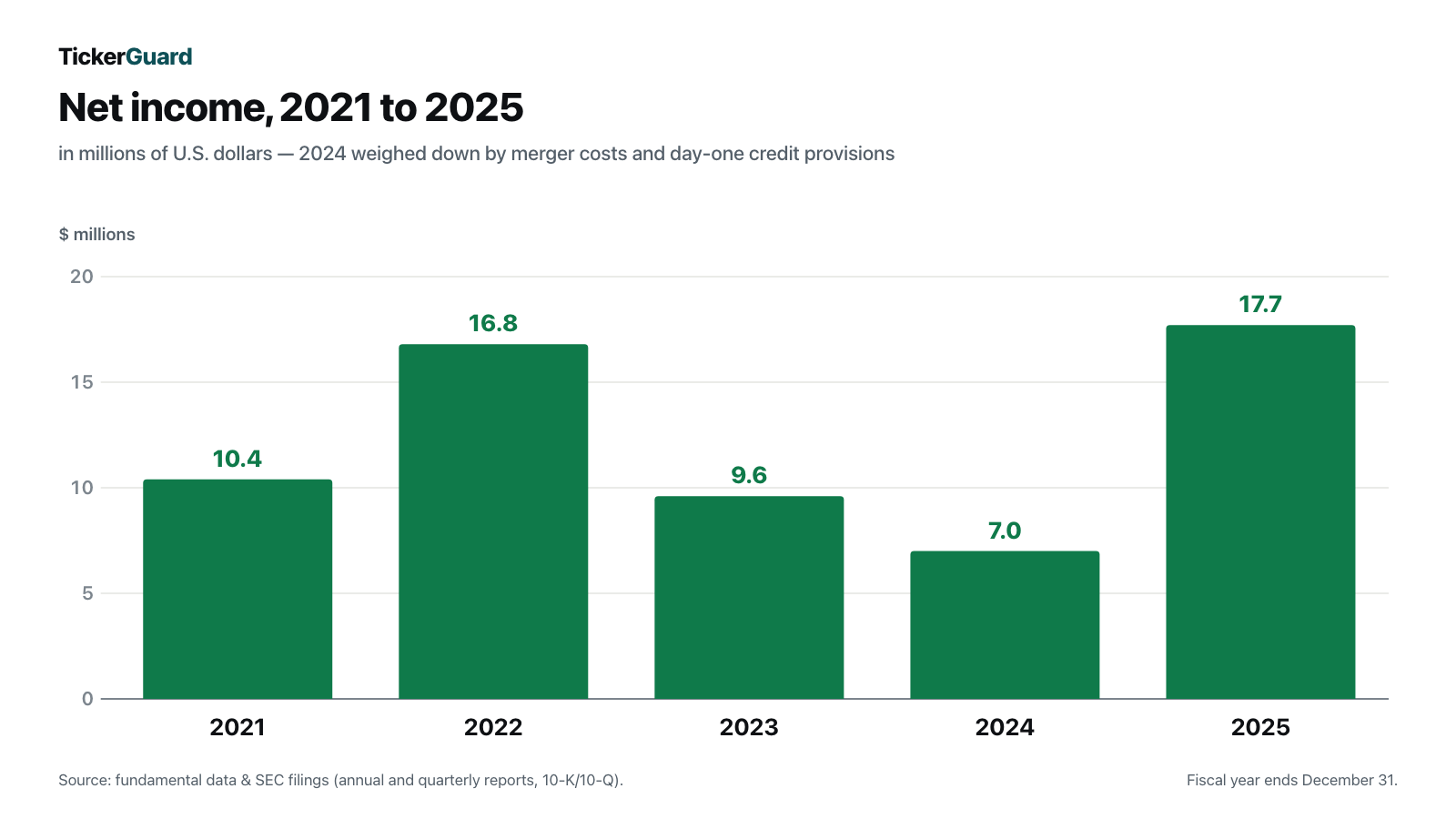
For 2025 itself, the annual report shows basic earnings per share of $1.97, a return on assets (ROA) of 0.87 percent and a return on equity (ROE) of 10.10 percent — both well above the 0.44 and 5.33 percent posted in the difficult 2024. The net interest margin (on a fully taxable-equivalent basis, FTE) stood at 3.88 percent for 2025, versus 3.51 percent a year earlier. Adjusted for one-time items, First National posted operating earnings of $19.1 million, or $2.13 per share, for 2025 — higher than the GAAP result because non-recurring costs are stripped out there too.
And now the metric that really measures a bank day to day — and it does not flatter First National: the efficiency ratio. It says how many cents of expense the bank needs to generate one dollar of revenue; lower is better. For 2025 the annual report shows 68.18%, up from 66.73% in 2024. The ratio, in other words, got worse — in the record year, of all years. Translated: of every dollar of revenue, roughly 32 cents were left over in 2025, versus a good 33 cents a year earlier. What makes that notable is that the metric already strips out merger costs and intangible amortization — so the deterioration cannot be explained away by the acquisition. Adjusted noninterest expense rose to $61.5 million in 2025 (2024: $44.3 million) while the matching revenue rose to $90.2 million (2024: $66.4 million): the bigger bank costs more than it additionally brings in. That is exactly what the branch optimization announced for late 2026 is aimed at — and exactly the number by which it will have to be judged.
A second metric rounds out the picture, and this one reads more kindly: the loan-to-deposit ratio. It says how much of every dollar of savings is actually put to work as a loan. As of June 30, 2026 it stood at 80.4% ($1,472 million of net loans against $1,831 million of deposits); as of December 31, 2025 it was 79.7% ($1,435 million against $1,800 million). That is conservative: First National still has plenty of room to lend more without having to borrow expensive money in the capital markets — this bank's growth brake in recent years was not sitting in its funding.
The uncomfortable flip side sits in the same report, in the "Executive Overview" section: at year-end 2025, loans were $15.2 million and deposits $4.2 million lower than at year-end 2024. A record year for earnings — without growth in the two most important balance-sheet lines. Keep that picture in mind: at a bank, an earnings record is only half the story until you know whether the loan book grew or shrank alongside it.
Only in the first half of 2026 did the picture tip back toward growth. Quarterly earnings per share moved like this: $0.18 in the first quarter of 2025 (still shaped by the systems conversion after the Touchstone acquisition), $0.56 in the second quarter of 2025, $0.62 in the third, $0.61 in the fourth — and $0.54 and $0.64 in the first two quarters of 2026.
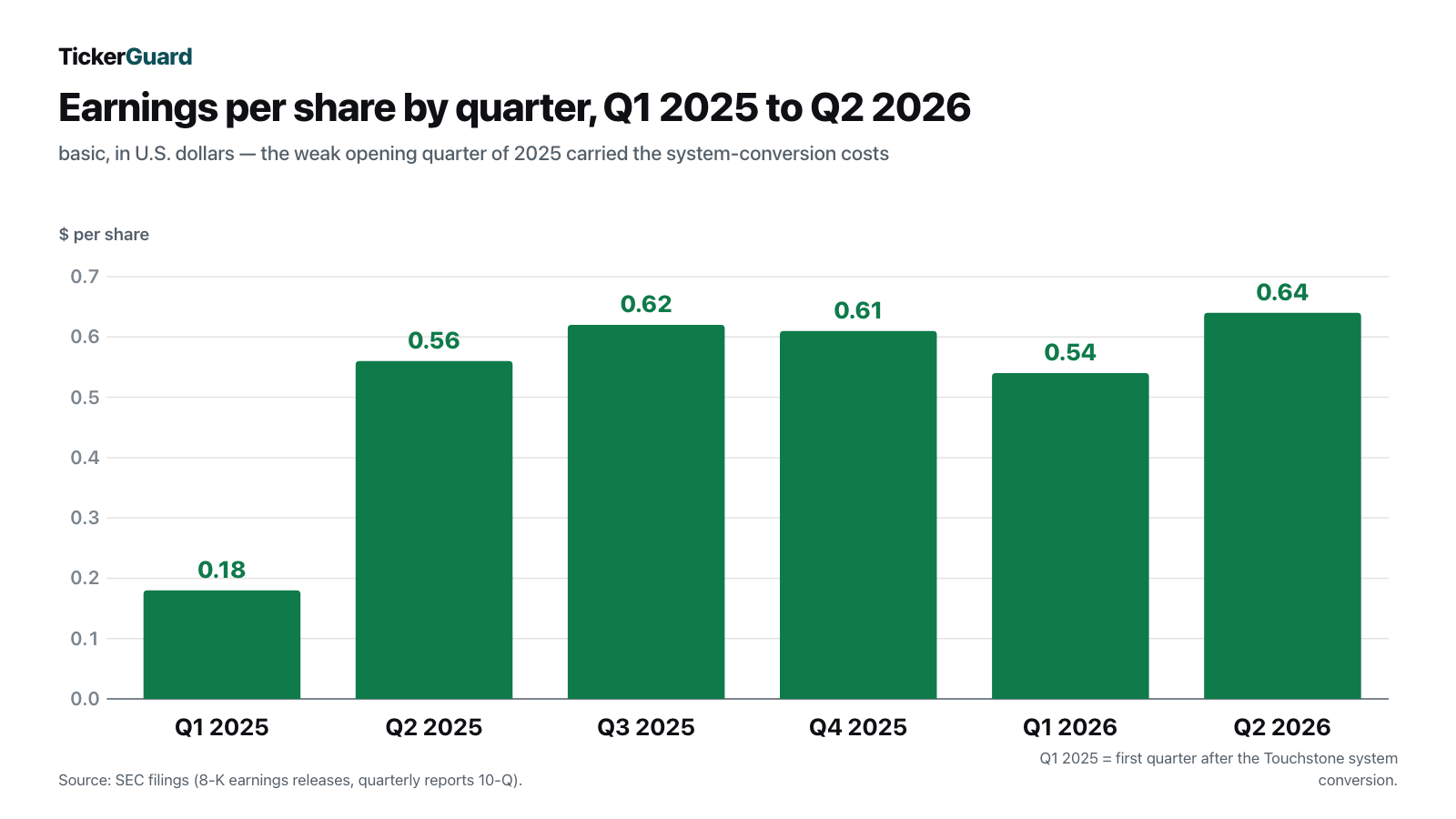
In the second quarter of 2026 (10-Q as of June 30, 2026), First National earned $5.7 million net, with a return on assets of 1.11 percent and a return on equity of 12.03 percent — both better than the first quarter (0.98 and 10.51 percent) and slightly better than a year earlier. The net interest margin rose to 4.15 percent, up from 3.99 percent in the first quarter. At first glance, a tidy success story. On a second look, this is where the real puzzle of this analysis begins — more on that shortly.
What management promised — and what it delivered
An honest note first: for a bank the size of First National, there are no publicly available earnings-call transcripts — that is standard for institutions of this size, which talk to investors almost exclusively through written press releases. In their place, we checked the earnings releases (Form 8-K, Exhibit 99.1) of the past four quarters and the MD&A in the annual report against what management actually delivered.
At the close of fiscal 2025, CEO Scott Harvard framed the year's goal like this:
"We spent 2025 integrating the Touchstone family and operations into our company, with a major focus on customer retention."
— First National Corporation, earnings release dated January 29, 2026 (SEC Exhibit 99.1 to Form 8-K)
Measured against that stated goal, management delivered: deposits stayed nearly flat, down just $4.2 million to $1.8 billion, and there was no sign of customer attrition after the integration. Growth, though, was explicitly not the goal that quarter — and it did not happen.
For the first quarter of 2026, Harvard signaled that the late-quarter loan production would carry forward: "We expect that the loan production late in the quarter will reap benefits going forward and we will begin the year with good momentum." Delivered in the second quarter: loans up $22.7 million (6.3 percent annualized) and a net interest margin that climbed to 4.15 percent.
"We expect that the loan production late in the quarter will reap benefits going forward and we will begin the year with good momentum."
— First National Corporation, CEO Scott Harvard, earnings release for the first quarter of 2026, SEC Exhibit 99.1 to Form 8-K dated April 30, 2026
Management also kept its word on paying down the subordinated notes. On the $13 million of subordinated notes repaid in the fourth quarter of 2025, the annual report said this would:
"position the Company for improved profitability in future periods"
— First National Corporation, SEC annual report 10-K for 2025, MD&A, subordinated debt discussion
Delivered: the cost of funds — what the bank pays on average for its deposits and borrowings — fell from 1.25 to 1.21 percent, while the net interest margin rose at the same time.
It is worth reading the tone alongside the bare numbers. In the first quarter of 2026, management still sounded defensive, referencing a "slow start to the first quarter" before noting that budgeted metrics were still exceeded. By the second quarter of 2026 the tone was noticeably more confident, pointing to "consistent execution of our deliberate, profitable growth strategy." Not a change of course, but a visible brightening — the language of a bank moving from an integration phase into a growth phase.
"The net interest margin in excess of four percent combined with expense management and strong asset quality delivered a strong second quarter and first half of the year."
— First National Corporation, CEO Scott Harvard, earnings release dated July 29, 2026 (SEC Exhibit 99.1 to Form 8-K)
What the filings say — the uncomfortable truths
Uncomfortable truth no. 1: a purchased loan portfolio with no safety net
Between October 2021 and October 2023, First National bought loans to physicians and other health care professionals from a third-party finance company — not at face value, but with a premium attached. The quarterly report explains why that used to be a smaller risk: the selling finance company offered buyback protection for loans that stopped performing. That protection is now gone:
"The finance company operated a program that historically provided credit support to the Company through, among other things, the repurchase of their loans and unamortized loan premiums when loans did not pay according to the loan agreements. The finance company no longer offers this credit support."
— First National Corporation, SEC quarterly report 10-Q as of June 30, 2026, Asset Quality section

What is left in practice: as of June 30, 2026, $11.9 million remains on the books — $8.5 million in loan balances plus $3.4 million of unamortized premiums (117 loans, averaging 5.0 years of remaining term). The premiums alone equal roughly 40 percent of the face value the bank paid for this portfolio. Of that, $1.8 million is already classified as non-accrual, carrying a specific reserve of $1.3 million. The annual report spells the risk out plainly: "Prepayments of the loans and securities would accelerate amortization expense of unamortized premiums and could result in a material decrease in earnings during future periods." Against $193.6 million of equity, the portfolio's 6.1 percent share is not existential, but it is not a footnote either — the remaining premiums alone equal roughly 60 percent of a single quarter's profit.
Uncomfortable truth no. 2: growth came from acquisitions — not from the ongoing business
The second uncomfortable truth concerns the source of growth itself. First National's share count has grown from 4.88 million to 9.04 million since 2020 — up 85 percent in six years, driven by two acquisitions: Bank of Fincastle in 2021 and Touchstone Bankshares in 2024. Total assets more than doubled over the same period, from $0.95 billion to $2.08 billion. That is growth — but growth paid for with fresh shares is never entirely free: whoever holds an FXNC share today holds a smaller slice of a bigger pie than in 2020.
The Touchstone acquisition itself was a good deal for existing shareholders. At closing on October 1, 2024, First National exchanged each Touchstone share for 0.55 of its own shares:
"each outstanding share of Touchstone common stock was converted into 0.55 shares of the Company's common stock, resulting in 2.7 million additional shares issued, or aggregate consideration of $46.8 million"
— First National Corporation, SEC annual report 10-K for 2025, Note 2 "Acquisitions"

Notably, First National bought Touchstone below the fair value of the net assets acquired — a discount, the way a house sells below its appraised value. In accounting terms that is called a bargain purchase gain, and the difference can be booked as income:
"As a result of the Touchstone merger, the Company recognized an adjusted bargain purchase gain of $3.2 million."
— First National Corporation, SEC annual report 10-K for 2025, Note 2 "Acquisitions"
That gain is tax-free and real — but it is a one-time effect of the acquisition itself, not recurring banking income. On top of that, 2024 carried a $3.8 million "day-one" provision on the acquired loans — a mandatory reserve under current accounting rules (CECL), booked immediately regardless of whether those loans ever actually default.
And then the real punch line: fiscal 2025 saw loans (−$15.2 million) and deposits (−$4.2 million) shrink versus 2024. In other words: the 85 percent increase in shares since 2020 paid for a bigger balance sheet — but in the first full year after the acquisition, the existing book stopped growing and, if anything, shrank slightly. Organic expansion only returned in 2026 — and it started right in the first quarter: loans rose $14.7 million, which the earnings release calls "a 4.0% annualized growth rate". In the second quarter of 2026 that accelerated to $22.7 million, driven, per the report, by newly hired loan officers. Keep this pattern in mind: balance-sheet growth through acquisition is a different thing from balance-sheet growth through more business with the same customers — and First National is only just beginning to prove the second kind.
Uncomfortable truth no. 3: a 2027 rate reset and paper losses in the bond book
Two smaller but concrete risks round out the picture. First, the last remaining subordinated note: after repaying $13 million of other subordinated notes in the fourth quarter of 2025, one note of $9.5 million remains, fixed at 4.00 percent — until January 30, 2027. The annual report names the date in black and white:
"Beginning January 30, 2027, the interest rate shall reset quarterly to an interest rate per annum equal to the current three-month SOFR, plus 596 basis points."
— First National Corporation, SEC annual report 10-K for 2025, Note on Subordinated Debt

SOFR is the U.S. reference rate that floating-rate financing keys off — a spread of 596 basis points means nearly 6 percentage points on top of whatever the reference rate happens to be. From that same date, the bank may call the note with regulatory approval for the first time; given the track record (two other subordinated notes already repaid early), a payoff looks more likely than sitting on the pricier rate.
Second, the unrealized losses sitting in the securities book. As of June 30, 2026, First National holds $322.8 million in securities — $227.8 million available-for-sale (AFS), carrying $15.8 million of unrealized losses, and $89.4 million held-to-maturity (HTM), carrying a further $7.2 million of unrealized losses. Combined, $23.0 million. These are paper losses — they exist because interest rates have risen since these bonds were purchased, so older, lower-yielding paper has lost market value; they only become real if the bank were forced to sell before maturity. The quarterly report itself notes the value changes are rate-driven, not a credit concern. Against $193.6 million of equity, $23.0 million is not an existential risk, but it is not a footnote either: it is what the bank would lose if it had to liquidate its entire bond book today.
Rounding out this analysis honestly requires one more pass over the one-time items that shaped the record picture: the $3.2 million bargain purchase gain (2024/2025), the $3.8 million day-one provision (Q4 2024), $8.1 million of merger costs (2024) — and one more planned one-time item still ahead: in February 2026, First National announced the sale of two North Carolina branches (Roanoke Rapids and Louisburg), regulatory approvals are now in hand, and closing is planned for October 2026. On top of that come three further branch consolidations, so that the number of banking offices is set to fall from 33 to 28 by year-end 2026, according to the company. Management expects a one-time gain from the branch sale in the fourth quarter of 2026 — another figure worth separating from the ongoing banking business once it is reported.
Valuation: solid, but no longer a bargain
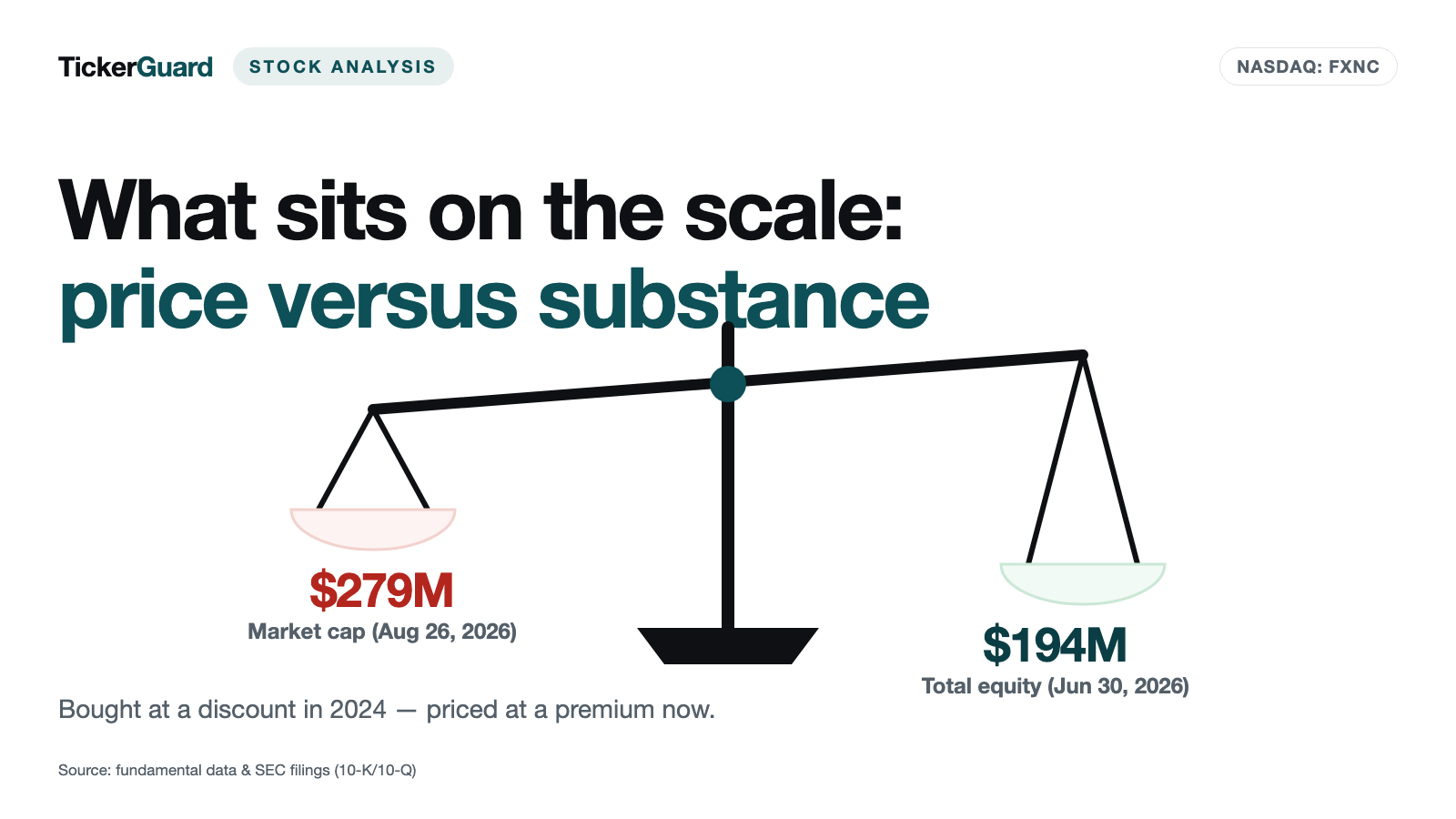
As a dated anchor: on August 26, 2026, FXNC shares closed at $30.89. With the 9,042,629 shares outstanding shown on the cover of the quarterly report (as of August 7, 2026), that puts the market capitalization at roughly $279 million — against balance-sheet equity of $193.6 million (June 30, 2026). That is the scale this stock sits on: the market pays roughly $86 million more for the bank than its books carry in substance. Against 2025 earnings ($1.97 per share, basic), the price works out to a price-to-earnings ratio of around 15.7 — a moderate figure for a community bank, not an inflated one. Against book value per share of $21.41 (equity of $193.6 million divided by 9,042,629 shares), the stock trades at roughly 1.45 times; against tangible book value per share of $19.71 — stripping out goodwill and other intangibles — it trades at roughly 1.6 times. The dividend yield is roughly 2.2 percent, based on the quarterly dividend of $0.17 most recently reaffirmed on August 12, 2026.
Is that expensive? The honest answer: no longer cheap, but no moonshot either. For a bank with a return on equity of around 12 percent, 1.5 to 1.6 times tangible book value counts as a fair, but no longer bargain, valuation — the market has already priced in the improved earnings power after the integration. The price is also sitting close to its 52-week high (a range of roughly $21 to $33, as of August 26, 2026), which means part of the recovery story has already played out. Whether 1.6 times tangible book is an acceptable entry price for you depends on how much confidence you place in organic growth continuing from the second quarter of 2026 onward — a pricing question the scanners answer, not this analysis.
Opportunities and risks at a glance
What speaks for First National:
- A net interest margin of 4.15 percent in the second quarter of 2026, up from 3.95 percent a year earlier — while the purchase-accounting accretion effect shrank over the same period from 19 to just 5 basis points, meaning the gain is increasingly organic.
- Solid credit quality: non-performing assets (NPAs) at just 0.23 percent of total assets (June 30, 2026), covered at 315 percent by the loan-loss reserve (a good three times over) — a marked improvement from a year earlier (223 percent).
- An inexpensive deposit base: 28 percent of deposits are non-interest-bearing, and the average cost of funds fell to 1.21 percent — a bank that gathers money cheaply can more easily defend its margin when rates fall.
- Solid capital: a common equity tier 1 (CET1) ratio of 12.60 percent as of June 30, 2026, well above regulatory requirements — the bank's "airbag" is well stocked.
- Organic loan growth is back: up $14.7 million in the first quarter of 2026 (4.0 percent annualized) and accelerating to $22.7 million in the second — the second straight quarter of growth.
What speaks against it:
- Growth so far has come mostly from acquisitions: share count up 85 percent since 2020, while loans and deposits actually shrank slightly in 2025 — organic growth is documented for only two quarters so far.
- A purchased physician-loan portfolio of $11.9 million (June 30, 2026) carries a 40 percent premium and has lost its former buyback protection; $1.8 million of it is already classified as non-accrual.
- $23.0 million of unrealized losses in the securities portfolio (June 30, 2026) against $193.6 million of equity — only real on a forced sale, but a tangible drag on the balance sheet.
- The efficiency ratio — expense per dollar of revenue, where lower is better — deteriorated to 68.18% in 2025 from 66.73% in 2024: the earnings record was not bought with more cost discipline.
- On January 30, 2027, the last remaining subordinated note ($9.5 million) resets from a fixed 4.00 percent to a substantially higher floating rate.
- Valuation has already priced in the recovery: the price sits near its 52-week high, at roughly 1.6 times tangible book — no longer a bargain for a bank earning roughly a 12 percent return on equity.
A human conclusion
Back to the glamour bias from the opening. First National is not a stock people argue about on Reddit, and it probably never will be — a 119-year-old bank from a town of 6,500 has no rocket-ship narrative. But it has something else: a net interest margin above 4 percent, a capital cushion well above minimum requirements, and a management team that has kept its word, in public, for four straight quarters. Still, the pattern behind the record numbers is not a simple one: a meaningful share of it comes from an acquisition bought at a discount, from one-time items, and from a purchase-accounting effect that is now nearly used up. Whether what remains after that — a bank with organic loan growth of 6.3 percent annualized in the most recent quarter — justifies the current price of roughly 1.6 times tangible book value is not a question an analysis can answer for you. What you make of it is your decision. And that is exactly as it should be.
Sources
All original documents used in this analysis — to read for yourself:
- First National Corporation — SEC annual report 10-K for 2025 (filed March 25, 2026)
- First National Corporation — SEC quarterly report 10-Q as of June 30, 2026 (filed August 13, 2026)
- First National Corporation — SEC quarterly report 10-Q as of March 31, 2026 (filed May 13, 2026)
- First National Corporation — Second-quarter 2026 earnings release, SEC Exhibit 99.1 to Form 8-K dated July 29, 2026
- First National Corporation — First-quarter 2026 earnings release, SEC Exhibit 99.1 to Form 8-K dated April 30, 2026
- First National Corporation — Fiscal-year 2025 earnings release, SEC Exhibit 99.1 to Form 8-K dated January 29, 2026
- First National Corporation — Branch-optimization notice, SEC Exhibit 99.1 to Form 8-K dated February 12, 2026
- First National Corporation — Board-change notice, SEC Exhibit 99.1 to Form 8-K dated May 14, 2026
- First National Corporation — 8-K filing on the dividend dated August 13, 2026
- Full SEC filing history of First National Corporation (CIK 0000719402): EDGAR overview (sec.gov)
- Fundamental data (metrics, price anchor, valuation; data as of August 26–28, 2026), reconciled with the SEC filings.
Transparency & disclaimer: This analysis is a journalistic contextualization of publicly available information and is not investment advice, not a financial analysis in the regulatory sense, and not a solicitation to buy or sell securities. Stock investments carry substantial risks up to total loss. All information without warranty; the data cut-off is noted in the text. The author holds no position in First National Corporation shares at the time of publication.
Key figures at a glance
All monetary figures in millions of $; earnings per share as reported.
| Metric | 2021 | 2022 | 2023 | 2024 | 2025 |
|---|---|---|---|---|---|
| Revenue | 46.2 | 60.7 | 67.9 | 88.3 | 112.2 |
| Operating Income (EBIT) | 12.9 | 20.7 | 11.8 | 8.0 | 21.9 |
| Net Income | 10.4 | 16.8 | 9.6 | 7.0 | 17.7 |
| Net Margin | 22.4% | 27.7% | 14.2% | 7.9% | 15.8% |
| Earnings Per Share | 1.86 $ | 2.68 $ | 1.53 $ | 1.00 $ | 1.96 $ |
Source: fundamental data & SEC filings (annual and quarterly reports, 10-K/10-Q)
Our Bottom Line at a Glance
- Earnings power after the integration positive
- Return on assets (ROA) of 1.11 percent and return on equity (ROE) of 12.03 percent in the second quarter of 2026, both above the prior quarter. The net interest margin rose to 4.15 percent while the purchase-accounting accretion from the Touchstone acquisition shrank over the same period from 19 to just 5 basis points — the gain is increasingly earned in the ongoing banking business.
- Credit quality positive
- Non-performing assets (NPAs) stood at just 0.23 percent of total assets as of June 30, 2026, covered at 315 percent by the loan-loss reserve (a good three times over) — a marked improvement from a year earlier (223 percent). No foreclosed real estate on the books, no loans past due 90 days and still accruing interest.
- Deposit base and funding cost positive
- 28 percent of deposits are non-interest-bearing ($520.5 million, June 30, 2026), and the average cost of funds fell from 1.44 percent (Q2 2025) to 1.21 percent (Q2 2026) — a cheap, broadly diversified deposit base without a notable concentration in pricier time deposits.
- Cost efficiency (efficiency ratio) negative
- The efficiency ratio — how many cents of expense the bank needs per dollar of revenue, where lower is better — deteriorated to 68.18% in 2025 from 66.73% in 2024. In the record year, of all years, the bank got more expensive to run rather than leaner — and that on a metric that already strips out merger costs. The branch optimization announced for late 2026 (33 down to 28 locations) is aimed squarely at this.
- Capital cushion and unrealized losses in the bond book neutral
- A solid common equity tier 1 (CET1) ratio of 12.60 percent (June 30, 2026), well above regulatory requirements. Against that stand $23.0 million of unrealized losses in the securities portfolio ($15.8 million AFS, $7.2 million HTM) against $193.6 million of equity — rate-driven, not a credit concern, but a tangible drag.
- Source of growth negative
- The share count has risen 85 percent since 2020, driven mainly by two acquisitions (Fincastle in 2021, Touchstone in 2024). In 2025 itself, loans (−$15.2 million) and deposits (−$4.2 million) actually shrank versus 2024 — organic growth is documented only since the first quarter of 2026 (+$14.7 million in loans, accelerating to +$22.7 million in the second).
- Legacy physician-loan portfolio negative
- A purchased physician-loan portfolio of $11.9 million (June 30, 2026) carries a 40 percent premium over face value, and the quarterly report says the seller's former buyback protection has disappeared without replacement. $1.8 million of it is already classified as non-accrual.
First National is a 119-year-old community bank out of Strasburg, Virginia, that delivered a net interest margin of 4.15 percent, a return on equity of 12.03 percent and solid credit quality by mid-2026. A meaningful share of the record numbers, however, comes from the acquisition of Touchstone Bankshares (closed October 1, 2024) and its one-time effects — organic growth in loans and deposits is documented for only two quarters so far. On top of that sit a purchased physician-loan portfolio with no safety net and a rate reset on the last remaining subordinated note in January 2027. Not investment advice.
What Our Rating Means
Quality confirmed
Business model, numbers and balance sheet hold up to our review. Whether the current price supports an entry is a separate question — it hangs on the price, not on the company.
The business model has held up since 1907, capital is solid (CET1 12.60 percent), credit quality is good (NPAs 0.23 percent, coverage 315 percent), and earnings power has clearly improved since the Touchstone integration (ROA above 1 percent, ROE 12 percent in the second quarter of 2026). The 2023/2024 swings are explained by documented, one-time merger costs, with no material operating concern left open. That the efficiency ratio rose to 68.18% in 2025 (2024: 66.73%) is a genuine minus on the cost side — it clouds the quality of earnings, but does not call the business model into question. That the valuation, at roughly 1.6 times tangible book value near its 52-week high, is no longer cheap does not change that assessment — that is a question of price, which the scanners answer, not the quality rating. The decision is yours.
A journalistic assessment by our editorial team at the time of the deep dive, based on public sources — not investment advice and not a solicitation to buy or sell. Your personal circumstances (investment goals, risk capacity, taxes) cannot be taken into account. What our levels mean, how verdicts are formed, and what conflicts of interest exist →
Worth Noting
- This analysis started from an editorial review of small U.S. community banks after the recent rate cycle: First National stood out for a net interest margin above 4 percent, the discounted acquisition of Touchstone Bankshares, and a valuation near 1.6 times tangible book value (data as of August 26, 2026).
- All balance-sheet and earnings figures are as of June 30, 2026 (10-Q) or December 31, 2025 (10-K); price, market capitalization and valuation metrics are dated August 26, 2026 and move with the market daily.
- Not to be confused with other banks that also use "First National" in their name — this analysis covers exclusively First National Corporation, Nasdaq ticker FXNC, CIK 0000719402, headquartered in Strasburg, Virginia.
Stock Watch
This analysis is as of August 28, 2026. Stock Watch will tell you what's changed at FXNC since then.
Later $1 a month per stock — signing up is free, and you'll be the first to know when it launches.
The full analysis as a PDF for later
We will send you this analysis as a PDF — to print, file away, and read at your own pace. And we will add you to the free Stock Watch list for First National Corp (FXNC), so you hear about it when something material in this analysis changes.
Frequently Asked Questions
First National Corporation (Nasdaq: FXNC) is the holding company of First Bank, a community bank founded in 1907 in Strasburg, Virginia. As of June 30, 2026 it operated 33 branches across the Shenandoah Valley, the Roanoke Valley, the greater Richmond area, south-central Virginia and northern North Carolina, plus a wealth-management arm, First Bank Wealth Management; the company expects that count to fall to 28 by year-end 2026. As of June 30, 2026, the bank reported $2.076 billion in total assets and 308 full-time employees (as of December 31, 2025).
That is your decision — this analysis makes no buy recommendation. The facts as of August 26, 2026: a price-to-earnings ratio of around 15.7 on 2025 earnings, a price of roughly 1.6 times tangible book value ($19.71 per share), and a dividend yield of roughly 2.2 percent. The bank is qualitatively solid, but a meaningful share of its growth has come from acquisitions rather than the ongoing business.
The common equity tier 1 (CET1) ratio stood at 12.60 percent as of June 30, 2026 — well above the regulatory minimum of 7.0 percent including capital buffers. Non-performing loans made up just 0.23 percent of total assets, and the loan-loss reserve covered them at 315 percent (a good three times over) — clearly better than a year earlier (223 percent). A drag on the picture: $23.0 million of unrealized losses in the securities portfolio — real only on a forced sale.
First National acquired Touchstone Bankshares of Prince George, Virginia, closing October 1, 2024 — an all-stock deal (0.55 FXNC shares per Touchstone share, 2.7 million new shares issued, $46.8 million in aggregate consideration). Because the purchase price was below the fair value of the net assets acquired, First National booked a tax-free bargain purchase gain of $3.2 million. Operational integration was completed in the first quarter of 2025.
Yes. First National pays a quarterly dividend of $0.17 per share, most recently reaffirmed on August 12, 2026, payable September 11, 2026. The dividend was raised by 9.7 percent in the fourth quarter of 2025. Based on the August 26, 2026 closing price ($30.89), that equals a dividend yield of roughly 2.2 percent.
Three documented points: first, a purchased physician-loan portfolio ($11.9 million, June 30, 2026) carries a 40 percent premium and lost its former buyback protection. Second, balance-sheet growth so far has come mostly from acquisitions — loans and deposits actually shrank slightly in 2025. Third, the last remaining subordinated note ($9.5 million) resets on January 30, 2027, from a fixed 4.00 percent to a substantially higher floating rate.
Found an error?
Did you spot a factual error, an outdated number, or a typo in this deep dive? Let us know briefly — your report goes straight to the editorial team.