Global Payments: Revenue Up 69 Percent — Only 4 Points of That Came From the Business Itself
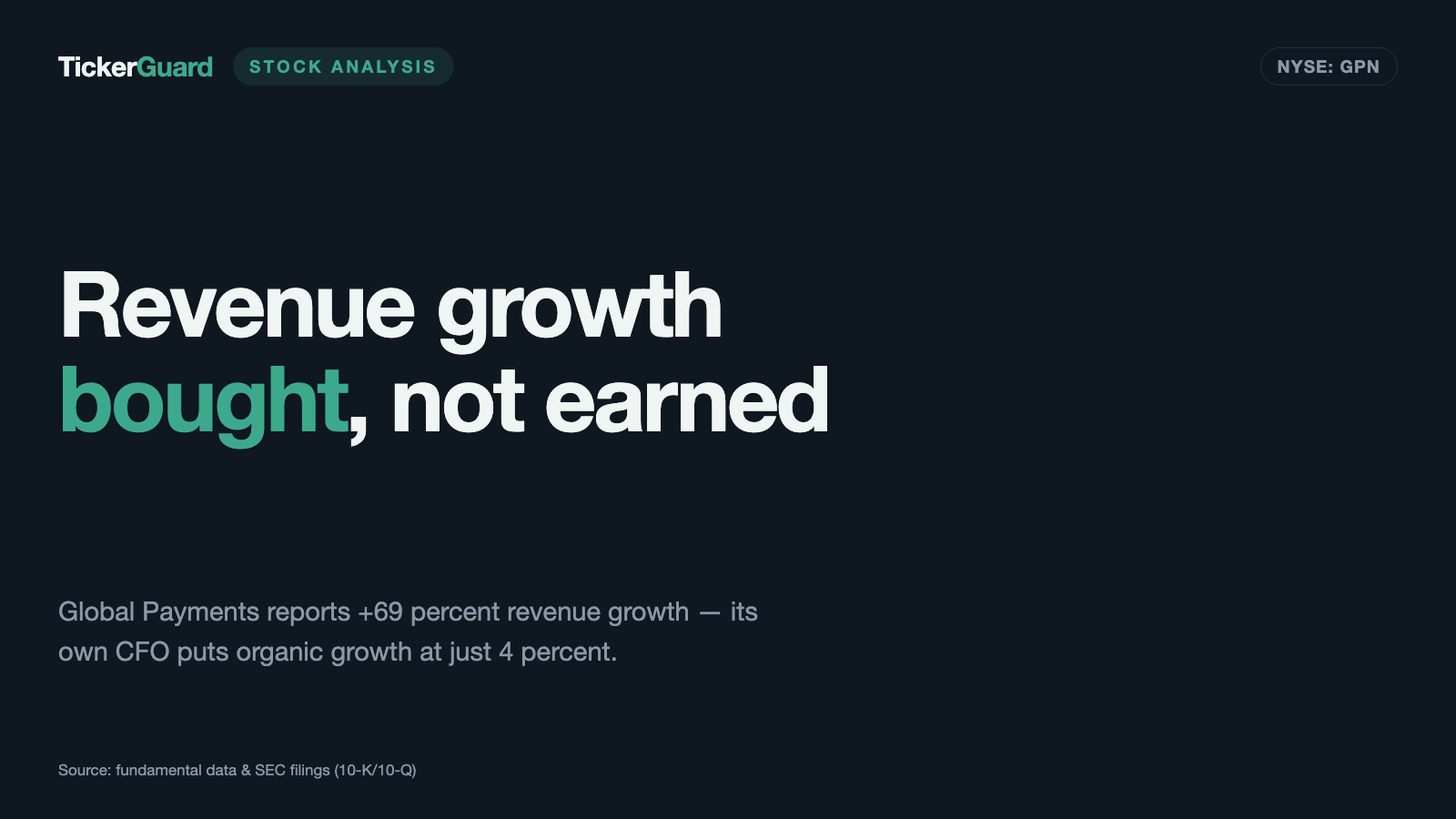
Global Payments ranks second on the in-house "Revenue Inflection" stock scanner — revenue jumped 68.6 percent in the second quarter of 2026. On January 9, 2026, the Atlanta-based payments processor had sold its Issuer Solutions business to FIS and, in the same move, acquired the larger rival Worldpay for an enterprise valuation of $24.25 billion. The revenue jump comes almost entirely from that consolidation — the company's own finance chief puts normalized organic growth at only about 4 percent. Reported profit collapsed at the same time, and a negative debt-to-equity ratio on the scanner causes confusion that dissolves once you read the balance sheet. Not investment advice — just two figures from the same report: $3.3 billion in revenue, $13 million in profit.
 Thomas Mücke
Founder & Publisher
Thomas Mücke
Founder & Publisher
As of Today
As of: October 7, 2026
- Closing price
- 81.10 $ -0.90%
- Market Capitalisation
- 22.2 $B
- P/E
- 29.9
- Growth Score
- 4/10
- AAQS
- 8/10
Price change since August 21, 2026: -13.3%
This analysis has a cut-off date. The Stock Guard tells you when something material changes in the numbers. Reserve your free spot
Chart
Interactive price chart (TradingView).
52-week range: 62.50 $ to 94.80 $ · Last price: 81.10 $ (As of: October 7, 2026)
Note: pure fact-based analysis, not investment advice and not a solicitation to buy or sell. All figures without guarantee.
There is an investor trap that springs shut exactly when a number looks most impressive — call it the afterburner illusion. It works like this: a jet suddenly accelerates hard, and your first thought is that the engine itself must have gotten stronger. What actually happened is that it lit an afterburner bolted on from outside — it burns bright, drinks fuel fast, and eventually the tank runs dry. Global Payments Inc. (NYSE: GPN), a payments processor based in Atlanta, ranks second on our in-house "Revenue Inflection" stock scanner (as of August 24, 2026, out of 28 hits) — and the scanner's own name gets the number right: revenue jumped 68.6 percent in the second quarter of 2026. What it does not tell you is where that thrust came from. So let's make a deal: before you mistake "acceleration" for "growth from the business itself," let's read together what Global Payments told the U.S. securities regulator, the SEC — the quarterly report (10-Q) for the period ended June 30, 2026, the filing (8-K) on the completed Worldpay acquisition, and what CEO Cameron Bready and CFO Josh Whipple said on the August 5, 2026 earnings call. The decision is yours at the end.
What Global Payments actually does
Global Payments is a payments processor — think of it as the invisible pipe between the card reader at a store (or the "pay now" button on a website) and the bank that ultimately records the money. For that service, the company keeps a small cut of every transaction. Until recently, the business had two very different halves: the merchant side (accepting payments for stores, restaurants and software platforms) and the Issuer Solutions side (behind-the-scenes technology for banks that issue their own credit cards). Global Payments sold that second half on January 9, 2026 — in the very same move in which it acquired the much larger payments processor Worldpay, previously majority-owned by private equity firm GTCR and financial technology company FIS. CFO Josh Whipple now calls the newly reshaped company a "pure-play commerce solutions provider" — a payments processor without a side business. Since the deal closed, the company reports in three segments: SMB (small and midsize merchants), Enterprise (large customers) and Platforms (software partners that embed payments into their own products).
What makes this deal unusual is its structure: not a simple acquisition, but a three-way transaction. Global Payments describes the closing this way in its SEC filing:
"On January 9, 2026, Global Payments Inc. ... completed its previously announced acquisition of Worldpay Holdco, LLC ... from Fidelity National Information Services, Inc. ... and certain affiliates of GTCR LLC ... and divestiture of Global Payments' Issuer Solutions business ... to FIS."
— Global Payments Inc., Form 8-K filed January 12, 2026, Introductory Note
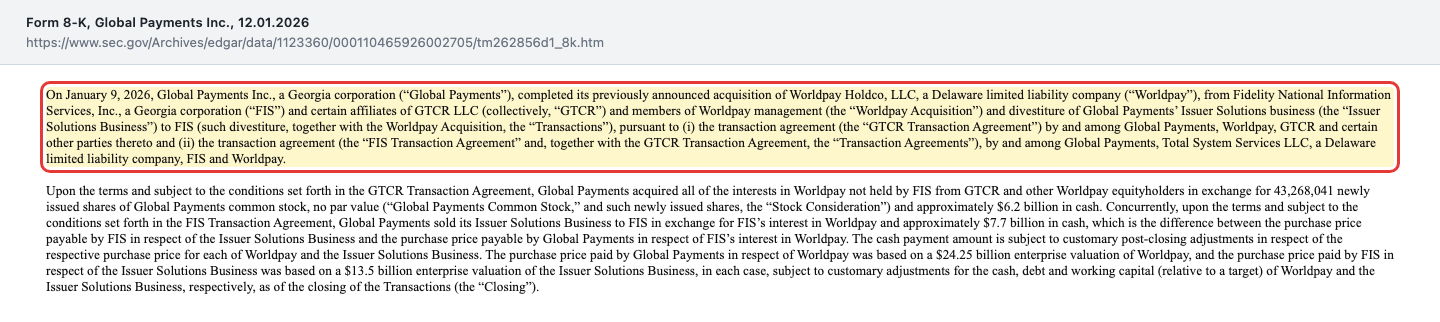
The scale of it: Global Payments paid for Worldpay with 43,268,041 newly issued shares of its own stock plus roughly $6.0 billion in cash, based on a Worldpay enterprise valuation of $24.25 billion. In exchange, it sold its own Issuer Solutions business to FIS for an enterprise valuation of $13.5 billion, netted against FIS's stake in Worldpay plus a cash difference of roughly $7.5 billion in Global Payments' favor. Both cash figures are the numbers in the Form 10-Q for the period ended June 30, 2026; the closing announcement on Form 8-K dated January 12, 2026 still put them at roughly $6.2 billion and $7.7 billion before the customary purchase-price adjustments. The whole swap had been announced back on April 17, 2025 — the date of the transaction agreements, made public in the SEC Form 8-K filed on April 21, 2025 — meaning it took just under nine months to actually close. One side effect of the stock consideration: private equity firm GTCR LLC, previously a Worldpay owner, now holds roughly 15.8 percent of all Global Payments shares (as of March 31, 2026) — more than any other single shareholder. Who GTCR is, and what the new major shareholder means, is covered in the FAQ at the end of this analysis.
Company history for investors
-
2001
NYSE listing
Global Payments has traded independently on the NYSE since January 2001, laying the groundwork for today's repeatedly reshaped payments processor.
-
2019
Merger with Total System Services (TSYS)
In September 2019, Global Payments merged with TSYS, assuming $3.0 billion of bond debt in the process — for shareholders, the largest deal before Worldpay.
-
2025
Worldpay deal announced
On 04/17/2025, Global Payments signs the transaction agreements and announces the swap (SEC Form 8-K filed 04/21/2025): selling Issuer Solutions to FIS, buying Worldpay for a $24.25B enterprise valuation. For shareholders, the start of a just-under-nine-month overhaul.
-
2026
Deal closes, shareholder base shifts
Both transactions close simultaneously on 01/09/2026. GTCR and other Worldpay equityholders receive 43,268,041 new shares; GTCR becomes the largest single shareholder at roughly 15.8% — a new, potentially selling, large holder.
-
2026
First guidance cut after two quarters
On 08/05/2026, management cuts the full-year outlook to 4–5% organic growth because of the Middle East conflict. For shareholders, the first reality check on the new corporate structure.
How the stock landed on our desk
Global Payments made our research list through our in-house "Revenue Inflection" stock scanner (as of August 24, 2026, rank 2 of 28 hits). The rule behind it, in plain terms: the scanner looks for companies whose revenue grew 30 to 70 percent year over year in at least two of the most recent quarters — after growing less than 15 percent in each of the four quarters before that. On top of that, trailing four-quarter revenue must be at least $100 million, and no more than two accelerating quarters may show up yet, so the scanner only catches the early stage of an inflection. The related backtest study found that fresh inflections like this returned 16.6 percent a year historically, against 9.9 percent for already-established growth companies.
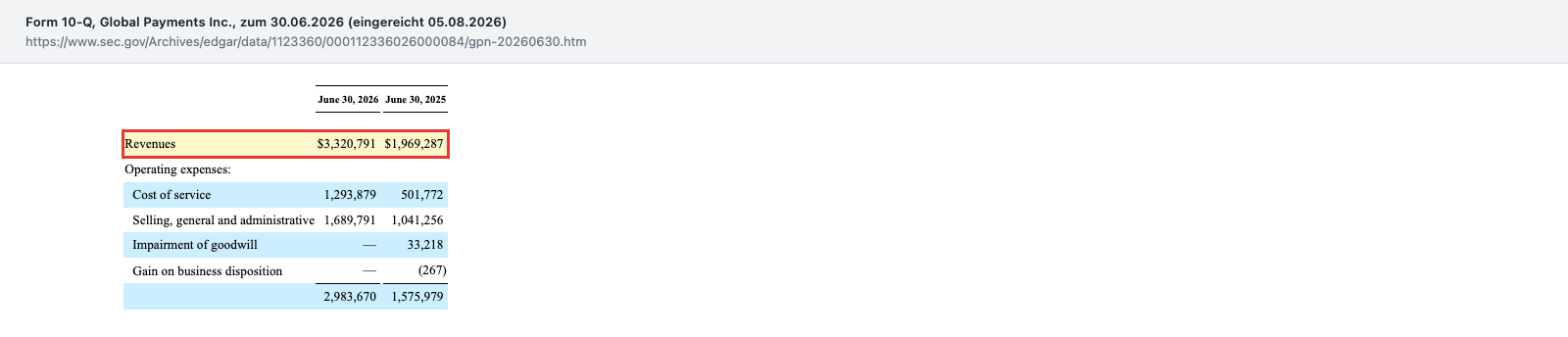
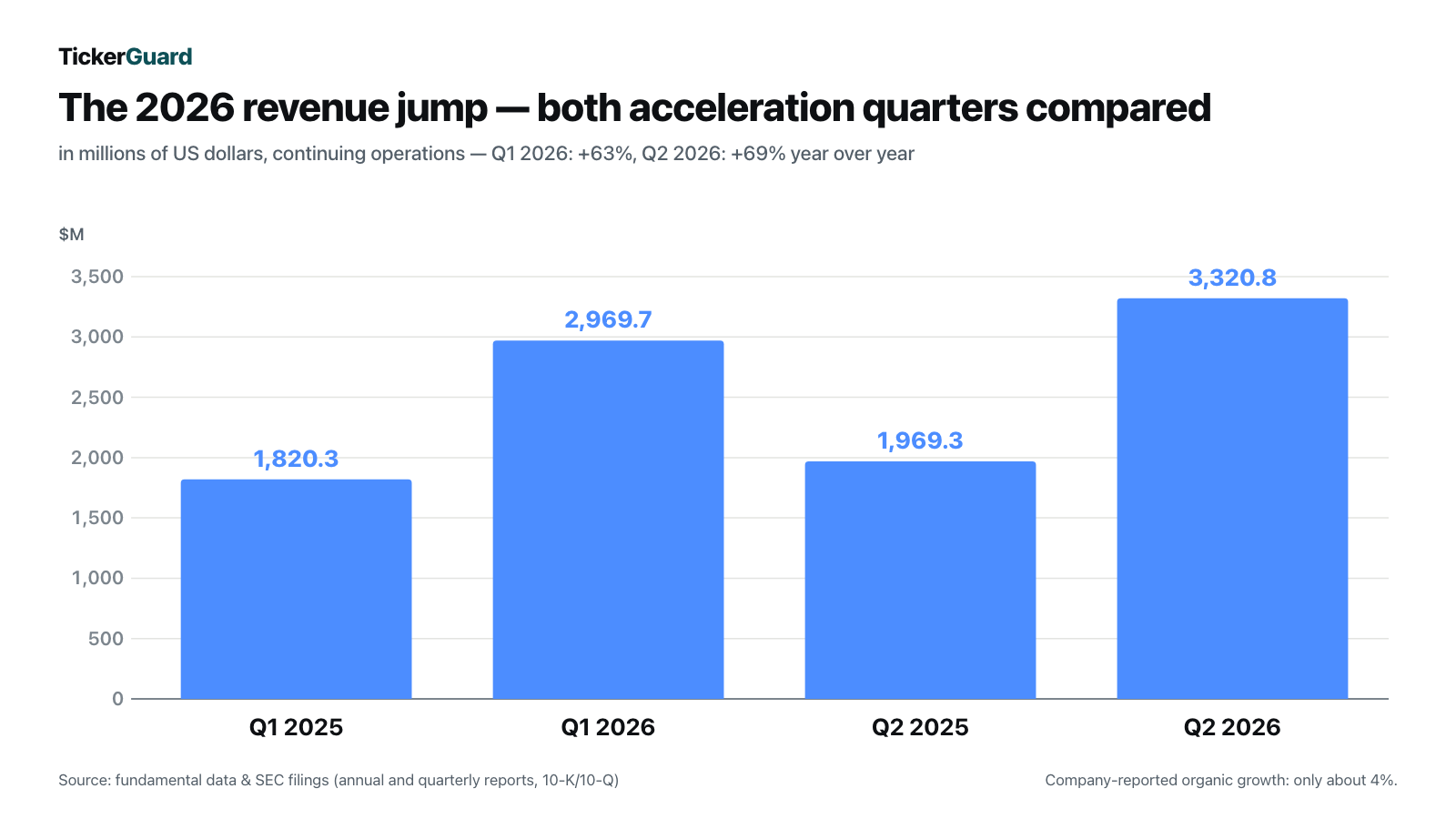
At Global Payments, the two flagged acceleration quarters can be named precisely: the first and second quarters of 2026. The 10-Q for the period ended June 30, 2026 reports continuing operations — with the former Issuer Solutions business retroactively stripped out as "discontinued operations" for every comparison period — as follows: revenue rose to $3,320.8 million in the second quarter of 2026, up from $1,969.3 million in the second quarter of 2025, a gain of 68.6 percent. In the first quarter of 2026 it was $2,969.7 million versus $1,820.3 million a year earlier, up 63.1 percent. Both figures sit squarely in the 30-to-70-percent band the scanner requires — and both quarters are the first two quarters after the Worldpay deal closed on January 9, 2026. Before the acquisition, revenue from continuing operations barely grew: 2025 came in at $7,705.9 million, actually slightly below the 2024 figure of $7,736.0 million (down 0.4 percent), and 2024 was up only 4.8 percent versus 2023 — both clearly under the 15-percent threshold the scanner requires for the "quiet" quarters before an inflection.
Is that acceleration organic? The most honest answer comes from the company itself — and it is, mostly, no. In the quarterly press release, CFO Josh Whipple gave his own growth figure, adjusted for the effects of the acquisition and the divestiture:
"We now expect normalized, constant currency adjusted net revenue growth of approximately 4% – 5% and adjusted earnings per share of $13.60 – $13.80 for the full year."
— Josh Whipple, Chief Financial Officer, Global Payments Inc., SEC Form 8-K filed 08/05/2026, Exhibit 99.1 (second-quarter 2026 earnings release)
"Normalized" means: calculated as if Global Payments had owned Worldpay for the entire prior year and had never had the now-divested Issuer Solutions business — an apples-to-apples comparison that strips out the consolidation effect. And that comparison does not show 69 percent. It shows about 4 percent. The gap between those two numbers — 69 percent on the accounting, 4 percent on the actual business — is the core of this analysis, and it runs through every chapter that follows: a scanner named "Revenue Inflection" got the number right. It gets the message completely wrong — the acceleration is not coming from the company's own engine. It is coming from a bolted-on afterburner.
The numbers over the years — an honest look
Before we get to the uncomfortable truths, Global Payments deserves a fair look at what actually works. The company, with roughly 26,000 employees as of December 31, 2025 — that is, before the Worldpay acquisition and the Issuer Solutions divestiture — is one of the world's largest payments processors, has traded on the NYSE since January 2001, and grew substantially again through its September 2019 merger with Total System Services (TSYS). Before the Worldpay acquisition, the core business — stripped of the now-divested Issuer Solutions unit — was a stable, if not spectacularly growing, cash generator:
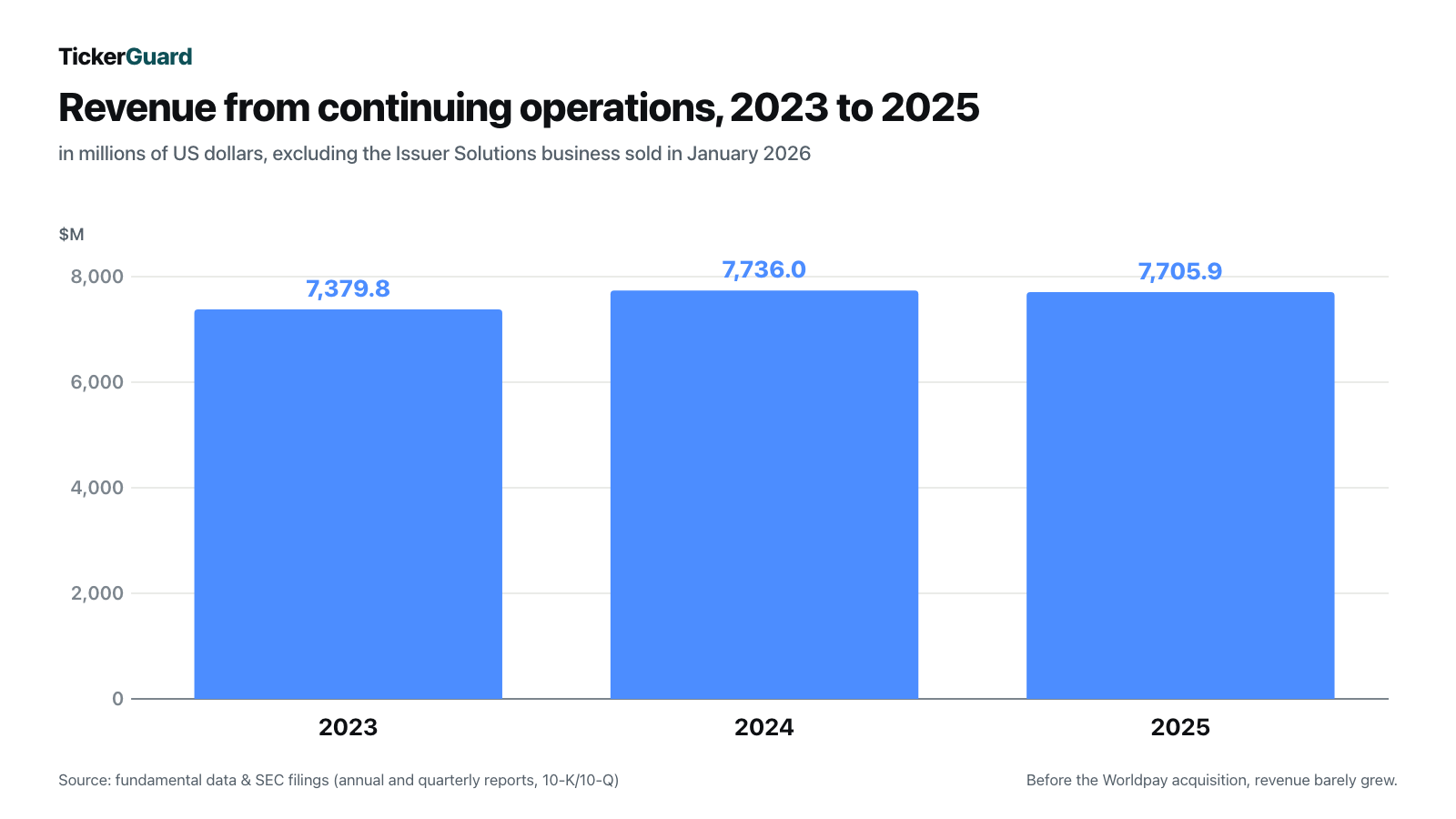
That quiet growth profile is exactly why the 2026 jump qualifies as an "inflection" on the scanner in the first place — the four quarters before it really were quiet. The second chart shows the jump itself, both flagged quarters side by side:
The core business itself also delivered solid, if unspectacular, results in 2025: net income from continuing operations of $1,072.7 million (2024: $1,285.2 million; 2023: $620.0 million) on an operating margin of 22.8 percent (operating income of $1,754.6 million on revenue of $7,705.9 million). Counting the now-divested Issuer Solutions business as well, the group reported $1,400.1 million (2024: $1,570.4 million; 2023: $986.2 million) — the difference is precisely the result of discontinued operations ($327.4 million / $285.2 million / $366.2 million). That is the baseline against which to measure the 2026 overhaul — not a turnaround story, but a profitable, established company reshaping itself through a major transaction.
What the filings show — the uncomfortable truths
Uncomfortable truth No. 1: profit collapsed in the very quarter revenue exploded
Anyone looking only at revenue misses the next line of the income statement. In the second quarter of 2026, Global Payments earned just $0.05 in diluted earnings per share — down from $0.99 a year earlier. Net income fell from $241.6 million to $13.0 million, even as revenue over the same period rose 68.6 percent.
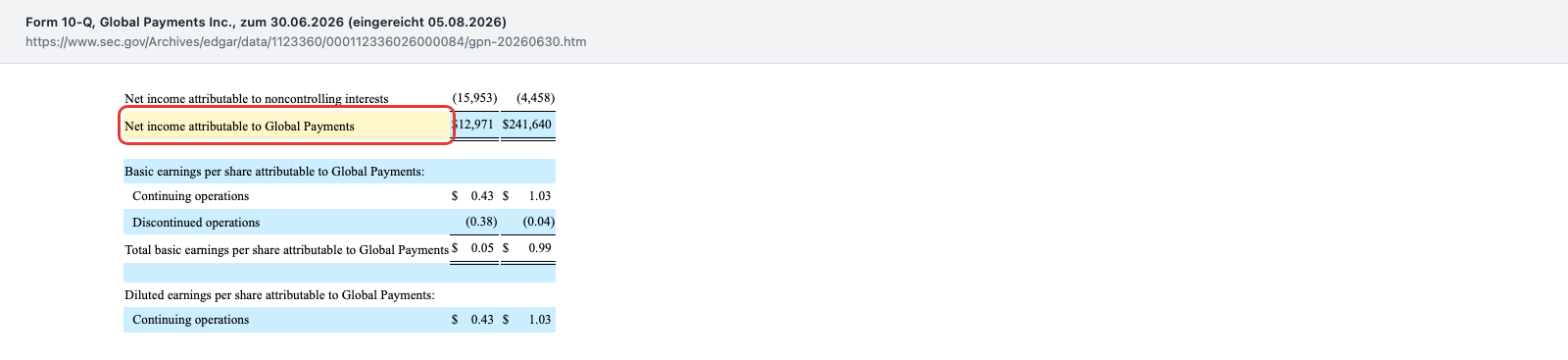
Two things are behind that, both tied to the transaction, neither pointing to an operating problem in the core business: first, financing the roughly $6.0 billion cash portion plus the debt assumed from Worldpay cost more — interest and other expense of $277.5 million versus $152.5 million in the second quarter alone. Second, the loss from discontinued operations (Issuer Solutions) weighed on earnings by $102.0 million. Those $102.0 million are only the small remainder, though: across the first half of 2026 the loss from discontinued operations added up to $1,688.2 million — roughly $1,586 million of it already in the first quarter, when the sale of the Issuer Solutions business was booked. For the first half of 2026 as a whole, the books therefore show not a profit but a net loss of $1,786.9 million, or −$6.58 per share. Looking at the second quarter alone shows only the smaller part of the bill for this overhaul. Adjusted earnings per share — corrected by the company itself for exactly these one-time items — rose 12 percent to $3.46 instead. That is a sign the underlying operating business keeps running even though the official GAAP number obscures it — but an adjustment the company makes itself is a self-disclosure, not an independent audit. For the quarters ahead, the test is simple: only once the GAAP number moves back toward the adjusted figure is the transition genuinely complete.
Uncomfortable truth No. 2: the "negative equity" on the scanner does not actually exist — but the balance sheet changed radically
The scanner shows a debt-to-equity ratio of −7.17 for Global Payments — at first glance, an alarm signal you would normally only expect from a genuinely troubled company. Reading the 10-Q shows this is not a solvency problem, it is a definitional one. Book equity — the figure that actually appears on the balance sheet — stood at $23,110.7 million as of June 30, 2026, positive and even slightly higher than the $22,888.8 million reported at year-end 2025.
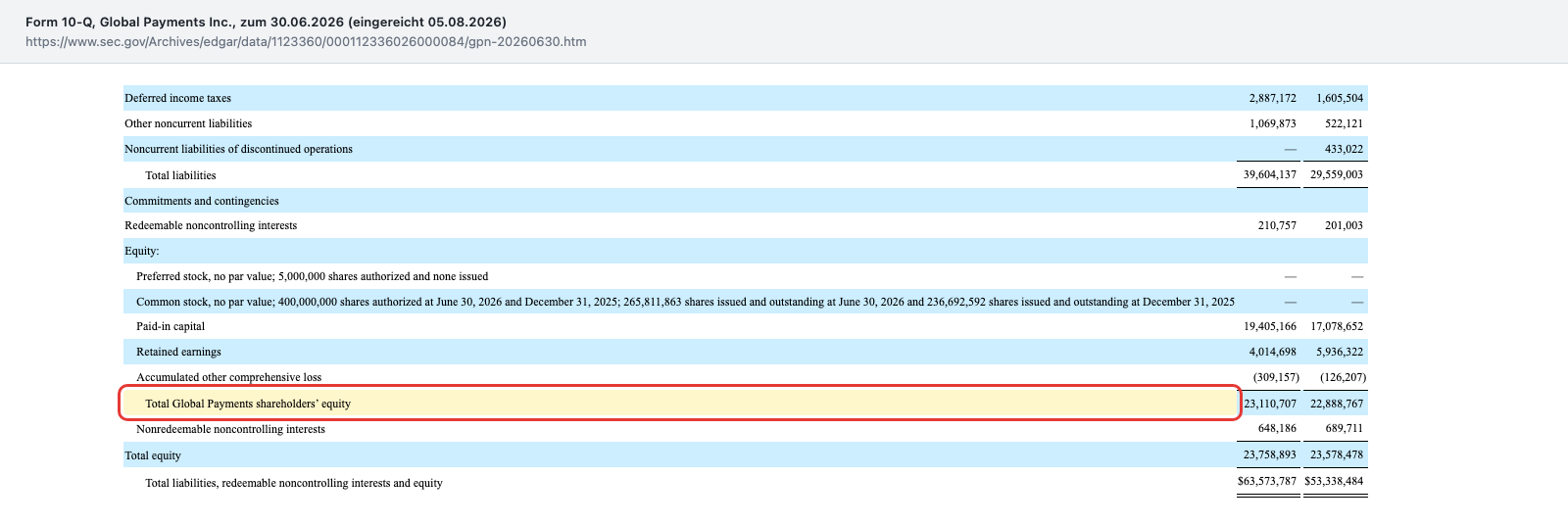
So where does the negative ratio on the scanner come from? It uses an adjusted, "tangible" equity figure — book equity minus goodwill and other intangible assets. And those two line items exploded because of the Worldpay deal: goodwill rose from $17,076.6 million to $26,984.8 million, other intangible assets from $4,231.2 million to $19,409.9 million — together $46.4 billion, or 73 percent of total assets, which grew to $63,573.8 million. Subtract those two items from equity and the result turns negative on paper — not because the company is short on real assets, but because a large part of the Worldpay purchase price was booked as a purchase-price premium rather than as tangible assets. That is the norm for large, debt-financed acquisitions, not something unique to Global Payments — but it explains why the "hard" metric is misleading while the actual balance sheet remains sound. On the liability side, long-term debt rose over the same period from $19,541.5 million to $21,493.3 million — noticeable, but not alarming against $63.6 billion in total assets, especially since the Altman Z-score (a bankruptcy-risk indicator) of 3.94 sits clearly in the zone considered safe, above 2.99 (fundamental data, as of August 21, 2026).
Uncomfortable truth No. 3: guidance was already cut after two quarters — for a reason outside the company's own business
On August 5, 2026, in the first full quarter under the new structure, management cut its 2026 outlook. CEO Cameron Bready named the reason directly:
"... capacity and forward bookings within our travel portfolio ... remain significantly below kind of pre-conflict levels. And the capacity that kind of has come back tends to be more short-haul, lower-yielding domestic sort of routes versus the higher-yielding long-haul routes that drive greater levels of revenue for us."
— Cameron Bready, Chief Executive Officer, Global Payments Inc., second-quarter 2026 earnings call, August 5, 2026 (transcript, Q&A session)
He means the Middle East conflict and its effect on the travel business, which makes up a meaningful share of volume for a payments processor with global card reach — CEO Bready put it at roughly a 100-basis-point headwind to normalized growth (the assumption after the first quarter had been 70), if anything a little more. What happened next is worth noting: instead of the acceleration originally expected in the back half of the year, management now expects only 4 to 5 percent normalized growth for the full year — a downward revision explicitly attributed to an external, geopolitical event, not to problems with the Worldpay integration itself. On the integration, Bready sounded confident: the company had completed its operating-model design and put its entire leadership structure in place, enabling "clearer accountability, greater agility and faster decision-making," and he expects growth to accelerate in 2027 "without a doubt." Whether that promise holds cannot be judged after just two quarters — but the first correction came quickly, and it pointed to an external, not a self-inflicted, cause. That is a mildly reassuring signal about how openly the company communicates, though it is not proof on the actual integration question.
Valuation: what the market pays for Global Payments today
For a company whose reported profit is currently distorted by one-time items, the classic price-to-earnings ratio is misleading. The "As of Today" box on this page shows a price-to-earnings ratio of 34.3 — that is the figure from the fundamental data (as of August 21, 2026). It cannot be reproduced from reported earnings: on the basis of reported twelve-month earnings no price-to-earnings ratio can be calculated at all, because the result is negative — the first half of 2026 alone shows a net loss of $1,786.9 million, or −$6.58 per share. The 34.3 is therefore a data field, not a valuation verdict. A more informative, though still cautiously read, figure is the roughly 6.8 multiple based on the company's own adjusted outlook — the $93.50 closing price of August 21, 2026 divided by the midpoint of the company's own $13.60 to $13.80 adjusted earnings-per-share guidance — a level that fits a company the market views skeptically on growth more than a genuine "inflection" story. The price-to-sales ratio of 2.5 and the enterprise-value-to-EBITDA ratio of 12.2 sit in between — moderate rather than expensive for a payments processor with a 67.4 percent gross margin (fundamental data, as of August 21, 2026; the filings themselves show 61.0 percent for the second quarter of 2026 and 72.6 percent for full-year 2025). One metric deserves particular caution: the PEG ratio (price-to-earnings ratio divided by the earnings growth rate) of just 0.24 looks extremely cheap — but it uses the acquisition-inflated earnings growth rate and is therefore not a reliable compass here.
We have seen this pattern before, where an acquisition distorts the classic metrics of an established industrial company: our ITT stock analysis covered a deal that pushed revenue up 52 percent while pushing earnings per share down 38 percent at the same time — a pattern that repeats at Global Payments on a larger scale.
The "view from the professionals" is mixed overall: 33 analysts cover the stock (fundamental data, as of August 21, 2026), of which 12 rate it "Strong Buy," 19 "Hold," and one each "Sell" and "Strong Sell" — no broad enthusiasm, but no rejection either. The average price target sits at $94.19 — about 0.7 percent above the closing price of $93.50 on August 21, 2026, essentially at the market price. Capital returns add a further argument for shareholders: $1.2 billion in dividends and buybacks had already gone back to shareholders in 2026 (as of August 5, 2026), more than half of the over-$2-billion plan for the full year; the company targets roughly $7.5 billion in total over 2025 through 2027. The quarterly dividend of $0.25 per share (yield of roughly 1.1 percent) is payable September 25, 2026 to shareholders of record as of September 11, 2026.
Strengths and risks at a glance
What speaks for Global Payments:
- An established, profitable payments processor with roughly 26,000 employees (as of December 31, 2025, before the Worldpay acquisition and the Issuer Solutions divestiture) and a 67.4 percent gross margin (fundamental data, as of August 21, 2026), reshaping itself through a major transaction into a focused "pure-play" provider instead of carrying a mismatched side business.
- Positive, even slightly growing book equity of $23.1 billion; an Altman Z-score of 3.94 in the zone considered safe — no solvency threat despite the misleading scanner ratio.
- Adjusted earnings per share still grew 12 percent to $3.46 despite the transition; generous, ongoing capital returns ($7.5 billion planned over 2025 through 2027, $1.2 billion already returned in 2026).
- Management communicates guidance cuts openly and with a concrete, externally grounded cause (the Middle East conflict and its effect on the travel portfolio), rather than obscuring them.
What speaks against it:
- The headline revenue jump (up 68.6 percent in the second quarter of 2026) is more than 90 percent a consolidation effect — the company itself puts organic growth at only 4 to 5 percent for the full year.
- GAAP net income collapsed 94.6 percent (Q2 2026: $13.0 million versus $241.6 million), driven by higher interest and other expense and the loss from discontinued operations (Issuer Solutions) — the integration has not yet been digested financially.
- Long-term debt rose to $21.5 billion, and over 70 percent of total assets now sit in goodwill and other intangible assets — a disappointing Worldpay integration would carry significant write-down risk.
- Since the deal closed, private equity firm GTCR has held roughly 15.8 percent of shares — a potential overhang risk on future sales, independent of how the business performs.
- Guidance was already cut after just two quarters; whether the growth acceleration management has promised for 2027 actually materializes remains unproven.
A human conclusion
Back to the afterburner illusion from the opening. Its point is not that the afterburner is useless — Global Payments genuinely acquired a much larger, complementary payments processor in Worldpay, while shedding a side business that no longer fit its strategy. Its point is that a scanner hit reading "revenue up 69 percent" spares you the work of checking how that number came to be. Read further and you find: a solid core business that barely grew before the acquisition; a revenue jump the company's own management puts at only about 4 percent organic; a profit collapse that reflects deal costs, not an operating problem; and a balance sheet that, despite a misleading scanner ratio, shows solidly positive equity. The honest question for you, then, is not "Is this company growing 69 percent?" but: do you trust a management team that openly calls its own afterburner an afterburner — and that admits, after just two quarters, when an external event cuts its altitude? The decision is yours.
Sources
All original documents used in this analysis — for you to read yourself:
- Global Payments Inc. — SEC Form 10-Q for the period ended June 30, 2026 (filed August 5, 2026)
- Global Payments Inc. — SEC Form 10-K for fiscal 2025 (filed February 20, 2026)
- Global Payments Inc. — SEC Form 8-K filed January 12, 2026 (closing of the Worldpay transactions)
- Global Payments Inc. — SEC Form 8-K filed August 5, 2026, Exhibit 99.1 (second-quarter 2026 earnings release)
- Complete SEC filing history for Global Payments Inc.: EDGAR filing index (sec.gov)
- Second-quarter 2026 earnings call, August 5, 2026, transcript (The Motley Fool)
- Fundamental data (valuation, price and analyst series, ownership structure; data as of August 21–24, 2026), cross-checked against the SEC filings.
- Hook: in-house "Revenue Inflection" stock scanner (as of August 24, 2026) and the related backtest study.
Transparency & disclaimer: This analysis is journalistic commentary on publicly available information. It is not investment advice, not a regulated financial analysis, and not a solicitation to buy or sell any security. Investing in stocks carries substantial risk, including total loss. All figures are provided without guarantee; the as-of date for each figure appears in the text. Positions held by the operator are disclosed daily; where one exists, it appears as a notice at the top of this deep dive.
Key figures at a glance
All monetary figures in millions of $; earnings per share as reported.
| Metric | 2021 | 2022 | 2023 | 2024 | 2025 |
|---|---|---|---|---|---|
| Revenue | 8,523.8 | 8,975.5 | 9,654.4 | 10,105.9 | 7,705.9 |
| Operating Income (EBIT) | 1,755.9 | 1,977.4 | 2,213.0 | 2,285.5 | 1,471.9 |
| Net Income | 965.5 | 111.5 | 986.2 | 1,570.4 | 1,400.1 |
| Net Margin | 11.3% | 1.2% | 10.2% | 15.5% | 18.2% |
| Earnings Per Share | 3.29 $ | 0.40 $ | 3.77 $ | 6.16 $ | 5.83 $ |
Source: fundamental data & SEC filings (annual and quarterly reports, 10-K/10-Q)
Our Bottom Line at a Glance
- Business model after the overhaul positive
- By selling Issuer Solutions to FIS and simultaneously acquiring Worldpay on 01/09/2026, Global Payments reshaped itself into a focused payments processor with three clear segments (SMB, Enterprise, Platforms) — CFO Whipple himself calls it a "pure-play commerce solutions provider."
- Quality of revenue growth negative
- The reported revenue jump of 68.6 percent (Q2 2026) is more than 90 percent a consolidation effect from the Worldpay acquisition. The company itself put organic, normalized growth at only 4 to 5 percent for the full year on 08/05/2026 — well below what the headline suggests.
- Earnings and profitability negative
- GAAP net income fell 94.6 percent in the second quarter of 2026 to $13.0 million, driven by higher interest and other expense ($277.5M versus $152.5M) and the loss from discontinued operations (Issuer Solutions). Adjusted EPS did grow 12 percent to $3.46 — but that adjustment is a self-disclosure by the company.
- Balance sheet & leverage neutral
- Book equity is a positive $23.1 billion and slightly growing, and an Altman Z-score of 3.94 signals no solvency threat. At the same time, over 70 percent of total assets now sit in goodwill and other intangible assets, and long-term debt rose to $21.5 billion — write-down risk if the integration disappoints.
- Capital returns positive
- $1.2 billion in capital already returned in 2026 (as of 08/05/2026), a plan for over $2 billion for the full year, and roughly $7.5 billion over 2025 through 2027; the $0.25 quarterly dividend — roughly $1.00 a year — is comfortably covered against guided adjusted earnings per share of $13.60 to $13.80.
- Ownership structure & communication neutral
- Private equity firm GTCR holds roughly 15.8 percent of shares (as of March 31, 2026; roughly 15.45 percent at closing) (an overhang risk on future sales). On the positive side, management cut guidance on 08/05/2026 openly and with a concrete, externally grounded cause (the Middle East conflict and its effect on the travel portfolio), rather than obscuring it.
Global Payments reshaped itself in a three-way deal on January 9, 2026: selling Issuer Solutions to FIS while buying the larger payments processor Worldpay for a $24.25 billion enterprise valuation. The resulting revenue jump of 68.6 percent (Q2 2026) is, by our own calculation, more than 90 percent a consolidation effect rather than organic growth — and GAAP profit fell 94.6 percent in the same quarter. Book equity remains solidly positive at $23.1 billion, even though a goodwill-adjusted scanner ratio suggests otherwise. The Worldpay integration is the central unproven factor for the quarters ahead. Not investment advice.
What Our Rating Means
Open questions
The business works in principle, but one material question is open. As long as it stays open, our findings do not carry a quality verdict.
Global Payments is not a turnaround story — the balance sheet is solid, with positive equity of $23.1 billion and an Altman Z-score of 3.94, the core business was consistently profitable before the acquisition, and management communicates setbacks openly. The open operating question is the Worldpay integration itself: our own calculation puts more than 90 percent of the headline revenue jump down to consolidation, organic growth sits at only 4 to 5 percent, GAAP profit has collapsed, and guidance was already cut after two quarters. Over 70 percent of total assets now sit in goodwill and intangible assets from the acquisition — whether that bet pays off will only become clear over the coming quarters, as it becomes visible whether the organic acceleration management has promised for 2027 actually shows up. Anyone waiting should check with each report: is GAAP profit moving back toward the adjusted figure? Does organic growth hold at 4 to 5 percent, or does it pick up? The decision is yours.
A journalistic assessment by our editorial team at the time of the deep dive, based on public sources — not investment advice and not a solicitation to buy or sell. Your personal circumstances (investment goals, risk capacity, taxes) cannot be taken into account. What our levels mean, how verdicts are formed, and what conflicts of interest exist →
Worth Noting
- Global Payments made our research list through the in-house "Revenue Inflection" stock scanner (rank 2 of 28 hits, as of August 24, 2026). The acceleration the scanner flags is real, but by our own calculation more than 90 percent of it is a consolidation effect from the Worldpay acquisition — not a contradiction between scanner and analysis, but the very point of this piece.
- The negative debt-to-equity ratio shown on the scanner (−7.17) is a metric artifact from a figure adjusted for goodwill and intangible assets — actual book equity is a positive $23.1 billion (see "Uncomfortable truth No. 2").
- Valuation figures are dated and evergreen: closing price of $93.50 on August 21, 2026; analyst and valuation data as of August 21–24, 2026. For context: the acquired Worldpay is the merchant business FIS obtained in 2019 through its purchase of Worldpay (formerly Vantiv) and carved out in 2024 as Worldpay Holdco, LLC, selling a 55 percent majority to GTCR; FIS kept 45 percent until both stakes passed to Global Payments in January 2026.
Stock Watch
This analysis is as of August 26, 2026. Stock Watch will tell you what's changed at GPN since then.
Later $1 a month per stock — signing up is free, and you'll be the first to know when it launches.
The full analysis as a PDF for later
We will send you this analysis as a PDF — to print, file away, and read at your own pace. And we will add you to the free Stock Watch list for Global Payments Inc (GPN), so you hear about it when something material in this analysis changes.
Frequently Asked Questions
Global Payments Inc. (NYSE: GPN), based in Atlanta, is a payments processor: it handles card transactions between merchants and banks and keeps a small cut of each one. After selling its Issuer Solutions business to FIS and simultaneously acquiring Worldpay on January 9, 2026, the company now reports in three segments: SMB (small and midsize merchants), Enterprise (large customers) and Platforms (software partners).
Because Global Payments acquired the larger payments processor Worldpay on January 9, 2026, and has been consolidating its revenue ever since. That pushed revenue up 68.6 percent to $3,320.8 million in the second quarter of 2026, and 63.1 percent to $2,969.7 million in the first quarter of 2026 — both are acquisition effects, not organic growth.
Mostly not. CFO Josh Whipple put the normalized growth rate, adjusted for acquisition and divestiture effects, at only about 4 percent in the second quarter of 2026 on August 5, 2026, and expects 4 to 5 percent for the full year — versus the 68.6 percent shown in the official GAAP number. The difference comes almost entirely from consolidating Worldpay.
Net income fell from $241.6 million to $13.0 million in the second quarter of 2026 (earnings per share from $0.99 to $0.05), because higher interest and other expense for financing the deal ($277.5 million versus $152.5 million) and a $102.0 million loss from discontinued operations (Issuer Solutions) weighed on earnings. Adjusted earnings per share, by contrast, rose 12 percent to $3.46.
No. Book equity attributable to Global Payments stood at a positive $23.1 billion as of June 30, 2026, slightly above the level at year-end 2025. The negative debt-to-equity ratio shown on the stock scanner uses a figure adjusted for goodwill ($27.0 billion) and other intangible assets ($19.4 billion), which turns negative because of the Worldpay acquisition — a purchase-price effect, not a solvency problem.
Global Payments sold its Issuer Solutions business (technology for banks that issue their own credit cards) to FIS on January 9, 2026, for an enterprise valuation of $13.5 billion — in the same move in which it acquired the payments processor Worldpay from FIS and GTCR. In the financial statements, the business is retroactively reported as "discontinued operations" for every comparison period.
GTCR LLC is a Chicago-based private equity firm that previously held a stake in Worldpay. As part of the purchase price, GTCR received a portion of the 43,268,041 newly issued Global Payments shares on January 9, 2026, giving it roughly 15.82 percent of all outstanding shares as of March 31, 2026 — more than any other single shareholder.
Found an error?
Did you spot a factual error, an outdated number, or a typo in this deep dive? Let us know briefly — your report goes straight to the editorial team.