ITT: One Deal Pushes Revenue Up 52 Percent — and Per-Share Profit Down 38 Percent
ITT Inc., a 106-year-old industrial company that makes pumps, brake pads and connectors, lands at rank 4 in our in-house "revenue accelerator" stock scanner — with revenue growth of 32.7 percent in the first and 51.5 percent in the second quarter of 2026, after four years in the quiet single-digit to low-double-digit range. The reason is not a sudden wave of new customers; it is a $4.3 billion acquisition completed on March 2, 2026: SPX FLOW. Organic growth was just 12.7 percent in the second quarter, while reported earnings per share fell 38 percent in the same period. Not investment advice — just the question of whether there is a real fire under the flash of straw.
 Thomas Mücke
Founder & Publisher
Thomas Mücke
Founder & Publisher
As of Today
As of: October 7, 2026
- Closing price
- 200.40 $ -3.30%
- Market Capitalisation
- 18.0 $B
- P/E
- 34.4
- Growth Score
- 4/10
- AAQS
- 9/10
Price change since August 21, 2026: -3.7%
This analysis has a cut-off date. The Stock Guard tells you when something material changes in the numbers. Reserve your free spot
Chart
Interactive price chart (TradingView).
52-week range: 169.50 $ to 221.70 $ · Last price: 200.40 $ (As of: October 7, 2026)
Note: pure fact-based analysis, not investment advice and not a solicitation to buy or sell. All figures without guarantee.
There is an investor trap that springs shut exactly when a scanner says "hit": the flash-in-the-pan trap. An in-house stock scanner flags a name because revenue is suddenly growing 30, 40, 50 percent — after years in the single-digit to low-double-digit range. Your gut says: a growth fire just caught, get in before everyone else notices. What your gut does not ask: is this real timber burning — or did someone just pour a can of accelerant on it that will burn out again in a few quarters? That is exactly the question at ITT Inc. (NYSE: ITT), a 106-year-old industrial company out of Stamford, Connecticut, that makes pumps, brake pads and connectors sitting inside practically every factory, train and aircraft without anyone knowing the name. ITT sits at rank 4 in our in-house "revenue accelerator" stock scanner (as of August 24, 2026) — with a revenue jump that looks spectacular at first glance. So let's make a deal: we read the primary filings with the U.S. securities regulator, the SEC, together before deciding whether this is a flash in the pan or a real fire.
What ITT actually does — pumps, brakes and connectors nobody sees
ITT Inc. is a diversified manufacturer of highly engineered components — in everyday terms, a company that does not build the finished car, aircraft or power plant, but the unglamorous, indispensable parts inside them. Three segments split the business. Motion Technologies (MT) makes brake pads (ITT Friction Technologies brand) for cars, trucks, buses and trains, plus shock absorbers and damping technology under the KONI brand — if you're riding a high-speed train or a sports car with KONI suspension, you may be sitting above an ITT part. Flow Technologies (FT) — renamed from "Industrial Process" (IP) in March 2026 — builds industrial pumps and valves under the Goulds Pumps brand, active since 1848, reinforced since January 2024 by the Danish cryogenic pump maker Svanehøj for LNG carriers and, since March 2026, by SPX FLOW (more on that shortly). Connect & Control Technologies (CCT) manufactures rugged connectors for aerospace, defense and industrial markets under the Cannon brand, strengthened since September 2024 by the cable and networking specialist kSARIA. For fiscal year 2025 the 10-K reported group revenue of $3.9 billion across roughly 125 countries, about 11,600 employees in 38 countries, and 65 percent of revenue generated outside the U.S.
Today's ITT Inc. is not the complete old "International Telephone & Telegraph." In 2011 the historical conglomerate split into three independent companies: Xylem (water technology), Exelis (defense electronics, now part of L3Harris) and the "new" ITT Corporation, renamed ITT Inc. in 2016 — the former-name history is on record in the SEC's own registration. What remained was the industrial core: pumps, brakes, connectors. That names the central tension of this analysis, and it runs through every chapter: ITT is showing the strongest revenue growth of its recent history — but the engine is a single, five-month-old acquisition, not a sudden demand surge in the legacy business.
Company history for investors
-
2011
Breakup of the old ITT Corporation
The conglomerate splits into Xylem, Exelis and the "new" ITT — today's shareholders own only the pumps-brakes-connectors core, not the former telecom or defense units.
-
2016
Renamed ITT Inc.
ITT Corporation becomes ITT Inc. — today's company name and structure have stood ever since.
-
2024
Svanehøj acquisition for $407.6 million
The first larger Flow bolt-on (pumps for LNG carriers) builds out today's Flow Technologies segment — long since absorbed into the numbers, with no role in the 2026 acceleration.
-
2024
kSARIA acquisition for $460.1 million
Cable and networking technology for aerospace and defense strengthens Connect & Control — also fully digested before the 2026 acceleration.
-
2025
SPX FLOW purchase agreement signed
A $4.775 billion headline price for the largest deal in company history — shareholders are now voting, in effect, on a much larger ITT.
-
2026
SPX FLOW acquisition closed
One month ahead of schedule, for a preliminary $4,311.3 million — from this day on, every quarter carries SPX FLOW revenue and costs.
-
2026
Guidance raised twice in a row
After both the first and second quarter of 2026, management raises revenue, margin and profit guidance and reports faster deleveraging than it promised.
Where the stock shows up in our scanner
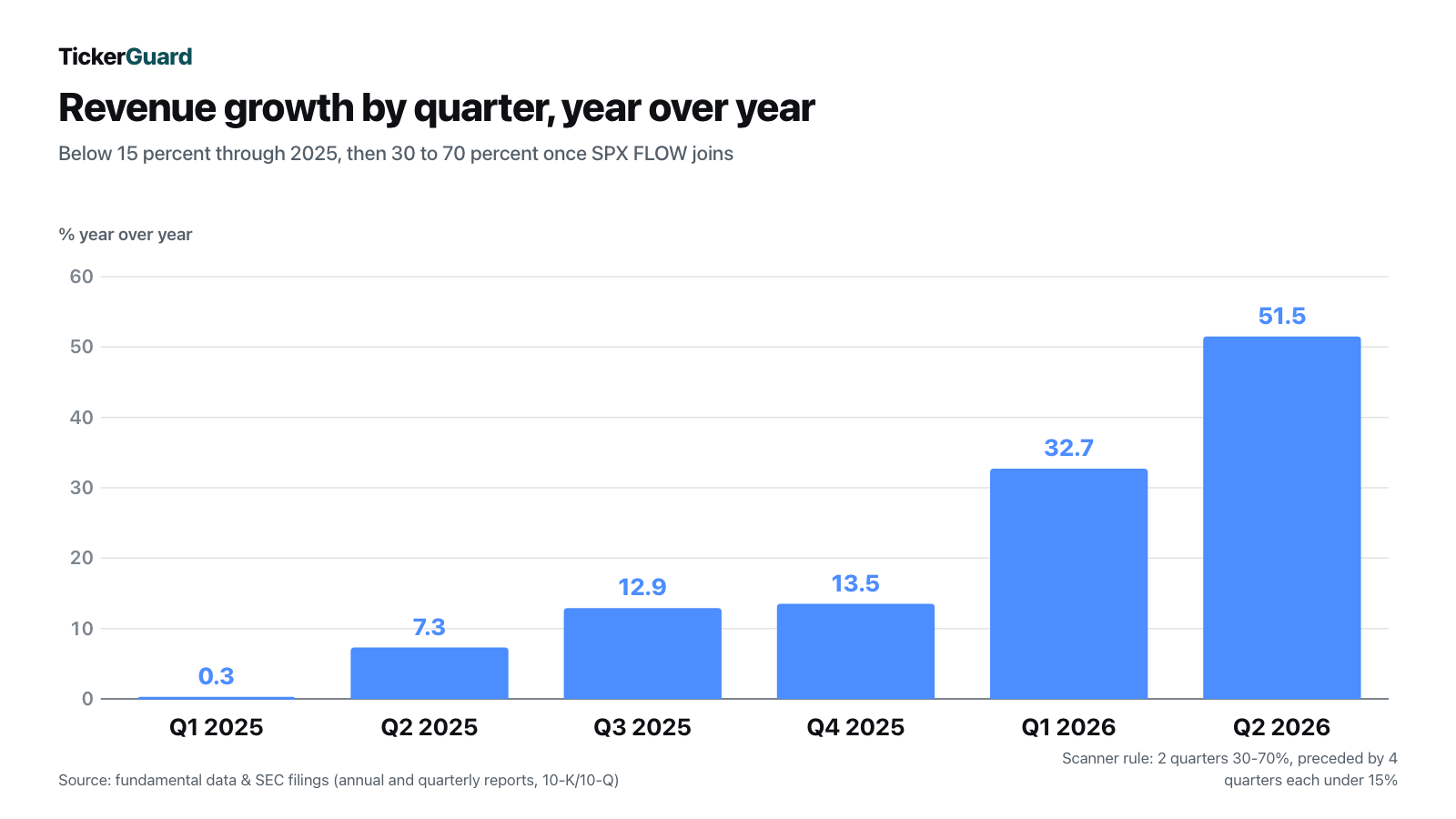
Our in-house stock scanner "revenue accelerator" continuously screens U.S. stocks for a specific pattern: the most recent two or more quarters each grow between 30 and 70 percent year over year — a genuine acceleration, not a one-off spike — while the four preceding quarters each grew under 15 percent. Additional conditions apply: trailing-twelve-month revenue of at least $100 million, at most two quarters already in the acceleration phase (an early-stage screen), and no heavy diluters. Our backtest study on this pattern shows why it is worth watching: fresh accelerators returned 16.6 percent a year, clearly ahead of the 9.9 percent posted by established, long-running growers.
To replicate it yourself: open the scanner, filter for "revenue accelerator," sort the "acceleration quarters" column for "2." Scanner data as of August 24, 2026: the scanner listed 28 hits, ITT at rank 4 with trailing-twelve-month revenue of $4,738.1 million. Based on the closing price of $208.10 on August 21, 2026, that puts the market capitalization at $18.7 billion. The two acceleration quarters, in detail: the first quarter of 2026 (ended April 4, 2026) brought $1,211.9 million in revenue, up 32.7 percent from $913.0 million in the first quarter of 2025. The second quarter of 2026 (ended July 4, 2026) brought $1,473.1 million, up 51.5 percent from $972.4 million in the second quarter of 2025. And the four quiet quarters before that match the required pattern exactly: Q1 2025 up just 0.3 percent, Q2 2025 up 7.3 percent, Q3 2025 up 12.9 percent, Q4 2025 up 13.5 percent — every single one under the 15 percent threshold.
A scanner only shows the pattern — it does not explain why a company falls into it. That is the job of the next chapters.
The numbers over the years — honestly appraised
Before dissecting the 2026 jump, the "old" ITT — before SPX FLOW — deserves an honest look, and it is mostly favorable. From 2023 to 2025, revenue grew solidly, if not spectacularly: from $3,283.0 million (2023) to $3,630.7 million (2024, up 10.6 percent) and $3,938.5 million (2025, up 8.5 percent) — mostly organic growth spread broadly across all three segments, without a single dominant customer. Operating income rose from $530.5 million to $678.1 million and $684.5 million; operating margin stood at a solid 17.4 percent in 2025. Two smaller acquisitions underpinned that growth even before the big jump: Svanehøj (pumps for LNG carriers, $407.6 million, January 2024) and kSARIA (cable connections for aerospace and defense, $460.1 million, September 2024) — both long since absorbed into the numbers. Neither explains the 2026 acceleration, as the next chapter shows.
One wrinkle showed up even before SPX FLOW, though: diluted earnings per share slipped in 2025 despite higher revenue — $6.11 versus $6.32 in 2024, a decline of roughly 3 percent (net income: from $519.9 million to $488.0 million). Rising revenue paired with declining per-share profit is rarely a good omen, and it partly explains why management went looking for a bigger growth lever, which arrived in 2025 as the SPX FLOW acquisition.
What the filings say — the uncomfortable truths
Uncomfortable truth no. 1: the acceleration is a deal, not an organic miracle
On December 4, 2025, ITT signed a purchase agreement for the largest acquisition in its history:
"Pursuant to the Purchase Agreement, the Buyer will purchase 100% of the membership interests of the Target … for an aggregate purchase price of $4.775 billion, which is expected to be comprised of $4.075 billion in cash … and 3,839,824 shares of ITT common stock."
— ITT Inc., SEC Form 8-K filed December 5, 2025, Item 1.01

The target, SPX FLOW, makes pumps, valves and mixing technology for chemical, energy, nutrition and health markets — a reinforcement of the Flow Technologies segment in substance, not a leap into a new line of business. On March 2, 2026, one month ahead of the original schedule, the deal closed:
"On March 2, 2026, we completed the acquisition of 100% of SPX FLOW pursuant to the Membership Interest Purchase Agreement … SPX FLOW's approximately 3,900 employees … SPX FLOW, which generated revenue of $1,340 during 2025, is reported within our FT segment."
— ITT Inc., SEC Form 10-Q as of July 4, 2026, Note 20 "Acquisitions"

The preliminary purchase price at closing stood at $4,311.3 million net of cash acquired — the difference from the announced $4.775 billion range mostly reflects the "net of cash" presentation and the stock component's market value on the closing date. Because the deal has been running since March 2, 2026, every quarter since carries SPX FLOW revenue — and that alone explains the two acceleration quarters. The 10-Q itself breaks it down, split into organic growth, the acquisition, and currency effects:
"Revenue of $1,473.1 increased by $500.7 including $359.6 from acquisition contributions and $17.6 from favorable foreign currency translation. Organic revenue increased by $123.5, or 12.7%, led by aerospace and defense in CCT, growth in pump projects and valves in FT, and increased aftermarket demand for Friction and KONI defense in MT."
— ITT Inc., SEC Form 10-Q as of July 4, 2026, Management's Discussion and Analysis

The first quarter of 2026 showed a similar ratio, just with one less month of SPX FLOW contribution (the deal closed only on March 2, roughly four weeks into the quarter): of $298.9 million in growth, $151.4 million came from the acquisition, $47.8 million from currency effects, and only $99.7 million — 10.9 percent — organically. The second chart makes the split between sources visible:
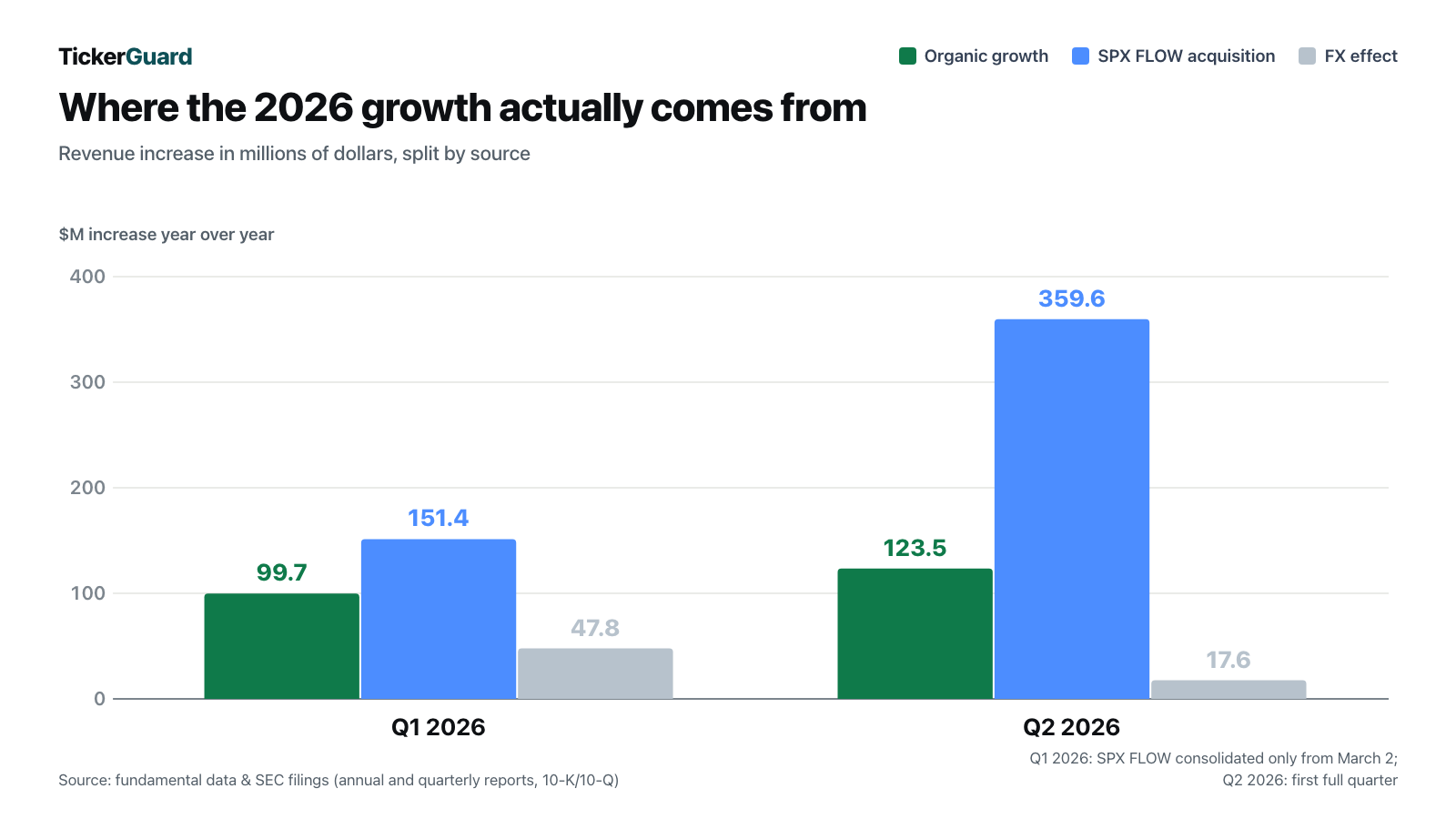
That answers the opening question: ITT's organic growth in 2026 ran at roughly 11 to 13 percent per quarter — solid, but not a scanner-worthy pace. The required 30 to 70 percent is reached only because SPX FLOW's own $1,340 million annual revenue (2025) was added to ITT's roughly $3.9 billion base in one step. The two earlier acquisitions, Svanehøj and kSARIA (together roughly $868 million, both closed in 2024), are by contrast already baked into the year-over-year comparison and contribute nothing further to the 2026 acceleration.
Uncomfortable truth no. 2: record revenue, but reported earnings per share collapse
Read only the revenue figures and you miss the second half of the story. ITT's own earnings release spells it out plainly:
"EPS for the second quarter of $0.95 decreased 38% versus prior year due to acquisition-related costs."
— ITT Inc., SEC Form 8-K filed August 6, 2026, Exhibit 99.1
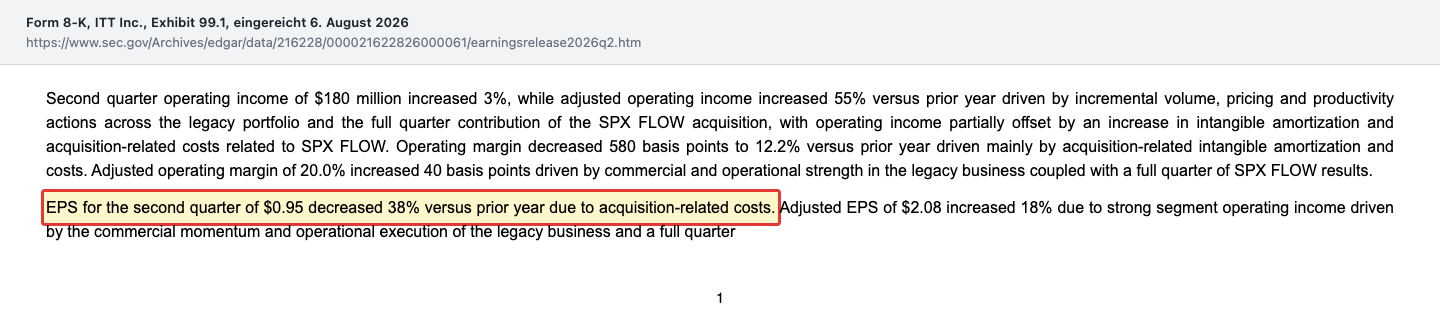
The cause: deal costs, and above all the scheduled amortization of acquired customer relationships and technology. In the second quarter of 2026 alone, intangible amortization jumped from $11.6 million to $62.6 million; the first quarter of 2026 carried an additional $67.5 million in pure acquisition-related costs. For full-year 2026, ITT therefore guides to reported earnings per share of $4.47 to $4.67 — at the midpoint roughly 25 percent below the $6.11 the company actually earned in 2025. At the same time, adjusted earnings per share, which strips out these special items, is guided to rise to $8.12–$8.32 — up 13 to 16 percent. Two metrics, two nearly opposite messages, from the same company, in the same year.
That is not automatically a red flag: amortization and one-time costs in the first year of a billion-dollar acquisition are normal for an industrial company, and the operating business is running ahead of plan by management's own account. But it shows how easily the headline "record revenue, guidance raised" can obscure the fact that on a GAAP basis, the company simply earns less in 2026 than it did in 2025 — a gap that matters for valuation in the next chapter.
Uncomfortable truth no. 3: debt rose sharply — but the scanner overstates it
A $4.3 billion acquisition has to be financed, and that leaves marks on the balance sheet. As of December 31, 2025, ITT still held $1,742.9 million in cash against short-term debt of $261.3 million and long-term debt of $521.5 million — $782.8 million combined. As of July 4, 2026, just over four months after the deal closed, the picture looked different: cash $590.8 million, short-term debt $858.4 million, long-term debt $2,869.8 million — $3,728.2 million in interest-bearing debt combined, more than four times the prior-year level. Shareholders were also diluted: the share count rose from 85.9 to 89.4 million — up 4.1 percent, essentially the 3,839,824 shares issued as part of the SPX FLOW purchase price.
The scanner reports a "debt-to-equity 4.17" figure for ITT — a number that does not hold up against the SEC balance sheet on closer inspection. Dividing total liabilities ($6,226.7 million as of July 4, 2026) by shareholders' equity ($4,809.6 million) yields a ratio of roughly 1.3; dividing only interest-bearing debt ($3,728.2 million) by equity yields roughly 0.8. Both calculations sit far below the reported 4.17 — it cannot be reconciled from the published balance sheet figures and is treated here as a likely data artifact, not used as a reliable metric.
What can be documented instead is a different, more common leverage metric that management itself cites: net debt to EBITDA. On the call covering first-quarter results, the company put leverage at 2.7 times immediately after the deal closed; on the call covering second-quarter results on August 6, 2026, CFO Emmanuel Caprais already reported a decline to 2.5 — by the company's own account, a target it originally expected to hit six months later. ITT paid down $124 million in debt in the second quarter of 2026 alone. Debt has genuinely risen and remains one of the metrics the coming quarters will need to keep proving out — but the scanner-reported 4.17 is not the evidence for that.
Valuation: what the market is paying for the deal
How expensive is ITT right now? The answer visibly depends on which earnings figure you use — a direct echo of the GAAP-versus-adjusted gap from the previous chapter. The price-to-earnings ratio (GAAP) reported by the data source stands at 35.3 — a level that fits a growth stock better than an industrial company posting roughly 11 percent organic growth. Using the adjusted earnings trajectory analysts expect instead, the ratio drops to 25.2 — still no bargain, but much closer to what an industrial company with double-digit organic growth typically commands. A price-to-sales ratio of 3.9 and an enterprise-value-to-EBITDA ratio of 24.3 confirm the picture: expensive, but not on the strength of a distorted GAAP number alone.
The professionals' view: 15 analysts rate the stock at an average 4.4 out of 5, with a price target roughly 19.7 percent above the closing price of $208.10 on August 21, 2026 (analyst data as of August 24, 2026) — a noticeably more optimistic picture than the raw GAAP price-to-earnings ratio suggests. A dividend yield of roughly 0.8 percent against a payout ratio of only about 19.6 percent shows ITT is deliberately keeping room to maneuver — the visible priority right now is deleveraging, not a bigger payout. The 52-week price range of $164.90 to $221.70 (fundamental data as of August 21, 2026) reflects the swings with which the market has been processing the acquisition news since December 2025.
Opportunities and risks at a glance
What speaks for ITT:
- Double-digit organic growth across all three segments in the second quarter of 2026 (12.7 percent overall), led by aerospace and defense in CCT, pump projects in FT, and aftermarket demand in MT — the "old" business runs on its own, independent of the deal.
- A concretely sized synergy program for SPX FLOW ($80 million identified, one third in year one) that management says is running ahead of plan.
- Faster deleveraging than promised: net debt to EBITDA cut from 2.7 to 2.5, six months ahead of its own target, with $124 million in debt paydown in the second quarter of 2026 alone.
- A broadly diversified portfolio across three very different end markets (transportation, industrial/chemical/energy, aerospace/defense), with 65 percent of revenue generated outside the U.S.
- A demonstrated ability to integrate smaller acquisitions: Svanehøj (2024) and kSARIA (2024) are fully absorbed into the numbers and no longer burden the ongoing business.
What speaks against it:
- Reported earnings per share are guided to come in roughly a quarter lower in 2026 than in 2025 — an expensively bought revenue jump while amortization and one-time costs keep running.
- Integration risk from a deal that, with $1.34 billion of its own annual revenue, accounts for more than a third of the old ITT revenue base and has been part of the company for only five months.
- Share dilution of 4.1 percent from the shares issued as purchase consideration.
- Interest-bearing debt more than quadrupled to $3,728.2 million; the real leverage trajectory needs several more quarters to confirm itself.
- Not cheap on a GAAP basis, with a price-to-earnings ratio of 35; the lower adjusted ratio of 25 holds only if the promised synergies actually materialize.
- Regional order delays in the Middle East and cost inflation in Motion Technologies that, by management's own account, has not yet been fully passed through in pricing (August 6, 2026 earnings call).
A human conclusion
Back to the flash-in-the-pan trap from the start. The honest answer is: both at once. Underneath the spectacular growth number, a smaller but genuine organic fire is indeed burning — 11 to 13 percent growth per quarter across three different industrial niches is respectable for a 106-year-old company, and deleveraging is running faster than even management promised. But the part that trips the scanner — the 30 to 70 percent — is not organic fire; it is the deliberately lit accelerant of a $4.3 billion acquisition whose full bill will only be settled over the coming years: in amortization that weighs on reported profit, and in a debt load that still has to come down. Buying ITT today is not buying "a company that suddenly grows twice as fast as before" — it is buying a solid industrial company that has placed a very large bet on its own ability to integrate. Whether that bet pays off will show more clearly in the coming quarterly reports than in today's scanner hit. What you make of it is your decision. And that is exactly as it should be.
Sources
All original documents used in this analysis — to read for yourself:
- ITT Inc. — SEC annual report 10-K for 2025 (filed February 9, 2026)
- ITT Inc. — SEC quarterly report 10-Q as of July 4, 2026 (filed August 6, 2026)
- ITT Inc. — SEC quarterly report 10-Q as of April 4, 2026 (filed May 6, 2026)
- ITT Inc. — SEC Form 8-K filed December 5, 2025, SPX FLOW purchase agreement (Item 1.01)
- ITT Inc. — SEC Form 8-K filed August 6, 2026, second-quarter 2026 earnings release (Exhibit 99.1)
- Full SEC filing history of ITT Inc.: EDGAR overview (sec.gov)
- Earnings calls for Q4 2025 (February 5, 2026), Q1 2026 (May 6, 2026) and Q2 2026 (August 6, 2026); transcripts publicly available via Motley Fool and Investing.com, among others.
- Fundamental data (metrics, valuation; data as of August 24, 2026), reconciled with the SEC filings.
- Backtest study on our in-house "revenue accelerator" stock scanner (fresh accelerators returned 16.6 percent a year versus 9.9 percent for established growers).
Transparency & disclaimer: This analysis is a journalistic contextualization of publicly available information and is not investment advice, not a financial analysis in the regulatory sense, and not a solicitation to buy or sell securities. Stock investments carry substantial risks up to total loss. All information without warranty; the data cut-off is noted in the text. Positions held by the operator are disclosed daily; where one exists, it appears as a notice at the top of this deep dive.
Key figures at a glance
All monetary figures in millions of $; earnings per share as reported.
| Metric | 2021 | 2022 | 2023 | 2024 | 2025 |
|---|---|---|---|---|---|
| Revenue | 2,765.0 | 2,987.7 | 3,283.0 | 3,630.7 | 3,938.5 |
| Operating Income (EBIT) | 504.3 | 468.0 | 528.2 | 676.0 | 684.5 |
| Net Income | 316.3 | 367.0 | 410.5 | 518.3 | 488.0 |
| Net Margin | 11.4% | 12.3% | 12.5% | 14.3% | 12.4% |
| Earnings Per Share | 3.66 $ | 4.38 $ | 4.96 $ | 6.30 $ | 6.11 $ |
Source: fundamental data & SEC filings (annual and quarterly reports, 10-K/10-Q)
Our Bottom Line at a Glance
- Organic core business positive
- Excluding the acquisition, ITT grew 12.7 percent in the second quarter of 2026 (Q1 2026: 10.9 percent) — solid, broadly spread across all three segments, led by aerospace and defense in CCT and pump projects in FT. The "old" business carries itself.
- Earnings quality negative
- Reported earnings per share are guided to come in roughly a quarter below 2025's $6.11, weighed down by amortization and one-time costs from the SPX FLOW acquisition. In the second quarter of 2026 alone it already fell 37.5 percent to $0.95, while adjusted earnings rose 18.2 percent.
- SPX FLOW integration risk neutral
- The deal, with $1.34B of its own 2025 revenue, is more than a third of the old ITT base and has only been part of the company since March 2, 2026. Synergies ($80M identified) are running ahead of plan by management's account, but a five-month track record is not yet a multi-year proof point.
- Leverage neutral
- Interest-bearing debt rose from $782.8M to $3,728.2M. Management reports net debt of 2.5 times EBITDA, falling faster than promised ($124M paid down in Q2 2026 alone); the scanner-reported 4.17 figure cannot be reconciled against the SEC balance sheet (roughly 1.3 by our own calculation) and is unusable.
- Valuation neutral
- A P/E of 35.3 on a GAAP basis looks expensive, dropping to 25.2 on the adjusted earnings analysts expect. Fifteen analysts rate the stock at an average 4.4 out of 5 with roughly 19.7 percent upside versus the closing price of $208.10 on August 21, 2026 (analyst data as of August 24, 2026) — notably more optimistic than the raw GAAP metric.
- Capital discipline positive
- A low payout ratio (roughly 19.6%) and deleveraging running six months ahead of its own schedule point to a management that did not overextend to fund the deal. Two earlier acquisitions (Svanehøj, kSARIA, both 2024) were already integrated without drama.
ITT shows revenue growth of 32.7 and 51.5 percent in our in-house "revenue accelerator" scanner — but only 10.9 and 12.7 percentage points of that are organic; the rest is the $4.3 billion SPX FLOW acquisition that closed March 2, 2026. The organic business is growing solidly and broadly, yet reported earnings per share are guided roughly a quarter below 2025, and debt has more than quadrupled. The scanner-reported leverage figure of 4.17 cannot be reconciled against the SEC balance sheet and should not be used. Not investment advice.
What Our Rating Means
Open questions
The business works in principle, but one material question is open. As long as it stays open, our findings do not carry a quality verdict.
ITT's core business is solid: three diversified industrial segments, double-digit organic growth, a track record of smoothly digesting smaller acquisitions, and deleveraging that is running faster than promised. The open operational question is the size of the SPX FLOW deal: an acquisition worth more than a third of the old revenue base is only five months old, and whether the promised synergies actually materialize — and reported earnings converge back toward adjusted earnings — will only be shown by several more quarterly reports. That is not a substance risk, but it is an unproven promise, which is why the light stays yellow for now. The decision is yours.
A journalistic assessment by our editorial team at the time of the deep dive, based on public sources — not investment advice and not a solicitation to buy or sell. Your personal circumstances (investment goals, risk capacity, taxes) cannot be taken into account. What our levels mean, how verdicts are formed, and what conflicts of interest exist →
Worth Noting
- ITT landed on our research list via our in-house "revenue accelerator" stock scanner (rank 4 of 28 hits, as of August 24, 2026) — two quarters of 30 to 70 percent growth after four quiet quarters in 2025. The scanner only shows the pattern, not the cause; this analysis supplies the cause.
- The scanner-reported "debt-to-equity 4.17" was checked against the SEC balance sheet as of July 4, 2026 and could not be confirmed (roughly 1.3 or 0.8 by our own calculation, depending on the basis used); it is not used in this analysis.
- All valuation metrics are evergreen and dated (metrics August 24, 2026, closing price on August 21, 2026, balance sheet data July 4, 2026); a daily price is not a buy argument.
Stock Watch
This analysis is as of August 26, 2026. Stock Watch will tell you what's changed at ITT since then.
Later $1 a month per stock — signing up is free, and you'll be the first to know when it launches.
The full analysis as a PDF for later
We will send you this analysis as a PDF — to print, file away, and read at your own pace. And we will add you to the free Stock Watch list for ITT Inc (ITT), so you hear about it when something material in this analysis changes.
Frequently Asked Questions
ITT Inc. (NYSE: ITT) of Stamford, Connecticut, is an industrial company with three segments: Flow Technologies makes industrial pumps and valves (Goulds Pumps brand, reinforced since March 2026 by SPX FLOW), Motion Technologies makes brake pads and shock absorbers for cars, trucks and trains (Friction and KONI brands), and Connect & Control Technologies makes aerospace connectors (Cannon brand). The company generated $3.9 billion in revenue in 2025 with roughly 11,600 employees.
Revenue rose 32.7 percent in the first quarter of 2026 and 51.5 percent in the second quarter, each versus the prior-year quarter. The main reason is the acquisition of SPX FLOW, completed March 2, 2026, for a preliminary $4,311.3 million — SPX FLOW alone generated roughly $1,340 million in revenue in 2025, now added to ITT's books since the deal closed.
Mostly an acquisition effect. Per the 10-Q, ITT's organic revenue grew just 12.7 percent ($123.5 million) in the second quarter of 2026, while the SPX FLOW acquisition alone contributed $359.6 million and currency effects added another $17.6 million. Organic growth in the first quarter of 2026 was 10.9 percent.
SPX FLOW makes pumps, valves and mixing technology for chemical, energy, nutrition and health markets, with roughly 3,900 employees and $1,340 million in 2025 revenue. ITT bought the company for a preliminary $4,311.3 million to substantially scale up its Flow Technologies segment; the deal has been consolidated there since it closed on March 2, 2026.
Reported (GAAP) earnings per share fell 37.5 percent to $0.95 in the second quarter of 2026, weighed down by deal costs and higher amortization of acquired assets. For full-year 2026, ITT expects reported earnings per share of $4.47 to $4.67 — roughly a quarter below the $6.11 it earned in 2025. Adjusted earnings per share, which strips out these special items, is guided to rise 13 to 16 percent instead.
Interest-bearing debt rose from $782.8 million (end of 2025) to $3,728.2 million (July 4, 2026). Management cites net debt of roughly 2.5 times EBITDA (as of August 6, 2026) — already six months ahead of its own timeline target. The stock scanner's reported "debt-to-equity 4.17" cannot be reconciled against the SEC balance sheet (roughly 1.3 by our own calculation) and is treated as a data artifact.
On reported earnings, the stock looks expensive with a price-to-earnings ratio of 35.3; on the adjusted earnings analysts expect, the ratio drops to 25.2. Fifteen analysts rate the stock at an average 4.4 out of 5, with a price target roughly 19.7 percent above the closing price of $208.10 on August 21, 2026 (analyst data as of August 24, 2026).
Yes, but a small one: the dividend yield is roughly 0.8 percent, with a payout ratio of only about 19.6 percent of earnings (data as of August 24, 2026). The company is deliberately keeping room to maneuver — the visible priority right now is paying down debt from the SPX FLOW acquisition, not a bigger payout.
Found an error?
Did you spot a factual error, an outdated number, or a typo in this deep dive? Let us know briefly — your report goes straight to the editorial team.