Concentra Stock: The Winner Whose Profit Stands Still
Concentra (NYSE: CON), America's largest occupational health provider since its spin-off from Select Medical, fires in 17 of our scanners and trades at an all-time high. But a look into the annual report (10-K) opens a gap: revenue ($2.16 billion, up 14 percent) and operating income keep climbing — yet net income has stood still since the separation, because the term loan drove interest expense from $0.2 to $109 million. Add to that: 61 percent of revenue hangs on state-regulated injury reimbursement. Not investment advice — just the sober question of what an all-time-high chart still carries when profit has long stopped growing with it.
 Thomas Mücke
Founder & Publisher
Thomas Mücke
Founder & Publisher
As of Today
As of: September 17, 2026
- Closing price
- 35.50 $ -2.30%
- Market Capitalisation
- 4.5 $B
- Growth Score
- 4/10
- AAQS
- 7/10
Price change since August 4, 2026: +12.0%
This analysis has a cut-off date. The Stock Guard tells you when something material changes in the numbers. Reserve your free spot
Chart
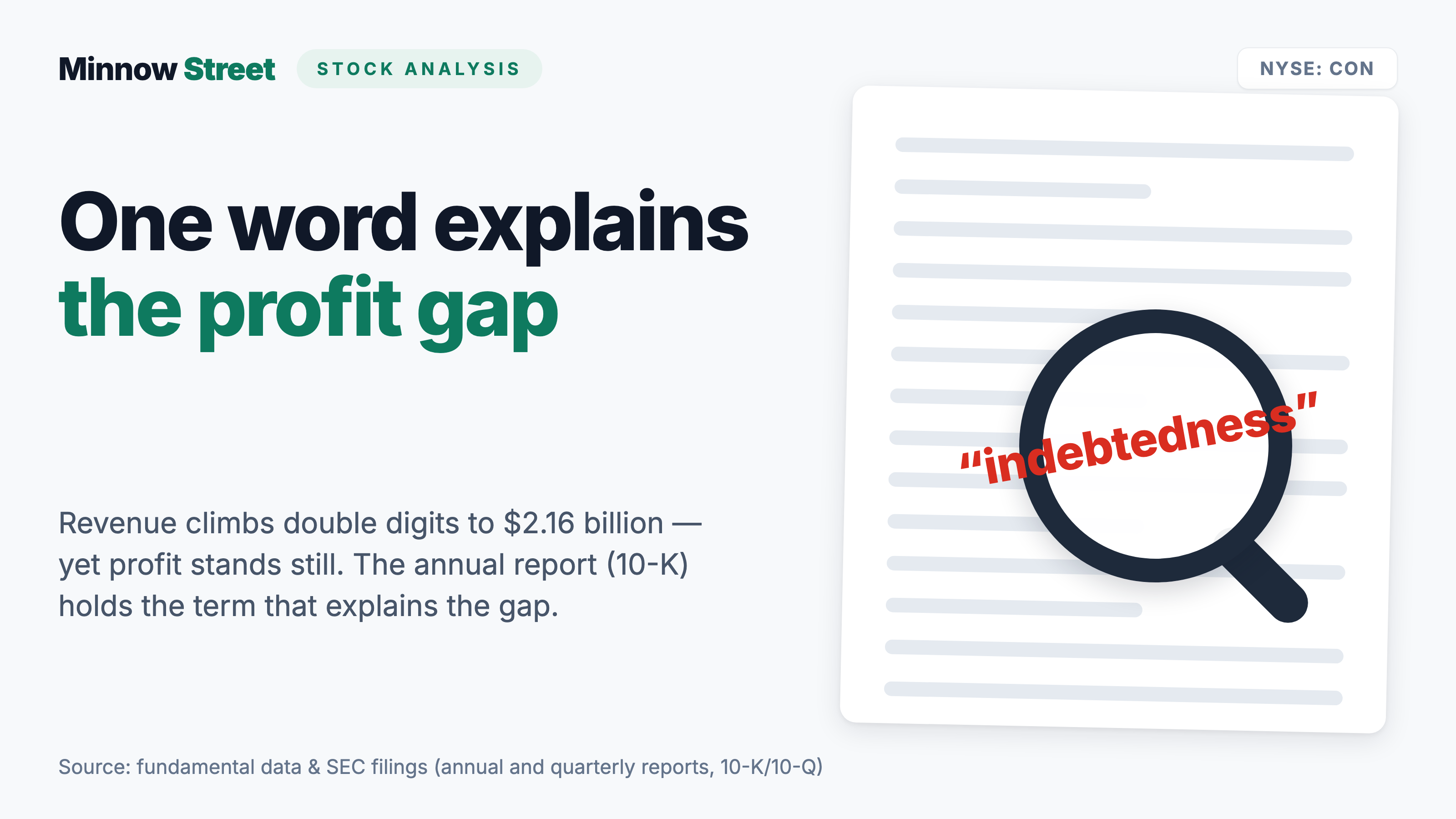
Interactive price chart (TradingView).
52-week range: 18.70 $ to 36.40 $ · Last price: 35.50 $ (As of: September 17, 2026)
Note: pure fact-based analysis, not investment advice and not a solicitation to buy or sell. All figures without guarantee.
There is a quiet trap that snaps shut precisely with the understandable stocks. You know this business from real life: the small health check before the new job, the drug test, the X-ray of the sprained ankle after the fall in the warehouse. Nothing mysterious, no rocket science — a business you can explain in one sentence. And because it feels so familiar and so unspectacular, a voice in your head whispers: "What I understand cannot be dangerous. Boring business, safe business." Psychologists call this the familiarity bias — the tendency to automatically mistake the known for the safe. At Concentra Group Holdings Parent (NYSE: CON), the largest occupational health provider in the United States, this trap is especially seductive: a rock-solid, everyday business, plus 17 green check marks in the scanner and a price at an all-time high. So let's make a deal: we will not rely on the good feeling, but first read what Concentra must honestly file, under penalty of law, with the U.S. securities regulator, the SEC — the annual report (10-K) and the latest quarterly report (10-Q). What sits in there is a strong company. And a gap that does not show up in the chart: revenue rises — but profit stands still. Remember this gap — it is the connecting thread of this analysis. In the end, you decide.
Updated on August 2, 2026: this analysis now carries a chapter of its own on the earnings calls. We reviewed the transcripts of all eight calls Concentra has held since its IPO — from 2024-Q2 through 2026-Q1 — that is, what management announced measured against what it actually delivered. None of the findings in this analysis is weakened, and not a single numerical commitment was missed over those two years. What is new is the view on reliability itself: annual guidance was raised repeatedly and beaten, synergy capture on the Nova acquisition was quantified quarter by quarter, and the separation from Select Medical is running half a year ahead of the contractual deadline. What deserves criticism is the pace of individual answers — the Florida fee schedule effect above all — not the reliability. Deliberately not yet incorporated: the second-quarter 2026 call and the outcome of the Select Medical separation at its November 2026 deadline.
What Concentra actually does
Think of Concentra as the company doctor of the American workplace — just as a nationwide chain. When a warehouse worker strains his back, when a trucker needs his legally required fitness exam, when a company must have its new hires tested for drugs — all of that lands at Concentra. The company was founded in 1979, is headquartered in Addison, Texas, and as of December 31, 2025 operated roughly 628 freestanding health centers in 41 states, plus 411 clinics located directly on employers' premises and a telemedicine operation covering 43 states. About 13,000 employees and affiliated clinicians handle the cases. The business splits into three segments:
- Occupational Health Centers — the core business: the freestanding centers where workplace injuries are treated and occupational health services are performed (exams, vaccinations, drug and alcohol testing).
- Onsite Health Clinics — health stations directly at the employer, for larger companies that bring care in-house.
- Other — side businesses: a mail-order pharmacy (St. Mary's), the Concentra Telemed platform and a service provider for administering testing programs.
Until the summer of 2024 all of this was a division of rehabilitation group Select Medical. On July 26, 2024 Concentra went public on the New York Stock Exchange (22.5 million shares); on November 25, 2024 Select distributed the remaining stake to its shareholders and has held not a single Concentra share since. Sounds like a clean divorce? Almost — a few threads still run back to the old parent, and one of them even sits at the head of the board. More on that later. First let's see where the stock shows up in the scanner.
Where the stock shows up in our scanner
Every day we run thousands of stocks through our in-house stock scanners. Concentra fires in 17 filters (data as of July 9, 2026) — an unusually dense strength confluence. Among them are the demanding ones: "Best of All", "ATH" (all-time high), "Oliver Kell: 52 Week Highs", "Power Trend", "Stan Weinstein: Checklist" and "Institutional accumulation". When many independent filters fire at the same time, that is no random hit but a genuine momentum signal. How to get there yourself: on tickerguard.com, open a filter in the "Scanner" menu and look for the CON row.
One hit deserves an honest framing, though: "ATH" — the all-time high. A price at record levels feels like a seal of quality, and often it is: strength attracts strength. But an all-time high is always both at once — strength AND height of fall. Whoever buys at the record has, by definition, not a single investor above him waiting to sell "finally back at break-even" on a decline — but he has no cushion below either. Remember: a check mark in the scanner is a starting point for research, not a substitute for it. So let's do the math.
The numbers over the years
And now what genuinely impresses — honestly appraised. Concentra grows reliably: revenue climbed from $1.72 billion (2022) via $1.84 (2023) and $1.90 (2024) to $2.16 billion (2025) — in 2025 alone a plus of 13.9 percent, strongly supported by the acquisition of Nova Medical Centers. Operating income — what the actual business throws off before interest and taxes — also rose year after year, from $258.5 to $334.0 million. In the first quarter of 2026 things kept running smoothly: revenue up 13.7 percent to $569.6 million. Operationally, Concentra is a well-oiled machine.
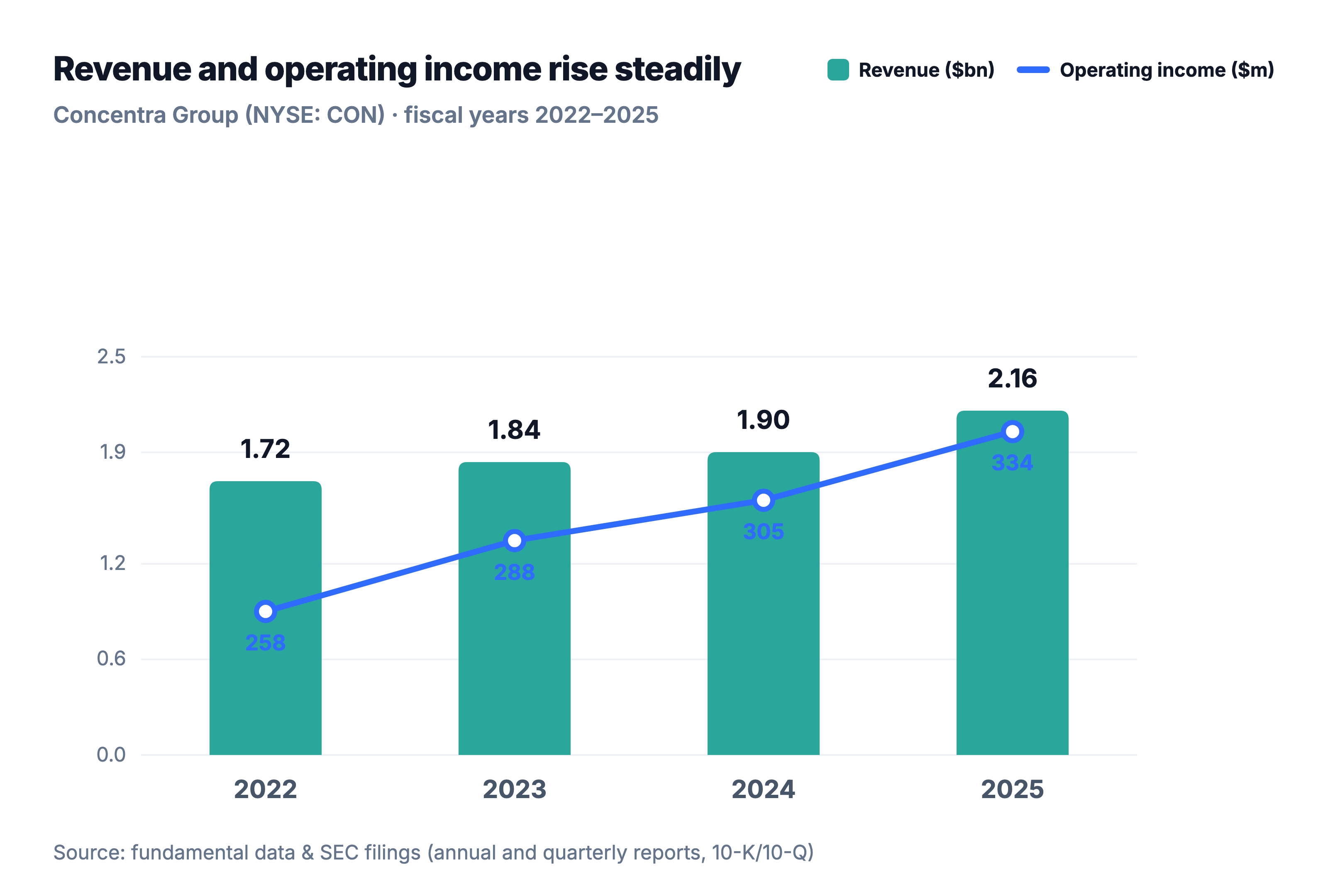
But now comes the point where the chart goes silent. Because what arrives at the shareholder is not operating income but the net income at the very bottom. And that has stood still since the separation: $179.9 million (2023), $166.5 million (2024), $166.4 million (2025). Revenue grows at a double-digit clip, the operating business flourishes — and below the line, less remains than two years ago. Between what the company earns and what reaches the investor, a gap has opened. Where it comes from, the next chart shows.
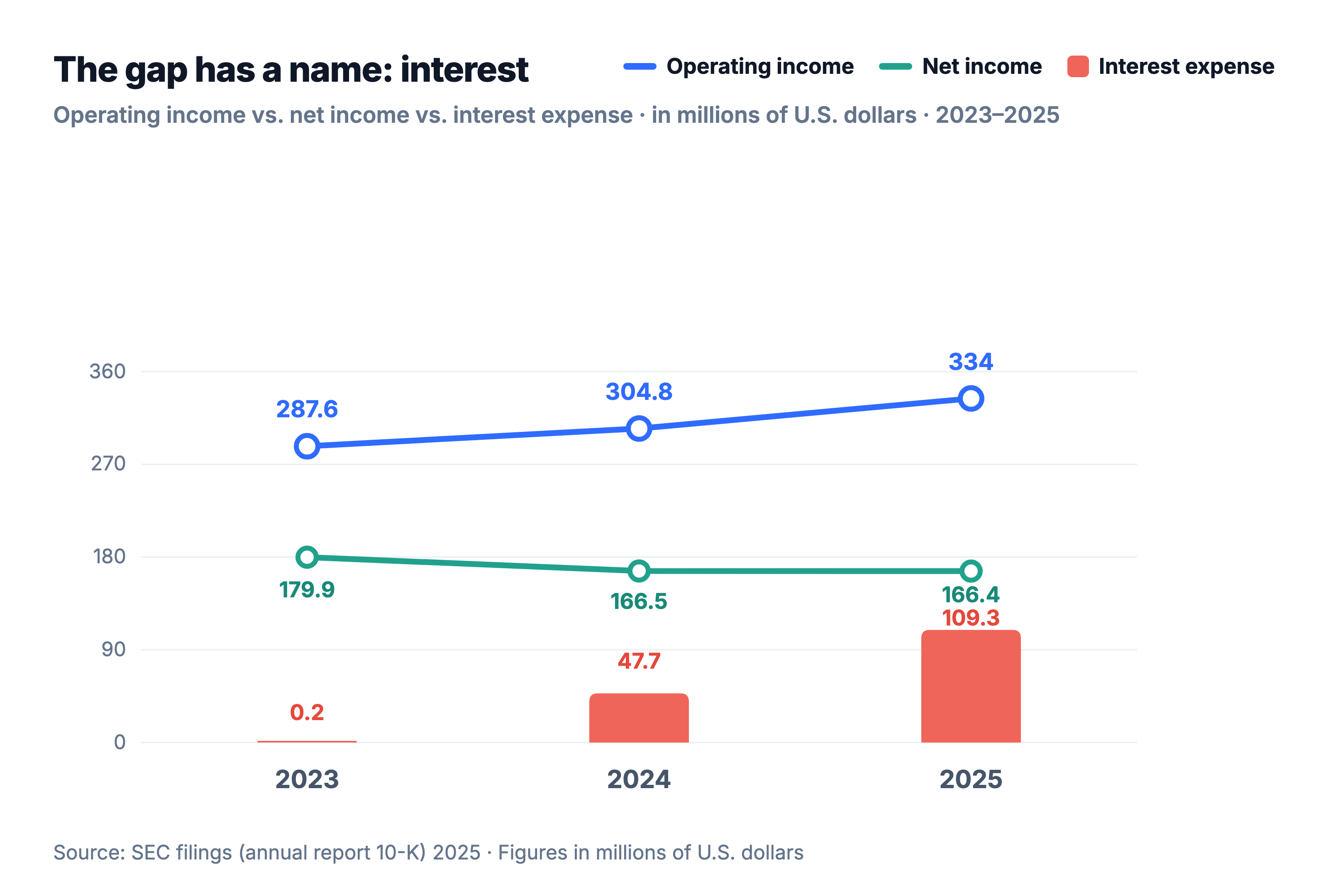
A growing business whose profit stands still — that is one half of the story. Now to the three uncomfortable truths behind it.
The uncomfortable truths
Uncomfortable truth no. 1: The optimism has an interest price — the debt from the spin-off
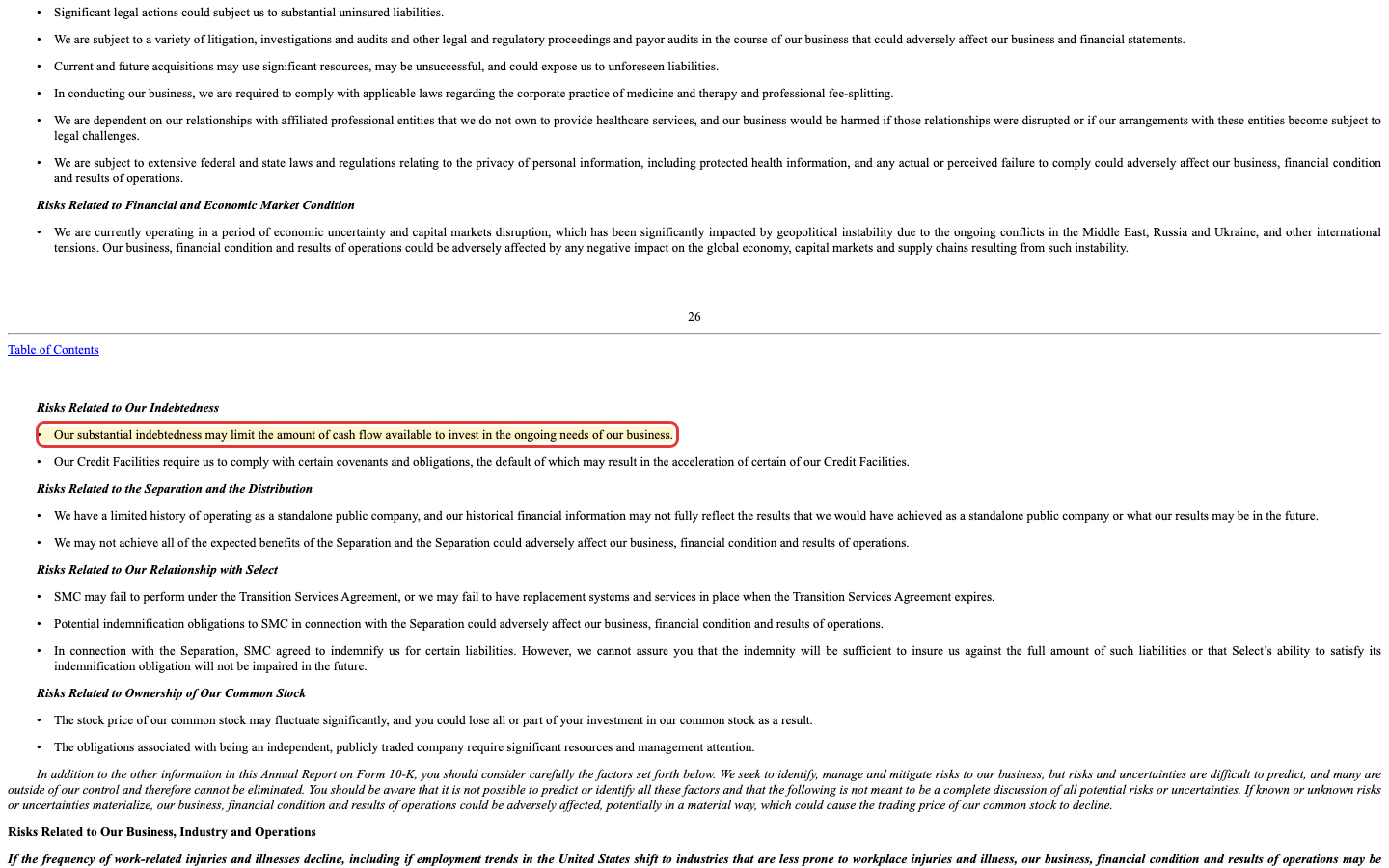
As a division of Select Medical, Concentra carried practically no financial debt of its own. For its independence, however, it took on a hefty term loan — roughly $850 million at the time of the separation, upsized to roughly $950 million in 2025 in the course of the Nova acquisition. A term loan is like a large mortgage on your own future: it buys room to act, but every month a piece of what you earn goes out the door as interest. That is exactly what the numbers show — interest expense jumped from $0.2 million (2023) via $47.7 (2024) to $109.3 million (2025). Concentra names the flip side in its risk section in no uncertain terms:
"Our substantial indebtedness may limit the amount of cash flow available to invest in the ongoing needs of our business."
— Concentra Group Holdings Parent, Inc., SEC annual report 10-K for fiscal year 2025, Item 1A "Risk Factors"
To be fair: the loan was renegotiated at better terms in 2025, the revolver (the flexible credit line) had been fully repaid by year-end 2025, and in the first quarter of 2026 net income pulled up again by almost 29 percent — the interest brake is loosening. But the lesson stands: a good part of the operating progress of the past two years did not land with the shareholder, but with the creditors.
Uncomfortable truth no. 2: 61 percent of revenue hangs on state-regulated reimbursement
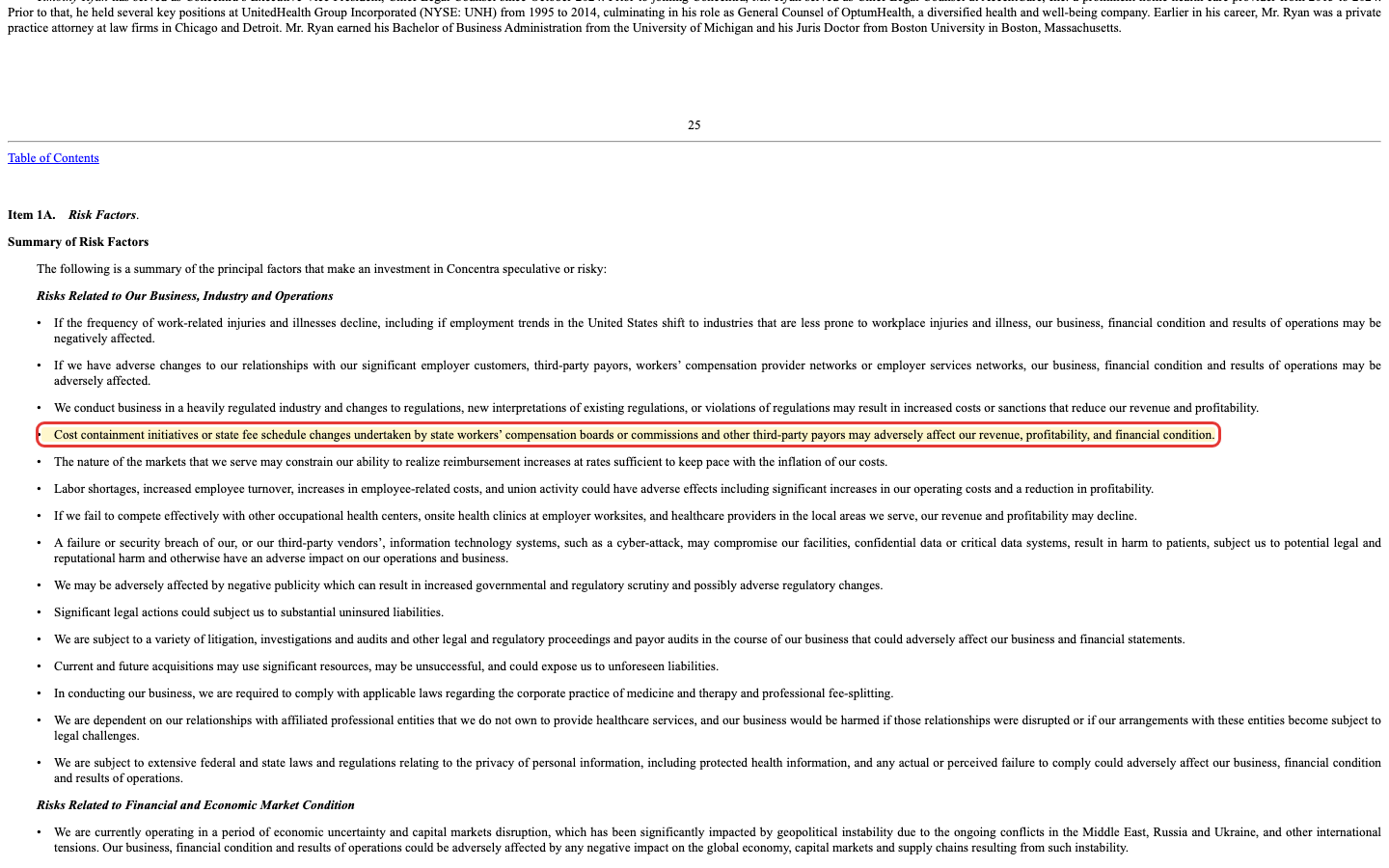
Concentra's customers are broadly spread — no single employer carries a dangerous share of revenue. The cluster risk sits elsewhere, namely with the payor. Roughly 61 percent of revenue in 2025 came from treating workplace injuries (workers' compensation) — and how much Concentra gets paid for that is set not by the free market but by each U.S. state through its fee schedules, the official price lists. Picture a tradesman whose hourly rate is set not by himself but by the authorities: if the state cuts the rate, revenue falls — without a single patient fewer walking in. Concentra lists exactly this dependence as a risk:
"Cost containment initiatives or state fee schedule changes undertaken by state workers' compensation boards or commissions and other third-party payors may adversely affect our revenue, profitability, and financial condition."
— Concentra Group Holdings Parent, Inc., SEC annual report 10-K for fiscal year 2025, Item 1A "Risk Factors"
For perspective: workers' compensation is legally mandated in the United States and a stable, non-cyclical market — demand does not evaporate quickly. But the pricing power sits with the state, not with Concentra. And geographically it clusters on top: California and Texas alone each host roughly 16 percent of the centers — a sixth of the network thus hangs on the reimbursement rules of just one state each.
Uncomfortable truth no. 3: Barely independent — and a lot of goodwill on thin equity
Concentra appears more seasoned than it is on the stock exchange. As an independent stock the company has existed only since July 2024, the full separation is not yet a full year old — and the company itself says how little experience the market has with this construction:
"We have a limited history of operating as a standalone public company, and our historical financial information may not fully reflect the results that we would have achieved as a standalone public company or what our results may be in the future."
— Concentra Group Holdings Parent, Inc., SEC annual report 10-K for fiscal year 2025, Item 1A "Risk Factors"
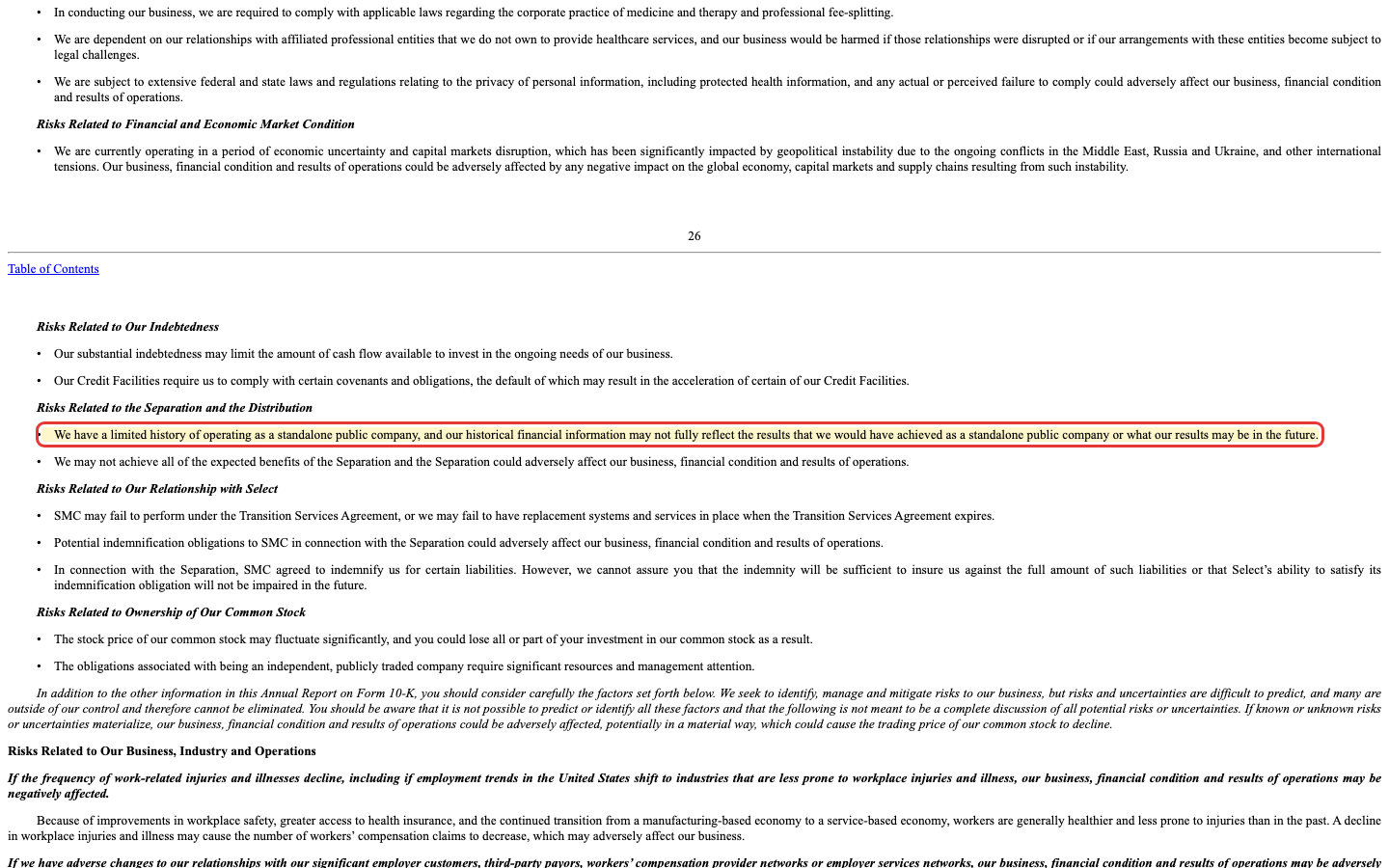
Two more things you should know. First, the balance sheet: the books carry $1.48 billion of goodwill — the premium from past acquisitions, a pure accounting item without bricks and mortar. That is roughly 52 percent of total assets, while real equity amounts to only $393 million. Put simply: subtract the goodwill and, arithmetically, no equity remains. The much-quoted return on equity of roughly 47 percent therefore looks shinier than it is — it shines mostly because the denominator is so thin. Second, the umbilical cord to the former parent: several administrative functions still run through transition services agreements with Select, and at the head of the board sits, to this day, Robert A. Ortenzio, the co-founder of Select Medical. How a freshly spun-off strength stock must first prove its independence is, by the way, something we also saw at construction services group Everus Construction.
Valuation — what the optimism costs
Now back to the familiarity bias from the opening. An understandable business at an all-time high is not a bargain just because it is easy to grasp. The valuation sits (orders of magnitude, as of mid-2026, deliberately without a daily price) at a price-to-earnings ratio of roughly 23, an enterprise value of about 12 times operating earnings before depreciation (EV/EBITDA) and a price-to-sales ratio around 1.9. For a defensive healthcare provider that is not absurd, but it is the price of a winner, not a discount. You are not paying for the past here, but for the expectation that the interest brake keeps easing and the operating growth finally arrives at the bottom line again.
And the professionals' view? Roughly eight analysts cover the young stock; their average price target sits in the order of $31, and the base rating is predominantly positive. For perspective: Concentra also pays a small dividend ($0.25 per share per year, a yield of roughly 0.8 percent) and launched a $100 million share buyback program at the end of 2025. A company that returns money to shareholders despite a mountain of credit — that is a vote of confidence, but also a balancing act. Remember: a high price is no argument against a good company — but it shrinks the safety cushion in case something ever goes off plan. And in the chapter of healthcare reimbursement you never quite know what the state will decide next — a lesson the physician group Pediatrix knows all too well.
Opportunities and risks at a glance
What speaks for Concentra:
- Market leader in a defensive, legally anchored niche market (occupational health), with roughly 628 centers, 411 onsite clinics and nationwide reach — a business that does not hang on the economic cycle.
- Reliable operating growth: revenue up 13.9 percent to $2.16 billion (2025), operating income up to $334.0 million; in the first quarter of 2026 net income up almost 29 percent — the interest brake is starting to release.
- Active growth through acquisitions (Nova Medical Centers, roughly $265 million); plus a dividend and a $100 million buyback program.
- Dense strength confluence in the scanner (17 hits), institutional accumulation, price at an all-time high.
What speaks against it:
- Net income stands still despite rising revenue ($179.9 → $166.4 million, 2023 through 2025), because the interest expense from the spin-off loan ($0.2 → $109.3 million) eats up the operating progress.
- Reimbursement and regulation risk: 61 percent of revenue from state-price-regulated workers' compensation; geographic clustering (roughly 16 percent of centers each in California and Texas).
- Thin substance behind the facade: $1.48 billion of goodwill against only $393 million of equity (52 percent of total assets), arithmetically negative tangible equity.
- Short independence (market debut July 2024), continuing entanglement with the former parent (transition services agreements, founder Ortenzio as board chairman) and an ambitious valuation at an all-time high (P/E around 23).
What the Earnings Calls Reveal
We reviewed all eight earnings calls Concentra has held since its IPO — from its first quarter as a listed company (2024-Q2) through the most recent call covering 2026-Q1. Matching what was announced against what was delivered, the first thing that stands out is what did not happen: over these two years, management has not missed a single numerical commitment it made.
The first annual outlook came in the 2024-Q3 call: about USD 1.9bn revenue, USD 370m to 375m adjusted EBITDA and net leverage of 3.5 to 3.6. Delivered were USD 376.9m and 3.46. The 2025 outlook started in January 2025 at USD 2.1bn revenue and USD 410m to 425m EBITDA, was raised three times in 2025-Q1, 2025-Q2 and 2025-Q3, and closed at USD 2.2bn revenue and USD 431.9m EBITDA — above the last stated ceiling. In the 2026-Q1 call the annual outlook was lifted again. Acquisition commitments were worked through on schedule as well: Nova synergy capture was quantified quarter by quarter (just over 70 percent in 2025-Q2, just over 85 percent in 2025-Q3, complete in 2026-Q1), and the separation from Select Medical is running half a year ahead of the contractual November 2026 deadline.
Three points looked like evasion at first glance, so we checked them against the transcripts — two of them dissolve on a careful reading:
- The Florida rate: asked three times, quantified late. In 2024-Q2 an analyst wanted to know how large the Florida fee increase would be for Concentra. Answer: no figure at this time, more to come later. In 2024-Q3 management promised to lay out early in 2025 where the states would land on reimbursement — and that promise was kept: per the 2024-Q4 call, the January 2025 outlook explicitly included all known fee schedule changes including Florida. A state-by-state breakdown was never promised; it was ruled out in 2024-Q4 ("we are not going to quantify the rate increases on a state-by-state basis"). In the 2025-Q1 call management then volunteered the effect: work comp revenue per visit up 7.1 percent including Florida versus about 5 percent excluding it. What deserves criticism is the pace, not the reliability.
- Onsite market position: loose wording, not a contradiction. In the 2025-Q1 call the CEO placed the onsite business in the top 10 and at the smaller end of the market. In 2025-Q2 the CFO said: "we now view ourselves as a top 5 player in terms of scale." One quarter later the CEO was back to "probably a top 10" — but measured against the number one, two and three players, whom he identifies in the same sentence as the providers focused on advanced primary care. A top 5 player is also inside the top 10, and the CEO used that same top 10 formula back in 2024-Q3, long before the Pivot deal. The hard numbers stayed consistent throughout: about USD 60m of onsite revenue in 2024, about USD 120m after Pivot, and most recently an annual run rate approaching USD 150m.
- Shifting metrics — but disclosed. As long as official labour data fitted the story (2024-Q3, 2024-Q4), it served as the explanation for visit trends. In 2025-Q3 management pointed out that its own numbers had recently "largely lacked correlation" with those statistics — in the prepared remarks, alongside the correlations that still hold, and in a quarter that came in stronger than the statistics implied. In 2025-Q4 the measure was narrowed to blue-collar employment (plus 0.4 percent), with the total-market figure of plus 0.1 percent given in the same passage and the choice explained.
Similar in the employer services segment. Its return to growth was, in management's words, "the big news" of the 2025-Q1 quarter, and from 2025-Q1 through 2025-Q4 growth excluding Nova ran between 0.9 and 2.3 percent. When growth dropped to 0.7 percent in 2026-Q1, a dedicated passage explained that employer services carries low margins and that work comp is the real engine. That argument was not new, though — as early as 2024-Q4 the CFO had described employer services visits as "lower revenue and lower margin visits" — and the passage was explicitly flagged as a reminder of a known dynamic.
Our conclusion: Concentra delivers what it announces and makes progress on integration and separation unusually easy to verify. Anyone looking for state-level figures will not get them, and the emphasis moves with the data — but nothing is withheld in the process. For investors that means the guidance of this management team can be followed.
A human conclusion
Remember the familiarity bias from the opening — the good feeling that an understandable, boring business will surely be safe? After the look into the filings you can now frame it differently. Concentra is no flimsy story: the market leader earns real money, the operating business grows reliably, the market is defensive. That is the one, good half — and it explains why the chart looks so strong.
The other half sits in the fine print: a profit that has stood still since the separation because interest eats it up; 61 percent of revenue tied to the state's price list; a mountain of goodwill on wafer-thin equity; and a company that has barely learned to walk while its stock already trades at an all-time high. None of this makes Concentra a bad company. But together they show: "familiar" is not the same as "safe" — and certainly not the same as "cheap".
What you make of it is your decision. And that is exactly as it should be. What matters is only that you do not buy out of the warm feeling of familiarity, but because you know the whole bill — the solid business and the quiet gap between revenue and profit. Keep an eye on that gap: if it closes because interest keeps falling, the chart winner becomes a winner with substance. If it stays open, you are paying at the all-time high for a promise.
Sources
- Concentra Group Holdings Parent, Inc. — SEC annual report (10-K), fiscal year 2025 (as of December 31, 2025; filed February 26, 2026)
- Concentra Group Holdings Parent, Inc. — SEC quarterly report (10-Q) as of March 31, 2026 (filed May 7, 2026)
- Concentra Group Holdings Parent, Inc. — SEC proxy statement (DEF 14A, March 17, 2026, beneficial ownership)
- Estate of Rocco A. Ortenzio — SEC beneficial ownership report (SC 13D) on Concentra (December 3, 2024, 5.0 percent)
- Earnings call transcripts 2024-Q2 through 2026-Q1 (public transcripts, 8 calls) — review as of August 2, 2026
- Fundamental data (metrics, valuation, analyst consensus, quarterly and annual series); in-house stock scanner, data as of July 9, 2026.
Transparency & disclaimer: This analysis is a journalistic contextualization of publicly available information and is not investment advice, not a financial analysis in the regulatory sense, and not a solicitation to buy or sell securities. Stock investments carry substantial risks up to total loss. All information without guarantee; the data cut-off is noted in the text in each case. Make your investment decisions on your own responsibility and seek independent advice when in doubt.
Key figures at a glance
All monetary figures in millions of $; earnings per share as reported.
| Metric | 2021 | 2022 | 2023 | 2024 | 2025 |
|---|---|---|---|---|---|
| Revenue | 1,732.0 | 1,724.4 | 1,838.1 | 1,900.2 | 2,163.4 |
| Operating Income (EBIT) | 270.3 | 258.2 | 287.6 | 304.8 | 334.0 |
| Net Income | 208.9 | 166.7 | 179.9 | 166.5 | 166.4 |
| Net Margin | 12.1% | 9.7% | 9.8% | 8.8% | 7.7% |
| Earnings Per Share | 1.65 $ | 1.32 $ | 1.42 $ | 1.30 $ | 1.30 $ |
Source: fundamental data & SEC filings (annual and quarterly reports, 10-K/10-Q)
Our Bottom Line at a Glance
- Business & market position positive
- Market leader in U.S. occupational health, a defensive, legally anchored niche market: roughly 628 centers in 41 states, 411 onsite clinics, nationwide telemedicine. Reliable operating growth — revenue up 13.9 percent to $2.16 billion (2025), operating income up to $334.0 million.
- Profit & interest burden negative
- Net income stands still despite rising revenue: $179.9 million (2023), $166.4 million (2025). The cause is the interest expense that exploded out of the spin-off term loan (roughly $850 million, upsized to $950 million) — from $0.2 (2023) via $47.7 to $109.3 million (2025). At least: Q1 2026 net income up almost 29 percent again.
- Reimbursement & cluster risk negative
- 61 percent of revenue comes from state-price-regulated workers' compensation — reimbursement is set by the states through fee schedules, not by the market. Add geographic clustering: roughly 16 percent of centers each in California and Texas. Single-customer concentration, by contrast, is low.
- Balance sheet & independence neutral
- $1.48 billion of goodwill stands against only $393 million of equity (52 percent of total assets) — the 47 percent return on equity shines mostly because of the thin denominator. A listing history of under two years, continuing transition services agreements with Select, founder Ortenzio as board chairman; plus a dividend and a $100 million buyback program.
- Valuation & momentum neutral
- Ambitious but not extreme: P/E around 23, EV/EBITDA around 12, price-to-sales around 1.9 (mid-2026) — the price of a winner, not a discount. Against that stand 17 scanner hits and a price at an all-time high; roughly eight analysts cover the stock, with an average price target in the order of $31.
Concentra is a genuine strength stock: market leader in defensive U.S. occupational health, growing reliably on the operating side, with 17 scanner hits and a price at an all-time high. But the quality has its price — and a gap the chart does not show: despite rising revenue, net income has stood still since the separation, because the spin-off loan drove interest expense to $109 million. Add 61 percent of revenue tied to state-regulated reimbursement, $1.48 billion of goodwill on $393 million of equity and barely two years of independence. A winner whose good news is partly already in the price. Not investment advice.
What Our Rating Means
Quality confirmed
Business model, numbers and balance sheet hold up to our review. Whether the current price supports an entry is a separate question — it hangs on the price, not on the company.
After the materiality gate: Concentra is a demonstrably strong, defensive company (market leader, revenue up 13.9 percent, operating income rising, Q1 2026 net income up almost 29 percent, dividend and buyback). Not a single find is an existential find: no going concern, no manipulation, no single-customer cluster, no covenant breach (revolver repaid by year-end 2025). The weighty finds — the valuation at an all-time high (P/E around 23), the interest burden stemming from the spin-off (roughly a third of operating income) and the regulatory dependence (61 percent of revenue) — are price and structure finds. None of them touches the substance of the business: the profit stays positive and grows again, the operating business rises reliably, the market position holds — hence "Quality confirmed". The rating says nothing about the entry price — that is what the metrics scanners answer. The decision is yours.
A journalistic assessment by our editorial team at the time of the deep dive, based on public sources — not investment advice and not a solicitation to buy or sell. Your personal circumstances (investment goals, risk capacity, taxes) cannot be taken into account. What our levels mean, how verdicts are formed, and what conflicts of interest exist →
Worth Noting
- Materiality gate (find by find): (1) Standstill net income / interest expense from the spin-off loan — affects roughly a third of operating income ($109.3 of $334.0 million); profit stays positive and grows again in Q1 2026 (+29%) → price find, no bearing on the rating. (2) 61 percent of revenue from state-regulated workers' compensation — defensive market, gradual fee-schedule changes, no state existentially dominant (CA/TX each 16% of centers); trigger case = a revenue/margin dent, the company stays intact → price/structure find. (3) Valuation at an all-time high (P/E ~23, EV/EBITDA ~12) → price find. (4) Goodwill of $1.48 billion against $393 million of equity — balance-sheet optics without a running cash effect → blemish (no vote). (5) Short independence, Select/Ortenzio entanglement — Select holds 0%, transition services are administrative, no quantifiable revenue/earnings share → blemish. No substance find (no going-concern doubt, no manipulation, no covenant breach, equity positive); price and structure finds do not enter the rating → it stays "Quality confirmed", the price question is answered by the metrics scanners.
- Valuation metrics are orders of magnitude as of mid-2026 (P/E ~23, EV/EBITDA ~12, price-to-sales ~1.9); annual figures refer to fiscal year 2025 (as of 12/31/2025), quarterly figures to Q1 2026 (as of 03/31/2026). Analyses are evergreen; daily prices are not a buy argument.
- The revenue, operating income, net income and interest expense series come from the SEC XBRL data (companyfacts) and were reconciled against the annual report (10-K) 2025 and the quarterly report (10-Q) Q1 2026. The term loan was issued at roughly $850 million at the separation and upsized to roughly $950 million in 2025 in the course of the Nova acquisition.
- AI dossier: category "nutzt" (rated 07/10/2026) — per the annual report (10-K), Concentra uses artificial intelligence and machine learning operationally (predictive models, automated record review), but sells no AI products and does not name AI as an existential threat to its business model.
- EDGAR delta check as of July 18, 2026: since the German first publication (July 10, 2026) only one 8-K of July 10, 2026 (Item 5.02 — consulting agreement with Dr. John R. Anderson, the Chief Medical Officer retiring effective December 31, 2026; his retirement had already been disclosed in April 2026) plus routine Form 4/144 notices. Not material to this analysis.
Stock Watch
This analysis is as of August 4, 2026. Stock Watch will tell you what's changed at CON since then.
Later $1 a month per stock — signing up is free, and you'll be the first to know when it launches.
The full analysis as a PDF for later
We will send you this analysis as a PDF — to print, file away, and read at your own pace. And we will add you to the free Stock Watch list for Concentra Group Holdings Parent, Inc. (CON), so you hear about it when something material in this analysis changes.
Frequently Asked Questions
Concentra (NYSE: CON) is the largest provider of occupational health services in the United States — put simply, the company doctor of the American workplace. In roughly 628 centers and 411 onsite clinics the company treats workplace injuries and performs fitness exams, vaccinations, and drug and alcohol testing for employers. Headquarters are in Addison, Texas; the company was founded in 1979.
No. Concentra Group Holdings (NYSE: CON) is a healthcare provider for occupational medicine. Concentra Biosciences is an entirely different company from the biotech world (an acquisition vehicle of Tang Capital) and has nothing to do with the stock analyzed here. The similarity of names is pure coincidence.
Because interest eats up the operating progress. At the separation from Select Medical, Concentra took on a term loan of roughly $850 million (upsized to roughly $950 million in 2025). As a result, interest expense rose from $0.2 million (2023) to $109.3 million (2025) — net income stands still despite rising revenue.
Concentra was a division of Select Medical until 2024. The IPO followed on July 26, 2024; on November 25, 2024 Select distributed the remaining stake to its shareholders and has held no Concentra shares since. Ties remain through transition services agreements and in person: Robert A. Ortenzio, co-founder of Select Medical, is chairman of Concentra's board.
Very: roughly 61 percent of 2025 revenue came from treating workplace injuries. Reimbursement is set by the U.S. states through official fee schedules — not by the free market. If a state cuts its rates, revenue falls immediately. The market itself, however, is legally mandated and defensive, so it depends little on the economic cycle.
After the rally it is ambitiously but not extremely valued: a price-to-earnings ratio around 23, EV/EBITDA in the order of 12, price-to-sales around 1.9 (mid-2026). For a defensive market leader that is the price of a winner, not a discount — with the price at an all-time high, little safety cushion remains below.
Yes. The first annual outlook from the 2024-Q3 call (about USD 1.9bn revenue, USD 370m to 375m adjusted EBITDA) was slightly beaten at USD 376.9m. The 2025 outlook was raised three times and closed at USD 2.2bn revenue and USD 431.9m EBITDA, above the last stated ceiling. Net leverage ended 2025 at 3.4 instead of the promised 3.5. In the 2026-Q1 call the annual outlook was raised again.
On the impact of the Florida fee increase. The question was asked three times, in the 2024-Q2, 2024-Q3 and 2024-Q4 calls; management declined a state-by-state breakdown, which it had never promised. The general guidance on reimbursement levels that had been promised arrived with the January 2025 outlook, and in the 2025-Q1 call management volunteered the effect via work comp revenue per visit (about 5 percent excluding Florida versus 7.1 percent including it).
Found an error?
Did you spot a factual error, an outdated number, or a typo in this deep dive? Let us know briefly — your report goes straight to the editorial team.