Zalando Grew 22 Percent — and Bought 20 Percentage Points of It
The half-year report for 2026 shows revenue up 22.2 percent. Treat the ABOUT YOU acquisition as if it had already belonged to the group in 2025, and 2.2 percent remains. Meanwhile reported operating profit fell 81 percent and the bottom line showed a half-year loss of EUR 13.8 million. We read the annual report and the half-year report ourselves — and sorted out which number this company earned and which one it paid for.
 Thomas Mücke
Founder & Publisher
Thomas Mücke
Founder & Publisher
Chart
Interactive price chart (TradingView).
Note: pure fact-based analysis, not investment advice and not a solicitation to buy or sell. All figures without guarantee.
Buy a T-shirt on Zalando and you can look up where it came from: fabric, country of origin, care instructions. We almost never do the same for the company's own headline number. Call it origin blindness: when a business reports "revenue up 22 percent," most of us stop reading at the percent sign. Whether those 22 points were earned in the shop or bought for a billion euros looks identical in the percentage — and is economically the opposite. Growth you earn costs nothing but work. Growth you buy costs cash, goodwill on the balance sheet and years of amortization.
So let us make a deal. We are going to read Zalando SE (XETRA: ZAL) the way you read a label: sorting every large number by where it came from. The only sources are the reports the company published itself — the audited Annual Report 2025 of March 12, 2026 and the Half-Year Report 2026 of August 4, 2026, plus the Q2 fact sheet and two investor statements from June and July 2026. No price targets, no headlines.
One point up front, because it shapes the entire evidence trail: there is no Zalando filing with the U.S. securities regulator, the SEC. The company is listed in the Prime Standard of the Frankfurt Stock Exchange and is a member of the DAX; the U.S. ticker ZLNDY is merely an over-the-counter depositary receipt with no reporting duty of its own. Every figure here therefore carries "Source: fundamental data and reports of Zalando SE" rather than "SEC filings (10-K/10-Q)." We last met the same setup — German listing, no U.S. filer — at Verbio, where the company's own reports are likewise the only solid source.
What Zalando Actually Does — and What Joined in July 2025
Zalando is a shop floor that belongs to nobody and is open to everyone. The group runs three consumer apps: Zalando, the fashion department store known since 2008, Lounge by Zalando for off-price stock, and ABOUT YOU, the Hamburg competitor that joined on July 11, 2025. There are two ways to sell. Either Zalando buys the goods and resells them, in which case the full selling price lands in revenue. Or a brand sells through the platform itself, in which case only the commission counts as revenue while the full price still counts toward merchandise volume. Keep that distinction in mind or every number this company reports will look contradictory.
That is precisely why Zalando reports two figures side by side: gross merchandise volume (GMV) — the value of all items sold including VAT, after cancellations and returns — and revenue. In 2025 GMV came to EUR 17,560.2 million and revenue to EUR 12,346.1 million. The gap between them is essentially the partner business.
The second pillar is called B2B and is the genuine surprise in this analysis. Here Zalando sells its own infrastructure to other retailers: ZEOS for warehousing and shipping, SCAYLE as enterprise commerce software, Tradebyte for connecting brands, and Highsnobiety as a media and agency business. In the first half of 2026 B2B generated EUR 631.4 million in revenue — close to a tenth of the group — and delivered EUR 66.4 million in adjusted operating profit against EUR 17.2 million a year earlier. The margin jumped from 3.4 to 10.5 percent. In the consumer segment it went the other way over the same period, from 4.5 to 3.5 percent. How seriously this second pillar is meant became clear shortly after the half-year report: on August 25, 2026 the British retailer Marks & Spencer announced it would run its entire European direct-to-consumer business across 22 markets through ZEOS — following a Polish pilot in which returns processing time fell from up to 35 days to 8.
As of June 30, 2026 the group counted 62.5 million active customers across 29 European markets and employed an average of 17,417 people. The average basket size was EUR 63.4, up from EUR 61.6 a year earlier.
Company history for investors
-
2014
Initial public offering in Frankfurt
The offer price at the October 1, 2014 initial public offering was EUR 21.50. Anyone who subscribed at that price and held to August 21, 2026 sits at EUR 22.78 — about six percent in nearly twelve years.
-
2021
Highest closing price on record
The stock closed at EUR 104.65 on July 7, 2021. Seen from today's price, that is the yardstick for how much expectation was in the price back then.
-
2025
July: ABOUT YOU acquisition completed
First-time consolidation on July 11, 2025 for consideration of EUR 1,028.7 million. For shareholders that meant EUR 620.2 million of goodwill on the balance sheet and, from 2026, two growth rates in every report.
-
2025
Shares lose 22 percent over the year
The stock closed 2025 at EUR 25.34 after EUR 32.45 at the start of the year. The peer index of competitors lost six percent while the DAX gained 23 percent.
-
2026
March: buyback programme of up to EUR 300 million
Zalando announced the programme alongside full-year figures on March 12, 2026. In the first half, 13,992,508 shares were acquired and around 14.0 million cancelled — the share count is falling.
-
2026
July: BaFin establishes an error in the 2025 notes
The regulator flagged the missing disclosure of the EUR 251.8 million purchase of ABOUT YOU shares from a company controlled by a supervisory board member. No reported figure changes for shareholders — the picture of the entanglement does.
-
2026
August: half-year figures and share price drop
On August 4, 2026 Zalando reported EUR 31.4 million of operating profit and cut its revenue outlook to the lower half. The close fell from EUR 29.11 to EUR 25.22 — 13.4 percent in a day.
How the Stock Landed on Our Desk
Zalando did not show up here through a growth filter. It showed up through three value filters. As of the August 22, 2026 data cut, our in-house stock scanner carries the name in exactly three lists, and all three ask the same question: is the stock cheap relative to what the business brings in?
- Price-to-sales ranking (ratio of 0.7 or below): Zalando sits at 0.41, ranking 41st of 70 hits. Translated: you pay 41 cents at the exchange for every euro of annual revenue.
- Price-to-cash-flow ranking (ratio of 10 or below): Zalando sits at 5.45, ranking 55th of 89.
- Price-to-free-cash-flow ranking (ratio of 10 or below): Zalando sits at 6.62, ranking 43rd of 62.
If you want to reproduce this: open the three lists on the scanner overview and sort ascending by the relevant ratio — the cheapest sit at the top. Now the part the ranking does not tell you: all three ratios are calculated over the four quarters from July 1, 2025 to June 30, 2026. That window contains the 2025 Christmas quarter, by far the strongest quarter of the year. And the free cash flow measure the scanner uses deducts only investments in property and software, not money spent on acquisitions.
Zalando itself counts more strictly — and arrives at different numbers. For financial year 2025 the free cash flow on the company's own definition was negative EUR 2.9 million, after positive EUR 379.4 million the year before. For the first half of 2026 it was negative EUR 95.0 million, after positive EUR 17.2 million in the prior-year period. A scanner is a search tool, not a verdict. It brought us here, which was its job. Whether cheap also means good value is what the rest of this piece is about.
The Numbers Over the Years — Credit Where It Is Due
Start with what genuinely impresses, because there is plenty. Zalando lifted revenue from EUR 7,982.0 million in 2020 to EUR 12,346.1 million in 2025, better than half again. The group was profitable in every one of those six years — including 2022, when the entire sector hit the wall after the pandemic boom and Zalando still posted EUR 16.8 million of net income. By its own description Zalando is Europe's leading online fashion platform, and the customer base grew to 62.5 million.
The operating steering metric points up as well: adjusted operating profit rose 15.6 percent to EUR 590.7 million in 2025 and 16.1 percent to EUR 269.6 million in the first half of 2026. The B2B business has moved from sideshow to profit engine. And the June 30, 2026 balance sheet shows no distress: EUR 1,397.8 million of cash, an equity ratio of 29.2 percent and — after deducting the convertible bond and lease liabilities — a small net cash position of roughly EUR 28 million. The management board states explicitly in the half-year report that no single risk and no combination of risks threatens the company as a going concern.
Now the other side of the same table. Earnings per share fell from EUR 0.97 to EUR 0.83 in 2025 — down 14.8 percent, in the same year revenue rose 16.8 percent. Profit attributable to Zalando SE shareholders slipped from EUR 251.1 million to EUR 215.1 million; group net income including non-controlling interests came to EUR 212.7 million in 2025. And in the first half of 2026 it turned negative: a loss of EUR 13.8 million and earnings per share of minus EUR 0.05, against plus EUR 0.41 a year earlier. Revenue in that same half-year was up 22.2 percent.
This is where the origin question stops being homework. Four findings from the original reports explain why growth and earnings pull apart here.
Uncomfortable Truth No. 1: The Growth Was Bought
Zalando consolidated the Hamburg-based ABOUT YOU Holding SE for the first time on July 11, 2025. It paid consideration of EUR 1,028.7 million for 91.5 percent of the shares, EUR 917.7 million of it in cash; the remaining shares followed later through a squeeze-out for EUR 96.6 million. The balance sheet has since carried EUR 620.2 million of goodwill and EUR 612.9 million of acquired intangible assets — including the ABOUT YOU and SCAYLE brands at EUR 191.0 million and customer relationships at EUR 327.0 million, amortized over 15 and 10 years respectively.
Goodwill is the amount a buyer pays above the fair value of everything that can be valued individually. It is the accounting form of the sentence "we believe the two are worth more together than apart." What that belief has delivered so far sits in a single line of the Annual Report 2025:
"Since the acquisition date, ABOUT YOU has contributed 1,095.7m EUR to the revenues of the group as well as a net loss of 47.7m EUR. If ABOUT YOU had been part of the group since 1 January 2025, the revenues of the Zalando group would have been 1,080.9m EUR higher and the net income would have been 55.6m EUR lower than that reported as of 31 December 2025."
— Zalando SE, Annual Report 2025, notes to the consolidated financial statements, note (5.) Business combinations
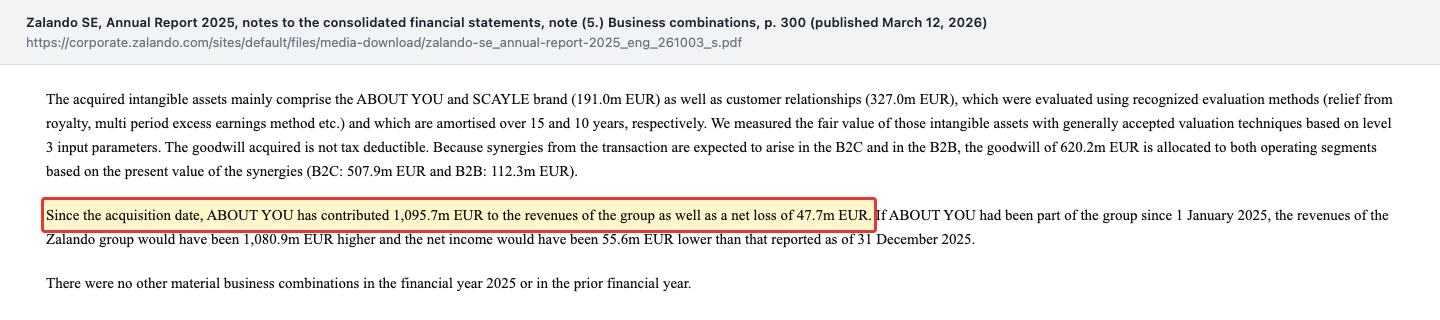
Read the second sentence again. The company itself calculates that its 2025 result would have been EUR 55.6 million lower had the acquisition been in the group for the full year. For EUR 1.03 billion, Zalando bought a business that lengthens the revenue line and shortens the profit line. That can still be the right call — market share, synergies, a second route to younger customers. But it is not a growth story. It is an integration project.
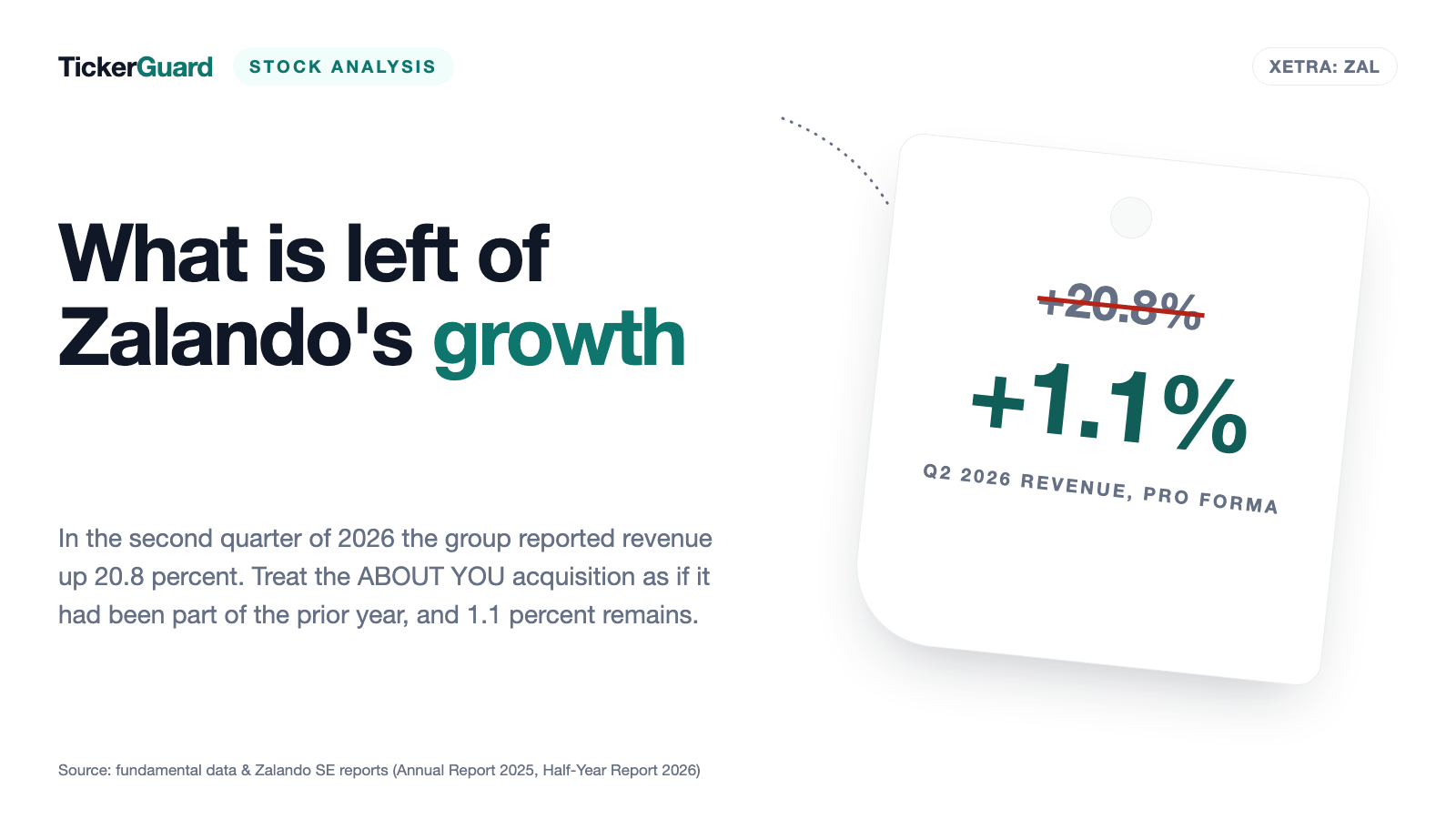
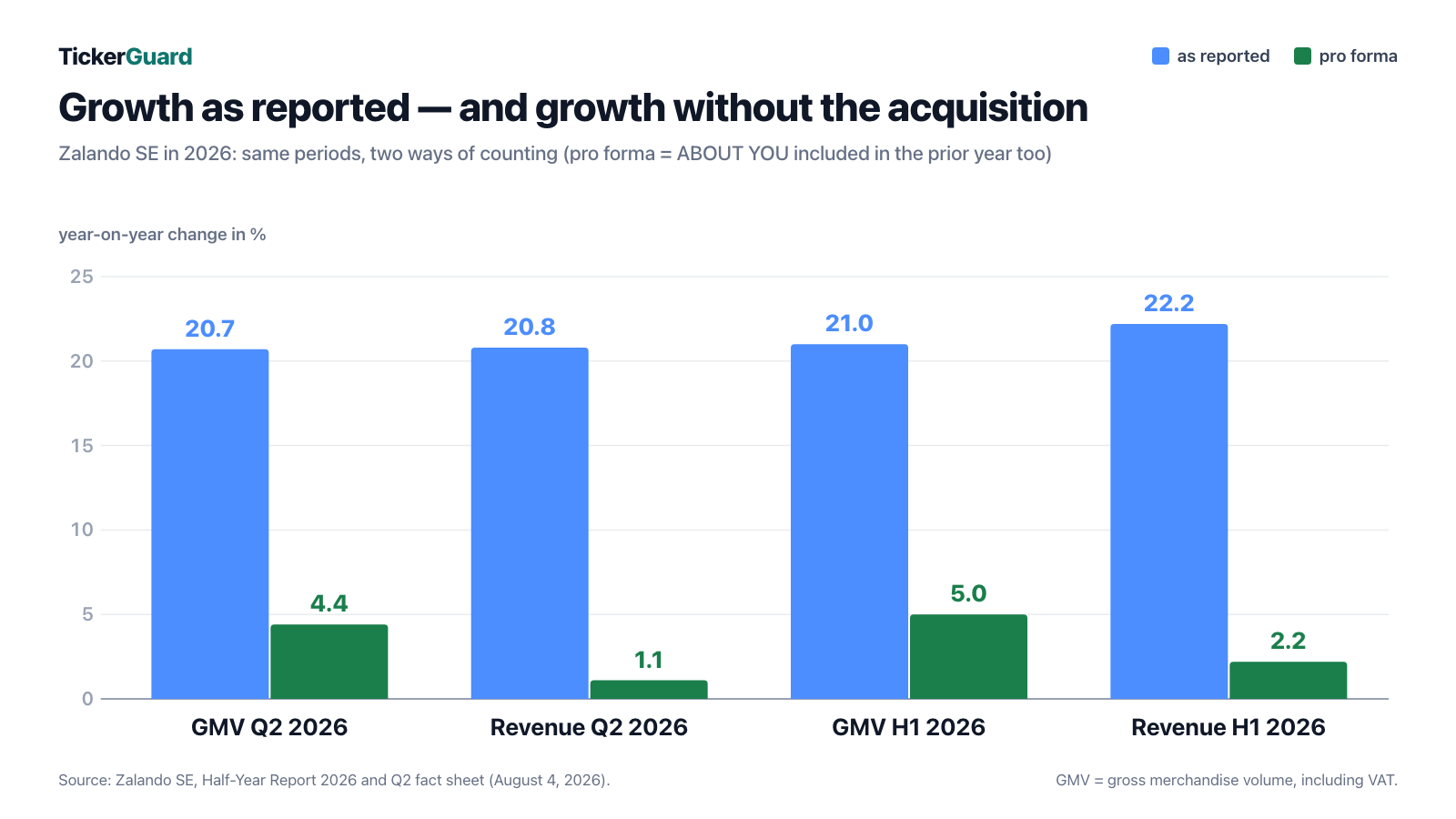
Which is why every Zalando report since 2026 carries two growth rates. In the second quarter of 2026 revenue rose 20.8 percent to EUR 3,424.4 million. Fold ABOUT YOU into the prior-year quarter as well — what the company calls pro forma — and 1.1 percent remains. For merchandise volume it is 20.7 versus 4.4 percent. Across the half-year: revenue 22.2 versus 2.2 percent, merchandise volume 21.0 versus 5.0 percent. The company spells it out:
"Reflecting a pro-forma revenue growth of +2.2%, this performance was supported by strong revenue growth in B2B and retail media, despite softer demand mainly in the B2C sneaker category."
— Zalando SE, Half-Year Report 2026, interim group management report, financial performance

For context: German online sales of clothing and shoes grew 4.0 percent in the first half of 2026 according to the industry figures cited in that same report, while bricks-and-mortar fashion retail lost 4.0 percent. On a comparable basis, then, Zalando grows roughly in line with its market — not faster. For a platform operator able to press its scale advantage against smaller merchants, that is the genuinely uncomfortable number.
Uncomfortable Truth No. 2: EUR 238 Million Sits Between "Adjusted" and Actual
"Adjusted" means: here is the result without the items we consider unrepresentative. That is legitimate and near-universal. It gets interesting when the gap between the two numbers widens.
In the first half of 2026 Zalando reported adjusted operating profit of EUR 269.6 million — up 16.1 percent. Actual reported operating profit came to EUR 31.4 million — down 81.1 percent. EUR 238.2 million sits in between. In the prior-year half the same gap was EUR 65.7 million. It has more than tripled.
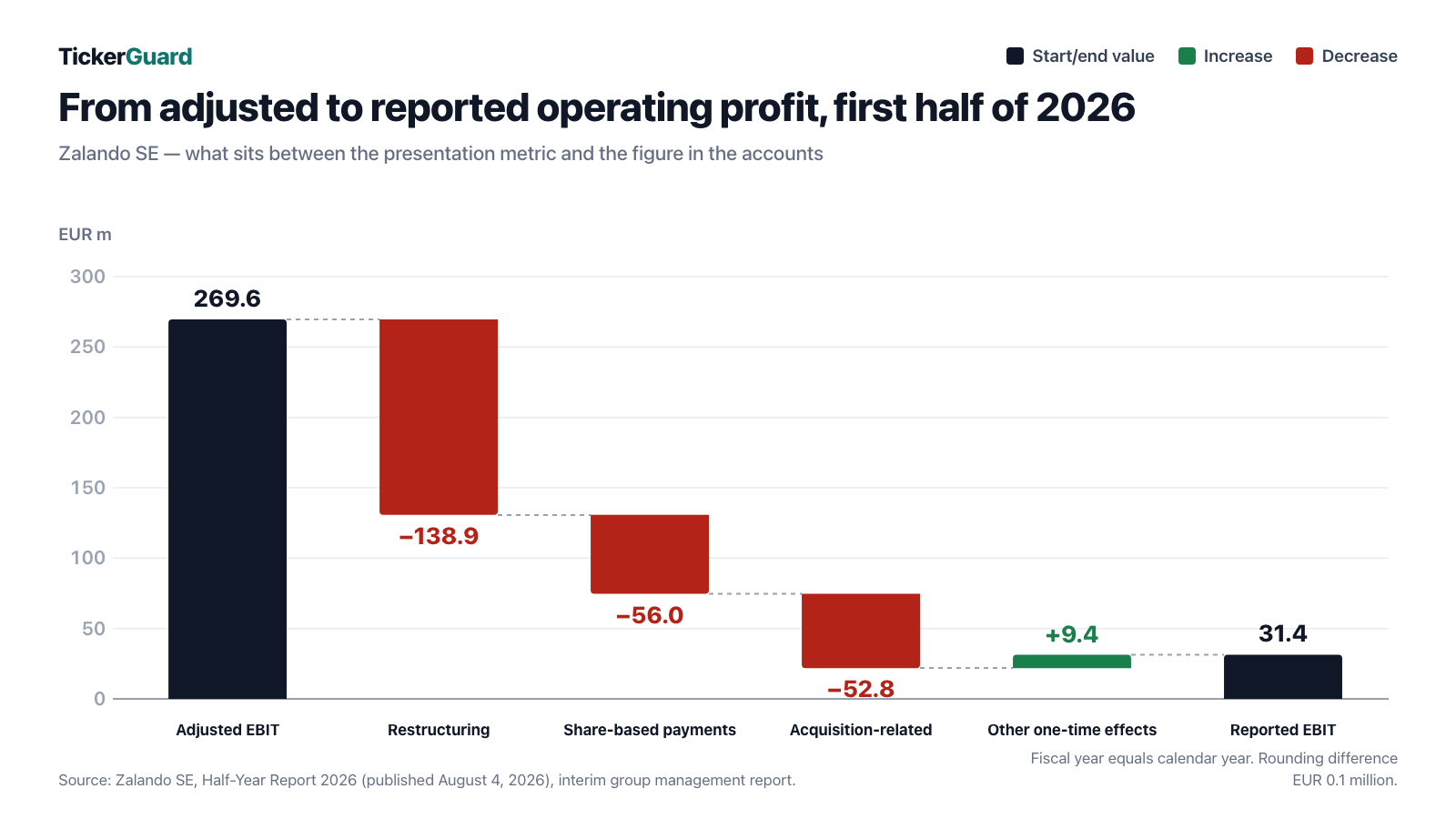
Each of the three deductions deserves its own look, because they are not equally forgivable:
- Restructuring: EUR 138.9 million (prior year EUR 14.9 million). The report attributes it mainly to the planned exit of the Erfurt fulfilment centre as part of the logistics network reshaping, plus further efficiency measures at the Berlin headquarters, in the studios and in the outlets. That is real money costing real sites — but it is genuinely one-off in nature.
- Share-based payments: EUR 56.0 million (prior year EUR 41.2 million). Here the adjustment is debatable. Shares handed to employees cost the company no cash — they dilute your slice instead. Your piece of the pie gets smaller without the pie getting bigger. This cost recurs every year, and it rose by a third between 2025 and 2026.
- Acquisition-related expenses: EUR 52.8 million (prior year EUR 9.5 million). Most of it, per the report, is the scheduled amortization of the brands and customer relationships acquired with ABOUT YOU. That amortization runs over 15 years for the brands and over 10 years for the customer relationships — it is not a one-off, it is the installment plan for the purchase price.
Those three items add up to EUR 247.7 million. Against them sit EUR 9.4 million of other one-time effects that work the other way and lift the reported figure — net, that leaves the EUR 238.2 million gap named above, with a rounding difference of EUR 0.1 million.
For the full year 2026 Zalando expects adjusted operating profit of EUR 680 to 720 million — a range narrowed in August from EUR 660 to 740 million, while the revenue outlook was cut to the lower half of the EUR 13.8 to 14.4 billion corridor. The market reacted sharply to that combination: the XETRA closing price fell from EUR 29.11 to EUR 25.22 between August 3 and August 4, 2026 — 13.4 percent in a single day.
Uncomfortable Truth No. 3: The Cash Flow Rests on Supplier Credit
The reason three value filters flag Zalando is cash flow. Which makes it worth understanding where that cash flow comes from.
Zalando runs a model called reverse factoring. It works like this: a supplier holds a claim against Zalando. Rather than wait, the supplier sells that claim to a bank and is paid immediately. Zalando pays the bank later — considerably later. The annual report puts a number on the difference: payment terms under reverse factoring run 60 to 180 days, against typically 45 to 90 days for comparable suppliers outside those arrangements. For Zalando this is cheap credit that appears on the balance sheet not under financial debt but under trade payables.
And that line has been moving hard:
- December 31, 2024: EUR 639.2 million
- December 31, 2025: EUR 931.6 million — of which EUR 284.9 million arrived on the balance sheet through the ABOUT YOU acquisition alone
- June 30, 2026: EUR 654.5 million
"Suppliers’ claims against Zalando, totalling 654.5m EUR as of 30 June 2026, were transferred to various factoring providers (prior year: 931.6m EUR); these balances were recognised under trade payables and similar liabilities."
— Zalando SE, Half-Year Report 2026, interim group management report, financial position

The EUR 277.1 million decline over six months equals roughly a tenth of total equity. And it is directly visible in the accounts: the cash flow statement line "increase/decrease in trade payables and similar liabilities" reads minus EUR 234.4 million for the first half of 2026, against plus EUR 26.3 million a year earlier. Cash flow from operating activities fell accordingly from EUR 140.8 million to EUR 35.1 million, and free cash flow from plus EUR 17.2 million to minus EUR 95.0 million.
The right dose of suspicion matters here. This is not fraud and not hidden debt — Zalando discloses both, and the fact that the group is winding down supplier financing reads more like strength than distress. But it shows how movable the metric underneath those value filters really is: a company that stretches payment terms by 30 days manufactures a cash flow jump without selling a single extra item. And the reverse holds too.
Uncomfortable Truth No. 4: The Largest Shareholder Sits on the Supervisory Board — and BaFin Noticed the Gap
Zalando's largest individual shareholder is the Danish entrepreneur Anders Holch Povlsen, chief executive of the fashion group Bestseller (Jack & Jones, Vero Moda, Only). He has sat on the supervisory board since December 2013 and held 10.1 percent of the shares as of December 31, 2025. He is therefore three things at once: co-owner, overseer — and supplier.
The size of that third relationship sits in the notes to the half-year report. In the first half of 2026 Zalando ordered EUR 184.8 million of merchandise from related parties, against EUR 122.4 million in the prior-year period — up roughly 51 percent. At the reporting date that left EUR 152.6 million of liabilities, EUR 103.3 million of which ran through a reverse factoring provider. All of these transactions were conducted on an arm's length basis according to the report, and they are disclosed — that is handled correctly. But EUR 184.8 million equals a good seven percent of equity, and a supplier of that size who also sits on the supervisory board earns a second look whenever the next report discusses purchasing terms.
In 2025 another role was added. When acquiring ABOUT YOU, Zalando bought part of the shares directly from an entity in the orbit of that same supervisory board member:
"We acquired 38,740,244 shares in ABOUT YOU for a total cash consideration of 251.8m EUR from Aktieselskabet af 12.6.2018, a company controlled by one of the members of our supervisory board."
— Zalando SE, Half-Year Report 2026, other selected notes (1.) Information about related parties

There is a reason that sentence appears only in the 2026 half-year report and not in the 2025 accounts. On June 26, 2026 Zalando announced that the German financial regulator BaFin was reviewing a disclosure in the notes to the 2025 consolidated financial statements. On July 21, 2026 the outcome followed: BaFin established that the disclosure of this relationship was missing from the notes. No fine was imposed. Zalando frames the matter this way:
"According to Zalando SE’s assessment, this is a purely formal and materially insignificant aspect of the notes to the financial statements, as all relevant information regarding the acquisition of the ABOUT YOU shares—including the companies involved, the transaction structure, and the purchase price—was already fully publicly accessible as part of the public tender offer."
— Zalando SE, investor statement of June 26, 2026
That framing is reasonable: no figure in the accounts changes, the tender offer was public, and the Annual Report 2025 records that Povlsen, because of the conflict of interest, did not take part in two supervisory board meetings while the ABOUT YOU acquisition was discussed. It nonetheless remains a formal regulatory finding of error in audited consolidated accounts — and precisely at the point where transactions with the largest shareholder are concerned. Anyone entrusting money to this company should know that setup rather than overlook it.
Completeness requires the other direction as well. The notes to the half-year report state that in January 2026 Zalando signed a contract for AI development services with a company controlled by a supervisory board member — signed before that person was elected to the board in May 2026. The minimum commitment is EUR 4.0 million for 2026 and EUR 5.0 million for 2027; EUR 0.4 million has been drawn so far. Measured against a group this size, those are small sums. The pattern is what is worth noting.
What the Stock Costs
Now the valuation — as an order of magnitude, not a daily quote. The reference point is the XETRA closing price of August 21, 2026: EUR 22.78. The share count comes from the most recent source available: per the voting rights notification under section 41 of the German Securities Trading Act, share capital was divided into 250,250,213 shares as of August 31, 2026. That figure includes the treasury shares the group holds itself — they carry neither votes nor dividends and do not count toward market value. Net of those, the June 30, 2026 consolidated accounts report issued capital of EUR 246.0 million, or roughly 246 million shares outstanding. On that basis market value comes to about EUR 5.6 billion. Strip out the small net cash position of roughly EUR 28 million and enterprise value comes to about EUR 5.58 billion. Incidentally, the same notification reveals that the share count rose in August through the issue of subscription shares out of conditional capital — dilution from the employee programmes is not a theoretical worry, it is running.
What do you get for that?
- A price-to-sales ratio of 0.41 on trailing twelve-month revenue of EUR 13.51 billion. A retailer with a four percent operating margin should not carry a high sales multiple — the question is whether 0.41 is too low or about right.
- Roughly 7.7 to 8.2 times adjusted operating profit, measured against the company's own 2026 guidance of EUR 680 to 720 million. That is the friendliest reading, because it sets aside restructuring and the amortization of the purchase price.
- Roughly 27 times 2025 earnings per share of EUR 0.83. That is the strictest reading. On a trailing twelve-month basis the multiple is far higher because of the half-year loss, and correspondingly less meaningful.
- Roughly 2.2 times book value of EUR 10.43 per share. Strip out goodwill and intangibles — together EUR 1,650.5 million, or 64.3 percent of equity — and EUR 3.72 of tangible book value per share remains, which is roughly 6.1 times.
The professionals' view, expressly as a third-party figure: the Annual Report 2025 records 27 analysts as of December 31, 2025, of whom 20 rated the stock a buy, 5 a hold and 2 a sell, at an average price target of EUR 35.99. Fundamental data show an average target of EUR 35.07 as of August 22, 2026. That is not our own view but a figure for orientation — and mostly it says the analyst community is considerably more optimistic than the share price.
One historical anchor, because it frames everything: the highest XETRA closing price in the company's history was EUR 104.65 on July 7, 2021. Between August 22, 2025 and August 21, 2026, closing prices ranged from EUR 19.085 (May 12, 2026) to EUR 30.24 (July 29, 2026). And the offer price at the October 1, 2014 initial public offering was EUR 21.50 — measured against that entry, the August 21, 2026 price stands about six percent higher, while revenue has multiplied since. The annual report also names the neighborhood: in 2025 Zalando shares lost 22 percent, the peer index of competitors six percent, while the DAX gained 23 percent.
If European consumer brands interest you, our Adidas analysis applies the same scrutiny to a company that also has to outrun its own past.
Upside and Risks at a Glance
What speaks for Zalando:
- B2B is becoming a second pillar. EUR 631.4 million of revenue in the first half of 2026 at a 10.5 percent adjusted margin, against 3.4 percent a year earlier. Software and logistics for other merchants carry better margins than selling sneakers. On August 25, 2026 ZEOS added a major client in Marks & Spencer, which intends to route its European direct-to-consumer business across 22 markets through the platform. Neither side has yet quantified the revenue contribution.
- Synergies are arriving early. Zalando puts the synergies realized from the ABOUT YOU integration in the first half of 2026 at more than EUR 20 million. Part of the integration burden has already been earned back.
- Excluding the acquisition, the margin improves. Per the second-quarter 2026 earnings-call presentation, Zalando's stand-alone adjusted operating margin rose from 6.5 to 6.6 percent in the first half, driven by B2B. ABOUT YOU itself achieved a positive adjusted operating profit, per the same presentation, while modestly diluting the group margin.
- A balance sheet without distress. EUR 1,397.8 million of cash, a small net cash position, a 29.2 percent equity ratio and no going-concern flag in the half-year report.
- The largest shareholder is buying more. After the August 4, 2026 sell-off, Zalando published managers' transactions under Article 19 of the EU Market Abuse Regulation: Anders Holch Povlsen bought in through entities attributable to him: a good 600,000 shares in total between August 5 and August 7, 2026, spread across several trading venues. That lifted his holding to roughly 28.7 million shares per the trade press — about 11.5 percent of the 250,250,213 shares outstanding. The trades were published via the EQS newswire on August 12 and 13, 2026; those are notification days, not trading days. Comparing that directly with the 10.1 percent reported as of December 31, 2025 is misleading, though, because Zalando cancelled roughly 14.0 million treasury shares in between: a smaller denominator lifts the same holding on its own. Somebody who knows the business from the inside evidently found the price too low anyway. Both readings hold at once, though: it is a vote of confidence — and it deepens precisely the entanglement listed two paragraphs below as a risk.
- Structural tailwind. Bricks-and-mortar fashion retail in Germany lost four percent in the first half of 2026 while online clothing sales gained four percent. The market keeps moving in Zalando's direction.
What speaks against it:
- Comparable growth in the low single digits. Pro forma revenue growth of 1.1 percent in the second quarter and 2.2 percent in the half-year — against market growth of four percent.
- The consumer margin is falling. In the B2C segment the adjusted margin dropped from 4.5 to 3.5 percent in the first half, and adjusted profit from EUR 214.7 million to EUR 202.3 million — despite 22 percent more revenue.
- Half-year loss and negative cash generation. Minus EUR 13.8 million of net income, minus EUR 95.0 million of free cash flow in the first half of 2026.
- Two-thirds of equity is intangible. EUR 765.9 million of goodwill and EUR 884.6 million of intangible assets against EUR 2,565.8 million of equity. Any later write-down on the ABOUT YOU purchase would land here directly.
- Dilution headroom. The 2025 annual general meeting authorized the management board to issue up to 79,181,289 new shares through May 26, 2030 — arithmetically about 30 percent of the EUR 264,181,977 share capital. The authorization has not been used so far.
- Governance entanglement. Largest shareholder, supervisory board member and merchandise supplier in one person, plus a formal BaFin finding of error on precisely that relationship.
- A 2027 repayment. The tranche B convertible bond issued in 2020, EUR 500 million nominal, matures in August 2027. At a conversion price of EUR 92.25 against a share price of EUR 22.78 it will have to be repaid in cash, not in shares.
An Honest Conclusion
Back to the label. Buy a T-shirt on Zalando and it tells you what is inside. Buy the Zalando share and you have to write the label yourself — and the composition looks like this: 22.2 percent revenue growth in the first half of 2026, of which 20 percentage points came from an acquisition costing EUR 1.03 billion and 2.2 percentage points from the company's own effort. EUR 269.6 million of adjusted operating profit, of which EUR 238.2 million are items the group considers unrepresentative and EUR 31.4 million actually remain. A cash flow that trips value filters — and that rests, to a movable degree, on stretched payment terms toward suppliers.
None of this is a scandal. Zalando is a functioning, Europe-wide business with EUR 1.4 billion of cash, a model the market is pushing toward, and a B2B arm that is getting genuinely good right now. Origin blindness is dangerous anyway, because it cuts both ways: it makes bought growth look homegrown — and it can equally hide a solid operation behind a disappointing headline.
So the most honest sentence in this analysis is an open question: nobody — Zalando included — can tell you today whether the EUR 1.1 billion of acquired ABOUT YOU revenue will be a profit engine in three years or a write-down. The next solid data point is the third-quarter statement on November 3, 2026. Until then: what you make of it is your decision. And that is exactly as it should be.
Sources and Disclaimer
- Zalando SE, Half-Year Report 2026 — signed by the management board in Berlin on August 3, 2026, published August 4, 2026: key figures, interim group management report, segment reporting, cash flow statement, financial position, outlook and condensed notes including earnings per share, equity, trade payables and information about related parties
- Zalando SE, Annual Report 2025 — published March 12, 2026: key figures, foreword, the Zalando share, shareholder structure, takeover law disclosures, notes on trade payables, convertible bonds and business combinations (ABOUT YOU purchase price allocation)
- Zalando SE, Q2 2026 fact sheet of August 4, 2026 — reported and pro forma growth rates, segment figures, narrowed guidance
- Zalando SE, second-quarter 2026 earnings-call presentation — pro forma view, first-half synergies, Zalando stand-alone margin, SCAYLE STUDIOS
- Zalando SE, second-quarter 2026 results announcement — August 4, 2026
- Zalando SE, statement on the BaFin review of June 26, 2026 and statement on its conclusion of July 21, 2026
- Zalando SE, Directors' Dealings — managers' transactions under Article 19 of the EU Market Abuse Regulation, published via the EQS newswire on August 12 and 13, 2026; the underlying trading days are August 5, 6 and 7, 2026. The holding and stake figures follow consistent trade-press reporting from August 2026
- Zalando SE, voting rights notification under section 41 of the German Securities Trading Act dated August 31, 2026 (distributed via the EQS newswire) — total voting rights 250,250,213, occasion: issue of subscription shares out of conditional capital
- Marks & Spencer plc, press release of August 25, 2026 — extension of the ZEOS partnership to the full European direct-to-consumer business across 22 markets, results of the Polish pilot
- Price, market value and range figures: fundamental data, XETRA closing prices through August 21, 2026. The twelve-month range was calculated by us from closing prices in the August 22, 2025 through August 21, 2026 window
Disclaimer: This article is journalistic analysis and expressly not investment advice, not a solicitation to buy or sell securities, and not a recommendation. Shares can lose their entire value; a total loss is possible. All figures come from the original reports linked above and are quoted with their respective reporting dates. The author holds no position in Zalando shares at the time of publication.
Our Bottom Line at a Glance
- Origin of the growth negative
- Reported revenue rose 22.2 percent in the first half of 2026 and 2.2 percent pro forma; in the second quarter it was 20.8 versus 1.1 percent. Comparable merchandise volume grew 5.0 percent while German online fashion retail grew 4.0 percent according to the industry figures cited in the half-year report — under its own steam, Zalando grows roughly with its market.
- Quality of earnings negative
- EUR 238.2 million separated adjusted operating profit (EUR 269.6 million) from reported operating profit (EUR 31.4 million) in the first half of 2026, against EUR 65.7 million a year earlier. The bottom line was a loss of EUR 13.8 million and earnings per share fell from plus EUR 0.41 to minus EUR 0.05 (Half-Year Report 2026).
- B2B business positive
- Revenue rose 25.7 percent (pro forma 18.9 percent) to EUR 631.4 million in the first half of 2026, adjusted operating profit from EUR 17.2 million to EUR 66.4 million and the margin from 3.4 to 10.5 percent. ZEOS, SCAYLE and Tradebyte thus deliver roughly a quarter of adjusted group profit on close to a tenth of revenue (Half-Year Report 2026, segment reporting).
- Balance sheet and cash generation neutral
- As of June 30, 2026 there is EUR 1,397.8 million of cash, a 29.2 percent equity ratio and a small net cash position of roughly EUR 28 million. Against that: free cash flow of minus EUR 95.0 million for the half-year, supplier financing down from EUR 931.6 million to EUR 654.5 million, and goodwill plus intangibles at 64.3 percent of equity.
- Governance and ownership negative
- The largest individual shareholder is also a supervisory board member and a merchandise supplier: EUR 184.8 million of related-party merchandise orders in the first half of 2026, after EUR 122.4 million. On July 21, 2026 BaFin established that the 2025 notes omitted the acquisition of ABOUT YOU shares worth EUR 251.8 million from a company controlled by that board member; no fine was imposed.
- Valuation neutral
- At the August 21, 2026 close of EUR 22.78 the market value is about EUR 5.6 billion, the price-to-sales ratio 0.41 and the multiple of adjusted operating profit guided for 2026 roughly 7.7 to 8.2. Measured against tangible book value of EUR 3.72 per share it is roughly 6.1 times.
Zalando reports 22.2 percent revenue growth for the first half of 2026 — on a comparable basis it is 2.2 percent, the rest coming from the EUR 1.03 billion ABOUT YOU acquisition. Reported operating profit fell 81.1 percent to EUR 31.4 million and the bottom line showed a EUR 13.8 million loss. Against that stand a fast-growing B2B business at a 10.5 percent margin, EUR 1.4 billion of cash and a market that keeps shifting online. Whether the acquisition ends as a profit engine or a write-down remains open. Not investment advice.
What Our Rating Means
Open questions
The business works in principle, but one material question is open. As long as it stays open, our findings do not carry a quality verdict.
The business works: by its own description Europe's leading fashion platform, with 62.5 million active customers in 29 markets, profitable in each of the last six financial years, EUR 1,397.8 million of cash, a small net cash position and no going-concern flag. Two things are missing for green. First, the key operating question is open: under its own steam revenue grows only one to two percent, the consumer-segment margin fell from 4.5 to 3.5 percent in the first half of 2026, and whether the EUR 1.03 billion spent on ABOUT YOU produces profit is undecided after a EUR 13.8 million half-year loss. Second, the entanglement with the largest shareholder — who also sits on the supervisory board and supplies merchandise — together with a formal BaFin finding of error on the 2025 notes deserves attention. Neither is a documented threat to the substance of the company, so it is yellow rather than red. The decision is yours.
A journalistic assessment by our editorial team at the time of the deep dive, based on public sources — not investment advice and not a solicitation to buy or sell. Your personal circumstances (investment goals, risk capacity, taxes) cannot be taken into account. What our levels mean, how verdicts are formed, and what conflicts of interest exist →
Worth Noting
- This analysis was triggered by a confluence hit across three value lists in our in-house stock scanner (price-to-sales, price-to-cash-flow and price-to-free-cash-flow rankings, data as of August 22, 2026), not by a news event.
- Key figures as of August 22, 2026. All company figures come from the Annual Report 2025 (published March 12, 2026), the Half-Year Report 2026 (published August 4, 2026) and the Q2 2026 fact sheet. Price and market value figures come from fundamental data, XETRA closing prices through August 21, 2026.
- Mandatory disclosures through September 5, 2026 were reviewed. Included are the section 41 voting rights notification of August 31, 2026 (250,250,213 shares) and the extension of the ZEOS partnership with Marks & Spencer of August 25, 2026. There was no ad hoc announcement, no change of guidance and no capital measure in that period; the next periodic report is the quarterly statement on November 3, 2026.
- Zalando is not an SEC filer: no 10-K, no 10-Q, no 20-F. The ZLNDY depositary receipt trades over the counter and creates no separate reporting duty; the governing listing is the Prime Standard of the Frankfurt Stock Exchange under ZAL.
- The twelve-month range in the profile is based on XETRA CLOSING prices in the August 22, 2025 through August 21, 2026 window (EUR 19.085 to EUR 30.24). Fundamental data quote EUR 18.61 and EUR 30.43, which are intraday values and are deliberately not used here.
- The analyst targets quoted — EUR 35.99 per the Annual Report 2025 as of December 31, 2025 and EUR 35.07 per fundamental data as of August 22, 2026 — are third-party figures for orientation, not targets of this publication.
- The August 2026 purchases by the largest shareholder rest on managers' transactions published via EQS on August 12 and 13, 2026 and on consistent trade-press reporting. The trading days were August 5, 6 and 7, 2026; August 12 and 13 are notification days. Stake percentages from different dates are not directly comparable, because Zalando cancelled roughly 14.0 million treasury shares in the first half of 2026 and thereby reduced the total share count. A correction notice dated August 13, 2026 clarifies that a partial acquisition of EUR 4,922,920 on August 5, 2026, first reported as off-venue, did not take place in that form but was already covered by the notifications for the individual trading venues — the total is unchanged.
- Gross merchandise volume and revenue are two different figures at Zalando: in the partner business the full selling price counts toward merchandise volume but only the commission counts as revenue. That is why the two growth rates regularly diverge.
The full analysis as a PDF for later
We will send you this analysis as a PDF — to print, file away, and read at your own pace.
Frequently Asked Questions
Because the growth comes mostly from the ABOUT YOU acquisition, consolidated since July 11, 2025. On a comparable basis, first-half 2026 revenue grew 2.2 percent. At the same time restructuring, share-based payments and amortization of the purchase price weighed on earnings by EUR 238.2 million combined, leaving a bottom-line loss of EUR 13.8 million.
Pro forma means ABOUT YOU is treated as if the group had already owned it in the prior-year period. That is the only way to compare two periods on a like-for-like basis. In the second quarter of 2026 reported revenue rose 20.8 percent and pro forma revenue 1.1 percent. For merchandise volume it was 20.7 versus 4.4 percent. Zalando publishes both figures itself.
Consideration for 91.5 percent of the shares came to EUR 1,028.7 million, EUR 917.7 million of it in cash. The remaining shares followed through a squeeze-out for EUR 96.6 million. The balance sheet carries EUR 620.2 million of goodwill and EUR 612.9 million of acquired intangibles from the deal, including brands at EUR 191.0 million and customer relationships at EUR 327.0 million.
Following the half-year report, Zalando expects merchandise volume and revenue in the lower half of the EUR 19.7 to 20.6 billion and EUR 13.8 to 14.4 billion corridors respectively. Adjusted operating profit was narrowed to EUR 680 to 720 million from EUR 660 to 740 million. Capital expenditure remains guided at EUR 240 to 300 million.
Zalando is listed in the Prime Standard of the Frankfurt Stock Exchange and reports under European capital markets law: audited IFRS consolidated financial statements and a half-year financial report under section 115 of the German Securities Trading Act. In the United States only an over-the-counter depositary receipt trades under the symbol ZLNDY, which creates no separate reporting duty with the U.S. securities regulator, the SEC.
On July 21, 2026 BaFin established that the notes to the 2025 consolidated accounts omitted the disclosure that Zalando had acquired 38,740,244 ABOUT YOU shares for EUR 251.8 million from a company controlled by a supervisory board member. No fine was imposed. Zalando calls the point purely formal; the disclosure was added in the Half-Year Report 2026.
Under reverse factoring a supplier sells its claim against Zalando to a bank and is paid immediately, while Zalando pays later. Payment terms run 60 to 180 days instead of 45 to 90, per the annual report. The volume fell from EUR 931.6 million on December 31, 2025 to EUR 654.5 million on June 30, 2026, which weighed directly on operating cash flow.
No. Zalando has never paid a dividend since its 2014 initial public offering, and fundamental data show no distribution as of August 22, 2026. Capital is returned through buybacks instead: in the first half of 2026 the group repurchased 13,992,508 of its own shares for close to EUR 300 million and cancelled around 14.0 million of them.
Found an error?
Did you spot a factual error, an outdated number, or a typo in this deep dive? Let us know briefly — your report goes straight to the editorial team.