Youngpoong Grew Revenue Up to 49 Percent in a Quarter — the Profit Comes From a Contested Stake, the Record Fine From Four Hidden Years
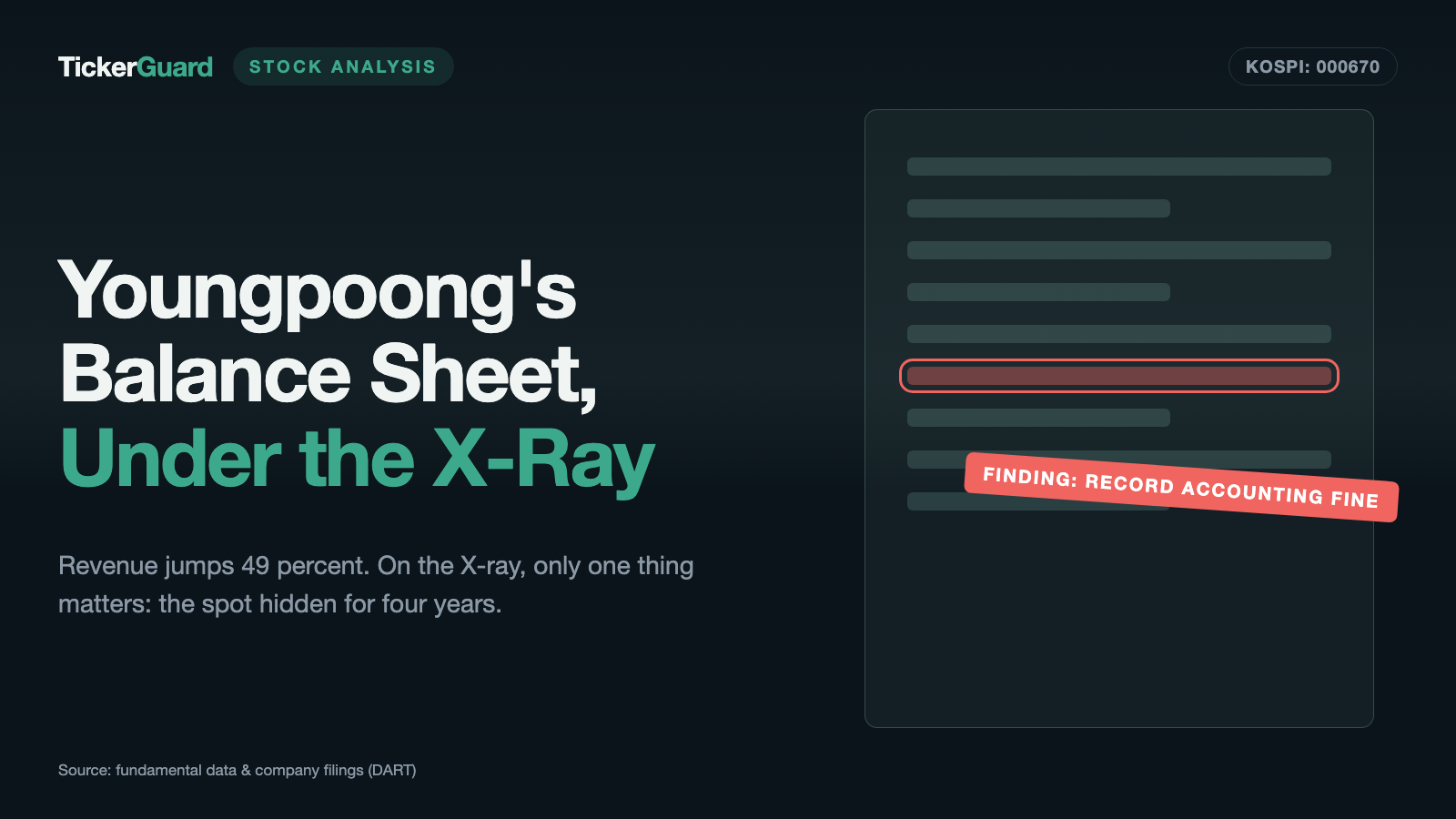
Youngpoong showed up at No. 2 on our in-house "revenue inflection" stock scanner, with quarterly revenue growth of up to 49 percent (after a currency-conversion fix in the scanner: No. 7 of 28). The semi-annual report tells a more complicated story: roughly half of group revenue now comes from circuit-board and semiconductor subsidiaries, not the zinc smelter — and part of the growth is simply recovery from a self-inflicted plant shutdown. The headline profit is over 80 percent non-operating, tied to a disputed stake in Korea Zinc — while South Korea's securities regulator just hit Youngpoong with the largest single accounting fine in the country's history for years of understated environmental liabilities. Not investment advice — just a look at what is actually behind the acceleration.
 Thomas Mücke
Founder & Publisher
Thomas Mücke
Founder & Publisher
There is an investor trap that starts with a very human weakness — call it the denial trap. You probably know it from your own life: the medical test result is unpleasant, so you push it aside and focus on the good news from the scale instead. The problem does not disappear — it just keeps growing until it can no longer be denied. That exact trap sits, with a remarkable twist, at the center of this analysis: Young Poong Corporation (KOSPI: 000670) landed on our desk through our in-house stock scanner "revenue inflection" — No. 2 of 33 hits on August 23, 2026; after a currency-conversion fix in the scanner later that same day, the list ranks the stock No. 7 of 28 — with quarterly revenue growth of up to 49 percent. Sounds like a growth story. Then you read the semi-annual report 2026 — filed August 14, 2026 with South Korea's securities regulator, in the disclosure system DART, the Korean counterpart to America's EDGAR — and halfway through the litigation chapter you run into a sentence you have to read twice as a shareholder: the regulator just hit Youngpoong with the largest single fine for an accounting violation in Korean history — because the company spent four years denying exactly the bad news that is now so expensive. Let's make a deal: we read together what is actually behind the acceleration before you form an opinion. A filing to a securities regulator is honest under penalty of law — a rule that, as you will see, applies rather literally this time.
What Youngpoong Actually Does
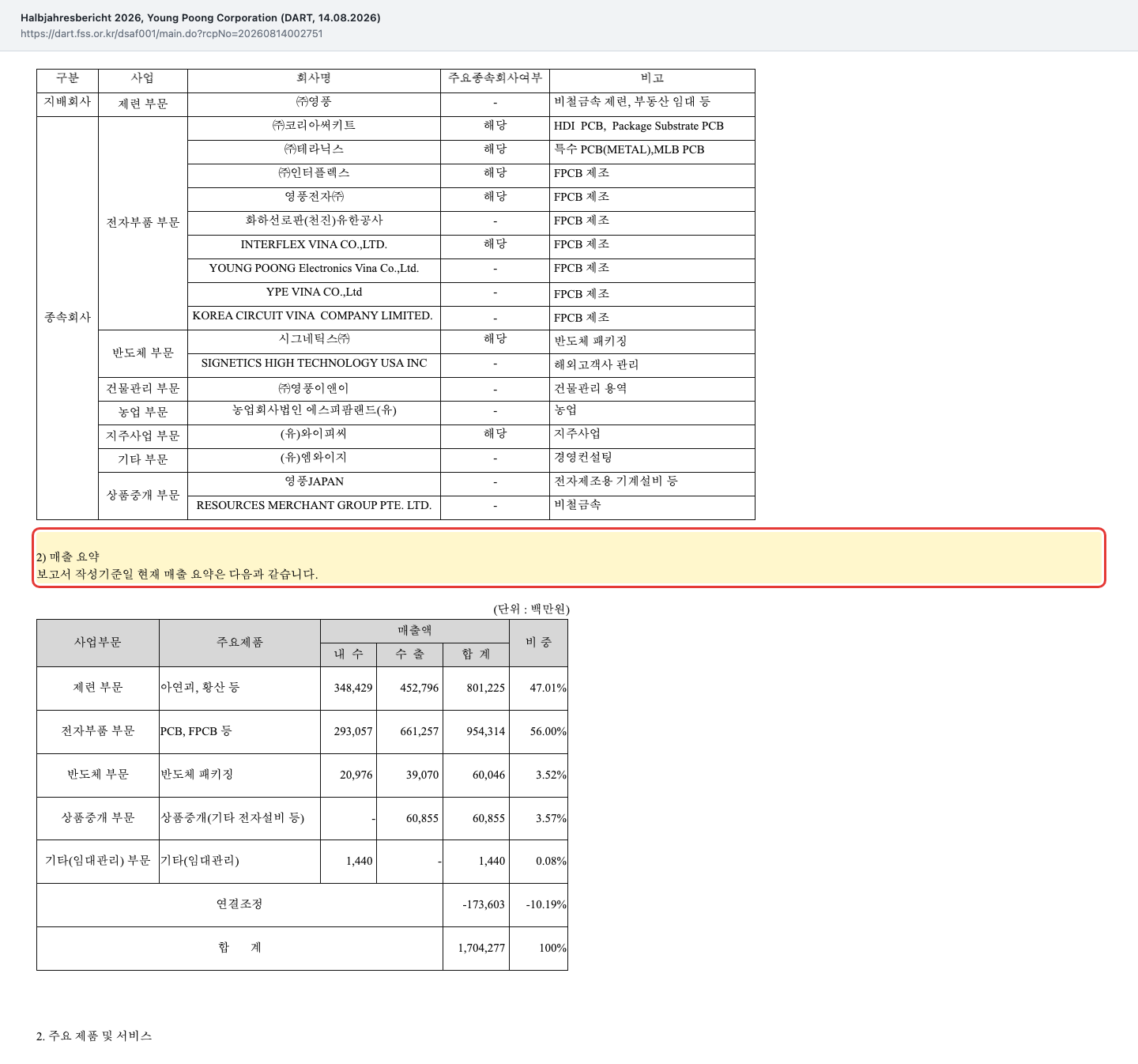
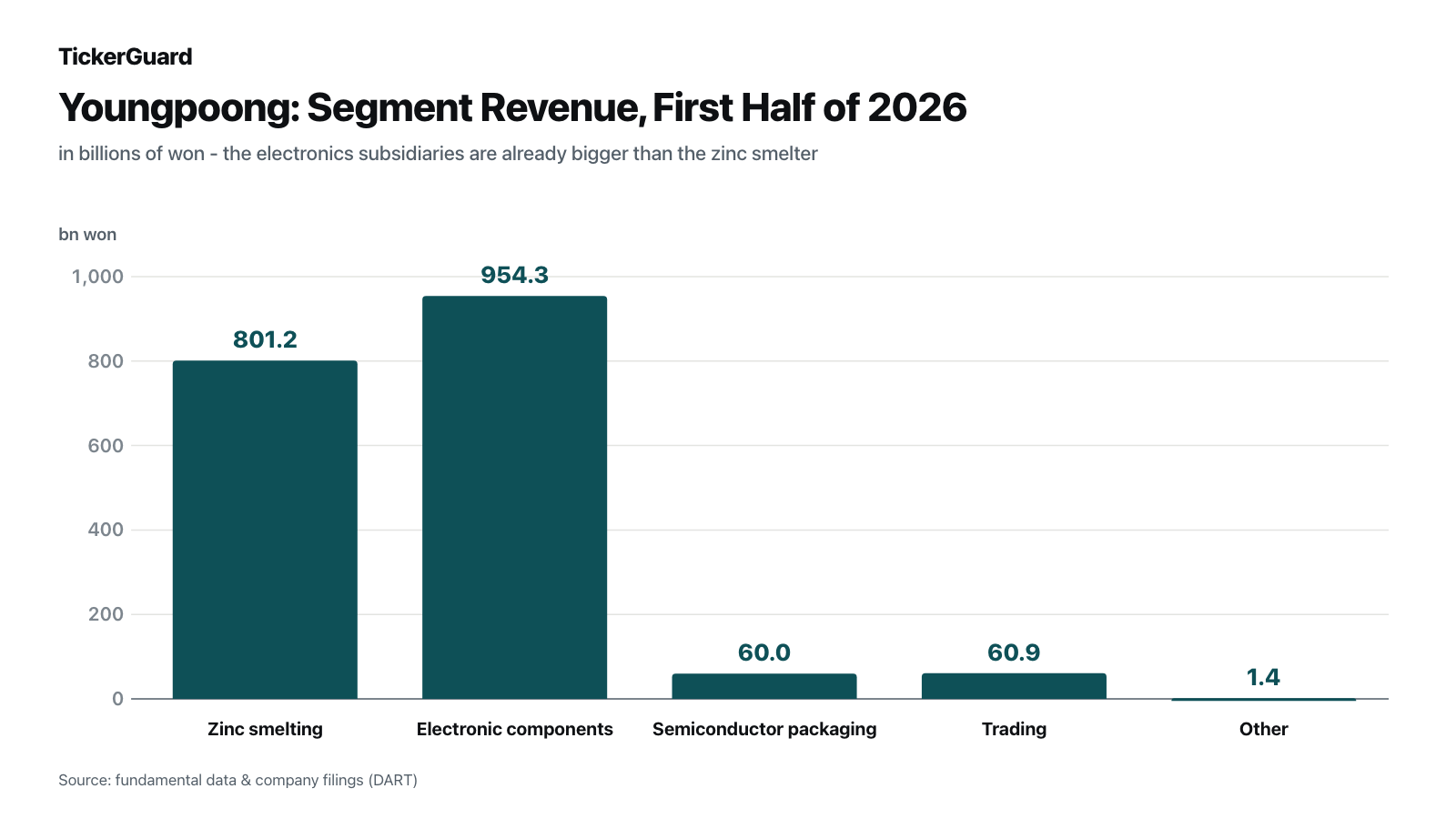
The name suggests a zinc smelter, and historically that is exactly what Youngpoong was: founded in November 1949 as a trading company, listed on the Korean stock exchange in 1976, operator for decades of the Seokpo zinc smelter in North Gyeongsang Province — one of Asia's largest nonferrous-metal smelters, producing zinc ingots and sulfuric acid as a byproduct. Zinc, in everyday terms, is the invisible rust protection around you: it coats car body panels, structural steel, guardrails and gutters as a corrosion-resistant plating. The business tracks the world zinc price (London Metal Exchange, LME) and the won-dollar exchange rate — both moved noticeably in the first half of 2026: the LME zinc price averaged $3,353.19 per metric ton, up 22.4 percent year over year, and the exchange rate averaged 1,482.88 won per dollar, up 3.9 percent. But that is only half the story. Youngpoong is now a five-segment group, and the other half is bigger: through subsidiaries such as Korea Circuit, Interflex, Teranix and Youngpoong Electronics, the group manufactures printed circuit boards (PCBs) and flexible printed circuit boards (FPCBs) — the carrier boards a smartphone's, a memory module's or a car's components sit on. Through its Signetics subsidiary, Youngpoong also runs a semiconductor-packaging business (sealing finished chips into a protective casing before they go into a device) for customers including Samsung Electronics, LG Electronics and Infineon. In the first half of 2026, the five segments' revenues added up to 1,877.9 billion won — about 173.6 billion won more than consolidated group revenue of 1,704.3 billion won, because that total also includes revenue booked between the group's own segments. Measured against that segment total, 801.2 billion won (42.7 percent) came from the zinc smelter, 954.3 billion won (50.8 percent) came from the electronics business, with the rest from semiconductor packaging and trading (semi-annual report 2026, chapter II). Remember the picture: anyone who hears "Youngpoong" and thinks only of zinc now knows less than half the company. On top of that sits a stake that matters more to the balance sheet than both operating businesses combined — more on that shortly.
Company history for investors
-
1949
Founded as a trading company
Youngpoong is founded as a trading company in November 1949 and lists on the Korean stock exchange on June 12, 1976 — the origin of today's group structure, including the Seokpo zinc smelter.
-
2023
Korea Zinc raises capital, Youngpoong sues
Korea Zinc's September 13, 2023 capital increase dilutes Youngpoong's stake — the starting point of the still-ongoing legal fight over Youngpoong's holding in its most important asset.
-
2024
Open power struggle: tender offer and counter-tender
MBK Partners and Youngpoong bid roughly 2 trillion won for Korea Zinc shares on September 13, 2024; Korea Zinc counters on October 2, 2024 with its own buyback offer worth up to 3.1 trillion won.
-
2025
Youngpoong's voting rights blocked at Korea Zinc
Via a circular-ownership structure (Sun Metals Holdings buys 10.33% of Youngpoong), Korea Zinc blocks Youngpoong's voting rights at its own shareholder meetings on January 23 and March 28, 2025 — a real loss of control for Youngpoong shareholders.
-
2026
Record accounting fine for hidden environmental liabilities
On June 22, 2026 the regulator imposes the largest single accounting-violation fine in Korean history (20.47 billion won) — four years of understated environmental provisions are officially ruled intentional.
-
2026
Semi-annual report: a revenue jump, but a borrowed profit
The August 14, 2026 report shows +45.5% revenue growth, but a profit that is over 80 percent tied to the Korea Zinc stake — proof, for shareholders, of just how intertwined the two stories are.
Where the Stock Shows Up in Our Scanner
The hook here is our in-house stock scanner "revenue inflection" (publicly viewable; to replicate: open the scanner list, sort by the "acceleration" column). The rule behind it, in our own words: the most recent at least two quarters must have grown 30 to 70 percent versus their respective year-ago quarter — a band, not a pure floor, because triple-digit growth usually means you are already deep into a story the market has priced in. Before that, at least four quarters must each have grown under 15 percent — only that quiet stretch turns an ongoing growth stock into a fresh inflection. Two safety nets round it out: a minimum revenue base of $100 million (when this stock was first flagged, the scanner's "$ million" column still showed the raw won figure under a dollar label — 3,188,197 rather than a genuine dollar conversion; that bug was fixed on August 23, 2026, and the list has shown converted dollar values ever since, $2,302.0 million for Youngpoong), and an exclusion for heavy diluters. The underlying backtest shows why the criterion works: stocks with a fresh inflection returned an average of 16.6 percent a year in the backtest, versus 9.9 percent for already-established growth names. For Youngpoong, the criterion checks out quarter by quarter: Q1 2026 revenue grew 48.8 percent to 851.1 billion won, Q2 2026 grew 42.2 percent to 853.2 billion won — both cleanly inside the 30-to-70-percent band. Before that came the four quiet quarters: full-year 2025 revenue grew just 4.4 percent versus 2024 (2,909.0 billion won versus 2,787.4 billion won) — arithmetically that forces every single 2025 quarter under the 15-percent line, and Q1 2025 (571.9 billion won) and Q2 2025 (599.8 billion won) were in fact down sharply against their own year-ago quarters, per the semi-annual report. The rest of the scanner row, translated and rated: fundamental rating 49 of 100 points (grade C — mediocre), Piotroski F-score 4 of 9 (a nine-point balance-sheet health test; 4 is weak, a genuinely healthy company sits at 8 or 9), Altman Z-score 1.4 (below 1.8 is generally read as a distress zone — more on that in the valuation chapter), growth score 2 of 10 possible criteria met. In short: the scanner found a real, mechanically verifiable revenue jump — but the surrounding metrics already hint that not everything underneath it is in order.
The Numbers Over the Years — Honestly Appraised
Start with what genuinely impresses. After two weak years of operating losses (2024: -160.7 billion won, 2025: -259.7 billion won, both group level), the business swung to a profit in the first half of 2026: 44.8 billion won in operating profit, up from an operating loss of 150.4 billion won in the first half of 2025. That is a real turnaround, not a one-off blip — both segments contributed: higher zinc prices plus a weaker won at the smelter, and higher average selling prices (including for memory-module circuit boards) plus new telecom and automotive-electronics customers at the electronics segment.
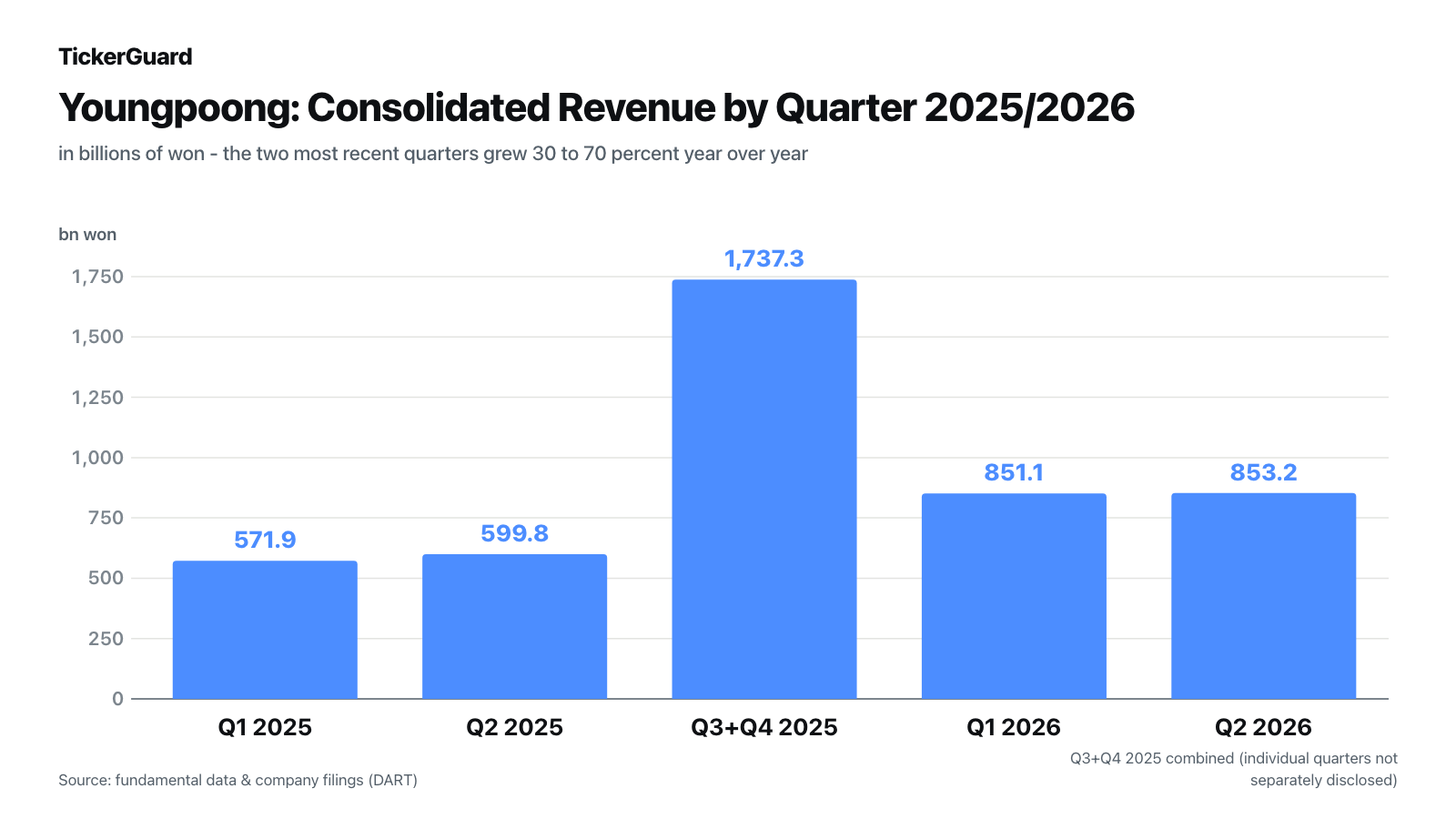
And the first-half profit reads spectacularly at first glance: 407.0 billion won in net income, up 54 percent from 264.3 billion won a year earlier — against a market capitalization of just 686.7 billion won, that looks like a profit for which an investor today pays a little more than one and a half times the half-year result to buy the entire company. Before you book that number as operating earning power, look at the revenue split by segment — it explains why the revenue jump itself is not quite what it looks like:
One detail tempers the picture further: Youngpoong has paid no cash dividend for years, only small stock dividends — 0.04 new shares per share for fiscal 2024 (4.0 percent), 0.03 per share for fiscal 2025 (3.0 percent), each decided at the spring shareholders' meeting. The "dividend yield" of roughly 0.3 percent shown in fundamental-data feeds therefore reflects no cash flow to shareholders at all — it reflects share dilution running in the opposite direction from a buyback. If you were expecting a cash dividend from Youngpoong, you read the wrong line.
What the Filings Say — the Uncomfortable Truths
Uncomfortable truth No. 1: Youngpoong denied its own environmental liabilities for four years — and got South Korea's largest-ever accounting fine for it
This is where the denial trap from the opening comes full circle. On June 22, 2026, Youngpoong received a sanction from South Korea's Securities and Futures Commission (SFC) that the semi-annual report itself describes as follows:
"지배기업은 2026년 6월 22일 증권선물위원회로부터 「주식회사 등의 외부감사에 관한 법률」에 따라 석포제련소와 관련한 토양정화 및 지하수정화 충당부채의 과소계상, 유형자산 손상차손의 과소(과대)계상(2021년부터 2024년까지의 보고기간) 등 회계처리기준 위반과 관련하여 시정요구(조치서를 받은 날로부터 1개월 이내에 지적사항을 회계장부 및 재무제표에 반영), 감사인 지정 3년, 전 대표이사 해임권고 상당, 담당임원 및 전 담당임원 해임(면직)권고 및 직무정지 6개월 등의 조치처분을 받았습니다."
— Young Poong Corporation, Semi-annual report 2026, chapter XI, item 4 (DART, filed August 14, 2026). On the SFC's decision received June 22, 2026: the sanctions cited understated provisions for soil and groundwater remediation and understated (and overstated) impairment losses on property, plant and equipment at the Seokpo smelter for reporting periods 2021 through 2024, ordering a corrective filing within one month, a three-year mandatory external-auditor designation, a recommendation to dismiss the former CEO, and a dismissal recommendation plus six-month suspension for the responsible current and former executives.
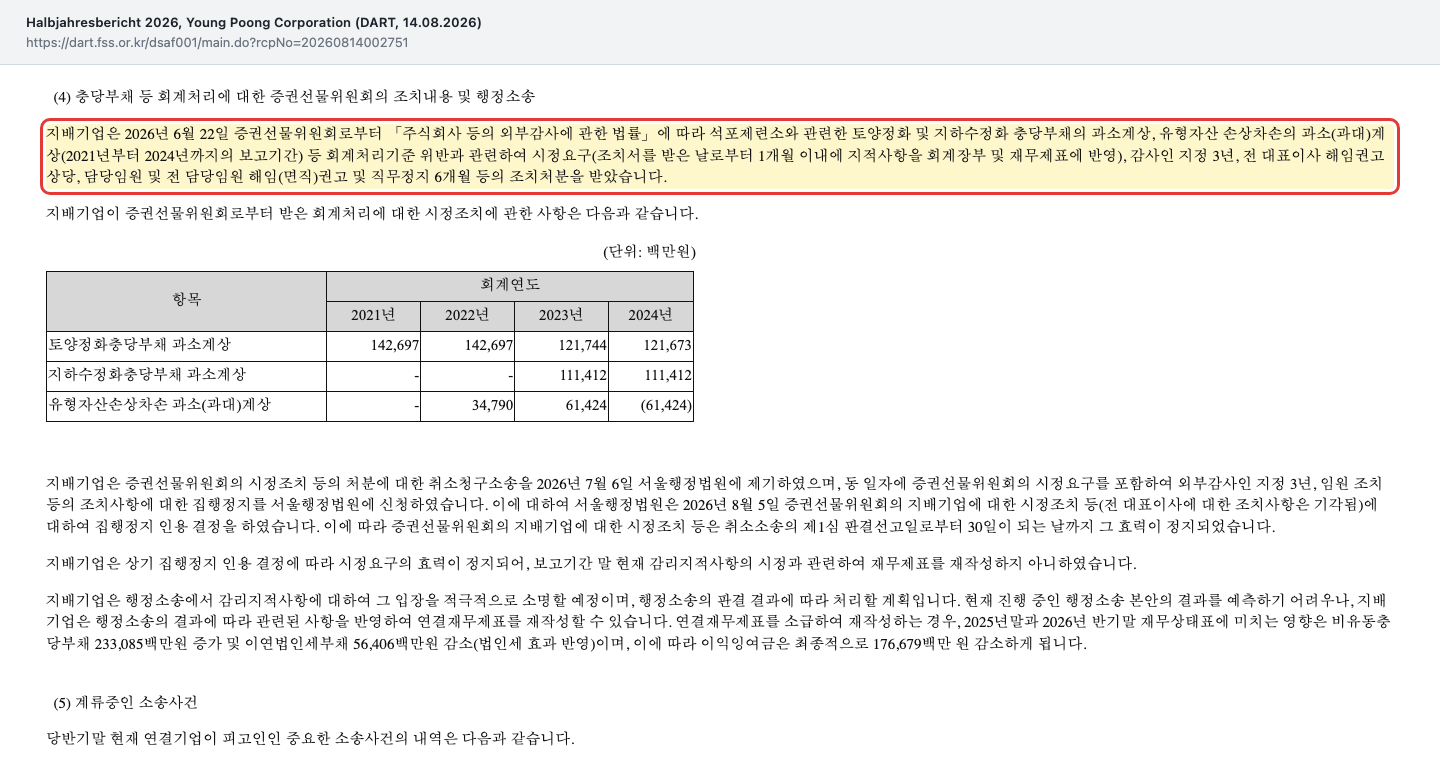
Year by year, from the same table: soil-remediation provisions were understated by 142.7 billion won each in 2021 and 2022, and by roughly 121.7 billion won each in 2023 and 2024 — on top of that, groundwater-remediation provisions were understated by 111.4 billion won in both 2023 and 2024, for a combined 233.2 billion won (2023) and 233.1 billion won (2024) — nearly a third of today's market capitalization, hidden year after year. On top of that, impairment losses on the smelter's fixed assets were understated by 34.8 billion won (2022) and 61.4 billion won (2023), then overstated by 61.4 billion won in the opposite direction in 2024 — as if the earlier gap had been over-corrected in one stroke. The fine: 20.47 billion won against the company — per Digital Daily (July 19, 2026), the largest single fine ever imposed in a Korean accounting-violation case — plus 1.51 billion won against four former and current board members and 1.07 billion won against external auditor Daejoo Accounting Corp. Picture it this way: imagine hiding a loan you actually owe from your bank for four years to keep your credit score looking good — and then getting caught because the bill eventually comes due regardless. That is essentially what the SFC accused Youngpoong of, and explicitly as intentional, not a defensible judgment call. Youngpoong is fighting back: on July 6, 2026 the company sued at the Seoul Administrative Court and simultaneously requested a stay of enforcement — which the court granted for the measures against the company on August 5, 2026 (though not for the former CEO's personal sanction). That is why the restatement had not happened as of this report's cutoff date — if Youngpoong ultimately loses, 233.1 billion won in additional provisions and a 176.7 billion won hit to retained earnings loom.
Uncomfortable truth No. 2: A good chunk of the "acceleration" is recovery from a self-inflicted plant shutdown
The scanner measures against the year-ago quarter — and last year is exactly where the reason for a deep, self-inflicted decline sits. From February 26 to April 24, 2025, the Seokpo smelter had to shut down completely for 58 days — a government order from the Ministry of Environment and North Gyeongsang Province, based on a final court ruling in an older water-pollution case (cadmium discharge, dating to 2019); Korean business media reported the actual shutdown in detail, and the semi-annual report itself confirms in retrospect that this measure was carried out. The environmental authority separately imposed two further 10-day shutdown orders in 2025 over newer, unrelated permit violations (March 4, 2025 and September 16, 2025) — Youngpoong is contesting these through administrative litigation, and the semi-annual report explicitly states that the smelter is currently operating normally; execution of these two orders has not occurred as of the report. The 58-day shutdown that was actually carried out hit the smelter's revenue and results hard in the first half of 2025 — both Q1 2025 (571.9 billion won) and Q2 2025 (599.8 billion won) came in well below their respective year-ago quarters. Part of the seemingly spectacular 2026 growth is therefore arithmetically not new demand, but simply recovery from the company's own, government-ordered pause. One more detail from the litigation chapter fits the pattern: Youngpoong already carries a 115.1 billion won provision for ordered soil remediation around Seokpo (Bonghwa County, North Gyeongsang Province) and is separately suing over an arsenic-specific soil-remediation order issued December 26, 2025 — the smelter's environmental record is not a closed chapter, it is an ongoing, litigated liability. Remember the pattern: whoever reads only the growth rate sees the recovery — whoever checks the year-ago base sees what is being recovered from.
Uncomfortable truth No. 3: Most of the record profit did not come from the business — it came from the power struggle over Korea Zinc
The 407.0 billion won first-half profit looks like a runaway success story — until you read one line further down the income statement. Against operating profit of 44.8 billion won stand financial income of 374.5 billion won and an equity-method share of associate income of 189.1 billion won — the latter essentially the proportional profit from the stake in Korea Zinc Co., Ltd., held through the wholly owned subsidiary YPC Limited. Combined with other income and net of financial expenses, pre-tax income came to 524.1 billion won — of which just 8.6 percent came from the actual zinc and electronics business. The gap is even starker in the quarterly comparison: profit attributable to Youngpoong shareholders collapsed 99.7 percent in the first quarter of 2026 year over year — from roughly 287.8 billion won (Q1 2025) to just 0.8 billion won (Q1 2026). Practically the entire first-half profit then materialized in a single quarter, the second, at 377.0 billion won. The semi-annual report adds a second, less conspicuous detail: the Korea Zinc stake — carried at 3,345.7 billion won as of June 30, 2026, nearly five times Youngpoong's own market value — itself went through a retroactive correction, because the associate "underwent a regulatory accounting review" that required a prior-period restatement; the carrying value of Youngpoong's stake fell by 50.1 billion won retroactively as a result. Picture it this way: your pay stub shows a record bonus — but nine-tenths of it comes not from your employer, but from a brokerage account that is itself currently under regulatory accounting review, and whose management you happen to be suing in court. Remember the tension at the heart of this analysis: revenue increasingly comes from two real, operating businesses — zinc and electronics. Profit overwhelmingly comes from a third, heavily contested source Youngpoong does not control.
Uncomfortable truth No. 4: A power struggle in which Youngpoong keeps losing its own voting rights
Since 2023/2024, Youngpoong (the founding Jang family, allied with private-equity firm MBK Partners) and the leadership of Korea Zinc (the Choi family, led by chairman Choi Yun-beom) have been locked in one of the largest corporate-control fights in recent Korean business history. On September 13, 2023, Korea Zinc raised capital via a third-party allotment — in Youngpoong's view, a targeted dilution of its roughly 25 percent stake, which the company (later through its subsidiary YPC Limited) sued over and won at first instance on June 27, 2025; Korea Zinc has appealed. On September 13, 2024, MBK Partners and Youngpoong launched a public tender offer for additional Korea Zinc shares worth roughly 2 trillion won; Korea Zinc countered on October 2, 2024 with its own buyback offer worth up to 3.1 trillion won at a higher price per share — a court that same day rejected Youngpoong's bid to block the buyback with an injunction. On January 22, 2025, Sun Metals Holdings — an Australian subsidiary of Korea Zinc — acquired 10.33 percent of Youngpoong's own shares, creating a circular ownership structure (Korea Zinc → Sun Metals Holdings → Youngpoong → Korea Zinc), which Korea Zinc used on January 23, 2025 at an extraordinary general meeting to block Youngpoong's voting rights on its own roughly 25 percent Korea Zinc stake — all seven director nominees proposed by Choi were elected, and the MBK/Youngpoong side's attempt to enter the board failed entirely. At the annual general meeting on March 28, 2025, the pattern repeated (Youngpoong's voting rights blocked again), though this time the Youngpoong-MBK side secured three of eight newly filled board seats. As of June 30, 2026, Sun Metals Holdings' stake in Youngpoong itself stands at 10.72 percent, ranking among Youngpoong's largest voting shareholders alongside major shareholder Jang Se-jun (18.11 percent, also CEO of subsidiary Korea Circuit), subsidiary Youngpoong Development (16.64 percent) and Jang Se-hwan (12.68 percent) — the block the report labels "largest shareholder and legally attributed related parties" covers 71.3 percent of Youngpoong shares, but that figure also includes the 10.72 percent held by Korea Zinc subsidiary Sun Metals; the Jang family together with its own entities and board members comes to roughly 60.4 percent. The float is still extremely tight: of 7,648 shareholders at year-end 2025, 7,627 were retail holders who together owned just 18.75 percent of shares.
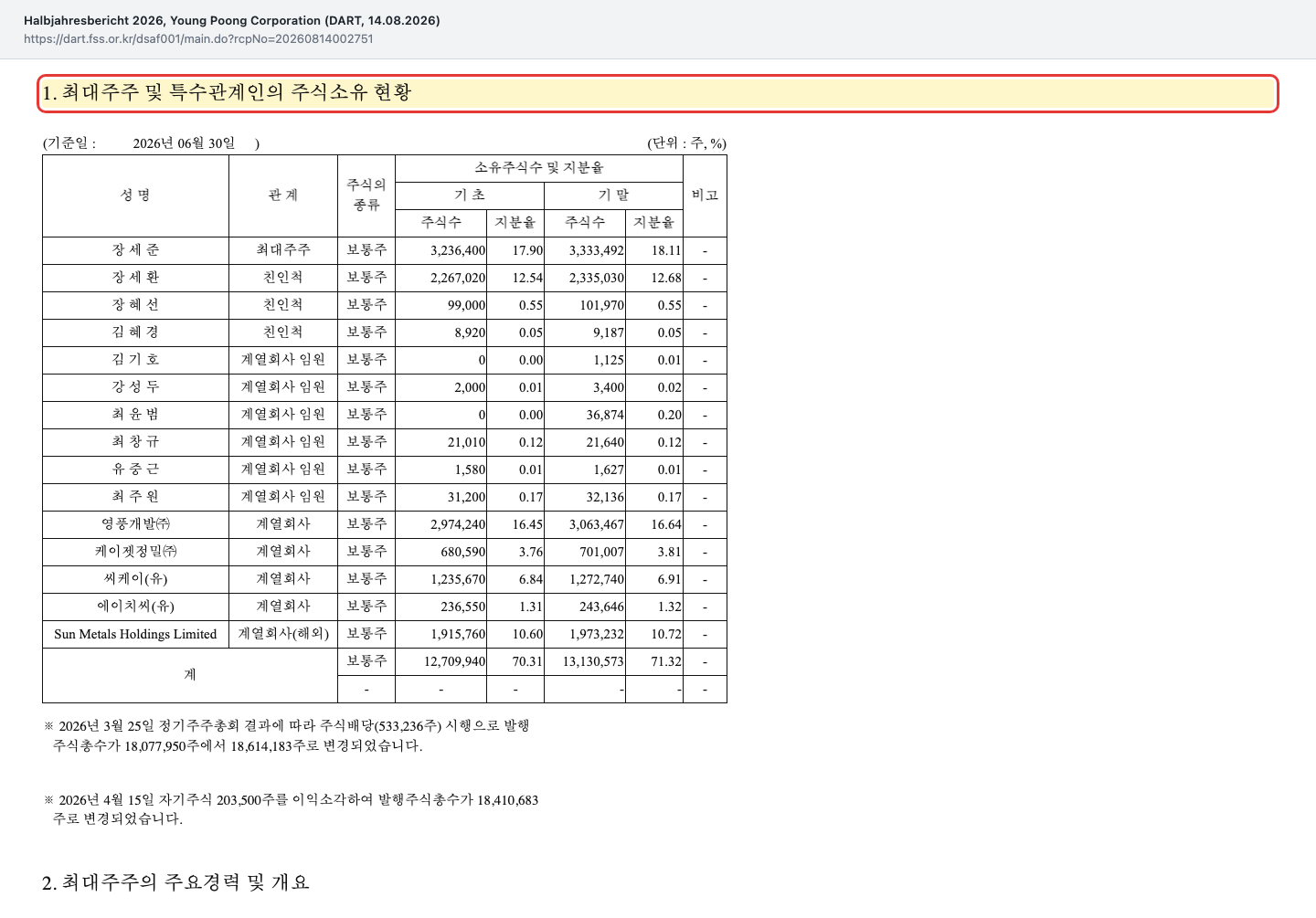
Korea Zinc's next extraordinary general meeting is scheduled for September 9, 2026; according to Korean business media (including Kukinews, December 2025, and further reports through August 2026), both sides are currently disputing the content of the meeting materials publicly. Nobody knows how the power struggle ends — but for Youngpoong shareholders it is not a side issue: their most important holding is worth nearly five times their own company, and right now they cannot even reliably vote it.
Valuation: One Ratio Telling Two Completely Different Stories at Once
How expensive is Youngpoong? The honest answer: a single price-to-earnings ratio is misleading here, because the earnings — as shown above — are overwhelmingly non-operating. At the August 21, 2026 closing price (37,300 won), market capitalization is roughly 686.7 billion won (18,410,683 shares times 37,300 won) — close to the 686.6 billion won market cap listed on the scanner, so the share count checks out. Measured against book value (equity attributable to parent shareholders: 3,996.6 billion won as of June 30, 2026), the stock trades at a price-to-book ratio of roughly 0.17 — a bargain at first glance. But most of that book value sits in the disputed Korea Zinc stake, which Youngpoong itself did not earn (3,345.7 billion won of 4,734.6 billion won in non-current assets) — a "discount" the market demands here is no accident given the litigation, the blocked voting rights, and the associate's own ongoing accounting review. The Altman Z-score of 1.4 (fundamental data, as of August 23, 2026) sits below the 1.8 threshold analysts generally treat as a distress zone — but that test weighs working capital and market cap against total assets, and for a group whose largest asset is a hard-to-trade, disputed minority-turned-large stake in a third company, the reading should be treated with caution rather than as a standalone alarm. A P/E built on the reported group profit would be single digits and would suggest "cheap" — exactly the miscalculation the third uncomfortable truth warns about. A more realistic lens is operating profit alone: 44.8 billion won in the first half of 2026, annualized to roughly 90 billion won — measured against the 686.7 billion won market cap, that is about 7.7 times annualized operating profit; for a group with a freshly proven operating turnaround but an unresolved litigation load, neither an obvious bargain nor an obvious overvaluation.
Opportunities and Risks at a Glance
What speaks for Youngpoong:
- A real operating turnaround: from an operating loss (H1 2025: -150.4 billion won) to an operating profit (H1 2026: +44.8 billion won), driven by higher zinc prices (+22.4% LME) and a stronger-margin electronics business (per-square-meter circuit-board prices up sharply in places).
- A diversified business model: more than half of revenue now comes from the electronics segment (PCB/FPCB, semiconductor packaging) with customers including Samsung Electronics, LG Electronics and Infineon — some independence from the pure zinc-price cycle.
- A win in the Korea Zinc capital-increase lawsuit (already secured at first instance) would automatically raise Youngpoong's stake in its most valuable holding if the ruling is finalized.
- A very low price-to-book ratio (roughly 0.17) offers substantial arithmetic re-rating potential if the legal uncertainties are resolved.
What speaks against it:
- A record accounting fine for intentionally hidden environmental provisions (20.47 billion won fine, 233.1 billion won in possible additional provisions if the lawsuit is lost) — a documented governance and accounting breach, not merely a valuation discount.
- The record profit is over 80 percent non-operating: it hinges on the equity stake in Korea Zinc, a company whose leadership Youngpoong is actively suing, and whose own books were just corrected by regulators.
- Recurring environmental-permit violations at the Seokpo smelter (a 58-day forced shutdown already carried out in early 2025, two further contested ten-day shutdown orders, ongoing remediation litigation, a 115.1 billion won remediation provision) with an uncertain further path.
- Youngpoong routinely loses its own voting rights at Korea Zinc in the ongoing power struggle (blocked at the January and March 2025 shareholder meetings) — shareholders are buying a stake in a stake the company currently cannot freely exercise.
- Extremely tight float (roughly 60.4% held by the founding family and affiliated entities; the statutory reporting block of 71.3% additionally includes the 10.72% held by Korea Zinc subsidiary Sun Metals) and no cash dividend, only a small annual stock dividend.
A Human Conclusion
Back to the denial trap from the opening. Its core is not that the good news is fabricated — Youngpoong's operating turnaround is real, the electronics segment is a genuine, growing second leg, and a win in the Korea Zinc case would be materially valuable to shareholders. Its core is that the acceleration number alone hides exactly what the company itself hid for years: that underneath a shiny growth rate sits a zinc smelter that understated its own environmental liabilities for four straight years, until South Korea's securities regulator responded with the largest accounting fine in the country's history — and that underneath a record profit sits a power struggle in which Youngpoong currently cannot raise its own voice on its most important holding. The honest question for you is therefore not "Is this stock growing?" but: Would you invest in a company whose profit is four-fifths dependent on a contested stake it does not control — and whose own books were just officially ruled to have been intentionally dressed up? If you can answer both questions for yourself, you have a thesis. If not, you only had a scanner row. What you make of it is your decision. And that is exactly as it should be.
Sources
All original documents used in this analysis — for your own reading:
- Young Poong Corporation — Semi-annual report 2026 (반기보고서, period ended June 30, 2026, filed with DART August 14, 2026)
- Young Poong Corporation — DART ad-hoc filing on the Securities and Futures Commission's accounting sanction (June 10, 2026)
- Full DART disclosure history for Young Poong Corporation (000670): DART overview (dart.fss.or.kr), English edition: englishdart.fss.or.kr
- Financial Services Commission / Digital Daily, on the record fine for four consecutive years of understated environmental provisions (July 19, 2026) — confirmation of the fine amount
- Digital Daily, on Youngpoong's standalone first-half 2026 results (August 19, 2026) — context for the parent-only figures
- Korea Herald, KED Global, Korea Times and other Korean business outlets (dated in the running text) — secondary sources on the Youngpoong/MBK Partners vs. Korea Zinc power struggle, used only to supplement the DART primary sources
- Digital Daily (February 24, 2025), OhmyNews (May 3, 2025) and The Korea Herald (dated in the running text) — dated press coverage confirming the Seokpo smelter's 58-day forced shutdown, actually carried out from February 26 to April 24, 2025 (a final court ruling in an older water-pollution case from 2019)
- Fundamental data (metrics, 52-week range, share-count cross-check; data as of August 23, 2026), checked against the semi-annual report 2026 where possible.
- Sourced via our in-house revenue-inflection scanner; underlying backtest: Revenue Inflection Backtest Study.
Transparency & disclaimer: This analysis is a journalistic contextualization of publicly available information and is not investment advice, not a regulated financial analysis, and not a solicitation to buy or sell securities. Stock investments carry substantial risk, including total loss. All figures are provided without guarantee; each data cutoff is noted in the text. Positions held by the operator are disclosed daily; where one exists, it appears as a notice at the top of this deep dive.
Our Bottom Line at a Glance
- Operating turnaround positive
- After two loss-making years (2024: -160.7 billion won, 2025: -259.7 billion won operating), the group swung to an operating profit of 44.8 billion won in the first half of 2026 — driven by higher zinc prices (LME +22.4%) and a stronger-margin electronics segment. A genuine, multi-segment improvement, not a single outlier.
- Earnings quality negative
- Of the first-half profit (407.0 billion won), only about 8.6 percent of pre-tax income came from the operating business — the rest from financial income and the Korea Zinc equity-method result. Q1 2026 profit collapsed 99.7 percent; nearly the entire half-year profit came from a single quarter and an uncontrolled stake.
- Accounting and governance integrity negative
- South Korea's Securities and Futures Commission found intentionally understated environmental remediation provisions over four years (2021-2024, up to 233.2 billion won annually) and imposed the largest single accounting-violation fine ever levied in South Korea (20.47 billion won) plus a three-year mandatory auditor designation. Youngpoong is suing and enforcement is provisionally stayed — the finding is an official regulatory determination, but it is under judicial challenge and not yet final.
- Environmental and legal risk at Seokpo negative
- A 58-day forced shutdown of the smelter that was actually carried out (February 26–April 24, 2025), plus two further 10-day shutdown orders from 2025 (March 4 and September 16) that are still being contested, an ongoing 115.1 billion won remediation provision, and a further lawsuit over a soil-remediation order dated December 26, 2025 point to a recurring, unresolved environmental and permitting risk at the zinc smelter.
- Control over the most important holding negative
- The Korea Zinc stake (3,345.7 billion won, nearly five times Youngpoong's own market value) is the subject of an open power struggle; Youngpoong's voting rights were repeatedly blocked at Korea Zinc's January and March 2025 shareholder meetings. Shareholders are buying a stake in a stake the group currently cannot freely exercise.
- Valuation neutral
- A price-to-book ratio around 0.17 looks cheap but largely reflects a disputed, illiquid stake rather than the operating business. No meaningful P/E given the non-operating share of profit; no cash dividend, only a small annual stock dividend.
Youngpoong shows a genuine operating turnaround — zinc and electronics are both profitable again for the first time in two years — but the revenue inflection the scanner flagged is partly a base effect from a self-inflicted plant shutdown, and the record 407.0 billion won profit is over 80 percent non-operating, tied to a disputed stake in Korea Zinc whose voting rights Youngpoong cannot reliably exercise in the ongoing power struggle. On top of that sits an officially intentional, record-fined understatement of the company's own environmental provisions over four years. Not investment advice.
What Our Rating Means
Substance risk
We found at least one documented issue that threatens the company itself — regardless of how the stock is currently valued.
The light rates the company, not the stock — and here a documented substance risk is on record: South Korea's securities regulator found an intentional accounting violation and imposed the country's largest-ever single fine for it, with a still-open risk of a further 233.1 billion won hit if Youngpoong's lawsuit fails. Add a recurring environmental-permit history — including a 58-day forced shutdown of the smelter already carried out in early 2025 and two further, still-contested 10-day shutdown orders — and a profit that overwhelmingly comes from a stake whose voting rights the company cannot reliably exercise amid an active power struggle. The operating business itself has visibly improved — but accounting and governance questions of this scale outweigh a single good quarterly stretch. Anyone watching should track the outcome of the Seoul Administrative Court case and the next Korea Zinc shareholder meeting on September 9, 2026. The decision is yours.
A journalistic assessment by our editorial team at the time of the deep dive, based on public sources — not investment advice and not a solicitation to buy or sell. Your personal circumstances (investment goals, risk capacity, taxes) cannot be taken into account. What our levels mean, how verdicts are formed, and what conflicts of interest exist →
Worth Noting
- Youngpoong reached our research list via our in-house "revenue inflection" stock scanner (August 23, 2026: No. 2 of 33 hits; after a currency-conversion fix in the scanner later that day: No. 7 of 28 hits): at least two quarters of 30 to 70 percent year-over-year revenue growth after four quieter quarters before that.
- All figures in South Korean won (the reporting currency); for scale, the semi-annual report itself states an average exchange rate of 1,482.88 won per U.S. dollar for the first half of 2026 — on that basis, the roughly 686.7 billion won market cap equals about $463 million. A price target of +2,524.7 percent shown in the scanner row is an obvious data artifact and was not used in this analysis.
- Youngpoong is not an SEC filer (home exchange KOSPI); evidence is drawn from Korean mandatory disclosures (DART), supplemented by named, dated business press citing the same filings.
- Not to be confused with Youngpoong Precision Corp., a separate, publicly listed sister company within the Youngpoong corporate group that went over to the Korea Zinc side in its own 2024 takeover fight — this analysis covers only Young Poong Corporation (000670).
The full analysis as a PDF for later
We will send you this analysis as a PDF — to print, file away, and read at your own pace.
Frequently Asked Questions
Youngpoong (KOSPI: 000670) is a South Korean five-segment group headquartered in Seoul. The parent company operates the Seokpo zinc smelter (zinc ingots, sulfuric acid); through subsidiaries such as Korea Circuit, Interflex, Teranix and Youngpoong Electronics, the group makes printed circuit boards (PCB/FPCB), and through Signetics it also runs semiconductor packaging for customers including Samsung Electronics and LG Electronics. In the first half of 2026, 954.3 billion won came from the electronics business and 801.2 billion won from the zinc smelter — the segments' revenues add up to 1,877.9 billion won (more than the consolidated group revenue of 1,704.3 billion won, because of inter-segment revenue); against that total, electronics accounts for 50.8 percent and the zinc smelter for 42.7 percent.
Only partly. Consolidated revenue grew 48.8 and 42.2 percent year over year in the first and second quarters of 2026, driven by higher zinc prices (LME zinc up 22.4 percent half over half), a weaker won, and higher average selling prices in the electronics segment. A meaningful part is a base effect, though: the Seokpo smelter was fully shut down for 58 days from February 26 to April 24, 2025 under a government order (a final court ruling in an older water-pollution case), which artificially depressed the year-ago quarters; two further 10-day shutdown orders from 2025 (March 4 and September 16) are, by contrast, still being contested and, per the semi-annual report, have not been carried out.
The Securities and Futures Commission (SFC) found on June 22, 2026 that Youngpoong understated remediation provisions for soil and groundwater contamination at the Seokpo smelter every year from 2021 through 2024 — about 233 billion won each in 2023 and 2024 — and classified this as intentional. The 20.47 billion won fine against the company is, per Korean business media, the largest single fine ever imposed in a domestic accounting-violation case; the SFC also ordered a three-year mandatory external-auditor designation and sanctioned several executives. Youngpoong is suing the Seoul Administrative Court to overturn the sanction.
Mostly not from operations. Against operating profit of just 44.8 billion won stand financial income of 374.5 billion won and an equity-method share of associate income of 189.1 billion won, tied to the stake in Korea Zinc. In the first quarter of 2026 alone, profit attributable to Youngpoong shareholders collapsed 99.7 percent year over year — practically the entire first-half profit came in the second quarter, driven largely by the disputed Korea Zinc stake, not zinc or electronics operations.
Youngpoong (the Jang family) and Korea Zinc (the Choi family) have been openly fighting for control of Korea Zinc since 2023/2024, in which Youngpoong holds roughly 25 percent through its subsidiary YPC Limited. After a Korea Zinc capital increase in September 2023, a Youngpoong/MBK Partners tender offer in September 2024, and a Korea Zinc counter-tender in October 2024, Korea Zinc has repeatedly blocked Youngpoong's voting rights at its own shareholder meetings via a circular-ownership structure (built through its Australian subsidiary Sun Metals Holdings, which bought 10.33 percent of Youngpoong in January 2025 and held 10.72 percent as of June 30, 2026). Korea Zinc's next shareholder meeting is scheduled for September 9, 2026.
Not in cash. Youngpoong has paid only small stock dividends for years — 0.04 new shares per share for fiscal 2024 (4.0 percent), 0.03 per share for fiscal 2025 (3.0 percent). A roughly 0.3 percent "dividend yield" shown in fundamental-data feeds therefore reflects no cash paid to shareholders, only ongoing dilution through new shares.
No. Youngpoong is listed on the Korean stock exchange KOSPI (ticker 000670) and is not an SEC filer — there is no 10-K and no 10-Q. Mandatory disclosures run through South Korea's Financial Supervisory Service via the DART system (dart.fss.or.kr), the Korean counterpart to the American EDGAR — semi-annual and quarterly reports instead of 10-K/10-Q filings.
Not in any publicly findable form, per our research: neither on the investor-relations page (ypzinc.co.kr) nor in the relevant Korean IR event calendars did we find evidence of regular analyst conferences or published transcripts of the kind larger Korean conglomerates routinely offer. We therefore relied on the mandatory DART filings rather than call transcripts.
Found an error?
Did you spot a factual error, an outdated number, or a typo in this deep dive? Let us know briefly — your report goes straight to the editorial team.