TOP Financial: 360 Million New Shares — and Not One Dollar in Return
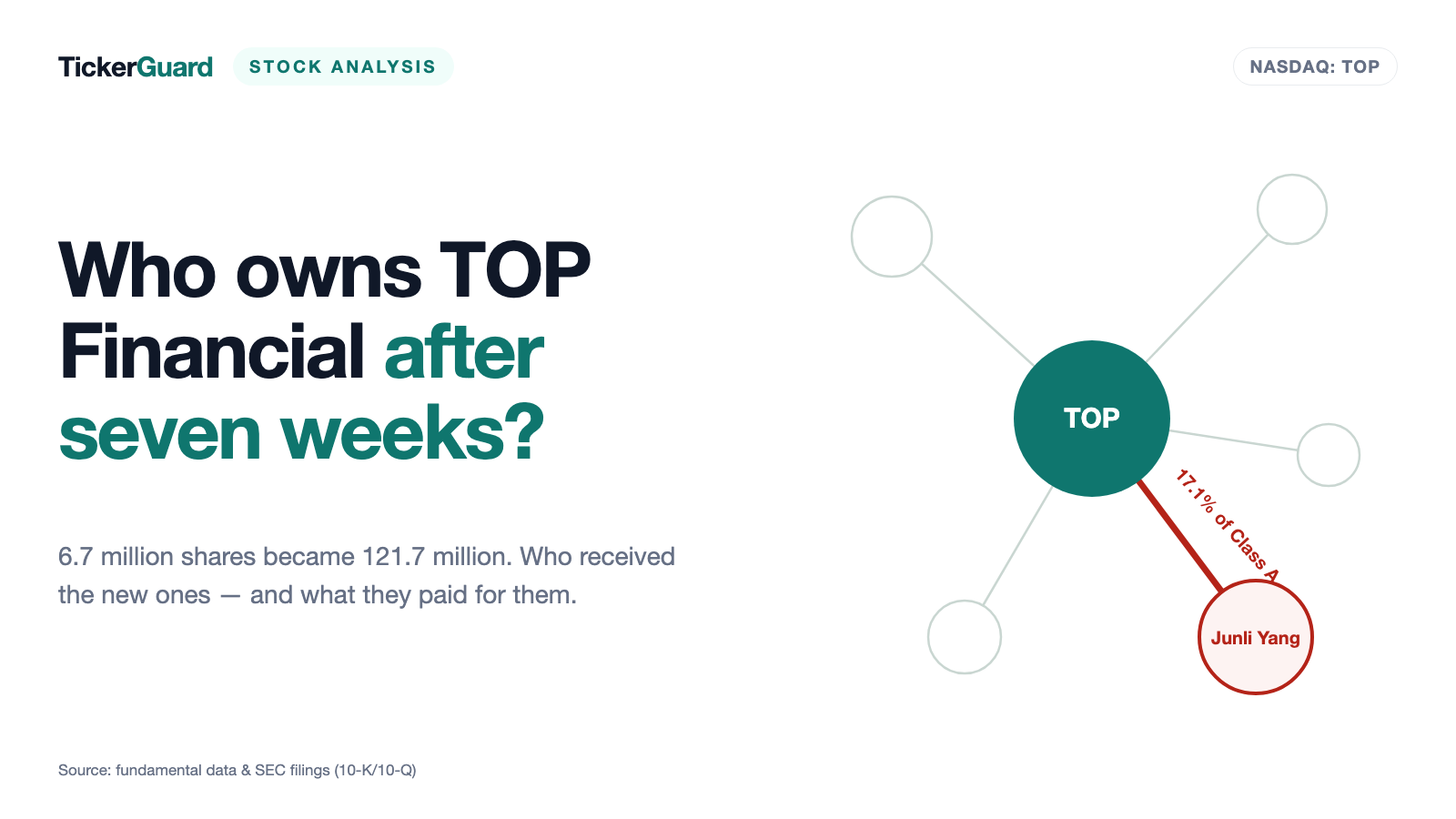
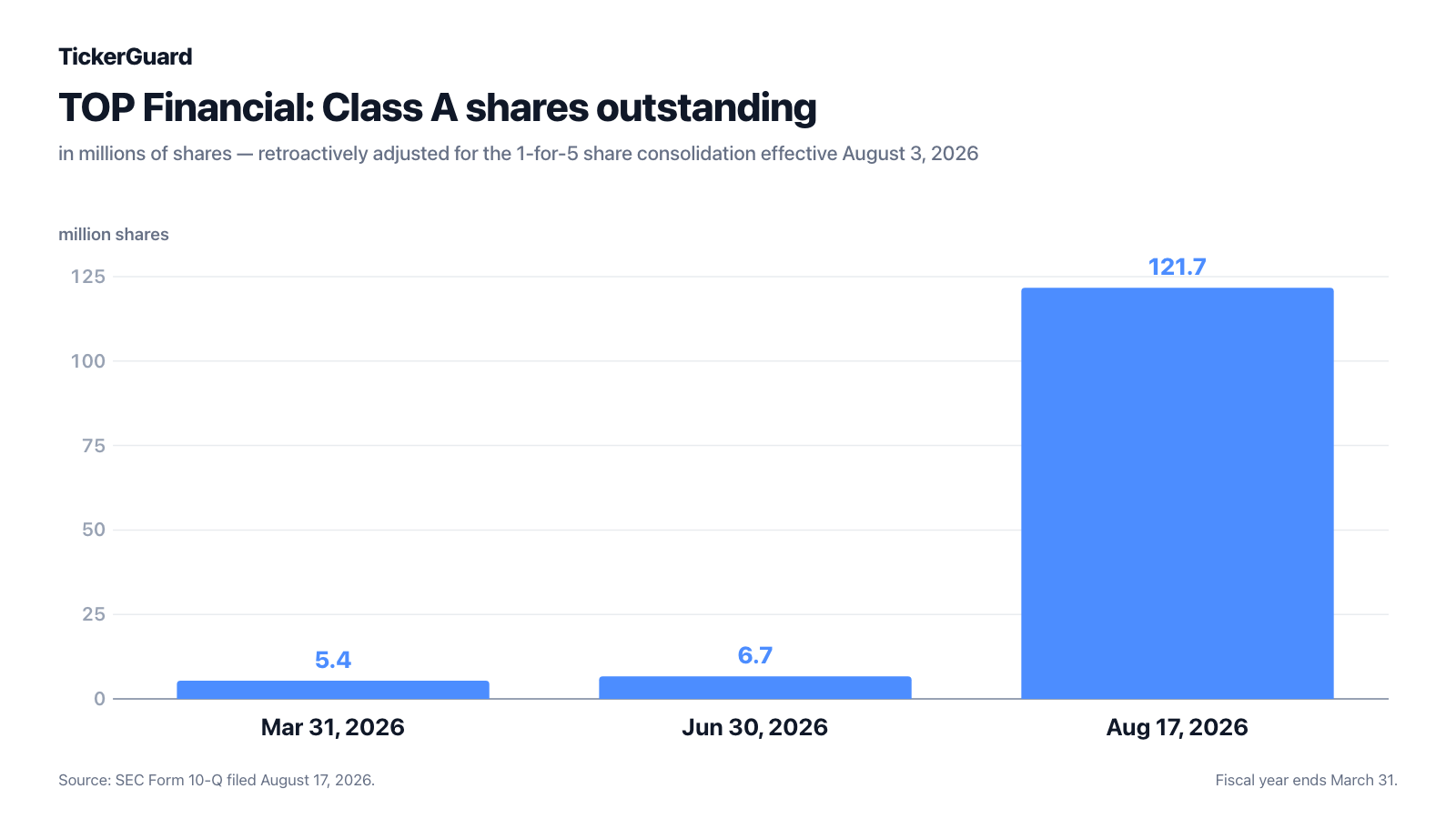
On June 30, 2026, TOP Financial had 6.7 million Class A shares outstanding. Seven weeks later, on August 17, it had 121.7 million. Most of that jump happened on a single day: on July 19 the company amended the terms of its warrants, every holder exercised in full the same day, and the next day TOP issued 360,534,431 shares — counted before the 1-for-5 share consolidation of August 3, or 72.1 million after it, and for no cash at all. Seven days earlier, the chair of the board had bought warrants on 100 million of those shares through a company she owns. We read the quarterly report filed August 17, 2026, the disclosures in between, and both versions of the warrant contract — and count who still owns what.
 Thomas Mücke
Founder & Publisher
Thomas Mücke
Founder & Publisher
As of Today
As of: October 5, 2026
- Closing price
- 15.60 $ +1.30%
- Market Capitalisation
- 1.9 $B
- Growth Score
- 6/10
- AAQS
- 1/10
Price change since August 20, 2026: +17.5%
This analysis has a cut-off date. The Stock Guard tells you when something material changes in the numbers. Reserve your free spot
Chart
Interactive price chart (TradingView).
52-week range: 0.622 $ to 16.70 $ · Last price: 15.60 $ (As of: October 5, 2026)
Note: pure fact-based analysis, not investment advice and not a solicitation to buy or sell. All figures without guarantee.
There is an investor weakness nobody treats as a weakness, because it feels like plain common sense: the label trap. We believe what is written on the outside. A ticker that reads "TOP." A press release with "Artificial Intelligence" in the headline. A share price that is suddenly in double digits instead of pennies. Three labels — and not one of them says anything about what is inside.
With TOP Financial Group Limited you can check this unusually cleanly, because the company disclosed almost everything an investor needs within a few weeks. You only have to read it in the right order. That is what we do here, together: the quarterly report, the current reports, the ownership filing, and two versions of the same warrant contract. What comes out at the end is not a recommendation but a number — how much of the company you still own after those seven weeks, if you were a shareholder on June 30, 2026.
What TOP Financial Actually Does
TOP Financial Group Limited is a Cayman Islands holding company with its administrative seat in Singapore. The operating business sits in Hong Kong: subsidiaries Zhong Yang Securities Limited and Zhong Yang Capital Limited are licensed by the Hong Kong Securities and Futures Commission for securities and futures dealing as well as advisory and asset management. Until July 13, 2022 the company was named Zhong Yang Financial Group Limited — that older name still appears in some market-data services, which makes the ticker easy to misidentify.
The model is simple at its core. TOP runs a trading platform on which clients trade futures and equities on international exchanges, and it collects a commission per contract. Around that sit a trading-solutions business (subsidiary WIN100 TECH supplies the technology to other firms), a money-lending business in Hong Kong operating under a license granted September 5, 2023, and, very recently, commissions from virtual asset trading. The quarterly report also lists planned lines: contracts for difference, trust services, investor relations services and asset management. As of March 31, 2026 the group employed 30 people.
A word about the client base, because it explains the whole business. TOP does not serve millions of retail investors but a manageable number of professional high-frequency traders. At June 30, 2026 there were 734 registered customers — up from 355 at March 31, 2025 and 711 at March 31, 2026. The growth therefore happened during fiscal 2026; the most recent quarter added just 23. The five largest clients accounted for 39 percent of revenue in the quarter ended June 30, 2026 — in the prior-year quarter it was 51 percent. If two or three of those houses switch providers, that is not customer churn; it is a revenue collapse.
One formal detail matters for reading the filings. With the U.S. securities regulator, the SEC, TOP is a foreign private issuer — a category that requires fewer and less frequent reports than U.S. domestic companies file. Since July 2026 the company has nonetheless been reporting on the stricter domestic forms. It says itself why it may, and that it does so voluntarily:
"Although the Company qualifies as a foreign private issuer and is therefore eligible to report on the forms and under the rules available to foreign private issuers (including Form 6-K), the Company has elected to file this Current Report on Form 8-K, and otherwise to report, under the forms and rules applicable to domestic U.S. registrants."
— TOP Financial Group Limited, Form 8-K filed July 13, 2026, Explanatory Note
In practice that means fiscal 2026 has, for the first time, a U.S.-style annual report (Form 10-K, filed July 7, 2026) and a quarterly report (Form 10-Q, filed August 17, 2026). Earlier years exist as Form 20-F annual reports. The fiscal year ends March 31, so "fiscal 2026" broadly covers calendar 2025 through the end of March 2026.
Company history for investors
-
2022
June: listing at $5.00, and a new name in July
An IPO of 5,000,000 shares at $5.00 each raises $25 million gross; trading starts June 1, and on July 13 the new name follows. The start of a price history shaped by capital actions ever since.
-
2025
Fiscal 2025: the first large loss
Revenue falls to $3.33 million and the loss reaches $5.97 million, weighed down in part by a $2.84 million allowance for expected credit losses. The profit streak of prior years ends.
-
2026
April 28: Nasdaq flags the minimum bid price
After 30 trading days below one dollar, a compliance period runs to October 26, 2026. On June 17 the exchange confirms compliance regained — the delisting risk is off the table for now.
-
2026
May 27: authorized capital raised twenty-fold
Shareholders lift the ceiling from 1 billion to 20 billion shares and permit a consolidation of up to 1-for-20. That creates the legal room for everything that follows in the next ten weeks.
-
2026
July 9: $80 million private placement
Non-U.S. investors subscribe for 214,431,222 shares plus 428,862,444 warrants. Real money reaches the company — and existing holders see their stake shrink materially for the first time.
-
2026
July 19/20: formula amended, everyone exercises
The exercise terms are changed and every holder exercises cashless the same day; 360,534,431 shares go out with no cash proceeds — the single largest step of the dilution.
-
2026
August 3: 1-for-5 share consolidation
Five shares become one and the price quintuples arithmetically. Read the chart without adjustment and you see a rally where in reality only the denomination changed.
How This Stock Landed on Our Desk
The prompt for this analysis was not a screening metric but our newsroom watching investor forums on August 21, 2026: the ticker TOP was showing up there shortly after the share price crossed ten dollars. We had no reliable mention count from a public measurement source, so the forum chatter is only the occasion here, not the argument. Everything that follows comes from the company's filings with the SEC.
And those filings are dense. Between June 22 and August 17, 2026, TOP Financial filed twenty documents with the SEC: one annual report, one quarterly report, five current reports, one beneficial-ownership statement, seven initial statements of beneficial ownership, two interim reports on Form 6-K, one prospectus supplement and two notifications of late filing. Anyone can count them: the full list sits in the SEC EDGAR database under CIK 0001848275. Look only at the chart and you see a stock that moved from roughly $9 to $13 (closing prices, adjusted for the consolidation). Read the documents in sequence and you see something else entirely.
For context: we have described several cases in recent months in which very small revenue met a very large market value — among them Diginex, where $3.6 million of revenue met a $1.5 billion purchase agreement payable in stock. TOP Financial belongs to the same family, but it has a mechanism of its own.
The Numbers Over the Years, Fairly Told
Start with what worked. TOP Financial used to be profitable, and not marginally so. In fiscal 2021 through 2024 the company earned money every single year — $5.04 million, $3.49 million, $3.40 million and $1.05 million of net income. For a broker that had just eleven employees as of March 31, 2024, those are remarkable figures. The highest revenue in any year documented in SEC filings, however, came before the IPO: $16.91 million in fiscal 2021 (year ended March 31, 2021), 95 percent of it futures brokerage commissions. Revenue has never come close since; the best year after the listing was fiscal 2023 at $9.70 million.
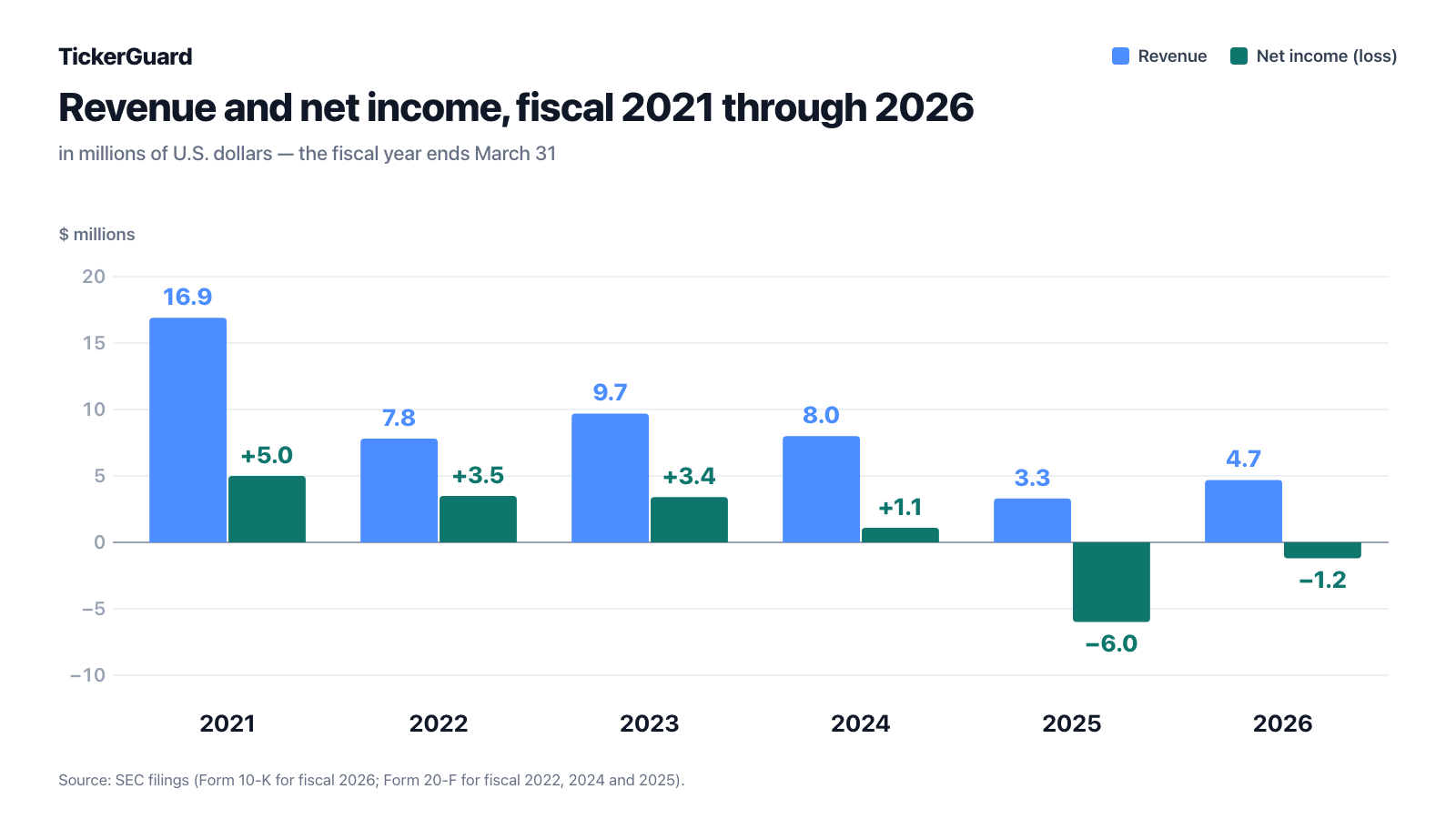
Then it turned. In fiscal 2025 (through March 31, 2025) revenue collapsed to $3.33 million and the group lost $5.97 million — largely because of a $2.84 million allowance for expected credit losses and trading results that swung to minus $1.42 million. In fiscal 2026 revenue recovered to $4.72 million and the loss narrowed to $1.18 million. That sounds like a turnaround.
It is not, once you look inside. Of the $4.72 million of fiscal 2026 revenue, only $1.83 million came from futures brokerage commissions — the original core business. The rest: $0.95 million of interest from the lending business, $0.44 million of other interest, $0.40 million of trading gains, $0.42 million of other service revenue, $0.39 million of virtual asset commissions and $0.29 million of trading solutions. Futures commissions, which ran at $16.1 million in fiscal 2021 and roughly $4.3 million in fiscal 2022, have been stuck at about $1.83 million for two years running — a good ninth of the fiscal 2021 figure.
The most recent quarter was considerably worse. In the three months to June 30, 2026, futures commissions fell from $638,546 to $164,201 — down 74 percent year over year. Total revenue fell from $1.333 million to $1.077 million, and a small profit of $85,992 became a loss of $113,725. The loss was not larger only because of a $273,229 income tax benefit; before tax the shortfall was $386,954. One cost line stands out: occupancy rose from $25,636 to $424,487, a factor of 16.6.
Rule of thumb: revenue that recovers while the core business shrinks is not a recovery. It is a reshuffle.
Uncomfortable Truth No. 1: Eighteen-Fold Dilution
Now the actual story. Dilution means new shares are issued, the company stays the same size, and your slice of the pie gets smaller. Normally that happens slowly and brings the company money. Here it happened fast.
The cover page of the quarterly report filed August 17, 2026 carries the number that matters:
"As of August 17, 2026, the registrant had 121,705,513 Class A Ordinary Shares and 2,000,000 Class B Ordinary Shares, par value $0.005 per share, outstanding."
— TOP Financial Group Limited, Form 10-Q filed August 17, 2026, cover page

On page 1 of the report itself, the balance sheet gives the comparison: 6,710,691 Class A shares at June 30, 2026 and 5,418,883 at March 31, 2026. Both figures are retroactively adjusted for the 1-for-5 consolidation effective August 3, 2026 — the company flags this explicitly in a footnote — so they are directly comparable with the 121,705,513.
Seven weeks, a factor of 18.1. Anyone holding one percent of the Class A shares on June 30, 2026 held 0.055 percent on August 17. The stake in the company shrank to 5.5 percent of its former size. For the same shares to represent the same slice of the company again, a pre-existing holder would need roughly eighteen times as many of them. Put the other way round: the business now has to be worth about eighteen times as much for a single share to mean what it meant seven weeks ago — at a company whose core business fell 74 percent in the same quarter.
Where did the shares come from? Three steps, all disclosed:
- May 27, 2026: an extraordinary general meeting raises authorized capital from 1,000,000,000 to 20,000,000,000 shares — twenty times as much. It also authorizes the board to consolidate shares at a ratio between 1-for-2 and 1-for-20.
- June 19, 2026: the agreement for a small registered direct offering of roughly $2.9 million; the 1,288,203 shares (measured after the consolidation, at $2.2823) were issued on June 25, 2026.
- July 9, 2026: closing of a private placement of $80,000,000: 214,431,222 Class A shares plus 428,862,444 warrants, sold to non-U.S. investors under Regulation S with no placement agent, at $0.37308 per unit. Of that, $64,983,160 was already sitting on the liability side at June 30 as subscription money received in advance.
Up to this point it is a large but ordinary capital raise: the company issues shares and receives money. Eighty million dollars for a business with $4.7 million of annual revenue is an enormous sum, but it is real capital. The bigger jump came afterwards — and that one brought in nothing.
Uncomfortable Truth No. 2: 360 Million Shares Without a Dollar
A warrant is a voucher: it lets the holder buy a share later at a price fixed in advance. At TOP that exercise price was $0.4477 per share (before the consolidation), or 120 percent of the placement price. Had all 428,862,444 warrants been exercised for cash, roughly $192 million would have flowed into the company.
But there was a second route from the start: cashless exercise. The holder pays nothing and receives, instead of every share, only the portion matching the value of their gain. How large that portion is depends on a formula — and that formula was changed. The original contract, dated March 25, 2026 and published as Exhibit 4.1 to the Form 6-K of March 26, 2026, read:
"(A) = the lower of (i) the closing price of the Class A Ordinary Shares (as reflected on Nasdaq.com) on the Trading Day immediately preceding the date of the applicable Notice of Exercise, or (ii) the average closing price of the Class A Ordinary Shares (as reflected on Nasdaq.com) for the five (5) Trading Days immediately preceding the date of the applicable Notice of Exercise"
— TOP Financial Group Limited, Form of Warrant, Exhibit 4.1 to Form 6-K, March 26, 2026, cashless exercise clause

On July 19, 2026 the company entered into amendment agreements with the holders. The new text reads only: "(A) = the closing price of the Class A Ordinary Shares (as reflected on Nasdaq.com) on the Trading Day immediately preceding the date of the applicable Notice of Exercise" — the comparison against the five-day average is gone. In plain terms: the reference value is no longer the lower of two prices but simply the prior day's close. And the higher that reference value, the more shares the holder receives without paying.
What happened next was reported one day later:
"On July 19, 2026, all holders of the Warrants exercised their Warrants in full pursuant to the cashless exercise provision thereof. On July 20, 2026, the Company issued 360,534,431 Class A Ordinary Shares (the 'Warrant Shares') as a result of the exercise of the Warrants, as amended."
— TOP Financial Group Limited, Form 8-K filed July 20, 2026, Item 3.02
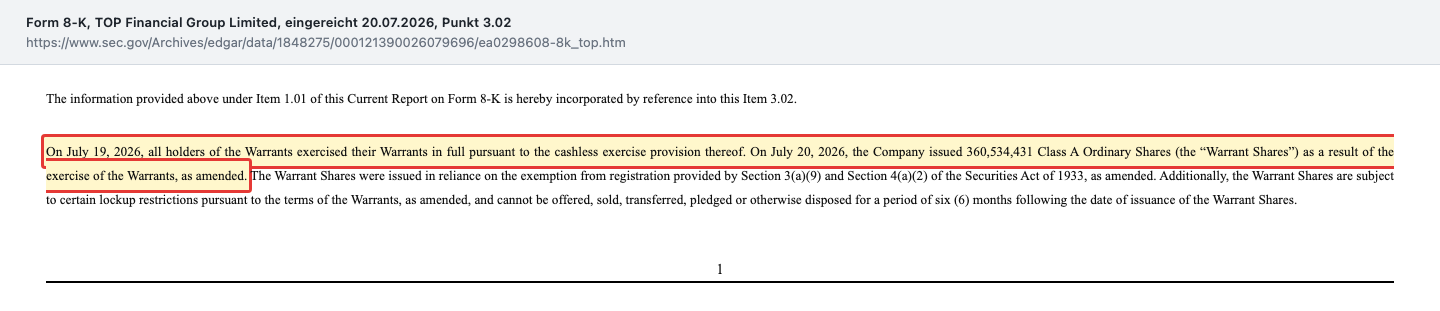
The arithmetic is easy to follow: 360,534,431 divided by 428,862,444 is roughly 84 percent. Holders received 84 of every 100 possible shares without any further payment, rather than paying the exercise price for all 100. No money reached the company, and the share count more than doubled in a single day.
In fairness: cashless exercise was built into the warrants from the beginning, so the $192 million of cash was never realistically on the table. The July 19 amendment did not change whether, only how much. And the fact that every holder without exception exercised on the very day of the amendment says something about how they valued the new formula.
Which brings us to who those holders were. One of them had to file a beneficial-ownership statement on July 30, 2026 — Schedule 13D, required when someone holds more than five percent and intends to influence the company. The filer: Junli Yang, chair of the board of TOP Financial, together with her British Virgin Islands company Quantum Leap Limited. It says:
"On July 12, 2026, Quantum Leap purchased from certain investors, in privately negotiated transactions, Warrants to purchase an aggregate of 100,000,000 Class A Ordinary Shares, for an aggregate purchase price of US$12,000,000.00. … On July 19, 2026, Quantum Leap exercised its Warrants in full on a cashless basis … and, on July 20, 2026, received 84,067,616 Class A Ordinary Shares upon such exercise. No cash consideration was paid by Quantum Leap in connection with the exercise."
— Junli Yang and Quantum Leap Limited, SEC Schedule 13D filed July 30, 2026, Item 3
The sequence in short. On July 12 Quantum Leap Limited — the BVI company of the chair of the board — buys warrants off the placement investors. On July 19 TOP Financial amends the terms of exactly those warrants. That same day every holder exercises. On July 20 Quantum Leap receives 84,067,616 shares without paying another dollar — 16,813,523 shares after the consolidation. That works out to $0.71 per share. At the August 20, 2026 close of $13.28, the same block was worth roughly $223 million.
One number in that filing is easily misread, so here is the split. Quantum Leap itself holds 84,067,616 Class A shares, or 13.81 percent of the class. The 104,067,616 shares and the 17.10 percent are Ms. Yang's personal total, which additionally includes 20,000,000 shares she has held since before the IPO through a second BVI company, Zhong Yang Holdings (BVI) Limited. Both percentages are calculated on 608,527,305 Class A shares as of July 21, 2026 — a figure stated before the consolidation, corresponding to the 121.7 million after it.
All of it was disclosed and, as far as can be judged from outside, formally correct. It is still a set-up a shareholder should look at closely: the company amended a contract in which its own chair had built a position seven days earlier. Who decided on that amendment, and how the board — to whom such decisions fall — handled the conflict of interest, the filing does not say; it names only "the Company" as the acting party.
One more thing belongs in the picture, and it cuts the other way. The chair herself lost voting power, and a great deal of it. The annual report filed July 7, 2026 still states that Ms. Yang holds all Class B shares, "representing 97% of the total voting power of our company." After the July 20 issuance the arithmetic looks like this: she still holds all 2,000,000 Class B shares, each carrying 50 votes, so 100 million votes from a class representing less than 2 percent of the capital. Against that now stand 121.7 million votes from all Class A shares combined. Add her 20.8 million Class A shares (after the consolidation) and she controls a little over 54 percent of all votes — a drop of more than forty percentage points in two weeks. She keeps the majority, and a shareholder meeting still cannot decide anything against her. But the dual-class structure that previously secured her almost everything has become considerably thinner.
Nobody can sell for now: the shares from the exercise carry a six-month lock-up from issuance, so they can be disposed of no earlier than January 20, 2027. That applies to the chair's block as well; the Schedule 13D says so explicitly. The placement shares themselves are subject to a separate lock-up, which we come to below.
Uncomfortable Truth No. 3: A Loan Book That Appeared Overnight
Where did the $80 million go? The quarterly report answers that unusually precisely, in the cash flow statement under "non-cash activities." It records that the $64,983,160 of subscription money and the $2,940,000 from the June registered direct offering arrived as USDT, a cryptocurrency pegged to the U.S. dollar, and that $58,950,000 went back out in the same form: as loans to customers. The money never passed through a bank account. Consistent with that, cash and cash equivalents actually fell during the quarter, from $12,989,922 to $10,407,367. Note 4 shows what it turned into:
"As of June 30, 2026, the loans receivables were comprised of principal of $78,537,345 and interest of $811,700, respectively. As of March 31, 2026, the loans receivables were comprised of principal of $10,713,159 and interest of $448,962, respectively."
— TOP Financial Group Limited, Form 10-Q filed August 17, 2026, Note 4 (Loans receivable)

Before going further, a caveat the report itself makes necessary: this footnote contradicts the rest of the report by exactly one million dollars. At March 31, 2026 the arithmetic is clean — principal of $10,713,159 plus interest of $448,962 equals the $11,162,121 shown in the table above. At June 30, 2026 the footnote gives principal of $78,537,345 plus interest of $811,700, a total of $79,349,045 — but the table shows $78,349,045 on the same line. Deduct the $811,700 of interest from that table line and $77,537,345 of principal remains, which is exactly what the MD&A reports as "principal of US$77.5 million." Two of the three figures agree; the footnote carries one digit too many. We therefore work with $77.54 million of principal below — and note that the company never reconciles the difference.
In plain language: a company with 30 employees lent out $66.8 million to customers in three months. For scale, total assets at June 30 were $158.41 million. Roughly half the company is now a loan book that was small one quarter earlier.
What the note does not say about these loans is the real story. It discloses no collateral, no maturity schedule, no borrower concentration and — this is the point — no allowance for expected credit losses. The only allowance in this note, $506,251, relates solely to $3.34 million of margin receivables; a second one of $1,708,802 sits in the note before it and writes off the trading solution receivables in full. For the $77.5 million book, the note says only that principal and interest are repayable at maturity.
That need not mean anything. The loans may all be well secured and serviced on time. It may also mean that a concentration risk has been assembled in one quarter that is larger than the equity shown on the balance sheet at June 30 ($36.70 million). One point belongs here for accuracy: the $2.84 million allowance of fiscal 2025 did not relate to this money-lending book. The annual report breaks it down into $2,590,291 against trading solution receivables and $249,616 against receivables from customers holding U.S. or Hong Kong stocks. None of it fell on the lending book — and that is the observation: the company has never recorded an allowance against this book, neither when it stood at $11 million nor now at $77.5 million. What it looks like when a receivable of this house does go bad is visible on the other side of the notes: the trading solution receivables are now written off in full. The next quarterly report is when we find out what becomes of these $77.5 million.
Uncomfortable Truth No. 4: The AI Push Appears in No Report
On August 4, 2026, TOP Financial issued a press release headlined "TOP Financial Group Limited Announces Strategic Expansion to Launch Artificial Intelligence Division and Integrate Advanced AI Across Core Brokerage and FinTech Operations." The board had approved a dedicated AI initiative on July 31; the company intends to build capabilities in "AI Software and Hardware Development, Cloud and GPU Compute Infrastructure, AI Model Access and Orchestration, Enterprise-Focused AI Agent Deployment." Chief Executive Ka Fai Yuen is quoted calling it "a watershed moment." The formal filing puts it more soberly:
"On July 31, 2026, the board of directors (the 'Board') of TOP Financial Group Limited … approved the establishment of a dedicated artificial intelligence development initiative (the 'AI Initiative'), pursuant to which the Company intends to develop and deploy artificial intelligence solutions to support, optimize and scale the Company's core financial business lines."
— TOP Financial Group Limited, Form 8-K filed August 4, 2026, Item 7.01
Three things sit alongside that, and all three are checkable. First: this disclosure was furnished under Item 7.01, not filed — a category to which the liability provision of Section 18 of the Securities Exchange Act expressly does not apply. The company writes that into the report itself.
Second: the phrase "artificial intelligence" appears not once in the Form 10-K for fiscal 2026 filed on July 7, 2026 — not in the business description, not in the risk factors, not in the MD&A.
Third, and most telling: it also appears not once in the Form 10-Q filed on August 17, 2026. That report went in thirteen days after the press release. It contains a "Recent Developments" section describing the private placement, the capital increase, the warrant exercise and the share consolidation in detail. It contains a section on planned new business lines — CFD trading, trust services, investor relations, corporate consultancy, asset management. The AI initiative is in neither.
To be clear, without insinuation: a press release is not a lie merely because it is written in the future tense. But an undertaking billed as a "watershed moment" that does not appear in the company's own quarterly report two weeks later is not a business line — it is a statement of intent. We therefore classified TOP Financial as neutral in our AI rating: no documented operational use of AI in the filings reviewed. For a look at how the same announcement gap plays out in another industry, see Bitzero — $2.6 billion on paper, $2.5 million in the bank.
What the Stock Costs
Put the pieces together, with a clear data date. On August 20, 2026 the stock closed at $13.28. Outstanding were 121,705,513 Class A and 2,000,000 Class B shares, or 123,705,513 in total. That gives a market value of roughly $1.64 billion.
Against that: $4.72 million of fiscal 2026 revenue and a net loss of $1.18 million. The price-to-sales ratio therefore stands at about 348. A price-to-earnings ratio cannot be formed, because there are no earnings. For scale: a fast-growing software company is considered very expensive at a price-to-sales ratio of 15 to 20. At 348 this is no longer a valuation; it is a bet.
Equity looks a little friendlier, but not much. At June 30, 2026 the balance sheet showed $36.70 million of shareholders' equity. Add the $80 million from the placement that closed July 9 — $64.98 million of which was already on the balance sheet as a liability at the reporting date — and you reach roughly $117 million before issuance costs. That is about $0.94 of book value per share. The stock therefore trades at roughly fourteen times book, at a company losing money in its operating business.
We ran the cross-check on the market value, because with a share flood like this, databases often carry stale counts: the market value of $1.566 billion reported in fundamental data corresponds exactly to 123,705,513 shares times the August 19 close of $12.66. The share count therefore agrees with the quarterly report.
And here is the point that puts the whole share flood on a clock: almost all of the new shares are locked up until January 2027. For the 214,431,222 shares from the private placement (about 42.9 million after the consolidation) every subscriber agreed in the securities purchase agreement of March 25, 2026 not to sell for six months from the applicable closing; the closing was July 9, 2026, so that period runs out around January 9, 2027. For the 360,534,431 warrant shares (about 72.1 million after the consolidation) a separate six-month lock-up runs from issuance, that is until January 20, 2027. Together that is roughly 115 million of the 121.7 million Class A shares. What is freely tradable today is essentially the old float of 6.7 million shares — which explains how far a modest buy order can move this price. Exactly how large the free float is, though, does not emerge from the filings.
"Pursuant to the Securities Purchase Agreement, each Purchaser has agreed not to sell, transfer or otherwise dispose of any of the Shares or Class A Ordinary Shares issuable pursuant to the Warrants for a period of six (6) months from the applicable closing."
— TOP Financial Group Limited, SEC Form 6-K filed March 26, 2026, on the securities purchase agreement of March 25, 2026
One word on the price itself, because it too is a label. On July 31, 2026 the stock closed at $2.06; on August 3 at $10.52. That is not a rally, it is the 1-for-5 consolidation: five shares became one and the price quintupled arithmetically. The trigger is documented as well — on April 28, 2026, Nasdaq had notified the company that its closing bid price had been below one dollar for 30 trading days and that it no longer met the continued listing requirement. That deadline is settled: on June 17, 2026 Nasdaq confirmed the company had regained compliance and closed the matter.
Upside and Risks at a Glance
What speaks for TOP Financial:
- Real capital came in. The private placement brought in $80 million gross — many times annual revenue of $4.72 million, and far more than losses at the current scale ($1.18 million in fiscal 2026) would consume for years. Funding pressure is not a near-term issue. One qualification matters: the money is not sitting in the bank. $64.98 million of it is documented as having arrived in the cryptocurrency USDT, and $58.95 million went straight back out as loans; cash and cash equivalents fell during the quarter, from $12.99 million to $10.41 million.
- Licenses in three jurisdictions. Hong Kong (HKSFC types 1, 2, 4, 5 and 9), Singapore (a capital markets services license from the Monetary Authority of Singapore), Australia (TOP 500 Sec Pty Ltd) plus a money lender's license under Hong Kong's Money Lenders Ordinance. Such approvals are laborious to obtain and carry value of their own.
- The listing problem is behind it. The Nasdaq minimum bid deadline, which would have run to October 26, 2026, was closed early on June 17, 2026 — before the share consolidation.
- New revenue lines exist. Lending contributed $0.95 million of interest in fiscal 2026, up from $0.24 million in fiscal 2024, the first year after the money lender's license was granted on September 5, 2023. Virtual asset commissions of $0.39 million are genuinely new; two years earlier they did not exist at all.
- Disclosure is better than required. As a foreign private issuer TOP would only have to report semi-annually. The voluntary switch to quarterly reports and current reports on U.S. domestic forms gives investors considerably more visibility — this article would not have been possible otherwise.
What speaks against it:
- The stake shrank to one eighteenth. 6,710,691 Class A shares on June 30 versus 121,705,513 on August 17, 2026. For every share an existing holder owned on June 30, roughly seventeen new ones had been created by August 17.
- The core business is falling away. Futures commissions in the quarter to June 30, 2026: $164,201 after $638,546 a year earlier, down 74 percent. Measured against fiscal 2021, when they ran at $16.1 million, they are down to about a ninth.
- An unresolved governance question. On July 19, 2026 the company amended warrant terms in which its chair had built a $12 million position through her own company seven days earlier. The filings say nothing about how that conflict of interest was handled.
- A loan book with no instructions attached. $77.54 million of principal, assembled in one quarter, roughly half of total assets — with no allowance disclosed, no collateral detail and no borrower information.
- Client concentration. The five largest clients account for 39 percent of quarterly revenue (prior-year quarter: 51 percent), out of 734 registered customers in total.
- A valuation without a floor. Roughly $1.64 billion of market value (August 20, 2026 close) against $4.72 million of annual revenue is 348 times sales. A return to a valuation conventional for a financial services firm would sit far below today’s price.
- Roughly 115 million shares come free in January 2027. The lock-up on the placement shares (about 42.9 million after the consolidation) expires six months after the July 9, 2026 closing, and the lock-up on the warrant shares (about 72.1 million) six months after the July 20, 2026 issuance. After that, a multiple of today's free float can reach the market.
A Human Conclusion
Back to the label trap. We listed three labels at the start, and now we can peel them off.
The first was the ticker. "TOP" is a trading symbol the company received in 2022 along with its new name. It says exactly as much about the quality of the business as a restaurant's name says about its food.
The second was the AI headline. Behind it sits a board resolution dated July 31, 2026 that appears in neither of the two reports the company has filed since. It may yet turn into something solid. So far it is an intention.
The third was the price. Double digits look sturdier than pennies, but the jump from July 31 to August 3, 2026 was a share consolidation — same company, one fifth of the shares, five times the price. The only genuine gain in that stretch is the move from roughly $9 to $13 over seven weeks. In those same seven weeks the number of shares rose eighteen-fold.
What remains is a Hong Kong broker with 30 employees, 734 customers and $4.72 million of annual revenue, holding a very large cash balance, having built a very large loan book, and whose chairwoman — holder of 17.10 percent of the Class A shares and of every Class B share — expanded her position in July 2026 on terms the company amended seven days after she bought in; who decided that amendment in detail does not appear in the filings. None of this is hidden. It is all there, in twenty documents filed between June 22 and August 17, 2026.
That is precisely the lesson against the label trap: the answer is nearly always in the text — it just is not in the headline. What you do with that is your decision. And that is exactly as it should be.
Sources
- Form 10-Q for the quarter ended June 30, 2026, filed August 17, 2026 (SEC EDGAR, CIK 0001848275) — most recent periodic report
- Form 10-K for fiscal 2026 (year ended March 31, 2026), filed July 7, 2026
- Form 20-F for fiscal 2022, filed August 16, 2022 — revenue and earnings series for fiscal 2020 through 2022, including the $16,906,372 peak in fiscal 2021
- Form 20-F for fiscal 2024, filed July 30, 2024 — revenue and earnings series for fiscal 2022 through 2024
- Form 20-F for fiscal 2025, filed August 13, 2025
- Form 8-K filed July 13, 2026, Item 3.02 — closing of the $80 million private placement
- Form 8-K filed July 20, 2026, Items 1.01 and 3.02 — warrant amendment agreements and issuance of 360,534,431 shares
- Form 8-K filed July 23, 2026, Item 8.01 — press release on the full exercise of the warrants
- Form 6-K filed March 26, 2026 — the securities purchase agreement of March 25, 2026, the warrant terms and the six-month lock-up from the applicable closing
- Form of Warrant, Exhibit 4.1 to Form 6-K filed March 26, 2026 — original wording of the cashless exercise clause
- Schedule 13D filed July 30, 2026 — Junli Yang and Quantum Leap Limited
- Form 8-K filed July 31, 2026, Items 3.03 and 5.03 — 1-for-5 share consolidation effective August 3, 2026
- Form 8-K filed August 4, 2026, Item 7.01 and Exhibit 99.1 — announcement of the AI initiative
- Fundamental data (market value, closing prices, company profile), data as of August 20, 2026
Disclosure: This article is journalistic analysis of publicly available company filings. It is expressly not investment advice, not a recommendation to buy or sell, and not a solicitation to buy or sell securities. Share prices can move sharply; a total loss of invested capital is possible. All figures come from the sources linked above and carry the dates stated there; later developments are not reflected. Positions held by the operator are disclosed daily; where one exists, it appears as a notice at the top of this deep dive.
Key figures at a glance
All monetary figures in millions of $; earnings per share as reported.
| Metric | 2022 | 2023 | 2024 | 2025 | 2026 |
|---|---|---|---|---|---|
| Revenue | 7.8 | 9.7 | 8.0 | 3.3 | 4.7 |
| Operating Income (EBIT) | 3.6 | 3.4 | 1.0 | -5.6 | -0.7 |
| Net Income | 3.5 | 3.4 | 1.1 | -6.0 | -1.2 |
| Net Margin | 44.6% | 35.0% | 13.1% | -179.3% | -24.9% |
| Earnings Per Share | 0.49 $ | 0.49 $ | 0.16 $ | -0.81 $ | -0.16 $ |
Source: fundamental data & SEC filings (annual and quarterly reports, 10-K/10-Q)
Our Bottom Line at a Glance
- Dilution negative
- Class A shares outstanding rose from 6,710,691 (June 30, 2026) to 121,705,513 (August 17, 2026) — 18.1 times in seven weeks. An existing shareholder retains 5.5 percent of their previous stake. Of those shares, 360,534,431 (before the consolidation) went out with no cash proceeds.
- Governance negative
- On July 12, 2026 Quantum Leap Limited, the BVI company of chairwoman Junli Yang, bought warrants on 100 million shares for $12 million from the placement investors; on July 19, 2026 TOP Financial amended the exercise formula of those warrants, and every holder exercised in full on a cashless basis that same day (Schedule 13D of July 30, 2026; Form 8-K of July 20, 2026). The filings are silent on how the conflict of interest was handled.
- Core business negative
- Futures brokerage commissions — the original core business — fell in the quarter to June 30, 2026 from $638,546 to $164,201 (down 74 percent) and have run at roughly $1.83 million for two fiscal years, against about $4.3 million in fiscal 2022.
- Balance sheet structure negative
- The loan book grew in one quarter from $10.71 million to $77.54 million of principal, roughly half of total assets of $158.41 million (June 30, 2026) — disclosed in Note 4 with no allowance, no collateral detail, no maturity schedule and no borrower concentration.
- Funding positive
- The private placement that closed July 9, 2026 raised $80 million gross. Against a quarterly loss of $0.114 million and a fiscal 2026 loss of $1.176 million, funding pressure is not a near-term issue; interest-bearing debt consists only of $637,592 of promissory notes (plus $1.416 million of lease liabilities). Qualification: $64.98 million of the proceeds is documented as having arrived in the cryptocurrency USDT, and $58.95 million went straight out as loans — cash and cash equivalents fell during the quarter from $12.99 million to $10.41 million (as of June 30, 2026).
- Disclosure positive
- As a foreign private issuer TOP would only have to report semi-annually; in July 2026 the company voluntarily switched to U.S. domestic forms 10-K, 10-Q and 8-K (stated in the Form 8-K of July 13, 2026). Everything described here was disclosed. One qualification: for the seven initial statements of beneficial ownership (Form 3), the event date (March 18, 2026) and the filing date (July 31, 2026) are more than four months apart.
TOP Financial is a Hong Kong online broker with 30 employees, 734 registered customers and $4.72 million of fiscal 2026 revenue. Between June 30 and August 17, 2026, Class A shares outstanding rose from 6,710,691 to 121,705,513; 360,534,431 of them were issued on July 20 with no cash proceeds, one day after the company amended the exercise formula of its warrants — and seven days after the chair of the board had bought warrants on 100 million shares through a company she owns. In parallel the loan book grew from $10.71 million to $77.54 million, roughly half of total assets, with no allowance disclosed. The AI initiative announced on August 4 does not appear in the quarterly report filed thirteen days later. Not investment advice.
What Our Rating Means
Substance risk
We found at least one documented issue that threatens the company itself — regardless of how the stock is currently valued.
We rate the underlying business quality Red — and expressly not because of the price. That the stock trades at 348 times annual revenue is a valuation argument and would not be a reason on its own. Two documented substance findings decide it. First, ownership: on July 19, 2026 the company amended the exercise terms of warrants in which its own chair had built a $12 million position seven days earlier through a company she wholly owns; every holder exercised in full on a cashless basis that same day, and the company issued 360,534,431 shares with no cash proceeds. How that conflict of interest was handled appears in none of the filings. Second, the balance sheet: a loan book of $77.54 million, assembled in a single quarter, accounts for roughly half of all assets and is carried with no allowance, no collateral detail and no borrower information — at a company that has never once recorded an allowance against this book, while writing off its trading solution receivables in full. On top of that, the original core business fell 74 percent in the most recent quarter. In fairness: the cash position is strong after the $80 million placement, there is virtually no financial debt, and the company reports more fully than it is required to — without that openness none of this would be readable. The decision is yours.
A journalistic assessment by our editorial team at the time of the deep dive, based on public sources — not investment advice and not a solicitation to buy or sell. Your personal circumstances (investment goals, risk capacity, taxes) cannot be taken into account. What our levels mean, how verdicts are formed, and what conflicts of interest exist →
Worth Noting
- The prompt for this analysis was our newsroom watching investor forums on August 21, 2026. No reliable mention count from a public measurement source was available at press time; the analysis rests solely on the company's SEC filings.
- Data status: Form 10-Q for the quarter ended June 30, 2026 (filed August 17, 2026) fully reviewed; all filings from the July 7, 2026 annual report through the August 22, 2026 cut-off examined (five Form 8-K, one Schedule 13D, seven Form 3 and one late-filing notification — the NT 10-Q of August 17, 2026; the summer's second late-filing notice, the NT 10-K, is dated June 30, 2026 and therefore precedes the annual report). No further filing existed after the 10-Q as of August 22, 2026. Prices and market value as of August 20, 2026.
- Risk of confusion: the company was named Zhong Yang Financial Group Limited until July 13, 2022, and some market-data services still carry the old name. The authoritative identifier is SEC CIK 0001848275. The ticker "TOP" is also a very generic string and is easily mistaken for other securities.
- All share counts in this analysis are retroactively adjusted for the 1-for-5 share consolidation effective August 3, 2026 — the same basis the company uses in its quarterly report. Figures from filings made before that date (such as the 360,534,431 shares issued) are expressly labeled there as pre-consolidation numbers.
- The Nasdaq minimum bid price deficiency that began on April 28, 2026 and would have run to October 26, 2026 is resolved: on June 17, 2026 the exchange confirmed compliance had been regained and closed the matter. The annual report dates the notice differently in two places — Item 1. Business, under "Recent Developments," gives April 28, 2026, while the Item 1A risk factor gives May 4, 2026; we follow Item 1, and the discrepancy changes neither the deadline nor the resolution.
Stock Watch
This analysis is as of August 26, 2026. Stock Watch will tell you what's changed at TOP since then.
Later $1 a month per stock — signing up is free, and you'll be the first to know when it launches.
The full analysis as a PDF for later
We will send you this analysis as a PDF — to print, file away, and read at your own pace. And we will add you to the free Stock Watch list for Zhong Yang Financial Group Limited (TOP), so you hear about it when something material in this analysis changes.
Frequently Asked Questions
TOP Financial is an online broker with operations in Hong Kong. Through subsidiaries Zhong Yang Securities and Zhong Yang Capital, clients trade futures and equities on international exchanges and TOP collects commissions. Around that sit a licensed money-lending business, trading solutions supplied to other firms and, since fiscal 2026 (April 2025 through March 2026), commissions from virtual asset trading. The group employed 30 people as of March 31, 2026.
In three steps. On July 9, 2026 an $80 million private placement closed (214,431,222 shares plus 428,862,444 warrants, both before the consolidation). On July 19 the company amended the exercise formula of those warrants; every holder exercised on a cashless basis the same day, and on July 20 a further 360,534,431 shares were issued with no cash proceeds. In total, Class A shares outstanding rose from 6,710,691 to 121,705,513.
Both large blocks are locked up. For the 214,431,222 shares from the private placement (about 42.9 million after the consolidation), the securities purchase agreement of March 25, 2026 binds every subscriber to a six-month holding period from the applicable closing; the closing was July 9, 2026, so that period ends around January 9, 2027. For the 360,534,431 warrant shares (about 72.1 million after the consolidation) a six-month lock-up runs from the July 20, 2026 issuance, that is until January 20, 2027. Together that is roughly 115 of the 121.7 million Class A shares.
Every five shares became one and the price quintupled arithmetically. The move from $2.06 on July 31 to $10.52 on August 3, 2026 is therefore almost entirely mechanical: $2.06 times five is $10.30, and the remaining 2 percent is genuine price movement. The trigger was a Nasdaq notice of April 28, 2026 after the closing bid price had been below one dollar for 30 trading days; the company regained compliance on June 17, 2026 — before the consolidation took effect.
On July 30, 2026 chairwoman Junli Yang reported 104,067,616 Class A shares in total — a figure stated before the share consolidation, or 20,813,523 shares after it, and 17.10 percent of the class. That total is made up of two holdings: 84,067,616 shares held by her BVI company Quantum Leap Limited (13.81 percent) and a further 20,000,000 shares held through a second BVI company, Zhong Yang Holdings (BVI) Limited, dating from before the IPO. She additionally holds all 2,000,000 Class B shares, each carrying 50 votes, which leaves her with a little over 54 percent of total voting power, down from the 97 percent reported in the annual report of July 7, 2026. She keeps control, but her economic stake has shrunk considerably.
Not according to the filings reviewed. The board approved an AI initiative on July 31, 2026, announced by press release on August 4. The phrase "artificial intelligence" appears neither in the Form 10-K filed July 7, 2026 nor in the Form 10-Q filed August 17, 2026 — that is, not even in the report filed thirteen days after the announcement. So far it is a statement of intent with no documented revenue.
At the August 20, 2026 close of $13.28 and 123,705,513 shares outstanding, market value is roughly $1.64 billion. Against that stands $4.72 million of fiscal 2026 revenue — a price-to-sales ratio of about 348. A price-to-earnings ratio cannot be calculated, because the company reported losses in both fiscal 2025 and fiscal 2026.
The holding company was incorporated in the Cayman Islands in 2019 as Zhong Yang Financial Group Limited, named after the Hong Kong operating entities set up in 2015 and 2016. On July 13, 2022 it changed its name to TOP Financial Group Limited. Some market-data services still carry the old name, which makes identification tricky — the authoritative identifier is CIK 0001848275 at the SEC.
Found an error?
Did you spot a factual error, an outdated number, or a typo in this deep dive? Let us know briefly — your report goes straight to the editorial team.